What’s Going On With Pro Rata Rights?
What causes pro rata disputes and why are they likely to become more frequent in the age of AI.
Last week, Startupland™ was abuzz after nuclear startup Valar Atomics sued one of its early investors, Day One Ventures, for trying to enforce their pro rata rights over the company's objections. It’s not often that a dispute like this breaks out into the public sphere, so I thought it worthwhile to share some thoughts on what causes pro rata disputes and why they’re likely to become even more frequent in the age of AI.
Before I go any further, I’ll note that I have zero firsthand knowledge about the situation currently unfolding between Valar Atomics and Day One Ventures. All references in this post are based on public information / claims.
What Are Pro Rata Rights?
Pro rata rights are contractual provisions that give an existing investor the right (but not the obligation) to invest in future rounds in order to maintain their original ownership percentage. They are typically granted to a small number of investors — usually the VCs or angels who make substantial investments in a given round.
How Are Pro Rata Rights Exercised in Practice?
As Dan Primack noted in his Axios article on the Valor Atomics conflict,
“…pro rata rights currently appear in the vast majority of early-stage venture deals. They also are included in the NVCA's model legal documents.”
At DataHero, both our Pre-Seed lead investor (Foundry Group) and our second-largest Pre-Seed investor (Bullet Time Ventures) held pro rata rights through our Series A.
In practice, the majority of situations involving the exercising of pro rata rights are fairly innocuous. Lead VCs typically ask existing investors if they want to exercise their pro rata rights and respect their decisions either way. In fact, many VCs look at the willingness of prior investors to exercise pro rata rights as a signal of their confidence in the company. But there are two situations where things can get dicey:
1. Oversubscribed Rounds
In oversubscribed rounds (rounds where there is more demand from investors than there is equity that the founders are willing to sell), there can be tension between founders and existing investors when it comes to pro rata rights. Consider the following fictitious example:
Unicorn Ventures led ABC Co’s Seed round and was granted pro rata rights as a condition of their investment.
ABC is now raising a $20M Series A from Tier One Ventures. Unicorn Ventures wants to exercise their pro rata rights, which require them to invest an additional $1M into ABC. Tier One is happy to respect those rights, which would result in Tier One Ventures investing $19M in ABC while Unicorn Ventures contributes $1M.
However, the founders also have an offer from How Can We Help Capital to invest $1M in the round. They would prefer to not dilute themselves further (i.e. they do not want to increase the round size to $21M) — in their ideal world, Unicorn Ventures would forgo their pro rata rights and the round would consist of $19M from Tier One Ventures and $1M from How Can We Help Capital.
In cases like this, existing investors might be willing to forgo their pro rata rights in the round if they were “on the fence” about participating in the round and/or the perceived value of having How Can We Help Capital on the cap table outweighs their need to invest additional capital. However, if investing in subsequent rounds is a significant part of their fund thesis (which is the case for many funds when it comes to the round immediately after their initial investment), then they are likely to insist on participating. In that case, the founders will have to decide between diluting themselves enough to have all three funds participate, or declining the investment from How Can We Help Capital.
2. Preemptive Rounds
2026 has seen a dramatic increase in preemptive rounds, as megafunds aggressively pursue the hottest AI companies. Preemptive rounds occur when a VC approaches a startup with an offer to invest, long before the founders were planning to start a process. This strategy aims to force founders into a quick decision with minimal competition. As founders weigh the benefits of a “bird in the hand” vs. the risks associated with declining the offer or the costs associated with running a full-blown fundraising process, preemptive VCs will often get assertive with their terms — including sometimes boxing out prior investors.
Consider the following alternative example:
Unicorn Ventures led ABC Co’s Seed round and was granted pro rata rights as a condition of their investment.
9 months after completing the round, Tier Two Ventures approached the founders of ABC with an unsolicited offer to invest $20M in a preemptive Series A round. The terms were aggressive but fair, with one caveat: Tier Two Ventures insisted that the cap table could not be further diluted beyond their investment. In other words, for the deal to happen, ABC would need to convince Unicorn Ventures to waive their pro rata rights.
In his Axios article, Dan Primack asserted that this dynamic is relatively new:
“One new wrinkle, however, is that some founders are getting pressured on pro rata by growth-stage firms that need to put their billions to work”
In fact, it’s a tale as old as time. Certain firms have long been known for offering “take it or leave it” term sheets that require founders to pressure existing investors to forgo pro rata rights in order to get the deal done (though its also true that some founders will falsely point to the incoming investor as the reason why an existing investor can’t participate, when in reality it’s the founder’s preference…).
When it comes to pressure from incoming investors, many offers are more bark than bite. Over the years I’ve seen many cases where founders went back to the new VC and demanded that certain existing investors be able to participate. In almost every case, the preemptive investor backed down (as the incoming investor didn’t want to risk losing the deal). Ultimately, these situations depend heavily on the confidence of the founders and the relationship with their existing investors (both historically and going forward).
Why Pro Rata Conflicts Are Rarely Made Public
If you’ve ever heard people compare Founder-VC relationships to marriages, it’s easy to understand why most pro rata disputes happen in secret — they’re like juicy conflicts between spouses that neither party wants to get out in the open.
Early-stage VCs don’t want to be seen as difficult / problematic / going against the founder’s wishes, as it could impact their future deal flow
Founders don’t want to be seen as breaching contracts, as it could impact interest from future investors and even the ability to close sales (as competitors could deploy scare tactics suggesting that the company won’t honor its contracts)
In the vast majority of cases, the parties involved hold their noses and get to a resolution. It might not make everyone happy, but it keeps the ship sailing.
Why We’re Likely to See More Pro Rata Conflicts
Unless you’ve been living under a rock, you’re well aware of the bifurcation that’s been upending the venture capital market. (If not, I wrote about the bifurcation in VC behavior happening at Series A a few weeks ago. That shift followed similar bifurcations at the Seed stage earlier in the year and at Pre-Seed in 2025.)
In all three cases, the behavior that investors converged on was the same: a small number of hot, fast-growing companies now draw the vast majority of investor interest, while other startups (including many that would have been seen as compelling only a few years ago) struggle to raise. A major strategy funds are deploying to win such deals is preemption, which as I alluded to above, can lead to pro rata conflicts.
But it’s not just preemption that’s causing conflict.
The hottest companies are raising so much capital so quickly that founders often don’t have time to develop meaningful relationships with their investors once they’re on the cap table. Without time to get to know each other, the degree of loyalty founders feel to their VCs plummets and it ends up something of an every-man-for-themself situation. Founders are trying to raise as much as they can with as little dilution as possible. Investors are trying to get into hot details and push as much money as they can into every round. Meanwhile, secondary investors are lurking around every corner searching for an opening.
The result looks far more like a bench-clearing brawl in a hockey game than a respectable investment process. So grab your popcorn, it’s going to be a wild ride 🍿

Actual footage of VCs trying to get into the latest round of TypeSafe AI
Why You Shouldn’t Use an Out-of-Office Responder
Here are three common mistakes I see founders make with out of office responders.
For almost as long as email has been around, there have been systems capable of sending “out of office” (OOO) notifications — automatic responses that you can set up to let people know that you’re away for an extended period of time and you won’t be able to respond as quickly as you normally would.

In the old days — back before smartphones and Starlink and global roaming plans — the etiquette and expectations for when to enable OOO responses was pretty straightforward:
If you worked in a role for which external clients/customers expected same-day responses (e.g. professionals who worked in legal, medical, etc.), you would enable an OOO response for any normal work day when you would be unavailable
If you worked in pretty much any role that used email, you would enable an OOO response anytime you were out of the office for multiple consecutive days (but maybe not if you were just taking a single day off)
Notwithstanding the performative aspect of out of office responses in big companies, the hardest part of OOO notifications was generally writing the actual text.
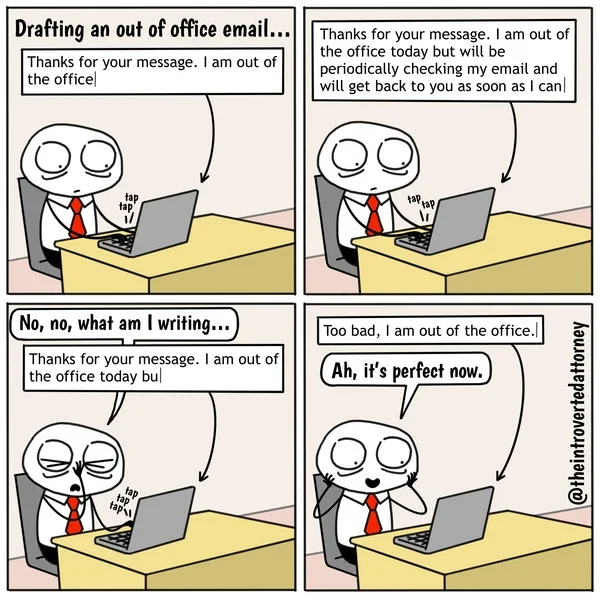
So why on earth am I writing about out of office responders in a blog that’s supposed to be about startups?
Because 25 years later, the etiquette and expectations around email have completely changed and even OOO responses can carry unintended signals in Startupland™.
A few months ago, I wrote about the fact that email read responses have made it impossible to get away with the excuse that, “I totally missed your email” (when I opened it 15 separate times and just didn’t get around to answering it).
Similarly, the frequency with which we check our work email — regardless of time or location — has changed how out of office responses are interpreted. Here are three common mistakes I see founders make with OOO responders:
1. Setting an OOO response and then posting all over social media
These days, most people you email with (including clients, investors and partners) also follow you on one or more social media platforms. If you set an out of office response that says you won’t have access to email and proceed to blow up threads on X or comment profusely on LinkedIn posts, know that your activity is highly likely to show up in their activity feeds.
…and immediately blow your credibility.
2. Setting an OOO response “because I’m visiting San Francisco”
I can’t tell you how many times I meet with a founder who is visiting the Bay Area, send them an email follow-up later that day, and receive an out of office response along the following lines:
“Thank you for your email. I am visiting San Francisco this week for meetings and will be slow to reply.”
I get why people do this — they’re trying to signal to folks back home, “Look at me! I’m in Silicon Valley doing the thing!” but to the residents of Northern California, you look like you can’t walk and chew gum at the same time.
Those meetings you’re having? Founders in SF have the same types of meetings day-in-and-day out (and I promise they aren’t setting autoresponders when they have them). If any of your meetings are with potential investors, sending an out of office response like this is likely to kill any future investment opportunity.
And you’ll never even know it.
3. Setting an OOO response when you’re customer-facing
If you’re doing founder-led sales and hustling to get your first customers, sending them an out of office response is very likely to cause churn.
Why?
Because you just reminded them that their single point of contact is also a single point of failure.
Early adopters have to convince themselves that it’s not really a big deal that the company they’re starting to rely on is actually 3 founders and a dog, selling software held together by duct tape and paper clips. Even in an age when some are envisioning billion dollar companies with only a handful of employees, there’s absolutely no reason for you to remind your customers of that fact.
So when should you use an out of office response?
Some people, like my friend Kirby, believe that early-stage founders should never use an out of office responder:
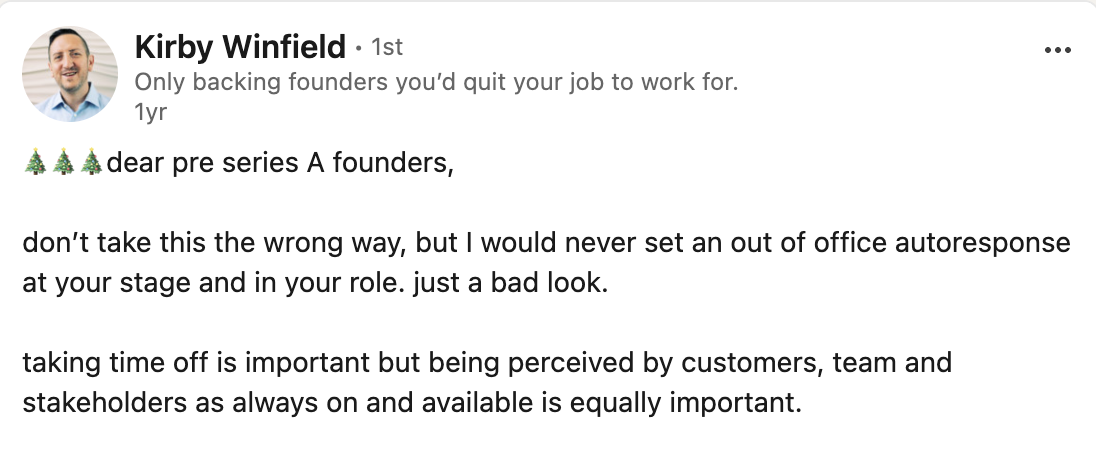
I have a slightly softer take: I generally think that it’s okay to set an out of office responder in two scenarios:
If you will actually be unreachable for an extended period of time (e.g. I set one whenever I go camping in the Canadian wilderness with my kids).
During holiday breaks (I think it’s okay to signal to employees and customers that you’re prioritizing some amount of time off around the holidays, provided that the out of office message includes a way to escalate)
But if there’s any chance whatsoever that you’re going to check your inbox while the OOO responder is set — even just once a day — then you should leave that autoresponder off.
These days, almost everyone in Startupland™ is perpetually online. And whether or not it’s fair, it’s generally in your best interest to be perceived that way as well.
Things I Think I Think - Q3 2026
It’s San Francisco Tech Week! Wait…isn’t that every week? Time for 5 Things I Think I Think: Q3 2026 edition.
It’s San Francisco Tech Week!
…wait, isn’t every week in San Francisco “tech week”? 🤔
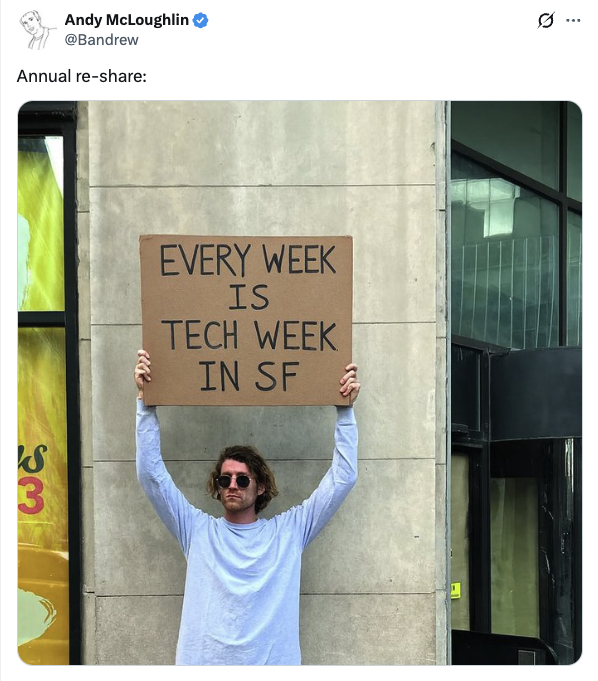
In any case, as we bid farewell to the summer of AI, it’s time for 5 Things I Think I Think - Q3 2026 Edition:
1. The Bifurcation of VC Accelerates
The first half of the year saw a sharp increase in preemptive rounds at Series A and B as later-stage funds pushed to get allocation in hot companies. After petering off towards the end of May, that activity resumed in earnest in mid-August (see: Instinct). But along with it came the continuation of a sluggish fundraising market for the majority of companies — i.e. those that aren’t displaying the “hypergrowth” characteristics of leading AI companies.
Notably, in Q3 we saw the shift in VC behavior that started with Pre-Seed in 2025 and Seed in Q1 progress to Series A, with VCs at that stage trying to figure out their investment strategy in a world of king-making. We’ve also started to see a drop in bridge rounds, with an increasing number of early-stage VCs choosing to pull the plug on companies they previously invested in rather than provide additional funding.
I think Q4 is going to tell us a lot about where the overall VC market is going to land when it comes to the long-term effects of this AI-centric bifurcation, particularly at Seed and Series A. How many funds will chase hot companies, regardless of the cost? How many will stick to an investment thesis based on pre-AI valuations (or at least, slightly inflated valuations with a consistent valuation range)? How many will adopt a hybrid approach? And how many will quietly quit (or be forced to quit after their LPs don’t re-up)?
I’m involved with a number of strong-but-not-hypergrowth companies that are preparing to raise Series A or B rounds in the coming weeks. Each of these companies would have been a no-brainer raise a year ago — and I’m still confident that each of them will drive competitive outcomes — but it will be interesting to see how the market reacts in terms of the level of competition, valuations, etc. for their offerings.
Moreover, I suspect that we’ll see a number of such companies test the fundraising waters in Q4 and quickly hit pause on their process if they don’t get the type of reaction they were expecting (and then reorient around a fundraising effort post-IPO window reopening). Speaking of which…
2. The IPOs are maybe, sort of, possibly coming..?
As I foreshadowed in my Q2 2026 update, Anthropic’s IPO did indeed get pushed back (though not yet all the way through to 2027). The S-1 that the company filed confidentially back in June leaked last week and analysts have been digging into the details. Current signs point towards an early-November IPO, but there is still plenty of time to hit a bump in the road (or three).
While there have been some notable acquisitions in the past few months (shout out to former Panache portfolio company PurposeMed on their acquisition by Grindr last week! 🙌), there is still a massive lack of liquidity in the market. Between SpaceX’s IPO landing with a resounding “meh” and other tech IPOs being pushed back, the impact is now being felt across the board.
What might not be obvious to founders is that, just as there is a significant bifurcation happening with company fundraising, there’s also a similar bifurcation happening when it comes to VCs raising new funds. While a small number of mega funds and high-profile GP spin outs are able to quickly raise new funds, the vast majority of VCs are taking longer than ever to raise new funding — in no small part due to the lack of liquidity in the market. As a specific data point, last week Carta released a report showing that the average time between raising a first and second fund for VCs has spiked to nearly 4 years (compared to a low of just over 2.5 years in 2022). For context, US VCs historically average just under 3 years to raise new funds. If an investment period is 2 - 3 years but it takes 4 years to raise a new fund, that means one full year when the VC isn’t making new investments (or is investing at a drastically slowed pace).
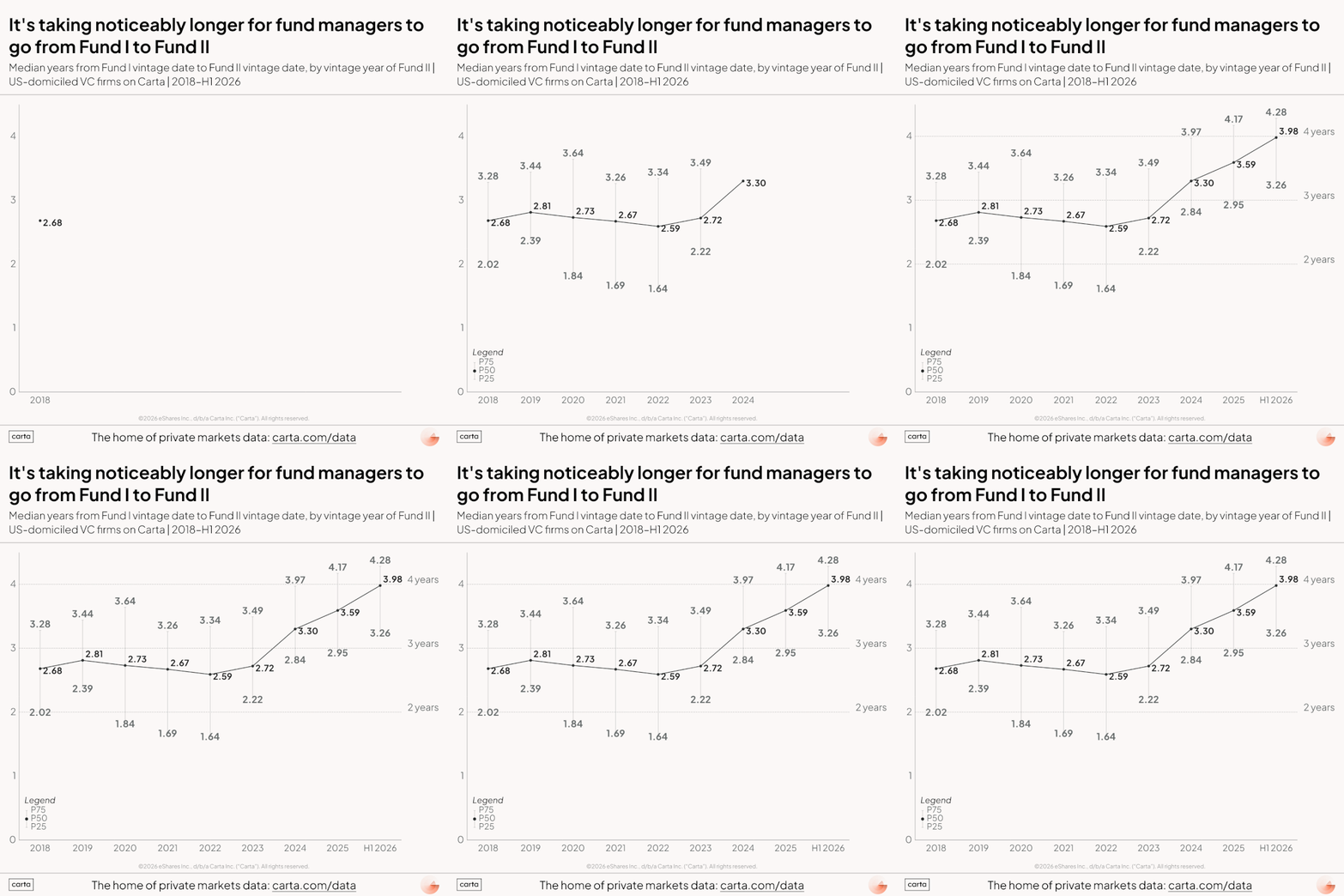
It’s worth noting that the data above is for US-domiciled VC firms. My strong suspicion is that the gap is even greater for funds based outside of the US.
3. Drowning in Agents
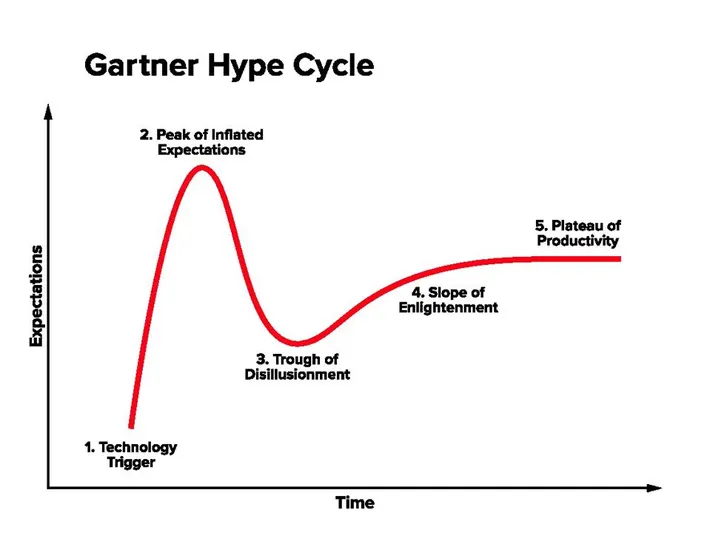
In my last update, I noted that AI agents had finally crossed the chasm. We’ve now blown past the top of the hype cycle and are rocketing towards the trough of disillusionment.
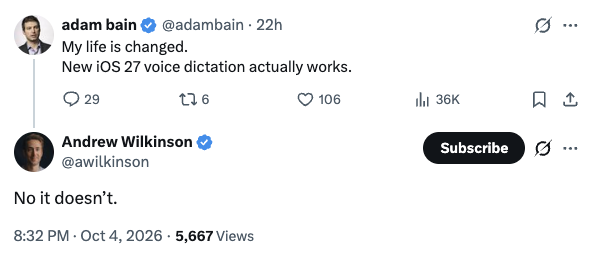
In the past month alone, a < 1 year old viral agent startup raised $1 billion in funding, Facebook (still not gonna call it Meta) released its own agent — that was promptly blocked by the majority of websites — and Apple finally released a version of Siri with dictation that works.
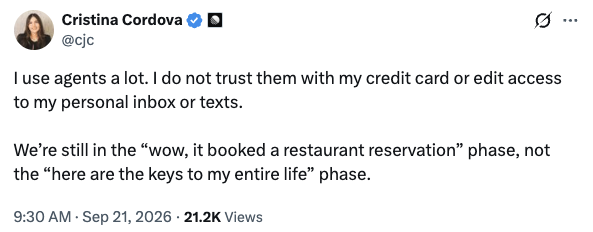
So why do I think we’re about to crash into the trough of disillusionment? Because users are quickly discovering how finicky and limited prepackaged AI agents really are. For as much hype as the technology has, the reality is that there are very few use cases for which agents genuinely and consistently work “out-of-the-box”. Once you get past the initial excitement of “Oh cool! My agent found an invoice for a service I forgot to cancel and saved me $20. Never mind that I would have found myself if I looked…,” there’s not a ton you can actually trust them to do right now without making mistakes.
Which is why, despite cheering loudly each time a funding round takes place, most folks in Silicon Valley use AI agents exclusively for low-value tasks with limited downside.
I’ve personally stopped using agents for most of the use cases I “kicked the tires on” over the past year, simply because they couldn’t be relied on to complete the task correctly. In many cases, I found myself spending more time trying to figure out if the agent actually did what I asked it to than I would have it I had simply done the task myself. With so many edge cases failing and infinitely more on the horizon, it’s becoming clear that the real moat for AI agents is going to be customer support.
I have no doubt that the technology will eventually get there, but in the meantime I expect a lot of very loud public disillusionment as mainstream users step (trip?) into the gap between inflated expectations and reality. In particular, I expect that we’ll soon see a stream of negative stories in the media that will resonate far more with the public at large than the recent spate of AI lab hacking stories has. Once the 6 o’clock news starts running tear-jerkers about how company X’s agent blew through a widow’s retirement savings or a small business owner’s payroll or a young couple’s wedding budget, well…let’s just say there’s not going to be a lot of empathy for the companies behind those agents.
4. Silicon Valley Founders are Speaking Another Language
A few weeks ago, I wrote a post suggesting that founders based outside of the San Francisco Bay Area should spend a few weeks in San Francisco “getting acclimated” before starting a fundraising process.
The extent to which the current generation of Silicon Valley founders really are speaking a different language was driven home to me last week, when I caught up with a founder whom I’ve known for nearly 20 years (starting back when I hired him at Aster Data in 2007). This particular individual has since founded and exited multiple VC-backed companies, raised funding from the some of leading Silicon Valley VC firms and, by all accounts, should be able to dictate the terms for any new endeavor as he sees fit. Yet when he talked to me about his latest concept, I couldn’t help but immediately think, “this guy is out-of-touch”.
We’ve since had multiple conversations on topic (which I plan to eventually synthesize in a dedicated post), but for now I’ll highlight a few things that have become clear to me:
Today’s most competitive founders are focused on opportunities measured in the tens of billions or even trillions of dollars.
They spend little-to-no-time anchoring their pitch around the traditional contrast of “this is the world today / this is the world tomorrow” and instead jump right ahead to “this is what the world is going to look like when AI is prevalent…and here is what’s going to break”.
Virtually no one spends time on the traditional market sizing exercise of TAM / SAM / SOM (it’s either, “this is a ridiculously massive opportunity that’s blatantly obvious to everyone” or crickets).
The traditional timeline of, “in 18 months we will achieve incremental milestone X,” now screams, “we’re going too slow!” for many categories of startups. Instead. the most ambitious pitches revolve around previously impossible timelines built around multiple rounds of funding per year. Yet they do so in a way that seems believable / achievable.
For founders looking to raise funding, it’s hard to understate how jarring the contrast is for VCs between a founder who credibly pitches a startup that can go from zero to massive in 2-3 years and one who projects needing multiple rounds of funding to get to PMF.
…for an app.
My best advice at this point for founders preparing to fundraise is to go through the following intellectual exercise: assume that the people who pitched a given VC before and after you both pitched hypergrowth startups that could credibly go to $1 billion in revenue in 3 years. How do you present what you’re doing in a way that gets them excited, even if it’s not on that trajectory?
If you can’t do that, then maybe VC isn’t right for you (even if it would have been two years ago).
5. Sometime in 2027, the Music Will Stop
A few weeks ago, Venky Ganesan of Menlo Partners wrote an exceptional post on the current state of venture capital that I strongly encourage you to read. Venky shared that, “…right now is the most disorienting period in venture capital I can remember, and I have been doing this for a while.” His post concluded with the following observation:
“The music will stop. It always does. Dance if you must, but know where the chairs are.”
As I alluded to earlier, I think that by the time 2026 comes to a close, we’ll have a much better sense of how early-stage VCs (i.e. VCs that invest in Pre-Seed / Seed / Series A companies) plan to adjust to the emergence of AI. Going into next year, we’ll have far more clarity on which funds are willing to invest in companies on “traditional” trajectories vs. those who are exclusively looking for hypergrowth AI startups. We’ll also likely see the emergence of a number of new funds explicitly targeting non-hypergrowth companies.
Moreover, at some point next year, the AI music will stop. One or more high-flying AI startups will crash to the ground, and with it the seemingly endless game of one-upmanship that many of the megafunds have been playing. That’s not to say that the AI bubble will burst (a number of these companies will turn out to be credible long-term businesses), but at this point it’s clear that a meaningful number of companies have raised funding at valuations that they can’t possibly ever grow into, even if the best king-making assumptions come to pass.
It’s too soon to know exactly what the fallout of this will be, but for founders building companies that are delivering real value to customers (and, in doing so, generating real revenue), staying focused through next summer will be essential.
Because there’s going to be a lot of noise.
Now Is Not the Time to Increase Your Burn Rate
I can’t think of a time in my career when capital has flowed this actively yet so little of it has seemingly gone towards extending runway.
Lately, it seems like not a day goes by without an announcement of a gigantic round of funding or another unprecedented acquisition. In fact, these announcements have become so frequent that it can feel like capital is virtually unlimited.
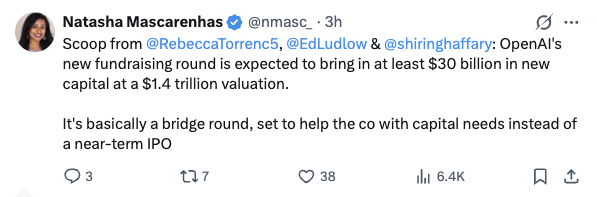
But it’s a dangerous time for many founders.
When it seems like investor capital is virtually unlimited is exactly when we make decisions that we wouldn’t otherwise make (especially if we knew that there was no more capital available). And right now a lot of founders are making such decisions, only to find out that the well has run dry.
Last week, I wrote about the bifurcation in VC behavior happening at Series A. That shift followed similar bifurcations at the Seed stage earlier in the year and at Pre-Seed in 2025. In all three cases, the behavior that investors converged on was the same: a small number of hot, fast-growing companies now draw the vast majority of investor interest, while other startups (including many that would have been seen as compelling only a few years ago) struggle to raise.
What hasn’t been written about is the impact this behavior is having on extensions and bridge rounds. And it’s not good.
Historically, most VCs who lead early-stage rounds allocate an additional amount of capital as part of their fund thesis to “bridge” a subset of their portfolio companies. These are companies that, for whatever reason, weren’t able to hit the milestones necessary to raise their next round of funding but made enough progress that their existing VCs still have confidence in them (and believe that with additional capital, they will be able to hit those milestones).
Anecdotally, it seems like fewer of those rounds are happening right now. In an era when fast-growing companies are becoming the norm, many Pre-Seed and Seed VCs seem less willing to bridge companies that aren’t hitting their milestones. In fact, many seem far more likely to cut their losses early and redirect capital they had previously earmarked for bridge rounds to other companies in their portfolio or net new investments.

The rate at which VCs invest in bridge rounds naturally ebbs and flows, but I can’t think of a time in my career when capital has flowed this actively yet so little of it has seemingly gone towards extending runway. What makes it even more dangerous for founders is how easy it is to misread the reality of our current situation.
Over the past few months, I’ve been aware of an unusually large number of startups who “misread the situation” in a very particular way:
Each one sharply increased their burn rates in order to “go faster”
They indeed accelerated, but didn’t have enough runway to hit the milestones that their investors identified as necessary to raise the next round of capital
The founders were surprised to find that those same investors were unwilling to commit more capital to extend their runway
In fact, I know of three companies this week that were told by their lead VCs that no more funding was forthcoming after the founders dramatically increased their burn rate and ran out of runway.
While it might seem easy to dismiss these as the actions of naive or egotistical founders (or, conversely, blame the VCs for encouraging them to go faster), the reality is far more subtle. In each case, the founders looked at what has been going on in the market and — regardless of what their investors told them — reached the conclusion that there would be more capital available so long as their velocity increased sufficiently.
That’s not an irrational read of the market at a macro level. But it is definitely a misread of the founder-investor dynamics at a micro level.
When the market collapsed at the end of ZIRP in 2022, I wrote a post encouraging founders to check with their VCs if they still loved them (i.e. would their investors be willing to invest more capital into the company if they didn’t hit their milestones?). I started that post by writing:
“When times are good and term sheets are flowing, founders don’t think a lot about whether or not their investors will follow-on in the future. But in times like these, when the pace of deals is slowing, it’s essential that founders know where they stand with their investors. And most don’t have a clue.”
The current venture capital market is unprecedented in that it can seem like there is infinite capital available for startups, when the reality is far closer to a slow-moving bear market than a fast-moving bull market for the majority of them.
To be clear: it is unequivocally a CEO’s prerogative to increase, decrease or adjust their spend as they see fit (investors are, generally speaking, not your boss). However, if your VCs tell you that if you don’t hit a particular milestone, it’s going to be a challenge to raise additional funding, you should assume that perspective applies to bridge funding too.
So be warned. Now is not the time to unilaterally increase your burn rate. Check in with your investors to see how they feel about any unplanned spend or change in strategy. Most investors will be upfront about the conditions under which they will / will not invest additional capital. You just need to ask them.
And believe them when they tell you.
What’s Going On with Series A?
What’s happening in Series A right now is the natural evolution of the AI-driven shift that started at Pre-Seed in early 2025 and flowed through the Seed stage beginning in Q4.
Venture capital is an industry in which certain changes take time to propagate. From the outside, it can seem as though VCs are a single, fast-moving herd, collectively spinning on a dime the moment they sense a change in the air. But in reality, it’s more like a high school cafeteria: the 9th graders are all in one corner, the 10th graders in another, and so on. Each group has their set of beliefs about what is “cool” at the moment. And while they’ll occasionally co-mingle and take cues from one another, for the most part they stick to themselves.
Unlike in high school, where younger students frequently take cues from the upperclassmen (but never the other way around), changes in venture capital can flow in either direction. Sometimes a shift will flow “upstream”, from later stages to early stages. For example, something might happen to IPOs that first impacts growth stage investors, which in turn has an effect on Series B VCs, and eventually flows all the way “up” to the early-stages. Other times, we see changes flow “downstream”: a shift in behavior at Pre-Seed might impact the Seed stage a year, then Series A a few quarters after that, and so on.
It’s like dominos falling in slow motion.
And right now we’re witnessing the Series A domino slowly start to fall on a downstream shift that started at Pre-Seed early last year.

Back in June 2025, I wrote about changes that were happening in Pre-Seed fundraising as the result of an emerging bifurcation of venture capital. I wrote at the time:
“…what we’re witnessing today in the early-stage market is both a realignment of the investment strategies of many early-stage VCs and a fundamental shift in how the best founders raise capital.
…fewer rounds are happening, but those that do are oversubscribed, resulting in higher valuations.”
Nine months later, I published a similar post titled, What’s Going On with Seed Rounds? Seed VCs typically make investment decisions by evaluating a company’s early traction against its stated market hypothesis. But at the start of this year, many Seed VCs were struggling to figure out what to do:
“AI is changing so many things at such a high velocity that many Seed VCs are struggling with how to evaluate startups when they no longer have conviction that the market hypothesis will hold over their 7-10 year investment horizon.
“[As a result,] capital is concentrating at the Seed stage…fewer deals are happening with larger average deal sizes [as] Seed VCs increasingly acting like Pre-Seed VCs when it comes to their investment decisions.”
As if to put an exclamation mark on that point, valuations for the top 5% of Seed rounds went stratospheric in Q4 of 2025 and the first two quarters of 2026 (though we saw a slight downshift in late-May as summer came early to Startupland™). Six months after my post on Seed rounds, we’re now starting to see the impact of last year’s bifurcation of venture capital hit the Series A market.
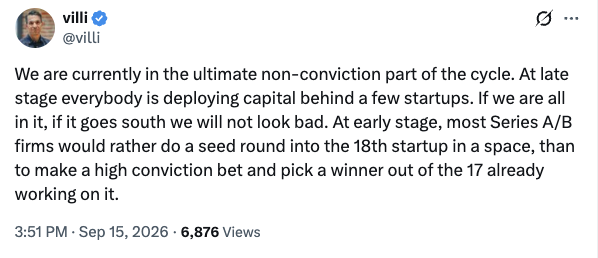
What’s happening in Series A right now is the natural progression of the downstream AI-driven shift that started at Pre-Seed in early 2025 and flowed through the Seed stage beginning in Q4.
Series A VCs have now encountered enough startups graduating from Seed to Series A on AI-driven “super-trajectories” that they’re being forced to re-evaluate their investment theses. Do they exclusively chase these extreme outliers, regardless of valuation? Do they maintain their price discipline, even if it means missing out on generational companies? Or do they take a different approach?
Chris McCann of Race Capital recently posited that, “Series A is not just harder, it has become discontinuous.” He wrote:
“Five years ago, $1M in ARR often gave a software company a credible path toward a Series A. Then the bar moved to $2M. Then $3M, $5M, and $7M. Today I see companies at a $10M run rate, with real customers and multi-year contracts, and it still is not enough.
…Downstream investors have changed their first question. It used to be: Is this a strong company at the right price? Now it is: Could this company become an extreme outlier? If yes, Series A investors will underwrite a startup with almost no revenue and fight to get into the round. If not, cutting the price often does not create demand. A genuinely good company can end up with very few, if any, viable institutional bids.
…Capital hasn't disappeared, but it’s concentrating around a smaller set of perceived breakouts. Series A used to behave more like a curve, where strong companies could find a price, now it is becoming binary.”
Chris’ last point is an important one. What’s happening at Series A right now is not a repeat of the Series A freeze of 2023, when virtually all Series A activity stopped post-ZIRP. Rather, Series A VCs are actively fighting to invest in a small number of companies they perceive to be extreme outliers while drastically slowing all other activity as they re-evaluate their long-term approach to investing (much like what happened at the Seed stage earlier in the year).
Some of this behavior, as Chris alluded to, is being influenced by what Series A VCs are encountering downstream from them. Rick Zullo of Equal Ventures shared the following anecdote a few weeks ago:
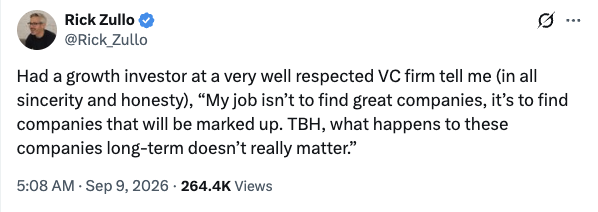
That may seem like a shocking statement to make, given that VCs generally don’t make money unless an exit occurs (management fees notwithstanding). But at this moment in time most VCs are far more concerned about whether or not they will be able to raise their next fund than they are long-term financial results. So many of them are unapologetically chasing logos (much like early-stage startups do before fundraising 😉).
Venky Ganesan of Menlo Partners described this behavior in more detail in an exceptional post on the current state of venture capital that I strongly encourage you to read. Venky observed that, “…right now is the most disorienting period in venture capital I can remember, and I have been doing this for a while.” He went on to share that,
“As far as I can tell, there are two groups on the dance floor.
The first group got in early. Firms like ours were in some of these AI companies before the numbers got silly, and the paper gains are enormous. When you are sitting on gains like that, you start to feel like you're playing with house money. I have been around long enough to know that house money is the most dangerous kind, because you don't respect it the way you respect money you had to earn.
The second group missed the early rounds and knows it. Their LPs know it too. So they are trying to make up for lost time by writing very large checks very late, which is the one strategy almost guaranteed to turn a missed opportunity into a real loss.
House money on one side, FOMO on the other, and reflexivity feeding both. That's the whole story. Everyone has a reason to keep dancing, and the reasons are different, which is why nobody can talk anyone else off the floor.”
So what does all of this mean for founders trying to raise a Series A?
For starters, unless you are showing clear signs of being an extreme outlier or are well north of $5M ARR, I would encourage you to plan as though you won’t be able to raise a Series A (at least, not for a few quarters). While a small number of Series A VCs have already adjusted their investment theses to lean into companies with “traditional” Series A traction, the vast majority are currently focused on hunting extreme outliers. By all means go out and test the waters (I always believe you should do that regardless of the what anyone tells you), but now is definitely not the time to spend 3 - 6 months fundraising.
Instead, figure out what the plan is if there isn’t Series A funding around the corner. Start off by having “the talk” with your existing investors and figuring out if they are willing and able to provide additional funding. Research alternative sources of funding that might exist. And, of course, figure out a clear path to profitability.
I suspect that in 12 to 18 months we’ll begin to see more options at Series A for great companies that aren’t AI-driven super-outliers, but right now the cold, hard truth is that a lot of great companies are learning the hard way that there isn’t a market for them at Series A (at any price).
The Real AI Moat? Customer Support
The hardest challenge facing AI startups as they scale isn’t technical, it’s technical support.
At the beginning of the year, AI adoption started to go exponential (at least, within the consumer / prosumer segment). Opus 4.5 came out and caused developers everywhere to stop, collaborate and listen. Then Clawdbot Moltbot OpenClaw delivered the world’s first AI agent “kit”. In the months since, countless teams have worked to develop (or pivot to) personal agents.
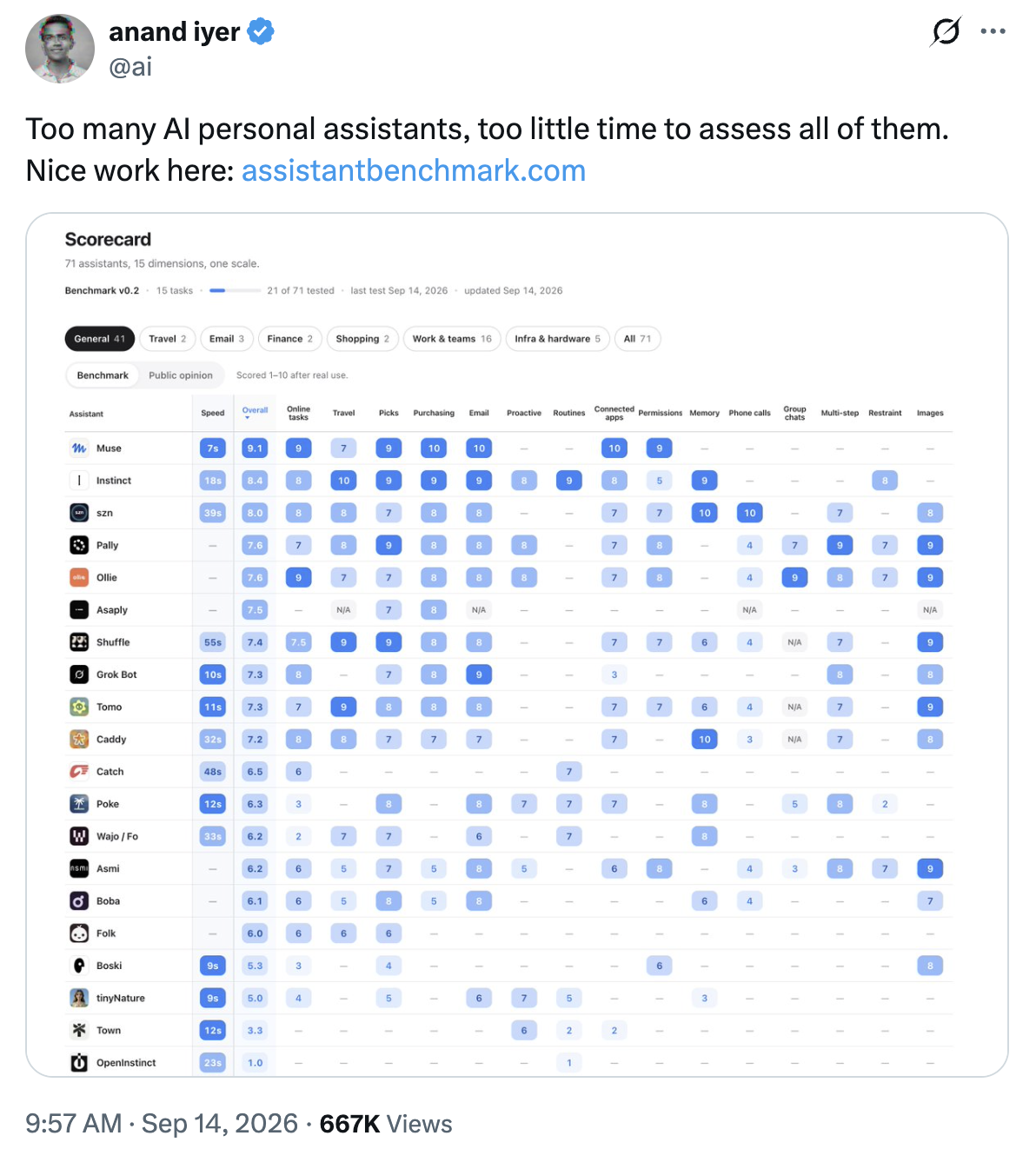
I’ve used a number of these agents to varying degrees over the course of the year and have come to two conclusions:
None of them are capable of doing everything I want them to do out-of-the-box (at least, not yet)
The hardest challenge facing these companies as they scale isn’t technical, it’s technical support
From a user/customer standpoint, the biggest difference between a framework that can be customized, like OpenClaw or Hermes, and an out-of-the-box solution is who is responsible when something doesn’t work. If I use an open source solution and it fails to do what I want, then it’s up to me to figure out how to fix it. But if you’re selling me a black box and promising that it can do all the things..?
Here’s a pattern that I’ve seen happen numerous times over the past year with personal agent startups:
Startup releases beta version of their new personal agent. The team slowly onboards a small number of users and actively solicits feedback. Everyone is extremely responsive as things inevitably break and fall down.
Agent gets released publicly. More users get onboarded. More things break. The team is still mostly responsive, but those responses take longer to get.
User growth goes parabolic as the new agent goes viral. Almost all effort goes towards keeping the platform up. Lots more things break. Lots more tickets get filed. And the team can’t keep up.

Cricket’s the name. Jiminy Cricket.
As a former founder, I’m incredibly empathetic to this plight.
In the early stages, it’s very likely you don’t have anyone dedicated full-time to technical support. It’s almost always the engineers and cofounders pulling double-duty to respond to customer complaints and feature requests (perhaps with the help of some triaging agents). For traditional startups, this approach usually works. But that’s because the surface area of “things that can go wrong” is relatively focused.
AI products are a different beast. For starters, their general-purpose nature dramatically increases the number of things that can go wrong (instead of naturally clustering around a handful of features, as is the case with traditional software).

That’s hard enough. But when you layer in the potential to quickly scale users, a fire hydrant of feedback is almost inevitable.
As an aside, a unfortunately large segment of Startupland™’s has been gaslit into believing that customer support should be a low priority.
This goes all the way back to the days when Google first launched Gmail in “beta” and basically put a sign on the front door telling users, “if something goes wrong, it’s not our problem.” Coming out of Covid, we saw many Web3 founders do the same thing: spin up a discord server, drop in once a week to check things out and call it a day. (What do you mean we need documentation? We wrote a white paper! 🤦♂️)
In markets that are highly-competitive — like almost every AI-related market currently emerging — that’s simply not going to be good enough. Especially when switching costs are almost non-existent.
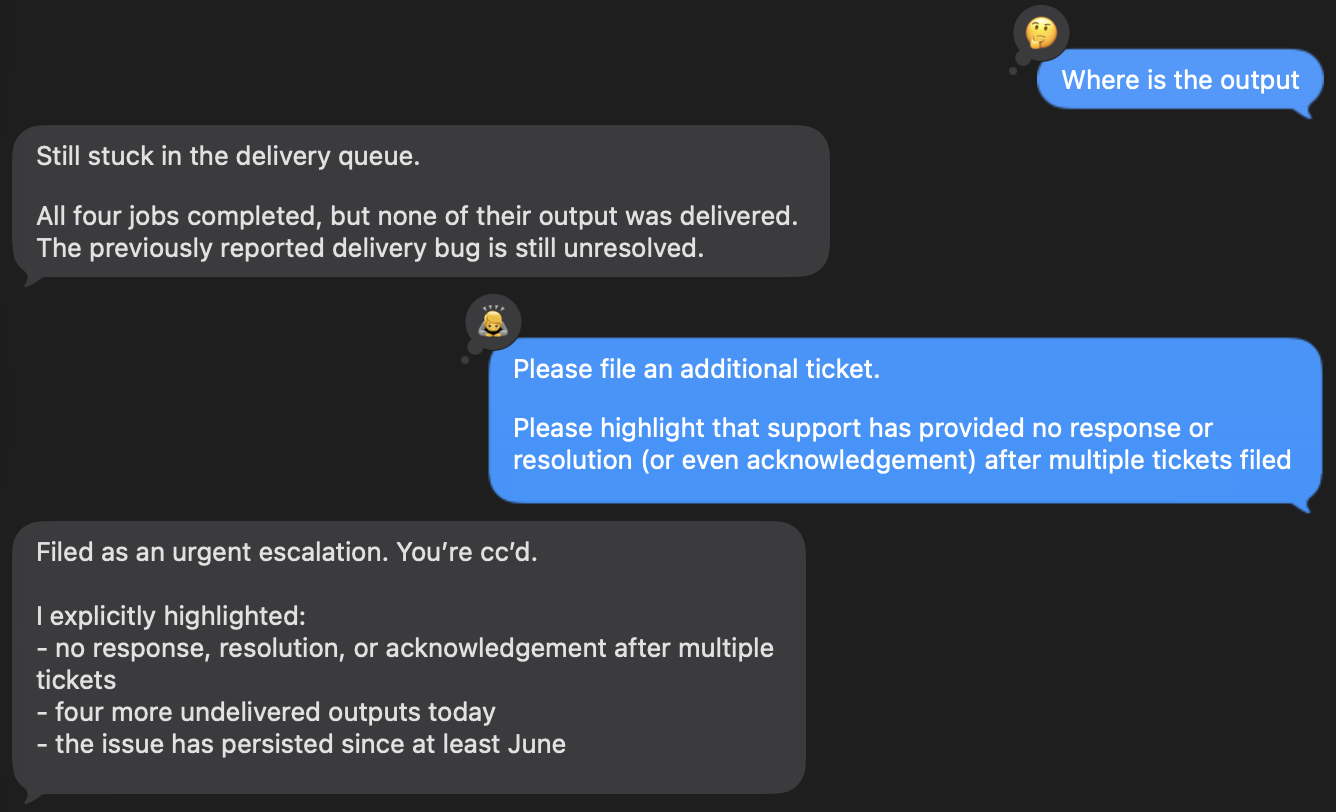
The solution? Prioritize customer support early.
In the early days, your customer funnel is guaranteed to be leaky. Simple yet effective communication goes a long way when it comes to building good will from early adopters. Which in turn results in those early adopters giving you more time and leeway to address their concerns.
But one-on-one customer support doesn’t scale (especially not if you go viral!), so you need to prepare. Here’s how to do that:
Make sure you have a customer-facing ticketing solution before you launch. It could be a traditional third-party solution or something home grown and integrated with your product. But there has to be a way for customers to check on the status of a ticket they previously filed.
When customers (or their agents) file a new ticket, make sure that receipt of the ticket is immediately acknowledged and comes with instructions on how to track it.
Provide status updates. This is the obviously the hard part if user growth is skyrocketing and you can’t keep up, but finding a way to let customers know that you haven’t forgotten about them is crucial. Even if those updates are automated and mostly mea culpas (“we’re trying our best!”).
Be honest when setting expectations. If you know that you won’t be able to get to a particular fix or feature for awhile, let customers know. If you have to back out a new feature because it broke in too many places, that’s okay too.
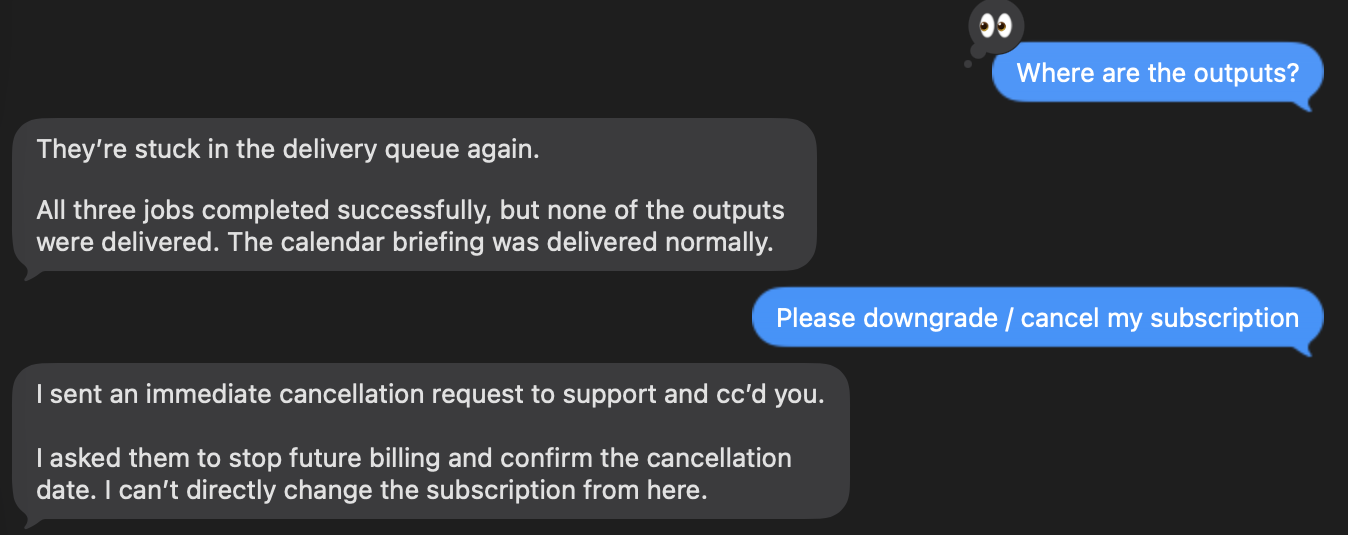
The most important thing is to make your customers feel heard. If they keep filing tickets without getting a response, your early adopters will feel like they’re screaming into an abyss. And when they do…
Lessons from 250 Blog Posts
I never thought I’d actually write for this long, so I thought I would take some time this week to reflect on it. Here are some of the lessons I learned from writing 250 blog posts.
This week marks a momentous milestone (for me, at least): this is the 250th post that I’ve written on chrisneumann.com.
I never thought I’d actually write for this long, so I thought I would take some time this week to reflect on it. How has my content evolved over the past four and a half years? Does it still resonate with readers? And where should I go next? (If you’re currently reading this on the website, you may have noticed a new look — I’ll dive into the rationale for that shortly.)
Here are some of the lessons I learned after 250 blog posts.
The Backstory
When I moved to Canada in late-2020 to join Panache Ventures, I noticed that there was a lack of entrepreneurial content available for founders there. I had spent the better part of the 5 years prior teaching founders around the world strategies and best practices used by leading Silicon Valley startups (first at 500 Startups and, later, through Commonwealth Ventures). So I thought I’d write about some of them.
But there was one problem.
Over the years, I had written a handful of blog posts, but I could never figure out how to publish content on a consistent schedule. I knew it was possible to write with a weekly cadence (after all, I wrote weekly investor updates for nearly five years at DataHero), but I had never done so with creative or longer-form content.
I mentioned this dilemma in passing to one of my mentors, Marvin Liao, who told me about a course he had recently taken called Write of Passage. The program was the brainchild of an exceptional young writer named David Perell. Despite its name, Write of Passage wasn’t actually a course about writing. At least, not in the strictest sense. Rather, it was a bootcamp designed to teach you how to build systems and processes to support writing and publishing new content on a regular basis (like weekly blog posts). It was exactly what I needed.
It turned out, I wasn’t the only one. The participants in my cohort included many residents of Startupland™, like founders and VCs. But there were also professional athletes, academics and a wide variety of other writers and aspiring writers.
How It Started
Write of Passage was one of those programs that unapologetically threw you in the deep end from the start. The very first session kicked off with a firm dictum from David: in order to stay in the program, you had to publish your first post within one week.
The prompt: “What is the definitive answer to the question that people ask you most often?”
At the time, it had been about six months since news of my joining Panache and moving to Vancouver was announced. In subsequent calls and coffee chats I was repeatedly being asked the same question:
“Why did you come back to Canada?”
On April 13th, 2022, I published the answer to that question and launched this website.

How It’s Going
It’s now been 229 weeks since that first post (for those of you wondering how I reached 250 posts in only 229 weeks, there were several periods of time when I published multiple posts each week — such as during my brief side quest into food blogging.) Over the past 4 ½ years, readership of both my website and the corresponding newsletter have steadily grown (thank you all for that 🙏).
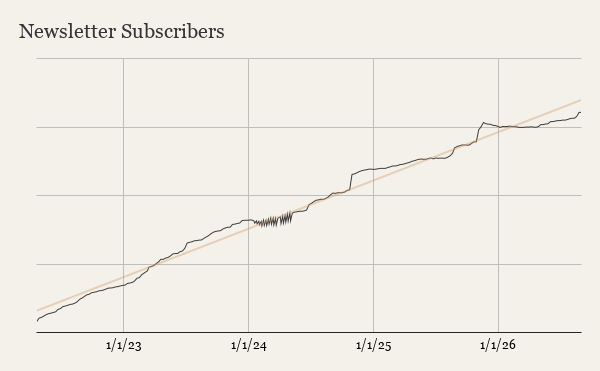
I have no idea what happened in early 2024…
But it hasn’t all been “up-and-to-the-right.”
While website traffic and newsletter subscribers have steadily grown, open rates for the newsletter have slightly declined over the years.
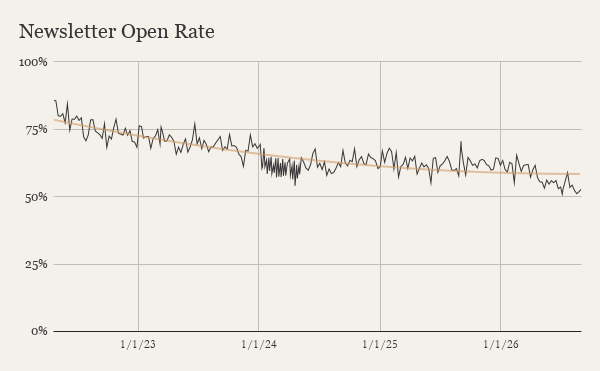
The open rate for my newsletter has held steady around 60% for the past two years (a rate that is generally considered pretty solid, though with AI preview and summary tools becoming so prevalent, it’s increasingly hard to tell). That said, I still wanted to dig into the performance data for both the website and the newsletter.
First, a few thoughts on open rates:
Year 1 open rates aren’t meaningful in any way. The early subscriber numbers were so low (and so heavily skewed to people who already knew me personally), that they were unnaturally high.
A better metric for overall relevance is unsubscribe rate. With agents making it easier-than-ever to ditch newsletters we don’t read anymore, are people still keeping me in their inbox? It turns out the answer is yes (the 90-day rolling unsubscribe rate for my newsletter is ~0.1%, which is considered very strong — thank you again 🙏)
That said, despite a steady open rate and strong retention, there has unequivocally been more inconsistency in content performance over the past few years. So I started to look at what I’ve been posting and how that’s changed:
The content I posted in Years 1 and 2 was overwhelmingly instructional/educational in nature (fundraising best practices, posts about how venture capital worked, etc.). In fact, more than 70% of the first 120 posts I wrote either taught the reader how to do something or explained how something worked.
In year 3, I started writing more posts about startup trends, observations about different ecosystems and topics related to mental and physical health. Last year (2025), only 37% of the posts I wrote were instructional/educational in nature.
The last 2 years have also seen an (understandable) uptick in posts related to AI.
Many of the posts I wrote in years 1 - 3 had an overtly Canadian slant to them. That was very much a by-product of my role as a GP at a Canadian-focused Pre-Seed fund. Since leaving Panache at the end of 2024 to focus on [Redacted], most of the posts that I’ve published were written independent of geography (though I’ve still made a point of writing about trends in the Canadian ecosystem as part of my quarterly 5 Things I Think I Think posts).
What Comes Next
The biggest epiphany going through 250 posts’ worth of data was the degree to which the type of content I’ve published has evolved over the years. The first few years were overwhelmingly educational/instructional in nature because I had a massive backlog of topics that I wanted to write about. Now that I’ve written about most of those, my posts are more focused on trends and observations.
But I’m not done yet.
For starters, it became abundantly clear as I went through Google Analytics data and spoke with founders that a significant portion of my older content had become difficult to find or access. That’s where this redesign comes in. In addition to a cleaner, more streamlined design, there’s a new Topics page that more effectively organizes all of my posts (driven by a complete refactoring of post tags).
I’m also working on a further refactoring related to AEO/SEO/GEO. But I’ll save details of that for a future post.
In the meantime, as I look ahead to (hopefully) another 250 posts on chrisneumann.com, expect more insights, more data and more in-depth posts to help founders, investors and ecosystem supporters around the world make sense of Silicon Valley and beyond.
Thanks for reading 🙏.
Before You Start Fundraising, You Need to Get Acclimated
Founders trying to raise Seed or Series A funding from Silicon Valley VCs need to change their approach now.
Last week, I met with 4 different startups based outside of California: one from New York, another in London, a third in Vancouver and the fourth from Toronto. All of these startups are preparing to fundraise in the fall (either for their Seed or Series A round). At some point in each of those conversations, I found myself giving the founders a piece of advice that I hadn’t previously offered with any regularity:
“You should go to San Francisco a few weeks before you start to fundraise. You need to get acclimated.”
It wasn’t all that long ago that the majority of fundraising — even at later stages — was being done mostly online. For founders based outside of the U.S., raising from Silicon Valley VCs took a bit of extra prep work, but for the most part it didn’t matter if you were based in Brisbane, California or Brisbane, Australia. As recently as Q1, most Seed and Series A fundraising processes still began with virtual intro calls.
But over the past few quarters, things have shifted dramatically. Silicon Valley has been speeding up. A lot.

The first half of the year saw valuations for the top 5% of Seed rounds hit unprecedented highs, driven primarily by a surge in preemptive fundraising rounds. At the same time, the culture in Silicon Valley has been evolving to reflect its shift in velocity and intensity, manifesting in ways both big and small.
I hadn’t internalized just how prevalent these changes have been until I was on those calls last week. As I spoke with each of the founders, I found myself subconsciously (and not-so-subconsciously) noticing a variety of tells that made clear that they were not based in the Bay Area. An observation that my mind immediately translated to, “they’re not going fast enough.”

Considering that 2 of the 4 founding teams had previously spent considerable time in Silicon Valley, I was shocked at just how apparent it was to me that they were no longer locals. Some of it was language — there are a lot of new phrases that have entered the San Francisco lexicon as of late (the tongue-in-cheek website SF-isms catalogues some of them). But mostly it was their sense of urgency.
Or lack thereof.
I want to be clear that I’m not suggesting that any of these four startups aren’t operating at a high velocity — they all are — but Silicon Valley founders have upped their intensity and velocity to such a degree that everyone else seems slow by comparison. And in fundraising, just as in life, perception is reality.
Velocity has always been the metric that matters most when it comes to early-stage startups. And in today’s AI-driven landscape, Silicon Valley VCs are paying more attention than ever to how fast startups are going. Fundraising calls are happening in hours instead of days. Meetings are scheduled over text messages instead of through Calendly links. Everything in the ecosystem is happening faster.
Which brings us back to my fundraising advice.
It used to be relatively easy to prepare out-of-town founders for Silicon Valley fundraising by pointing them to a few key phrases, a list of what was “hot or not” in San Francisco at the time and a rubric of what Bay Area VCs would focus on for their stage. But it’s not so simple anymore. Right now many Seed and Series A VCs are struggling to adapt to the changing landscape, so there is no single list of what these investors are looking for to point at. Moreover, Silicon Valley itself is still accelerating.
Which makes it challenging to enumerate exactly what out-of-town founders should do in order to best prepare to pitch Silicon Valley VCs at this particular moment in time.
So I will instead share the advice I gave to each of the four founders I spoke to last week:
As you prepare your pitch for Silicon Valley VCs, reduce your level of confidence in feedback from hometown founders and investors (unless they have spent considerable time in the Bay Area recently and/or successfully fundraised from Silicon Valley VCs this year). In all likelihood, their advice is outdated.
Counterbalance this by proactively seeking feedback from founders, investors and others with strong current ties to Silicon Valley.
If at all possible, spend 2 - 3 weeks in San Francisco immediately prior to kicking off your fundraise. Doing so will:
Give you enough time to adjust and acclimate to the “new” pace and culture of Silicon Valley
Allow you to tap into the serendipity of Silicon Valley by attending events and meeting other founders
Provide an opportunity for you to solicit feedback on your pitch and fundraising strategy from Silicon Valley-based founders and investors
Expect to do most of your fundraising in person this time around
For founders outside of California who are trying to raise a Seed or Series A round from Silicon Valley VCs this year, I think this is likely to be the best approach given (a) the currently evolving nature of Silicon Valley, and (b) the widening gap in velocity/intensity/urgency between Silicon Valley and the rest of the world.
Note: the above advice is specifically geared towards founders trying to raise Seed or Series A rounds from Silicon Valley VCs. While Pre-Seed founders can certainly benefit from spending time in Silicon Valley, the vast majority of Pre-Seed rounds globally continue to be raised from local investors, so it may not impact your success rate when it comes to fundraising.
Building in Public: Founders Day Edition
Over the past year, we rebuilt Founders Day from the ground up, added a bunch of new features and unleashed version 3.0 to the world. How did it go?
Last week, I hosted the third annual Founders Day in Vancouver, BC.
Like the origin stories from many a startup, Founders Day was something of an accidental creation. It was originally born out of casual conversations and was intended to be a one-off event (before Web Summit moved to Vancouver the following year). Put simply, it was an experiment.
But as Eric Ries once famously wrote, “an experiment is more than just a theoretical inquiry; it is also a first product.”
Not only did the local ecosystem embrace the experiment that was Founders Day, by year two it had become abundantly clear that we had tapped in to a deep unmet need amongst founders in Western Canada.
Coming into year three, it was time to start evolving Founders Day into something sustainable.
The Evolution of an Event
The first two Founders Days were prototypes in the truest sense. They were giant meetups built atop a base of duct tape, paperclips and a lot of behind-the-scenes scrambling (if you arrived early enough last year to see Google, Fasken and RBCx employees madly stuffing badges into plastic name tag holders, you know what I’m talking about). The events looked fancy by virtue of being held at the Vancouver Convention Centre, but they were very much delivered in the model of Paul Graham’s famous essay, Do Things that Don’t Scale.

Nice place for a tech meetup, eh?
By the time we kicked off the planning cycle for Founders Day 2026 towards the end of last year, I had zeroed in on three distinct areas in which I wanted to evolve Founders Day:
1. The Venue
For as stunning as the Vancouver Convention Centre is, it’s very much designed for large-scale conferences and poses challenges for hosts of smaller events. For example, the first two Founders Days had no on-site lunch offerings and we had to host the networking portion of the day at a separate venue 15 minutes away (both of which led to a lot of attrition throughout the day).
This year, I wanted to find a venue where we could deliver a more holistic, continuous experience to attendees. I also wanted to see if we could take better advantage of Vancouver’s exceptional August weather.
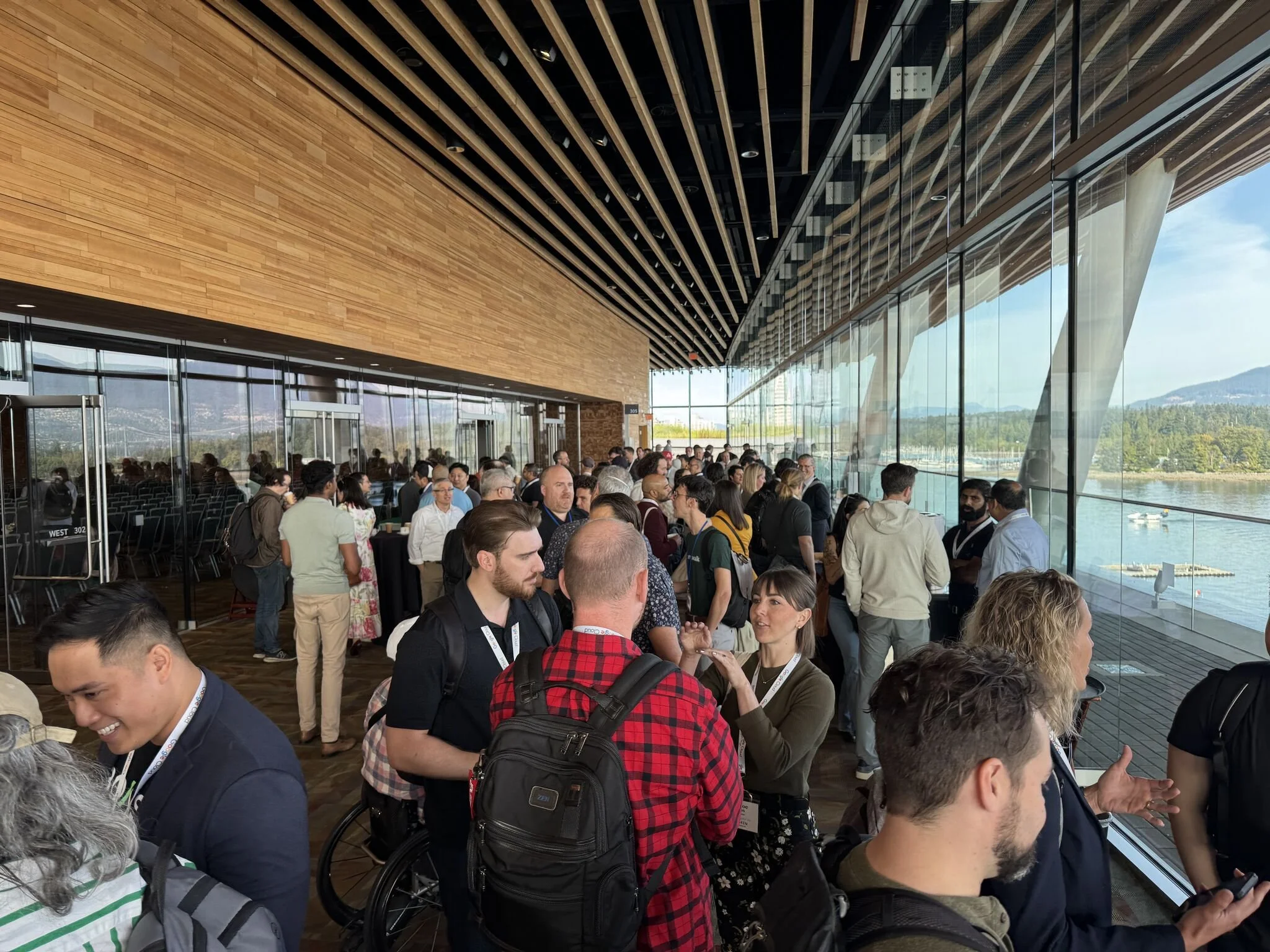
Look how sunny it is outside…
2. Delivery
Like any good early-stage startup, the first two Founders Days were a success in large part because of the shared willingness of everyone involved to roll up their sleeves and “get it done”. Sponsors showed up at 6:00 am to stuff badges into plastic name tags. Lawyers and bankers scanned attendees at registration and handed out lanyards. Speakers ran around trying to find their fellow panelists and ensure that everyone got on stage at the right time.
That’s fun and exhilarating once or twice, but it’s not sustainable. Especially not when the novelty wears off and the hiccups become more glaring to attendees.
Coming into this year, a big focus was on progressing from the inconsistency and unpredictability of a large, volunteer-driven meetup towards something more intentional and well-executed.
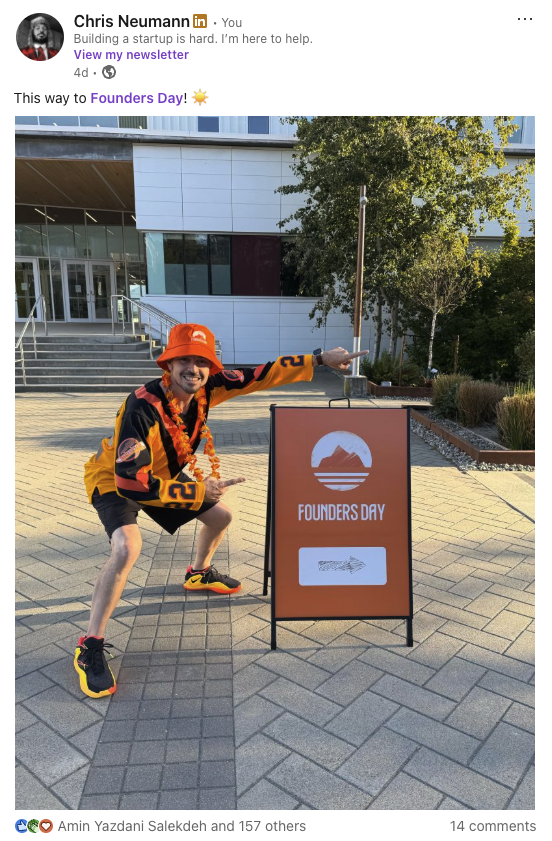
Look! An actual sign with an arrow →
3. Finances
Of course, added infrastructure comes with added costs. To-date, Founders Day has been entirely subsidized by corporate and government sponsors and myself. In order for Founders Day to cement itself as a permanent event in the annual Startupland™ calendar, it needs to be built atop a foundation that is long-term sustainable.
That means, like any startup, we needed to start the long march towards break-even.
The Journey towards Product-Market Fit
Continuing along with the startup analogy, year three of Founders Day came with many of the same questions that all early-stage startups face as they progress towards product-market fit:
Will free MVP users pay for it?
Can you maintain what makes the core offering special while adding new features and making it more robust?
How do you navigate conflicting user feedback and decide on a roadmap and priorities?
How will you evaluate the success of the new version?
We made a number of changes this year to both the event and the organization/infrastructure behind-the-scenes. In other words, we rebuilt the MVP from the ground up, added a bunch of new features and released version 3.0 to the world.
If I were to write technical release notes for this year’s Founders Day, they would look something like this:
Release Notes - Founders Day 3.0
New branding and design languageCompletely redesigned UI/UX (new venue)Improved user onboarding (actual conference badges, expanded registration area with redesigned staffing, improved signage)Redefined user roles
Blue = Founders, studentsOrange = Speakers, mentors, ecosystem championsBrown = Sponsors, investorsWhite = Staff, volunteersEnhanced in-app user support (on-site F&B)Improved and expanded partner integrations (more sponsors and community partners, many of whom exhibited at Founders Day)Platform and stability upgradesMisc. bug fixes
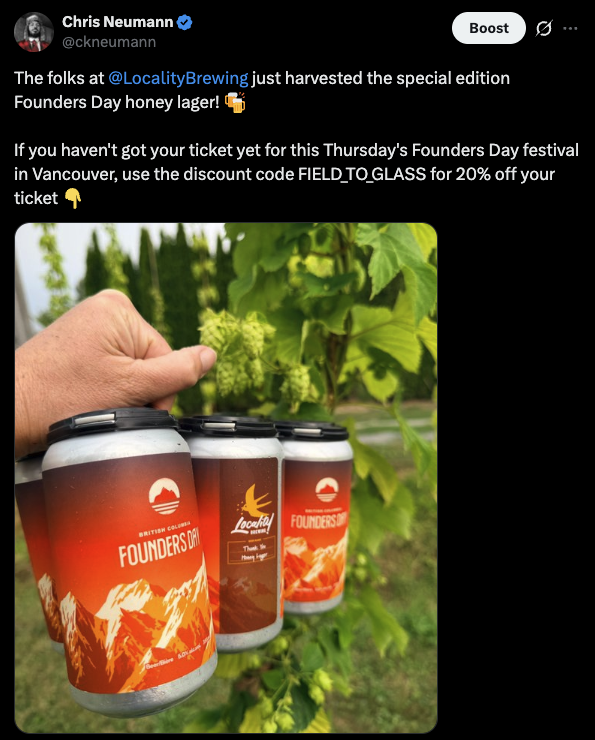
Enhanced user support 🍻
What does all of that look like, practically speaking? Here are some of the bigger changes we made for Founders Day 2026:
By far, the biggest change to Founders Day was the move from the Vancouver Convention Centre to a new outdoor venue. That was a huge undertaking, as it meant moving from a “turn key” venue to one where we had to bring everything in ourselves (from the stage, A/V setup and seating to fencing, garbage, and even porta potties).
The shift from “turn key” venue to custom experience wasn’t limited to the stage show. For the first two years of Founders Day, the networking event took place at a bar about 15 minutes from the convention centre. For year three, I wanted everything to be in one place. We brought in food trucks, concession stands, coffee bars, local beer and wine vendors and even an ice cream truck (the latter courtesy of local startup IcePanel). That kind of effort required procurement, power and permits. Lots and lots of permits…🤦♂️
Completely rethinking the venue for Founders Day meant a massive expansion to the team. The first two events relied heavily on convention centre staff for much of the behind-the-scenes logistics. For year three, we had to assemble a full-blown event and production team from scratch. That included event planners, a stage team, A/V staff, videographers and photographers, on-site security and more. Plus a whole lot of volunteers (shout out to Chris Hobbs for recruiting, training and supervising all of the amazing Founders Day volunteers 🙏).
Another seemingly simple but significant effort was on the design side. Founders Day 1.0 had a Luma page and a LinkedIn post. Version 2.0 had a Luma page, a LinkedIn post and a SquareSpace website. Founders Day 3.0 had my long-time collaborator Gail Yui. In the months leading up to this year’s Founders Day, Gail performed a top-to-bottom branding exercise that touched every aspect of the event, from signage and attendee badges to exhibiter booths and volunteer t-shirts to beer cans and bucket hats (plus, of course, the LinkedIn page).
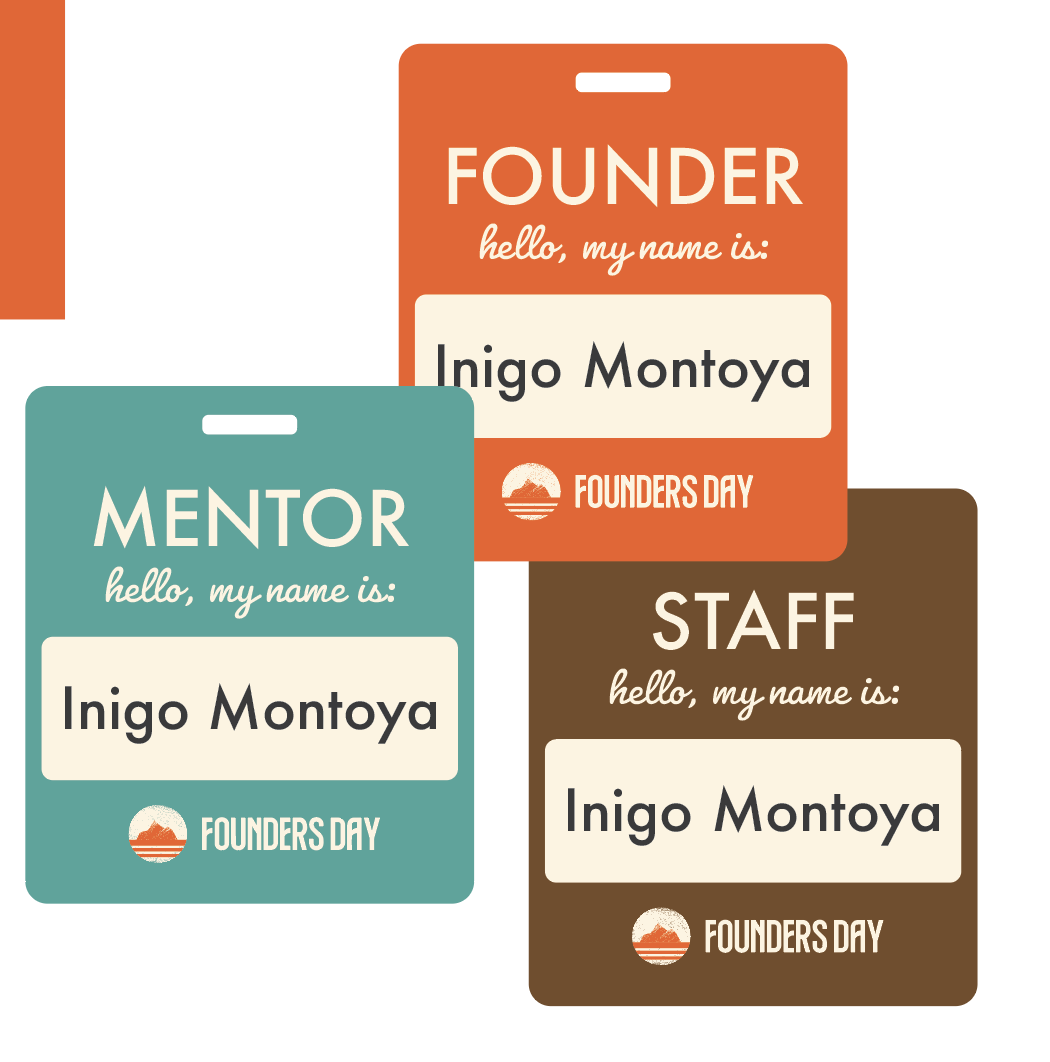
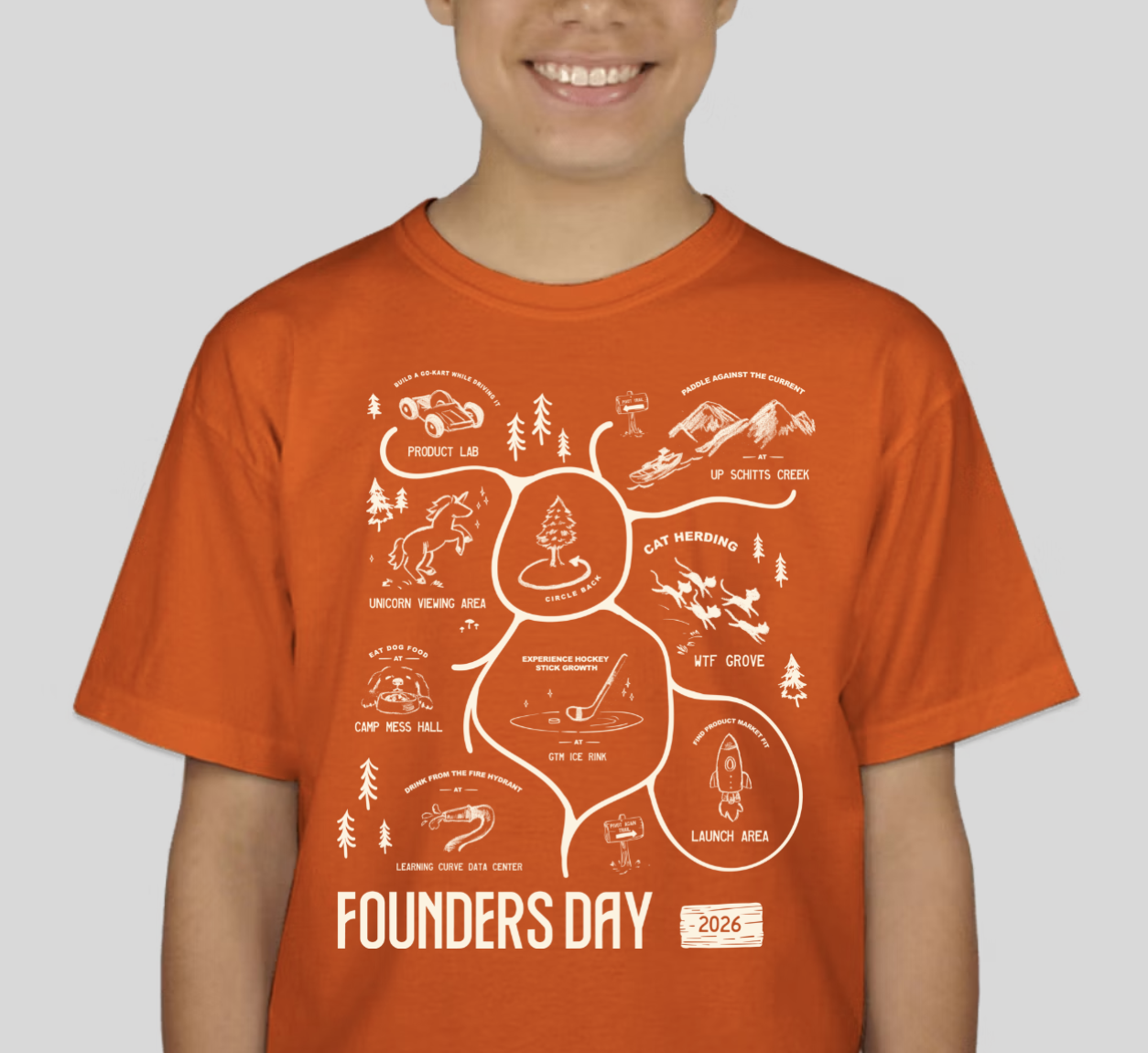
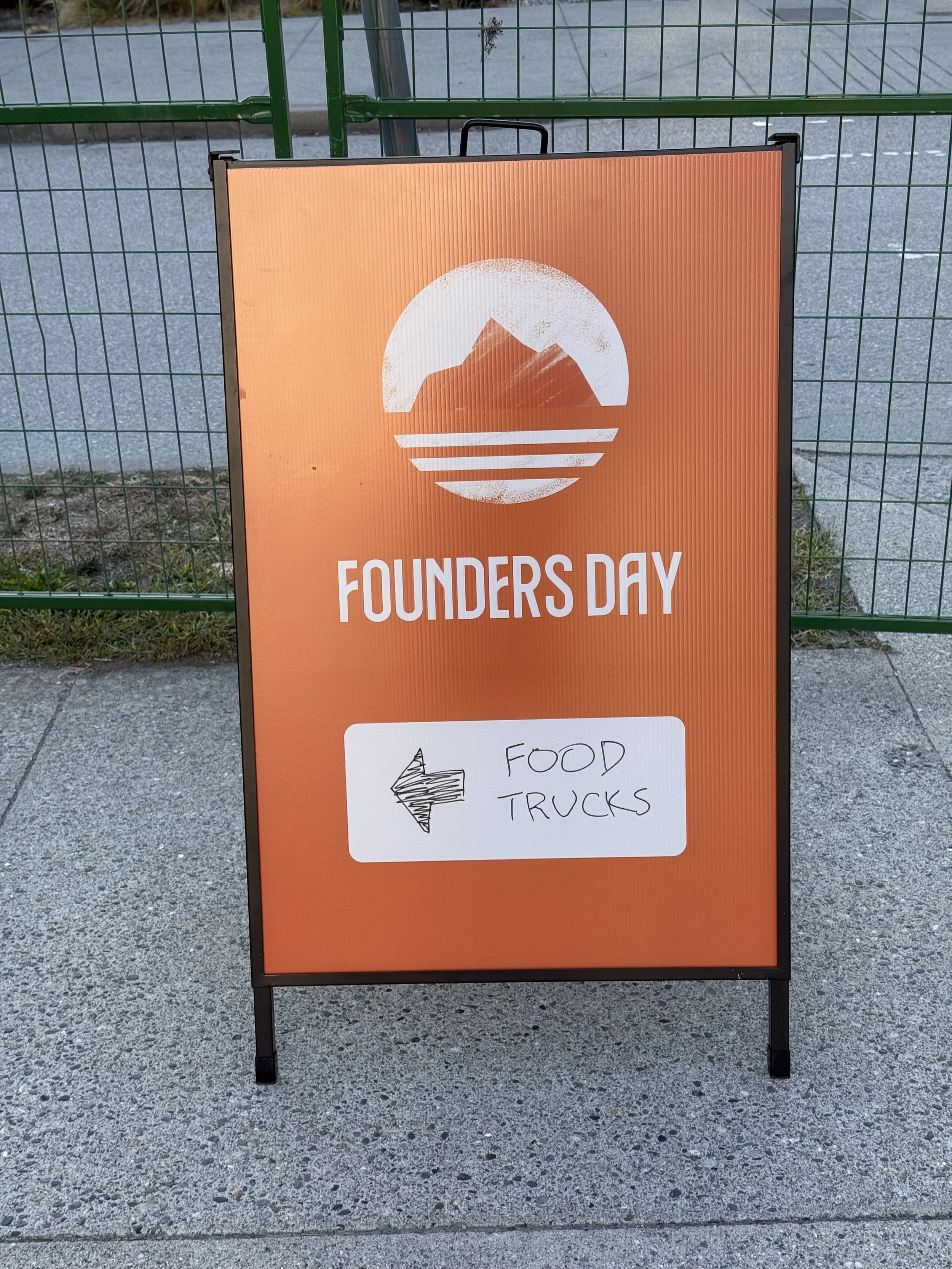
For all of the changes we made to this year’s event, we tried hard to stay true to the original vision of Founders Day: to facilitate and encourage connections between founders. In his seminal book, Startup Communities, Brad Feld observed that,
“Building a startup community is not a zero-sum game in which there are winners and losers: if everyone engages, they and the entire community can all be winners.”
This year’s Founders Day had nearly 100 experienced founders and investors speaking to and mentoring up-and-coming founders — many of whom flew in just for this event.
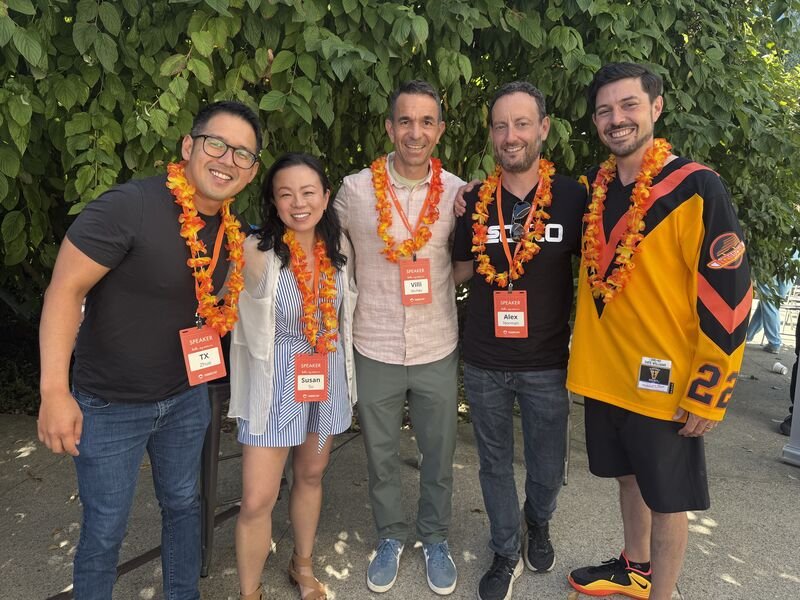
These speakers flew in from San Francisco, LA, Toronto and Seattle ✈️
The Results?
So what did attendees think of Founders Day 2026?
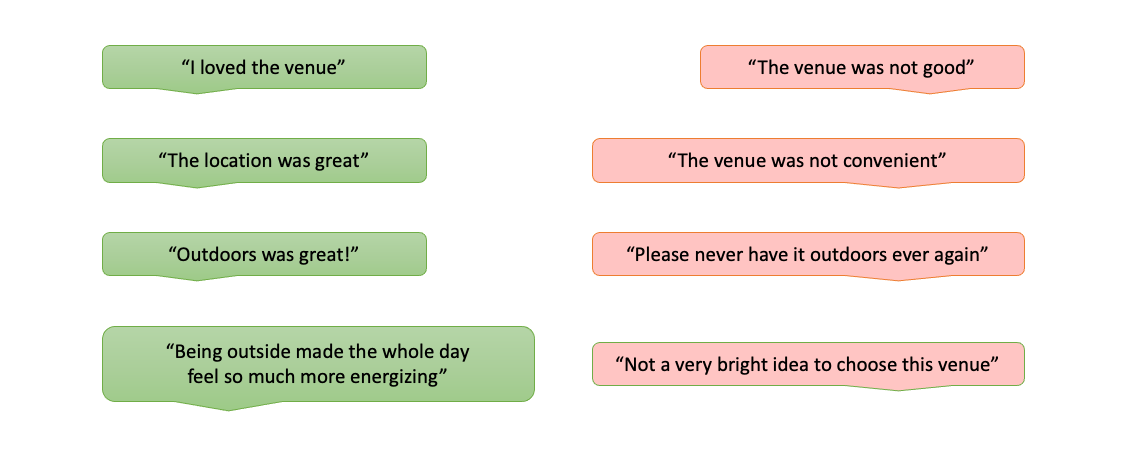
🫠
The thing about building in public is that if you’re doing something that matters to people, then they are going to have opinions.
Strong opinions.
And that’s okay. In fact, it’s great!
Genuine customer feedback is a signal that people care about what you’re building. They may not agree with everything you’re doing. They may not like all of the decisions you make. They might get really loud and upset when things break. But that means they care about your product and the problem you’re solving.
And it’s infinitely better than silence. (It’s also why the field of product management exists.)
If the volume of attendee feedback alone is any indication, then Founders Day is trending in the right direction:
Founders Day 2024: 7 people provided feedback
Founders Day 2025: 37 people provided feedback
Founders Day 2026: 102 people provided feedback (so far…)
Of course, that’s not the only metric that matters. So here is my honest review of Founders Day 2026:
Founders Day 2026: The Good, The Bad and the Ugly
Let’s start with the good:
From a product-market fit perspective, the biggest win of Founders Day 2026 was that we had almost as many founders, investors and ecosystem supporters buy paid tickets as attended for free in 2025. (We didn’t have as many registrations as last year, but that was to be expected given how many people register for free events without giving much thought to whether or not they actually plan to attend.)
At a more granular level, attendance figures for many ticket categories, including prospective founders/students, investors and ecosystem supporters, were up significantly compared to last year.
Other than running out of cold brew coffee towards the end of the day, the logistics for the food trucks, bars and concessions all went off without a hitch.
The registration process — which was a disaster in years past — was smooth and seamless.
Attendee feedback on the founder mentoring and networking portions of Founders Day 2026 was through the roof. 📈
We ever-so-slightly beat our revenue objective for this year’s event (revenue = sponsorship dollars + ticket sales).
Finally, we got strong subjective feedback from the majority of attendees at this years event, including a 4.3/5.0 event rating on Luma and broadly positive feedback both publicly on social media and privately through attendee surveys.
Next, the bad:
Overall attendance was slightly down compared to last year. We already know some of the reasons for this (e.g. marketing for this year’s event started later than planned due to delays in securing the venue). In the coming weeks, we will dig deeper into attendance statistics and feedback to see what other lessons are to be had.
Some of the decisions we made around the venue layout and configuration led to challenges with the A/V setup (e.g. in some areas of the venue the sound was too loud while in others it was inaudible).
Although we met our revenue target for this year’s event, expenses significantly exceeded our original estimates (primarily due to delays and unforeseen challenges with the new venue). Founders Day 2026 was never projected to break even, but the overruns definitely led to a larger deficit than planned.
Finally, the ugly:
This biggest miss of this year’s event came from the main stage seating layout. Our team spent significant time and effort developing contingency plans for rain, but we didn’t anticipate that last Thursday would be one of the hottest days of the year in Vancouver. The result? For significant portions of the day, it was entirely too hot and sunny for most people to watch the main stage presentations from the audience seating.
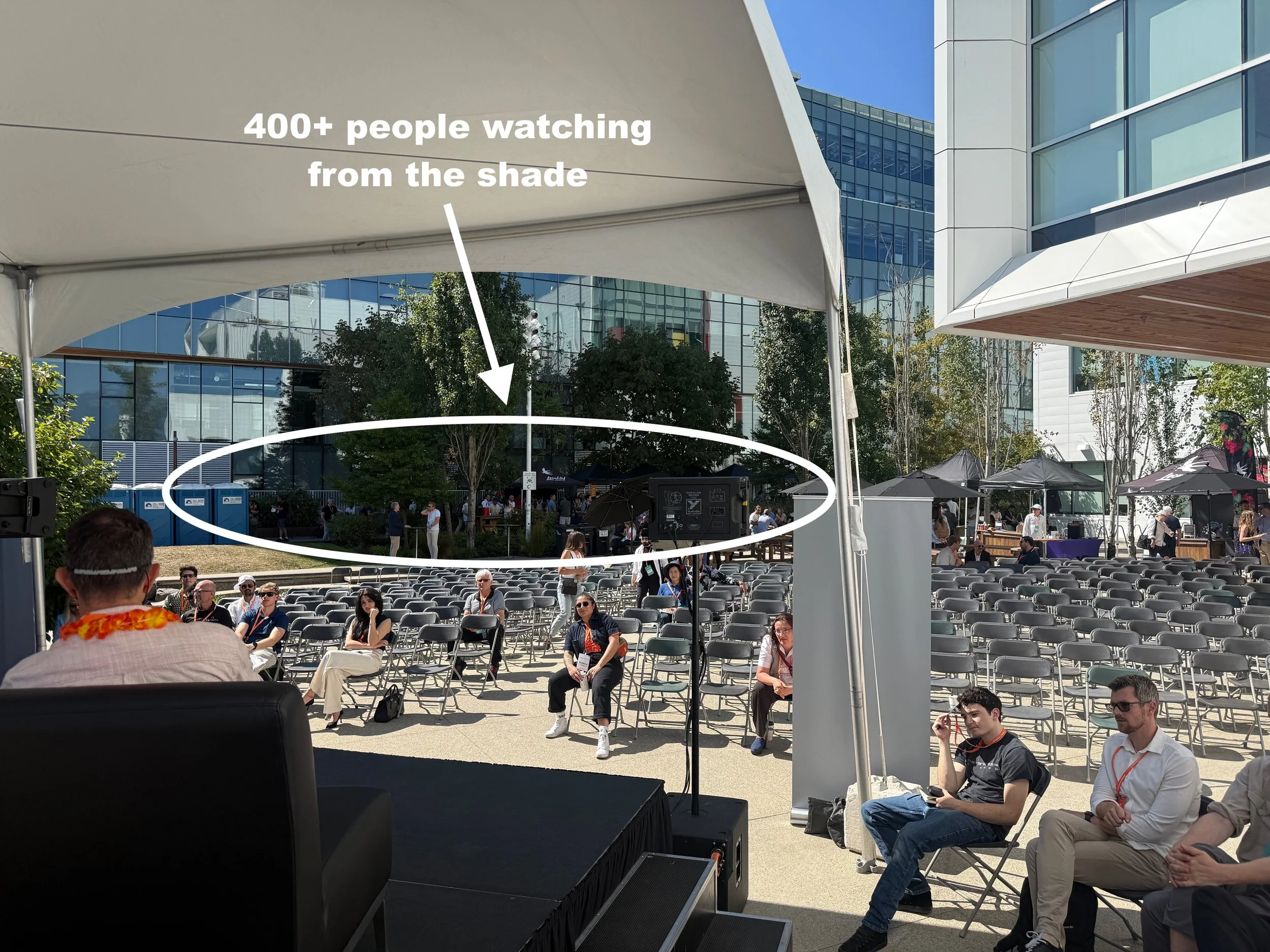
The change in audience flow resulting from the heat led to a number of additional challenges, most notably on the audio side. The speakers that lined the outside of the seating area weren’t configured to overcome the ambient noise from 400+ people mingling in close quarters. That meant many of the attendees standing in the shade were unable to clearly hear the panelists for significant portions of the day (though, rest assured, all of the sessions were recorded and we’ll post the videos soon!).
What’s Next for Founders Day?
Despite the hiccups that happened with this year’s event, Founders Day 2026 was an unquestionable success.
It delivered on the core value proposition we originally set forth while making considerable improvements over the “MVP” of years one and two. We also made meaningful progress on each of the three high-level objectives defined at the beginning of our planning cycle, which is a big deal when it comes to evolving into something that is long-term sustainable.
Of course, there is still plenty of work to be done on the journey towards product-market fit. Founders Day 3.0 had its fair share of “bugs” and there remains a healthy backlog of feature requests. In the coming weeks, we’ll dig deep into all of the feedback we received from speakers, mentors, sponsors and attendees and unpack the many lessons and learning’s from Founders Day 2026.
After that, it’s time to get to work on Founders Day 2027!
We’ve already got a tentative date soft-circled and clear ideas for how to make next year’s event even better, so stay tuned.
In the meantime, I want to thank all of the vendors, volunteers, speakers, sponsors, mentors and founders who made Founders Day 2026 happen. This year’s event wouldn’t have been possible without each and everyone one of you.
Thank you to our many corporate and government partners, including:
Presenting Partner: Fasken Emerging Tech
Gold Partner: Innovate BC
Silver Partners: AWS, Conference Badge, DuploCloud, IcePanel, Launch, New Ventures BC, Osler, Remitly and Web Summit Vancouver
And thank you to the many incredible people who contributed to Founders Day 2026 in ways big and small, including: Alex Conconi, Alex Norman, Alexandra Greenhill, Ali Pejman, Allen Pike, Amin Yazdani, Andrew Fursman, Andrew Harries, Andrew Vilcsak, Anthonia Ogundele, Arif Khimani, Ath Caramanolis, Bijan Sanii, Bill Tam, Brandon Waselnuk, Chris Albinson, Chris Hobbs, Colin Harris, Conrad Whelan, Daniel Eberhard, Darrell Kopke, David Luba, Dennis Pilarinos, Derrick Emsley, Diraj Goel, Edoardo de Martin, Edward Chiang, Gary Agnew, Glen Lougheed, Handol Kim, Ian MacKinnon, Irene Dorsman, Jack Newton, Jacob Shadbolt, Joel Hansen, Josh Nilson, Karm Sumal, Landseer Enga, Mayor Ken Sim, Kenndal McArdle, Kim Kaplan, Kris Hartvigsen, Michael Buhr, Michael Henson, Nejeed Kassam, Noah Stanford, Olivier Vincent, Praveen Varshney, Ray Walia, Reza Sanaie, Reza Arbabian, Serge Salager, Shivam Kishore, Sophia Millar, Susan Su, Tanis Jorge, Tifanee Po, TJ Rak, TX Zhuo, Vik Kambli, Villi Iltchev, William Johnson, Wilson Tang and Yen Lee (sorry if I missed anyone!!).
See you all at Founders Day 2027.
Stop with the AI Slop, Part 2
What happens when AI slop finds its way into emails and text messages you send your coworkers, clients and friends?
Tomasz Tunguz recently wrote about his experiences incorporating AI as part of his writing process. He observed that,
“The problem with AI as a ghost writer: everyone uses the same ghost writer. AI’s voice isn’t the author’s.”
Since ChatGPT first came onto the scene, I’ve made a point of periodically testing new models to see if they could accurately reproduce my voice in writing. Years of blog content and social media posts has provided me with a solid set of training data. It turns out that even the earliest models were remarkably good at analyzing my writing style. They could pull out phrases that I constantly use, my preferred filler words, linguistic fingerprints and so on.
But for all of their promise, I’ve never managed to get an AI model to write even a single paragraph that isn’t clearly and obviously someone else’s voice. But does that actually matter these days?
Much like Tomasz, I periodically get emails from readers asking about the authenticity of my content (or, in some cases, expressing their appreciation for something I wrote that was clearly not AI-generated). In his post, Tomasz hypothesized that,
“In the age of slop, readers test authenticity.”
I think he’s right on that. Increasingly, I find myself reading posts, articles, emails and even text messages with the not-so-subconscious question, “was this written by AI?” going through my head.

Nobody who received this email questioned if it was from a human… 😂
A few months ago, I sent out emails to a number of people in my network asking if they would volunteer as mentors for this year’s Founders Day. It was a pretty simple email that included high-level details about the event plus the ask (“Will you mentor this year?”). Most of the responses were a few words or less (“I’m in!” or “Sorry, I’m out of town that week.”), but one of them stuck out:
“Hi Chris,
Great to hear from you, and count me in. I'd be glad to mentor again this year.
The new format sounds excellent. Moving everything to South Flats and giving it a festival feel is a smart change, and having the conference, mentoring, and networking party all in one place will make the day flow much better.
The mentor ask works for me. Happy to wear the lei and spend time in the mentor area during the day, so just send the signup sheet once logistics firm up and I'll pick a slot. The mentor and speaker dinner sounds great too, so keep me posted on the date.
I'll keep the details to myself until the announcement goes out. Looking forward to August 20.
Thanks,XXX”
I immediately texted the sender,
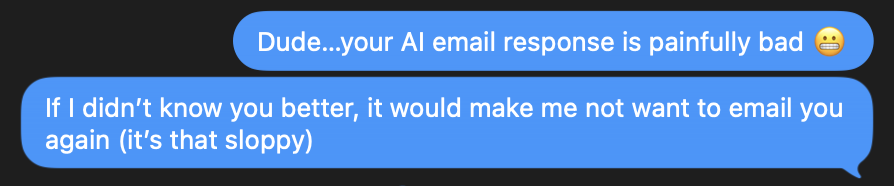
His response?


Since AI came on the scene, a subset of the residents of Startupland™ have become obsessed with efficiency. A number of people I know have spent a mind-boggling amount of time spinning up agents to handle every task imaginable.
And in more than a few cases, that includes an agent to act as the frontline interface for all of their personal communications.
A few months ago, I wrote about the rise of AI slop on social media and how relying on AI to generate posts is now likely to result content that under-performs. I noted that after reading dozens of nearly-identical AI-authored comments, “…my eyes glazed over. Eventually, I stopped reading and responding.”
What happens when the AI slop isn’t confined to LinkedIn and X posts and finds its way into the emails and text messages you send to your coworkers, clients and even your friends?
Lately, I’ve started to receive emails from personal friends and long-time colleagues that were clearly written by AI. Most aren’t quite as egregious as the example above, but most of the time it’s pretty obvious. When I receive such emails, I find myself both less likely to read to the end and less likely to respond to it.
More and more, I find myself less likely to want to email that person at all.

There’s a certain degree of trust that exists in one-to-one communication. For the most part, I assume that if I send you an email, you (meaning, the real you) will read it — or at least scan the header before deciding whether or not to answer it. Similarly, when I receive an email from you, I assume that you (the real you) is the person who wrote the email.
Sure, some people have EAs who read and respond to emails for them. But long-established etiquette is that if a human EA writes an email on someone else’s behalf, they initial it in order to make clear that the email was written by someone else. Rarely do EAs actually ghost-write personal communications (though in Startupland™ that behavior is more common than in the rest of the world).
And while plenty of people use tools like Grammarly to improve their writing and leverage email templates / snippets to be more efficient, you can generally tell that the core was still written by the original author. The voice is still theirs.
So where do we go from here?
On the one hand, part of me wonders if we’re experiencing a similar dynamic to what happened when Calendly first came on the scene (when many people were upset by the “audacity” that someone would dare send them a link to fit into their calendar, rather than engaging in the time-consuming back-and-forth of scheduling). From that perspective, it seems reasonable and broadly net positive to have AI handle communication tasks that don’t really need a human-in-the-loop.
But having AI handle basic scheduling tasks or dealing with customer support is very different from having an agent pretend to be you in conversations with people you know personally. And perhaps that’s the core issue here. There’s a breach of etiquette and trust that seems to be happening with a subset of early adopters of AI. And they’re not fooling anyone.
I’m very transparent about the fact that I use an AI scheduling assistant, But I’ve never, ever had it pretend to be me. And I think that’s important.
At the end of his post, Tomasz noted,
“AI is a poor ghost writer, but a great editor.”
I suspect that in the very near future, we’ll see a similar backlash to AI slop in personal emails to what we’ve seen in social media and cold emails. Use AI as an editor. Offload tasks in a transparent manner to agents. But stop having AI pretend to be you. The incremental gain in productivity is likely costing you more than you realize.
That particular friend I referenced earlier who I emailed about Founders Day? I haven’t sent him a single email since.
Because I know he’s not the one reading it.
What Do VCs Talk About When Nobody’s Listening?
Last week, I hosted an emerging manager summit in San Francisco with VCs from across North America. Guess what we talked about?
Last week, I hosted an emerging manager summit in San Francisco with more than two dozen early-stage VCs from across North America. GPs from Austin, Toronto, Seattle, Vancouver, Montreal, Missouri, Los Angeles, Halifax and more joined San Francisco and Silicon Valley colleagues for a day of sessions on the changing startup and VC landscapes.
So what exactly do VCs talk about when no one is listening?
Here are 5 topics that were top-of-mind for the VCs at our emerging manager summit:
1. Liquidity
Everyone at the summit was accutely aware of the upcoming end to the SpaceX investor lockup period. The debate amongst the group was how much of an impact would that newfound liquidity have on LPs? Would emerging managers start to see more appetite to invest from family offices and institutional investors who had been waiting on DPI, or would it take another major IPO from the likes of Anthropic or OpenAI for things to shift?
2. Valuations
Like most residents of Startupland™, our group of VCs was eager to discuss the trend of skyrocketing Seed valuations and its potential impacts. With YC’s most recent crop of companies reportedly commanding valuations north of $40M and the most recent Carta data showing the top 5% of Seed valuations surpassing $200M, there was plenty to talk about.
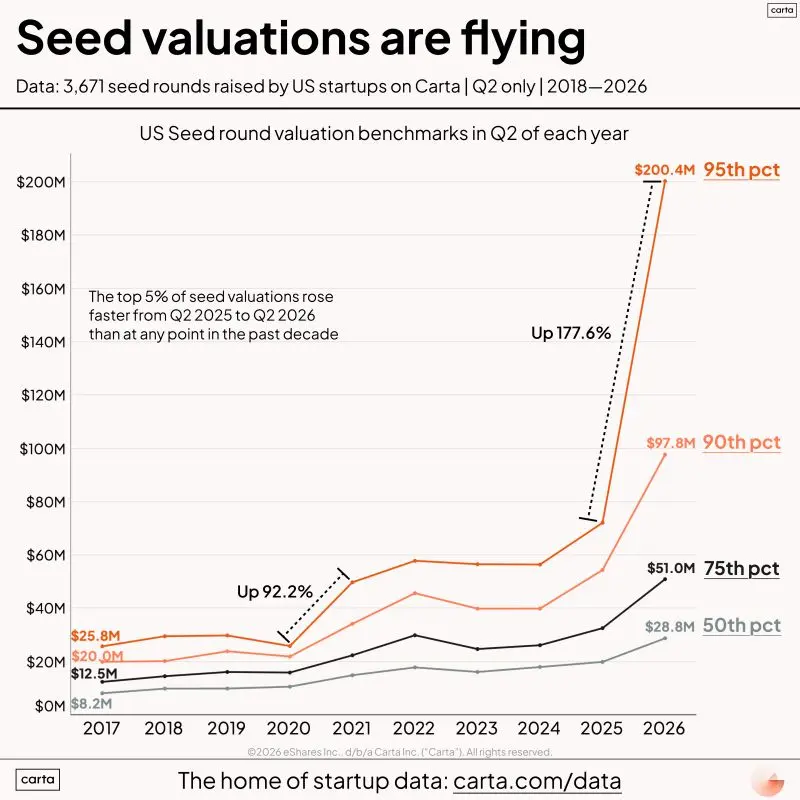
3. Ownership Targets
I’ve previously written about why VCs care a lot about ownership when investing in startups. Skyrocketing valuations are challenging a number of long-held assumptions when it comes to VC fund models.
Most emerging Pre-Seed and Seed funds target 3 - 5% ownership. But rising valuations have made those ownership targets increasingly out of reach — especially for hot companies. Should smaller funds forgo ownership targets and strive to be in the best deals no matter the price? Should they remain disciplined in their approach to investing (even if that means passing on hot companies)? Or perhaps a combination of the two?
Towards the end of the day, our group of GPs was joined by the cofounder of one of Silicon Valley’s largest megafunds, who pulled back the curtain on how multi-billion dollar funds think about price and ownership. That led to an incredible back-and-forth amongst our GPs on the future of early-stage investing and the opportunities for smaller funds.
4. The Changing Age of Founders
Another hot topic at our emerging manager summit was the changing demographics of founders — specifically, age.
For more than a decade, many VCs have held a noticeable bias towards founders in their 30s, as reports repeatedly showed the average age of “successful founders” hovering around the mid- to late-30s. But the rise of AI has turned that on its head. Over the past few years, the average age of VC-backed founders has plummeted. Today, many investors are once again exhibiting a strong preference towards younger founding teams, betting that their AI-native sensibilities will trump any lack of experience.

Several of the GPs in attendance — including our guest megafund manager — shared recent data from their portfolios to quantify the trend. That led to a robust discussion that included the rise of residencies and hacker houses, the pros and cons of degen behavior, and how to evaluate founder velocity vs. experience.
5. The Opportunities in AI
Of course, we couldn’t possibly have had a gathering of tech investors without spending a considerable amount of time talking about tech. More than half of the participating VCs came from technical backgrounds. Not only does that fact have a significant impact on their propensity to invest in napkins, but it enabled us to have deep, thoughtful conversations on the state of AI and its potential future trajectories.
Open vs. closed weights, on-prem vs. cloud, the merits of forward-deployed engineers and thoughts on what will happen when the true cost of AI compute gets passed on to end customers were just a few of the topics we touched on during our technical sessions.
Should I Fundraise in the Summer?
If summer is a bad time to fundraise, why do so many VCs proclaim that they’re open for business?
It’s that time of year again.
We just hit the mid-point of Silicon Valley’s summer break and, right on cue, a plethora of VCs started proclaiming that they’re not actually on summer vacation.
I’ve previously written about why summer is a bad time for founders to fundraise. If you haven’t read that post before, I suggest you start by giving it a quick skim. Here’s the tl;dr:
The vast majority of VCs do, in fact, work through the summer. But like everyone else, they do so at a reduced pace. They take summer vacations, spend more time with their kids, run around in the desert dressed up like fuzzy cyberpunk muppets. You know…normal summer stuff.
So it’s not that you can’t raise a round of funding in the summer. But it is logistically harder:
It takes longer to schedule initial meetings with a VC
The time between meetings increases
The amount of time needed for a VC to complete their diligence takes longer (as analysts and others at the firm also take vacations)
The result is that running a fundraising process in the summer takes longer than at other times of the year. Not only that, if you are able to successfully raise a round, you will very likely end up with a lower valuation due to the lack of competition.
But rather than revisit why summer is a bad time to fundraising from a founder’s perspective (seriously, read this post if you haven’t already), I thought I would share a bit of insight into why, each and every year, so many VCs try to push back against that narrative.
Let’s start with the basics: the goal of running a high-velocity fundraising process is to move as many investors as you possibly can through your funnel at roughly the same pace. The approach is designed to maximize the number of VCs that make it to the end of your funnel and finish their diligence process at in parallel. That point is critical because Econ 101 teaches us that competition for a scarce resource leads to increased prices. One VC willing to lead your round is great. But having multiple VCs reach the same conclusion at roughly the same time is what drives up price.
In other words, a strong company gets you a term sheet, but a strong process gets you a valuation.
A few years ago, I wrote about how VCs adjust their approach to investing during periods of reduced deal flow. This particular post was focused on the slowdown that happened post-ZIRP, but it pretty accurately describes how the psychology of investors changes during the summer:
“[During periods] of slow deal flow, VCs by-and-large disassociate themselves from any external pressure to do new deals…The result? A creeping inertia to not make investments…As inertia sets in, investors slow their deal pace. This can mean more meetings with each investor and — crucially — more time between meetings (as VCs no longer feel the time pressure to rush into a deal). The reduction in pace, combined with some VCs stopping making new investments altogether, makes it harder for founders to generate competitive dynamics when running a high-velocity fundraising process.”
Despite the inertia that creeps in during the summer, each year many VCs loudly proclaim that “they’re open” as a means to drive deal flow in a time of reduced competition. They’re hoping that you fundraise in the summer specifically because they know everyone else has that same inertia:
If they meet you in the summer and get really excited, they can likely ramp up their diligence efforts and reach a conclusion before you’ve booked a first meeting with many of their competitors
If they can get to a term sheet quick enough, they may be able to win the deal without having to compete on price or terms
If they’re interested but not enough to go fast, they still get an early look at your company and can slow play the process into the fall (giving them more data points to use in their decision while knowing that they likely won’t lose the deal)
Speaking of getting an early look, summer events is another well-worn approach that VCs use to get a sneak peak into companies that might be fundraising in the near future. Casual meetups and office hours (like those referenced by Forerunner at the start of this post) are one common tactic. Mini-conferences, founder bootcamps and other educational events is another.
Why do you think YC makes such a big deal about Startup School each summer…? 😉
I Totally Missed Your Email
There’s a good chance many people you interact with these days are aware of when and how often you open their emails. Time to stop making excuses for why you took so long to respond.
Human etiquette is filled with performative interactions. Like all members of the animal kingdom, we have rituals around dating and mating, fighting and family. But unlike our wild friends, our etiquette has also evolved as a result of the changing nature of electronic communication.

“As per my previous email…”
Take the telephone, for example. It was invented way back in 1876 (150 years ago!), but it wasn’t until the 90s that we had a way to know who was calling before we answered. That’s right youngsters, back when I was a kid, you had to pick up the phone and say “hello?” in order to figure out if the caller was someone you wanted to speak with or a person you had desperately been trying to avoid.
(You also had to physically “pick up” the phone to answer it — none of this tapping or swiping or “Hey, Siri” nonsense…).
Once caller ID became mainstream, the etiquette and expectations around phone calls — especially missed calls — evolved. If you ran into someone whose phone calls you had been avoiding, you could no longer credibly claim that you didn’t know they had called. If you did, they immediately knew you were lying.
We’ve now officially reached that point with email — although a good chunk of the population still doesn’t realize it.
For most of the history of email, we didn’t actually know if the intended recipient opened an email that we sent. “Maybe it went to spam?” became the most common question asked when we didn’t get a response (and, by corollary, “It probably went to spam,” the go-to excuse when asked why we didn’t respond). Corporate email solutions, like Microsoft Exchange, have had the ability to track email opens (known as “read receipts”) for decades, but the functionality was mostly absent from mainstream email platforms.
That changed back in 2019, when an email startup named Superhuman added read receipt functionality to its client using tracking pixels (a concept that had been leveraged for years to deliver website analytics). Privacy advocates were in an uproar over the practice, but it wasn’t long before the backlash died down and other email clients began embedding similar capabilities into their products.
At this point, read receipts have been pretty widely available for more than 5 years, yet many people either don’t know they exist, forget that they exist, or delusionally believe that the person they’re interacting with isn’t using them.
I still regularly get email responses like this:
“I totally missed this email!
<response to the original email>
LMK and so sorry for being late.”
Meanwhile, the read history for the original email I sent looks like this:
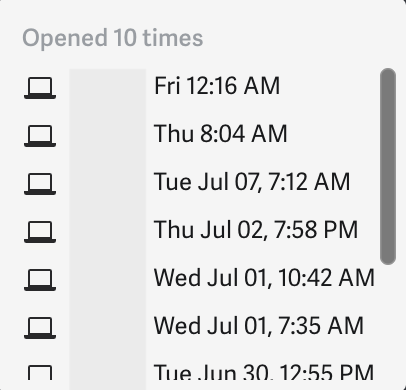
We’ve all done this before — reading and re-reading an email before deciding whether or not to respond — and it’s honestly not a big deal if we’re talking about emails between friends or work colleagues. But if you’re a resident of Startupland™ responding to an email from a potential investor, another founder, or someone else you’re trying to build a relationship with, you absolutely need to stop doing this.
For starters, you should presume that the person who sent you the email has read receipts enabled. You should also presume that they might be keeping tabs on whether or not you opened it. Not because they’re weirdly obsessed with you, but because high-throughput email clients like Superhuman now put the open feed front and center:
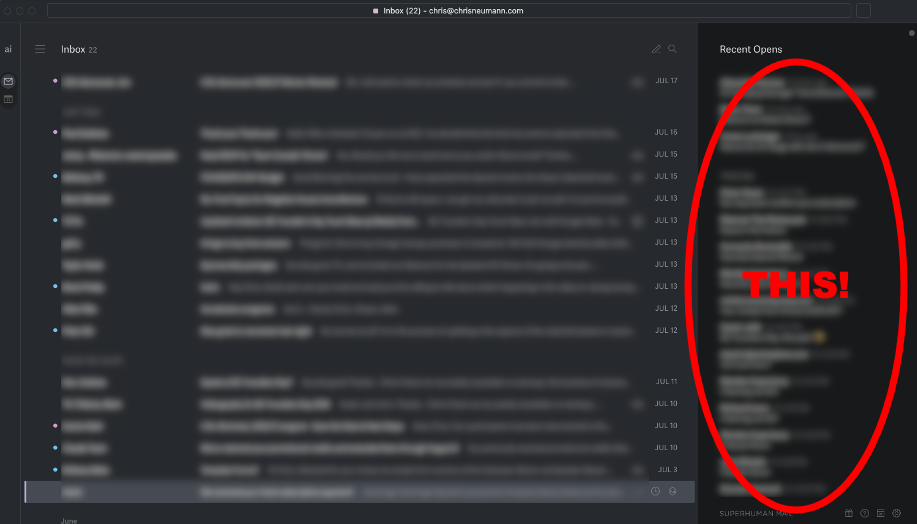
And for those of you chuckling at this because your AI agent now takes care of all your emails, I promise that, “I didn’t see your email because my agent sucks at filtering,” isn’t going to buy you much credibility either.
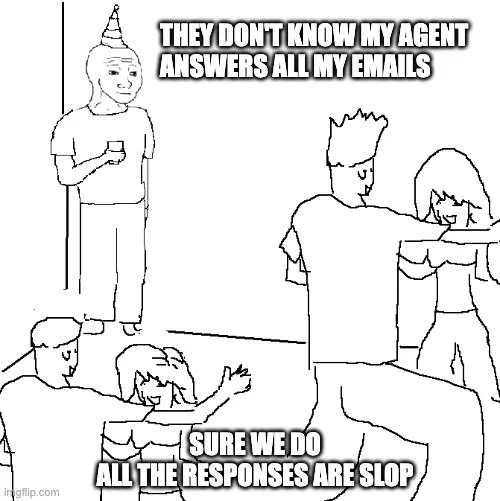
In any case, there’s a good chance that many of the people you interact with these days are aware of how long it takes you to respond to their emails. Virtually every VC I know uses Superhuman. As do a significant percentage of founders in my network. Most of the time, your email response behavior isn’t going to make one iota of difference in your life. But if the person you’re responding to is in the process of evaluating you (such as an investor deciding whether or not to back your startup or someone in a position of influence trying to gauge if you respect their time), you might want to rethink how you handle email.
If an email takes less than a minute to respond to, just do it (this has been best practice for a long time, yet many of us still don’t)
If a request is going to take time for you to complete, send a quick note of acknowledgement to show your responsiveness
And most importantly, stop sending emails claiming that “I just saw this” after opening and closing it for weeks
Even if you’re not at the point where you’re willing to trust an agent to fully manage your inbox, with AI now embedded into virtually every email client, there really isn’t a credible reason to let your backlog build up. Let the AI auto-generate quick responses for you and either tweak them or quickly hit send.
More than ever, velocity is the one metric that matters most. And for better or worse, email read receipts now provide a measurable indication of your velocity and how you prioritize things.
Reply quickly or be honest when you don’t. Your reputation will thank me later.
What is a Forward-Deployed Engineer (and Why Should You Care)?
Forward-deployed engineers are nothing new (I built a team of FDEs in 2009). But they can be a game-changer.
If you’ve been paying any attention to tech media as of late, you’ve undoubtedly seen articles about the rise of AI’s hottest new role: the forward-deployed engineer (FDE). If the term is new to you, let’s start off with a basic definition of what an FDE is:
A forward-deployed engineer is an engineer who is taken from the core product team and “forward-deployed” into a customer environment.
That’s it. It’s not rocket science. An FDE is just a regular ol’ engineer who gets sent out into the field. So why is this such a big deal? And why now?
The History of the Forward-Deployed Engineer
The folks from Palantir’s PR department would have you believe that their company invented the forward-deployed engineers in 2011. Although they can certainly claim credit for having originated the modern job title, the practice of sending engineers from the core product team into the field long predated their adoption of it.
I know this because I built and ran a team of “forward-deployed engineers” back in 2009 (more on that later).
Generally speaking, sending highly-specialized engineers from HQ into customer environments isn’t an optimal use of a company’s resources. Notwithstanding brief trips into the field to get “real-world experience”, product engineers are almost always more valuable working on the product than they are deploying and/or customizing it. That’s why the vast majority of technology companies build separate organizations (staffed with less expensive hires) for field engineering tasks.
But every once in a while, a new technology emerges for which demand spikes before it is mature enough to be deployed by arms-length professional services workers. That happened with application servers in the late-90s. It happened again with big data platforms in the late-00s / early-10s.
And it’s happening today with AI.
What a Forward-Deployed Engineer Really Is (and What It Is Not)
Before we go any further, I think it’s helpful to know what an actual forward-deployed engineer is (especially given how quickly we’ve already progressed in the “hype cycle” of the term).
A true forward-deployed engineer is someone who has spent time working on a company’s core product and is later “forward-deployed” into customer environments in order to help with installation, deployment, customization and/or sales.
Despite what some articles suggest, a forward-deployed engineer is not just a rebranding of a solutions engineer/field engineer/integration engineer. Yes, the title sounds cool (and, yes, there are actual gains to be had by simply giving professional services workers a trendy new title). But the distinction is important as it goes to the unique capabilities that a forward-deployed engineer brings to the table — particularly for early-stage startups.
Solutions engineers and their ilk generally have strong technical backgrounds and experience working in customer environments but they rarely have deep insights into how the product was developed or how it works beneath-the-hood. Their effectiveness comes from the combination of advanced training, access to “employee-only” functionality, and a direct line-of-communication into the engineering department. Ultimately, solutions engineers can be thought of as supercharged power users who specialize in installing, deploying and customizing the product.

The didn’t build it, but they’re really good at installing it
In contrast, forward-deployed engineers understand the how and the why of a product’s operation by virtue of having contributed to its development. As we’ll see later, it is this experience and understanding that is critical to delivering customer value when demand for a new technology surges ahead of the its maturity.
When are Forward-Deployed Engineers Required?
In a typical technology company, the team responsible for installing, deploying and customizing the product for customers exists independently from the product team. This evolution happens surprisingly early on — and for very practical reasons — but demands a key prerequisite: the product must be mature enough that responsibility for installing/deploying/customizing it can be “handed off” to individuals who have little-to-no understanding of how it actually works.
This isn’t usually a challenging requirement. Case in point: the rise of SaaS software was entirely predicated on the notion that most tasks related to installation/deployment/customization could be automated (and those that couldn’t were easily encapsulated into standalone configuration tasks).
If we think about it within the context of the technology adoption lifecycle, most new technologies are relatively mature from an installation/deployment standpoint before early adopters come on board (and absolutely before they “cross the chasm” into the early majority). That’s because startups are usually able to work out the kinks in their deployment processes through beta testers and their earliest customers (innovators).

But what happens when customer demand surges before the product is ready? Or more precisely, what happens when customer demand surges before the process for installing/deploying/customizing the product is ready?
That’s what we are currently seeing with AI.
And while we’re not used to this dynamic after 10+ years of relying on easy-to-install vertical SaaS solutions, historically speaking it’s fairly common.
To illustrate this, let’s take a look at the rise of big data.
A Case Study in Forward-Deployed Engineers
For those of you who are too young to remember, there was a time not so long ago when large-scale data analytics was impossible. At the turn of the millennia — a decade before Snowflake or Databricks were founded — complex analytics could only be performed on data that was physically collocated on a single server. In those days, we already had web servers and mobile devices generating tons of data. We also had systems capable of storing all that data. But if you wanted to perform anything more than the most rudimentary statistical analysis on it…too bad.
By the mid-noughts, a handful of startups were trying to figure out how to make complex distributed analytics a reality. I was the first engineer at one such startup, Aster Data, which was founded by three of my friends from grad school.

We were much younger in those days…
By 2007, we had a handful of notable customers and enough revenue to raise our Series A. We used those funds to hire a number of experienced sales reps to scale our go-to-market efforts. And scale they did. The promise of distributed data analytics was so clear and compelling that demand surged. Fortune 500 companies were tripping over each other to schedule trials and pilots with Aster Data and our competitors. But we quickly discovered that our ability to install/deploy/configure the product couldn’t keep up with sales (and we weren’t alone in that regard).
Our first attempt to build an independent field engineering organization began as most such efforts do. In parallel to hiring our first sales reps, we brought on a number of experienced “pre-sales” and “post-sales” engineers from companies like Oracle and Business Objects. These individuals had spent years working alongside sales reps to understand the technical requirements of prospective customers and subsequently deploy database software into their organizations. Yet every single one of them struggled upon joining Aster Data.
The issue? Our product — and distributed data analytics technology more broadly — wasn’t mature enough to be deployed by individuals who didn’t have a deep understanding of how it worked beneath-the-hood. The installation and configuration of those early “big data” systems depended on a litany of variables, including the nature of a customer’s data, the types of queries they intended to ask of it, and even the brand and configuration of the servers that they planned to deploy it on. Our core R&D team — and those of our competitors — were still trying to understand and quantify exactly how all of these variables coexisted, so it was unreasonable (and, in fact, impossible) for anyone outside of the core product team to take on this responsibility.
Having failed multiple times to scale our field organization with traditional hires, in late-2008 I was tasked with figuring out a path forward. And there was only one solution we could come up with: to “deputize” some of our core product engineers into the field.
If you’ve ever tried to convince an engineer to trade in their IDE for the opportunity to be joined at the hip with an enterprise sales rep, it’s not exactly an easy sell. But we were able to convince four of our early engineers to sign on for 6-month field deployments (including two who relocated to New York and Chicago for their stints).
The results were incredible. But almost as important as the increase in sales was the fact that the strategy bought us enough time for the product to mature to the point that it could finally support a truly independent field organization (which we started building after raising our Series B).
Why Forward-Deployed Engineers are Critical to AI Adoption
By this point, the parallels between what’s happening with AI and my big data anecdote should be pretty clear.
Much like with big data, the enticing potential of AI has caused demand to surge amongst early adopters well before the processes for installing/deploying/customizing these products have matured. We can already see the impact of that imbalance in the pitiful numbers of companies that have managed to successfully get these systems into production.
One dirty little secret of the big data era was that a significant percentage of the industry’s early revenue came from R&D spend, as Fortune 500 companies tried to figure out how to get actual value from these systems. Sounds a lot like early token spend, doesn’t it?

Go on…
The parallels don’t stop there.
A few weeks ago, I wrote about the return of solution selling as the preferred sales methodology for AI. With AI technology significantly ahead of where the market is, sales teams are returning to a go-to-market approach that focuses on selling solutions to business problems. The return of forward-deployed engineers is a well-worn strategy for taking those early customers into deployment while we await the maturation of the technology.
But there is one big difference from what happened two decades ago. Both founders and VCs today understand the critical role that forward-deployed engineers can play in making sure these early customers are successful. Which is why the hype around FDEs is almost as loud as AI itself. Instead of wasting valuable time trying to build traditional field organizations, many AI companies are skipping right to engineers. And their VCs are following close behind with support.
A few weeks ago, a16z announced a fellowship for forward-deployed engineers. Such programs are normally launched as a means for VCs to find new founders to invest in. But in this case, if a16z can accelerate the development of the individuals who are critical to deploying early AI systems, the impact on their portfolio companies will be massive.
(And if they become known as the VC who understands the best way to get nascent AI products into production…well, that will undoubtedly help them win future deals.)
In the coming years, AI will mature and we’ll get to a point where arms-length professional services teams can once again drive the majority of installation/deployment/configuration (at which point the title forward-deployed engineer will return to being little more than the “ninja” of professional services). But I suspect that we’re a few years away from that.
In the meantime, if you’re struggling to get from sale to production (or even from interest to pilot), don’t be afraid to forward-deploy core engineering resources to make it happen. It can be scary at first to think about slowing down your product roadmap, but in the long run, it’s 1,000% worth it.
Cycling the Great Glen Way with Kids
The ultimate guide to cycling the Great Glen way with kids.
Earlier this year, I had a business trip scheduled to Edinburgh to meet with my friends at Codebase. The trip happened to coincide with my son’s spring school break, so I decided to take him along for the week.
I wanted to make sure we did more than just stay in the city for our trip, so I started researching off-the-beaten-path adventures that might appeal to my energetic 9 year old. Eventually, I came across the Great Glen Way, a scenic 79 mile (127 km) trail from Fort William to Inverness in Scotland’s famed Highlands. The path starts at the base of Ben Nevis, the UK’s highest mountain, and runs north-east along the Caladonian Canal and alongside some of the country’s famous lochs (notably Loch Ness).
My son does a lot of mountain biking. Growing up between Vancouver and San Francisco, he can frequently be found climbing Mount Tam, exploring the trails above Mount Seymour or bombing down Grouse Mountain. While a 79 mile mountain bike ride might seem unrealistic to many, given that he regularly does rides of 10 miles or more after school, the Great Glen Way seemed like an appropriate — albeit challenging — adventure.

My 9 year old and his “apprentice”
The Great Glen Way is mostly promoted as a hiking trail, but it’s becoming increasingly popular with mountain bikers. There are bike shops in both Fort William and Inverness that rent bikes (“bike hires”) for one-way journeys.
Unfortunately, it was very difficult for me to find detailed descriptions on what to expect — particularly as it related to kids. I stumbled upon a few blog posts with photos of proud parents with their youngsters and some brief commentary scattered across social media sites, but nothing that really laid out whether or not the Great Glen Way is actually kid-appropriate.
Nonetheless, we took the plunge and decided to go for it. And now that we have (successfully) completed cycling the Great Glen Way, I thought I’d share the details that I wished I had before the trip. Here are the sections if you want to skip ahead:
Is the Great Glen Way Appropriate for Parents? (seriously)
How to Divide the Great Glen Way into Stages when Cycling with Kids (our experience cycling the Great Glen Way)
Alternate Itineraries for Cycling the Great Glen Way (if I knew then what I know now)
With no further ado, I present to you Chris Neumann’s guide to cycling the Great Glen Way with kids!
What is the Great Glen Way?
The Great Glen Way is a 79 mile (127 km) hiking and biking path that runs between Fort William and Inverness. It was originally created as a hiking path (which is why most of the posts you find on the internet about it relate to walking). But it’s also a great path for cycling that’s increasingly popular with mountain bikers.

While it is possible to traverse the Great Glen Way in either direction, the most common route starts at Fort William on the coast and ends at the regional capital of Inverness in the north. Having completed it, I would agree that the route from Fort William to Inverness is definitely the better way for bikes.
Is the Great Glen Way Appropriate for Kids?
The Great Glen Way is not a particularly technical path from a mountain biking perspective. That said, it is not without its challenges. There are lots of inclines, some of which will likely require you to push your bike — and potentially your child’s — uphill (more on that later). If your child is not an avid bike rider and relatively athletic overall, I would hesitate to recommend this. But if they are, cycling the Great Glen Way can be a wonderful, fulfilling challenge.
At a high level, I would suggest that all participants:
Regularly and confidently ride a bike, including going up and down hills
Be able to cycle at least 10 miles on flat roads with relative ease (as a point of comparison, the Vancouver seawall is 13 miles / 22 km and takes my kids about an hour to complete)
Have some experience / familiarity with trail riding and/or mountain biking
Be able to run around and exercise for prolonged periods of time without getting tired or breaking down in tears

If this reminds you of your kids, then they might enjoy the Great Glen Way
Is the Great Glen Way Appropriate for Parents?
It’s not just the kids you have to think about!
Cycling the Great Glen Way is a legitimate workout. As I mentioned above, it’s not a particularly technical ride, but you are likely to end up with several long days of biking (potentially 6 hours or more). Moreover, unless your kids are extremely strong riders, you are going to have a few extended periods of time when you are pushing your bikes uphill (and, potentially, both your bike and theirs during some of the steeper segments). Add to that the fact that you’ll inevitably be carrying the lion’s share of any luggage and you need to be in decent shape.
I’m not nearly as avid a rider as my kids, but I do exercise regularly. I certainly felt like I earned by evening pint at the end of each day, but I never felt close to exhaustion (nor did my son).
The start of our adventure
Renting Bikes to Cycle the Great Glen Way
There are a number of bike shops that rent bikes (“bike hires”) for one-way trips to cycle the Great Glen Way. That said, not all of them have kids bikes for hire, so make sure to call in advance.
We rented from the folks at Off Beat Bikes in Fort William. They had the most rental options for kids and were very helpful in making sure we got the right equipment. Not only that, when a change in our flight caused us to arrive later than we intended, they offered to come into the shop on a day when it was closed so that we could get our bikes and not have to otherwise adjust our plans (thank you Damian! 🙏)
We rented standard hardtail mountain bikes for both of us, which came with helmets and a repair kit in case of emergency (there are also electric bike options, but since those aren’t any available for kids, it seemed silly for me to have an e-bike whilst my son was doing hard work!).
Our rental bikes
We also rented panniers (saddle bags) for my bike to carry some of our belongings. Many of the posts about cycling the Great Glen Way encourage riders to forgo panniers and make sure that they can carry everything on their back. That might be realistic if you’re a local, but if you’re coming to Scotland from abroad, chances are you have more stuff than you would want to carry on your back during a long ride. Having panniers also leaves easy room for sandwiches, drinks and extra snacks for the day.
How to Divide the Great Glen Way into Stages when Cycling with Kids
Figuring out how to divide up the stages of the Great Glen Way was one of the hardest parts of planning this trip.
Most of the articles and posts on the internet relate to hiking (which typically takes 5 - 7 days) or are clearly written for avid adult mountain bikers (generally presented as a 3-day journey). Based on our experience, I would recommend either 4 or 5 days when cycling the Great Glen Way with kids.
We broke up our journey into 4 stages/days:
Fort William to Invergarry (25.36 miles)
Invergarry to Fort Augustus (8.21 miles)
Fort Augustus to Drumnadrochit (21.68 miles)
Drumnadrochit to Inverness (21.71 miles)
Below, I go into detail on our experience with each stage. Later on, I’ll share some thoughts on alternate itineraries that I think might make sense in hindsight.
Note: all distances, elevation changes, etc. are based on data collected by my Apple Watch’s built-in Workout app. I have no clue how accurate this app is nor how it compares to dedicated cycling apps like Strava, so take all measurements with a grain of salt.
Day 1: Fort William to Invergarry
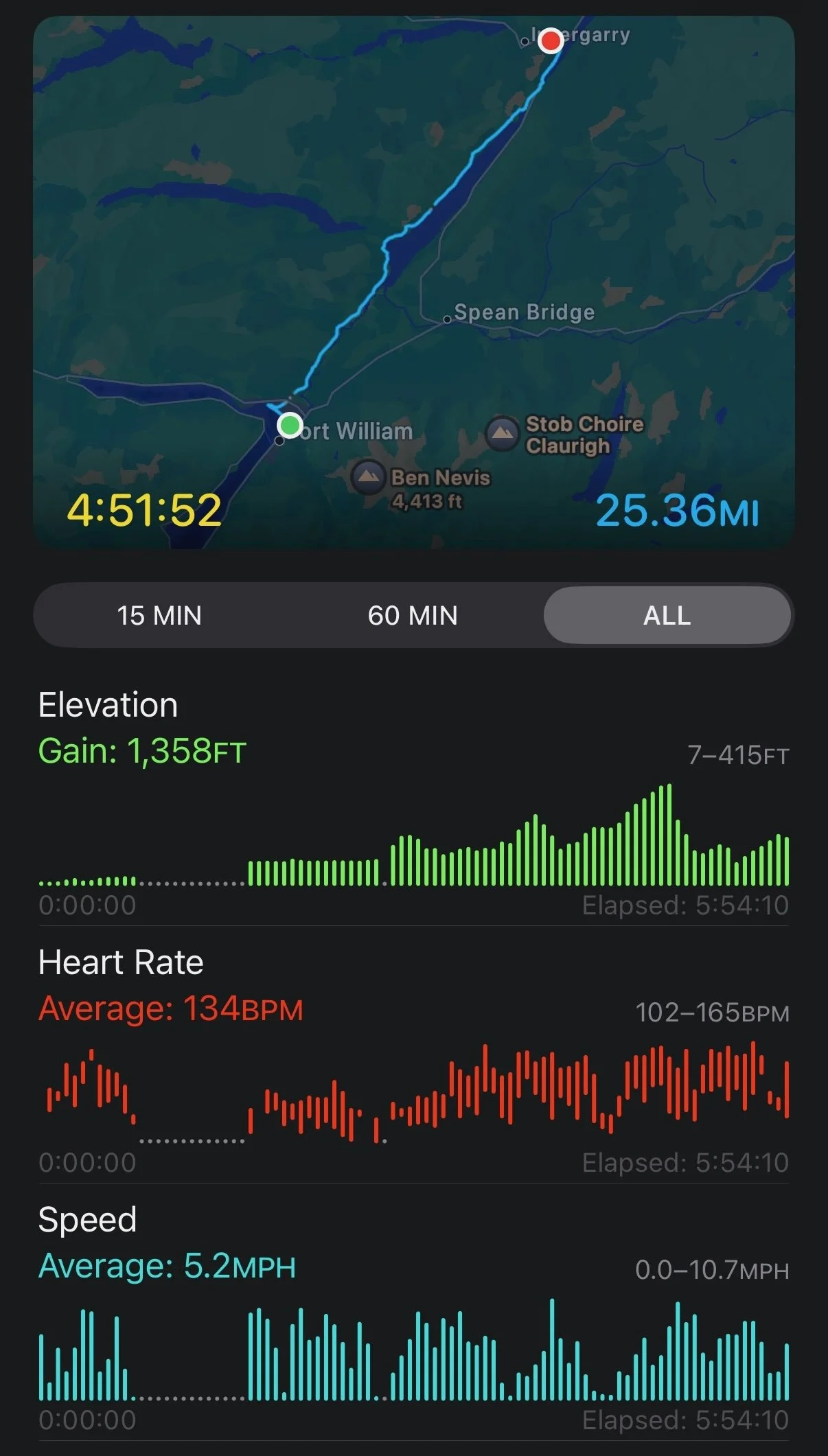
Fort William to Invergarry
Day 1 Summary
Distance travelled: 25.36 miles
Active biking time: 4:52
Total time including breaks: 6:01
Elevation gain: 1,358 ft (415 max)
Description: The Great Glen Way from Fort William to Invergarry is mostly flat and runs alongside Loch Lochy and Loch Oich. It’s generally an easy ride and serves as a great start to the trip (though, in our case, an unexpected detour caused by public works added an extra 90 minutes to our first day).
Day 1 Experience
Our first day started late, thanks to our flight into Edinburgh being delayed. Instead of picking up our bikes the day before and leaving right after breakfast, we had to get them in the morning (shout out to Damian from Off Beat Bikes for coming in on his day off to get us setup!). After getting our equipment set and our panniers packed, we grabbed some snacks and sandwiches from a nearby shop and headed out.
Damian pointed us to the starting point of the Great Glen Way near the edge of town. We easily found the first of many light blue markers to indicate the path and we were off on our adventure!
The start of our first stage took us along Fort William’s seaside. It was about 45 minutes of easy riding until we reached the first stopping point: Neptune’s Staircase (the UK’s longest staircase-style lock). Although we had barely started cycling, it was already noon, so we decided to stop at a nearby cafe for lunch.
After lunch, we set off for the rest of our day.
The section of the Great Glen Way between Fort William and Invergarry is generally described as one of the easiest, as the majority of it runs alongside the lochs and canals. Unfortunately, there was a diversion between Gairlochy and Invergarry that made our first day more difficult than expected.
The works were definitely not completed “early in 2026”
The Great Glen Way’s website provides up-to-date details on any diversions or issues with the path, so you should check it regularly in the lead up to your trip. Unfortunately for us, the recommended alternative for cyclists was not a feasible option, as we were planning to stay in Invergarry for the night. We quickly discovered why the website stated that, “…the diversion route is a little trickier to travel on a bike”.
Our easy ride along the canals was replaced with more than an hour of pushing our bikes up a hill that was too steep for my 9 year old to ride 🤦♂️.
While the detour took us further up into the hills than we had expected on day one, it wasn’t all bad news. The extra elevation gave us an excuse to pull out our sidekick for the journey: a tiny DJI Mini 3 drone.
Official videographer
This pint-sized drone is both perfect for kids while being small and light enough to not add much weight to the journey (I kept it strapped to my bike’s rack for easy access during our travels). Throughout our trip, we took countless photos and videos, which my son later turned into a short film about his adventure.
The detour provided our first look at the lochs from above, as well as the first of many waterfalls we encountered along the Great Glen Way.
Overall, the diversion probably added 90 minutes to the trek. A little intense for the first day, but nothing we couldn’t handle. After a lengthy cruise down from the hills, we arrived at the Invergarry Hotel where we unloaded our gear and enjoyed the largest plate of fish and chips my son had ever seen.

Day 2: Invergarry to Fort Augustus
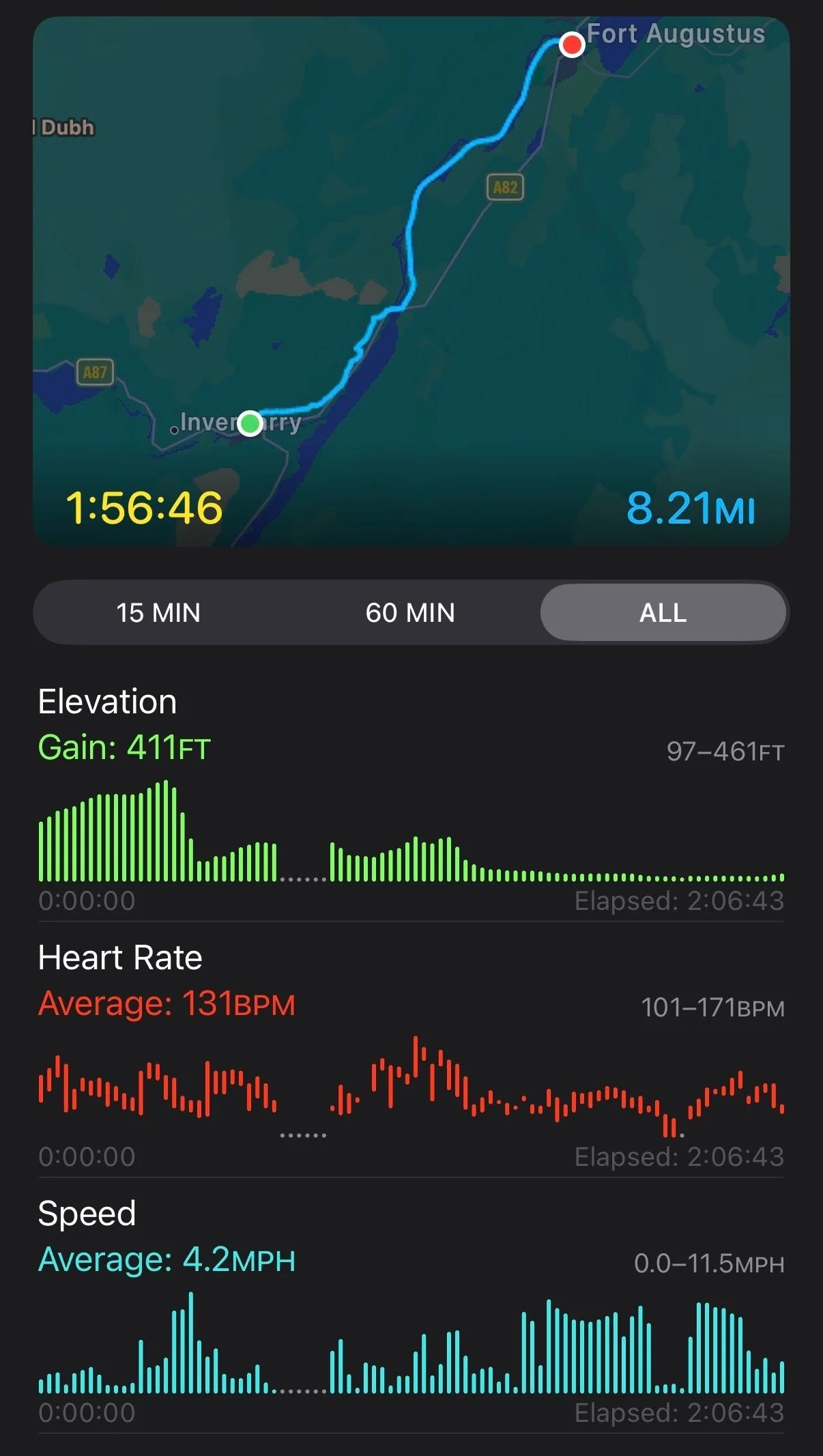
Invergarry to Fort Augustus
Day 2 Summary
Distance travelled: 8.21 miles
Active biking time: 1:56
Total time including breaks: 2:06
Elevation gain: 411 ft (461 max)
Description: The Great Glen Way from Invergarry to Fort Augustus is a short ride that starts in the hills just above the shore of Loch Oich and finishes alongside the canal between Loch Oich and Loch Ness. It’s a quick, easy trek that left us with plenty of time to explore the town at the southern tip of Scotland’s most famous lake.
Day 2 Experience
I intentionally planned for a light second day of cycling the Great Glen Way, as I figured that the combination of jet lag and a long first day might benefit from some rest.
Day 2 started with a short (~15 minute) uphill climb, followed by a few miles along a easy-going logging road.
At the top of the hill, we took a break to get some more video with our trusty drone. While getting our sidekick setup, we encountered the first of several unexpected “Top Gun” moments, as Royal Air Force jets ripped across the lochs on training runs.
Sadly, we did not get any photos of the RAF jets
After our break, we cruised back down to loch-level and leisurely cycled along the canals towards Loch Ness and into Fort Augustus in time for lunch.

The afternoon respite was appreciated by both of us after 24 hours of travel from North America and a full day of biking. We spent the afternoon exploring the town, sampling several of the ice cream shops along the canals and enjoying an early dinner at one of the local pubs.
Day 3: Fort Augustus to Drumnadrochit
In contrast to our leisurely Day 2, our third day of cycling was a long one (6 ½ hours cycling time / 7 ½ hours total travel time). I’ll break the recap into two parts, which I’ll revisit in the following section about alternate itineraries for cycling the Great Glen Way.
Day 3a (morning): Fort Augustus to Invermoriston
Day 3b (afternoon): Invermoriston to Drumnadrochit
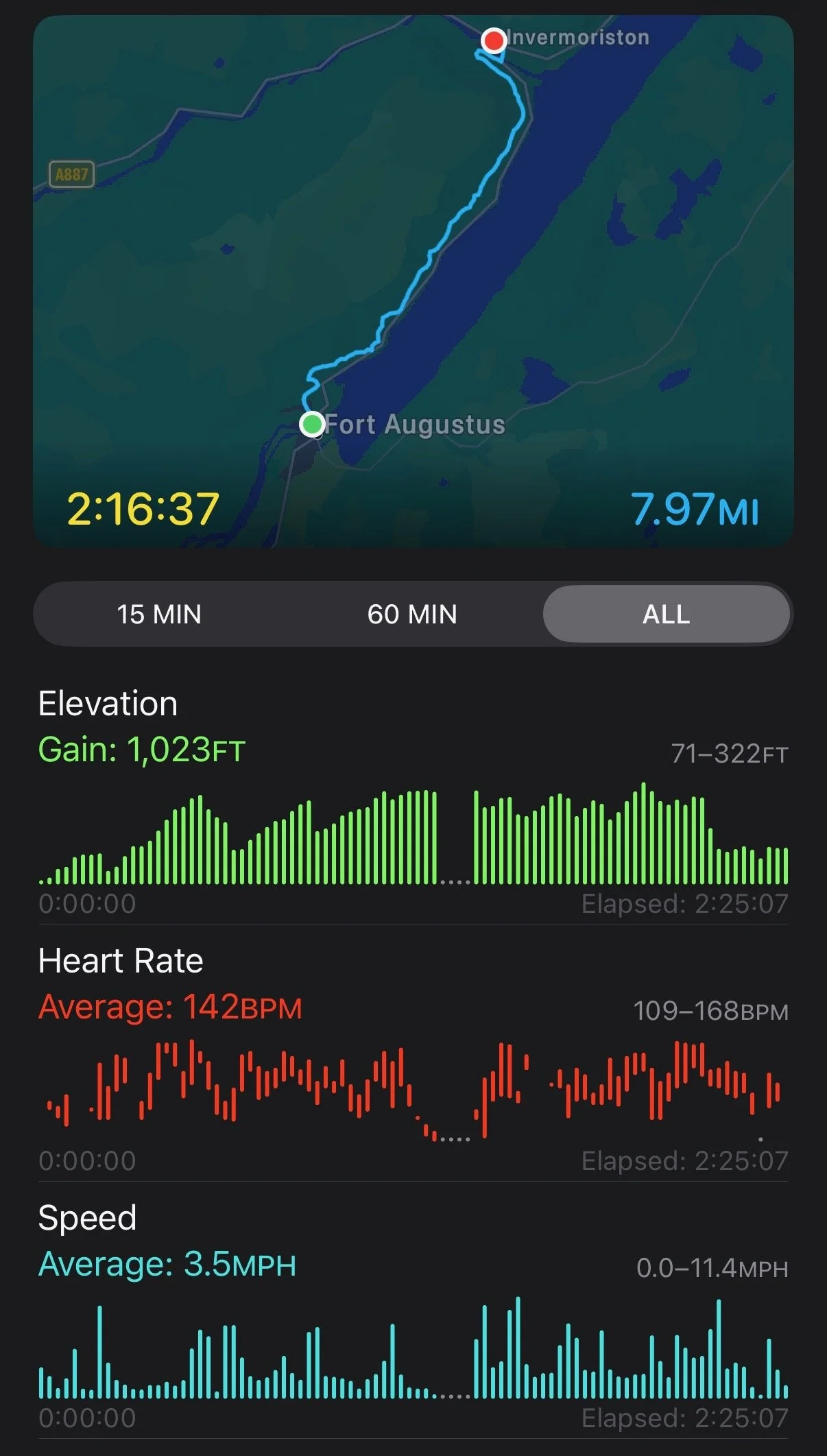
Fort Augustus to Invermorriston
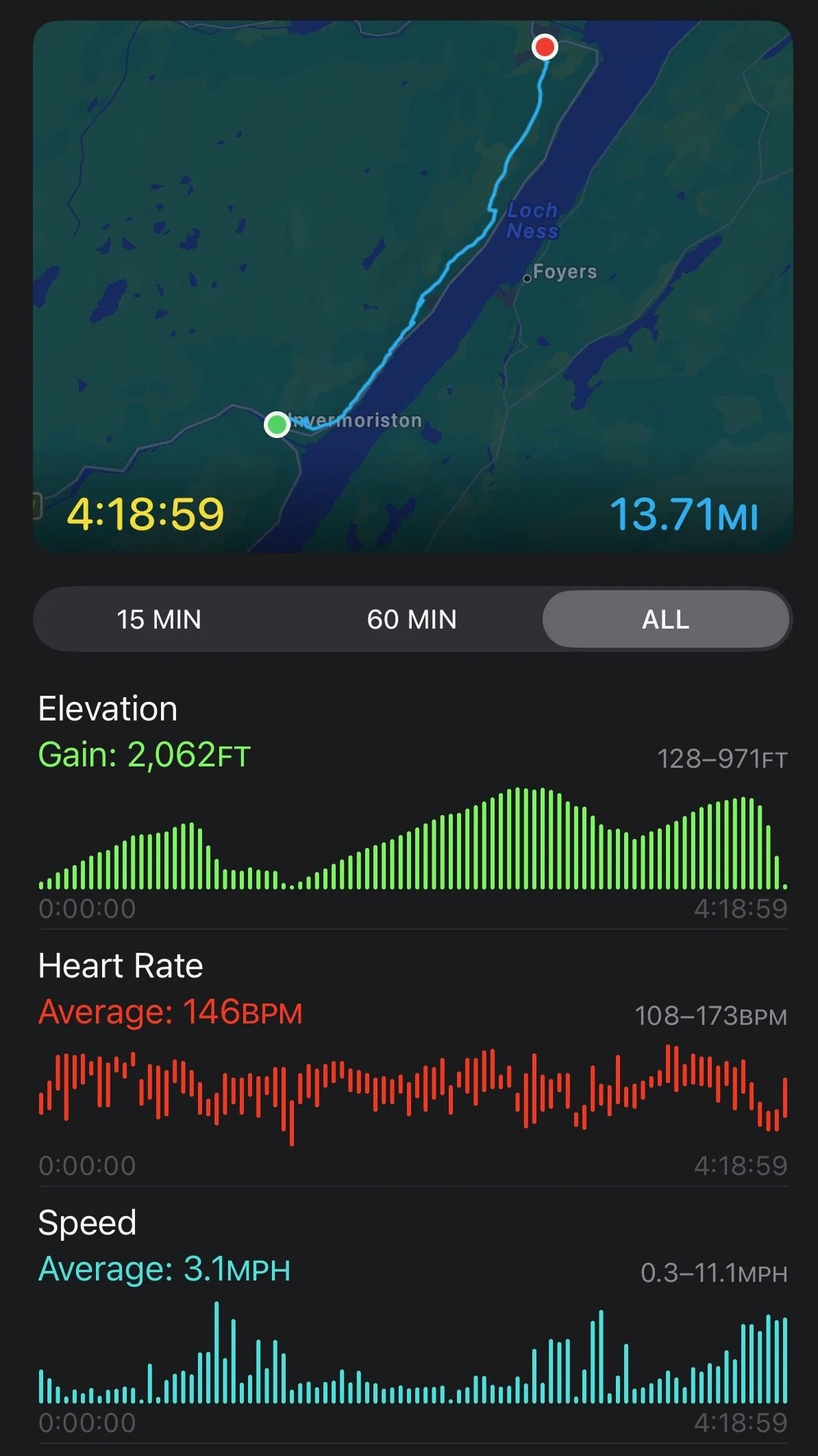
Invermorriston to Drumnadrochit
Day 3 Summary
Distance travelled: 21.68 miles
Active biking time: 6:35
Total time including breaks: 7:32
Elevation gain: 3,085 ft (971 max)
Description: The Great Glen Way from Fort Augustus to Drumnadrochit consists of two sections: a mostly flat, easy ride from Fort Augustus to Invermoriston and more challenging section further up into the hills between Invermoriston and Drumnadrochit. The second section includes several extended climbs, which gave this stage the largest total elevation gain of our journey.
Day 3 Experience
The morning section from Fort Augustus to Invermoriston (“section 3a”) was relatively easy and quite similar to Day 2. There were a few ups-and-downs, but for the most part the trail tracked fairly close to loch-level.
Along the route, we encountered the first of several “forks in the road” that form part of the Great Glen Way. Each fork leads to a “high road” and a “low road” with signage that includes detailed maps and descriptions of each route. Generally speaking, the “high roads” provide better views and scenic opportunities, but require additional climbs. In contrast, the “low roads” typically follow logging roads with easier riding but miss out on some of the views. We made a point of choosing the low roads at each opportunity, mostly because it was unclear how steep the inclines were and how much extra time they would add to our journey.
High road or low road…?
We took 2 ½ hours to complete the morning section and reached Invermoriston just before noon, stopping at a local cafe for lunch. After that, we set off on the trail to Drumnadrochit (“section 3b”).
Immediately after leaving town, you head up a set of switchbacks that go on for several miles with virtually no flats. For a strong adult rider, it would be a manageable (albeit lengthy) climb. For a 9 year old, it meant extended periods pushing the bike uphill.
Once you reach the top, you’re met with a very active logging road. The ride itself became much easier at that point and there was a certain adventure to riding amongst hundreds of giant logs.
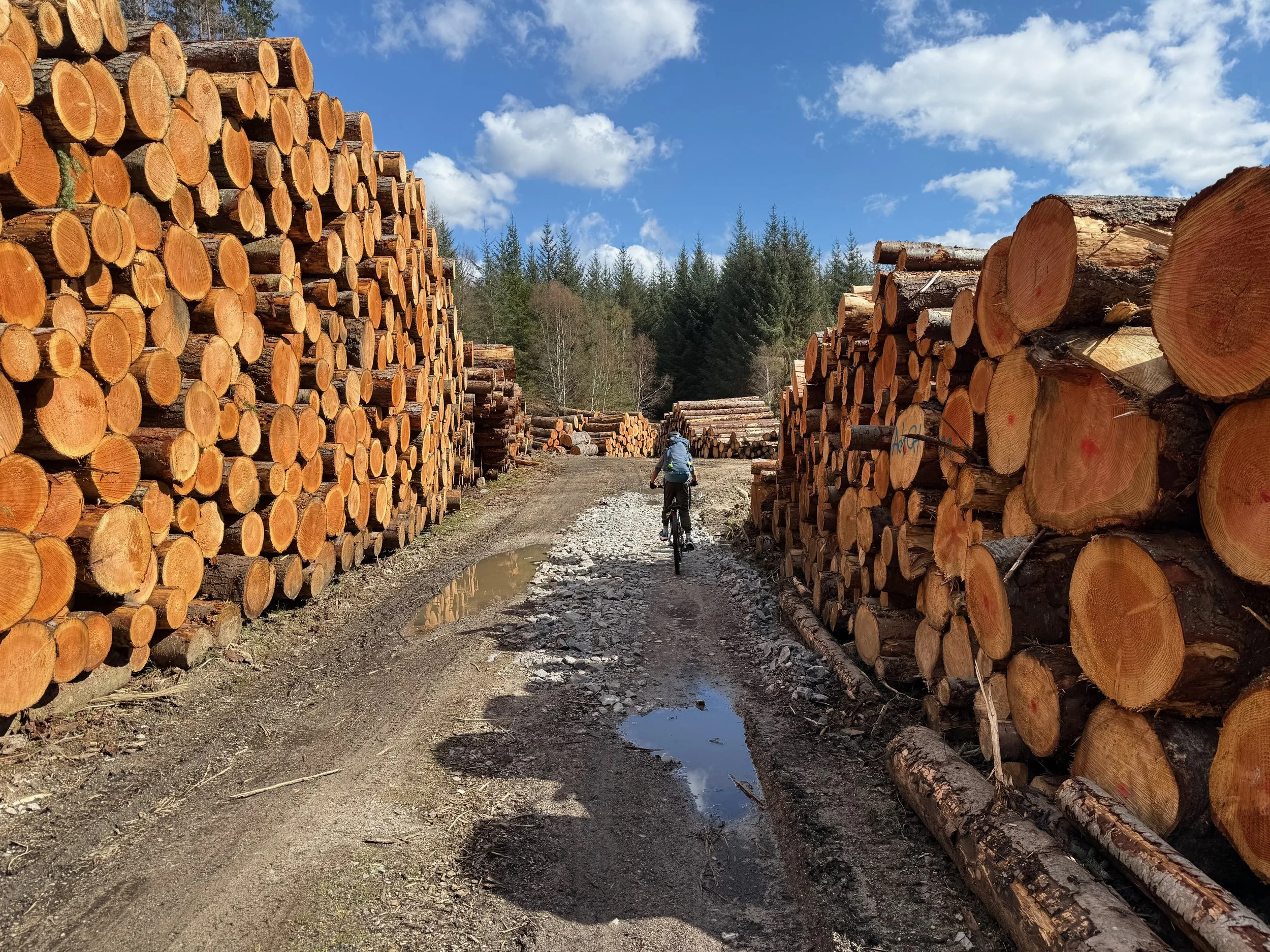
Eventually, we headed downhill, only to start another — even longer — uphill climb.
All things told, I would guess that we spent ⅔ of this section on climbs. That makes the journey from Invermoriston to Drumnadrochit one of the more challenging segments of the Great Glen Way. But there were still plenty of great moments to enjoy, including more waterfalls, bridges and viewpoints.

After a full afternoon of riding, we cruised into Invermoriston with a brisk descent and finished at the welcome sight of the Loch Ness Inn.

Drumnadrochit is the home of Urquhart Castle and the jumping off point for many Loch Ness-related adventures. Unfortunately, our late arrival left us with little time (or energy) to explore. This was the only disappointing part of our adventure — and a point I revisit below in discussing alternate routes to consider.
Day 4: Drumnadrochit to Inverness
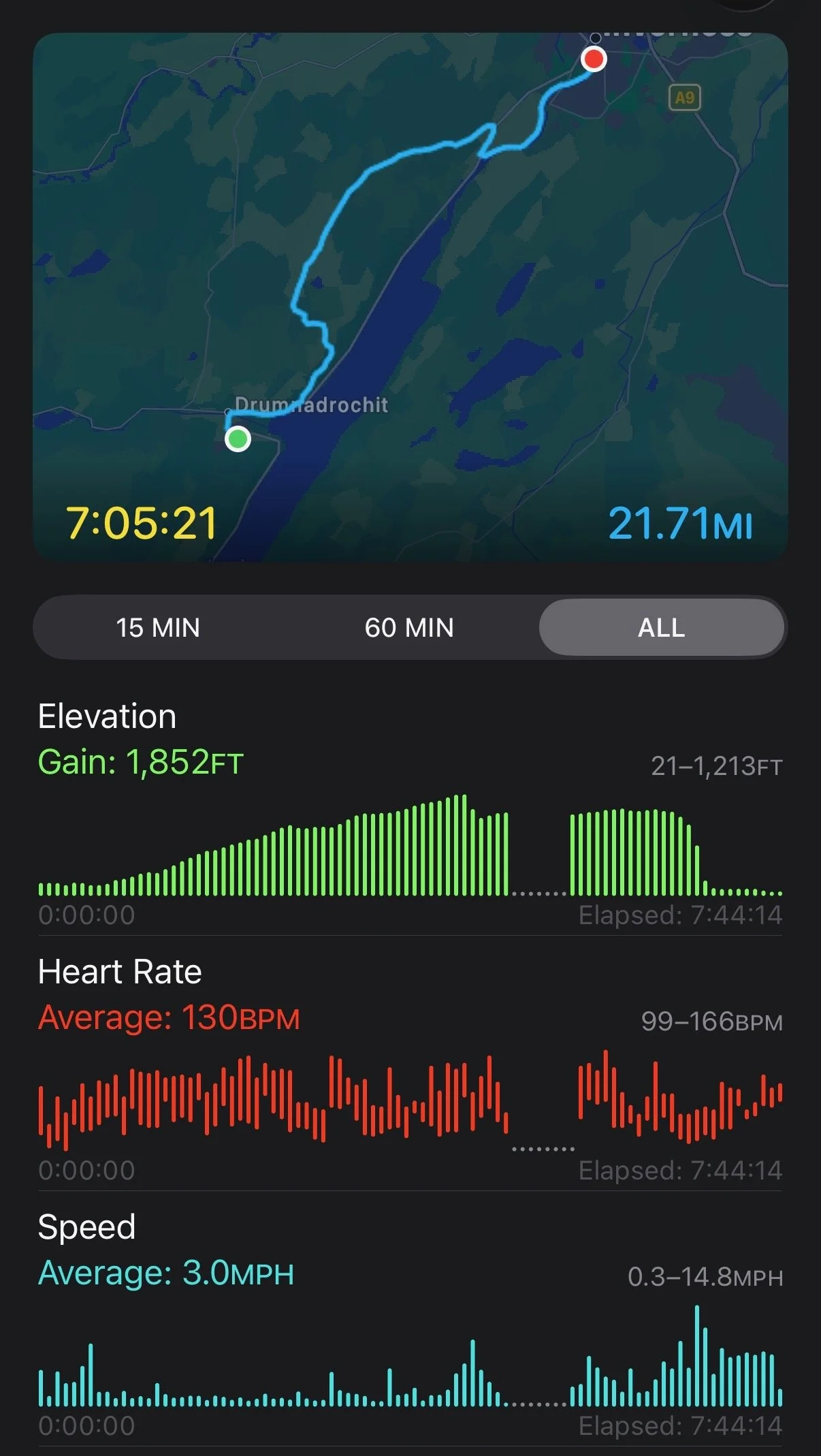
Drumnadrochit to Inverness
Day 4 Summary
Distance travelled: 21.71 miles
Active biking time: 7:05
Total time including breaks: 7:44
Elevation gain: 1,852 ft (1,213 max)
Description: The Great Glen Way from Drumnadrochit to Inverness starts with the steepest climb of the entire journey, high up into the hills above Urquhart Castle. But the climb was absolutely worth it. At the top, we were greeted with a magical forest filled with surprises that eventually opened up into a quaint farming community nestled in the Highlands. After a brisk descent back down to loch-level, the final stretch on a running path alongside River Ness led us to our final destination: Inverness Castle.
Day 4 Experience
The final stage of the Great Glen Way had the most challenging start to any of our stages, starting with a steep climb from Drumnadrochit high up into the hills above Loch Ness. The early part of the trail was clearly designed for hikers rather than mountain bikes, which meant a lot of walking and a few situations where I had to push both bikes uphill (as my son could not physically lift his bike up some of the gnarlier segments).
More climbing
Even though the initial climb was tough, there was plenty to see along the way that kept it enjoyable. The trail passes by many farms (and lots of sheep!) and we got buzzed a few more times by RAF jets whilst we were walking along. The forest eventually flattens out, leading to some great riding with a few unexpected surprises along the way (which I won’t spoil).

After awhile, the forest gives way to a country road that winds through a quaint farming community. The plateau views above Inverness are stunning, though it’s quite windy (so be prepared). We spent about an hour riding amongst farms before our final reward: a massive paved downhill towards Inverness.
(Note: the final descent towards Inverness is a significant downhill on an active road, so make sure your child is comfortable riding roads with steep downhill gradients safely.)
At the bottom of the hill, there were a few final miles of flat riding on a running path alongside the River Ness before we finally reached the city of Inverness.
The official end of the Great Glen Way is at Inverness Castle. But across the street, the folks at the Castle Tavern happily give out “certificates of completion” to kids who successfully complete the Great Glen Way. We sat down for a well-earned pint / juice and celebrated our achievement before heading to our hotel for the night.
Alternate Itineraries for Cycling the Great Glen Way
Having completed the Great Glen Way, there are three alternate itineraries that I would consider with kids, based primarily on the difficulty of section 3b (Invermorriston to Drumnadrochit) and the impact it had on our time in Drumnadrochit:
Alternate Itinerary #1 (4 Days)
The first alternate itinerary I would consider would shift the segment from Fort Augustus to Invermoriston (our segment 3a above) to Day 2. Whilst we absolutely loved the Lovat Hotel and a shortened Day 2 served as a welcome respite after an unexpectedly difficult Day 1, it left us with such a long third day that we had no time to enjoy Drumnadrochit.
That meant we didn’t have time to explore Urquhart Castle, take a boat trip onto Loch Ness, or search for Nessie. Which really wasn’t cool.
This alternate route would be:
Day 1: Fort William to Invergarry (Medium without diversion / hard with diversion)
Day 2: Invergarry to Invermoriston (Medium)
Day 3: Invermoriston to Drumnadrochit (Medium)
Day 4: Drumnadrochit to Inverness (Hard)
Alternate Itinerary #2 (4 Days)
A number of itineraries posted on the internet start with Day 1 going all the way from Fort William to Fort Augustus. I think this would actually be a reasonable approach, provided that there is no diversion in place.
The first segment would certainly be lengthy, but given that it’s almost entirely flat (without a diversion in place) it wouldn’t be much harder than what we encountered with the diversion.
This alternate route would be:
Day 1: Fort William to Fort Augustus (Hard without diversion / not recommended with diversion)
Day 2: Fort Augustus to Invermoriston (Easy)
Day 3: Invermoriston to Drumnadrochit (Medium)
Day 4: Drumnadrochit to Inverness (Hard)
Alternate Itinerary #3 (5 Days)
If your schedule allows, completing the Great Glen Way across five days instead of four is another option that would allow for even more time to explore and enjoy the lochs and highlands.
In this case, I would suggest completing the stage from Fort Augustus to Drumnadrochit across two days (i.e. splitting up our stages 3a and 3b above):
Day 1: Fort William to Invergarry (Medium without diversion / hard with diversion)
Day 2: Invergarry to Fort Augustus (Easy)
Day 3: Fort Augustus to Invermorison (Easy)
Day 4: Invermoriston to Drumnadrochit (Medium)
Day 5: Drumnadrochit to Inverness (Hard)
Packing for Cycling the Great Glen Way
When it comes to traveling with kids, packing is always a challenge. Do you bring more clothes and extras knowing that likely things are going to go wrong, or do you pack lightly and deal with the consequences?
Coming across the Atlantic, we travelled with two large backpacks (rucksacks), containing all of our clothes, toiletries and biking necessities, a few items for the long airplane rides (e.g. headphones and books) plus my work necessities (work-appropriate clothes, laptop, etc.). If it weren’t for the fact that this adventure was combined with a work trip, we probably could have cut our weight by half, but it was nonetheless manageable.
My son had an Osprey Ace 38L backpack while I used my wife’s Osprey Fairview 40L travel backpack (which is a much more appropriate size for cycling than my significantly larger 65-liter hiking backpack.)

Walking to the plane
As I mentioned earlier, I rented panniers (saddle bags) for my bike. This was specifically because I knew that our backpacks would be far too heavy to wear on the ride. Each morning, we transferred the majority of our clothes and all of our heavy items (electronics, extra shoes, etc.) into the panniers, leaving us with relatively light backpacks for the day. We also picked up sandwiches and some snacks each morning, which went into the panniers.
(I should note that there are courier services available that will transport luggage between towns along the Great Glen Way, but that wasn’t something we looked into.)
Essentials
I won’t go into full details about each-and-every item we packed. What I will say is that you should think in terms of layers when packing clothes (if you spend any time in San Francisco, you know what I’m talking about). We each had short-sleeve and long-sleeve shirts, a warmer sweater / sweatshirt, a light jacket and a couple of pairs of comfortable athletic pants. We added and removed layers multiple times each day in response to the changing weather and wind. We also each had two pairs of shoes (one pair of rugged, all-weather hiking shoes for riding and another pair of shoes for walking around) plus extra socks just in case.
In addition to clothing and toiletries, key items we packed included:
Water containers (either a hydration pack for your backpack or a very large water bottle)
Sunscreen
Bug repellant (there are lots of midges depending on the time of year)
Hiking/athletic snacks (energy bars/chews/gels/etc.)
Basic bike repair knowledge (make sure you know how to perform basic repair tasks, including replacing a flat tire and resetting a chain that falls off)
And, most importantly: patience.
It goes without saying that, as a parent, you need to approach an adventure like this with the right mindset. Even if it’s not physically challenging for them, riding the Great Glen Way is mentally challenging for kids. Take as many breaks as you need to. Indulge in whatever distractions and exploration they want to do. Don’t worry if you’re “on time” for anything. And definitely don’t skimp on giving out snacks (there’s no reason for anyone to be hangry!).
Things We Didn’t Need to Pack But I’m Glad We Did
There were a few things we didn’t use and/or weren’t strictly necessary, but I’m glad we packed. These included:
Rain clothes — We each had a pair of easy-to-pack waterproof pants and a rain jacket from REI. We never needed to pull them out — as it only ever rained lightly during our travels — but given the unpredictable weather in Scotland, I’m glad we had them (more on that below).
Small medical kit - Thankfully, we had no injuries, but making sure you’re prepared for the unexpected is important with any adventure.
Power bank - My Iniu 65W power bank added another extra couple of pounds of weight to the load. While we never used it, my phone was close to 0% on several occasions (in no small part due to the many photos and videos we took). We often went for hours without seeing anyone else, so I would have hated to not have a phone available if an emergency took place or something went wrong.
Drone - Definitely not a “must have” but it certainly added fun to the trip. We brought our small DJI Mini 3 drone with us and used it during many of our breaks to document the journey. (In the UK, you are required to have a drone license in order to operate a personal drone, so if you bring one make sure that you and your kids complete their online “driving tests”.)
Baseball gloves - My son loves playing baseball and didn’t want to “miss out” on any practice time while we were in Scotland. We brought along our gloves (and a ball) and attached them to the panniers with carabiners. They were a bit bulky on some of the narrow trails, but I was happy to carry them for some more father-son moments.
Books - My son reads a lot. As easy as it would have been to pack a Kindle, my wife and I had long ago decided that we were going to prioritize physical books as a key part of his learning experience. And he definitely read a lot that week.
An extra 5 pounds that I was (mostly) happy to carry
Accommodations for Cycling the Great Glen Way
This is really important: you must book your accommodations for every single night of your journey in advance. In fact, you need to do it well in advance!
The towns along the Great Glen Way have limited accomodations (generally one or two small hotels, plus a handful of bed-and-breakfasts). During the high season, many of the rooms are taken up by tour groups, leaving relatively few options available for booking. If you take only one thing away from this post, it should be this: the moment you decide to cycle the Great Glen Way and choose your route, book your accommodations before doing or planning anything else!
Here are the places we stayed along our route, each of which I would gladly recommend and stay at again:
Fort William: Guisachan Guesthouse
Invergarry: Invergarry Hotel
Fort Augustus: The Lovat
Drumnadrochit: Loch Ness Inn & Bunk Inn
The Invergarry Hotel has only 13 rooms. There are two hotels in Invergarry.
Getting to/from the Great Glen Way
Traveling to and from the Great Glen Way is easy by train.
The scenic West Highland Line runs from Glasgow to Fort William and there are multiple train operators that go daily between Edinburgh and Inverness. We flew into Edinburgh airport, took a taxi to Glasgow and then rode the West Highland Line to Fort William. At the end of our ride (after a good night’s sleep in Inverness) we took the train back down to Edinburgh. In both cases, the train ride was a little over 3 hours and easy to book through ScotRail.

Weather Considerations when Cycling the Great Glen Way
The weather in Scotland can be quite finicky (though if you’re coming from Vancouver or the Pacific Northwest, you’ll be very familiar with it). We had some light showers on the first two days of our journey, but otherwise the weather was sunny and clear.
When planning to cycle the Great Glen Way, pay particular attention to the time of year and the expected weather. It is not realistic to cycle the Great Glen Way with kids if it is raining more than lightly. Aside from the fact that biking in the open rain isn’t that much fun to begin with, significant portions of the Great Glen Way are likely to be difficult, if not impossible, to traverse by bike if turned into mud — especially not with panniers.
While the sections alongside the canals are durable, the logging roads upon which much of the Great Glen Way takes place are open to the elements and not overly robust. In addition, some of the steeper trails — most notably the climb out of Drumnadrochit on the final day — would be virtually impossible to utilize in poor conditions.
Thankfully, there are options for traveling from one town to another should your plans get derailed by weather (such as buses and taxis).
Final Thoughts
If you made it all the way here, then I offer you my hearty congratulations (and thanks for reading! 🙏).
Completing the Great Glen Way with my 9 year old son was a fantastic experience for both of us. While we did have to push our bikes uphill on some of the sections, nothing ever felt unbearable. The views at the top were incredible and there were countless opportunities for exploration (including wonderful educational stations located throughout the trail).
Bottom line: cycling the Great Glen Way was a wonderful experience that I highly recommend if your kids are into biking. It takes a bit of extra effort, planning and patience to make it through the journey, but the reward in terms of their feelings of accomplishment and the memories you’ll make along the way are well worth it.
It’s fun, fulfilling, and it builds character 😉
Things I Think I Think - Q2 2026
Against the backdrop of this summer’s competition for global sport supremacy, here are 5 Things I Think I Think - Q2 2026 Edition.
There is a magical time once every 4 years when the world comes together around the beautiful game. Given all of the geopolitical changes that have taken place over the past few years, it’s hard not to smile at the fact that cohost United States will play its first elimination game today, on Canada Day, while Canada will next take to the pitch on the 4th of July.
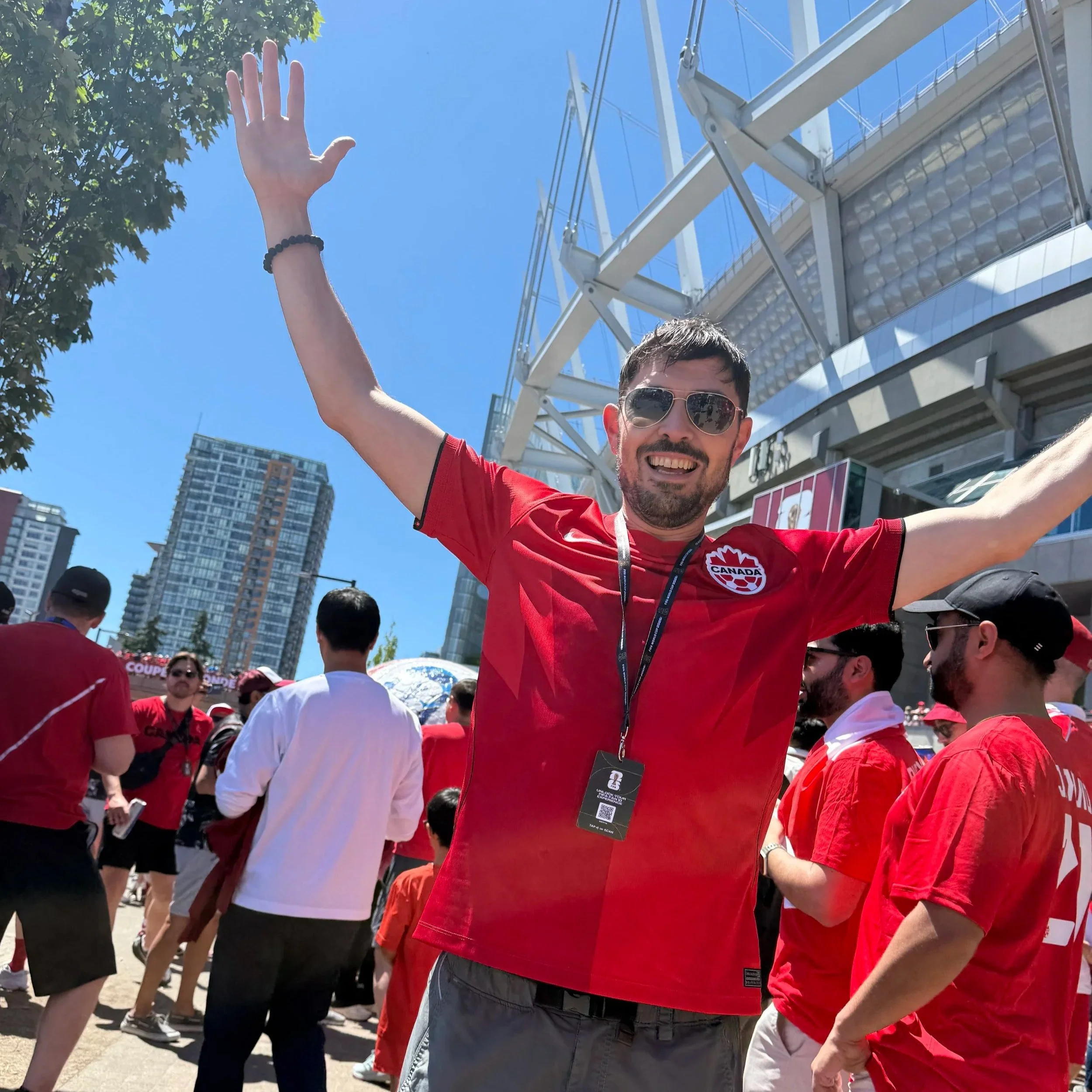
Let’s go Canada! 🇨🇦
Set against the backdrop of this summer’s competition for global sport supremacy, here are 5 Things I Think I Think - Q2 2026 Edition:
1. Fast and then Slow
The frantic pace of investment that characterized the first quarter of 2026 continued into Q2. Megafunds, in particular, continued to throw around their proverbial weight, with numerous preemptive rounds happening at the start of the quarter (especially at Series A and B). I suspect that when the statistics for Q2 eventually see the light of day, we’ll see that valuations for the top 5% of companies continued to climb sharply through Q1 and into Q2.
But a funny thing happened as May rolled around: the pace of deals started to slow. Gradually, then suddenly.
In particular, the preemption of Series A and B rounds that was prevalent during the first third of the year dropped off rather dramatically towards the end of Q2. I watched a number of VCs that had been aggressively pursuing preemptive deals downshift their activity mid-quarter. Almost in sync, a number of founders I know who were looking down the barrel of preemptive term sheets stepped back from the alter, with plans to revisit in the fall.
It’s not often that you see VCs and founders adjust their activities in parallel. In my inaugural “Things I Think I Think” post back in 2023, one of my observations was about Canadian founders lagging in their acceptance of and adjustment to changes that were happening in the market post-ZIRP. So what happened in Q2 was quite unusual (but something I view as a strong positive). It wasn’t so much a correction in the fundraising market as a mutual, unspoken agreement by both sides to hit the pause button.

Coming into Q2, I had spoken with both VCs and founders who felt that they had no choice but to play the “preemption game”. As alluded to in my Q4 2025 update, investors fearful of missing out on the next OpenAI or Anthropic were driving “…a degree of preemption and FOMO for hypergrowth AI startups that’s on par (if not greater) than what happened during ZIRP.” At the same time, a number of founders I spoke with felt like they had an obligation to entertain preemptive investor interest. Many of them were spending considerable cycles on investor meetings even though they already had plenty of money in the bank.
By the time June came around, the slowdown in activity had expanded well beyond the “cease fire” in preemptive investments. Many VCs I know — from Pre-Seed to Series B — had all but stopped taking new meetings by the start of June. Perhaps it was a similar desire to hit pause and revisit their AI-related investment theses. Perhaps it was simply a weariness after more than a year of frenetic activity. Regardless, this summer is going to be a particularly bad time to fundraise (but a great time to be heads down on your business).
2. The IPOs are Coming! The IPOs are Coming!
Q2 saw the first of three potentially massive tech liquidity events with SpaceX’s record-breaking IPO. But it was the other two IPOs on the horizon — from Anthropic and OpenAI — that had a more immediate impact on the behavior of many VCs.
As I alluded to above, a lot of the high-octane investor behavior over the past year has been driven by VCs desperately trying to replicate investments in Anthropic and OpenAI. Both companies have achieved unprecedented user adoption, revenue growth and — most appreciated by investors — valuation growth (aka markups). And, until recently, both seemed on a path that would quickly translate those paper gains into similarly unprecedented IPOs (DPI!).
But what seemed like surefire wins suddenly became not-so-certain. Anthropic’s smooth sailing hit bumpy seas as it repeatedly found itself in conflict with the U.S. government, while ongoing questions about OpenAI’s business fundamentals has led to speculation that it may delay its IPO until 2027.

Pete the Cat, early-stage VC
As the shine began to come off these two industry darlings, VCs slowly started to remove their rose-colored AI glasses. The slowdown in preemptive activity I described above was very much triggered by the recognition that, despite their unprecedented growth trajectories, the path from inception to IPO for AI-based companies is still a bumpy one.
To be clear, investors are by no means giving up on AI (many are still wearing very thick rose-colored AI glasses, albeit with a slightly lighter tint). The fact that Anthropic and Open AI have hit bumps in the road won’t damper VC enthusiasm for AI’s industry-disrupting potential. Rather, investors are adjusting their expectations when it comes to the trajectories of these companies, particularly as it relates to time-to-liquidity. Ultimately, that will affect the rate at which preemptive rounds occur and the valuations at which those rounds happen.
But make no mistake, once fall comes around, VCs will once again be champing at the bit to invest in the latest-and-greatest AI startups.
3. Agents Cross the Chasm
When I wrote my end-of-year update six months ago, nobody had heard of moltbot clawdbot OpenClaw. By Q1, prominent VCs were showing up on podcasts wearing lobster costumes. But the technology was still barely usable. We were still very much at the Homebrew Computer Club phase of the technology adoption lifecycle.
But like many things related to AI, the rate of progression from barely usable open source “projects” to relatively-stable early “products” has been unprecedented. This past quarter, a number of companies came to market with purpose-built agent products, ranging from more mature open source projects, like Hermes, to agents for managing family calendars. Howie, an email scheduling assistant that I previously wrote about, recently released “Howie Blue”, a full-blown personal agent that integrates with both email and iMessage (hence the name).
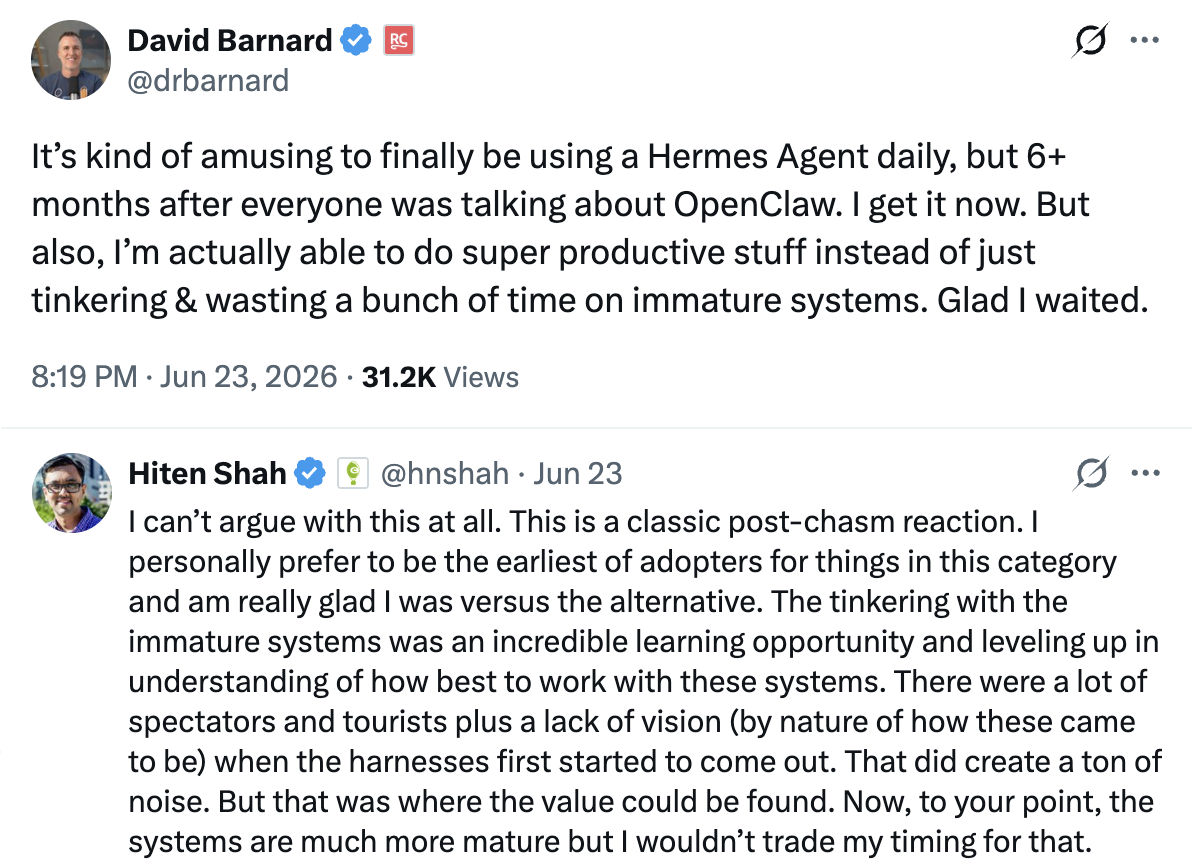
My friend Hiten did a great job of describing the value that many early adopters got from working with nascent agent platforms, though I’m not sure that the general populace had nearly as much ROI to gain from adopting the technology so early. But with so many agent-based products now coming to market, the bar has never been lower to start using AI agents.
I expect that adoption rates of agent-based products will skyrocket as we head into the back half of the year, especially in Startupland™. For founders and investors alike, the takeaway should be this: if you aren’t already using agents in some form or another (not just within your company, but you personally) take some time this summer to get started. It doesn’t matter if you’re rolling your own open source agent or signing up for one of the many turnkey solutions hitting the market. Do something.
Continuing to sit on the sidelines won’t land you in a “permanent underclass” (despite what many in Silicon Valley continue to believe), but it will absolutely leave you at an increasing competitive disadvantage.
4. Canadian VC on the Brink
For the past few quarters, the ongoing bifurcation of venture capital has led to a relatively small number of big VC firms capturing an increasing percentage of LP dollars. This shift is happening all over the world, but the particular manner in which it has manifested in Canada has the potential to completely devastate the country’s tech sector.
RBCx recently published its mid-year report on Canada’s VC market, which included a staggering claim: as of the end of 2025, the country’s emerging managers (new VCs who are on their first, second or third fund) have raised 36% less capital than projected. For a country that already has too few early-stage VCs, a lack of fundraising by emerging managers is nothing less than an existential threat to its entire tech sector.
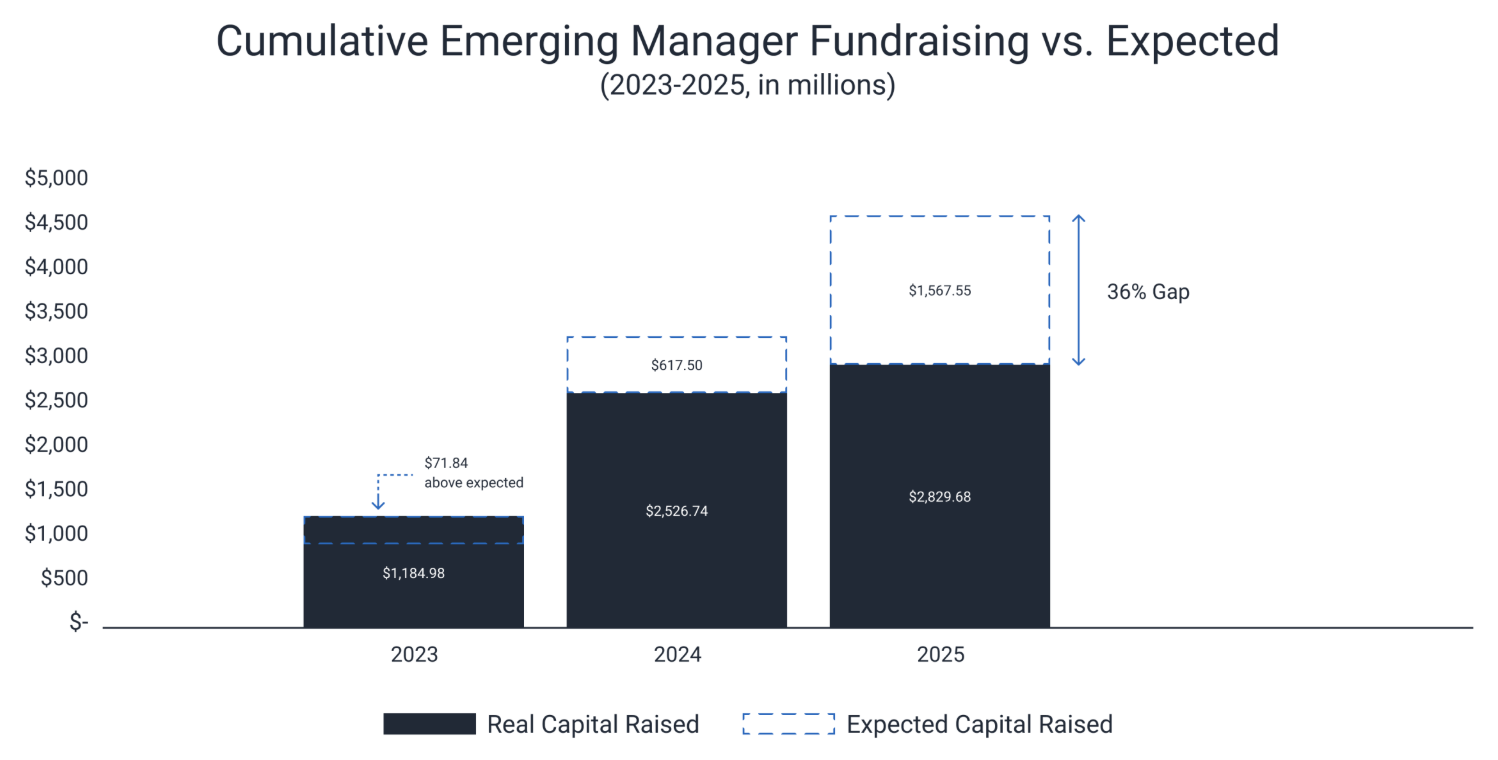
A lack of support for emerging managers isn’t a new phenomenon in Canada. In fact, I wrote about it 3 years ago. But the implications of the current prolonged drought has the country on the precipice of disaster — whether or not its leaders realize it.
Why? Emerging managers overwhelmingly invest at the earliest stages. They also tend to bring new ideas and new perspectives to startup ecosystems. That frequently leads them to be the first check into companies with very different profiles to what “old guard” VCs back, which is key to an ecosystem’s ability to innovate and drive long-term growth. Lisa Cawley, Managing Director of Screendoor, a leading fund-of-funds that invests exclusively in U.S.-based emerging managers, described the critical role of new VCs to the Wall Street Journal last year,
“New VC firms matter; they have an opportunity to drive competition and disrupt incumbent complacency. The question shouldn’t be ‘How many VCs,’ but why are there so many mediocre ones?”
That said, a dip in the number of early-stage VCs in an ecosystem typically doesn’t threaten its long-term survival. But time is not on Canada’s side. Its unique existential threat comes from the fact that its neighbor to the south is home to the tech world’s largest, fastest-moving and most risk-taking capital market. At a time when fewer Canadian VCs are willing (or able) to write the first check into first-time founders, a growing number of local founders have simply stopped looking for capital at home. Instead, they’re going straight to Silicon Valley.
And in many cases, those first-time Canadian founders are choosing to move to the U.S. as part of the process.
A handful of efforts have recently emerged trying to address the lack of capital flowing to emerging managers in Canada — notably the launch of the Canadian Startup Capital Association (CSCA) in April — but the country needs to make some bold, systemic moves fast. The last time Canada experienced a dip in the number of active VC firms, most Silicon Valley VCs were unwilling to invest in Canadian startups. That’s no longer the case.
If 2026 ends with a similar lack of fundraising success for Canada’s emerging managers, by this time next year there may not be much of a startup pipeline for the rest of the ecosystem to support.
5. We Lost a Giant
Last week, Om Malik passed away after a prolonged health battle. Countless posts and articles have been written about him in the days since. This observation from John Gruber does a good job of capturing how many of us in the tech industry currently feel,
“it is a profound irony that a man with such a big and beautiful figurative heart could have such a lousy literal one.”
I only met Om a handful of times over the years, so I can’t say that I knew him well, but his work and legacy had a profound impact on my journey.
His namesake publication, Gigaom, was unlike any other tech publication at the time (or since). It seamlessly blended the “breaking news”-style coverage of Silicon Valley that was on the rise with a deeper level of analysis — about both technology and business — that simply didn’t exist anywhere else. The approach stemmed from Om’s personal style of journalism, which Stacey Higginbotham described thusly,
“He was the smartest guy writing about really geeky tech and putting it into context. He was able to discuss the nuts and bolts of technology and then extrapolate what new advances would mean and how people would react.”
Gigaom focused primarily on infrastructure and enterprise software, which put both Aster Data and DataHero squarely in its coverage box. In 2009, the publication brought on a dedicated infrastructure/data writer named Derrick Harris, who I quickly got to know and soon became friends with. He shared his own thoughts on Om’s passing here.
For more than 5 years, my professional world existed very much within the orbit of Gigaom. I got to know many of the exceptional writers that passed through its doors and had the privilege of speaking at several of the company’s influential conferences. To this day, the way in which I view tech journalism and its potential for positively influencing the world while holding people in power accountable is overwhelmingly influenced by my years interacting with the team at Gigaom.
In a world where tech media is increasingly driven by algorithms and agendas, the type of deep, thoughtful writing that Om championed is frustratingly hard to come by. If you haven’t already checked out Crazy Stupid Tech, the blog Om launched last year with Fred Vogelstein, I strongly encourage you to do so.
The Cost of Hubris
Founder hubris can be deadly for startups. Here's how to identify it early and avoid its consequences.
A few weeks into my first batch as an EIR at 500 Startups, we held a week-long series of talks about fundraising. In those days, fundraising best practices weren’t as widely known as they are today, so the topics we covered were new to virtually all of the founders participating in the program.
Towards the end of the week, I was chatting with Marvin Liao — head of the firm’s flagship accelerator — when one of the founders approached us to discuss his fundraising process. This particular founder was one of the strongest in the batch. He had bootstrapped his company to an impressive amount of revenue, enough so that he should have been able to easily raise a competitive Seed round. But there was a catch.
Despite being part of a mentorship-based accelerator, this particular founder had zero interest in listening to anyone’s advice.

On that particular day, this founder came towards us not to ask questions, but to vent. You see, he had just returned from Sand Hill Road after pitching a top tier VC — his dream investor — and, suffice to say, it did not go well.
Why not? For starters, this founder hadn’t spent any time preparing his fundraising pitch. He hadn’t worked on it, refined it or practiced it. Not once.
Despite an entire week of programming about fundraising, and despite partner-after-partner-after-partner urging him to hold off on meeting with any VCs until he was ready, this founder decided that he knew better then everyone else and sauntered into the offices of [redacted] without so much as a slide.
And he totally, completely, unequivocally sh*t the bed.
It was so bad that the partner he met with at the tier one VC texted Marvin immediately after the meeting to ask, “What the hell was that dumpster fire?”

Watching this founder recount the experience to us was like watching a car wreck in slow motion. His reflection on what went wrong (or, more precisely, his complete lack of self-reflection) was astonishing to me. The entire conversation consisted of him complaining about how clueless the VC was, without so much of a inkling of recognition that he might have gone in unprepared.
When he eventually finished venting and walked away, I stood there with what must have looked like an utterly gobsmacked look on my face. Marvin turned towards me, smiled, and whispered,
“There’s always one.”
After the founder left, I asked him to explain.
“There’s always one,” Marvin continued. “One founder who thinks they’re special. One founder who thinks the rules don’t apply to them. One founder who thinks they know better than everyone else.”
“Every. Single. Batch.”
As my tenure at 500 Startups continued, I was astonished by the accuracy of Marvin’s observation. Every single batch, there was a founder who did this. A founder who took the accelerator’s investment, accepted a place in the batch, and immediately upon arrival decided that they needed none of the advice or education the program had to offer.

Hubris is a funny thing. You have to have a certain amount of hubris to start a company to begin with — entrepreneurship demands the audacious belief that you can create something out of nothing — but the line between confidence and cockiness is a thin one. And landing on the wrong side of it can have a detrimental impact on the trajectory of your company. Whether you realize it or not.
In the 10+ years since that first encounter, I’ve seen similar stories play out time and time again. Oftentimes when founders fall victim to hubris, the results are fatal to their startups. Those that do manage to survive frequently end up so far off course that the company never comes close to reaching its full potential.
I’ve observed some patterns when it comes to founder hubris and wanted to share them in the hope that I can help you to avoid its trap. Here are some common themes I’ve seen over the years:
Early Success
I’ve found that disproportionate hubris is often present in founders who achieved uncommon early success and/or hit significant milestones on their first try. Examples include:
Unusually strong early user or revenue growth
Unexpected virality or marketing notoriety
An unusually easy first fundraise
Founders who achieve such quick wins without realizing how unusual they are often attribute their early success to skill rather than other factors (such as luck, preexisting connections or just good timing). The result is frequently a form of complacency — sort of like when you ace the first few quizzes in a class, get used to how easy it is, and presume you don’t have to study for subsequent ones.
Charisma
In my experience, there is a strong correlation between a founder’s charisma and the likelihood that they develop hubris early in their journey. This is especially pronounced when they have an easy time raising their first round of funding.
In most cases, the initial round of funding (angel and/or Pre-Seed) is driven by narrative. Many founders with strong charisma have an easier time raising their first round specifically because of their storytelling and persuasive abilities. Where things can go sideways is in subsequent funding rounds, when investment decisions are driven more by analysis of early traction, unit economics and so on. I’ve seen many founders who breezed through their Pre-Seed round run full speed into a brick wall when raising subsequent rounds specifically due to a lack of preparation caused by hubris. Moreover, many such founders vastly overestimate the degree to which they can overcome weaknesses in their pitch and/or business with their charisma.
Small Town Founders
This might seem paradoxical, but I’ve found that early hubris is more common in founders who come from outside of Silicon Valley than in founders based in the Bay Area. For as confident and cocky as some Silicon Valley founders come across, they tend to be very well informed about the competitive landscape and the expectations of both customers and investors. Founders from smaller cities — especially ones who get early wins — are often disproportionately lifted up by their ecosystem and can unknowingly end up with big-fish-in-small-pond syndrome before achieving any actual success.
Many years ago, I was introduced to a promising young founder from a small ecosystem whose SaaS startup had surpassed $1M ARR in their first year (this was well before the rise of AI, when doing so was really, really hard). In discussing their early traction, it was immediately obvious to me that the company had a leaky bucket caused by an incredibly high churn rate. Although top-line revenue was growing, it was driven by unsustainable marketing spend. I tried my best to encourage this founder to address the company’s churn rate and its unit economics before approaching Silicon Valley Seed VCs (as they would immediately dig into whether or not the revenue was “real”), but she would hear none of it. Bolstered by local cheerleaders, startup awards and fawning media coverage, she went out and spent nearly 9 months trying to raise a Seed round. Despite countless VCs giving her nearly-identical feedback, she was unwilling (or unable) to change course. The fundraise ultimately failed and the once promising company was acqui-hired shortly thereafter.
Solo Founders
Solo founders are particularly prone to falling victim to hubris because they often don’t have voices around them to provide critical feedback and who they are willing to listen to. I’ve seen many solo founders over the years who simply ignored feedback from employees, advisors and even investors if it didn’t reinforce their preconceived views. When hubris raises its ugly head, it’s almost impossible for someone new to pierce the veil. In contrast, a trusted cofounder can often break through all but the most stubborn cases of intransigence.
One last point before I close — in Silicon Valley, hubris doesn’t just prevent you from hearing helpful advice or critical feedback. It can close doors that you never realized were open. Pay-it-forward culture is a very real thing. But an important corollary is that in an ecosystem filled with people who genuinely want to help, immediately rejecting advice or feedback that doesn’t reinforce your previously-held beliefs sticks out like a sore thumb.
If you read my post from a few weeks ago on snakes and ladders, what I’m talking about here is access to ladders. Many of the people trying to help you can also point you to a ladder, but whether or not they do so will depend on how you react. You don’t have to agree with everyone who offers advice or opinions (in fact, you most certainly shouldn’t). But you should at least listen to what they have to say. Otherwise, you will likely never know what other help they might have been willing to offer.
Instead of pointing you towards a ladder, those individuals will simply redirect their time and efforts towards one of the thousands of other founders hungry for their help.
When it comes to startups, the cost of founder hubris is high. And over time, it also compounds.
On Resilience, Rockets and IPOs
Plenty of stories have been written about the history of SpaceX. This is not one of those stories.
Plenty of articles have been written about the history of SpaceX. Stories of how the company nearly failed after its first three rockets exploded. About how it almost ran out of cash during the financial crisis and Elon Musk had to borrow money to keep it afloat. About how its recent IPO minted the world’s first trillionaire.
This is not one of those stories.
Nearly 25 years ago, I arrived at Stanford as a wide-eyed Canadian kid excited to study computer science at one of the best schools in the world. I did my undergrad at Simon Fraser University, which I imagine was a pretty typical CS experience in those days (insofar as the computer science kids were mostly the weirdos in the corner who no one else talked to).
Stanford was different. Most people truly have no idea just how special a place it is. At Stanford, everyone is an uber nerd in whatever field they chose to study. Computer science was one of the larger graduate programs in those days, but there were programs and sub-programs for just about every field imaginable, from financial mathematics to international policy.

There’s no drive in the world quite like this one
Almost everyone at Stanford lives on campus, so you meet all sorts of exceptional people from different programs. I ended up with a bunch of friends who were in aeronautics and astronautics (colloquially knows as “aero-astro”). Kids who were studying to be literal rocket scientists.
Masters degree programs are generally short (1-2 years), so it wasn’t long before conversations shifted from how excited we all were to be at Stanford to what we were going to do next. As graduation approached, I noticed that many of my aero-astro friends didn’t have the same level of excitement as the rest of our group. I recall asking one of those friends about his post-Stanford plans. He shrugged his shoulders,
“There aren’t that many good jobs,” he lamented. “You can work for a bloated dinosaur like Lockheed or Northrop, try to get a government job (NASA, ESA, etc.) or go into academia. That’s about it.”
I was pretty shocked to hear him say that. These were some of the smarted people I had ever met, yet there seemed to be no path forward in their chosen field other than becoming a cog-in-the-wheel at a giant corporate. At a time when fast-growing software companies like Google, Amazon and Apple were hiring just about anyone they could, it was a sharp contrast to my own experience.
A few weeks later, I was hanging out with another aero-astro friend and again got to talking about our summer plans. She casually mentioned that she was about to join a startup. Apparently, a member of the famed PayPal mafia had a background in physics and decided to use his newfound wealth to try to start a new rocket company.
After graduation, my friend moved to LA and joined Space Exploration Technologies Corporation. That was 23 years ago.
The original SpaceX “office” was in a nondescript warehouse in El Segundo, a fairly industrial corner of west LA just north of the beach towns of Manhattan Beach, Hermosa Beach and Redondo Beach. I remember visiting it for the first time and being shocked to see a full-sized rocket being assembled just down the street from strip malls and drive-thrus.

SpaceX’s original office
At a time when Silicon Valley offices were already overflowing with perks and creature comforts, the SpaceX warehouse was an exercise in austerity. There were no foosball tables. No video games. Just computers flashing with CAD designs and piles of wires, metal sheets and manufacturing equipment. (Actually, there was one fun item in the office — Elon owned one of the first Segways and he was eager to show anyone who stopped by what the “future” of urban transportation looked like.)

Bizarrely, I once spent a Saturday afternoon driving one of these around the original Merlin engine
In contrast to typical software companies, the employees of SpaceX weren’t shipping something new every day. They didn’t get the dopamine hits from watching a new product go viral or reading the reviews about a feature they’d just released. They met up as a team each day before work, went surfing to build camaraderie (pretty cool, if you ask me) and then headed into the office to toil away. And they quietly did that for years.
The first launch attempt happened in 2006, 4 years after SpaceX was founded. The first successful launch took another 2 years. That’s 6 years from the founding of the company until the first rocket made it into orbit.
Aster Data went from founding to being acquired by Teradata in 5.5 years. DataHero was acquired 4.5 years after it was founded. It took longer for the SpaceX team to complete a single “end-to-end test” than it did for either of the startups I was a part of to complete their entire lifespan.
Now multiply that by 4.
Most people in Startupland™ can’t fathom the idea of working for a single company for more than twenty years. To be a “lifer” in tech is generally seen as a negative. The implication is that you got comfortable. You couldn’t keep up. You lost your drive and your ambition.
Silicon Valley’s culture is far more mercenary than missionary. Many engineers hop from startup to startup, collecting stock options and increasingly ludicrous salaries with little regard for what they’re actually building. The skillsets of most people in tech are so transferable and so in-demand that an incredible number move on the minute things get uncomfortable (or the moment they see a shinier opportunity). I’ve lost track of how many people I’ve met who brag about being an early employee at Uber, Pinterest or some other hotshot company, only to discover that they barely lasted a year there.
Until recently, “going to another startup” simply wasn’t possible for aero-astro engineers. For the early team at SpaceX, failure meant having to go work for a bloated corporate. Or worse, the government. There was no fallback plan.
This weekend, a number of those early SpaceX employees woke up to find themselves on the receiving end of generational wealth. Each and every one earned it in a way that few people in Startupland™ can relate to: a two decade-long grind that, for most part, was completely unglamorous. It’s the furthest thing from an overnight success that one can imagine and I am genuinely happy for each and every one of them.
At a time when AI is making it easier than ever for founders to pivot and early employees to jump ship, I’m reminded about what Silicon Valley used to be about: the weirdos in the corner quietly and unglamorously trying to change the world.
Let’s get back to that.
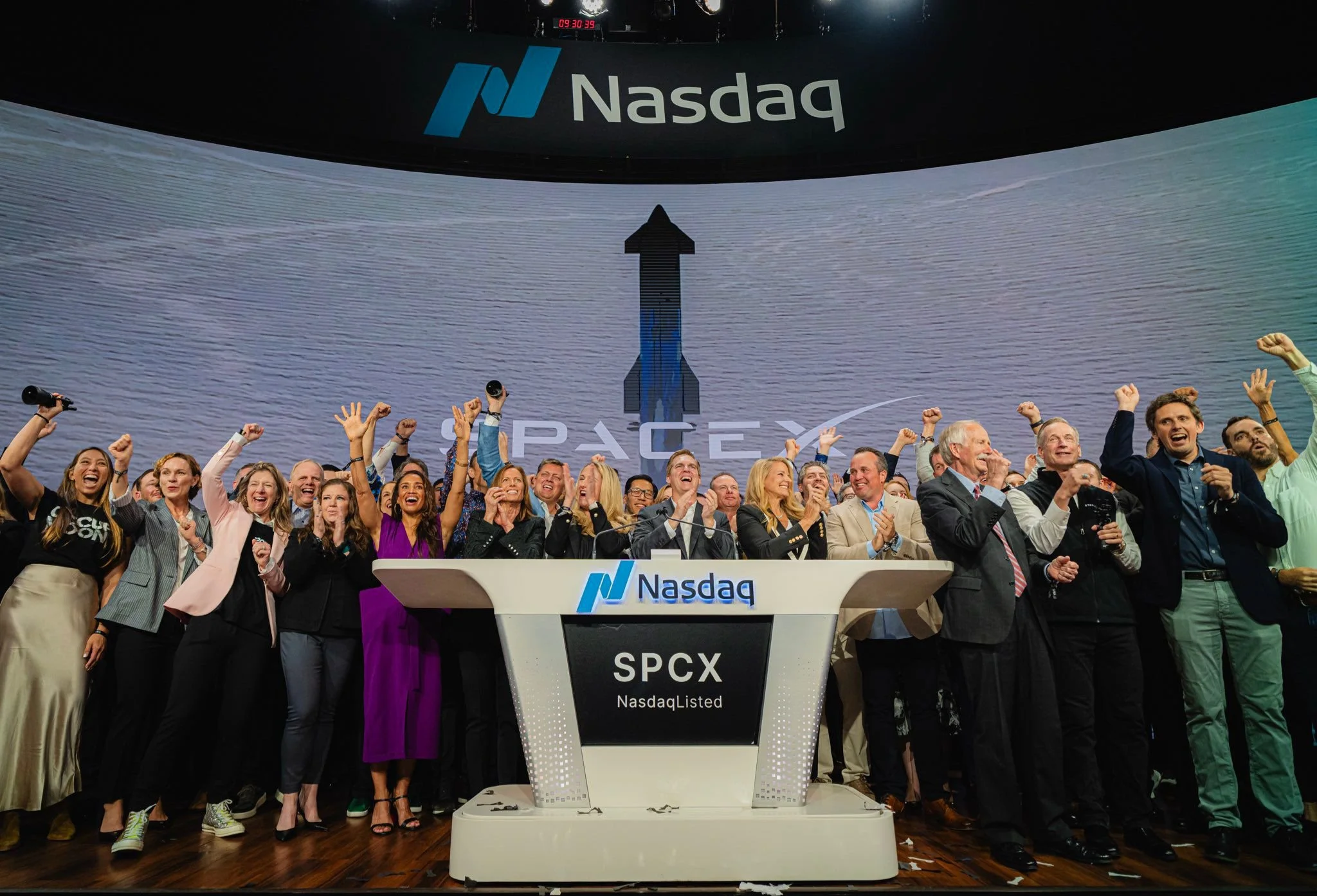
What If You Fire Them?
What happens when a VC likes the CEO, but doesn’t have conviction about the rest of the founding team?
This past week, Startupland™’s corner of social media was abuzz after podcaster Greg Isenberg posted a “horror story” from his days as a founder. As the week wore on, founders around the world quote-tweeted the original post with their own tales of VC misbehavior (yes, I’m still calling it a “quote-tweet”). Things took a sharp turn Friday morning, when Cloudflare CEO and Cofounder Matthew Prince shared some of his own experiences.
…and named names.
The third anecdote he shared — about Midas List investor Vinod Khosla — set the internet ablaze.
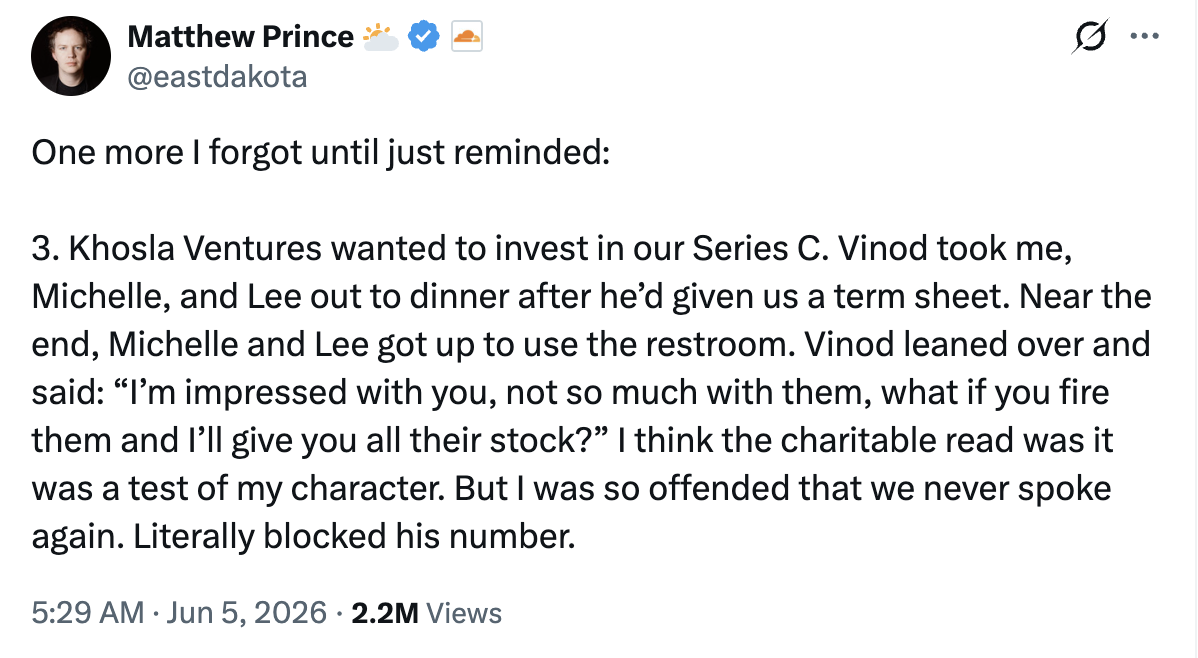
Rather than dive into the particulars of Matthew’s experience (which plenty of netizens have already done), I want to explore a topic that we don’t often talk about when it comes to startups and fundraising: what happens when a VC likes the CEO, but doesn’t have conviction about the rest of the founding team?
When it comes to fundraising and fundraising advice, we frequently talk about founders as a single unit. We refer to the characteristics of the “founding team” and write blog posts (like this one) about frameworks that VCs use to evaluate them. But the reality is that not all founders are equal in the eyes of prospective investors.
There is the CEO, and then there is everyone else.
Now, before you rush to pitchforks, it’s important to understand that there’s logic to this thinking. For starters, the CEO is (in theory at least), the person who is ultimately responsible for all decisions. The buck stops with them. Moreover, there’s a reasonable likelihood that at least one of the cofounders pitching the VC will be gone within a few years. A recent Carta report looked at more than 22,000 VC-backed companies with 2-3 cofounders. More than 25% of them had at least one cofounder leave by year 4:
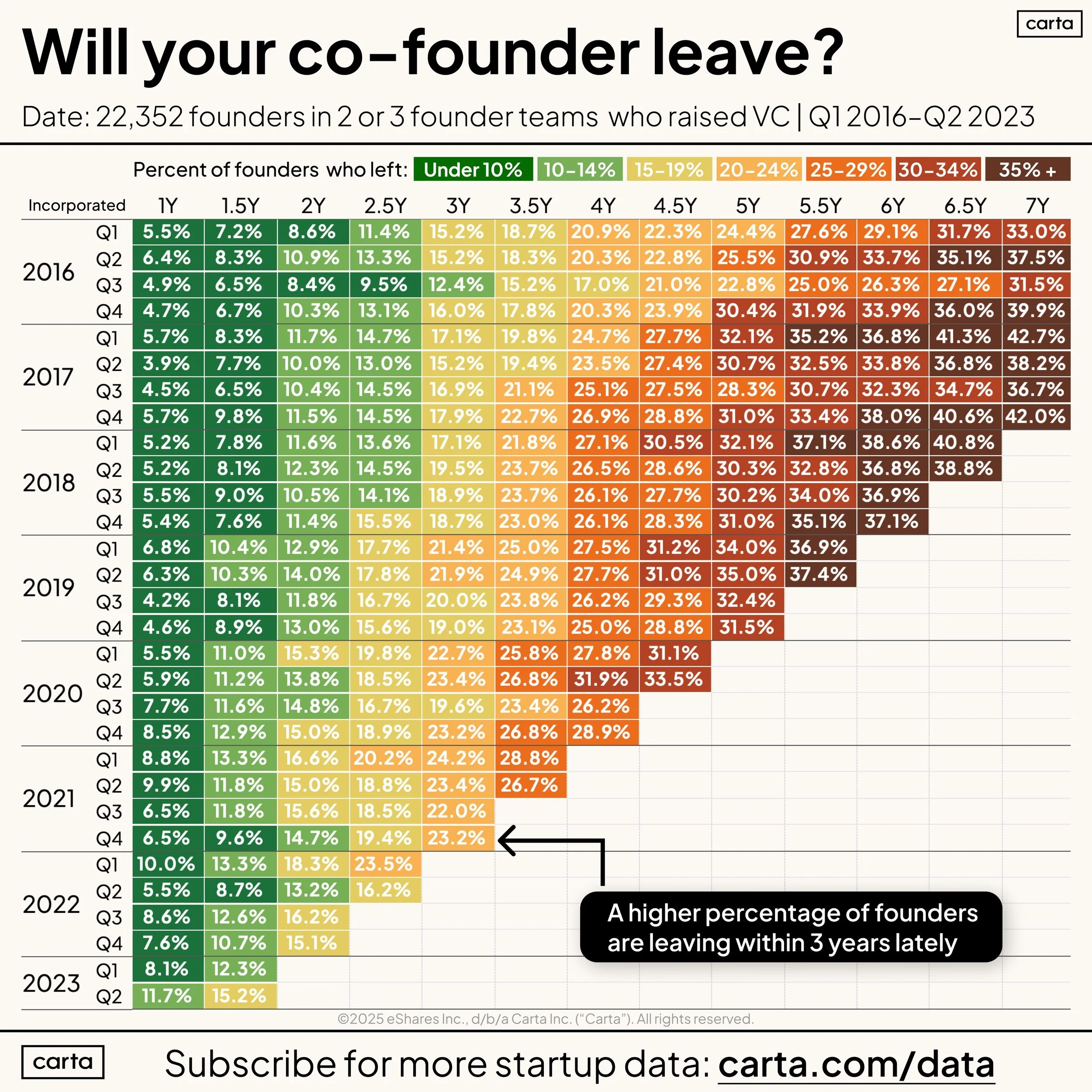
The two VC-backed companies that I was a part of — Aster Data, where I was the first employee, and DataHero, where I was the CEO — both had a cofounder leave by year 4. And many of the companies that I’ve invested in over the years have had one or more cofounders leave relatively early on.
There are wide variety of reasons why a cofounder may leave a startup, but there are several situations that occur frequently enough that VCs actively watch for them during fundraising meetings:
Interpersonal conflicts between cofounders
Lack of alignment (particularly to the company’s mission and values)
Inability to take feedback / have their assumptions challenged
Lack of growth mindset (this one is more difficult to interview for, but what investors are keeping an eye out for are signals that a cofounder might not be willing or able to evolve fast enough to keep pace with the rest of the company)
More often than not, if a prospective investors sees signs of one or more of the situations listed above, they will simply pass on the opportunity. But there is one case where some VCs will take a deeper look despite the warning signs: when they are excited about the CEO but are less infatuated with one or more of the cofounders.
Over the years, I’ve had this happen to me a number of times. After meeting an impressive CEO with an ambitious vision, strong background and clear founder-market fit, I met their cofounders and…

Believe it or not, it’s actually quite unusual to meet a founding team made up of individuals who aren’t at the same level as each other. Most high-achieving people (particularly CEOs) surround themselves by other, similarly-impressive individuals. On those rare occasions when I’m introduced to cofounders that come off as a significant step down from the CEO, it’s actually rather jarring.
My first question in such a situation is always, “did I get it wrong?” I’ll usually try to diligence the cofounder quickly (often by leveraging backchannel references) in order to figure out if my initial read was incorrect. If my suspicions are confirmed, the next question I need to answer is, “is the CEO aware that their cofounder…isn’t strong?”
Before I go any further, I want to acknowledge that this entire topic is very subjective. What I consider to be “strong” and what other people consider to be “strong” can vary wildly (which is why it’s so important when fundraising to fill your fundraising funnel with a large set of potential investors). The reality is that VC investing is far more art than science — particularly at the early stages. So while it might feel uncomfortable to think that investors are picking apart your founding team like this, understanding what’s happening (and why) can make a big difference in your outcome.
I should also point out that the stage of a company plays a big part in the ramifications of an underperforming cofounder. It is generally challenging to replace a cofounder at the early stages. On the other hand, at later stages (e.g. Series C) it’s not uncommon to see cofounders moved into different roles as experienced executives are brought in to lead specific functions. For the remainder of this post, I’ll focus on ridiculously early startups — where I spend most of my time.
In my experience, a significant “competency mismatch” between a CEO and another cofounder at the early stages usually falls into one of three categories:
The CEO is aware of the mismatch and has nonetheless chosen to cofound a company with this individual
The CEO is subconsciously aware of the mismatch but is hoping they are wrong
The CEO is completely oblivious to the mismatch
Let’s look at each of these scenarios:
1. The CEO is aware of the mismatch and has nonetheless chosen to cofound a company with this individual
In some cases, a strong CEO will intentionally choose to include one or more less experienced individuals as part of the founding team. For example, a senior CEO might have junior cofounders filling independent contributor roles, knowing that they will likely have to hire leadership “above them” at some point. Provided that there is transparency around this, it can be a healthy long-term situation (I’ve invested in several companies with this dynamic).
That said, a founding team with an intentionally large competency gap between the CEO and other cofounders can also be a strong negative signal. For example, it might indicate that the CEO isn’t comfortable managing people who are at or above their level or that they are unable to recruit strong cofounders. Both situations imply dynamics that are almost always fatal to a company, which is why experienced VCs will avoid such startups at all costs.
2. The CEO is subconsciously aware of the mismatch but is hoping they are wrong
In this situation, the CEO has a gut feeling that their cofounder might not be up to the task, but goes along with it anyways. In my experience, this mostly happens with first-time founders who haven’t previously dealt with the ramifications of an underperforming cofounder.
3. The CEO is completely oblivious to the mismatch
A great engineer will rarely cofound a company with a mediocre engineer. Similarly, an exceptional business cofounder will rarely cofound a company with salesperson or marketer who is mid. But what happens when cofounders have completely different backgrounds?
I’ve met multiple companies over the years that had an exceptional technical CEO but a goofball “business cofounder”. I’ve also met founding CEOs with incredible business backgrounds who didn’t realize that their technical cofounder was a dud.
So how do VCs deal with situations like the ones described above?
While I’ve never told a founder outright that they should fire their cofounders, I’ve have shared cofounder-related feedback with a handful of CEOs over the years. Many VCs are reticent to give feedback, but every once in awhile we meet a CEO who’s both objectively impressive and seems open to “out-of-the-box” feedback. In cases where I sense that the CEO either doesn’t realize the competency mismatch or perhaps does, but doesn’t want to admit it, I will occasionally offer feedback on their cofounders.
I only ever do this 1×1 and always verbally (either in person or on a call). But unlike the situation described by Matthew above, it’s never been as part of an offer to invest. Rather, it’s always been a follow-on conversation after deciding to pass on the company.
At the end of the day, the situation described by Matthew is an unusual one. But Vinod’s experience — of meeting a CEO that he was excited by but cofounders that he found to be less impressive — happens a lot more than you probably realize.
If you sense something that something’s off after a VC meets your cofounders, consider asking them about it. Here’s a great question to try:
“After meeting my cofounders, are you more or less likely to want to invest. Why?”
Regardless of the the outcome, you’ll learn something new.
How AI Helped Me Prioritize the Important-But-Not-Urgent
Here’s how I use AI to finish the important-but-not-urgent tasks that my executive coach couldn’t solve.
I am a huge fan of executive coaches. I think every founder should hire one as early in their career as they possibly can.
One of the most memorable conversations I had with an executive coach took place almost 15 years ago, back when I was the CEO of DataHero. On one of our bi-weekly calls, I was lamenting the fact that I hadn’t made meaningful progress on some personal goals that I had, when my coach paused me mid-sentence with a calm but piercing comment that I can still hear more than a decade later.
“The reason you haven’t made any progress,” she calmly observed, “is because you absolutely suck at prioritizing the important-but-not-urgent.”
Thanks Camille… 🤣
My coach at the time, Camille Preston, was generally soft spoken, but she didn’t mince words when she needed to get a point across. And on that day, she definitely made her point.
I was always very good at completing “P0” (top priority) tasks, but would often let “P1” (second tier) tasks languish. With her help, I developed strategies to ensure that I made regular progress on some of the important-but-not-urgent tasks on both my personal and professional todo lists. Strategies that have served me well to this day.
In the weeks that followed, many of the important-but-not-urgent tasks that had quietly lived on in my todo lists were completed, but others remained stubbornly untouched. I worked with Camille to unpack the reasons why, and eventually realized that I had been subconsciously performing ROI calculations on each task on my important-but-not-urgent list before deciding whether or not to “pop” it off the stack.

So what does this have to do with AI?
The emergence of AI — and agents, in particular — has completely upended the ROI calculations for many of the tasks that languished for months (or years!) on my important-but-not-urgent list. It’s made tasks that didn’t make sense to me from an opportunity cost perspective suddenly very reasonable. And I bet it can do the same for you.
One Example of How I Use AI
Let me share one example of how I’m leveraging AI to get important-but-not-urgent tasks done to make it real.
Since you’re reading this post, you’re hopefully well aware that I write a weekly blog post about startups, the business of venture capital and tech ecosystems (if not, go here right now and signup for my newsletter!). Every Wednesday morning, I distribute a new post that I’ve written in three ways:
I publish the original post on my website
I email a copy of it to all of my newsletter subscribers using Kit
I post a link to it on my LinkedIn page
This is certainly not the most sophisticated — or comprehensive — content distribution strategy, but it’s worked pretty well for me until now. That said, there are two additions that have been relatively high on my important-but-not-urgent list for some time yet remained untouched until recently:
Cross-posting links to new blog posts on Reddit
Repurposing old blog posts as social media content
Neither one of these tasks is particularly complex. In fact, both are well understood as low-hanging fruit for content creators who are looking to grow their audiences. So why hadn’t I done them already?
Because I was never able to justify the ROI.
Unlike a lot of content creators, I don’t generate income from my newsletter or any of the content that I create. A writer who actively monetizes their content can quite easily justify spending 1-2 hours per day strategically posting on social media or hiring a social media manager to do it for them, since it’s part of their core business, but for me the juice was never worth the squeeze. That math changed with agents.
Here’s how I now leverage agents to perform these two tasks with ease:
1. Cross-posting links to new blog posts on Reddit
One common tactic used to drive traffic to a blog is to search for active threads on social media that discuss the topic of a blog post and add a comment that links to the post. Reddit, in particular, is a very popular platform for this.
While the idea is straightforward, it’s actually very time-consuming to do it manually — particularly the process of searching for relevant threads. But AI makes it almost instantaneous.
Each time I publish a new blog post, my agent reads the post and then searches Reddit for active threads that it believes relate to the topic of the post. It returns to me a list of up to 10 posts ranked in terms of relevance, audience reach and comment quality.
For each thread, I have it come up with several draft comments that could lead readers to visit my post. Using these as inspiration, I visit each of the threads flagged by my agent, scan them briefly to make sure that they’re actually relevant, and then post a comment with the blog link.
Before AI, it easily would have taken me 2 - 3 hours per week to identify relevant threads and post comments to Reddit (which is why I never did it). With my agent’s help, it takes me about 10 minutes.
2. Repurposing old blog posts for new social media content
Another thing I’ve wanted to do for awhile is to repurpose old blog posts as social media content. At this point, I’ve got literally hundreds of posts worth of content to draw from, but it was never enough of a priority for me to justify the time it would take. Once again, AI helps me do it in minutes.
Each week, I have my agent randomly select 3 blog posts that I’ve written that are at least 18 months old. For each one, I ask it to create 3 different draft social media posts based on the content. Unlike the posts I make when I first publish the content, these ones aren’t designed to drive traffic to my website. Rather, they’re meant to elicit feedback, start conversations and (hopefully) gain a few new followers.
I specifically ask my agent to select 3 different posts so that I can choose one that feels relevant based on what’s going on in the world that week. And I ask it to create 3 distinct draft posts as inspiration, since (surprise surprise) I have zero intention of copy-pasting any of them. Instead, I choose the topic that feels the most timely to me and quickly write a social media post that’s influenced by the 3 drafts my agent created.
Once again, the entire process takes me less than 10 minutes each week (vs. several hours if I were to do it manually).
My Current Philosophy when Using AI
The examples above are just two of the tasks on my important-but-not-urgent list for which AI completely changed the ROI calculations. And I’ve got many more.
Of course, at this point you might be wondering why I bother doing any of the work myself. Why not let the agent post the comments and automate the entire process (plenty of other people have done just that)?
The answer can be found in the R ('Return’) in ROI.
First, consider the direct output of the tasks. The deluge of AI-generated comments on social media have significantly decreased their effectiveness, in no small part due to how obvious it is when a comment was written by AI. Spending 10 minutes of my time each week authoring these posts has a dramatic impact on their effectiveness (moreover, it ensures that I avoid the negative implications of my social media accounts being identified as sources of AI slop).
Second, think about the indirect benefits of performing the task manually. In the case of cross-posting to Reddit, I gain insights from reading through the threads that my agent identifies before I post links to them. In other words, the return for me is not just measured in traffic to my website, it’s in additional learnings that I didn’t previously have.
Oh…and there’s also the fact that the platforms themselves are actively working on identifying and blocking AI-generated comments:
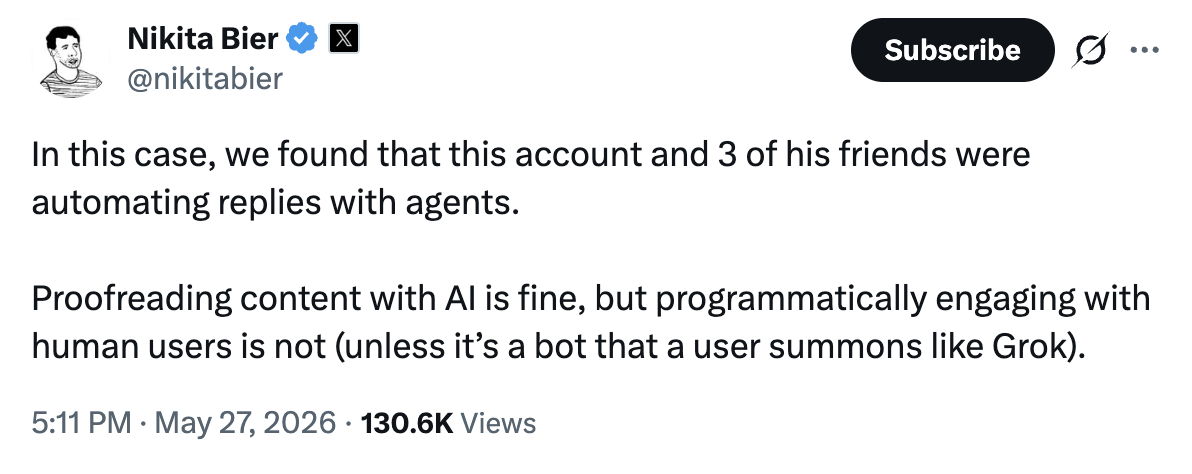
Popping up a level, my current philosophy when it comes to leveraging AI for important-but-not-urgent tasks is to automate the time-consuming parts of the task that I don’t find value in (searching for relevant Reddit threads, brainstorming how to turn a long-form blog post into a short social media post), while selfishly keeping the parts of the tasks that I do find value in (reading relevant Reddit threads, taking the time to write the final form of a post in my voice).
Garry Tan recently reflected on this in a post about near-term opportunities for agent frameworks — distinguishing between the high-value “CEO stuff” and the things that are “not fun, not interesting, but have to be done”:
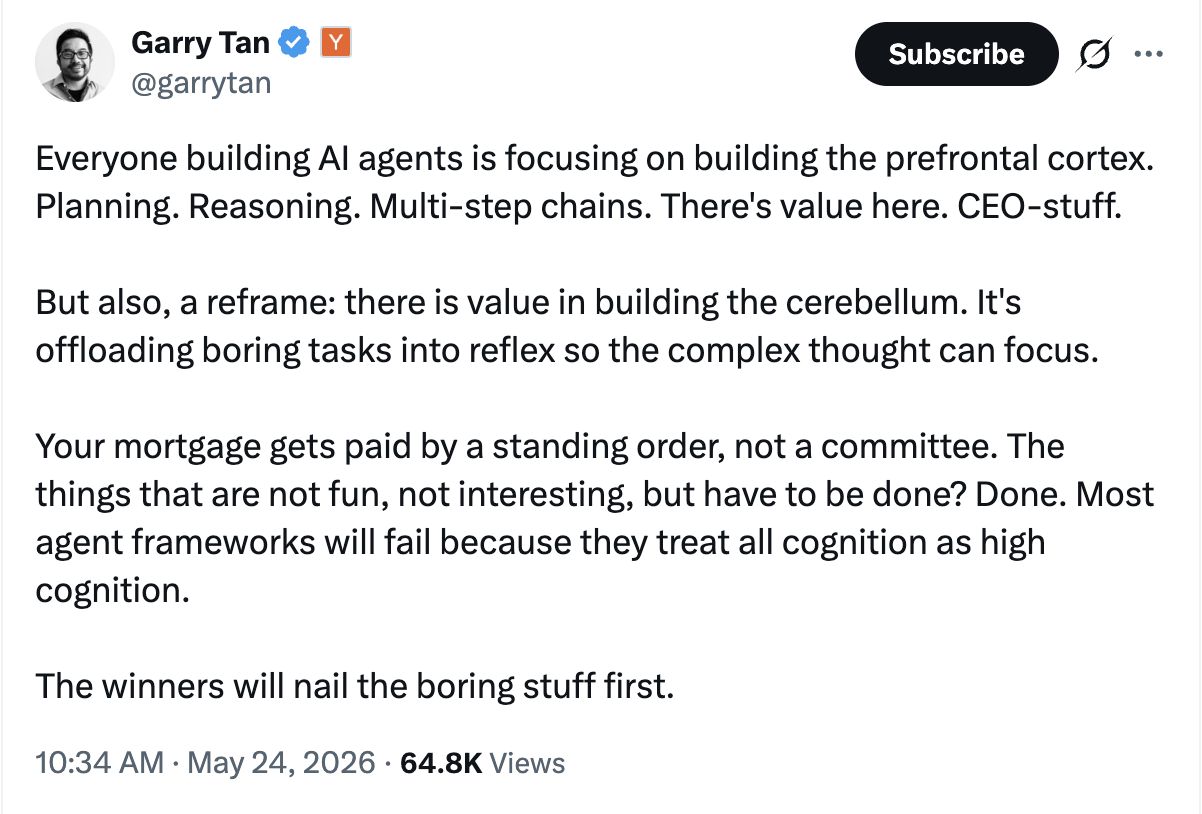
In his most recent biannual technology report, Benedict Evans described AI as “giving you infinite interns.” I think that’s one of the best descriptions I’ve heard yet (and it maps very well to how I think about agents).
The reason why so many of my important-but-not-urgent tasks languished on my todo list for so long was never because they were too hard. It was because they were too time-consuming (and from an ROI perspective, I couldn’t justify the amount of time it would take for me to do them nor the cost to hire someone else to).
But now that I have infinite interns at my disposal, I can offload the parts of each task that are “not fun, not interesting, but have to be done.” What remains is the “CEO stuff” — and a much smaller denominator for calculating ROI.
So take a look at each task on your important-but-not-urgent list and think, “if I have access to infinite interns, is that enough to finally get it done?”