Stop, Collaborate and Listen
Last week, I urged founders to ignore distractions.
“In an age of distractions, the winners will be the ones who stay focused.”
But there is a counter point to that. For there are moments in time when it’s important to stop and pay attention to what’s happening around you.

I recently caught up with an absolutely dialed-in founder whom I’ve known for many years. He’s S-tier when it comes to ignoring the noise and staying focused on whatever he’s working on (these days, it’s an algorithmic trading platform that’s crushing the intersection of DeFi and traditional finance).
When I asked him how he’d started off the year, he had this to say,
“When my team came back from the holidays, we put everything on pause. Literally everything.
We put all of our algorithms on autopilot and spent a week trying the latest versions of every tool, program and project we could find.
We tinkered as a team for a full week. My mind was completely blown by what we had built by the end.”
Coming from this particular founder — whose teams are known to push the boundaries of whatever technologies they’re working with — a statement like that made me sit up in my seat.
Not just because of what he said, but because he wasn’t the first person to have shared something similar with me over the past few weeks.

At this point, I’m old enough to have seen a lot of technology inflection points. And I have a strong suspicion that we’ll look back at January 2026 as being one of those.
From my vantage point, there are three important things that have emerged in the past few weeks:
1. AI Can Finally Write Good Code
Most developers at this point have become accustomed to using some form of AI while writing code. But for all the hype around vibe coding, anything remotely complex still required humans to roll up their sleeves and wade through muck. Remo Jansen recently described it like this,
“For over two years, I have been using GitHub Copilot extensively with multiple models, coding agents, and custom agents, and for the most part it has been hit and miss.
I usually ask GitHub Copilot to implement a feature or fix a bug using the chat or coding agent, and a lot of times it would go very wrong. I have developed the habit of staging changes before each prompt, code reviewing changes for each prompt as I go along, and rolling back via git when I'm not happy with the solution. Working like this for a while means that I have been able to develop a sense of what kinds of things will work and how to break problems into steps that make it more likely that the AI agent will do what I expect.”
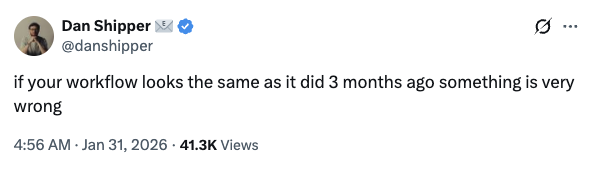
In late-November, Anthropic released it’s newest model, Claude Opus 4.5. At the time, the release didn’t jump out as particularly significant. But that was probably because it came after U.S. Thanksgiving — which meant most developers were focused on wrapping things up for the year as opposed to testing new models. As the year came to a close and we entered 2026, posts like these started to emerge:

I’m generally skeptical of hyperbole and presume most extreme reactions to new technologies are exaggerated, but then I started hearing similar sentiments from people I know and trust. Friends who spent time over the holidays to kick the tires on Opus 4.5 all had similar reactions:
“I built something I’ve wanted to do for awhile over the weekend. I’ve tried (and failed) multiple times to get it done with earlier models.”
“It’s the first time I didn’t have to spend hours reviewing and fixing the code.”
“This one’s different.”
2. The First Agent “Kit”
Almost every major technology shift includes a particular point at which the New Thing™ is made available to highly technical early adopters in a way that is (almost) turn key.
For the personal computer, it was the introduction of the Altair 8800 in 1974. The Altair 8800 was the first commercially successful microcomputer kit. You had to be incredibly technical to assemble it (and it was easy to make mistakes), but it provided the launchpad for the personal computer revolution that came after. (In March 1975, the Homebrew Computer Club held its first meeting in Menlo Park, which Steve Wozniak credits as the inspiration for the Apple I.)

Over the past few weeks, the internet has been awash with posts about Clawdbot Moltbot OpenClaw. On the one hand, there isn’t anything particularly mind-blowing about OpenClaw’s technology. After all, we’ve had agents for some time now. But if you think about it within the context of technology history, it’s an extremely significant product.
OpenClaw is the first agent “kit”.
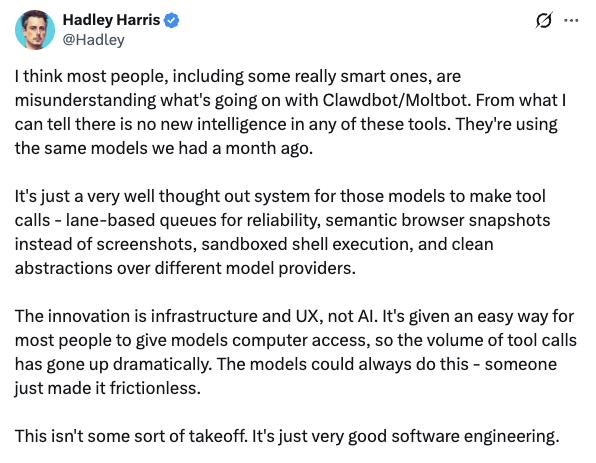
Just like the Altair 8800, OpenClaw is accessible to only highly technical early adopters (at least, for now), but those hobbyists, hackers and tinkers are swarming to it.
And while there’s an incredible amount of noise and nonsense taking place around this (*cough cough* moltbook), it’s only a matter of time before we see some of these projects turn into products.

3. Open World Games from a Prompt
On the last day of the month, Google announced “Project Genie”, an AI tool capable of creating playable open-worlds from a prompt.
And gaming stocks around the world immediately plummeted.
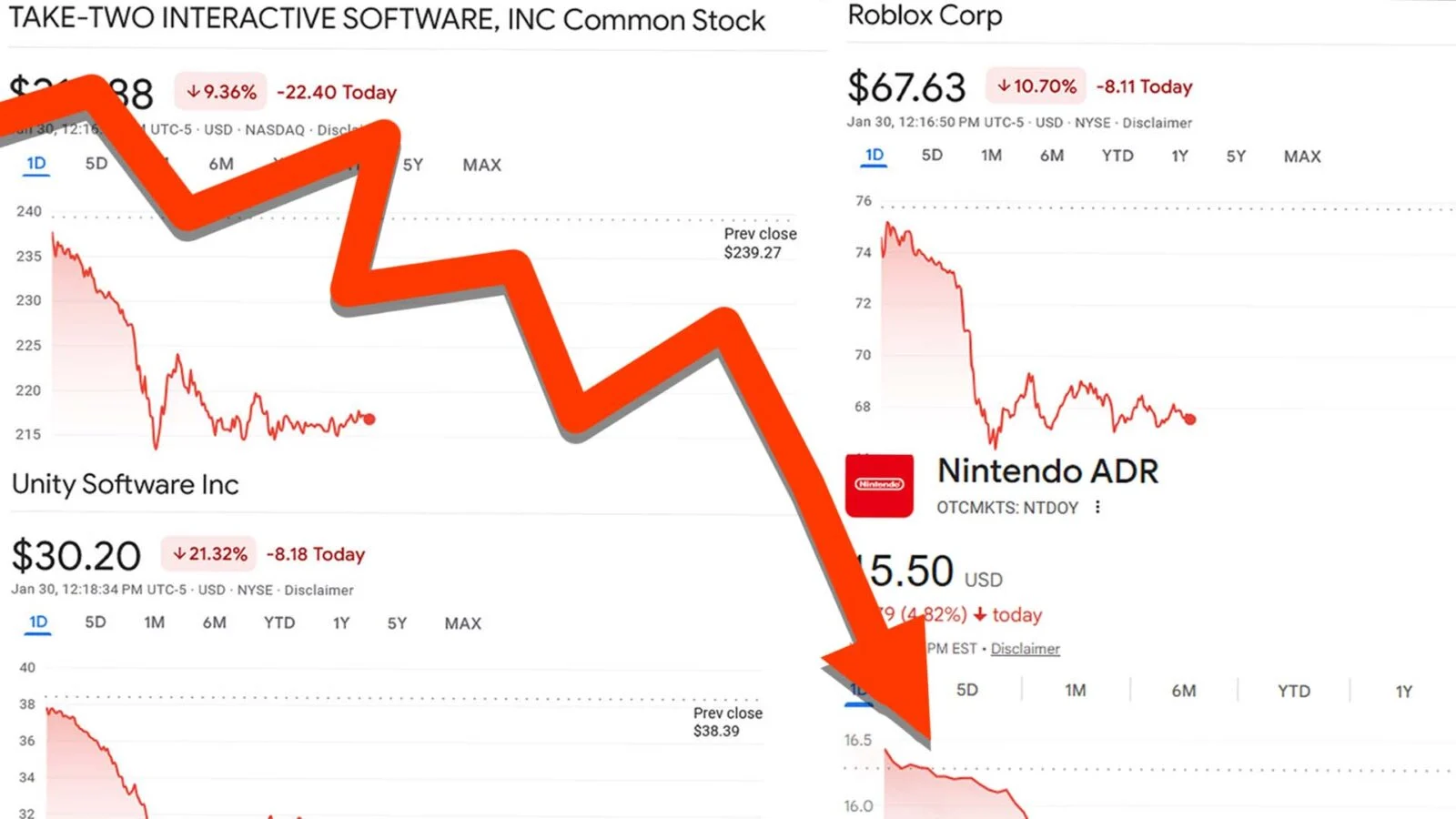
On the one hand, this might seem like a bit of an overreaction. After all, we’re a ways away from having a prompt result in a brand new end-to-end GTA game (many of my friends in the gaming industry confidently responded as much).
On the other hand, the economics of AAA video games has been upside down for many years. Costs have skyrocketed (the budget for GTA 6 is predicted to be somewhere between $1 and $2 Billion), but financial results remain highly unpredictable.
What makes the stock market response to the release of Project Genie directionally reasonable (at least, in my opinion) is that it represents an expectation that AI will have a similar impact on gaming that it already is having on general software. If we accept that a small team of highly specialized founders can create a billion-dollar software company using AI, then it’s perfectly reasonable to predict that a small team of experienced game developers will create a AAA video game using AI.
While I remain steadfast in my believe that the founders who focus will win, this very much feels like a moment-in-time when it’s important for founders to take stock of what’s going on around them.
That doesn’t mean diving down the rabbit hole of agent social networks, but it does mean checking out the latest tools. And it’s always better to do that with friends.
I’m setting aside time in the next few weeks to stop, collaborate and listen. I suggest you do too.