The Real AI Moat? Customer Support
The hardest challenge facing AI startups as they scale isn’t technical, it’s technical support.
At the beginning of the year, AI adoption started to go exponential (at least, within the consumer / prosumer segment). Opus 4.5 came out and caused developers everywhere to stop, collaborate and listen. Then Clawdbot Moltbot OpenClaw delivered the world’s first AI agent “kit”. In the months since, countless teams have worked to develop (or pivot to) personal agents.
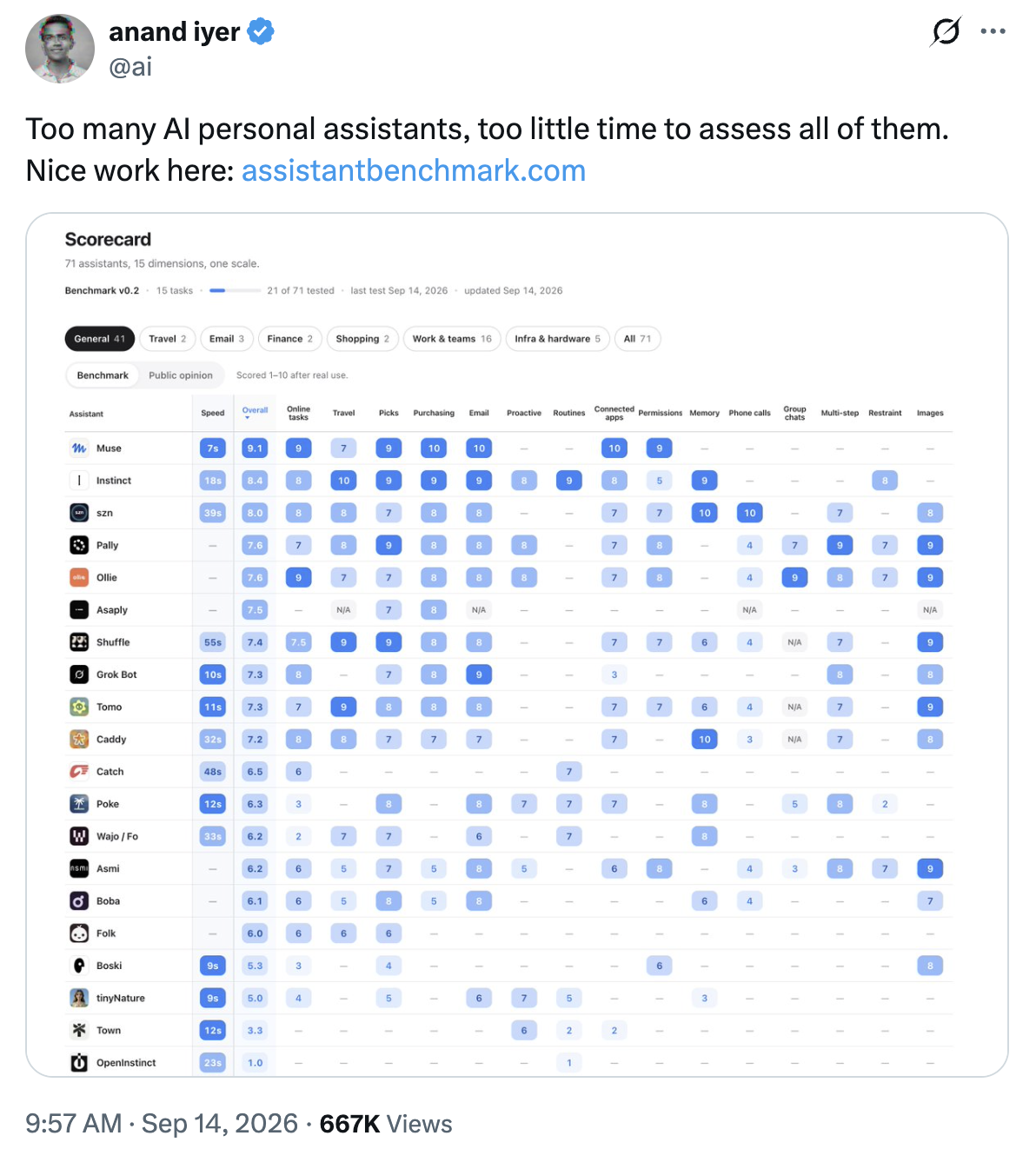
I’ve used a number of these agents to varying degrees over the course of the year and have come to two conclusions:
None of them are capable of doing everything I want them to do out-of-the-box (at least, not yet)
The hardest challenge facing these companies as they scale isn’t technical, it’s technical support
From a user/customer standpoint, the biggest difference between a framework that can be customized, like OpenClaw or Hermes, and an out-of-the-box solution is who is responsible when something doesn’t work. If I use an open source solution and it fails to do what I want, then it’s up to me to figure out how to fix it. But if you’re selling me a black box and promising that it can do all the things..?
Here’s a pattern that I’ve seen happen numerous times over the past year with personal agent startups:
Startup releases beta version of their new personal agent. The team slowly onboards a small number of users and actively solicits feedback. Everyone is extremely responsive as things inevitably break and fall down.
Agent gets released publicly. More users get onboarded. More things break. The team is still mostly responsive, but those responses take longer to get.
User growth goes parabolic as the new agent goes viral. Almost all effort goes towards keeping the platform up. Lots more things break. Lots more tickets get filed. And the team can’t keep up.

Cricket’s the name. Jiminy Cricket.
As a former founder, I’m incredibly empathetic to this plight.
In the early stages, it’s very likely you don’t have anyone dedicated full-time to technical support. It’s almost always the engineers and cofounders pulling double-duty to respond to customer complaints and feature requests (perhaps with the help of some triaging agents). For traditional startups, this approach usually works. But that’s because the surface area of “things that can go wrong” is relatively focused.
AI products are a different beast. For starters, their general-purpose nature dramatically increases the number of things that can go wrong (instead of naturally clustering around a handful of features, as is the case with traditional software).

That’s hard enough. But when you layer in the potential to quickly scale users, a fire hydrant of feedback is almost inevitable.
As an aside, a unfortunately large segment of Startupland™’s has been gaslit into believing that customer support should be a low priority.
This goes all the way back to the days when Google first launched Gmail in “beta” and basically put a sign on the front door telling users, “if something goes wrong, it’s not our problem.” Coming out of Covid, we saw many Web3 founders do the same thing: spin up a discord server, drop in once a week to check things out and call it a day. (What do you mean we need documentation? We wrote a white paper! 🤦♂️)
In markets that are highly-competitive — like almost every AI-related market currently emerging — that’s simply not going to be good enough. Especially when switching costs are almost non-existent.
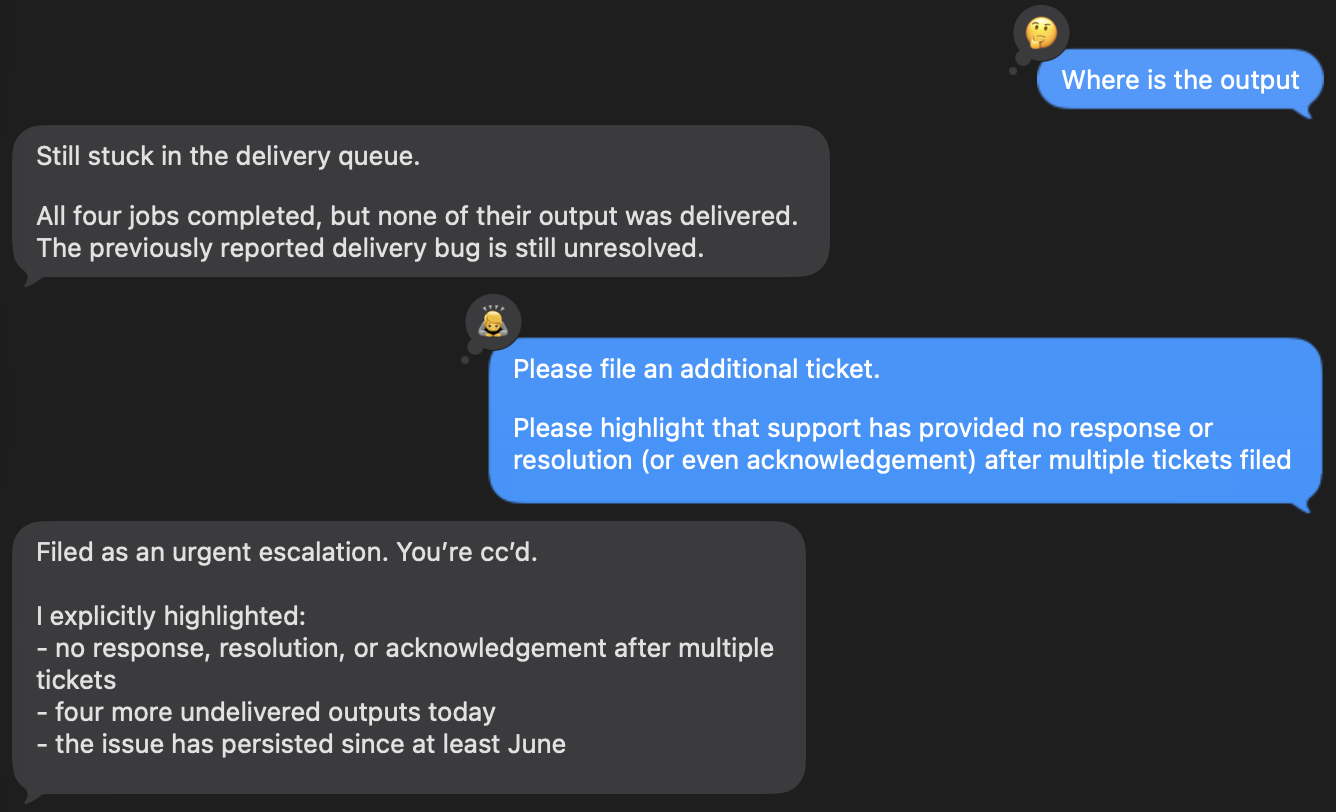
The solution? Prioritize customer support early.
In the early days, your customer funnel is guaranteed to be leaky. Simple yet effective communication goes a long way when it comes to building good will from early adopters. Which in turn results in those early adopters giving you more time and leeway to address their concerns.
But one-on-one customer support doesn’t scale (especially not if you go viral!), so you need to prepare. Here’s how to do that:
Make sure you have a customer-facing ticketing solution before you launch. It could be a traditional third-party solution or something home grown and integrated with your product. But there has to be a way for customers to check on the status of a ticket they previously filed.
When customers (or their agents) file a new ticket, make sure that receipt of the ticket is immediately acknowledged and comes with instructions on how to track it.
Provide status updates. This is the obviously the hard part if user growth is skyrocketing and you can’t keep up, but finding a way to let customers know that you haven’t forgotten about them is crucial. Even if those updates are automated and mostly mea culpas (“we’re trying our best!”).
Be honest when setting expectations. If you know that you won’t be able to get to a particular fix or feature for awhile, let customers know. If you have to back out a new feature because it broke in too many places, that’s okay too.
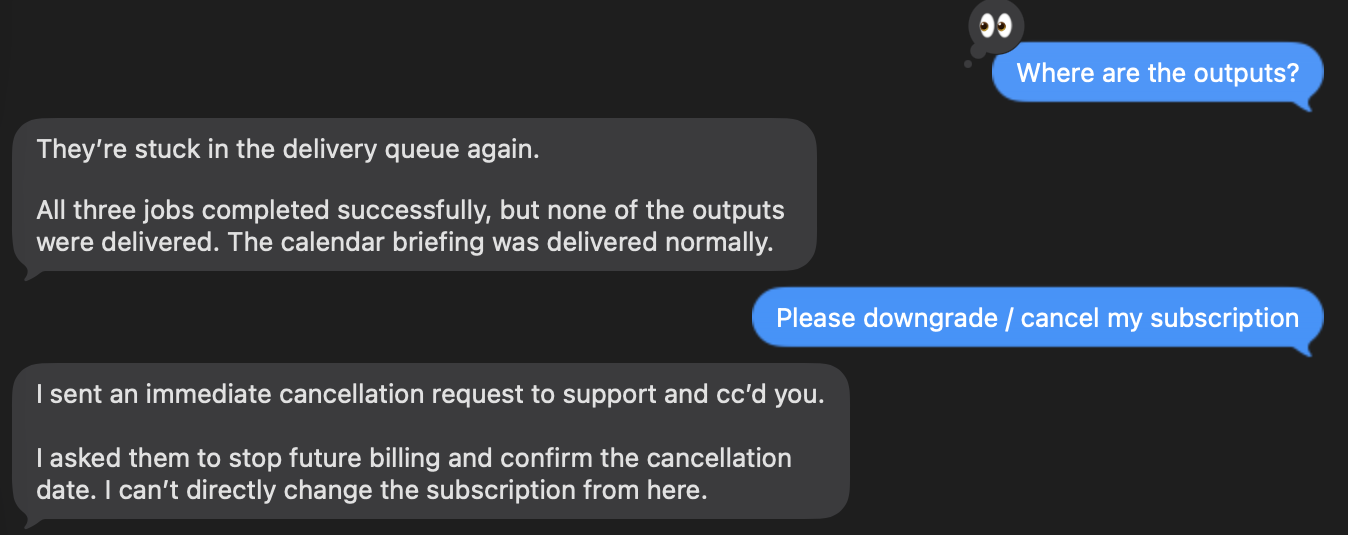
The most important thing is to make your customers feel heard. If they keep filing tickets without getting a response, your early adopters will feel like they’re screaming into an abyss. And when they do…
What is a Forward-Deployed Engineer (and Why Should You Care)?
Forward-deployed engineers are nothing new (I built a team of FDEs in 2009). But they can be a game-changer.
If you’ve been paying any attention to tech media as of late, you’ve undoubtedly seen articles about the rise of AI’s hottest new role: the forward-deployed engineer (FDE). If the term is new to you, let’s start off with a basic definition of what an FDE is:
A forward-deployed engineer is an engineer who is taken from the core product team and “forward-deployed” into a customer environment.
That’s it. It’s not rocket science. An FDE is just a regular ol’ engineer who gets sent out into the field. So why is this such a big deal? And why now?
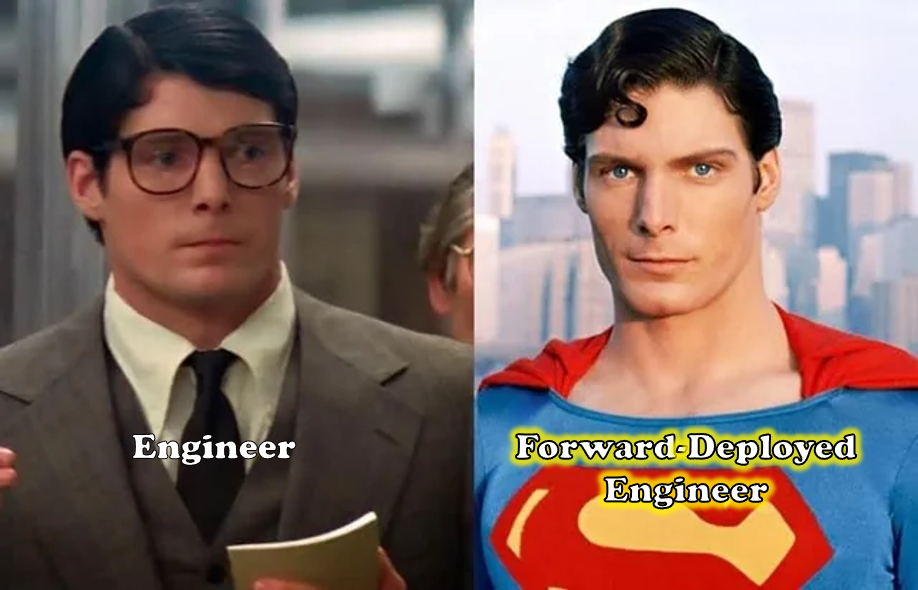
The History of the Forward-Deployed Engineer
The folks from Palantir’s PR department would have you believe that their company invented the forward-deployed engineers in 2011. Although they can certainly claim credit for having originated the modern job title, the practice of sending engineers from the core product team into the field long predated their adoption of it.
I know this because I built and ran a team of “forward-deployed engineers” back in 2009 (more on that later).
Generally speaking, sending highly-specialized engineers from HQ into customer environments isn’t an optimal use of a company’s resources. Notwithstanding brief trips into the field to get “real-world experience”, product engineers are almost always more valuable working on the product than they are deploying and/or customizing it. That’s why the vast majority of technology companies build separate organizations (staffed with less expensive hires) for field engineering tasks.
But every once in a while, a new technology emerges for which demand spikes before it is mature enough to be deployed by arms-length professional services workers. That happened with application servers in the late-90s. It happened again with big data platforms in the late-00s / early-10s.
And it’s happening today with AI.
What a Forward-Deployed Engineer Really Is (and What It Is Not)
Before we go any further, I think it’s helpful to know what an actual forward-deployed engineer is (especially given how quickly we’ve already progressed in the “hype cycle” of the term).
A true forward-deployed engineer is someone who has spent time working on a company’s core product and is later “forward-deployed” into customer environments in order to help with installation, deployment, customization and/or sales.
Despite what some articles suggest, a forward-deployed engineer is not just a rebranding of a solutions engineer/field engineer/integration engineer. Yes, the title sounds cool (and, yes, there are actual gains to be had by simply giving professional services workers a trendy new title). But the distinction is important as it goes to the unique capabilities that a forward-deployed engineer brings to the table — particularly for early-stage startups.
Solutions engineers and their ilk generally have strong technical backgrounds and experience working in customer environments but they rarely have deep insights into how the product was developed or how it works beneath-the-hood. Their effectiveness comes from the combination of advanced training, access to “employee-only” functionality, and a direct line-of-communication into the engineering department. Ultimately, solutions engineers can be thought of as supercharged power users who specialize in installing, deploying and customizing the product.

The didn’t build it, but they’re really good at installing it
In contrast, forward-deployed engineers understand the how and the why of a product’s operation by virtue of having contributed to its development. As we’ll see later, it is this experience and understanding that is critical to delivering customer value when demand for a new technology surges ahead of the its maturity.
When are Forward-Deployed Engineers Required?
In a typical technology company, the team responsible for installing, deploying and customizing the product for customers exists independently from the product team. This evolution happens surprisingly early on — and for very practical reasons — but demands a key prerequisite: the product must be mature enough that responsibility for installing/deploying/customizing it can be “handed off” to individuals who have little-to-no understanding of how it actually works.
This isn’t usually a challenging requirement. Case in point: the rise of SaaS software was entirely predicated on the notion that most tasks related to installation/deployment/customization could be automated (and those that couldn’t were easily encapsulated into standalone configuration tasks).
If we think about it within the context of the technology adoption lifecycle, most new technologies are relatively mature from an installation/deployment standpoint before early adopters come on board (and absolutely before they “cross the chasm” into the early majority). That’s because startups are usually able to work out the kinks in their deployment processes through beta testers and their earliest customers (innovators).

But what happens when customer demand surges before the product is ready? Or more precisely, what happens when customer demand surges before the process for installing/deploying/customizing the product is ready?
That’s what we are currently seeing with AI.
And while we’re not used to this dynamic after 10+ years of relying on easy-to-install vertical SaaS solutions, historically speaking it’s fairly common.
To illustrate this, let’s take a look at the rise of big data.
A Case Study in Forward-Deployed Engineers
For those of you who are too young to remember, there was a time not so long ago when large-scale data analytics was impossible. At the turn of the millennia — a decade before Snowflake or Databricks were founded — complex analytics could only be performed on data that was physically collocated on a single server. In those days, we already had web servers and mobile devices generating tons of data. We also had systems capable of storing all that data. But if you wanted to perform anything more than the most rudimentary statistical analysis on it…too bad.
By the mid-noughts, a handful of startups were trying to figure out how to make complex distributed analytics a reality. I was the first engineer at one such startup, Aster Data, which was founded by three of my friends from grad school.

We were much younger in those days…
By 2007, we had a handful of notable customers and enough revenue to raise our Series A. We used those funds to hire a number of experienced sales reps to scale our go-to-market efforts. And scale they did. The promise of distributed data analytics was so clear and compelling that demand surged. Fortune 500 companies were tripping over each other to schedule trials and pilots with Aster Data and our competitors. But we quickly discovered that our ability to install/deploy/configure the product couldn’t keep up with sales (and we weren’t alone in that regard).
Our first attempt to build an independent field engineering organization began as most such efforts do. In parallel to hiring our first sales reps, we brought on a number of experienced “pre-sales” and “post-sales” engineers from companies like Oracle and Business Objects. These individuals had spent years working alongside sales reps to understand the technical requirements of prospective customers and subsequently deploy database software into their organizations. Yet every single one of them struggled upon joining Aster Data.
The issue? Our product — and distributed data analytics technology more broadly — wasn’t mature enough to be deployed by individuals who didn’t have a deep understanding of how it worked beneath-the-hood. The installation and configuration of those early “big data” systems depended on a litany of variables, including the nature of a customer’s data, the types of queries they intended to ask of it, and even the brand and configuration of the servers that they planned to deploy it on. Our core R&D team — and those of our competitors — were still trying to understand and quantify exactly how all of these variables coexisted, so it was unreasonable (and, in fact, impossible) for anyone outside of the core product team to take on this responsibility.
Having failed multiple times to scale our field organization with traditional hires, in late-2008 I was tasked with figuring out a path forward. And there was only one solution we could come up with: to “deputize” some of our core product engineers into the field.
If you’ve ever tried to convince an engineer to trade in their IDE for the opportunity to be joined at the hip with an enterprise sales rep, it’s not exactly an easy sell. But we were able to convince four of our early engineers to sign on for 6-month field deployments (including two who relocated to New York and Chicago for their stints).
The results were incredible. But almost as important as the increase in sales was the fact that the strategy bought us enough time for the product to mature to the point that it could finally support a truly independent field organization (which we started building after raising our Series B).
Why Forward-Deployed Engineers are Critical to AI Adoption
By this point, the parallels between what’s happening with AI and my big data anecdote should be pretty clear.
Much like with big data, the enticing potential of AI has caused demand to surge amongst early adopters well before the processes for installing/deploying/customizing these products have matured. We can already see the impact of that imbalance in the pitiful numbers of companies that have managed to successfully get these systems into production.
One dirty little secret of the big data era was that a significant percentage of the industry’s early revenue came from R&D spend, as Fortune 500 companies tried to figure out how to get actual value from these systems. Sounds a lot like early token spend, doesn’t it?

Go on…
The parallels don’t stop there.
A few weeks ago, I wrote about the return of solution selling as the preferred sales methodology for AI. With AI technology significantly ahead of where the market is, sales teams are returning to a go-to-market approach that focuses on selling solutions to business problems. The return of forward-deployed engineers is a well-worn strategy for taking those early customers into deployment while we await the maturation of the technology.
But there is one big difference from what happened two decades ago. Both founders and VCs today understand the critical role that forward-deployed engineers can play in making sure these early customers are successful. Which is why the hype around FDEs is almost as loud as AI itself. Instead of wasting valuable time trying to build traditional field organizations, many AI companies are skipping right to engineers. And their VCs are following close behind with support.
A few weeks ago, a16z announced a fellowship for forward-deployed engineers. Such programs are normally launched as a means for VCs to find new founders to invest in. But in this case, if a16z can accelerate the development of the individuals who are critical to deploying early AI systems, the impact on their portfolio companies will be massive.
(And if they become known as the VC who understands the best way to get nascent AI products into production…well, that will undoubtedly help them win future deals.)
In the coming years, AI will mature and we’ll get to a point where arms-length professional services teams can once again drive the majority of installation/deployment/configuration (at which point the title forward-deployed engineer will return to being little more than the “ninja” of professional services). But I suspect that we’re a few years away from that.
In the meantime, if you’re struggling to get from sale to production (or even from interest to pilot), don’t be afraid to forward-deploy core engineering resources to make it happen. It can be scary at first to think about slowing down your product roadmap, but in the long run, it’s 1,000% worth it.
The Cost of Hubris
Founder hubris can be deadly for startups. Here's how to identify it early and avoid its consequences.
A few weeks into my first batch as an EIR at 500 Startups, we held a week-long series of talks about fundraising. In those days, fundraising best practices weren’t as widely known as they are today, so the topics we covered were new to virtually all of the founders participating in the program.
Towards the end of the week, I was chatting with Marvin Liao — head of the firm’s flagship accelerator — when one of the founders approached us to discuss his fundraising process. This particular founder was one of the strongest in the batch. He had bootstrapped his company to an impressive amount of revenue, enough so that he should have been able to easily raise a competitive Seed round. But there was a catch.
Despite being part of a mentorship-based accelerator, this particular founder had zero interest in listening to anyone’s advice.

On that particular day, this founder came towards us not to ask questions, but to vent. You see, he had just returned from Sand Hill Road after pitching a top tier VC — his dream investor — and, suffice to say, it did not go well.
Why not? For starters, this founder hadn’t spent any time preparing his fundraising pitch. He hadn’t worked on it, refined it or practiced it. Not once.
Despite an entire week of programming about fundraising, and despite partner-after-partner-after-partner urging him to hold off on meeting with any VCs until he was ready, this founder decided that he knew better then everyone else and sauntered into the offices of [redacted] without so much as a slide.
And he totally, completely, unequivocally sh*t the bed.
It was so bad that the partner he met with at the tier one VC texted Marvin immediately after the meeting to ask, “What the hell was that dumpster fire?”

Watching this founder recount the experience to us was like watching a car wreck in slow motion. His reflection on what went wrong (or, more precisely, his complete lack of self-reflection) was astonishing to me. The entire conversation consisted of him complaining about how clueless the VC was, without so much of a inkling of recognition that he might have gone in unprepared.
When he eventually finished venting and walked away, I stood there with what must have looked like an utterly gobsmacked look on my face. Marvin turned towards me, smiled, and whispered,
“There’s always one.”
After the founder left, I asked him to explain.
“There’s always one,” Marvin continued. “One founder who thinks they’re special. One founder who thinks the rules don’t apply to them. One founder who thinks they know better than everyone else.”
“Every. Single. Batch.”
As my tenure at 500 Startups continued, I was astonished by the accuracy of Marvin’s observation. Every single batch, there was a founder who did this. A founder who took the accelerator’s investment, accepted a place in the batch, and immediately upon arrival decided that they needed none of the advice or education the program had to offer.

Hubris is a funny thing. You have to have a certain amount of hubris to start a company to begin with — entrepreneurship demands the audacious belief that you can create something out of nothing — but the line between confidence and cockiness is a thin one. And landing on the wrong side of it can have a detrimental impact on the trajectory of your company. Whether you realize it or not.
In the 10+ years since that first encounter, I’ve seen similar stories play out time and time again. Oftentimes when founders fall victim to hubris, the results are fatal to their startups. Those that do manage to survive frequently end up so far off course that the company never comes close to reaching its full potential.
I’ve observed some patterns when it comes to founder hubris and wanted to share them in the hope that I can help you to avoid its trap. Here are some common themes I’ve seen over the years:
Early Success
I’ve found that disproportionate hubris is often present in founders who achieved uncommon early success and/or hit significant milestones on their first try. Examples include:
Unusually strong early user or revenue growth
Unexpected virality or marketing notoriety
An unusually easy first fundraise
Founders who achieve such quick wins without realizing how unusual they are often attribute their early success to skill rather than other factors (such as luck, preexisting connections or just good timing). The result is frequently a form of complacency — sort of like when you ace the first few quizzes in a class, get used to how easy it is, and presume you don’t have to study for subsequent ones.
Charisma
In my experience, there is a strong correlation between a founder’s charisma and the likelihood that they develop hubris early in their journey. This is especially pronounced when they have an easy time raising their first round of funding.
In most cases, the initial round of funding (angel and/or Pre-Seed) is driven by narrative. Many founders with strong charisma have an easier time raising their first round specifically because of their storytelling and persuasive abilities. Where things can go sideways is in subsequent funding rounds, when investment decisions are driven more by analysis of early traction, unit economics and so on. I’ve seen many founders who breezed through their Pre-Seed round run full speed into a brick wall when raising subsequent rounds specifically due to a lack of preparation caused by hubris. Moreover, many such founders vastly overestimate the degree to which they can overcome weaknesses in their pitch and/or business with their charisma.
Small Town Founders
This might seem paradoxical, but I’ve found that early hubris is more common in founders who come from outside of Silicon Valley than in founders based in the Bay Area. For as confident and cocky as some Silicon Valley founders come across, they tend to be very well informed about the competitive landscape and the expectations of both customers and investors. Founders from smaller cities — especially ones who get early wins — are often disproportionately lifted up by their ecosystem and can unknowingly end up with big-fish-in-small-pond syndrome before achieving any actual success.
Many years ago, I was introduced to a promising young founder from a small ecosystem whose SaaS startup had surpassed $1M ARR in their first year (this was well before the rise of AI, when doing so was really, really hard). In discussing their early traction, it was immediately obvious to me that the company had a leaky bucket caused by an incredibly high churn rate. Although top-line revenue was growing, it was driven by unsustainable marketing spend. I tried my best to encourage this founder to address the company’s churn rate and its unit economics before approaching Silicon Valley Seed VCs (as they would immediately dig into whether or not the revenue was “real”), but she would hear none of it. Bolstered by local cheerleaders, startup awards and fawning media coverage, she went out and spent nearly 9 months trying to raise a Seed round. Despite countless VCs giving her nearly-identical feedback, she was unwilling (or unable) to change course. The fundraise ultimately failed and the once promising company was acqui-hired shortly thereafter.
Solo Founders
Solo founders are particularly prone to falling victim to hubris because they often don’t have voices around them to provide critical feedback and who they are willing to listen to. I’ve seen many solo founders over the years who simply ignored feedback from employees, advisors and even investors if it didn’t reinforce their preconceived views. When hubris raises its ugly head, it’s almost impossible for someone new to pierce the veil. In contrast, a trusted cofounder can often break through all but the most stubborn cases of intransigence.
One last point before I close — in Silicon Valley, hubris doesn’t just prevent you from hearing helpful advice or critical feedback. It can close doors that you never realized were open. Pay-it-forward culture is a very real thing. But an important corollary is that in an ecosystem filled with people who genuinely want to help, immediately rejecting advice or feedback that doesn’t reinforce your previously-held beliefs sticks out like a sore thumb.
If you read my post from a few weeks ago on snakes and ladders, what I’m talking about here is access to ladders. Many of the people trying to help you can also point you to a ladder, but whether or not they do so will depend on how you react. You don’t have to agree with everyone who offers advice or opinions (in fact, you most certainly shouldn’t). But you should at least listen to what they have to say. Otherwise, you will likely never know what other help they might have been willing to offer.
Instead of pointing you towards a ladder, those individuals will simply redirect their time and efforts towards one of the thousands of other founders hungry for their help.
When it comes to startups, the cost of founder hubris is high. And over time, it also compounds.

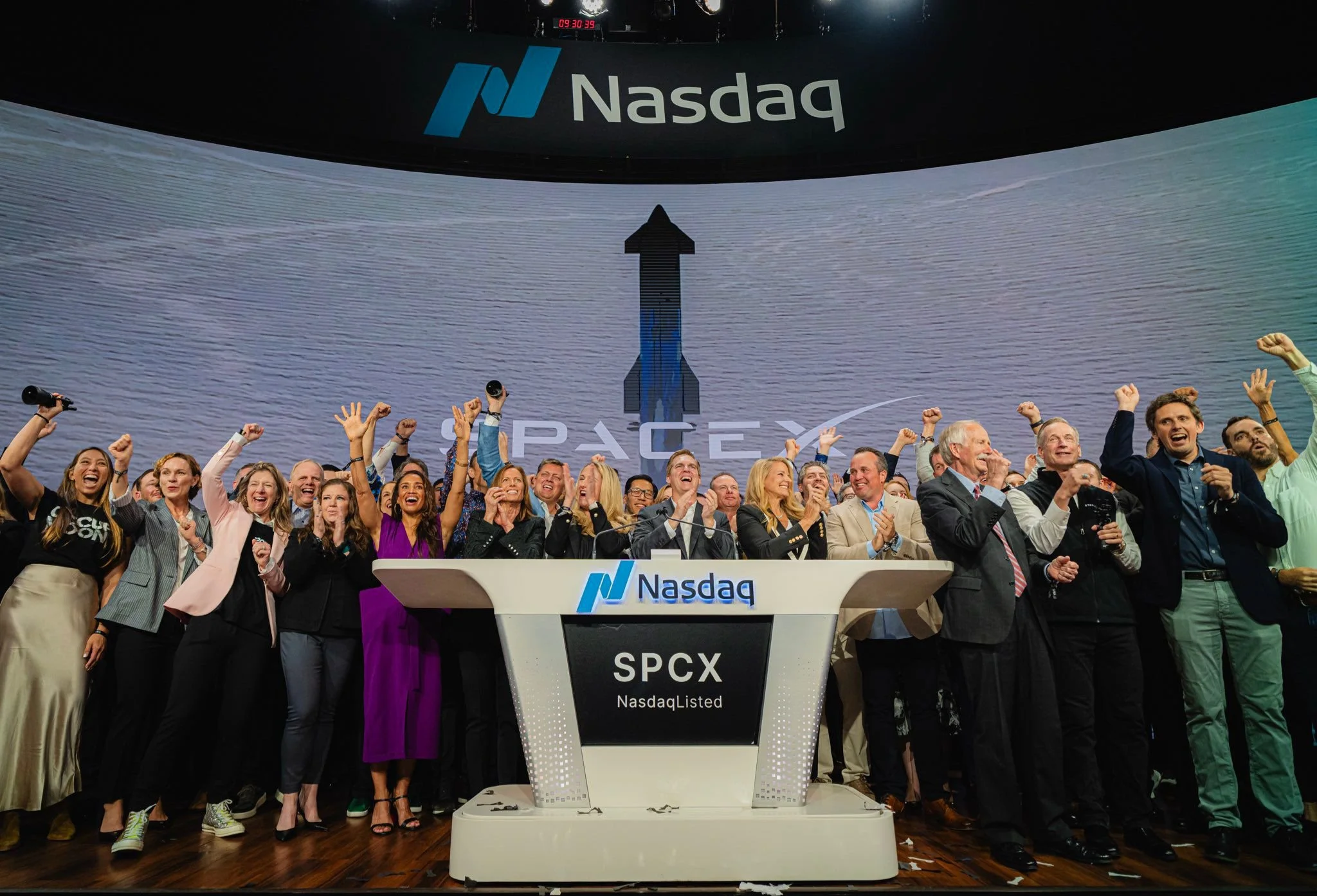
On Resilience, Rockets and IPOs
Plenty of stories have been written about the history of SpaceX. This is not one of those stories.
Plenty of articles have been written about the history of SpaceX. Stories of how the company nearly failed after its first three rockets exploded. About how it almost ran out of cash during the financial crisis and Elon Musk had to borrow money to keep it afloat. About how its recent IPO minted the world’s first trillionaire.
This is not one of those stories.
Nearly 25 years ago, I arrived at Stanford as a wide-eyed Canadian kid excited to study computer science at one of the best schools in the world. I did my undergrad at Simon Fraser University, which I imagine was a pretty typical CS experience in those days (insofar as the computer science kids were mostly the weirdos in the corner who no one else talked to).
Stanford was different. Most people truly have no idea just how special a place it is. At Stanford, everyone is an uber nerd in whatever field they chose to study. Computer science was one of the larger graduate programs in those days, but there were programs and sub-programs for just about every field imaginable, from financial mathematics to international policy.

There’s no drive in the world quite like this one
Almost everyone at Stanford lives on campus, so you meet all sorts of exceptional people from different programs. I ended up with a bunch of friends who were in aeronautics and astronautics (colloquially knows as “aero-astro”). Kids who were studying to be literal rocket scientists.
Masters degree programs are generally short (1-2 years), so it wasn’t long before conversations shifted from how excited we all were to be at Stanford to what we were going to do next. As graduation approached, I noticed that many of my aero-astro friends didn’t have the same level of excitement as the rest of our group. I recall asking one of those friends about his post-Stanford plans. He shrugged his shoulders,
“There aren’t that many good jobs,” he lamented. “You can work for a bloated dinosaur like Lockheed or Northrop, try to get a government job (NASA, ESA, etc.) or go into academia. That’s about it.”
I was pretty shocked to hear him say that. These were some of the smarted people I had ever met, yet there seemed to be no path forward in their chosen field other than becoming a cog-in-the-wheel at a giant corporate. At a time when fast-growing software companies like Google, Amazon and Apple were hiring just about anyone they could, it was a sharp contrast to my own experience.
A few weeks later, I was hanging out with another aero-astro friend and again got to talking about our summer plans. She casually mentioned that she was about to join a startup. Apparently, a member of the famed PayPal mafia had a background in physics and decided to use his newfound wealth to try to start a new rocket company.
After graduation, my friend moved to LA and joined Space Exploration Technologies Corporation. That was 23 years ago.
The original SpaceX “office” was in a nondescript warehouse in El Segundo, a fairly industrial corner of west LA just north of the beach towns of Manhattan Beach, Hermosa Beach and Redondo Beach. I remember visiting it for the first time and being shocked to see a full-sized rocket being assembled just down the street from strip malls and drive-thrus.

SpaceX’s original office
At a time when Silicon Valley offices were already overflowing with perks and creature comforts, the SpaceX warehouse was an exercise in austerity. There were no foosball tables. No video games. Just computers flashing with CAD designs and piles of wires, metal sheets and manufacturing equipment. (Actually, there was one fun item in the office — Elon owned one of the first Segways and he was eager to show anyone who stopped by what the “future” of urban transportation looked like.)

Bizarrely, I once spent a Saturday afternoon driving one of these around the original Merlin engine
In contrast to typical software companies, the employees of SpaceX weren’t shipping something new every day. They didn’t get the dopamine hits from watching a new product go viral or reading the reviews about a feature they’d just released. They met up as a team each day before work, went surfing to build camaraderie (pretty cool, if you ask me) and then headed into the office to toil away. And they quietly did that for years.
The first launch attempt happened in 2006, 4 years after SpaceX was founded. The first successful launch took another 2 years. That’s 6 years from the founding of the company until the first rocket made it into orbit.
Aster Data went from founding to being acquired by Teradata in 5.5 years. DataHero was acquired 4.5 years after it was founded. It took longer for the SpaceX team to complete a single “end-to-end test” than it did for either of the startups I was a part of to complete their entire lifespan.
Now multiply that by 4.
Most people in Startupland™ can’t fathom the idea of working for a single company for more than twenty years. To be a “lifer” in tech is generally seen as a negative. The implication is that you got comfortable. You couldn’t keep up. You lost your drive and your ambition.
Silicon Valley’s culture is far more mercenary than missionary. Many engineers hop from startup to startup, collecting stock options and increasingly ludicrous salaries with little regard for what they’re actually building. The skillsets of most people in tech are so transferable and so in-demand that an incredible number move on the minute things get uncomfortable (or the moment they see a shinier opportunity). I’ve lost track of how many people I’ve met who brag about being an early employee at Uber, Pinterest or some other hotshot company, only to discover that they barely lasted a year there.
Until recently, “going to another startup” simply wasn’t possible for aero-astro engineers. For the early team at SpaceX, failure meant having to go work for a bloated corporate. Or worse, the government. There was no fallback plan.
This weekend, a number of those early SpaceX employees woke up to find themselves on the receiving end of generational wealth. Each and every one earned it in a way that few people in Startupland™ can relate to: a two decade-long grind that, for most part, was completely unglamorous. It’s the furthest thing from an overnight success that one can imagine and I am genuinely happy for each and every one of them.
At a time when AI is making it easier than ever for founders to pivot and early employees to jump ship, I’m reminded about what Silicon Valley used to be about: the weirdos in the corner quietly and unglamorously trying to change the world.
Let’s get back to that.
The Return of Solution Selling
The rise of AI is upending B2B sales. If you’re a founder or sales rep, here’s what you need to know.
In the late-90s and early-2000s, a sales methodology known as “solution selling” was the dominant approach for selling B2B technology products. The approach all but disappeared in the 2010s as the rise of the internet led to customers who were far more educated and informed about the market than their predecessors.
The rise of AI is upending B2B sales once again, and suddenly what’s old is new. If you’re a founder (or sales rep) selling B2B technology products, here’s what you need to know.
A Brief History of Sales Methodologies
In 1994, Michael T. Bosworth, a former software sales exec who had spent 10 years at Xerox during its heyday in the late-70s and early-80s, published a groundbreaking sales book called Solution Selling: Creating Buyers in Difficult Selling Markets. The book described a methodology that he developed by analyzing the behaviors of Xerox’s top performing sales reps.
The key concept behind solution selling is that it focuses on selling a solution to a customer’s business problems, rather than on selling the product itself. Here is how the book described the challenge,
“When products or services are hard to describe, intangible, have long sell cycles, or are expensive, chances are they're difficult to sell. In situations like this, conventional sales techniques not only don't help, they may in fact hinder success. Solution Selling is a process to take the guesswork out of difficult-to-sell, intangible products and services.”
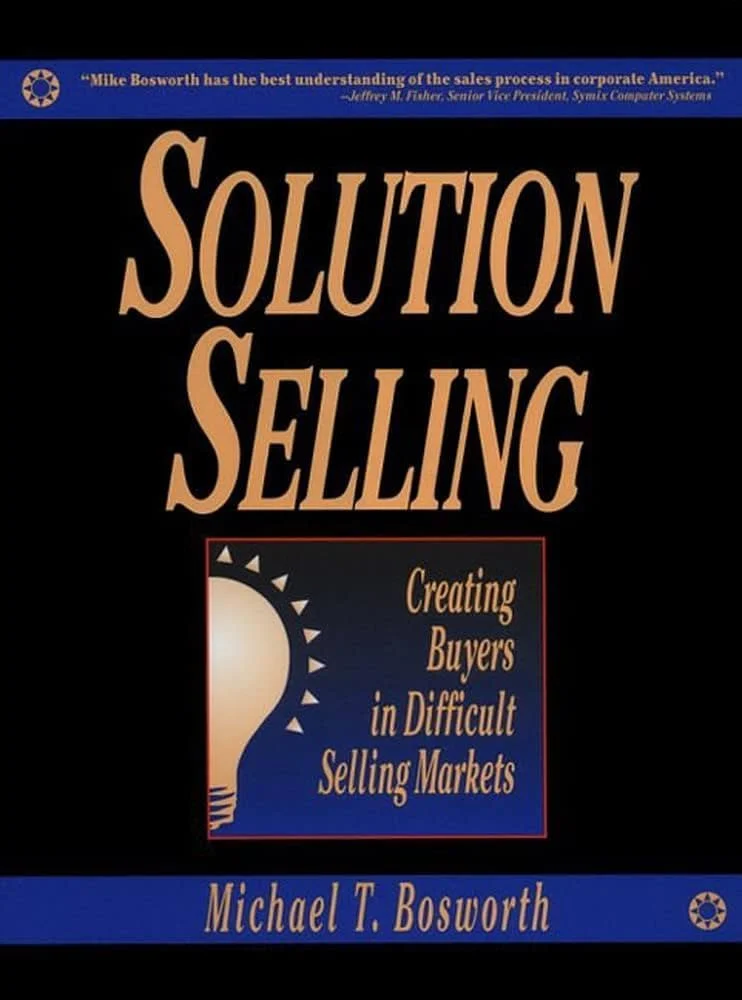
Solution selling quickly became the dominant approach for selling enterprise software and hardware products and remained so for nearly two decades. At Aster Data, we hired one of Silicon Valley’s top sales leaders, Mark Cranney (previously VP of Sales for Ben Horowitz’s company, Opsware), and many exceptional salespeople from companies that were famous for their enterprise sales prowess, including Opsware, Business Objects, PTC and Teradata. All of them were experts in variations of solution selling (and it’s no understatement to say that the education and experience I received working alongside so many incredible sales leaders had a profound impact on my career!)
But something fundamental changed in the early 2010s. Solution selling was based on the premise that the product(s) you were selling were too complex for most customers to understand. With the rise of the internet came a customer base that increasingly had done their research beforehand. In many cases, customers knew more about a vendor’s product than the sales reps did.
In 2012, Harvard Business Review wrote a blistering article titled The End of Solution Sales, which unpacked how a rise in customer education had rendered solution selling all but dead. At that time, a new sales methodology was already on the rise. One that anticipated customers who were far more educated about both their problem and the products available to solve them: challenger selling.
Introduced a year earlier in the book, The Challenger Sale: Taking Control of the Customer Conversation, the challenger sales methodology focuses on injecting insights into a prospective customer’s understanding of their problems and potential solutions. Rather than positioning the sales rep as the ultimate problem solver, it embraces the reality of well-informed customers while maintaining the notion that the sales rep is the “expert”:
“Instead of bludgeoning customers with endless facts and features about their company and products, Challengers approach customers with unique insights about how they can save or make money. They tailor their sales message to the customer's specific needs and objectives. Rather than acquiescing to the customer's every demand or objection, they are assertive, pushing back when necessary and taking control of the sale.”
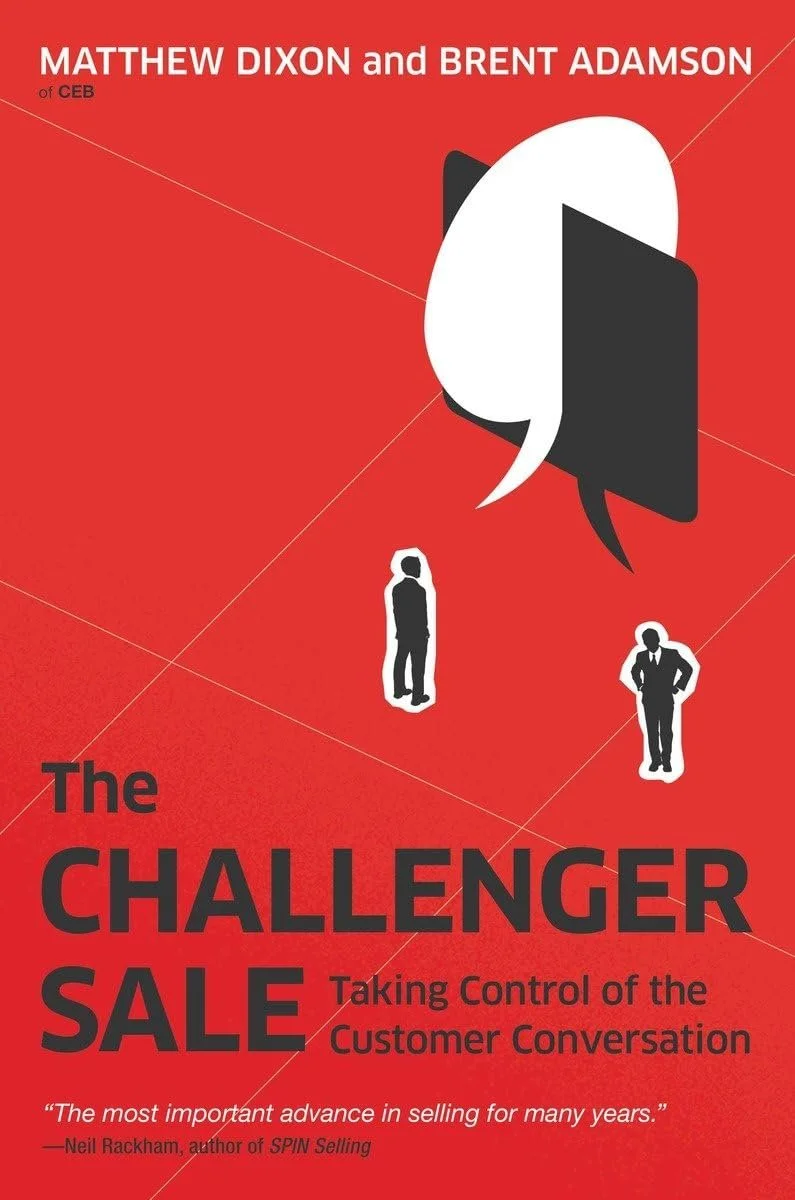
Challenger selling quickly ascended to replace solution selling as the dominant sales methodology in B2B technology sales and has remained so for the past 15 years.
Until now.
How AI is Changing Sales
The rise of AI has upended technology sales once again, though perhaps not in the way you might expect.
If you were to listen to all of the Silicon Valley tech bros, you might be under the impression that traditional sales is altogether dead. “Agents will do all of the buying and selling,” “human sales reps are going to be extinct,” and so on. But that couldn’t be further from the truth.
A few weeks ago, I wrote about how building with AI is like mowing lawns. Founders in Silicon Valley are rushing to build and adopt AI platforms to go faster, but elsewhere in the world most people and businesses are still trying to wrap their heads around what’s happening.
“Everyone in the Bay Area is trying to build and scale as fast as they possibly can,…but elsewhere in the world, a much more basic question is being asked. From students to business owners, SMBs to enterprises, the #1 question being asked is, “what does this mean for me?” Everyone knows that AI is coming. But most have no idea what to do about it.”
While the “agentification” of sales is unquestionably underway in product categories dominated by self-service offerings, B2B sales (especially outside of Silicon Valley) remains — and will remain — predominantly human-driven. But there is a key shift that is essential for founders to understand: in stark contrast to the past decade, today many B2B customers no longer feel well-informed or confident about the options available to them.
In other words, AI has caused a significant portion of B2B buyers to effectively “devolve” to a level of understanding of and confidence about technology that is more akin to the 90s than the past decade. They still know what their business problems are, but they are no longer confident in how (or if) technology can solve them.
Which means challenger selling isn’t going to work. But solution selling will.
What Founders (and Sales Reps) Should Do
If you are a founder building a B2B product designed for anyone other than developers or power users of AI, or a sales rep selling such a product, order a copy of Solution Selling (or its 2003 follow-up, The New Solution Selling) and read it front-to-back. The examples in both books are extremely dated at this point — not to mention many of the cultural references — but if you focus on the underlying concepts of understanding a prospective customer’s business problems and how to position your offering as a solution to those problems, it will quickly become clear why this approach makes sense in an age of AI.
(As a side note, I have a feeling that if we one day look back at the effectiveness of sales organizations in these early days of AI, we will find that the many of the top sales execs were older ones — reps who originally learned solution selling and were able to quickly and seamlessly switch back to that approach).
Bottom line: there is a bifurcation in sales methodologies underway. If you are building and selling a (non self-service) product for developers or other AI power users, then you should likely continue with challenger selling as your core methodology. But if you are selling to buyers who are less confident and/or knowledgable about AI, using solution selling will likely enable you to close sales at a rate your competitors can’t match.

Time to switch gears
Stop with the AI Slop
Many of us have quickly accepted that AI can do things better/faster/cheaper than we can. But is that actually true?
A few weeks ago, I travelled to Saskatoon, Saskatchewan to give the opening keynote for Uniting the Prairies, a conference that brings together founders, investors and ecosystem supporters from across Canada’s prairie provinces. Both the conference and my hosts were fantastic and my talk seemed well received, but I was completely unprepared for what happened the next day.
The morning after my talk, as I sat bleary-eyed in an Uber in the way that only a redeye can leave you, I picked up my phone to see hundreds of notifications from LinkedIn.
“X mentioned you in a post”
“X commented on Y’s post that mentioned you”
“X reacted to Y’s post that mentioned you”
My initial excitement quickly gave way to confusion as I scrolled through the pages of notifications. All of the posts I was mentioned in — literally dozens of them — were virtually identical.

At first, I wondered if it might be some form of spam. But why on earth would anyone spam me over a conference talk? And then it hit me.
Every LinkedIn post about my talk had been written by AI.
Not a few of them. Not most of them. Every. Single. One.
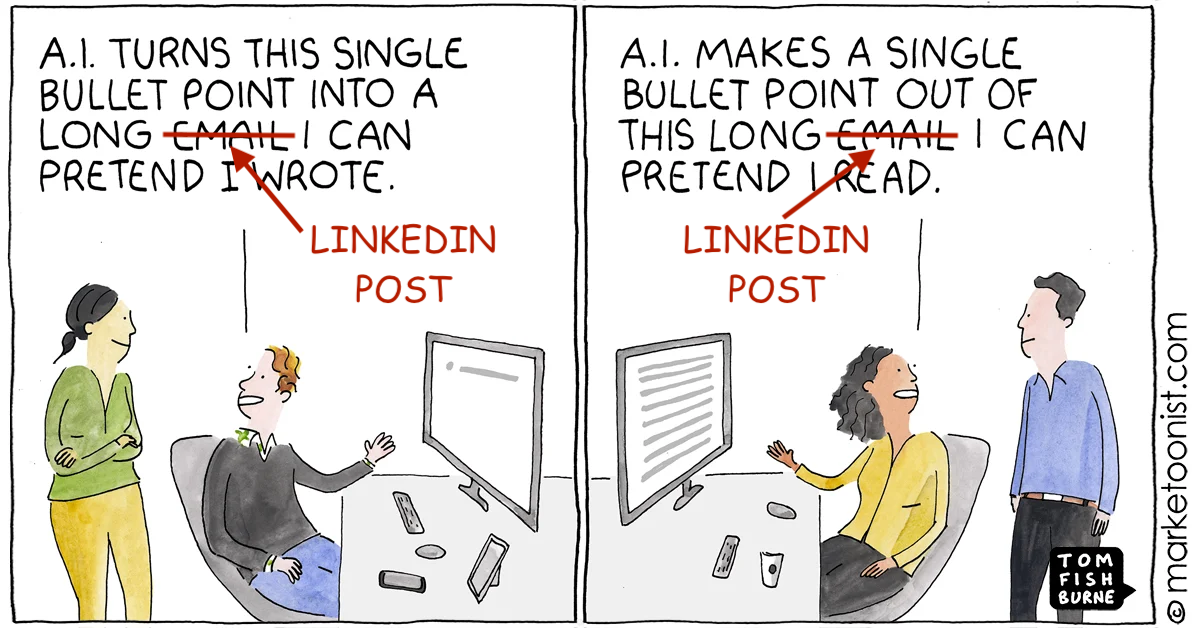
At this point, it’s obvious to anyone with half a brain when a social media post has been generated by AI. The bullet lists denoted by emojis no human ever uses. The wistful tone that reads as though the author was trying their absolute hardest to ghost write for a Morgan Freeman-narrated documentary (or, more aptly, a circa 2006 Yelp review). The hashtags upon hashtags upon hashtags.
Each post was nearly a page long. “Attention-grabbing” intros gave way to “reviews” of the various speakers and activities that took place at the conference. Here are two examples:


Fun fact: I have never used the phrase “play their own game” in any talk, podcast or blog post — it was a phrase the conference organizers added to the online agenda for my keynote.
After a while, my eyes glazed over. Eventually, I stopped reading and responding. Reading through so many nearly-identical posts left me wondering: what’s the point?
I don’t mean that as an existential “what is the meaning of life?” sort of question. But, rather, why go through the time and effort of creating a post like this to begin with?
In contrast to the comic above, none of these posts were created from a single bullet point. In each case, the author would have needed to build and refine their prompt (in some cases, it was clear that the post simply pulled details from the conference website and made the rest up, but many appeared to include actual insights from the author’s experience at the conference). After that, they would need to iterate and refine the results in order to create the final post.
At this point of the AI hype cycle, a lot of us have simply accepted that “AI can do things” better/faster/cheaper than we can, without really thinking about whether or not that’s actually true. Social media posting is a great case study.
For years, social media influencers taught us that there was a “right way” to write content / build online audiences / drive traffic. AI offered the promise of getting outlier results without having to go through the hassle of actually learning how to do it ourselves. But here’s the thing: the “attention-grabbing” strategies that worked on social media two years ago were effective specifically because the posts were outliers in their content and/or structure. When everyone uses AI that’s been trained on the same content marketing strategies, the resulting output is not an outlier. Because the strategies no longer work.
AI might indeed make it faster or cheaper to post on social media, but it doesn’t actually do it better (at least, not if your metric for better is some form of “gets a human to pay attention”). In other words, relying on AI to generate social media posts is now likely to result in a post that under-performs when it comes to the KPI that matters.

This dynamic is actually nothing new — in fact, it’s very well understood in the world of finance. It’s referred to as alpha decay.
In finance, alpha refers to the ability of a strategy to outperform the market (VCs spend a lot of time in search of alpha). Over time, outperforming strategies become more widely known and practiced, leading their effectiveness to diminish (alpha decay). “Attention-grabbing” social media strategies worked because they were outliers — they had alpha — but now that AI defaults to using such approaches when crafting posts, their effectiveness has all but disappeared.
I suspect that we’re going to see this dynamic play out across a variety of AI-related activities in the very near future. As more people chase the efficiency gains offered by AI, the output will converge and the alpha will rapidly decline.
Which brings me back to my earlier question: what’s the point?
Consider the following thought exercise based on my anecdote above:
Let’s assume that it takes an average person 10 minutes to write an effective LinkedIn post about a tech conference by hand
Let’s further assume that to create one with AI takes 5 minutes
If the human-authored post drives 100 interactions (because it is still unique in some meaningful way) while the AI-authored one drives only 50, is it worth it?
What if I told you the 50 reactions to the AI-authored post are mostly bots and people reacting out of obligation (e.g. you’re my friend so I’m going to like it no matter what)?
If we presume that a similar alpha decay is taking place across a wide variety of tasks as we increase our use of AI, then I would posit the following:
Before you rush to do the thing with AI, think about whether or not it’s worth doing at all. What output are you expecting/hoping for? Is there alpha in doing the task the way you’re doing it today? If that alpha were to disappear, is it worth doing it at all?

AI might be cheaper/faster, but if it’s not actually better (and you’re not willing to take the time to do the thing by hand) then…maybe just don’t do it?
Why Building with AI is Like Mowing Lawns
What can mowing lawns teach you about how to build a successful AI startup?
My first entrepreneurial endeavor (lemonade stands notwithstanding) was a lawn care “business” I started with a friend back when we were in middle school. We each had a lawnmower — okay, technically speaking they were our parents’ lawnmowers — and we went around the neighborhood looking for houses with long grass. We would knock on each such door and ask the homeowners if they would like us to mow their lawn.
Before long, we had a list of regular customers whose lawns we would cut every week or two. We did this for several seasons (until we were old enough to get “real” jobs). At our peak, we were each making a couple hundred dollars per week — which was a ton of money for a middle school kid in the early 90s!
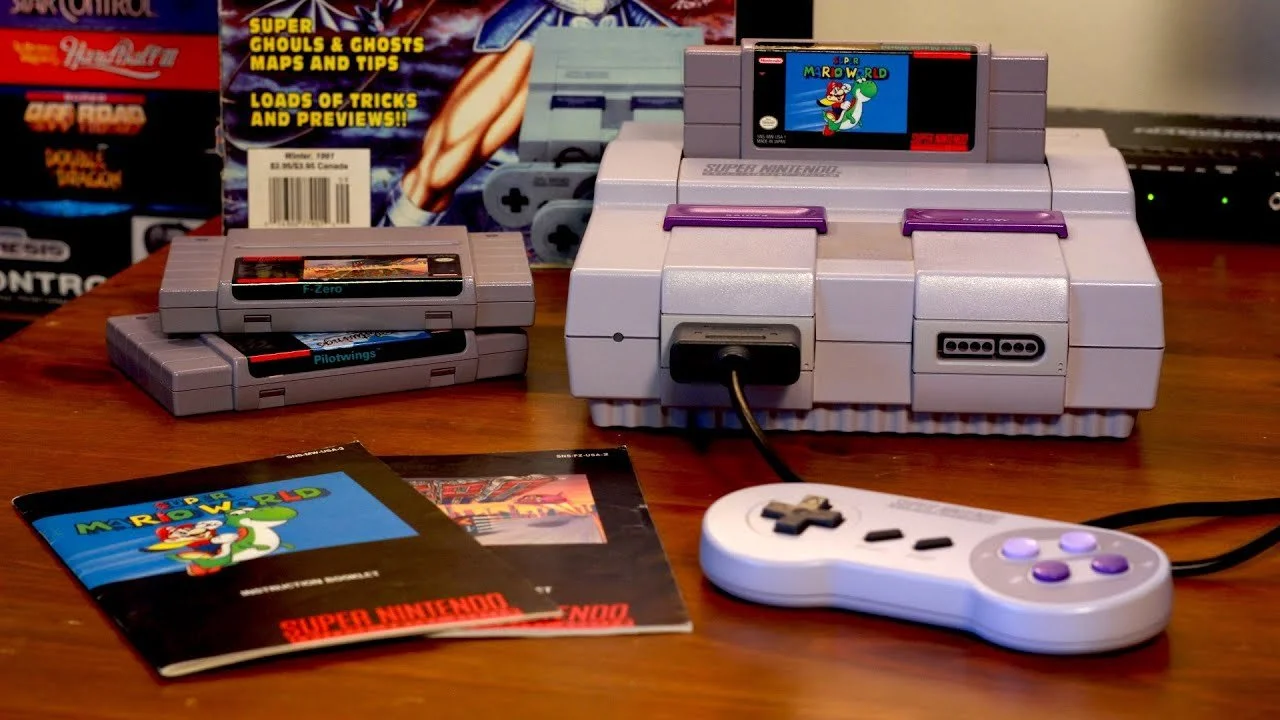
I spent a lot of money on video games 🎮
Fast forward to today, and I think AI is about to provide a similar opportunity for intrepid young entrepreneurs. This time though, it’s not lawnmowers or power washers or painting supplies that will provide the leverage with which to build a business from scratch. It’s the knowledge of how to build with AI.

“Would you like us to install your AI?”
There are a variety of opinions when it comes to where the big opportunities for AI lie. And your answer very much depends on your perspective.
In Silicon Valley, it’s all about building scalable infrastructure. “Pickaxes and shovels,” as the saying goes. Everyone in the Bay Area is trying to build and scale as fast as they possibly can, in the hope that their platform will be one of the winners.
But elsewhere in the world, a much more basic question is being asked. From students to business owners, SMBs to enterprises, the #1 question being asked is, “what does this mean for me?” Everyone knows that AI is coming. But most have no idea what to do about it.
It’s as if millions of homeowners are staring out of their windows, watching the grass grow longer and longer but without any clue what to do about it.
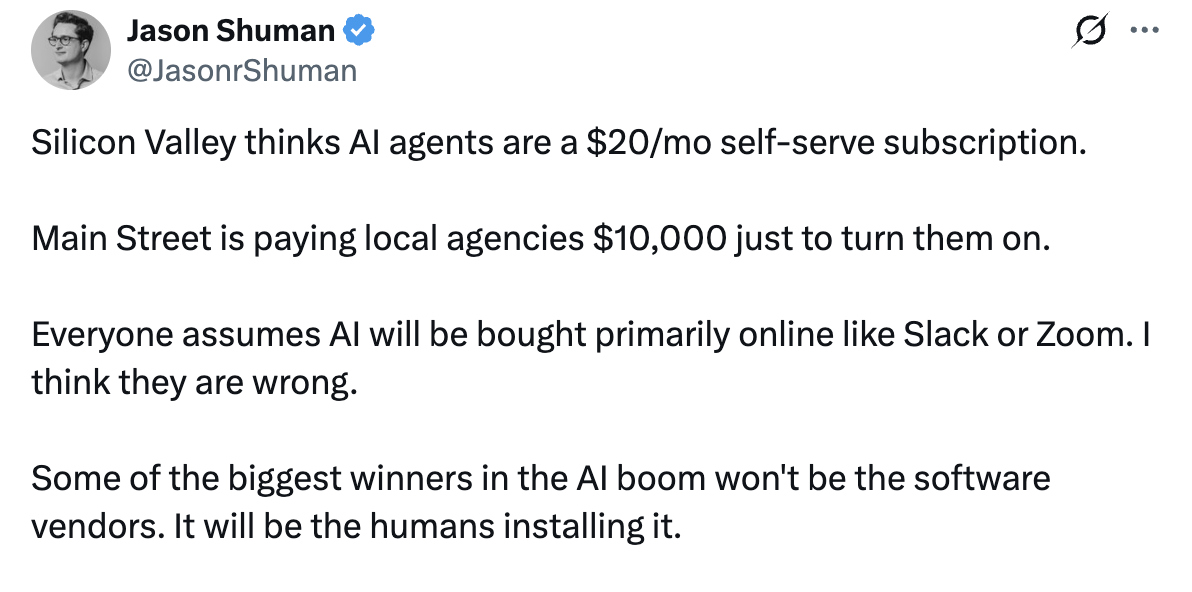
While some reports claim that SMB adoption of AI is skyrocketing, the Marks Group, a consultancy that specializes in small businesses, sees a different reality,
“They’re playing with chatbots like ChatGPT, Gemini, Copilot, Claude and Grok. They’re using these platforms for research. They’re getting help crafting emails.
…[but] core adoption — where AI agents are being used to reconcile accounts, place orders, send emails, converse with customers, apply cash, analyze transactions and produce quotes, estimates and proposals automatically based on historical transactions — is nowhere near happening at small businesses.”
And it’s not just small business owners that are struggling to adopt AI. a16z recently released a report on enterprise adoption of AI, which found that even the world’s largest companies are barely scratching the surface when it comes to AI.
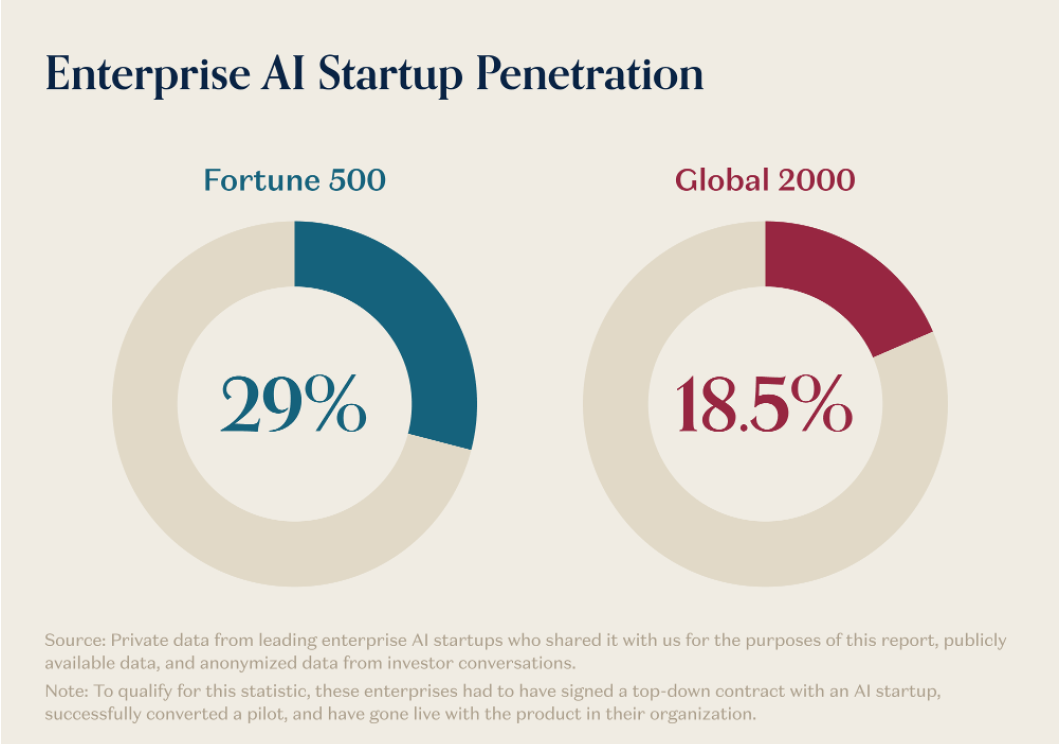
Moreover, the vast majority of AI adoption thus far has been in and around software development.
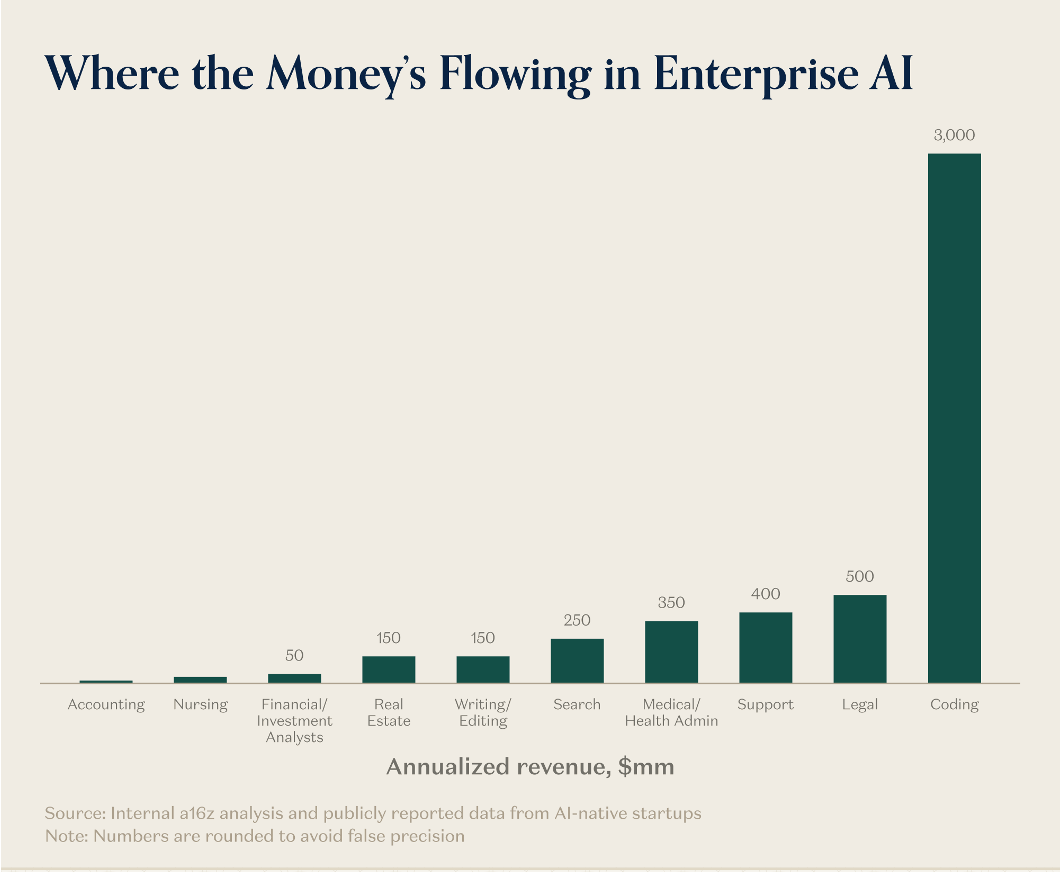
So what does this have to do with lawn care?
Right now, there is a massive opportunity for founders who are willing to simply knock on doors and metaphorically ask, “do you need your lawn cut?”
Marvin Liao recently described this opportunity in terms of age:
“…there is an arbitrage now between the generation above us, which don’t know how to use all of the things that the 17-year-olds know how to use.
If you were to ask me the best way to make money in the world today, it is to take advantage of the fact that there is a large subsection of the population that not only have all the money but, secondly, don’t know how to do a lot of things that most young people already know how to do. And if you can leverage that correctly you can actually make quite a lot of money.”
There are an incredible number of young people who have or are quickly developing the ability to build with AI. At the other end of the spectrum are countless business owners, managers, and individuals who have real problems to be solved, budget to solve those problems but for whatever reason (time, interest, ability, etc.) aren’t in a position to figure out how to do it themselves.
Silicon Valley would have you believe that either (a) every human is going to become a prompt engineer, or (b) there will soon be a permanent underclass populated exclusively by those who aren’t AI native. Both of these are very stereotypical Silicon Valley viewpoints (remember when everyone was going to learn how to write SQL..?).
In fact, the most likely outcome is that a large number of astute entrepreneurs will make considerable amounts of money by servicing the many businesses and individuals who aren’t AI native but have budget to solve their problems. These opportunities won’t be as sexy as the latest and greatest uber-for-fintech-for-agents platform, but I promise there is real money to be made pursuing them.
A lot of real money.
But capturing this value will require a skill that many technical founders struggle with: the ability (and willingness) to unflinchingly listen to prospective customers and build for their needs. The path to success for these businesses will have far more in common with building a consulting company than a traditional product startup:
Market Research — Reach out to potential clients and interview them about their biggest challenges and what specific problems they have budget to solve.
Initial Engagement — After landing on a problem area, build an initial, custom solution for one or more clients (while making sure you own the resulting IP).
Attempt to Resell — Reach out to additional, similar prospects and see if they have the same problem. If so, attempt to service them with the previously-created solution (or as much of it as can be reused).
Productize — After completing multiple engagements with the same general solution, productize your work and bring it to market at scale.
While this approach sounds easy enough, it’s actually quite hard for many founders. In recent months, I’ve met multiple founding teams who, despite having credible prospects tell them very directly what their biggest problem was, chose instead to build something different in the “hope” of capturing a market.
I think that a big reason for this is that, as an industry, we’ve spent the better part of the past twenty years trivializing consulting-first startups as “lifestyle businesses” whilst idolizing the potential of product-first startups. But AI will flip that (at least, when it comes to how vertical solutions get built).
So if you’re a founder, a student, or anyone else who’s holding an AI “lawnmower” and trying to figure out what to do next…try knocking on your neighbor’s door.

(You can also ring the doorbell)
Snakes and Ladders
Over the past 18 months, Silicon Valley has sped up. And most people outside of the Bay Area have no clue just how wide the chasm has become.
I spend a lot of time traveling back and forth between San Francisco and other cities across North America and the UK.
Every time I leave the Bay Area, I find that my internal clock naturally slows down, as it adjusts to the pace of life in whatever city I’m visiting. Conversely, the moment my flight lands at SFO, it ramps back up. My good friend Marvin Liao wrote about this last year (referencing a short but insightful post from Sriram Krishnan the year prior).
This particular phenomenon isn’t new to anyone in tech. Silicon Valley has always operated at a higher velocity than other startup ecosystems (similar to how New York has a different gear than comparable cities when it comes to other forms of white collar work). But over the past 18 months, something has been happening.
Silicon Valley has been speeding up.
And most people outside of the Bay Area — including founders, ecosystem supporters and even many VCs — have no clue just how wide the chasm has become.

The Resurgence of Silicon Valley
Over the past year, there have been a number of signals hinting at Silicon Valley’s resurgence. For example, the PitchBook-NVCA Venture Monitor, which provides a quarterly snapshot of the US venture landscape, has shown a steady increase in the percentage of US VC investment going to companies based in the San Francisco Bay Area (on both a dollar and deal count basis):

Source: PitchBook-NVCA Venture Monitor, Q1 2023 - Q1 2026
A report recently published by Silicon Valley Bank showed that, since 2022, the rate of VC-backed company formation has plummeted in every major city in America, except for San Francisco…where new company formation has skyrocketed:
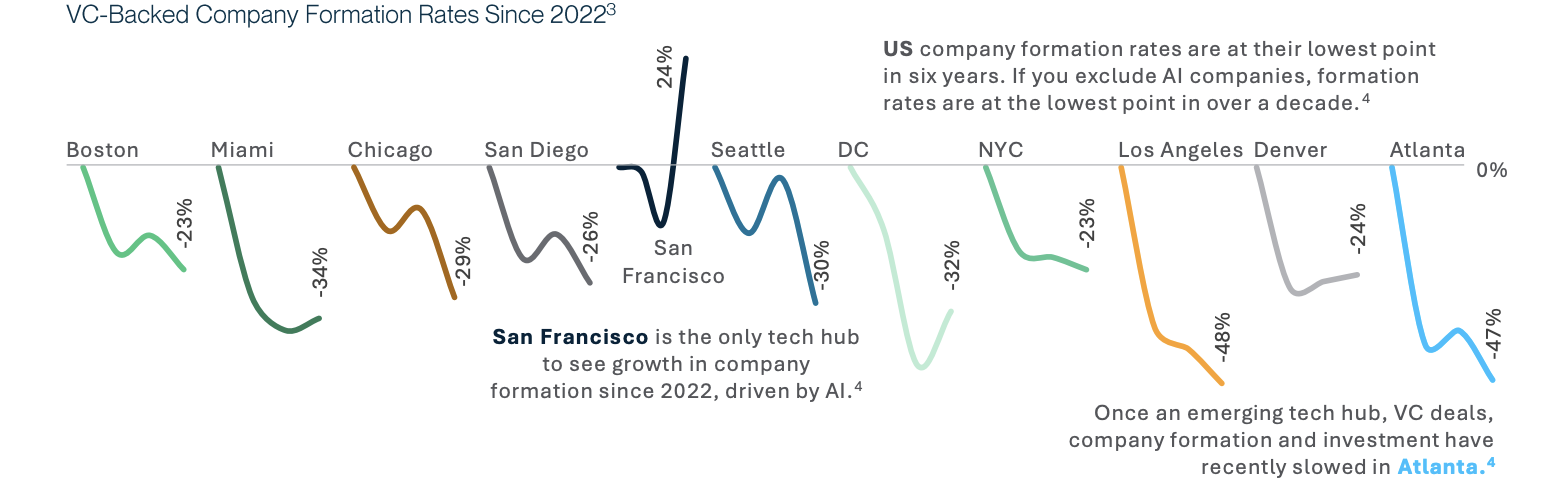
Meanwhile, rent in San Francisco is increasing at the highest rate in the US and is on pace to surpass NYC for one- and two-bedroom units.
“In San Francisco, rents are surging, with one-bedrooms climbing 16.1% and two-bedrooms up 19% year-over-year, as a return-to-office push and optimism around AI-driven hiring pull high-income workers back into an already supply-constrained market.”
Taken alone — or even together — these signals don’t necessarily indicate a shift in “how” Silicon Valley is operating as an ecosystem. After all, San Francisco has been a gold rush town since the 1800s. People in tech rushed to the Bay Area during the dotcom boom in the late 90s and then again as the recovery from the 2008 financial crisis accelerated in the early 2010s. But this time is different.
Each time I’ve returned to the Bay over the past 18 months, it’s seemed faster than when I left. And each time I travelled to another city, the slowdown felt more pronounced. The contrast more jarring. It was as if Silicon Valley was accelerating and evolving in near real-time, while other ecosystems remained static.

What’s Going On?
Last year, tech media started publishing articles about Silicon Valley embracing “996”. The implication of these articles was that the acceleration happening in tech could simply and easily be attributed to startup employees working longer hours. But that explanation rang hollow to me.
While the idea of working 996 (9AM to 9PM, 6 days/week) seems shocking to many people, it’s actually nothing new for Silicon Valley. Back when I worked in startups, a 12-hour workday was pretty normal (I actually have a draft blog post on the topic which I have yet to get around to finishing…). I personally think the media reaction has a lot more to do with how many visitors to Startupland™ during the ZIRP era didn’t actually work that hard, but that’s a topic for another day.
From where I sat, there had to be something else going on.
It took a conversation that I had with Charles Hudson last fall — when I was brainstorming for an experiment that would become Game On — to provide the lightbulb moment. We were discussing the fact that founders seemed to be executing faster in San Francisco than they had been before. Charles had observed something similar and had invited several of his portfolio founders from outside of California to visit for “field trips” (short visits to San Francisco during which they would work out of the Precursor Ventures office).
Charles shared with me a story about one such founder, who was working at the Precursor office on a Friday afternoon when he ran into a bug with an API that he was building on top of (the anecdote is paraphrased as follows):
Founder: “I just ran into a bug with X, so I’m blocked.”
Charles: “What are you going to do about it?”
Founder: “I filed a ticket.”
Charles: “And then?”
Founder: “And then what…?”
Charles: “What else did you do?”
At this point, the founder looked dumbfounded.
Charles: “Are you really going to just file a ticket and call it a day?”
Founder: “What else am I supposed to do?”
Charles: “How about I connect you with the CEO?”
A few minutes later, the founder was describing the bug to the company’s CEO. Within an hour, it was fixed.

Snakes and Ladders
I’ve been thinking about that anecdote — any many similar ones that I’ve heard since — and I believe that the best metaphor for what’s going on in Silicon Valley right now is the board game snakes and ladders.

Founders in SF have always benefited from high-value networks, but over the past couple of years they’ve become far more aggressive in how they leverage them. Have a bug? Reach out to the CEO. Want early access to the next release? Get your VC to connect you to the CEO. Trying to get into that invite only party with the who’s who of your sector? Reach out to the party organizer (aka the CEO).
These days, founders up and down Silicon Valley unapologetically search for and leverage “ladders” in order to skip steps. They’ve become far more aggressive at this than I’ve ever seen before — going into social debt to a degree that would have been considered inappropriate (and, frankly, cringe-worthy) only a few years ago. But these days, it’s increasingly perceived as a socially-acceptable form of ambition.
These founders are sprinting and scrambling as fast as they possibly can up each and every ladder they find. Occasionally, they screw up and slide back down a “snake”. But no one in the valley bats an eyelash. There are no negative social implications. Meanwhile, founders everywhere else in the world are dutifully running back and forth along the left-to-right game squares. Some of them are trying to go faster (aka 996), but all of them continue to follow the linear, back-and-forth path.
Have you ever heard of anyone winning a game of snakes and ladders without climbing a ladder? Me neither…
One of the experiments we performed during the “Game On” program last January involved introducing the 35 visiting Canadian founders to some unexpected ladders. On day two of the program, we had Google’s Global Founder Advocate, John Alioto, join us. He sat down in front of our visiting founders with a simple offer,
“Tell me anything you want access to anywhere in Google, and I’ll make it happen.”
One of the founders in the room raised their hand and mentioned that they had been on a waiting list for a pre-release product for 3 months. John smiled, typed a few things into his computer, and several moments later declared that they had access to it. Everyone’s eyes widened.
Over the course of the morning, he repeated similar unlocks for many of the founders in the room. In mere moments, these founders climbed ladders that they had been dutifully marching towards for weeks or months. John unlocked doors that were previously closed to them, with no idea as to when (or if) they might be opened.
That’s a daily occurrence for Silicon Valley’s highest-velocity founders.
The Fog of War
Popping up a level, it’s important to address the topic of information asymmetry in the current startup landscape.
Whether you are a founder, an investor or an ecosystem supporter, it’s essential that you understand that there has been a significant reduction in the information flow emanating from Silicon Valley. The “fog of war” between the Bay Area and the rest of the world has gotten thicker. “Snake and ladders” is but a single example of the many changes that have taken place in how San Francisco startups operate that aren’t yet apparent to the outside world.
Historically, information and innovation flowed fairly reliable out of Silicon Valley. Each time a new idea would arise — whether technical, business process, or otherwise — it would first disperse throughout local Bay Area networks. A month or two later, some number of people would share it with the wider world through blog posts, Twitter threads and videos. Within a quarter or two, the majority of the world’s tech ecosystems were up-to-speed.
That’s not happening anymore.
Technological innovations are still widely and reliably distributed online (you need only look at the speed with which OpenClaw took the world by storm to be convinced of that). But when it comes to business processes, go-to-market strategies, best practices and other innovations, very little information is leaving the Bay Area these days.
There are three reasons for this:
The intensity of AI-driven competition has resulted in many people deprioritizing non-critical content creation
An increasing percentage of the content that does get created is useless, AI-generated slop
Within Silicon Valley, information sharing has overwhelmingly shifted from public forums to private group chats and closed events
When taken together, the result is that founders, investors and ecosystem builders outside of Silicon Valley are increasingly out-of-touch with what’s happening on the ground in San Francisco for no other reason than that no one is telling them.
In the past six months, I’ve seen numerous founding teams from outside of Silicon Valley visit the Bay Area, only to discover that their knowledge — about technology, competition, customer interest, and more — was significantly out of date. Despite having every belief that they were operating at the bleeding edge of their industry, they discovered that they were, in fact, very far behind.
I’m not sure when (or if) the flow of information from Silicon Valley to the outside world will return to it’s previous rate. For now, I can simply offer this: if your goal is to create a globally competitive tech company, you should presume that what you think you know about what’s happening Silicon Valley is significantly outdated. At worst, it’s flat-out wrong.
The solution? Go on a field trip. Get on a plane, spend a few weeks in San Francisco during the summer. And see for yourself.
For founders building outside of Silicon Valley, it’s the new playbook.
Go Touch Grass
Here are some of the ways that I slow things down and take a break from the dopamine rush of AI.
Last week, I wrote about a question that is increasingly top-of-mind for many residents of Startupland™: is agentic programming addictive?
I’ve received as many responses to my post asserting that, “this is normal…if you’re a founder you should have some level of addiction…” as I did emails expressing some form of, “thank you for writing this…it describes exactly how I’ve been feeling as of late,” (which to me is a pretty good indication that I’m on to something).
As someone who’s founded a number of startups over the years, I have some experience when it comes to late night coding binges. I personally feel like there are some real differences at play now that AI is in the mix. Of course, it could just be that I’m a boomer past my prime…

I will say this: as a parent, I find myself increasingly motivated to be thoughtful and intentional when it comes to our current AI-driven obsession. The question of “how much screen time is appropriate?” existed long before I was born. With the addition of AI — and its productive and addictive possibilities — that question seems even more prudent.
For both adults and kids alike, I think that it’s essential to maintain a connection to activities that are not impacted by AI. That’s why I concluded my post on the potential addictiveness of agentic programming with the following suggestion:
“…taking time away from your agents is important not only for your general health and well-being, but because our ability to think, create and invent depends on it.
So take a break. Make a point each day to step out of the AI- and social media-driven dopamine loops and touch grass. Not only is it okay to go outside, it’s essential.”
I thought that this week I would share some of the small but meaningful ways that my family and I “slow things down” in order to take a break from the dopamine-driven cycles of Startupland™:
1. No Technology at the Dinner Table
I’m a big believer in family dinners. It’s not always easy to pull off, but establishing a daily or weekly ritual with family or friends provides time for everyone to catch up, share stories and build connection.
One change we made in the Neumann household (that was harder than it seemed when we started) was to ban technology at the dinner table. That means no cell phones, no Apple Watches, and no questions to “Google”, “Siri” or “Alexa” (we actually unplug our Google Home before eating dinner because we are so used to interacting with it).
Remember the days when someone had a question and you actually discussed and debated the answer…? Turns out, you can still do that.
2. Listening to Vinyl Records
The resurgence of vinyl has been on the upswing for awhile. But that was mostly for audiophiles who couldn’t shut up about how much better their sound system was than yours. We jumped on the vinyl bandwagon for an entirely different reason: in order to stop our kids from skipping around when listening to music.
We noticed that, at a young age, our kids often struggled to listen to entire songs, much less albums. In some cases they would skip ahead. In others, they would restart a song multiple times before it finished. This isn’t anything particularly new, but it’s a lot more prevalent with digital music. As our kids got older, the frequency with which the soundtrack of our lives became measured in 15 second increments became unbearable.
Our solution: to buy a record player and give everyone in the family “credits” to buy their favorite albums.
Now, the only music we have on during dinner comes from a record player. We take turns picking music and, once someone puts on a particular record, it cannot be changed until it’s done. Not only has it given our children a better appreciation for music (they’ve had to learn how to handle and change vinyl records), everyone has gained/regained an appreciation for albums as a distinct work of art.
(Bonus points: there are no vinyl “brain rot” albums 😉).
3. Gardening
Another hobby that we’ve increased the amount of family time we spend on is gardening. As a kid, I spend countless hours learning to garden with my grandfather, who dedicated much of his retirement to meticulously tending one of the most fantastic vegetable gardens you could possibly imagine (the rest of his time was focused on fly fishing).
In today’s era of farm-to-table groceries, it’s hard to justify economically the time and effort that goes into growing vegetables in an urban setting, but the practice itself is both calming and centering.
And AI isn’t going to make those cherry tomatoes grow any faster.
4. Cooking
It’s no secret that I love to cook. In fact, it’s one of the things that recharges me. I cook multiple times each week, whether I’m by myself, with my family or when hosting a dinner party.
I’ve long-since learned to not try to multitask whilst cooking (no better way to burn dinner than by accidentally falling down an AI rabbit hole). Moreover, it’s a skill that very much can only be perfected through practice. The internet might give you the perfect recipe for pan-seared duck breast, but chances are you won’t get it right the first time. Or the 10th…
5. Board Game Night
Video games are fun, but it’s hard to beat the energy and laughter that comes from playing board games.
We try to find at least one night each week to play board games with our kids. Some nights it’s old faithfuls like chess or Monopoly. Other nights it’s strategy games like Ticket to Ride or Carcassonne.
It doesn’t matter if it’s 15 minutes or 3 hours, putting down the screens to play a game while sitting around the table provides a type of dopamine hit that AI simply can’t deliver.
6. Playing / Coaching Sports
Speaking of games, playing and/or coaching sports is one of the best ways I know of to disconnect.
I’m the type of person who desperately needs regular exercise (I workout almost every morning), but going to the gym and/or working out with my trainer is more like a daily routine than it is a true disconnect. For me, the competitiveness and camaraderie of sports is where the magic happens.
As a parent, I love coaching my kids’ sports teams. I also love playing sports. Whether it’s team sports like soccer, hockey and baseball or individual sports like skiing, swimming or rock climbing, the combination of physicality, competitiveness and disconnect provides an effective mental and physical reset.
There are plenty of other ways to “touch grass”, from reading a book to camping (and fly fishing!) to playing a musical instrument. Whatever you do, try to find 20 minutes a day to disconnect from all of your agents, breath deeply, and relax.
I promise you’ll have more energy, more stamina and more focus.
And, as I said last week, those agents aren’t going anywhere 😉.
Stop, Collaborate and Listen
There are moments in time when it’s important as a founder to stop and pay attention to what’s happening around you. This is one of those moments.
Last week, I urged founders to ignore distractions.
“In an age of distractions, the winners will be the ones who stay focused.”
But there is a counter point to that. For there are moments in time when it’s important to stop and pay attention to what’s happening around you.
I recently caught up with an absolutely dialed-in founder whom I’ve known for many years. He’s S-tier when it comes to ignoring the noise and staying focused on whatever he’s working on (these days, it’s an algorithmic trading platform that’s crushing the intersection of DeFi and traditional finance).
When I asked him how he’d started off the year, he had this to say,
“When my team came back from the holidays, we put everything on pause. Literally everything.
We put all of our algorithms on autopilot and spent a week trying the latest versions of every tool, program and project we could find.
We tinkered as a team for a full week. My mind was completely blown by what we had built by the end.”
Coming from this particular founder — whose teams are known to push the boundaries of whatever technologies they’re working with — a statement like that made me sit up in my seat.
Not just because of what he said, but because he wasn’t the first person to have shared something similar with me over the past few weeks.
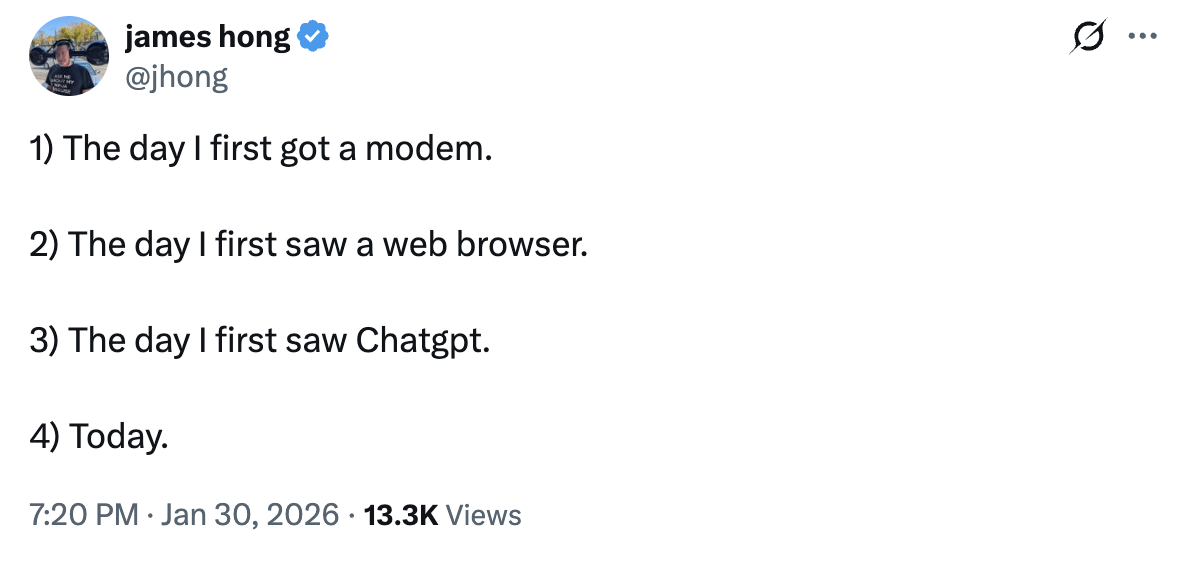
At this point, I’m old enough to have seen a lot of technology inflection points. And I have a strong suspicion that we’ll look back at January 2026 as being one of those.
From my vantage point, there are three important things that have emerged in the past few weeks:
1. AI Can Finally Write Good Code
Most developers at this point have become accustomed to using some form of AI while writing code. But for all the hype around vibe coding, anything remotely complex still required humans to roll up their sleeves and wade through muck. Remo Jansen recently described it like this,
“For over two years, I have been using GitHub Copilot extensively with multiple models, coding agents, and custom agents, and for the most part it has been hit and miss.
I usually ask GitHub Copilot to implement a feature or fix a bug using the chat or coding agent, and a lot of times it would go very wrong. I have developed the habit of staging changes before each prompt, code reviewing changes for each prompt as I go along, and rolling back via git when I'm not happy with the solution. Working like this for a while means that I have been able to develop a sense of what kinds of things will work and how to break problems into steps that make it more likely that the AI agent will do what I expect.”
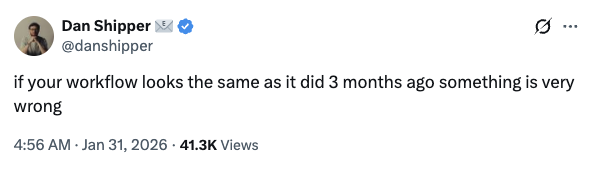
In late-November, Anthropic released it’s newest model, Claude Opus 4.5. At the time, the release didn’t jump out as particularly significant. But that was probably because it came after U.S. Thanksgiving — which meant most developers were focused on wrapping things up for the year as opposed to testing new models. As the year came to a close and we entered 2026, posts like these started to emerge:

I’m generally skeptical of hyperbole and presume most extreme reactions to new technologies are exaggerated, but then I started hearing similar sentiments from people I know and trust. Friends who spent time over the holidays to kick the tires on Opus 4.5 all had similar reactions:
“I built something I’ve wanted to do for awhile over the weekend. I’ve tried (and failed) multiple times to get it done with earlier models.”
“It’s the first time I didn’t have to spend hours reviewing and fixing the code.”
“This one’s different.”
2. The First Agent “Kit”
Almost every major technology shift includes a particular point at which the New Thing™ is made available to highly technical early adopters in a way that is (almost) turn key.
For the personal computer, it was the introduction of the Altair 8800 in 1974. The Altair 8800 was the first commercially successful microcomputer kit. You had to be incredibly technical to assemble it (and it was easy to make mistakes), but it provided the launchpad for the personal computer revolution that came after. (In March 1975, the Homebrew Computer Club held its first meeting in Menlo Park, which Steve Wozniak credits as the inspiration for the Apple I.)

Over the past few weeks, the internet has been awash with posts about Clawdbot Moltbot OpenClaw. On the one hand, there isn’t anything particularly mind-blowing about OpenClaw’s technology. After all, we’ve had agents for some time now. But if you think about it within the context of technology history, it’s an extremely significant product.
OpenClaw is the first agent “kit”.
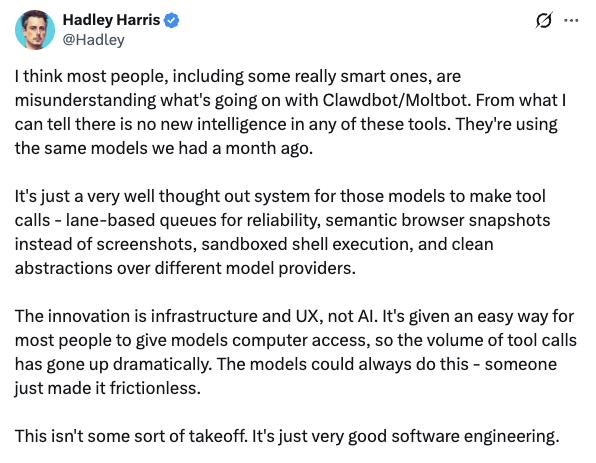
Just like the Altair 8800, OpenClaw is accessible to only highly technical early adopters (at least, for now), but those hobbyists, hackers and tinkers are swarming to it.
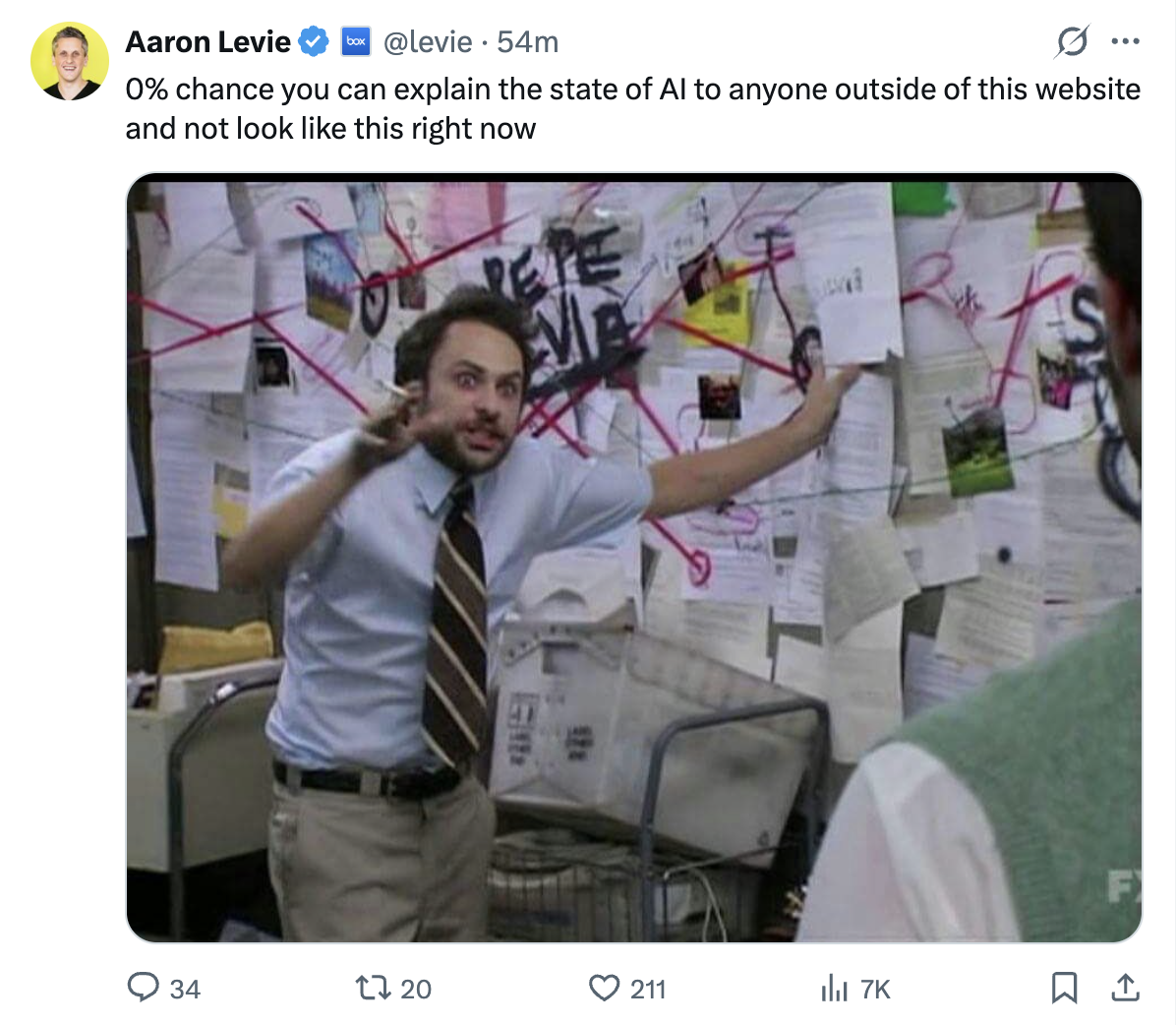
And while there’s an incredible amount of noise and nonsense taking place around this (*cough cough* moltbook), it’s only a matter of time before we see some of these projects turn into products.
3. Open World Games from a Prompt
On the last day of the month, Google announced “Project Genie”, an AI tool capable of creating playable open-worlds from a prompt.
And gaming stocks around the world immediately plummeted.
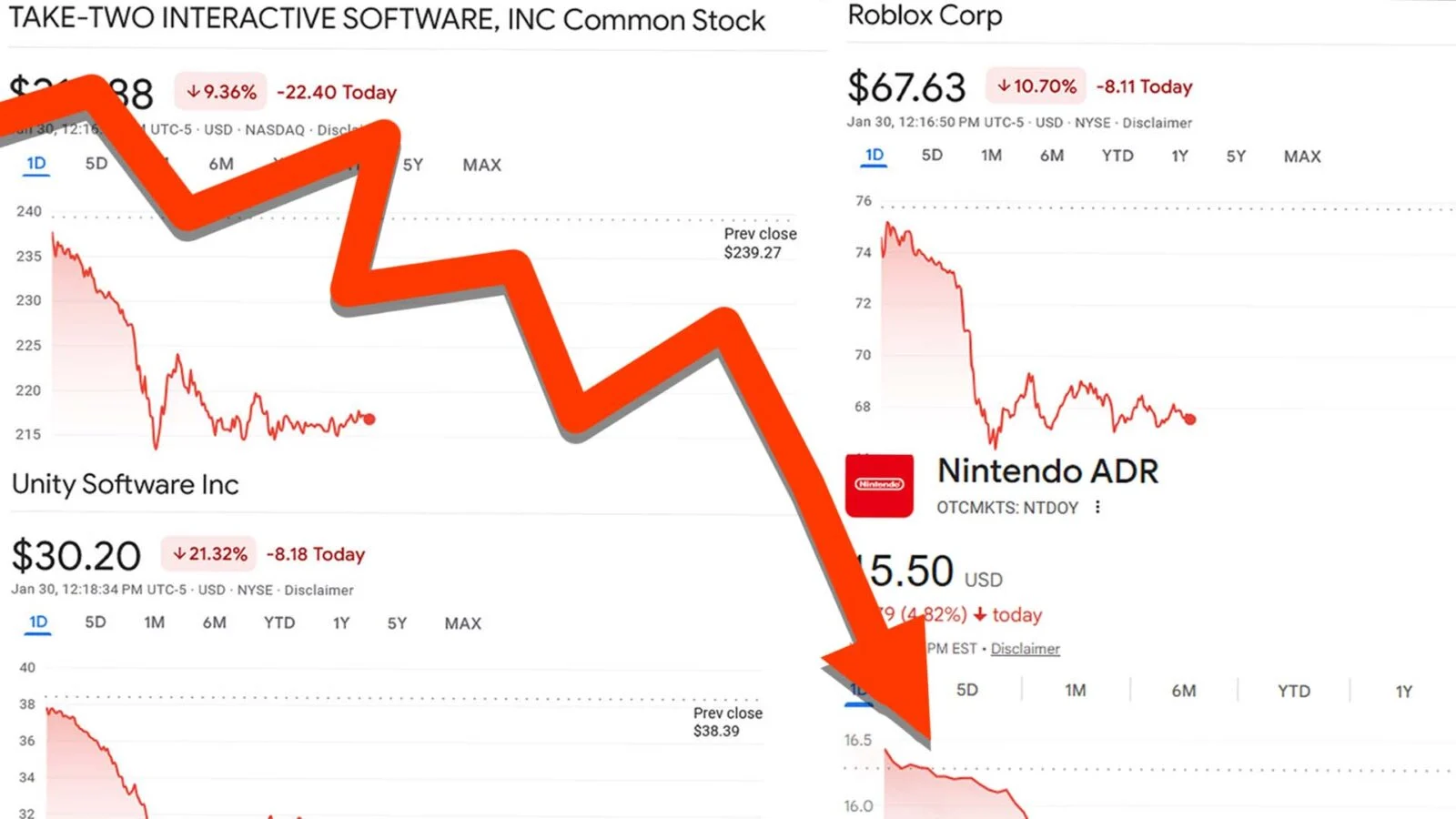
On the one hand, this might seem like a bit of an overreaction. After all, we’re a ways away from having a prompt result in a brand new end-to-end GTA game (many of my friends in the gaming industry confidently responded as much).
On the other hand, the economics of AAA video games has been upside down for many years. Costs have skyrocketed (the budget for GTA 6 is predicted to be somewhere between $1 and $2 Billion), but financial results remain highly unpredictable.
What makes the stock market response to the release of Project Genie directionally reasonable (at least, in my opinion) is that it represents an expectation that AI will have a similar impact on gaming that it already is having on general software. If we accept that a small team of highly specialized founders can create a billion-dollar software company using AI, then it’s perfectly reasonable to predict that a small team of experienced game developers will create a AAA video game using AI.
While I remain steadfast in my believe that the founders who focus will win, this very much feels like a moment-in-time when it’s important for founders to take stock of what’s going on around them.
That doesn’t mean diving down the rabbit hole of agent social networks, but it does mean checking out the latest tools. And it’s always better to do that with friends.
I’m setting aside time in the next few weeks to stop, collaborate and listen. I suggest you do too.
Humility vs. Hubris
A lot of the magic that happens in Startupland™ takes place at the intersection of humility and hubris.
Last week, I visited Edinburgh, Scotland to speak at Ecosystem Exchange, an annual conference that brings together investors, government officials and ecosystem builders from across UK to collaborate on ways to improve their local, regional and national startup ecosystems.
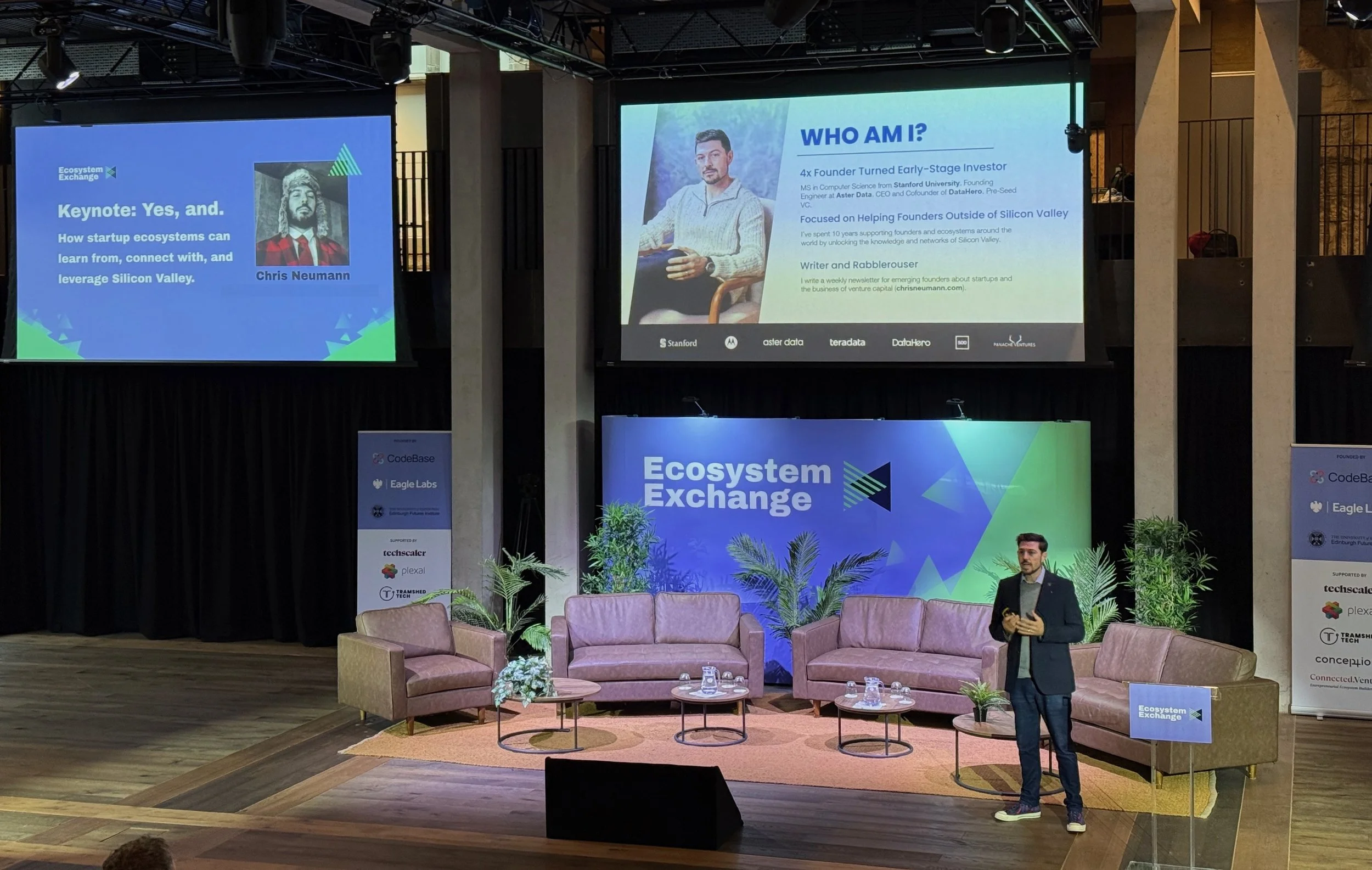
The conference was the brainchild of Jon Hope, a long-time UK ecosystem builder who previously co-founded one of the country’s largest networks of incubators and co-working spaces, Barclays Eagle Labs.
Over the course of two days, the speakers and panelists dove into a number of issues shared by countries around the world, including:
Disparities in talent, experience and capital availability across different cities and regions
Challenges commercializing IP developed in (government-funded) universities
The tensions between supporting high-growth companies with global ambitions and locally-focused startups that serve domestic needs
The impact of government policies / geopolitical shifts / local culture on startup ecosystems
Challenges retaining top talent and competing globally
When it was my turn to step to the mic, I spoke to the audience about a topic that’s deeply engrained in the ethos of each and every VC around the world: humility.
Ok, so maybe humility isn’t the first word that comes to mind when you think about a venture capitalist.
How about hubris?

It may seem surprising, but a lot of the magic that happens in Startupland™ takes place at the intersection of humility and hubris.
Here are some examples:
The best startup founders possess the hubris to believe that they can create billion-dollar companies out of nothing, but the humility to seek out mentorship, peer advice, and other forms of support to do so.
Top performing VCs possess the hubris to believe that they can identify the most promising startups before anyone else. Their humility comes from the knowledge that nearly 90% of their investments will fail (despite their best efforts). And no matter how much diligence they do, they won’t know which ones until much later.
But what about ecosystems?
In my experience, the ability to navigate hubris vs. humility is essential for ecosystems to grow. Why? Because no ecosystem outside of Silicon Valley has enough density of experience, expertise and talent to do it all.
Smaller ecosystems inherently understand this. One of the reasons why Scotland is amongst the fastest-growing startup ecosystems in the world is because it long-ago embraced the notion that it needs to build connections with other ecosystems in order to augment its domestic capabilities and support its local startups.

Scotland even has a version of its national soda dedicated to startups.
So why did I talk about humility and hubris at an ecosystem conference that took place in a country that seems to have figured it out?
Because even ecosystems that possess the self-awareness to recognize that they have gaps often struggle to maintain humility when addressing them.
Governments spend millions of dollars sending founders around the world to “tap into” other ecosystems (humility), but insist that they participate in highly choreographed programs designed at home (hubris).
Ecosystem builders pour time and effort into creating incubators and accelerators to support their startups (humility), then staff them with people who have no experience actually building successful tech companies (hubris).
Investors obsess over the their portfolio companies raising follow-on rounds from bigger, more prominent (predominantly Silicon Valley-based) VCs (humility) but can’t be bothered to get on a plane to get to know them in order to understand what they are actually looking for (hubris).
(And just to be clear, it’s not only ecosystem supporters who struggle with this tension — founders are far from immune to the pull of hubris.)
We’re currently in an era of significant macroeconomic, technological and geopolitical change. The gap between Silicon Valley and the rest of the world has never been greater. Yet at a time when the U.S. is becoming more insular, tech ecosystems around the world are banding together to address their weaknesses and create economies of scale.
On top of that, I’ve increasingly come to believe that Gen Z may be inherently better at walking the tightrope between humility and hubris than the generations who came before them. Younger founders have a different relationship with community than those who came before them. They also have a different relationship with geography. The Times, They Are A-Changin’.
I’ll close with this thought: as countries continue to shift away from globalization, there is opportunity in building deeper, more consequential relationships between tech ecosystems. Founder-to-founder. Investor-to-investor. Ecosystem-to-ecosystem. The ecosystems that capitalize on these opportunities will be the ones that embrace the idea that economic prosperity >> egos.
And that magic happens at the intersection of humility and hubris.
Much Ado About Nothing, H-1B Edition
What does the announcement of a $100,000 fee for H-1B visas mean for startups in the U.S. and tech ecosystems around the world?
Let’s jump right in with the biggest news in Startupland™ this week: the announcement that the U.S. is increasing the fee to apply for an H-1B visa to $100,000.
What does this announcement mean for startups in the U.S. and tech ecosystems around the world?

Absolutely. Nothing.
Before you interrupt me to explain how wrong I am, why this changes everything for America, or why your favorite non-U.S. city/state/country stands to benefit, hear me out.
Since President Trump’s announcement last Friday, the internet has been awash with hot takes. Why is Chris Neumann’s any better? For starters, I’ve actually been on an H-1B visa. Moreover, I’ve also hired people on H-1B visas. I’ve worked at big U.S. tech companies and small ones. I’ve been a founder and a VC. None of these facts make me an immigration lawyer by any stretch of the imagination, but they make my understanding of what these visas are, how they’re used by tech companies, and the potential impact of this announcement better than 99% of what you’ve read so far.
So let’s dive right in, starting with a quick primer…
What is an H-1B visa?
Established under the Immigration Act of 1990, the H-1B program enables U.S. employers to temporarily hire highly-skilled foreign professionals in specialized occupations, primarily in science, technology, engineering and mathematics (STEM) fields.
U.S. companies apply for the visa on behalf of prospective employees, who must have at least a bachelor’s degree in their area of specialization. There are three buckets for H-1Bs:
Up to 65,000 petitions each year are granted to general applicants
An additional 20,000 petitions each year are granted specifically to applicants who earned a master’s degree or higher from a U.S. institution
A further category of H-1B petitions, known as cap-exempt petitions, enables universities, government research organizations and certain non-profits to apply for H-1Bs visas outside of the congressionally-mandated annual cap
Note that the H-1B caps described above are for “initial employment” visas (visas granted to people who did not previously have an ongoing right to work in the U.S.) as opposed to extensions/adjustments to existing H-1B visas.
To give a sense of scale, according to the USCIS report to congress on the Characteristics of H-1B Specialty Occupation Workers for FY 2024, 141,205 H-1B petitions were granted for initial employment in FY 2024 (which we can reasonably assume consisted of 65,000 general petitions, 20,000 petitions for individuals with a U.S. master’s degree or higher, and 56,205 cap-exempt petitions), while 258,190 were approved for continuing employment:
Who Gets H-1B Visas?
Contrary to popular belief, H-1B visas are not only used to bring new workers into the U.S. from other countries. In fact, they are mostly used to keep highly-skilled workers in the U.S.
In its report to congress, USCIS noted the following breakdown of the 141,205 H-1B petitions for initial employment that were approved in FY 2024,
“Of the 141,205 petitions approved in FY 2024 for initial employment, almost 46 percent requested consular (or port of entry) notification, and the remaining approximate 54 percent requested a change to H-1B nonimmigrant status for a beneficiary already in the United States.”
In other words, 54% of the approved petitions for “initial employment” H-1Bs went to people who were already in the U.S. on other, non-employment visas. The vast majority of those (more than 71%) were transitioning to H-1Bs from student visas. This is the path that I personally took after graduating from Stanford with my master’s degree (we’ll get back to this point later).
Who Sponsors H-1B Visas?
All H-1B visa petitions must be submitted / sponsored by a U.S. company. The significant majority are sponsored by tech companies (which should come as no surprise to most readers). What might be surprising is the types of tech companies that sponsor H-1B petitions. According to the USCIS Data Hub, the top 10 petitioners for FY 2024 included 6 of the largest tech companies in the U.S. (Amazon, Google, Meta, Microsoft, Apple and IBM). The other 4? U.S. subsidiaries of India’s largest consulting companies (Infosys, Cognizant, Tata and HCL).
If you’re wondering why the the topic of H-1B visas is so contentious in the U.S. right now, here it is in one chart:
Despite all of the political rhetoric, the biggest critique of H-1Bs has never really been that U.S. companies use them to hire the best and brightest from around the world in place of American workers. Rather, it’s the perception that foreign consulting firms have been leveraging the program to bring in foreign workers to service U.S. clients (ostensibly at lower wages). I don’t know the degree to which these criticisms hold true, but it certainly doesn’t look good.
Y Combinator CEO Garry Tan has some thoughts on the matter
In fact, if you go through the top 100 list of H-1B petitioners on the USCIS website, alongside a “who’s who” of American tech giants you’ll find a surprising number of U.S. subsidiaries of foreign-owned consulting companies. You know what you won’t find? Actual startups.
Do Startups Hire H-1B Employees?
The short answer is “sometimes”. And that “sometimes” comes with a lot of caveats.
The first thing to note about H-1B visa applications is that “initial employment” petitions take a long time to approve. The approval process (known as the H-1B lottery) only takes place once per year. So depending on when an application gets filed, it could easily take a year or more for an H-1B petition to be approved — if it’s approved at all.
That’s way too long for most startups to wait. Especially when there are other options.
Here’s the reality: the vast majority of U.S. startups don’t hire any foreign workers using initial employment visas. At least, not in their early days.
Why not? Because hiring employees on initial employment visas takes time, costs money and is generally a pain-in-the-ass. It’s far more efficient and effective for startups to hire Americans. No immigration. No complications.
When they do hire nonimmigrant workers, early-stage startups prefer to hire people who already have a visa.
Transferring Sponsorship of H-1B Visas
In FY 2024, 16% of H-1B actions (covering nearly nearly 64,000 individual workers) were transfers of H-1Bs from one employer to another. That’s how a lot of startups hire foreign-born workers. In fact, that’s what happened to me. My initial H-1B petition (approved under the category for individuals with U.S. master’s degrees) was filed by a big U.S. tech company known as Motorola (remember them?). When I joined my former classmates from Stanford a few years later as Aster Data’s first employee, they simply filed the paperwork to transfer sponsorship of my visa over. There was no uncertainty. No long wait. Just some simple paperwork and a (relatively small) transfer fee.
Guess what startups often get when they hire an ambitious young (foreign-born) engineer with a couple of years of experience at Google/Meta/Apple/etc.? A freshly-approved H-1B.
According to USCIS, the fee change announced last week will have no impact on this path:
“This Proclamation does not:
- Apply to any previously issued H-1B visas, or any petitions submitted prior to 12:01 a.m. eastern daylight time on September 21, 2025.
- Does not change any payments or fees required to be submitted in connection with any H-1B renewals. The fee is a one-time fee on submission of a new H-1B petition.
- Does not prevent any holder of a current H-1B visa from traveling in and out of the United States.”
Transferring from Other Visas to H-1B Visas
Another common approach that startups use to hire foreign-born workers is to hire individuals who are already in the U.S. on another visa.
Earlier, I noted that 71% of the H-1B visas granted in FY 2024 to holders of other visas went to individuals who were already in the U.S. on student visas. (That’s 52,385 visas for those keeping track.) How does this work if it can take a year or more to complete an H-1B petition?
It works because F-1 visas come with up to 36 months of post-graduation work authorization.
When it comes to taking advantage of the economic benefits of foreign-born students educated in the U.S., America isn’t dumb. New graduates with designated STEM degrees can legally work in the U.S. for up to 3 years after graduation while their employers petition for an H-1B or other long-term visa on their behalf.
And guess who early-stage startups tend to hire? New graduates.
The change announced last week will have minimal impact on the very healthy pipeline of foreign-born students → U.S. universities → U.S. startups.
(I won’t say zero, as there are likely some individuals who might choose to go to a “big tech” company before joining a startup to increase the likelihood of getting a long-term work visa. But as I described above, that isn’t a new phenomenon.)
It is worth nothing that the change to H-1B petition fees does impact the transition of individuals who begin working at startups on F-1 work authorizations to H-1Bs. But as we’ll see below, there are other potential paths for such individuals. (It’s also worth noting that as of the publishing of this post, there are already discussions underway about potential exemptions to the fee for smaller companies.)
What About Startup Founders? Won’t They Leave?
Probably not.
One important thing to understand is that the H-1B visa isn’t the only employment visa available for tech workers in the U.S. And when it comes to startups, it isn’t necessarily even the best one.
The H-1B wasn’t the only tech-friendly visa established under the Immigration Act of 1990. The Act also established the O-1 nonimmigrant visa, for “the individual who possesses extraordinary ability in the sciences, arts, education, business, or athletics.” In recent years, it has become the preferred option for startup founders and many early employees of startups for three big reasons:
No Annual Cap: Unlike the H-1B, there is no annual cap on O-1 visas.
Shorter Processing Time: Whereas H-1B applications are only processed once per year, O-1 petitions can be processed within weeks of the application being filed, regardless of when the petition is filed.
Certainty: Whereas H-1B recipients are chosen randomly from a pool of qualified applicants as part of a lottery, O-1 visas are granted entirely on the merit of the petition.
It’s only in recent years that O-1s became more common among startups and for a simple reason: they’re harder to qualify for.
To qualify for an H-1B, an individual needs little more than an offer letter and a degree from a qualifying institution. An O-1 is much more involved than that. To qualify for an O-1, the petitioner must provide evidence that the individual is of “extraordinary ability” within their industry:
“The petitioner must provide evidence demonstrating your extraordinary ability in the sciences, arts, business, education, or athletics, or extraordinary achievement in the motion picture industry. The record must include at least three different types of documentation corresponding to those listed in the regulations, or comparable evidence in certain circumstances, and the evidence must, as a whole, demonstrate that you meet the relevant standards for classification.“
Guess what? Many startup founders and early employees fall into that category.
So What Does This Change Actually Mean?
At the start of this post, I posed the question, “what does this announcement mean for startups and tech ecosystems around the world?”
If we ignore the politics around this change and focus only on (1) what has been officially announced by the administration (including the most recent clarifications) and (2) how H-1B visas actually work and are used in practice, here is my personal opinion:
1. What Will Be the Impact on Startups?
Despite all of the rhetoric, increasing the application fee for new H-1B petitions will have little-to-no impact on startups in the U.S.
At the early stages, relatively few startups submit initial employment H-1Bs. Those that do can potentially take advantage of other visa programs and/or are likely to have raised enough funding to be able to absorb the cost (considering that many VC-backed startups in the U.S. spend more than $100K on recruiters or legal fees).
Don’t believe me? The best example the Wall Street Journal could find of a startup founder claiming that he would stop using H-1Bs as a result of this change raised $6M in VC funding, employs 11 people — 5 of whom are remote contractors in South Africa and Portugal — and has hired *checks notes* one H-1B worker 🤦♂️.
Still don’t believe me? Here’s what Democratic megadonor Reed Hastings had to say:

Granted, Reed’s take was certainly against the flow when it came to Silicon Valley reactions, but I think it’s the correct one if you reframe the categorization of visas as follows:
H-1Bs will be used for very high value jobs
O-1s will be used for very high value people
2. What will be the Impact on Ecosystems Outside of the U.S.?
As much as politicians and ecosystem advocates around the world rushed to proclaim that this was a massive own-goal on the part of the U.S., I doubt that we’re going to see much (if any) impact in other countries.
Big tech companies in the U.S. won’t blink an eye when it comes to paying this fee. Neither will startups if the jobs are very high value (they will also continue to happily hire workers who spent a few years at a big company in order to get a visa).
We may see a reduction in the number of H-1B applications from consulting companies — who are often driven far more by per-employee margins than other organizations — but that won’t necessarily translate into increases in immigration elsewhere (unless those consulting companies suddenly increase their non-U.S. hiring).
My good friend Alex Norman, Founding Partner of Canadian Pre-Seed firm N49P (who incidentally also previously worked in the U.S. on an H-1B visa) had perhaps the best take on this:
Or as Jack Dorsey once said, “You can worry about the competition…or you can focus on what’s ahead of you and drive fast.”
AI Won’t Actually Change Everything
The current gap between the tech world’s obsession-of-the-moment and the rest of the world seems more like a chasm.
Last week, I took a few days away from preparing for this year’s BC Founders Day and escaped into the British Columbia wilderness.
I’ve written before about the importance of finding what recharges you. For me, a few days in nature (preferably somewhere devoid of cell phone coverage) is ideal. One reason why I do this on a regular basis is because of how it rejuvenates me. The healing benefits of spending time in nature have been proven time and time again (not only is it okay to go outside, it will make you more effective as a founder).
But there’s another reason why nature is my preferred escape: it forces me completely out of the bubble of Startupland™.

I don’t wanna goooooooo!
Usually when I head into the wilderness, I use the time to reset and reflect. When I go with my kids (as was the case last week), I try to simply focus on them (p.s. if you haven’t gone camping with kids before, it really is one of the best things in life).
Despite nature throwing an atmospheric river at us — after nearly 60 days of pure sunshine, no less — our brief trip into the woods was an undeniable success. There was exploring, swimming, laughing, getting dirty, getting frustrated, overcoming challenges and, of course, s’mores.
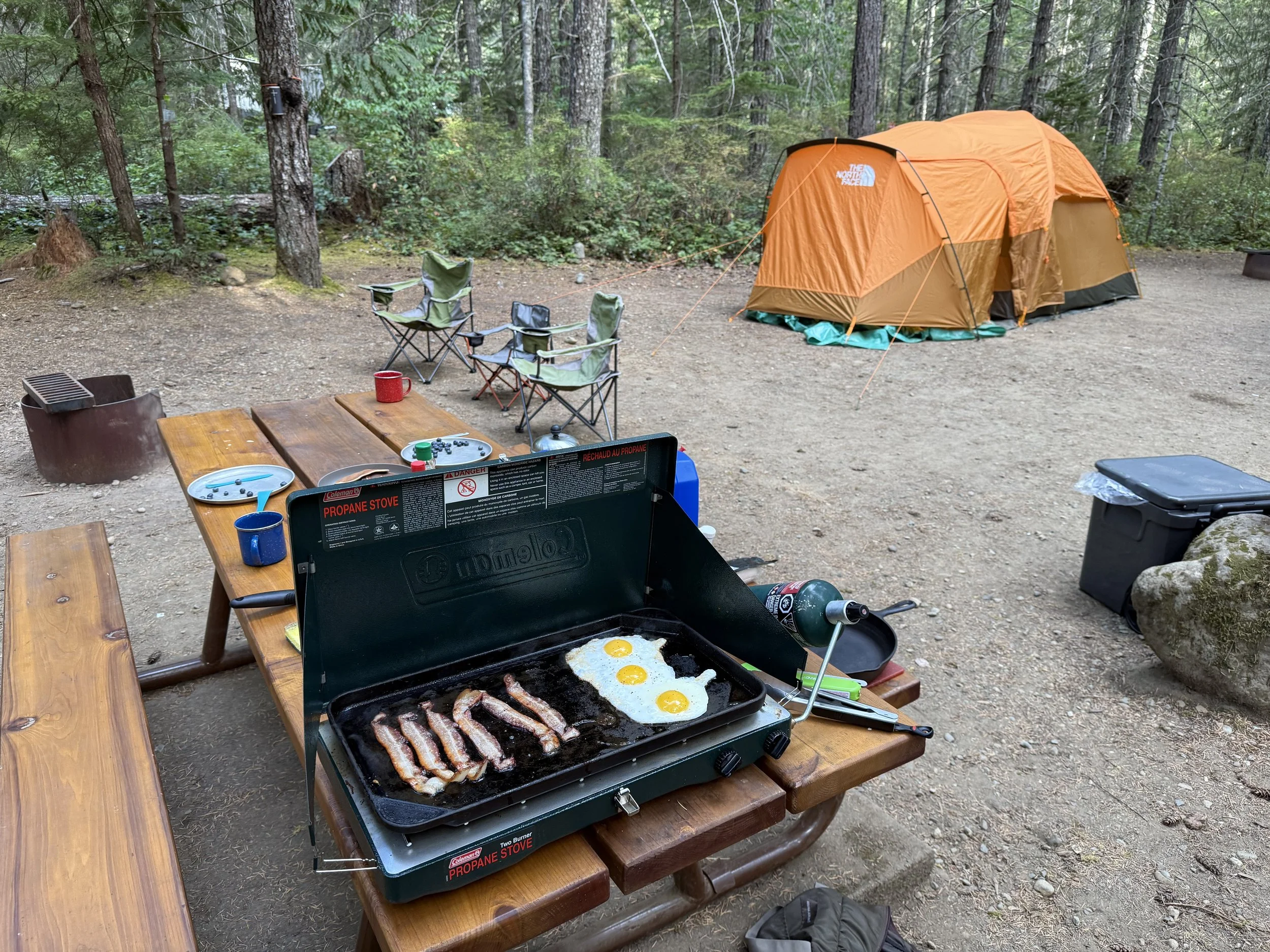


You know what there wasn’t any of? AI.
The only prompting I did was trying to get my boys to help wash the dishes. The only agent I encountered with was the one checking tickets for BC Ferries.
AI didn’t help us put up the tent when we arrived late to our campsite and it didn’t make it any easier to anchor a tarp over the picnic table when the skies suddenly opened up.

AI didn’t help my son spot these two bald eagles
I wasn’t expecting to have any work-related epiphanies on this particular trip, but as I sat on my well-worn REI camping chair, I was struck by how wide the gap had become between Startupland™ and the outside world since the emergence of AI. There is always a sizable distance between the tech world’s obsession-of-the-moment and the perspective of the rest of society. But it feels like the current AI-centric gap is closer to a chasm.
If you’re like me, you’ve probably had a lot of conversations with other residents of Startupland™ recently that leave you feeling like we’re all in a mad rush to maintain relevance. Investors and founders are sprinting to capture market share, CEOs are rushing to make their workforce AI-native, and everyone seems desperate to leverage AI and agents any and every way possible.
But in the rest of the world? Not so much.
That’s not to say that the masses aren’t already benefiting from AI. It’s creeping into everyone’s cell phones, search tools and social media. But in many industries, AI isn’t really changing anything. And it probably won’t anytime soon.
AI won’t change how the friendly campground hosts we met on our trip welcome visiting campers. It won’t change how the small town ice cream store we stopped at doles out scoops of ice cream to wide-eyed children. Nor will it change the operations of the mini golf course we played at, the local bait and tackle store we bought supplies at, or the fish-and-chip shop we patronized before boarding our ferry.
And while it might be easy to dismiss these as niche examples that only representing the long-tail of the economy, such observations are increasingly being made by larger players. Earlier this summer, Thomas Bravo raised nearly $35 Billion for three new funds. The firm’s co-founder and managing partner, Orlando Bravo, was asked how they leverage AI and where he saw potential,
"Summarizing data. But right now there is not a compelling use case we see that will dramatically affect how we add value."
Around the same time, Jason Lemkin of Saastr made this observation,

I’m certainly not trying to downplay the impact and importance of AI — to the tech world or beyond. AI represents the most significant technological advancement in a generation. But it’s worth remembering that there are a lot of places where AI isn’t necessarily top of mind.
Generational wealth will undoubtedly be made by many working in and around AI. But there are also an incredible number of opportunities that remain for founders willing to look where others don’t.
Plus ça change, plus c'est la même chose.
Give Your Customers What They Want
What can this recent history of fast food teach us about AI? It turns out, a lot.
For this week’s post, I’m going to start off with a case study that isn’t from the annals of Silicon Valley (although many in the tech world are loyal customers of this industry). Today, we’re going to talk about fast food. Specifically, we’re going to look at the astonishing rise of A&W Canada.

If you’re reading this from the U.S., you’re probably scratching your head right now (in all likelihood, you haven’t been inside of an A&W in years and, if you have, your experience was likely…not great).
A&W Canada is a completely separate company from A&W Restaurants, which operates A&W in the U.S. and elsewhere. You can read the full history here, but the tl;dr is that A&W Canada split from the US company in 1972 when it was sold to Unilever. A group of Canadian franchisees subsequently bought the company back in 1995 and have operated independently since then. Not only is the Canadian company larger than A&W Restaurants (by both number of stores and revenue), many of the popular menu items and brand assets (including the chain’s bear mascot) were created by A&W Canada and licensed to A&W Restaurants.
Ok, so let’s jump into the case study.
Back in the early 2010s, fast food chains were going through an existential crisis as millennials led a massive shift towards healthier eating. Quick-service restaurants (QSRs) around the world were seeing sharply decreasing sales and rushed to introduce new menu items in order to stem the bleeding. McDonald’s introduced McWraps and egg white sandwiches, Taco Bell added herb-grilled chicken and cantina bowls, while Burger King unveiled turkey burgers and low-sodium french fries. But A&W Canada took a different approach.
At the time, A&W Canada was having its own crisis of identity. Although it was the fifth-largest QSR in the country, its growth was stagnating.
“We were seen as not being very connected with consumers and being out of date, out of style, out of touch, outmoded, not very relevant,” said [Trish] Sahlstrom.
Rather than rush to introduce new menu items as many QSRs were doing, A&W Canada initiated a deeper strategic planning process centred on “dramatic changes in consumers’ attitudes and behaviours.”
“We saw, for instance, an increasing desire among consumers to know who and where their food was raised,” she said. “Consumers were saying, ‘Where’s the evidence? I no longer trust just that it tastes good. I want to know where it came from. I want to know who has raised the animals that are feeding us. I want to know your values, A&W.’”
The company then asked what factors came into play when consumers wanted a hamburger.
“As we started to put together all of these pieces of evidence — all of the answers to these questions — what came out incredibly strong and clear to us was leave out the hormones and steroids and don’t use the antibiotics.”
A&W Canada stumbled on an epiphany that, surprisingly, seems to have been missed by most other QSRs: their customers didn’t want them to change their menu per se, they just wanted to feel better about eating there. A&W customers didn’t want to buy a salad or a wrap or a gluten-free super food quinoa bowl when they visited one of the company’s restaurants. They simply wanted a slightly healthier hamburger.
So in 2013, the company announced that all of its burgers would be made with beef raised without hormones, steroids or other additives.

Following the announcement, the Canadian beef industry was up in arms. The move required A&W Canada to source beef from the U.S. and Australia, as there weren’t enough ranchers in Canada at the time raising cattle that met their requirements. The industry responded with a public relations campaign and attempted boycott of A&W, but failed miserably.
Same-store revenue for A&W Canada increased 6.3% the following year, while a consumer research study by QRI subsequently found that “89% of burger eaters [in Canada] were “impressed and interested that A&W is serving beef raised without added hormones or steroids.” (By contrast, McDonald's same-store sales decreased in 2014 — falling by -2.1% in the U.S. and -1.0% globally)
A&W followed up the success of its “better beef” campaign with similar shifts to its chicken and egg supply chains in 2014.

The sustained focused on healthy ingredients resulted in even greater success in 2015, with same-store revenue increasing 7.6% that year. Total revenue for 2015 topped $1 billion — the first time in the company’s history — while its share of the QSR market in Canada increased from 12.7% in 2013 to 14.4% in 2015. And the company hasn’t taken its foot off the gas since.
In 2018, A&W Canada became the first QSR in the world to introduce Beyond Burgers nationally. That same year, the company further evolved its egg supply from vegetarian-fed to cage-free and antibiotic free eggs. And in 2020, it shifted its burgers to 100% Canadian, grass-fed beef.

And the results showed. With the exception of 2020’s Covid-driven drop, A&W Canada outpaced the world’s largest QSR brands on same-store sales for many of the years following this strategic shift.

So what does this have to do with tech?
A&W Canada’s recent successes were the result of a management team that, amidst a groundbreaking shift in consumer preferences, took the time to stop and ask the question, “what do our customers really want?”
Today, the technology world is undergoing a similarly unprecedented shift as AI rapidly permeates every aspect of our industry. As I look around, I see countless companies of all shapes and sizes rushing to plug AI into their offerings without stopping to ask themselves, “is this what our customers really want?”
Services businesses trying to become product companies, “so our customers can do it themselves”
Product companies replacing interfaces that their customers have grown to love with text-based prompt interfaces, “because that’s how AI works”
Business intelligence / data analytics startups rushing to leverage AI so that “business users can directly query the database” (trust me on this one 😉)
While it’s inevitable that AI will fundamentally change many aspects of our lives, it’s important that founders take the time to think about the shift from their customers’ perspective. In some cases, AI will completely upend a category and, thus, require a total rethink of a company and its products. But I suspect in many industries, customers will simply want a faster, more powerful, AI-enabled “hamburger”.
Want to Hire the Best? Stop Paying Local Wages
If you raise Silicon Valley funding or are generating revenue primarily from US customers, there is fundamentally no reason why you can’t pay employees Silicon Valley salaries.
One of the excuses I hear all the time from founders, investors and others outside of Silicon Valley about why startups in their ecosystems “aren’t succeeding” is the claim that it’s impossible for them to compete with Silicon Valley salaries. Founders use it as an excuse for why they lose out on top talent. Community builders point to it as the reason why more young people aren’t building. Politicians use it as a scape goat for brain drain.

Here’s the thing: the only thing stopping you from paying a higher wage…is you.
Before your mind starts racing with all of the reasons why the above statement is laughably wrong, let me set the foundation for my claim: First off, I’m not trying to argue that wages can be (or should be) identical the world over. I’m also not suggesting that startups in Moose Jaw, Memphis or Manchester have a chance of competing on salary against “Big Tech” — especially when Meta starts throwing around $100M bonuses.
But guess what? Startups in Silicon Valley can’t compete on that either.
For as long as startups have been starting up, they’ve had to attract talent in the face of big incumbents with big treasuries. This report from ReadWriteWeb (circa 2013) provides insight into the hiring challenges faced by startups a dozen years ago:
“The toughest challenge facing most new technology companies these days isn’t getting funded – it’s hiring the best, most skilled employees. Heavyweights such as Google and Facebook can lure top talent with six-figure salaries, lucrative stock packages and lavish perks, including sushi buffets and free laundry service.”
You know what else came out in 2013? This post from Open AI CEO Sam Altman about how to hire, which he wrote while a Partner at YC:
“If you don’t hire very well, you will not be successful—companies are a product of the team the founders build. There is no way you can build an important company by yourself. It’s easy to delude yourself into thinking that you can manage a mediocre hire into doing good work.”
(If you want to go back in time even further, check out the “People” section of this 2005 post from YC Founder Paul Graham on How to Start a Startup.)
So let’s put to the side the talent battle of startup vs. incumbent and instead focus on the battle between startups. Specifically, let’s compare equivalent-stage startups in Silicon Valley and elsewhere in the world. Can startups based outside of Silicon Valley employ the same tactics (including salary ranges) as their Bay Area brethren to attract and retain talent?
In today’s world, the answer is unequivocally yes.

You’ve been spending too much time at Grateful Dead concerts…
Historically, startups outside of Silicon Valley have behaved a lot like sports teams in small markets — trying to win championships by squeezing the most out of a roster of lesser-known, lower salaried players. Twenty years ago, that approach made sense, as the majority of startups generated their early revenue locally (and, thus, were beholden to the economic realities of the ecosystems in which they operated). But things have changed significantly since then.
Today, many startups sell their products globally from day one. At the same time, their founders — emboldened by the realization that they hold more power than ever before — are increasingly unwilling to limit their fundraising goals simply because of the limitations of local VCs. Which means the most promising startups around the world are following Silicon Valley revenue trajectories and raising Silicon Valley-sized funding rounds. So why shouldn’t they be able to compete with Silicon Valley-based startups for talent?
Still don’t believe me? Let’s look at some numbers…

I used OpenAI’s o3 reasoning model to research the following two questions:
What is the average salary of a software engineer at a Seed stage startup in <city>?
What is the average number of employees at a startup that has raised USD $3M in <city>?
Let’s look at the results for some major startup ecosystems:
San Francisco
According to o3, the average salary of a software engineer at a Seed stage startup based in San Francisco is $150K. On average, startups that have raised $3M in funding have 6 - 8 employees at the time their funding was announced (although recent reports, such as Carta’s 2024 State of Startup Compensation Report, suggest that this number has fallen in recent years).
Toronto, Canada
Given the identical prompt, o3 reported that the average salary of a software engineer at a Seed stage startup in Toronto is CAD $125K - 135K (roughly $90K - 100K). Upon raising $3M in funding, the average Toronto-based startup has 10 - 12 employees.
London, UK
For London, o3 determined that the average salary of a software engineer at a Seed stage startup is £75K (approximately $100K). London-based startups that have raised $3M in funding have, on average, between 9 and 12 full-time employees.
What’s the point of all of this…?
Here is the average amount that Seed stage startups are spending on employees after raising $3M (assuming all of those employees are software engineers):
San Francisco: $900K - $1.2M
Toronto: $900K - $1.2M
London: $900K - $1.2M

There are obviously a bunch of assumptions baked into the above (it doesn’t take into account differences in taxes, benefits, actual employee roles, etc.) but, roughly speaking, Seed stage startups in San Francisco, Toronto and London all spend approximately the same amount of money on salaries.
How can this be possible, yet so many founders (and investors and community builders and politicians) outside of Silicon Valley remain convinced that they can’t compete on salary?
For years, founders outside of Silicon Valley have been sold a narrative that goes something like this:
Hustle hard and show early traction
Raise VC funding from Silicon Valley investors
Leverage that funding to build a higher-margin company in your home town (i.e. hire more employees at a lower average wage than what Silicon Valley startups can do)
The problem is, quality (and experience) matter. Both in building companies and winning championships.

So what we’re really talking about isn’t so much of a financial shift as it is a mindset shift. And I suspect it starts with torpedoing the (imho very bad) advice pushed by many investors outside of the US that startups should hire CFOs, COOs and other non-product employees before achieving PMF (though I’ll save that rant for another post).
For now, I’m going to keep the punchline simple: if you raise Silicon Valley funding and/or are generating revenue primarily from US-based customers, there is fundamentally no reason why you can’t pay employees Silicon Valley salaries.
That doesn’t mean you have to (you certainly don’t have to follow the Silicon Valley playbook by any means). It also doesn’t mean that you should spend recklessly or pay high salaries for the sake of paying high salaries. But it’s time to retire the excuse that startups in <city> can’t compete on salary with Silicon Valley startups.
Which means if you’re an early-stage startup that’s playing to win, your salary benchmark shouldn’t be set by other companies in your city (even the locally-famous ones 😉). If you find someone you believe to be a game changer for your startup, you should be willing to pay them up to the current benchmark for startups at your stage based in Silicon Valley. Even if that amount is considerably higher than the local norm.
I'm sure that plenty of folks will argue with me on this, but IMHO there is simply no reason for a startup to lose talent to an equivalently-funded startup anywhere in the world based on salary alone. Even Silicon Valley.

SMH
We all have them. Moments that seem so unbelievable that the only sane reaction is to shake my head.
A few weeks ago, Indie VC founder Bryce Roberts posted an epic photo from his operating days, which involved an ad campaign for famed Scotch Dewar’s:

Later that day, I was chatting about this post with another friend and we started sharing various “SMH” moments in our careers — moments that seem so unbelievable that the only sane reaction is to shake my head.
After more than 20 years in Startupland™, I’ve come to realize that these crazy, unbelievable experiences are one of the reasons why so many people love startups. When you’re in an industry that attracts the most ambitious outliers in the world, the likelihood of crazy stuff happening is so high that it’s not actually that unusual.
There are some moments that are shared by many founders, such as the first time you found yourself in the Sand Hill Road office of a world-famous VC, or the first time you met a “celebrity” founder that you’d always admired (bonus points if you eventually became peers or even friends). Then there are those moments that are a part of your personal journey, each one shared with only a handful of people.
Some moments are triumphant; others are tragic. Some are just too ridiculous to be believed. But they’re a big part of what makes startups so fun and fulfilling. And these experiences — good, bad or just plain ridiculous — weave their way through the tapestry of our lives so frequently that most outside of the industry can hardly believe it. But to fellow residents of Startupland™, a knowing nod and SMH is par for the course.
I started off intending to share some of my own SMH moments, but quickly realized that what was emerging was more of a cringy humble-brag post. So rather than rattle off a list of memories, I’ll share some thoughts on why I think this matters.
Startups are hard. They really are. They’re all-encompassing, financially and emotionally stressful and many of our friends and family members simply can’t relate. But they’re also inspiring, exciting and invigorating. The opportunity to literally change the world is why so many of us are drawn to this life.
We often speak of the rollercoaster of startups — with their incredible highs and lows. I find that it can be difficult to fully appreciate either one in the moment (when things are going well, we’re too busy to really enjoy it…and when things are crashing and burning, we’re just trying to put out the fire!). But over time, these moments eventually become the stories that power us to greater and greater heights.
In times of stress, reconnecting with the friends and colleagues with whom you share such memories can be an incredible way to reset. With enough time, even the most challenging moments can become fond memories that form part of a heroic story (“Remember that time we almost lost all of MySpace’s data and Vaibhav figured out a way to recover the missing files from the damaged hard drives?”)

Actual photo circa 2009 of Vaibhav Nivargi (current CTO and Cofounder of Moveworks), saving ~100TB of MySpace’s data (“Dude…why are you bothering me?”)
It’s easier said than done, but if you’re going through a founder moment that seems absolutely surreal, do your best to enjoy it. If your startup just survived an existential crisis, take an extra moment to pat yourself (and everyone around you) on the back for making it through.
And if you’re feeling a little nostalgic, don’t hesitate to call a former coworker and reminisce about that time famed superangel and Silicon Valley heavyweight Ron Conway stopped by the office on his birthday, and you rushed out to by him a cake…at Safeway 🎂.
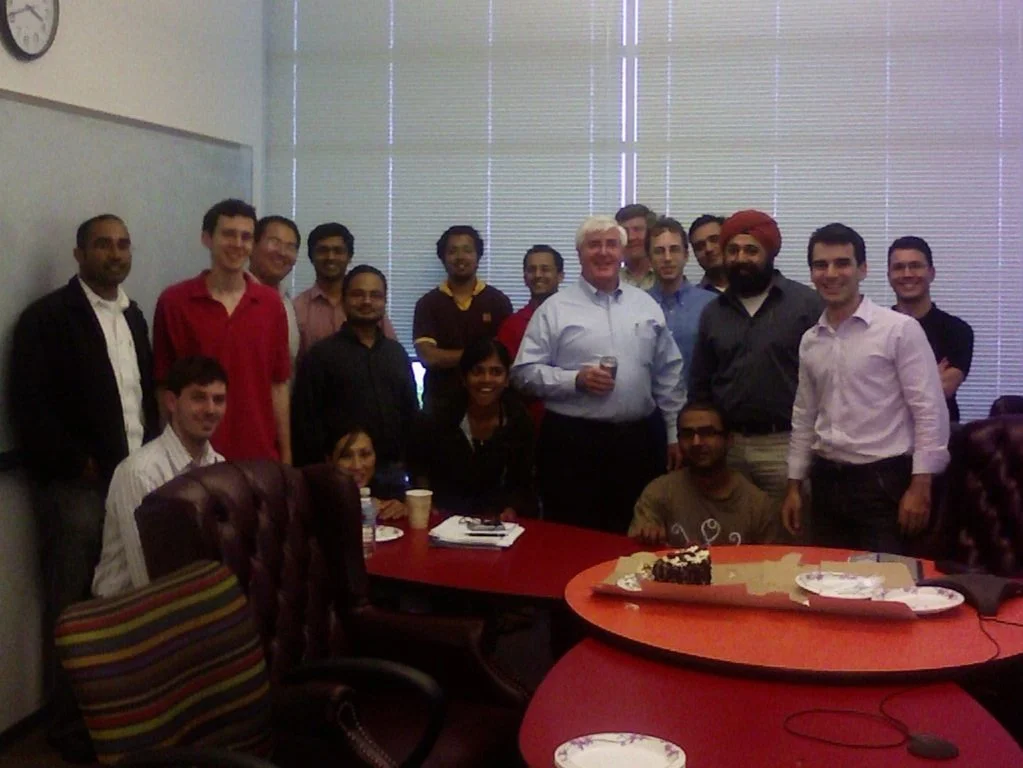
Happy birthday Ron!
Life is Short. Have Fun.
Over time, small injections of fun can change the trajectory of a company. And your experience as a founder.
There’s a lot going on in the world right now.
A lot of distractions. A lot of things to feel stressed about. A lot of armchair entrepreneurs telling founders to “just put your head down and build” (never mind that they’ve long since forgotten what it actually feels like to build).
Being a founder is never easy. I know firsthand — I’ve done it 4 times. It doesn’t matter if you’re building a high-growth VC-backed company, a slow-growth calm business, a consulting company, or something else…they’re all hard! It’s risky. It’s stressful. It involves long hours and sleepless nights. And that’s before throwing in curveballs like global pandemics, unprecedented interest rates spikes and geopolitical rollercoasters.

Life as an founder
But entrepreneurship can also be a hell of a lot of fun.
One of the things I try to do with my “founder journey” posts is to share simple tips to improve the entrepreneurial experience that are easy for even the busiest founders to adopt. 5 Easy Ways to be a Healthier Founder, Treat Yo’ Self and Find Your Recharge are recent examples of this. Today, I’m going to focus on fun.

I’ve previously written about the recent resurgence of hustle culture in certain corners of the startup world. Last week, Matt Munson published a post challenging what he sees as a false choice between “leading with heart” and “founder-mode”. Matt noted that, as a founder:
You can lead with heart and strength.
You can be decisive and deeply human.
You can care about your team and hold a clear standard.
His point is an important one, which I deeply believe in: the best founders don’t choose between high expectations and showing empathy for their teams. Nor should they face or force that choice on themselves. That’s where fun comes in.
But before I get there, I want to be clear in my belief that for many ambitious people, the simple act of being part of an intense, high-growth startup is fun. A few years ago, Tobi Lütke of Shopify made the following observation (which was shockingly controversial in some circles):

Tobi’s point was that working long, hard hours can itself be fun, if you enjoy the work and the people you’re working with.
But no matter how passionate about the work you are, and no matter how caring and brilliant the people you’re surrounded by are, it can still be exhausting. Which is where genuine fun comes in. The thing is, you don’t need to come up with grand plans to have fun. You just need to be open to taking things a bit less seriously. And the impact can be huge (both on you and on your team).
In the early days of Aster Data, we were working particularly long hours (often well into the night). There was an intensity to our work environment, such that when things went wrong — which they often did — people had a tendency to get pretty upset.
One day, one of the engineers brought in a stuffed animal of the “evil monkey” from the TV show Family Guy to the office. He declared that, going forward, the evil monkey would belong to whomever most recently broke the build.

Now, one could imagine that this could amp up the level of frustration when the build broke, but it had the polar opposite effect. Everyone found it so hilarious to have a giant stuffed monkey pointing at them that breaking the build went from an event that triggered frustration and arguments to a celebration of the “build monkey” being moved to a new person’s desk. That simple gesture of fun was a key pillar of the Aster Data engineering culture for years through to the company’s acquisition.
At DataHero, we had a similar level of intensity in the early days that would occasionally result in colorful arguments (particularly amongst the founders 😬). We eventually recognized that we had to button things up, but we didn’t want to lose the intensity. My long-time partner-in-crime, Gail Yui, proposed a solution: the “HR Jar” (aka a grown up “swear jar”). The implementation was simple, yet hilarious.
If someone used inappropriate language or an argument got too heated, anyone could yell out “HR violation!” and the entire company would immediately stop what they were doing. That person would then recount what just happened (e.g. “Chris just said that my idea was stupid”) and the rest of the company would vote on whether or not it was an “HR violation” (99.99% of complaints were voted to be HR violations).

Don’t ask about the zebra head
Over time, things got even funnier as there developed a trend of “prepayments” into the HR jar (people would proactively drop $20 into the jar before going to town on something that they were annoyed with). None of this related to actual HR violations, mind you. It was simply a fun way to defuse arguments. And when the jar got full? We would take the entire company out to the bar around the corner for drinks.
The observant reader will notice that in neither of these examples did the idea come from a founder. Rather, their success came from the fact that the founders were willing to adopt silly ideas proposed by the team. Being willing to support and incorporate grassroots “fun” into the company serves the dual purpose of making work more enjoyable and empowering the rest of the team. Easy. Simple. Win-win.
There are plenty of ways to incorporate fun into startups, from stocking games in the office to taking the team out to offsites to planned multi-day retreats. But in my experience, the biggest impact comes from adopting simple, silly ideas without overthinking it. Over time, those small injections of fun can change the trajectory of a company (and your experience as a founder).
Want another suggestion? Take the budget you’ve set aside for the next fancy team dinner and swap it for an impromptu cooking “competition”.

American VCs Aren’t the Reason Your Startups are Leaving
Instead of blaming American VCs for “taking” their high-potential startups, ecosystems should stop and look in the proverbial mirror.
There isn’t a week that goes by without well-meaning ecosystem supporters around the world posting about how startups from their city/state/country keep moving to the U.S. because they raised funding from American investors.

Every time I see one of these posts, I want to scream.

If you’ve never participated in a startup board meeting, I can promise you that no VC spends time trying to convince a company to move, unless there’s a very, very good reason to do so. Moving a company — especially internationally — is expensive, disruptive, and risky. Scaling a company in a country where the founders have no lived experience is similarly fraught with risks.
In my experience, there is exactly one reason that rises to the level where investors will push a company to move or scale elsewhere: velocity.
For startups, velocity is the one metric that matters most. If investors sense that a company is going too slow or, conversely, believe that there’s an opportunity to dramatically increase the velocity of a startup, then they will flag that to the founders. The most common scenarios where this happens include:
Founder Velocity: This is fairly common when a company is very young (e.g. just the founders plus maybe an employee or two). Investors may believe that the individuals and, thus, the company as a whole, would benefit from the founders being in a larger, more intense ecosystem. We see this both domestically (e.g. startups in small Canadian towns being encouraged to relocate to Toronto or small UK towns being encouraged to relocate to London) as well as internationally (with San Francisco and New York as the most frequently-recommended destinations).
Sales Velocity: Other than outsourcing (which is typically more of a cost argument than a velocity argument), the opportunity to increase sales velocity is the most common reason why companies scale internationally. We normally think of this as occurring later in a startup’s life cycle (e.g. after the company has established strong domestic sales, it expands into new markets). Such international expansion is fairly well accepted and doesn’t usually bother hometown advocates. But it can also occur early on if the company struggles to sign pilots and/or secure early sales with local companies. If a startup finds that its early sales traction is much stronger in the U.S. — especially when sales are still founder-led — investors may encourage one or more of the founders to relocate.
Executive Velocity: This scenario typically arises when a CEO travels back-and-forth between the company’s home base and a larger, higher-velocity ecosystem (usually San Francisco or New York) and begins to recognize a difference in velocity between the executives they meet in that ecosystem and those on their leadership team. The result could be replacing one or more executives at HQ with higher-velocity individuals elsewhere or relocating one or more executives to a higher-velocity ecosystem. (I know of one Canadian company that recently raised a $5M round for the express purpose of relocating their entire leadership team to San Francisco because of a lack of executive velocity — a move that the CEO proposed to his investors, rather than the other way around).
Hiring Velocity: Another common reason why companies move/scale in the U.S. occurs when founders struggle to hire senior talent with the necessary skills and experience locally. Like it or not, there is more experienced talent in almost every job function relevant to tech in San Francisco/Silicon Valley than there is in any other ecosystem on the planet. The most ambitious founders and investors inherently understand this. If hiring velocity becomes an issue, investors won’t hesitate to recommend that the company change tactics.
In none of these situations do the investors issue an ultimatum to the founders. VCs simply don’t have that power. And these discussions don’t generally occur if the company is firing on all cylinders.
In reality, these moves almost always arise synergistically between founders and investors. The reason why there’s a higher correlation between a startup taking investment from U.S. VCs and a move/expansion into the U.S. is that American investors can facilitate these “aha!” moments earlier in a company’s journey. Silicon Valley VCs often encourage founders to spend more time in the U.S., help them build their U.S. network by making introductions to other founders, inviting them to events, etc. and help with introductions to potential customers in the U.S. They can also flag issues of velocity earlier in a startup’s journey than a founder (or a local investor) would typically recognize them.
As the strengths and opportunities of higher-velocity ecosystems become more apparent (and, in contrast, the weaknesses of being based in a lower-velocity ecosystem), many ambitious founders naturally start to think about moving/scaling elsewhere. That’s the #1 reason why complaints about a lack of ambition in other countries misses the point. Once ambitious founders experience high-velocity excellence, it’s difficult to unsee.

“You take the blue pill - the story ends, you wake up in your bed and believe whatever you want to believe. You take the red pill - you stay in Wonderland and I show you how deep the rabbit hole goes.”
I should also note that there is a category of founders who intrinsically want to move to the U.S. These are typically younger founders with relatively few attachments and for whom the adventure is part of the motivation. It’s really no different from young people wanting to leave home to go to college or moving from a rural town to the big city. There’s no point in trying to change their minds and no benefit to complaining about it (*cough cough* Waterloo).
The reality is that the vast majority of founders who either move to Silicon Valley or setup significant operations in the U.S. do so reluctantly. Almost all of them want to build their companies in their home towns/countries, but eventually come to the realization that it is impossible to do so (at least, if they want to compete globally). The decision to move/expand elsewhere is not “because Silicon Valley VC”. It’s because of the limitations of their own ecosystem — and the contrasts that they see first-hand traveling back-and-forth to the U.S.
So instead of blaming American VCs for “taking” your high-potential startups, stop and take a look in the proverbial mirror:
It’s not the fault of U.S. investors if there isn’t enough senior leadership experience in your ecosystem
It’s not the fault of U.S. investors if the established companies in your ecosystem aren’t willing to buy from local startups
It’s not the fault of U.S. investors if the “work-life” balance in your ecosystem prioritizes surfing and snowboarding over…work
It’s not the fault of U.S. investors if taxes, regulations or other government bureaucracy in your ecosystem make it more difficult to get a startup off the ground
And it’s definitely not the fault of U.S. investors if the VCs in your ecosystem aren’t willing to invest.
“Remember, all I'm offering is the truth.
Nothing more.”
- Morpheus
Where are the Builders?
Why does it seem harder to find communities of technical founders in some ecosystems than in others?
A founder I know recently wrote a LinkedIn post lamenting the lack of technical founders at startup community events in Canada. He noted the following,
“Communities reflect the people who make them up. When I meet people from the startup community in Canada, I rarely meet programmers. There are some — I see you, and I’ll seek you out at a party — but the odds of randomly meeting a coder are low.”
The author went on to suggest that, in contrast to San Francisco and New York, the startup scene in Canada is “very businessy.”
I reflected on his perception while I was writing my end-of-year post, in which I noted that the “Maker Faire” phase of this tech cycle was coming to a close in San Francisco. It certainly felt at times like there were more builders in the Bay Area (especially at this point in the cycle), but is it actually true? Do cities like San Francisco and New York have a higher ratio of technical founders to non-technical founders than other startup ecosystems?

I started going down a rabbit hole of using data to reason about this, but pretty quickly concluded that this was a very deep hole. Between the fact that many “technical” founders these days don’t have obvious signals on their LinkedIn profiles to the propensity of many founders to obfuscate their physical location, it was going to take me far more time, effort and data sources to come up with a plausible theory than I had at my disposal.
(I also tried to cheat by using ChatGPT to source some of the data. But given its confident assertion that “…there could be several hundred technical founders in San Francisco,” I figured that would be a waste of time.)

“Technical Founder at Stealth,
San Francisco Bay Area”
I personally think that it’s reasonable to presume that the Bay Area does, in fact, have a higher percentage of technical founders than most other startup ecosystems. So let’s go with that assumption and take San Francisco / Silicon Valley out of the equation. Moreover, let’s assume for the purpose of this discussion that every other major startup ecosystem has roughly the same ratio of technical to non-technical founders.
If that is the case, then why does it seem harder to find “the builders” in some ecosystems than in others?
I’ve previously written about the fact that the very nature of startup ecosystems is changing. In that post, I noted two significant dynamics that are at play:
1. An effective 5-year gap [due to the pandemic] has left young founders with no memories of, attachment to, or nostalgia for the local institutions that played critical roles in the success of prior generations of startups.
2. The social and societal changes that occurred during and after the pandemic have left a lasting impact on how founders operate and on how they engage with their local ecosystems.
The combination of these two dynamics means that founders of all stripes are gravitating to new and different institutions for “community” than generations prior and, in many cases, those new institutions aren’t physically nearby.
The evolution of media, with the rise of the creator economy and concepts like Kevin Kelly’s "1,000 True Fans”, has brought to the mainstream an understanding that hyper-personalization of almost anything is possible. Whatever interest you may have, there are almost certain to be others online with that exact same interest. Given that we’ve embraced this in so many aspects of our lives, it makes perfect sense that founders are taking advantage of this concept in how they think about community.
The best founders are no longer content with founder communities where the only thing they have in common is the city they live in.
The best founders aren’t even content to be part of generalist sub-communities within their geography (e.g. local CTO meetups).
Instead, the best founders today are actively seeking out other founders who are just like them, regardless of where in the world they might be.
They’re seeking communities of founders who are specifically building B2B infrastructure software targeting mid-market companies in regulated industries. They’re seeking communities of founders who are specifically building PLG-driven open source projects targeting Node.js developers. And so on.
And they’re finding them.

But if that’s the case, why isn’t this happening at the same rate in every ecosystem? Why does it seem harder to find “the builders” in some ecosystems than in others?
I’ve observed two significant factors that seem to have contributed to the “regrowth” of in-person builder communities post-pandemic:
1. Clusters of Founders in the Same / Similar Industry
While many cities have “generalist” startup populations, some have significant clusters of startups in the same industry. I’ve observed that in such ecosystems, builder communities around those industries have formed/rebounded at a higher rate post-pandemic.
For example, Vancouver has a disproportionately large number of developer-centric startups (dev tools, API-related companies, open source platforms, etc.). There are frequent, well-attended events for the large community of technical founders who are building in and around these areas. El Segundo has a significantly outsized cluster of defensetech and dual-use companies. The growing community of “Gundo Bros” is well-known for their meetups and hackathons.
2. Ecosystem Remoteness
Another factor that I’ve observed as contributing to the strength of local builder communities is the “remoteness” of an ecosystem. Cities like Edinburgh, Waterloo and Boulder are all relatively remote, and their in-person builder communities have rebounded at a much higher rate post-pandemic than places like Vancouver, Portland and Manchester, where technical founders have — to a significant degree — reoriented around more frequent travel to larger ecosystems.
(If you’re scratching your head around the fact that I mentioned Vancouver twice, it’s a great example of an ecosystem where there is a thriving builder community around one specific industry — developer tools — but relatively little engagement by technical founders in other areas.)
So what’s my conclusion in all of this?
For starters, there are unquestionably strong technical founders in every single startup ecosystem (if there weren’t, there wouldn’t be a “startup ecosystem”). But in a post-pandemic, hyper-connected and hyper-personalized world, the best technical founders are increasingly choosing whether or not to engage with their local communities based on whether or not there are peers within those communities who share similar characteristics (ambition and industry being at the top of that list).
Startup ecosystems where technical founders aren’t actively participating in the local community don’t necessarily represent a failure of the community (or a perceived failure — e.g. a startup community that is “too businessy”). Rather, they reflect the reality that the builders aren’t seeing value in that community and, correctly, are opting out in favor of finding their community elsewhere.
In such ecosystems, this is an opportunity for community instigators to create something new that is valuable enough for the builders to engage. In some ecosystems, that could mean new, more targeted offerings for local builders. In others, it could be a recognition that the most important thing the community can offer is moral support and social engagements.

As a final note, I can’t help but recall an anecdote my own founders days. In the months after DataHero was acquired, I went to a variety of “startup events” happening around the Bay Area. My goal was to get a sense of what people were working on at that time (by late-2015, I had been heads down in the world of databases and business intelligence for more than 10 years, so I really had no clue what was going on outside of my tiny microcosm of tech).
I brought my then-girlfriend (not in tech) to several of these events. Each evening ended roughly the same: she would tell me about all of the interesting founders she met and the amazing things they were working on. I would inevitably end up tactfully unpacking for her why 9/10 weren’t actually doing what they claimed to be. After three or four of these events, she finally turned to me and asked,
“Why aren’t any of your badass founder friends ever at these events?”
To which I smiled and responded,
“Because they’re too busy actually building things.”
The Changing Startup Landscape According to Video Games
Believe it or not, the contemporary evolution of startups in many ways mirrors the evolution of video games. Here are 3 lessons founders should take from the history of video games.
As we near the end of 2024, there’s an incredible amount of change happening in and around Startupland™. From recent elections to the ascendance of AI to venture capital’s changing of the guard, the landscape for startups tomorrow is likely to look very different from today.
The contemporary evolution of startups — in particular, the acceleration of certain parts of the founder journey — in many ways mirrors the evolution of video games.
Seriously.
So at the risk of publishing another one of those annoying “here are 5 things you can learn about X from Y” posts, here are 3 changes to the typical founder journey that mirror the evolution of video games.
1. Ramp Up Time
Real-time strategy (RTS) games have been in the mainstream for more than 30 years. They all follow a similar blueprint: gather resources, use those resources to build infrastructure and units, battle.
Early entries in the genre, such as Warcraft and Command & Conquer, provided players with a relatively lengthy ramp up period for each new game. Players would start each battle with minimal resources and have similar early capabilities. Regardless of which faction you chose, it would take time to amass enough resources to do much of anything — so you would have time to ramp up before the real battle began. While there was some strategy in terms of prioritizing what to build early-on, the first 3-5 minutes of almost every game was relatively benign (unless you played against that one jerk who would build 3 infantry units right away and rush to end it quick).

“Yes, milord”
Things changed in 1995 with the release of Starcraft. Up until that point, competing factions in RTS games all had basically equal capabilities. Units and buildings might have slightly different characteristics, but at the end of the day they were all about the same. Starcraft was the first RTS game to introduce velocity as a differentiating capability with the Zerg.
In Starcraft, the Zerg’s basic melee attacker (called zerglings) can be created at a 2:1 rate to those of other factions. As a result, the effective velocity at which zerglings can be spawned is double that of competing races. “Zerg rushes”, in which an army of zerglings are sent to attack an enemy relatively early in the game, was an infamous tactic in Starcraft.

The “zerg rush”
As more capabilities are unlocked over the course of a game, the races in Starcraft become more balanced (and, in fact, the Zerg are generally thought of as the weakest faction overall), but if you weren’t prepared to defend against a zerg rush at the start, you wouldn’t last long enough to find out.
What does this have to do with startups?
When I was a founder, we generally weren’t too concerned with how our velocity compared to that of other startups. We certainly kept tabs on them, but mostly we were heads down focused on our product and early customers. We would release our products when we felt they were ready and fundraise when the time made sense for us, without much regard for what others were doing. Our velocity came from internal pressures rather than external.
That’s no longer a luxury for most startup founders.
In an age of AI, cloud infrastructure and global competition, the competitive landscape has never been tougher — or faster. The difference between leader and too-late is now measured in months, not years. Whether it’s capturing public mindshare, securing early pilots or raising funding, founders can no longer afford to go at their own pace. More than ever, velocity is the metric that matters most.
2. Skills Development
The original Super Mario Bros., which will turn 40 next year (🤯), was the gateway drug for an entire generation of gamers. Its opening level (1 - 1) remains a master class in onboarding. It provided a safe space for players new to the game — many new to video games entirely — to figure out the mechanics of Super Mario’s gameplay.

Where it all started
For decades after the original Nintendo’s unveiling, most games used similar onboarding techniques to gradually introduce new players to game mechanics (often including increasingly powerful moves and weapons). From Metroid’s roll to Castlevania’s holy water to Contra’s increasingly absurd weapons, the approach to slowly-but-surely adding capabilities and complexities remains a fixture of video games to this day.
But in the late-80s, the discovery of a short sequence of button presses rocked our simple world…

The Konami Code
First introduced in the NES port of Gradius, the “Konami Code” provided instant power-ups to players. It became a worldwide phenomenon when it was later discovered in the hit-1988 game Contra and birthed the notion of the “cheat code”. (It wasn’t long after that the Game Genie was released, permanently shattering a generation’s innocence.)
Notably, it introduced the unheard of idea that players could start off a game with everything.
Fast forward to today and there are many games where it’s possible for players to leverage all of the capabilities from the start.
The same can be said of founders today.
The best first-time founders are more informed than ever before. As a result of a wide availability of blogs, newsletters and online courses, many young founders are fully-versed in startup best practices before ever leaving school. Competition amongst service providers has similarly enabled startups to unlock high-value resources and services long before they have a dollar in revenue (e.g. free cloud credits + implementation experts). The best founders have learned to leverage all of these capabilities and offerings to accelerate and compete right out of the gate.
In today’s world, founders hoping to move slow and steady, while learning one thing at a time, will be left in the dust.

Who wouldn’t want to play Fortnite as a gingerbread man?
3. Geographic Expansion
If you grew up in the 80s or 90s, you’re almost certain to have played the board game Risk. Each player starts off in a different country with a fixed number of pieces (each piece representing a different army unit). Over the course of the game, you increase the size of your army and slowly try to take over the world by expanding into adjacent countries.

This basic format of geographic expansion served as the inspiration for countless video games, including enduring franchises like Civilization and Romance of the Three Kingdoms.
Civilization II, released back in 1996, introduced a new twist on the genre: the concept that a player’s choice of faction (nationality) would fundamentally impact their starting capabilities. Most strategy games released before then allowed players to select what country or region they would start in, but other than their placement on a map and some cosmetic differences, the choice had little impact on the game itself. Civilization II forced players to think carefully about the default strengths of each faction before the game even started.

The same is becoming true when it comes to founding startups.
In the past, there were geographic advantages that startups could leverage as they grew, but it really didn’t matter too much where you founded your company (at least, not until you needed to access capital). But with the world shifting away from globalization and returning to nationalistic tendencies, founders would be wise to give careful thought to where they incorporate their startup.
2025 America is likely to be the best place in the world to start companies in defensetech, aerospace and manufacturing. Climatetech and clean energy companies, on the other hand, may find better prospects in Canada and Europe (at least, when it comes to the availability of grants and supportive commercial prospects). Similarly, companies focused on privacy, DEI and improving the worker’ experience are likely to face headwinds in America but welcoming prospects in other countries.
Silicon Valley — and the United States more broadly — will undoubtedly continue to lead the world’s innovation economy, but with industry and politics becoming ever more intertwined when it comes to tech, not all starting points will be equal.

Sid Meier’s view of America in 2016. What will 2025 look like?
So there you have it. Three ways in which the evolution of startups mirrors that of video games.
Not too much of a stretch.
…or have I been hitting the eggnog too hard…?
