Stop with the AI Slop
A few weeks ago, I travelled to Saskatoon, Saskatchewan to give the opening keynote for Uniting the Prairies, a conference that brings together founders, investors and ecosystem supporters from across Canada’s prairie provinces. Both the conference and my hosts were fantastic and my talk seemed well received, but I was completely unprepared for what happened the next day.
The morning after my talk, as I sat bleary-eyed in an Uber in the way that only a redeye can leave you, I picked up my phone to see hundreds of notifications from LinkedIn.
“X mentioned you in a post”
“X commented on Y’s post that mentioned you”
“X reacted to Y’s post that mentioned you”
My initial excitement quickly gave way to confusion as I scrolled through the pages of notifications. All of the posts I was mentioned in — literally dozens of them — were virtually identical.

At first, I wondered if it might be some form of spam. But why on earth would anyone spam me over a conference talk? And then it hit me.
Every LinkedIn post about my talk had been written by AI.
Not a few of them. Not most of them. Every. Single. One.
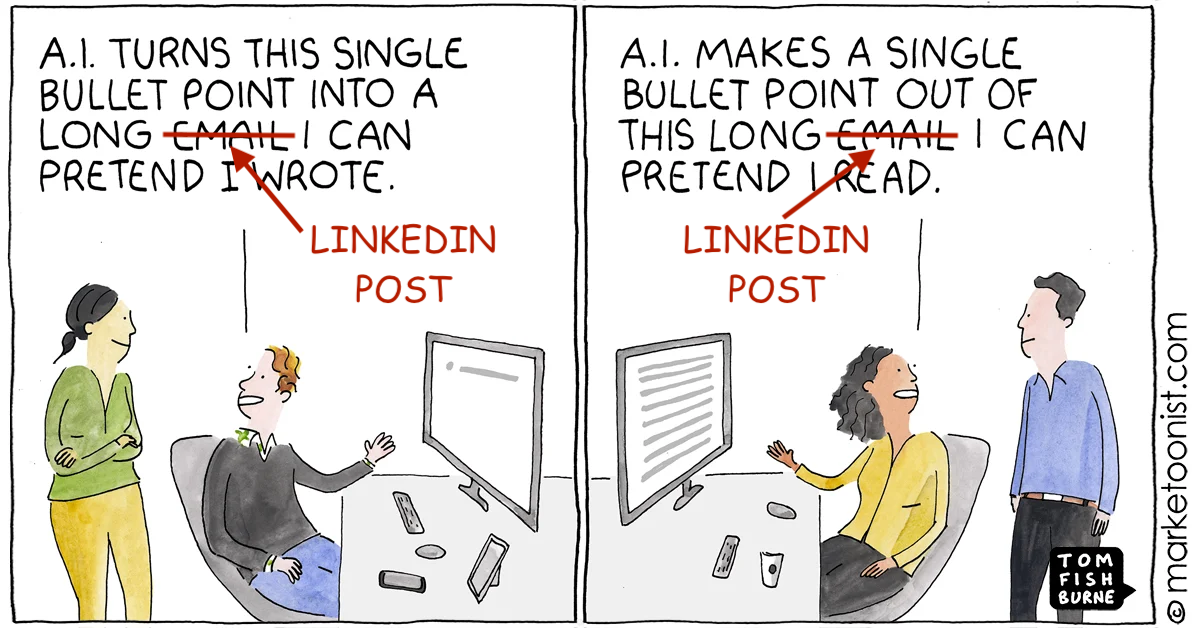
At this point, it’s obvious to anyone with half a brain when a social media post has been generated by AI. The bullet lists denoted by emojis no human ever uses. The wistful tone that reads as though the author was trying their absolute hardest to ghost write for a Morgan Freeman-narrated documentary (or, more aptly, a circa 2006 Yelp review). The hashtags upon hashtags upon hashtags.
Each post was nearly a page long. “Attention-grabbing” intros gave way to “reviews” of the various speakers and activities that took place at the conference. Here are two examples:


Fun fact: I have never used the phrase “play their own game” in any talk, podcast or blog post — it was a phrase the conference organizers added to the online agenda for my keynote.
After a while, my eyes glazed over. Eventually, I stopped reading and responding. Reading through so many nearly-identical posts left me wondering: what’s the point?
I don’t mean that as an existential “what is the meaning of life?” sort of question. But, rather, why go through the time and effort of creating a post like this to begin with?
In contrast to the comic above, none of these posts were created from a single bullet point. In each case, the author would have needed to build and refine their prompt (in some cases, it was clear that the post simply pulled details from the conference website and made the rest up, but many appeared to include actual insights from the author’s experience at the conference). After that, they would need to iterate and refine the results in order to create the final post.
At this point of the AI hype cycle, a lot of us have simply accepted that “AI can do things” better/faster/cheaper than we can, without really thinking about whether or not that’s actually true. Social media posting is a great case study.
For years, social media influencers taught us that there was a “right way” to write content / build online audiences / drive traffic. AI offered the promise of getting outlier results without having to go through the hassle of actually learning how to do it ourselves. But here’s the thing: the “attention-grabbing” strategies that worked on social media two years ago were effective specifically because the posts were outliers in their content and/or structure. When everyone uses AI that’s been trained on the same content marketing strategies, the resulting output is not an outlier. Because the strategies no longer work.
AI might indeed make it faster or cheaper to post on social media, but it doesn’t actually do it better (at least, not if your metric for better is some form of “gets a human to pay attention”). In other words, relying on AI to generate social media posts is now likely to result in a post that under-performs when it comes to the KPI that matters.

This dynamic is actually nothing new — in fact, it’s very well understood in the world of finance. It’s referred to as alpha decay.
In finance, alpha refers to the ability of a strategy to outperform the market (VCs spend a lot of time in search of alpha). Over time, outperforming strategies become more widely known and practiced, leading their effectiveness to diminish (alpha decay). “Attention-grabbing” social media strategies worked because they were outliers — they had alpha — but now that AI defaults to using such approaches when crafting posts, their effectiveness has all but disappeared.
I suspect that we’re going to see this dynamic play out across a variety of AI-related activities in the very near future. As more people chase the efficiency gains offered by AI, the output will converge and the alpha will rapidly decline.
Which brings me back to my earlier question: what’s the point?
Consider the following thought exercise based on my anecdote above:
Let’s assume that it takes an average person 10 minutes to write an effective LinkedIn post about a tech conference by hand
Let’s further assume that to create one with AI takes 5 minutes
If the human-authored post drives 100 interactions (because it is still unique in some meaningful way) while the AI-authored one drives only 50, is it worth it?
What if I told you the 50 reactions to the AI-authored post are mostly bots and people reacting out of obligation (e.g. you’re my friend so I’m going to like it no matter what)?
If we presume that a similar alpha decay is taking place across a wide variety of tasks as we increase our use of AI, then I would posit the following:
Before you rush to do the thing with AI, think about whether or not it’s worth doing at all. What output are you expecting/hoping for? Is there alpha in doing the task the way you’re doing it today? If that alpha were to disappear, is it worth doing it at all?

AI might be cheaper/faster, but if it’s not actually better (and you’re not willing to take the time to do the thing by hand) then…maybe just don’t do it?