Why Building with AI is Like Mowing Lawns
My first entrepreneurial endeavor (lemonade stands notwithstanding) was a lawn care “business” I started with a friend back when we were in middle school. We each had a lawnmower — okay, technically speaking they were our parents’ lawnmowers — and we went around the neighborhood looking for houses with long grass. We would knock on each such door and ask the homeowners if they would like us to mow their lawn.
Before long, we had a list of regular customers whose lawns we would cut every week or two. We did this for several seasons (until we were old enough to get “real” jobs). At our peak, we were each making a couple hundred dollars per week — which was a ton of money for a middle school kid in the early 90s!

I spent a lot of money on video games 🎮
Fast forward to today, and I think AI is about to provide a similar opportunity for intrepid young entrepreneurs. This time though, it’s not lawnmowers or power washers or painting supplies that will provide the leverage with which to build a business from scratch. It’s the knowledge of how to build with AI.

“Would you like us to install your AI?”
There are a variety of opinions when it comes to where the big opportunities for AI lie. And your answer very much depends on your perspective.
In Silicon Valley, it’s all about building scalable infrastructure. “Pickaxes and shovels,” as the saying goes. Everyone in the Bay Area is trying to build and scale as fast as they possibly can, in the hope that their platform will be one of the winners.
But elsewhere in the world, a much more basic question is being asked. From students to business owners, SMBs to enterprises, the #1 question being asked is, “what does this mean for me?” Everyone knows that AI is coming. But most have no idea what to do about it.
It’s as if millions of homeowners are staring out of their windows, watching the grass grow longer and longer but without any clue what to do about it.
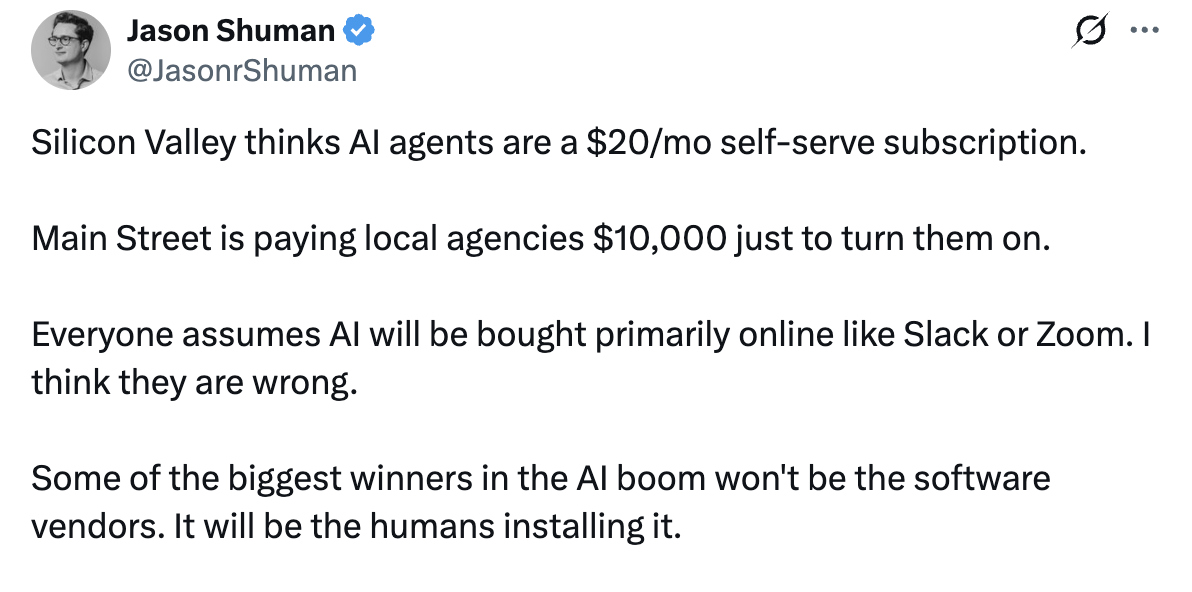
While some reports claim that SMB adoption of AI is skyrocketing, the Marks Group, a consultancy that specializes in small businesses, sees a different reality,
“They’re playing with chatbots like ChatGPT, Gemini, Copilot, Claude and Grok. They’re using these platforms for research. They’re getting help crafting emails.
…[but] core adoption — where AI agents are being used to reconcile accounts, place orders, send emails, converse with customers, apply cash, analyze transactions and produce quotes, estimates and proposals automatically based on historical transactions — is nowhere near happening at small businesses.”
And it’s not just small business owners that are struggling to adopt AI. a16z recently released a report on enterprise adoption of AI, which found that even the world’s largest companies are barely scratching the surface when it comes to AI.
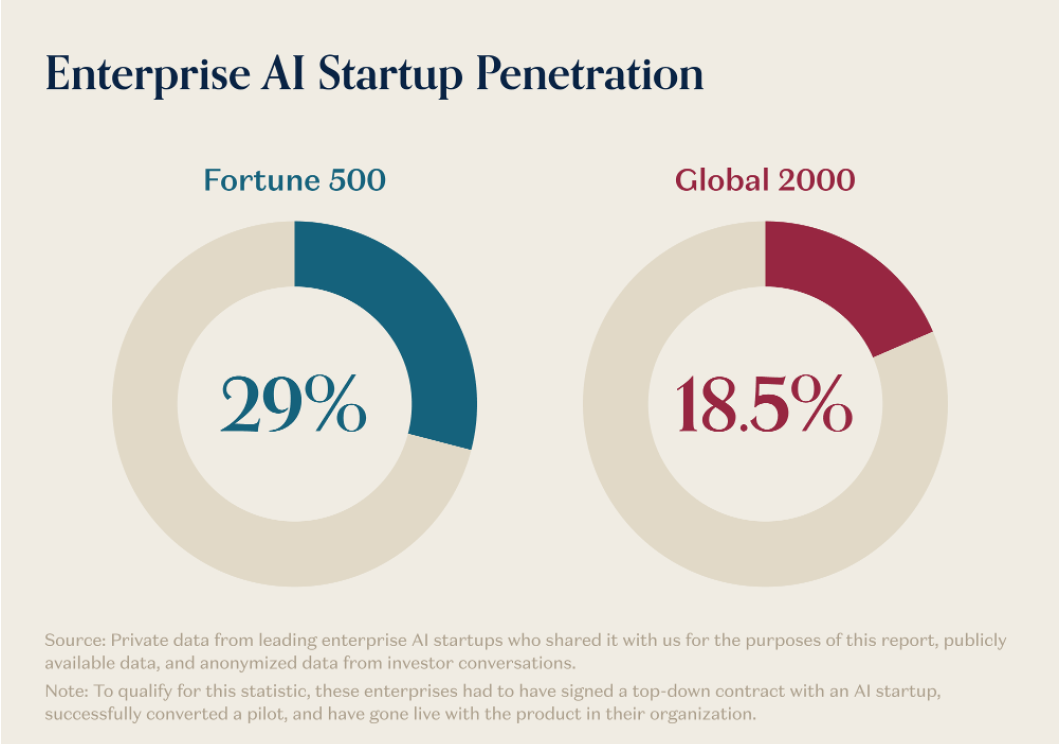
Moreover, the vast majority of AI adoption thus far has been in and around software development.
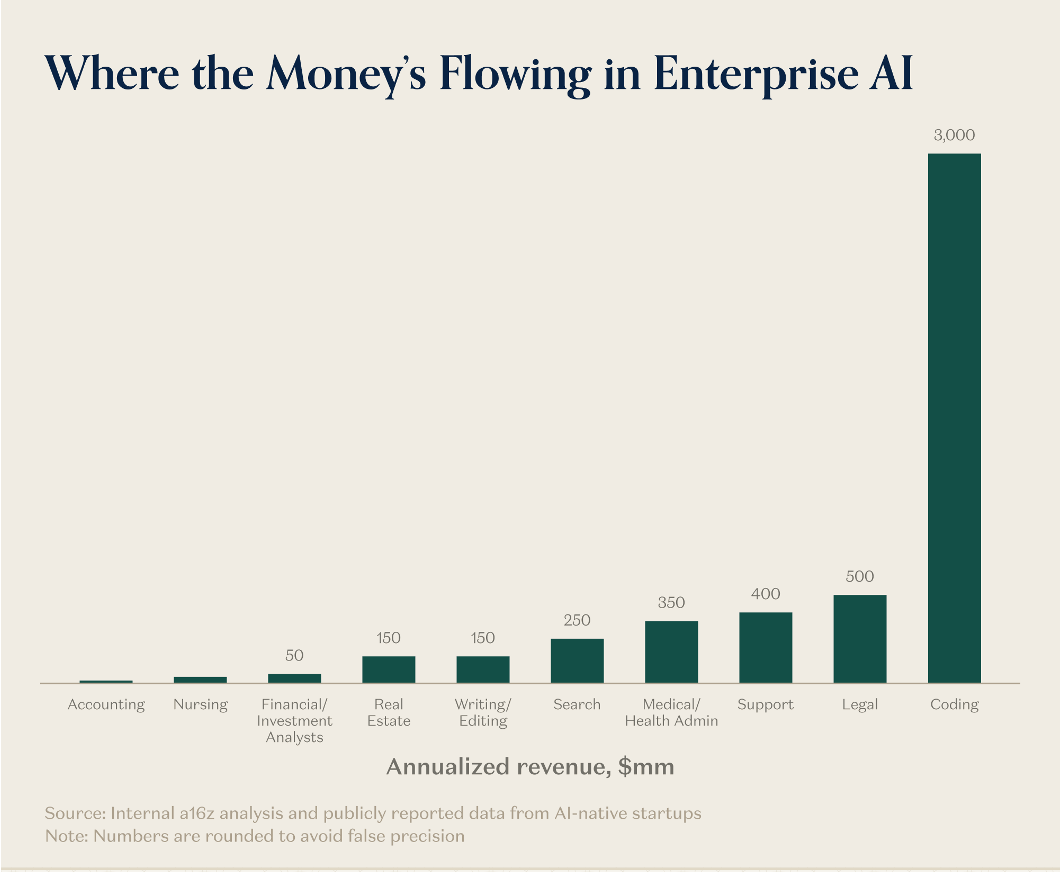
So what does this have to do with lawn care?
Right now, there is a massive opportunity for founders who are willing to simply knock on doors and metaphorically ask, “do you need your lawn cut?”
Marvin Liao recently described this opportunity in terms of age:
“…there is an arbitrage now between the generation above us, which don’t know how to use all of the things that the 17-year-olds know how to use.
If you were to ask me the best way to make money in the world today, it is to take advantage of the fact that there is a large subsection of the population that not only have all the money but, secondly, don’t know how to do a lot of things that most young people already know how to do. And if you can leverage that correctly you can actually make quite a lot of money.”
There are an incredible number of young people who have or are quickly developing the ability to build with AI. At the other end of the spectrum are countless business owners, managers, and individuals who have real problems to be solved, budget to solve those problems but for whatever reason (time, interest, ability, etc.) aren’t in a position to figure out how to do it themselves.
Silicon Valley would have you believe that either (a) every human is going to become a prompt engineer, or (b) there will soon be a permanent underclass populated exclusively by those who aren’t AI native. Both of these are very stereotypical Silicon Valley viewpoints (remember when everyone was going to learn how to write SQL..?).
In fact, the most likely outcome is that a large number of astute entrepreneurs will make considerable amounts of money by servicing the many businesses and individuals who aren’t AI native but have budget to solve their problems. These opportunities won’t be as sexy as the latest and greatest uber-for-fintech-for-agents platform, but I promise there is real money to be made pursuing them.
A lot of real money.
But capturing this value will require a skill that many technical founders struggle with: the ability (and willingness) to unflinchingly listen to prospective customers and build for their needs. The path to success for these businesses will have far more in common with building a consulting company than a traditional product startup:
Market Research — Reach out to potential clients and interview them about their biggest challenges and what specific problems they have budget to solve.
Initial Engagement — After landing on a problem area, build an initial, custom solution for one or more clients (while making sure you own the resulting IP).
Attempt to Resell — Reach out to additional, similar prospects and see if they have the same problem. If so, attempt to service them with the previously-created solution (or as much of it as can be reused).
Productize — After completing multiple engagements with the same general solution, productize your work and bring it to market at scale.
While this approach sounds easy enough, it’s actually quite hard for many founders. In recent months, I’ve met multiple founding teams who, despite having credible prospects tell them very directly what their biggest problem was, chose instead to build something different in the “hope” of capturing a market.
I think that a big reason for this is that, as an industry, we’ve spent the better part of the past twenty years trivializing consulting-first startups as “lifestyle businesses” whilst idolizing the potential of product-first startups. But AI will flip that (at least, when it comes to how vertical solutions get built).
So if you’re a founder, a student, or anyone else who’s holding an AI “lawnmower” and trying to figure out what to do next…try knocking on your neighbor’s door.

(You can also ring the doorbell)