What’s Going On With Accelerators?
I’ve written a lot lately about the ongoing bifurcation of venture capital and its implications for fundraising (both in my quarterly updates and in dedicated posts, like this one on early-stage investing).
One prediction I made last year was that we would start to see more early-stage investors lean in to the “hands-on” styles of investing that were more common in years past. As megafunds ramped up their early-stage activity, many Seed VCs would be crowded out. They would in turn head upstream to the “safety” of Pre-Seed. The increased competition at Pre-Seed would force investors to find new ways to differentiate themselves in the eyes of both founders and LPs.
And that would lead to more accelerators,
“…we’re seeing a resurgence of both small, dedicated accelerators and offerings from Seed-specialist VCs…it feels like the pendulum is swinging solidly back from the “hands-off” investing style of the ZIRP era to the more “hands-on” style of years past. At a time when AI is making it cheaper than ever to get a company off the ground, I think we’re going to quickly see a new level of competition amongst credible accelerators (and between accelerators and pre-seed VCs).”
Sure enough, the accelerator landscape has gotten a lot more crowded since I wrote that post.

Since the beginning of the year, megafund a16z significantly ramped up their speedrun team (I might have done reference calls for some people they were looking to hire 👀). They followed that up by launching a new fellowship program called “alpha” a few weeks ago.
Speaking of alpha, the big dog of accelerators, YC, didn’t sit long with its earlier assertion that, “…the total number of startups going through the program each year will hold steady at about 500…” The recently completed W26 batch had nearly 200 companies (i.e. they’re currently on pace to invest in 800 startups in 2026).
And that’s just the start. Here is some of the other activity that took place across the accelerator landscape during the first quarter of 2026:
London-founded fellowship program Entrepreneurs First completed its move to San Francisco and unveiled a fresh $200M fund
Accelerator upstart Neo announced a new Residency program for college students
Montreal-based AI research institute Mila launched a new venture-building program for AI research scientists as part of a $100M “venture scientist fund” announced earlier in the year
South Park Commons shared its plans to raise a new $500M fund for its self-proclaimed “anti-accelerator”
Taken together, it might seem like there’s now an overabundance of programs for founders to choose from. But if you look closer, what we’re seeing is actually a clustering around two very specific approaches to hands-on investing:
Accelerators as the New MBA
Fellowships as the New Montessori
Let’s dig deeper into each of these trends.
Accelerators as the New MBA
In the early days of accelerators, programs like YC, Techstars and 500 Startups didn’t have nearly the prestige of today’s industry leaders. In fact, it was quite the opposite. Amongst many founders and investors in the startup world, accelerators were seen as something of a crutch. They were the thing you went to if you couldn’t figure it out on your own.
Fast-forward 20 years and the perception is very different. Not only are accelerators broadly accepted as a reasonable path for first-time founders to take, but having simply attended a top accelerator is seen by many as a mark of credibility and prestige. Sound familiar?
“You got into Harvard…you must be smart!”
“You got into YC…you must be smart!”
Last year, David Crow wrote about the increasing similarities between top accelerators and universities. He noted that,
“In the past, ambitious graduates invested in themselves by going to grad school. They spent $100,000 on an MBA, law degree, or medical program as their path to impact.
Today, ambitious people might choose YC or Speedrun instead…
YC and Speedrun are not just accelerators; they’re the new professional schools of venture.”
I’ll take it a step further: not only are ambitious individuals increasingly looking at top accelerators as a credible path to advance their careers, accelerators are increasingly selecting founders in ways that look a lot like how elite MBAs choose students.
And I’m not the only one.
I recently caught up with a friend who spent many years as a VC at one of Silicon Valley’s top-tier funds (he also happens to have an MBA from a prominent business school). In discussing the evolution of the early-stage landscape, he suggested that top accelerators have very intentionally moved towards a model for selecting founders that mirrors how top MBA programs select students:
“At this point, [top accelerators] know the “shape” of founders that Tier 1 VCs like to invest in. The schools they went to, the companies on their resume, the traction points that matter. The things that get an IC* comfortable investing in a company that maybe hasn’t done anything yet.
It’s the same way MBA programs cater to top employers. What undergrad did the student go to? Where did they intern? What test scores do they need if they came from a lesser-known school? They’re trying to maximize the chances that an incoming student will land a job with a name brand employer, regardless of what they actually do during business school.”
* investment committee
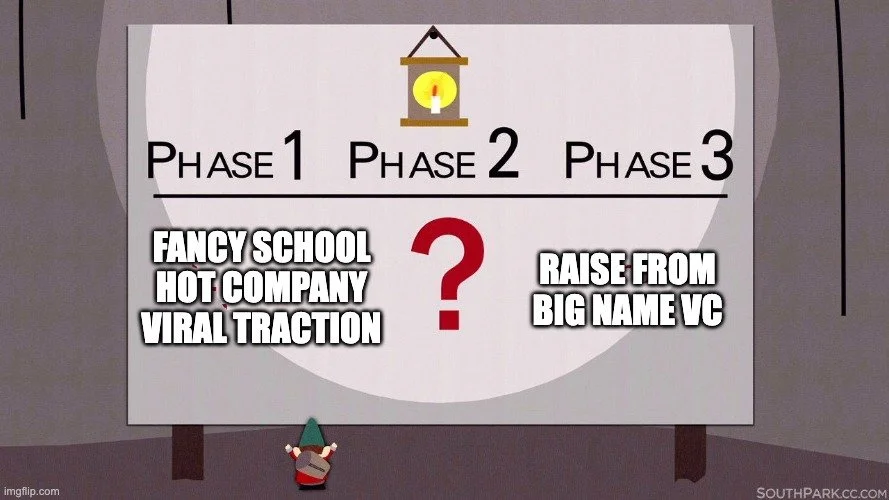
If you read my recent post on Hunters vs. Farmers, you might be getting a sense of deja vu. That’s because what we’re talking about here is the approach that “hunters” typically take, but within the context of a segment of venture that we historically think of as “farmers”:
“Early-stage hunters focus on pedigree and traction as their primary signals. Things like:
Graduating from a top school or program (Stanford, MIT, Waterloo, IIT Bombay, Thiel Fellowship, etc.)
Early employees that left “hot” companies
Repeat founders
Hot sectors
Virality / significant early traction
They’re generally betting on the correlation between pedigree and outcome (or, at least, pedigree and quick markups).”
This is exactly what elite MBA programs do. They bet on the correlation between pedigree and outcome, where outcome is “gets hired by a top-tier employer”. Today’s top accelerators are increasingly converging on a similar model. And you can see it in their marketing,
“Want to maximize your chances of landing a job with [top employer]? Apply to Harvard!”
“Want to maximize your chances of raising a round from [top VC]? Apply to YC!”
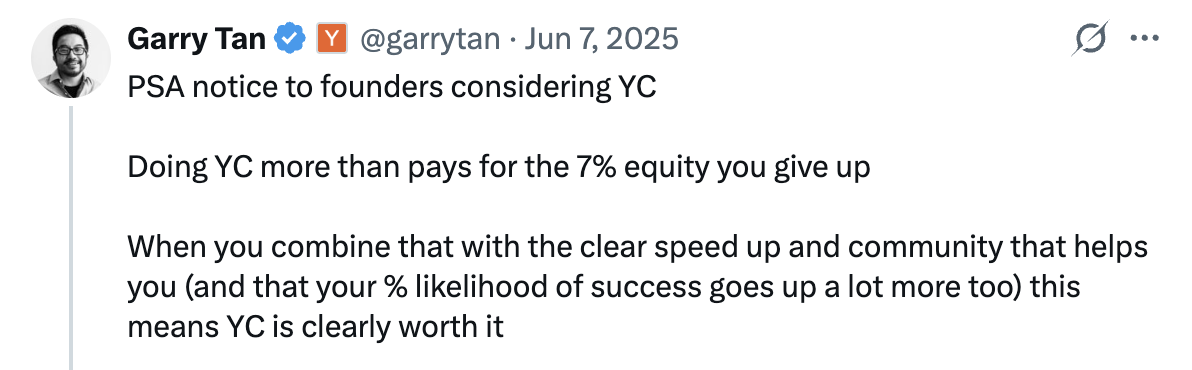
This certainly isn’t a bad approach — for either the accelerators or the founders.
That said, it’s worth noting that what’s happening at the top of the accelerator pyramid right now is very much influenced by a considerable imbalance in supply and demand. More and more qualified founders are looking for the “cheat codes” that come with the brand recognition and alumni networks of top accelerators. Yet there are very few programs that credibly deliver consistent outcomes along these dimensions (particularly in the aftermath of 500 Startups and Techstars both effectively failing). With so many qualified startups and so few spaces available in each program, founder pedigree naturally becomes a more prominent factor in selection.
Which means that a significant number of ambitious founders — especially founders outside of California and those from schools, companies and backgrounds that don’t neatly fit the typical Silicon Valley mold — are struggling to gain acceptance into these elite programs.
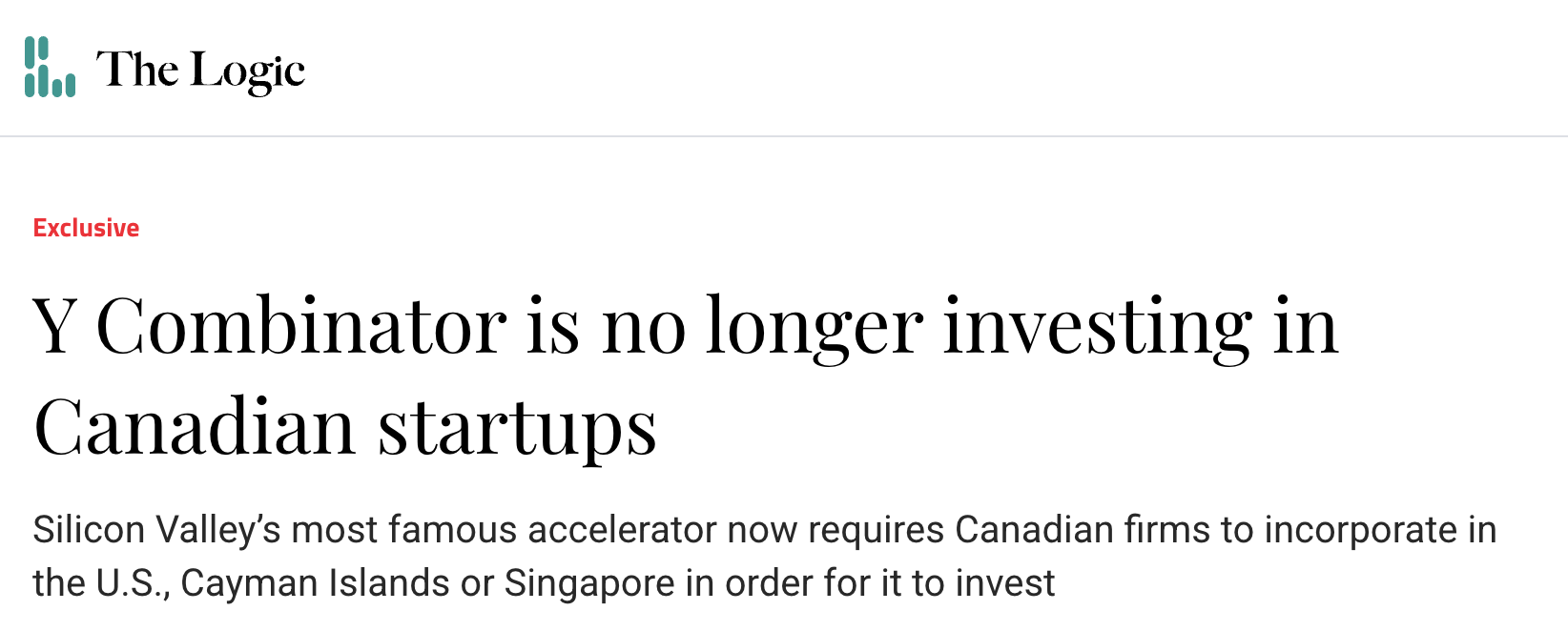
When the supply-demand curve is so imbalanced that an entire country doesn’t make the cut
So why aren’t we seeing more “elite MBA programs” emerge if the supply-demand curve is so imbalanced?
Despite the incredible demand for top tier Silicon Valley-based accelerators, only two platforms founded in the past decade have found success: Neo starting in 2017 and speedrun (from a16z) in 2023.
It turns out that creating a full-fledged accelerator platform from scratch is hard. It takes a lot of resources, investors who are experienced evaluating startups with virtually no traction, and an incredible number of high-quality, properly incentivized mentors. Creating a high-quality accelerator is, in fact, really, really hard.
But it is doable. Not only that, with so much latent opportunity — especially when it comes to startups outside of California — more elite Silicon Valley-based platforms are undoubtedly going to emerge. It’s just a question of when.
In the meantime, the majority of early-stage investors that have started rolling up their sleeves are taking a different approach. One that focuses almost entirely on the potential of individual founders while forgoing much of the complexity of a full-blown accelerator…
Fellowships as the New Montessori
If accelerators like YC and speedrun are the new MBA, then fellowship programs like South Park Commons, HF0 and Entepreneurs First are the new Montessori school.
If you’re unfamiliar with the term “Montessori”, it is an approach to early childhood education that focuses on encouraging children’s natural interests rather than providing formal, structured education. Montessori programs are designed around student-directed work, with a particular emphasis on uninterrupted work periods. The approach is based on the idea that children are naturally eager for knowledge and the primary role of teachers is to guide and mentor them.
At a high level, Montessori schools take a group of highly-motivated individuals and place them in a room with a handful of experienced, light-touch mentors in the hope of creating magic.

A Montessori “hacker house”
Which brings us to fellowships.
Fellowship programs invest in aspiring founders based primarily on their experience and pedigrees. These individuals are placed into a cohort and participate in activities designed to guide them towards founding high-potential companies (with a particular emphasis on ideation and cofounder matching). In other words, they take a group of highly-motivated individuals and place them in a room with a handful of experienced, light-touch mentors in the hope of creating magic.
Over the past few years, the number of fellowship programs has exploded. Not only are there an increasing number of standalone platforms (like South Park Commons, HF0 and Entepreneurs First), but many existing VCs have launched fellowship offerings as a means to increase their access to high-potential founders at the earliest stages. Some examples include a16z’s “alpha” fellowship (mentioned above), Conviction Partners’ “Embed” program, and Afore Capital’s “Founder in Residency” program.
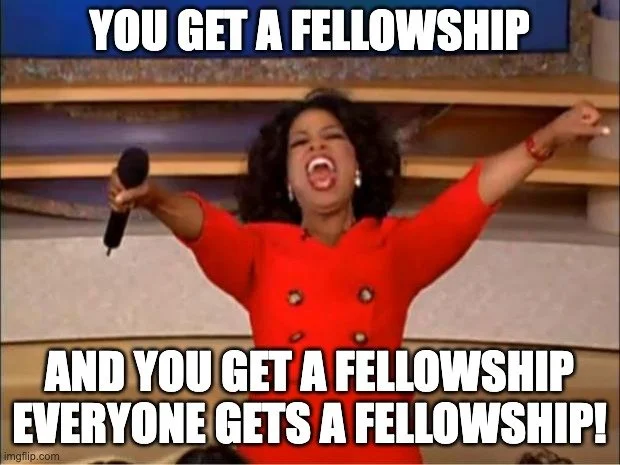
Earlier, I alluded to the fact that fellowship programs forgo much of the complexity of a full-blown accelerator. Let me expand on that point — as it’s key to understanding why so many fellowship programs are emerging.
Both fellowship programs and Montessori schools are rooted in the notion that individual participants are highly-motivated and eager for knowledge. The corollary of that belief is that mentors need not be heavy-handed (either in their depth of programming or the help they provide). Montessori programs don’t so much teach children as they guide them on where to look for their own answers. Similarly, fellowship programs don’t focus on the type of “startup 101” programming that accelerators historically delivered. Instead, they provide frameworks for aspiring founders to search for answers while making introductions and connections to help them progress.
Guess what? That approach means fewer mentors, less time and effort developing programming, and significantly lower costs.
The simplest form of a fellowship offering is a VC partner providing regular mentorship and occasional connections to an aspiring founder. Which is exactly what many VCs have done for years through entrepreneur-in-residence (EIR) programs. From the perspective of traditional VCs, fellowship programs are little more than the cohort-ization (is that a word?) of something they were already doing.
Want to have your mind blown even further? Y Combinator — the world’s foremost accelerator — actually started out more like a fellowship program. Here is how Paul Graham originally described YC (then referred to as the “Summer Founders Program”):
The Summer Founders Program preserves many features of a conventional summer job. You have to move here (Cambridge) for the summer, as with a regular summer job. We give you enough money to live on for a summer, as with a regular summer job. You get to work on real problems, as you would in a good summer job. But instead of working for an existing company, you'll be working for your own; instead showing up at some office building at 9 AM, you can work when and where you like; and instead of salary, the money you get will be seed funding.
…
We'll have some smart people who are willing to talk over your plans with you, and suggest pitfalls and new ideas. We may also have connections to companies you'd like to do deals with. But how much you want to take advantage of our advice and connections is up to you.
We'll organize dinner once a week for all the Summer Founders, so you can meet one another and compare notes. We'll try to get some expert in technology, business, or law to speak at each dinner. But beyond that we'll be hands-off.

The first batch of YC’s “fellowship program”
To be clear, today’s top-tier fellowship programs provide significantly more that just a la carte mentoring and connections. They are full-blown platforms with programming and mentorship strategies that have been developed and iterated over many years. But the low “entry price” of starting a basic fellowship program, combined with the dramatic supply and demand imbalance I alluded to earlier (more and more founders looking for “cheat codes” but relatively few credible accelerators), is driving what I believe to be just the start of a wave of new fellowship offerings.
To recap:
The bifurcation of venture capital is forcing many VCs to invest earlier-and-earlier
Increased competition at the Pre-Seed stage is driving those investors to find new ways to differentiate themselves — which, for many, involves getting more hands-on with founders
Creating a new accelerator is difficult and prohibitively expensive for most VCs (a16z can afford to throw a ton of money at creating a new accelerator, but the funds who are moving upstream specifically because they can’t afford to compete against a16z most certainly cannot)
However, “systematizing” mentorship and/or scaling an existing EIR program is much more approachable for most VCs (and easy to justify from an ROI standpoint)
Bottom line: expect to see more and more fellowship programs emerge in the coming months (particularly from mid-sized Seed funds that are trying to figure out how to effectively compete at Pre-Seed).
On Terms and Terminology
Before I wrap things up, I want to share two final thoughts on terms and terminology:
On Terms
Many accelerators and fellowships are increasingly trumpeting large numbers when it comes to their investment amount. It’s not uncommon to see programs seemingly offering $1M of investment to startups.
But don’t believe everything you read.
The vast majority of accelerators and fellowships make either milestone-based or follow-on based investments. That means that (a) you might not receive the full amount, and (b) if you do, you may end up giving away a much higher portion of your company than you realized.
Consider the following examples:
Y Combinator
Top-line number: $500K
Actual initial investment: $125K for 7%
Follow-on investment: $375K (MFN)
a16z Speedrun
Top-line number: $1M
Actual initial investment: $500K for 10%
Follow-on investment: $500K (contingent on follow-on funding)
Entrepreneurs First (US)
Top-line number: $250K
Actual initial investment: $125K for 8%
Follow-on investment: $125K (MFN)
South Park Commons
Top-line number: $1M
Actual initial investment: $400K for 7%
Follow-on investment: $600K (contingent on follow-on funding)
Strictly speaking, there’s nothing wrong with this approach (in fact, it very much represents a standardization of the traditional venture capital strategy of “investing early and doubling down on winners”). But as a founder, it’s important that you read the fine print (here is a somewhat dated post on accelerator terms that I wrote a few years ago).
On Terminology
I’m not going dive into the etymology of (or debate over) terms related to accelerators / incubators / startup schools / etc., but I do think it’s important to share one point as it relates to fellowships (as they’re relatively new on the startup landscape and the language is still in flux):
The term “residency” is often used interchangeably with “fellowship” (e.g. Neo refers to its fellowship program as “Neo Residency”). However, it is also increasingly being used to differentiate between full-blown fellowship programs and lighter-touch coworking offerings that standalone fellowship programs are using to attract potential candidates (e.g. the Entrepreneurs First Residency and the South Park Commons Residency).
If you are considering a fellowship program, be sure to pay attention to the terminology and make sure you understand exactly what you’re applying to (lest you mistake one for the other).
