Snakes and Ladders
I spend a lot of time traveling back and forth between San Francisco and other cities across North America and the UK.
Every time I leave the Bay Area, I find that my internal clock naturally slows down, as it adjusts to the pace of life in whatever city I’m visiting. Conversely, the moment my flight lands at SFO, it ramps back up. My good friend Marvin Liao wrote about this last year (referencing a short but insightful post from Sriram Krishnan the year prior).
This particular phenomenon isn’t new to anyone in tech. Silicon Valley has always operated at a higher velocity than other startup ecosystems (similar to how New York has a different gear than comparable cities when it comes to other forms of white collar work). But over the past 18 months, something has been happening.
Silicon Valley has been speeding up.
And most people outside of the Bay Area — including founders, ecosystem supporters and even many VCs — have no clue just how wide the chasm has become.

The Resurgence of Silicon Valley
Over the past year, there have been a number of signals hinting at Silicon Valley’s resurgence. For example, the PitchBook-NVCA Venture Monitor, which provides a quarterly snapshot of the US venture landscape, has shown a steady increase in the percentage of US VC investment going to companies based in the San Francisco Bay Area (on both a dollar and deal count basis):

Source: PitchBook-NVCA Venture Monitor, Q1 2023 - Q1 2026
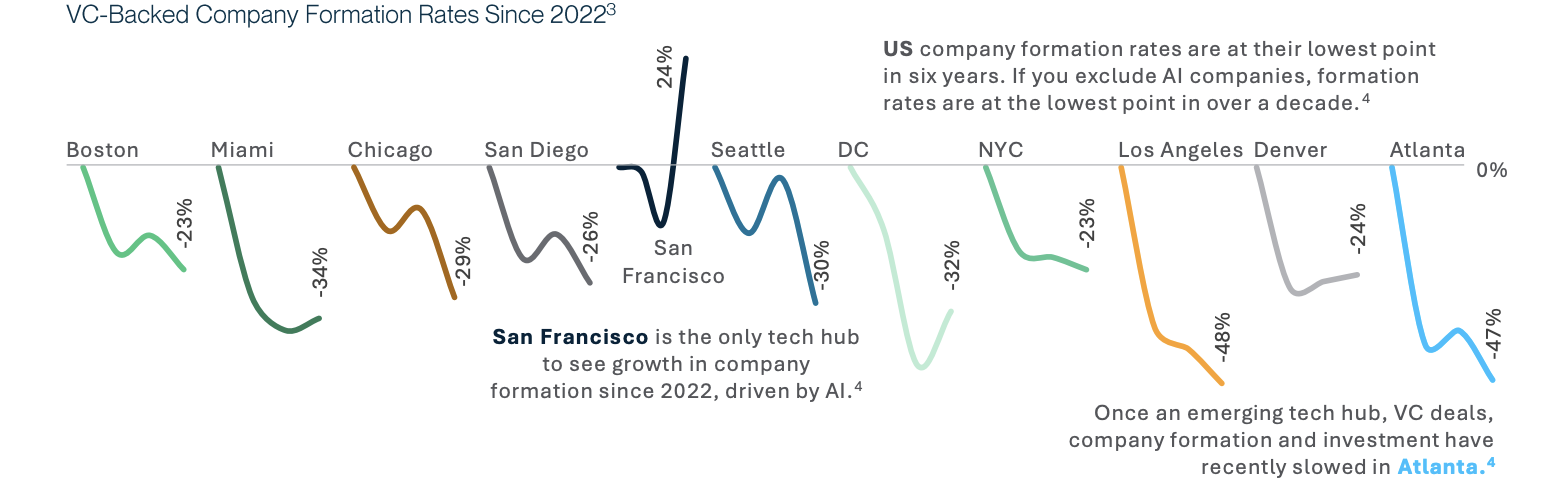
A report recently published by Silicon Valley Bank showed that, since 2022, the rate of VC-backed company formation has plummeted in every major city in America, except for San Francisco…where new company formation has skyrocketed:
Meanwhile, rent in San Francisco is increasing at the highest rate in the US and is on pace to surpass NYC for one- and two-bedroom units.
“In San Francisco, rents are surging, with one-bedrooms climbing 16.1% and two-bedrooms up 19% year-over-year, as a return-to-office push and optimism around AI-driven hiring pull high-income workers back into an already supply-constrained market.”
Taken alone — or even together — these signals don’t necessarily indicate a shift in “how” Silicon Valley is operating as an ecosystem. After all, San Francisco has been a gold rush town since the 1800s. People in tech rushed to the Bay Area during the dotcom boom in the late 90s and then again as the recovery from the 2008 financial crisis accelerated in the early 2010s. But this time is different.
Each time I’ve returned to the Bay over the past 18 months, it’s seemed faster than when I left. And each time I travelled to another city, the slowdown felt more pronounced. The contrast more jarring. It was as if Silicon Valley was accelerating and evolving in near real-time, while other ecosystems remained static.

What’s Going On?
Last year, tech media started publishing articles about Silicon Valley embracing “996”. The implication of these articles was that the acceleration happening in tech could simply and easily be attributed to startup employees working longer hours. But that explanation rang hollow to me.
While the idea of working 996 (9AM to 9PM, 6 days/week) seems shocking to many people, it’s actually nothing new for Silicon Valley. Back when I worked in startups, a 12-hour workday was pretty normal (I actually have a draft blog post on the topic which I have yet to get around to finishing…). I personally think the media reaction has a lot more to do with how many visitors to Startupland™ during the ZIRP era didn’t actually work that hard, but that’s a topic for another day.
From where I sat, there had to be something else going on.
It took a conversation that I had with Charles Hudson last fall — when I was brainstorming for an experiment that would become Game On — to provide the lightbulb moment. We were discussing the fact that founders seemed to be executing faster in San Francisco than they had been before. Charles had observed something similar and had invited several of his portfolio founders from outside of California to visit for “field trips” (short visits to San Francisco during which they would work out of the Precursor Ventures office).
Charles shared with me a story about one such founder, who was working at the Precursor office on a Friday afternoon when he ran into a bug with an API that he was building on top of (the anecdote is paraphrased as follows):
Founder: “I just ran into a bug with X, so I’m blocked.”
Charles: “What are you going to do about it?”
Founder: “I filed a ticket.”
Charles: “And then?”
Founder: “And then what…?”
Charles: “What else did you do?”
At this point, the founder looked dumbfounded.
Charles: “Are you really going to just file a ticket and call it a day?”
Founder: “What else am I supposed to do?”
Charles: “How about I connect you with the CEO?”
A few minutes later, the founder was describing the bug to the company’s CEO. Within an hour, it was fixed.

Snakes and Ladders
I’ve been thinking about that anecdote — any many similar ones that I’ve heard since — and I believe that the best metaphor for what’s going on in Silicon Valley right now is the board game snakes and ladders.

Founders in SF have always benefited from high-value networks, but over the past couple of years they’ve become far more aggressive in how they leverage them. Have a bug? Reach out to the CEO. Want early access to the next release? Get your VC to connect you to the CEO. Trying to get into that invite only party with the who’s who of your sector? Reach out to the party organizer (aka the CEO).
These days, founders up and down Silicon Valley unapologetically search for and leverage “ladders” in order to skip steps. They’ve become far more aggressive at this than I’ve ever seen before — going into social debt to a degree that would have been considered inappropriate (and, frankly, cringe-worthy) only a few years ago. But these days, it’s increasingly perceived as a socially-acceptable form of ambition.
These founders are sprinting and scrambling as fast as they possibly can up each and every ladder they find. Occasionally, they screw up and slide back down a “snake”. But no one in the valley bats an eyelash. There are no negative social implications. Meanwhile, founders everywhere else in the world are dutifully running back and forth along the left-to-right game squares. Some of them are trying to go faster (aka 996), but all of them continue to follow the linear, back-and-forth path.
Have you ever heard of anyone winning a game of snakes and ladders without climbing a ladder? Me neither…
One of the experiments we performed during the “Game On” program last January involved introducing the 35 visiting Canadian founders to some unexpected ladders. On day two of the program, we had Google’s Global Founder Advocate, John Alioto, join us. He sat down in front of our visiting founders with a simple offer,
“Tell me anything you want access to anywhere in Google, and I’ll make it happen.”
One of the founders in the room raised their hand and mentioned that they had been on a waiting list for a pre-release product for 3 months. John smiled, typed a few things into his computer, and several moments later declared that they had access to it. Everyone’s eyes widened.
Over the course of the morning, he repeated similar unlocks for many of the founders in the room. In mere moments, these founders climbed ladders that they had been dutifully marching towards for weeks or months. John unlocked doors that were previously closed to them, with no idea as to when (or if) they might be opened.
That’s a daily occurrence for Silicon Valley’s highest-velocity founders.
The Fog of War
Popping up a level, it’s important to address the topic of information asymmetry in the current startup landscape.
Whether you are a founder, an investor or an ecosystem supporter, it’s essential that you understand that there has been a significant reduction in the information flow emanating from Silicon Valley. The “fog of war” between the Bay Area and the rest of the world has gotten thicker. “Snake and ladders” is but a single example of the many changes that have taken place in how San Francisco startups operate that aren’t yet apparent to the outside world.
Historically, information and innovation flowed fairly reliable out of Silicon Valley. Each time a new idea would arise — whether technical, business process, or otherwise — it would first disperse throughout local Bay Area networks. A month or two later, some number of people would share it with the wider world through blog posts, Twitter threads and videos. Within a quarter or two, the majority of the world’s tech ecosystems were up-to-speed.
That’s not happening anymore.
Technological innovations are still widely and reliably distributed online (you need only look at the speed with which OpenClaw took the world by storm to be convinced of that). But when it comes to business processes, go-to-market strategies, best practices and other innovations, very little information is leaving the Bay Area these days.
There are three reasons for this:
The intensity of AI-driven competition has resulted in many people deprioritizing non-critical content creation
An increasing percentage of the content that does get created is useless, AI-generated slop
Within Silicon Valley, information sharing has overwhelmingly shifted from public forums to private group chats and closed events
When taken together, the result is that founders, investors and ecosystem builders outside of Silicon Valley are increasingly out-of-touch with what’s happening on the ground in San Francisco for no other reason than that no one is telling them.
In the past six months, I’ve seen numerous founding teams from outside of Silicon Valley visit the Bay Area, only to discover that their knowledge — about technology, competition, customer interest, and more — was significantly out of date. Despite having every belief that they were operating at the bleeding edge of their industry, they discovered that they were, in fact, very far behind.
I’m not sure when (or if) the flow of information from Silicon Valley to the outside world will return to it’s previous rate. For now, I can simply offer this: if your goal is to create a globally competitive tech company, you should presume that what you think you know about what’s happening Silicon Valley is significantly outdated. At worst, it’s flat-out wrong.
The solution? Go on a field trip. Get on a plane, spend a few weeks in San Francisco during the summer. And see for yourself.
For founders building outside of Silicon Valley, it’s the new playbook.