AI Price Drops Are Coming
My first co-op job back in the 90s was for a regional Canadian telecom company called BC Tel. It was the early days of the internet, when dial-up modems were the norm (you were envied if you had one of the new 56K ones). The most recognized sound in the world was this.

RIP BC Tel
BC Tel was preparing to launch its first deployments of a new technology called “digital subscriber lines” — dedicated phone lines that businesses could purchase in addition to their standard voice line in order to have an always-on internet connection (you’ll recognize the technology by its acronym, “DSL”). Like most telecoms that were rolling out DSL, BC Tel planned to initially sell their product using usage-based pricing.
Over the course of the summer, I wrote metering software that would track exactly how many bytes were transferred up and down a customer’s DSL connection each month. Those metrics were then used to generate their monthly invoice.
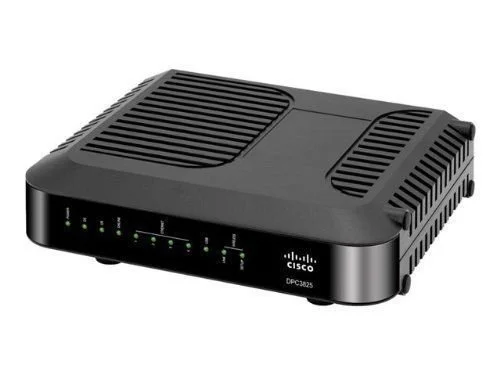
A “vintage” Cisco 678 DSL router
Midway through the summer, the first DSL deployments were rolled out to great fanfare. While some early adopters were eager to brag about their state-of-the-art internet connections, it wasn’t long before the complaints started coming in. Businesses that were used to paying $100/month for a dial-up line were suddenly getting invoices in the thousands (or tens of thousands) of dollars. The telcos argued that usage-based pricing was the only approach that made sense (since the increased traffic would result in increased costs on their side).
Customers weren’t buying it. And the competition took notice.
The cable companies weren’t far behind. And when they eventually rolled out their competing broadband offerings, they did so with fixed, monthly pricing. Within a couple of years, usage-based internet pricing was a distant memory, along with the short-lived revenue burst that came with it.
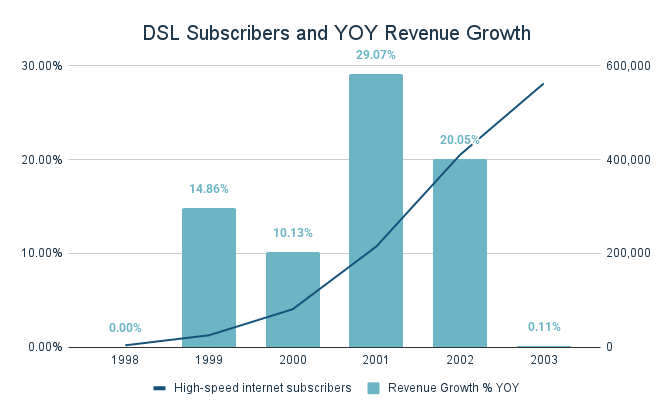
From 1999 - 2003, BC Tel/Telus’ DSL revenue skyrocketed as a result of usage-based pricing. Revenue flattened in 2003 (despite ongoing subscriber growth) as it was replaced with fixed pricing.
What Does This Have To Do With AI?
As the saying goes, “history doesn’t repeat itself, but it often rhymes.”
Right now, AI companies around the world are capturing unprecedented revenue, driven primarily by usage-based pricing. Early adopters are eager to take advantage of the incredible productivity gains offered by this new technology, but are also running head-first into the sticker shock of pricing. Many prosumers are now spending thousands of dollars each month on AI tools, while some companies are already well into the millions.
While investors and tech leaders loudly proclaim that this type of pricing “is the future”, the reality is it won’t last forever.
Why Usage-Based Pricing Never Lasts
In markets where customers have multiple competitors and/or alternative ways to fill a need, pricing always trends towards “value-based” pricing. Value-based pricing is where a customer is willing to pay an amount of money for a product or service based on its perceived value to them.
For some products and services, value-based pricing is, in fact, aligned with usage. For example, we are used to paying for travel-related products (fuel) and services (taxis, Ubers, etc.) based on how far we travel. Utilities, like water and electricity also employ usage-based pricing.
But there are many products and services for which value-based pricing is independent of usage. You’re unlikely to want to pay a fee every time you sit on your sofa or open and close your window.
For usage-based pricing to persist over time, two things have to be true:
The value that a customer perceives in the product/service must somehow derive from it’s usage (more usage → more value)
The customer must be able to reasonably predict and/or control usage
The second point is key for businesses that leverage AI. At the end of the day, a business that utilizes a product/service with usage-based pricing must ensure that they’re still able to generate a profit themselves, even if the product/service that they ultimately sell is fixed-price.
This is a crucial point, considering that the vast majority of end products are (and will remain) fixed-price.
To illustrate my point, as a consumer you are unlikely to pay more for one coffee mug over another because one was “designed with AI”. Nor are you likely to pay more for a book that was researched with AI, a movie that was generated with AI or ribs that were smoked using a recipe perfected with AI.

Why AI Adoption is Different (For Now)
What makes AI adoption different from the introduction of DSL 25+ years ago is that the latter didn’t come with immediate productivity gains. Sure, a DSL line was faster and more reliable than dial-up, but software wasn’t yet at the point that better internet access automatically translated into significantly more revenue or lower costs.
As a result, early adopters revolted at the high costs of DSL and threatened to go back to dial-up. They called the telecoms’ bluff…and it worked.
But AI is different. There are legitimate and immediate productivity gains that come from leveraging it. As a result, companies are willing to pay outrageous rates for AI because of the increased productivity that they’re realizing. But that willingness isn’t infinite.
The simple narrative being pushed by AI companies and their investors is that AI is making software developers more productive than they’ve ever been. So much so that companies should be willing to spend infinite amounts of money on AI. The more nuanced reality is that, in most cases, those productivity gains aren’t resulting in equivalent profit gains. In fact, in many cases the incremental cost of AI is eliminating (or, at least, significantly reducing) the profit margins of the companies leveraging it.
Put differently, what we’re seeing is not a straight-forward case of “developers are more productive so we need fewer developers”. Beneath the surface is a clear current of, “we’re spending so much on AI that we can’t afford to keep all of our developers.”
That dynamic is what’s driving the massive VC rounds commanded by today’s fastest-growing startups. It’s also the real reason behind many of the layoffs being announced by companies whose revenue growth has stalled.
Consider this week’s 10% layoff by Atlassian. Buried within the company’s announcement was the following justification,
“We are doing this to self-fund further investment in AI…”
In other words, “we need to cut staff because we can’t afford to pay our increasing AI bills” (P.S. if we can’t figure out how to effectively leverage AI, we’ll probably die).
In the not-too-distant future, we will reach a breaking point in terms of the ability and willingness of businesses and consumers to pay ever-growing AI bills. (I suspect that we have a few more quarters before that happens, but it will happen.)
And therein lies the opportunity for astute startup founders.
The Opportunity in Fixed-Priced AI
For many customers (both individuals and businesses), price certainty is more important than the price itself.
As a case study, through the 1990s and into the early 2000s, most personal computers were custom-built. Anyone could order the components needed to build a computer, buy an OEM copy of an operating system (Windows or one of many Linux distributions) and get up and running. The coolest retailer on the planet in those days was Fry’s.
Over time, custom computer shops popped up filled with people who assembled and sold “no-name-brand” computers to consumers and businesses. Eventually, global brands like Compaq, HP, Gateway and Dell took over.
To computer nerds like myself, it seemed absolutely ludicrous that someone would pay $4,000 (in 1990s money!) to buy a PC that had half the performance of one that I could custom-build in a day for less than $2,000. But many did. And their market share kept growing for one simple reason: their customers wanted certainty. Certainty in price. And certainty that their computer would work.
We’re seeing that same dynamic play out today in AI.
Amidst the many threads proclaiming that if you aren’t rolling your own OpenClaw server, you’re falling behind, is the reality of how most of the world works. Ambitious individuals and businesses around the world will absolutely leverage AI, but the vast majority have neither the time nor the inclination to do it from scratch. And they won’t have to.
Because someone will do it for them.
Moreover, they’ll do it for them at a fixed price (even if that price seems exorbitant to the many hackers deep-in-the-weeds of AI).
We’re already seeing early examples of this, including:
Vertical AI offerings that provide specialized AI capabilities at a fixed price
AI search capabilities that are now bundled with CRMs, note-taking software and other databases
Consultants that will spin up an OpenClaw server on a Mac Mini for you for a fee (much to the chagrin of open source hackers)
If you’re a founder looking for opportunity in AI, don’t just look at the technology. Pay attention to price. There are an incredible number of markets where customers will buy AI-based offerings today if they (a) solve a real problem they have right now, and (b) do so at a fixed price (even if that price seems ludicrous).
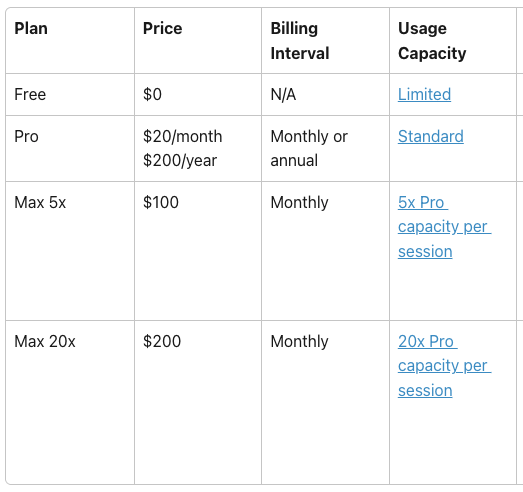
None of the hyperlinks on Claude’s pricing page provide any real definition as to what usage is actually based on — which, for most people and businesses, is a problem
If you can create an AI-based offering that solves a real problem at a fixed price, while ensuring that you have a healthy operating margin, you’re likely in a good position to sell to the 99% of consumers and businesses who aren’t glued to Twitter/X 24/7.
Not only will you start focusing on margin (in terms of controlling your own use of AI whilst delivering your product/service) long before most other AI companies think about it, you’ll have a head start on building brand loyalty while others obsess over, “but what if X builds it?”
Because at the end of the day, consumers and businesses still just want a solution to their problem.