What’s Going On With Accelerators?
With more accelerators and fellowships than ever, it might seem like there’s an overabundance of options for founders to choose from. What we’re seeing is actually a clustering around two very specific approaches to hands-on investing.
I’ve written a lot lately about the ongoing bifurcation of venture capital and its implications for fundraising (both in my quarterly updates and in dedicated posts, like this one on early-stage investing).
One prediction I made last year was that we would start to see more early-stage investors lean in to the “hands-on” styles of investing that were more common in years past. As megafunds ramped up their early-stage activity, many Seed VCs would be crowded out. They would in turn head upstream to the “safety” of Pre-Seed. The increased competition at Pre-Seed would force investors to find new ways to differentiate themselves in the eyes of both founders and LPs.
And that would lead to more accelerators,
“…we’re seeing a resurgence of both small, dedicated accelerators and offerings from Seed-specialist VCs…it feels like the pendulum is swinging solidly back from the “hands-off” investing style of the ZIRP era to the more “hands-on” style of years past. At a time when AI is making it cheaper than ever to get a company off the ground, I think we’re going to quickly see a new level of competition amongst credible accelerators (and between accelerators and pre-seed VCs).”
Sure enough, the accelerator landscape has gotten a lot more crowded since I wrote that post.

Since the beginning of the year, megafund a16z significantly ramped up their speedrun team (I might have done reference calls for some people they were looking to hire 👀). They followed that up by launching a new fellowship program called “alpha” a few weeks ago.
Speaking of alpha, the big dog of accelerators, YC, didn’t sit long with its earlier assertion that, “…the total number of startups going through the program each year will hold steady at about 500…” The recently completed W26 batch had nearly 200 companies (i.e. they’re currently on pace to invest in 800 startups in 2026).
And that’s just the start. Here is some of the other activity that took place across the accelerator landscape during the first quarter of 2026:
London-founded fellowship program Entrepreneurs First completed its move to San Francisco and unveiled a fresh $200M fund
Accelerator upstart Neo announced a new Residency program for college students
Montreal-based AI research institute Mila launched a new venture-building program for AI research scientists as part of a $100M “venture scientist fund” announced earlier in the year
South Park Commons shared its plans to raise a new $500M fund for its self-proclaimed “anti-accelerator”
Taken together, it might seem like there’s now an overabundance of programs for founders to choose from. But if you look closer, what we’re seeing is actually a clustering around two very specific approaches to hands-on investing:
Accelerators as the New MBA
Fellowships as the New Montessori
Let’s dig deeper into each of these trends.
Accelerators as the New MBA
In the early days of accelerators, programs like YC, Techstars and 500 Startups didn’t have nearly the prestige of today’s industry leaders. In fact, it was quite the opposite. Amongst many founders and investors in the startup world, accelerators were seen as something of a crutch. They were the thing you went to if you couldn’t figure it out on your own.
Fast-forward 20 years and the perception is very different. Not only are accelerators broadly accepted as a reasonable path for first-time founders to take, but having simply attended a top accelerator is seen by many as a mark of credibility and prestige. Sound familiar?
“You got into Harvard…you must be smart!”
“You got into YC…you must be smart!”
Last year, David Crow wrote about the increasing similarities between top accelerators and universities. He noted that,
“In the past, ambitious graduates invested in themselves by going to grad school. They spent $100,000 on an MBA, law degree, or medical program as their path to impact.
Today, ambitious people might choose YC or Speedrun instead…
YC and Speedrun are not just accelerators; they’re the new professional schools of venture.”
I’ll take it a step further: not only are ambitious individuals increasingly looking at top accelerators as a credible path to advance their careers, accelerators are increasingly selecting founders in ways that look a lot like how elite MBAs choose students.
And I’m not the only one.
I recently caught up with a friend who spent many years as a VC at one of Silicon Valley’s top-tier funds (he also happens to have an MBA from a prominent business school). In discussing the evolution of the early-stage landscape, he suggested that top accelerators have very intentionally moved towards a model for selecting founders that mirrors how top MBA programs select students:
“At this point, [top accelerators] know the “shape” of founders that Tier 1 VCs like to invest in. The schools they went to, the companies on their resume, the traction points that matter. The things that get an IC* comfortable investing in a company that maybe hasn’t done anything yet.
It’s the same way MBA programs cater to top employers. What undergrad did the student go to? Where did they intern? What test scores do they need if they came from a lesser-known school? They’re trying to maximize the chances that an incoming student will land a job with a name brand employer, regardless of what they actually do during business school.”
* investment committee
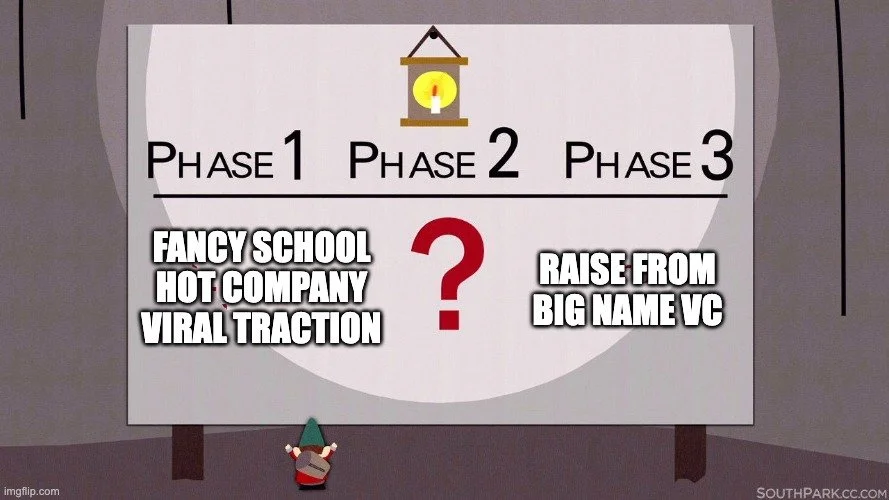
If you read my recent post on Hunters vs. Farmers, you might be getting a sense of deja vu. That’s because what we’re talking about here is the approach that “hunters” typically take, but within the context of a segment of venture that we historically think of as “farmers”:
“Early-stage hunters focus on pedigree and traction as their primary signals. Things like:
Graduating from a top school or program (Stanford, MIT, Waterloo, IIT Bombay, Thiel Fellowship, etc.)
Early employees that left “hot” companies
Repeat founders
Hot sectors
Virality / significant early traction
They’re generally betting on the correlation between pedigree and outcome (or, at least, pedigree and quick markups).”
This is exactly what elite MBA programs do. They bet on the correlation between pedigree and outcome, where outcome is “gets hired by a top-tier employer”. Today’s top accelerators are increasingly converging on a similar model. And you can see it in their marketing,
“Want to maximize your chances of landing a job with [top employer]? Apply to Harvard!”
“Want to maximize your chances of raising a round from [top VC]? Apply to YC!”
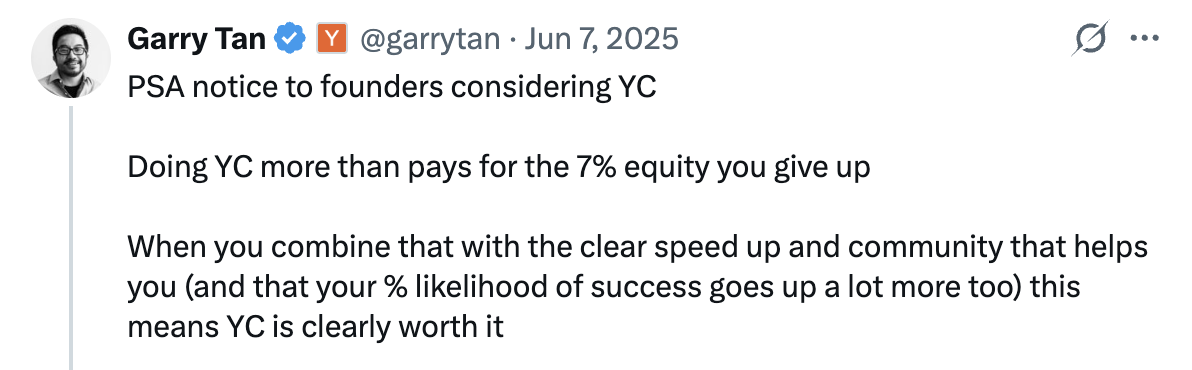
This certainly isn’t a bad approach — for either the accelerators or the founders.
That said, it’s worth noting that what’s happening at the top of the accelerator pyramid right now is very much influenced by a considerable imbalance in supply and demand. More and more qualified founders are looking for the “cheat codes” that come with the brand recognition and alumni networks of top accelerators. Yet there are very few programs that credibly deliver consistent outcomes along these dimensions (particularly in the aftermath of 500 Startups and Techstars both effectively failing). With so many qualified startups and so few spaces available in each program, founder pedigree naturally becomes a more prominent factor in selection.
Which means that a significant number of ambitious founders — especially founders outside of California and those from schools, companies and backgrounds that don’t neatly fit the typical Silicon Valley mold — are struggling to gain acceptance into these elite programs.
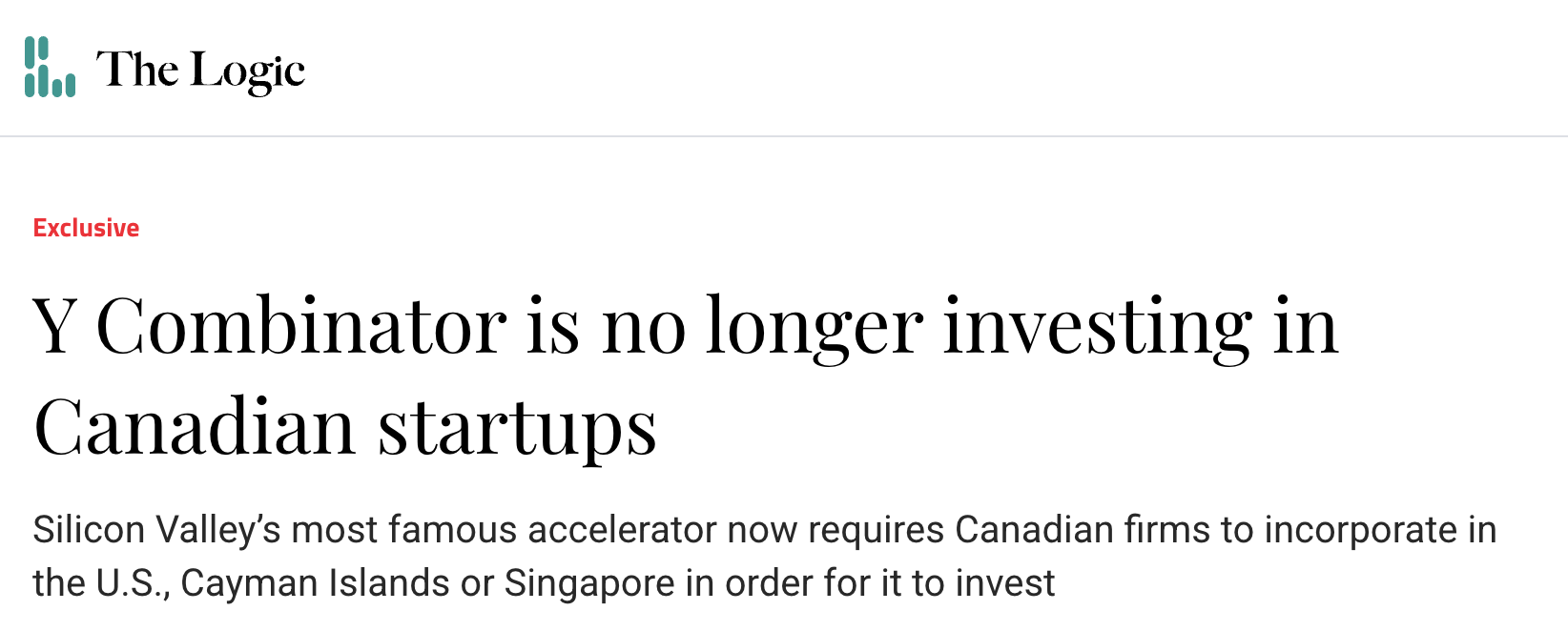
When the supply-demand curve is so imbalanced that an entire country doesn’t make the cut
So why aren’t we seeing more “elite MBA programs” emerge if the supply-demand curve is so imbalanced?
Despite the incredible demand for top tier Silicon Valley-based accelerators, only two platforms founded in the past decade have found success: Neo starting in 2017 and speedrun (from a16z) in 2023.
It turns out that creating a full-fledged accelerator platform from scratch is hard. It takes a lot of resources, investors who are experienced evaluating startups with virtually no traction, and an incredible number of high-quality, properly incentivized mentors. Creating a high-quality accelerator is, in fact, really, really hard.
But it is doable. Not only that, with so much latent opportunity — especially when it comes to startups outside of California — more elite Silicon Valley-based platforms are undoubtedly going to emerge. It’s just a question of when.
In the meantime, the majority of early-stage investors that have started rolling up their sleeves are taking a different approach. One that focuses almost entirely on the potential of individual founders while forgoing much of the complexity of a full-blown accelerator…
Fellowships as the New Montessori
If accelerators like YC and speedrun are the new MBA, then fellowship programs like South Park Commons, HF0 and Entepreneurs First are the new Montessori school.
If you’re unfamiliar with the term “Montessori”, it is an approach to early childhood education that focuses on encouraging children’s natural interests rather than providing formal, structured education. Montessori programs are designed around student-directed work, with a particular emphasis on uninterrupted work periods. The approach is based on the idea that children are naturally eager for knowledge and the primary role of teachers is to guide and mentor them.
At a high level, Montessori schools take a group of highly-motivated individuals and place them in a room with a handful of experienced, light-touch mentors in the hope of creating magic.

A Montessori “hacker house”
Which brings us to fellowships.
Fellowship programs invest in aspiring founders based primarily on their experience and pedigrees. These individuals are placed into a cohort and participate in activities designed to guide them towards founding high-potential companies (with a particular emphasis on ideation and cofounder matching). In other words, they take a group of highly-motivated individuals and place them in a room with a handful of experienced, light-touch mentors in the hope of creating magic.
Over the past few years, the number of fellowship programs has exploded. Not only are there an increasing number of standalone platforms (like South Park Commons, HF0 and Entepreneurs First), but many existing VCs have launched fellowship offerings as a means to increase their access to high-potential founders at the earliest stages. Some examples include a16z’s “alpha” fellowship (mentioned above), Conviction Partners’ “Embed” program, and Afore Capital’s “Founder in Residency” program.
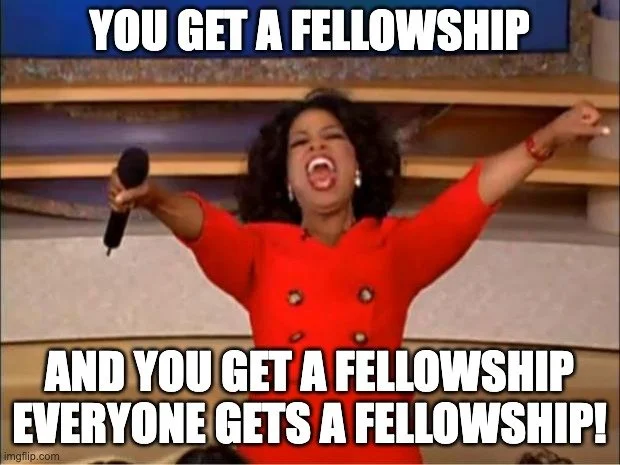
Earlier, I alluded to the fact that fellowship programs forgo much of the complexity of a full-blown accelerator. Let me expand on that point — as it’s key to understanding why so many fellowship programs are emerging.
Both fellowship programs and Montessori schools are rooted in the notion that individual participants are highly-motivated and eager for knowledge. The corollary of that belief is that mentors need not be heavy-handed (either in their depth of programming or the help they provide). Montessori programs don’t so much teach children as they guide them on where to look for their own answers. Similarly, fellowship programs don’t focus on the type of “startup 101” programming that accelerators historically delivered. Instead, they provide frameworks for aspiring founders to search for answers while making introductions and connections to help them progress.
Guess what? That approach means fewer mentors, less time and effort developing programming, and significantly lower costs.
The simplest form of a fellowship offering is a VC partner providing regular mentorship and occasional connections to an aspiring founder. Which is exactly what many VCs have done for years through entrepreneur-in-residence (EIR) programs. From the perspective of traditional VCs, fellowship programs are little more than the cohort-ization (is that a word?) of something they were already doing.
Want to have your mind blown even further? Y Combinator — the world’s foremost accelerator — actually started out more like a fellowship program. Here is how Paul Graham originally described YC (then referred to as the “Summer Founders Program”):
The Summer Founders Program preserves many features of a conventional summer job. You have to move here (Cambridge) for the summer, as with a regular summer job. We give you enough money to live on for a summer, as with a regular summer job. You get to work on real problems, as you would in a good summer job. But instead of working for an existing company, you'll be working for your own; instead showing up at some office building at 9 AM, you can work when and where you like; and instead of salary, the money you get will be seed funding.
…
We'll have some smart people who are willing to talk over your plans with you, and suggest pitfalls and new ideas. We may also have connections to companies you'd like to do deals with. But how much you want to take advantage of our advice and connections is up to you.
We'll organize dinner once a week for all the Summer Founders, so you can meet one another and compare notes. We'll try to get some expert in technology, business, or law to speak at each dinner. But beyond that we'll be hands-off.

The first batch of YC’s “fellowship program”
To be clear, today’s top-tier fellowship programs provide significantly more that just a la carte mentoring and connections. They are full-blown platforms with programming and mentorship strategies that have been developed and iterated over many years. But the low “entry price” of starting a basic fellowship program, combined with the dramatic supply and demand imbalance I alluded to earlier (more and more founders looking for “cheat codes” but relatively few credible accelerators), is driving what I believe to be just the start of a wave of new fellowship offerings.
To recap:
The bifurcation of venture capital is forcing many VCs to invest earlier-and-earlier
Increased competition at the Pre-Seed stage is driving those investors to find new ways to differentiate themselves — which, for many, involves getting more hands-on with founders
Creating a new accelerator is difficult and prohibitively expensive for most VCs (a16z can afford to throw a ton of money at creating a new accelerator, but the funds who are moving upstream specifically because they can’t afford to compete against a16z most certainly cannot)
However, “systematizing” mentorship and/or scaling an existing EIR program is much more approachable for most VCs (and easy to justify from an ROI standpoint)
Bottom line: expect to see more and more fellowship programs emerge in the coming months (particularly from mid-sized Seed funds that are trying to figure out how to effectively compete at Pre-Seed).
On Terms and Terminology
Before I wrap things up, I want to share two final thoughts on terms and terminology:
On Terms
Many accelerators and fellowships are increasingly trumpeting large numbers when it comes to their investment amount. It’s not uncommon to see programs seemingly offering $1M of investment to startups.
But don’t believe everything you read.
The vast majority of accelerators and fellowships make either milestone-based or follow-on based investments. That means that (a) you might not receive the full amount, and (b) if you do, you may end up giving away a much higher portion of your company than you realized.
Consider the following examples:
Y Combinator
Top-line number: $500K
Actual initial investment: $125K for 7%
Follow-on investment: $375K (MFN)
a16z Speedrun
Top-line number: $1M
Actual initial investment: $500K for 10%
Follow-on investment: $500K (contingent on follow-on funding)
Entrepreneurs First (US)
Top-line number: $250K
Actual initial investment: $125K for 8%
Follow-on investment: $125K (MFN)
South Park Commons
Top-line number: $1M
Actual initial investment: $400K for 7%
Follow-on investment: $600K (contingent on follow-on funding)
Strictly speaking, there’s nothing wrong with this approach (in fact, it very much represents a standardization of the traditional venture capital strategy of “investing early and doubling down on winners”). But as a founder, it’s important that you read the fine print (here is a somewhat dated post on accelerator terms that I wrote a few years ago).
On Terminology
I’m not going dive into the etymology of (or debate over) terms related to accelerators / incubators / startup schools / etc., but I do think it’s important to share one point as it relates to fellowships (as they’re relatively new on the startup landscape and the language is still in flux):
The term “residency” is often used interchangeably with “fellowship” (e.g. Neo refers to its fellowship program as “Neo Residency”). However, it is also increasingly being used to differentiate between full-blown fellowship programs and lighter-touch coworking offerings that standalone fellowship programs are using to attract potential candidates (e.g. the Entrepreneurs First Residency and the South Park Commons Residency).
If you are considering a fellowship program, be sure to pay attention to the terminology and make sure you understand exactly what you’re applying to (lest you mistake one for the other).

Snakes and Ladders
Over the past 18 months, Silicon Valley has sped up. And most people outside of the Bay Area have no clue just how wide the chasm has become.
I spend a lot of time traveling back and forth between San Francisco and other cities across North America and the UK.
Every time I leave the Bay Area, I find that my internal clock naturally slows down, as it adjusts to the pace of life in whatever city I’m visiting. Conversely, the moment my flight lands at SFO, it ramps back up. My good friend Marvin Liao wrote about this last year (referencing a short but insightful post from Sriram Krishnan the year prior).
This particular phenomenon isn’t new to anyone in tech. Silicon Valley has always operated at a higher velocity than other startup ecosystems (similar to how New York has a different gear than comparable cities when it comes to other forms of white collar work). But over the past 18 months, something has been happening.
Silicon Valley has been speeding up.
And most people outside of the Bay Area — including founders, ecosystem supporters and even many VCs — have no clue just how wide the chasm has become.

The Resurgence of Silicon Valley
Over the past year, there have been a number of signals hinting at Silicon Valley’s resurgence. For example, the PitchBook-NVCA Venture Monitor, which provides a quarterly snapshot of the US venture landscape, has shown a steady increase in the percentage of US VC investment going to companies based in the San Francisco Bay Area (on both a dollar and deal count basis):

Source: PitchBook-NVCA Venture Monitor, Q1 2023 - Q1 2026
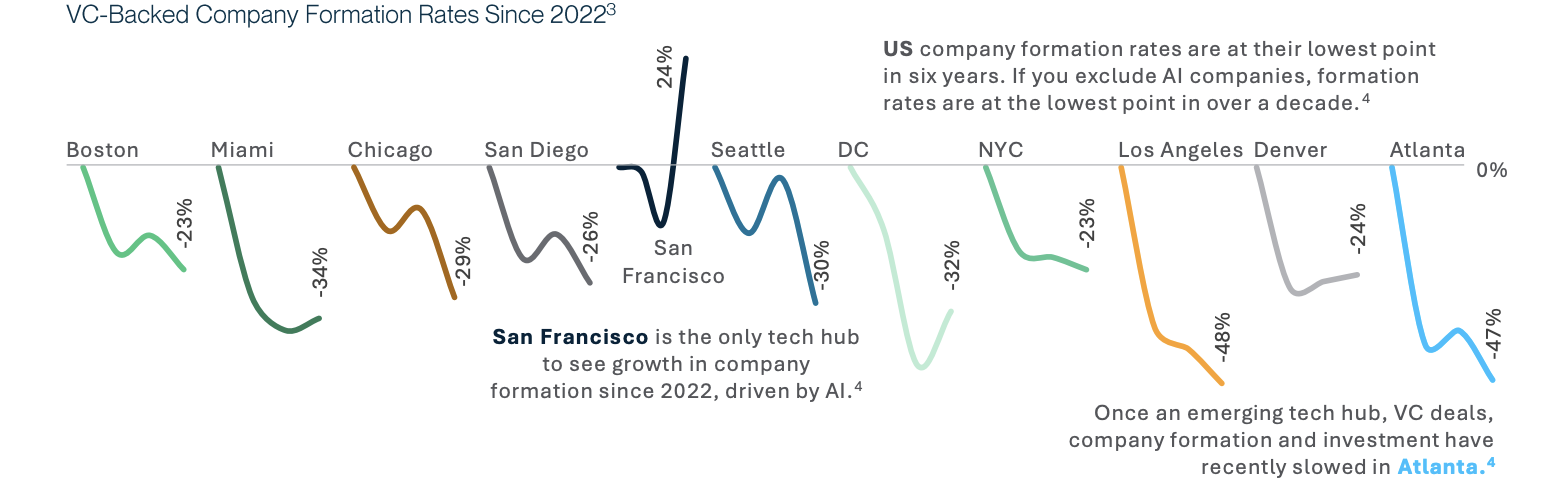
A report recently published by Silicon Valley Bank showed that, since 2022, the rate of VC-backed company formation has plummeted in every major city in America, except for San Francisco…where new company formation has skyrocketed:
Meanwhile, rent in San Francisco is increasing at the highest rate in the US and is on pace to surpass NYC for one- and two-bedroom units.
“In San Francisco, rents are surging, with one-bedrooms climbing 16.1% and two-bedrooms up 19% year-over-year, as a return-to-office push and optimism around AI-driven hiring pull high-income workers back into an already supply-constrained market.”
Taken alone — or even together — these signals don’t necessarily indicate a shift in “how” Silicon Valley is operating as an ecosystem. After all, San Francisco has been a gold rush town since the 1800s. People in tech rushed to the Bay Area during the dotcom boom in the late 90s and then again as the recovery from the 2008 financial crisis accelerated in the early 2010s. But this time is different.
Each time I’ve returned to the Bay over the past 18 months, it’s seemed faster than when I left. And each time I travelled to another city, the slowdown felt more pronounced. The contrast more jarring. It was as if Silicon Valley was accelerating and evolving in near real-time, while other ecosystems remained static.

What’s Going On?
Last year, tech media started publishing articles about Silicon Valley embracing “996”. The implication of these articles was that the acceleration happening in tech could simply and easily be attributed to startup employees working longer hours. But that explanation rang hollow to me.
While the idea of working 996 (9AM to 9PM, 6 days/week) seems shocking to many people, it’s actually nothing new for Silicon Valley. Back when I worked in startups, a 12-hour workday was pretty normal (I actually have a draft blog post on the topic which I have yet to get around to finishing…). I personally think the media reaction has a lot more to do with how many visitors to Startupland™ during the ZIRP era didn’t actually work that hard, but that’s a topic for another day.
From where I sat, there had to be something else going on.
It took a conversation that I had with Charles Hudson last fall — when I was brainstorming for an experiment that would become Game On — to provide the lightbulb moment. We were discussing the fact that founders seemed to be executing faster in San Francisco than they had been before. Charles had observed something similar and had invited several of his portfolio founders from outside of California to visit for “field trips” (short visits to San Francisco during which they would work out of the Precursor Ventures office).
Charles shared with me a story about one such founder, who was working at the Precursor office on a Friday afternoon when he ran into a bug with an API that he was building on top of (the anecdote is paraphrased as follows):
Founder: “I just ran into a bug with X, so I’m blocked.”
Charles: “What are you going to do about it?”
Founder: “I filed a ticket.”
Charles: “And then?”
Founder: “And then what…?”
Charles: “What else did you do?”
At this point, the founder looked dumbfounded.
Charles: “Are you really going to just file a ticket and call it a day?”
Founder: “What else am I supposed to do?”
Charles: “How about I connect you with the CEO?”
A few minutes later, the founder was describing the bug to the company’s CEO. Within an hour, it was fixed.

Snakes and Ladders
I’ve been thinking about that anecdote — any many similar ones that I’ve heard since — and I believe that the best metaphor for what’s going on in Silicon Valley right now is the board game snakes and ladders.

Founders in SF have always benefited from high-value networks, but over the past couple of years they’ve become far more aggressive in how they leverage them. Have a bug? Reach out to the CEO. Want early access to the next release? Get your VC to connect you to the CEO. Trying to get into that invite only party with the who’s who of your sector? Reach out to the party organizer (aka the CEO).
These days, founders up and down Silicon Valley unapologetically search for and leverage “ladders” in order to skip steps. They’ve become far more aggressive at this than I’ve ever seen before — going into social debt to a degree that would have been considered inappropriate (and, frankly, cringe-worthy) only a few years ago. But these days, it’s increasingly perceived as a socially-acceptable form of ambition.
These founders are sprinting and scrambling as fast as they possibly can up each and every ladder they find. Occasionally, they screw up and slide back down a “snake”. But no one in the valley bats an eyelash. There are no negative social implications. Meanwhile, founders everywhere else in the world are dutifully running back and forth along the left-to-right game squares. Some of them are trying to go faster (aka 996), but all of them continue to follow the linear, back-and-forth path.
Have you ever heard of anyone winning a game of snakes and ladders without climbing a ladder? Me neither…
One of the experiments we performed during the “Game On” program last January involved introducing the 35 visiting Canadian founders to some unexpected ladders. On day two of the program, we had Google’s Global Founder Advocate, John Alioto, join us. He sat down in front of our visiting founders with a simple offer,
“Tell me anything you want access to anywhere in Google, and I’ll make it happen.”
One of the founders in the room raised their hand and mentioned that they had been on a waiting list for a pre-release product for 3 months. John smiled, typed a few things into his computer, and several moments later declared that they had access to it. Everyone’s eyes widened.
Over the course of the morning, he repeated similar unlocks for many of the founders in the room. In mere moments, these founders climbed ladders that they had been dutifully marching towards for weeks or months. John unlocked doors that were previously closed to them, with no idea as to when (or if) they might be opened.
That’s a daily occurrence for Silicon Valley’s highest-velocity founders.
The Fog of War
Popping up a level, it’s important to address the topic of information asymmetry in the current startup landscape.
Whether you are a founder, an investor or an ecosystem supporter, it’s essential that you understand that there has been a significant reduction in the information flow emanating from Silicon Valley. The “fog of war” between the Bay Area and the rest of the world has gotten thicker. “Snake and ladders” is but a single example of the many changes that have taken place in how San Francisco startups operate that aren’t yet apparent to the outside world.
Historically, information and innovation flowed fairly reliable out of Silicon Valley. Each time a new idea would arise — whether technical, business process, or otherwise — it would first disperse throughout local Bay Area networks. A month or two later, some number of people would share it with the wider world through blog posts, Twitter threads and videos. Within a quarter or two, the majority of the world’s tech ecosystems were up-to-speed.
That’s not happening anymore.
Technological innovations are still widely and reliably distributed online (you need only look at the speed with which OpenClaw took the world by storm to be convinced of that). But when it comes to business processes, go-to-market strategies, best practices and other innovations, very little information is leaving the Bay Area these days.
There are three reasons for this:
The intensity of AI-driven competition has resulted in many people deprioritizing non-critical content creation
An increasing percentage of the content that does get created is useless, AI-generated slop
Within Silicon Valley, information sharing has overwhelmingly shifted from public forums to private group chats and closed events
When taken together, the result is that founders, investors and ecosystem builders outside of Silicon Valley are increasingly out-of-touch with what’s happening on the ground in San Francisco for no other reason than that no one is telling them.
In the past six months, I’ve seen numerous founding teams from outside of Silicon Valley visit the Bay Area, only to discover that their knowledge — about technology, competition, customer interest, and more — was significantly out of date. Despite having every belief that they were operating at the bleeding edge of their industry, they discovered that they were, in fact, very far behind.
I’m not sure when (or if) the flow of information from Silicon Valley to the outside world will return to it’s previous rate. For now, I can simply offer this: if your goal is to create a globally competitive tech company, you should presume that what you think you know about what’s happening Silicon Valley is significantly outdated. At worst, it’s flat-out wrong.
The solution? Go on a field trip. Get on a plane, spend a few weeks in San Francisco during the summer. And see for yourself.
For founders building outside of Silicon Valley, it’s the new playbook.
Go Touch Grass
Here are some of the ways that I slow things down and take a break from the dopamine rush of AI.
Last week, I wrote about a question that is increasingly top-of-mind for many residents of Startupland™: is agentic programming addictive?
I’ve received as many responses to my post asserting that, “this is normal…if you’re a founder you should have some level of addiction…” as I did emails expressing some form of, “thank you for writing this…it describes exactly how I’ve been feeling as of late,” (which to me is a pretty good indication that I’m on to something).
As someone who’s founded a number of startups over the years, I have some experience when it comes to late night coding binges. I personally feel like there are some real differences at play now that AI is in the mix. Of course, it could just be that I’m a boomer past my prime…

I will say this: as a parent, I find myself increasingly motivated to be thoughtful and intentional when it comes to our current AI-driven obsession. The question of “how much screen time is appropriate?” existed long before I was born. With the addition of AI — and its productive and addictive possibilities — that question seems even more prudent.
For both adults and kids alike, I think that it’s essential to maintain a connection to activities that are not impacted by AI. That’s why I concluded my post on the potential addictiveness of agentic programming with the following suggestion:
“…taking time away from your agents is important not only for your general health and well-being, but because our ability to think, create and invent depends on it.
So take a break. Make a point each day to step out of the AI- and social media-driven dopamine loops and touch grass. Not only is it okay to go outside, it’s essential.”
I thought that this week I would share some of the small but meaningful ways that my family and I “slow things down” in order to take a break from the dopamine-driven cycles of Startupland™:
1. No Technology at the Dinner Table
I’m a big believer in family dinners. It’s not always easy to pull off, but establishing a daily or weekly ritual with family or friends provides time for everyone to catch up, share stories and build connection.
One change we made in the Neumann household (that was harder than it seemed when we started) was to ban technology at the dinner table. That means no cell phones, no Apple Watches, and no questions to “Google”, “Siri” or “Alexa” (we actually unplug our Google Home before eating dinner because we are so used to interacting with it).
Remember the days when someone had a question and you actually discussed and debated the answer…? Turns out, you can still do that.
2. Listening to Vinyl Records
The resurgence of vinyl has been on the upswing for awhile. But that was mostly for audiophiles who couldn’t shut up about how much better their sound system was than yours. We jumped on the vinyl bandwagon for an entirely different reason: in order to stop our kids from skipping around when listening to music.
We noticed that, at a young age, our kids often struggled to listen to entire songs, much less albums. In some cases they would skip ahead. In others, they would restart a song multiple times before it finished. This isn’t anything particularly new, but it’s a lot more prevalent with digital music. As our kids got older, the frequency with which the soundtrack of our lives became measured in 15 second increments became unbearable.
Our solution: to buy a record player and give everyone in the family “credits” to buy their favorite albums.
Now, the only music we have on during dinner comes from a record player. We take turns picking music and, once someone puts on a particular record, it cannot be changed until it’s done. Not only has it given our children a better appreciation for music (they’ve had to learn how to handle and change vinyl records), everyone has gained/regained an appreciation for albums as a distinct work of art.
(Bonus points: there are no vinyl “brain rot” albums 😉).
3. Gardening
Another hobby that we’ve increased the amount of family time we spend on is gardening. As a kid, I spend countless hours learning to garden with my grandfather, who dedicated much of his retirement to meticulously tending one of the most fantastic vegetable gardens you could possibly imagine (the rest of his time was focused on fly fishing).
In today’s era of farm-to-table groceries, it’s hard to justify economically the time and effort that goes into growing vegetables in an urban setting, but the practice itself is both calming and centering.
And AI isn’t going to make those cherry tomatoes grow any faster.
4. Cooking
It’s no secret that I love to cook. In fact, it’s one of the things that recharges me. I cook multiple times each week, whether I’m by myself, with my family or when hosting a dinner party.
I’ve long-since learned to not try to multitask whilst cooking (no better way to burn dinner than by accidentally falling down an AI rabbit hole). Moreover, it’s a skill that very much can only be perfected through practice. The internet might give you the perfect recipe for pan-seared duck breast, but chances are you won’t get it right the first time. Or the 10th…
5. Board Game Night
Video games are fun, but it’s hard to beat the energy and laughter that comes from playing board games.
We try to find at least one night each week to play board games with our kids. Some nights it’s old faithfuls like chess or Monopoly. Other nights it’s strategy games like Ticket to Ride or Carcassonne.
It doesn’t matter if it’s 15 minutes or 3 hours, putting down the screens to play a game while sitting around the table provides a type of dopamine hit that AI simply can’t deliver.
6. Playing / Coaching Sports
Speaking of games, playing and/or coaching sports is one of the best ways I know of to disconnect.
I’m the type of person who desperately needs regular exercise (I workout almost every morning), but going to the gym and/or working out with my trainer is more like a daily routine than it is a true disconnect. For me, the competitiveness and camaraderie of sports is where the magic happens.
As a parent, I love coaching my kids’ sports teams. I also love playing sports. Whether it’s team sports like soccer, hockey and baseball or individual sports like skiing, swimming or rock climbing, the combination of physicality, competitiveness and disconnect provides an effective mental and physical reset.
There are plenty of other ways to “touch grass”, from reading a book to camping (and fly fishing!) to playing a musical instrument. Whatever you do, try to find 20 minutes a day to disconnect from all of your agents, breath deeply, and relax.
I promise you’ll have more energy, more stamina and more focus.
And, as I said last week, those agents aren’t going anywhere 😉.
Is Agentic Programming Addictive?
There’s a worrying dynamic occurring with AI power users: many early adopters of AI (and agents, in particular), are seemingly getting addicted to it.
Last week, I shared my quarterly musings about the tech world. Suffice to say, the past two quarters have been wild. In less than 6 months, we went from an impending AI backlash to a mad rush to agentify anything and everything not nailed down (and plenty of things that are).
Watching all of the activity around me, I find myself equal parts excited and struggling to not roll my eyes — which I consider to be a perfect balance during times of rapid innovation. Some of what is being enabled by these early agent systems is truly astonishing. A lot of it is just…automation for the sake of automation.
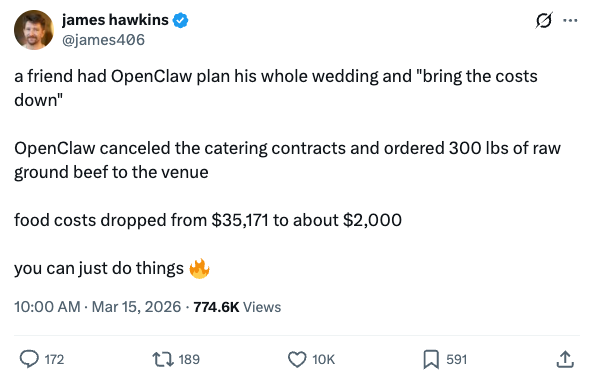
All jokes aside, a lot of smart people are spending a lot of time building with AI right now. And I definitely believe that this collective effort is going to move us forward in some pretty incredible ways.
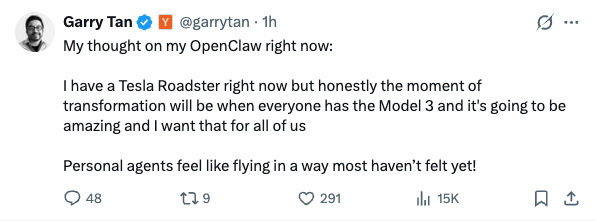
That said, there’s a worrying dynamic occurring within a segment of today’s AI “power users”: many early adopters of AI (and agents, in particular), are seemingly getting addicted to it.
And I don’t mean in a metaphorical sense.
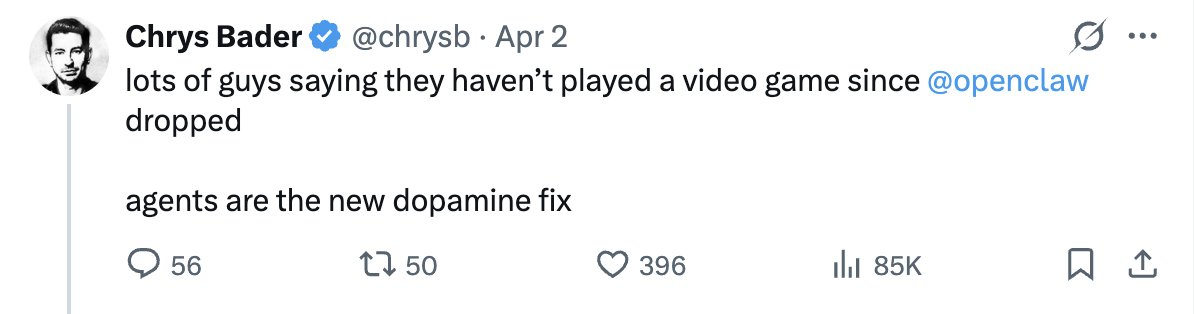
Longtime blogger and AI developer Steve Yegge recently wrote a post about this trend and its impact on early adopters called The AI Vampire (I highly recommend you give it a read). Steve notes,
“Agentic software building is genuinely addictive. The better you get at it, the more you want to use it. It’s simultaneously satisfying, frustrating, and exhilarating. It doles out dopamine and adrenaline shots like they’re on a fire sale.”
I’ve been around long enough to have been through several innovation “bursts” and have certainly spent my fair share of sleepless nights building and coding and hacking away. But the current vibe around AI and agents feels different (pun intended 😉). It’s like the excitement of the early Linux and Windows days, the gold rush of the dotcom bubble, the degeneracy of Web 3 and a solid dose of cold war paranoia all rolled into one.
A notable contributor to this behavior is an idea circulating in tech circles called “permanent underclass theory”. The concept is equal parts meme and sincere worry that if you’re not aggressively adopting AI right now, you might be priced out of it in the future.
Another driver is unquestionably the increasing pressure from tech companies large and small to “do more” (come to think of it, we should probably also give a nod to the boiler rooms of the 80s in our metaphor — *cough cough* tokenmaxxing).
None of this is to say that you should stop experimenting, tinkering or building with AI (I’m certainly not). But it does feel like, for as fast as things are evolving, this technological shift — like most — will turn out to be a marathon, not a sprint. Which means it’s crucial that you pace yourself accordingly. This is what Steve Yegge describes as the need to “fight the AI vampire”:
“…you need to consciously fight the AI Vampire even if you’re at a 30-person startup, where everyone agreed when they signed up that this was a sprint to try to get rich.
You need to fight it if you’re an investor. You will kill your Golden Geese.
You need to fight the AI vampire most of all if you’re a CEO or founder. People will be caught up in your enthusiasm. And they won’t understand why they’re being drained until they hit a wall…
As an individual developer, you need to fight the vampire yourself, when you’re all alone, with nobody pushing you but the AI itself. I think every single one of us needs to go touch grass, every day. Do something without AI. Close the computer. Go be a human.”
On top of its seemingly addictive properties, a recent study from MIT suggested that extensive use of LLMs may “diminish critical thinking capabilities and lead to decreased engagement in deep analytical processes.” Professor Saeema Ahmed-Kristensen from Exeter University in the UK found that while AI can generate a significantly higher volume of work than people, “human beings are much better at creating ideas that are very different.”
In other words, taking time away from your agents is important not only for your general health and well-being, but because our ability to think, create and invent depends on it.
So take a break. Make a point each day to step out of the AI- and social media-driven dopamine loops and touch grass. Not only is it okay to go outside, it’s essential.
I promise, your agents aren’t going anywhere.

(Or are they…?)
Things I Think I Think - Q1 2026
Three months ago, nobody had heard of OpenClaw, OpenAI was valued at a mere $500B, and Anthropic was signing multi-year partnerships with the U.S. Government.
Three months ago, nobody had heard of moltbot clawdbot OpenClaw, OpenAI was valued at a mere $500B, and Anthropic was signing multi-year partnerships with the U.S. Government.
Here’s where we stand ninety days into 2026 in my latest homage to legendary sports columnist Peter King.

Try explaining this one to 2025 Garry
Here are 5 Things I Think I Think - Q1 2026 Edition:
1. The Bifurcation of VC Continues (Continued…)
In my Q4 2025 post, I shared some observations about the ongoing bifurcation of VC. In particular, I discussed some of the changes that were starting to emerge at the Seed round. Over the past three months, those shifts have gone into overdrive.
It’s now very clear that for a certain category of companies (namely, AI-native companies whose revenue tracks usage), the growth trajectory is very different from what has historically been the case in the software world. The extreme compression of time has led to a dramatic acceleration of funding for those companies and a dramatic upswing in round sizes and valuations. And while usage-based revenue won’t last forever, the companies capitalizing on it are running away from the proverbial pack.
Carta recently noted that the top 5% of U.S. Seed rounds in Q4 2025 had an average valuation of $115.5M (compared to a median valuation of $24M). That looks a lot more like a traditional Series A valuation. And if this year’s on-the-ground activity is any indication, I expect the Q1 numbers to absolutely crush that.
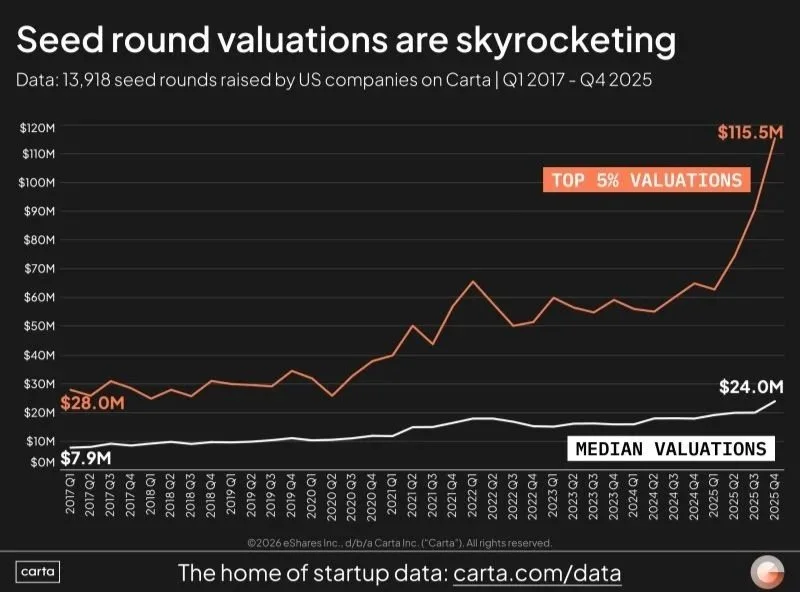
So, if it’s the case that the top segment of Seed companies are splitting off from the rest, are we still talking about a “bifurcation” of VC?
Yes.
Because it’s the megafunds that are swooping in to fund the perceived top Seed companies.
The vast majority of traditional Seed funds (even large ones) can’t afford to invest in these mega rounds. At least…not with traditional fund models. Which is why we’re seeing a ton of adjustment happening amongst Seed VCs. I shared some thoughts on this shift in last week’s post, but it’s worth pointing out that we’re only just starting to see the resulting dominos fall.
I expect that we’ll see a lot of changes when it comes to fund strategies at the Seed by this time next year. In particular, I expect that we’ll see a number of Seed funds adjust their models to look more like Pre-Seed microfunds, with 3 - 5% ownership targets at much higher valuations.
In the meantime, I offer a warning for founders preparing to fundraise: expect to see a Seed crunch for at least the rest of this year.
Much like the Series A crunch we saw last year, this one won’t be due to a lack of capital. It will be because the majority of Seed funds are completely rethinking their investment criteria.

Warning: goal posts moving
In the past few weeks alone, I’ve seen multiple companies that would have easily raised a Seed round a year ago struggle to get first meetings with VCs. Companies with real revenue and prominent logos aren’t even getting a 20-minute intro call.
Plan accordingly.
2. The SF Maker Phase is On Off On
A little over a year ago, I noted that the “maker faire” phase of San Francisco’s AI cycle was over,
“…we’ve moved from the “innovators” phase of this edition of the San Francisco technology lifecycle to the “early adopters” phase. And that’s a good thing.
This isn’t to say that you shouldn’t go to San Francisco in 2025 if you’re a builder — you absolutely should — just don’t expect it to have the same level of serendipity as last year. On the other hand, if you’re a founder a bit further along on your journey who’s looking to meet other high-quality founders focused on building their companies, there’s no better time to come. Just know that you need to be more intentional about your visit and manufacture the outcomes you want.”
I also argued that, “if history’s any indication, it will be another 20 years before it’s back.”
It turns out that history wasn’t helpful in this one. In January, moltbot clawdbot OpenClaw took the tech world by storm. Add to that the latest advancements in Claude Code and it seems like everyone is back to tinkering again.
In reality, I don’t believe that we’re heading back to another full-blown “maker faire” phase of SF’s tech cycle, but there is definitely is mini boom that’s happening right now around agents. Lots of meetups. Lots of activity. Lots of enthusiasm.
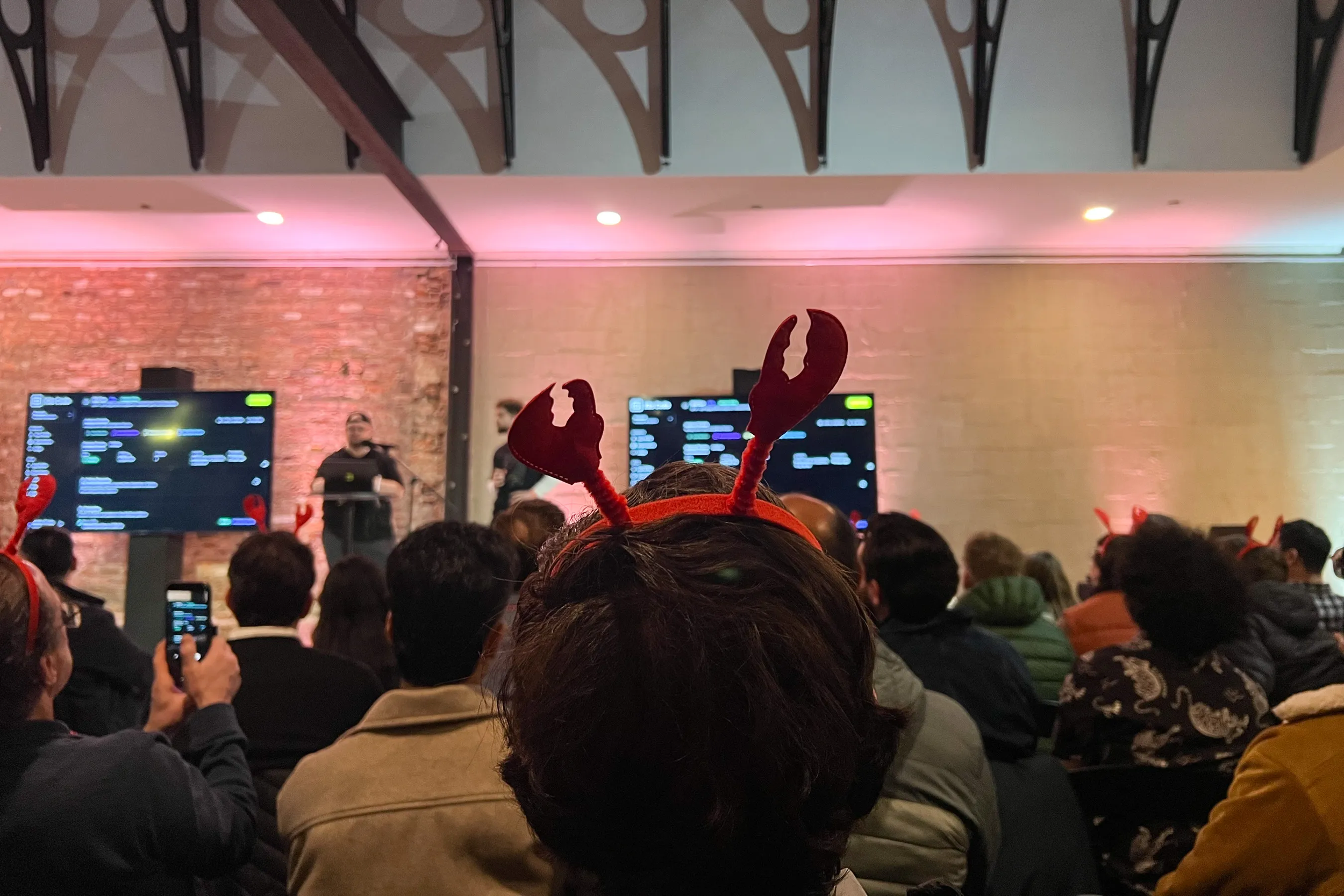
I suspect that this maker revival period will be relatively short-lived, particularly as more (and differently-targeted) agent offerings come to market. But it’s definitely going to be an eventful spring in Silicon Valley.
3. Do You Even Moat, Bro?
Another ongoing debate in the tech world surrounds the evolution of moats.
Historically, technical moats were a big deal for a lot of VCs. But with AI compressing time-to-market, a variety of new ideas have emerged. Some pundits have argued that deep knowledge of a particular industry or specialization will be a moat. Others suggest that trust and brand loyalty will win the day. There’s also the element of “taste”…

Jordi Visser recently wrote an article titled, The Repricing of Time: Equity in the Age of Agents, in which he discussed the impact of AI on equity markets (I highly recommend that you read it). Jordi posits the following:
“For more than a decade, equity markets were built around a simple premise: durable franchises deserved durable multiples. Investors weren’t just buying earnings. They were buying time. Time to compound. Time before meaningful competition arrived…Time was the moat.
…
But something subtle has changed.
AI does not simply disrupt business models.
It compresses time.”
Jordi goes on to propose that as AI continues to improve, the biggest moat will no longer relate to what you are building. It will be dictated by your ability to adapt. In other words, more than ever before, velocity will be the one metric that matters most.
4. YC is Pricing the Market
A year and a half ago, I noted that YC was boxing out. Earlier that year, Techstars had effectively failed. With 500 Startups’ having imploded a few years prior, that left an unprecedented opening for YC to dictate the proverbial terms across the entire accelerator landscape. It started with a move to 4 batches per year and has followed with the firm driving higher and higher average valuations each batch.
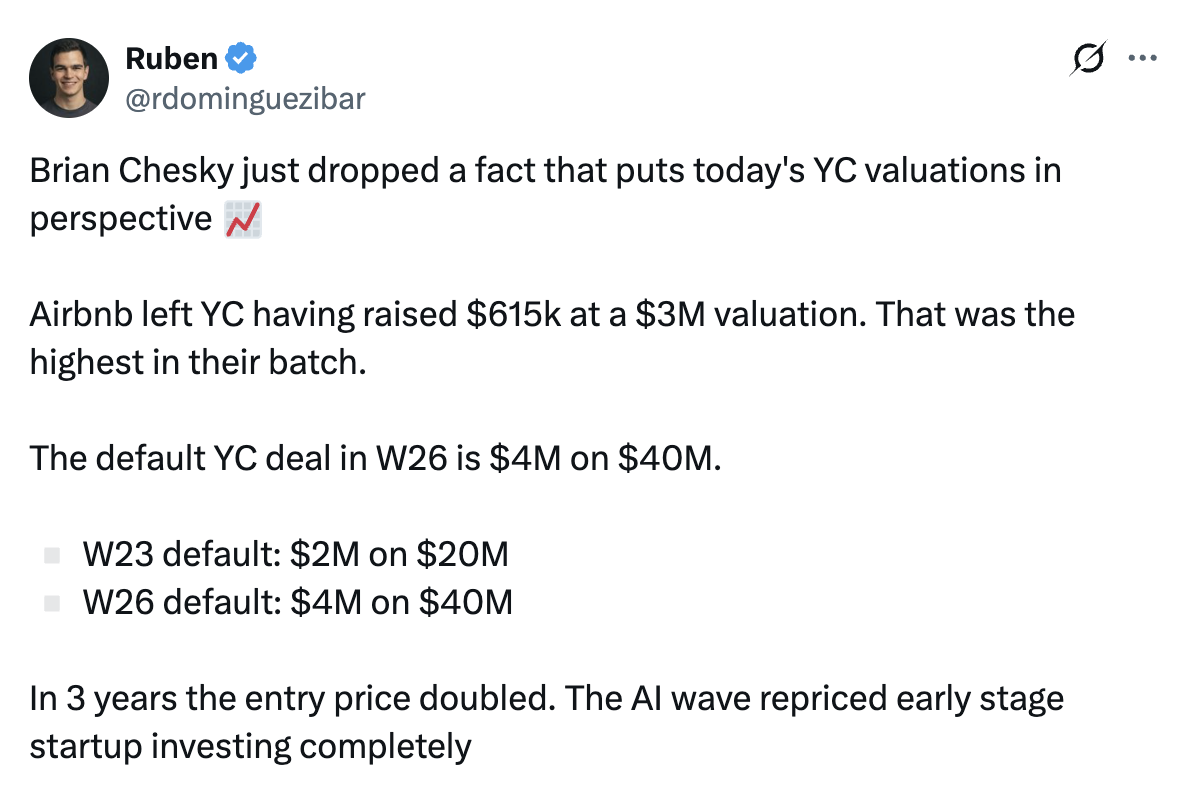
To be clear, the “default” YC deal isn’t actually what all of the companies graduating from the program get. (Moreover, as an index YC batches represent a very particular segment of the early-stage market — one typically characterized by high-pedigree founding teams supplemented by certain early traction signals). But the fact remains that these companies consistently price at the high end of the market across multiple dimensions.
a16z is targeting the same founder demographic with their Speedrun platform. The firm spent Q1 aggressively ramping up their team (I did more than a few reference calls over the past few months). It will be interesting to see where their batch valuations land as that platform settles into its groove and whether or not the well-funded competition puts a dent in YC’s ability to dictate prices.
5. The Delta Between SF / Silicon Valley and the Rest of the World is Exploding
I constantly travel between San Francisco / Silicon Valley and other startup ecosystems around the world (particularly those in Canada and the UK). Over the past year, the rate of change in the Bay Area has accelerated dramatically. Over the past 3 months, it’s gone stratospheric.
And founders / investors / ecosystem builders in the rest of the world — including in most of the US — genuinely have no clue.
I find myself increasingly disoriented as I bounce between ecosystems. I regularly meet founders outside of Northern California who are excited about the projects and products they’re working on, completely oblivious to the fact that companies in Silicon Valley have long-since abandoned those approaches, technologies or markets. At the same time, technologies that have permeated the day-to-day lives of Bay Area residents are still foreign in most of the world.
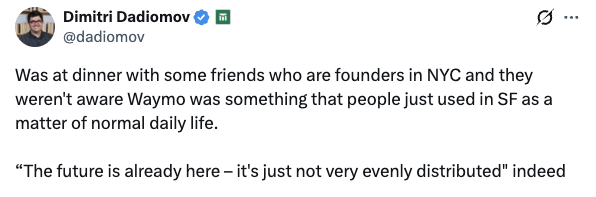
That’s certainly not to suggest that founders / startups / investors in the Bay Area are the preeminent experts on everything to do with technology (Silicon Valley remains a very thick bubble in both positive and negative ways). But it feels to me as though the rate of change occurring as a result of AI is actually decreasing the flow of information from Silicon Valley to the rest of the world.
Things are advancing so quickly that people in the Bay Area are finding less time to share what they’re working on with the world outside.
More than ever, I think it’s essential that founders, investors and ecosystem supporters around the world make a point of traveling early and often to Silicon Valley. To understand what’s going on, to benchmark the velocity at which it’s happening, and to understand what the competitive landscape really looks like.
Things are only going to get faster.
What’s Going on with Seed Rounds?
Another major shift is underway and, this time, it’s throwing off founders, angel investors, and Pre-Seed VCs alike.
As we near the end of the first quarter of 2026, yet another major shift is underway in the funding / fundraising landscape. And this time, it’s throwing off founders, angel investors, and Pre-Seed VCs alike:
Seed VCs are increasingly not acting like Seed VCs.

“Let’s see who this “early-stage VC” really is!”
Rather than dive into a full history of early-stage investing, I’ll anchor this post with the following loose — but by no means dogmatic — definitions of early-stage VCs (at least, as we’ve come to define them over the past decade or so):
Pre-Seed: The first institutional round of capital. Often comes before any revenue or pilots. The investment decision is primarily based on an evaluation of the team, their initial idea, and its market potential.
Seed: The first round of capital where traction plays a factor in the investment decision. Initial traction (revenue, pilots, etc.) provides early evidence that the product solves a real problem in the market and that customers are willing to pay to solve that problem.
Series A: The first round of capital where traction is at the forefront of the investment decision. At this point, there is enough traction to demonstrate that there is a real market for the product and that initial traction wasn’t a “fluke”. The investment decision focuses on how large and how fast the company can scale its early wins.
To frame it another way, the key variable around which the investment thesis is built for each of these stages is:
Pre-Seed: Team
Seed: Market Hypothesis
Series A: Traction
The Market Hypothesis
If you are unfamiliar with the term “market hypothesis”, it’s the statement that underpins a startup’s primary focus and typically takes the following form:
“There is a market X in which problem Y exists and customers are willing to pay for solution Z.”
If this concept seems vaguely familiar, it’s because of its close relationship to product-market fit (PMF). One definition for product-market fit is the point at which a market hypothesis is proven to be true (through the creation of a product/solution that slots into the hypothesis statement):
“There is a market X in which problem Y exists and customers are willing to pay for our solution Z.”
At the Pre-Seed stage, a market hypothesis may or may not be fully formed. Even if it is, investors typically incorporate into their investment decision an expectation that one or more aspects of it may turn out to be incorrect (and, thus, focus primarily on the team and their ability to iterate in search of product-market fit).
At the Seed stage, the market hypothesis is (historically) at the center of the investment decision. While it may not be in its final form, VCs evaluate potential investments through the lens of the market hypothesis that founders provide. Do they believe that the market is big enough? Do they believe that the startup has the right team to go after that market? To what degree does the early traction support the notion that their solution (a) solves the problem the founders are describing, and (b) demonstrates that customers are willing to pay for that particular solution?
(This is why it’s so important that founders spend time refining their positioning and market hypothesis before fundraising!).
What Has Changed?
While Seed-stage investments have been anchored around the market hypothesis for more than a decade, in the past few months things have shifted considerably. And the reason starts and ends with “AI”.
AI is changing so many things at such a high velocity that many Seed VCs are struggling with how to evaluate startups when they no longer have conviction that the market hypothesis will hold over their 7-10 year investment horizon. Consider the following:
“There is a market X…” — will that market still exist in 10 years?
“…in which problem Y exists…” — will this still be a problem in 10 years?
“…and customers are willing to pay for our solution Z” — will they still be willing to pay for this in 10 years?

Live footage of a Seed VC
While the above comments might seem facetious, it’s important to understand that these are real questions within the context of the role that Seed VCs have historically played. For the past 10+ years, Seed VCs have been primarily responsible for funding companies from the point at which they had a clear market hypothesis and early signals supporting that hypothesis through to product-market fit.
What happens when Seed VCs can no longer rely on those market hypotheses being stable?
How Seed VCs are Reacting
According to Crunchbase, the number of Seed deals in North America has fallen for 3 consecutive quarters — despite the fact that total deal volume by dollars remaining relatively strong. That means capital is concentrating at the Seed stage.
In other words, fewer deals are happening with larger average deal sizes.
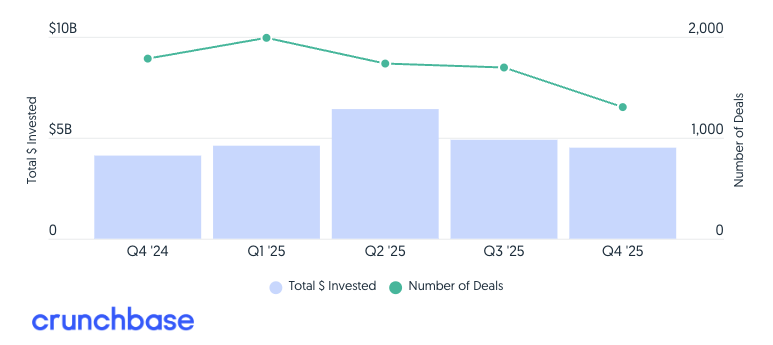
North American Seed Investment Through Q4 2025
Beneath the surface, Seed VCs are broadly reacting in one of three ways:
1. Reducing the Number of Deals
Some Seed VCs have reacted by doing fewer deals.
Over the past few months, I’ve spoken with a number of institutional LPs concerned by the fact that some of the funds they’ve invested in aren’t actively deploying capital. One early justification was the need to “slow things down” while they adjusted their investment theses to an increasingly bifurcated VC landscape. But at this point, it appears that some Seed VCs remain inactive / less active because they are simply unsure of what to do.
2. Chasing Repeat / Pedigreed Founders
Many Seed VCs are reacting by investing more in repeat founders and/or founding teams with a strong “pedigree” (graduated from top schools, worked at prominent companies, YC graduates, etc.).
Pitchbook showed a significant increase in the early-stage deal sizes commanded by repeat founders in recent years (in the chart below, “serial” founders are repeat founders who had an exit, while “unproven” founders are repeat founders whose prior companies failed).
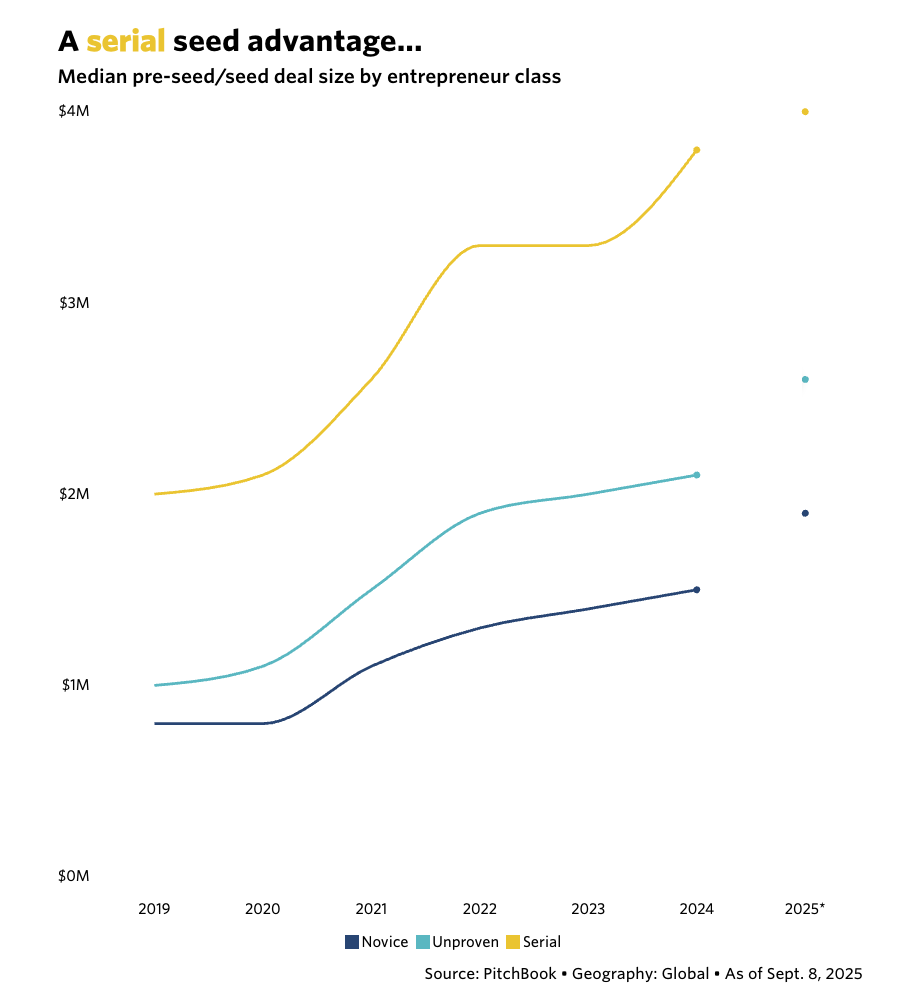
In the absence of conviction about the underlying market hypothesis, these investors are betting on the prior experience of the team.
“They figured it out before, so (hopefully) they can figure it out again.”
3. Focusing on Early Traction
The third trend has been to chase signs of early traction.
Early, disproportionate traction has always been something of a cheat code for startups. At the Pre-Seed stage, we often see deals happen quickly when a team comes to the table with unusually strong traction (revenue, users, GitHub stars, etc.), even if they don’t have a fully-formed market hypothesis.
The bet here involves a similar benefit-of-the-doubt as the one given to repeat founders:
“They figured out how to get to X traction, so (hopefully) they can leverage that to build a real product / get to product-market fit.”
Wait a Minute…
Ok, so to summarize what we’re currently seeing in the early-stage fundraising market:
Pre-Seed VCs generally discount the market hypothesis and focus primarily on the team and their ability to iterate in search of product-market fit
Seed VCs are increasingly discounting the market hypothesis and…focusing primarily on the team and their ability to iterate in search of product-market fit???

That’s right. Seed VCs are increasingly acting like Pre-Seed VCs when it comes to their investment decisions.
There’s a lot to unpack when it comes to the potential long-term implications of this shift. It’s especially fascinating within the context of the ongoing bifurcation of VC (and explains why some Seed VCs continue to sit on the sidelines — they simply don’t know how to invest based solely/primarily on the potential of a team). For now founders, angel investors and Pre-Seed VCs need to understand the following about what’s happening at the Seed stage:
Outside of markets that are unlikely to be disrupted by AI, the rubric with which many Seed VCs are evaluating potential investments has changed. Specifically,
The focus on traction has increased — not because it shows more evidence in support of the market hypothesis, but because it shows more evidence in support of the team’s ability to execute.
The focus on a team’s track record has increased.
The impact of whether or not a company is building in a “hot space” has increased.
While Seed VCs are increasingly acting like Pre-Seed VCs, it’s not exactly the same as raising another Pre-Seed round.
For starters, Seed VCs have a lot more data to analyze about your team and your trajectory (especially when it comes to velocity, the one metric that matters most).
It’s also important to understand that Seed VCs have promised their LPs a shorter path to returns than Pre-Seed VCs. In other words, they still need to get an exit in the same amount of time that they did before. This means that you have to be able to demonstrate meaningful progress towards something valuable (it’s not a do-over if you’re still wandering around in the woods in search of PMF).
Finally, this dynamic is most prominent with generalist Seed VCs. Specialized Seed VCs — particularly those in deep tech — are relatively unchanged in their behavior.

If you’re preparing to raise a Seed round, keep the following in mind as you fine-tune your pitch: in addition to analyzing the usual details on problem, solution, traction, etc., many Seed VCs are now asking themselves the following question as part of their investment process:
Can this team win (generate a return) even if one or more of their core assumptions is disrupted by AI? (In other words, can they still win if their market hypothesis gets disrupted?)
Unfortunately, it’s not at all clear yet how Seed VCs are testing for this. As a result, I suspect that we’re going to see a significant “crunch” at the Seed stage in the next few quarters. Startups that historically could raise funding based on a clear market hypothesis and reasonable early traction will struggle, especially if they can’t convince investors that the market hypothesis is viable over a long-term horizon.
Most Seed VCs don’t know what the future is going to look like, so they’re increasingly betting on founders who they believe can figure-it-out.

AI Price Drops Are Coming
Right now, AI companies around the world are capturing unprecedented revenue. But it won’t last forever.
My first co-op job back in the 90s was for a regional Canadian telecom company called BC Tel. It was the early days of the internet, when dial-up modems were the norm (you were envied if you had one of the new 56K ones). The most recognized sound in the world was this.

RIP BC Tel
BC Tel was preparing to launch its first deployments of a new technology called “digital subscriber lines” — dedicated phone lines that businesses could purchase in addition to their standard voice line in order to have an always-on internet connection (you’ll recognize the technology by its acronym, “DSL”). Like most telecoms that were rolling out DSL, BC Tel planned to initially sell their product using usage-based pricing.
Over the course of the summer, I wrote metering software that would track exactly how many bytes were transferred up and down a customer’s DSL connection each month. Those metrics were then used to generate their monthly invoice.
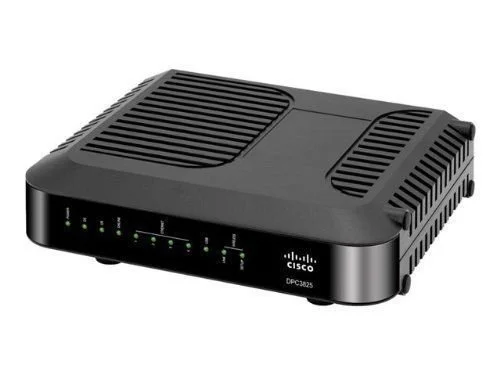
A “vintage” Cisco 678 DSL router
Midway through the summer, the first DSL deployments were rolled out to great fanfare. While some early adopters were eager to brag about their state-of-the-art internet connections, it wasn’t long before the complaints started coming in. Businesses that were used to paying $100/month for a dial-up line were suddenly getting invoices in the thousands (or tens of thousands) of dollars. The telcos argued that usage-based pricing was the only approach that made sense (since the increased traffic would result in increased costs on their side).
Customers weren’t buying it. And the competition took notice.
The cable companies weren’t far behind. And when they eventually rolled out their competing broadband offerings, they did so with fixed, monthly pricing. Within a couple of years, usage-based internet pricing was a distant memory, along with the short-lived revenue burst that came with it.
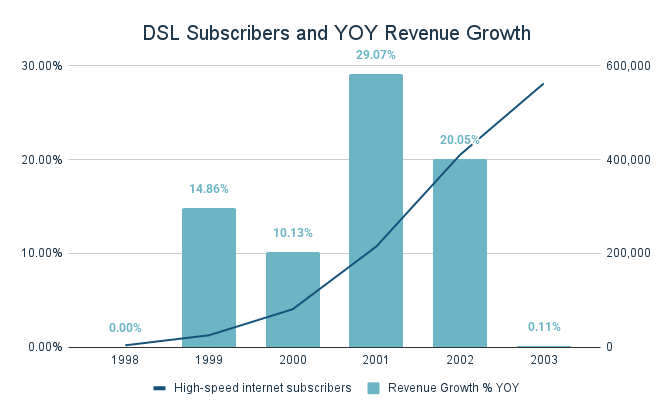
From 1999 - 2003, BC Tel/Telus’ DSL revenue skyrocketed as a result of usage-based pricing. Revenue flattened in 2003 (despite ongoing subscriber growth) as it was replaced with fixed pricing.
What Does This Have To Do With AI?
As the saying goes, “history doesn’t repeat itself, but it often rhymes.”
Right now, AI companies around the world are capturing unprecedented revenue, driven primarily by usage-based pricing. Early adopters are eager to take advantage of the incredible productivity gains offered by this new technology, but are also running head-first into the sticker shock of pricing. Many prosumers are now spending thousands of dollars each month on AI tools, while some companies are already well into the millions.
While investors and tech leaders loudly proclaim that this type of pricing “is the future”, the reality is it won’t last forever.
Why Usage-Based Pricing Never Lasts
In markets where customers have multiple competitors and/or alternative ways to fill a need, pricing always trends towards “value-based” pricing. Value-based pricing is where a customer is willing to pay an amount of money for a product or service based on its perceived value to them.
For some products and services, value-based pricing is, in fact, aligned with usage. For example, we are used to paying for travel-related products (fuel) and services (taxis, Ubers, etc.) based on how far we travel. Utilities, like water and electricity also employ usage-based pricing.
But there are many products and services for which value-based pricing is independent of usage. You’re unlikely to want to pay a fee every time you sit on your sofa or open and close your window.
For usage-based pricing to persist over time, two things have to be true:
The value that a customer perceives in the product/service must somehow derive from it’s usage (more usage → more value)
The customer must be able to reasonably predict and/or control usage
The second point is key for businesses that leverage AI. At the end of the day, a business that utilizes a product/service with usage-based pricing must ensure that they’re still able to generate a profit themselves, even if the product/service that they ultimately sell is fixed-price.
This is a crucial point, considering that the vast majority of end products are (and will remain) fixed-price.
To illustrate my point, as a consumer you are unlikely to pay more for one coffee mug over another because one was “designed with AI”. Nor are you likely to pay more for a book that was researched with AI, a movie that was generated with AI or ribs that were smoked using a recipe perfected with AI.

Why AI Adoption is Different (For Now)
What makes AI adoption different from the introduction of DSL 25+ years ago is that the latter didn’t come with immediate productivity gains. Sure, a DSL line was faster and more reliable than dial-up, but software wasn’t yet at the point that better internet access automatically translated into significantly more revenue or lower costs.
As a result, early adopters revolted at the high costs of DSL and threatened to go back to dial-up. They called the telecoms’ bluff…and it worked.
But AI is different. There are legitimate and immediate productivity gains that come from leveraging it. As a result, companies are willing to pay outrageous rates for AI because of the increased productivity that they’re realizing. But that willingness isn’t infinite.
The simple narrative being pushed by AI companies and their investors is that AI is making software developers more productive than they’ve ever been. So much so that companies should be willing to spend infinite amounts of money on AI. The more nuanced reality is that, in most cases, those productivity gains aren’t resulting in equivalent profit gains. In fact, in many cases the incremental cost of AI is eliminating (or, at least, significantly reducing) the profit margins of the companies leveraging it.
Put differently, what we’re seeing is not a straight-forward case of “developers are more productive so we need fewer developers”. Beneath the surface is a clear current of, “we’re spending so much on AI that we can’t afford to keep all of our developers.”
That dynamic is what’s driving the massive VC rounds commanded by today’s fastest-growing startups. It’s also the real reason behind many of the layoffs being announced by companies whose revenue growth has stalled.
Consider this week’s 10% layoff by Atlassian. Buried within the company’s announcement was the following justification,
“We are doing this to self-fund further investment in AI…”
In other words, “we need to cut staff because we can’t afford to pay our increasing AI bills” (P.S. if we can’t figure out how to effectively leverage AI, we’ll probably die).
In the not-too-distant future, we will reach a breaking point in terms of the ability and willingness of businesses and consumers to pay ever-growing AI bills. (I suspect that we have a few more quarters before that happens, but it will happen.)
And therein lies the opportunity for astute startup founders.
The Opportunity in Fixed-Priced AI
For many customers (both individuals and businesses), price certainty is more important than the price itself.
As a case study, through the 1990s and into the early 2000s, most personal computers were custom-built. Anyone could order the components needed to build a computer, buy an OEM copy of an operating system (Windows or one of many Linux distributions) and get up and running. The coolest retailer on the planet in those days was Fry’s.
Over time, custom computer shops popped up filled with people who assembled and sold “no-name-brand” computers to consumers and businesses. Eventually, global brands like Compaq, HP, Gateway and Dell took over.
To computer nerds like myself, it seemed absolutely ludicrous that someone would pay $4,000 (in 1990s money!) to buy a PC that had half the performance of one that I could custom-build in a day for less than $2,000. But many did. And their market share kept growing for one simple reason: their customers wanted certainty. Certainty in price. And certainty that their computer would work.
We’re seeing that same dynamic play out today in AI.
Amidst the many threads proclaiming that if you aren’t rolling your own OpenClaw server, you’re falling behind, is the reality of how most of the world works. Ambitious individuals and businesses around the world will absolutely leverage AI, but the vast majority have neither the time nor the inclination to do it from scratch. And they won’t have to.
Because someone will do it for them.
Moreover, they’ll do it for them at a fixed price (even if that price seems exorbitant to the many hackers deep-in-the-weeds of AI).
We’re already seeing early examples of this, including:
Vertical AI offerings that provide specialized AI capabilities at a fixed price
AI search capabilities that are now bundled with CRMs, note-taking software and other databases
Consultants that will spin up an OpenClaw server on a Mac Mini for you for a fee (much to the chagrin of open source hackers)
If you’re a founder looking for opportunity in AI, don’t just look at the technology. Pay attention to price. There are an incredible number of markets where customers will buy AI-based offerings today if they (a) solve a real problem they have right now, and (b) do so at a fixed price (even if that price seems ludicrous).

None of the hyperlinks on Claude’s pricing page provide any real definition as to what usage is actually based on — which, for most people and businesses, is a problem
If you can create an AI-based offering that solves a real problem at a fixed price, while ensuring that you have a healthy operating margin, you’re likely in a good position to sell to the 99% of consumers and businesses who aren’t glued to Twitter/X 24/7.
Not only will you start focusing on margin (in terms of controlling your own use of AI whilst delivering your product/service) long before most other AI companies think about it, you’ll have a head start on building brand loyalty while others obsess over, “but what if X builds it?”
Because at the end of the day, consumers and businesses still just want a solution to their problem.
Who Should I Talk To?
I’m a big proponent of startup founders visiting San Francisco on a regular basis. But many make a fatal mistake when asking for on-the-ground introductions.
I’m a big proponent of startup founders visiting San Francisco on a regular basis. But there’s one mistake many founders make when planning their trip to Silicon Valley. Each-and-every week, I get at least one email from a founder that goes something like this:
“Hey Chris,
I’m coming to SF in a few weeks. Who are the 2-3 people I should absolutely talk to when I’m there?”
It seems like a reasonable enough request, right? Especially given Silicon Valley’s pay-it-forward culture. But emails like this are more likely to result in me hitting the trash button than typing out a reply.
Here’s why:
1. I Probably Don’t Know You
Granted, I don’t have the world’s best memory, but these emails generally come from people I barely know. In fact, they almost always come from founders I’ve spoken with exactly once.
Looking at the example above, the lack of familiarity is pretty obvious from the tone — you would never write an email like this to someone you’re friends with. But for some reason many people (particularly CEOs), think it’s okay to fire off what are effectively demands to relative strangers.

2. I Definitely Don’t Work for You
Not only are emails like this tone-deaf, they also imply a request: please do work for me.
In order for me to respond affirmatively to this request, I have to:
Look up our past interactions to refresh my memory on who you are and what your company does (granted, AI does help with this)
Then spend time to think about what help you might need at this point in your journey
After that, I need to think through the details of my personal and professional networks to match those needs with people I know
Next, I need to write a detailed email back to you about who these people are and why I think they might help you
Then…
Suffice to say, that’s a considerable amount of work for someone I barely know. And it certainly doesn’t show an understanding of the paradox of time.

3. I’m Very Protective of My Network
Even if I were to come up with 2 or 3 people that I think might be of use to you, I won’t promise you an intro.
In order for my friends to remain my friends, I need to be respectful of their time and ensure that all introductions are double opt-in.
How to Ask for Introductions
Chris Albinson, Managing Partner of True North Fund and cofounder of the Canadian expat network, C100, recently shared this advice with visiting Canadian founders,
“There are nearly 300,000 Canadians in the Bay and they sincerely want to help. But you have to show up prepared.”
This scenario is a great example of that.
Instead of asking someone to do all of the work for you, be specific in your asks,
“I’m hoping to meet 2 or 3 Pre-Seed investors to get feedback on my pitch before we start fundraising in the fall. Do you know any VCs who actively invest in X and might be willing to take a 20-minute meeting?”
“I want to meet CTOs of companies in industry X in order to ask about Y. Do you have any connections to such companies in your portfolio that you would be willing to pass along a request-for-intro email to?”
“I’m considering spending more time in San Francisco and would like to speak with a couple of expats who recently relocated there to learn about their experience. Do you happen to know anyone that might be willing to connect?”
Not only do each of these examples have specifics about the type of person the author wants to meet with, they’re also significantly more humble in their tone (which is likely to lead to more positive responses).
Here are some other tips:
Consider including a fully-written request-for-introduction email below the ask (so that the recipient can take action without having to go back-and-forth with you)
Use LinkedIn to research if a person is connected to individuals who meet your target and ask for specific intros (e.g. “I notice you’re connected to the following VPs of Engineering. Would you be willing to pass along a request-for-introduction email to any of them?”)
And always remember, to win transactions, don’t be transactional.
Hunters vs. Farmers
What does it mean if a VC is a “hunter” or a “farmer” and why does it matter?
Over the years, I’ve interacted with hundreds of VCs — first as a founder and, later, as an investor myself. And I’ve heard hundreds of investors pitch their funds. There is a distinct bifurcation in how VCs approach investing and, if you listen carefully to the words they choose to describe themselves with, that approach shows through.
The two approaches are known as “hunting” and “farming”.
I’ve written before about hunting vs. farming within the context of how investors generate returns. In venture capital, “hunting” refers to going out and winning new deals (investing in new companies) while “farming” refers to increasing the likelihood that a company will succeed through post-investment support and services. In theory, investors should do both. In reality, VCs operate across a spectrum, with most firms focusing their efforts on one or the other.
I was recently at an investor conference filled with emerging managers (the VCs behind new, up-and-coming firms). As I listened to pitch-after-pitch from these aspiring VCs, it dawned on me that most founders probably don’t know how to recognize the signs that indicate if an investor is a hunter or a farmer. All VCs seems to use the same “value add” language when talking about why their fund is special, so how can you actually tell?
And why does it matter?
The Difference Between Hunters and Farmers
At a high level, “hunters” are VCs who spend most of their time and effort trying to get into the best deals. For the most part, they focus on companies that are (or will become) “consensus investments” — startups that at subsequent stages will be the hot companies that follow-on investors fight to get into.
Early-stage hunters focus on pedigree and traction as their primary signals. Things like:
Graduating from a top school or program (Stanford, MIT, Waterloo, IIT Bombay, Thiel Fellowship, etc.)
Early employees that left “hot” companies
Repeat founders
Hot sectors
Virality / significant early traction
They’re generally betting on the correlation between pedigree and outcome (or, at least, pedigree and quick markups).
Farmers, on the other hand, tend to cast a wider net. They’re betting on their ability to identify high-potential, non-consensus companies/founders and help them outperform. It’s not that farmers won’t invest in “hot” companies or founders with pedigree. It’s that they believe their edge comes from looking beyond those traditional signals.
It’s important to understand that both of these are valid investment strategies that can lead to great success. Not only that, you can find investors who do both to varying degrees at almost every stage of investment. Consider this map showing a selection of pre-seed investors:
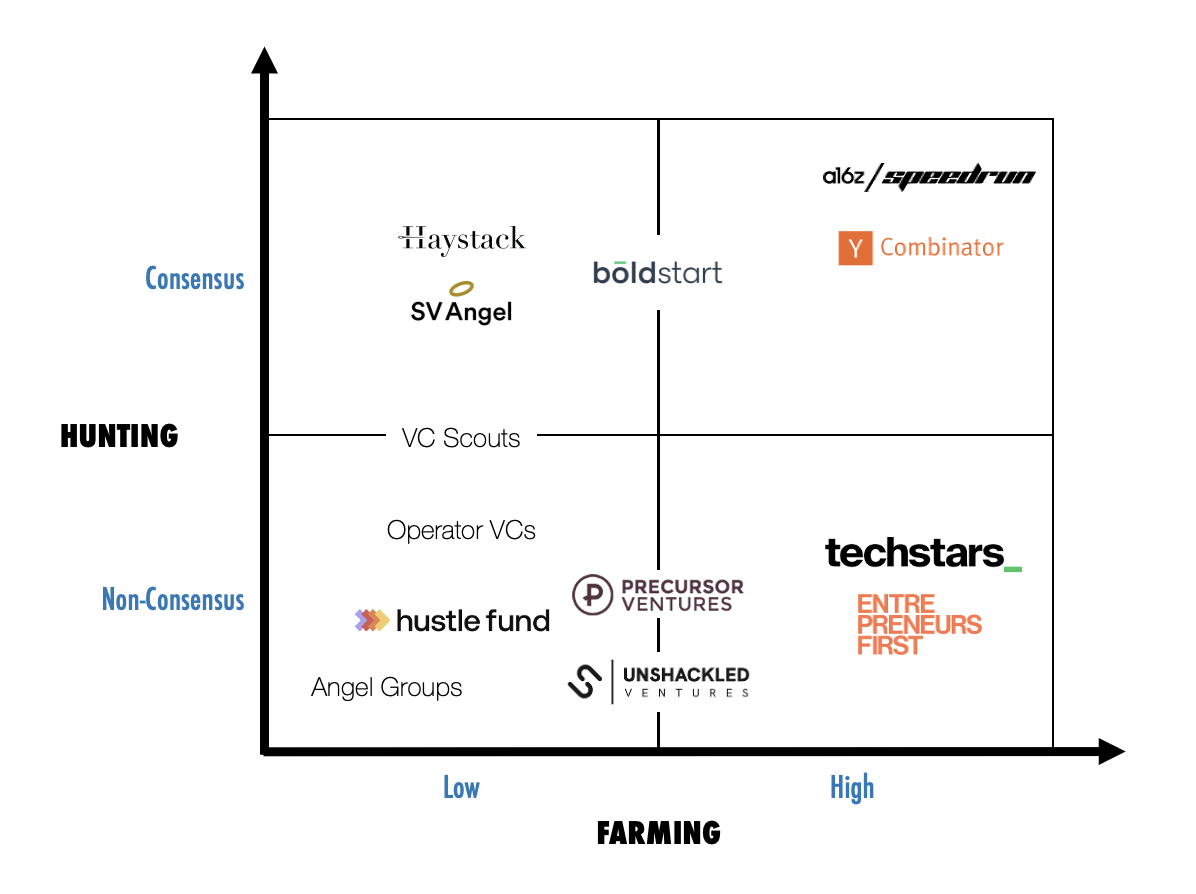
On the far right, you have accelerators. In the middle, are “hands-on” pre-seed funds (of which there are many). On the far left, you have hands-off investors, scouts and angel groups.
The Different Types of Farmers
You might be a bit confused looking at the above image, particularly given that many of the investors on the left side of the chart are known to be “very helpful” to portfolio founders. So let me specific about what I mean by farming. I consider a VC with a high degree of farming as one who regularly communicates with a founder (on at least a weekly basis) and provides hands-on help from the point at which they invest through at least the completion of their next round of funding. Accelerators and incubators typically have the highest degree of farming.
Investors with a low degree of farming might still be incredibly helpful, but that help is generally less frequent and/or lower touch. It might come in the form of on-demand introductions to potential customers, partners and follow-on investors or through “one-to-many” services.
Here is a very non-scientific ranking of the different types of VC farmers:
Passive Investors - After they invest, you rarely if ever hear from them (except occasionally in response to an investor update). Some can be very helpful with introductions and expertise but, generally speaking if you don’t call them, they won’t call you.
Automated Investors - These investors provide access to a selection of one-to-many resources (prerecorded videos, tutorials, webinars and online communities). Almost every email you get from them is from an automated system. One-on-one help is rare.
“Our Partners are Very Important People” Investors - These investors present as farmers — they often talk a big game about how they support portfolio companies — but after the deal is done, your point-of-contact suddenly switches from a partner to an associate or another lower-level member of the team. This approach is typically borne from VC firms trying to prioritize the “very important” partners’ time for hunting, as well as supporting the development of junior employees at the firm. While that sounds great on paper, it often feels like a bait-and-switch to portfolio founders (particularly when the “value-add” is provided by generalist team members with little or no real-world experience).
Board-Centric Investors - This category comprises a significant percentage of smaller VC firms (those with little or no support staff). Founders have a direct line-of-communication to their board partner (the partner who led the investment), but have little if any contact with anyone else at the firm. The board partner is often very hands-on, but the value provided is entirely dependent on what that individual brings to the table.
“We’re All Here for You” Investors - This is the next step up the farming ladder for smaller firms. In this case, founders have a direct (if infrequent) line of communication to all of the partners at the firm The board partner takes the lead on most matters, but the culture is such that founders are invited to reach out to any partner if they think they can help. Foundry Group (who invested in DataHero) had this approach — and I’ve always felt it to be the best strategy for small firms to take.
“We’re All Here for You” Investors II - Many mid-sized VC firms leverage analysts and associates to provide additional value add, like helping with research, market studies and financial analysis. The key difference between this category of VCs and “Our Partners are Very Important People” investors is that the associates/analysts provide services in addition to what the partner bring to the table instead of as a replacement for it.
Investors with a “Platform Team” - VCs with a platform team take the idea of additional support one step further by hiring experienced subject-matter experts to provide specific services to their portfolio companies. These hires can include recruiters, marketers, designers, media experts and even technical resources. Some of the larger traditional firms (most famously a16z) employ hundreds of people on their platform teams.
“We Have a Program” Investors - At the top of the farming pyramid are VC firms with “a program.” The difference between regular platform teams and platform teams at “We Have a Program” VCs is that startups who receive investment from the latter go through a formal program staffed by members of the platform team (as opposed to just receiving ad hoc support). Accelerators are the most well-known in this category, but an increasing number of traditional firms now have some form of post-investment programming (ranging from large firms like a16Z and Sequoia to smaller ones like Conviction).
(Strictly speaking, venture studios are at the tippy-top of the farming pyramid, but since most don’t invest in startups that are already up and running, I’ve omitted them from this discussion.)
How To Identify Hunters vs. Farmers
If all VCs seem to use the same, generic “value add” language when talking about their fund, how can you tell if they’re a hunter or a farmer? By listening to the subtleties in how they describe their approach.
In my experience, there are two topics where you can usually tell how a VC thinks about hunting vs. farming:
How the describe the founders they invest in
How they describe what they bring to the table (why they’re special / different / better than other VCs)
1. Who They Invest In
When describing the types of founders they invest in, hunters often use language that hints at pedigree and exclusiveness. Farmers, on the other hand, tend to emphasize the fact that they back founders from a variety of geographies, backgrounds and experiences:
| Hunters | Farmers |
|---|---|
|
"We only back the best founders" "We're looking for the top founders." "We invest in the top 1% of founders we meet." (Note: most VCs invest in about 1% of the founders they meet, but hunters often go out-of-their-way to make that point.) |
"We back founders from across North America." "We invest in founders from a variety of backgrounds." "We're less concerned with where you went to school and more interested in what you accomplished there." "We invest in founders from overlooked geographies." |
2. What Their Value-Add Is
When describing what their differentiation / value-add is, farmers tend to describe what they do (specific services / support offerings that they provide founders post-investment). Hunters, on the other hand, often focus on who they know.
| Hunters | Farmers |
|---|---|
|
"We know all of the top Series A investors." "We can introduce you to almost any C-level executive in your industry." "We host an annual CEO summit that brings together all of the founders in our portfolio with [insert celebrity CEOs here]." "We regularly host intimate/curated founder dinners with key industry stakeholders." |
"We facility monthly webinars with CEOs / CTOs / CROs across our portfolio to discuss specific topics." "We have a regular speaker series with subject-matter experts." "Each quarter, we host a fundraising bootcamp for companies preparing to raise their next round." "We have a number of resources on our platform team at your disposal. For example, we have a head of recruiting who can help you with executive hiring...." |
VCs can generate returns from almost any combination of hunting and farming. Which makes it essential to think in advance about what your ideal investor looks like.
Do you want a hands-on investor that will coach and mentor you through the next stage?
Do you feel confident in how to get from A to B, but need help with introductions?
There’s no right or wrong answer here, which makes diligencing a potential investor so important.
So when it’s your turn to ask an investor questions, turn the tables on them and ask the go-to question that so many VCs use:
“Why are you doing this, when there are so many other things you could be working on?”
“No, really. Why is this the thing you’re dedicated the next 10+ years of your life to?”
Then sit back and listen. You’re likely to learn more than anything you’ve read about them online.
How to Tap Into the Serendipity of Silicon Valley
Many founders come to San Francisco for a weekend or a week, hoping to “tap into the magic.” But come away disappointed. Why?
If you’ve been a reader of my newsletter for any length of time, then you know that I’m a huge proponent of founders (and investors) spending time in San Francisco / Silicon Valley. But I regularly meet founders who travelled to the Bay Area only to come away disappointed.
They didn’t meet anyone particularly interesting. They didn’t have any life-changing epiphanies. Sure, it was cool to visit. But they didn’t get it.
In contrast to the never-ending stream of posts about amazing SF experiences, it doesn’t make a lot of sense. So many people claim that San Francisco is open and welcoming. They assure you that it’s easy to get in the proverbial door. That it’s all about “paying it forward”.
But not everyone has that experience. What gives?
It boils down to two things: time and a willingness to say ‘yes’.
Silicon Valley is a fast-moving ecosystem, but relationships still take time to develop. Many founders come to San Francisco for a weekend or a week, hoping to “tap into the magic.” But a week isn’t long enough.
Because San Francisco serendipity works in hops.
Consider the following scenario:
You fly to SF, having done your research and found some events to attend on SF IRL. The first couple of meetups you go to are duds, but on the third day you strike gold. While at a hackathon, you start up a conversation with some like-minded founders, who casually drop the opportunity,
“You should totally come to X with us on Tuesday.”
Too bad you’re leaving town the next morning… 🤷♂️
These types of conversations happen every week in San Francisco — it’s a big part of how the ecosystem operates. Many events don’t have formal invites. The details spread through word-of-mouth, text messages and group chats. It’s easier than it might seem to get into the “inner circle”, but it starts with being able to say yes.
Which means you have to visit for more than a few days.
When we first conceived of last month’s Game On Canada experiment, one of the key questions was, “how long should the program be?” One of my objectives was to help the visiting founders build the beginnings of genuine personal and professional networks in the Bay Area. That meant having them visit San Francisco long enough that they could say “yes” — not only to the first hop of serendipity, but to the ones that came after.
We eventually landed on three weeks. In theory, that would be enough time to get the lay-of-the-land, attend a number of “entry level” events and meetups (both those we held and ones they found themselves), and then go deeper with some of their burgeoning relationships.
At the end of the program, I asked the founders to export their LinkedIn connection graphs for me. I wanted to see if that part of the experiment worked. Were the founders able to make connections in the Bay Area? Here’s what I saw:
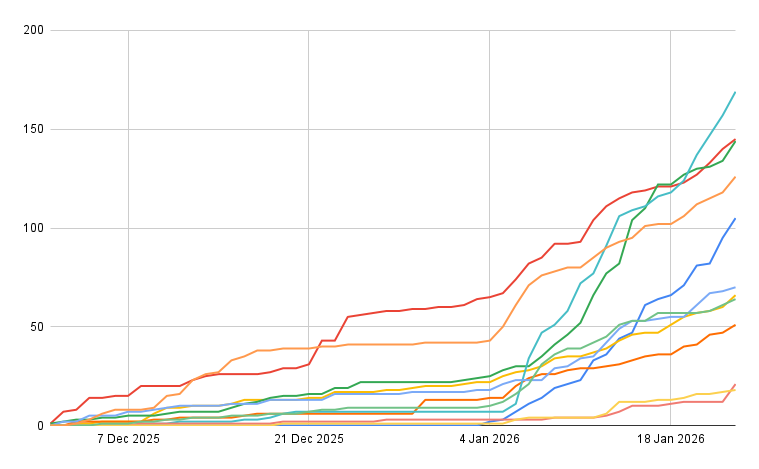
LinkedIn Connections (Baseline as of 1/1/25)
LinkedIn connections certainly don’t provide a complete picture of anyone’s relationship graph (I’m connected to plenty of people who I don’t remember and have many friends who I’m not “LinkedIn official” with). But when I first saw this graph, I immediately smiled. Not only did every single founder have a meaningful increase in LinkedIn connections during the program, but a significant number had their rate of connections “accelerate” as the program went on.
On the last day of the program, I asked the founders to share their experiences meeting people in San Francisco. As we went around the room, almost all of them told stories of meeting people who invited them to something, where they met other people who then invited them to something else. Hackathons, art exhibits, dinners, conference parties, after parties, hikes,… — almost all of the founders were able to tap into the serendipity of Silicon Valley!
And almost every single one referenced the fact that they had met people that they intended to stay in touch with after returning home.
That, to me, is success.
Is three weeks the correct number for everyone? I don’t know — but it feels like a good place to start. It’s obviously not easy to pickup and relocate for three weeks, but if one of your goals is to build genuine connections in San Francisco / Silicon Valley, see if you can make it happen.
And be sure to say yes.
I Have Questions…
Here are 5 red flags that leave VCs scratching their heads after reading your deck.
Over the years, I’ve written a number of posts about nonobvious mistakes that can hurt your fundraising process. There are the things that make VCs go "hmmm..." — subtle red flags that might not kill a fundraise outright, but cause enough potential investors to pause that they can meaningfully hurt your chances. There are phrases that founders often use without realizing that they have a different meaning for investors. And mistakes many international founders make when pitching US VCs.
In the lead up to last month’s Game On experiment, I reviewed hundreds of applications from founders across Canada (that’s right folks, although I use AI for many things, reviewing decks isn’t one of them). And there were a lot of things I saw that left me with more questions than answers.
Here are 5 red flags that leave most VCs scratching their heads after reading your deck:
1. Multiple Incubators / Accelerators
Let me get this straight: you did Rocket Founders? And then Instant Incubator? And Super Startups? And Awesome Accelerator after that…?

For a significant percentage of VCs, seeing multiple incubators / accelerators on a slide deck is a big red flag. In particular, seeing more than one equity-taking program on your slide deck makes me wonder:
Are you addicted to accelerators (like the startup equivalent of being a professional student)?
Did you not learn the material the first time?
Why haven’t you been able to generate enough revenue / raise enough capital that you need to keep doing this?
How messed up is your cap table…?
This is how most investors think about things:
0 or 1 incubators / accelerators: cool 👍
1 local / unknown incubator + 1 prominent accelerator: cool 👍 (e.g. SmallTown Startups followed by YC)
Multiple local / unknown incubators and/or multiple prominent accelerators: I have questions…
The only exception is non-equity programs (e.g. Creative Destruction Lab, 48 Hours in the Valley, Government-funded programs, etc.). These are generally useful and not held against you, but they also don’t show any particular signal to investors — so consider leaving them off your slide deck entirely.
2. More Advisors Than Employees
Nothing sets off a VC’s warning system quite like a team slide with 2 cofounders and 6 advisors.
I get it — when you’re just starting off, founders grasp for anything that will make them seem more credible. Big name advisors on the team slide do that, right?
What if you saw someone’s online dating profile and it had a single picture of them, followed by photos of their fitness instructor, their therapist and their financial advisor?
On the one hand, it’s great that you have those folks in the background helping you out. But they’re not the ones building the company.
If you have an advisor who is genuinely well-known (particularly in your domain), by all means put them on your team slide — it shows that you can attract prominent people to your mission. The problem comes when an advisor slide is filled with local nobodies. Although they might genuinely be helpful, they add zero credibility outside of a very small circle (and raise questions about why you need so many advisors).
Here’s my general rule of thumb: only put an advisor on your team slide if either (a) they are likely to be recognizable to the investors you’re pitching, or (b) Googling them immediately comes up with impressive accolades and accomplishments. Anyone whose LinkedIn profile starts with “startup advisor”or something equivalently generic should 100% be left off the slide deck.
Do not put guys like this on your team slide.
(P.S. Always remember that from a VC’s perspective, angel investors >> advisors — they believed in you enough to put their own money in!)
3. No Competition
If I get to the end of your deck and haven’t seen any mention of competition, then I have questions.
There is no such thing as a startup without competition. There might not be anyone else doing the exact same thing you are with the exact same approach, but your prospective customers/users definitely have alternatives.

Investors want to understand how they’re solving the problem today and why your solution is better. Most importantly, they want to know that you have a clear understanding of the market and what it’s going to take to win.
4. Too Many Awards
Similar to having too many incubators / accelerators, having a slide filled with goofy awards is a red flag for many investors.
Best Startup in Saskatoon for the Month of September!
Fastest Rising Founder according to Follower Count on Friendster!
Nantucket’s Next Best Nanotech Star!
Although awards like this can be genuinely helpful in some respects (particularly with early hiring and go-to-market), they mean absolutely nothing to investors. If anything, they’re likely to put more of a spotlight on the fact that you’re early in your journey (especially when paired with little-to-no revenue and/or a lack of supporting metrics).
Unless an award is genuinely interesting — such as one that comes from an industry conference or is paired with a significant non-dilutive cash prize — you should probably leave it out (note: if you did win a significant amount of money, make sure to put that amount in parentheses).
5. No Accomplishments
Wait…didn’t I just say too many awards is a bad thing?
As a potential investor, one of the most important things I’m trying to get is is a sense of your velocity. To me, that’s the one metric that matters most. When reviewing your deck, I’m looking for anything that hints at how fast you’re progressing — and those usually come in the form of bragging about accomplishments.
“We launched 3 months ago and already have $5K MRR!”
“In only 6 months, we built the MVP and signed 3 pilot customers!”
“Our prototype outperforms the old thing by 100x!”
Keep in mind that I’m looking for business accomplishments, not vanity metrics (see: goofy awards). Tell me what you’ve achieved as a team that genuinely matters and how fast you did it!
The Bouncer at the Nightclub
To succeed as a founder, you need to find ways to get past the bouncer.
We all know the scene.
There’s a long line outside of a packed nightclub. People dressed in their finest line the street, patiently waiting to get in. Except for those who don’t have to wait. You know the ones. The girls who flash a smile and strut past everyone. The guys who dap the bouncer as they confidently walk through the door.
Meanwhile, the normies dutifully stand in line, all-the-while grumbling about how unfair it is…

Now, let’s play make believe.
Imagine that instead of trying to get into a nightclub, you’re trying to get pre-release access to a new AI model. Or a meeting with a prominent VC. Access to an exclusive dinner for up-and-coming founders. Or an invite to the best private party taking place on the edges of that conference.
All of these scenarios have the same dynamic. And just like night clubs, it’s possible to work your way.
Here are four ways to get past the bouncer at the nightclub:
1. Get To Know the Owner
The most direct route into an exclusive club of any kind is to get to know the proverbial owner.
In Startupland™, that’s where the warm introduction comes in. In many cases, you can get direct access to any CEO, event organizer or investor through a warm introduction. The parallel to nightclubs comes from the fact that the introducer is vouching for you. They’re effectively saying to the nightclub owner, “this person is cool.”
Mind you, that doesn’t guarantee the introduction will work. In a world where the double opt-in intro is required etiquette, almost no one will promise you an intro.

If a warm introduction doesn’t work (or you don’t know anyone who can introduce you), you can often connect directly with someone via social media. In many cases, a well-written cold outreach can lead to success.
2. Get To Know the Bouncer
The next best approach is to make friends with the bouncer.
Whenever there’s exclusivity, there’s someone responsible for identifying high potential guests while keeping out the riff-raff.

Don’t mess with Bill Murray
In VC firms, it’s the Associates. In companies, it’s the front-line employees.
Spending time getting to know the people responsible for filtering access can help you eventually get the meeting, get access to the beta release or score an invite to the event.
3. Make Friends with the “In Crowd”
If you can’t get in on your own merits, making friends with someone who can get you in is the next best thing. Who’s already part of the club that you’re trying to get into?
If you’re hoping to raise from a particular VC, there’s no better intro than from one of their portfolio founders. Want to go to an exclusive event? Get to know the sponsors who are paying for it (your lawyers can probably get you into plenty of parties! 😂).
4. Slip the Bouncer a Twenty
I’m pretty old at this point, so I’m guessing that $20 won’t actually get you into a nightclub anymore, but you get the point. In a world of capitalism, there’s almost always a price. So what does that mean when it comes to startup founders?
Well, I’m certainly not suggesting that you directly try to buy your way into events (in most cases, it’s not going to work). But there is a parallel: selling your equity for access.

VCs love to brag about how much “value add” they bring to the table. One of the most impactful benefits investors can bestow on founders is access.
Almost every VC has some form of CEO summit (instant access to every CEO of every company in their portfolio). Most investors will brag about how extensive their rolodexes are. And many regularly host small format dinners and invite-only events. Whether it’s Sequoia or YC or one of numerous super angels, thinking intentionally about access as part of your fundraising decision can be a major cheat code.
“If I take capital from X, who (or what) can they help me get access to?”
Of course, you shouldn’t just take their word for it. Reach out to founders in their portfolio and ask how good they were at making connections and helping to “get them in the door.”
This may all sound very transactional, but getting access to the people, events and opportunities that can accelerate your business is an essential part of being a successful founder.
When it comes to startups, distribution wins. And networking is how founders distribute themselves.
If you spend time getting to know people who are well-connected and they see that you are genuine, high-value and have something to contribute (assuming that you are, in fact, all of those things), before you know it, you’ll start to find yourself nodding at the bouncer on your way in.

Stop, Collaborate and Listen
There are moments in time when it’s important as a founder to stop and pay attention to what’s happening around you. This is one of those moments.
Last week, I urged founders to ignore distractions.
“In an age of distractions, the winners will be the ones who stay focused.”
But there is a counter point to that. For there are moments in time when it’s important to stop and pay attention to what’s happening around you.
I recently caught up with an absolutely dialed-in founder whom I’ve known for many years. He’s S-tier when it comes to ignoring the noise and staying focused on whatever he’s working on (these days, it’s an algorithmic trading platform that’s crushing the intersection of DeFi and traditional finance).
When I asked him how he’d started off the year, he had this to say,
“When my team came back from the holidays, we put everything on pause. Literally everything.
We put all of our algorithms on autopilot and spent a week trying the latest versions of every tool, program and project we could find.
We tinkered as a team for a full week. My mind was completely blown by what we had built by the end.”
Coming from this particular founder — whose teams are known to push the boundaries of whatever technologies they’re working with — a statement like that made me sit up in my seat.
Not just because of what he said, but because he wasn’t the first person to have shared something similar with me over the past few weeks.
At this point, I’m old enough to have seen a lot of technology inflection points. And I have a strong suspicion that we’ll look back at January 2026 as being one of those.
From my vantage point, there are three important things that have emerged in the past few weeks:
1. AI Can Finally Write Good Code
Most developers at this point have become accustomed to using some form of AI while writing code. But for all the hype around vibe coding, anything remotely complex still required humans to roll up their sleeves and wade through muck. Remo Jansen recently described it like this,
“For over two years, I have been using GitHub Copilot extensively with multiple models, coding agents, and custom agents, and for the most part it has been hit and miss.
I usually ask GitHub Copilot to implement a feature or fix a bug using the chat or coding agent, and a lot of times it would go very wrong. I have developed the habit of staging changes before each prompt, code reviewing changes for each prompt as I go along, and rolling back via git when I'm not happy with the solution. Working like this for a while means that I have been able to develop a sense of what kinds of things will work and how to break problems into steps that make it more likely that the AI agent will do what I expect.”
In late-November, Anthropic released it’s newest model, Claude Opus 4.5. At the time, the release didn’t jump out as particularly significant. But that was probably because it came after U.S. Thanksgiving — which meant most developers were focused on wrapping things up for the year as opposed to testing new models. As the year came to a close and we entered 2026, posts like these started to emerge:

I’m generally skeptical of hyperbole and presume most extreme reactions to new technologies are exaggerated, but then I started hearing similar sentiments from people I know and trust. Friends who spent time over the holidays to kick the tires on Opus 4.5 all had similar reactions:
“I built something I’ve wanted to do for awhile over the weekend. I’ve tried (and failed) multiple times to get it done with earlier models.”
“It’s the first time I didn’t have to spend hours reviewing and fixing the code.”
“This one’s different.”
2. The First Agent “Kit”
Almost every major technology shift includes a particular point at which the New Thing™ is made available to highly technical early adopters in a way that is (almost) turn key.
For the personal computer, it was the introduction of the Altair 8800 in 1974. The Altair 8800 was the first commercially successful microcomputer kit. You had to be incredibly technical to assemble it (and it was easy to make mistakes), but it provided the launchpad for the personal computer revolution that came after. (In March 1975, the Homebrew Computer Club held its first meeting in Menlo Park, which Steve Wozniak credits as the inspiration for the Apple I.)

Over the past few weeks, the internet has been awash with posts about Clawdbot Moltbot OpenClaw. On the one hand, there isn’t anything particularly mind-blowing about OpenClaw’s technology. After all, we’ve had agents for some time now. But if you think about it within the context of technology history, it’s an extremely significant product.
OpenClaw is the first agent “kit”.
Just like the Altair 8800, OpenClaw is accessible to only highly technical early adopters (at least, for now), but those hobbyists, hackers and tinkers are swarming to it.
And while there’s an incredible amount of noise and nonsense taking place around this (*cough cough* moltbook), it’s only a matter of time before we see some of these projects turn into products.
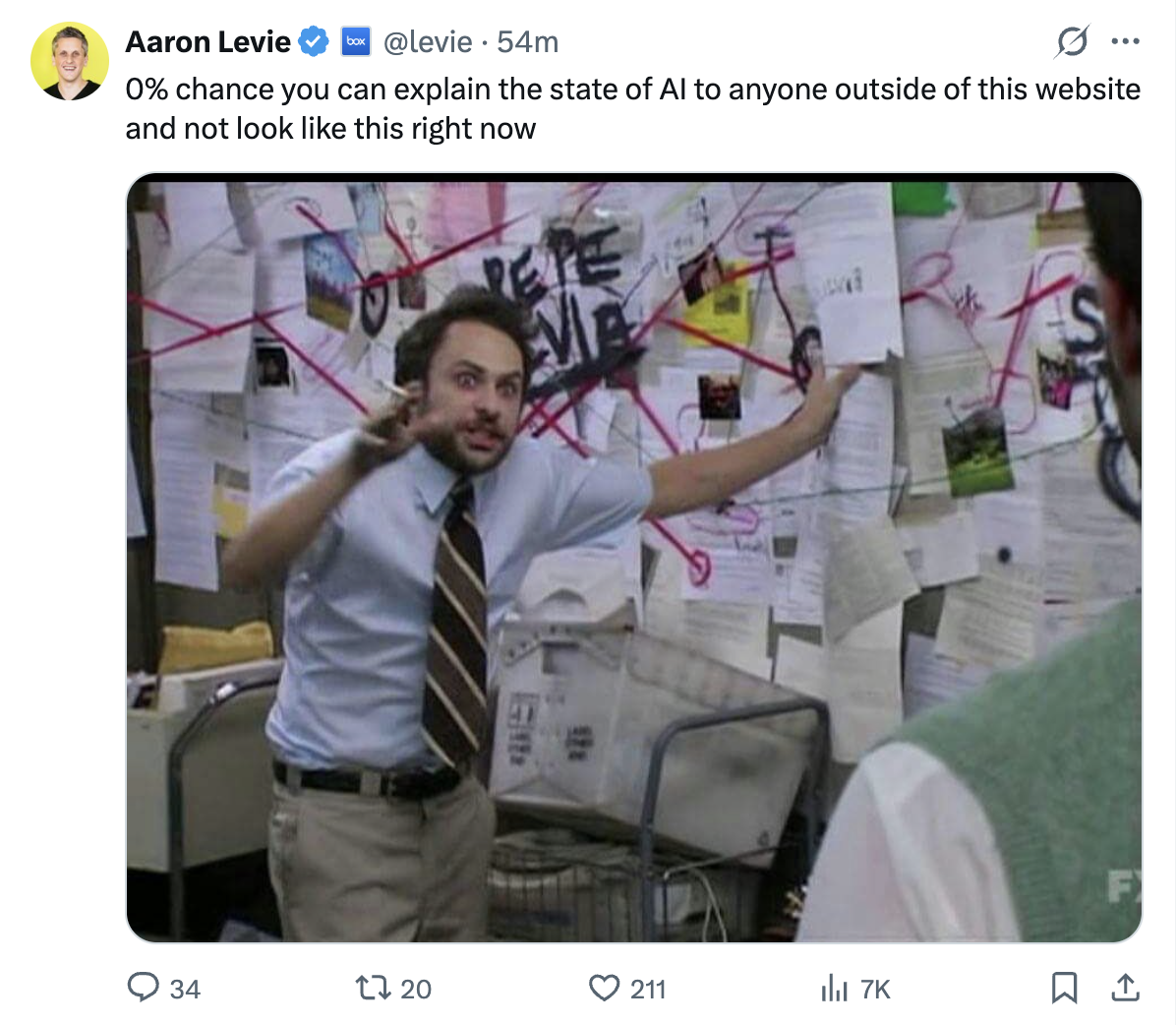
3. Open World Games from a Prompt
On the last day of the month, Google announced “Project Genie”, an AI tool capable of creating playable open-worlds from a prompt.
And gaming stocks around the world immediately plummeted.
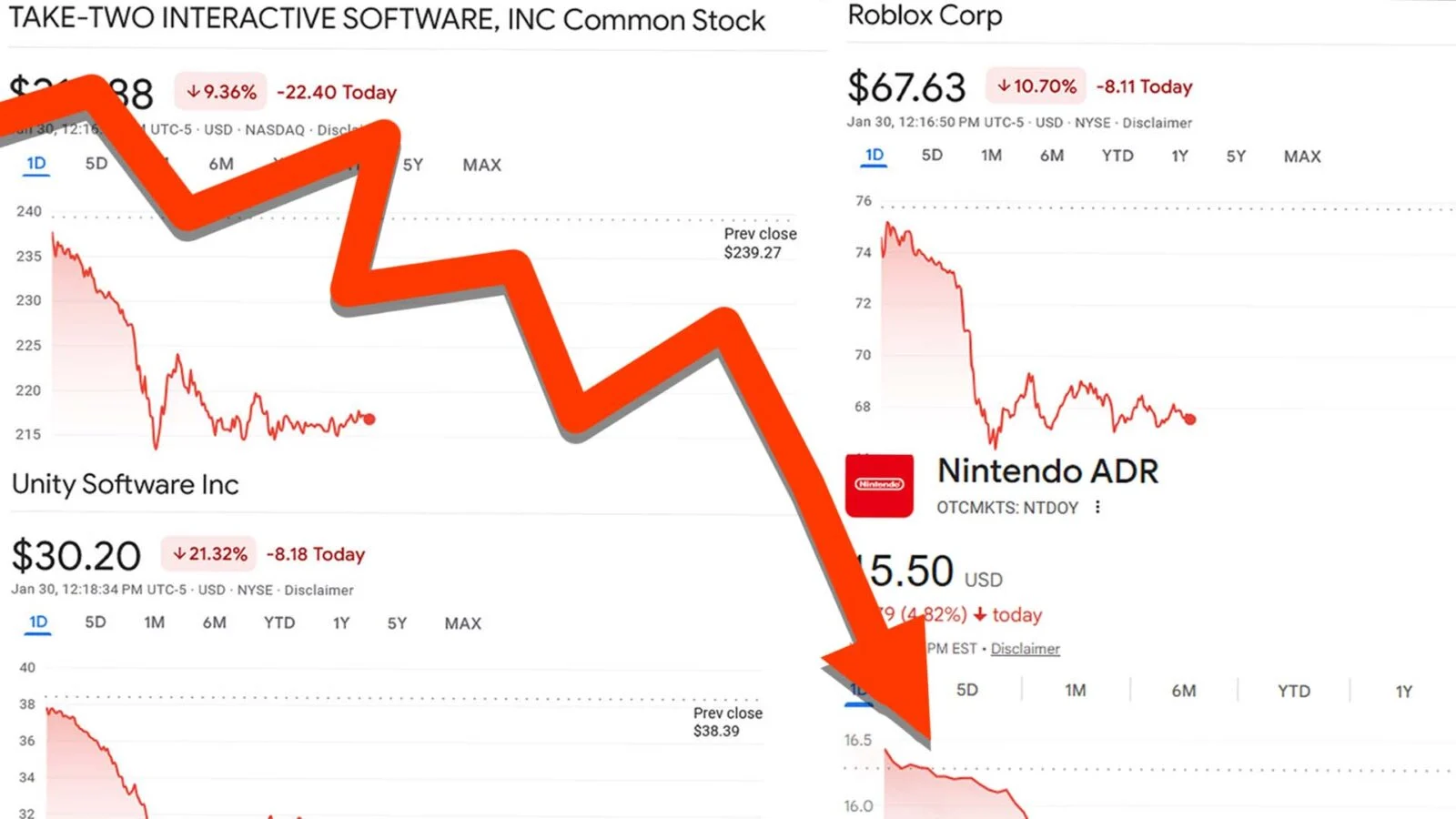
On the one hand, this might seem like a bit of an overreaction. After all, we’re a ways away from having a prompt result in a brand new end-to-end GTA game (many of my friends in the gaming industry confidently responded as much).
On the other hand, the economics of AAA video games has been upside down for many years. Costs have skyrocketed (the budget for GTA 6 is predicted to be somewhere between $1 and $2 Billion), but financial results remain highly unpredictable.
What makes the stock market response to the release of Project Genie directionally reasonable (at least, in my opinion) is that it represents an expectation that AI will have a similar impact on gaming that it already is having on general software. If we accept that a small team of highly specialized founders can create a billion-dollar software company using AI, then it’s perfectly reasonable to predict that a small team of experienced game developers will create a AAA video game using AI.
While I remain steadfast in my believe that the founders who focus will win, this very much feels like a moment-in-time when it’s important for founders to take stock of what’s going on around them.
That doesn’t mean diving down the rabbit hole of agent social networks, but it does mean checking out the latest tools. And it’s always better to do that with friends.
I’m setting aside time in the next few weeks to stop, collaborate and listen. I suggest you do too.

When Distractions are Everywhere, Focus Wins
The rate of advancements resulting from AI is nothing short of astonishing. But for founders, it can be a major distraction.
We live in an age of distractions.
Geopolitical distractions. Social media distractions. Prediction markets and crypto degens and brainrots and, and, and…
Remember that time a VC’s streamlining measure caused an entire country’s tech sector to screech to a halt?
Oh yeah…and there’s that whole AI thing:
“Have you tried the latest Claude Code?”
“My Mac Mini arrives tomorrow, I can’t wait to get Clawdbot going”
“It’s not called Clawdbot anymore, it’s Moltbot!”
The rate of advancements that are coming at us as a result of AI is nothing short of astonishing. But for founders, it can be a major distraction.
I remember sitting at YC’s W2025 demo day last March when Garry Tan stood in front of the crowd and declared that 25% of the companies in the batch had 95% of their code generated by LLMs. During the course of the day, company after company went on stage with a pitch that included a line like this:
“We wrote our first line of code 3 weeks ago, and…”
Almost everyone in the audience was enamored by how much progress these companies had made in such a short amount of time. But my mind went elsewhere. As someone who spent years working within accelerators, I knew that underneath every such statement was another one:
“We just pivoted 3 weeks ago…”
And that’s what I heard again and again over the course of the day,
“We pivoted 3 weeks ago, and…”
“We pivoted last month, and…”
“We pivoted last week, and…”
Despite meeting numerous incredible founders and amazing companies that day, I left the Palace of Fine Arts with a singular thought stuck in my head: AI is going to be a super power for some founders and will absolutely undermine the focus of many more.

Since then, I’ve seen the results time and time again:
Pre-revenue companies pivoting left, right, and centre around whatever excites them.
Companies who change what they’re doing after not finding an excited customer after…3 tries.
Too many founding teams throwing the baby out with the bathwater time and time again.
For every team I meet that found a new opportunity as a result of AI, there are 10 more who couldn’t stay focused enough to push through the natural challenges of getting to product-market fit.
On the one hand, I get it. New technologies are exciting! Most of us got into this because we really like to build things. But the easier it is to just “start over”, the harder it is to persevere.
These days, my timeline is filled with posts from founders who built X or automated Y after chugging red bull all night. And that’s cool! But does it solve your customer’s pain point?
You know…the one you founded the company to solve?

Unless you’re building dev tools, those customers are probably going to have the same problem on Monday that they did on Friday. The latest AI model or open source agent didn’t change that.
By all means try new things. Spend time to test the new models and try the new toys. But for the love of god constrain the amount of time you spend doing that. If you started a company to solve a pain point that you’re passionate about, keep your eye on the prize (provided, of course, that you continue to believe that pain point matters).
And if you find yourself spending more time on the shiny new thing than you are on solving your customer’s pain points, think about that too.
In an age of distractions, the winners will be the ones who stay focused.
Now, where’s my Mac Mini…

10 Nonobvious Things About Silicon Valley Fundraising
Here are 10 nonobvious tips about Silicon Valley fundraising from the VCs mentoring at Game On.
We’re in the final stretch of Game On, a 3-week experiment in founder velocity.
Week two was all about fundraising. Specifically, the second week focused on helping our out-of-town founders understand why fundraising from Silicon Valley VCs is different from raising capital elsewhere.
Here are 10 nonobvious things about fundraising in Silicon Valley according to our week two speakers:
1. Getting Warm Intros is Easier than it Seems
Charles Hudson, Managing Partner, Precursor Ventures
Charles Hudson has been investing in early-stage startups for more than 20 years. He noted that getting warm intros in Silicon Valley is far easier that it might seem from the outside.
“Trying to get warm intros can seem intimidating,” he shared with the founders. “But if you’re physically here in San Francisco, it’s far easier that it looks.”
Charles went on to explain that the Bay Area is effectively a “company town”. Almost everyone in the region is somehow connected into the tech/startup ecosystem.
“Of course you meet people at networking events,” Charles continued. “But you also see them at social events, community events or just bumping into each other.”
He encouraged founders to spend time in the Bay Area building connections and getting to know people as a way to prime their networks long before they need intros.
2. Cultivate Relationships Before You Fundraise
Emily Bennett, Partner, a16z
Emily Bennett, who co-leads a16z’s speedrun accelerator, similarly encouraged founders to cultivate relationships with Silicon Valley-based founders and other people within the “orbit” of the firms they hope to raise money from well before they go out to fundraise.
“As we get closer to investing in your company, we’re going to start doing backchannel references,” she explained. “That means we’re looking at LinkedIn and other sources to see who we know that you’re connected to.”
Emily went on to explain that for a16z, the number of connections a founder has to people known to partners in the firm is a factor in their investment decisions.
“Having a large number of connections to people in our orbit is a signal that you’re building relationships with the right people (or, at least, people who we think can make a difference for your company),” Emily continued. “Spending time getting to know founders and individuals connected to us long before you fundraise won’t just help you with warm intros, it will provide signal that you’re able to get into the right circles.”
3. People Will Open Doors…If You Come Prepared
Chris Albinson, Managing Partner, True North Fund
Chris Albinson has been traveling back-and-forth between Canada and Silicon Valley for nearly three decades, so he knows a thing or two about navigating ecosystems. The cofounder of C100 reinforced the willingness of people in the Bay Area to help visiting founders,
“There are nearly 300,000 Canadians in the Bay,” he remarked to the Game On cohort. “And they sincerely want to help. But you have to show up prepared.”
Chris went on to speak about the paradox of time — how people in positions of influence and power genuinely want to help but don’t have enough time — and the need for founders to come to meetings prepared.
“You need to know who the person is before you meet them,” he continued. “Don’t show up and ask them generic questions or things you can Google. Know who they are, what they’ve accomplished and how they, specifically, can help you before the meeting starts. If you do that, when you finish up and ask them to introduce you to 3 people who can help you with X, 99% of the time they’ll say yes.”
4. It’s Easier Than You Think to Get a First Meeting
Marvin Liao, Partner, Sukna Ventures
Marvin Liao, who has invested in nearly 500 early-stage startups during his career, echoed the notion that folks in the Bay Area are more open to initial meetings that it might seem.
“This is an ecosystem that’s built on knowledge and opportunities,” he shared with the founders. “Almost everyone in SF is from somewhere else. People here want to meet new people with new ideas.”
Marvin explained that simply walking up to someone and saying hi can lead to meetings and opportunities in ways you don’t generally see in other parts of the world.
“Whether you’re asking someone for a meeting at a conference, getting a warm intro from a founder, or connecting with someone at a hackathon, it’s way easier to get a first meeting than in other places.” But Marvin also cautioned the founders, “But that’s just the first meeting. After that, you have to earn it. If the first meeting sucks, you’re not getting another one!”
5. Pay-It-Forward Culture is Real
Angela Tran, General Partner, Version One Ventures
Toronto-born Angela Tran has spent the past 12 years investing in mission-driven founders as the San Francisco-based General Partner of Vancouver-based Version One Ventures. She admitted that after so many years in the Bay Area, she sometimes forgets how unique Silicon Valley’s “pay-it-forward” culture is.
“When I first came to the Bay Area, I was amazed how willing people were to do things without expecting anything in return,” Angela recounted. “People here will make introductions or find ways to help you after barely meeting you once.”
She went on to describe the contrast to other ecosystems she operates in,
“When I travel to other places, I meet people who make offers they don’t follow through on, or say things they don’t do. It’s those moments when I remember that Silicon Valley truly is special like that.”
6. Information is a Commodity
Alex Norman, Managing Partner, N49P
Alex Norman, Managing Partner of Toronto-based VC firm N49P and Cofounder of TechTO, noted that in Silicon Valley, information is a commodity amongst investors.
“First off, VCs are constantly sharing information with each other,” Alex offered. “They’re swapping decks, talking about startups they’ve met and otherwise trying to look smart. If you want to learn something from an investor or start building a relationship with them, offer them information.”
Alex referenced Mark Suster’s famous call to arms, Invest in Lines, Not Dots, and encouraged founders to find reasons to have touch points with the VCs they want to meet (check out this post for tips on how do do that).
7. The Best Founders Seem Inevitable
Gaurav Jain, Managing Partner, Afore Capital
A graduate of the University of Waterloo, Gaurav Jain cofounded one of the largest venture funds dedicated to Pre-Seed ($500M AUM). He observed that the best founders he’s invested in seem “inevitable”.
“You meet certain founders and it seems like their success is inevitable,” Gaurav shared. “They move fast. They’re impatient. They make you feel like they’re going to win with or without your help.”
He went on to share why that trait is so important to early investors.
“At my stage, I’m investing in the founders and not much else. The more confidence they have in themselves, the more appealing it is to me. But it’s not just about self-confidence, it’s also that they have a plan and know how they’re going to get there.”
8. Deck Design Matters More Than You Think
Arjun Dev Arora, Managing Partner, Format One
“Plenty of VCs claim that the design of your deck doesn’t matter,” started former founder and long-time investor Arjun Dev Arora. “But the reality is that deck design matters a lot.”
Potential investors are looking for the smallest signals in every deck they see, either as a reason to lean in or an excuse to pass.
“If you’re pitching a consumer app and your design sucks, you immediately lose credibility. Similarly, if you’re building back-office software for slow-moving enterprises but your deck looks like it’s for a Marin kombucha brand, it’s not going to fly. The design of your deck needs to reinforce what you’re trying to pitch to investors.”
Arjun went on to explain why seemingly small aspects of a pitch deck can matter so much.
“Ultimately, the pitch deck isn’t just a representation of the company, it’s a reflection on you as the CEO. Do you pay attention to details? Do you understand the market you’re going after?
Investors see dozens or even hundreds of decks a week — make sure you spend the time and effort to put your best foot forward.”
9. The Sense of Urgency is Palpable
Alysaa Co, Partner, Bain Capital Ventures
Alysaa Co is one of a very small number of people who have worked at both a Canadian-based VC firm and a Silicon Valley one. The former iNovia Associate and now Partner at Bain Capital Ventures noted that, from her vantage point, the sense of urgency that founders in the Bay Area have is unlike anywhere else in the world.
And investors in San Francisco are used to seeing that.
“Founders in San Francisco seem like they’re impatient about almost everything,” shared Alysaa. “It’s not just about 9-9-6. It’s as if they can’t wait to run through each obstacle and get on to the next one.”
After sharing several examples from her portfolio, Alysaa went on to observe that she’s become more cognoscente of urgency when evaluating new founders.
“You get used to seeing it. These days, if I don’t sense that urgency when I meet someone, I find myself less interested.”
10. You’re Just as Smart as Everyone Else
Dana Oshiro, General Partner, Heavybit
Vancouver-born Dana Oshiro, an investor in early-stage dev tools startups, channelled her nearly twenty years of experience living in Silicon Valley into words of inspiration.
“You’re just as smart as anyone here,” she offered. “The founders here aren’t smarter than you. They’re not better than you. What they have is a lot more reps and probably better networks. You can solve for that.”
Dana went on to encourage founders to find ways to operate at the speed of Silicon Valley,
“When you’re here, meet as many people as you can. Find out how they operate and figure out how to maintain that pace when you leave.”
How to Build a Silicon Valley Network
Here are the top tips for breaking into Silicon Valley and building a network that matters.
Last week, we welcomed 35 Canadian founders to San Francisco as part of an experiment in velocity called Game On. More than a third of the founders had never been to the Bay Area before, so we spent a good chunk of time helping them get acquainted with the unique culture and etiquette of the world’s preeminent tech ecosystem.
One of the big questions our founders had during week one was how to get to know quality people while in San Francisco. Here are some of the top tips for “breaking into Silicon Valley”, as shared by our speakers:
Leverage Your “Expat Network”
Michael Buhr, Executive Director, C100
As a former founder and the current executive director of the Canada’s tech expat network in Silicon Valley, Michael has been helping visiting Canadians build their San Francisco networks for more than 20 years. His number one piece of advice is to leverage that network to bootstrap local connections.
“Almost everyone in the Bay Area came from somewhere else — a different city, state or country,” shared Michael at the start of Game On. “And most everyone here genuinely wants to help. Reach out to people who grew up where you did and you’ll be amazed what happens.”
“If you reach out to a Canadian living in the Bay Area with a cold email or DM that starts with ‘I’m from Canada,’ 99% of the time you’ll get a response.”
Doing your homework before arriving in the Bay Area and looking up people you want to meet from the same city, school or former employer can give you a leg up when landing in Silicon Valley.
Follow Up Right Away
Ramneet Sran, Consul and Head of Office, Consulate General of Canada in San Francisco
The head of Canada’s Trade Commissioner Service in San Francisco, Ramneet Sran, emphasized follow-up in her advice,
“Try to follow-up with everyone you meet the same day. Don’t wait until tomorrow or next week or until you get home — they’ll forget about you by then.
Silicon Valley moves so quickly that one of the best things you can do is to simply make sure that there’s an email or text in their inbox before they go to bed.”
Even VCs have to remind themselves to do this
Do Things That Keep You Top of Mind
Tom Charman, CEO and Cofounder, Blok
Tom Charman has built multiple companies in the U.K., Germany and the U.S. He encouraged founders to find creative ways to stay top-of-mind, even when you aren’t in Silicon Valley,
“It’s easy to add people to your mailing list, but there’s so much more you can do,” he offered. “If you’re creating company swag, make extra and send it to the VCs, founders and other people in San Francisco you’re trying to build relationships with. For years, I’ve made a point of sending personalized Christmas cards to everyone I want to get to know.”
“Almost nobody does that anymore, so it really sticks out.”
Treat Your Visit Like a Vacation
Hiten Shah, CEO and Cofounder, Crazy Egg
Multi-time founder and prolific investor Hiten Shah offered this seemingly counterintuitive advice to visiting founders,
“Use every visit to the Bay like a vacation from your default settings.”
Hiten’s not suggesting that you kick it on Ocean Beach with a bonfire and a beer (though that can certainly be fun). Rather, it’s about being open to change and putting everything on the table,
“Go back with more urgency than you arrived with.”
Have a Plan
Clayton Bryan, Partner, 500 Global
Clayton Bryan has welcomed thousands of founders to San Francisco over the past decade. His advice was to make sure that you have a plan before trying to meet people,
“Too many founders spend their time in San Francisco all over the place,” he shared. “They’ll take our database of mentors and email every single one, without rhyme or reason. Or they’ll go to every single party and meetup they can…just because. That might fill your calendar with meetings, but it won’t move your business along.”
He encouraged founders to be clear on their goals and intentional about how they spend their time in the Bay Area,
“Who are you trying to meet? What are you trying to achieve? It’s cool to go to parties, but if you’re doing it for work, what will you consider a success?”
(If you want some tips specifically on how to get the most out of networking events, check out this post.)
Visit Often
Ian MacKinnon, Cofounder, Stingray Security
When Ian MacKinnon was building Later.com, he took full advantage of the fact that the company’s headquarters in Vancouver, British Columbia was only a 2-hour flight from San Francisco.
“I would regularly take the earliest flight down in the morning, go to investor or other meetings in Silicon Valley, and be back home in time for bed.”
By showing up in person periodically, you stay top of mind and build deeper relationships than you would if your interactions were entirely over Zoom.
“Plus, over time people will forget that you aren’t actually based in SF. Which is a huge advantage.”
For more ideas on what to do when you first land in San Francisco / Silicon Valley, check out these posts:
Things I Think I Think - Q4 2025
Now that we’ve all made it through our backlogged New Years inboxes, let’s reflect on Q4 and kick off 2026 with my latest homage to legendary sports columnist Peter King
It’s hard to believe how much transpired in the past year. From new administrations to the blistering pace of innovation, 2025 was one for the books.
Now that we’ve made it through our backlogged inboxes, let’s reflect on Q4 and kick off the new year with my latest homage to legendary sports columnist Peter King.
Here are 5 Things I Think I Think - Q4 2025 Edition:
1. The Bifurcation of VC Continues
At this point of the movie, the idea that venture capital has split into two broad categories (multi-billion dollar megafunds and nimble, specialized funds) is no longer up for debate. What’s been fascinating to watch is the behavior of the many funds caught in the middle. These funds are too small to compete on price, too big to embrace the opportunities presented by AI-native companies going after niche markets (read this post on why market matters most to VCs to understand why), and, more often than not, incapable of pivoting to an industry or technological speciality due to the backgrounds of the partners.
Over the past few months, I’ve spoken with multiple institutional LPs who are frustrated at a lack of deployment by some of the VCs they’ve invested in. Unlike the immediate aftermath of the ZIRP crash — when VCs slowing deployment was seen by LPs as a feature, not a bug — the firms caught-in-the-middle have slowed their pace of investment due to an entirely internal reason: they can’t figure out how to adjust their investment thesis to this new reality.
The noncommittal investment committee
The fastest-growing companies are now leap-frogging one or more fundraising rounds (most commonly, the Seed round). That leaves $100M - $250M funds that anchored around Seed — particularly generalist funds — having to reinvent themselves. Do they invest larger amounts of money in fewer companies? Try going downstream to Series A? Or upstream to Pre-Seed?
This dynamic is most noticeable outside of the Bay Area, especially in ecosystems where multistage funds are increasing their presence.
For founders, it’s harder than ever to make sense of local investor behavior. If you plan to fundraise outside of the Bay Area, I recommend adding the following question to every initial investor meeting:
“How many investments did you make last quarter?”
(With followup questions, “what stage were the investments?”, “how much did your firm invest in those companies?” and “were you the lead investor?”)
Don’t be surprised if the answers don’t match what the VC has on their website.
2. SF is Over
It seems like only yesterday that I was trumpeting the return of San Francisco:
Q3 2024: “SF’s slow recovery is accelerating”
Q4 2024: “…we’ve moved from the “innovators” phase of this edition of the San Francisco technology lifecycle to the “early adopters” phase. And that’s a good thing.”
Q1 2025: “San Francisco is still the place to be”
Q2 2025: (I was really excited by Toronto Tech Week and forgot to fanboy San Francisco)
Q3 2025: “…the difference between what’s happening in Silicon Valley right now and what we’re seeing in the rest of the world couldn’t be more stark.”
But I guess it’s all over now…

So what’s happening?
A year ago, I noted that the “maker faire” phase of San Francisco’s AI cycle was over,
“…we’ve moved from the “innovators” phase of this edition of the San Francisco technology lifecycle to the “early adopters” phase. And that’s a good thing.
This isn’t to say that you shouldn’t go to San Francisco in 2025 if you’re a builder — you absolutely should — just don’t expect it to have the same level of serendipity as last year. On the other hand, if you’re a founder a bit further along on your journey who’s looking to meet other high-quality founders focused on building their companies, there’s no better time to come. Just know that you need to be more intentional about your visit and manufacture the outcomes you want.”
What you’re seeing now is the natural result of that shift. The folks who thrived during the meetup and party-heavy experimentation phase of AI’s emergence are finding that, “…there’s nothing too interesting to discuss at a party anymore.”
But it’s not because interesting work isn’t being done. It’s because the people doing interesting work no longer have time to go to parties.
(Side note: a few weeks ago, I wrote about the fact that the tide is starting to turn against rage bait as a strategy for product development and marketing. I suspect that there is a significant overlap in the venn diagram of “Founders who are leaving loudly SF in 2026” and “Founders who rely heavily on rage bait as a strategy”.)
3. The AI Backlash is Here
For a few weeks now, there’s been an increasing amount of coverage about an impending “AI backlash”. Traditional media, social media and countless “2026 predictions” have referenced the turn in public sentiment against AI.
Rather than focus on public sentiment, I thought I’d share some observations on how investors are behaving.
On the one hand, legitimate AI startups are as hot as ever. We’re seeing a degree of preemption and FOMO for hypergrowth AI startups that’s on par (if not greater) than what happened during ZIRP.
On the other hand, I’m seeing an increasing number of investors respond to credible “good-but-not-great” AI startup pitches with a resounding, “meh.”
Overall, it’s clear that the AI honeymoon is over. What’s intriguing to me is that I’m seeing more VC interest in AI startups that are targeting specific niches based on subject-matter expertise (and have real traction points) than in broad, big picture startups.
It’s almost as if vertical SaaS might not actually be dead…
4. The Impact of AI on Junior Roles
Speaking of AI, one of the pervasive narratives in the back half of 2025 was that it was going to kill all of the “junior roles.”
I can’t tell you how many founders I spoke to last year who excitedly proclaimed that they were cutting their staff, getting rid of all of their junior employees and that “AI was the future.” Why hire junior employees when you can just have experienced, senior hires managing teams of agents?
With economists and politicians alike warning of increasing youth unemployment, this trend seemed like a near-inevitability.
Aside from the fact that this didn’t make sense to me as a long-term strategy (if you don’t ever hire junior people, how will you end up with experienced employees when those senior staff members move on?), I couldn’t help but observe a sharp contrast between different companies that I was connected to. At the same time that many CEOs were culling their junior ranks, others were on a hiring binge. I felt a distinct sense of deja vu…
And then it dawned on me: the founders who were proclaiming that AI was end of junior hiring were the same ones who, five years prior, predicted that work-from-home was the future. And you know what they have in common?
They all sucked at managing people.
I’m not suggesting that the job market for new graduates is rosy by any means. But my personal observation is that ambitious, highly-motivated young people with technical skills are in extremely high demand. Especially in companies where there’s a willingness to focus on nurturing, growing and developing talent.
But here’s the zinger: in many cases, Gen Z employees are often more productive than their more experienced colleagues, specifically because they are the first ever AI-native generation. While they may lack experience, their willingness to embrace and utilize AI far outpaces what many of their older colleagues are willing (or able) to do.
Which leads me to two, admittedly knee-jerk, conclusions:
CEOs arbitrarily reducing their junior ranks and/or completely pausing junior hiring is, broadly speaking, a negative signal
CEOs prioritizing the hiring and development of AI-native / Gen Z employees (and, even better, intentionally pairing them with more experienced colleagues) is a positive signal
5. Accelerators are Hot Again
Many of you know that my first stop as an investor was at 500 Startups. Ten years ago, there was genuine competition in the accelerator game. In those days, YC was focused mostly on California, TechStars was championing the “rise of the rest” while 500 was staking its claim to the rest of the world.
But 500 Startups and TechStars both lost the plot, leaving YC to assert its dominance. With YC’s move to four batches a year ago, there’s been little room for competitors to wiggle in. But the tides are turning. Over the past two years, a number of challengers — both new and old — have started to gain momentum.

At one end of the spectrum are the megafunds. Almost all of them now offer some form of accelerator or incubator — either as standalone entities or as platform offerings for their portfolio companies (Canadian investor David Crow wrote a great piece last year about how larger funds are trying to manufacture funnels with this approach).
Most notable amongst the megafunds is a16z, which originally launched its Speedrun accelerator in 2023 as a gaming-focused offering. The firm has since pivoted Speedrun into a generalist accelerator and poured considerable resources into the program (it’s deployed more than $180M to-date and is currently in the process of significantly scaling up its team).
At the other end of the spectrum, we’re seeing a resurgence of both small, dedicated accelerators and offerings from Seed-specialist VCs. There’s Mint from BTV, Pear X from Pear Ventures, and recent entrants like Neo and HF0. Add to that the fact that several international accelerators — most notably, London-based Entrepreneur First — are refocusing their efforts on the Bay Area and it makes for an increasingly crowded field.
With both founders and investors alike looking for an edge, it feels like the pendulum is swinging solidly back from the “hands-off” investing style of the ZIRP era to the more “hands-on” style of years past. At a time when AI is making it cheaper than ever to get a company off the ground, I think we’re going to quickly see a new level of competition amongst credible accelerators (and between accelerators and pre-seed VCs).
And that’s great for founders.
Chris Neumann's Top 10 Posts of 2025
Here are my 10 most popular posts for 2025.
When I launched chrisneumann.com, I committed to publishing a new post and accompanying newsletter every week. No repeats. No missed weeks. No excuses. And for the most part, I’ve managed to do that.
Made it to 3rd this week on the consecutive weeks high score board ️🔥
I also promised my family that I wouldn’t do any work between Christmas and New Years (except in the case of founder emergencies).
So here is my annual unapologetic cop-out: Chris Neumann’s Top 10 Posts of 2025 (just wait until you see this year’s #1…):
#10

#9

#8

#7
#6

#5
#4
#3

#2

#1

That’s right.
For all of my time and dedication to writing about startups, the business of venture capital and tech ecosystems around the world, my most-read post of 2025 was about how to setup a Minecraft server 😂.
…that probably helps explain why so many people fell for my April Fool’s Day joke this year 🙃.
See you in 2026! 🥳 🎉 🥂
If you want to read more, check out my lists from past years:
(And if you really want to read more, sign up for my weekly newsletter.)
Start the New Year with a New Routine
Over the years, I’ve found that setting New Year’s resolutions rarely works for me. But there is something that does work for me time and time again: setting a new routine.
It’s almost the new year again.
For many people, a new year is a symbol of new opportunity. It’s the time of year when many people try to embrace new goals, particularly around self-improvement. Gym memberships surge 25 - 30% at the turn of each year (in fact, nearly 50% of people have some sort of fitness-related New Year’s resolution).

Over the years, I’ve found that setting New Year’s resolutions rarely works for me. Even when I set very specific goals. But there is something that does work for me time and time again: adding new routines at the start of the year.
Here’s what I mean:
Instead of focusing my New Year’s resolutions on goals or objectives (like, “lose 10 lbs” or “read 10 books”), I use the new year as an opportunity to adjust my schedule in favor of the things that I want to prioritize. For example, here is how those two goals might translate into routines:
Lose 10 lbs → Add 10 minutes / day of walking or exercise (or make other adjustments to be a healthier founder)
Read 10 books → Add 10 minutes / day of reading time
If you adjust your routines to prioritize the things that you want to achieve, the results will naturally follow (and you can set specific goals after that).
Of course, achieving your goals still requires you to follow though on those changes. It’s uncomfortable to make changes, but there is power in discomfort. And, thankfully, there’s an app for that (there always is 😉). I use an app called Streaks to track my habits.
I also find it helpful to learn from other peoples’ routines. For example, last week John Coogan from TBPN shared his daily routine. While reading it, I learned about an app for tracking workouts that I wasn’t familiar with: Strong. (I also got a good chuckle at the fact that the cofounder of Soylent now eats double smash burgers and cinnamon buns for breakfast 😂.)
I’m not sure that my morning routine contains any epiphanies, but I thought I’d share it nonetheless. To start off with, here’s what my weekday routine looked like 3 years ago:

I’ve made a few changes since then — mostly because my wife now has an earlier start to her day than I do.
These days, I wake up at 5:45am, then go downstairs and make coffee. While I’m waiting for the pour over to brew, I put together the kids’ snacks and lunches for school. At 6:15am, I deliver coffee to my wife and give a light nudge to my boys (who naturally wake up between 6:00 and 6:30am).
I work out with a remote personal trainer from 6:30 - 7:00am while the boys get dressed and watch some morning cartoons. Having a virtual trainer is great because it eliminates the travel time from my schedule (he’s also great with kids — ensuring to throw in some bicycle kicks or planks at the end of each workout to get them involved).

Let’s go boys!
At 7:00am, I jump in a quick shower and then make breakfast. We all sit down as a family from 7:15 - 7:30 to eat. It’s short, but it’s a great touch point for us to start each day. At 7:30am, my wife is out the door to her work, while I get the boys ready to go. At 7:45am, we’re in the car and off to school.
After dropping them off, I stop by a nearby coffee shop, where I spend 45 blissfully peaceful minutes sipping on a cappuccino while responding to emails and reviewing my schedule for the day. By 9:00am, the day is on 🔥.
(My actual working days are all over the place, so I won’t try to pretend that there’s anything close to a routine between 9:00am and when my head hits the pillow.)
Speaking of which, I personally find it a million times easier to add new things to my routine in the morning — for the simple reason that there are fewer opportunities for interruption. I find it far easier to wake up 15 minutes earlier or delay my first meeting by 15 minutes than to insert anything regular into the rest of my day. But everyone is different.
Just remember that it’s not about being perfect. If you want to adopt a new habit, do your best, keep track, and be proud of your new routine and whatever you’re able to accomplish. Despite what Yoda says, trying matters (while perfect is the enemy of done).
So what am I going to do in the new year?
Recently, I was inspired by Charles Hudson’s post, Teaching AI to Think Like Me Made Me Rethink How I Think. While I’ve experimented a lot with AI, I’ve been inconsistent about how and when I do it. So I’m going to try adding a dedicated “AI block” to the start of each day. I’ll circle back at the end of Q1 to see what came of it.
Happy holidays! (And rememeber, you should take a break. No really).
Get To The Point
When corresponding over email, it’s essential that you get to the point. Here are 5 common mistakes founders make when interacting over email.
If you’ve been reading my posts for awhile, by now you’ll likely have noticed that I regularly write about writing.
It’s not just because I’m pedantic about prose. It’s because we live in an era where a significant percentage of new relationships start in writing.
When you combine that fact with the paradox of time, the need to be concise in your writing becomes paramount. Whether your reaching out to potential investors, trying to cut through the noise with sales prospects or trying to get press for your startup, it’s essential that you get to the point.

Here are 5 common mistakes founders make when interacting over email:
1. Asking for Permission
Several times each month, I get cold emails from founders that include only partial details and then ask for permission to send the rest. For example,
“We’re raising a $1.5M pre-seed round. Can I send you the deck?”
Perhaps they once took a sales class where the instructor suggested this as a way to get a “buying signal”, but I can tell you that emails like this almost always go straight to my trash. I have neither the time nor the interest to go back-and-forth with someone I’ve never met to get the other half of an email I didn’t ask for.
If you’re going to do cold outreach (or even warm outreach!), make sure your emails contain all of the information necessary for the recipient to respond.
2. Explanation, Answer
Many founders — particularly those from Commonwealth countries — have a tendency to answer questions starting with an explanation or justification. In a verbal conversation, it might go something like this:
Investor: What is your revenue?
Founder: Well, we just started monetizing a few months ago,…
By the time you eventually answer the question, I’m convinced that you’re making excuses. So even if the answer is awesome, I’ll have already discounted it. Instead, answer the question directly, then add any context:
Investor: What is your revenue?
Founder: We’re currently at $1,500 MRR. We just started monetizing a few months ago,…
In writing, the impact of this mistake is amplified even more. When responding to written questions, make sure that you start with facts and then provide any explanation/justification afterwards.
Better yet, ask yourself if the justification is actually necessary. Oftentimes, you’ll come across as more confident by sticking to the facts and letting the recipient come back at you if they want additional details:
Investor: What is your revenue?
Founder: We’re currently at $1,500 MRR.
3. Having Someone Else Write Your Cold Email
Multiple times each week, I get cold fundraising emails in my inbox from someone who isn’t the CEO. They look something like this:
Hello Chris, thought you'd be the right person for this.
I represent a platform undergoing their Series A round with 125,000+ members and 40+ global partners built for independent professionals and enterprises. The company helps enterprises manage flexible talent while providing Individuals access to essential benefits usually reserved for corporate employees.
Can I share more details on their Series A round?
with appreciation,
[Redacted]
Revenue Growth Advisor(This one gets bonus points for also asking permission to share the rest of the details.)
Sometimes, these emails come from fundraising brokers. Sometimes, they’re from angel investors or advisors. Sometimes, the CEO has another employee at the company write the email. And sometimes they’re from a random person who I can’t for the life of me tell the nature of their relationship with the company.
Regardless, 100% of these emails go to my trash.
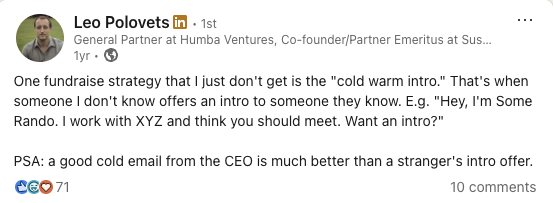
(Note: while early-stage fundraising brokers are common in some parts of the world, exactly zero credible VCs in North America will fund your Pre-Seed or Seed round if the introduction comes via a broker. So don’t waste your time or money with them.)
4. Unnecessary Sarcasm / Jokes
This is another strategy that, more often than not, is a turn off: starting with sarcasm or an unnecessary joke before getting to the point of the email.
Humor often works very well in-person, but amongst a flood of tightly-written emails, it often has the opposite effect. For example, I received a handful of emails after the deadline for Game On that started with some form of,
“I guess we didn’t get in…”
“I’m sure there were plenty of applications, bla bla bla…”
“I didn’t see an email after the deadline…”
I’m not sure what folks hope to gain with this. In contrast to the examples above, a number of applicants wrote very thoughtful emails asking for feedback, and I responded to almost every one. But the ones who started with unnecessary sarcasm or negging or jokes… 🤷♂️
5. Justifying No’s
This last point is less a mistake and more an opportunity for improvement.
One of the hardest personal evolutions for most founders is learning to say no.
In our early days, we worry that we might be missing out on something. We might close a door that could lead somewhere. Even when we become successful, we want to help and give back (hence, the paradox of time). But there’s a level beyond just learning to say no…
The S-tier evolution of this is learning how to say no without justifying the reason.