Get To The Point
If you’ve been reading my posts for awhile, by now you’ll likely have noticed that I regularly write about writing.
It’s not just because I’m pedantic about prose. It’s because we live in an era where a significant percentage of new relationships start in writing.
When you combine that fact with the paradox of time, the need to be concise in your writing becomes paramount. Whether your reaching out to potential investors, trying to cut through the noise with sales prospects or trying to get press for your startup, it’s essential that you get to the point.

Here are 5 common mistakes founders make when interacting over email:
1. Asking for Permission
Several times each month, I get cold emails from founders that include only partial details and then ask for permission to send the rest. For example,
“We’re raising a $1.5M pre-seed round. Can I send you the deck?”
Perhaps they once took a sales class where the instructor suggested this as a way to get a “buying signal”, but I can tell you that emails like this almost always go straight to my trash. I have neither the time nor the interest to go back-and-forth with someone I’ve never met to get the other half of an email I didn’t ask for.
If you’re going to do cold outreach (or even warm outreach!), make sure your emails contain all of the information necessary for the recipient to respond.
2. Explanation, Answer
Many founders — particularly those from Commonwealth countries — have a tendency to answer questions starting with an explanation or justification. In a verbal conversation, it might go something like this:
Investor: What is your revenue?
Founder: Well, we just started monetizing a few months ago,…
By the time you eventually answer the question, I’m convinced that you’re making excuses. So even if the answer is awesome, I’ll have already discounted it. Instead, answer the question directly, then add any context:
Investor: What is your revenue?
Founder: We’re currently at $1,500 MRR. We just started monetizing a few months ago,…
In writing, the impact of this mistake is amplified even more. When responding to written questions, make sure that you start with facts and then provide any explanation/justification afterwards.
Better yet, ask yourself if the justification is actually necessary. Oftentimes, you’ll come across as more confident by sticking to the facts and letting the recipient come back at you if they want additional details:
Investor: What is your revenue?
Founder: We’re currently at $1,500 MRR.
3. Having Someone Else Write Your Cold Email
Multiple times each week, I get cold fundraising emails in my inbox from someone who isn’t the CEO. They look something like this:
Hello Chris, thought you'd be the right person for this.
I represent a platform undergoing their Series A round with 125,000+ members and 40+ global partners built for independent professionals and enterprises. The company helps enterprises manage flexible talent while providing Individuals access to essential benefits usually reserved for corporate employees.
Can I share more details on their Series A round?
with appreciation,
[Redacted]
Revenue Growth Advisor(This one gets bonus points for also asking permission to share the rest of the details.)
Sometimes, these emails come from fundraising brokers. Sometimes, they’re from angel investors or advisors. Sometimes, the CEO has another employee at the company write the email. And sometimes they’re from a random person who I can’t for the life of me tell the nature of their relationship with the company.
Regardless, 100% of these emails go to my trash.
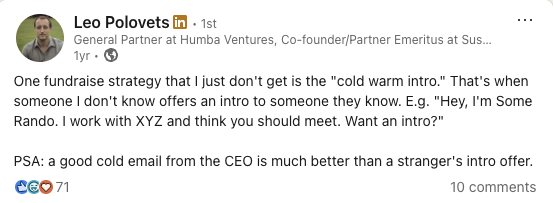
(Note: while early-stage fundraising brokers are common in some parts of the world, exactly zero credible VCs in North America will fund your Pre-Seed or Seed round if the introduction comes via a broker. So don’t waste your time or money with them.)
4. Unnecessary Sarcasm / Jokes
This is another strategy that, more often than not, is a turn off: starting with sarcasm or an unnecessary joke before getting to the point of the email.
Humor often works very well in-person, but amongst a flood of tightly-written emails, it often has the opposite effect. For example, I received a handful of emails after the deadline for Game On that started with some form of,
“I guess we didn’t get in…”
“I’m sure there were plenty of applications, bla bla bla…”
“I didn’t see an email after the deadline…”
I’m not sure what folks hope to gain with this. In contrast to the examples above, a number of applicants wrote very thoughtful emails asking for feedback, and I responded to almost every one. But the ones who started with unnecessary sarcasm or negging or jokes… 🤷♂️
5. Justifying No’s
This last point is less a mistake and more an opportunity for improvement.
One of the hardest personal evolutions for most founders is learning to say no.
In our early days, we worry that we might be missing out on something. We might close a door that could lead somewhere. Even when we become successful, we want to help and give back (hence, the paradox of time). But there’s a level beyond just learning to say no…
The S-tier evolution of this is learning how to say no without justifying the reason.