I Have Questions…
Over the years, I’ve written a number of posts about nonobvious mistakes that can hurt your fundraising process. There are the things that make VCs go "hmmm..." — subtle red flags that might not kill a fundraise outright, but cause enough potential investors to pause that they can meaningfully hurt your chances. There are phrases that founders often use without realizing that they have a different meaning for investors. And mistakes many international founders make when pitching US VCs.
In the lead up to last month’s Game On experiment, I reviewed hundreds of applications from founders across Canada (that’s right folks, although I use AI for many things, reviewing decks isn’t one of them). And there were a lot of things I saw that left me with more questions than answers.

Here are 5 red flags that leave most VCs scratching their heads after reading your deck:
1. Multiple Incubators / Accelerators
Let me get this straight: you did Rocket Founders? And then Instant Incubator? And Super Startups? And Awesome Accelerator after that…?

For a significant percentage of VCs, seeing multiple incubators / accelerators on a slide deck is a big red flag. In particular, seeing more than one equity-taking program on your slide deck makes me wonder:
Are you addicted to accelerators (like the startup equivalent of being a professional student)?
Did you not learn the material the first time?
Why haven’t you been able to generate enough revenue / raise enough capital that you need to keep doing this?
How messed up is your cap table…?
This is how most investors think about things:
0 or 1 incubators / accelerators: cool 👍
1 local / unknown incubator + 1 prominent accelerator: cool 👍 (e.g. SmallTown Startups followed by YC)
Multiple local / unknown incubators and/or multiple prominent accelerators: I have questions…
The only exception is non-equity programs (e.g. Creative Destruction Lab, 48 Hours in the Valley, Government-funded programs, etc.). These are generally useful and not held against you, but they also don’t show any particular signal to investors — so consider leaving them off your slide deck entirely.
2. More Advisors Than Employees
Nothing sets off a VC’s warning system quite like a team slide with 2 cofounders and 6 advisors.
I get it — when you’re just starting off, founders grasp for anything that will make them seem more credible. Big name advisors on the team slide do that, right?
What if you saw someone’s online dating profile and it had a single picture of them, followed by photos of their fitness instructor, their therapist and their financial advisor?

On the one hand, it’s great that you have those folks in the background helping you out. But they’re not the ones building the company.
If you have an advisor who is genuinely well-known (particularly in your domain), by all means put them on your team slide — it shows that you can attract prominent people to your mission. The problem comes when an advisor slide is filled with local nobodies. Although they might genuinely be helpful, they add zero credibility outside of a very small circle (and raise questions about why you need so many advisors).
Here’s my general rule of thumb: only put an advisor on your team slide if either (a) they are likely to be recognizable to the investors you’re pitching, or (b) Googling them immediately comes up with impressive accolades and accomplishments. Anyone whose LinkedIn profile starts with “startup advisor”or something equivalently generic should 100% be left off the slide deck.
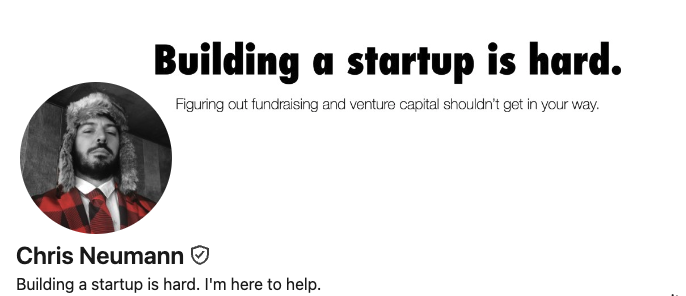
Do not put guys like this on your team slide.
(P.S. Always remember that from a VC’s perspective, angel investors >> advisors — they believed in you enough to put their own money in!)
3. No Competition
If I get to the end of your deck and haven’t seen any mention of competition, then I have questions.
There is no such thing as a startup without competition. There might not be anyone else doing the exact same thing you are with the exact same approach, but your prospective customers/users definitely have alternatives.

Investors want to understand how they’re solving the problem today and why your solution is better. Most importantly, they want to know that you have a clear understanding of the market and what it’s going to take to win.
4. Too Many Awards
Similar to having too many incubators / accelerators, having a slide filled with goofy awards is a red flag for many investors.
Best Startup in Saskatoon for the Month of September!
Fastest Rising Founder according to Follower Count on Friendster!
Nantucket’s Next Best Nanotech Star!
Although awards like this can be genuinely helpful in some respects (particularly with early hiring and go-to-market), they mean absolutely nothing to investors. If anything, they’re likely to put more of a spotlight on the fact that you’re early in your journey (especially when paired with little-to-no revenue and/or a lack of supporting metrics).
Unless an award is genuinely interesting — such as one that comes from an industry conference or is paired with a significant non-dilutive cash prize — you should probably leave it out (note: if you did win a significant amount of money, make sure to put that amount in parentheses).
5. No Accomplishments
Wait…didn’t I just say too many awards is a bad thing?

As a potential investor, one of the most important things I’m trying to get is is a sense of your velocity. To me, that’s the one metric that matters most. When reviewing your deck, I’m looking for anything that hints at how fast you’re progressing — and those usually come in the form of bragging about accomplishments.
“We launched 3 months ago and already have $5K MRR!”
“In only 6 months, we built the MVP and signed 3 pilot customers!”
“Our prototype outperforms the old thing by 100x!”
Keep in mind that I’m looking for business accomplishments, not vanity metrics (see: goofy awards). Tell me what you’ve achieved as a team that genuinely matters and how fast you did it!