What’s Going On with Series A?
Venture capital is an industry in which certain changes take time to propagate. From the outside, it can seem as though VCs are a single, fast-moving herd, collectively spinning on a dime the moment they sense a change in the air. But in reality, it’s more like a high school cafeteria: the 9th graders are all in one corner, the 10th graders in another, and so on. Each group has their set of beliefs about what is “cool” at the moment. And while they’ll occasionally co-mingle and take cues from one another, for the most part they stick to themselves.
Unlike in high school, where younger students frequently take cues from the upperclassmen (but never the other way around), changes in venture capital can flow in either direction. Sometimes a shift will flow “upstream”, from later stages to early stages. For example, something might happen to IPOs that first impacts growth stage investors, which in turn has an effect on Series B VCs, and eventually flows all the way “up” to the early-stages. Other times, we see changes flow “downstream”: a shift in behavior at Pre-Seed might impact the Seed stage a year, then Series A a few quarters after that, and so on.
It’s like dominos falling in slow motion.
And right now we’re witnessing the Series A domino slowly start to fall on a downstream shift that started at Pre-Seed early last year.

Back in June 2025, I wrote about changes that were happening in Pre-Seed fundraising as the result of an emerging bifurcation of venture capital. I wrote at the time:
“…what we’re witnessing today in the early-stage market is both a realignment of the investment strategies of many early-stage VCs and a fundamental shift in how the best founders raise capital.
…fewer rounds are happening, but those that do are oversubscribed, resulting in higher valuations.”
Nine months later, I published a similar post titled, What’s Going On with Seed Rounds? Seed VCs typically make investment decisions by evaluating a company’s early traction against its stated market hypothesis. But at the start of this year, many Seed VCs were struggling to figure out what to do:
“AI is changing so many things at such a high velocity that many Seed VCs are struggling with how to evaluate startups when they no longer have conviction that the market hypothesis will hold over their 7-10 year investment horizon.
“[As a result,] capital is concentrating at the Seed stage…fewer deals are happening with larger average deal sizes [as] Seed VCs increasingly acting like Pre-Seed VCs when it comes to their investment decisions.”
As if to put an exclamation mark on that point, valuations for the top 5% of Seed rounds went stratospheric in Q4 of 2025 and the first two quarters of 2026 (though we saw a slight downshift in late-May as summer came early to Startupland™). Six months after my post on Seed rounds, we’re now starting to see the impact of last year’s bifurcation of venture capital hit the Series A market.
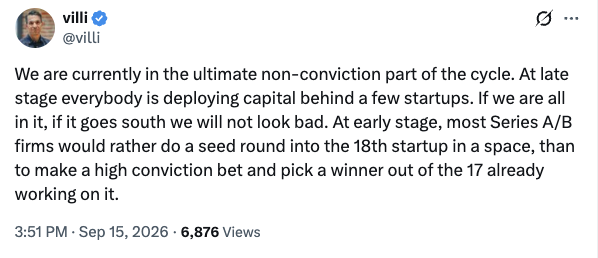
What’s happening in Series A right now is the natural progression of the downstream AI-driven shift that started at Pre-Seed in early 2025 and flowed through the Seed stage beginning in Q4.
Series A VCs have now encountered enough startups graduating from Seed to Series A on AI-driven “super-trajectories” that they’re being forced to re-evaluate their investment theses. Do they exclusively chase these extreme outliers, regardless of valuation? Do they maintain their price discipline, even if it means missing out on generational companies? Or do they take a different approach?
Chris McCann of Race Capital recently posited that, “Series A is not just harder, it has become discontinuous.” He wrote:
“Five years ago, $1M in ARR often gave a software company a credible path toward a Series A. Then the bar moved to $2M. Then $3M, $5M, and $7M. Today I see companies at a $10M run rate, with real customers and multi-year contracts, and it still is not enough.
…Downstream investors have changed their first question. It used to be: Is this a strong company at the right price? Now it is: Could this company become an extreme outlier? If yes, Series A investors will underwrite a startup with almost no revenue and fight to get into the round. If not, cutting the price often does not create demand. A genuinely good company can end up with very few, if any, viable institutional bids.
…Capital hasn't disappeared, but it’s concentrating around a smaller set of perceived breakouts. Series A used to behave more like a curve, where strong companies could find a price, now it is becoming binary.”
Chris’ last point is an important one. What’s happening at Series A right now is not a repeat of the Series A freeze of 2023, when virtually all Series A activity stopped post-ZIRP. Rather, Series A VCs are actively fighting to invest in a small number of companies they perceive to be extreme outliers while drastically slowing all other activity as they re-evaluate their long-term approach to investing (much like what happened at the Seed stage earlier in the year).
Some of this behavior, as Chris alluded to, is being influenced by what Series A VCs are encountering downstream from them. Rick Zullo of Equal Ventures shared the following anecdote a few weeks ago:
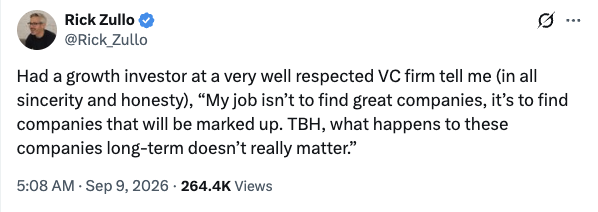
That may seem like a shocking statement to make, given that VCs generally don’t make money unless an exit occurs (management fees notwithstanding). But at this moment in time most VCs are far more concerned about whether or not they will be able to raise their next fund than they are long-term financial results. So many of them are unapologetically chasing logos (much like early-stage startups do before fundraising 😉).
Venky Ganesan of Menlo Partners described this behavior in more detail in an exceptional post on the current state of venture capital that I strongly encourage you to read. Venky observed that, “…right now is the most disorienting period in venture capital I can remember, and I have been doing this for a while.” He went on to share that,
“As far as I can tell, there are two groups on the dance floor.
The first group got in early. Firms like ours were in some of these AI companies before the numbers got silly, and the paper gains are enormous. When you are sitting on gains like that, you start to feel like you're playing with house money. I have been around long enough to know that house money is the most dangerous kind, because you don't respect it the way you respect money you had to earn.
The second group missed the early rounds and knows it. Their LPs know it too. So they are trying to make up for lost time by writing very large checks very late, which is the one strategy almost guaranteed to turn a missed opportunity into a real loss.
House money on one side, FOMO on the other, and reflexivity feeding both. That's the whole story. Everyone has a reason to keep dancing, and the reasons are different, which is why nobody can talk anyone else off the floor.”
So what does all of this mean for founders trying to raise a Series A?
For starters, unless you are showing clear signs of being an extreme outlier or are well north of $5M ARR, I would encourage you to plan as though you won’t be able to raise a Series A (at least, not for a few quarters). While a small number of Series A VCs have already adjusted their investment theses to lean into companies with “traditional” Series A traction, the vast majority are currently focused on hunting extreme outliers. By all means go out and test the waters (I always believe you should do that regardless of the what anyone tells you), but now is definitely not the time to spend 3 - 6 months fundraising.
Instead, figure out what the plan is if there isn’t Series A funding around the corner. Start off by having “the talk” with your existing investors and figuring out if they are willing and able to provide additional funding. Research alternative sources of funding that might exist. And, of course, figure out a clear path to profitability.
I suspect that in 12 to 18 months we’ll begin to see more options at Series A for great companies that aren’t AI-driven super-outliers, but right now the cold, hard truth is that a lot of great companies are learning the hard way that there isn’t a market for them at Series A (at any price).