How AI Helped Me Prioritize the Important-But-Not-Urgent
I am a huge fan of executive coaches. I think every founder should hire one as early in their career as they possibly can.
One of the most memorable conversations I had with an executive coach took place almost 15 years ago, back when I was the CEO of DataHero. On one of our bi-weekly calls, I was lamenting the fact that I hadn’t made meaningful progress on some personal goals that I had, when my coach paused me mid-sentence with a calm but piercing comment that I can still hear more than a decade later.
“The reason you haven’t made any progress,” she calmly observed, “is because you absolutely suck at prioritizing the important-but-not-urgent.”

Thanks Camille… 🤣
My coach at the time, Camille Preston, was generally soft spoken, but she didn’t mince words when she needed to get a point across. And on that day, she definitely made her point.
I was always very good at completing “P0” (top priority) tasks, but would often let “P1” (second tier) tasks languish. With her help, I developed strategies to ensure that I made regular progress on some of the important-but-not-urgent tasks on both my personal and professional todo lists. Strategies that have served me well to this day.
In the weeks that followed, many of the important-but-not-urgent tasks that had quietly lived on in my todo lists were completed, but others remained stubbornly untouched. I worked with Camille to unpack the reasons why, and eventually realized that I had been subconsciously performing ROI calculations on each task on my important-but-not-urgent list before deciding whether or not to “pop” it off the stack.

So what does this have to do with AI?
The emergence of AI — and agents, in particular — has completely upended the ROI calculations for many of the tasks that languished for months (or years!) on my important-but-not-urgent list. It’s made tasks that didn’t make sense to me from an opportunity cost perspective suddenly very reasonable. And I bet it can do the same for you.
One Example of How I Use AI
Let me share one example of how I’m leveraging AI to get important-but-not-urgent tasks done to make it real.
Since you’re reading this post, you’re hopefully well aware that I write a weekly blog post about startups, the business of venture capital and tech ecosystems (if not, go here right now and signup for my newsletter!). Every Wednesday morning, I distribute a new post that I’ve written in three ways:
I publish the original post on my website
I email a copy of it to all of my newsletter subscribers using Kit
I post a link to it on my LinkedIn page
This is certainly not the most sophisticated — or comprehensive — content distribution strategy, but it’s worked pretty well for me until now. That said, there are two additions that have been relatively high on my important-but-not-urgent list for some time yet remained untouched until recently:
Cross-posting links to new blog posts on Reddit
Repurposing old blog posts as social media content
Neither one of these tasks is particularly complex. In fact, both are well understood as low-hanging fruit for content creators who are looking to grow their audiences. So why hadn’t I done them already?
Because I was never able to justify the ROI.
Unlike a lot of content creators, I don’t generate income from my newsletter or any of the content that I create. A writer who actively monetizes their content can quite easily justify spending 1-2 hours per day strategically posting on social media or hiring a social media manager to do it for them, since it’s part of their core business, but for me the juice was never worth the squeeze. That math changed with agents.
Here’s how I now leverage agents to perform these two tasks with ease:
1. Cross-posting links to new blog posts on Reddit
One common tactic used to drive traffic to a blog is to search for active threads on social media that discuss the topic of a blog post and add a comment that links to the post. Reddit, in particular, is a very popular platform for this.
While the idea is straightforward, it’s actually very time-consuming to do it manually — particularly the process of searching for relevant threads. But AI makes it almost instantaneous.
Each time I publish a new blog post, my agent reads the post and then searches Reddit for active threads that it believes relate to the topic of the post. It returns to me a list of up to 10 posts ranked in terms of relevance, audience reach and comment quality.
For each thread, I have it come up with several draft comments that could lead readers to visit my post. Using these as inspiration, I visit each of the threads flagged by my agent, scan them briefly to make sure that they’re actually relevant, and then post a comment with the blog link.
Before AI, it easily would have taken me 2 - 3 hours per week to identify relevant threads and post comments to Reddit (which is why I never did it). With my agent’s help, it takes me about 10 minutes.
2. Repurposing old blog posts for new social media content
Another thing I’ve wanted to do for awhile is to repurpose old blog posts as social media content. At this point, I’ve got literally hundreds of posts worth of content to draw from, but it was never enough of a priority for me to justify the time it would take. Once again, AI helps me do it in minutes.
Each week, I have my agent randomly select 3 blog posts that I’ve written that are at least 18 months old. For each one, I ask it to create 3 different draft social media posts based on the content. Unlike the posts I make when I first publish the content, these ones aren’t designed to drive traffic to my website. Rather, they’re meant to elicit feedback, start conversations and (hopefully) gain a few new followers.
I specifically ask my agent to select 3 different posts so that I can choose one that feels relevant based on what’s going on in the world that week. And I ask it to create 3 distinct draft posts as inspiration, since (surprise surprise) I have zero intention of copy-pasting any of them. Instead, I choose the topic that feels the most timely to me and quickly write a social media post that’s influenced by the 3 drafts my agent created.
Once again, the entire process takes me less than 10 minutes each week (vs. several hours if I were to do it manually).
My Current Philosophy when Using AI
The examples above are just two of the tasks on my important-but-not-urgent list for which AI completely changed the ROI calculations. And I’ve got many more.
Of course, at this point you might be wondering why I bother doing any of the work myself. Why not let the agent post the comments and automate the entire process (plenty of other people have done just that)?
The answer can be found in the R ('Return’) in ROI.
First, consider the direct output of the tasks. The deluge of AI-generated comments on social media have significantly decreased their effectiveness, in no small part due to how obvious it is when a comment was written by AI. Spending 10 minutes of my time each week authoring these posts has a dramatic impact on their effectiveness (moreover, it ensures that I avoid the negative implications of my social media accounts being identified as sources of AI slop).
Second, think about the indirect benefits of performing the task manually. In the case of cross-posting to Reddit, I gain insights from reading through the threads that my agent identifies before I post links to them. In other words, the return for me is not just measured in traffic to my website, it’s in additional learnings that I didn’t previously have.
Oh…and there’s also the fact that the platforms themselves are actively working on identifying and blocking AI-generated comments:
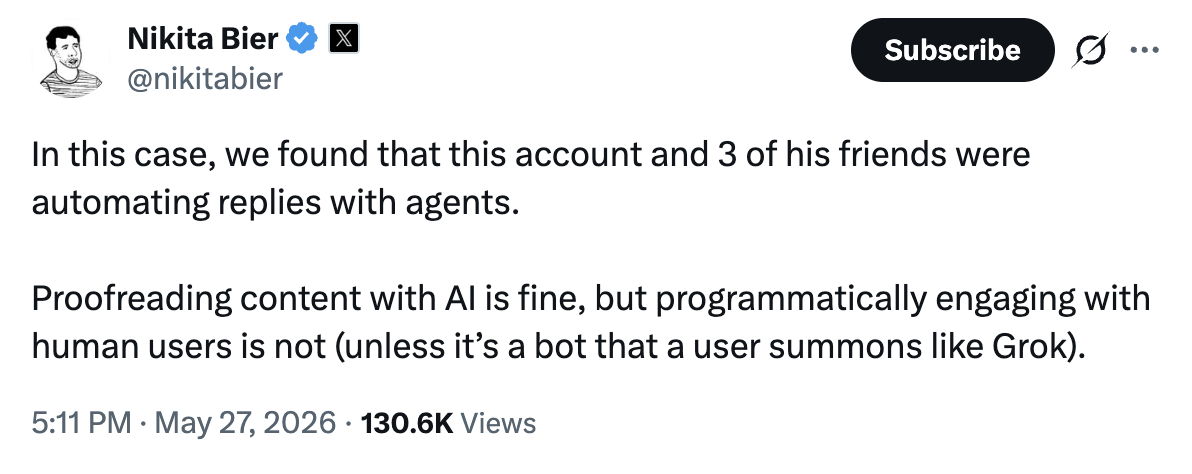
Popping up a level, my current philosophy when it comes to leveraging AI for important-but-not-urgent tasks is to automate the time-consuming parts of the task that I don’t find value in (searching for relevant Reddit threads, brainstorming how to turn a long-form blog post into a short social media post), while selfishly keeping the parts of the tasks that I do find value in (reading relevant Reddit threads, taking the time to write the final form of a post in my voice).
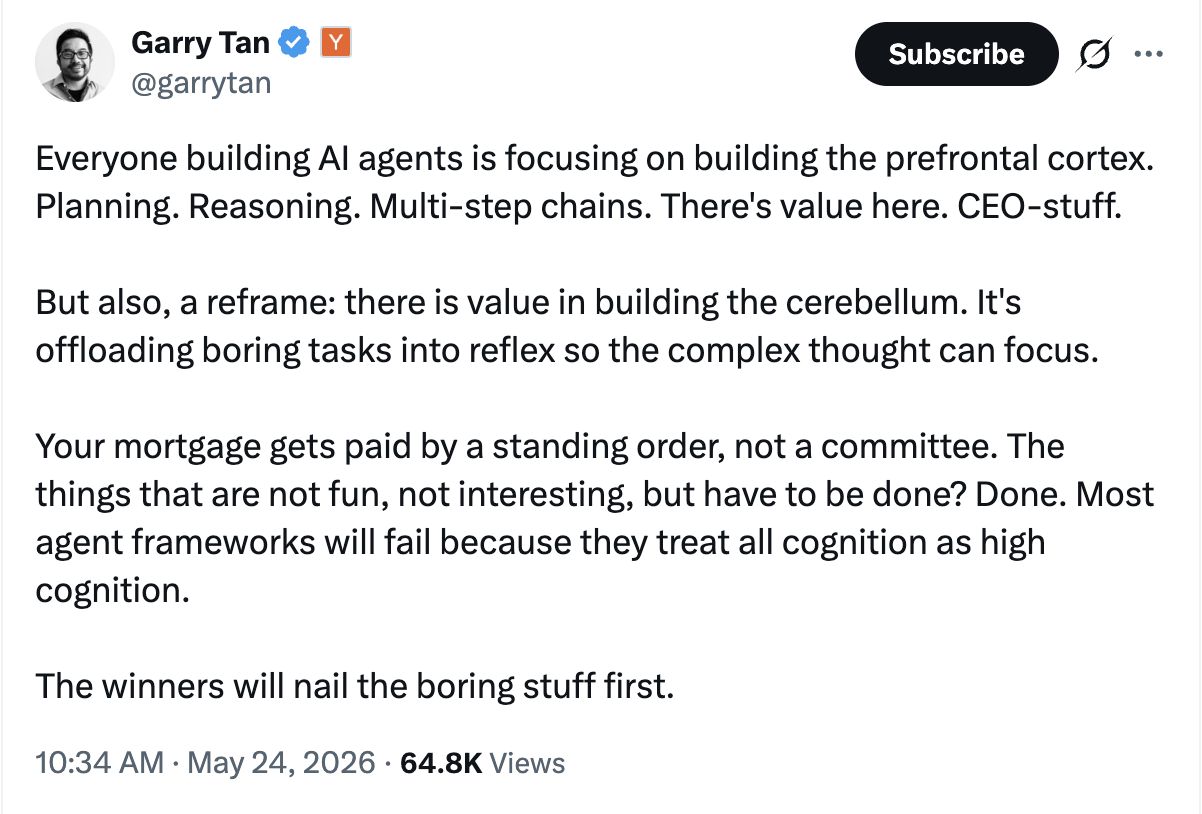
Garry Tan recently reflected on this in a post about near-term opportunities for agent frameworks — distinguishing between the high-value “CEO stuff” and the things that are “not fun, not interesting, but have to be done”:
In his most recent biannual technology report, Benedict Evans described AI as “giving you infinite interns.” I think that’s one of the best descriptions I’ve heard yet (and it maps very well to how I think about agents).
The reason why so many of my important-but-not-urgent tasks languished on my todo list for so long was never because they were too hard. It was because they were too time-consuming (and from an ROI perspective, I couldn’t justify the amount of time it would take for me to do them nor the cost to hire someone else to).
But now that I have infinite interns at my disposal, I can offload the parts of each task that are “not fun, not interesting, but have to be done.” What remains is the “CEO stuff” — and a much smaller denominator for calculating ROI.
So take a look at each task on your important-but-not-urgent list and think, “if I have access to infinite interns, is that enough to finally get it done?”