What If You Fire Them?
This past week, Startupland™’s corner of social media was abuzz after podcaster Greg Isenberg posted a “horror story” from his days as a founder. As the week wore on, founders around the world quote-tweeted the original post with their own tales of VC misbehavior (yes, I’m still calling it a “quote-tweet”). Things took a sharp turn Friday morning, when Cloudflare CEO and Cofounder Matthew Prince shared some of his own experiences.
…and named names.
The third anecdote he shared — about Midas List investor Vinod Khosla — set the internet ablaze.
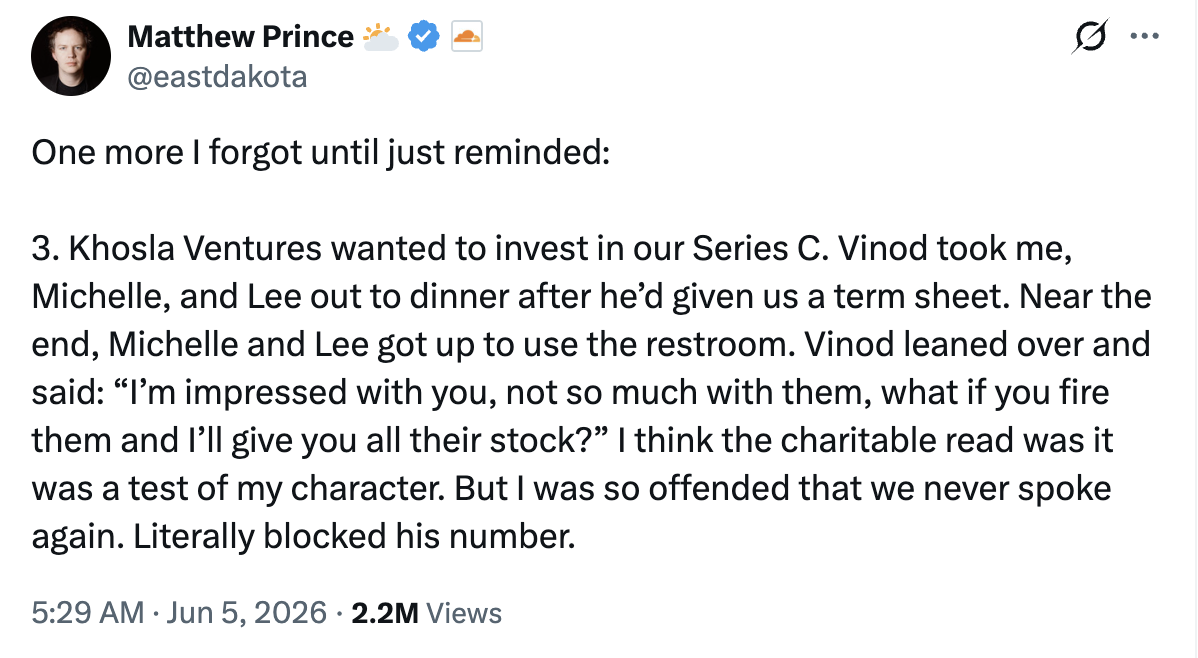
Rather than dive into the particulars of Matthew’s experience (which plenty of netizens have already done), I want to explore a topic that we don’t often talk about when it comes to startups and fundraising: what happens when a VC likes the CEO, but doesn’t have conviction about the rest of the founding team?
When it comes to fundraising and fundraising advice, we frequently talk about founders as a single unit. We refer to the characteristics of the “founding team” and write blog posts (like this one) about frameworks that VCs use to evaluate them. But the reality is that not all founders are equal in the eyes of prospective investors.
There is the CEO, and then there is everyone else.
Now, before you rush to pitchforks, it’s important to understand that there’s logic to this thinking. For starters, the CEO is (in theory at least), the person who is ultimately responsible for all decisions. The buck stops with them. Moreover, there’s a reasonable likelihood that at least one of the cofounders pitching the VC will be gone within a few years. A recent Carta report looked at more than 22,000 VC-backed companies with 2-3 cofounders. More than 25% of them had at least one cofounder leave by year 4:
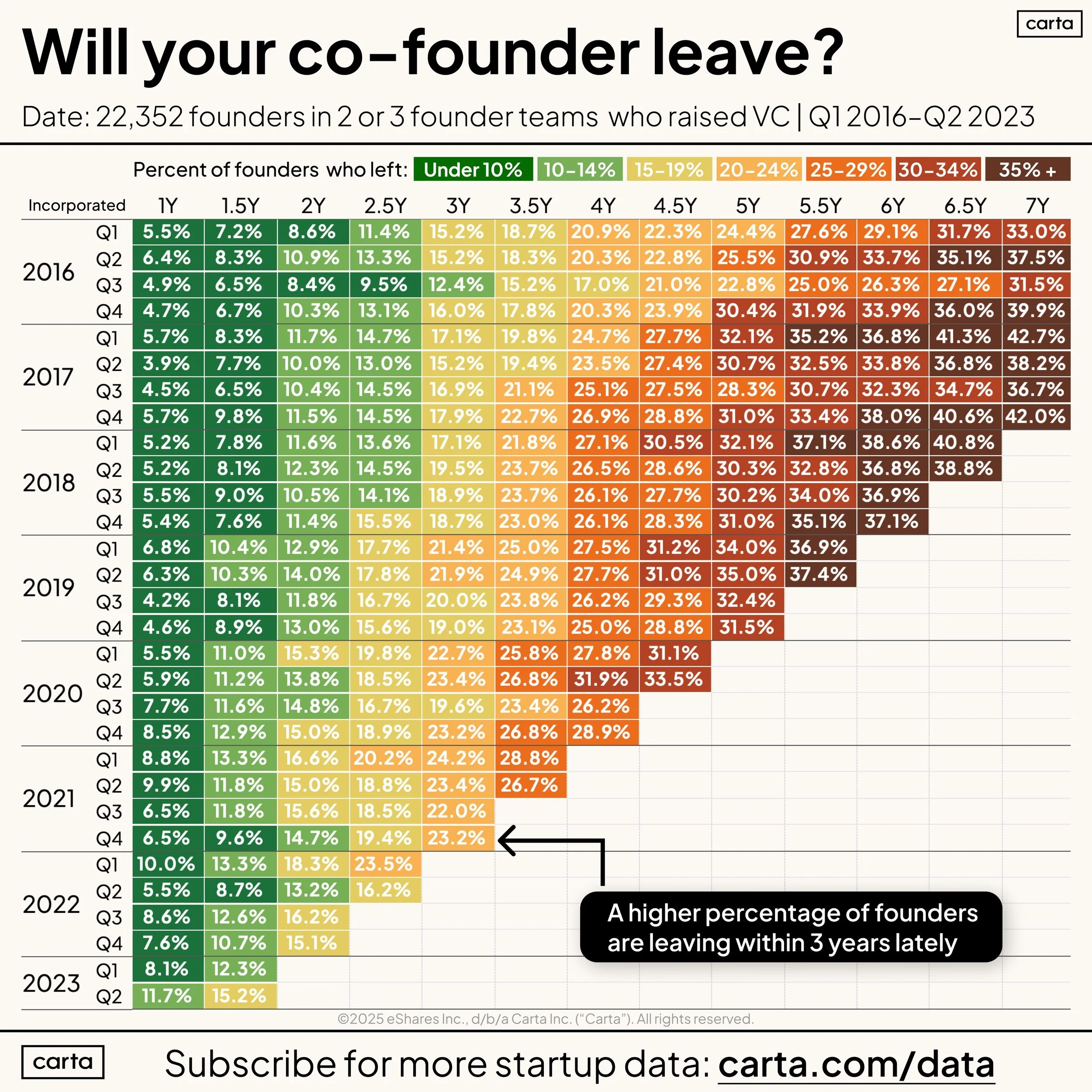
The two VC-backed companies that I was a part of — Aster Data, where I was the first employee, and DataHero, where I was the CEO — both had a cofounder leave by year 4. And many of the companies that I’ve invested in over the years have had one or more cofounders leave relatively early on.
There are wide variety of reasons why a cofounder may leave a startup, but there are several situations that occur frequently enough that VCs actively watch for them during fundraising meetings:
Interpersonal conflicts between cofounders
Lack of alignment (particularly to the company’s mission and values)
Inability to take feedback / have their assumptions challenged
Lack of growth mindset (this one is more difficult to interview for, but what investors are keeping an eye out for are signals that a cofounder might not be willing or able to evolve fast enough to keep pace with the rest of the company)
More often than not, if a prospective investors sees signs of one or more of the situations listed above, they will simply pass on the opportunity. But there is one case where some VCs will take a deeper look despite the warning signs: when they are excited about the CEO but are less infatuated with one or more of the cofounders.
Over the years, I’ve had this happen to me a number of times. After meeting an impressive CEO with an ambitious vision, strong background and clear founder-market fit, I met their cofounders and…

Believe it or not, it’s actually quite unusual to meet a founding team made up of individuals who aren’t at the same level as each other. Most high-achieving people (particularly CEOs) surround themselves by other, similarly-impressive individuals. On those rare occasions when I’m introduced to cofounders that come off as a significant step down from the CEO, it’s actually rather jarring.
My first question in such a situation is always, “did I get it wrong?” I’ll usually try to diligence the cofounder quickly (often by leveraging backchannel references) in order to figure out if my initial read was incorrect. If my suspicions are confirmed, the next question I need to answer is, “is the CEO aware that their cofounder…isn’t strong?”
Before I go any further, I want to acknowledge that this entire topic is very subjective. What I consider to be “strong” and what other people consider to be “strong” can vary wildly (which is why it’s so important when fundraising to fill your fundraising funnel with a large set of potential investors). The reality is that VC investing is far more art than science — particularly at the early stages. So while it might feel uncomfortable to think that investors are picking apart your founding team like this, understanding what’s happening (and why) can make a big difference in your outcome.
I should also point out that the stage of a company plays a big part in the ramifications of an underperforming cofounder. It is generally challenging to replace a cofounder at the early stages. On the other hand, at later stages (e.g. Series C) it’s not uncommon to see cofounders moved into different roles as experienced executives are brought in to lead specific functions. For the remainder of this post, I’ll focus on ridiculously early startups — where I spend most of my time.
In my experience, a significant “competency mismatch” between a CEO and another cofounder at the early stages usually falls into one of three categories:
The CEO is aware of the mismatch and has nonetheless chosen to cofound a company with this individual
The CEO is subconsciously aware of the mismatch but is hoping they are wrong
The CEO is completely oblivious to the mismatch
Let’s look at each of these scenarios:
1. The CEO is aware of the mismatch and has nonetheless chosen to cofound a company with this individual
In some cases, a strong CEO will intentionally choose to include one or more less experienced individuals as part of the founding team. For example, a senior CEO might have junior cofounders filling independent contributor roles, knowing that they will likely have to hire leadership “above them” at some point. Provided that there is transparency around this, it can be a healthy long-term situation (I’ve invested in several companies with this dynamic).
That said, a founding team with an intentionally large competency gap between the CEO and other cofounders can also be a strong negative signal. For example, it might indicate that the CEO isn’t comfortable managing people who are at or above their level or that they are unable to recruit strong cofounders. Both situations imply dynamics that are almost always fatal to a company, which is why experienced VCs will avoid such startups at all costs.
2. The CEO is subconsciously aware of the mismatch but is hoping they are wrong
In this situation, the CEO has a gut feeling that their cofounder might not be up to the task, but goes along with it anyways. In my experience, this mostly happens with first-time founders who haven’t previously dealt with the ramifications of an underperforming cofounder.
3. The CEO is completely oblivious to the mismatch
A great engineer will rarely cofound a company with a mediocre engineer. Similarly, an exceptional business cofounder will rarely cofound a company with salesperson or marketer who is mid. But what happens when cofounders have completely different backgrounds?
I’ve met multiple companies over the years that had an exceptional technical CEO but a goofball “business cofounder”. I’ve also met founding CEOs with incredible business backgrounds who didn’t realize that their technical cofounder was a dud.
So how do VCs deal with situations like the ones described above?
While I’ve never told a founder outright that they should fire their cofounders, I’ve have shared cofounder-related feedback with a handful of CEOs over the years. Many VCs are reticent to give feedback, but every once in awhile we meet a CEO who’s both objectively impressive and seems open to “out-of-the-box” feedback. In cases where I sense that the CEO either doesn’t realize the competency mismatch or perhaps does, but doesn’t want to admit it, I will occasionally offer feedback on their cofounders.
I only ever do this 1×1 and always verbally (either in person or on a call). But unlike the situation described by Matthew above, it’s never been as part of an offer to invest. Rather, it’s always been a follow-on conversation after deciding to pass on the company.
At the end of the day, the situation described by Matthew is an unusual one. But Vinod’s experience — of meeting a CEO that he was excited by but cofounders that he found to be less impressive — happens a lot more than you probably realize.
If you sense something that something’s off after a VC meets your cofounders, consider asking them about it. Here’s a great question to try:
“After meeting my cofounders, are you more or less likely to want to invest. Why?”
Regardless of the the outcome, you’ll learn something new.