Stop with the AI Slop, Part 2
Tomasz Tunguz recently wrote about his experiences incorporating AI as part of his writing process. He observed that,
“The problem with AI as a ghost writer: everyone uses the same ghost writer. AI’s voice isn’t the author’s.”
Since ChatGPT first came onto the scene, I’ve made a point of periodically testing new models to see if they could accurately reproduce my voice in writing. Years of blog content and social media posts has provided me with a solid set of training data. It turns out that even the earliest models were remarkably good at analyzing my writing style. They could pull out phrases that I constantly use, my preferred filler words, linguistic fingerprints and so on.
But for all of their promise, I’ve never managed to get an AI model to write even a single paragraph that isn’t clearly and obviously someone else’s voice. But does that actually matter these days?
Much like Tomasz, I periodically get emails from readers asking about the authenticity of my content (or, in some cases, expressing their appreciation for something I wrote that was clearly not AI-generated). In his post, Tomasz hypothesized that,
“In the age of slop, readers test authenticity.”
I think he’s right on that. Increasingly, I find myself reading posts, articles, emails and even text messages with the not-so-subconscious question, “was this written by AI?” going through my head.

Nobody who received this email questioned if it was from a human… 😂
A few months ago, I sent out emails to a number of people in my network asking if they would volunteer as mentors for this year’s Founders Day. It was a pretty simple email that included high-level details about the event plus the ask (“Will you mentor this year?”). Most of the responses were a few words or less (“I’m in!” or “Sorry, I’m out of town that week.”), but one of them stuck out:
“Hi Chris,
Great to hear from you, and count me in. I'd be glad to mentor again this year.
The new format sounds excellent. Moving everything to South Flats and giving it a festival feel is a smart change, and having the conference, mentoring, and networking party all in one place will make the day flow much better.
The mentor ask works for me. Happy to wear the lei and spend time in the mentor area during the day, so just send the signup sheet once logistics firm up and I'll pick a slot. The mentor and speaker dinner sounds great too, so keep me posted on the date.
I'll keep the details to myself until the announcement goes out. Looking forward to August 20.
Thanks,XXX”
I immediately texted the sender,
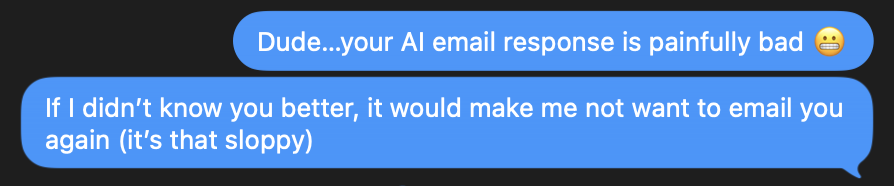
His response?


Since AI came on the scene, a subset of the residents of Startupland™ have become obsessed with efficiency. A number of people I know have spent a mind-boggling amount of time spinning up agents to handle every task imaginable.
And in more than a few cases, that includes an agent to act as the frontline interface for all of their personal communications.
A few months ago, I wrote about the rise of AI slop on social media and how relying on AI to generate posts is now likely to result content that under-performs. I noted that after reading dozens of nearly-identical AI-authored comments, “…my eyes glazed over. Eventually, I stopped reading and responding.”
What happens when the AI slop isn’t confined to LinkedIn and X posts and finds its way into the emails and text messages you send to your coworkers, clients and even your friends?
Lately, I’ve started to receive emails from personal friends and long-time colleagues that were clearly written by AI. Most aren’t quite as egregious as the example above, but most of the time it’s pretty obvious. When I receive such emails, I find myself both less likely to read to the end and less likely to respond to it.
More and more, I find myself less likely to want to email that person at all.

There’s a certain degree of trust that exists in one-to-one communication. For the most part, I assume that if I send you an email, you (meaning, the real you) will read it — or at least scan the header before deciding whether or not to answer it. Similarly, when I receive an email from you, I assume that you (the real you) is the person who wrote the email.
Sure, some people have EAs who read and respond to emails for them. But long-established etiquette is that if a human EA writes an email on someone else’s behalf, they initial it in order to make clear that the email was written by someone else. Rarely do EAs actually ghost-write personal communications (though in Startupland™ that behavior is more common than in the rest of the world).
And while plenty of people use tools like Grammarly to improve their writing and leverage email templates / snippets to be more efficient, you can generally tell that the core was still written by the original author. The voice is still theirs.
So where do we go from here?
On the one hand, part of me wonders if we’re experiencing a similar dynamic to what happened when Calendly first came on the scene (when many people were upset by the “audacity” that someone would dare send them a link to fit into their calendar, rather than engaging in the time-consuming back-and-forth of scheduling). From that perspective, it seems reasonable and broadly net positive to have AI handle communication tasks that don’t really need a human-in-the-loop.
But having AI handle basic scheduling tasks or dealing with customer support is very different from having an agent pretend to be you in conversations with people you know personally. And perhaps that’s the core issue here. There’s a breach of etiquette and trust that seems to be happening with a subset of early adopters of AI. And they’re not fooling anyone.
I’m very transparent about the fact that I use an AI scheduling assistant, But I’ve never, ever had it pretend to be me. And I think that’s important.
At the end of his post, Tomasz noted,
“AI is a poor ghost writer, but a great editor.”
I suspect that in the very near future, we’ll see a similar backlash to AI slop in personal emails to what we’ve seen in social media and cold emails. Use AI as an editor. Offload tasks in a transparent manner to agents. But stop having AI pretend to be you. The incremental gain in productivity is likely costing you more than you realize.
That particular friend I referenced earlier who I emailed about Founders Day? I haven’t sent him a single email since.
Because I know he’s not the one reading it.