The Real AI Moat? Customer Support
The hardest challenge facing AI startups as they scale isn’t technical, it’s technical support.
At the beginning of the year, AI adoption started to go exponential (at least, within the consumer / prosumer segment). Opus 4.5 came out and caused developers everywhere to stop, collaborate and listen. Then Clawdbot Moltbot OpenClaw delivered the world’s first AI agent “kit”. In the months since, countless teams have worked to develop (or pivot to) personal agents.
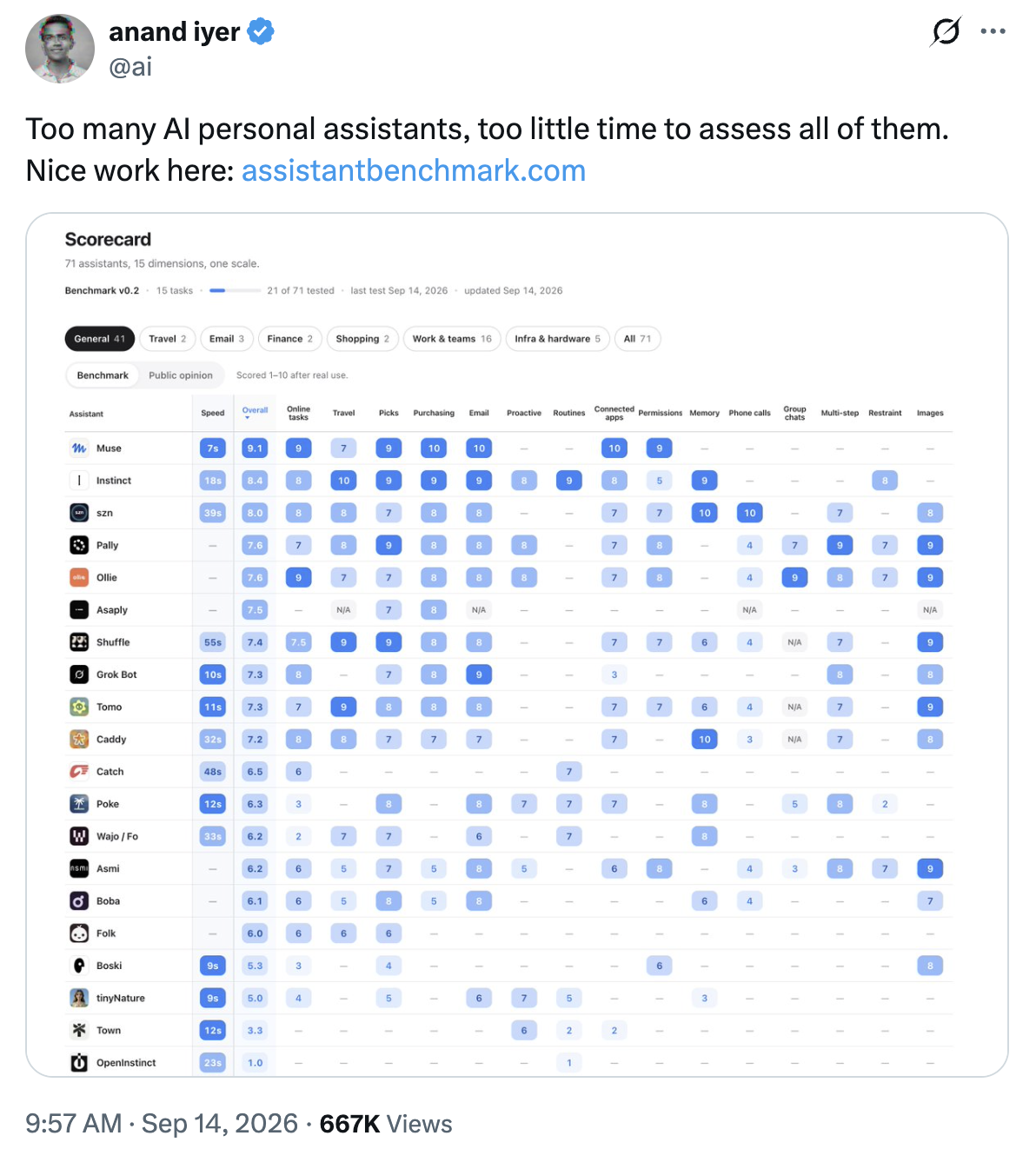
I’ve used a number of these agents to varying degrees over the course of the year and have come to two conclusions:
None of them are capable of doing everything I want them to do out-of-the-box (at least, not yet)
The hardest challenge facing these companies as they scale isn’t technical, it’s technical support
From a user/customer standpoint, the biggest difference between a framework that can be customized, like OpenClaw or Hermes, and an out-of-the-box solution is who is responsible when something doesn’t work. If I use an open source solution and it fails to do what I want, then it’s up to me to figure out how to fix it. But if you’re selling me a black box and promising that it can do all the things..?
Here’s a pattern that I’ve seen happen numerous times over the past year with personal agent startups:
Startup releases beta version of their new personal agent. The team slowly onboards a small number of users and actively solicits feedback. Everyone is extremely responsive as things inevitably break and fall down.
Agent gets released publicly. More users get onboarded. More things break. The team is still mostly responsive, but those responses take longer to get.
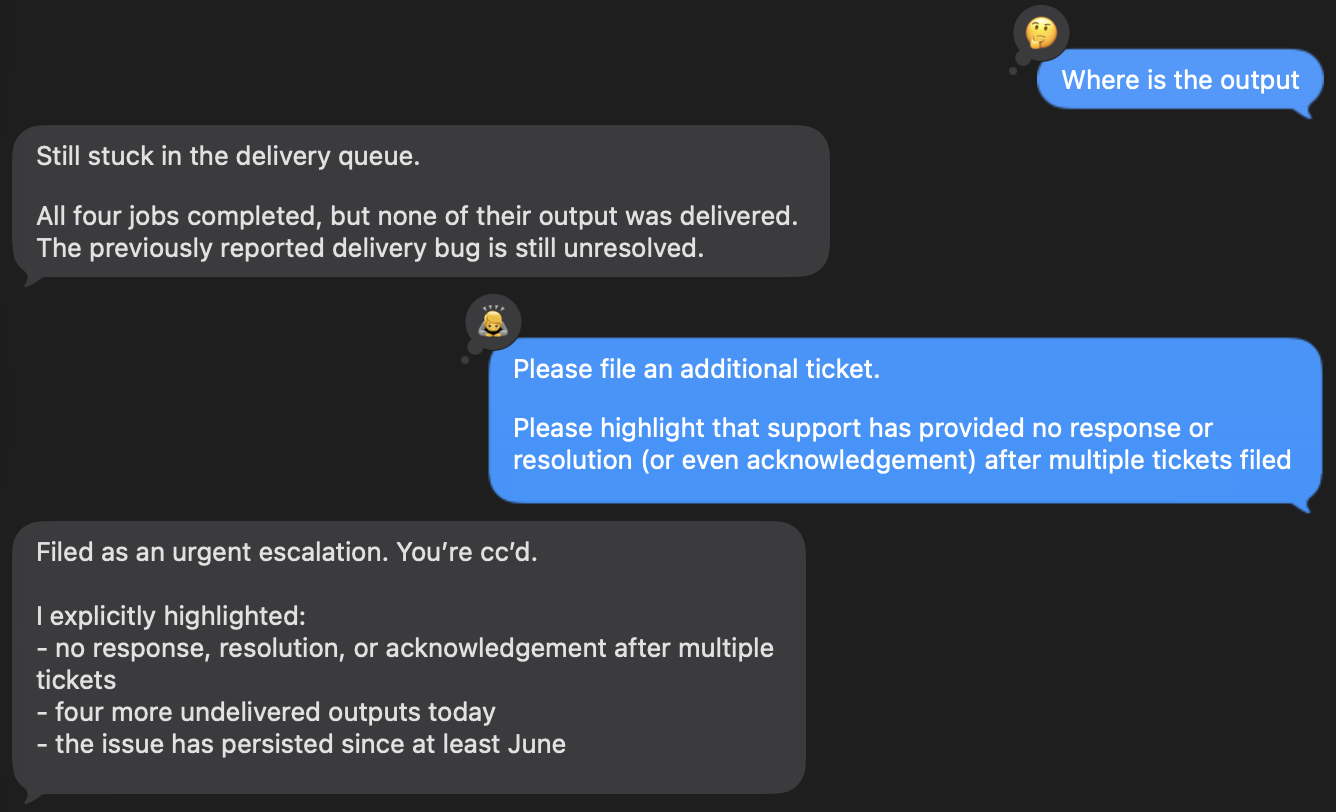
User growth goes parabolic as the new agent goes viral. Almost all effort goes towards keeping the platform up. Lots more things break. Lots more tickets get filed. And the team can’t keep up.

Cricket’s the name. Jiminy Cricket.
As a former founder, I’m incredibly empathetic to this plight.
In the early stages, it’s very likely you don’t have anyone dedicated full-time to technical support. It’s almost always the engineers and cofounders pulling double-duty to respond to customer complaints and feature requests (perhaps with the help of some triaging agents). For traditional startups, this approach usually works. But that’s because the surface area of “things that can go wrong” is relatively focused.
AI products are a different beast. For starters, their general-purpose nature dramatically increases the number of things that can go wrong (instead of naturally clustering around a handful of features, as is the case with traditional software).

That’s hard enough. But when you layer in the potential to quickly scale users, a fire hydrant of feedback is almost inevitable.
As an aside, a unfortunately large segment of Startupland™’s has been gaslit into believing that customer support should be a low priority.
This goes all the way back to the days when Google first launched Gmail in “beta” and basically put a sign on the front door telling users, “if something goes wrong, it’s not our problem.” Coming out of Covid, we saw many Web3 founders do the same thing: spin up a discord server, drop in once a week to check things out and call it a day. (What do you mean we need documentation? We wrote a white paper! 🤦♂️)
In markets that are highly-competitive — like almost every AI-related market currently emerging — that’s simply not going to be good enough. Especially when switching costs are almost non-existent.
The solution? Prioritize customer support early.
In the early days, your customer funnel is guaranteed to be leaky. Simple yet effective communication goes a long way when it comes to building good will from early adopters. Which in turn results in those early adopters giving you more time and leeway to address their concerns.
But one-on-one customer support doesn’t scale (especially not if you go viral!), so you need to prepare. Here’s how to do that:
Make sure you have a customer-facing ticketing solution before you launch. It could be a traditional third-party solution or something home grown and integrated with your product. But there has to be a way for customers to check on the status of a ticket they previously filed.
When customers (or their agents) file a new ticket, make sure that receipt of the ticket is immediately acknowledged and comes with instructions on how to track it.
Provide status updates. This is the obviously the hard part if user growth is skyrocketing and you can’t keep up, but finding a way to let customers know that you haven’t forgotten about them is crucial. Even if those updates are automated and mostly mea culpas (“we’re trying our best!”).
Be honest when setting expectations. If you know that you won’t be able to get to a particular fix or feature for awhile, let customers know. If you have to back out a new feature because it broke in too many places, that’s okay too.
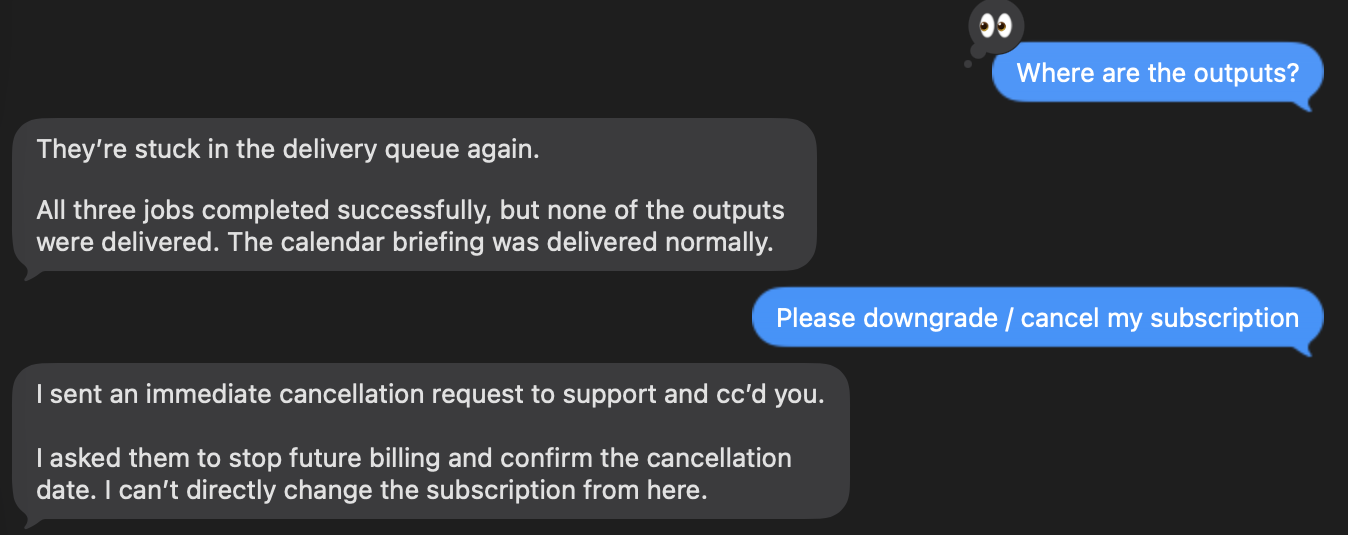
The most important thing is to make your customers feel heard. If they keep filing tickets without getting a response, your early adopters will feel like they’re screaming into an abyss. And when they do…
Stop with the AI Slop, Part 2
What happens when AI slop finds its way into emails and text messages you send your coworkers, clients and friends?
Tomasz Tunguz recently wrote about his experiences incorporating AI as part of his writing process. He observed that,
“The problem with AI as a ghost writer: everyone uses the same ghost writer. AI’s voice isn’t the author’s.”
Since ChatGPT first came onto the scene, I’ve made a point of periodically testing new models to see if they could accurately reproduce my voice in writing. Years of blog content and social media posts has provided me with a solid set of training data. It turns out that even the earliest models were remarkably good at analyzing my writing style. They could pull out phrases that I constantly use, my preferred filler words, linguistic fingerprints and so on.
But for all of their promise, I’ve never managed to get an AI model to write even a single paragraph that isn’t clearly and obviously someone else’s voice. But does that actually matter these days?
Much like Tomasz, I periodically get emails from readers asking about the authenticity of my content (or, in some cases, expressing their appreciation for something I wrote that was clearly not AI-generated). In his post, Tomasz hypothesized that,
“In the age of slop, readers test authenticity.”
I think he’s right on that. Increasingly, I find myself reading posts, articles, emails and even text messages with the not-so-subconscious question, “was this written by AI?” going through my head.

Nobody who received this email questioned if it was from a human… 😂
A few months ago, I sent out emails to a number of people in my network asking if they would volunteer as mentors for this year’s Founders Day. It was a pretty simple email that included high-level details about the event plus the ask (“Will you mentor this year?”). Most of the responses were a few words or less (“I’m in!” or “Sorry, I’m out of town that week.”), but one of them stuck out:
“Hi Chris,
Great to hear from you, and count me in. I'd be glad to mentor again this year.
The new format sounds excellent. Moving everything to South Flats and giving it a festival feel is a smart change, and having the conference, mentoring, and networking party all in one place will make the day flow much better.
The mentor ask works for me. Happy to wear the lei and spend time in the mentor area during the day, so just send the signup sheet once logistics firm up and I'll pick a slot. The mentor and speaker dinner sounds great too, so keep me posted on the date.
I'll keep the details to myself until the announcement goes out. Looking forward to August 20.
Thanks,XXX”
I immediately texted the sender,

His response?


Since AI came on the scene, a subset of the residents of Startupland™ have become obsessed with efficiency. A number of people I know have spent a mind-boggling amount of time spinning up agents to handle every task imaginable.
And in more than a few cases, that includes an agent to act as the frontline interface for all of their personal communications.
A few months ago, I wrote about the rise of AI slop on social media and how relying on AI to generate posts is now likely to result content that under-performs. I noted that after reading dozens of nearly-identical AI-authored comments, “…my eyes glazed over. Eventually, I stopped reading and responding.”
What happens when the AI slop isn’t confined to LinkedIn and X posts and finds its way into the emails and text messages you send to your coworkers, clients and even your friends?
Lately, I’ve started to receive emails from personal friends and long-time colleagues that were clearly written by AI. Most aren’t quite as egregious as the example above, but most of the time it’s pretty obvious. When I receive such emails, I find myself both less likely to read to the end and less likely to respond to it.
More and more, I find myself less likely to want to email that person at all.

There’s a certain degree of trust that exists in one-to-one communication. For the most part, I assume that if I send you an email, you (meaning, the real you) will read it — or at least scan the header before deciding whether or not to answer it. Similarly, when I receive an email from you, I assume that you (the real you) is the person who wrote the email.
Sure, some people have EAs who read and respond to emails for them. But long-established etiquette is that if a human EA writes an email on someone else’s behalf, they initial it in order to make clear that the email was written by someone else. Rarely do EAs actually ghost-write personal communications (though in Startupland™ that behavior is more common than in the rest of the world).
And while plenty of people use tools like Grammarly to improve their writing and leverage email templates / snippets to be more efficient, you can generally tell that the core was still written by the original author. The voice is still theirs.
So where do we go from here?
On the one hand, part of me wonders if we’re experiencing a similar dynamic to what happened when Calendly first came on the scene (when many people were upset by the “audacity” that someone would dare send them a link to fit into their calendar, rather than engaging in the time-consuming back-and-forth of scheduling). From that perspective, it seems reasonable and broadly net positive to have AI handle communication tasks that don’t really need a human-in-the-loop.
But having AI handle basic scheduling tasks or dealing with customer support is very different from having an agent pretend to be you in conversations with people you know personally. And perhaps that’s the core issue here. There’s a breach of etiquette and trust that seems to be happening with a subset of early adopters of AI. And they’re not fooling anyone.
I’m very transparent about the fact that I use an AI scheduling assistant, But I’ve never, ever had it pretend to be me. And I think that’s important.
At the end of his post, Tomasz noted,
“AI is a poor ghost writer, but a great editor.”
I suspect that in the very near future, we’ll see a similar backlash to AI slop in personal emails to what we’ve seen in social media and cold emails. Use AI as an editor. Offload tasks in a transparent manner to agents. But stop having AI pretend to be you. The incremental gain in productivity is likely costing you more than you realize.
That particular friend I referenced earlier who I emailed about Founders Day? I haven’t sent him a single email since.
Because I know he’s not the one reading it.
What is a Forward-Deployed Engineer (and Why Should You Care)?
Forward-deployed engineers are nothing new (I built a team of FDEs in 2009). But they can be a game-changer.
If you’ve been paying any attention to tech media as of late, you’ve undoubtedly seen articles about the rise of AI’s hottest new role: the forward-deployed engineer (FDE). If the term is new to you, let’s start off with a basic definition of what an FDE is:
A forward-deployed engineer is an engineer who is taken from the core product team and “forward-deployed” into a customer environment.
That’s it. It’s not rocket science. An FDE is just a regular ol’ engineer who gets sent out into the field. So why is this such a big deal? And why now?

The History of the Forward-Deployed Engineer
The folks from Palantir’s PR department would have you believe that their company invented the forward-deployed engineers in 2011. Although they can certainly claim credit for having originated the modern job title, the practice of sending engineers from the core product team into the field long predated their adoption of it.
I know this because I built and ran a team of “forward-deployed engineers” back in 2009 (more on that later).
Generally speaking, sending highly-specialized engineers from HQ into customer environments isn’t an optimal use of a company’s resources. Notwithstanding brief trips into the field to get “real-world experience”, product engineers are almost always more valuable working on the product than they are deploying and/or customizing it. That’s why the vast majority of technology companies build separate organizations (staffed with less expensive hires) for field engineering tasks.
But every once in a while, a new technology emerges for which demand spikes before it is mature enough to be deployed by arms-length professional services workers. That happened with application servers in the late-90s. It happened again with big data platforms in the late-00s / early-10s.
And it’s happening today with AI.
What a Forward-Deployed Engineer Really Is (and What It Is Not)
Before we go any further, I think it’s helpful to know what an actual forward-deployed engineer is (especially given how quickly we’ve already progressed in the “hype cycle” of the term).
A true forward-deployed engineer is someone who has spent time working on a company’s core product and is later “forward-deployed” into customer environments in order to help with installation, deployment, customization and/or sales.
Despite what some articles suggest, a forward-deployed engineer is not just a rebranding of a solutions engineer/field engineer/integration engineer. Yes, the title sounds cool (and, yes, there are actual gains to be had by simply giving professional services workers a trendy new title). But the distinction is important as it goes to the unique capabilities that a forward-deployed engineer brings to the table — particularly for early-stage startups.
Solutions engineers and their ilk generally have strong technical backgrounds and experience working in customer environments but they rarely have deep insights into how the product was developed or how it works beneath-the-hood. Their effectiveness comes from the combination of advanced training, access to “employee-only” functionality, and a direct line-of-communication into the engineering department. Ultimately, solutions engineers can be thought of as supercharged power users who specialize in installing, deploying and customizing the product.

The didn’t build it, but they’re really good at installing it
In contrast, forward-deployed engineers understand the how and the why of a product’s operation by virtue of having contributed to its development. As we’ll see later, it is this experience and understanding that is critical to delivering customer value when demand for a new technology surges ahead of the its maturity.
When are Forward-Deployed Engineers Required?
In a typical technology company, the team responsible for installing, deploying and customizing the product for customers exists independently from the product team. This evolution happens surprisingly early on — and for very practical reasons — but demands a key prerequisite: the product must be mature enough that responsibility for installing/deploying/customizing it can be “handed off” to individuals who have little-to-no understanding of how it actually works.
This isn’t usually a challenging requirement. Case in point: the rise of SaaS software was entirely predicated on the notion that most tasks related to installation/deployment/customization could be automated (and those that couldn’t were easily encapsulated into standalone configuration tasks).
If we think about it within the context of the technology adoption lifecycle, most new technologies are relatively mature from an installation/deployment standpoint before early adopters come on board (and absolutely before they “cross the chasm” into the early majority). That’s because startups are usually able to work out the kinks in their deployment processes through beta testers and their earliest customers (innovators).

But what happens when customer demand surges before the product is ready? Or more precisely, what happens when customer demand surges before the process for installing/deploying/customizing the product is ready?
That’s what we are currently seeing with AI.
And while we’re not used to this dynamic after 10+ years of relying on easy-to-install vertical SaaS solutions, historically speaking it’s fairly common.
To illustrate this, let’s take a look at the rise of big data.
A Case Study in Forward-Deployed Engineers
For those of you who are too young to remember, there was a time not so long ago when large-scale data analytics was impossible. At the turn of the millennia — a decade before Snowflake or Databricks were founded — complex analytics could only be performed on data that was physically collocated on a single server. In those days, we already had web servers and mobile devices generating tons of data. We also had systems capable of storing all that data. But if you wanted to perform anything more than the most rudimentary statistical analysis on it…too bad.
By the mid-noughts, a handful of startups were trying to figure out how to make complex distributed analytics a reality. I was the first engineer at one such startup, Aster Data, which was founded by three of my friends from grad school.

We were much younger in those days…
By 2007, we had a handful of notable customers and enough revenue to raise our Series A. We used those funds to hire a number of experienced sales reps to scale our go-to-market efforts. And scale they did. The promise of distributed data analytics was so clear and compelling that demand surged. Fortune 500 companies were tripping over each other to schedule trials and pilots with Aster Data and our competitors. But we quickly discovered that our ability to install/deploy/configure the product couldn’t keep up with sales (and we weren’t alone in that regard).
Our first attempt to build an independent field engineering organization began as most such efforts do. In parallel to hiring our first sales reps, we brought on a number of experienced “pre-sales” and “post-sales” engineers from companies like Oracle and Business Objects. These individuals had spent years working alongside sales reps to understand the technical requirements of prospective customers and subsequently deploy database software into their organizations. Yet every single one of them struggled upon joining Aster Data.
The issue? Our product — and distributed data analytics technology more broadly — wasn’t mature enough to be deployed by individuals who didn’t have a deep understanding of how it worked beneath-the-hood. The installation and configuration of those early “big data” systems depended on a litany of variables, including the nature of a customer’s data, the types of queries they intended to ask of it, and even the brand and configuration of the servers that they planned to deploy it on. Our core R&D team — and those of our competitors — were still trying to understand and quantify exactly how all of these variables coexisted, so it was unreasonable (and, in fact, impossible) for anyone outside of the core product team to take on this responsibility.
Having failed multiple times to scale our field organization with traditional hires, in late-2008 I was tasked with figuring out a path forward. And there was only one solution we could come up with: to “deputize” some of our core product engineers into the field.
If you’ve ever tried to convince an engineer to trade in their IDE for the opportunity to be joined at the hip with an enterprise sales rep, it’s not exactly an easy sell. But we were able to convince four of our early engineers to sign on for 6-month field deployments (including two who relocated to New York and Chicago for their stints).
The results were incredible. But almost as important as the increase in sales was the fact that the strategy bought us enough time for the product to mature to the point that it could finally support a truly independent field organization (which we started building after raising our Series B).
Why Forward-Deployed Engineers are Critical to AI Adoption
By this point, the parallels between what’s happening with AI and my big data anecdote should be pretty clear.
Much like with big data, the enticing potential of AI has caused demand to surge amongst early adopters well before the processes for installing/deploying/customizing these products have matured. We can already see the impact of that imbalance in the pitiful numbers of companies that have managed to successfully get these systems into production.
One dirty little secret of the big data era was that a significant percentage of the industry’s early revenue came from R&D spend, as Fortune 500 companies tried to figure out how to get actual value from these systems. Sounds a lot like early token spend, doesn’t it?

Go on…
The parallels don’t stop there.
A few weeks ago, I wrote about the return of solution selling as the preferred sales methodology for AI. With AI technology significantly ahead of where the market is, sales teams are returning to a go-to-market approach that focuses on selling solutions to business problems. The return of forward-deployed engineers is a well-worn strategy for taking those early customers into deployment while we await the maturation of the technology.
But there is one big difference from what happened two decades ago. Both founders and VCs today understand the critical role that forward-deployed engineers can play in making sure these early customers are successful. Which is why the hype around FDEs is almost as loud as AI itself. Instead of wasting valuable time trying to build traditional field organizations, many AI companies are skipping right to engineers. And their VCs are following close behind with support.
A few weeks ago, a16z announced a fellowship for forward-deployed engineers. Such programs are normally launched as a means for VCs to find new founders to invest in. But in this case, if a16z can accelerate the development of the individuals who are critical to deploying early AI systems, the impact on their portfolio companies will be massive.
(And if they become known as the VC who understands the best way to get nascent AI products into production…well, that will undoubtedly help them win future deals.)
In the coming years, AI will mature and we’ll get to a point where arms-length professional services teams can once again drive the majority of installation/deployment/configuration (at which point the title forward-deployed engineer will return to being little more than the “ninja” of professional services). But I suspect that we’re a few years away from that.
In the meantime, if you’re struggling to get from sale to production (or even from interest to pilot), don’t be afraid to forward-deploy core engineering resources to make it happen. It can be scary at first to think about slowing down your product roadmap, but in the long run, it’s 1,000% worth it.
How AI Helped Me Prioritize the Important-But-Not-Urgent
Here’s how I use AI to finish the important-but-not-urgent tasks that my executive coach couldn’t solve.
I am a huge fan of executive coaches. I think every founder should hire one as early in their career as they possibly can.
One of the most memorable conversations I had with an executive coach took place almost 15 years ago, back when I was the CEO of DataHero. On one of our bi-weekly calls, I was lamenting the fact that I hadn’t made meaningful progress on some personal goals that I had, when my coach paused me mid-sentence with a calm but piercing comment that I can still hear more than a decade later.
“The reason you haven’t made any progress,” she calmly observed, “is because you absolutely suck at prioritizing the important-but-not-urgent.”

Thanks Camille… 🤣
My coach at the time, Camille Preston, was generally soft spoken, but she didn’t mince words when she needed to get a point across. And on that day, she definitely made her point.
I was always very good at completing “P0” (top priority) tasks, but would often let “P1” (second tier) tasks languish. With her help, I developed strategies to ensure that I made regular progress on some of the important-but-not-urgent tasks on both my personal and professional todo lists. Strategies that have served me well to this day.
In the weeks that followed, many of the important-but-not-urgent tasks that had quietly lived on in my todo lists were completed, but others remained stubbornly untouched. I worked with Camille to unpack the reasons why, and eventually realized that I had been subconsciously performing ROI calculations on each task on my important-but-not-urgent list before deciding whether or not to “pop” it off the stack.

So what does this have to do with AI?
The emergence of AI — and agents, in particular — has completely upended the ROI calculations for many of the tasks that languished for months (or years!) on my important-but-not-urgent list. It’s made tasks that didn’t make sense to me from an opportunity cost perspective suddenly very reasonable. And I bet it can do the same for you.
One Example of How I Use AI
Let me share one example of how I’m leveraging AI to get important-but-not-urgent tasks done to make it real.
Since you’re reading this post, you’re hopefully well aware that I write a weekly blog post about startups, the business of venture capital and tech ecosystems (if not, go here right now and signup for my newsletter!). Every Wednesday morning, I distribute a new post that I’ve written in three ways:
I publish the original post on my website
I email a copy of it to all of my newsletter subscribers using Kit
I post a link to it on my LinkedIn page
This is certainly not the most sophisticated — or comprehensive — content distribution strategy, but it’s worked pretty well for me until now. That said, there are two additions that have been relatively high on my important-but-not-urgent list for some time yet remained untouched until recently:
Cross-posting links to new blog posts on Reddit
Repurposing old blog posts as social media content
Neither one of these tasks is particularly complex. In fact, both are well understood as low-hanging fruit for content creators who are looking to grow their audiences. So why hadn’t I done them already?
Because I was never able to justify the ROI.
Unlike a lot of content creators, I don’t generate income from my newsletter or any of the content that I create. A writer who actively monetizes their content can quite easily justify spending 1-2 hours per day strategically posting on social media or hiring a social media manager to do it for them, since it’s part of their core business, but for me the juice was never worth the squeeze. That math changed with agents.
Here’s how I now leverage agents to perform these two tasks with ease:
1. Cross-posting links to new blog posts on Reddit
One common tactic used to drive traffic to a blog is to search for active threads on social media that discuss the topic of a blog post and add a comment that links to the post. Reddit, in particular, is a very popular platform for this.
While the idea is straightforward, it’s actually very time-consuming to do it manually — particularly the process of searching for relevant threads. But AI makes it almost instantaneous.
Each time I publish a new blog post, my agent reads the post and then searches Reddit for active threads that it believes relate to the topic of the post. It returns to me a list of up to 10 posts ranked in terms of relevance, audience reach and comment quality.
For each thread, I have it come up with several draft comments that could lead readers to visit my post. Using these as inspiration, I visit each of the threads flagged by my agent, scan them briefly to make sure that they’re actually relevant, and then post a comment with the blog link.
Before AI, it easily would have taken me 2 - 3 hours per week to identify relevant threads and post comments to Reddit (which is why I never did it). With my agent’s help, it takes me about 10 minutes.
2. Repurposing old blog posts for new social media content
Another thing I’ve wanted to do for awhile is to repurpose old blog posts as social media content. At this point, I’ve got literally hundreds of posts worth of content to draw from, but it was never enough of a priority for me to justify the time it would take. Once again, AI helps me do it in minutes.
Each week, I have my agent randomly select 3 blog posts that I’ve written that are at least 18 months old. For each one, I ask it to create 3 different draft social media posts based on the content. Unlike the posts I make when I first publish the content, these ones aren’t designed to drive traffic to my website. Rather, they’re meant to elicit feedback, start conversations and (hopefully) gain a few new followers.
I specifically ask my agent to select 3 different posts so that I can choose one that feels relevant based on what’s going on in the world that week. And I ask it to create 3 distinct draft posts as inspiration, since (surprise surprise) I have zero intention of copy-pasting any of them. Instead, I choose the topic that feels the most timely to me and quickly write a social media post that’s influenced by the 3 drafts my agent created.
Once again, the entire process takes me less than 10 minutes each week (vs. several hours if I were to do it manually).
My Current Philosophy when Using AI
The examples above are just two of the tasks on my important-but-not-urgent list for which AI completely changed the ROI calculations. And I’ve got many more.
Of course, at this point you might be wondering why I bother doing any of the work myself. Why not let the agent post the comments and automate the entire process (plenty of other people have done just that)?
The answer can be found in the R ('Return’) in ROI.
First, consider the direct output of the tasks. The deluge of AI-generated comments on social media have significantly decreased their effectiveness, in no small part due to how obvious it is when a comment was written by AI. Spending 10 minutes of my time each week authoring these posts has a dramatic impact on their effectiveness (moreover, it ensures that I avoid the negative implications of my social media accounts being identified as sources of AI slop).
Second, think about the indirect benefits of performing the task manually. In the case of cross-posting to Reddit, I gain insights from reading through the threads that my agent identifies before I post links to them. In other words, the return for me is not just measured in traffic to my website, it’s in additional learnings that I didn’t previously have.
Oh…and there’s also the fact that the platforms themselves are actively working on identifying and blocking AI-generated comments:
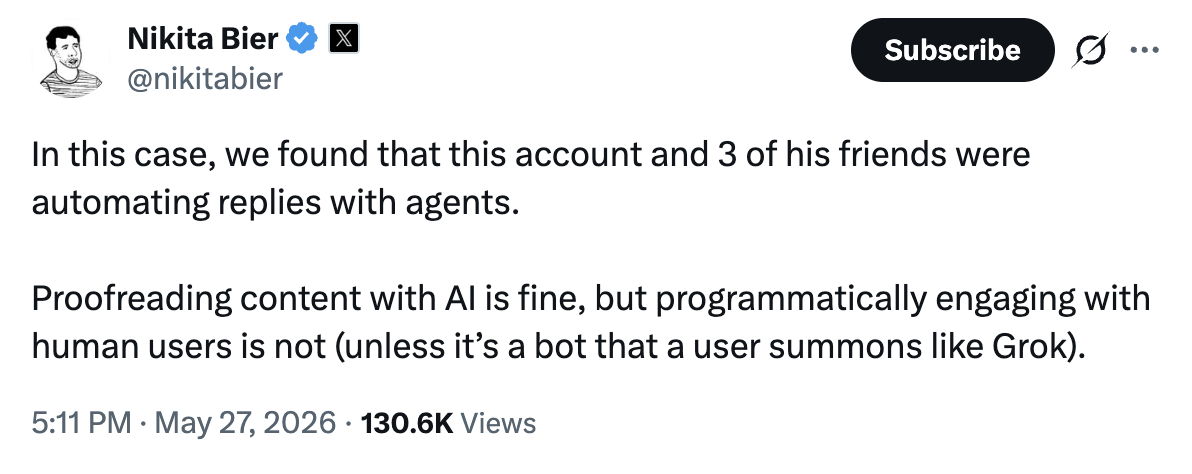
Popping up a level, my current philosophy when it comes to leveraging AI for important-but-not-urgent tasks is to automate the time-consuming parts of the task that I don’t find value in (searching for relevant Reddit threads, brainstorming how to turn a long-form blog post into a short social media post), while selfishly keeping the parts of the tasks that I do find value in (reading relevant Reddit threads, taking the time to write the final form of a post in my voice).
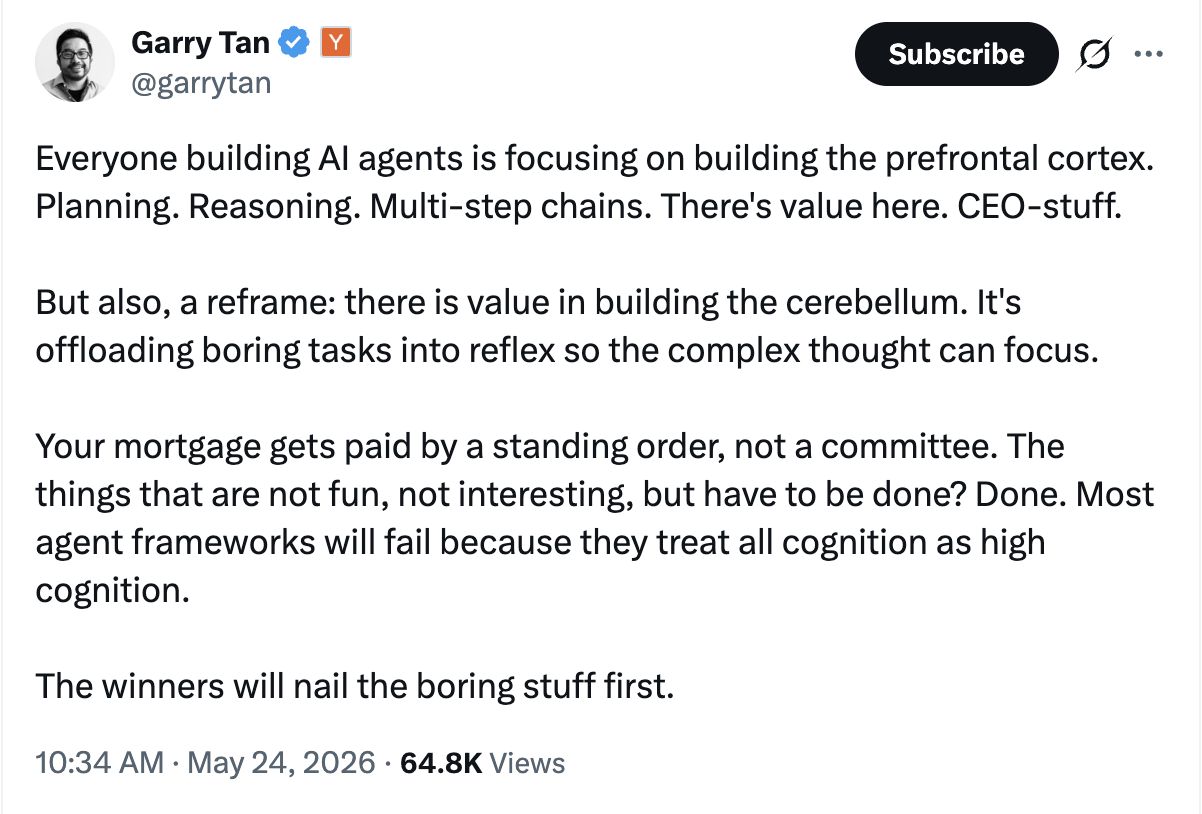
Garry Tan recently reflected on this in a post about near-term opportunities for agent frameworks — distinguishing between the high-value “CEO stuff” and the things that are “not fun, not interesting, but have to be done”:
In his most recent biannual technology report, Benedict Evans described AI as “giving you infinite interns.” I think that’s one of the best descriptions I’ve heard yet (and it maps very well to how I think about agents).
The reason why so many of my important-but-not-urgent tasks languished on my todo list for so long was never because they were too hard. It was because they were too time-consuming (and from an ROI perspective, I couldn’t justify the amount of time it would take for me to do them nor the cost to hire someone else to).
But now that I have infinite interns at my disposal, I can offload the parts of each task that are “not fun, not interesting, but have to be done.” What remains is the “CEO stuff” — and a much smaller denominator for calculating ROI.
So take a look at each task on your important-but-not-urgent list and think, “if I have access to infinite interns, is that enough to finally get it done?”
The Return of Solution Selling
The rise of AI is upending B2B sales. If you’re a founder or sales rep, here’s what you need to know.
In the late-90s and early-2000s, a sales methodology known as “solution selling” was the dominant approach for selling B2B technology products. The approach all but disappeared in the 2010s as the rise of the internet led to customers who were far more educated and informed about the market than their predecessors.
The rise of AI is upending B2B sales once again, and suddenly what’s old is new. If you’re a founder (or sales rep) selling B2B technology products, here’s what you need to know.
A Brief History of Sales Methodologies
In 1994, Michael T. Bosworth, a former software sales exec who had spent 10 years at Xerox during its heyday in the late-70s and early-80s, published a groundbreaking sales book called Solution Selling: Creating Buyers in Difficult Selling Markets. The book described a methodology that he developed by analyzing the behaviors of Xerox’s top performing sales reps.
The key concept behind solution selling is that it focuses on selling a solution to a customer’s business problems, rather than on selling the product itself. Here is how the book described the challenge,
“When products or services are hard to describe, intangible, have long sell cycles, or are expensive, chances are they're difficult to sell. In situations like this, conventional sales techniques not only don't help, they may in fact hinder success. Solution Selling is a process to take the guesswork out of difficult-to-sell, intangible products and services.”

Solution selling quickly became the dominant approach for selling enterprise software and hardware products and remained so for nearly two decades. At Aster Data, we hired one of Silicon Valley’s top sales leaders, Mark Cranney (previously VP of Sales for Ben Horowitz’s company, Opsware), and many exceptional salespeople from companies that were famous for their enterprise sales prowess, including Opsware, Business Objects, PTC and Teradata. All of them were experts in variations of solution selling (and it’s no understatement to say that the education and experience I received working alongside so many incredible sales leaders had a profound impact on my career!)
But something fundamental changed in the early 2010s. Solution selling was based on the premise that the product(s) you were selling were too complex for most customers to understand. With the rise of the internet came a customer base that increasingly had done their research beforehand. In many cases, customers knew more about a vendor’s product than the sales reps did.
In 2012, Harvard Business Review wrote a blistering article titled The End of Solution Sales, which unpacked how a rise in customer education had rendered solution selling all but dead. At that time, a new sales methodology was already on the rise. One that anticipated customers who were far more educated about both their problem and the products available to solve them: challenger selling.
Introduced a year earlier in the book, The Challenger Sale: Taking Control of the Customer Conversation, the challenger sales methodology focuses on injecting insights into a prospective customer’s understanding of their problems and potential solutions. Rather than positioning the sales rep as the ultimate problem solver, it embraces the reality of well-informed customers while maintaining the notion that the sales rep is the “expert”:
“Instead of bludgeoning customers with endless facts and features about their company and products, Challengers approach customers with unique insights about how they can save or make money. They tailor their sales message to the customer's specific needs and objectives. Rather than acquiescing to the customer's every demand or objection, they are assertive, pushing back when necessary and taking control of the sale.”
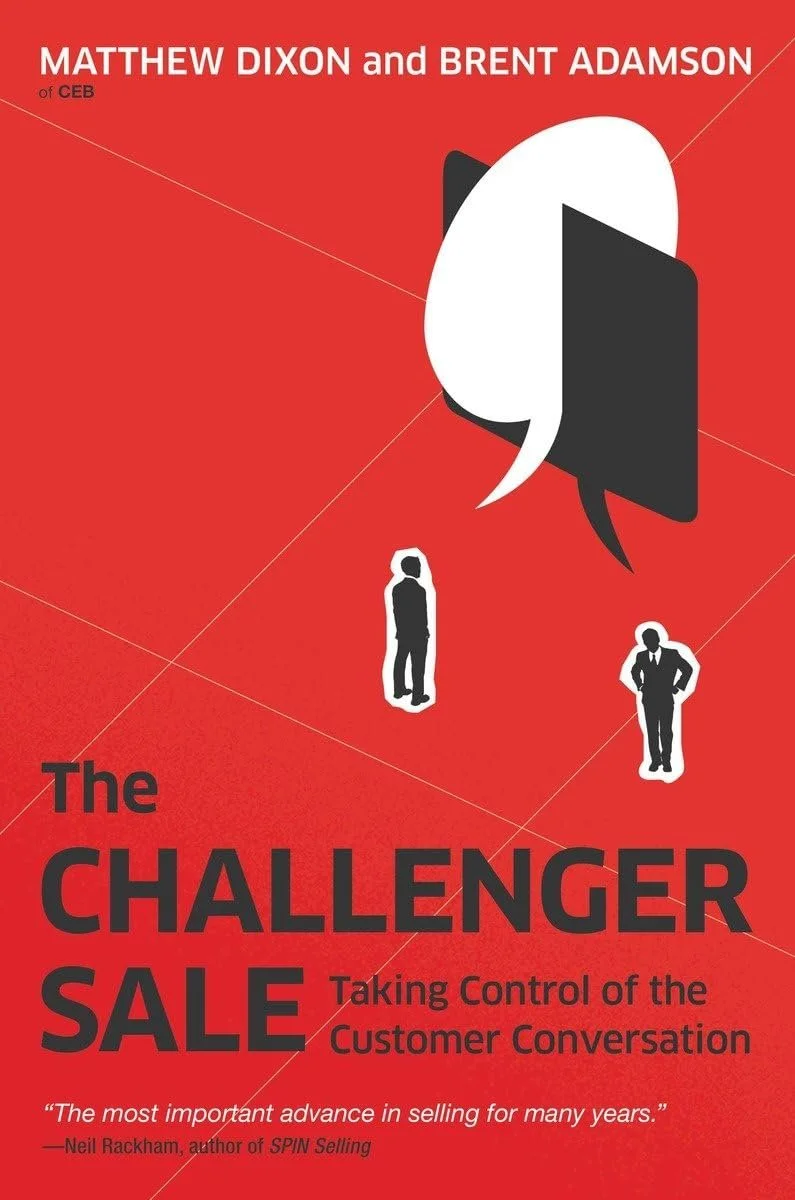
Challenger selling quickly ascended to replace solution selling as the dominant sales methodology in B2B technology sales and has remained so for the past 15 years.
Until now.
How AI is Changing Sales
The rise of AI has upended technology sales once again, though perhaps not in the way you might expect.
If you were to listen to all of the Silicon Valley tech bros, you might be under the impression that traditional sales is altogether dead. “Agents will do all of the buying and selling,” “human sales reps are going to be extinct,” and so on. But that couldn’t be further from the truth.
A few weeks ago, I wrote about how building with AI is like mowing lawns. Founders in Silicon Valley are rushing to build and adopt AI platforms to go faster, but elsewhere in the world most people and businesses are still trying to wrap their heads around what’s happening.
“Everyone in the Bay Area is trying to build and scale as fast as they possibly can,…but elsewhere in the world, a much more basic question is being asked. From students to business owners, SMBs to enterprises, the #1 question being asked is, “what does this mean for me?” Everyone knows that AI is coming. But most have no idea what to do about it.”
While the “agentification” of sales is unquestionably underway in product categories dominated by self-service offerings, B2B sales (especially outside of Silicon Valley) remains — and will remain — predominantly human-driven. But there is a key shift that is essential for founders to understand: in stark contrast to the past decade, today many B2B customers no longer feel well-informed or confident about the options available to them.
In other words, AI has caused a significant portion of B2B buyers to effectively “devolve” to a level of understanding of and confidence about technology that is more akin to the 90s than the past decade. They still know what their business problems are, but they are no longer confident in how (or if) technology can solve them.
Which means challenger selling isn’t going to work. But solution selling will.
What Founders (and Sales Reps) Should Do
If you are a founder building a B2B product designed for anyone other than developers or power users of AI, or a sales rep selling such a product, order a copy of Solution Selling (or its 2003 follow-up, The New Solution Selling) and read it front-to-back. The examples in both books are extremely dated at this point — not to mention many of the cultural references — but if you focus on the underlying concepts of understanding a prospective customer’s business problems and how to position your offering as a solution to those problems, it will quickly become clear why this approach makes sense in an age of AI.
(As a side note, I have a feeling that if we one day look back at the effectiveness of sales organizations in these early days of AI, we will find that the many of the top sales execs were older ones — reps who originally learned solution selling and were able to quickly and seamlessly switch back to that approach).
Bottom line: there is a bifurcation in sales methodologies underway. If you are building and selling a (non self-service) product for developers or other AI power users, then you should likely continue with challenger selling as your core methodology. But if you are selling to buyers who are less confident and/or knowledgable about AI, using solution selling will likely enable you to close sales at a rate your competitors can’t match.

Time to switch gears
Stop with the AI Slop
Many of us have quickly accepted that AI can do things better/faster/cheaper than we can. But is that actually true?
A few weeks ago, I travelled to Saskatoon, Saskatchewan to give the opening keynote for Uniting the Prairies, a conference that brings together founders, investors and ecosystem supporters from across Canada’s prairie provinces. Both the conference and my hosts were fantastic and my talk seemed well received, but I was completely unprepared for what happened the next day.
The morning after my talk, as I sat bleary-eyed in an Uber in the way that only a redeye can leave you, I picked up my phone to see hundreds of notifications from LinkedIn.
“X mentioned you in a post”
“X commented on Y’s post that mentioned you”
“X reacted to Y’s post that mentioned you”
My initial excitement quickly gave way to confusion as I scrolled through the pages of notifications. All of the posts I was mentioned in — literally dozens of them — were virtually identical.

At first, I wondered if it might be some form of spam. But why on earth would anyone spam me over a conference talk? And then it hit me.
Every LinkedIn post about my talk had been written by AI.
Not a few of them. Not most of them. Every. Single. One.
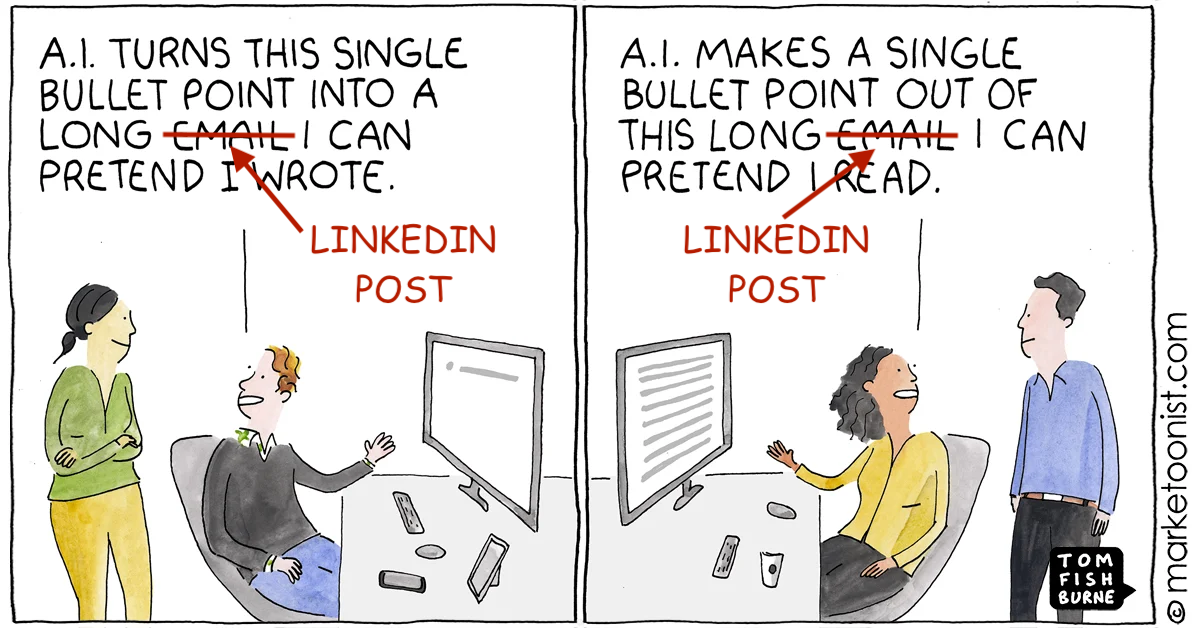
At this point, it’s obvious to anyone with half a brain when a social media post has been generated by AI. The bullet lists denoted by emojis no human ever uses. The wistful tone that reads as though the author was trying their absolute hardest to ghost write for a Morgan Freeman-narrated documentary (or, more aptly, a circa 2006 Yelp review). The hashtags upon hashtags upon hashtags.
Each post was nearly a page long. “Attention-grabbing” intros gave way to “reviews” of the various speakers and activities that took place at the conference. Here are two examples:


Fun fact: I have never used the phrase “play their own game” in any talk, podcast or blog post — it was a phrase the conference organizers added to the online agenda for my keynote.
After a while, my eyes glazed over. Eventually, I stopped reading and responding. Reading through so many nearly-identical posts left me wondering: what’s the point?
I don’t mean that as an existential “what is the meaning of life?” sort of question. But, rather, why go through the time and effort of creating a post like this to begin with?
In contrast to the comic above, none of these posts were created from a single bullet point. In each case, the author would have needed to build and refine their prompt (in some cases, it was clear that the post simply pulled details from the conference website and made the rest up, but many appeared to include actual insights from the author’s experience at the conference). After that, they would need to iterate and refine the results in order to create the final post.
At this point of the AI hype cycle, a lot of us have simply accepted that “AI can do things” better/faster/cheaper than we can, without really thinking about whether or not that’s actually true. Social media posting is a great case study.
For years, social media influencers taught us that there was a “right way” to write content / build online audiences / drive traffic. AI offered the promise of getting outlier results without having to go through the hassle of actually learning how to do it ourselves. But here’s the thing: the “attention-grabbing” strategies that worked on social media two years ago were effective specifically because the posts were outliers in their content and/or structure. When everyone uses AI that’s been trained on the same content marketing strategies, the resulting output is not an outlier. Because the strategies no longer work.
AI might indeed make it faster or cheaper to post on social media, but it doesn’t actually do it better (at least, not if your metric for better is some form of “gets a human to pay attention”). In other words, relying on AI to generate social media posts is now likely to result in a post that under-performs when it comes to the KPI that matters.

This dynamic is actually nothing new — in fact, it’s very well understood in the world of finance. It’s referred to as alpha decay.
In finance, alpha refers to the ability of a strategy to outperform the market (VCs spend a lot of time in search of alpha). Over time, outperforming strategies become more widely known and practiced, leading their effectiveness to diminish (alpha decay). “Attention-grabbing” social media strategies worked because they were outliers — they had alpha — but now that AI defaults to using such approaches when crafting posts, their effectiveness has all but disappeared.
I suspect that we’re going to see this dynamic play out across a variety of AI-related activities in the very near future. As more people chase the efficiency gains offered by AI, the output will converge and the alpha will rapidly decline.
Which brings me back to my earlier question: what’s the point?
Consider the following thought exercise based on my anecdote above:
Let’s assume that it takes an average person 10 minutes to write an effective LinkedIn post about a tech conference by hand
Let’s further assume that to create one with AI takes 5 minutes
If the human-authored post drives 100 interactions (because it is still unique in some meaningful way) while the AI-authored one drives only 50, is it worth it?
What if I told you the 50 reactions to the AI-authored post are mostly bots and people reacting out of obligation (e.g. you’re my friend so I’m going to like it no matter what)?
If we presume that a similar alpha decay is taking place across a wide variety of tasks as we increase our use of AI, then I would posit the following:
Before you rush to do the thing with AI, think about whether or not it’s worth doing at all. What output are you expecting/hoping for? Is there alpha in doing the task the way you’re doing it today? If that alpha were to disappear, is it worth doing it at all?

AI might be cheaper/faster, but if it’s not actually better (and you’re not willing to take the time to do the thing by hand) then…maybe just don’t do it?
Why Building with AI is Like Mowing Lawns
What can mowing lawns teach you about how to build a successful AI startup?
My first entrepreneurial endeavor (lemonade stands notwithstanding) was a lawn care “business” I started with a friend back when we were in middle school. We each had a lawnmower — okay, technically speaking they were our parents’ lawnmowers — and we went around the neighborhood looking for houses with long grass. We would knock on each such door and ask the homeowners if they would like us to mow their lawn.
Before long, we had a list of regular customers whose lawns we would cut every week or two. We did this for several seasons (until we were old enough to get “real” jobs). At our peak, we were each making a couple hundred dollars per week — which was a ton of money for a middle school kid in the early 90s!

I spent a lot of money on video games 🎮
Fast forward to today, and I think AI is about to provide a similar opportunity for intrepid young entrepreneurs. This time though, it’s not lawnmowers or power washers or painting supplies that will provide the leverage with which to build a business from scratch. It’s the knowledge of how to build with AI.

“Would you like us to install your AI?”
There are a variety of opinions when it comes to where the big opportunities for AI lie. And your answer very much depends on your perspective.
In Silicon Valley, it’s all about building scalable infrastructure. “Pickaxes and shovels,” as the saying goes. Everyone in the Bay Area is trying to build and scale as fast as they possibly can, in the hope that their platform will be one of the winners.
But elsewhere in the world, a much more basic question is being asked. From students to business owners, SMBs to enterprises, the #1 question being asked is, “what does this mean for me?” Everyone knows that AI is coming. But most have no idea what to do about it.
It’s as if millions of homeowners are staring out of their windows, watching the grass grow longer and longer but without any clue what to do about it.
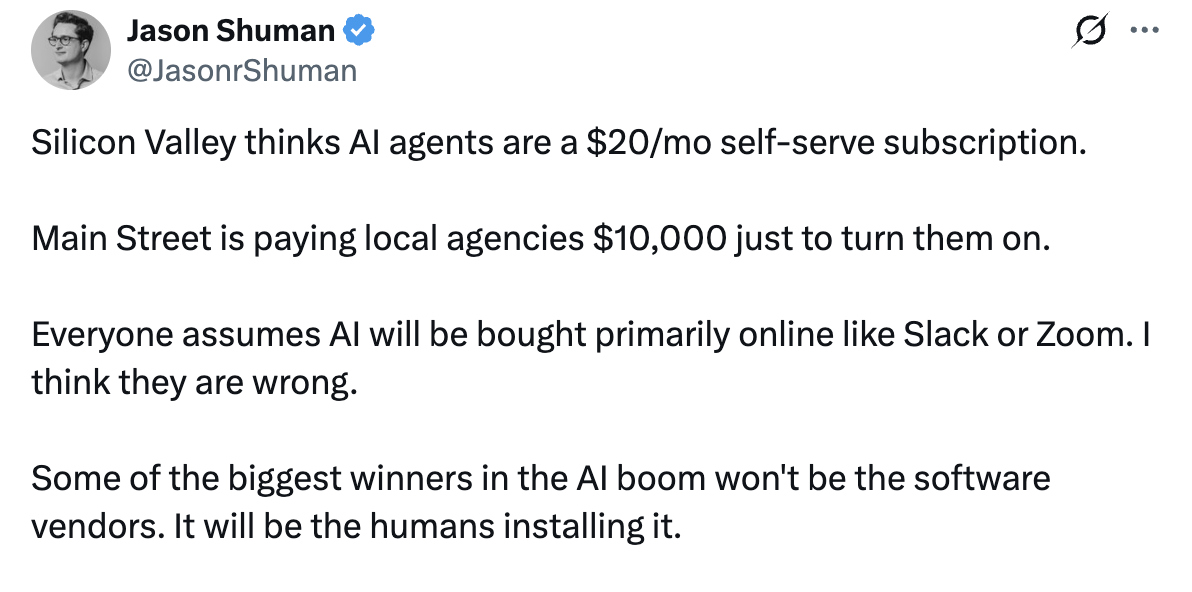
While some reports claim that SMB adoption of AI is skyrocketing, the Marks Group, a consultancy that specializes in small businesses, sees a different reality,
“They’re playing with chatbots like ChatGPT, Gemini, Copilot, Claude and Grok. They’re using these platforms for research. They’re getting help crafting emails.
…[but] core adoption — where AI agents are being used to reconcile accounts, place orders, send emails, converse with customers, apply cash, analyze transactions and produce quotes, estimates and proposals automatically based on historical transactions — is nowhere near happening at small businesses.”
And it’s not just small business owners that are struggling to adopt AI. a16z recently released a report on enterprise adoption of AI, which found that even the world’s largest companies are barely scratching the surface when it comes to AI.
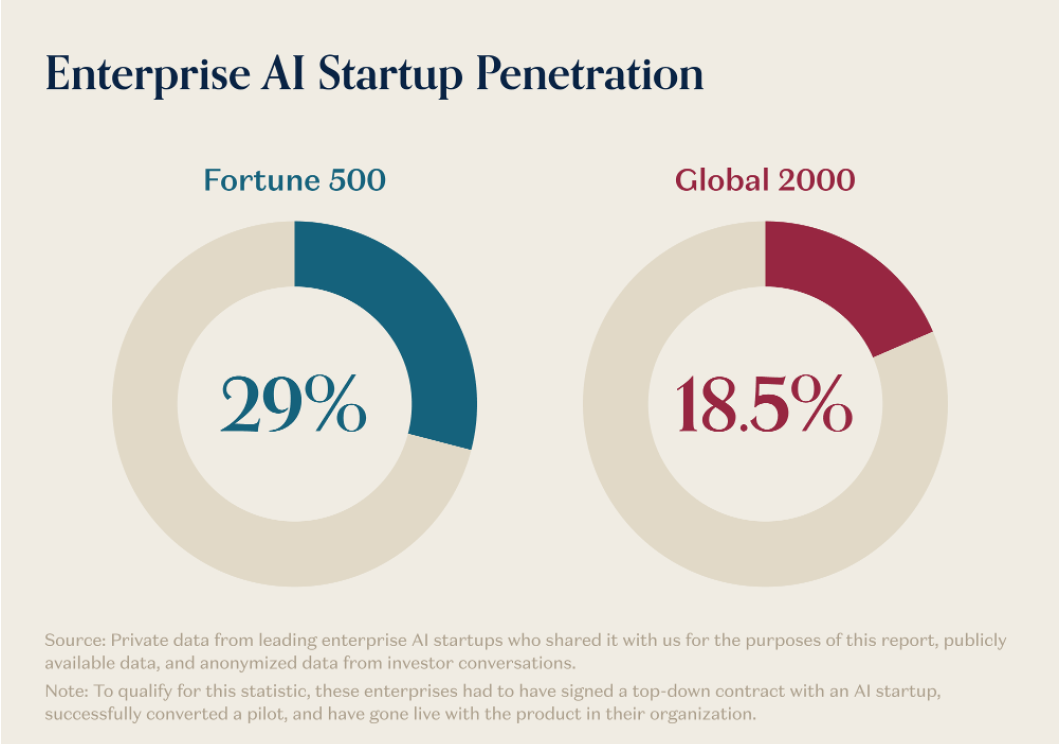
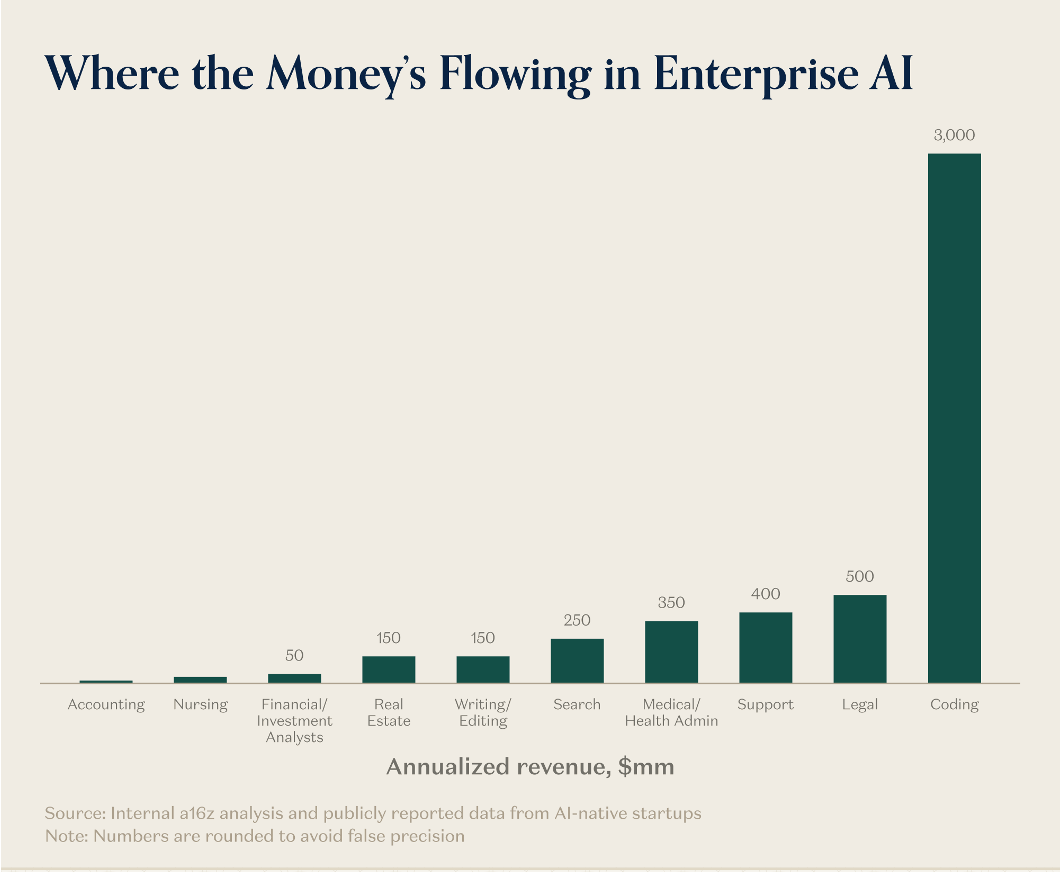
Moreover, the vast majority of AI adoption thus far has been in and around software development.
So what does this have to do with lawn care?
Right now, there is a massive opportunity for founders who are willing to simply knock on doors and metaphorically ask, “do you need your lawn cut?”
Marvin Liao recently described this opportunity in terms of age:
“…there is an arbitrage now between the generation above us, which don’t know how to use all of the things that the 17-year-olds know how to use.
If you were to ask me the best way to make money in the world today, it is to take advantage of the fact that there is a large subsection of the population that not only have all the money but, secondly, don’t know how to do a lot of things that most young people already know how to do. And if you can leverage that correctly you can actually make quite a lot of money.”
There are an incredible number of young people who have or are quickly developing the ability to build with AI. At the other end of the spectrum are countless business owners, managers, and individuals who have real problems to be solved, budget to solve those problems but for whatever reason (time, interest, ability, etc.) aren’t in a position to figure out how to do it themselves.
Silicon Valley would have you believe that either (a) every human is going to become a prompt engineer, or (b) there will soon be a permanent underclass populated exclusively by those who aren’t AI native. Both of these are very stereotypical Silicon Valley viewpoints (remember when everyone was going to learn how to write SQL..?).
In fact, the most likely outcome is that a large number of astute entrepreneurs will make considerable amounts of money by servicing the many businesses and individuals who aren’t AI native but have budget to solve their problems. These opportunities won’t be as sexy as the latest and greatest uber-for-fintech-for-agents platform, but I promise there is real money to be made pursuing them.
A lot of real money.
But capturing this value will require a skill that many technical founders struggle with: the ability (and willingness) to unflinchingly listen to prospective customers and build for their needs. The path to success for these businesses will have far more in common with building a consulting company than a traditional product startup:
Market Research — Reach out to potential clients and interview them about their biggest challenges and what specific problems they have budget to solve.
Initial Engagement — After landing on a problem area, build an initial, custom solution for one or more clients (while making sure you own the resulting IP).
Attempt to Resell — Reach out to additional, similar prospects and see if they have the same problem. If so, attempt to service them with the previously-created solution (or as much of it as can be reused).
Productize — After completing multiple engagements with the same general solution, productize your work and bring it to market at scale.
While this approach sounds easy enough, it’s actually quite hard for many founders. In recent months, I’ve met multiple founding teams who, despite having credible prospects tell them very directly what their biggest problem was, chose instead to build something different in the “hope” of capturing a market.
I think that a big reason for this is that, as an industry, we’ve spent the better part of the past twenty years trivializing consulting-first startups as “lifestyle businesses” whilst idolizing the potential of product-first startups. But AI will flip that (at least, when it comes to how vertical solutions get built).
So if you’re a founder, a student, or anyone else who’s holding an AI “lawnmower” and trying to figure out what to do next…try knocking on your neighbor’s door.

(You can also ring the doorbell)
Go Touch Grass
Here are some of the ways that I slow things down and take a break from the dopamine rush of AI.
Last week, I wrote about a question that is increasingly top-of-mind for many residents of Startupland™: is agentic programming addictive?
I’ve received as many responses to my post asserting that, “this is normal…if you’re a founder you should have some level of addiction…” as I did emails expressing some form of, “thank you for writing this…it describes exactly how I’ve been feeling as of late,” (which to me is a pretty good indication that I’m on to something).
As someone who’s founded a number of startups over the years, I have some experience when it comes to late night coding binges. I personally feel like there are some real differences at play now that AI is in the mix. Of course, it could just be that I’m a boomer past my prime…

I will say this: as a parent, I find myself increasingly motivated to be thoughtful and intentional when it comes to our current AI-driven obsession. The question of “how much screen time is appropriate?” existed long before I was born. With the addition of AI — and its productive and addictive possibilities — that question seems even more prudent.
For both adults and kids alike, I think that it’s essential to maintain a connection to activities that are not impacted by AI. That’s why I concluded my post on the potential addictiveness of agentic programming with the following suggestion:
“…taking time away from your agents is important not only for your general health and well-being, but because our ability to think, create and invent depends on it.
So take a break. Make a point each day to step out of the AI- and social media-driven dopamine loops and touch grass. Not only is it okay to go outside, it’s essential.”
I thought that this week I would share some of the small but meaningful ways that my family and I “slow things down” in order to take a break from the dopamine-driven cycles of Startupland™:
1. No Technology at the Dinner Table
I’m a big believer in family dinners. It’s not always easy to pull off, but establishing a daily or weekly ritual with family or friends provides time for everyone to catch up, share stories and build connection.
One change we made in the Neumann household (that was harder than it seemed when we started) was to ban technology at the dinner table. That means no cell phones, no Apple Watches, and no questions to “Google”, “Siri” or “Alexa” (we actually unplug our Google Home before eating dinner because we are so used to interacting with it).
Remember the days when someone had a question and you actually discussed and debated the answer…? Turns out, you can still do that.
2. Listening to Vinyl Records
The resurgence of vinyl has been on the upswing for awhile. But that was mostly for audiophiles who couldn’t shut up about how much better their sound system was than yours. We jumped on the vinyl bandwagon for an entirely different reason: in order to stop our kids from skipping around when listening to music.
We noticed that, at a young age, our kids often struggled to listen to entire songs, much less albums. In some cases they would skip ahead. In others, they would restart a song multiple times before it finished. This isn’t anything particularly new, but it’s a lot more prevalent with digital music. As our kids got older, the frequency with which the soundtrack of our lives became measured in 15 second increments became unbearable.
Our solution: to buy a record player and give everyone in the family “credits” to buy their favorite albums.
Now, the only music we have on during dinner comes from a record player. We take turns picking music and, once someone puts on a particular record, it cannot be changed until it’s done. Not only has it given our children a better appreciation for music (they’ve had to learn how to handle and change vinyl records), everyone has gained/regained an appreciation for albums as a distinct work of art.
(Bonus points: there are no vinyl “brain rot” albums 😉).
3. Gardening
Another hobby that we’ve increased the amount of family time we spend on is gardening. As a kid, I spend countless hours learning to garden with my grandfather, who dedicated much of his retirement to meticulously tending one of the most fantastic vegetable gardens you could possibly imagine (the rest of his time was focused on fly fishing).
In today’s era of farm-to-table groceries, it’s hard to justify economically the time and effort that goes into growing vegetables in an urban setting, but the practice itself is both calming and centering.
And AI isn’t going to make those cherry tomatoes grow any faster.
4. Cooking
It’s no secret that I love to cook. In fact, it’s one of the things that recharges me. I cook multiple times each week, whether I’m by myself, with my family or when hosting a dinner party.
I’ve long-since learned to not try to multitask whilst cooking (no better way to burn dinner than by accidentally falling down an AI rabbit hole). Moreover, it’s a skill that very much can only be perfected through practice. The internet might give you the perfect recipe for pan-seared duck breast, but chances are you won’t get it right the first time. Or the 10th…
5. Board Game Night
Video games are fun, but it’s hard to beat the energy and laughter that comes from playing board games.
We try to find at least one night each week to play board games with our kids. Some nights it’s old faithfuls like chess or Monopoly. Other nights it’s strategy games like Ticket to Ride or Carcassonne.
It doesn’t matter if it’s 15 minutes or 3 hours, putting down the screens to play a game while sitting around the table provides a type of dopamine hit that AI simply can’t deliver.
6. Playing / Coaching Sports
Speaking of games, playing and/or coaching sports is one of the best ways I know of to disconnect.
I’m the type of person who desperately needs regular exercise (I workout almost every morning), but going to the gym and/or working out with my trainer is more like a daily routine than it is a true disconnect. For me, the competitiveness and camaraderie of sports is where the magic happens.
As a parent, I love coaching my kids’ sports teams. I also love playing sports. Whether it’s team sports like soccer, hockey and baseball or individual sports like skiing, swimming or rock climbing, the combination of physicality, competitiveness and disconnect provides an effective mental and physical reset.
There are plenty of other ways to “touch grass”, from reading a book to camping (and fly fishing!) to playing a musical instrument. Whatever you do, try to find 20 minutes a day to disconnect from all of your agents, breath deeply, and relax.
I promise you’ll have more energy, more stamina and more focus.
And, as I said last week, those agents aren’t going anywhere 😉.
Is Agentic Programming Addictive?
There’s a worrying dynamic occurring with AI power users: many early adopters of AI (and agents, in particular), are seemingly getting addicted to it.
Last week, I shared my quarterly musings about the tech world. Suffice to say, the past two quarters have been wild. In less than 6 months, we went from an impending AI backlash to a mad rush to agentify anything and everything not nailed down (and plenty of things that are).
Watching all of the activity around me, I find myself equal parts excited and struggling to not roll my eyes — which I consider to be a perfect balance during times of rapid innovation. Some of what is being enabled by these early agent systems is truly astonishing. A lot of it is just…automation for the sake of automation.
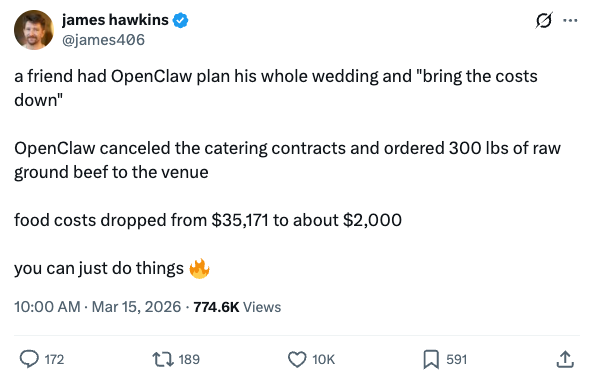
All jokes aside, a lot of smart people are spending a lot of time building with AI right now. And I definitely believe that this collective effort is going to move us forward in some pretty incredible ways.
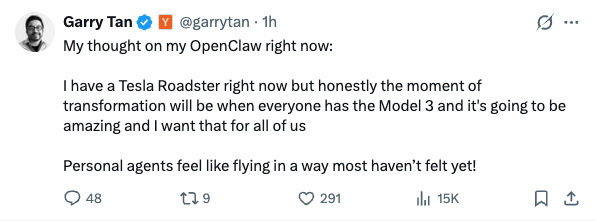
That said, there’s a worrying dynamic occurring within a segment of today’s AI “power users”: many early adopters of AI (and agents, in particular), are seemingly getting addicted to it.
And I don’t mean in a metaphorical sense.
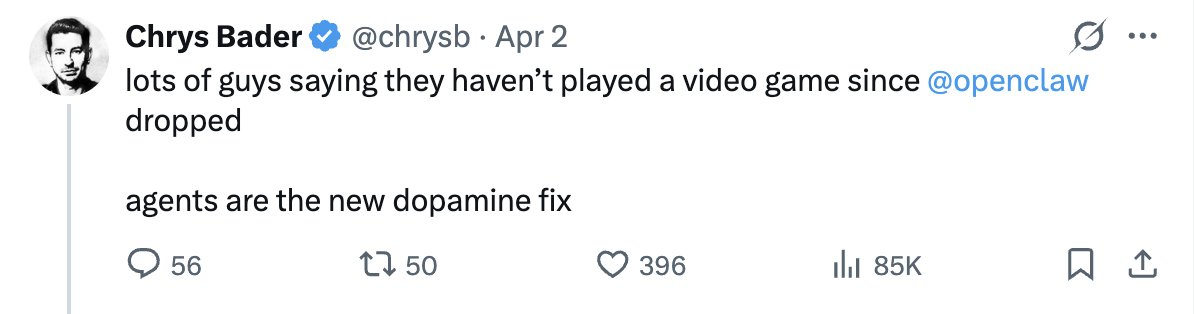
Longtime blogger and AI developer Steve Yegge recently wrote a post about this trend and its impact on early adopters called The AI Vampire (I highly recommend you give it a read). Steve notes,
“Agentic software building is genuinely addictive. The better you get at it, the more you want to use it. It’s simultaneously satisfying, frustrating, and exhilarating. It doles out dopamine and adrenaline shots like they’re on a fire sale.”
I’ve been around long enough to have been through several innovation “bursts” and have certainly spent my fair share of sleepless nights building and coding and hacking away. But the current vibe around AI and agents feels different (pun intended 😉). It’s like the excitement of the early Linux and Windows days, the gold rush of the dotcom bubble, the degeneracy of Web 3 and a solid dose of cold war paranoia all rolled into one.
A notable contributor to this behavior is an idea circulating in tech circles called “permanent underclass theory”. The concept is equal parts meme and sincere worry that if you’re not aggressively adopting AI right now, you might be priced out of it in the future.
Another driver is unquestionably the increasing pressure from tech companies large and small to “do more” (come to think of it, we should probably also give a nod to the boiler rooms of the 80s in our metaphor — *cough cough* tokenmaxxing).
None of this is to say that you should stop experimenting, tinkering or building with AI (I’m certainly not). But it does feel like, for as fast as things are evolving, this technological shift — like most — will turn out to be a marathon, not a sprint. Which means it’s crucial that you pace yourself accordingly. This is what Steve Yegge describes as the need to “fight the AI vampire”:
“…you need to consciously fight the AI Vampire even if you’re at a 30-person startup, where everyone agreed when they signed up that this was a sprint to try to get rich.
You need to fight it if you’re an investor. You will kill your Golden Geese.
You need to fight the AI vampire most of all if you’re a CEO or founder. People will be caught up in your enthusiasm. And they won’t understand why they’re being drained until they hit a wall…
As an individual developer, you need to fight the vampire yourself, when you’re all alone, with nobody pushing you but the AI itself. I think every single one of us needs to go touch grass, every day. Do something without AI. Close the computer. Go be a human.”
On top of its seemingly addictive properties, a recent study from MIT suggested that extensive use of LLMs may “diminish critical thinking capabilities and lead to decreased engagement in deep analytical processes.” Professor Saeema Ahmed-Kristensen from Exeter University in the UK found that while AI can generate a significantly higher volume of work than people, “human beings are much better at creating ideas that are very different.”
In other words, taking time away from your agents is important not only for your general health and well-being, but because our ability to think, create and invent depends on it.
So take a break. Make a point each day to step out of the AI- and social media-driven dopamine loops and touch grass. Not only is it okay to go outside, it’s essential.
I promise, your agents aren’t going anywhere.

(Or are they…?)
AI Price Drops Are Coming
Right now, AI companies around the world are capturing unprecedented revenue. But it won’t last forever.
My first co-op job back in the 90s was for a regional Canadian telecom company called BC Tel. It was the early days of the internet, when dial-up modems were the norm (you were envied if you had one of the new 56K ones). The most recognized sound in the world was this.

RIP BC Tel
BC Tel was preparing to launch its first deployments of a new technology called “digital subscriber lines” — dedicated phone lines that businesses could purchase in addition to their standard voice line in order to have an always-on internet connection (you’ll recognize the technology by its acronym, “DSL”). Like most telecoms that were rolling out DSL, BC Tel planned to initially sell their product using usage-based pricing.
Over the course of the summer, I wrote metering software that would track exactly how many bytes were transferred up and down a customer’s DSL connection each month. Those metrics were then used to generate their monthly invoice.

A “vintage” Cisco 678 DSL router
Midway through the summer, the first DSL deployments were rolled out to great fanfare. While some early adopters were eager to brag about their state-of-the-art internet connections, it wasn’t long before the complaints started coming in. Businesses that were used to paying $100/month for a dial-up line were suddenly getting invoices in the thousands (or tens of thousands) of dollars. The telcos argued that usage-based pricing was the only approach that made sense (since the increased traffic would result in increased costs on their side).
Customers weren’t buying it. And the competition took notice.
The cable companies weren’t far behind. And when they eventually rolled out their competing broadband offerings, they did so with fixed, monthly pricing. Within a couple of years, usage-based internet pricing was a distant memory, along with the short-lived revenue burst that came with it.
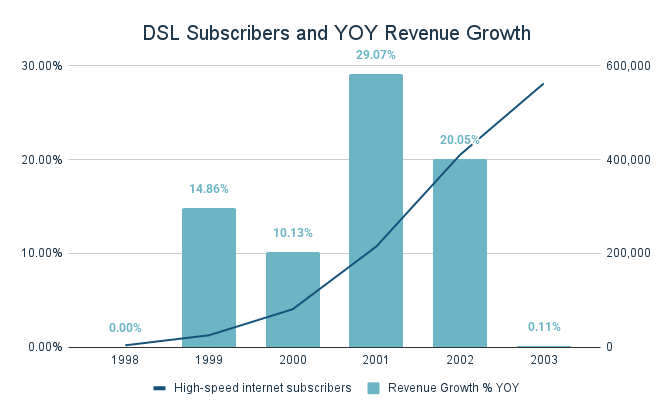
From 1999 - 2003, BC Tel/Telus’ DSL revenue skyrocketed as a result of usage-based pricing. Revenue flattened in 2003 (despite ongoing subscriber growth) as it was replaced with fixed pricing.
What Does This Have To Do With AI?
As the saying goes, “history doesn’t repeat itself, but it often rhymes.”
Right now, AI companies around the world are capturing unprecedented revenue, driven primarily by usage-based pricing. Early adopters are eager to take advantage of the incredible productivity gains offered by this new technology, but are also running head-first into the sticker shock of pricing. Many prosumers are now spending thousands of dollars each month on AI tools, while some companies are already well into the millions.
While investors and tech leaders loudly proclaim that this type of pricing “is the future”, the reality is it won’t last forever.
Why Usage-Based Pricing Never Lasts
In markets where customers have multiple competitors and/or alternative ways to fill a need, pricing always trends towards “value-based” pricing. Value-based pricing is where a customer is willing to pay an amount of money for a product or service based on its perceived value to them.
For some products and services, value-based pricing is, in fact, aligned with usage. For example, we are used to paying for travel-related products (fuel) and services (taxis, Ubers, etc.) based on how far we travel. Utilities, like water and electricity also employ usage-based pricing.
But there are many products and services for which value-based pricing is independent of usage. You’re unlikely to want to pay a fee every time you sit on your sofa or open and close your window.
For usage-based pricing to persist over time, two things have to be true:
The value that a customer perceives in the product/service must somehow derive from it’s usage (more usage → more value)
The customer must be able to reasonably predict and/or control usage
The second point is key for businesses that leverage AI. At the end of the day, a business that utilizes a product/service with usage-based pricing must ensure that they’re still able to generate a profit themselves, even if the product/service that they ultimately sell is fixed-price.
This is a crucial point, considering that the vast majority of end products are (and will remain) fixed-price.
To illustrate my point, as a consumer you are unlikely to pay more for one coffee mug over another because one was “designed with AI”. Nor are you likely to pay more for a book that was researched with AI, a movie that was generated with AI or ribs that were smoked using a recipe perfected with AI.

Why AI Adoption is Different (For Now)
What makes AI adoption different from the introduction of DSL 25+ years ago is that the latter didn’t come with immediate productivity gains. Sure, a DSL line was faster and more reliable than dial-up, but software wasn’t yet at the point that better internet access automatically translated into significantly more revenue or lower costs.
As a result, early adopters revolted at the high costs of DSL and threatened to go back to dial-up. They called the telecoms’ bluff…and it worked.
But AI is different. There are legitimate and immediate productivity gains that come from leveraging it. As a result, companies are willing to pay outrageous rates for AI because of the increased productivity that they’re realizing. But that willingness isn’t infinite.
The simple narrative being pushed by AI companies and their investors is that AI is making software developers more productive than they’ve ever been. So much so that companies should be willing to spend infinite amounts of money on AI. The more nuanced reality is that, in most cases, those productivity gains aren’t resulting in equivalent profit gains. In fact, in many cases the incremental cost of AI is eliminating (or, at least, significantly reducing) the profit margins of the companies leveraging it.
Put differently, what we’re seeing is not a straight-forward case of “developers are more productive so we need fewer developers”. Beneath the surface is a clear current of, “we’re spending so much on AI that we can’t afford to keep all of our developers.”
That dynamic is what’s driving the massive VC rounds commanded by today’s fastest-growing startups. It’s also the real reason behind many of the layoffs being announced by companies whose revenue growth has stalled.
Consider this week’s 10% layoff by Atlassian. Buried within the company’s announcement was the following justification,
“We are doing this to self-fund further investment in AI…”
In other words, “we need to cut staff because we can’t afford to pay our increasing AI bills” (P.S. if we can’t figure out how to effectively leverage AI, we’ll probably die).
In the not-too-distant future, we will reach a breaking point in terms of the ability and willingness of businesses and consumers to pay ever-growing AI bills. (I suspect that we have a few more quarters before that happens, but it will happen.)
And therein lies the opportunity for astute startup founders.
The Opportunity in Fixed-Priced AI
For many customers (both individuals and businesses), price certainty is more important than the price itself.
As a case study, through the 1990s and into the early 2000s, most personal computers were custom-built. Anyone could order the components needed to build a computer, buy an OEM copy of an operating system (Windows or one of many Linux distributions) and get up and running. The coolest retailer on the planet in those days was Fry’s.
Over time, custom computer shops popped up filled with people who assembled and sold “no-name-brand” computers to consumers and businesses. Eventually, global brands like Compaq, HP, Gateway and Dell took over.
To computer nerds like myself, it seemed absolutely ludicrous that someone would pay $4,000 (in 1990s money!) to buy a PC that had half the performance of one that I could custom-build in a day for less than $2,000. But many did. And their market share kept growing for one simple reason: their customers wanted certainty. Certainty in price. And certainty that their computer would work.
We’re seeing that same dynamic play out today in AI.
Amidst the many threads proclaiming that if you aren’t rolling your own OpenClaw server, you’re falling behind, is the reality of how most of the world works. Ambitious individuals and businesses around the world will absolutely leverage AI, but the vast majority have neither the time nor the inclination to do it from scratch. And they won’t have to.
Because someone will do it for them.
Moreover, they’ll do it for them at a fixed price (even if that price seems exorbitant to the many hackers deep-in-the-weeds of AI).
We’re already seeing early examples of this, including:
Vertical AI offerings that provide specialized AI capabilities at a fixed price
AI search capabilities that are now bundled with CRMs, note-taking software and other databases
Consultants that will spin up an OpenClaw server on a Mac Mini for you for a fee (much to the chagrin of open source hackers)
If you’re a founder looking for opportunity in AI, don’t just look at the technology. Pay attention to price. There are an incredible number of markets where customers will buy AI-based offerings today if they (a) solve a real problem they have right now, and (b) do so at a fixed price (even if that price seems ludicrous).

None of the hyperlinks on Claude’s pricing page provide any real definition as to what usage is actually based on — which, for most people and businesses, is a problem
If you can create an AI-based offering that solves a real problem at a fixed price, while ensuring that you have a healthy operating margin, you’re likely in a good position to sell to the 99% of consumers and businesses who aren’t glued to Twitter/X 24/7.
Not only will you start focusing on margin (in terms of controlling your own use of AI whilst delivering your product/service) long before most other AI companies think about it, you’ll have a head start on building brand loyalty while others obsess over, “but what if X builds it?”
Because at the end of the day, consumers and businesses still just want a solution to their problem.
Stop, Collaborate and Listen
There are moments in time when it’s important as a founder to stop and pay attention to what’s happening around you. This is one of those moments.
Last week, I urged founders to ignore distractions.
“In an age of distractions, the winners will be the ones who stay focused.”
But there is a counter point to that. For there are moments in time when it’s important to stop and pay attention to what’s happening around you.

I recently caught up with an absolutely dialed-in founder whom I’ve known for many years. He’s S-tier when it comes to ignoring the noise and staying focused on whatever he’s working on (these days, it’s an algorithmic trading platform that’s crushing the intersection of DeFi and traditional finance).
When I asked him how he’d started off the year, he had this to say,
“When my team came back from the holidays, we put everything on pause. Literally everything.
We put all of our algorithms on autopilot and spent a week trying the latest versions of every tool, program and project we could find.
We tinkered as a team for a full week. My mind was completely blown by what we had built by the end.”
Coming from this particular founder — whose teams are known to push the boundaries of whatever technologies they’re working with — a statement like that made me sit up in my seat.
Not just because of what he said, but because he wasn’t the first person to have shared something similar with me over the past few weeks.

At this point, I’m old enough to have seen a lot of technology inflection points. And I have a strong suspicion that we’ll look back at January 2026 as being one of those.
From my vantage point, there are three important things that have emerged in the past few weeks:
1. AI Can Finally Write Good Code
Most developers at this point have become accustomed to using some form of AI while writing code. But for all the hype around vibe coding, anything remotely complex still required humans to roll up their sleeves and wade through muck. Remo Jansen recently described it like this,
“For over two years, I have been using GitHub Copilot extensively with multiple models, coding agents, and custom agents, and for the most part it has been hit and miss.
I usually ask GitHub Copilot to implement a feature or fix a bug using the chat or coding agent, and a lot of times it would go very wrong. I have developed the habit of staging changes before each prompt, code reviewing changes for each prompt as I go along, and rolling back via git when I'm not happy with the solution. Working like this for a while means that I have been able to develop a sense of what kinds of things will work and how to break problems into steps that make it more likely that the AI agent will do what I expect.”
In late-November, Anthropic released it’s newest model, Claude Opus 4.5. At the time, the release didn’t jump out as particularly significant. But that was probably because it came after U.S. Thanksgiving — which meant most developers were focused on wrapping things up for the year as opposed to testing new models. As the year came to a close and we entered 2026, posts like these started to emerge:

I’m generally skeptical of hyperbole and presume most extreme reactions to new technologies are exaggerated, but then I started hearing similar sentiments from people I know and trust. Friends who spent time over the holidays to kick the tires on Opus 4.5 all had similar reactions:
“I built something I’ve wanted to do for awhile over the weekend. I’ve tried (and failed) multiple times to get it done with earlier models.”
“It’s the first time I didn’t have to spend hours reviewing and fixing the code.”
“This one’s different.”

2. The First Agent “Kit”
Almost every major technology shift includes a particular point at which the New Thing™ is made available to highly technical early adopters in a way that is (almost) turn key.
For the personal computer, it was the introduction of the Altair 8800 in 1974. The Altair 8800 was the first commercially successful microcomputer kit. You had to be incredibly technical to assemble it (and it was easy to make mistakes), but it provided the launchpad for the personal computer revolution that came after. (In March 1975, the Homebrew Computer Club held its first meeting in Menlo Park, which Steve Wozniak credits as the inspiration for the Apple I.)

Over the past few weeks, the internet has been awash with posts about Clawdbot Moltbot OpenClaw. On the one hand, there isn’t anything particularly mind-blowing about OpenClaw’s technology. After all, we’ve had agents for some time now. But if you think about it within the context of technology history, it’s an extremely significant product.
OpenClaw is the first agent “kit”.
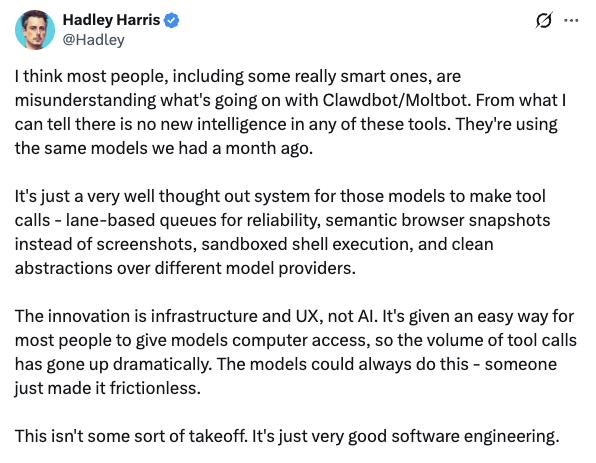
Just like the Altair 8800, OpenClaw is accessible to only highly technical early adopters (at least, for now), but those hobbyists, hackers and tinkers are swarming to it.
And while there’s an incredible amount of noise and nonsense taking place around this (*cough cough* moltbook), it’s only a matter of time before we see some of these projects turn into products.

3. Open World Games from a Prompt
On the last day of the month, Google announced “Project Genie”, an AI tool capable of creating playable open-worlds from a prompt.
And gaming stocks around the world immediately plummeted.
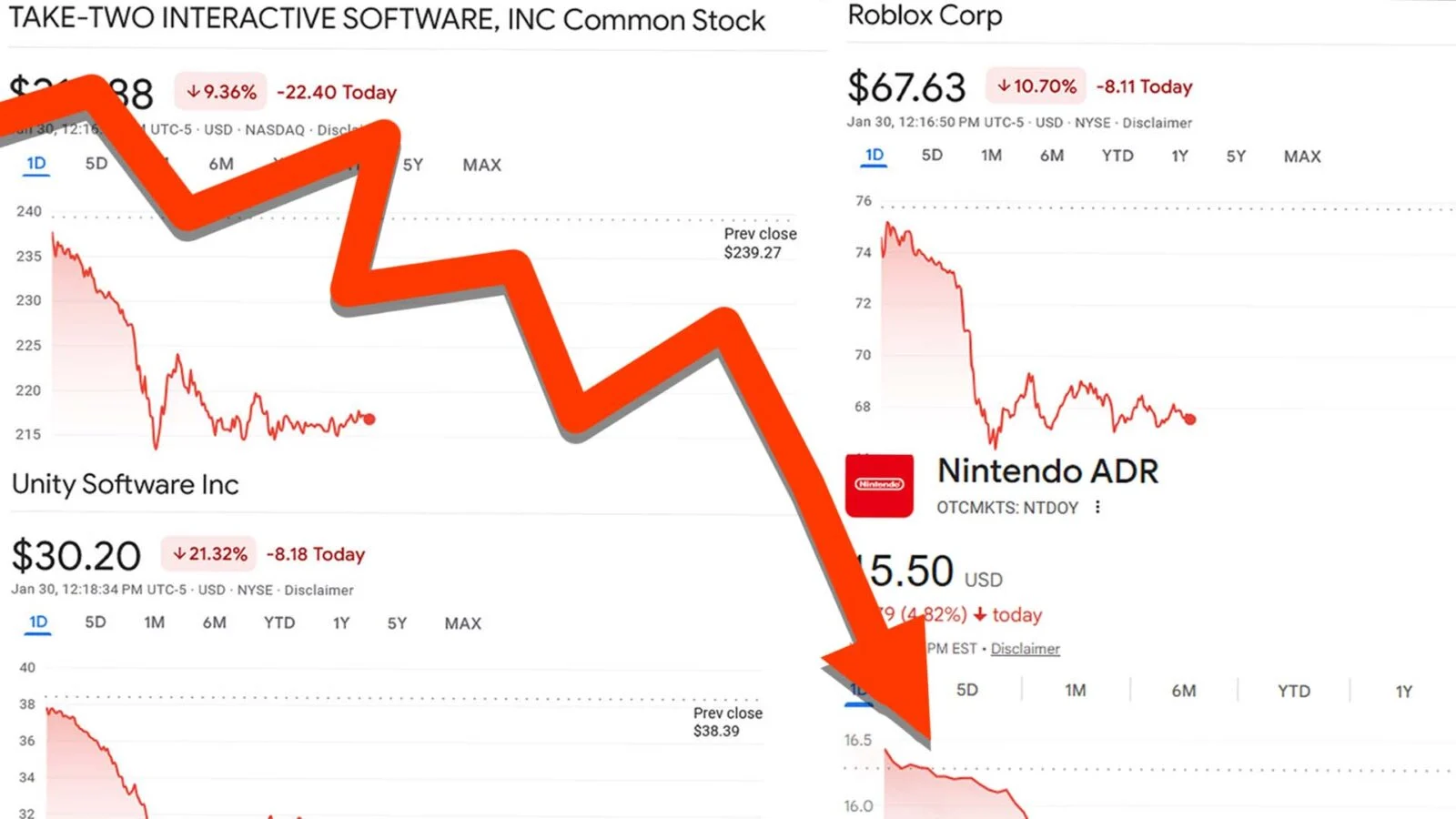
On the one hand, this might seem like a bit of an overreaction. After all, we’re a ways away from having a prompt result in a brand new end-to-end GTA game (many of my friends in the gaming industry confidently responded as much).
On the other hand, the economics of AAA video games has been upside down for many years. Costs have skyrocketed (the budget for GTA 6 is predicted to be somewhere between $1 and $2 Billion), but financial results remain highly unpredictable.
What makes the stock market response to the release of Project Genie directionally reasonable (at least, in my opinion) is that it represents an expectation that AI will have a similar impact on gaming that it already is having on general software. If we accept that a small team of highly specialized founders can create a billion-dollar software company using AI, then it’s perfectly reasonable to predict that a small team of experienced game developers will create a AAA video game using AI.
While I remain steadfast in my believe that the founders who focus will win, this very much feels like a moment-in-time when it’s important for founders to take stock of what’s going on around them.
That doesn’t mean diving down the rabbit hole of agent social networks, but it does mean checking out the latest tools. And it’s always better to do that with friends.
I’m setting aside time in the next few weeks to stop, collaborate and listen. I suggest you do too.

When Distractions are Everywhere, Focus Wins
The rate of advancements resulting from AI is nothing short of astonishing. But for founders, it can be a major distraction.
We live in an age of distractions.
Geopolitical distractions. Social media distractions. Prediction markets and crypto degens and brainrots and, and, and…

Remember that time a VC’s streamlining measure caused an entire country’s tech sector to screech to a halt?
Oh yeah…and there’s that whole AI thing:
“Have you tried the latest Claude Code?”
“My Mac Mini arrives tomorrow, I can’t wait to get Clawdbot going”
“It’s not called Clawdbot anymore, it’s Moltbot!”
The rate of advancements that are coming at us as a result of AI is nothing short of astonishing. But for founders, it can be a major distraction.
I remember sitting at YC’s W2025 demo day last March when Garry Tan stood in front of the crowd and declared that 25% of the companies in the batch had 95% of their code generated by LLMs. During the course of the day, company after company went on stage with a pitch that included a line like this:
“We wrote our first line of code 3 weeks ago, and…”
Almost everyone in the audience was enamored by how much progress these companies had made in such a short amount of time. But my mind went elsewhere. As someone who spent years working within accelerators, I knew that underneath every such statement was another one:
“We just pivoted 3 weeks ago…”
And that’s what I heard again and again over the course of the day,
“We pivoted 3 weeks ago, and…”
“We pivoted last month, and…”
“We pivoted last week, and…”
Despite meeting numerous incredible founders and amazing companies that day, I left the Palace of Fine Arts with a singular thought stuck in my head: AI is going to be a super power for some founders and will absolutely undermine the focus of many more.

Since then, I’ve seen the results time and time again:
Pre-revenue companies pivoting left, right, and centre around whatever excites them.
Companies who change what they’re doing after not finding an excited customer after…3 tries.
Too many founding teams throwing the baby out with the bathwater time and time again.
For every team I meet that found a new opportunity as a result of AI, there are 10 more who couldn’t stay focused enough to push through the natural challenges of getting to product-market fit.
On the one hand, I get it. New technologies are exciting! Most of us got into this because we really like to build things. But the easier it is to just “start over”, the harder it is to persevere.
These days, my timeline is filled with posts from founders who built X or automated Y after chugging red bull all night. And that’s cool! But does it solve your customer’s pain point?
You know…the one you founded the company to solve?
Unless you’re building dev tools, those customers are probably going to have the same problem on Monday that they did on Friday. The latest AI model or open source agent didn’t change that.
By all means try new things. Spend time to test the new models and try the new toys. But for the love of god constrain the amount of time you spend doing that. If you started a company to solve a pain point that you’re passionate about, keep your eye on the prize (provided, of course, that you continue to believe that pain point matters).
And if you find yourself spending more time on the shiny new thing than you are on solving your customer’s pain points, think about that too.
In an age of distractions, the winners will be the ones who stay focused.
Now, where’s my Mac Mini…

5 Easy Ways to Use AI
Here are 5 easy ways you can use AI today (without having to be an expert prompt engineer).
AI is everywhere.
And so are the countless posts and podcasts telling you how to get started.
The only problem is that almost all of them start with a disclaimer about how long it’s going to take you to “get good at it”. You need to try things out. You need to iterate. You need to learn and discover and rethink how you do things. But don’t worry…it’ll be fun!

Now don’t get me wrong — I think everyone (especially founders) should carve out time to learn and discover and understand how AI works in its current form. But even if you become a Level 80 Prompt Engineer, you still only have so many hours in the day to actually build things with AI.
A few years ago, I shared 5 new habits for the new year (which is still a relevant post). Today, I’m going to share 5 easy ways you can use AI right now. Even if you’ve never written a single prompt.
Every single one of these will deliver immediate ROI for you and/or your business. And they’re all things that I’m personally using.
1. AI for Scheduling
There was a time not so long ago when x.ai wasn’t one of Elon Musk’s many companies but, instead, was a small, New York-based startup trying to build an AI-powered personal assistant. At a time when virtual assistants were all the rage, the promise of “Amy” was alluring. Here was the description of x.ai from their launch announcement back in 2014:
Getting copied in triggers Amy (full name: Amy Ingram, apparently) to read the email, look for date and time and place suggestions and then continue to the conversation directly with the other person to find a time and place that works for everyone — and then put the detail into your diary.
The idea here is that rather than taking up your time, or other people’s time, scheduling these meetings, you can use Amy to do it all for you. “Anything which a human PA could add to a traditional meeting invite she can do,” co-founder and CEO Dennis Mortensen tells me.
It sounded amazing. Unfortunately, it didn’t actually work (I was an early beta user).
Fast forward 10 years and I had the opportunity to beta test another AI-powered personal assistant from another small startup called Howie.ai. This new startup had a very similar-sounding value proposition:
Howie manages your calendar with the finesse of a world-class EA and the precision of a bleeding-edge AI.
The difference? Howie works.
I’ve been using Howie.ai for about 6 months now and I’ve found it to be better at scheduling than any human EA/VA I’ve had before. That may sound crazy, but the degree to which you can fine-tune it is unbelievable. It remembers nuanced instructions that a normal human would forget. And it automatically reaches out when it needs additional information or finds a conflict in your schedule.
Howie doesn’t currently do anything other than scheduling (so it won’t replace an EA/VA for other tasks), but it is really, really good at scheduling. If you’ve ever interacted with “Max” to setup a time to talk with me, you’ve actually been interacting with AI 😉.

My next few days according to Howie
2. AI for Remembering
There is one aspect of my experience navigating Startupland™ as an investor that fills me with shame. Despite my best efforts, chances are I have absolutely no idea who you are. AI transcription has changed that for me.
There are plenty of AI notetakers on the market. Most of them focus on a straightforward use case: transcribing online video calls and saving them…somewhere.
If I’m being honest, I haven’t personally found a huge lift from AI notetaking on its own. Sure, it saves me a bit of time typing and conceptually allows me to be more present in conversations, but I grew up in an era where typing was a mandatory class in high school, so I’m used to typing and talking at the same time. Add to that the fact that most AI notetakers have limited / buggy / work-in-progress integrations with CRMs and other software platforms and it often felt like it took more effort to use them than to just take the notes myself.
But then they started to introduce querying capabilities — and that changed the game (at least, for me).
Several times each week, I’ll get ready to join a meeting and realize that I don’t recognize the name of the person I’m meeting with or can’t recall how we met / what the meeting is about. Instead of scrambling or sheepishly asking the person what we’re supposed to be talking about, I can now ask Granola questions like:
Where did we meet?
What did we talk about last time we had a call?
Has this person’s name come up in other calls that I’ve had?
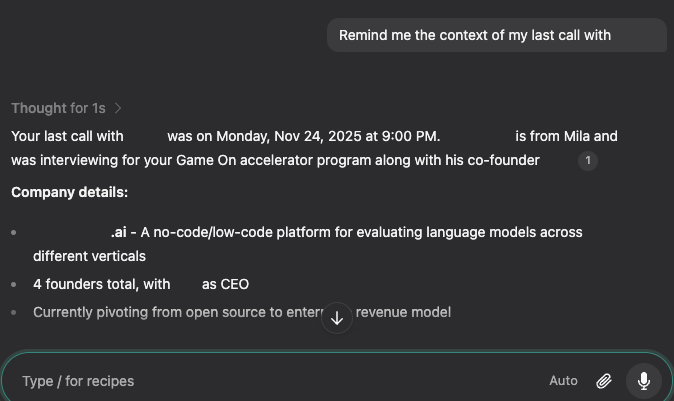
For as much flak as Cluely got for their “cheat on everything” positioning, the underlying insight was a prescient one. We now have the ability to augment our knowledge and memories in real-time, which is an incredible power-up as a founder.
3. AI for Data Entry
Data entry is the bane of every tech worker’s existence (and I say that as someone who made his mark in the database / data analytics industry). It’s tedious, time-consuming and error prone.
AI has helped me eliminate a surprising amount of manual data entry, not only at work but in my day-to-day life (which means less time doing data entry and more time doing…anything else).

Here’s a simple example: adding flight details to my calendar.
I’m a picky traveller and generally book my own flights (even when I work with an EA/VA). Whenever I book a flight, I have to add details to one or more calendars. That might not sound like a big deal, but each one takes a few minutes — potentially more if you’re like me and like to have your calendar entries in a particular format, complete with flight details and booking references.
Google has tried to automate this for awhile (by scanning emails and adding flight details to Google Calendars), but the way it creates calendar entries is problematic. Not to mention the fact that it’s inconsistent. Modern AI solves this.
I can now forward any email confirmation / itinerary to Howie.ai with a simple note: “add to <x> calendar” and have a corresponding entry added to my calendar(s) in the exact format I prefer. It can also invite other people or add entries to shared calendars. That might sound trivial, but it saves me anywhere from 20 minutes to an hour each month. That’s meaningful.
And all I had to do to set this up was send a single email to Howie describing the format I like for my calendar entries.
The internal rules Howie created based on my email request
I’ve found similar gains using AI agents for CRM data entry, expense reporting, and other, similar “small tasks” that multiply over time.
4. AI for Statistics
There are a lot of situations in Startupland™ that require statistics: pitch decks, conference talks, blog posts, etc.
In the course of my work and writing, I often find myself wondering about a variety of statistics — for example, how many VCs in a particular geography have technical degrees?
In the past, the best I could do was to query Google in the hope of finding someone who had researched and written about the particular stat I was interested in. More often than not, nobody had — which meant that after a few queries it was time to give up (either that, or go way down a rabbit hole desperately searching for the result I wanted).
Thanks to AI reasoning / deep research models, it’s now possible to ask an AI agent to go out and derive almost any statistic imaginable in an easy, cost-efficient manner.
For a long time I’ve had a hypothesis that a difference in the backgrounds of early-stage VCs in Silicon Valley and other parts of the world was responsible for some of the behaviors that we often dismiss as “risk aversion”. AI deep research tools allowed me to uncover what it was: the percentage of VCs in Silicon Valley who have technical degrees is significantly higher than in other parts of the world.
It also allowed me to debunk a commonly-held myth: that more VCs in Silicon Valley have entrepreneurial experience than VCs in other parts of the world (the ratio is almost identical).
And all of this took just a few minutes of querying ChatGPT with its reasoning model (o3) activated.

It turns out that Star Trek IV wasn’t that far off
To be clear: the statistics that these tools come up with generally aren’t scientifically accurate (unless they find the result in a peer-reviewed academic publication). But in my experience, the insights and “directional correctness” that they provide — along with the ability to easily fact-check the underlying data sources — is an unprecedented game-changer (and one that I use multiple times each week).
5. AI for Media
There have already been plenty of cultural flashpoints involving the intersection of AI and media (believe it or not, it was less than a year ago that the world was briefly obsessed with reimagining images “in the style of Studio Gibli”). But rather than share all of the things you could do with AI, I’m going to share a few of the things I actually do on a regular basis:
Images for Blog Posts, Websites and Event Announcements
Old
Spend hours searching Google to try to find the perfect image
Pay stock photography companies for generic looking images that are “good enough”
Hire someone to create the “perfect” image that probably costs way more than it’s worth
New
Spend a few minutes max searching Google for the perfect image (in particular, when I’m looking for memes for my blog posts)
Spend a few minutes prompting AI to create the perfect image (e.g. for a Canadian VC holiday dinner that I’m hosting)

“Create an image showing a group of moose, loons and beavers wearing red and black plaid patagonia vests holding glasses of red wine around a table at an old school mahogany steakhouse with a Christmas tree in the background”
Video Editing
Old
Spend hours manually editing videos on iMovie or similar
Pay a video editor way-too-much money to do the work for me
New
For simple videos (e.g. “walk-and-talks”), use free tools like Adobe Express to instantly add captions and make basic edits
For more involved videos, use an AI video editor like Descript to quickly-and-easily create and edit the video
Pay a video editor a very reasonable amount of money to do the work for me, knowing that they’re just turning around and using AI tools themselves
Have you checked out my YouTube channel yet?
Music and Sound for Videos
Old
Use boring, generic, open source or licensable music / sound clips and manually edit to (hopefully) fit the video
Use short clips of popular songs and hope you don’t get an automated takedown notice
New
Subscribe to audio platforms like Epidemic Sound (which license music and sound clips from a variety of artists specifically for use in online videos)
Use their AI-driven tools to create derived sounds clips that include specific parts of songs at specific durations
I created the background music for the Game On launch video in about 30 minutes while on a flight
Every single one of these you can get started using instantly, without needing to learn how to be a prompt engineer (so no more AI intimidation!). I personally think that specialized tools like these will be the “gateway drug” for many people who want to leverage AI, but don’t know where to start.
And when you’re ready to go deeper, check out this excellent post by Charles Hudson about how Teaching AI to Think Like Me Made Me Rethink How I Think.
AI Won’t Actually Change Everything
The current gap between the tech world’s obsession-of-the-moment and the rest of the world seems more like a chasm.
Last week, I took a few days away from preparing for this year’s BC Founders Day and escaped into the British Columbia wilderness.
I’ve written before about the importance of finding what recharges you. For me, a few days in nature (preferably somewhere devoid of cell phone coverage) is ideal. One reason why I do this on a regular basis is because of how it rejuvenates me. The healing benefits of spending time in nature have been proven time and time again (not only is it okay to go outside, it will make you more effective as a founder).
But there’s another reason why nature is my preferred escape: it forces me completely out of the bubble of Startupland™.

I don’t wanna goooooooo!
Usually when I head into the wilderness, I use the time to reset and reflect. When I go with my kids (as was the case last week), I try to simply focus on them (p.s. if you haven’t gone camping with kids before, it really is one of the best things in life).
Despite nature throwing an atmospheric river at us — after nearly 60 days of pure sunshine, no less — our brief trip into the woods was an undeniable success. There was exploring, swimming, laughing, getting dirty, getting frustrated, overcoming challenges and, of course, s’mores.



You know what there wasn’t any of? AI.
The only prompting I did was trying to get my boys to help wash the dishes. The only agent I encountered with was the one checking tickets for BC Ferries.
AI didn’t help us put up the tent when we arrived late to our campsite and it didn’t make it any easier to anchor a tarp over the picnic table when the skies suddenly opened up.

AI didn’t help my son spot these two bald eagles
I wasn’t expecting to have any work-related epiphanies on this particular trip, but as I sat on my well-worn REI camping chair, I was struck by how wide the gap had become between Startupland™ and the outside world since the emergence of AI. There is always a sizable distance between the tech world’s obsession-of-the-moment and the perspective of the rest of society. But it feels like the current AI-centric gap is closer to a chasm.
If you’re like me, you’ve probably had a lot of conversations with other residents of Startupland™ recently that leave you feeling like we’re all in a mad rush to maintain relevance. Investors and founders are sprinting to capture market share, CEOs are rushing to make their workforce AI-native, and everyone seems desperate to leverage AI and agents any and every way possible.
But in the rest of the world? Not so much.
That’s not to say that the masses aren’t already benefiting from AI. It’s creeping into everyone’s cell phones, search tools and social media. But in many industries, AI isn’t really changing anything. And it probably won’t anytime soon.
AI won’t change how the friendly campground hosts we met on our trip welcome visiting campers. It won’t change how the small town ice cream store we stopped at doles out scoops of ice cream to wide-eyed children. Nor will it change the operations of the mini golf course we played at, the local bait and tackle store we bought supplies at, or the fish-and-chip shop we patronized before boarding our ferry.
And while it might be easy to dismiss these as niche examples that only representing the long-tail of the economy, such observations are increasingly being made by larger players. Earlier this summer, Thomas Bravo raised nearly $35 Billion for three new funds. The firm’s co-founder and managing partner, Orlando Bravo, was asked how they leverage AI and where he saw potential,
"Summarizing data. But right now there is not a compelling use case we see that will dramatically affect how we add value."
Around the same time, Jason Lemkin of Saastr made this observation,

I’m certainly not trying to downplay the impact and importance of AI — to the tech world or beyond. AI represents the most significant technological advancement in a generation. But it’s worth remembering that there are a lot of places where AI isn’t necessarily top of mind.
Generational wealth will undoubtedly be made by many working in and around AI. But there are also an incredible number of opportunities that remain for founders willing to look where others don’t.
Plus ça change, plus c'est la même chose.
If You’re Not Prototyping with AI, You’re Going Too Slow
If you’re a founder in 2025, you need to learn about vibe coding. Here’s why.
Last week, I attended YC’s W25 demo day, where 160 startups presented to a packed room of the world’s top investors. At the start of the program, Y Combinator CEO Garry Tan shared an astonishing fact that he had posted on Twitter/X a few days earlier,

If you haven’t heard the term “vibe coding” before, then you’re to be forgiven. It was only coined 6 weeks ago.

YC Demo Day was just the latest in a string of events that has quickly brought vibe coding to the forefront of the tech world. The week before, Clockwork Labs unveiled Spacetime DB, a new relational database with an integrated back-end server.
So what?
By creating a system that can seamlessly execute application logic inside the database, Spacetime DB unlocked the ability for code — and, thus, AI-generated code — to fully deliver an application back end.

<Side Quest> As a database geek, I went down the rabbit hole a bit on this one. Spacetime DB isn’t a complete replacement for existing relational databases (for example, it doesn’t support complex analytics, like those I helped build at Aster Data). Rather, it is purpose-built around the subset of high speed / low latency features required to support real-time applications. You can think of it as the natural successor to MongoDB, which was originally positioned as a turn-key back end database for web applications. Pretty cool, if you ask me. </Side Quest>
Clockwork Labs is specifically targeting online games as the initial market for Spacetime DB, which makes a ton of sense. But what does that have to do with vibe coding? Well, if you’ve spent anytime on “startup Twitter/X” in the past few weeks, you’ve likely come across an increasing number of posts from people showing off simple games that they built using AI.

That gives us YC startups and amateur game developers as two groups that are early adopters of vibe coding. And what do they both have in common?
They’re both prototyping.
Prototypers are the ICP for Vibe Coding
One of the most important early tasks for founders is to get from initial concept to prototype as quickly as possible, so that they can validate their core hypothesis. Until you can get a real-life implementation of “the idea” in the hands of potential users/customers, it’s impossible to really know if you’re on to something (which is why The Mom Test is required reading for all founders).
When I was a founder, the journey from idea to prototype was measured in months or even years. The emergence of AWS significantly reduced both the time and cost of developing new software, but it still took most startups several months to go from concept to prototype. “Clickable prototyping” tools, like Figma, provided an incremental improvement, but they mostly ended up as tools for non-technical founders and settled into an ICP in larger, more mature companies.

This early prototype of DataHero took more than 6 months to build
The arrival of AI and vibe coding is once again changing the game.
Even in the early innings, LLM-based coding has drastically reduced the journey from idea to a functional prototype for many startups (something I predicted last year). And we saw this on full display at YC Demo Day.
Although I don’t know this for certain, I have a strong suspicion that the 40 or so YC companies that had generated 95% of their code using LLMs were almost all still at their prototyping / early user feedback stage (a strong hint was the frequency with which certain founders proudly shared that, “we only started writing code X weeks ago…” in their pitch). That’s not to lessen the impact of AI-based development. Rather, it’s to emphasize that the initial PMF of vibe coding very clearly falls within the early prototyping stage. And I suspect it’s going to stay that way for the foreseeable future.
As amazing as AI-based coding tools are at accelerating developers, they’re nowhere close to a point where they can develop complex, production-quality applications on their own (I’ll dive into this assertion more in an upcoming post). For now, I’ll simply point to the current state of AI image generators as a proxy:

So…which one is facing backwards? (Also, I asked for founders…not McKinsey consultants.)
I often share that one of my litmus tests when meeting new founders is the question, “Can you beat my friends?” Well, my friends are all now building prototypes using AI. So if you’re a software founder and you’re not already leveraging these tools, stop what you’re doing and spend a week trying them out.
Because if you’re not prototyping with AI, you’re going too slow.
DeepSeek was Inevitable
The emergence of DeepSeek R1 has shaken the tech industry to its core. But in hindsight, it was inevitable.
The tech world has been abuzz since last week about the release of DeepSeek R1, an open source AI model that seemingly came out of nowhere. Not only does DeepSeek R1 appear to be a credible competitor to offerings from AI behemoths like OpenAI, Meta and Google, but the company behind it claims to have developed the model for less than US $6M. DeepSeek’s emergence has rattled the global stock market, with chip maker Nvidia losing nearly $600 billion in market cap in a single day.
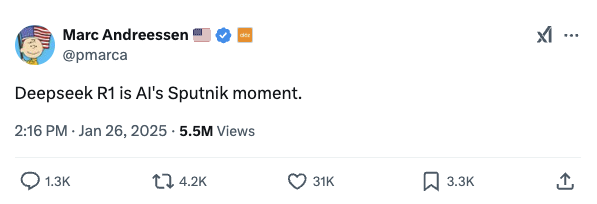
There are plenty of questions still to be answered about DeepSeek (and more than enough folks already diving down those rabbit holes). In the meantime, it’s clear that two of the tech industry’s fundamental assumptions about foundation models have been disproven:
The incumbents already have an insurmountable lead
The only way to get better results is to throw more hardware at the problem
I’ll be the first to admit that I bought into both of these assumptions to some degree. It was difficult for me to see how any up-and-coming company could credibly challenge the industry leaders, with their billion-dollar war chests and armies of top AI talent (at least, when it came to generalist models — I have invested in companies building specialized models). Moreover, with the incumbents all seeming to converge on increasingly incremental rates of advancement as of late, it certainly felt like we were hitting an asymptote of progress.
Of course, in hindsight, we were foolish to believe either one of these as true. Had we stopped to really think about it, it would have been obvious that a challenger would emerge. The history of tech simply does not have any precedents for either of the above statements.
The emergence of DeepSeek — or something like it — was inevitable.
Forgot About Dre Open Source
“Y’all know me. Still the same OG.
But I’ve been low-key…”
Earlier in the year, I wrote about the hard tech renaissance that’s currently underway and the lack of VCs who are old enough to have experience underwriting technology risk. In thinking about why so many investors were surprised by the emergence of DeepSeek, it occurred to me that a corollary of this observation is that there’s an entire generation of investors who have no clue just how powerful open source can be.
In the 90s and well into the early 00s, epic battles took place between commercial companies and open source companies in many segments of the market:
Microsoft battled with Linux distributions for operating system supremacy
Oracle and IBM DB2 faced off against MySQL and PostgreSQL in the database world
Mozilla emerged from the ashes of Netscape to confront Internet Explorer
While open source software certainly plays a role in many aspects of the tech ecosystem today, we really haven’t seen it at the forefront of any major industry in awhile (the closest is probably Android, which itself was more a tool for major handset manufacturers than anything). And I say this as someone who has invested in multiple open source and open core startups.
But of course there would be a compelling open source foundation model. It was inevitable.
Investors didn’t see it, however, because they weren’t necessarily looking for it. Many VCs today avoid open source software entirely or consider it nothing more than a distribution model — a way to get developer adoption. But the best open source projects have always been more than that — they were cultural movements — the likes of which we haven’t seen in a long time.
Of course the next open source movement would emerge around AI. It was inevitable.
We Need More Dilithium H100s
The other unprecedented assumption we’ve been making over the past several years is that the only way to make meaningful forward progress is to throw more hardware at the problem. If anyone knew better, it should have been me.

“Let’s go get more dilithium…”
20 years ago, internet adoption was exploding. By virtue of everyone coming online, we could observe and measure all sorts of human behavior that we couldn’t before — from interactions on social networks to consumer buying behavior. But we had no ability to analyze all the data that we were collecting. In those days, network connections were so slow that databases could only perform complex analysis of data that was physically colocated on the same computer or server.
The solution? Throw hardware at it.
Incumbents like HP, Oracle and Teradata spent millions upon millions of dollars building custom servers capable of storing a fraction of the data that will fit on your laptop today. Companies signed massive multi-year contracts in order to get the most basic insights into what their users and customers were doing, gleaned by sampling and filtering data. It wasn’t nearly enough, but the incumbents all had the same message: hardware was a fundamental limitation and there was nothing more that could be done on the software side.
Alas, on the campus of Stanford University my friend and fellow grad student Mayank Bawa had a different perspective. In his PhD research with the Stanford InfoLab, Mayank contemplated whether or not intelligent partitioning of data across a peer-to-peer network of commodity servers could allow a distributed database to perform the type of complex analytics that until then could only be done with colocated data. The resulting paper, published in 2004 at VLDB (the international conference on “very large databases”) was the basis for Aster Data, which he convinced me to join shortly thereafter.
You may not heard of Mayank or Aster Data, but you likely know what we created by another name: Big Data.
The first prototype system, built using 3 cheap off-the-shelf computers from Fry’s Electronics in Palo Alto, out-performed a $10 Million custom Oracle server on the core industry benchmark, TPC-H. And we weren’t the only ones. Around the same time, a handful of other companies (notably Vertica and Greenplum) emerged with products based on similar algorithmic insights. And the rest was history.
Fast forward to today, and we’ve been listening to incumbent AI companies making the same calcified claims.
A new challenger with a new approach that could work around hardware limitations? It was inevitable.
But, but, but…
Obviously, the DeepSeek situation isn’t as simple as I described above. This isn’t a Hallmark story about a plucky open source community taking on a commercial goliath. There are significant geopolitical considerations at play and we’re already hearing claims and counterclaims between the parties.
But if we put all of that to the side, I sincerely believe that the emergence of a credible alternative to the increasingly converging approaches of the incumbent AI companies was inevitable.
Necessity is the mother of invention. And by all accounts, DeepSeek’s lack of access to state-of-the-art hardware drove it to invent a new approach to AI.
Marc Andreessen called it AI’s Sputnik moment. I think it’s a thunderous reminder that as exciting as the past few years have been, we’ve barely scratched the surface when it comes to AI.
Note: if you want to get a sense of some of the algorithmic solutions the DeepSeek team came up with to work around hardware limitations, check out this post (jump down to the section titled, “The Theoretical Threat”).
The Changing Startup Landscape According to Video Games
Believe it or not, the contemporary evolution of startups in many ways mirrors the evolution of video games. Here are 3 lessons founders should take from the history of video games.
As we near the end of 2024, there’s an incredible amount of change happening in and around Startupland™. From recent elections to the ascendance of AI to venture capital’s changing of the guard, the landscape for startups tomorrow is likely to look very different from today.
The contemporary evolution of startups — in particular, the acceleration of certain parts of the founder journey — in many ways mirrors the evolution of video games.
Seriously.
So at the risk of publishing another one of those annoying “here are 5 things you can learn about X from Y” posts, here are 3 changes to the typical founder journey that mirror the evolution of video games.
1. Ramp Up Time
Real-time strategy (RTS) games have been in the mainstream for more than 30 years. They all follow a similar blueprint: gather resources, use those resources to build infrastructure and units, battle.
Early entries in the genre, such as Warcraft and Command & Conquer, provided players with a relatively lengthy ramp up period for each new game. Players would start each battle with minimal resources and have similar early capabilities. Regardless of which faction you chose, it would take time to amass enough resources to do much of anything — so you would have time to ramp up before the real battle began. While there was some strategy in terms of prioritizing what to build early-on, the first 3-5 minutes of almost every game was relatively benign (unless you played against that one jerk who would build 3 infantry units right away and rush to end it quick).

“Yes, milord”
Things changed in 1995 with the release of Starcraft. Up until that point, competing factions in RTS games all had basically equal capabilities. Units and buildings might have slightly different characteristics, but at the end of the day they were all about the same. Starcraft was the first RTS game to introduce velocity as a differentiating capability with the Zerg.
In Starcraft, the Zerg’s basic melee attacker (called zerglings) can be created at a 2:1 rate to those of other factions. As a result, the effective velocity at which zerglings can be spawned is double that of competing races. “Zerg rushes”, in which an army of zerglings are sent to attack an enemy relatively early in the game, was an infamous tactic in Starcraft.

The “zerg rush”
As more capabilities are unlocked over the course of a game, the races in Starcraft become more balanced (and, in fact, the Zerg are generally thought of as the weakest faction overall), but if you weren’t prepared to defend against a zerg rush at the start, you wouldn’t last long enough to find out.
What does this have to do with startups?
When I was a founder, we generally weren’t too concerned with how our velocity compared to that of other startups. We certainly kept tabs on them, but mostly we were heads down focused on our product and early customers. We would release our products when we felt they were ready and fundraise when the time made sense for us, without much regard for what others were doing. Our velocity came from internal pressures rather than external.
That’s no longer a luxury for most startup founders.
In an age of AI, cloud infrastructure and global competition, the competitive landscape has never been tougher — or faster. The difference between leader and too-late is now measured in months, not years. Whether it’s capturing public mindshare, securing early pilots or raising funding, founders can no longer afford to go at their own pace. More than ever, velocity is the metric that matters most.
2. Skills Development
The original Super Mario Bros., which will turn 40 next year (🤯), was the gateway drug for an entire generation of gamers. Its opening level (1 - 1) remains a master class in onboarding. It provided a safe space for players new to the game — many new to video games entirely — to figure out the mechanics of Super Mario’s gameplay.

Where it all started
For decades after the original Nintendo’s unveiling, most games used similar onboarding techniques to gradually introduce new players to game mechanics (often including increasingly powerful moves and weapons). From Metroid’s roll to Castlevania’s holy water to Contra’s increasingly absurd weapons, the approach to slowly-but-surely adding capabilities and complexities remains a fixture of video games to this day.
But in the late-80s, the discovery of a short sequence of button presses rocked our simple world…

The Konami Code
First introduced in the NES port of Gradius, the “Konami Code” provided instant power-ups to players. It became a worldwide phenomenon when it was later discovered in the hit-1988 game Contra and birthed the notion of the “cheat code”. (It wasn’t long after that the Game Genie was released, permanently shattering a generation’s innocence.)
Notably, it introduced the unheard of idea that players could start off a game with everything.
Fast forward to today and there are many games where it’s possible for players to leverage all of the capabilities from the start.
The same can be said of founders today.
The best first-time founders are more informed than ever before. As a result of a wide availability of blogs, newsletters and online courses, many young founders are fully-versed in startup best practices before ever leaving school. Competition amongst service providers has similarly enabled startups to unlock high-value resources and services long before they have a dollar in revenue (e.g. free cloud credits + implementation experts). The best founders have learned to leverage all of these capabilities and offerings to accelerate and compete right out of the gate.
In today’s world, founders hoping to move slow and steady, while learning one thing at a time, will be left in the dust.

Who wouldn’t want to play Fortnite as a gingerbread man?
3. Geographic Expansion
If you grew up in the 80s or 90s, you’re almost certain to have played the board game Risk. Each player starts off in a different country with a fixed number of pieces (each piece representing a different army unit). Over the course of the game, you increase the size of your army and slowly try to take over the world by expanding into adjacent countries.

This basic format of geographic expansion served as the inspiration for countless video games, including enduring franchises like Civilization and Romance of the Three Kingdoms.
Civilization II, released back in 1996, introduced a new twist on the genre: the concept that a player’s choice of faction (nationality) would fundamentally impact their starting capabilities. Most strategy games released before then allowed players to select what country or region they would start in, but other than their placement on a map and some cosmetic differences, the choice had little impact on the game itself. Civilization II forced players to think carefully about the default strengths of each faction before the game even started.

The same is becoming true when it comes to founding startups.
In the past, there were geographic advantages that startups could leverage as they grew, but it really didn’t matter too much where you founded your company (at least, not until you needed to access capital). But with the world shifting away from globalization and returning to nationalistic tendencies, founders would be wise to give careful thought to where they incorporate their startup.
2025 America is likely to be the best place in the world to start companies in defensetech, aerospace and manufacturing. Climatetech and clean energy companies, on the other hand, may find better prospects in Canada and Europe (at least, when it comes to the availability of grants and supportive commercial prospects). Similarly, companies focused on privacy, DEI and improving the worker’ experience are likely to face headwinds in America but welcoming prospects in other countries.
Silicon Valley — and the United States more broadly — will undoubtedly continue to lead the world’s innovation economy, but with industry and politics becoming ever more intertwined when it comes to tech, not all starting points will be equal.

Sid Meier’s view of America in 2016. What will 2025 look like?
So there you have it. Three ways in which the evolution of startups mirrors that of video games.
Not too much of a stretch.
…or have I been hitting the eggnog too hard…?

"What if Google Builds It?" is No Longer a Bullshit Question
In a world of generative AI and LLMs, “What if Google builds it?” is no longer a bullshit question for investors to ask founders.
For as long as I can remember, VCs have been faithfully asking founders variations of the question, “What if <incumbent> builds it?”
And for as long as I can remember, it’s been mocked by founders and investors alike as one of the laziest questions a VC could ask.

In some cases — typically when trying to figure out “is this a feature or a product?” — asking a founder about potential competition from incumbents can lead to an enlightening discussion. But more often than not, there are far better ways to explore the competitive landscape. Deep down, asking a founder “what if Google (or Facebook, or Amazon, or Oracle, or…) builds it?” has always been a lazy question.
Until now.

The advent of LLMs, alongside feature-rich offerings from OpenAI and others, has led to a rush of development around AI. Countless products are being built by small teams uncovering use cases that can be solved using AI.
Historically, the development of new, vertical-specific applications would take many months (or years) and teams of 10 or more. This simple fact is why the question “what if <incumbent> builds it?” was generally a lazy one: it presumed that the incumbent would allocate a considerable amount of time and resources to an experiment.
(The fact that one of the most impactful business books of all time focuses on why incumbents can’t do this should have been enough to eliminate this question from the average investor’s lexicon, but I digress…)

Here’s the thing: the calculus for AI is different.
If a team of 2-3 founders can create a full-fledged application in a matter of weeks, an incumbent can absolutely do the same. The cost is lower, the risk is lower, and incumbents around the world are actively doing it.
As a case-in-point, over the past year, countless startups raised funding and came to market with services that used generative AI to create backgrounds and images for e-commerce sites. The idea made sense: instead of spending a huge amount of time and money to stage photographs of every product you sell, take photos of the items in a showroom and let AI do the rest.
In one fell swoop, this entire category of startups was rendered moot. And this isn’t an outlier.
In his Q2 earnings call, Amazon CEO Andy Jassy stated that,
“Every single one” of Amazon’s businesses has “multiple generative AI initiatives going right now,”
While Amazon itself is an outlier when it comes to e-commerce businesses, it isn’t when it comes to tech incumbents. Every incumbent around the world is actively exploring how and where they can incorporate generative AI into their businesses.
Founders need to understand that and appreciate that it is no longer lazy for investors to ask about incumbents in this way. In fact, it’s their duty to. Given the sheer breadth of advancements in generative AI, it is reasonable and rationale to presume that every incumbent in every industry has people exploring what is possible with these new technologies. Some of what they develop will be exceptional. Some of it will have the stain of an old guy desperate to re-live his glory days. A lot of it will be “good enough” for their customers.

Don’t ever forget that this man once scored four touchdowns in a single game
As a founder, you can no longer scoff when an investor asks, “what if <incumbent> builds it?”
More than ever, you need to provide a compelling answer as to why, even if the incumbent does try to build something similar, your version will win. You need to lay out the case as to why customers will pay to use your product over the maybe-not-as-good-but-free offerings that incumbents will inevitably roll out.
Will inevitably roll out.
“What if Google builds it?” is no longer a bullshit question. It's a reflection of the changing competitive landscape. If you're building something compelling, then it shouldn't scare you. But if you can’t (or won’t) credibly answer it, then you may very well be building a feature.
Canadian Founders Need to Go to SF. Now.
Right now is a unique moment in time for both San Francisco and tech in general. And it’s one that likely won’t last long.
Last week, Panache Ventures hosted four early-stage California VCs in Vancouver for a panel on startups, fundraising, and the opportunities and challenges for companies based outside of Silicon Valley.

Five VCs walk into a comedy club…
The investors in our first California Dreamin’ event were specifically chosen for two reasons:
All of them are based in California
None of them are originally from California
As such, they each came with a particular life experience that was free of the “born and raised” Kool-aid that many VCs who grew up in the Bay Area embody. Despite coming from different places with different backgrounds, each of them had the same message:
The world’s best founders go to Silicon Valley.
To be clear, the VC panelists weren’t necessarily advocating for founders to move their companies to San Francisco. Rather, they were noting that the best, most ambitious founders in the world regularly travel there to learn, hire, benchmark and access capital. That’s never been more apparent than today.
Right now, San Francisco is on fire (and for once, it’s not the the kind in a forest that’s caused by an inept public utility).

Sept. 9, 2020 is a day San Franciscans won’t soon forget
The level of activity, excitement and creativity happening right now in the Bay Area’s tech community is unlike anything I’ve seen in nearly two decades. There are literally dozens of events happening each night, many of them related to AI.

There are more AI events on a random Tuesday night in SF then in a full week across all of Canada
Under normal circumstances, I’m the first person to tell founders not to waste time at conferences, meetups, and social events that aren’t directly related to their business. But what’s happening in the Bay Area right now is different. It’s special.
What’s happening right now represents a convergence of excitement and creativity around a new technological wave (AI) and a long-awaited resurgence of a struggling yet world-leading city. I’ve been to SF four times in the past two months and the momentum is vicerally building week-over-week.
I believe that this is a unique moment in time for both San Francisco and tech in general. And it’s one that likely won’t last long.
A big part of the reason is that we’re so early in the current AI cycle. Alex Kolicich of 8VC recently wrote:
I genuinely believe that the impact of this new generation of models will be revolutionary over the next decade. It will transform how every industry operates….I believe the majority of the capital invested today will be lost, similar to what happened in the .com era. However, I expect there will be a select group of companies that endure and build the future.
I generally agree with this perspective. We’re very much in a period of experimentation built upon a rapidly evolving technological base (a fact made all the more clear with the recent OpenAI drama). A lot of the technology and companies being built today won’t survive. But what will endure are the communities being created in and around all of the activity taking place in Silicon Valley. And that’s not some wishy-washy nonsense. It’s happened before.
So if you’re a Canadian founder, get on a plane and go to the Bay Area. Go for a week. Go for a month. Go for whatever period of time you can. Land on the ground and go to as many events and meetups as possible. You don’t need to know anyone beforehand to make it happen. You just need to have the willingness to dive in.

They might not have reliable WiFi, but at least they get you there
Want help getting started? The SF IRL newsletter lists many of the in-person events going on in-and-around San Francisco.
One of our Associates, Sarah Willson, joined me in SF a few weeks ago. Armed only with this newsletter (and a lot of hustle), she went to 7 events in two days and made dozens of meaningful connections with founders and investors.
I can’t promise you’ll learn anything specific. I won’t promise that it will help you get to product-market fit or secure your next investor. But I can absolutely guarantee that if you spend time in San Francisco right now, you’ll come away with enthusiasm injected into your veins, more connections with founders and investors in Silicon Valley than you’ve likely ever had, and an understanding of the insane velocity of iteration that’s happening right now in the Bay Area.
And if your goal is to win the world, that’s exactly what you need.

Don't Forget the Big Picture
Last week, I had the privilege to attend Capital Camp, a 3-day investor conference held in Columbia, Missouri.
If you’ve never been to Columbia, you’re not alone - it’s a town with a population of about 125,000 smack dab in the middle of the American Midwest. Columbia is probably best known as the home of the University of Missouri (aka “Mizzou”), but it’s also home to a unique private equity fund called Permanent Equity, the hosts of Capital Camp.

Columbia, Missouri was not on any of my American geography tests growing up in Canada…
Permanent Equity invests in “private companies deliberately built for long-term success…with 30-year funds.” It goes without saying that any group of people who would have the audacity to create a PE firm that invests in 30-year fund cycles think about the world in a different way, which is part of why I was so excited to attend Capital Camp. The thing is, other than having a number like-minded investors telling me for the past few years that I “have to go to Capital Camp,” I really didn’t know what to expect.
What I got was a 3-day reminder of why many of us do what we do: to make the world a better place for our children and our communities.

Opening night (photo courtesy of Kirby Winfield)
While Capital Camp is an investor conference insofar as all of the attendees are investors, it’s not a conference about investing. Yes, there were talks on interest rates, emerging markets and M&A. But there were also panels on developing audiences, strengthening marriages and reinvigorating communities. Moreover, the entire 3-day event was curated specifically to facilitate building genuine connections through small group activities (many of which involved food).
Here are some of my takeaways from this year’s Capital Camp:
Tech Really is a Bubble
While I saw a number of familiar faces at Capital Camp, I would guess that fewer than 25% of the attendees were tech investors. To my sincere delight, I met incredible investors who were every bit as deep into areas that I know nothing about as I am into tech. Some owned brick-and-mortar businesses while others were focused on creating financially self-sustaining models for reducing global poverty and homelessness. Over the course of three days, I spent almost no time talking about tech investing, other than when answering questions from my fellow “campers” about how our industry works (it was quite entertaining to see the looks of confusion on the faces of so many investors when I shared that my job is primarily to invest in businesses that have no business plan 🤣).
AI Will Change Everything…Maybe
One of the most talked-about sessions was from Kanyi Maqubela of Kindred Ventures, who gave a riveting overview of the history of AI and shared his thoughts on where things might be headed. On the one hand, it was apparent to everyone in the room that the rise of AI will have a monumental impact on everyone. On the other hand, many of the investors I spoke to afterwards reacted with bemusement to the thought that AI could threaten their businesses (“I promise you, AI is not going to stick its arm into a dirty pipe to remove a jammed sock from a washing machine.”). Overall, the feelings around AI were a mix of excitement, trepidation and ambivalence - which is probably the right balance.

Investor-Philosopher Kanyi Maqubela
Food Builds Connection
At the start of Capital Camp, the hosts — Brent Beshore and Patrick O’Shaughnessy — playfully joked that one thought of Capital Camp as an investor conference with great food, while the other looked at it as a food and wine event with a bunch of investors. That perspective was the foundation for many of the conference’s activities: small-format demonstrations and hands-on tutorials for groups of 10 - 30 investors. Each session was intentionally designed to be informative and entertaining, while facilitating conversations and connections between the attendees. As someone who loves to cook and host food-related events, I came away with a ton of ideas for future Panache events (along with a full belly and many new friends).


What Matters is People
Whether it was the founders of Marsh Collective sharing stories from their 30-year marriage and their mission to revitalize small towns across America or David Steward and Jim Kavanaugh of World Wide Technology inspiring the audience with lessons from building the largest black-owned company in America, the focus throughout Capital Camp was on the people. The employees, communities and families without whom nothing is possible. At a conference attended by some of the most successful investors in the world, the humility, groundedness and feeling of genuine care for people in each and every conversation was amazing and served as a poignant reminder of what really matters.

Not a bad place to hold a conference
While I never expected to attend an investor conference in Columbia, MO (heck, until recently, I never even knew such a place existed), I am beyond grateful to have escaped my VC bubble for 3 days in the American Midwest. It’s easy to get caught up in the hype of our industry, which makes it all the more important that we step out of our bubble from time-to-time to reflect on the big picture.