Lessons from 250 Blog Posts
I never thought I’d actually write for this long, so I thought I would take some time this week to reflect on it. Here are some of the lessons I learned from writing 250 blog posts.
This week marks a momentous milestone (for me, at least): this is the 250th post that I’ve written on chrisneumann.com.
I never thought I’d actually write for this long, so I thought I would take some time this week to reflect on it. How has my content evolved over the past four and a half years? Does it still resonate with readers? And where should I go next? (If you’re currently reading this on the website, you may have noticed a new look — I’ll dive into the rationale for that shortly.)
Here are some of the lessons I learned after 250 blog posts.
The Backstory
When I moved to Canada in late-2020 to join Panache Ventures, I noticed that there was a lack of entrepreneurial content available for founders there. I had spent the better part of the 5 years prior teaching founders around the world strategies and best practices used by leading Silicon Valley startups (first at 500 Startups and, later, through Commonwealth Ventures). So I thought I’d write about some of them.
But there was one problem.
Over the years, I had written a handful of blog posts, but I could never figure out how to publish content on a consistent schedule. I knew it was possible to write with a weekly cadence (after all, I wrote weekly investor updates for nearly five years at DataHero), but I had never done so with creative or longer-form content.
I mentioned this dilemma in passing to one of my mentors, Marvin Liao, who told me about a course he had recently taken called Write of Passage. The program was the brainchild of an exceptional young writer named David Perell. Despite its name, Write of Passage wasn’t actually a course about writing. At least, not in the strictest sense. Rather, it was a bootcamp designed to teach you how to build systems and processes to support writing and publishing new content on a regular basis (like weekly blog posts). It was exactly what I needed.
It turned out, I wasn’t the only one. The participants in my cohort included many residents of Startupland™, like founders and VCs. But there were also professional athletes, academics and a wide variety of other writers and aspiring writers.
How It Started
Write of Passage was one of those programs that unapologetically threw you in the deep end from the start. The very first session kicked off with a firm dictum from David: in order to stay in the program, you had to publish your first post within one week.
The prompt: “What is the definitive answer to the question that people ask you most often?”
At the time, it had been about six months since news of my joining Panache and moving to Vancouver was announced. In subsequent calls and coffee chats I was repeatedly being asked the same question:
“Why did you come back to Canada?”
On April 13th, 2022, I published the answer to that question and launched this website.

How It’s Going
It’s now been 229 weeks since that first post (for those of you wondering how I reached 250 posts in only 229 weeks, there were several periods of time when I published multiple posts each week — such as during my brief side quest into food blogging.) Over the past 4 ½ years, readership of both my website and the corresponding newsletter have steadily grown (thank you all for that 🙏).

I have no idea what happened in early 2024…
But it hasn’t all been “up-and-to-the-right.”
While website traffic and newsletter subscribers have steadily grown, open rates for the newsletter have slightly declined over the years.

The open rate for my newsletter has held steady around 60% for the past two years (a rate that is generally considered pretty solid, though with AI preview and summary tools becoming so prevalent, it’s increasingly hard to tell). That said, I still wanted to dig into the performance data for both the website and the newsletter.
First, a few thoughts on open rates:
Year 1 open rates aren’t meaningful in any way. The early subscriber numbers were so low (and so heavily skewed to people who already knew me personally), that they were unnaturally high.
A better metric for overall relevance is unsubscribe rate. With agents making it easier-than-ever to ditch newsletters we don’t read anymore, are people still keeping me in their inbox? It turns out the answer is yes (the 90-day rolling unsubscribe rate for my newsletter is ~0.1%, which is considered very strong — thank you again 🙏)
That said, despite a steady open rate and strong retention, there has unequivocally been more inconsistency in content performance over the past few years. So I started to look at what I’ve been posting and how that’s changed:
The content I posted in Years 1 and 2 was overwhelmingly instructional/educational in nature (fundraising best practices, posts about how venture capital worked, etc.). In fact, more than 70% of the first 120 posts I wrote either taught the reader how to do something or explained how something worked.
In year 3, I started writing more posts about startup trends, observations about different ecosystems and topics related to mental and physical health. Last year (2025), only 37% of the posts I wrote were instructional/educational in nature.
The last 2 years have also seen an (understandable) uptick in posts related to AI.
Many of the posts I wrote in years 1 - 3 had an overtly Canadian slant to them. That was very much a by-product of my role as a GP at a Canadian-focused Pre-Seed fund. Since leaving Panache at the end of 2024 to focus on [Redacted], most of the posts that I’ve published were written independent of geography (though I’ve still made a point of writing about trends in the Canadian ecosystem as part of my quarterly 5 Things I Think I Think posts).
What Comes Next
The biggest epiphany going through 250 posts’ worth of data was the degree to which the type of content I’ve published has evolved over the years. The first few years were overwhelmingly educational/instructional in nature because I had a massive backlog of topics that I wanted to write about. Now that I’ve written about most of those, my posts are more focused on trends and observations.
But I’m not done yet.
For starters, it became abundantly clear as I went through Google Analytics data and spoke with founders that a significant portion of my older content had become difficult to find or access. That’s where this redesign comes in. In addition to a cleaner, more streamlined design, there’s a new Topics page that more effectively organizes all of my posts (driven by a complete refactoring of post tags).
I’m also working on a further refactoring related to AEO/SEO/GEO. But I’ll save details of that for a future post.
In the meantime, as I look ahead to (hopefully) another 250 posts on chrisneumann.com, expect more insights, more data and more in-depth posts to help founders, investors and ecosystem supporters around the world make sense of Silicon Valley and beyond.
Thanks for reading 🙏.
Stop with the AI Slop, Part 2
What happens when AI slop finds its way into emails and text messages you send your coworkers, clients and friends?
Tomasz Tunguz recently wrote about his experiences incorporating AI as part of his writing process. He observed that,
“The problem with AI as a ghost writer: everyone uses the same ghost writer. AI’s voice isn’t the author’s.”
Since ChatGPT first came onto the scene, I’ve made a point of periodically testing new models to see if they could accurately reproduce my voice in writing. Years of blog content and social media posts has provided me with a solid set of training data. It turns out that even the earliest models were remarkably good at analyzing my writing style. They could pull out phrases that I constantly use, my preferred filler words, linguistic fingerprints and so on.
But for all of their promise, I’ve never managed to get an AI model to write even a single paragraph that isn’t clearly and obviously someone else’s voice. But does that actually matter these days?
Much like Tomasz, I periodically get emails from readers asking about the authenticity of my content (or, in some cases, expressing their appreciation for something I wrote that was clearly not AI-generated). In his post, Tomasz hypothesized that,
“In the age of slop, readers test authenticity.”
I think he’s right on that. Increasingly, I find myself reading posts, articles, emails and even text messages with the not-so-subconscious question, “was this written by AI?” going through my head.

Nobody who received this email questioned if it was from a human… 😂
A few months ago, I sent out emails to a number of people in my network asking if they would volunteer as mentors for this year’s Founders Day. It was a pretty simple email that included high-level details about the event plus the ask (“Will you mentor this year?”). Most of the responses were a few words or less (“I’m in!” or “Sorry, I’m out of town that week.”), but one of them stuck out:
“Hi Chris,
Great to hear from you, and count me in. I'd be glad to mentor again this year.
The new format sounds excellent. Moving everything to South Flats and giving it a festival feel is a smart change, and having the conference, mentoring, and networking party all in one place will make the day flow much better.
The mentor ask works for me. Happy to wear the lei and spend time in the mentor area during the day, so just send the signup sheet once logistics firm up and I'll pick a slot. The mentor and speaker dinner sounds great too, so keep me posted on the date.
I'll keep the details to myself until the announcement goes out. Looking forward to August 20.
Thanks,XXX”
I immediately texted the sender,
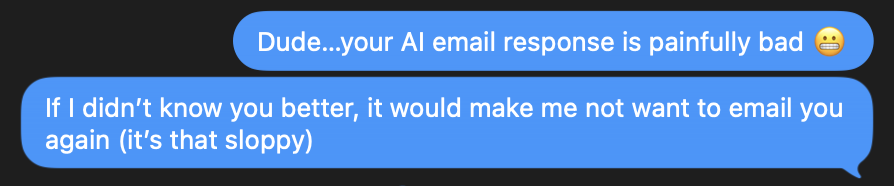
His response?


Since AI came on the scene, a subset of the residents of Startupland™ have become obsessed with efficiency. A number of people I know have spent a mind-boggling amount of time spinning up agents to handle every task imaginable.
And in more than a few cases, that includes an agent to act as the frontline interface for all of their personal communications.
A few months ago, I wrote about the rise of AI slop on social media and how relying on AI to generate posts is now likely to result content that under-performs. I noted that after reading dozens of nearly-identical AI-authored comments, “…my eyes glazed over. Eventually, I stopped reading and responding.”
What happens when the AI slop isn’t confined to LinkedIn and X posts and finds its way into the emails and text messages you send to your coworkers, clients and even your friends?
Lately, I’ve started to receive emails from personal friends and long-time colleagues that were clearly written by AI. Most aren’t quite as egregious as the example above, but most of the time it’s pretty obvious. When I receive such emails, I find myself both less likely to read to the end and less likely to respond to it.
More and more, I find myself less likely to want to email that person at all.

There’s a certain degree of trust that exists in one-to-one communication. For the most part, I assume that if I send you an email, you (meaning, the real you) will read it — or at least scan the header before deciding whether or not to answer it. Similarly, when I receive an email from you, I assume that you (the real you) is the person who wrote the email.
Sure, some people have EAs who read and respond to emails for them. But long-established etiquette is that if a human EA writes an email on someone else’s behalf, they initial it in order to make clear that the email was written by someone else. Rarely do EAs actually ghost-write personal communications (though in Startupland™ that behavior is more common than in the rest of the world).
And while plenty of people use tools like Grammarly to improve their writing and leverage email templates / snippets to be more efficient, you can generally tell that the core was still written by the original author. The voice is still theirs.
So where do we go from here?
On the one hand, part of me wonders if we’re experiencing a similar dynamic to what happened when Calendly first came on the scene (when many people were upset by the “audacity” that someone would dare send them a link to fit into their calendar, rather than engaging in the time-consuming back-and-forth of scheduling). From that perspective, it seems reasonable and broadly net positive to have AI handle communication tasks that don’t really need a human-in-the-loop.
But having AI handle basic scheduling tasks or dealing with customer support is very different from having an agent pretend to be you in conversations with people you know personally. And perhaps that’s the core issue here. There’s a breach of etiquette and trust that seems to be happening with a subset of early adopters of AI. And they’re not fooling anyone.
I’m very transparent about the fact that I use an AI scheduling assistant, But I’ve never, ever had it pretend to be me. And I think that’s important.
At the end of his post, Tomasz noted,
“AI is a poor ghost writer, but a great editor.”
I suspect that in the very near future, we’ll see a similar backlash to AI slop in personal emails to what we’ve seen in social media and cold emails. Use AI as an editor. Offload tasks in a transparent manner to agents. But stop having AI pretend to be you. The incremental gain in productivity is likely costing you more than you realize.
That particular friend I referenced earlier who I emailed about Founders Day? I haven’t sent him a single email since.
Because I know he’s not the one reading it.
I Totally Missed Your Email
There’s a good chance many people you interact with these days are aware of when and how often you open their emails. Time to stop making excuses for why you took so long to respond.
Human etiquette is filled with performative interactions. Like all members of the animal kingdom, we have rituals around dating and mating, fighting and family. But unlike our wild friends, our etiquette has also evolved as a result of the changing nature of electronic communication.

“As per my previous email…”
Take the telephone, for example. It was invented way back in 1876 (150 years ago!), but it wasn’t until the 90s that we had a way to know who was calling before we answered. That’s right youngsters, back when I was a kid, you had to pick up the phone and say “hello?” in order to figure out if the caller was someone you wanted to speak with or a person you had desperately been trying to avoid.
(You also had to physically “pick up” the phone to answer it — none of this tapping or swiping or “Hey, Siri” nonsense…).

Once caller ID became mainstream, the etiquette and expectations around phone calls — especially missed calls — evolved. If you ran into someone whose phone calls you had been avoiding, you could no longer credibly claim that you didn’t know they had called. If you did, they immediately knew you were lying.
We’ve now officially reached that point with email — although a good chunk of the population still doesn’t realize it.
For most of the history of email, we didn’t actually know if the intended recipient opened an email that we sent. “Maybe it went to spam?” became the most common question asked when we didn’t get a response (and, by corollary, “It probably went to spam,” the go-to excuse when asked why we didn’t respond). Corporate email solutions, like Microsoft Exchange, have had the ability to track email opens (known as “read receipts”) for decades, but the functionality was mostly absent from mainstream email platforms.
That changed back in 2019, when an email startup named Superhuman added read receipt functionality to its client using tracking pixels (a concept that had been leveraged for years to deliver website analytics). Privacy advocates were in an uproar over the practice, but it wasn’t long before the backlash died down and other email clients began embedding similar capabilities into their products.
At this point, read receipts have been pretty widely available for more than 5 years, yet many people either don’t know they exist, forget that they exist, or delusionally believe that the person they’re interacting with isn’t using them.
I still regularly get email responses like this:
“I totally missed this email!
<response to the original email>
LMK and so sorry for being late.”
Meanwhile, the read history for the original email I sent looks like this:

We’ve all done this before — reading and re-reading an email before deciding whether or not to respond — and it’s honestly not a big deal if we’re talking about emails between friends or work colleagues. But if you’re a resident of Startupland™ responding to an email from a potential investor, another founder, or someone else you’re trying to build a relationship with, you absolutely need to stop doing this.
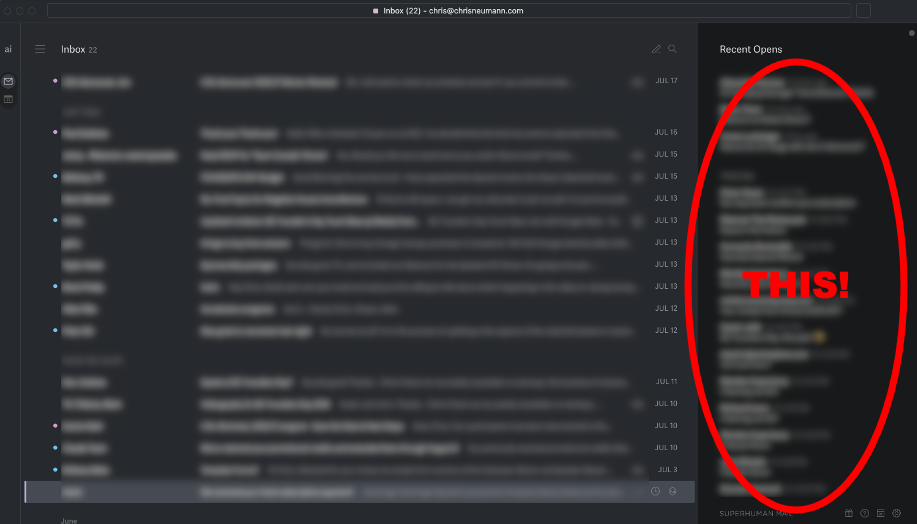
For starters, you should presume that the person who sent you the email has read receipts enabled. You should also presume that they might be keeping tabs on whether or not you opened it. Not because they’re weirdly obsessed with you, but because high-throughput email clients like Superhuman now put the open feed front and center:
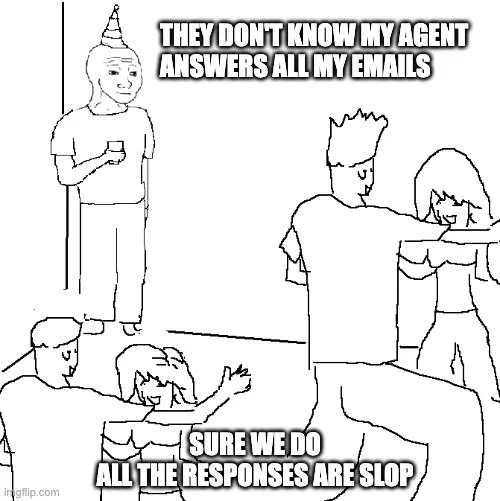
And for those of you chuckling at this because your AI agent now takes care of all your emails, I promise that, “I didn’t see your email because my agent sucks at filtering,” isn’t going to buy you much credibility either.
In any case, there’s a good chance that many of the people you interact with these days are aware of how long it takes you to respond to their emails. Virtually every VC I know uses Superhuman. As do a significant percentage of founders in my network. Most of the time, your email response behavior isn’t going to make one iota of difference in your life. But if the person you’re responding to is in the process of evaluating you (such as an investor deciding whether or not to back your startup or someone in a position of influence trying to gauge if you respect their time), you might want to rethink how you handle email.
If an email takes less than a minute to respond to, just do it (this has been best practice for a long time, yet many of us still don’t)
If a request is going to take time for you to complete, send a quick note of acknowledgement to show your responsiveness
And most importantly, stop sending emails claiming that “I just saw this” after opening and closing it for weeks
Even if you’re not at the point where you’re willing to trust an agent to fully manage your inbox, with AI now embedded into virtually every email client, there really isn’t a credible reason to let your backlog build up. Let the AI auto-generate quick responses for you and either tweak them or quickly hit send.
More than ever, velocity is the one metric that matters most. And for better or worse, email read receipts now provide a measurable indication of your velocity and how you prioritize things.
Reply quickly or be honest when you don’t. Your reputation will thank me later.
The Cost of Hubris
Founder hubris can be deadly for startups. Here's how to identify it early and avoid its consequences.
A few weeks into my first batch as an EIR at 500 Startups, we held a week-long series of talks about fundraising. In those days, fundraising best practices weren’t as widely known as they are today, so the topics we covered were new to virtually all of the founders participating in the program.
Towards the end of the week, I was chatting with Marvin Liao — head of the firm’s flagship accelerator — when one of the founders approached us to discuss his fundraising process. This particular founder was one of the strongest in the batch. He had bootstrapped his company to an impressive amount of revenue, enough so that he should have been able to easily raise a competitive Seed round. But there was a catch.
Despite being part of a mentorship-based accelerator, this particular founder had zero interest in listening to anyone’s advice.

On that particular day, this founder came towards us not to ask questions, but to vent. You see, he had just returned from Sand Hill Road after pitching a top tier VC — his dream investor — and, suffice to say, it did not go well.
Why not? For starters, this founder hadn’t spent any time preparing his fundraising pitch. He hadn’t worked on it, refined it or practiced it. Not once.
Despite an entire week of programming about fundraising, and despite partner-after-partner-after-partner urging him to hold off on meeting with any VCs until he was ready, this founder decided that he knew better then everyone else and sauntered into the offices of [redacted] without so much as a slide.
And he totally, completely, unequivocally sh*t the bed.
It was so bad that the partner he met with at the tier one VC texted Marvin immediately after the meeting to ask, “What the hell was that dumpster fire?”

Watching this founder recount the experience to us was like watching a car wreck in slow motion. His reflection on what went wrong (or, more precisely, his complete lack of self-reflection) was astonishing to me. The entire conversation consisted of him complaining about how clueless the VC was, without so much of a inkling of recognition that he might have gone in unprepared.
When he eventually finished venting and walked away, I stood there with what must have looked like an utterly gobsmacked look on my face. Marvin turned towards me, smiled, and whispered,
“There’s always one.”
After the founder left, I asked him to explain.
“There’s always one,” Marvin continued. “One founder who thinks they’re special. One founder who thinks the rules don’t apply to them. One founder who thinks they know better than everyone else.”
“Every. Single. Batch.”
As my tenure at 500 Startups continued, I was astonished by the accuracy of Marvin’s observation. Every single batch, there was a founder who did this. A founder who took the accelerator’s investment, accepted a place in the batch, and immediately upon arrival decided that they needed none of the advice or education the program had to offer.

Hubris is a funny thing. You have to have a certain amount of hubris to start a company to begin with — entrepreneurship demands the audacious belief that you can create something out of nothing — but the line between confidence and cockiness is a thin one. And landing on the wrong side of it can have a detrimental impact on the trajectory of your company. Whether you realize it or not.
In the 10+ years since that first encounter, I’ve seen similar stories play out time and time again. Oftentimes when founders fall victim to hubris, the results are fatal to their startups. Those that do manage to survive frequently end up so far off course that the company never comes close to reaching its full potential.
I’ve observed some patterns when it comes to founder hubris and wanted to share them in the hope that I can help you to avoid its trap. Here are some common themes I’ve seen over the years:
Early Success
I’ve found that disproportionate hubris is often present in founders who achieved uncommon early success and/or hit significant milestones on their first try. Examples include:
Unusually strong early user or revenue growth
Unexpected virality or marketing notoriety
An unusually easy first fundraise
Founders who achieve such quick wins without realizing how unusual they are often attribute their early success to skill rather than other factors (such as luck, preexisting connections or just good timing). The result is frequently a form of complacency — sort of like when you ace the first few quizzes in a class, get used to how easy it is, and presume you don’t have to study for subsequent ones.
Charisma
In my experience, there is a strong correlation between a founder’s charisma and the likelihood that they develop hubris early in their journey. This is especially pronounced when they have an easy time raising their first round of funding.
In most cases, the initial round of funding (angel and/or Pre-Seed) is driven by narrative. Many founders with strong charisma have an easier time raising their first round specifically because of their storytelling and persuasive abilities. Where things can go sideways is in subsequent funding rounds, when investment decisions are driven more by analysis of early traction, unit economics and so on. I’ve seen many founders who breezed through their Pre-Seed round run full speed into a brick wall when raising subsequent rounds specifically due to a lack of preparation caused by hubris. Moreover, many such founders vastly overestimate the degree to which they can overcome weaknesses in their pitch and/or business with their charisma.
Small Town Founders
This might seem paradoxical, but I’ve found that early hubris is more common in founders who come from outside of Silicon Valley than in founders based in the Bay Area. For as confident and cocky as some Silicon Valley founders come across, they tend to be very well informed about the competitive landscape and the expectations of both customers and investors. Founders from smaller cities — especially ones who get early wins — are often disproportionately lifted up by their ecosystem and can unknowingly end up with big-fish-in-small-pond syndrome before achieving any actual success.
Many years ago, I was introduced to a promising young founder from a small ecosystem whose SaaS startup had surpassed $1M ARR in their first year (this was well before the rise of AI, when doing so was really, really hard). In discussing their early traction, it was immediately obvious to me that the company had a leaky bucket caused by an incredibly high churn rate. Although top-line revenue was growing, it was driven by unsustainable marketing spend. I tried my best to encourage this founder to address the company’s churn rate and its unit economics before approaching Silicon Valley Seed VCs (as they would immediately dig into whether or not the revenue was “real”), but she would hear none of it. Bolstered by local cheerleaders, startup awards and fawning media coverage, she went out and spent nearly 9 months trying to raise a Seed round. Despite countless VCs giving her nearly-identical feedback, she was unwilling (or unable) to change course. The fundraise ultimately failed and the once promising company was acqui-hired shortly thereafter.
Solo Founders
Solo founders are particularly prone to falling victim to hubris because they often don’t have voices around them to provide critical feedback and who they are willing to listen to. I’ve seen many solo founders over the years who simply ignored feedback from employees, advisors and even investors if it didn’t reinforce their preconceived views. When hubris raises its ugly head, it’s almost impossible for someone new to pierce the veil. In contrast, a trusted cofounder can often break through all but the most stubborn cases of intransigence.
One last point before I close — in Silicon Valley, hubris doesn’t just prevent you from hearing helpful advice or critical feedback. It can close doors that you never realized were open. Pay-it-forward culture is a very real thing. But an important corollary is that in an ecosystem filled with people who genuinely want to help, immediately rejecting advice or feedback that doesn’t reinforce your previously-held beliefs sticks out like a sore thumb.
If you read my post from a few weeks ago on snakes and ladders, what I’m talking about here is access to ladders. Many of the people trying to help you can also point you to a ladder, but whether or not they do so will depend on how you react. You don’t have to agree with everyone who offers advice or opinions (in fact, you most certainly shouldn’t). But you should at least listen to what they have to say. Otherwise, you will likely never know what other help they might have been willing to offer.
Instead of pointing you towards a ladder, those individuals will simply redirect their time and efforts towards one of the thousands of other founders hungry for their help.
When it comes to startups, the cost of founder hubris is high. And over time, it also compounds.

Get To The Point
When corresponding over email, it’s essential that you get to the point. Here are 5 common mistakes founders make when interacting over email.
If you’ve been reading my posts for awhile, by now you’ll likely have noticed that I regularly write about writing.
It’s not just because I’m pedantic about prose. It’s because we live in an era where a significant percentage of new relationships start in writing.
When you combine that fact with the paradox of time, the need to be concise in your writing becomes paramount. Whether your reaching out to potential investors, trying to cut through the noise with sales prospects or trying to get press for your startup, it’s essential that you get to the point.

Here are 5 common mistakes founders make when interacting over email:
1. Asking for Permission
Several times each month, I get cold emails from founders that include only partial details and then ask for permission to send the rest. For example,
“We’re raising a $1.5M pre-seed round. Can I send you the deck?”
Perhaps they once took a sales class where the instructor suggested this as a way to get a “buying signal”, but I can tell you that emails like this almost always go straight to my trash. I have neither the time nor the interest to go back-and-forth with someone I’ve never met to get the other half of an email I didn’t ask for.
If you’re going to do cold outreach (or even warm outreach!), make sure your emails contain all of the information necessary for the recipient to respond.
2. Explanation, Answer
Many founders — particularly those from Commonwealth countries — have a tendency to answer questions starting with an explanation or justification. In a verbal conversation, it might go something like this:
Investor: What is your revenue?
Founder: Well, we just started monetizing a few months ago,…
By the time you eventually answer the question, I’m convinced that you’re making excuses. So even if the answer is awesome, I’ll have already discounted it. Instead, answer the question directly, then add any context:
Investor: What is your revenue?
Founder: We’re currently at $1,500 MRR. We just started monetizing a few months ago,…
In writing, the impact of this mistake is amplified even more. When responding to written questions, make sure that you start with facts and then provide any explanation/justification afterwards.
Better yet, ask yourself if the justification is actually necessary. Oftentimes, you’ll come across as more confident by sticking to the facts and letting the recipient come back at you if they want additional details:
Investor: What is your revenue?
Founder: We’re currently at $1,500 MRR.
3. Having Someone Else Write Your Cold Email
Multiple times each week, I get cold fundraising emails in my inbox from someone who isn’t the CEO. They look something like this:
Hello Chris, thought you'd be the right person for this.
I represent a platform undergoing their Series A round with 125,000+ members and 40+ global partners built for independent professionals and enterprises. The company helps enterprises manage flexible talent while providing Individuals access to essential benefits usually reserved for corporate employees.
Can I share more details on their Series A round?
with appreciation,
[Redacted]
Revenue Growth Advisor(This one gets bonus points for also asking permission to share the rest of the details.)
Sometimes, these emails come from fundraising brokers. Sometimes, they’re from angel investors or advisors. Sometimes, the CEO has another employee at the company write the email. And sometimes they’re from a random person who I can’t for the life of me tell the nature of their relationship with the company.
Regardless, 100% of these emails go to my trash.
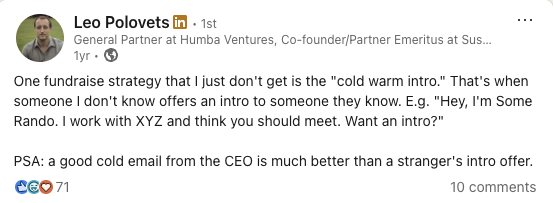
(Note: while early-stage fundraising brokers are common in some parts of the world, exactly zero credible VCs in North America will fund your Pre-Seed or Seed round if the introduction comes via a broker. So don’t waste your time or money with them.)
4. Unnecessary Sarcasm / Jokes
This is another strategy that, more often than not, is a turn off: starting with sarcasm or an unnecessary joke before getting to the point of the email.
Humor often works very well in-person, but amongst a flood of tightly-written emails, it often has the opposite effect. For example, I received a handful of emails after the deadline for Game On that started with some form of,
“I guess we didn’t get in…”
“I’m sure there were plenty of applications, bla bla bla…”
“I didn’t see an email after the deadline…”
I’m not sure what folks hope to gain with this. In contrast to the examples above, a number of applicants wrote very thoughtful emails asking for feedback, and I responded to almost every one. But the ones who started with unnecessary sarcasm or negging or jokes… 🤷♂️
5. Justifying No’s
This last point is less a mistake and more an opportunity for improvement.
One of the hardest personal evolutions for most founders is learning to say no.
In our early days, we worry that we might be missing out on something. We might close a door that could lead somewhere. Even when we become successful, we want to help and give back (hence, the paradox of time). But there’s a level beyond just learning to say no…
The S-tier evolution of this is learning how to say no without justifying the reason.

Believe It Or Not, Etiquette Still Matters
In the era of rage bait, showing deference, respect and etiquette in your interactions can make you stick out amongst a crowd.
A lot has changed over the past few decades when it comes to how we interact with the world around us. As a culture, we have become more casual, more concise and more curt. We are increasingly drawn to conflict, whether real or perceived. The Oxford Word of the Year for 2025 is “rage bait”:
rage bait (noun): online content deliberately designed to elicit anger or outrage by being frustrating, provocative, or offensive, typically posted in order to increase traffic to or engagement with a particular web page or social media content.
Recently, a number of startups that were clearly built with rage bait in mind were funded by prominent VCs, including Cluely (“cheat on everything”) and Chad (“the brainrot IDE”) — with plenty of opinions from the residents of Startupland™. A few weeks ago, Jordi Hays of TBPN published an excellent post on how we got to this point,
“To understand Chad IDE, Cluely, Icon, Friend, and the new class of Gen Z startups, you have to understand the online environment these founders grew up in. If you grew up on the internet and studied how and why certain people would regularly go viral, you know that making people mad has and always will be a highly effective way to get attention. The feedback loop is simple: 1) make something (product or ad) that makes people angry; 2) people comment/ share/ dunk; 3) because feeds are optimized to show posts with high engagement the most, you get more reach.”
He goes on to explain why he believes rage baiting ultimately won’t work as a product strategy. I’ll take it a step further: unless you’re specifically building in or around marketing, content, or certain subsegments of the direct-to-consumer market, it doesn’t even provide a short-term gain.
In other words, etiquette still matters.

Really…?
Like many former founders / early-stage investors, I interact with hundreds of people each week in marketing- and sales-related scenarios. I’m regularly:
On the receiving end of pitches (founders trying to raise money)
On the sidelines of pitches (founders asking for my feedback on both VC pitches and their own GTM)
On the periphery of pitches (doom scrolling social media like everyone else)
When rage bait first started to come to the forefront, I observed it mostly with idle curiosity. It seemed a pretty natural evolution of where we had been going culturally for some time. And for the most part, it remained squarely in the realm of marketing and content creators. Sure, a handful of creators leveraged their personas to build larger brands and companies, but none of this seemed to me all that different from the “villains” and “heels” of years past.
I started to pay more attention when rage bait began to creep into the realm of startups. First came the rage bait social media posts. Then bus stops and billboards. Before long, I started to see it in pitch decks and elevator pitches.

Here’s the thing: even in the early days of rage bait — when the approach seemed relatively novel (at least, to old guys like me) — the tactic didn’t come across differently from any other GTM approach. Except for one key aspect, which Jordi aptly noted:
“Rage baiting (whether at the marketing level or product level) is the most effective way to get people (who could be potential investors, customers, or team members) to actively pray for your downfall.”
So what does this have to do with etiquette?
Around the same time rage started to become more prominent, I noticed an uptick in what I’ll simply refer to as “rude” interactions with founders. I’m not talking about the handful of founders getting upset because they were rejected by a VC (that always happens). Rather, I’m referring to an increase in the number of interactions that were overly casual or unexpectedly disrespectful. It felt like there was more sarcasm, presumption and entitlement in many of my interactions — especially emails.
At first I wasn’t sure what to make of it, but before long I reached the conclusion that this was intentional (either that, or an unintended side effect of founders spending too much time in the realm of rage bait). In either case, a subset of founders seemed to be introducing a version of rage bait into their interactions with me. It was unmissable.
An increase in subtly condescending, overly casual introductions (“Yo lad,” “Hey bud,” etc.)
An increase in sarcasm in places it didn’t belong
Cold pitch emails clearly written as rage bait
The thing is, none of these worked (at least, not on me). If anything, they had the opposite effect. Requests I might have otherwise responded to went unanswered. PDFs I might have been inclined to open went to the trash.
After I announced next month’s Game On program, I received a flood of emails from founders. A non-insignificant percentage of those emails included some degree of rage bait, which got me thinking: what is my perception of people who use this as an intentional tactic?
Transactional
Short-term thinker
Fake
Untrustworthy
Unprofessional
…
Rage bait has become so widespread that it no longer resonates with me as shocking or creative or even worthy of a response. It’s honestly just lame.

If anything, I’ve found myself even more drawn to founders who exhibit basic etiquette and respect in their interactions. I’ve always been a sucker for a well-written cold email, but these days I’m even more likely to respond to emails that are simply polite.
The use of rage bait is still on the rise in Startupland™, but I suspect that it will be short lived. For now, just know that these days, showing deference, respect and etiquette in your interactions can make you stick out amongst a crowd. And always remember that you never get a second chance to make a first impression.
Know what I mean, bruh?
Stop and Say Thanks
Customer-facing roles are often thankless endeavors, but they’re essential to a startup’s success. Make sure to thank the people on the front line.
A few weeks ago, I wrote about my propensity to travel and my belief that a willingness to travel can be a superpower for founders. Recently, I had my superpower put to the test.
In the past two weeks, I flew to Columbia, Missouri for Capital Camp, an annual gathering of investors who focus on markets outside of the traditional coastal superpowers. From there, I travelled to San Francisco, where I stayed for 2 nights before flying to London (via Vancouver) and then on to Edinburgh to speak at Ecosystem Exchange. A few days later, it was all the way back.
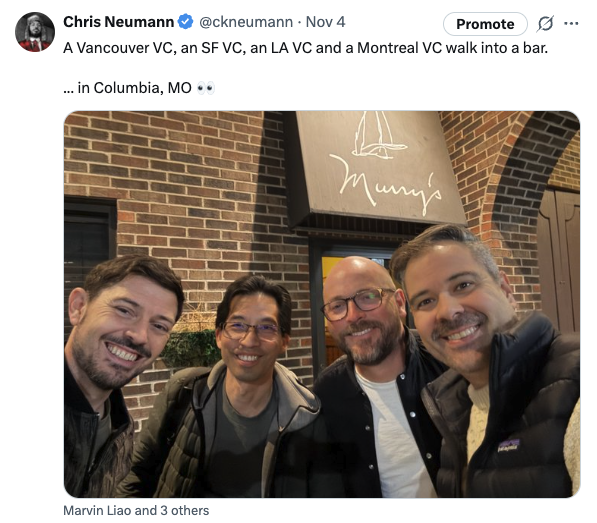
Flying cross-country is a common affair for many people who travel for work. I myself used to do it quite frequently when I was an operator. But this trip was different.
My travel took place during the longest U.S. government shutdown in history — neither the air traffic controllers nor the TSA agents working at airports across the country were being paid at that time. In the midst of all that, the federal government instructed airlines to reduce the number of flights they were operating by 10%. Thousands of flights were cancelled or rescheduled the night before I was to fly from Columbia to SF, leaving travelers scrambling.
I was scheduled to fly to San Francisco via Denver, one of the busiest airports in the U.S. When we touched down (45 minutes late), the stress was palpable. A number of the passengers on our Embraer E175 were nervous about making our connections, but that was nothing compared to what I saw when I exited the plane. It was absolute chaos. People were sprinting back-and-forth trying to make their flights, yelling at each other and at airport and airline staff, and the entire place exuded a level of stress that I haven’t felt in an airport in a long while.

Despite this, each and every person I encountered working at the airport — including those who hadn’t received a paycheck in weeks — was professional and courteous. If anything, they were even more professional and courteous than usual, despite an onslaught of angry customers and challenges.
A few days later, I was set to fly to London via Vancouver. Once again, my initial flight was delayed — this time due to a last-minute aircraft change. There was plenty of time before my connection, so the only real impact was that my seat was changed (to one of those bulkhead seats where you can’t put things under the row in front of you). I don’t usually choose to sit in those rows, as I like to have easy access to my laptop bag, but it was far from a big deal. Or so I thought…
I settled into my seat and spent the next couple of hours polishing my slides for Edinburgh and putting the finishing touches on an investor dinner I’m hosting in December. Overall, a solidly productive flight.
After we touched down in Vancouver, I passed by the courteous and professional Air Canada crew as I deplaned, then the courteous and professional YVR staff as I navigated through the airport to the international terminal, and finally the courteous and professional staff at the airport lounge where I arrived to spend the next hour. I sat down ready to continue my work…
…only to discover that my laptop wasn’t in my bag.

Red alert!
Immediately, I knew what had happened. Normally, I place my laptop into my laptop bag and slide it under the seat in front of me before landing. In this case, I didn’t have access to my bag, so I put my laptop into the sleeve attached to the bulkhead…and promptly forgot it 🤦♂️.
I had less than an hour before my flight to London and immediately rushed to the airport staff to see if they could help. Unfortunately, I had already cleared customs, so there was no way for me to go back to the gate to get it myself — despite the fact that it was mere meters away from me.

Noooooooooooo
Seriously — I could actually see the plane I had just arrived on from the window of the lounge.

I rushed back to the welcome desk of the lounge to tell the staff what happened. They jotted down the details and got on the phone to try to help.
Unfortunately, airports are complicated places with lots of moving parts (and even airline staff get caught in phone trees trying to track down the right people). The fact that it was on the other side of a customs gate prevented the simple fix of just going and getting it. After 20 minutes of valiant effort, they gently suggested that I head to the gate, as my next flight was about to board. The most likely outcome was that they would have to ship it to me after I returned home from the UK.

At that point, there wasn’t much I could do. I headed to my gate and boarded my flight to London.
In reality, it wasn’t the end of the world. The slides for my upcoming talk were saved to Dropbox and, thanks to the miracles of modern phones, I had access to virtually everything I needed. Still…it was far from ideal.
A few minutes before takeoff, one of the flight attendants approached me and asked me to come with her. Standing outside the plane were two Air Canada staff members and a Canada Border Services officer holding my laptop!

I gratefully shook each of their hands and said thank you multiple times. All three smiled ear-to-ear. Even the stern-looking customs agent stood a little taller as she nodded proudly.
As I got back onto the plane, I couldn’t help but reflect on my last few days of travel. All of these people — and tens of thousands more — had likely spent the bulk of the past few weeks with people yelling and screaming at them. Directing frustrations at them over missed connections, rescheduled flights and countless other events that, while likely minor inconveniences in the grand scheme of things, at the time seemed overwhelming.
And yet every single person I encountered was professional and courteous.
That’s the thing about customer-facing roles. Nobody signs up to be yelled at. It’s not one of the perks highlighted in the job description. The vast majority of people I know who are customer-facing want to help. They want to solve problems and make people happy and be a part of something bigger. They want to be the hero of a lot of little stories — just like they were for me that day.
But in reality, customer-facing roles are often thankless endeavors. Both in air travel and in startups.

We heap praise on the engineers who create the thing, the sales execs who close the big deals and the marketers who come up with the viral campaigns. But behind the scenes are the field engineers who figure out how to deploy it and work around all the bugs, the embedded teams who keep the accounts stabilized, the customer support agents who respond to emails and phone calls at all times of the day, and the IT staff — that’s right, the IT staff — whose customers are inside the company but get no less frustrated when things go wrong.
Years ago, I hired a customer support specialist who had previously worked at 23andMe, the once-high-flying DNA testing startup. In recounting her experience there, she told me of her excitement at getting to work at a company on the bleeding edge of genetics. The opportunity to see the inside of one of Silicon Valley’s most prominent startups. And the reality of spending most of her shifts getting yelled at by people whose DNA tests brought unexpected or unwanted results.
People who discovered that their parents weren’t actually their parents. Their siblings weren’t actually their siblings. Their ethnicity wasn’t actually their ethnicity. They were angry and needed someone to yell at — and that was her (along with dozens of her colleagues).
I asked if the company’s leaders ever came by to thank them for their work. She just smiled.
In each and every startup, their are unsung heroes. The people who don’t often get the credit, but without whom the company simply wouldn’t operate. And if they’re customer facing, more than likely they spend a meaningful amount of their working hours as a receptacle for other people’s frustrations — whether or not there’s anything they can do about it.
So if you’re traveling this week, take an extra minute to stop and say thanks to the people helping make your travel a reality. Look them in the eyes, shake their hands, say their names and express your gratitude.
And when you get back to the office, do the same for everyone in your organization. Especially the unsung heroes. I promise, they’ll remember it.

I Don’t Know Who You Are. I’m Sorry.
There’s one aspect of being an investor that fills me with shame. Despite my best efforts, chances are I have absolutely no idea who you are.
Last week was Startupfest, Montreal’s annual outdoor celebration of early-stage startups. It’s been one of my favorite events to attend each year since I was first introduced to it while I was at 500 Startups. Founders and investors from across Canada descend on La Belle Province to catch up, swap stories, and check out what the next generation of founders is up to.

I use it as an excuse to make questionable fashion statements
Startupfest also marks the end of a two month gauntlet of tech events that take place across Canada each year. Kicking off in late-spring, the industry’s “festival season” now includes Web Summit, Invest Canada, NACO Summit, Toronto Tech Week, Creative Destruction Lab’s Super Session and more. By the time summer comes around, my default introvert is in full rebellion and desperately in search of a recharge.
But no matter how tired I am by the end of it, I simply can’t get enough of events like these. It’s been almost 10 years since DataHero was acquired (damn…) and I still absolutely love the energy that comes from being around other founders. The excitement. The ambition. The creativity. The velocity. Each and every conversation I have with a founder genuinely invigorates me.
But there’s one aspect of my experience navigating Startupland™ as an investor that fills me with shame. Despite my best efforts, chances are I have absolutely no idea who you are.

As a former founder, this is unquestionably one of the most frustrating aspect of transitioning to being an investor. I remember how impactful each-and-every interaction I had with an investor was to me. That’s why I try to always bring my full, focused self whenever I meet founders.
It’s also what makes this particular aspect of being an investor so frustrating. Even after a decade, I’m still struggling to come to terms with how inverted the dynamic is from the other side.
Maybe it’s just me, but I can still remember almost every conversation that I had with a VC during my days as a founder. Sure, some of the interactions were negative, but the vast majority felt sincere and genuine. Many of these conversations changed my trajectory as a founder — and, thus, the trajectory of my life.
When I first started the next chapter of my career as an investor, I reconnected with many of these same people to get their advice. Inevitably, I brought up some interaction that we had had years before and how impactful it was to me. In almost every case, the VC shifted awkwardly in their seat, looking visibly uncomfortable.
They. Didn’t. Remember.

In some cases, the VC admitted as much. In others, they tried to play it off. At first, it was disconcerting and discouraging. How could so many people not remember moments that were so impactful to me? Was I imagining their sincerity? Was I foolish enough to believe that they cared about me or my future? Was it all a facade?
Now that nearly 10 years have passed, I’ve realized that, no, it’s not a facade (at least, not with most investors). The vast majority of VCs absolutely try to bring their full, focused self to every interaction they have with founders. Unfortunately, most investors do so thousands upon thousands of times each year. Despite the fact that many of these conversations are impactful (or, at least, memorable) to the founders, from the investor’s perspective they are but one of dozens each day.
And the majority of people can’t retain that. Which means that if I’ve only met you once or twice, chances are I don’t remember you.

For founders who are giving everything to their startup, this can feel like a hard pill to swallow. Especially if that initial conversation was particularly impactful to you. But you can reconnect with VCs (or, really, anyone where there is a similar asymmetrical dynamic) in a way that increases your likelihood of a positive outcome: by providing context with grace.
The insight comes from a simple observation: nobody likes to feel uncomfortable in a conversation. And it’s corollary: if you actively remove a discomfort from a conversation, the other person will not only appreciate it, they’ll be more likely to remember it.
The trick? Providing context with grace.
Consider these three examples:
“It’s great to see you again.”
“It’s great to see you again. Do you remember our last conversation?”
“It’s great to see you again. You probably don’t remember, but we met last year at Startupfest during a Braindate session.”
These three slightly different openers leave the other person with vastly different feelings if they don’t remember the prior meeting. The first puts the person on edge (who is this? are they going to ask me something about our last conversation? I don’t want to look dumb…). The second is even more challenging, as it serves as an interpersonal pop quiz (I have no idea who this person is…why are they expecting me to remember?). The third, however, gracefully provides context from the prior interaction with no expectation that the other person remembers.
Using the third approach might spur the person’s memory. But even if it doesn’t, it provides a safe re-introduction. Moreover, it signals that you have a high enough EQ to remove a potential barrier to this new conversation (thus increasing the likelihood that they’ll remember it).
Epilogue
Years ago when I was a graduate student at Stanford, I met a visiting politician at an event. We spoke briefly — 1 or 2 minutes of small talk in which he asked where I was from, what I was studying, etc. Ten years later, I encountered that same politician at another event. Before I could say anything, he commented, “Haven’t we met before? At a Stanford event, right?”
That’s just not fair.
Don’t Slam the Door on Your Way Out
If you successfully fundraise from Silicon Valley VCs, be careful about how you tell the story. You could end up accidentally burning bridges.
It’s a tale as old as time.
An ambitious young founder starts a company in their hometown. After struggling to raise funding locally, they decide to make a trip to California. In a matter of weeks, the young founder successfully raises money from from “Silicon Valley investors” and returns home triumphant. Then, they go on to tell anyone and everyone they meet how much better it is “in Silicon Valley”.

In most cases, this is beneficial for the ecosystem. Other young founders see someone “like them” succeed raising money abroad and learn to expand their fundraising horizons. Local investors get a healthy reminder to stay competitive.
But occasionally, an excited founder takes it too far.
In their eagerness to ingratiate themselves with other founders in the ecosystem, the tone of their message turns from positive (“Silicon Valley is great / Silicon Valley investors are great”) to negative (“this ecosystem is not great / local investors are not great”). Before long, the young founder is known more for railing on their local ecosystem than anything to do with their startup.
While other founders eat it up — especially those who’ve struggled to raise — the founder can become persona non grata to many others in the ecosystem. And chances are, they don’t even know it.

At this point, some of you might be rolling your eyes at me (“aren’t you the guy who’s always talking about San Francisco?”).
But if you pay close attention to my writing, you’ll find that I never express a blanket perspective that “Silicon Valley is better” — because I simply don’t believe that. For example, last year I wrote a post titled The Mythical U.S. Lead Investor in order to debunk the overly-simplistic stereotype that U.S. investors are more risk-taking than investors in other countries. I’ve also written about The 9 Types of Startup Investors to help explain the varying motivations held by different categories of startup investors and how those impact their behavior.
While I absolutely believe that a significant number of VCs outside of Silicon Valley do themselves (and their ecosystems) a disservice by not building deep connections to Silicon Valley, I don’t believe that investors in the Bay Area are inherently better than investors in other ecosystems.
They’re just different.
But enough about me. Let’s get back to our intrepid young founder…

When we last left our heroes…
The problem with spending too much time comparing and contrasting your fundraising experiences at home and in Silicon Valley is that the story you tell yourself is often self-serving. Local VCs obviously didn’t invest because there is something wrong with them. Silicon Valley VCs clearly saw the potential and were willing to take the risk.
End of story.

Local investors obviously didn’t get it
In some cases, that might actually be the story. But 99% of the time, it’s not that simple.
In reality, most founders have no idea why local VCs actually passed on their startup, or for that matter what caused the investors on their cap table to lean in.
Here are 3 key differences between the perspective of Silicon Valley investors and those in other ecosystems when it comes to evaluating out-of-town startups:
1. History
For better or worse, local investors have more intimate access to your recent history. That promising startup you previously worked at? They know if it was legit or a total sh*tshow. The regional tech company you cut your teeth at? They know whether it hires the cream of the crop or pays the bare minimum and takes whoever it can get. They also likely have access to people who can vouch for your reputation — good, bad or otherwise.
As a result, local investors will sometimes pass on promising startups because the founders didn’t reference well or they have negative perceptions about their prior work history.
Silicon Valley investors are often unaware of the baggage an out-of-town founder brings (and many are less inclined to find out). That gives you an opportunity for a clean slate, but it also means that they won’t give you as much credit for some of your “locally famous” accomplishments.
2. Generalist vs. Specialist Investors
Outside of Silicon Valley, the vast majority of investors are generalists. That means they might not have any prior experience in your space (and may never have met a single company doing what you’re doing). There are some things you can do to more effectively pitch to a generalist investor, but you should also expect that you’ll get far more noes than you will yesses.
From a VC perspective, investing in something you don’t understand is akin to playing the lottery. That’s not a good investment strategy. While this can be frustrating as a founder, don’t blame it on risk-averseness.
By simple virtue of the number of investors in Silicon Valley (there are nearly 2,000 active early-stage funds between San Francisco and San Jose), you’re more likely to run into investors that understand and have experience with what you’re working on. Which makes it more likely that you’ll be able to secure investment if your space is less widely-understood.
3. Power Law
The majority of Silicon Valley investors rely heavily on the concept that returns in venture follow a power law distribution. These investors expect one or two companies to drive the returns of their fund, while the rest will provide a rounding error.
VCs that adhere to power law investing presume that any startup they invest in which is not a “breakout win” will not be material to their returns and, therefore, spend little-to-no time evaluating alternative scenarios. That can be good or bad for startups.
If you have a clear thesis as to how you could become a billion dollar company but no credible “Plan B”, it could be a great fit for Silicon Valley investors but a turnoff for local VCs (who tend to — correctly — discount the likelihood that you’ll actually become a unicorn). On the other hand, if your trajectory lends itself to multiple options should the primary hypothesis fail, local investors might lean in whilst Silicon Valley VCs worry that you’re straddling the fence.
All of this is to say, be careful about how and when you share your reflections on fundraising. Chances are, your perspective is hidden behind rose colored glasses. Also keep in mind that there’s a big difference between sharing your experiences with a group of founders under Chatham House Rule and airing your dirty laundry on stage at a conference. Or worse, in the media.
Not only do negative quotes in press statements take attention away from your company (the story isn’t about how awesome your company is, it’s about how bad your ecosystem is), it can burn a lot of bridges. That might feel good for a moment, but I promise you that in exchange for your 15 seconds of fame, you’ve lost potential local champions.
Often because those folks “knew the real story.”
Like the founder whose funding announcement was focused his big “decision” to move the company to San Francisco, when everyone in the local ecosystem knew he’d been trying to get a U.S. visa for years. Or the founder who complained that local investors only wanted safe investments with complicated deal structures, when all of the local VCs had passed due to concerns over a prior company.
Or the founder who publicly complained about how atrocious Salesforce’s reporting interface was, only to have the SVP of Analytics for Salesforce call him incensed because they were supposed to be partners.

…oh wait, that was me. 😬
What were we talking about again?
Want People to Say Yes? Listen to Them.
One simple filter busy people use trips up many founders: when I tell you how to get my help, do you listen?
I had been trying for weeks to get an introduction to a well-known founder-turned-angel investor. Finally, I was able to find a friend willing to forward my request for introduction email. A few hours later, a successful introduction landed in my inbox followed quickly by an email response from the angel 🙌.
I opened his email and saw the following:
“Call me. 415-XXX-XXXX”
Caught off-guard by his directness and unsure of what to do, I sent a polite response thanking him for his time and offering to schedule a call.
I never heard from him again.

At the time, I was so used to the choreographed dance of introductions and scheduling that my mind was completely broken by a stranger telling me to just “call him”. That was 15 years ago, long before I understood Silicon Valley’s paradox of time:
In Silicon Valley, most people in places of power, influence and experience genuinely want to help up-and-coming founders, but their work and obligations leave little to no time for them to do so.
The founders who can solve this puzzle unlock an unfair advantage that can change the trajectory of their startup: access to Silicon Valley’s insiders. And the solution isn’t as complex as you might imagine.
You simply have to make it easy for them to say yes.
A corollary of the paradox of time is that people in places of power, influence and experience who genuinely want to help employ aggressive filtering in order to decide who to help.
The double opt-in intro system is an example of one such filter. Another filter — which is shockingly simple yet trips up many people — is the following: when I tell you how to get my help, do you listen?

Can you follow the “treasure” map?
In my anecdote above, the investor literally told me to call him. I ignored his instructions and instead did something else (sent him an email to try to schedule a call). While it might seem harsh for him to ghost me after such a simple slight, it makes perfect sense if you look at it through the lens of what he was really saying:
“I’m willing to talk to you but I am unwilling to spend even 5 seconds on scheduling.”
By responding to him with an email, I introduced additional overhead and, thus, failed his filter.
Fifteen years later, I have the privilege of receiving dozens of requests each week for help from founders. But I’m beholden to the paradox of time — as much as I would genuinely like to help each-and-every person who reaches out to me, I simply don’t have enough hours in the day.
So I filter.
And one of those filters is embedded within the responses that I send to the founders I want to help. Responses like:
Asking someone who DM’d me to please send me an email (e.g. “Email me your pitch deck and I’ll take a look.”)
Sending someone a Vimcal link to book a call (e.g. “Click on a slot below to book a call or lmk if none of these work.”)
Pointing them to a blog post I previously wrote that answers their exact question
In each of these cases, I’m trying to minimize the time and effort to get from initial interaction to help. And it’s very much based on how I personally work. For example, my preferred workflow centers around email on my laptop, which is why I redirect as many inbound requests as I can to email.
This is where understanding the dynamics of the relationship is essential to success. If you are the person asking for help, then you should make every effort to fit seamlessly into how the other person works. Jason Lemkin’s advice on asking for in-person meetings is a perfect example of this:

That’s why it’s so essential that you pay attention to the instructions encoded in an offer for help. Especially if it involves changing the communication channel.
If someone responds to your DM asking you to email them, email them.
If someone sends you a Vimcal, Calendly, etc. link to book a call, use that link to book a call.
If someone tells you to just call them, pick up the phone and just call them.
Now that I’m on the other side of the table, I see how frequently people who ask for help ignore (or miss) such instructions. Perhaps it’s because they don’t recognize them for what they are. Perhaps it’s because it’s out of their comfort zone or doesn’t fit the way they prefer to work. Either way, I simply don’t have time to figure it out.
If I ask you to email me something and you instead keep messaging me, I’ll probably stop responding.
If I send you a Vimcal link and you email me back with the time you prefer (instead of clicking the link to just book it), I’ll probably stop responding.
If I send you a link to a blog post that has the exact answer to your question and you instead complain that I’m redirecting you to my blog instead of answering your question, I’ll definitely stop responding.
Not because I’m ornery or don’t want to help you, but because every minute I spend on overhead is one less minute I have to actually help.
That, or I might just be a cranky old man.

Want to Improve Your Pitch? Stop Talking to Founders
A trusted group of peers is one of the most valuable resources a founder can have, but there’s one area where talking to founders can steer you wrong: your fundraising pitch.
One of the most important resources that any startup founder can possibly have is a trusted group of peers to talk to. Whether it’s getting feedback on product, tips for go-to-market or simply venting / decompressing in a safe space, a pit crew of other founders is invaluable.

But there’s one area where talking to founders can steer you wrong: your fundraising pitch.

Creating a pitch deck typically involves the following steps:
Scour the internet for blog posts, templates and examples to use as a starting point (or use AI)
Create v1 of the deck
Get feedback and iterate
Step 3 is where things can go off the rails for founders — and it’s all because of who they talk to: the vast majority of founders start by getting their feedback from other founders.
Why is that a problem? After all, conventional wisdom holds that having a solid pit crew of other founders is one of the best resources you can have (heck, I just told you as much).
It’s simple: most founders don’t actually know what matters to investors in a pitch — even (especially?) if they’ve successfully raised money before.
What Do Investors Care About?
Let’s start with the basics: what matters to investors in a fundraising pitch?
Every investor is different, but in general all VCs and angel investors want to understand the following:
What problem are you’re solving?
How big is the problem?
What is your solution?
Why is your solution new/innovative/different?
What evidence do you have in support of your hypothesis?
Who are you and why are you the team to do this?
What have you accomplished so far?
The astute reader will notice that only two of these things are related to product (3 and 4). Yet the vast majority of founders presume that product is the most important part of an early-stage pitch.
But investors don’t invest in products or product ideas. They invest in companies.

This simple distinction trips up a lot of first-time founders, but it’s crucial to understand. Your product (or product idea) is a key part of your pitch, but it’s only one part of the story. Good investors will, of course, spend a considerable amount of time on your product, but the other points are just as important when it comes to creating a full portrait of your company’s true potential.
It makes perfect sense that founders gravitate so often towards product. After all, that’s what you spend the vast majority of your time on. When you meet other founders, they generally want to geek out about what you’ve built — which is exactly why their pitch feedback disproportionately relates to product.
Founders who have successfully raised capital can be even worse, as they tend to fall victim to survivorship bias in their feedback.
More emphasis on product!
Founders who believed that part X of their pitch was the key to their success in fundraising will tell you that part X of *your* pitch must also be the most important part. Unfortunately, very few founders actually fact-check this with the investors who gave them money.
So how can you get more complete, well-rounded feedback on your pitch? Intentionally source feedback from a variety of sources:
Founders: Does the pitch make sense? Can they understand it?
Subject-matter experts: Is the pitch credible to experts and industry insiders?
Non-tech friends and family: Does the pitch make sense at a conceptual level? Can they understand it even without a strong technical background (this is important for two reasons: (1) many investors you meet won’t be experts in your space, and (2) many investors want to know that you can pitch to non-experts, given how important that skill is to company building)
Angel investors: Does the pitch resonate as a potential investment opportunity?
VCs: Does the pitch resonate with how VCs, specifically, think and invest?
This might seem easier said than done, particularly if you don’t have an extensive network. Not only is it possible, it’s pragmatic and well worth the effort.
Feedback from groups (1) - (3) should be easy to obtain, since you should already know multiple people in those groups. (4) and (5) is actually quite obtainable, given how many VCs and angel investors hold office hours, engage with incubators and accelerators, and otherwise make themselves accessible to founders as part of their deal flow strategies. You can also try reaching out to a small, targeted set of investors to get more precise feedback (this post on How to Create a Dotted Line with VCs discusses how to do this in more depth).
Regardless of your approach, just remember not to over-index on any one person’s feedback (including the one or two VCs you might talk to). With a diverse audience, you’re very likely to get feedback that’s all over the place — and some that directly contradicts each other. Filter the feedback you receive through the lens of who provided it and how much experience they have making investment decisions (also keep in mind that there are 9 different types of startup investors, each of which tends to focus on something different).
Last point: expect that you will very likely receive entirely new and unexpected points of feedback when you start pitching investors for real. Why? Because investors pay a little more attention and think about things more seriously when they’re genuinely considering an investment.
Good luck!

Want to get the Most Out of Mentoring? Don’t be a Pushover
Here are 5 steps to ensuring that you get the most out of mentorship without being steamrolled by an overzealous mentor.
One of the joys of being at the current stage of my career comes from the fact that I’ve amassed a reasonably-sized collection of experiences that seem to be helpful to founders. Sharing those experiences with up-and-coming founders is one of my favorite things to do. Whether it’s in one-on-one meetings with portfolio companies, online sessions with founders across Canada and the UK, through structured programs like Creative Destruction Lab, or as part of university programs, it’s always an honor and a privilege to speak with ambitious entrepreneurs.
But many founders don’t maximize the opportunities presented by mentorship. And a big reason is that they get caught up in the “honor” of speaking with the mentors.

It seems silly, but it’s absolutely true — I certainly did it when I was a founder!
I’m not talking about getting caught up in a mentor’s “celebrity” or fawning over them like a fanboy/girl. I’m referring to the very common scenario in which a founder eagerly comes to a mentorship meeting and the mentor — caught up in “trying to be helpful” — absolutely steamrolls over them and monologues for an hour.
…and the mentee walks away with none of their actual problems solved.

The solution? Don’t be a pushover!
Here are 5 steps to ensuring that you get the most out of mentorship (without being steamrolled by an overzealous mentor):
1. Have an elevator pitch designed for mentors
A standard startup elevator pitch is a precursor to a sales pitch — whether for customers, investors or potential employees. But mentorship is something different. You’re trying to solicit information and advice, not sell them something. As such, if you use your standard elevator pitch to kick off a mentor session, you’re likely to be pulled into the wrong types of conversations and questions.
To get the most out of a mentorship session, kick things off with a purpose-built elevator pitch that gives mentors the context they need about your company while telegraphiing the topics you’d like to discuss:
Start with a high-level company description
Provide a summary of the current status (sales, funding, etc.)
What are the things that are going well?
What are the things that are challenging?
What are 1-3 specific topics you would like to focus on?
Here’s an example:
“Acme.ai has created the world’s first AI-driven LEGO brick sorter to help LEGO enthusiasts quickly find the piece they’re looking for from a large inventory of bricks. More than 5 trillion hours each year are wasted by LEGO enthusiasts looking for specific bricks at a cost of $500 billion to the global economy.
In less than 6 months, our team has:
- Built a working prototype that can identify specific LEGO bricks within collections of up to 10,000 pieces
- Signed 20 paid pilots worth $100,000 with some of the world’s leading LEGO clubs
- Built a waiting list of more than 20,000 LEGO enthusiasts
We recently closed a $750K Pre-Seed round, which gives us 18 months of runway.
We feel like we’ve definitely tapped into a latent interest amongst LEGO enthusiasts, which is manifesting in our waiting lists and top-of-funnel engagement. However, we’re struggling with converting the paid pilots into long-term contracts. The pilot users generally like the prototype system and find value in it, but it’s not translating into commercial agreements.
If it’s okay with you, I’d like to spend our time reviewing the feedback and results from our first few pilots and walking you through our sales process, to see what we’re missing.”
2. Come armed with questions
Beyond just a topic of focus for the conversation, come armed with a selection of specific questions that you’d like the mentor’s perspective on. This will demonstrate to the investor that you’ve already given the topic thought, while ensuring you don’t revisit aspects of the topic that you’ve already thought through.
For example:
“Here are some specific things I would like to dig into:
- Why are our pilot companies willing to spend thousands of dollars on a pilot but don’t seem to have budget for a larger agreement?
- The subjective feedback from pilot users seems to be all over the place. It would be really helpful to see if you can discern any patterns that we’re missing.
- Are there any obvious flaws in our pilot process that might be preventing or delaying users from getting to the “a ha!” moment that could lead to a deal?”

3. Don’t be afraid to interrupt
Ever been in a situation where a mentor starts talking and you can’t seem to get a word in edgewise?
It happens all the time. Sometimes, it’s good ol’ fashioned mansplaining. Other times, the well-meaning mentor gets so caught up in the emotion of recounting an experience they previously had that they lose track of time.
Either way, don’t be afraid to interrupt them! It can feel awkward to do so (particularly if the mentor is someone that you look up to), but I promise they won’t be offended. Just charge right in if/when the conversation goes off-track or the short story turns into a novel:
Sorry to interrupt, but given how little time we have left, I’d love to refocus on X.

4. Be honest and vulnerable
This is the hardest one for most founders, particularly if the mentorship opportunity is in a group setting or the mentor is also a potential investor. But the more honest and vulnerable you are with a mentor, the more likely they’ll be able to help you with your real problem.
I can’t tell you how many mentorship sessions I’ve been in where it’s utterly apparent that the founder’s “up-and-to-the-right” narrative of how perfectly everything is going has no basis in reality. The founder spends the entire time trying to convince the mentor(s) how awesome things are, completely missing the opportunity for help.
Don’t do this.
It may be hard to admit when things aren’t going perfectly — especially when so much of your time is spent putting on a brave face for those around you — but that’s exactly why most mentors want to help. We’ve been there. We’ve seen that. We’ve ridden the startup rollercoaster. And we genuinely understand and empathize with what you’re going through.
We want to help…but we can only do so if you’ll let us in.
5. Remember that these are one person’s opinions based on limited information
Remember that no matter how convincing or confident the mentor is, their advice is just that: the advice and opinions of a single person.
It can be tempting to jump right into following the recommendations of a mentor, but it’s essential that you view their advice through the lens of their lived experience (which may or may not be the same as yours).
The best mentors bookend their advice with a disclaimer, but even if they don’t, just add the phrase “in my experience,” “in my opinion,” or “ymmv” (your mileage may vary) to each and every piece of advice.
Check out this post for more thoughts on how to make the most of mentors.
How to Write an Effective Fundraising Introduction Email
What makes an effective fundraising email and how do you create a request-for-introduction or a cold outreach email?
It’s a start of a new year, which means thousands of founders the world over are kicking off fundraising rounds. One of the critical components in a high-velocity fundraising process is the introduction email. An impactful company overview (aka introductory passage) is key to that.
A strong introductory passage confidently and concisely presents your company, the problem you’re solving, and the key milestones you’ve already hit (which demonstrates your velocity, the one metric that matters most). It can be used in a request-for-introduction email from someone offering a warm intro, to reengage with an investor you’ve previously met or even as a cold email (since a strong cold email always beats a weak warm one).
Let’s dig into what makes an effective introductory passage and how to use it in different types of fundraising communications.
The Introductory Passage
An effective introductory passage delivers a confident, concise introduction to your company. In 2 - 3 paragraphs, it should answer the following questions:
What does the company do? (1-2 sentences)
Why does this matter? (1-2 sentences)
Who are the founders? (1-2 sentences)
What has the team accomplished so far? (3-5 bullet points)
Here is an example:
Acme.ai has created the world’s first AI-driven LEGO brick sorter to help LEGO enthusiasts quickly find the piece they’re looking for from a large inventory of bricks. More than 5 trillion hours each year are wasted by LEGO enthusiasts looking for specific bricks at a cost of $500 billion to the global economy.
In less than 6 months, our team has:
- Built a working prototype that can identify specific LEGO bricks within collections of up to 10,000 pieces
- Signed 20 paid pilots worth $100,000 with some of the world’s leading LEGO clubs
- Built a waiting list of more than 20,000 LEGO enthusiasts
Our founding team includes the world’s top LEGO AI researcher, computer vision experts and the former head of global sales for LEGO.
Other than the accomplishments (3 bullet points), each of the above questions is answered with a single sentence. The point here is not to explain everything about the company, but to give enough context for the reader to understand the basics of the company and quickly decide whether or not they want to learn more.
If your introductory passage includes more than 3 full sentences for any of the above questions or spans more than 3 paragraphs, it’s likely too long — either you’re including details that aren’t critical or you’re over-explaining something that could be said more concisely. The most likely outcome when an introductory passage is too long is that the reader gets bored and gives up before they get to the end.

While an extra sentence or two might not seem like a big deal, the reality is that you’re fighting against the paradox of time when trying to secure fundraising meetings, so every detail counts (even when you’re getting a warm introduction).
For most founders, it takes a considerable amount of time and effort to distill the company down to only a few sentences — particularly if you’re not sure which are the important parts (“everything is important!”). When writing an introductory passage, leverage your investors, advisors and friends to help you get it right.
Now, let’s look at how to use an introductory passage in fundraising.
The Request for Introduction Email
Plenty of posts have been written about request-for-introduction emails, the emails used to facilitate warm introductions. This post by Arjun Dev Arora provides a great overview of effective RFI emails and the key components they should have. You might also find this post about why I won’t promise you an introduction helpful to understand why they’re so important when fundraising (particularly when you’re targeting Silicon Valley VCs).
Once you’ve written your introductory passage, building a request-for-introduction email is pretty straight forward. The structure is as follows:
Opening phrase (addressed to the introducer)
Why are you requesting the introduction?
Opening phrase (addressed to the recipient)
Introductory passage
Link to deck
Call to action (CTA)
Let’s build on the above example:
Hi Mary,
Thanks for offering to connect me with Bob at LEGO Enthusiasts Ventures. Given their firm’s focus on startups in the LEGO ecosystem and, in particular, his recent investment in NinjagoDelivery.ai, I think that they would be a great fit for Acme.ai’s Seed round. Below is a forwardable email that you can send for double opt-in:
Hi Bob,
My name is Chris and I’m the CEO and Cofounder of Acme.ai. Acme.ai has created the world’s first AI-driven LEGO brick sorter to help LEGO enthusiasts quickly find the piece they’re looking for from a large inventory of bricks. More than 5 trillion hours each year are wasted by LEGO enthusiasts looking for specific bricks at a cost of $500 billion to the global economy.
In less than 6 months, our team has:
- Built a working prototype that can identify specific LEGO bricks within collections of up to 10,000 pieces
- Signed 20 paid pilots worth $100,000 with some of the world’s leading LEGO clubs
- Built a waiting list of more than 20,000 LEGO enthusiasts
Our founding team includes the world’s top LEGO AI researcher, computer vision experts and the former head of global sales for LEGO.
You can learn more about Acme.ai from this deck. ← (link to deck in Docsend)
We are scheduling initial meetings for our Seed round from January 27th through Februrary 7th. Please email me if you’d like to learn more.
I look forward to speaking with you,
- Chris
Time for some rapid-fire questions (aka “RFI FAQs”):
1. Do I have to personalize every introduction?
If you want to maximize your conversation rate, then yes. Andy McLoughlin of Uncork Capital refers to this as “show me you know me”:
The best advice to remember…is to “show me you know me”. Show the investor that you’ve done the work and this is why you are pitching to them.
Is it possible to secure an initial meeting without personalizing the request-for-introduction? Absolutely. But I can tell you firsthand that an email which demonstrates the founder has at least a passing understanding of who I am and what I invest in significantly increases the chances I’ll opt in — especially if I’m on the fence.
On the other hand, one of the worse things you can do is use a standardized intro that pretends to be personal (or worse, personalization that is factually incorrect). I get plenty of both each week and they go straight to the trash.
2. Do I have to include the deck?
Yes.
It used to be that founders could send a “teaser” or otherwise hold off until after the initial meeting, but for most VCs that’s no longer the case. It’s just not worth it for most people to spend 20-30 minutes on a call that they could have known wasn’t a fit by glancing at the deck.
3. PDF or DocSend?
There was a time not long ago when the question of whether to send a fundraising deck as a PDF or a Docsend link would evoke a holy war, but that debate is largely settled.
Always use DocSend.
VCs are now used to it (and, if they really want to download a copy of your deck, there are plenty of tools to do so). As a founder, the analytics, email capture and built-in data room (Docsend Spaces) provide far too much value for you to use anything else.
4. Can I include a calendar link instead of asking the investor to email me?
I don’t recommend it. Read this post to understand why.
5. Do I really have to personalize every introduction..?
Look, I get it. Researching each and every investor you want to talk to and coming up with something personal to say (especially when you’re targeting 100 - 150 potential investors) takes a lot of time. But this is an enterprise sales process and you’re trying to raise hundreds of thousands (or millions) of dollars. If you’re not optimizing the conversion rate at the top of your funnel, you’re only hurting your chances of success.
In the words of Benjamin Franklin,
“By failing to prepare,
you are preparing to fail.”
The Cold Email
The structure of a cold email is similar to that of a request-for-introduction email, except that you fold the “personalization” into the main email:
Opening phrase (addressed to the recipient)
Introductory passage
Why are you requesting the introduction? (This can also go at the start)
Link to deck
Call to action (CTA)
Here is a cold email based on our earlier example:
Hi Bob,
My name is Chris and I’m the CEO and Cofounder of Acme.ai. Acme.ai has created the world’s first AI-driven LEGO brick sorter to help LEGO enthusiasts quickly find the piece they’re looking for from a large inventory of bricks. More than 5 trillion hours each year are wasted by LEGO enthusiasts looking for specific bricks at a cost of $500 billion to the global economy.
In less than 6 months, our team has:
- Built a working prototype that can identify specific LEGO bricks within collections of up to 10,000 pieces
- Signed 20 paid pilots worth $100,000 with some of the world’s leading LEGO clubs
- Built a waiting list of more than 20,000 LEGO enthusiasts
Our founding team includes the world’s top LEGO AI researcher, computer vision experts and the former head of global sales for LEGO.
You can learn more about Acme.ai from this deck. ← (link to deck in Docsend)
Given your firm’s focus on startups in the LEGO ecosystem and, in particular, your recent investment in NinjagoDelivery.ai, I think that LEGO Enthusiasts Ventures would be a great fit for Acme.ai’s Seed round.
We are scheduling initial meetings for our Seed round from January 27th through Februrary 7th. Please email me if you’d like to learn more.
I look forward to speaking with you,
- Chris
Ideally, there’s significant overlap between your introductory passage, your fundraising communications and your sales collateral, but that’s a topic for another time. For now, here are some additional posts specifically around fundraising request-for-introduction emails:
How to Write an Email Intro Request (Brad Feld, Foundry Group)
Introductions and the “forward intro email” (Roy Bahat, Bloomberg Beta)
Use This Template to Ask for VC Intros (Raimonds Kulbergs, BADideas.fund)
How to Write a Great Email Request for Introduction: Investment, Hiring, Sales, and Anything Else (Arjun Dev Arora, Format One)
Good luck!
In Silicon Valley, No Answer is an Answer
No aspect of Silicon Valley etiquette is more jarring to newly-arrived founders than the fact that it is culturally acceptable to not reply to emails.
Silicon Valley has a unique business culture that has the paradox of time at the core of many of its peculiarities: most people in places of power, influence and experience genuinely want to help up-and-coming founders, but their work and other obligations leave little to no time for them to do so.
No side effect of this paradox is more jarring to newly-arrived founders than the fact that, in Silicon Valley, it is culturally acceptable to not reply to emails.

As humans, we like closure. In fact, we expect it in most facets of our lives. When you ask someone a question (even a complete stranger), you almost always get a response. It’s considered extremely rude in most cultures to not acknowledge such a request, even if the answer is a polite “no”.
When we don’t receive a response to our inquiries, it drives us mad.

In recent years, “ghosting” has become a more common cultural trait. But that’s not what I’m talking about here.
Ghosting refers to a sudden ending of active communication without any apparent warning or explanation. If you had an ongoing back-and-forth email thread with someone and they suddenly stop replying, that’s ghosting. And it’s unequivocally not culturally acceptable. Anywhere.
But what if you reach out to someone with a brand new request?
In Silicon Valley, it is culturally acceptable to not respond to such an email as a form of “no” (even if you know the person).

Here’s the thing: I’m pretty sure nobody actually likes this. Literally no human I have ever met enjoys the idea of not getting a response to a reasonable request. Moreover, most folks aren’t exactly thrilled that they’re potentially leaving others hanging.
But it’s widely adopted and accepted as a means of survival.

So how do you deal with this behavior in an era of email read receipts, when you know that the person has opened your email? Here are some tips:
DO - Internalize the fact that the recipient is not trying be a jerk. They’re not “not responding” out of spite or arrogance or whatever.
DON’T - Get mad or send an angry follow-up email. There is literally no situation where this will put you in a better position (even if it might make you feel better for 12 seconds).
DO - Lean into this aspect of Silicon Valley etiquette. When I send an email request, I intentionally include the phrase “Let me know if you’re interested.” This is a subtle signal that I understand the etiquette at play, as if to say “…you don’t have to respond if you’re not interested.” (Ironically, I’ve found that including this particular phrase actually increases the likelihood that I get some form of response. 👀)
DO - Give them a second chance. Many times I’ll scan an email, decide to return to it later and simply forget (e.g. because I didn’t mark it correctly in my todo system). If you don’t hear back after a week, feel free to send a polite follow-up email.
DON’T - Keep trying ad nauseum. If you haven’t received a response after 2 or 3 emails, then the answer is no. Continuing to follow-up demonstrates that you don’t understand the etiquette at play and decreases the likelihood of a positive response to a future request. Your effective flow should be something along the lines of:
Send Initial Email → Wait 7 Days → Send Follow-Up Email → Wait 7 Days → Mark as “No”
DON’T - Interpret a non-response as no forever. Whether in fundraising, sales or other activities, you shouldn’t remove a person who doesn’t respond to your email from consideration for future opportunities. Oftentimes, “no” just means, “not right now”.
DO - Check out this post for more tips on how to write for success.
It takes time to get used to this dynamic — if I’m being honest, I still find it frustrating at times after 20+ years — but the sooner you make peace with this etiquette, the more effective and efficient you’ll be in your outreach.
Because in Silicon Valley, no response means no.
…unless it means I’m already off for Thanksgiving.

How to Pitch Hard Tech to a Generalist VC
To increase fundraising success with generalist VCs, hard tech founders must show that your startup fits the traditional VC model. Here's how.
A few months ago, I wrote a post about the current hard tech renaissance and the challenges founders face when trying to raise capital for hard tech / deep tech startups. That post resonated with a lot of folks and I was subsequently invited to talk about it at Startupfest in Montreal. The conference organizers gave me the following prompt:
Shed light on the Canadian hard tech landscape, the reality of engaging with VCs, and the realities of raising capital as a hard tech startup.
It shouldn’t come as a surprise that despite a resurgence of interest in hard tech, convincing early-stage VCs to invest is still really hard. For many hard tech founders, the experience of raising pre-seed capital often feels like this:

I started digging into the numbers: how many Canadian VCs have actually invested in at least one hard tech startup? It turns out, quite a few:

Some of the Canadian VCs who have recently invested in hard tech
If so many VCs are willing to invest in hard tech startups, why does raising pre-seed capital still feel so hard? It starts with a simple fact: the vast majority of VCs that invest in hard tech startups aren’t actually hard tech VCs. They’re generalists. And generalist investors often come to the table with stereotypes and preconceived notions that can get in the way of making an investment.
Thankfully, Leo Polovets of Susa Ventures / Humba Ventures is helping to dismantle many of the misconceptions around hard tech investing.

Two years ago, Susa Ventures announced a spin-off fund led by Leo called Humba Ventures. Humba’s mandate includes a specific focus on early-stage investing in hard tech / deep tech. Leo — a very data-oriented VC — published a post titled Betting on Deep Tech that shared some of the detailed research he did to better understand the historical performance of deep tech investments and convince himself that a deep tech-focused fund was viable. He found that the following four assumptions about deep tech companies turn out to be misconceptions:
Deep tech companies have poor outcomes.
Deep tech companies are much more capital intensive.
Deep tech companies take much longer to exit.
Deep tech companies have much higher failure rates.
(If you haven’t already, I highly encourage you to read the full post here.)
Of course, there are some nuances to these conclusions. Leo found that some of the stereotypes around hard tech companies are actually true. For example, certain sub-categories in hard tech — such as life sciences — are inherently capital intensive. So what does that mean when it comes to raising early-stage capital?
To increase your chances of success with generalist VCs, you need to credibly make the argument that your startup fits the traditional venture capital model. Which means arguing that the stereotypes listed above don’t apply to your company.
1. Outcome Potential
Assuming that you’re pitching to a power law VC, you need to demonstrate that your company has the potential for a multi-billion dollar exit. There are three factors that come into play:
Historical Exits - What exits have occurred in your industry for similar companies and at what stage of development?
Exit Multiple - For revenue-based exits, what is the historical multiple for your industry?
Revenue Trajectory - What is a realistic revenue trajectory for your company?
With the three pieces of information above, you can suggest potential scenarios that might occur (e.g. this is what is likely to happen if we get acquired at point X, this is what happens if we get acquired at point Y, and this is what happens if we IPO).
Note that this is different from saying “this is our exit plan” (which is a bad thing to present — at least, when pitching to North American VCs). Rather, you’re trying to paint a picture as to the potential of your company to achieve the scale of outcome necessary to return a VC’s fund.
2. Capital Requirements
Generalist VCs are very wary of capital-intensive companies, as their funding needs can dilute the investor’s holdings such that they won’t realize a significant return even if the startup is a breakout success. To counter this, you need to demonstrate that the amount of dilutive funding that your company will require is not dissimilar from what a software startup might need.
In this case, I’m not talking about a detailed, 10-year financial plan. What I’m referring to is understanding the amount of capital that will likely be required to achieve each of your key milestones (prototype, regulatory, product, GTM, etc.) and the levels of non-dilutive funding that you can realistically access to help defer those. Showing these milestones in 12-24 month phases will best align this with the traditional VC model. For example:
Milestone 1 (12 - 18 months): $5M ($1.5M equity / $3.5M non-dilutive)
Milestone 2 (15 - 21 months): $15M ($5 - 6M equity / $9 - 10M non-dilutive)
…
Be sure to list as many of the sources of non-dilutive capital as you can for each phase, in order to add credibility to your predictions.
3. Exit Timeline
Generalist VCs typically look for exits to occur in 7-10 years. You can counter the fear that your hard tech startup might take “too long” by adding a timeline to (1) and (2). How long did it take for the historical exits described in (1) to occur? How do those timelines map to the milestones described in (2)?
4. Failure Scenarios
One of the most powerful things any startup can do in their initial pitch is to be forthcoming about the “likely reasons we will fail”. For a generalist VC that isn’t an expert in your space, the risk of failure can seem much higher than it actually is — so countering any preconceived notions is crucial.
For each of the milestones described in (2), lay out the risks that could prevent you from succeeding along with the actions that you’re taking (or have already taken) to mitigate those risks. If there are recent examples of companies in your space that failed, explain why their situations don’t apply to your startup.
The details above are likely too much to include in your initial pitch, so add them as an appendix to your deck or include them in an “investor FAQ” that you distribute after your initial meeting (just make sure to telegraph to the VC that you’re going to send this after the call to preempt them from jumping to conclusions). You won’t be able to convince every generalist VC that your hard tech startup is a fit, but by countering common stereotypes, you can significantly increase the number from whom you receive serious consideration.

How to Connect with a VC on LinkedIn
Connecting on LinkedIn can be the easiest way to open a direct line of communication with a potential investor. But you have to do it right.
LinkedIn is the preeminent social network when it comes to professional relationships. It’s also grown significantly in prominence as a a content platform in recent years. For many founders, connecting on LinkedIn can be the easiest way to open a direct line of communication with a potential investor.
But you have to do it right.

Here are 5 tips for connecting with a VC (or really anyone) on LinkedIn:
1. Make Sure Your Profile is Tight
The first thing most people do when they receive a LinkedIn connection request is click on the profile link. So make sure you’re profile page is buttoned up.
At a minimum, your profile should have the following:
Headline - A few words about who you are / what you do (e.g. “Cofounder and CTO at Stealth”). Make sure that your headline is short enough to fit into a preview without being truncated.
About - A couple of sentences about you and your prior experience.
Experience - List all of your past positions with key projects/achievements that you were responsible for. If a company is a lesser-known startup, consider adding a line about what the company did or links to significant media stories.
Education - What schools did you go to, what did you study and what were a few significant achievements?
LinkedIn offers plenty of other profile sections, so feel free to add any that seem relevant and can highlight aspects of your experience.
Finally, make sure that your profile photo is visible to people who haven’t yet connected with you. It might seem great to keep your photo private, but nothing screams “spammer” more than a connection request from someone without a visible photo.

Go to Settings ➡ Visibility to set this
2. Create a Company Profile
If you’re fundraising for a startup that’s out of stealth, take the time to setup a robust company profile.
Upload size-appropriate logos and headline images
Add a solid “About” statement that concisely describes what the company does
Make sure all of your cofounders and any employees, advisors, etc. have added the company to their profile (so you all show up under the “People” tab)
If any media articles have been published about your company, include them under the “Posts” section
If your company is still in stealth mode, you should still list the experience on your profile as your current role (so eager investors can find you). You can do this in one of two ways:
List yourself as a cofounder of one of the ubiquitous “Stealth Startup” companies already on LinkedIn (the largest of which currently has more than 21,000 “employees”)
Create a custom “stealth” profile for your company, including a more accurate description, location and list of cofounders

3. Always Send a Personalized Message
Like most social networks, LinkedIn makes it incredibly easy to connect with anyone by displaying a big, fat “Connect” button on their profile. But far too many people simply click that button without any further thought or effort.
I get dozens of LinkedIn requests each week — and I’m sure that’s nothing compared to many people. Many of them are undoubtedly legit. But a significant percentage are spam/bots/etc. So once or twice each week, I scan through the list of requests. Unless someone immediately jumps out at me, I ignore them. As a result, I regularly ignore requests from people who I previously met in person, simply because I don’t recognize their LinkedIn photo or remember their name (sorry!).
How do you stick out from the crowd? Simple: include a personalized note.
Here’s how you do it:
Connecting on Desktop
When you click the “Connect” button on someone’s profile page when using LinkedIn on a desktop browser, you will get a popup box with an option to “Add a note”. Click this to enter a custom message that goes along with the connection request.

If you pitched a VC at a party, this is where you remind them where you met:
Hi Chris,
It was great to meet you last night at the epic Panache Venture party! I’d love to connect and schedule a follow-up conversation as we discussed.
If you’re sending a cold connection request, then consider this the equivalent to sending a cold email — so make it shine (here are some tips on how to write for success).
Connecting on Mobile
Here’s where things start to get tricky: if you click on that exact same “Connect” button on someone’s mobile profile, you don’t get the option to send a personalized note. Instead, the connection request gets sent off automatically without any personalization (and no ability to add one later…big thanks to the PM who removed that option).
To send a personalized connection request on LinkedIn mobile, press the button with the 3 ellipses to the right (“…”). That will bring up a menu with an option to “Personalize invite” (do not use the “Connect” option 🤦♂️). Press that button and you can add your message.

Connecting vs. Following
Some profiles on LinkedIn have a “Follow” button instead of a “Connect” button.

Who does this guy think he is?
These users have optimized their profile for sharing content by offering a way for people to easily follow their posts. To send a connection request to users with these “creator” profiles, do the following:
On Desktop: Click the “More” button to reveal the Connect option, which will be followed by the personalization popup.

On Mobile: Click the button with the three ellipses (“…”) and use the “Personalize invite” option:

Never Click the Connect Button on a Recommended Profile
Are we having fun yet? 🙃
Here’s another doozy for you: when LinkedIn recommends someone to you via their People You May Know algorithm, they have an identical-looking “Connect” button under their profile:

Notice the person who’s profile photo is hidden 👀
Never, ever, ever click that button. On both desktop and mobile, clicking the connect button on a recommended profile will instantly send a connection request without any option to include a personalized note.
To send a personalized connection request to someone recommended to you via LinkedIn’s People You May Know algorithm, click on their name, go to their full profile and send a personalized connection request using one of the options above.

P.S. In case you’re wondering why all of this matters, it’s because if you try to rescind a connection request in order to add a personalized note, LinkedIn won’t let you do so for 3 weeks.

The next time a VC asks you “what if BigCo does this?”, just point them to post-acquisition LinkedIn
4. Review Your Connection Requests
In general, if someone doesn’t accept your connection request after a week or so, it’s highly unlikely they ever will. Not because they don’t like you, but because they’re never going to scroll through the thousands-upon-thousands of requests they received on the off chance they might find someone interesting.
Once a month, go through your pending requests by navigating to My Network ➡ Invitations ➡ See All ➡ Sent:

Even VCs get ignored sometimes 😢
Remove any that are more than a few weeks old by clicking the “Withdraw” button, then add them to a list to revisit later (such as by sending a different personalized note).
5. Follow Up
Once you’ve connected with a potential investor, it’s time to start a conversation (you aren’t connecting for the sake of connecting).
Send a follow-up message via LinkedIn or email (if they’ve also given you their email address) and make a point to stay in touch. Just as regular investor updates can keep potential new investors apprised of your progress, tagging them on important updates on LinkedIn can help keep you top-of-mind.
Just don’t overdo it.
How to Pitch a VC at a Party
Pitching an investor at a party is very different from pitching in an office, a coffee shop or over Zoom. Here are 6 tips for pitching a VC at a party.
Part of our thesis at Panache Ventures is that, as investors, we benefit from helping the Canadian startup ecosystem grow. A stronger startup ecosystem leads to more (and better) founders, which leads to more (and better) startups for us to invest in.
One of the ways we try to contribute to the ecosystem is by providing opportunities to build connections between founders, investors and others in Canada and the US.
That’s a fancy way of saying, “we like to throw parties”.

Who invited that guy?
When we host events, our team makes every effort to be accessible to everyone who attends. One of the side-effects of this is that we get pitched at parties. A lot. But pitching an investor at a party is very different from pitching in an office, a coffee shop or over Zoom.
Here are 6 tips for pitching a VC at a party:
1. Know Your Objective
When pitching a VC at a party, it’s important to know what your goal is: to get their contact information.
It’s not to convince them to invest. It’s not even to convince them to take a meeting (although that’s likely your ultimate goal). Rather, your objective is simply to get them to share their contact information.
Why? So that, when you send a follow-up message, it’s treated like a warm introduction rather than a cold email.

2. Be Concise
Parties are loud (at least, the good ones are). It’s hard to hear people and you frequently get interrupted. As such, it’s essential that you are concise when pitching a VC at a party.
Even if an investor is genuinely interested, they’re at best half-listening to your pitch. They’re likely scanning the room for other people they want to meet, reacting to bumps and interruptions from other attendees and asking you to repeat yourself over-and-over again.
Resist the urge to give them your full pitch in all its glory. Rather, keep things focused on your founder background and the key highlights of your company. In other words, the shortest possible version of your elevator pitch.

3. Make the Ask
In sales, one of the most important steps is “making the ask”. In this case, the ask is quite straightforward:
“Can I have your email address so that I can send you a follow-up email with our pitch deck?”
At a loud, busy party, the dynamics are such that you’re more likely to “close the sale” the earlier into the conversation you make the ask. Think about these two scenarios:
You ask for their email after pitching the investor for an extended period of time, ignoring the fact that they’re looking around and paying less-and-less attention to you as time goes on.
After giving your best, most concise elevator pitch, you tell the investor, “I know there are probably lots of people you want to talk to at this party. Can I get your email address and I can send you a follow-up with our pitch deck so we can talk further at a better time?“
By preempting your pitch with an early ask, you signal respect for the investor’s time and, in doing so, are more likely to get a ‘yes’ than if you gave them an extended pitch. At that point, the investor might happily give you their contact info or they might ask more questions (in which case, you can dig in deeper if you choose).
The other benefit: by making the ask early, you can be more efficient with your time. The faster you make the ask, the sooner you’ll close the “sale”. And the sooner you close the sale, the sooner you can move on to your next prospect.

4. Associates Are Your Friend
Most founders looking for VCs at a party focus exclusively on partners. Given all of the fundraising advice about only talking to partners, it makes total sense. But they’re also the most in-demand individuals at a party. Which makes associates and other junior members of the investment team a far better target at these events.
When you’re at a party with lots of other founders, there is often a line of people waiting to talk to each VC partner. It can be almost impossible to get time alone to pitch them (especially if they themselves are trying to connect with other attendees). Associates, on the other hand, often navigate parties solo, trying to connect with founders and other investors.
Because that’s their job.

One thing to understand is when it comes to parties and other community events, each person at a VC firm has their role. Partners are often tasked with talking to LPs, influential ecosystem players and partners at other firms, while associates are responsible for connecting with promising new founders. In other words, the KPI for most associates at a party is how many strong founders they identify.
Which means that if you make a good impression with an associate at a party, it’s very likely you’ll be fast-tracked to meet with a partner.
Another thing to note: if you’re speaking with a VC associate, don’t be as concise and quick to make the ask as you are with a partner. Their primary responsibility for the party is speaking with founders and identifying the top candidates, so take more time to share your story and your pitch. Not only do you need to get their contact information, but you need to sell them enough on your business for them to highlight you to the partners in their event debrief.
5. Follow Up Immediately
I can’t tell you how many founders I’ve given my contact information to over the years who never followed up. The conversation usually goes something like this:
[Founder] Can I have your email address / connect with you on LinkedIn?
[Me] Absolutely. Please be sure to include the fact that we met tonight, so that I have context and can follow-up.
That’s a pretty clear opt-in on my part, yet countless founders never act on it.
If you’re serious about fundraising, you should send the follow-up email or LinkedIn message immediately after the conversation ends. Not later that night. Not the next day. The minute you walk away from the investor.
The best way to do this is to pre-write a template for the follow-up email before you come to the party (if you use Superhuman, this is a great use case for snippets). Then, you can immediately hit send on an email with all of the pertinent details plus a sentence or two of personalization before you forget anything (use the “send later” feature if you want to pre-write the email to be sent the next morning).

Dude…this is VC. You definitely get more than one shot (but still…).
6. Don’t Act a Fool
Last, but not least, if you’re going to a party to meet potential investors, act like a professional.
Don’t get drunk. Don’t get high. Don’t act inappropriately towards anyone at the party.
These things should be obvious, but sadly they’re not. Moreover, with an increasing number of people choosing to stay sober at work-related parties, out-of-bounds behavior is more likely than ever to lead to negative ramifications.
(Founders: if you’re ever at an industry party and someone acts inappropriately towards you, don’t be afraid to let one of the hosts know. You deserve better, and the vast majority of investors want to create safe, inclusive environments for everyone.)
Be Honest With Your Metrics
Here are 5 misleading metrics that have no place in your fundraising deck.
Traction.
For early-stage founders, it’s a word that can represent accomplishment, growth and possibility. It can also embody pressure, fear and judgement. Especially within the context of fundraising.
Unfortunately, all too often the pressures of fundraising lead founders to present traction in non-standard ways that they hope will make it look better. MRR becomes ARR. Daily active users become monthly active users. And so on.

Just putting on some lipstick…
I get it. You’re worried that the numbers aren’t impressive enough to secure the funding you need to keep going. But here’s the thing: you’re not tricking any investors by presenting “roll-up” metrics like these. What’s worse, you’re potentially planting unnecessary seeds of doubt in their minds about your trustworthiness, focus and understanding of the business.
Here are 5 misleading metrics that have no place in your fundraising deck (or your business):
1. ARR
What You Think it Means
Annual Recurring Revenue
What it Actually Means
If you sell your products exclusively through contracts that auto-renew once per year (or after multiple years), then it’s the amount of revenue normalized on an annual basis.
But if even a single customer renews monthly, it means absolutely nothing.
Despite what many blog posts and questionable startup advisors claim, you cannot calculate ARR by multiplying MRR by 12.
What You Should be Using Instead
If you’re a subscription service with any customers that renew on a monthly basis, your revenue metric should be monthly recurring revenue (MRR). All of your relevant performance metrics (churn, growth, etc.) should be based on the same time horizon: monthly.
2. Downloads/Signups/Accounts/Users
What You Think it Means
The number of people for whom your value proposition resonates.
What it Actually Means
The number of people who saw your Facebook ad, Product Hunt launch, etc., said to themselves “this sounds interesting” and clicked a link.
What You Should be Using Instead
Users.
But a very specific definition of users.
If you’re being honest about your metrics, a user isn’t a download nor is it a signup. It isn’t simply an ID that was created in your database (so, no, your total number of users isn’t equal to the number of the user accounts in your database). A user also isn’t someone who made it through your activation flow, kicked the tires for 30 seconds and never came back (see: MAU).
A true user is someone who not only created an account and made it through the activation flow, but looked around for awhile and, most importantly, came back.
At DataHero, we defined a user as someone who logged in on at least 3 separate occasions. Once just meant that they created an account. Twice could indicate they ran into problems during the activation flow or initial onboarding and came back to complete it. Three separate visits meant that they unequivocally understood what the product did and were intrigued enough to try to use it.
There’s an important benefit of using such a strict definition of users: it allows you to separate churn during each step of the acquisition and onboarding process from churn after they became a user. From a product development standpoint, this is massive:

3. MAU
What You Think it Means
Monthly Active Users
What it Actually Means
People who tried your app once and never came back.
Ok, that’s a bit harsh. Some of them probably came back…

What You Should be Using Instead
Usage should be measured on a daily or weekly basis (DAU or WAU), depending on your use case.
You should also expect that investors will ask for a cohort analysis showing usage over time, so have it ready to go (bonus points for including it as an appendix when you send your initial pitch deck):

4. LOI
What You Think it Means
Letter of Intent.
Proof that a company is excited about what you’re doing and wants to become a customer.
What it Actually Means
Absolutely nothing.
A letter of intent has zero commercial value and isn’t worth the paper it’s printed on.
What You Should be Using Instead
Phone calls.

In general, the key metric for B2B companies that aren’t yet into significant revenue is pilot agreements (signed legal agreements that form the basis of a pilot or trial engagement). But there’s an interim metric that can be beneficial when fundraising: referenceable prospects (aka “phone calls”).
How many people have you spoken with, showed a prototype or demo to, etc. who are willing to get on the phone and tell an investor that they genuinely want to try your product when it’s ready?
Rather than try to get a prospect to sign an LOI, see if you can convince them to take a reference call from a potential investor. Time is money, so I promise that I’ll be far more impressed by someone willing to spend 15 minutes of their day telling me how much they can’t wait to try your MVP than an “agreement” that has no commercial value whatsoever.
5. Partners
Just…don’t.

While it might seem perfectly reasonable to “roll-up” your metrics to try to look better to investors, the reality is most will have the exact opposite reaction. Meaningless metrics shine a spotlight on your insecurities and guarantee you’ll be asked even more questions about the things you’re trying to smooth over.

Every billion-dollar company had to get to $1 first. Every massive hit app started with a single user.
So instead of trying to make your traction look better, be confident in where you are in your journey. Come prepared with detailed that shows how things are moving in the right direction, even if the numbers are small. Convince me you have a plan to get from zero to one, instead of trying to trick me (and yourself) into thinking you’re already there.
Want more examples of phrases that founders and investors interpret differently? Check out You Keep Using that Word…
The Beginner VC’s Guide to Not Being a Jerk
Fundraising is hard enough before we add power dynamics and egos to the mix. So let’s try to be better as investors.
I’ve been a VC for 8 years. But long before I was an investor, I was a founder. I’ve pitched hundreds of VCs over the years and, to this day, I can tell you how I was treated by each and every one of them. Because founders never forget.
Now that I’m on the other side of the table, I try my best to treat founders how I would like to be treated. I’m certainly not perfect, but I’m trying.
The process of fundraising is stressful enough — and that’s before adding power dynamics and egos into the mix — so anything we can do to remove barriers and eliminate avoidable slights is good for everyone.
Here are 5 tips for new VCs on how not to be a jerk:

How Do I Reach These Kids?
1. Don’t Use Possessive Adjectives
“My companies do X…”
“When we work with our companies…”
It’s a subtle signal, but a telling one.
I’ve never met a investor who was previously a founder who uses possessive adjectives to describe portfolio companies. Not one.
Because possessive adjectives imply ownership. And while a VC might own a portion of a company, they don’t own the company. So you’d better believe that founders take notice when investors use possessive adjectives.
2. Don’t Multitask When a Founder is Pitching
If someone is pitching you their life’s work, have the decency to pay attention to them.
You may think you’re being sneaky checking email or writing a slack message while you’re talking over zoom, but the person on the other side of the call can clearly see your eyes darting back and forth. They can tell.
Same thing for panels, AMAs and any other founder engagements. If you signed up for it, put on your big girl / big boy pants and show up. Don’t glance at your phone. Don’t jump back-and-forth between monitors. Focus on the founders who are focused on you.
I still remember the VC who, during an in-person pitch, pulled out his phone while I was talking and started sending a text message. Like, what-the-actual-f*ck? (He certainly doesn’t remember…given how frequently he hits me up for deal flow these days 🤦).
3. Don’t Badmouth Founders
Let’s call this the VC equivalent of “locker room talk”. Their are certain investors (and, in fact, entire firms) who believe it’s appropriate to dunk on founders that they’ve met.
On the one hand, I get it — there are objectively many founders who are unlikely to succeed. But they’re putting it on the line and giving it a try. You’ve got to respect that. So when I hear a VC badmouth founders, it makes my blood boil (all the more so when those investors have never started anything themselves). And every other founder-turned-investor I know feels the same way.
So while you might think you’re engaging in locker room talk amongst friends, you’re likely losing credibility with a significant portion of the investors in the room (even if you don’t realize it).
That’s why at Panache, there is a very clear, unmistakeable rule that no one at the firm is allowed to badmouth a founder. Ever.
You can critique a pitch. You can criticize a business. But you can never, ever badmouth a founder.

A great anecdote courtesy of Hunter Walk
4. Don’t Mansplain
I know that this is hard for some people.
Especially men.
And especially men in VC. But you don’t actually have to be the “smartest person in the room” every time.
Especially if your entire resume is investment banking and management consulting.

5. Don’t Ghost Founders
As much as this behavior is widely tolerated, there is no legitimate reason to ghost founders.
So while you may have been led to believe that ghosting founders is a way of keeping your options open, not responding to a founder’s repeated emails after meeting with them actually leaves them with a very clear perception of you. A bad one.

So even if it’s a ridiculously generic pass email with no meaningful details whatsoever, you’ll end up with a better reputation amongst founders if by simply closing the loop.
None of this should be hard. There’s no rocket science here. Just common sense and decency.
(And founders, if you come across any of these behaviors, know that it’s not okay. You deserve better.)
To Win Transactions, Don’t Be Transactional
How often do you meet someone new and within 10 seconds get the feeling that they’re a transactional person?
How often do you meet someone new and within 10 seconds get the feeling that they’re a transactional person?
If you haven’t heard this term before, a transactional person is someone who navigates interpersonal relationships expecting that if they give, then they should receive (in very short order). This type of person often “keeps score” within their relationships and generally will not offer something to the other person unless they have a clear line-of-sight to when they will get their “reward”. Transactional individuals think first and foremost, “what’s in it for me?”

We all have transactional relationships in our lives. Many relationships — such as in commerce — presume a direct and immediate quid pro quo. And there’s nothing inherently wrong with that. But in my experience, long-term success comes from looking far beyond the horizon of a single interaction. Especially when it comes to the world of technology startups, where any given endeavor has a high probability of failure.
And believe you me, there are a lot of transactional people in startup land,
Founders who talk your ear off about what they’re working on but never ask about about your startup
Investors who reach out for an update on your progress without offering any insights in return
Engineers who join “because of the mission” but leave the moment their stock options vest
Board members who text you day and night when things are going well but ghost you when you hit a bump in the road
VCs who reach out to other investors when they want deal flow but never offer anything back

Let me get right on that…
The sad thing is, most of these people have no clue just how obvious their behavior is to others (or the negative impact it has on their reputation).
But if you plan to spend 20, 30 or more years in a single industry, you’ll realize very quickly that you encounter the same people over and over again. And you carry your reputation with you wherever you go.
Competitors become coworkers
Coworkers become cofounders, investors and “co-conspirators”
Customers become colleagues
Colleagues become friends
And all of these people become backchannel references on you
Just think about your local tech ecosystem. How often do you run into the same people at meetups, networking events and other gatherings?

Naval Ravikant and Babak Nivi, co-founders of Angellist, published a podcast back in 2019 about playing long-term games with long-term people. Their conversation does a great job of capturing the impact that a long-term approach to relationships has on long-term success:
“In Silicon Valley, the trust comes from the network of people in the small geographic area, that you figure out over time who you can work with, and who you can’t. …those people have to signal that they’re going to be around for a long time. That they’re ethical. And their ethics are visible through their actions.
In a long-term game, it seems that everybody is making each other rich. And in a short-term game, it seems like everybody is making themselves rich. … In a long-term game, it’s positive sum. We’re all baking the pie together. We’re trying to make it as big as possible. And in a short-term game, we’re cutting up the pie.”
I’ve written before about the fact that the best investors approach meeting founders with a long-term perspective. Yes, in the back of their mind, they’re spending time with founders in order to have an option on a potential future investment. But they’re also going in with a full expectation that the most likely outcome is nothing. In other words, the best investors spend time developing relationships with founders and others in the startup ecosystem knowing that they will likely get nothing in return.
Nothing except paying it forward and, perhaps, founders saying positive things about them. And guess what? That has value.


Brent Beshore, Founder and CEO of Permanent Equity, has in my opinion one of the best perspective of any investor in the power of thinking long-term. He founded one of the first — and only — PE firms that places a genuinely long-term lens on investing, co-founded the exceptional investor conference Capital Camp, and was the inspiration for the title of this post.
And although his perspective is very much that of an investor, anyone — founder, investor or employee — can learn from his approach. Treat people well, help others even when you have nothing to gain in return, and be “outrageously reliable”.
In the long-term, you’ll have more success. And it’s a hell of a lot more fun.