Before You Start Fundraising, You Need to Get Acclimated
Founders trying to raise Seed or Series A funding from Silicon Valley VCs need to change their approach now.
Last week, I met with 4 different startups based outside of California: one from New York, another in London, a third in Vancouver and the fourth from Toronto. All of these startups are preparing to fundraise in the fall (either for their Seed or Series A round). At some point in each of those conversations, I found myself giving the founders a piece of advice that I hadn’t previously offered with any regularity:
“You should go to San Francisco a few weeks before you start to fundraise. You need to get acclimated.”
It wasn’t all that long ago that the majority of fundraising — even at later stages — was being done mostly online. For founders based outside of the U.S., raising from Silicon Valley VCs took a bit of extra prep work, but for the most part it didn’t matter if you were based in Brisbane, California or Brisbane, Australia. As recently as Q1, most Seed and Series A fundraising processes still began with virtual intro calls.
But over the past few quarters, things have shifted dramatically. Silicon Valley has been speeding up. A lot.

The first half of the year saw valuations for the top 5% of Seed rounds hit unprecedented highs, driven primarily by a surge in preemptive fundraising rounds. At the same time, the culture in Silicon Valley has been evolving to reflect its shift in velocity and intensity, manifesting in ways both big and small.
I hadn’t internalized just how prevalent these changes have been until I was on those calls last week. As I spoke with each of the founders, I found myself subconsciously (and not-so-subconsciously) noticing a variety of tells that made clear that they were not based in the Bay Area. An observation that my mind immediately translated to, “they’re not going fast enough.”

Considering that 2 of the 4 founding teams had previously spent considerable time in Silicon Valley, I was shocked at just how apparent it was to me that they were no longer locals. Some of it was language — there are a lot of new phrases that have entered the San Francisco lexicon as of late (the tongue-in-cheek website SF-isms catalogues some of them). But mostly it was their sense of urgency.
Or lack thereof.
I want to be clear that I’m not suggesting that any of these four startups aren’t operating at a high velocity — they all are — but Silicon Valley founders have upped their intensity and velocity to such a degree that everyone else seems slow by comparison. And in fundraising, just as in life, perception is reality.
Velocity has always been the metric that matters most when it comes to early-stage startups. And in today’s AI-driven landscape, Silicon Valley VCs are paying more attention than ever to how fast startups are going. Fundraising calls are happening in hours instead of days. Meetings are scheduled over text messages instead of through Calendly links. Everything in the ecosystem is happening faster.
Which brings us back to my fundraising advice.
It used to be relatively easy to prepare out-of-town founders for Silicon Valley fundraising by pointing them to a few key phrases, a list of what was “hot or not” in San Francisco at the time and a rubric of what Bay Area VCs would focus on for their stage. But it’s not so simple anymore. Right now many Seed and Series A VCs are struggling to adapt to the changing landscape, so there is no single list of what these investors are looking for to point at. Moreover, Silicon Valley itself is still accelerating.
Which makes it challenging to enumerate exactly what out-of-town founders should do in order to best prepare to pitch Silicon Valley VCs at this particular moment in time.
So I will instead share the advice I gave to each of the four founders I spoke to last week:
As you prepare your pitch for Silicon Valley VCs, reduce your level of confidence in feedback from hometown founders and investors (unless they have spent considerable time in the Bay Area recently and/or successfully fundraised from Silicon Valley VCs this year). In all likelihood, their advice is outdated.
Counterbalance this by proactively seeking feedback from founders, investors and others with strong current ties to Silicon Valley.
If at all possible, spend 2 - 3 weeks in San Francisco immediately prior to kicking off your fundraise. Doing so will:
Give you enough time to adjust and acclimate to the “new” pace and culture of Silicon Valley
Allow you to tap into the serendipity of Silicon Valley by attending events and meeting other founders
Provide an opportunity for you to solicit feedback on your pitch and fundraising strategy from Silicon Valley-based founders and investors
Expect to do most of your fundraising in person this time around
For founders outside of California who are trying to raise a Seed or Series A round from Silicon Valley VCs this year, I think this is likely to be the best approach given (a) the currently evolving nature of Silicon Valley, and (b) the widening gap in velocity/intensity/urgency between Silicon Valley and the rest of the world.
Note: the above advice is specifically geared towards founders trying to raise Seed or Series A rounds from Silicon Valley VCs. While Pre-Seed founders can certainly benefit from spending time in Silicon Valley, the vast majority of Pre-Seed rounds globally continue to be raised from local investors, so it may not impact your success rate when it comes to fundraising.
The Cost of Hubris
Founder hubris can be deadly for startups. Here's how to identify it early and avoid its consequences.
A few weeks into my first batch as an EIR at 500 Startups, we held a week-long series of talks about fundraising. In those days, fundraising best practices weren’t as widely known as they are today, so the topics we covered were new to virtually all of the founders participating in the program.
Towards the end of the week, I was chatting with Marvin Liao — head of the firm’s flagship accelerator — when one of the founders approached us to discuss his fundraising process. This particular founder was one of the strongest in the batch. He had bootstrapped his company to an impressive amount of revenue, enough so that he should have been able to easily raise a competitive Seed round. But there was a catch.
Despite being part of a mentorship-based accelerator, this particular founder had zero interest in listening to anyone’s advice.

On that particular day, this founder came towards us not to ask questions, but to vent. You see, he had just returned from Sand Hill Road after pitching a top tier VC — his dream investor — and, suffice to say, it did not go well.
Why not? For starters, this founder hadn’t spent any time preparing his fundraising pitch. He hadn’t worked on it, refined it or practiced it. Not once.
Despite an entire week of programming about fundraising, and despite partner-after-partner-after-partner urging him to hold off on meeting with any VCs until he was ready, this founder decided that he knew better then everyone else and sauntered into the offices of [redacted] without so much as a slide.
And he totally, completely, unequivocally sh*t the bed.
It was so bad that the partner he met with at the tier one VC texted Marvin immediately after the meeting to ask, “What the hell was that dumpster fire?”

Watching this founder recount the experience to us was like watching a car wreck in slow motion. His reflection on what went wrong (or, more precisely, his complete lack of self-reflection) was astonishing to me. The entire conversation consisted of him complaining about how clueless the VC was, without so much of a inkling of recognition that he might have gone in unprepared.
When he eventually finished venting and walked away, I stood there with what must have looked like an utterly gobsmacked look on my face. Marvin turned towards me, smiled, and whispered,
“There’s always one.”
After the founder left, I asked him to explain.
“There’s always one,” Marvin continued. “One founder who thinks they’re special. One founder who thinks the rules don’t apply to them. One founder who thinks they know better than everyone else.”
“Every. Single. Batch.”
As my tenure at 500 Startups continued, I was astonished by the accuracy of Marvin’s observation. Every single batch, there was a founder who did this. A founder who took the accelerator’s investment, accepted a place in the batch, and immediately upon arrival decided that they needed none of the advice or education the program had to offer.

Hubris is a funny thing. You have to have a certain amount of hubris to start a company to begin with — entrepreneurship demands the audacious belief that you can create something out of nothing — but the line between confidence and cockiness is a thin one. And landing on the wrong side of it can have a detrimental impact on the trajectory of your company. Whether you realize it or not.
In the 10+ years since that first encounter, I’ve seen similar stories play out time and time again. Oftentimes when founders fall victim to hubris, the results are fatal to their startups. Those that do manage to survive frequently end up so far off course that the company never comes close to reaching its full potential.
I’ve observed some patterns when it comes to founder hubris and wanted to share them in the hope that I can help you to avoid its trap. Here are some common themes I’ve seen over the years:
Early Success
I’ve found that disproportionate hubris is often present in founders who achieved uncommon early success and/or hit significant milestones on their first try. Examples include:
Unusually strong early user or revenue growth
Unexpected virality or marketing notoriety
An unusually easy first fundraise
Founders who achieve such quick wins without realizing how unusual they are often attribute their early success to skill rather than other factors (such as luck, preexisting connections or just good timing). The result is frequently a form of complacency — sort of like when you ace the first few quizzes in a class, get used to how easy it is, and presume you don’t have to study for subsequent ones.
Charisma
In my experience, there is a strong correlation between a founder’s charisma and the likelihood that they develop hubris early in their journey. This is especially pronounced when they have an easy time raising their first round of funding.
In most cases, the initial round of funding (angel and/or Pre-Seed) is driven by narrative. Many founders with strong charisma have an easier time raising their first round specifically because of their storytelling and persuasive abilities. Where things can go sideways is in subsequent funding rounds, when investment decisions are driven more by analysis of early traction, unit economics and so on. I’ve seen many founders who breezed through their Pre-Seed round run full speed into a brick wall when raising subsequent rounds specifically due to a lack of preparation caused by hubris. Moreover, many such founders vastly overestimate the degree to which they can overcome weaknesses in their pitch and/or business with their charisma.
Small Town Founders
This might seem paradoxical, but I’ve found that early hubris is more common in founders who come from outside of Silicon Valley than in founders based in the Bay Area. For as confident and cocky as some Silicon Valley founders come across, they tend to be very well informed about the competitive landscape and the expectations of both customers and investors. Founders from smaller cities — especially ones who get early wins — are often disproportionately lifted up by their ecosystem and can unknowingly end up with big-fish-in-small-pond syndrome before achieving any actual success.
Many years ago, I was introduced to a promising young founder from a small ecosystem whose SaaS startup had surpassed $1M ARR in their first year (this was well before the rise of AI, when doing so was really, really hard). In discussing their early traction, it was immediately obvious to me that the company had a leaky bucket caused by an incredibly high churn rate. Although top-line revenue was growing, it was driven by unsustainable marketing spend. I tried my best to encourage this founder to address the company’s churn rate and its unit economics before approaching Silicon Valley Seed VCs (as they would immediately dig into whether or not the revenue was “real”), but she would hear none of it. Bolstered by local cheerleaders, startup awards and fawning media coverage, she went out and spent nearly 9 months trying to raise a Seed round. Despite countless VCs giving her nearly-identical feedback, she was unwilling (or unable) to change course. The fundraise ultimately failed and the once promising company was acqui-hired shortly thereafter.
Solo Founders
Solo founders are particularly prone to falling victim to hubris because they often don’t have voices around them to provide critical feedback and who they are willing to listen to. I’ve seen many solo founders over the years who simply ignored feedback from employees, advisors and even investors if it didn’t reinforce their preconceived views. When hubris raises its ugly head, it’s almost impossible for someone new to pierce the veil. In contrast, a trusted cofounder can often break through all but the most stubborn cases of intransigence.
One last point before I close — in Silicon Valley, hubris doesn’t just prevent you from hearing helpful advice or critical feedback. It can close doors that you never realized were open. Pay-it-forward culture is a very real thing. But an important corollary is that in an ecosystem filled with people who genuinely want to help, immediately rejecting advice or feedback that doesn’t reinforce your previously-held beliefs sticks out like a sore thumb.
If you read my post from a few weeks ago on snakes and ladders, what I’m talking about here is access to ladders. Many of the people trying to help you can also point you to a ladder, but whether or not they do so will depend on how you react. You don’t have to agree with everyone who offers advice or opinions (in fact, you most certainly shouldn’t). But you should at least listen to what they have to say. Otherwise, you will likely never know what other help they might have been willing to offer.
Instead of pointing you towards a ladder, those individuals will simply redirect their time and efforts towards one of the thousands of other founders hungry for their help.
When it comes to startups, the cost of founder hubris is high. And over time, it also compounds.

How AI Helped Me Prioritize the Important-But-Not-Urgent
Here’s how I use AI to finish the important-but-not-urgent tasks that my executive coach couldn’t solve.
I am a huge fan of executive coaches. I think every founder should hire one as early in their career as they possibly can.
One of the most memorable conversations I had with an executive coach took place almost 15 years ago, back when I was the CEO of DataHero. On one of our bi-weekly calls, I was lamenting the fact that I hadn’t made meaningful progress on some personal goals that I had, when my coach paused me mid-sentence with a calm but piercing comment that I can still hear more than a decade later.
“The reason you haven’t made any progress,” she calmly observed, “is because you absolutely suck at prioritizing the important-but-not-urgent.”

Thanks Camille… 🤣
My coach at the time, Camille Preston, was generally soft spoken, but she didn’t mince words when she needed to get a point across. And on that day, she definitely made her point.
I was always very good at completing “P0” (top priority) tasks, but would often let “P1” (second tier) tasks languish. With her help, I developed strategies to ensure that I made regular progress on some of the important-but-not-urgent tasks on both my personal and professional todo lists. Strategies that have served me well to this day.
In the weeks that followed, many of the important-but-not-urgent tasks that had quietly lived on in my todo lists were completed, but others remained stubbornly untouched. I worked with Camille to unpack the reasons why, and eventually realized that I had been subconsciously performing ROI calculations on each task on my important-but-not-urgent list before deciding whether or not to “pop” it off the stack.

So what does this have to do with AI?
The emergence of AI — and agents, in particular — has completely upended the ROI calculations for many of the tasks that languished for months (or years!) on my important-but-not-urgent list. It’s made tasks that didn’t make sense to me from an opportunity cost perspective suddenly very reasonable. And I bet it can do the same for you.
One Example of How I Use AI
Let me share one example of how I’m leveraging AI to get important-but-not-urgent tasks done to make it real.
Since you’re reading this post, you’re hopefully well aware that I write a weekly blog post about startups, the business of venture capital and tech ecosystems (if not, go here right now and signup for my newsletter!). Every Wednesday morning, I distribute a new post that I’ve written in three ways:
I publish the original post on my website
I email a copy of it to all of my newsletter subscribers using Kit
I post a link to it on my LinkedIn page
This is certainly not the most sophisticated — or comprehensive — content distribution strategy, but it’s worked pretty well for me until now. That said, there are two additions that have been relatively high on my important-but-not-urgent list for some time yet remained untouched until recently:
Cross-posting links to new blog posts on Reddit
Repurposing old blog posts as social media content
Neither one of these tasks is particularly complex. In fact, both are well understood as low-hanging fruit for content creators who are looking to grow their audiences. So why hadn’t I done them already?
Because I was never able to justify the ROI.
Unlike a lot of content creators, I don’t generate income from my newsletter or any of the content that I create. A writer who actively monetizes their content can quite easily justify spending 1-2 hours per day strategically posting on social media or hiring a social media manager to do it for them, since it’s part of their core business, but for me the juice was never worth the squeeze. That math changed with agents.
Here’s how I now leverage agents to perform these two tasks with ease:
1. Cross-posting links to new blog posts on Reddit
One common tactic used to drive traffic to a blog is to search for active threads on social media that discuss the topic of a blog post and add a comment that links to the post. Reddit, in particular, is a very popular platform for this.
While the idea is straightforward, it’s actually very time-consuming to do it manually — particularly the process of searching for relevant threads. But AI makes it almost instantaneous.
Each time I publish a new blog post, my agent reads the post and then searches Reddit for active threads that it believes relate to the topic of the post. It returns to me a list of up to 10 posts ranked in terms of relevance, audience reach and comment quality.
For each thread, I have it come up with several draft comments that could lead readers to visit my post. Using these as inspiration, I visit each of the threads flagged by my agent, scan them briefly to make sure that they’re actually relevant, and then post a comment with the blog link.
Before AI, it easily would have taken me 2 - 3 hours per week to identify relevant threads and post comments to Reddit (which is why I never did it). With my agent’s help, it takes me about 10 minutes.
2. Repurposing old blog posts for new social media content
Another thing I’ve wanted to do for awhile is to repurpose old blog posts as social media content. At this point, I’ve got literally hundreds of posts worth of content to draw from, but it was never enough of a priority for me to justify the time it would take. Once again, AI helps me do it in minutes.
Each week, I have my agent randomly select 3 blog posts that I’ve written that are at least 18 months old. For each one, I ask it to create 3 different draft social media posts based on the content. Unlike the posts I make when I first publish the content, these ones aren’t designed to drive traffic to my website. Rather, they’re meant to elicit feedback, start conversations and (hopefully) gain a few new followers.
I specifically ask my agent to select 3 different posts so that I can choose one that feels relevant based on what’s going on in the world that week. And I ask it to create 3 distinct draft posts as inspiration, since (surprise surprise) I have zero intention of copy-pasting any of them. Instead, I choose the topic that feels the most timely to me and quickly write a social media post that’s influenced by the 3 drafts my agent created.
Once again, the entire process takes me less than 10 minutes each week (vs. several hours if I were to do it manually).
My Current Philosophy when Using AI
The examples above are just two of the tasks on my important-but-not-urgent list for which AI completely changed the ROI calculations. And I’ve got many more.
Of course, at this point you might be wondering why I bother doing any of the work myself. Why not let the agent post the comments and automate the entire process (plenty of other people have done just that)?
The answer can be found in the R ('Return’) in ROI.
First, consider the direct output of the tasks. The deluge of AI-generated comments on social media have significantly decreased their effectiveness, in no small part due to how obvious it is when a comment was written by AI. Spending 10 minutes of my time each week authoring these posts has a dramatic impact on their effectiveness (moreover, it ensures that I avoid the negative implications of my social media accounts being identified as sources of AI slop).
Second, think about the indirect benefits of performing the task manually. In the case of cross-posting to Reddit, I gain insights from reading through the threads that my agent identifies before I post links to them. In other words, the return for me is not just measured in traffic to my website, it’s in additional learnings that I didn’t previously have.
Oh…and there’s also the fact that the platforms themselves are actively working on identifying and blocking AI-generated comments:
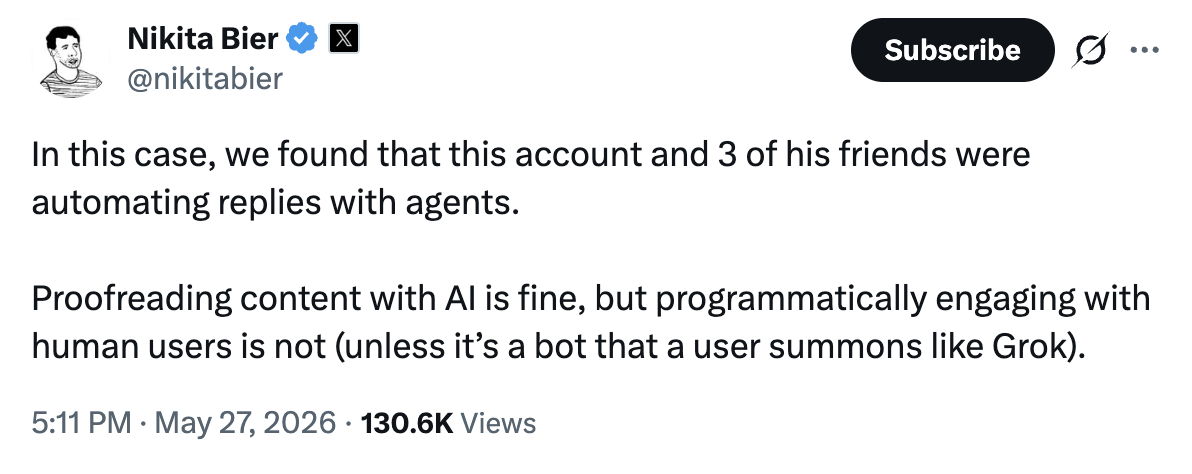
Popping up a level, my current philosophy when it comes to leveraging AI for important-but-not-urgent tasks is to automate the time-consuming parts of the task that I don’t find value in (searching for relevant Reddit threads, brainstorming how to turn a long-form blog post into a short social media post), while selfishly keeping the parts of the tasks that I do find value in (reading relevant Reddit threads, taking the time to write the final form of a post in my voice).
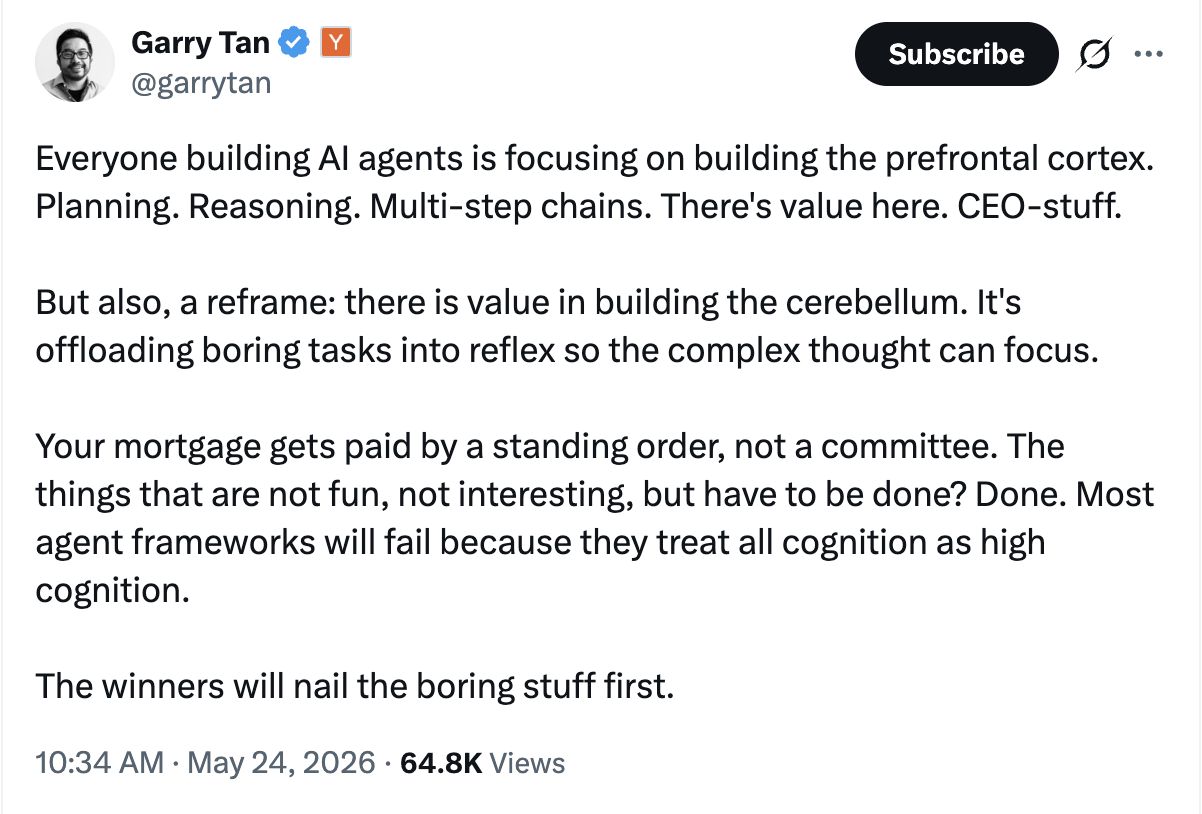
Garry Tan recently reflected on this in a post about near-term opportunities for agent frameworks — distinguishing between the high-value “CEO stuff” and the things that are “not fun, not interesting, but have to be done”:
In his most recent biannual technology report, Benedict Evans described AI as “giving you infinite interns.” I think that’s one of the best descriptions I’ve heard yet (and it maps very well to how I think about agents).
The reason why so many of my important-but-not-urgent tasks languished on my todo list for so long was never because they were too hard. It was because they were too time-consuming (and from an ROI perspective, I couldn’t justify the amount of time it would take for me to do them nor the cost to hire someone else to).
But now that I have infinite interns at my disposal, I can offload the parts of each task that are “not fun, not interesting, but have to be done.” What remains is the “CEO stuff” — and a much smaller denominator for calculating ROI.
So take a look at each task on your important-but-not-urgent list and think, “if I have access to infinite interns, is that enough to finally get it done?”
Who Should I Talk To?
I’m a big proponent of startup founders visiting San Francisco on a regular basis. But many make a fatal mistake when asking for on-the-ground introductions.
I’m a big proponent of startup founders visiting San Francisco on a regular basis. But there’s one mistake many founders make when planning their trip to Silicon Valley. Each-and-every week, I get at least one email from a founder that goes something like this:
“Hey Chris,
I’m coming to SF in a few weeks. Who are the 2-3 people I should absolutely talk to when I’m there?”
It seems like a reasonable enough request, right? Especially given Silicon Valley’s pay-it-forward culture. But emails like this are more likely to result in me hitting the trash button than typing out a reply.
Here’s why:
1. I Probably Don’t Know You
Granted, I don’t have the world’s best memory, but these emails generally come from people I barely know. In fact, they almost always come from founders I’ve spoken with exactly once.
Looking at the example above, the lack of familiarity is pretty obvious from the tone — you would never write an email like this to someone you’re friends with. But for some reason many people (particularly CEOs), think it’s okay to fire off what are effectively demands to relative strangers.

2. I Definitely Don’t Work for You
Not only are emails like this tone-deaf, they also imply a request: please do work for me.
In order for me to respond affirmatively to this request, I have to:
Look up our past interactions to refresh my memory on who you are and what your company does (granted, AI does help with this)
Then spend time to think about what help you might need at this point in your journey
After that, I need to think through the details of my personal and professional networks to match those needs with people I know
Next, I need to write a detailed email back to you about who these people are and why I think they might help you
Then…
Suffice to say, that’s a considerable amount of work for someone I barely know. And it certainly doesn’t show an understanding of the paradox of time.

3. I’m Very Protective of My Network
Even if I were to come up with 2 or 3 people that I think might be of use to you, I won’t promise you an intro.
In order for my friends to remain my friends, I need to be respectful of their time and ensure that all introductions are double opt-in.
How to Ask for Introductions
Chris Albinson, Managing Partner of True North Fund and cofounder of the Canadian expat network, C100, recently shared this advice with visiting Canadian founders,
“There are nearly 300,000 Canadians in the Bay and they sincerely want to help. But you have to show up prepared.”
This scenario is a great example of that.
Instead of asking someone to do all of the work for you, be specific in your asks,
“I’m hoping to meet 2 or 3 Pre-Seed investors to get feedback on my pitch before we start fundraising in the fall. Do you know any VCs who actively invest in X and might be willing to take a 20-minute meeting?”
“I want to meet CTOs of companies in industry X in order to ask about Y. Do you have any connections to such companies in your portfolio that you would be willing to pass along a request-for-intro email to?”
“I’m considering spending more time in San Francisco and would like to speak with a couple of expats who recently relocated there to learn about their experience. Do you happen to know anyone that might be willing to connect?”
Not only do each of these examples have specifics about the type of person the author wants to meet with, they’re also significantly more humble in their tone (which is likely to lead to more positive responses).
Here are some other tips:
Consider including a fully-written request-for-introduction email below the ask (so that the recipient can take action without having to go back-and-forth with you)
Use LinkedIn to research if a person is connected to individuals who meet your target and ask for specific intros (e.g. “I notice you’re connected to the following VPs of Engineering. Would you be willing to pass along a request-for-introduction email to any of them?”)
And always remember, to win transactions, don’t be transactional.
How to Tap Into the Serendipity of Silicon Valley
Many founders come to San Francisco for a weekend or a week, hoping to “tap into the magic.” But come away disappointed. Why?
If you’ve been a reader of my newsletter for any length of time, then you know that I’m a huge proponent of founders (and investors) spending time in San Francisco / Silicon Valley. But I regularly meet founders who travelled to the Bay Area only to come away disappointed.
They didn’t meet anyone particularly interesting. They didn’t have any life-changing epiphanies. Sure, it was cool to visit. But they didn’t get it.
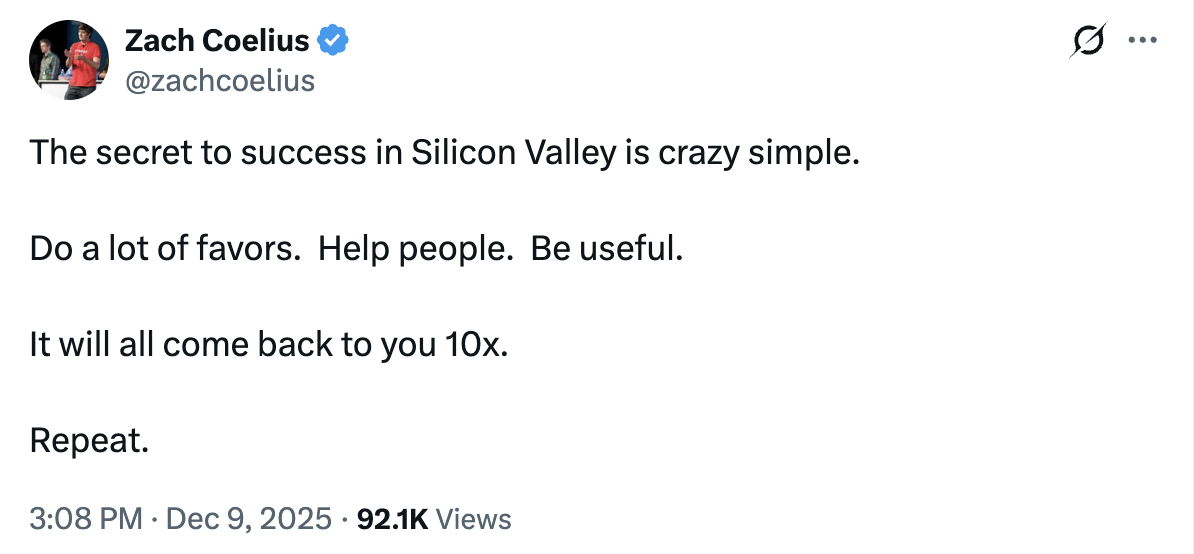
In contrast to the never-ending stream of posts about amazing SF experiences, it doesn’t make a lot of sense. So many people claim that San Francisco is open and welcoming. They assure you that it’s easy to get in the proverbial door. That it’s all about “paying it forward”.
But not everyone has that experience. What gives?
It boils down to two things: time and a willingness to say ‘yes’.
Silicon Valley is a fast-moving ecosystem, but relationships still take time to develop. Many founders come to San Francisco for a weekend or a week, hoping to “tap into the magic.” But a week isn’t long enough.
Because San Francisco serendipity works in hops.
Consider the following scenario:
You fly to SF, having done your research and found some events to attend on SF IRL. The first couple of meetups you go to are duds, but on the third day you strike gold. While at a hackathon, you start up a conversation with some like-minded founders, who casually drop the opportunity,
“You should totally come to X with us on Tuesday.”
Too bad you’re leaving town the next morning… 🤷♂️
These types of conversations happen every week in San Francisco — it’s a big part of how the ecosystem operates. Many events don’t have formal invites. The details spread through word-of-mouth, text messages and group chats. It’s easier than it might seem to get into the “inner circle”, but it starts with being able to say yes.
Which means you have to visit for more than a few days.
When we first conceived of last month’s Game On Canada experiment, one of the key questions was, “how long should the program be?” One of my objectives was to help the visiting founders build the beginnings of genuine personal and professional networks in the Bay Area. That meant having them visit San Francisco long enough that they could say “yes” — not only to the first hop of serendipity, but to the ones that came after.
We eventually landed on three weeks. In theory, that would be enough time to get the lay-of-the-land, attend a number of “entry level” events and meetups (both those we held and ones they found themselves), and then go deeper with some of their burgeoning relationships.
At the end of the program, I asked the founders to export their LinkedIn connection graphs for me. I wanted to see if that part of the experiment worked. Were the founders able to make connections in the Bay Area? Here’s what I saw:

LinkedIn Connections (Baseline as of 1/1/25)
LinkedIn connections certainly don’t provide a complete picture of anyone’s relationship graph (I’m connected to plenty of people who I don’t remember and have many friends who I’m not “LinkedIn official” with). But when I first saw this graph, I immediately smiled. Not only did every single founder have a meaningful increase in LinkedIn connections during the program, but a significant number had their rate of connections “accelerate” as the program went on.
On the last day of the program, I asked the founders to share their experiences meeting people in San Francisco. As we went around the room, almost all of them told stories of meeting people who invited them to something, where they met other people who then invited them to something else. Hackathons, art exhibits, dinners, conference parties, after parties, hikes,… — almost all of the founders were able to tap into the serendipity of Silicon Valley!
And almost every single one referenced the fact that they had met people that they intended to stay in touch with after returning home.
That, to me, is success.
Is three weeks the correct number for everyone? I don’t know — but it feels like a good place to start. It’s obviously not easy to pickup and relocate for three weeks, but if one of your goals is to build genuine connections in San Francisco / Silicon Valley, see if you can make it happen.
And be sure to say yes.
The Bouncer at the Nightclub
To succeed as a founder, you need to find ways to get past the bouncer.
We all know the scene.
There’s a long line outside of a packed nightclub. People dressed in their finest line the street, patiently waiting to get in. Except for those who don’t have to wait. You know the ones. The girls who flash a smile and strut past everyone. The guys who dap the bouncer as they confidently walk through the door.
Meanwhile, the normies dutifully stand in line, all-the-while grumbling about how unfair it is…

Now, let’s play make believe.
Imagine that instead of trying to get into a nightclub, you’re trying to get pre-release access to a new AI model. Or a meeting with a prominent VC. Access to an exclusive dinner for up-and-coming founders. Or an invite to the best private party taking place on the edges of that conference.
All of these scenarios have the same dynamic. And just like night clubs, it’s possible to work your way.
Here are four ways to get past the bouncer at the nightclub:
1. Get To Know the Owner
The most direct route into an exclusive club of any kind is to get to know the proverbial owner.
In Startupland™, that’s where the warm introduction comes in. In many cases, you can get direct access to any CEO, event organizer or investor through a warm introduction. The parallel to nightclubs comes from the fact that the introducer is vouching for you. They’re effectively saying to the nightclub owner, “this person is cool.”
Mind you, that doesn’t guarantee the introduction will work. In a world where the double opt-in intro is required etiquette, almost no one will promise you an intro.

If a warm introduction doesn’t work (or you don’t know anyone who can introduce you), you can often connect directly with someone via social media. In many cases, a well-written cold outreach can lead to success.
2. Get To Know the Bouncer
The next best approach is to make friends with the bouncer.
Whenever there’s exclusivity, there’s someone responsible for identifying high potential guests while keeping out the riff-raff.

Don’t mess with Bill Murray
In VC firms, it’s the Associates. In companies, it’s the front-line employees.
Spending time getting to know the people responsible for filtering access can help you eventually get the meeting, get access to the beta release or score an invite to the event.
3. Make Friends with the “In Crowd”
If you can’t get in on your own merits, making friends with someone who can get you in is the next best thing. Who’s already part of the club that you’re trying to get into?
If you’re hoping to raise from a particular VC, there’s no better intro than from one of their portfolio founders. Want to go to an exclusive event? Get to know the sponsors who are paying for it (your lawyers can probably get you into plenty of parties! 😂).
4. Slip the Bouncer a Twenty
I’m pretty old at this point, so I’m guessing that $20 won’t actually get you into a nightclub anymore, but you get the point. In a world of capitalism, there’s almost always a price. So what does that mean when it comes to startup founders?
Well, I’m certainly not suggesting that you directly try to buy your way into events (in most cases, it’s not going to work). But there is a parallel: selling your equity for access.

VCs love to brag about how much “value add” they bring to the table. One of the most impactful benefits investors can bestow on founders is access.
Almost every VC has some form of CEO summit (instant access to every CEO of every company in their portfolio). Most investors will brag about how extensive their rolodexes are. And many regularly host small format dinners and invite-only events. Whether it’s Sequoia or YC or one of numerous super angels, thinking intentionally about access as part of your fundraising decision can be a major cheat code.
“If I take capital from X, who (or what) can they help me get access to?”
Of course, you shouldn’t just take their word for it. Reach out to founders in their portfolio and ask how good they were at making connections and helping to “get them in the door.”
This may all sound very transactional, but getting access to the people, events and opportunities that can accelerate your business is an essential part of being a successful founder.
When it comes to startups, distribution wins. And networking is how founders distribute themselves.
If you spend time getting to know people who are well-connected and they see that you are genuine, high-value and have something to contribute (assuming that you are, in fact, all of those things), before you know it, you’ll start to find yourself nodding at the bouncer on your way in.

When Distractions are Everywhere, Focus Wins
The rate of advancements resulting from AI is nothing short of astonishing. But for founders, it can be a major distraction.
We live in an age of distractions.
Geopolitical distractions. Social media distractions. Prediction markets and crypto degens and brainrots and, and, and…
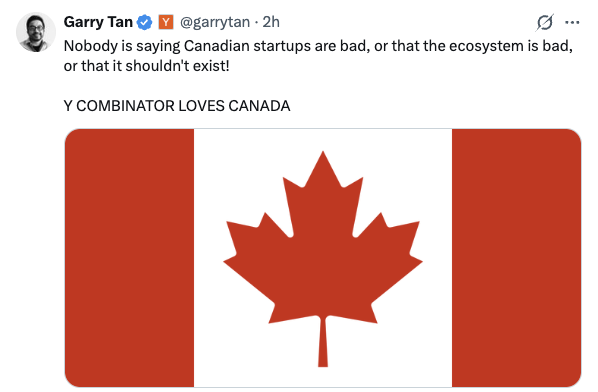
Remember that time a VC’s streamlining measure caused an entire country’s tech sector to screech to a halt?
Oh yeah…and there’s that whole AI thing:
“Have you tried the latest Claude Code?”
“My Mac Mini arrives tomorrow, I can’t wait to get Clawdbot going”
“It’s not called Clawdbot anymore, it’s Moltbot!”
The rate of advancements that are coming at us as a result of AI is nothing short of astonishing. But for founders, it can be a major distraction.
I remember sitting at YC’s W2025 demo day last March when Garry Tan stood in front of the crowd and declared that 25% of the companies in the batch had 95% of their code generated by LLMs. During the course of the day, company after company went on stage with a pitch that included a line like this:
“We wrote our first line of code 3 weeks ago, and…”
Almost everyone in the audience was enamored by how much progress these companies had made in such a short amount of time. But my mind went elsewhere. As someone who spent years working within accelerators, I knew that underneath every such statement was another one:
“We just pivoted 3 weeks ago…”
And that’s what I heard again and again over the course of the day,
“We pivoted 3 weeks ago, and…”
“We pivoted last month, and…”
“We pivoted last week, and…”
Despite meeting numerous incredible founders and amazing companies that day, I left the Palace of Fine Arts with a singular thought stuck in my head: AI is going to be a super power for some founders and will absolutely undermine the focus of many more.

Since then, I’ve seen the results time and time again:
Pre-revenue companies pivoting left, right, and centre around whatever excites them.
Companies who change what they’re doing after not finding an excited customer after…3 tries.
Too many founding teams throwing the baby out with the bathwater time and time again.
For every team I meet that found a new opportunity as a result of AI, there are 10 more who couldn’t stay focused enough to push through the natural challenges of getting to product-market fit.
On the one hand, I get it. New technologies are exciting! Most of us got into this because we really like to build things. But the easier it is to just “start over”, the harder it is to persevere.
These days, my timeline is filled with posts from founders who built X or automated Y after chugging red bull all night. And that’s cool! But does it solve your customer’s pain point?
You know…the one you founded the company to solve?

Unless you’re building dev tools, those customers are probably going to have the same problem on Monday that they did on Friday. The latest AI model or open source agent didn’t change that.
By all means try new things. Spend time to test the new models and try the new toys. But for the love of god constrain the amount of time you spend doing that. If you started a company to solve a pain point that you’re passionate about, keep your eye on the prize (provided, of course, that you continue to believe that pain point matters).
And if you find yourself spending more time on the shiny new thing than you are on solving your customer’s pain points, think about that too.
In an age of distractions, the winners will be the ones who stay focused.
Now, where’s my Mac Mini…

How to Build a Silicon Valley Network
Here are the top tips for breaking into Silicon Valley and building a network that matters.
Last week, we welcomed 35 Canadian founders to San Francisco as part of an experiment in velocity called Game On. More than a third of the founders had never been to the Bay Area before, so we spent a good chunk of time helping them get acquainted with the unique culture and etiquette of the world’s preeminent tech ecosystem.
One of the big questions our founders had during week one was how to get to know quality people while in San Francisco. Here are some of the top tips for “breaking into Silicon Valley”, as shared by our speakers:
Leverage Your “Expat Network”
Michael Buhr, Executive Director, C100
As a former founder and the current executive director of the Canada’s tech expat network in Silicon Valley, Michael has been helping visiting Canadians build their San Francisco networks for more than 20 years. His number one piece of advice is to leverage that network to bootstrap local connections.
“Almost everyone in the Bay Area came from somewhere else — a different city, state or country,” shared Michael at the start of Game On. “And most everyone here genuinely wants to help. Reach out to people who grew up where you did and you’ll be amazed what happens.”
“If you reach out to a Canadian living in the Bay Area with a cold email or DM that starts with ‘I’m from Canada,’ 99% of the time you’ll get a response.”
Doing your homework before arriving in the Bay Area and looking up people you want to meet from the same city, school or former employer can give you a leg up when landing in Silicon Valley.
Follow Up Right Away
Ramneet Sran, Consul and Head of Office, Consulate General of Canada in San Francisco
The head of Canada’s Trade Commissioner Service in San Francisco, Ramneet Sran, emphasized follow-up in her advice,
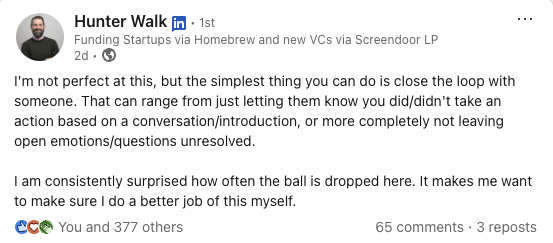
“Try to follow-up with everyone you meet the same day. Don’t wait until tomorrow or next week or until you get home — they’ll forget about you by then.
Silicon Valley moves so quickly that one of the best things you can do is to simply make sure that there’s an email or text in their inbox before they go to bed.”
Even VCs have to remind themselves to do this
Do Things That Keep You Top of Mind
Tom Charman, CEO and Cofounder, Blok
Tom Charman has built multiple companies in the U.K., Germany and the U.S. He encouraged founders to find creative ways to stay top-of-mind, even when you aren’t in Silicon Valley,
“It’s easy to add people to your mailing list, but there’s so much more you can do,” he offered. “If you’re creating company swag, make extra and send it to the VCs, founders and other people in San Francisco you’re trying to build relationships with. For years, I’ve made a point of sending personalized Christmas cards to everyone I want to get to know.”
“Almost nobody does that anymore, so it really sticks out.”
Treat Your Visit Like a Vacation
Hiten Shah, CEO and Cofounder, Crazy Egg
Multi-time founder and prolific investor Hiten Shah offered this seemingly counterintuitive advice to visiting founders,
“Use every visit to the Bay like a vacation from your default settings.”
Hiten’s not suggesting that you kick it on Ocean Beach with a bonfire and a beer (though that can certainly be fun). Rather, it’s about being open to change and putting everything on the table,
“Go back with more urgency than you arrived with.”
Have a Plan
Clayton Bryan, Partner, 500 Global
Clayton Bryan has welcomed thousands of founders to San Francisco over the past decade. His advice was to make sure that you have a plan before trying to meet people,
“Too many founders spend their time in San Francisco all over the place,” he shared. “They’ll take our database of mentors and email every single one, without rhyme or reason. Or they’ll go to every single party and meetup they can…just because. That might fill your calendar with meetings, but it won’t move your business along.”
He encouraged founders to be clear on their goals and intentional about how they spend their time in the Bay Area,
“Who are you trying to meet? What are you trying to achieve? It’s cool to go to parties, but if you’re doing it for work, what will you consider a success?”
(If you want some tips specifically on how to get the most out of networking events, check out this post.)
Visit Often
Ian MacKinnon, Cofounder, Stingray Security
When Ian MacKinnon was building Later.com, he took full advantage of the fact that the company’s headquarters in Vancouver, British Columbia was only a 2-hour flight from San Francisco.
“I would regularly take the earliest flight down in the morning, go to investor or other meetings in Silicon Valley, and be back home in time for bed.”
By showing up in person periodically, you stay top of mind and build deeper relationships than you would if your interactions were entirely over Zoom.
“Plus, over time people will forget that you aren’t actually based in SF. Which is a huge advantage.”
For more ideas on what to do when you first land in San Francisco / Silicon Valley, check out these posts:
Start the New Year with a New Routine
Over the years, I’ve found that setting New Year’s resolutions rarely works for me. But there is something that does work for me time and time again: setting a new routine.
It’s almost the new year again.
For many people, a new year is a symbol of new opportunity. It’s the time of year when many people try to embrace new goals, particularly around self-improvement. Gym memberships surge 25 - 30% at the turn of each year (in fact, nearly 50% of people have some sort of fitness-related New Year’s resolution).
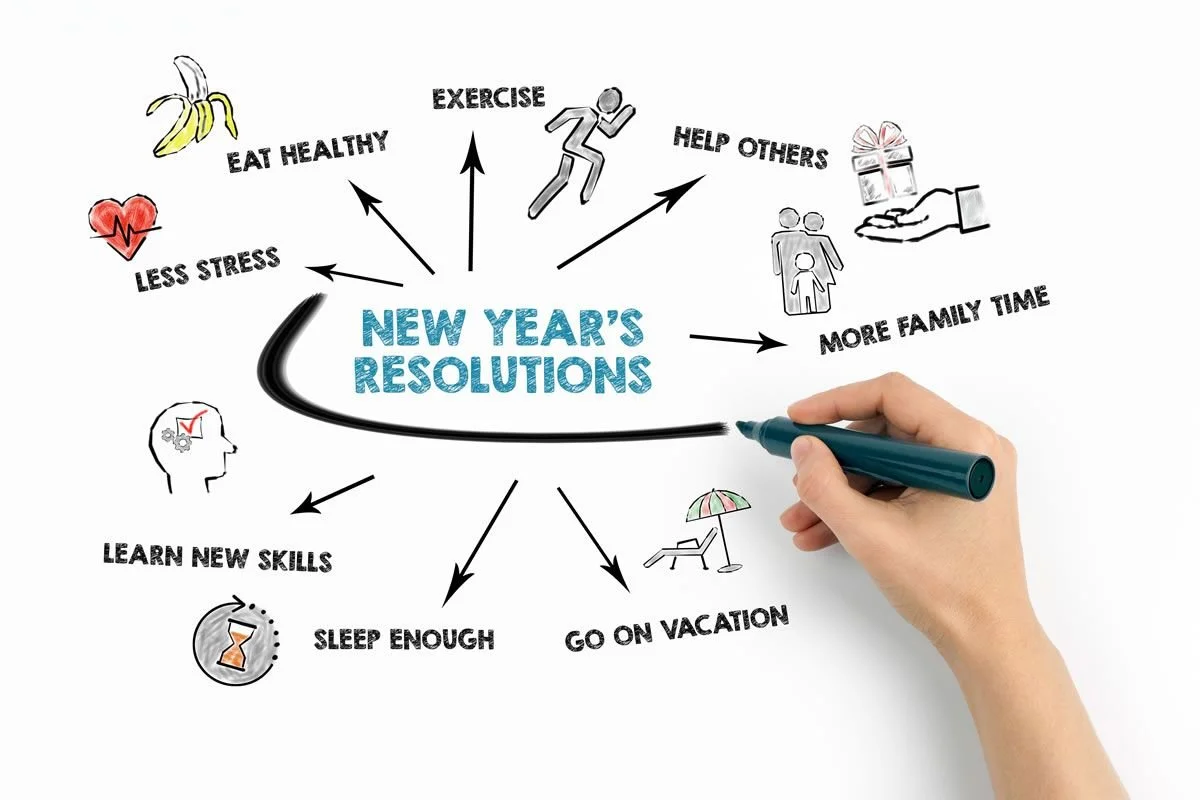
Over the years, I’ve found that setting New Year’s resolutions rarely works for me. Even when I set very specific goals. But there is something that does work for me time and time again: adding new routines at the start of the year.
Here’s what I mean:
Instead of focusing my New Year’s resolutions on goals or objectives (like, “lose 10 lbs” or “read 10 books”), I use the new year as an opportunity to adjust my schedule in favor of the things that I want to prioritize. For example, here is how those two goals might translate into routines:
Lose 10 lbs → Add 10 minutes / day of walking or exercise (or make other adjustments to be a healthier founder)
Read 10 books → Add 10 minutes / day of reading time
If you adjust your routines to prioritize the things that you want to achieve, the results will naturally follow (and you can set specific goals after that).
Of course, achieving your goals still requires you to follow though on those changes. It’s uncomfortable to make changes, but there is power in discomfort. And, thankfully, there’s an app for that (there always is 😉). I use an app called Streaks to track my habits.
I also find it helpful to learn from other peoples’ routines. For example, last week John Coogan from TBPN shared his daily routine. While reading it, I learned about an app for tracking workouts that I wasn’t familiar with: Strong. (I also got a good chuckle at the fact that the cofounder of Soylent now eats double smash burgers and cinnamon buns for breakfast 😂.)
I’m not sure that my morning routine contains any epiphanies, but I thought I’d share it nonetheless. To start off with, here’s what my weekday routine looked like 3 years ago:

I’ve made a few changes since then — mostly because my wife now has an earlier start to her day than I do.
These days, I wake up at 5:45am, then go downstairs and make coffee. While I’m waiting for the pour over to brew, I put together the kids’ snacks and lunches for school. At 6:15am, I deliver coffee to my wife and give a light nudge to my boys (who naturally wake up between 6:00 and 6:30am).
I work out with a remote personal trainer from 6:30 - 7:00am while the boys get dressed and watch some morning cartoons. Having a virtual trainer is great because it eliminates the travel time from my schedule (he’s also great with kids — ensuring to throw in some bicycle kicks or planks at the end of each workout to get them involved).

Let’s go boys!
At 7:00am, I jump in a quick shower and then make breakfast. We all sit down as a family from 7:15 - 7:30 to eat. It’s short, but it’s a great touch point for us to start each day. At 7:30am, my wife is out the door to her work, while I get the boys ready to go. At 7:45am, we’re in the car and off to school.
After dropping them off, I stop by a nearby coffee shop, where I spend 45 blissfully peaceful minutes sipping on a cappuccino while responding to emails and reviewing my schedule for the day. By 9:00am, the day is on 🔥.
(My actual working days are all over the place, so I won’t try to pretend that there’s anything close to a routine between 9:00am and when my head hits the pillow.)
Speaking of which, I personally find it a million times easier to add new things to my routine in the morning — for the simple reason that there are fewer opportunities for interruption. I find it far easier to wake up 15 minutes earlier or delay my first meeting by 15 minutes than to insert anything regular into the rest of my day. But everyone is different.
Just remember that it’s not about being perfect. If you want to adopt a new habit, do your best, keep track, and be proud of your new routine and whatever you’re able to accomplish. Despite what Yoda says, trying matters (while perfect is the enemy of done).
So what am I going to do in the new year?
Recently, I was inspired by Charles Hudson’s post, Teaching AI to Think Like Me Made Me Rethink How I Think. While I’ve experimented a lot with AI, I’ve been inconsistent about how and when I do it. So I’m going to try adding a dedicated “AI block” to the start of each day. I’ll circle back at the end of Q1 to see what came of it.
Happy holidays! (And rememeber, you should take a break. No really).
Get To The Point
When corresponding over email, it’s essential that you get to the point. Here are 5 common mistakes founders make when interacting over email.
If you’ve been reading my posts for awhile, by now you’ll likely have noticed that I regularly write about writing.
It’s not just because I’m pedantic about prose. It’s because we live in an era where a significant percentage of new relationships start in writing.
When you combine that fact with the paradox of time, the need to be concise in your writing becomes paramount. Whether your reaching out to potential investors, trying to cut through the noise with sales prospects or trying to get press for your startup, it’s essential that you get to the point.

Here are 5 common mistakes founders make when interacting over email:
1. Asking for Permission
Several times each month, I get cold emails from founders that include only partial details and then ask for permission to send the rest. For example,
“We’re raising a $1.5M pre-seed round. Can I send you the deck?”
Perhaps they once took a sales class where the instructor suggested this as a way to get a “buying signal”, but I can tell you that emails like this almost always go straight to my trash. I have neither the time nor the interest to go back-and-forth with someone I’ve never met to get the other half of an email I didn’t ask for.
If you’re going to do cold outreach (or even warm outreach!), make sure your emails contain all of the information necessary for the recipient to respond.
2. Explanation, Answer
Many founders — particularly those from Commonwealth countries — have a tendency to answer questions starting with an explanation or justification. In a verbal conversation, it might go something like this:
Investor: What is your revenue?
Founder: Well, we just started monetizing a few months ago,…
By the time you eventually answer the question, I’m convinced that you’re making excuses. So even if the answer is awesome, I’ll have already discounted it. Instead, answer the question directly, then add any context:
Investor: What is your revenue?
Founder: We’re currently at $1,500 MRR. We just started monetizing a few months ago,…
In writing, the impact of this mistake is amplified even more. When responding to written questions, make sure that you start with facts and then provide any explanation/justification afterwards.
Better yet, ask yourself if the justification is actually necessary. Oftentimes, you’ll come across as more confident by sticking to the facts and letting the recipient come back at you if they want additional details:
Investor: What is your revenue?
Founder: We’re currently at $1,500 MRR.
3. Having Someone Else Write Your Cold Email
Multiple times each week, I get cold fundraising emails in my inbox from someone who isn’t the CEO. They look something like this:
Hello Chris, thought you'd be the right person for this.
I represent a platform undergoing their Series A round with 125,000+ members and 40+ global partners built for independent professionals and enterprises. The company helps enterprises manage flexible talent while providing Individuals access to essential benefits usually reserved for corporate employees.
Can I share more details on their Series A round?
with appreciation,
[Redacted]
Revenue Growth Advisor(This one gets bonus points for also asking permission to share the rest of the details.)
Sometimes, these emails come from fundraising brokers. Sometimes, they’re from angel investors or advisors. Sometimes, the CEO has another employee at the company write the email. And sometimes they’re from a random person who I can’t for the life of me tell the nature of their relationship with the company.
Regardless, 100% of these emails go to my trash.
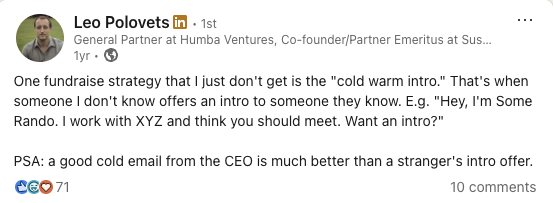
(Note: while early-stage fundraising brokers are common in some parts of the world, exactly zero credible VCs in North America will fund your Pre-Seed or Seed round if the introduction comes via a broker. So don’t waste your time or money with them.)
4. Unnecessary Sarcasm / Jokes
This is another strategy that, more often than not, is a turn off: starting with sarcasm or an unnecessary joke before getting to the point of the email.
Humor often works very well in-person, but amongst a flood of tightly-written emails, it often has the opposite effect. For example, I received a handful of emails after the deadline for Game On that started with some form of,
“I guess we didn’t get in…”
“I’m sure there were plenty of applications, bla bla bla…”
“I didn’t see an email after the deadline…”
I’m not sure what folks hope to gain with this. In contrast to the examples above, a number of applicants wrote very thoughtful emails asking for feedback, and I responded to almost every one. But the ones who started with unnecessary sarcasm or negging or jokes… 🤷♂️
5. Justifying No’s
This last point is less a mistake and more an opportunity for improvement.
One of the hardest personal evolutions for most founders is learning to say no.
In our early days, we worry that we might be missing out on something. We might close a door that could lead somewhere. Even when we become successful, we want to help and give back (hence, the paradox of time). But there’s a level beyond just learning to say no…
The S-tier evolution of this is learning how to say no without justifying the reason.

5 Easy Ways to Use AI
Here are 5 easy ways you can use AI today (without having to be an expert prompt engineer).
AI is everywhere.
And so are the countless posts and podcasts telling you how to get started.
The only problem is that almost all of them start with a disclaimer about how long it’s going to take you to “get good at it”. You need to try things out. You need to iterate. You need to learn and discover and rethink how you do things. But don’t worry…it’ll be fun!

Now don’t get me wrong — I think everyone (especially founders) should carve out time to learn and discover and understand how AI works in its current form. But even if you become a Level 80 Prompt Engineer, you still only have so many hours in the day to actually build things with AI.
A few years ago, I shared 5 new habits for the new year (which is still a relevant post). Today, I’m going to share 5 easy ways you can use AI right now. Even if you’ve never written a single prompt.
Every single one of these will deliver immediate ROI for you and/or your business. And they’re all things that I’m personally using.
1. AI for Scheduling
There was a time not so long ago when x.ai wasn’t one of Elon Musk’s many companies but, instead, was a small, New York-based startup trying to build an AI-powered personal assistant. At a time when virtual assistants were all the rage, the promise of “Amy” was alluring. Here was the description of x.ai from their launch announcement back in 2014:
Getting copied in triggers Amy (full name: Amy Ingram, apparently) to read the email, look for date and time and place suggestions and then continue to the conversation directly with the other person to find a time and place that works for everyone — and then put the detail into your diary.
The idea here is that rather than taking up your time, or other people’s time, scheduling these meetings, you can use Amy to do it all for you. “Anything which a human PA could add to a traditional meeting invite she can do,” co-founder and CEO Dennis Mortensen tells me.
It sounded amazing. Unfortunately, it didn’t actually work (I was an early beta user).
Fast forward 10 years and I had the opportunity to beta test another AI-powered personal assistant from another small startup called Howie.ai. This new startup had a very similar-sounding value proposition:
Howie manages your calendar with the finesse of a world-class EA and the precision of a bleeding-edge AI.
The difference? Howie works.
I’ve been using Howie.ai for about 6 months now and I’ve found it to be better at scheduling than any human EA/VA I’ve had before. That may sound crazy, but the degree to which you can fine-tune it is unbelievable. It remembers nuanced instructions that a normal human would forget. And it automatically reaches out when it needs additional information or finds a conflict in your schedule.
Howie doesn’t currently do anything other than scheduling (so it won’t replace an EA/VA for other tasks), but it is really, really good at scheduling. If you’ve ever interacted with “Max” to setup a time to talk with me, you’ve actually been interacting with AI 😉.
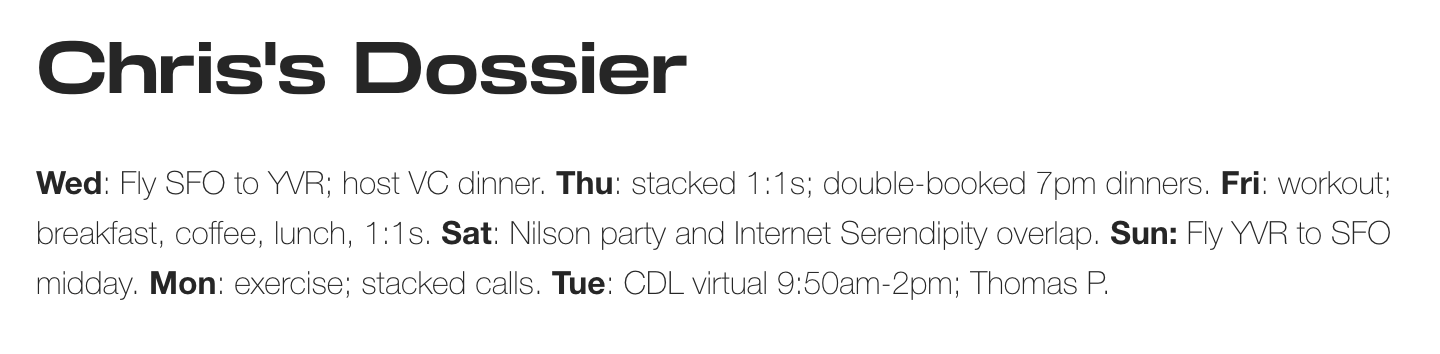
My next few days according to Howie
2. AI for Remembering
There is one aspect of my experience navigating Startupland™ as an investor that fills me with shame. Despite my best efforts, chances are I have absolutely no idea who you are. AI transcription has changed that for me.
There are plenty of AI notetakers on the market. Most of them focus on a straightforward use case: transcribing online video calls and saving them…somewhere.
If I’m being honest, I haven’t personally found a huge lift from AI notetaking on its own. Sure, it saves me a bit of time typing and conceptually allows me to be more present in conversations, but I grew up in an era where typing was a mandatory class in high school, so I’m used to typing and talking at the same time. Add to that the fact that most AI notetakers have limited / buggy / work-in-progress integrations with CRMs and other software platforms and it often felt like it took more effort to use them than to just take the notes myself.
But then they started to introduce querying capabilities — and that changed the game (at least, for me).
Several times each week, I’ll get ready to join a meeting and realize that I don’t recognize the name of the person I’m meeting with or can’t recall how we met / what the meeting is about. Instead of scrambling or sheepishly asking the person what we’re supposed to be talking about, I can now ask Granola questions like:
Where did we meet?
What did we talk about last time we had a call?
Has this person’s name come up in other calls that I’ve had?
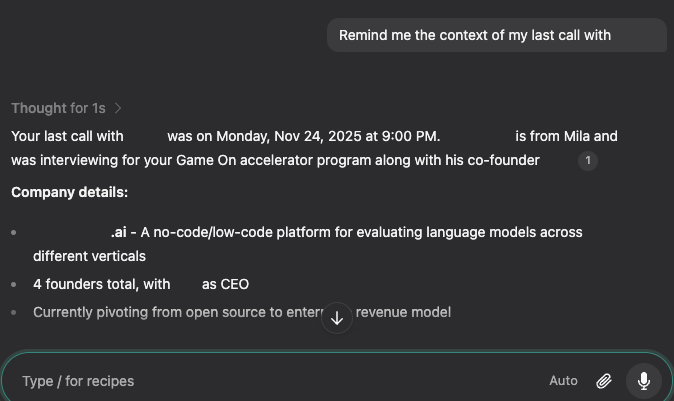
For as much flak as Cluely got for their “cheat on everything” positioning, the underlying insight was a prescient one. We now have the ability to augment our knowledge and memories in real-time, which is an incredible power-up as a founder.
3. AI for Data Entry
Data entry is the bane of every tech worker’s existence (and I say that as someone who made his mark in the database / data analytics industry). It’s tedious, time-consuming and error prone.
AI has helped me eliminate a surprising amount of manual data entry, not only at work but in my day-to-day life (which means less time doing data entry and more time doing…anything else).

Here’s a simple example: adding flight details to my calendar.
I’m a picky traveller and generally book my own flights (even when I work with an EA/VA). Whenever I book a flight, I have to add details to one or more calendars. That might not sound like a big deal, but each one takes a few minutes — potentially more if you’re like me and like to have your calendar entries in a particular format, complete with flight details and booking references.
Google has tried to automate this for awhile (by scanning emails and adding flight details to Google Calendars), but the way it creates calendar entries is problematic. Not to mention the fact that it’s inconsistent. Modern AI solves this.
I can now forward any email confirmation / itinerary to Howie.ai with a simple note: “add to <x> calendar” and have a corresponding entry added to my calendar(s) in the exact format I prefer. It can also invite other people or add entries to shared calendars. That might sound trivial, but it saves me anywhere from 20 minutes to an hour each month. That’s meaningful.
And all I had to do to set this up was send a single email to Howie describing the format I like for my calendar entries.
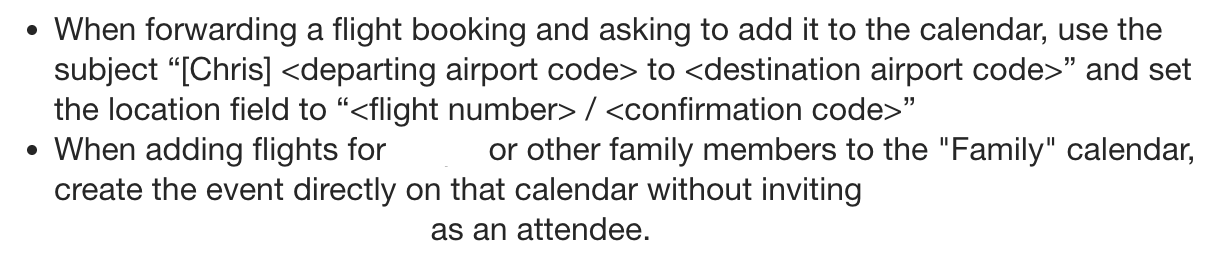
The internal rules Howie created based on my email request
I’ve found similar gains using AI agents for CRM data entry, expense reporting, and other, similar “small tasks” that multiply over time.
4. AI for Statistics
There are a lot of situations in Startupland™ that require statistics: pitch decks, conference talks, blog posts, etc.
In the course of my work and writing, I often find myself wondering about a variety of statistics — for example, how many VCs in a particular geography have technical degrees?
In the past, the best I could do was to query Google in the hope of finding someone who had researched and written about the particular stat I was interested in. More often than not, nobody had — which meant that after a few queries it was time to give up (either that, or go way down a rabbit hole desperately searching for the result I wanted).
Thanks to AI reasoning / deep research models, it’s now possible to ask an AI agent to go out and derive almost any statistic imaginable in an easy, cost-efficient manner.
For a long time I’ve had a hypothesis that a difference in the backgrounds of early-stage VCs in Silicon Valley and other parts of the world was responsible for some of the behaviors that we often dismiss as “risk aversion”. AI deep research tools allowed me to uncover what it was: the percentage of VCs in Silicon Valley who have technical degrees is significantly higher than in other parts of the world.
It also allowed me to debunk a commonly-held myth: that more VCs in Silicon Valley have entrepreneurial experience than VCs in other parts of the world (the ratio is almost identical).
And all of this took just a few minutes of querying ChatGPT with its reasoning model (o3) activated.

It turns out that Star Trek IV wasn’t that far off
To be clear: the statistics that these tools come up with generally aren’t scientifically accurate (unless they find the result in a peer-reviewed academic publication). But in my experience, the insights and “directional correctness” that they provide — along with the ability to easily fact-check the underlying data sources — is an unprecedented game-changer (and one that I use multiple times each week).
5. AI for Media
There have already been plenty of cultural flashpoints involving the intersection of AI and media (believe it or not, it was less than a year ago that the world was briefly obsessed with reimagining images “in the style of Studio Gibli”). But rather than share all of the things you could do with AI, I’m going to share a few of the things I actually do on a regular basis:
Images for Blog Posts, Websites and Event Announcements
Old
Spend hours searching Google to try to find the perfect image
Pay stock photography companies for generic looking images that are “good enough”
Hire someone to create the “perfect” image that probably costs way more than it’s worth
New
Spend a few minutes max searching Google for the perfect image (in particular, when I’m looking for memes for my blog posts)
Spend a few minutes prompting AI to create the perfect image (e.g. for a Canadian VC holiday dinner that I’m hosting)

“Create an image showing a group of moose, loons and beavers wearing red and black plaid patagonia vests holding glasses of red wine around a table at an old school mahogany steakhouse with a Christmas tree in the background”
Video Editing
Old
Spend hours manually editing videos on iMovie or similar
Pay a video editor way-too-much money to do the work for me
New
For simple videos (e.g. “walk-and-talks”), use free tools like Adobe Express to instantly add captions and make basic edits
For more involved videos, use an AI video editor like Descript to quickly-and-easily create and edit the video
Pay a video editor a very reasonable amount of money to do the work for me, knowing that they’re just turning around and using AI tools themselves
Have you checked out my YouTube channel yet?
Music and Sound for Videos
Old
Use boring, generic, open source or licensable music / sound clips and manually edit to (hopefully) fit the video
Use short clips of popular songs and hope you don’t get an automated takedown notice
New
Subscribe to audio platforms like Epidemic Sound (which license music and sound clips from a variety of artists specifically for use in online videos)
Use their AI-driven tools to create derived sounds clips that include specific parts of songs at specific durations
I created the background music for the Game On launch video in about 30 minutes while on a flight
Every single one of these you can get started using instantly, without needing to learn how to be a prompt engineer (so no more AI intimidation!). I personally think that specialized tools like these will be the “gateway drug” for many people who want to leverage AI, but don’t know where to start.
And when you’re ready to go deeper, check out this excellent post by Charles Hudson about how Teaching AI to Think Like Me Made Me Rethink How I Think.
Stop and Say Thanks
Customer-facing roles are often thankless endeavors, but they’re essential to a startup’s success. Make sure to thank the people on the front line.
A few weeks ago, I wrote about my propensity to travel and my belief that a willingness to travel can be a superpower for founders. Recently, I had my superpower put to the test.
In the past two weeks, I flew to Columbia, Missouri for Capital Camp, an annual gathering of investors who focus on markets outside of the traditional coastal superpowers. From there, I travelled to San Francisco, where I stayed for 2 nights before flying to London (via Vancouver) and then on to Edinburgh to speak at Ecosystem Exchange. A few days later, it was all the way back.
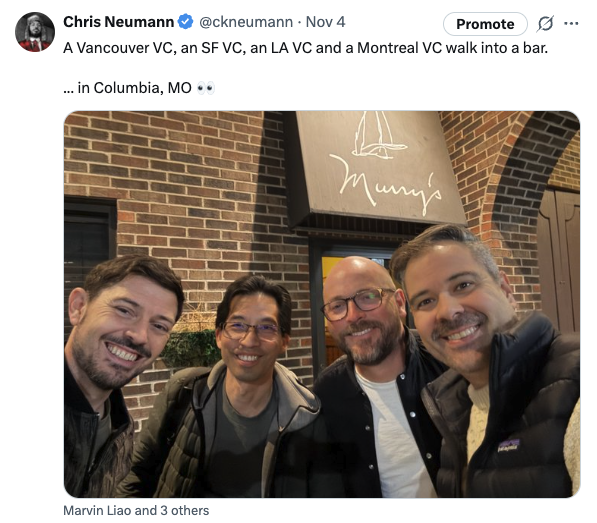
Flying cross-country is a common affair for many people who travel for work. I myself used to do it quite frequently when I was an operator. But this trip was different.
My travel took place during the longest U.S. government shutdown in history — neither the air traffic controllers nor the TSA agents working at airports across the country were being paid at that time. In the midst of all that, the federal government instructed airlines to reduce the number of flights they were operating by 10%. Thousands of flights were cancelled or rescheduled the night before I was to fly from Columbia to SF, leaving travelers scrambling.
I was scheduled to fly to San Francisco via Denver, one of the busiest airports in the U.S. When we touched down (45 minutes late), the stress was palpable. A number of the passengers on our Embraer E175 were nervous about making our connections, but that was nothing compared to what I saw when I exited the plane. It was absolute chaos. People were sprinting back-and-forth trying to make their flights, yelling at each other and at airport and airline staff, and the entire place exuded a level of stress that I haven’t felt in an airport in a long while.

Despite this, each and every person I encountered working at the airport — including those who hadn’t received a paycheck in weeks — was professional and courteous. If anything, they were even more professional and courteous than usual, despite an onslaught of angry customers and challenges.
A few days later, I was set to fly to London via Vancouver. Once again, my initial flight was delayed — this time due to a last-minute aircraft change. There was plenty of time before my connection, so the only real impact was that my seat was changed (to one of those bulkhead seats where you can’t put things under the row in front of you). I don’t usually choose to sit in those rows, as I like to have easy access to my laptop bag, but it was far from a big deal. Or so I thought…
I settled into my seat and spent the next couple of hours polishing my slides for Edinburgh and putting the finishing touches on an investor dinner I’m hosting in December. Overall, a solidly productive flight.
After we touched down in Vancouver, I passed by the courteous and professional Air Canada crew as I deplaned, then the courteous and professional YVR staff as I navigated through the airport to the international terminal, and finally the courteous and professional staff at the airport lounge where I arrived to spend the next hour. I sat down ready to continue my work…
…only to discover that my laptop wasn’t in my bag.

Red alert!
Immediately, I knew what had happened. Normally, I place my laptop into my laptop bag and slide it under the seat in front of me before landing. In this case, I didn’t have access to my bag, so I put my laptop into the sleeve attached to the bulkhead…and promptly forgot it 🤦♂️.
I had less than an hour before my flight to London and immediately rushed to the airport staff to see if they could help. Unfortunately, I had already cleared customs, so there was no way for me to go back to the gate to get it myself — despite the fact that it was mere meters away from me.

Noooooooooooo
Seriously — I could actually see the plane I had just arrived on from the window of the lounge.

I rushed back to the welcome desk of the lounge to tell the staff what happened. They jotted down the details and got on the phone to try to help.
Unfortunately, airports are complicated places with lots of moving parts (and even airline staff get caught in phone trees trying to track down the right people). The fact that it was on the other side of a customs gate prevented the simple fix of just going and getting it. After 20 minutes of valiant effort, they gently suggested that I head to the gate, as my next flight was about to board. The most likely outcome was that they would have to ship it to me after I returned home from the UK.

At that point, there wasn’t much I could do. I headed to my gate and boarded my flight to London.
In reality, it wasn’t the end of the world. The slides for my upcoming talk were saved to Dropbox and, thanks to the miracles of modern phones, I had access to virtually everything I needed. Still…it was far from ideal.
A few minutes before takeoff, one of the flight attendants approached me and asked me to come with her. Standing outside the plane were two Air Canada staff members and a Canada Border Services officer holding my laptop!

I gratefully shook each of their hands and said thank you multiple times. All three smiled ear-to-ear. Even the stern-looking customs agent stood a little taller as she nodded proudly.
As I got back onto the plane, I couldn’t help but reflect on my last few days of travel. All of these people — and tens of thousands more — had likely spent the bulk of the past few weeks with people yelling and screaming at them. Directing frustrations at them over missed connections, rescheduled flights and countless other events that, while likely minor inconveniences in the grand scheme of things, at the time seemed overwhelming.
And yet every single person I encountered was professional and courteous.
That’s the thing about customer-facing roles. Nobody signs up to be yelled at. It’s not one of the perks highlighted in the job description. The vast majority of people I know who are customer-facing want to help. They want to solve problems and make people happy and be a part of something bigger. They want to be the hero of a lot of little stories — just like they were for me that day.
But in reality, customer-facing roles are often thankless endeavors. Both in air travel and in startups.

We heap praise on the engineers who create the thing, the sales execs who close the big deals and the marketers who come up with the viral campaigns. But behind the scenes are the field engineers who figure out how to deploy it and work around all the bugs, the embedded teams who keep the accounts stabilized, the customer support agents who respond to emails and phone calls at all times of the day, and the IT staff — that’s right, the IT staff — whose customers are inside the company but get no less frustrated when things go wrong.
Years ago, I hired a customer support specialist who had previously worked at 23andMe, the once-high-flying DNA testing startup. In recounting her experience there, she told me of her excitement at getting to work at a company on the bleeding edge of genetics. The opportunity to see the inside of one of Silicon Valley’s most prominent startups. And the reality of spending most of her shifts getting yelled at by people whose DNA tests brought unexpected or unwanted results.
People who discovered that their parents weren’t actually their parents. Their siblings weren’t actually their siblings. Their ethnicity wasn’t actually their ethnicity. They were angry and needed someone to yell at — and that was her (along with dozens of her colleagues).
I asked if the company’s leaders ever came by to thank them for their work. She just smiled.
In each and every startup, their are unsung heroes. The people who don’t often get the credit, but without whom the company simply wouldn’t operate. And if they’re customer facing, more than likely they spend a meaningful amount of their working hours as a receptacle for other people’s frustrations — whether or not there’s anything they can do about it.
So if you’re traveling this week, take an extra minute to stop and say thanks to the people helping make your travel a reality. Look them in the eyes, shake their hands, say their names and express your gratitude.
And when you get back to the office, do the same for everyone in your organization. Especially the unsung heroes. I promise, they’ll remember it.

What’s The Worst That Could Happen?
Even founders who are naturally risk-averse can develop a bias towards action. And it starts by understanding the real — and realistic — worst case scenario.
One trait shared by the best founders I meet is a propensity to action. Specifically, a bias towards action over excuses. When an new opportunity arises, these individuals ask themselves, “how can I make this happen?” or “how can I take advantage of this opportunity?” as opposed to starting with the reasons why it’s going to be hard.
Case in point: a few weeks ago, I announced Game On, a 3-week long experiment in the heart of San Francisco to accelerate Canadian founders. The goal of the program is to evoke a mindset shift in early-stage founders by exposing them to the velocity and intensity of Silicon Valley’s ecosystem through mentorship, speakers and intentional experiences.
The program will be entirely free for participating founders thanks to support of some incredible partner organizations. But there’s a caveat: the founders have to cover their own transportation and living expenses while in San Francisco.
A handful of people publicly and privately suggested that the need for founders to cover their own expenses would make the program “inaccessible” to some. Meanwhile, one founder emailed me to let me know that they had already arranged for a couch to sleep on and pre-purchased a refundable plane ticket, “…in case we’re selected.”

I firmly believe that velocity is the metric that matters most to startups. A big part of that is a willingness to take action on the part of the founders. And while it might seem easy for me to suggest that the best founders “just get it”, for many people it’s neither easy nor natural. Thankfully, in my experience this is a behavior that can be learned.
It turns out that even founders who are naturally risk-averse can develop a bias towards action. And it starts by understanding the real — and realistic — worst case scenario.

Scaredy Squirrel has a wild imagination
Focusing on the worst case that can realistically occur in a decision has helped me to lean into more opportunities while making faster decisions. Even really big ones. Here’s an example:
Many years ago, some friends of mine from grad school approached me about joining a new startup they were building. It was in a space I wasn’t familiar with but I was intrigued by the opportunity to work with them (they were three of the smartest guys I knew at the time, which is saying a lot coming out of Stanford). Having lived through the dot com bubble, I knew that there was a high likelihood that the startup would fail. So, I thought about the worst case scenario:
My friends had just raised a small pre-seed round — enough money to last about a year
In the worst case scenario, the company would fail after a year and I would struggle to find another job
Given that I was on an H-1B visa, if I didn’t find a new job in time, my visa would expire and I would have to go back to Canada
That would likely mean moving back in with my parents while I figured out what to do next
So, the realistic worst case scenario was that after a year, I would have to leave the U.S., move back in with my parents, and figure out a new job. But in exchange, I would get to spend a year working alongside three of the smartest people I knew. That’s a pretty good worst case scenario if you ask me. I leaned in and the result turned out to be far from the worst case.

Of course, not all decisions turn out the way you hoped, which is why it’s essential that you think about the worst case as part of your decision process (if you’ve ever heard the phrase “hope for the best, plan for the worst,” that’s what I’m talking about). But more than that, you need to mitigate the worst case scenario whenever possible.
If you assume that the worst case scenario will occur, are there things you can do to make it “not so bad”?
I recently wrote about my propensity to travel and the fact that traveling is an underrated superpower. As much as I do it, traveling does come with real costs:
Financial costs
Opportunity costs
Personal costs (time away from family, etc.)
In many cases, it can be hard to know in advance if a given trip will be “worth it.” A conference might end up sucking. A speaking opportunity might not deliver the expected ROI. A 3-week trip to San Francisco to participate in an experiment to accelerate Canadian founders might not actually accelerate you.
How do you mitigate the worst case scenario in situations like these?
Before committing to a trip, I look at whether or not there are things I can do to generate value even if the worst case occurs. For example:
Are there additional people I can arrange to meet while I’m there (either personally or professionally)?
Can I instigate a founder meetup or other easy / low-cost event (like these)?
Is it somewhere I just want to personally visit?
At the same time, I generally try to minimize the financial/opportunity/personal costs by keeping the trip as short as possible. After doing all of that, I’ll make a decision based on the “new and improved” worst case scenario.
It turns out, if you mitigate the worst case scenario as part of your decision process, many seemingly obvious “noes” turn into pretty clear “yesses” (and the ones that remain “noes” are all the more obvious). This extra step can make it much easier to say yes to an opportunity, particularly if the upside is significant.
And this approach doesn’t only apply to work-related decisions.
Years ago, I met a girl who was living in Hawaii at the time. We kept in touch for a few months, until one day I asked her what it would take for the two of us to go out on a date. She responded, “when do you want to come to Hawaii?”
I thought about it for a moment, and replied, “How about this weekend?”
When I told some friends of my plan, they thought I was crazy. Why would I fly all the way to Hawaii just to go on a date?
Aside from the fact that I really liked this girl, I thought about the worst case scenario.
In the absolute worst case, we would meet up for drinks, it would be super awkward and I’d be stuck in Hawaii by myself for the rest of the weekend. In other words, the worst case scenario was that I would get a desperately-needed weekend break in Hawaii right before having to go out and raise DataHero’s series A. That’s a pretty good worst-case scenario if you ask me.
Ten years and two kids later, it remains one of the best decisions of my life.

Traveling is an Underrated Superpower
In a world where most of our interactions occur online, a willingness to travel is a superpower.
In the past month, I’ve been to San Francisco, Vancouver, Toronto, Montreal, and Halifax. In the coming month, I’ll spend time in Chicago, Columbia (Missouri), London, Edinburgh and then again in both San Francisco and Vancouver.
People I meet often comment that they can’t believe how much I travel. To most, it seems absurd. Unsustainable. Irrational. But to a small number of people, it’s normal. A smile. A knowing nod.
In the world of startups, a willingness to travel is a superpower.

I’m not talking about traveling for fun or personal growth (though I certainly do love that). I’m talking about traveling in support of professional goals.
We live in a world where an increasing number of our interactions occur online. We order on Amazon, Instacart or DoorDash instead of going to the store. We have meetings over Zoom instead of over coffee. We swipe left and right and up and down for hours each day. Increasingly, we prioritize efficiency above all else.

Improving efficiency unquestionably increases productivity in many parts of our lives. It helps us solve the paradox of time, helps us get more done each day and, in theory, unlocks more time for ourselves. But at what cost?
There was a time when if you wanted to sell something, you had no choice but to travel. For centuries, the traveling salesman was a key part of society in one form or another. In fact, one of the most famous problems in computational science is known as the “traveling salesman problem”.
Here’s the thing: showing up in person still matters. In fact, in a world where it costs us virtually nothing to get on a phone call or Zoom, the potential impact of traveling and showing up in person has never been greater.

For the majority of people, traveling — especially by plane — is a stressful affair. Even people who fly regularly often experience anxiety when traveling. For many flyers, the idea of missing a flight or landing only to discover that you’ve forgotten something is nerve-wracking.
Back in 2007, we had signed MySpace as the flagship customer for Aster Data. It was a $1M deal that would change the trajectory of the company — but we had to get the system into production. And that system was the world’s first commercially-deployed 100 TB data warehouse.
We decided that I would take point on the deployment and project manage the work from Aster’s side. MySpace was headquartered in Beverly Hills, while Aster Data was in San Carlos (a small suburb of San Francisco close to the airport). For the first few months, I traveled to LA for 2-3 days every other week. Each time, I would drive to SFO, fly to LAX, rent a car, head to their offices and work for a few days while staying overnight at a (cheap) hotel. I hadn’t done much work travel up until that point, so these trips were exciting. They were adventurous. They were also exhausting.
After awhile, they became routine. And as we got closer to the launch, they became shorter.
Multi-day trips every other week were replaced with daytrips every week. I would drive to SFO in the morning, hop on the first Southwest flight of the day, grab the rental car, head to MySpace, then turn around and be back home in time for bed.
It wasn’t long before my brain stopped thinking about it as travel. I wasn’t flying somewhere exotic. I was simply commuting to a client’s office. It just happened that part of my commute involved an airplane. That simple change of perspective changed everything.

Travel isn’t easy. It’s tiring (especially when you change time zones). It can be unhealthy if you aren’t careful about your eating and exercise habits. And when you have family or other obligations, there are additional complexities and considerations.
But the moment travel stops being stressful, it becomes a super power.
You stop worrying about taking a flight. You stop worrying about missing a flight (after all, there’s always another one).
Before long, you’ve experienced almost everything that can go wrong. And just like other aspects of being a startup founder, you learn to roll with the punches. You expect the unexpected.
More than that, you start to account for travel time in your regular routine. For some people, being on a plane means reading and deep work. For others, it’s mindless movies and downtime. For me, it’s writing (I wrote this post on a plane). As a result, your opportunity cost changes. Travel time is no longer “lost” time. The return-on-investment that comes from travel is much higher, because your cost is much lower.
And that’s how the magic happens. You start going where others won’t. You go when others won’t. While competitors are trying to schedule Zoom calls to close a deal, you’re there in person taking the prospect out for lunch. When new opportunities present themselves, your default answer is yes instead of no.
You are seemingly everywhere, all at once.

Be like Michelle Yeoh
To be clear, this amount of travel is not for everyone. And the opportunity cost calculations very much change depending on the stage of your company and your stage of life.
But if you can mentally get over the hump of “travel is hard”. If you can switch your mindset from “this is intimidating” to “this is easy”. If you can transcend the stress that typically comes with travel, you’ll find yourself with a superpower that few can match.
Stay Hungry, Stay Foolish
Stay hungry, stay foolish. A simple phrase so effortlessly and completely captures the ethos of being a founder.
Twenty years ago, Steve Jobs encouraged the graduating students of Stanford University to “stay hungry, stay foolish.” The phrase originated in a counter culture magazine called the Whole Earth Catalog that was published in the late-1960s and early 70s. If you haven’t heard of WEG before, it was the precursor to print publications like Make Magazine and Tom’s Hardware Guide and pretty much birthed the entire genre of media combining DIY, product reviews and a dash of social commentary (Top Gear, anyone?).

Stanford University Commencement, June 2005
The phrase “stay hungry, stay foolish” was a directive from the magazine’s authors to actively seek out knowledge and remain curious and open. To question the status quo.

The back cover of the final edition of the Whole Earth Catalog
This simple phrase so effortlessly and completely captures the ethos of being a founder. It evokes determination and resolve. It commands continuous reflection, iteration and improvement. The word “foolish” can equally well refer to a hunger for knowledge as it can the naivety of believing that you can single-handedly change the world. And it quickly became a rallying cry in startup circles in Silicon Valley and around the world.
As an investor, this is one of the phrases that goes through my mind when I meet new founders. I try to get a sense of their level of “hunger” and “foolishness”. Here’s what I mean:
How Hungry Are You?
Depending on how you interpret this question, it can mean different things. Here are some of the variations that go through my head when meeting a founder:
How important is it to you to solve this problem? Why is this the thing that you want to dedicate the next 7 - 10 years of your life to? What are your motivations (beyond financial)?
How badly do you want to win? Assuming that this is a winner-takes all / winner-takes most market, how hard are you going to compete? What will keep you going when things get really, really tough?
How hard are you going right now? Velocity is the one metric that matters most. What is yours? How are you benchmarking your progress?
How driven are you to self-improve? The best founders are driven to continuously improve themselves. Some are avid readers. Some obsess over exercise and diet. Some have therapists, executive coaches or both. Some founders just really, really want to win their annual football/hockey/basketball pool. In my experience, the best founders are constantly trying to get better at multiple things, both inside and outside of their startup (though I don’t recommend playing League of Legends during an investor pitch meeting).
How Foolish Are You?
This question similarly evokes multiple characteristics of strong founders:
Do you have a beginners mind? Are you willing to be wrong? When faced with new information, do you incorporate it and adapt your thinking?
How much time do you spend learning? What are your sources of information? What do you do proactively to learn and improve (despite having less-than-no-time in your day)?
What do you do outside of your role as a founder? To me, this is a very important question. It’s not a question about work-life-balance but, rather, it’s about making sure that you’re not so insulated in your bubble that you are oblivious to lessons and revelations from other disciplines and aspects of life.
Do you find time for deep thinking? The best founders prioritize time for regular reflection. But it doesn’t have to come in the form of a half-day block in your calendar. Some founders think while doing exercise. Others carve out time in the mornings, at night or on weekends. When I was a founder, I did a lot of my thinking during regular 2-hour commutes between San Francisco and Palo Alto.
Are you open to new people and new opportunities? What are you doing to expand your personal and professional networks? Are you proactively getting to know people beyond your immediate circle of friends and colleagues? Are you keeping an eye on the broader market in order to know how the players are moving and the market is evolving?
One simple phrase. Four short words. To paraphrase the late Steve Jobs:
Stay hungry. Stay foolish.
I've always wished that for myself. And I wish that for you.
Stay hungry. Stay foolish.
10 Anthems for Startup Founders
Here are 10 songs that perfectly capture the journey of a startup founder. And they’re probably not the ones you would expect.
One of my favorite inventions in modern sports is the walk out song. The idea originated back in the 70s, when Chicago White Sox organist Nancy Faust started playing different songs to entertain fans when the players came up to bat. In the late 80s and early 90s, teams began using short clips from recorded songs for player entrances. But it wasn’t until 1995, when a brash rookie named Derek Jeter requested Montell Jordan’s This is How we Do It for his very first professional at-bat, that the trend of players choosing their own entrance music caught fire.
Today, walk out songs can be found across sports and around the world. They’ve even found their way into Startupland™. Back when I was at 500 Startups, founders got to choose their walk out songs when presenting on demo day (I’m pretty sure a few teams spent more time debating their entrance song than practicing their pitch… 🤦♂️).
So for something a bit different this week, here are 10 songs that (I think) perfectly capture different aspects of a startup founder’s journey.
1. Anthem for the Founder Going Into a VC Partner Meeting
Raising venture capital is an enterprise sale. And in any enterprise sale, you have to be ready to overcome objections.
Hit Me With Your Best Shot by Pat Benatar
Well you're a real tough cookie with a long history
Of breaking little hearts like the one in me
That's okay, let's see how you do it
Put up you dukes, let's get down to it
Hit me with your best shot
Why don't you hit me with your best shot
Hit me with your best shot
Fire away
2. Anthem for the (Repeat) Solo Founder
Some founders are destined to walk the startup path alone. 80s hair band Whitesnake knows all about that.
Here I Go Again by Whitesnake
Here I go again on my own
Going down the only road I've ever known
Like a drifter I was born to walk alone
And I've made up my mind
I ain't wasting no more time
3. Anthem for the Founder in Search of Product-Market Fit
Replace the word “music” with “product-market fit” in Eminem’s 2002 anthem Till I Collapse and you’ve got a song that captures the struggle of every early founder.
Till I Collapse by Eminem ft. Nate Dogg
Music is like magic, there’s a certain feelin’ you get
When you real and you spit, and people are feelin’ your sh*t
This is your moment, and every single minute you spend
Tryna hold on to it ’cause you may never get it again
So while you’re in it, try to get as much sh*t as you can
And when your run is over, just admit when it’s at its end
4. Ballad for the Sacrifices of a Founder
Long before they became a household name in the United States, French band Pheonix released a song that captures the challenges and sacrifices of a founder’s journey.
If I Ever Feel Better by Pheonix
It's like somebody took my place
I ain't even playing my own game
The rules have changed, well, I didn't know
There are things in my life I can't control
I feel the chaos around me
A thing I don't try to deny
I'd better learn to accept that
There's a part of my life that will go away
5. Anthem for the Founder Who Wasn’t Discouraged When a VC Said No
This song was originally written about a girl who moved on, but it could easily apply to a diligent founder who didn’t slow down when they heard no from an overconfident VC.
Break my Stride by Matthew Wilder
Ain't nothin' gonna break my stride
Nobody gonna slow me down
Oh no, I got to keep on moving
Ain't nothin' gonna break-a my stride
I'm runnin' and I won't touch ground
Oh no, I got to keep on moving
6. Anthem for the Founder Going Fearlessly Against the Incumbent
Look no further than the Beastie Boys for a song that perfectly captures the feeling of a founder boldly going after an overconfident incumbent. “That startup can’t possibly beat us. It must be…sabotage.”
Sabotage by Beastie Boys
So listen up 'cause you can't say nothin'
You'll shut me down with a push of your button
But I'm out and I'm gone
I'll tell you now I keep it on and on
'Cause what you see you might not get
And we can bet so don't you get souped yet
You're scheming on a thing that's a mirage
I'm trying to tell you now it's sabotage
7. Anthem for the Bootstrappers Who Started with a Side Hustle
Drake’s massive hit Started from the Bottom resonates with plenty of founders, but it’s a perfect fit for those whose companies started off as a side hustle.
Started From the Bottom by Drake
I done kept it real from the jump
Living at my mama house we'd argue every month
I was tryna get it on my own
Workin' all night, traffic on the way home
…
And we started from the bottom, now we're here
Started from the bottom, now my whole team f*ckin' here
Started from the bottom, now we're here
Started from the bottom, now the whole team here
8. Ballad for the Founder Who Moved Away
Many founders leave home in pursuit of their startup dreams, only to find mixed receptions when they return. Rick Nelson’s 1972 ballad Garden Party, written after he was booed at a concert where he chose not to sing some of his earlier hits, could just as easily capture the feelings of founders returning home after achieving startup success abroad.
Garden Party by Rick Nelson and the Stone Canyon Band
I went to a garden party
To reminisce with my old friends
A chance to share old memories
And play our songs again
When I got to the garden party
They all knew my name
But no one recognized me
I didn't look the same
9. Anthem for Technical Founders Coming Into Their Own as CEOs
My kids told me that I was not allowed to publish a list of songs without at least one from KPop Demon Hunters (if you don’t yet know what that is, this is the best explanation I’ve come across). So here it is: the anthem for all the technical founders who had to listen to finance bro VCs repeatedly telling them that they needed to hire a “business cofounder”.
Golden by HUNTR/X
I'm done hidin', now I'm shinin' like I'm born to be
We dreamin' hard, we came so far, now I believe
We're goin' up, up, up, it's our moment
You know together we're glowing
Gonna be, gonna be golden
10. Anthem for Every Founder
Last but certainly not least, there’s one song that universally describes the plight of the underdog, while also capturing the challenges involved in staying focused enough to come out on top. It needs no further introduction…
Eye of the Tiger by Survivor
So many times, it happens too fast
You trade your passion for glory
Don't lose your grip on the dreams of the past
You must fight just to keep them alive
How to Approach Someone at an Event
Knowing how to get the most out of an event is an underrated and unpracticed skill for many founders.
It’s the second week of September.
The memories of summer are already starting to fade away. The annual ritual of “back to school”, a glorious event celebrated by parents across the northern hemisphere, has come and gone. Burning Man is over. So is the After Burn. And the After After Burn.
For most of the world, that means back to the humdrum of office life. But for residents of Startupland™, the second week of September marks the start of fall event season. YC officially kicked things off yesterday with with their S25 Demo Day in San Francisco. In startup ecosystems around the world, the coming weeks will be filled with happy hours and hackathons, receptions and retreats, soirees and cinq à septs. (All while founders try their best to make actual progress on their business and VCs fight over the hottest deals.)
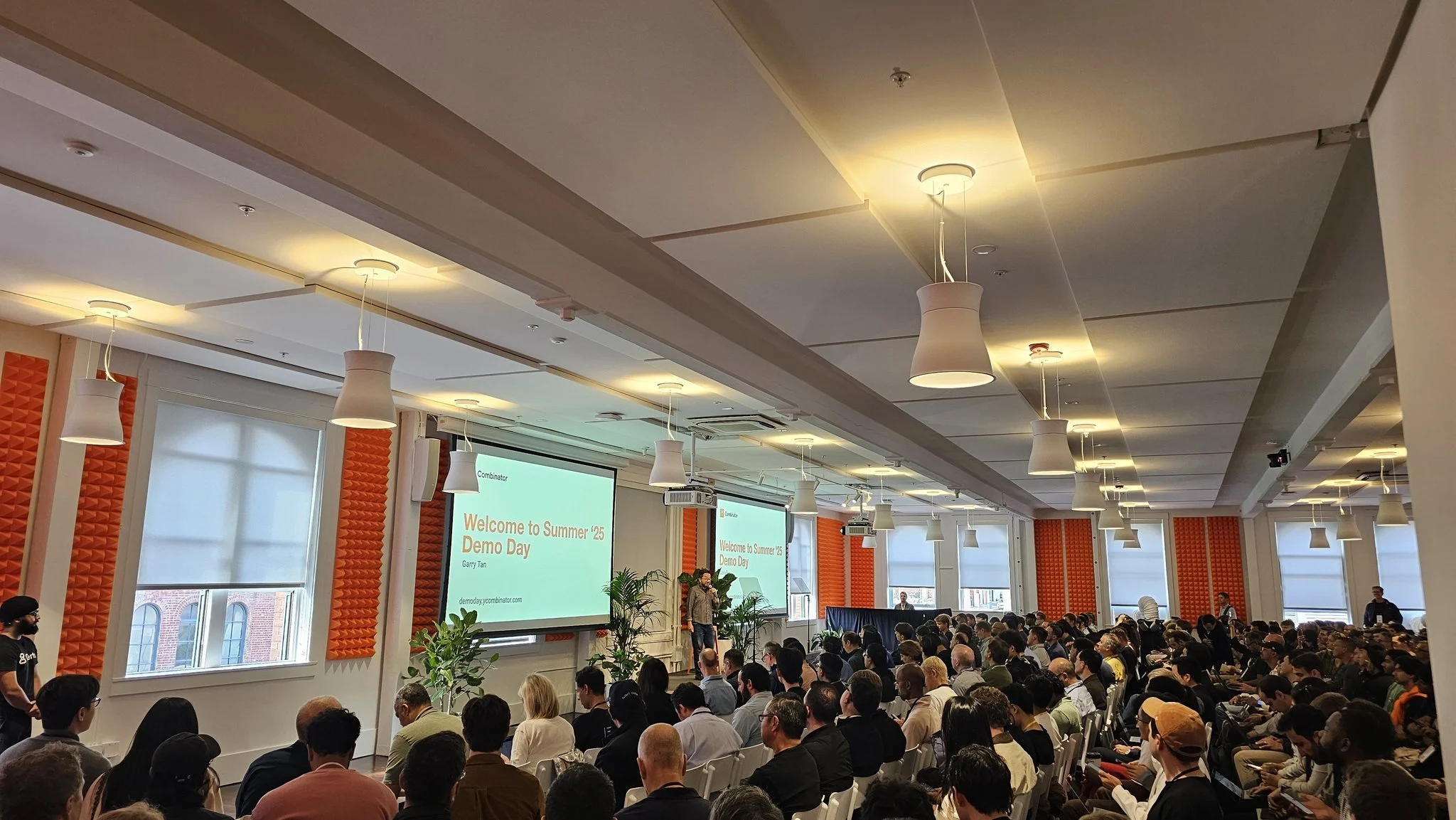
Packed room to hear the Mayor of San Francisco speak
It’s a busy time of year, but also one filled with opportunities…provided you play your cards right.
Knowing how to get the most out of an event is an underrated and unpracticed skill for many founders. I’ve previously shared tips for how to pitch a VC at a party. In this post, I’ll pop up a level and discuss more broadly how to make the most out of any work-related event.
1. Define Your “Why”
The best founders don’t go to events for the sake of going. At least, not after the initial buzz of being invited to “exclusive” events for the first time wears off (we’ve all been there). There has to be a reason for high achievers to take time away from work, friends, family and other priorities to attend a professional event. What’s yours?
There are plenty of reasons to attend an event, including:
Prospecting for customers
Prospecting for investors
Prospecting for employees
Getting feedback on an idea
Meeting other high-achieving founders (for inspiration, to build your network, etc.)
Showing support for someone or their company
Being seen and/or catching up with people you already know
Just getting out of the office (that’s okay too!)
Before you go to an event, take a moment to really think about your objective. What is your “why” for attending the event?
2. Quantity or Quality?
The second question to answer is “quantity or quality?”
Do you want to have deep conversations with a small number of people or are you hoping to connect with as many individuals as possible who fit your target persona?
Think about this question carefully. Would you be happy if you spent the entire night speaking to only one person? What if you already knew them? Are there specific people you absolutely have to speak to (if only so they know that “you were there”) or is your primary objective to meet new people?
Even if your reason for going to the event is simply “to get out of the office,” thinking about the types of conversations you hope to have and/or the types of people you hope to meet will help you to navigate the event with more intentionality.
3. Target List
Who are the people you absolutely, positively need to see at this event?
Write down those names or personas and what your objective is with each person (Is it simply to say hello and be seen? Do you want discuss a particular topic with them? Do you hope to get their contact information?) If you have access to the invite list, spend 5 minutes to review it and highlight anyone you specifically want to talk to. Think about the types of conversations you hope to have with each person and how much time you want to spend with each of them.

“At 7:35pm, the Series A VC will arrive…”
4. The Approach
Despite the title of this post, I’m not actually going to tell you how to approach a stranger at an event. There are plenty of books, posts and podcasts that have been made on the topic, so I’ll leave that as an exercise for the reader. But I will encourage you to be thoughtful about it. There isn’t necessarily a perfect approach, but there are plenty of ways that are guaranteed to fail.
Here are some actual approaches I’ve had from people at events:
A self-proclaimed “ecosystem leader” who rudely interrupted an obvious conversation that I was having with a young founder, positioned his back to the founder, and then proceeded to declare how influential he was in the ecosystem and that we should find time for a conversation
A founder who physically blocked me from walking onto a stage (while I was holding a microphone) and insisted on trying to pitch me despite my saying multiple times, “I have to go on stage”
A founder who followed me into a bathroom, stood beside me and attempted to pitch me while I was doing my business (that really does happen…)

In general, people who attend networking and other startup events are there to meet and talk to others. So if you’re patient, polite and just the right amount of assertive, chances are you can talk to almost anyone at an event. If only for a few minutes…
5. Make Your Move
You’ve patiently waited and finally have the opportunity to talk to the person you’ve had your eye on. What’s next?
If you’re doing any sort of prospecting, your goal is actually not to pitch the person on the spot. Rather, it’s to get their contact information so that you can have a proper 1-1 conversation later. Events are loud (at least, the good ones are). It’s hard to hear people and you frequently get interrupted. As such, it’s essential that you are concise.
Make your elevator pitch and see where the conversation goes. If the person shows interest, ask if you can get their contact information to follow-up later. By preempting your own pitch with an early ask, you signal respect for the person’s time and, in doing so, are more likely to get a ‘yes’ than if you gave them an extended pitch. At this point, they might happily give you their contact info or they might ask more questions (in which case, you can dig in deeper if you choose).
The other benefit of making the ask early is that you can be more efficient with your time. The faster you make the ask, the sooner you’ll close the “sale”. And the sooner you close the sale, the sooner you can move on to your next prospect.
(On the other hand, if your goal is quality over quantity, then by all means engage the person in a deep, lengthy conversation about whatever topic you have in mind.)
6. Watch for Yes
If someone offers you the close — i.e. they offer to share their contact information with you — take it. Even if you’re not ready.
It’s not uncommon for someone to interrupt your pitch during an event in order to preemptively offer you their contact information. I do it all the time. It usually goes something like this,
“This sounds great. Why don’t you send me an email and we can find time to continue the conversation later.”
Many times, founders are so focused on their pitch that they fail to recognize that the person they’re talking to just said yes and they continue pitching. By not watching for yes, they miss the signal in the response.
When someone interrupts you to preemptively offer their contact information, they’re not only saying “yes”, they’re also saying, “I want to end this conversation.” There could be any manner of reasons why they want to move on, but the critical piece is that they gave you a yes. If you fail to catch the double-meaning — and graciously cut off the conversation while taking their contact information — it’s possible they won’t offer it a second time. And you might ultimately lose the opportunity.
Also be prepared for the yes to come in a form you weren’t expecting. For example, you might ask for an email address and they might instead offer you their phone number or a LinkedIn QR code. Whatever form they offer, you should take it. Here’s an actual conversation I had with a founder recently:
Founder: “Can I have your email address?”
Me: “You already have it. The invite for tonight’s event came from my actual email…just hit reply and email me there.”
Founder (pulling out phone): “Ok, but can I have your email address?”
Me: “You already have it. The invite for tonight came from my actual email…just email me there.”
After the founder asked for a third time, I shrugged and said no.
That might seem harsh, but if someone has to repeat themself more than once, it’s generally a signal that you’re not listening (and as an investor, it’s not a great signal). So always remember, if you want people to say yes, you have to listen to them.
I’m sure that more than a few of you have made it to this point and are thinking “wow, Chris really overthinks things,” or “this all seems a bit over-calculated.”
You certainly don’t have to meticulously plan out each and every event you attend. By all means, show up to some events and just have fun. But if you take a few minutes to consciously set a goal for each work-related event you attend and then “debrief” with yourself afterwards (did you meet the goal? why or why not?), you’ll soon discover that you’re navigating events with far more intentionality and effectiveness than you were before.
And as a founder, every little bit helps.

Want to Hire the Best? Stop Paying Local Wages
If you raise Silicon Valley funding or are generating revenue primarily from US customers, there is fundamentally no reason why you can’t pay employees Silicon Valley salaries.
One of the excuses I hear all the time from founders, investors and others outside of Silicon Valley about why startups in their ecosystems “aren’t succeeding” is the claim that it’s impossible for them to compete with Silicon Valley salaries. Founders use it as an excuse for why they lose out on top talent. Community builders point to it as the reason why more young people aren’t building. Politicians use it as a scape goat for brain drain.

Here’s the thing: the only thing stopping you from paying a higher wage…is you.
Before your mind starts racing with all of the reasons why the above statement is laughably wrong, let me set the foundation for my claim: First off, I’m not trying to argue that wages can be (or should be) identical the world over. I’m also not suggesting that startups in Moose Jaw, Memphis or Manchester have a chance of competing on salary against “Big Tech” — especially when Meta starts throwing around $100M bonuses.
But guess what? Startups in Silicon Valley can’t compete on that either.
For as long as startups have been starting up, they’ve had to attract talent in the face of big incumbents with big treasuries. This report from ReadWriteWeb (circa 2013) provides insight into the hiring challenges faced by startups a dozen years ago:
“The toughest challenge facing most new technology companies these days isn’t getting funded – it’s hiring the best, most skilled employees. Heavyweights such as Google and Facebook can lure top talent with six-figure salaries, lucrative stock packages and lavish perks, including sushi buffets and free laundry service.”
You know what else came out in 2013? This post from Open AI CEO Sam Altman about how to hire, which he wrote while a Partner at YC:
“If you don’t hire very well, you will not be successful—companies are a product of the team the founders build. There is no way you can build an important company by yourself. It’s easy to delude yourself into thinking that you can manage a mediocre hire into doing good work.”
(If you want to go back in time even further, check out the “People” section of this 2005 post from YC Founder Paul Graham on How to Start a Startup.)
So let’s put to the side the talent battle of startup vs. incumbent and instead focus on the battle between startups. Specifically, let’s compare equivalent-stage startups in Silicon Valley and elsewhere in the world. Can startups based outside of Silicon Valley employ the same tactics (including salary ranges) as their Bay Area brethren to attract and retain talent?
In today’s world, the answer is unequivocally yes.
You’ve been spending too much time at Grateful Dead concerts…
Historically, startups outside of Silicon Valley have behaved a lot like sports teams in small markets — trying to win championships by squeezing the most out of a roster of lesser-known, lower salaried players. Twenty years ago, that approach made sense, as the majority of startups generated their early revenue locally (and, thus, were beholden to the economic realities of the ecosystems in which they operated). But things have changed significantly since then.
Today, many startups sell their products globally from day one. At the same time, their founders — emboldened by the realization that they hold more power than ever before — are increasingly unwilling to limit their fundraising goals simply because of the limitations of local VCs. Which means the most promising startups around the world are following Silicon Valley revenue trajectories and raising Silicon Valley-sized funding rounds. So why shouldn’t they be able to compete with Silicon Valley-based startups for talent?
Still don’t believe me? Let’s look at some numbers…

I used OpenAI’s o3 reasoning model to research the following two questions:
What is the average salary of a software engineer at a Seed stage startup in <city>?
What is the average number of employees at a startup that has raised USD $3M in <city>?
Let’s look at the results for some major startup ecosystems:
San Francisco
According to o3, the average salary of a software engineer at a Seed stage startup based in San Francisco is $150K. On average, startups that have raised $3M in funding have 6 - 8 employees at the time their funding was announced (although recent reports, such as Carta’s 2024 State of Startup Compensation Report, suggest that this number has fallen in recent years).
Toronto, Canada
Given the identical prompt, o3 reported that the average salary of a software engineer at a Seed stage startup in Toronto is CAD $125K - 135K (roughly $90K - 100K). Upon raising $3M in funding, the average Toronto-based startup has 10 - 12 employees.
London, UK
For London, o3 determined that the average salary of a software engineer at a Seed stage startup is £75K (approximately $100K). London-based startups that have raised $3M in funding have, on average, between 9 and 12 full-time employees.
What’s the point of all of this…?

Here is the average amount that Seed stage startups are spending on employees after raising $3M (assuming all of those employees are software engineers):
San Francisco: $900K - $1.2M
Toronto: $900K - $1.2M
London: $900K - $1.2M

There are obviously a bunch of assumptions baked into the above (it doesn’t take into account differences in taxes, benefits, actual employee roles, etc.) but, roughly speaking, Seed stage startups in San Francisco, Toronto and London all spend approximately the same amount of money on salaries.
How can this be possible, yet so many founders (and investors and community builders and politicians) outside of Silicon Valley remain convinced that they can’t compete on salary?
For years, founders outside of Silicon Valley have been sold a narrative that goes something like this:
Hustle hard and show early traction
Raise VC funding from Silicon Valley investors
Leverage that funding to build a higher-margin company in your home town (i.e. hire more employees at a lower average wage than what Silicon Valley startups can do)
The problem is, quality (and experience) matter. Both in building companies and winning championships.

So what we’re really talking about isn’t so much of a financial shift as it is a mindset shift. And I suspect it starts with torpedoing the (imho very bad) advice pushed by many investors outside of the US that startups should hire CFOs, COOs and other non-product employees before achieving PMF (though I’ll save that rant for another post).
For now, I’m going to keep the punchline simple: if you raise Silicon Valley funding and/or are generating revenue primarily from US-based customers, there is fundamentally no reason why you can’t pay employees Silicon Valley salaries.
That doesn’t mean you have to (you certainly don’t have to follow the Silicon Valley playbook by any means). It also doesn’t mean that you should spend recklessly or pay high salaries for the sake of paying high salaries. But it’s time to retire the excuse that startups in <city> can’t compete on salary with Silicon Valley startups.
Which means if you’re an early-stage startup that’s playing to win, your salary benchmark shouldn’t be set by other companies in your city (even the locally-famous ones 😉). If you find someone you believe to be a game changer for your startup, you should be willing to pay them up to the current benchmark for startups at your stage based in Silicon Valley. Even if that amount is considerably higher than the local norm.
I'm sure that plenty of folks will argue with me on this, but IMHO there is simply no reason for a startup to lose talent to an equivalently-funded startup anywhere in the world based on salary alone. Even Silicon Valley.

How to Be a Community Instigator
To many people, the idea of planning an event is overwhelming, so I’m going to show you how to do it. Here’s how you can be an instigator for your community.
Last week, tens of thousands of people descended on my home town of Vancouver, Canada for the inaugural Web Summit Vancouver conference. Of course, given that I’m an unapologetic instigator, I couldn’t pass up the opportunity to host an event.
Or three 😃.


There was the Web Summit Investor Dinner, where 50 VCs from around the world engaged in conversations about the future of tech. There was the Web Summit Developer Dim Sum, where founders from both small startups and industry leaders like Netlify and Klue connected over dumplings. And, finally, the Celebration of Vancouver Party, where 250 VIPs, including CEOs, investors, conference speakers and the Mayor of Vancouver discussed Vancouver’s tech scene on the top floor of one of the city’s iconic high rises.
As I floated through the buzz of the city, catching up with friends and connecting with visitors from around the world, one question kept coming up:
“How do you do it?”
To many people, the idea of planning a single event — much less three in one week — is overwhelming. So I’m going to show you how to do it.
Here’s how you can be an instigator for your community.
Start with Why
The most important part of planning an effective event is coming up with the “why”. Specifically:
Why do you (the host) want to do this? What is your goal?
Why will the people you want to bring together choose to attend your event over the many other things they have to do in their lives?
Far too many event organizers know their “why”, but fail to develop a compelling “why” for attendees. Instead, they try to use gimmicks. They think that:
People will come to my dinner because it’s at nice restaurant
People will come to my party because it’s at a fancy club
People will come to my conference because it’s in a beautiful city
These gimmicks work on college students and mid-level managers, but not on high-achievers (which, I’m assuming is your target market). High achievers will occasionally go out to a nice restaurant, a fancy club or an out-of-town conference for work, but only if there’s another reason to do so. (Moreover, if they really want to go to that nice restaurant, fancy club or beautiful city, they’ll generally do so on their own terms with their own friends and family.)
In my experience, high achievers gravitate towards events that deliver on one or more of the following four goals:
1. Meeting Other High Achievers
The most ambitious people I know are drawn to other high-achievers. They want to learn from them, connect with them and be surrounded by them. Creating an event focused on the opportunity to meet other high-achievers can be a big draw. The most impactful events often take it a step further by focusing the audience around a specific theme, such as:
A single industry (e.g. founders of developer tool companies vs. all founders)
A job function (e.g. CTOs vs. anyone who works at a startup)
A stage-of-life / career / company (e.g. CEOs of Series B+ companies, exited founders looking for their next thing, etc.)
Most intimate events (dinners, lunches, cocktails, etc.) have this as the primary “why”.

Secret meeting of the Vancouver dev tool founders club
2. Meeting Customers / Partners
High-achievers are always selling. The opportunity to connect with potential customers or partners can, therefore, be a major draw for ambitious people.
Investor-only events are a great example of this. A big part of being a VC involves building a network of other investors (for co-investment, deal flow and leveling up), so any opportunity to meet a large number of credible investors in one place is an easy sell.

“Our team has more than 200 years of combined experience in VC…”
Connecting startup founders with executives of established companies is another great example, provided that they overlap in their areas of interest (e.g. founders of fintech startups and banking/finance executives).
And, of course, events where both investors and founders are present can appeal to both groups.
3. Leveling Up
Focused opportunities for learning are another great way to anchor community events. Identify a shared challenge in your target audience and build an event around one or more people who can speak to the problem. For example:
Bringing in later-stage founders to speak to a group of up-and-coming founders
Bringing in subject-matter experts to speak to specific challenges (e.g. how to hire your first sales person, how to open an office in the U.S., etc.)
Facilitating off-the-record / Chatham House Rule events, where attendees can openly speak about sensitive topics

“Four California VCs walk into a bar…”
4. Paying it Forward
Finally, many high achievers (myself included) dedicate a percentage of their time to paying-it-forward. Often times, you can attract prominent high-achievers to anchor an event through their desire to give back to their community. Many events that involve mentorship and office hours leverage this as the “why” for their mentors.
In addition to planning three events last week, I spoke at two more where my primary “why” for attending was to pay it forward.
Note that it’s essential that you not abuse the goodwill of attendees looking to pay it forward. It’s one thing to ask a prominent CEO to speak for free at your sponsored community event. It’s another to ask them to speak for free at an event you’re charging $100 per person to attend (and pocketing the profits).
Finally, it’s important to note that if you’re creating an event that will bring together two or more groups of people, each group will need a distinct “why” to draw them in — and they’re likely different.
For example, Vancouver Founders Day — an event I created that brought together more than 800 up-and-coming founders with experienced founders from the community — was anchored around “leveling up” for the up-and-coming founders and paying it forward for the experienced founders.

Clarify Who
Intertwined with “why” is the question of “who”. Specifically, who exactly do you want to attend your event?
It is important to precisely define “who”, as the same “why” can generally be applied to a wide swath of people. Moreover, there is no right or wrong answer to the question of “who”. It is based on your objectives for the event as the host.
Part of the answer to this question is demographic (are you targeting early-stage founders, CTOs of growth-stage companies, anyone who invests in startups, etc.?). But there’s also a question of quality vs. quantity. Do you want to create an intimate event where each-and-every attendee is highly vetted or do you want to put on a “big tent” event that’s open to anyone who wants to attend?
There are pros and cons of each approach. I won’t dig into them, other than to say that it’s essential to be intentional about your target audience. If you aren’t explicit in your definition, you’re likely to end up with a mediocre event that leaves everyone involved — attendees, partners and hosts — underwhelmed and disappointed.
Build Your Base
Once you’ve identified the “why” and “who” for your event, you should build a base of core attendees to anchor the event around. These are the folks that are willing to commit early to your event and who you can then leverage to draw in other attendees.

Like a snowball…but with less screaming
There are three main strategies to build the base for your event:
1. Anchor Around a Minimum Attendance
When using this approach, you should reach out to people in your target audience and gauge their willingness to attend, based on a minimum viable group size. For example:
“I’m planning a dinner for founders of developer tools startups. If I can find a night that works for 10-12 people, are you interested?”
Many people are willing to conditionally commit to an event, provided the expectations are met. Once you’ve got those initial soft commits, you can start to entice others to attend:
“I’m planning a dinner for founders of developer tools startups. I’ve got 4 seats left…are you interested?”
As you get closer to your target number, you can switch gears to logistics and lock in attendees. Just make sure you don’t over-promise and under-deliver. If you tell people that there are going to be 12 high-quality attendees and instead 5 random people show up, you’ll burn your reputation.
2. Anchor Around a Person / People
Many events are anchored around one or more high-profile individuals who serve as a draw to the broader target audience. This could be a recognized speaker for a “leveling up” event or visiting high-achievers for a dinner.
A few years ago, several of my VC friends from California coincidentally needed to schedule visits to Vancouver (to meet with portfolio companies, visit family, etc.). I suggested that they all visit during the same week and then anchored a “leveling up” event around their visit. We brought together 250 founders for an event to help them better understand how California-based VCs make investment decisions.

3. Anchor Around an Activity
The third way to anchor an event is to focus on an activity that appeals to your target audience and is synergistic with the “why”. Many founder-focused events are built around activities.
San Franciso-based Brandon Waselnuk has built up a massive community of Canadian expats (the Maple Syrup Gang) anchored around monthly hikes. Vancouver-based IcePanel holds a monthly “Chill Club” for developers where attendees reverse-demo each others’ products (volunteers try to figure out how someone else’s product works with no documentation or advanced instructions).

One advantage to this type of event is that the activity still delivers value even if attendance is low. Another advantage is that they can provide a healthy alternative to alcohol-centric events, thus appealing to attendees tired of happy hours.

The main disadvantage is that attendance for activity-anchored events is often inconsistent. Without a core group of attendees “pulling in” others, individuals make just-in-time decisions based on how they feel about the activity on that particular day.
Activity-anchored events succeed best when they’re delivered over multiple occasions, as their reputation builds within the community. But consistency is key — it’s very likely that no one will show up the first few times (so don’t get discouraged).
Regardless of your approach, start small and build your attendance from there. Secure your initial commits and leverage them to attract the rest of your attendees.
Here’s how I leveraged the early speakers for Vancouver Founders Day to secure even more speakers (which then provided the anchor for all of the founders who attended):


Figure Out the Finances
Once you’ve got the outline of your event, the next thing you have to do is figure out the finances. I’ll assume for this part that you aren’t trying to generate a profit, so our goal is to make sure we break even (that is, we have enough revenue to cover the full cost of the event, including possible overages).
Depending on how your mind works, you can either start with the revenue and then back into the expenses or vice versa. Either way, it’s likely to be an iterative process as you converge on a plan.
Revenue
Event revenue generally comes from one or more of the following three sources:
Host Sponsorship (you and/or your co-hosts subsidize the event)
Revenue from Attendees (attendees purchase tickets, dinner guests split the bill, etc.)
Partner Sponsorship (other groups subsidize the event)
The first thing you need to do is figure out what combination of the above sources you want to leverage to fund your event.
1. Host Sponsorship
From a logistical standpoint, host sponsorship is the easiest way to finance an event. You organize the event, run the event and pay for the event (or split the bill with your co-hosts). Kind of like when you host a birthday party and invite all of your friends over.
Of course, this requires you to be willing and able to pay for the event.
From a business standpoint, this approach makes the most sense for events where the “why” involves meeting customers/partners or otherwise building your company’s brand. Customer dinners, LP events held by VCs and pretty much any event where the attendees fall into the bucket of “deal flow” fit this category.
2. Revenue from Attendees
At the other end of the spectrum are events where the attendees themselves are expected to pay all or part of the costs.
Ticket sales are common for events that deliver high value to the attendees, such as “leveling up” events with prominent speakers. Splitting the bill is a reasonable approach for events that the host is organizing but doesn’t necessarily derive disproportionate value from (like a dinner amongst peers or a coffee / happy hour meet-up).

Vancouver-based tech journalist William Johnson has for years organized a weekly coffee at various venues around the city
When I first came back to Vancouver, I met a number of later-stage founders who lamented the fact that they didn’t know many peers in the city. These CEOs felt that while there were plenty of startup events in the community, they were all focused on early-stage founders. I heard the same complaint so many times that I organized a “Breakfast of Champions” on the first Friday of each month. The offer was simple: I’ll make the restaurant reservation and each person pays for their own meal.
30 CEOs showed up to the first breakfast.
(Note: many events combine ticket sales / splitting the bill with host and/or partner sponsorship in order to control costs, such as events where the attendees receive a fixed number of drink tickets).
3. Partner Sponsorship
The third way to finance an event is through sponsorship arrangements, under which one or more partners contribute to the event in exchange for some form of benefit. Partner/sponsor benefits can include:
Advertising (the partner’s name and logo get included in marketing materials)
Access (the partner gains access to a group of potential customers / partners that they might not otherwise)
Information (the partner receives contact information about the attendees)
All of these benefits typically fall under a company’s marketing objectives, so what we’re really talking about are branding / marketing / top-of-funnel benefits. Thankfully, there are many vendors and service providers who sell to startups, VCs and other groups involved in tech.
The key thing to understand about sponsorship arrangements is that one of two things must be true for a potential partner to lean in:
They either must get some meaningful brand benefit from being associated with the event; and/or
The target attendees (the “who”) must significantly overlap with their target customers or partners
In other words, for a partner organization to commit to sponsoring your event, you need to have a compelling “why” for them.
Expenses
Event expenses are typically driven by the following three categories:
Venue (some venues charge a fee to use them)
Food & Beverage (aka “F&B” costs)
Staffing & Equipment
(Many events will also incur costs for consumables like name tags, lanyards and swag, but these are usually discretionary and/or relatively minor, so I’ll skip them in the interest of brevity.)
The Venue
The choice of venue can either result in a major expense for the event or no expense at all. Auditoriums, convention centers and specialty venues typically charge a rental fee for the use of their space. Many restaurants will also charge a “buy-out” fee on top of other charges to rent out all or a significant percentage of their venue.

The venue for Vancouver Founders Day was…not free
In contrast, many restaurants, bars and coffee shops bundle all of their charges into a single amount based on your F&B purchases, with a minimum spend amount and a fixed service charge (tip).
For “leveling up” events and basic networking, you can often get sponsors to provide space in their offices at no charge, provided they can attend and receive some marketing benefits. And if you’re just getting started, consider hosting it in your office or even the “party room” at a team member’s apartment building.
Tip: Many venues have lower rental fees and F&B minimums on days when they’re not typically busy (typically Monday - Wednesday). In each city I operate, I have a list of go-to venues (typically independently-owned), where I’ve built relationships with the owners/managers over time and where I can organize cost effective, win-win events for everyone involved.
Food & Beverage
F&B spend is the largest expense for many events, but it’s also the easiest to control (as it’s generally tied to the number of attendees).
While it can be tempting to splurge on F&B for your events — particularly if you’re inviting people you admire or look up to — it’s essential that you control your temptation. The best instigators know how to throw events within their means while delivering on the “why”.
Some strategies for controlling F&B costs include:
Arranging fixed menus at restaurants
Filtering the available drink options (e.g. no top-shelf)
Serving shared appetizers / snacks instead of full meals
Off-loading some or all of the F&B costs to attendees or sponsors is also a common strategy (e.g. have a sponsor bring branded food or drinks, provide a fixed number of drink tickets to attendees or even make attendees responsible for any and all F&B).
Staffing & Equipment
Staffing and equipment for events is one of those categories that sneaks up on you. Hiring a caterer? Watching out for the cost of servers. That fancy convention space? They’ll charge you extra for access to the projectors (and a union A/V person to run it). And don’t get me started on the cost of power and WiFi.
All of these costs can be controlled, but if you’re not prepared for them they can be a shock.
If you’re just getting started running events, keep things simple. Organizing a “leveling up” event in a host or sponsor’s office is an easy way to minimize staffing & equipment costs (at most, they’ll charge you a cleaning fee). One big advantage to hosting events with food and/or drinks at a restaurant or bar is that the servers are included in the F&B costs, whereas you’ll often be charged additional fees if you bring in vendors.
One last note on finances: when planning things out, assume that your math will be wrong by at least 20%. Even after running hundreds of events, I still end up with my estimates being off. It might be a service charge that I forgot to add, an estimate that didn’t include tax, or an extra round of chicken dumplings that one of the tables ordered.
None of these things should be a deal breaker — especially if your attendees walk away with big smiles on their faces — but making sure you know exactly what the plan is should expenses go over is critical.
Bringing It All Together
At this point, your eyes might be glazing over, but I promise you that events done right aren’t nearly as hard as they seem. You just need to focus on these 3 key questions:
What is the core value proposition for the event?
What are you trying to achieve as the host, who is your target audience (or audiences) and what is the compelling “why” for each group involved (including potential sponsors)?
What is the anchor for the event?
What is the initial draw upon which you will build momentum?
One or more prominent attendees,
The overall group of attendees, or
The activity that attendees will perform?
How will you leverage that anchor to pull together the various groups that you want to attract?
What are the logistics for the event?
What are your revenue sources / what is your budget? What type of venue will you hold the event at? What other resources will you need to deliver your event (equipment, F&B, etc.) and what will they cost?
There are plenty of other questions to answer and details to define (what color will the lanyards be? what witty name will you give the signature cocktail? what AI-generated image will you use for the online invitations?), but if you focus on the above questions, you’re well on your way to a successful event.



A Few Examples
Last but not least, I thought it might be helpful to provide a few specific examples of events I’ve hosted within the context of the above framework:

Don’t Slam the Door on Your Way Out
If you successfully fundraise from Silicon Valley VCs, be careful about how you tell the story. You could end up accidentally burning bridges.
It’s a tale as old as time.
An ambitious young founder starts a company in their hometown. After struggling to raise funding locally, they decide to make a trip to California. In a matter of weeks, the young founder successfully raises money from from “Silicon Valley investors” and returns home triumphant. Then, they go on to tell anyone and everyone they meet how much better it is “in Silicon Valley”.

In most cases, this is beneficial for the ecosystem. Other young founders see someone “like them” succeed raising money abroad and learn to expand their fundraising horizons. Local investors get a healthy reminder to stay competitive.
But occasionally, an excited founder takes it too far.
In their eagerness to ingratiate themselves with other founders in the ecosystem, the tone of their message turns from positive (“Silicon Valley is great / Silicon Valley investors are great”) to negative (“this ecosystem is not great / local investors are not great”). Before long, the young founder is known more for railing on their local ecosystem than anything to do with their startup.
While other founders eat it up — especially those who’ve struggled to raise — the founder can become persona non grata to many others in the ecosystem. And chances are, they don’t even know it.

At this point, some of you might be rolling your eyes at me (“aren’t you the guy who’s always talking about San Francisco?”).
But if you pay close attention to my writing, you’ll find that I never express a blanket perspective that “Silicon Valley is better” — because I simply don’t believe that. For example, last year I wrote a post titled The Mythical U.S. Lead Investor in order to debunk the overly-simplistic stereotype that U.S. investors are more risk-taking than investors in other countries. I’ve also written about The 9 Types of Startup Investors to help explain the varying motivations held by different categories of startup investors and how those impact their behavior.
While I absolutely believe that a significant number of VCs outside of Silicon Valley do themselves (and their ecosystems) a disservice by not building deep connections to Silicon Valley, I don’t believe that investors in the Bay Area are inherently better than investors in other ecosystems.
They’re just different.
But enough about me. Let’s get back to our intrepid young founder…

When we last left our heroes…
The problem with spending too much time comparing and contrasting your fundraising experiences at home and in Silicon Valley is that the story you tell yourself is often self-serving. Local VCs obviously didn’t invest because there is something wrong with them. Silicon Valley VCs clearly saw the potential and were willing to take the risk.
End of story.

Local investors obviously didn’t get it
In some cases, that might actually be the story. But 99% of the time, it’s not that simple.
In reality, most founders have no idea why local VCs actually passed on their startup, or for that matter what caused the investors on their cap table to lean in.
Here are 3 key differences between the perspective of Silicon Valley investors and those in other ecosystems when it comes to evaluating out-of-town startups:
1. History
For better or worse, local investors have more intimate access to your recent history. That promising startup you previously worked at? They know if it was legit or a total sh*tshow. The regional tech company you cut your teeth at? They know whether it hires the cream of the crop or pays the bare minimum and takes whoever it can get. They also likely have access to people who can vouch for your reputation — good, bad or otherwise.
As a result, local investors will sometimes pass on promising startups because the founders didn’t reference well or they have negative perceptions about their prior work history.
Silicon Valley investors are often unaware of the baggage an out-of-town founder brings (and many are less inclined to find out). That gives you an opportunity for a clean slate, but it also means that they won’t give you as much credit for some of your “locally famous” accomplishments.
2. Generalist vs. Specialist Investors
Outside of Silicon Valley, the vast majority of investors are generalists. That means they might not have any prior experience in your space (and may never have met a single company doing what you’re doing). There are some things you can do to more effectively pitch to a generalist investor, but you should also expect that you’ll get far more noes than you will yesses.
From a VC perspective, investing in something you don’t understand is akin to playing the lottery. That’s not a good investment strategy. While this can be frustrating as a founder, don’t blame it on risk-averseness.
By simple virtue of the number of investors in Silicon Valley (there are nearly 2,000 active early-stage funds between San Francisco and San Jose), you’re more likely to run into investors that understand and have experience with what you’re working on. Which makes it more likely that you’ll be able to secure investment if your space is less widely-understood.
3. Power Law
The majority of Silicon Valley investors rely heavily on the concept that returns in venture follow a power law distribution. These investors expect one or two companies to drive the returns of their fund, while the rest will provide a rounding error.
VCs that adhere to power law investing presume that any startup they invest in which is not a “breakout win” will not be material to their returns and, therefore, spend little-to-no time evaluating alternative scenarios. That can be good or bad for startups.
If you have a clear thesis as to how you could become a billion dollar company but no credible “Plan B”, it could be a great fit for Silicon Valley investors but a turnoff for local VCs (who tend to — correctly — discount the likelihood that you’ll actually become a unicorn). On the other hand, if your trajectory lends itself to multiple options should the primary hypothesis fail, local investors might lean in whilst Silicon Valley VCs worry that you’re straddling the fence.
All of this is to say, be careful about how and when you share your reflections on fundraising. Chances are, your perspective is hidden behind rose colored glasses. Also keep in mind that there’s a big difference between sharing your experiences with a group of founders under Chatham House Rule and airing your dirty laundry on stage at a conference. Or worse, in the media.
Not only do negative quotes in press statements take attention away from your company (the story isn’t about how awesome your company is, it’s about how bad your ecosystem is), it can burn a lot of bridges. That might feel good for a moment, but I promise you that in exchange for your 15 seconds of fame, you’ve lost potential local champions.
Often because those folks “knew the real story.”
Like the founder whose funding announcement was focused his big “decision” to move the company to San Francisco, when everyone in the local ecosystem knew he’d been trying to get a U.S. visa for years. Or the founder who complained that local investors only wanted safe investments with complicated deal structures, when all of the local VCs had passed due to concerns over a prior company.
Or the founder who publicly complained about how atrocious Salesforce’s reporting interface was, only to have the SVP of Analytics for Salesforce call him incensed because they were supposed to be partners.

…oh wait, that was me. 😬
What were we talking about again?