Lessons from 250 Blog Posts
I never thought I’d actually write for this long, so I thought I would take some time this week to reflect on it. Here are some of the lessons I learned from writing 250 blog posts.
This week marks a momentous milestone (for me, at least): this is the 250th post that I’ve written on chrisneumann.com.
I never thought I’d actually write for this long, so I thought I would take some time this week to reflect on it. How has my content evolved over the past four and a half years? Does it still resonate with readers? And where should I go next? (If you’re currently reading this on the website, you may have noticed a new look — I’ll dive into the rationale for that shortly.)
Here are some of the lessons I learned after 250 blog posts.
The Backstory
When I moved to Canada in late-2020 to join Panache Ventures, I noticed that there was a lack of entrepreneurial content available for founders there. I had spent the better part of the 5 years prior teaching founders around the world strategies and best practices used by leading Silicon Valley startups (first at 500 Startups and, later, through Commonwealth Ventures). So I thought I’d write about some of them.
But there was one problem.
Over the years, I had written a handful of blog posts, but I could never figure out how to publish content on a consistent schedule. I knew it was possible to write with a weekly cadence (after all, I wrote weekly investor updates for nearly five years at DataHero), but I had never done so with creative or longer-form content.
I mentioned this dilemma in passing to one of my mentors, Marvin Liao, who told me about a course he had recently taken called Write of Passage. The program was the brainchild of an exceptional young writer named David Perell. Despite its name, Write of Passage wasn’t actually a course about writing. At least, not in the strictest sense. Rather, it was a bootcamp designed to teach you how to build systems and processes to support writing and publishing new content on a regular basis (like weekly blog posts). It was exactly what I needed.
It turned out, I wasn’t the only one. The participants in my cohort included many residents of Startupland™, like founders and VCs. But there were also professional athletes, academics and a wide variety of other writers and aspiring writers.
How It Started
Write of Passage was one of those programs that unapologetically threw you in the deep end from the start. The very first session kicked off with a firm dictum from David: in order to stay in the program, you had to publish your first post within one week.
The prompt: “What is the definitive answer to the question that people ask you most often?”
At the time, it had been about six months since news of my joining Panache and moving to Vancouver was announced. In subsequent calls and coffee chats I was repeatedly being asked the same question:
“Why did you come back to Canada?”
On April 13th, 2022, I published the answer to that question and launched this website.

How It’s Going
It’s now been 229 weeks since that first post (for those of you wondering how I reached 250 posts in only 229 weeks, there were several periods of time when I published multiple posts each week — such as during my brief side quest into food blogging.) Over the past 4 ½ years, readership of both my website and the corresponding newsletter have steadily grown (thank you all for that 🙏).
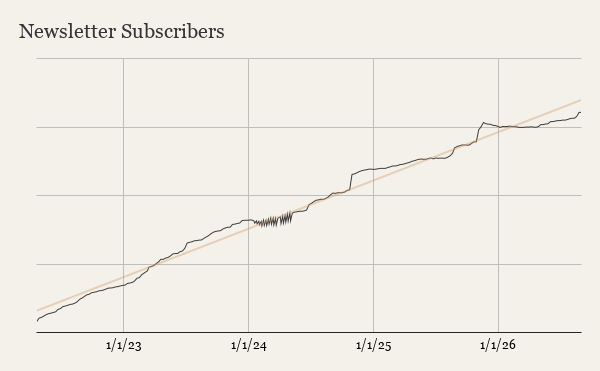
I have no idea what happened in early 2024…
But it hasn’t all been “up-and-to-the-right.”
While website traffic and newsletter subscribers have steadily grown, open rates for the newsletter have slightly declined over the years.
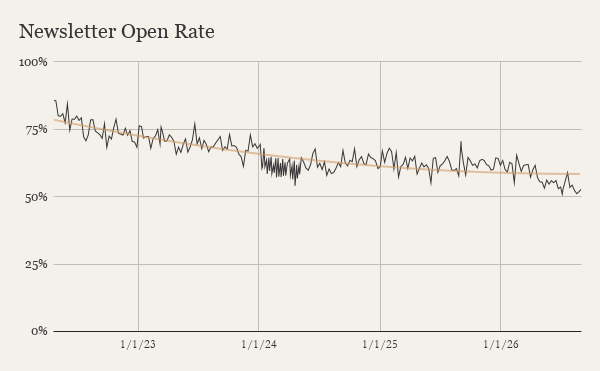
The open rate for my newsletter has held steady around 60% for the past two years (a rate that is generally considered pretty solid, though with AI preview and summary tools becoming so prevalent, it’s increasingly hard to tell). That said, I still wanted to dig into the performance data for both the website and the newsletter.
First, a few thoughts on open rates:
Year 1 open rates aren’t meaningful in any way. The early subscriber numbers were so low (and so heavily skewed to people who already knew me personally), that they were unnaturally high.
A better metric for overall relevance is unsubscribe rate. With agents making it easier-than-ever to ditch newsletters we don’t read anymore, are people still keeping me in their inbox? It turns out the answer is yes (the 90-day rolling unsubscribe rate for my newsletter is ~0.1%, which is considered very strong — thank you again 🙏)
That said, despite a steady open rate and strong retention, there has unequivocally been more inconsistency in content performance over the past few years. So I started to look at what I’ve been posting and how that’s changed:
The content I posted in Years 1 and 2 was overwhelmingly instructional/educational in nature (fundraising best practices, posts about how venture capital worked, etc.). In fact, more than 70% of the first 120 posts I wrote either taught the reader how to do something or explained how something worked.
In year 3, I started writing more posts about startup trends, observations about different ecosystems and topics related to mental and physical health. Last year (2025), only 37% of the posts I wrote were instructional/educational in nature.
The last 2 years have also seen an (understandable) uptick in posts related to AI.
Many of the posts I wrote in years 1 - 3 had an overtly Canadian slant to them. That was very much a by-product of my role as a GP at a Canadian-focused Pre-Seed fund. Since leaving Panache at the end of 2024 to focus on [Redacted], most of the posts that I’ve published were written independent of geography (though I’ve still made a point of writing about trends in the Canadian ecosystem as part of my quarterly 5 Things I Think I Think posts).
What Comes Next
The biggest epiphany going through 250 posts’ worth of data was the degree to which the type of content I’ve published has evolved over the years. The first few years were overwhelmingly educational/instructional in nature because I had a massive backlog of topics that I wanted to write about. Now that I’ve written about most of those, my posts are more focused on trends and observations.
But I’m not done yet.
For starters, it became abundantly clear as I went through Google Analytics data and spoke with founders that a significant portion of my older content had become difficult to find or access. That’s where this redesign comes in. In addition to a cleaner, more streamlined design, there’s a new Topics page that more effectively organizes all of my posts (driven by a complete refactoring of post tags).
I’m also working on a further refactoring related to AEO/SEO/GEO. But I’ll save details of that for a future post.
In the meantime, as I look ahead to (hopefully) another 250 posts on chrisneumann.com, expect more insights, more data and more in-depth posts to help founders, investors and ecosystem supporters around the world make sense of Silicon Valley and beyond.
Thanks for reading 🙏.
Before You Start Fundraising, You Need to Get Acclimated
Founders trying to raise Seed or Series A funding from Silicon Valley VCs need to change their approach now.
Last week, I met with 4 different startups based outside of California: one from New York, another in London, a third in Vancouver and the fourth from Toronto. All of these startups are preparing to fundraise in the fall (either for their Seed or Series A round). At some point in each of those conversations, I found myself giving the founders a piece of advice that I hadn’t previously offered with any regularity:
“You should go to San Francisco a few weeks before you start to fundraise. You need to get acclimated.”
It wasn’t all that long ago that the majority of fundraising — even at later stages — was being done mostly online. For founders based outside of the U.S., raising from Silicon Valley VCs took a bit of extra prep work, but for the most part it didn’t matter if you were based in Brisbane, California or Brisbane, Australia. As recently as Q1, most Seed and Series A fundraising processes still began with virtual intro calls.
But over the past few quarters, things have shifted dramatically. Silicon Valley has been speeding up. A lot.

The first half of the year saw valuations for the top 5% of Seed rounds hit unprecedented highs, driven primarily by a surge in preemptive fundraising rounds. At the same time, the culture in Silicon Valley has been evolving to reflect its shift in velocity and intensity, manifesting in ways both big and small.
I hadn’t internalized just how prevalent these changes have been until I was on those calls last week. As I spoke with each of the founders, I found myself subconsciously (and not-so-subconsciously) noticing a variety of tells that made clear that they were not based in the Bay Area. An observation that my mind immediately translated to, “they’re not going fast enough.”

Considering that 2 of the 4 founding teams had previously spent considerable time in Silicon Valley, I was shocked at just how apparent it was to me that they were no longer locals. Some of it was language — there are a lot of new phrases that have entered the San Francisco lexicon as of late (the tongue-in-cheek website SF-isms catalogues some of them). But mostly it was their sense of urgency.
Or lack thereof.
I want to be clear that I’m not suggesting that any of these four startups aren’t operating at a high velocity — they all are — but Silicon Valley founders have upped their intensity and velocity to such a degree that everyone else seems slow by comparison. And in fundraising, just as in life, perception is reality.
Velocity has always been the metric that matters most when it comes to early-stage startups. And in today’s AI-driven landscape, Silicon Valley VCs are paying more attention than ever to how fast startups are going. Fundraising calls are happening in hours instead of days. Meetings are scheduled over text messages instead of through Calendly links. Everything in the ecosystem is happening faster.
Which brings us back to my fundraising advice.
It used to be relatively easy to prepare out-of-town founders for Silicon Valley fundraising by pointing them to a few key phrases, a list of what was “hot or not” in San Francisco at the time and a rubric of what Bay Area VCs would focus on for their stage. But it’s not so simple anymore. Right now many Seed and Series A VCs are struggling to adapt to the changing landscape, so there is no single list of what these investors are looking for to point at. Moreover, Silicon Valley itself is still accelerating.
Which makes it challenging to enumerate exactly what out-of-town founders should do in order to best prepare to pitch Silicon Valley VCs at this particular moment in time.
So I will instead share the advice I gave to each of the four founders I spoke to last week:
As you prepare your pitch for Silicon Valley VCs, reduce your level of confidence in feedback from hometown founders and investors (unless they have spent considerable time in the Bay Area recently and/or successfully fundraised from Silicon Valley VCs this year). In all likelihood, their advice is outdated.
Counterbalance this by proactively seeking feedback from founders, investors and others with strong current ties to Silicon Valley.
If at all possible, spend 2 - 3 weeks in San Francisco immediately prior to kicking off your fundraise. Doing so will:
Give you enough time to adjust and acclimate to the “new” pace and culture of Silicon Valley
Allow you to tap into the serendipity of Silicon Valley by attending events and meeting other founders
Provide an opportunity for you to solicit feedback on your pitch and fundraising strategy from Silicon Valley-based founders and investors
Expect to do most of your fundraising in person this time around
For founders outside of California who are trying to raise a Seed or Series A round from Silicon Valley VCs this year, I think this is likely to be the best approach given (a) the currently evolving nature of Silicon Valley, and (b) the widening gap in velocity/intensity/urgency between Silicon Valley and the rest of the world.
Note: the above advice is specifically geared towards founders trying to raise Seed or Series A rounds from Silicon Valley VCs. While Pre-Seed founders can certainly benefit from spending time in Silicon Valley, the vast majority of Pre-Seed rounds globally continue to be raised from local investors, so it may not impact your success rate when it comes to fundraising.
Building in Public: Founders Day Edition
Over the past year, we rebuilt Founders Day from the ground up, added a bunch of new features and unleashed version 3.0 to the world. How did it go?
Last week, I hosted the third annual Founders Day in Vancouver, BC.
Like the origin stories from many a startup, Founders Day was something of an accidental creation. It was originally born out of casual conversations and was intended to be a one-off event (before Web Summit moved to Vancouver the following year). Put simply, it was an experiment.
But as Eric Ries once famously wrote, “an experiment is more than just a theoretical inquiry; it is also a first product.”
Not only did the local ecosystem embrace the experiment that was Founders Day, by year two it had become abundantly clear that we had tapped in to a deep unmet need amongst founders in Western Canada.
Coming into year three, it was time to start evolving Founders Day into something sustainable.
The Evolution of an Event
The first two Founders Days were prototypes in the truest sense. They were giant meetups built atop a base of duct tape, paperclips and a lot of behind-the-scenes scrambling (if you arrived early enough last year to see Google, Fasken and RBCx employees madly stuffing badges into plastic name tag holders, you know what I’m talking about). The events looked fancy by virtue of being held at the Vancouver Convention Centre, but they were very much delivered in the model of Paul Graham’s famous essay, Do Things that Don’t Scale.

Nice place for a tech meetup, eh?
By the time we kicked off the planning cycle for Founders Day 2026 towards the end of last year, I had zeroed in on three distinct areas in which I wanted to evolve Founders Day:
1. The Venue
For as stunning as the Vancouver Convention Centre is, it’s very much designed for large-scale conferences and poses challenges for hosts of smaller events. For example, the first two Founders Days had no on-site lunch offerings and we had to host the networking portion of the day at a separate venue 15 minutes away (both of which led to a lot of attrition throughout the day).
This year, I wanted to find a venue where we could deliver a more holistic, continuous experience to attendees. I also wanted to see if we could take better advantage of Vancouver’s exceptional August weather.
Look how sunny it is outside…
2. Delivery
Like any good early-stage startup, the first two Founders Days were a success in large part because of the shared willingness of everyone involved to roll up their sleeves and “get it done”. Sponsors showed up at 6:00 am to stuff badges into plastic name tags. Lawyers and bankers scanned attendees at registration and handed out lanyards. Speakers ran around trying to find their fellow panelists and ensure that everyone got on stage at the right time.
That’s fun and exhilarating once or twice, but it’s not sustainable. Especially not when the novelty wears off and the hiccups become more glaring to attendees.
Coming into this year, a big focus was on progressing from the inconsistency and unpredictability of a large, volunteer-driven meetup towards something more intentional and well-executed.
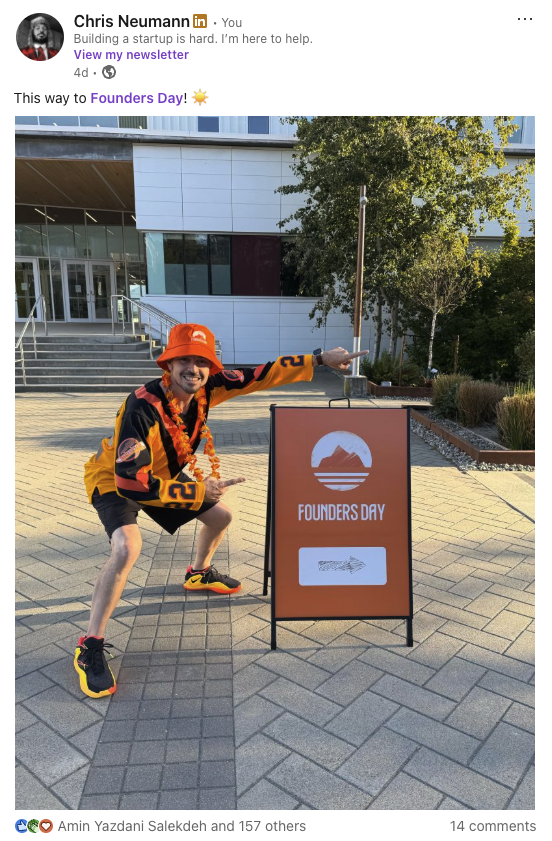
Look! An actual sign with an arrow →
3. Finances
Of course, added infrastructure comes with added costs. To-date, Founders Day has been entirely subsidized by corporate and government sponsors and myself. In order for Founders Day to cement itself as a permanent event in the annual Startupland™ calendar, it needs to be built atop a foundation that is long-term sustainable.
That means, like any startup, we needed to start the long march towards break-even.
The Journey towards Product-Market Fit
Continuing along with the startup analogy, year three of Founders Day came with many of the same questions that all early-stage startups face as they progress towards product-market fit:
Will free MVP users pay for it?
Can you maintain what makes the core offering special while adding new features and making it more robust?
How do you navigate conflicting user feedback and decide on a roadmap and priorities?
How will you evaluate the success of the new version?
We made a number of changes this year to both the event and the organization/infrastructure behind-the-scenes. In other words, we rebuilt the MVP from the ground up, added a bunch of new features and released version 3.0 to the world.
If I were to write technical release notes for this year’s Founders Day, they would look something like this:
Release Notes - Founders Day 3.0
New branding and design languageCompletely redesigned UI/UX (new venue)Improved user onboarding (actual conference badges, expanded registration area with redesigned staffing, improved signage)Redefined user roles
Blue = Founders, studentsOrange = Speakers, mentors, ecosystem championsBrown = Sponsors, investorsWhite = Staff, volunteersEnhanced in-app user support (on-site F&B)Improved and expanded partner integrations (more sponsors and community partners, many of whom exhibited at Founders Day)Platform and stability upgradesMisc. bug fixes
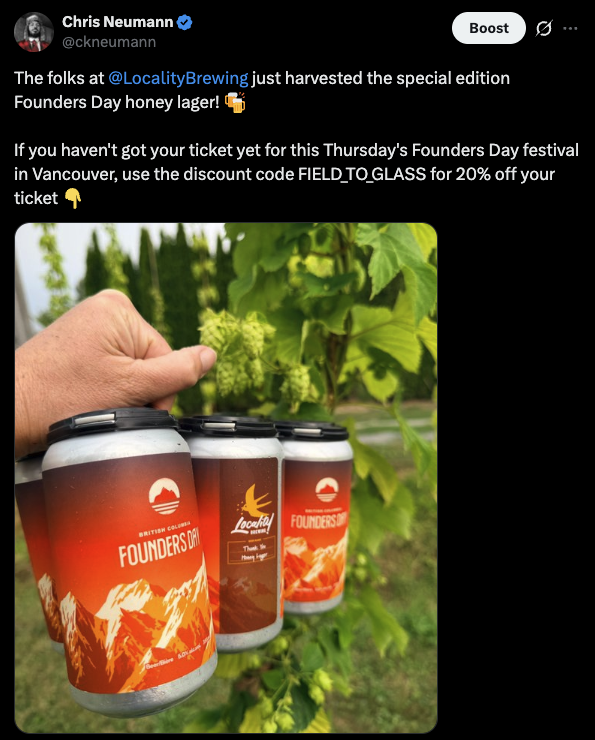
Enhanced user support 🍻
What does all of that look like, practically speaking? Here are some of the bigger changes we made for Founders Day 2026:
By far, the biggest change to Founders Day was the move from the Vancouver Convention Centre to a new outdoor venue. That was a huge undertaking, as it meant moving from a “turn key” venue to one where we had to bring everything in ourselves (from the stage, A/V setup and seating to fencing, garbage, and even porta potties).
The shift from “turn key” venue to custom experience wasn’t limited to the stage show. For the first two years of Founders Day, the networking event took place at a bar about 15 minutes from the convention centre. For year three, I wanted everything to be in one place. We brought in food trucks, concession stands, coffee bars, local beer and wine vendors and even an ice cream truck (the latter courtesy of local startup IcePanel). That kind of effort required procurement, power and permits. Lots and lots of permits…🤦♂️
Completely rethinking the venue for Founders Day meant a massive expansion to the team. The first two events relied heavily on convention centre staff for much of the behind-the-scenes logistics. For year three, we had to assemble a full-blown event and production team from scratch. That included event planners, a stage team, A/V staff, videographers and photographers, on-site security and more. Plus a whole lot of volunteers (shout out to Chris Hobbs for recruiting, training and supervising all of the amazing Founders Day volunteers 🙏).
Another seemingly simple but significant effort was on the design side. Founders Day 1.0 had a Luma page and a LinkedIn post. Version 2.0 had a Luma page, a LinkedIn post and a SquareSpace website. Founders Day 3.0 had my long-time collaborator Gail Yui. In the months leading up to this year’s Founders Day, Gail performed a top-to-bottom branding exercise that touched every aspect of the event, from signage and attendee badges to exhibiter booths and volunteer t-shirts to beer cans and bucket hats (plus, of course, the LinkedIn page).
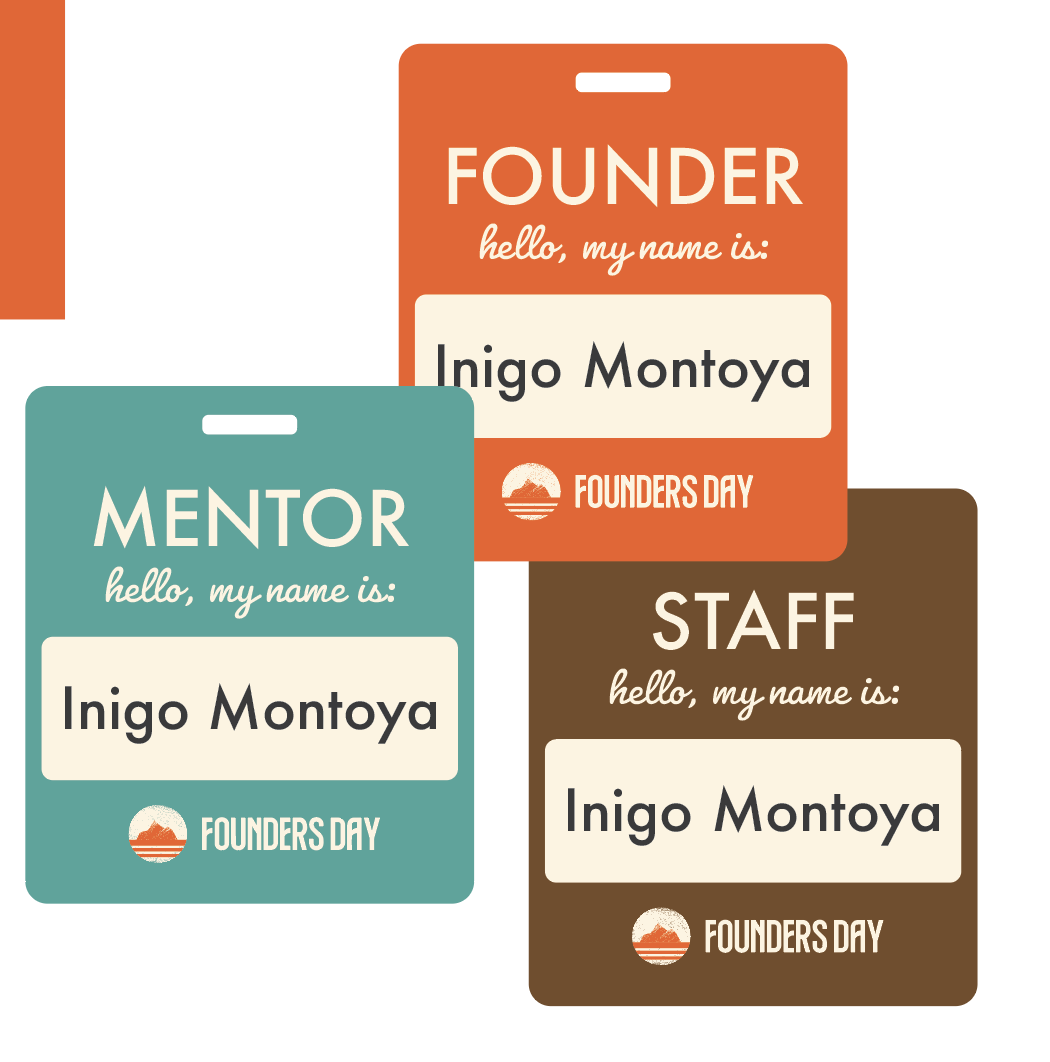
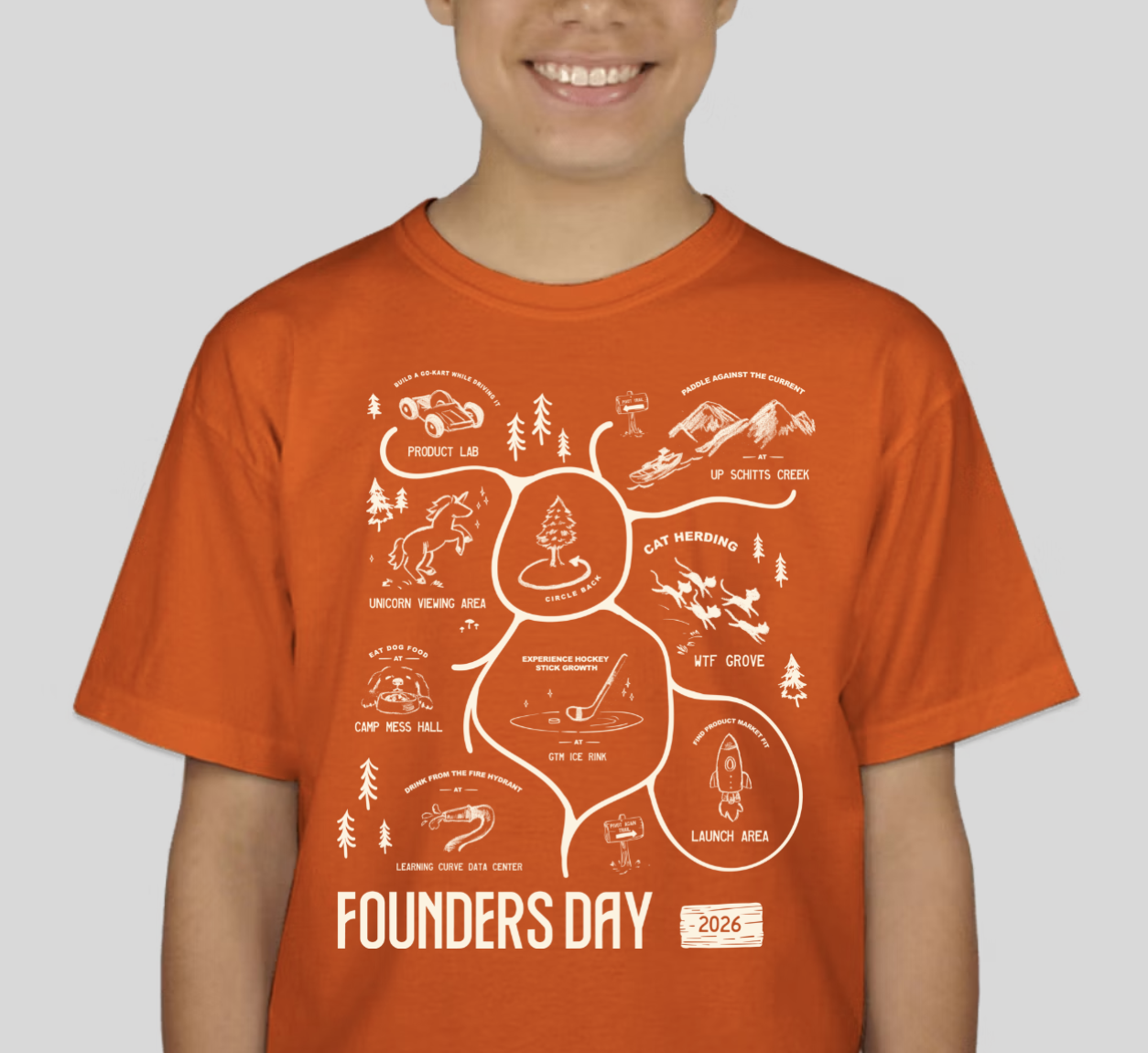
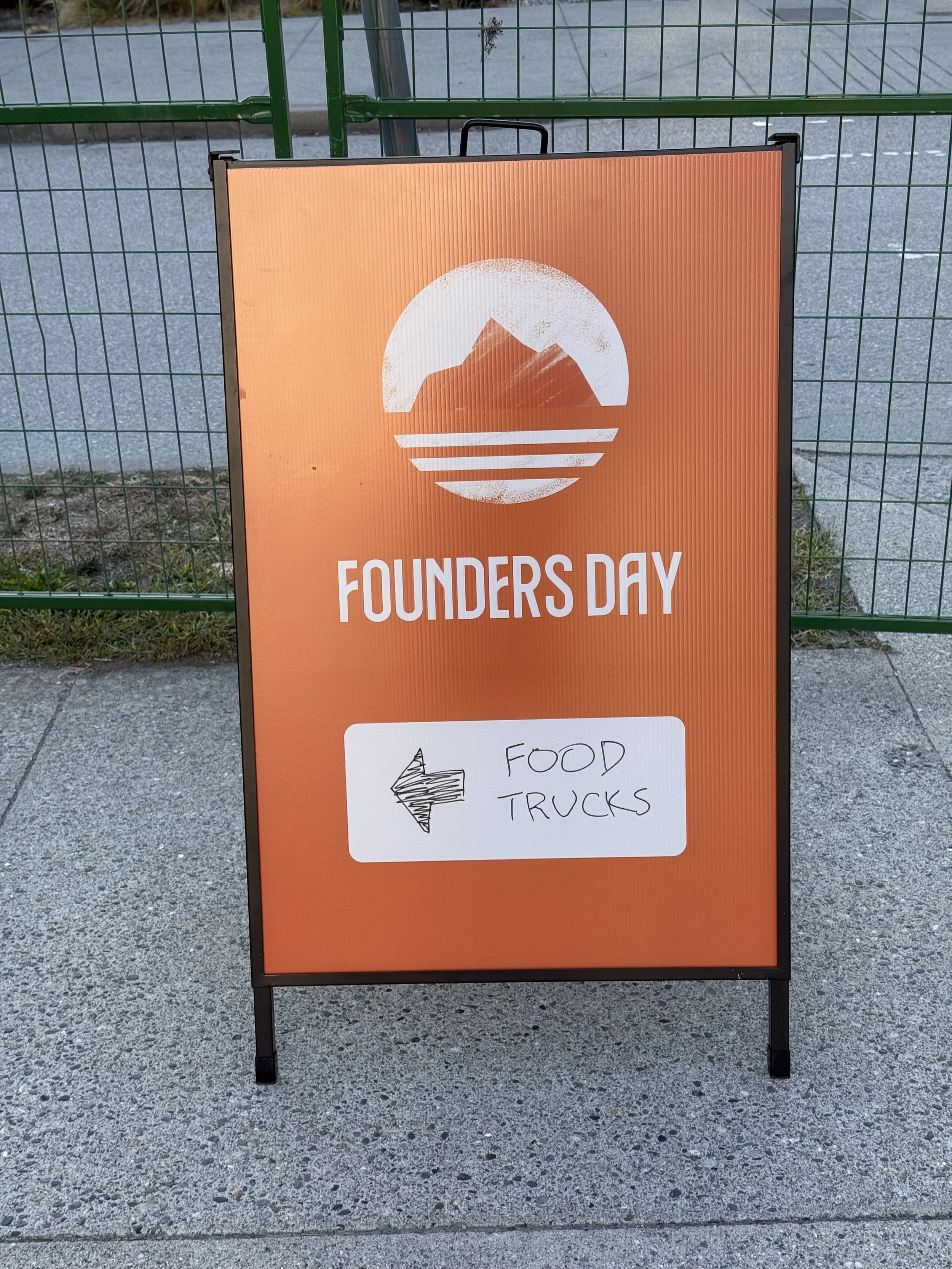
For all of the changes we made to this year’s event, we tried hard to stay true to the original vision of Founders Day: to facilitate and encourage connections between founders. In his seminal book, Startup Communities, Brad Feld observed that,
“Building a startup community is not a zero-sum game in which there are winners and losers: if everyone engages, they and the entire community can all be winners.”
This year’s Founders Day had nearly 100 experienced founders and investors speaking to and mentoring up-and-coming founders — many of whom flew in just for this event.
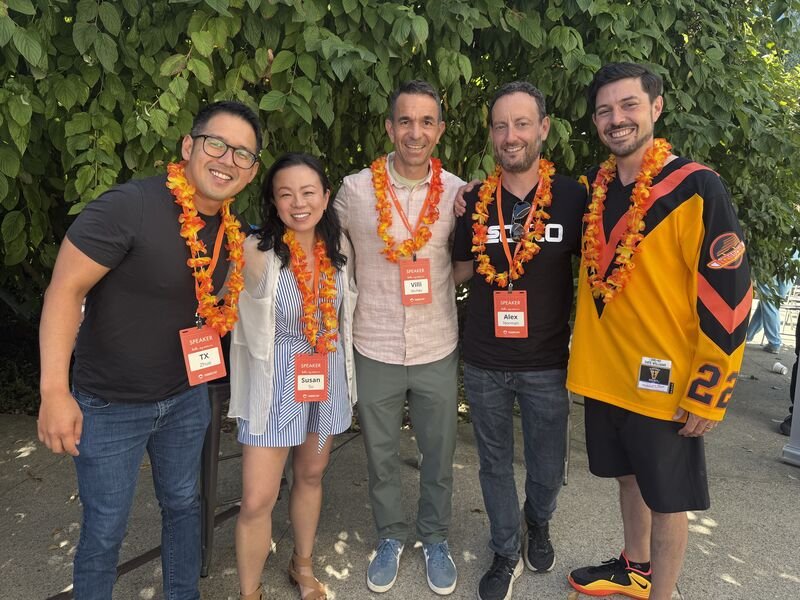
These speakers flew in from San Francisco, LA, Toronto and Seattle ✈️
The Results?
So what did attendees think of Founders Day 2026?
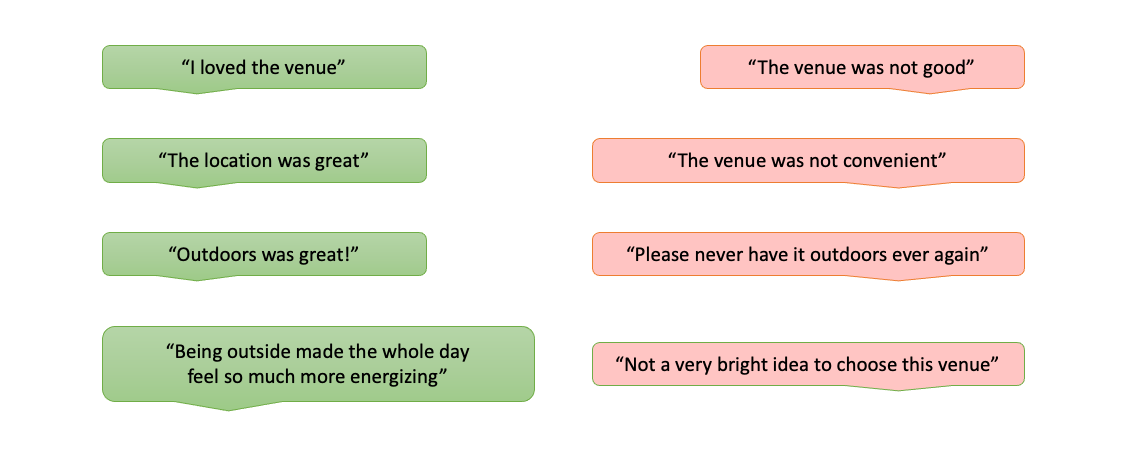
🫠
The thing about building in public is that if you’re doing something that matters to people, then they are going to have opinions.
Strong opinions.
And that’s okay. In fact, it’s great!
Genuine customer feedback is a signal that people care about what you’re building. They may not agree with everything you’re doing. They may not like all of the decisions you make. They might get really loud and upset when things break. But that means they care about your product and the problem you’re solving.
And it’s infinitely better than silence. (It’s also why the field of product management exists.)
If the volume of attendee feedback alone is any indication, then Founders Day is trending in the right direction:
Founders Day 2024: 7 people provided feedback
Founders Day 2025: 37 people provided feedback
Founders Day 2026: 102 people provided feedback (so far…)
Of course, that’s not the only metric that matters. So here is my honest review of Founders Day 2026:
Founders Day 2026: The Good, The Bad and the Ugly
Let’s start with the good:
From a product-market fit perspective, the biggest win of Founders Day 2026 was that we had almost as many founders, investors and ecosystem supporters buy paid tickets as attended for free in 2025. (We didn’t have as many registrations as last year, but that was to be expected given how many people register for free events without giving much thought to whether or not they actually plan to attend.)
At a more granular level, attendance figures for many ticket categories, including prospective founders/students, investors and ecosystem supporters, were up significantly compared to last year.
Other than running out of cold brew coffee towards the end of the day, the logistics for the food trucks, bars and concessions all went off without a hitch.
The registration process — which was a disaster in years past — was smooth and seamless.
Attendee feedback on the founder mentoring and networking portions of Founders Day 2026 was through the roof. 📈
We ever-so-slightly beat our revenue objective for this year’s event (revenue = sponsorship dollars + ticket sales).
Finally, we got strong subjective feedback from the majority of attendees at this years event, including a 4.3/5.0 event rating on Luma and broadly positive feedback both publicly on social media and privately through attendee surveys.
Next, the bad:
Overall attendance was slightly down compared to last year. We already know some of the reasons for this (e.g. marketing for this year’s event started later than planned due to delays in securing the venue). In the coming weeks, we will dig deeper into attendance statistics and feedback to see what other lessons are to be had.
Some of the decisions we made around the venue layout and configuration led to challenges with the A/V setup (e.g. in some areas of the venue the sound was too loud while in others it was inaudible).
Although we met our revenue target for this year’s event, expenses significantly exceeded our original estimates (primarily due to delays and unforeseen challenges with the new venue). Founders Day 2026 was never projected to break even, but the overruns definitely led to a larger deficit than planned.
Finally, the ugly:
This biggest miss of this year’s event came from the main stage seating layout. Our team spent significant time and effort developing contingency plans for rain, but we didn’t anticipate that last Thursday would be one of the hottest days of the year in Vancouver. The result? For significant portions of the day, it was entirely too hot and sunny for most people to watch the main stage presentations from the audience seating.
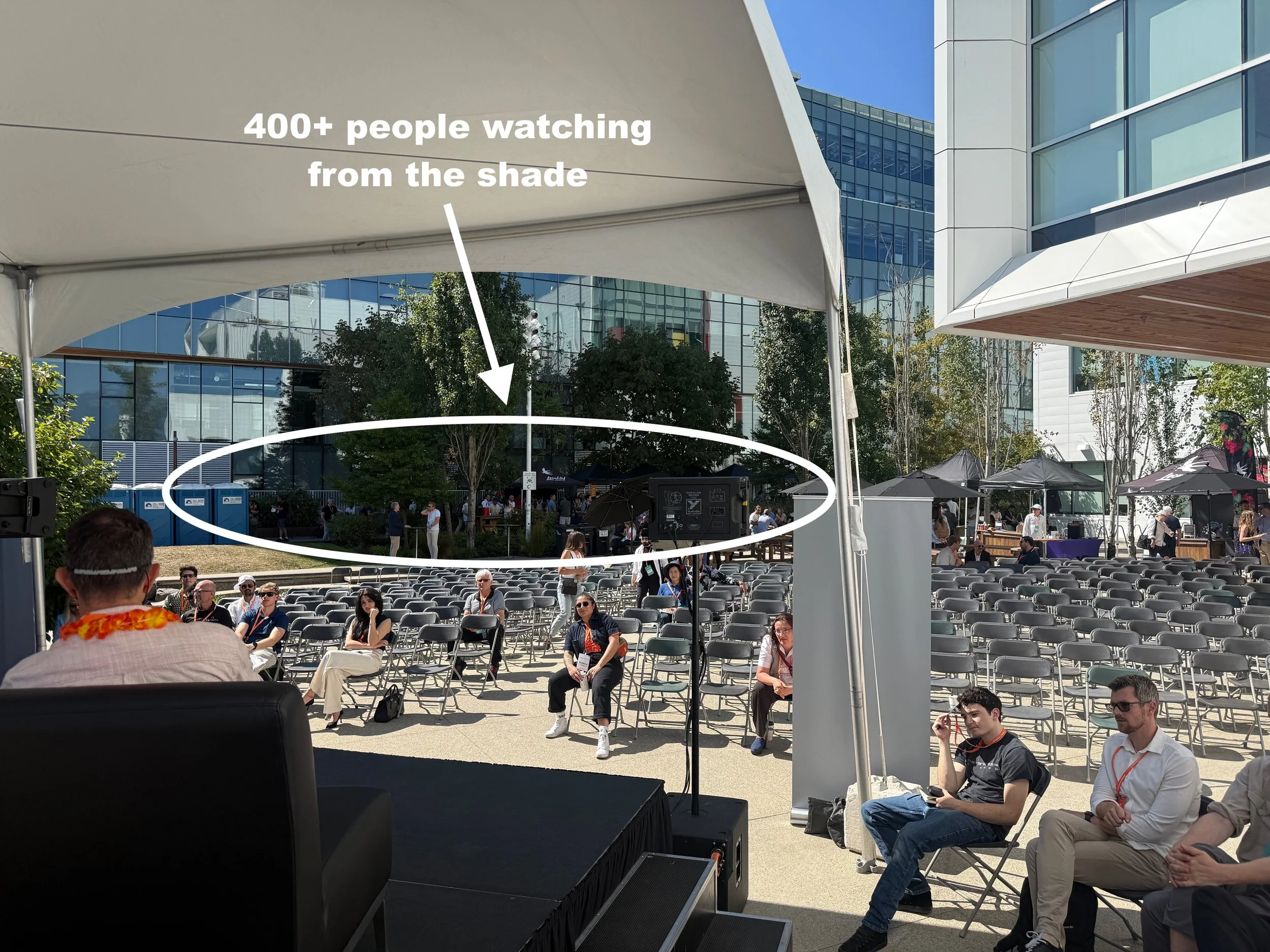
The change in audience flow resulting from the heat led to a number of additional challenges, most notably on the audio side. The speakers that lined the outside of the seating area weren’t configured to overcome the ambient noise from 400+ people mingling in close quarters. That meant many of the attendees standing in the shade were unable to clearly hear the panelists for significant portions of the day (though, rest assured, all of the sessions were recorded and we’ll post the videos soon!).
What’s Next for Founders Day?
Despite the hiccups that happened with this year’s event, Founders Day 2026 was an unquestionable success.
It delivered on the core value proposition we originally set forth while making considerable improvements over the “MVP” of years one and two. We also made meaningful progress on each of the three high-level objectives defined at the beginning of our planning cycle, which is a big deal when it comes to evolving into something that is long-term sustainable.
Of course, there is still plenty of work to be done on the journey towards product-market fit. Founders Day 3.0 had its fair share of “bugs” and there remains a healthy backlog of feature requests. In the coming weeks, we’ll dig deep into all of the feedback we received from speakers, mentors, sponsors and attendees and unpack the many lessons and learning’s from Founders Day 2026.
After that, it’s time to get to work on Founders Day 2027!
We’ve already got a tentative date soft-circled and clear ideas for how to make next year’s event even better, so stay tuned.
In the meantime, I want to thank all of the vendors, volunteers, speakers, sponsors, mentors and founders who made Founders Day 2026 happen. This year’s event wouldn’t have been possible without each and everyone one of you.
Thank you to our many corporate and government partners, including:
Presenting Partner: Fasken Emerging Tech
Gold Partner: Innovate BC
Silver Partners: AWS, Conference Badge, DuploCloud, IcePanel, Launch, New Ventures BC, Osler, Remitly and Web Summit Vancouver
And thank you to the many incredible people who contributed to Founders Day 2026 in ways big and small, including: Alex Conconi, Alex Norman, Alexandra Greenhill, Ali Pejman, Allen Pike, Amin Yazdani, Andrew Fursman, Andrew Harries, Andrew Vilcsak, Anthonia Ogundele, Arif Khimani, Ath Caramanolis, Bijan Sanii, Bill Tam, Brandon Waselnuk, Chris Albinson, Chris Hobbs, Colin Harris, Conrad Whelan, Daniel Eberhard, Darrell Kopke, David Luba, Dennis Pilarinos, Derrick Emsley, Diraj Goel, Edoardo de Martin, Edward Chiang, Gary Agnew, Glen Lougheed, Handol Kim, Ian MacKinnon, Irene Dorsman, Jack Newton, Jacob Shadbolt, Joel Hansen, Josh Nilson, Karm Sumal, Landseer Enga, Mayor Ken Sim, Kenndal McArdle, Kim Kaplan, Kris Hartvigsen, Michael Buhr, Michael Henson, Nejeed Kassam, Noah Stanford, Olivier Vincent, Praveen Varshney, Ray Walia, Reza Sanaie, Reza Arbabian, Serge Salager, Shivam Kishore, Sophia Millar, Susan Su, Tanis Jorge, Tifanee Po, TJ Rak, TX Zhuo, Vik Kambli, Villi Iltchev, William Johnson, Wilson Tang and Yen Lee (sorry if I missed anyone!!).
See you all at Founders Day 2027.
Humility vs. Hubris
A lot of the magic that happens in Startupland™ takes place at the intersection of humility and hubris.
Last week, I visited Edinburgh, Scotland to speak at Ecosystem Exchange, an annual conference that brings together investors, government officials and ecosystem builders from across UK to collaborate on ways to improve their local, regional and national startup ecosystems.
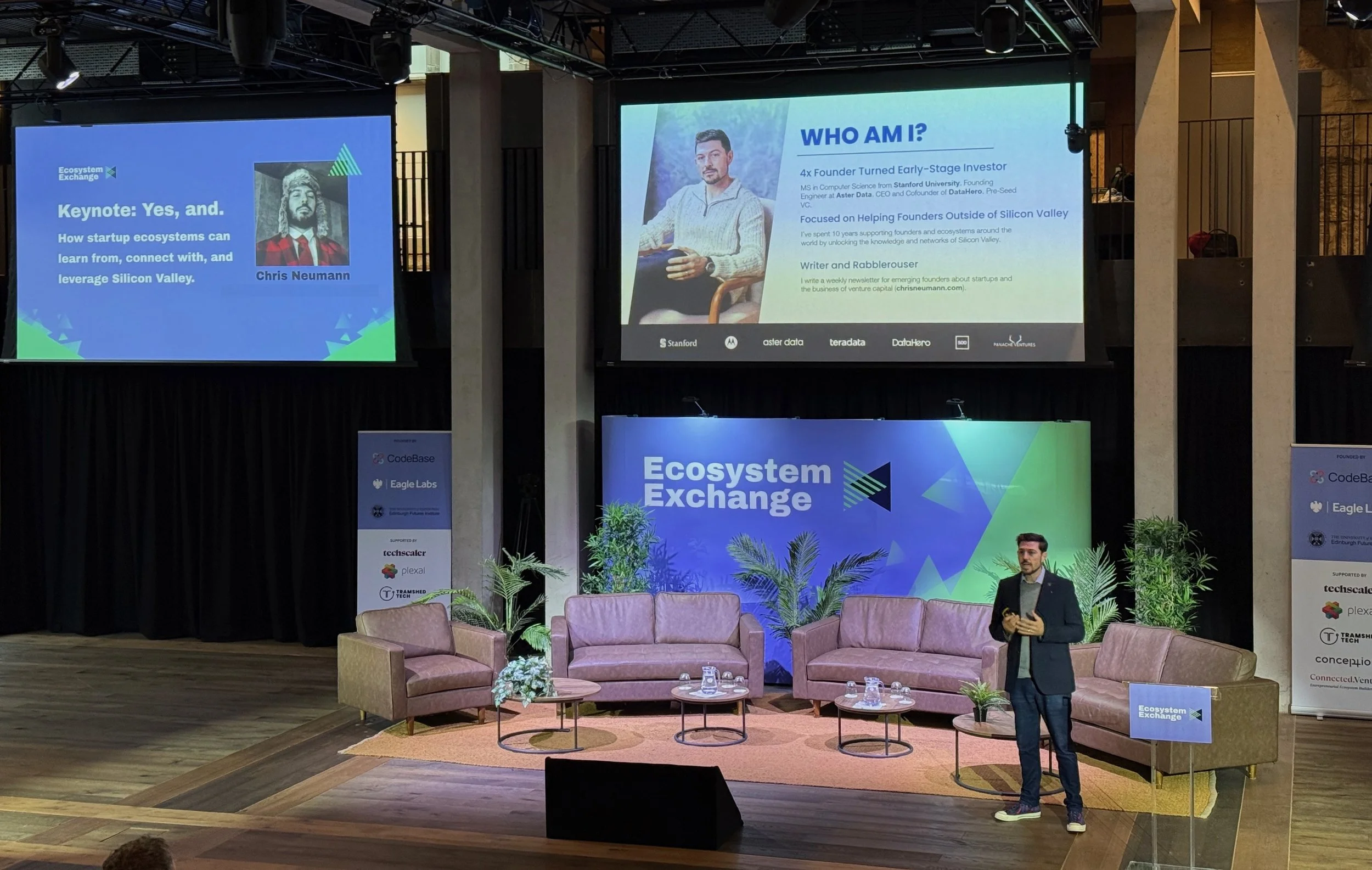
The conference was the brainchild of Jon Hope, a long-time UK ecosystem builder who previously co-founded one of the country’s largest networks of incubators and co-working spaces, Barclays Eagle Labs.
Over the course of two days, the speakers and panelists dove into a number of issues shared by countries around the world, including:
Disparities in talent, experience and capital availability across different cities and regions
Challenges commercializing IP developed in (government-funded) universities
The tensions between supporting high-growth companies with global ambitions and locally-focused startups that serve domestic needs
The impact of government policies / geopolitical shifts / local culture on startup ecosystems
Challenges retaining top talent and competing globally
When it was my turn to step to the mic, I spoke to the audience about a topic that’s deeply engrained in the ethos of each and every VC around the world: humility.
Ok, so maybe humility isn’t the first word that comes to mind when you think about a venture capitalist.
How about hubris?

It may seem surprising, but a lot of the magic that happens in Startupland™ takes place at the intersection of humility and hubris.
Here are some examples:
The best startup founders possess the hubris to believe that they can create billion-dollar companies out of nothing, but the humility to seek out mentorship, peer advice, and other forms of support to do so.
Top performing VCs possess the hubris to believe that they can identify the most promising startups before anyone else. Their humility comes from the knowledge that nearly 90% of their investments will fail (despite their best efforts). And no matter how much diligence they do, they won’t know which ones until much later.
But what about ecosystems?
In my experience, the ability to navigate hubris vs. humility is essential for ecosystems to grow. Why? Because no ecosystem outside of Silicon Valley has enough density of experience, expertise and talent to do it all.
Smaller ecosystems inherently understand this. One of the reasons why Scotland is amongst the fastest-growing startup ecosystems in the world is because it long-ago embraced the notion that it needs to build connections with other ecosystems in order to augment its domestic capabilities and support its local startups.

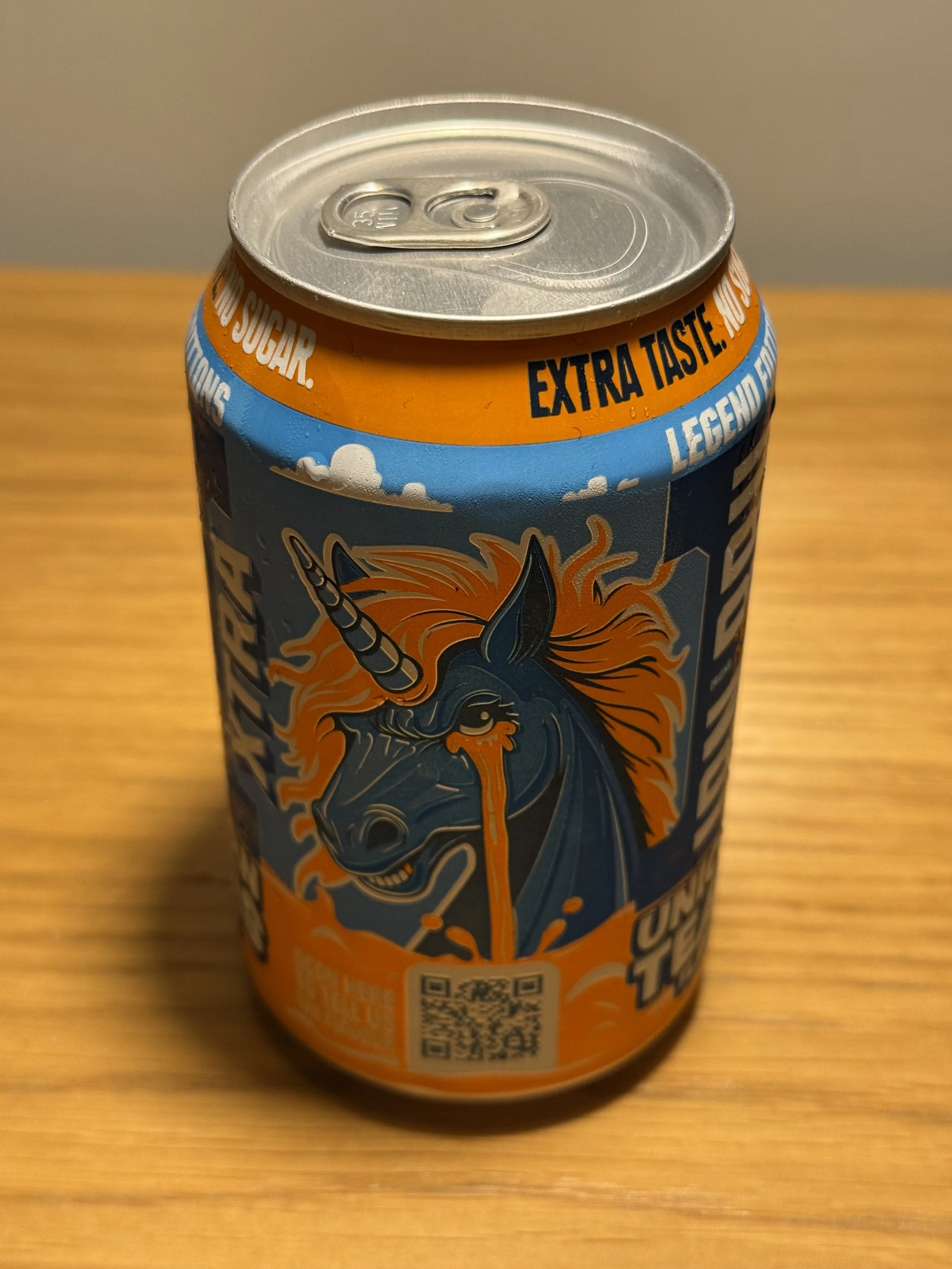
Scotland even has a version of its national soda dedicated to startups.
So why did I talk about humility and hubris at an ecosystem conference that took place in a country that seems to have figured it out?
Because even ecosystems that possess the self-awareness to recognize that they have gaps often struggle to maintain humility when addressing them.
Governments spend millions of dollars sending founders around the world to “tap into” other ecosystems (humility), but insist that they participate in highly choreographed programs designed at home (hubris).
Ecosystem builders pour time and effort into creating incubators and accelerators to support their startups (humility), then staff them with people who have no experience actually building successful tech companies (hubris).
Investors obsess over the their portfolio companies raising follow-on rounds from bigger, more prominent (predominantly Silicon Valley-based) VCs (humility) but can’t be bothered to get on a plane to get to know them in order to understand what they are actually looking for (hubris).
(And just to be clear, it’s not only ecosystem supporters who struggle with this tension — founders are far from immune to the pull of hubris.)
We’re currently in an era of significant macroeconomic, technological and geopolitical change. The gap between Silicon Valley and the rest of the world has never been greater. Yet at a time when the U.S. is becoming more insular, tech ecosystems around the world are banding together to address their weaknesses and create economies of scale.
On top of that, I’ve increasingly come to believe that Gen Z may be inherently better at walking the tightrope between humility and hubris than the generations who came before them. Younger founders have a different relationship with community than those who came before them. They also have a different relationship with geography. The Times, They Are A-Changin’.
I’ll close with this thought: as countries continue to shift away from globalization, there is opportunity in building deeper, more consequential relationships between tech ecosystems. Founder-to-founder. Investor-to-investor. Ecosystem-to-ecosystem. The ecosystems that capitalize on these opportunities will be the ones that embrace the idea that economic prosperity >> egos.
And that magic happens at the intersection of humility and hubris.
Changing Founder Metabolism
Announcing Game On, a program designed to accelerate Canadian founders and help them build meaningful connections to Silicon Valley.
A few weeks ago, I wrote about why 99% of accelerators fail. The vast majority of accelerators around the world fail to live up to their expectations for the simple reason that most of the mentors who work with these programs don’t actually have the lived experience needed to accelerate startups (at least, not if we’re talking about billion-dollar outcomes).
As it stands today, the only ecosystem in the world that has enough such mentors is Silicon Valley. So how do we accelerate startups in the rest of the world?
If the quintessential requirement of a good startup accelerator is good mentorship and only Silicon Valley has a sufficient quantity and diversity of mentors to cater to a wide diversity of founders, how can we reasonably accelerate startups in the rest of the world?
By leveraging Silicon Valley’s talent.
This isn’t a new epiphany by any stretch of the imagination. For more than 20 years, governments around the world have recognized this experience gap and have poured considerable resources into trying to tap into Silicon Valley’s magic. Almost every country (and many cities/states/provinces within them) have programs that attempt to build connections between their startups and Silicon Valley.
Unfortunately, a lot of these efforts fall flat.
A for Effort
There’s the Hollywood Tour of the Stars, designed by organizers convinced that the solution to their country’s woes is to expose founders to Silicon Valley’s biggest successes “for inspiration”. Founders drive up and down the San Francisco peninsula, sampling the cafeteria fare at the world’s most prominent tech companies and visiting their gift shops. They return home excited and energized, only to realize a few days later that they learned absolutely nothing.

Another well-meaning but low-ROI approach is the Investor Dating Game, designed on the premise that the only thing missing in a tech ecosystem is funding. If organizers could simply introduce their startups to Silicon Valley VCs, everything would magically come together.
There’s only one problem: the organizers often don’t understand that there are different stages of startups and different types of investors. Founders soon realize that they’re pitching a random mashup of VCs, private equity investors and corporates, and return home without a dollar raised between them.

And, of course, there’s the Silicon Valley Bootcamp. This one is actually a step in the right direction. Rather than wasting founders’ time with tours of big tech cafeterias or low-probability investor show-and-tells, organizers attempt to design a program centered around Silicon Valley insights. Unfortunately, many of them — particularly those planned from afar — end up as little more than a haphazard collection of fireside chats with expats. Such as:
The locally-famous founder, who moved to San Francisco a decade ago only to have their company fail before the ink was dry on their work visa.
The charismatic connector, who convinced the organizers that he/she sits at the center of Silicon Valley’s power brokers — but nobody in the Bay Area knows them.
The self-proclaimed fundraising coach, who has never actually fundraised.
Employee #12,376 of Uber, who joined 2 years after Travis left but will nonetheless tell you all about the early days.
Rise of the Expats
While many “top-down” efforts to connect with Silicon Valley have struggled over the years, one type of initiative has yielded ongoing success for many countries. And each country’s version has one thing in common: they all started as grassroots efforts instigated by Silicon Valley expats.
Here are some examples:
TiE was founded back in 1992 by Ambrish (AJ) Patel and eight cofounders originally from India
In 2007, Israeli expats Moshik Raccah and Eran Wagner founded IEFF
Canada’s C100 was founded in 2009 by Canadian expats Anthony Lee and Chris Albinson
In 2017, a group of British expats led by Trulia founder Pete Flint launched GBx
And there are many more such groups. Some of these organizations receive funding and support from the “home” government and/or local embassy while others are completely independent.
Each of these organizations creates networking opportunities that bring Silicon Valley-based expats together and then leverages that community for the benefit of visiting founders (offerings that typically include a more effective version of the Silicon Valley Bootcamp, such as C100’s “48 Hours in the Valley” or GBx’s “Brits by the Bay”).

The annual C100 Summit at Halfmoon Bay
The Landing Pad
Recently, we’ve started to see the emergence of a new category of offering that seeks to make it easier for international founders to spend an extended period of time working in Silicon Valley. The “landing pad” concept blends Silicon Valley co-working with the benefits of an international cohort. One of the best examples of this comes from the relatively small startup ecosystem of Scotland.
Back in 2022, the Scottish government issued a £42 million tender, known as “Techscaler”, to find novel ways to improve the local startup ecosystem. But rather than award the contract to one of the (many) US-based pay-to-play accelerator brands that applied, they awarded it to a local organization called Codebase. What makes Codebase different from most incubators around the world is that the founders deeply understand and accept the limitations of their local ecosystem. And they’ve spent years building relationships with Silicon Valley and other ecosystems to help plug the gaps (I first met them back in 2017 when I was with 500 Startups).
One of the first proposals that Codebase put forth as part of Techscaler was both incredibly progressive and incredibly simple: they proposed a 3-week program to take a dozen Scottish founders to San Francisco…to work. Not to drive up and down the peninsula visiting big tech offices. Not to sit in a financial district office listening to speakers deliver content they probably could have watched online. But to go to Silicon Valley and work on their startups.

And guess what? The Scottish government supported it wholeheartedly. They didn’t trip over themselves panicking about brain drain. They didn’t insist that the founders needed guidance / structure / handholding. They agreed with the assertion that the best way to support Scottish founders building connections to Silicon Valley was to let them do it. Here’s how the program was originally described:
The Techscaler Silicon Valley Hub was delivered as a pilot programme throughout February 2024, to build links between Scotland’s and Silicon Valley’s start-up ecosystems. It consisted of a “pop-up” hub in San Francisco, which provided office space for 12 Scottish start-ups to use as a base for several weeks, from where they built a new business network, learned from other world class businesses in similar markets, connected with US founders, partners, potential customers and investors. The programme also offered support for founders to find their way around San Francisco and Silicon Valley, signpost relevant events and facilitate introductions as relevant.
Since that first pilot, Techscaler has delivered multiple international programs with the full support of the Scottish government (the third Silicon Valley program took place this past spring).
Game On.
Over the years, I’ve had a front-row seat for an incredible number of accelerators, incubators, and startup programs. I’ve also spent a lot of time in a lot of ecosystems around the world.
Witnessing what Codebase was able to do with their landing pad got me thinking:
What if we went a step further?
What if we combined the simplicity of a San Francisco landing pad with the intentionality of an expat program and the experience of Silicon Valley mentors?

Today, I’m thrilled to share a new experiment in velocity designed specifically for Canadian founders: Game On.
I believe that one of Silicon Valley's greatest advantages over other startup ecosystems is velocity. And the velocity gap between Silicon Valley and the rest of the world has only grown since AI came on the scene. That’s why I’m inviting 30 up-and-coming founders from across Canada to join me in San Francisco for 3 weeks in January with two objectives:
To infuse them with a deep understanding of Silicon Valley’s velocity (and teach them how to operate at that velocity)
To help them develop their own high-value networks with potential customers, partners, other founders and investors in Silicon Valley
All while working on their startup.
This is an experiment unlike any founder program that’s been done before. It won’t be startup 101. And it definitely won’t be innovation theatre. Through light-touch programming, mentorship and intentional experiences, founders will experience firsthand how Silicon Valley really works. All towards one singular goal: go faster.
We’re not just trying to change the velocity of startups. We’re trying to change the metabolism of founders (H/T to my friend Mark Dobbin for that one 😉).
Applications are open now through November 15, 2025. You can learn more at chrisneumann.com/gameon.
Why Do 99% of Startup Accelerators Fail?
Why do 99% of startup accelerators fail to live up to their expectations?
In 2005, Paul Graham, Trevor Blackwell, Jessica Livingston, and Robert Morris decided to run an experiment. Paul had a hypothesis that undergraduates were undervalued when it came to starting companies. At a time when almost all VC’s required a “business cofounder” to run the company (aka a CEO with an MBA from a fancy school), Paul et. al. believed that the world was changing,
“This summer, as an experiment, some friends and I are giving seed funding to a bunch of new startups. It's an experiment because we're prepared to fund younger founders than most investors would. That's why we're doing it during the summer—so even college students can participate.
We know from Google and Yahoo that grad students can start successful startups. And we know from experience that some undergrads are as capable as most grad students. The accepted age for startup founders has been creeping downward. We're trying to find the lower bound.”
Their summer 2005 experiment — referred to as the Summer Founders Program — is today better known as Batch #1 of Y Combinator.
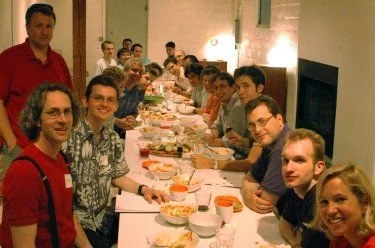
SFP included Alexis Ohanian (Reddit, Initialized Capital, 776 Ventures), Justin Kan (Kiko, Twitch) and Sam Altman (Loopt, OpenAI)
Fast forward twenty years and there are self-proclaimed “startup accelerators” around the world. Yet despite all of the innovations that have occurred over the past two decades — technologically, socially, and business-wise — YC remains the world’s preeminent accelerator — and it’s not even close.
So why is it that 99% of accelerators fail to live up to their expectations?
What is a Startup Accelerator?
Let’s start with a definition, to make sure we’re all on the same page.
The key characteristic of a startup accelerator is that it accelerates a startup.

You might think I’m being facetious, but I’m not. A startup accelerator is a program that is purpose-built to accelerate the trajectory of a high-growth tech startup. Implicit in that definition is that the participants are founders/cofounders of a startup with a clearly-defined market hypothesis (a business idea). They are not founders in search of an idea, a cofounder or a market for their technology.
This distinction is crucial (and we’ll get back to it later).
What Do Startup Accelerators Do?
The basic concept of a startup accelerator has changed very little since the Summer Founders Program. In October 2005, Paul Graham shared some of his learnings from the initial batch. It’s incredible how many of those observations remain at the core of today’s accelerators:
Mentorship
“Some we helped with technical advice-- for example, about how to set up an application to run on multiple servers. Most we helped with strategy questions, like what to patent, and what to charge for and what to give away. Nearly all wanted advice about dealing with future investors: how much money should they take and what kind of terms should they expect?”
Pitch Practice and Demo Day
“The weekend before the demo day for investors, we had a practice session where all the groups gave their presentations. They were all terrible. We tried to explain how to make them better, but we didn't have much hope. So on demo day I told the assembled angels and VCs that these guys were hackers, not MBAs, and so while their software was good, we should not expect slick presentations from them.
The groups then proceeded to give fabulously slick presentations. Gone were the mumbling recitations of lists of features. It was as if they'd spent the past week at acting school. I still don't know how they did it.”
Investor and Customer Intros
“I was surprised how much time I spent making introductions. Fortunately I discovered that when a startup needed to talk to someone, I could usually get to the right person by at most one hop. I remember wondering, how did my friends get to be so eminent? and a second later realizing: shit, I'm forty.”
Peer Learnings
“Just as happens in college, the summer founders learned a lot from one another-- maybe more than they learned from us. A lot of the problems they face are the same, from dealing with investors to hacking Javascript.”
Batch Format
“Another surprise was that the three-month batch format, which we were forced into by the constraints of the summer, turned out to be an advantage. When we started Y Combinator, we planned to invest the way other venture firms do: as proposals came in, we'd evaluate them and decide yes or no. The SFP was just an experiment to get things started. But it worked so well that we plan to do all our investing this way, one cycle in the summer and one in winter. It's more efficient for us, and better for the startups too.”
Twenty years later, startup accelerators around the world all follow roughly the same approach as that first Y Combinator batch:
Cohorts of startups / founders participate in a program that takes place over a defined period of time
The accelerator invests on standardized terms (typically at a lower valuation than a traditional VC would provide — thus pricing in the perceived benefit of the program)
Founders benefit from both peer learnings and the peer pressure that comes from being in a class / batch
The organizers provide mentorship and facilitate introductions to customers and potential investors
Most programs conclude with a “demo day” event, where potential investors can meet all of a program’s startups at once
The most significant evolution of accelerators has been the addition of standardized content intended to streamline learnings that almost all first-time founders have, such as:
Go-to-market (sales/marketing best practices)
Finding product-market fit
Fundraising
Startup Schools are Not Accelerators
A significant percentage of programs offered to startups around the world are not, in fact, accelerators. They are startup schools.
Startup schools teach founders the basics of running a company along with various concepts and methodologies related to entrepreneurship. But they do not accelerate a company in a fundamental sense.
True acceleration changes the trajectory of a startup by instilling founders with the best practices and work habits needed to succeed. And if we’re talking about building world-changing companies, then what we’re referring to is specifically, “instilling founders with the best practices and work habits needed to create billion-dollar companies.”
How does that happen? Through one-on-one mentorship.
If the definition of a startup accelerator is “a program that accelerates startups” and the primary means through which these programs effect change is through mentorship, then the quintessential requirement of a good startup accelerator is good mentorship.
But what is “good” mentorship?
The One About Youth Sports
Let me tell you about my friend Kenndal McArdle.
Like me, Kenndal is an early-stage investor. He is also a former founder. Kenndal and I have kids that are the same age and we both coach their sports teams. But there’s one big difference in what we bring to the table in that regard.
You see, one of us was a first-round draft pick of the Florida Panthers and played in the NHL. And one of us is me.

While we can both teach our kids the fundamentals of playing sports, only one of us has first-hand experience in the best practices and work habits necessary to reach the highest echelons of professional sports. Kenndal has a gold medal from the 2007 World Junior Championships. I watched the 2007 World Junior Championships on TV. We are not the same.
At a basic level, this is the fundamental flaw with 99% of startup accelerators. The mentorship in almost all of the world’s “accelerators” is provided by well-meaning individuals who have zero personal experience at the highest echelons of tech. Many have genuine experience building and/or investing in startups, but the vast majority have no firsthand experience building billion-dollar companies (as a founder, employee or investor).
They can teach topics, but they don’t actually know what it takes to reach the pinnacle.
Spotting Opportunity is Only the First Step
Almost all accelerators are founded by individuals who observe specific problems and/or opportunities within their ecosystems.
Y Combinator’s founding was a response to Paul Graham’s observation that “hackers” (specifically, undergraduate hackers) were not getting as much funding as he felt they deserved and that there was an investment opportunity to be had in addressing that need.
Techstars was founded in the tiny community of Boulder, Colorado by David Cohen, Brad Feld, David Brown and Jared Polis, who believed that there was a lack of funding available to founders in middle America and that there was an investment opportunity to be had in addressing that need.
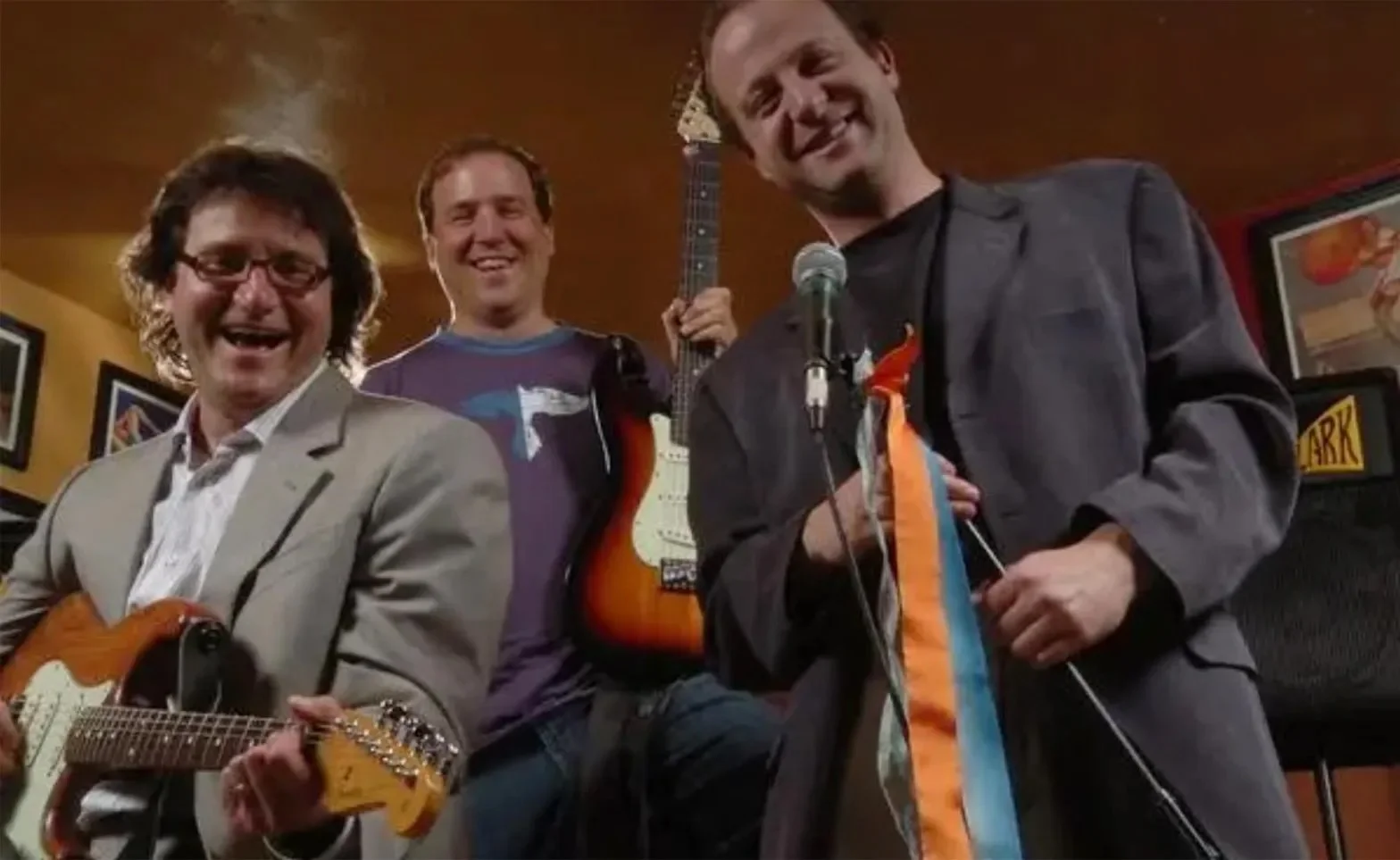
Boulder is a wild place 🤘
500 Startups’ origins came from the observation that women, minority and foreign founders did not have access to the same degree of funding that white male Stanford graduates had access to and that there was an investment opportunity to be had in addressing that need.
So why did these accelerators flourish while so many others failed? It starts with the experience of the founders:
Y Combinator: YC cofounders Paul Graham and Robert Morris previously cofounded Viaweb, the world’s first application service provider. They subsequently sold the company to Yahoo! and witnessed Yahoo!’s meteoric rise through the dotcom bubble.
Techstars: David Cohen, David Brown and Jared Polis all cofounded multiple successful tech startups while cofounder Brad Feld cofounded both startups and VC firms (most notably Foundry Group).
500 Startups: In addition to founding his own startups, Dave McClure was a member of the famed PayPal Mafia and an early employee at Simply Hired.
In all three cases, the founders had firsthand experience working at globally-successful tech startups. While they were not the founders of those companies, they had experience working with (and observing) the habits of exceptional founders both as employees within such companies and as investors later on. They understood from multiple angles what exceptional looked like.
But, more than that, they also had direct relationships with dozens of other founders and early employees who had similar firsthand experience inside the world’s biggest tech companies. Relationships that they could leverage for the benefit of the startups that went through their programs. (Recall Paul Graham’s observation from Y Combinator’s first batch: “I discovered that when a startup needed to talk to someone, I could usually get to the right person by at most one hop.”)
Anatomy of a Premier Accelerator
Let’s get back to the topic of mentorship.
What sets the world’s best accelerators apart is the strength of the teams working with founders. The quality of the mentorship, as well as the introductions that mentors can potentially make.
This starts with the employees of the accelerator. The best accelerators employ partners, entrepreneurs-in-residence and even operational staff who have firsthand experience working in some of the world’s fastest-growing tech companies.
Here are just a few of the people I had the privilege of working with at 500 Startups back in its heyday:
Jake Gibson (previously Cofounder of NerdWallet)
Sheel Mohnot (previously Founder of FeeFighters, which he sold to GroupOn where he became VP of Business Development)
Marvin Liao (previously head of international markets for Yahoo!)
Arjun Dev Arora (previously Founder of ReTargeter)
Binh Tran (previously Cofounder of Klout)
Elizabeth Yin (previously Cofounder of Launchbit)
Eric Bahn (previously Founder of Beat the GMAT and early employee at Instagram)
Mike Sigal (multiple time cofounder with both acquisitions and IPOs under his belt)
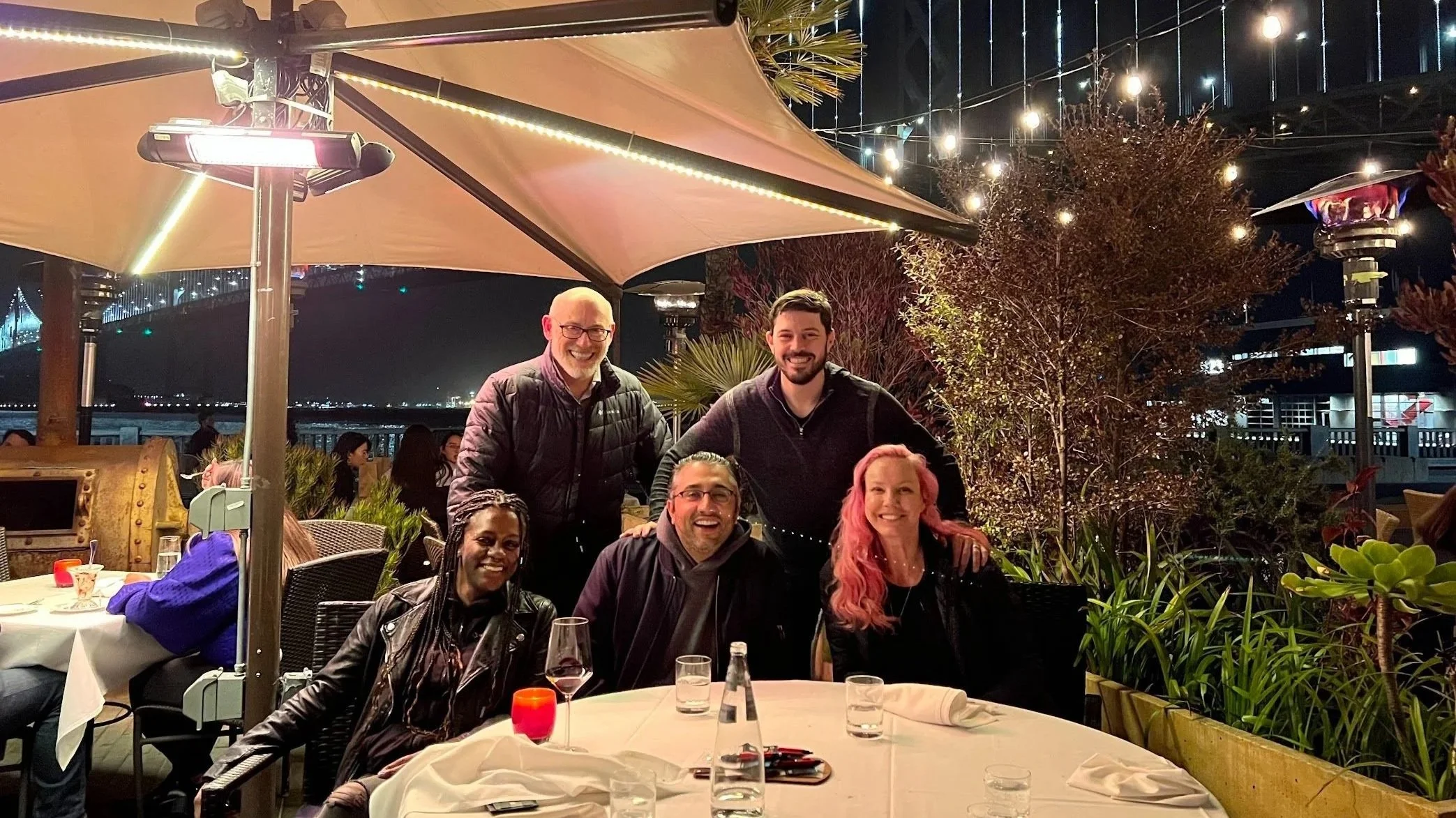
A gathering of a few old friends
A few of these individuals were founders of unicorns. But all of us had direct, firsthand experience with billion-dollar tech companies (as key employees, founders/early employees of companies that were acquired into unicorns, and as investors). We had each seen firsthand the best practices and work habits necessary to reach the highest echelons of tech.
That experience is key. But it’s not just the employees. It’s their personal networks and the multiplier effect that comes from them.
On Density and Mentorship
The world’s best accelerators surround founders with mentors and subject-matter experts who have directly contributed to some of the world’s most successful tech companies. Some of those mentors are employees of the accelerator. Many more come from the employees’ personal networks.
It’s this ability to provide founders with a wide variety of high-quality mentorship that differentiates the best accelerators from the rest. Ultimately, quantity of “good” mentors matters to the ongoing success of an accelerator almost as much as quality.
The companies within an accelerator batch are generally trying to solve vastly different problems in a variety of markets. While some of the mentorship topics (e.g. fundraising) have commonality across the batch, many more — from sales and marketing to product development — differ. So being able to pair each founder with multiple mentors who have direct experience in their industry and with the specific problems they’re trying to overcome matters.
If you think about my friend Kenndal, he’s a phenomenal mentor for anyone who wants to play professional sports. But he has far more to offer someone whose specific goal is to play left wing in the NHL than others. As a mentee strays further away from his lived experience (from left wing to other hockey positions and from hockey to other sports), his experiences and mentorship will necessarily be less relevant and specific. Introductions that he can potentially make will similarly be fewer and less direct.
This is why accelerators in smaller ecosystems generally fail over the long term. Even if there are a handful of unicorns locally, the specific experience and advice of the mentors coming from those companies will only resonate with a subset of founders. You can also only call on those same people so many times. If you think about it as a “snowball effect”, it’s a lot harder to build a snowman when there isn’t much snow on the ground.
This is why Silicon Valley has such an advantage when it comes to startup acceleration: experience and mentorship compounds.
When I was at 500 Startups, if I wanted someone with a particular type of experience to stop by (for office hours, to meet with a specific company or to deliver a talk), I could easily reach out to multiple people at multiple companies and find someone willing and able to drop by our San Francisco office. That’s simply not possible anywhere else in the world.
Even YC — which originally split batches between Silicon Valley and Boston/Cambridge — ultimately shifted entirely to the Bay Area. In 2009, Paul Graham wrote the following:
“I think it will be better for the startups we fund to all be in the Valley. We never tried to claim to the startups in the summer cycles that it was a net advantage to be in Boston. The most we could claim was that we could mitigate the disadvantages sufficiently well—for example, by flying everyone out to California to present to investors at our Mountain View office. But we did worry that the Boston groups were losing out. Boston just doesn't have the startup culture that the Valley does. It has more startup culture than anywhere else, but the gap between number 1 and number 2 is huge; nothing makes that clearer than alternating between them.”
But, But, But…
“But wait!” you say, “What about all of those big name accelerators around the world?”
How could the above claim hold true if so many prominent accelerators have created programs in cities around the world?
Simple.
Those “global” programs aren’t actually startup accelerators. They’re mostly government- and corporate-funded startup schools.
About 10 years ago, governments and corporates started approaching some of Silicon Valley’s accelerators with a proposition: if we pay you money, will you run a program locally in our ecosystem / for our specific industry?
At first glance, there seemed to be clear synergies. Founders in underrepresented geographies or industries would get programming, education and mentorship from experienced Silicon Valley founders and investors. Accelerators would gain exposure, access to new markets and revenue. They could expand their impact globally (which many genuinely wanted to do). But it didn’t take long before the shine wore off.
It turns out that few, if any, of these programs consistently birthed companies that the accelerators actually wanted to invest in. So while the first few batches were typically led by experienced Silicon Valley founders and investors excited to visit new ecosystems, before long the quality of mentorship plummeted as the accelerators shifted resources. Out of town experts were soon replaced with inexperienced local mentors, augmented by a roving band of “digital nomad” mentors who travel the world, offering their services to any accelerator or incubator willing to pay their room and board (trust me, there’s a lot of them).
Over time, many of these accelerators became addicted to the (very significant) revenue that governments and corporates around the world offered. They created entire divisions dedicated to selling and staffing such programs (in some cases, those divisions became larger than the actual core fund / accelerator). A focus on DPI was replaced by an obsession with program margin, often with disastrous consequences.
But There Have Been Successes Outside of Silicon Valley
Yes and no.
Over the past 20 years, there have been a number of examples of accelerators operating successfully for brief periods of time outside of Silicon Valley. But almost none of them succeeded over the long-term. In many cases, these programs were founded in nascent startup ecosystems hungry for any sort of cohort-based programming and benefited from an initial "burst” of extremely high quality founders. In others, an initial set of high-quality mentors eventually gave way to inexperienced replacements, with the quality of the program (and its results) soon following. We really haven’t seen accelerators form outside of Silicon Valley that have repeatedly, consistently shown an ability to take early-stage startups and accelerate them into unicorns.
What we have seen come out of other geographies are some of the most incredible, innovative “pre-acceleration” programs. Recall my earlier assertion that a startup accelerator is a program that is purpose-built to accelerate the trajectory of a high-growth tech startup. What about before then?
In 2011, Matt Clifford and Alice Bentinck founded Entrepreneur First in London. Their observation: that there was a lack of mentorship and guidance available for talented individuals who had the potential to be founders but didn’t necessarily have a specific idea in mind.
In 2012, Ajay Agarwal founded Creative Destruction Lab at the University of Toronto. His observation: too many PhD researchers were being hired directly into large tech companies instead of commercializing their research.
Both of these organizations have become globally impactful, each with billions of dollars worth of equity value created and multiple unicorns emerging from their programs.
(At this point, I’ll admit that the line between accelerator and pre-accelerator is a blurry one at best. YC, for example, is known to accept some founders whose ideas aren’t yet fully formed, while both Entrepreneur First and Creative Destruction Lab accept incorporated startups. The distinction as I see it is about whether the program primarily focuses on helping founders figure out whether or not a concept could be massive vs. instilling the best practices and work habits necessary to accelerate and ultimately reach that level of success.)
Accelerating the Rest of the World
We’re getting to the finish line here, I promise!
If the quintessential requirement of a good startup accelerator is good mentorship and only Silicon Valley has a sufficient quantity and diversity of mentors to cater to a wide diversity of founders, how can we reasonably accelerate startups in the rest of the world?
By leveraging Silicon Valley’s talent.
Side note: I’ve found over the years that, for some reason, this simple, seemingly innocuous statement offends a lot of people.
If I were to say to a minor league hockey coach, “I can bring some former NHL players to come work with your kids for a week,” or “We’re running a camp on the sidelines of this year’s all-star game and we’d like to invite some of your kids to join,” every single coach would be over the moon. No one would respond, “No, no…we don’t need that. One guy from our town made the NHL 15 years ago. We’re good.” Yet for some reason that’s the reaction that comes from many ecosystem builders when it comes building connections with Silicon Valley.
I’m not going to go down the rabbit hole of why this happens (it’s surely a deep one). Suffice to say, the idea of leveraging the world’s largest pool of startup experience to augment local mentors shouldn’t be a controversial one.
In any case, there are two obvious ways to leverage Silicon Valley experience for the benefit of global ecosystems: bring Silicon Valley’s mentors to the world or bring the world’s startups to Silicon Valley.
Both approaches can work. In fact, they’re not even exclusionary.
I won’t go into a discussion of how to do this — that’s a post for another day. Instead, I’ll conclude with the following observation:
Like many things in Startupland™, the majority of accelerators around the world have failed as a result trying to replicate something that can (at least today) only work at scale in Silicon Valley. But that doesn’t mean there can’t be successes elsewhere.
They just won’t look like “the YC of X.”

Much Ado About Nothing, H-1B Edition
What does the announcement of a $100,000 fee for H-1B visas mean for startups in the U.S. and tech ecosystems around the world?
Let’s jump right in with the biggest news in Startupland™ this week: the announcement that the U.S. is increasing the fee to apply for an H-1B visa to $100,000.
What does this announcement mean for startups in the U.S. and tech ecosystems around the world?

Absolutely. Nothing.
Before you interrupt me to explain how wrong I am, why this changes everything for America, or why your favorite non-U.S. city/state/country stands to benefit, hear me out.
Since President Trump’s announcement last Friday, the internet has been awash with hot takes. Why is Chris Neumann’s any better? For starters, I’ve actually been on an H-1B visa. Moreover, I’ve also hired people on H-1B visas. I’ve worked at big U.S. tech companies and small ones. I’ve been a founder and a VC. None of these facts make me an immigration lawyer by any stretch of the imagination, but they make my understanding of what these visas are, how they’re used by tech companies, and the potential impact of this announcement better than 99% of what you’ve read so far.
So let’s dive right in, starting with a quick primer…
What is an H-1B visa?
Established under the Immigration Act of 1990, the H-1B program enables U.S. employers to temporarily hire highly-skilled foreign professionals in specialized occupations, primarily in science, technology, engineering and mathematics (STEM) fields.
U.S. companies apply for the visa on behalf of prospective employees, who must have at least a bachelor’s degree in their area of specialization. There are three buckets for H-1Bs:
Up to 65,000 petitions each year are granted to general applicants
An additional 20,000 petitions each year are granted specifically to applicants who earned a master’s degree or higher from a U.S. institution
A further category of H-1B petitions, known as cap-exempt petitions, enables universities, government research organizations and certain non-profits to apply for H-1Bs visas outside of the congressionally-mandated annual cap
Note that the H-1B caps described above are for “initial employment” visas (visas granted to people who did not previously have an ongoing right to work in the U.S.) as opposed to extensions/adjustments to existing H-1B visas.
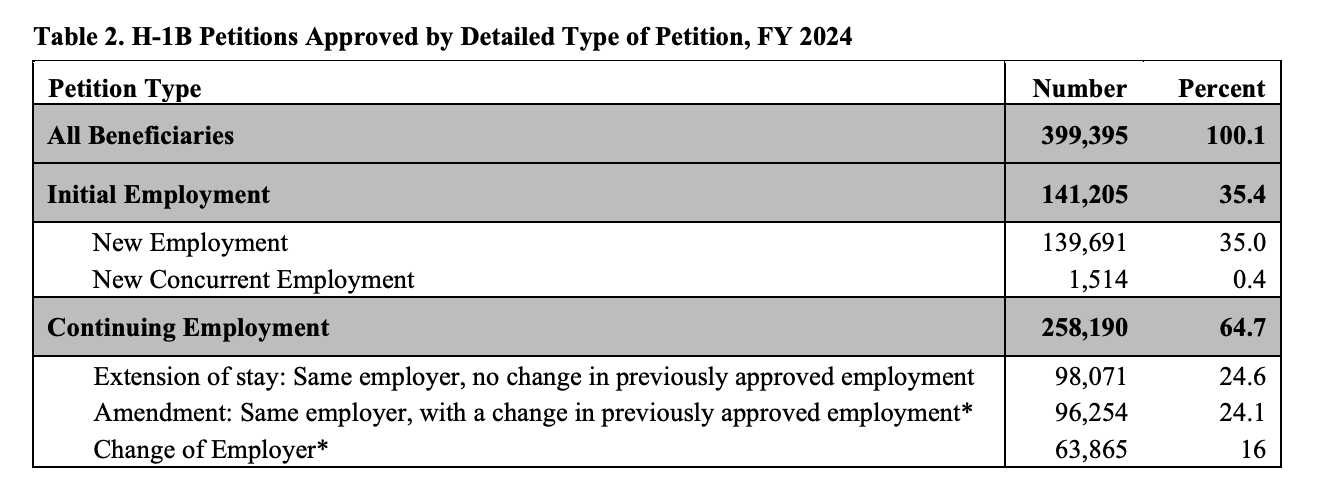
To give a sense of scale, according to the USCIS report to congress on the Characteristics of H-1B Specialty Occupation Workers for FY 2024, 141,205 H-1B petitions were granted for initial employment in FY 2024 (which we can reasonably assume consisted of 65,000 general petitions, 20,000 petitions for individuals with a U.S. master’s degree or higher, and 56,205 cap-exempt petitions), while 258,190 were approved for continuing employment:
Who Gets H-1B Visas?
Contrary to popular belief, H-1B visas are not only used to bring new workers into the U.S. from other countries. In fact, they are mostly used to keep highly-skilled workers in the U.S.
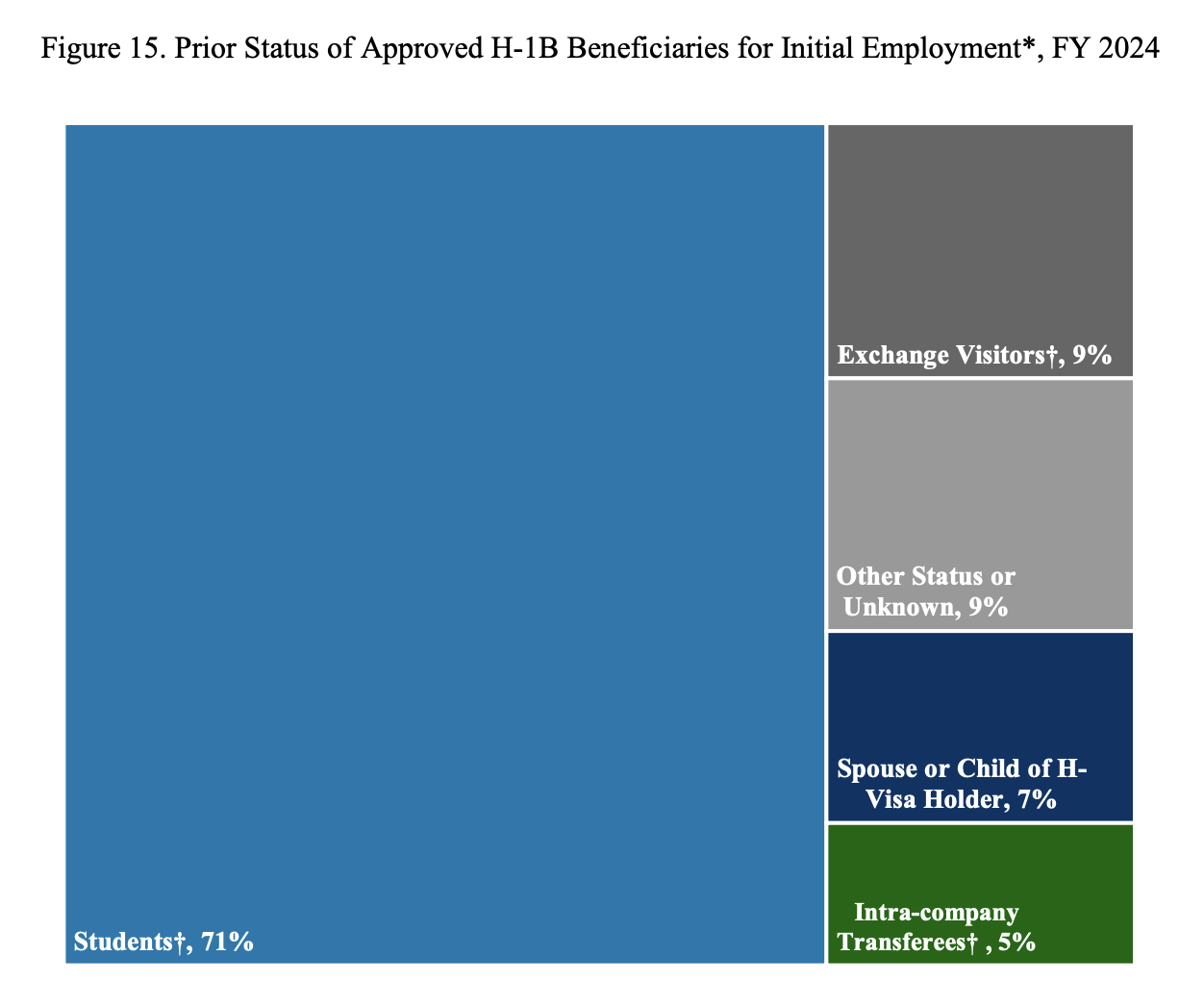
In its report to congress, USCIS noted the following breakdown of the 141,205 H-1B petitions for initial employment that were approved in FY 2024,
“Of the 141,205 petitions approved in FY 2024 for initial employment, almost 46 percent requested consular (or port of entry) notification, and the remaining approximate 54 percent requested a change to H-1B nonimmigrant status for a beneficiary already in the United States.”
In other words, 54% of the approved petitions for “initial employment” H-1Bs went to people who were already in the U.S. on other, non-employment visas. The vast majority of those (more than 71%) were transitioning to H-1Bs from student visas. This is the path that I personally took after graduating from Stanford with my master’s degree (we’ll get back to this point later).
Who Sponsors H-1B Visas?
All H-1B visa petitions must be submitted / sponsored by a U.S. company. The significant majority are sponsored by tech companies (which should come as no surprise to most readers). What might be surprising is the types of tech companies that sponsor H-1B petitions. According to the USCIS Data Hub, the top 10 petitioners for FY 2024 included 6 of the largest tech companies in the U.S. (Amazon, Google, Meta, Microsoft, Apple and IBM). The other 4? U.S. subsidiaries of India’s largest consulting companies (Infosys, Cognizant, Tata and HCL).
If you’re wondering why the the topic of H-1B visas is so contentious in the U.S. right now, here it is in one chart:
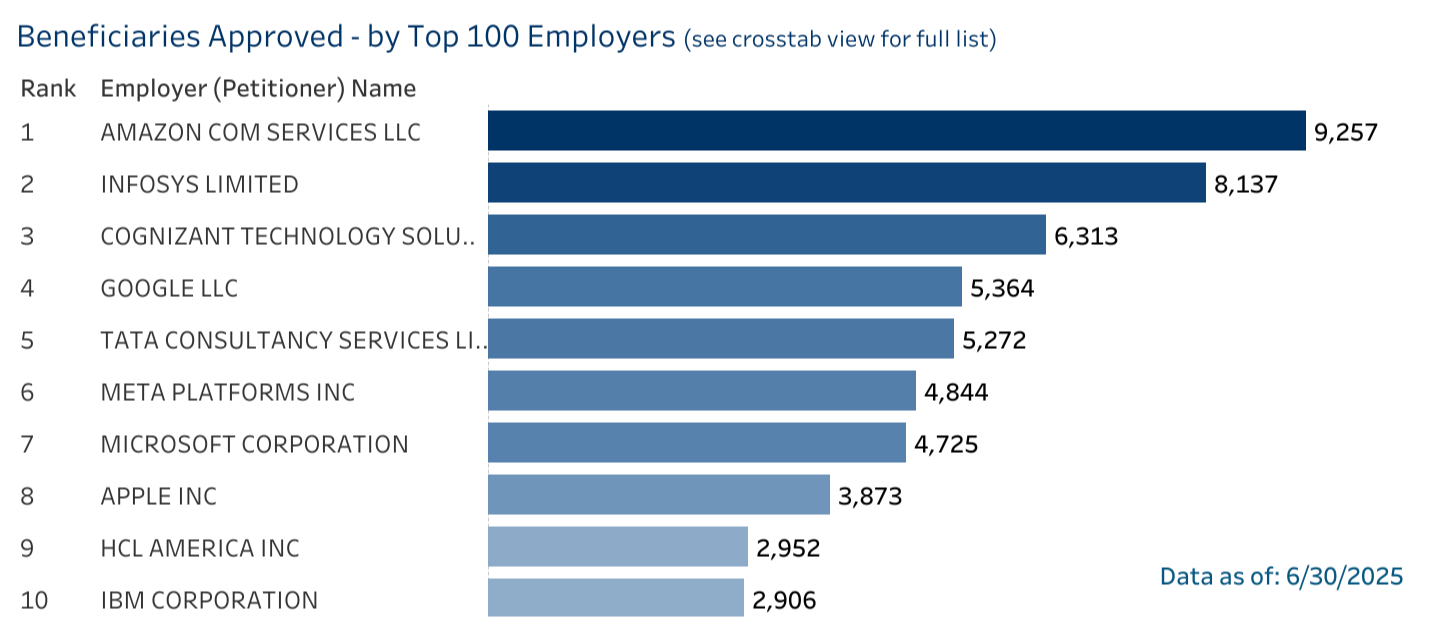
Despite all of the political rhetoric, the biggest critique of H-1Bs has never really been that U.S. companies use them to hire the best and brightest from around the world in place of American workers. Rather, it’s the perception that foreign consulting firms have been leveraging the program to bring in foreign workers to service U.S. clients (ostensibly at lower wages). I don’t know the degree to which these criticisms hold true, but it certainly doesn’t look good.
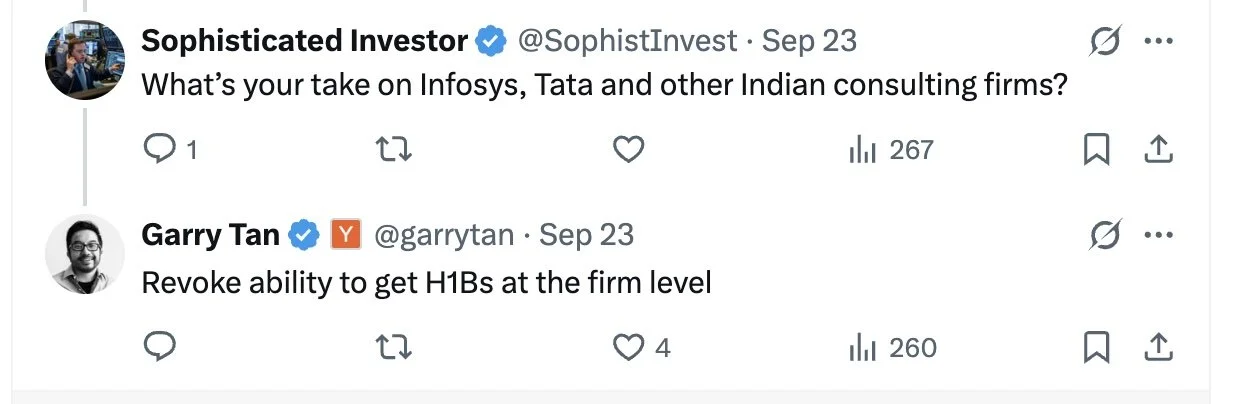
Y Combinator CEO Garry Tan has some thoughts on the matter
In fact, if you go through the top 100 list of H-1B petitioners on the USCIS website, alongside a “who’s who” of American tech giants you’ll find a surprising number of U.S. subsidiaries of foreign-owned consulting companies. You know what you won’t find? Actual startups.
Do Startups Hire H-1B Employees?
The short answer is “sometimes”. And that “sometimes” comes with a lot of caveats.
The first thing to note about H-1B visa applications is that “initial employment” petitions take a long time to approve. The approval process (known as the H-1B lottery) only takes place once per year. So depending on when an application gets filed, it could easily take a year or more for an H-1B petition to be approved — if it’s approved at all.
That’s way too long for most startups to wait. Especially when there are other options.
Here’s the reality: the vast majority of U.S. startups don’t hire any foreign workers using initial employment visas. At least, not in their early days.
Why not? Because hiring employees on initial employment visas takes time, costs money and is generally a pain-in-the-ass. It’s far more efficient and effective for startups to hire Americans. No immigration. No complications.
When they do hire nonimmigrant workers, early-stage startups prefer to hire people who already have a visa.
Transferring Sponsorship of H-1B Visas
In FY 2024, 16% of H-1B actions (covering nearly nearly 64,000 individual workers) were transfers of H-1Bs from one employer to another. That’s how a lot of startups hire foreign-born workers. In fact, that’s what happened to me. My initial H-1B petition (approved under the category for individuals with U.S. master’s degrees) was filed by a big U.S. tech company known as Motorola (remember them?). When I joined my former classmates from Stanford a few years later as Aster Data’s first employee, they simply filed the paperwork to transfer sponsorship of my visa over. There was no uncertainty. No long wait. Just some simple paperwork and a (relatively small) transfer fee.
Guess what startups often get when they hire an ambitious young (foreign-born) engineer with a couple of years of experience at Google/Meta/Apple/etc.? A freshly-approved H-1B.
According to USCIS, the fee change announced last week will have no impact on this path:
“This Proclamation does not:
- Apply to any previously issued H-1B visas, or any petitions submitted prior to 12:01 a.m. eastern daylight time on September 21, 2025.
- Does not change any payments or fees required to be submitted in connection with any H-1B renewals. The fee is a one-time fee on submission of a new H-1B petition.
- Does not prevent any holder of a current H-1B visa from traveling in and out of the United States.”
Transferring from Other Visas to H-1B Visas
Another common approach that startups use to hire foreign-born workers is to hire individuals who are already in the U.S. on another visa.
Earlier, I noted that 71% of the H-1B visas granted in FY 2024 to holders of other visas went to individuals who were already in the U.S. on student visas. (That’s 52,385 visas for those keeping track.) How does this work if it can take a year or more to complete an H-1B petition?
It works because F-1 visas come with up to 36 months of post-graduation work authorization.
When it comes to taking advantage of the economic benefits of foreign-born students educated in the U.S., America isn’t dumb. New graduates with designated STEM degrees can legally work in the U.S. for up to 3 years after graduation while their employers petition for an H-1B or other long-term visa on their behalf.
And guess who early-stage startups tend to hire? New graduates.
The change announced last week will have minimal impact on the very healthy pipeline of foreign-born students → U.S. universities → U.S. startups.
(I won’t say zero, as there are likely some individuals who might choose to go to a “big tech” company before joining a startup to increase the likelihood of getting a long-term work visa. But as I described above, that isn’t a new phenomenon.)
It is worth nothing that the change to H-1B petition fees does impact the transition of individuals who begin working at startups on F-1 work authorizations to H-1Bs. But as we’ll see below, there are other potential paths for such individuals. (It’s also worth noting that as of the publishing of this post, there are already discussions underway about potential exemptions to the fee for smaller companies.)
What About Startup Founders? Won’t They Leave?
Probably not.
One important thing to understand is that the H-1B visa isn’t the only employment visa available for tech workers in the U.S. And when it comes to startups, it isn’t necessarily even the best one.
The H-1B wasn’t the only tech-friendly visa established under the Immigration Act of 1990. The Act also established the O-1 nonimmigrant visa, for “the individual who possesses extraordinary ability in the sciences, arts, education, business, or athletics.” In recent years, it has become the preferred option for startup founders and many early employees of startups for three big reasons:
No Annual Cap: Unlike the H-1B, there is no annual cap on O-1 visas.
Shorter Processing Time: Whereas H-1B applications are only processed once per year, O-1 petitions can be processed within weeks of the application being filed, regardless of when the petition is filed.
Certainty: Whereas H-1B recipients are chosen randomly from a pool of qualified applicants as part of a lottery, O-1 visas are granted entirely on the merit of the petition.
It’s only in recent years that O-1s became more common among startups and for a simple reason: they’re harder to qualify for.
To qualify for an H-1B, an individual needs little more than an offer letter and a degree from a qualifying institution. An O-1 is much more involved than that. To qualify for an O-1, the petitioner must provide evidence that the individual is of “extraordinary ability” within their industry:
“The petitioner must provide evidence demonstrating your extraordinary ability in the sciences, arts, business, education, or athletics, or extraordinary achievement in the motion picture industry. The record must include at least three different types of documentation corresponding to those listed in the regulations, or comparable evidence in certain circumstances, and the evidence must, as a whole, demonstrate that you meet the relevant standards for classification.“
Guess what? Many startup founders and early employees fall into that category.
So What Does This Change Actually Mean?
At the start of this post, I posed the question, “what does this announcement mean for startups and tech ecosystems around the world?”
If we ignore the politics around this change and focus only on (1) what has been officially announced by the administration (including the most recent clarifications) and (2) how H-1B visas actually work and are used in practice, here is my personal opinion:
1. What Will Be the Impact on Startups?
Despite all of the rhetoric, increasing the application fee for new H-1B petitions will have little-to-no impact on startups in the U.S.
At the early stages, relatively few startups submit initial employment H-1Bs. Those that do can potentially take advantage of other visa programs and/or are likely to have raised enough funding to be able to absorb the cost (considering that many VC-backed startups in the U.S. spend more than $100K on recruiters or legal fees).
Don’t believe me? The best example the Wall Street Journal could find of a startup founder claiming that he would stop using H-1Bs as a result of this change raised $6M in VC funding, employs 11 people — 5 of whom are remote contractors in South Africa and Portugal — and has hired *checks notes* one H-1B worker 🤦♂️.
Still don’t believe me? Here’s what Democratic megadonor Reed Hastings had to say:

Granted, Reed’s take was certainly against the flow when it came to Silicon Valley reactions, but I think it’s the correct one if you reframe the categorization of visas as follows:
H-1Bs will be used for very high value jobs
O-1s will be used for very high value people
2. What will be the Impact on Ecosystems Outside of the U.S.?
As much as politicians and ecosystem advocates around the world rushed to proclaim that this was a massive own-goal on the part of the U.S., I doubt that we’re going to see much (if any) impact in other countries.
Big tech companies in the U.S. won’t blink an eye when it comes to paying this fee. Neither will startups if the jobs are very high value (they will also continue to happily hire workers who spent a few years at a big company in order to get a visa).
We may see a reduction in the number of H-1B applications from consulting companies — who are often driven far more by per-employee margins than other organizations — but that won’t necessarily translate into increases in immigration elsewhere (unless those consulting companies suddenly increase their non-U.S. hiring).
My good friend Alex Norman, Founding Partner of Canadian Pre-Seed firm N49P (who incidentally also previously worked in the U.S. on an H-1B visa) had perhaps the best take on this:
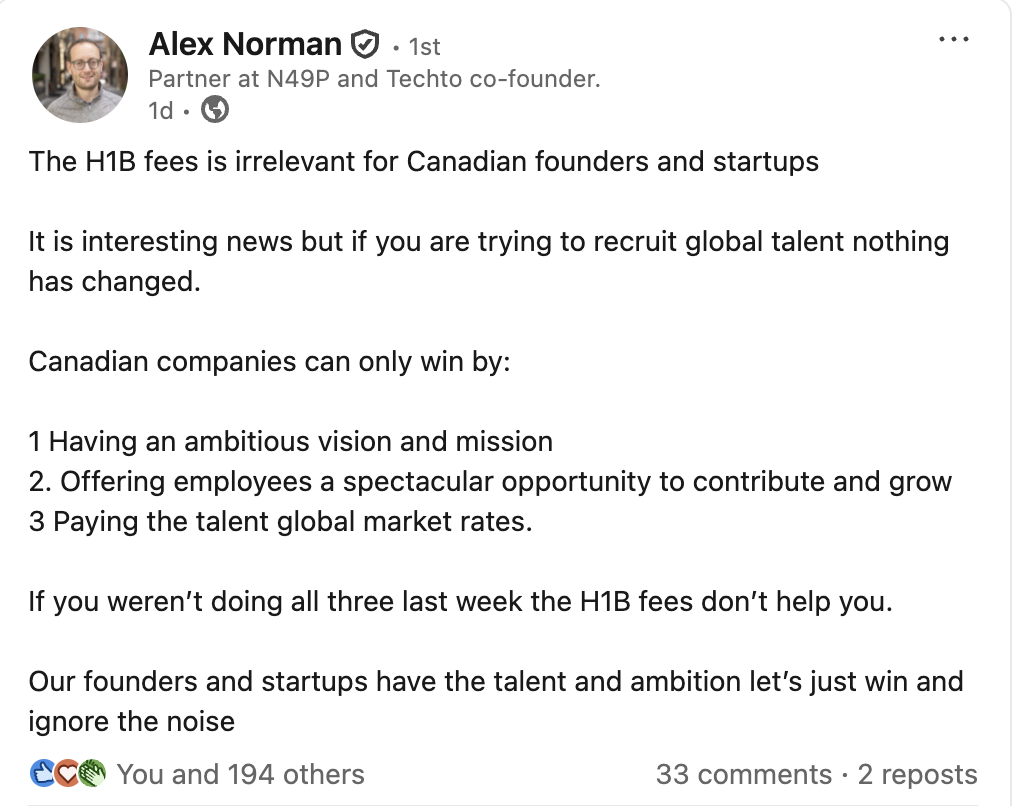
Or as Jack Dorsey once said, “You can worry about the competition…or you can focus on what’s ahead of you and drive fast.”
Anatomy of an Ecosystem
Let’s look at the evolution of Vancouver’s startup ecosystem through the lens of BC Founders Day..
Last week, I had the privilege of hosting the second iteration of what’s fast becoming an annual celebration of startups in Vancouver and the surrounding ecosystems: BC Founders Day.

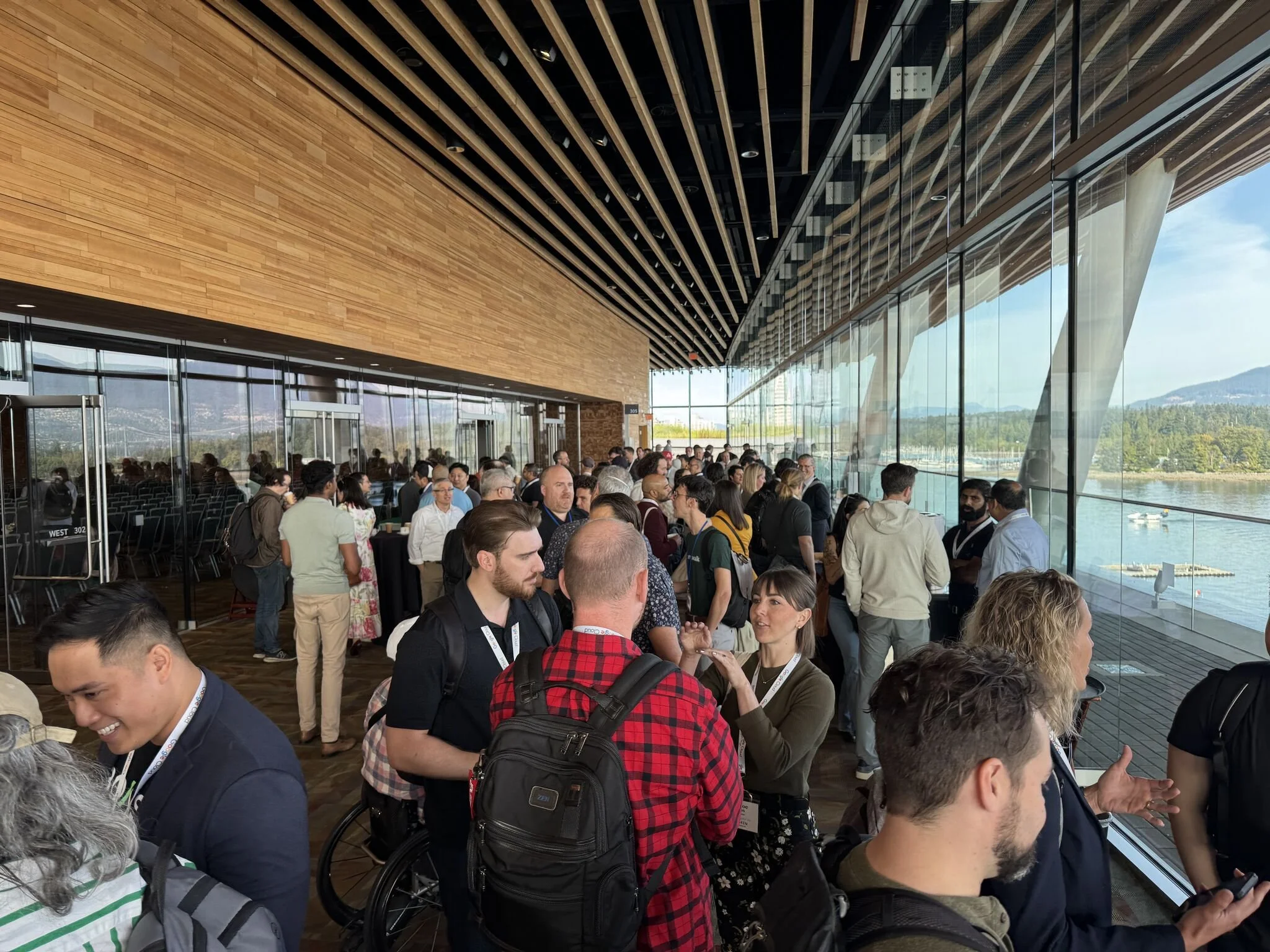
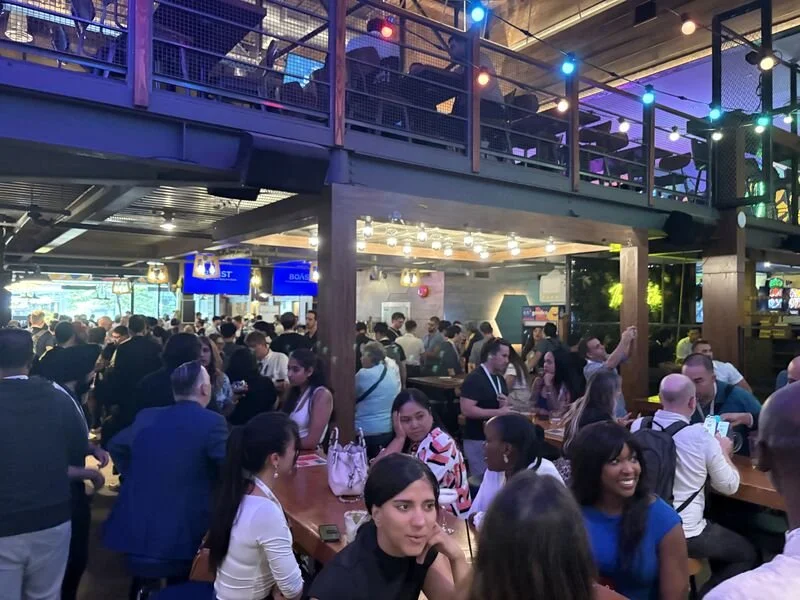
BC Founders Day originated from a simple idea: what would happen if we put up-and-coming founders from across British Columbia in the same room with dozens of experienced founders from startups past? It turns out, a lot.
The day consisted of three parts:
A mini conference with experienced founders sharing insights from their startup journeys (with a few VCs sprinkled in for good measure)
Founder-only office hours, where founders could meet and ask questions of the speakers and dozens of other experienced founders
A community networking event where founders, investors and supporters from across the ecosystem celebrated together
For an event like this to have maximum impact, curating the attendees is key. I’ve written before about the emphasis that high achievers place on meeting other high achievers when deciding whether or not to attend an event,
“The most ambitious people I know are drawn to other high-achievers. They want to learn from them, connect with them and be surrounded by them. Creating an event focused on the opportunity to meet other high-achievers can be a big draw. The most impactful events often take it a step further by focusing the audience around a specific theme,”
A big draw of BC Founders Day is that a significant portion of the event is only open to founders. Advisors, brokers, recruiters, consultants, fractional CXOs, salespeople and even investors are only permitted to join the community networking event. The result is a safe space where founders (and aspiring founders) from across the ecosystem can engage with each other on any topic they feel drawn to.
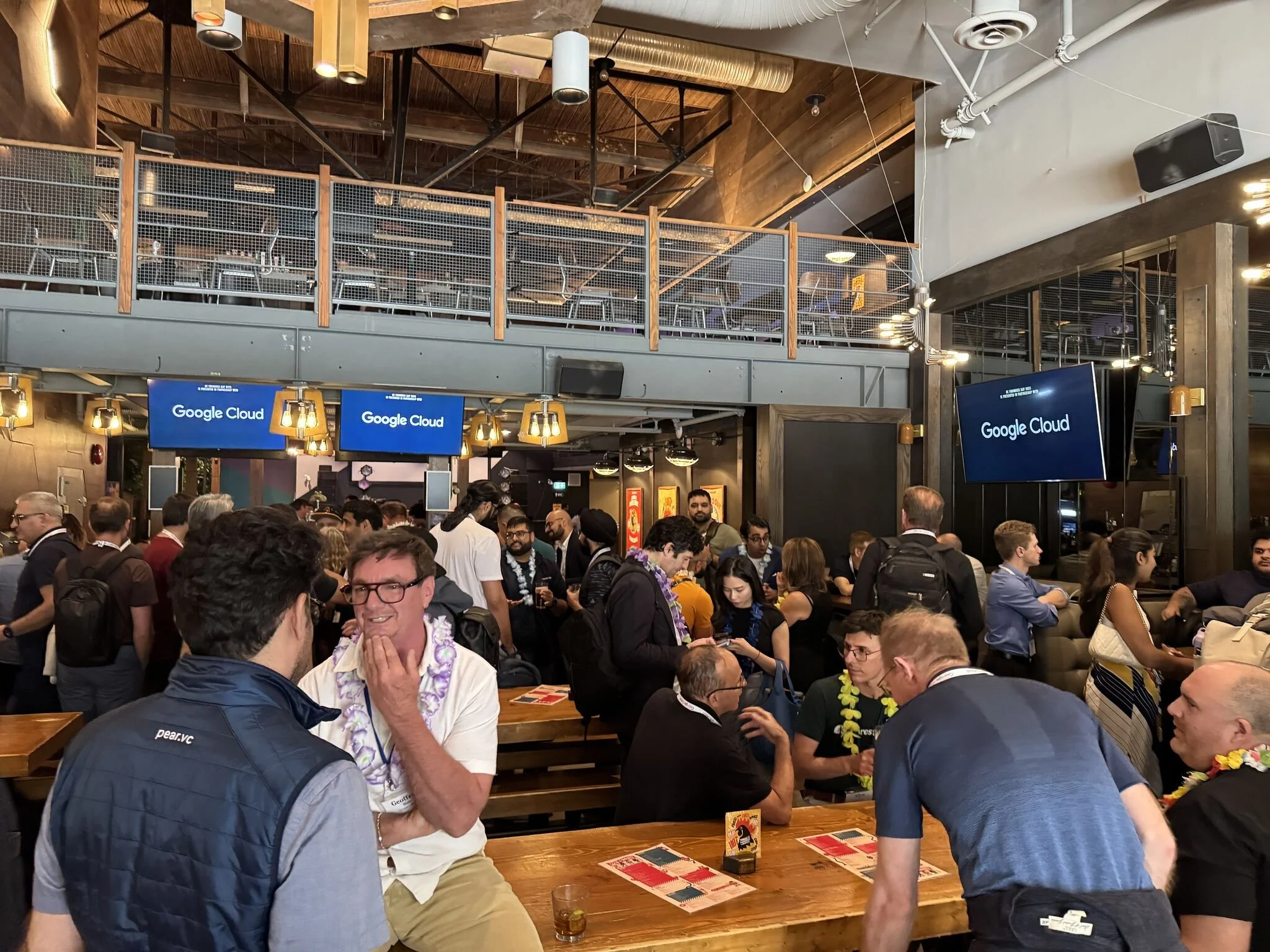
70+ speakers and OG founders wore Hawaiian leis during the founders-only office hours to identify themselves as mentors
In order to achieve this, we have to meticulously validate each attendee’s background and establish whether or not they are, in fact, a founder. That process gives us some pretty interesting data. Which got me thinking: with nearly 1,000 registered attendees this year (a 25% year-over-year increase 😉) we’ve created a pretty good snapshot of the BC startup ecosystem. So why not share it?
Let’s take a look at the startup ecosystem in Vancouver and the surrounding region through the lens of BC Founders Day…
Attendee Breakdown
Let’s begin with a high-level breakdown of the registered attendees by their role in the ecosystem:
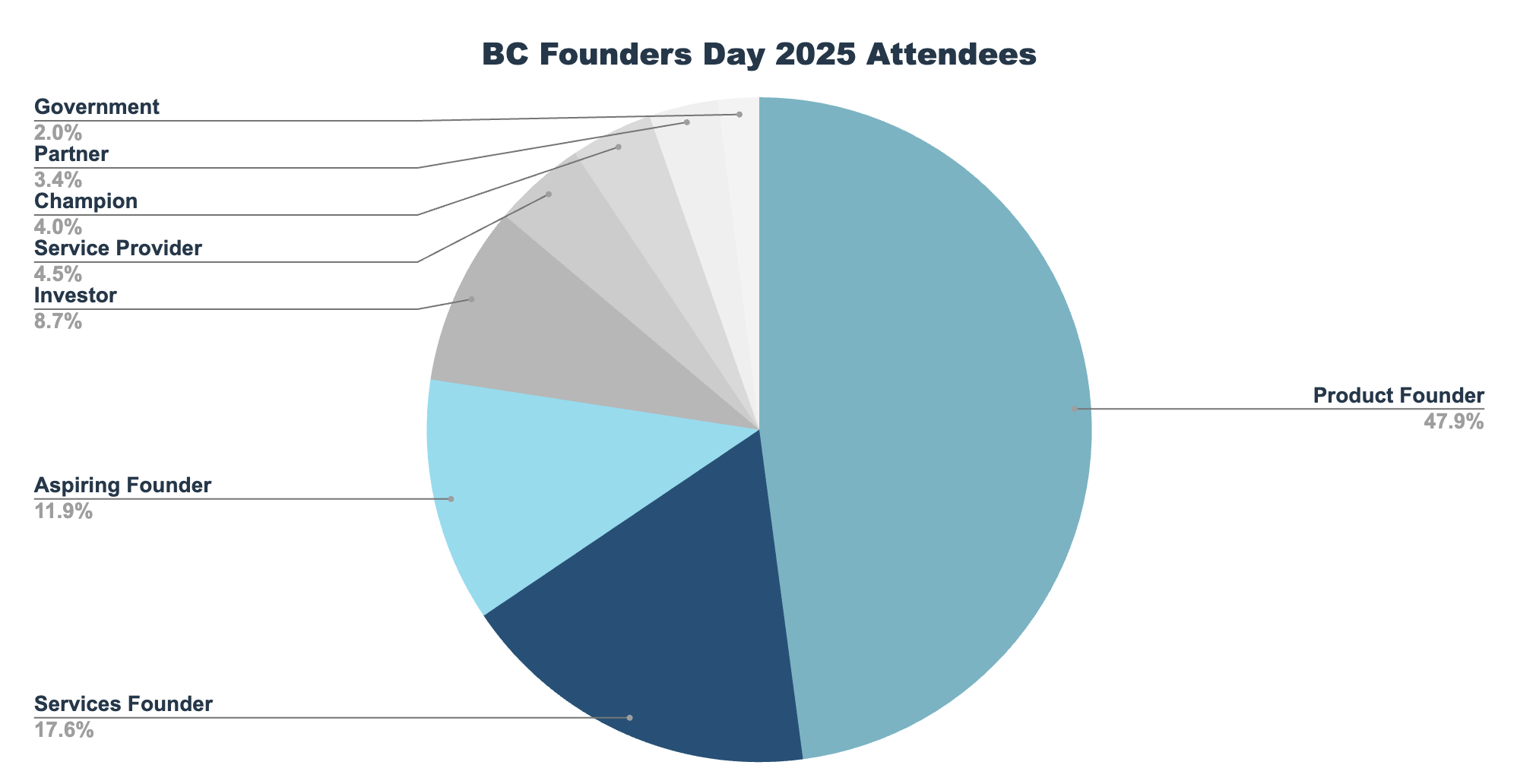
More than 65% of the event’s registered attendees — about 660 people — were confirmed, active founders. We broke that group down into two categories based on whether they founded a product company or a services company (a cohort that included consultancies, outsourced development shops and other service providers).
Another ~12% were aspiring founders. That group included students, individuals currently working full-time at a larger tech company and previously-exited founders considering starting something new.
8.7% of the attendees were VCs, angel investors and folks who work at local incubators/accelerators.
The remaining ~14% of registered attendees included non-founder service providers (recruiters, lawyers, salespeople, etc.), a group we refer to as “Champions” (individuals who either through occupation or by way of personal interest dedicate their time to supporting the local ecosystem), corporate partners and government representatives.
That’s a pretty good mix!
Location
Next up is location: where did this year’s attendees come from?

The vast majority of registered attendees — nearly 90% — came from the Greater Vancouver area (the city of Vancouver and it’s surrounding suburbs).
Another 1.6% traveled by boat, seaplane or helicopter to join us from the capital city of Victoria, while 5.1% of the attendees came from elsewhere in British Columbia.
A further 1.6% of attendees came from the rest of Canada (including former Wattpad co-founder and current deep tech investor Allen Lau, who made a 4,200 km day trip from Toronto to share his experiences).
The final ~2.2% of registered attendees were from outside of Canada (split evenly between the US and the rest of the world, at 1.1% each).
Founder Experience
To me, this was one of the coolest discoveries from our analysis.
We looked at the backgrounds of every single registered attendee to see if they had any founder experience at any point in their professional history. It turned out that ~78% of attendees to BC Founders Day 2025 had founded or cofounded at least one company 🤯.

Those companies weren’t all tech startups. Some had previously founded consulting companies. Others were the founders of media companies. A few had founded cough cough VC firms cough cough. The point is, ~780 of the registered attendees of BC Founders Day had founded something. And for a startup ecosystem, that’s amazing.
It truly was a gathering of founders.
Financing Stage
Last but not least, we dug into the progress made by the founders of product companies using fundraising as a (very imperfect) proxy. How far along are the companies and where is there source of funding?
Two quick notes on this before I go further:
The data below represents a combination of public and non-public data. It’s also imperfect. While I personally have knowledge of a number of unannounced funding rounds, there are undoubtedly others that I’m not privy to. So take this as an approximation.
The data reflects the companies that the founders are currently working on. Many attendees have progressed further in the past (raising multiple rounds of funding, exiting and even IPOing). But this data is all about what they’re working on right now.
With that out of the way, here’s what we found:

Once you move past the obvious reaction (“Wow…Chris must be colorblind”), what this data shows is a healthy, balanced and — most importantly — growing ecosystem.
About 35% of the founders have bootstrapped their companies. Some of them may eventually raise funding. Many won’t (either because their company isn’t a fit for investors or because they choose not to).
About 20% of the founders have financed their company thus far through a combination of angel investors, accelerators, incubators and/or grants (the latter something that is quite prevalent in British Columbia).
Nearly 14% of the founders have successfully raised Pre-Seed funding. Another 12% have raised a Seed round.
Once we get into the scaling and growth stages, the “graduation” rates approximate what we see globally in VC-backed startups.
Perhaps the most interesting insight from the data is that more than 14% of the registered attendees (nearly 150 founders) are currently building in stealth 👀. How do I know this? Some of those founders currently have “Stealth” listed on their LinkedIn profiles. Others…well, I can’t share all of my secrets 🤫
(Though I will note that a number of these stealth founders have already raised unannounced rounds of funding 🔥🔥🔥).
Overall, BC Founders Day 2025 was an incredible, invigorating event. For an ecosystem that’s often accused of being fragmented, it’s clear that a lot of founders across the region crave connectivity.
One last note: by far, my favorite panel of the day was comprised of three young, relatively unknown (for now) Gen Z founders. Each of these individuals is spearheading their own movement within the local ecosystem. And each of them was unapologetic about what they’re doing, why they’re doing it, and how it bears no resemblance whatsoever to what came before it.

A wise man once sang, “The Times, They Are A-Changin’”. The next generation of founders is grabbing the reins of ecosystems around the world — whether the old guard is ready or not. And that’s a great thing.
Even if the data doesn’t show it just yet.
Special thanks to our incredible corporate and government partners. BC Founders Day 2025 would not have been possible without their support: Google, RBCx, Fasken, Boast, Launch Academy, Innovate BC and Web Summit.
To get more of my thoughts on startups, the business of venture capital and tech ecosystems delivered to your inbox, subscribe to my newsletter.
Want to Hire the Best? Stop Paying Local Wages
If you raise Silicon Valley funding or are generating revenue primarily from US customers, there is fundamentally no reason why you can’t pay employees Silicon Valley salaries.
One of the excuses I hear all the time from founders, investors and others outside of Silicon Valley about why startups in their ecosystems “aren’t succeeding” is the claim that it’s impossible for them to compete with Silicon Valley salaries. Founders use it as an excuse for why they lose out on top talent. Community builders point to it as the reason why more young people aren’t building. Politicians use it as a scape goat for brain drain.

Here’s the thing: the only thing stopping you from paying a higher wage…is you.
Before your mind starts racing with all of the reasons why the above statement is laughably wrong, let me set the foundation for my claim: First off, I’m not trying to argue that wages can be (or should be) identical the world over. I’m also not suggesting that startups in Moose Jaw, Memphis or Manchester have a chance of competing on salary against “Big Tech” — especially when Meta starts throwing around $100M bonuses.
But guess what? Startups in Silicon Valley can’t compete on that either.
For as long as startups have been starting up, they’ve had to attract talent in the face of big incumbents with big treasuries. This report from ReadWriteWeb (circa 2013) provides insight into the hiring challenges faced by startups a dozen years ago:
“The toughest challenge facing most new technology companies these days isn’t getting funded – it’s hiring the best, most skilled employees. Heavyweights such as Google and Facebook can lure top talent with six-figure salaries, lucrative stock packages and lavish perks, including sushi buffets and free laundry service.”
You know what else came out in 2013? This post from Open AI CEO Sam Altman about how to hire, which he wrote while a Partner at YC:
“If you don’t hire very well, you will not be successful—companies are a product of the team the founders build. There is no way you can build an important company by yourself. It’s easy to delude yourself into thinking that you can manage a mediocre hire into doing good work.”
(If you want to go back in time even further, check out the “People” section of this 2005 post from YC Founder Paul Graham on How to Start a Startup.)
So let’s put to the side the talent battle of startup vs. incumbent and instead focus on the battle between startups. Specifically, let’s compare equivalent-stage startups in Silicon Valley and elsewhere in the world. Can startups based outside of Silicon Valley employ the same tactics (including salary ranges) as their Bay Area brethren to attract and retain talent?
In today’s world, the answer is unequivocally yes.

You’ve been spending too much time at Grateful Dead concerts…
Historically, startups outside of Silicon Valley have behaved a lot like sports teams in small markets — trying to win championships by squeezing the most out of a roster of lesser-known, lower salaried players. Twenty years ago, that approach made sense, as the majority of startups generated their early revenue locally (and, thus, were beholden to the economic realities of the ecosystems in which they operated). But things have changed significantly since then.
Today, many startups sell their products globally from day one. At the same time, their founders — emboldened by the realization that they hold more power than ever before — are increasingly unwilling to limit their fundraising goals simply because of the limitations of local VCs. Which means the most promising startups around the world are following Silicon Valley revenue trajectories and raising Silicon Valley-sized funding rounds. So why shouldn’t they be able to compete with Silicon Valley-based startups for talent?
Still don’t believe me? Let’s look at some numbers…

I used OpenAI’s o3 reasoning model to research the following two questions:
What is the average salary of a software engineer at a Seed stage startup in <city>?
What is the average number of employees at a startup that has raised USD $3M in <city>?
Let’s look at the results for some major startup ecosystems:
San Francisco
According to o3, the average salary of a software engineer at a Seed stage startup based in San Francisco is $150K. On average, startups that have raised $3M in funding have 6 - 8 employees at the time their funding was announced (although recent reports, such as Carta’s 2024 State of Startup Compensation Report, suggest that this number has fallen in recent years).
Toronto, Canada
Given the identical prompt, o3 reported that the average salary of a software engineer at a Seed stage startup in Toronto is CAD $125K - 135K (roughly $90K - 100K). Upon raising $3M in funding, the average Toronto-based startup has 10 - 12 employees.
London, UK
For London, o3 determined that the average salary of a software engineer at a Seed stage startup is £75K (approximately $100K). London-based startups that have raised $3M in funding have, on average, between 9 and 12 full-time employees.
What’s the point of all of this…?
Here is the average amount that Seed stage startups are spending on employees after raising $3M (assuming all of those employees are software engineers):
San Francisco: $900K - $1.2M
Toronto: $900K - $1.2M
London: $900K - $1.2M
There are obviously a bunch of assumptions baked into the above (it doesn’t take into account differences in taxes, benefits, actual employee roles, etc.) but, roughly speaking, Seed stage startups in San Francisco, Toronto and London all spend approximately the same amount of money on salaries.
How can this be possible, yet so many founders (and investors and community builders and politicians) outside of Silicon Valley remain convinced that they can’t compete on salary?
For years, founders outside of Silicon Valley have been sold a narrative that goes something like this:
Hustle hard and show early traction
Raise VC funding from Silicon Valley investors
Leverage that funding to build a higher-margin company in your home town (i.e. hire more employees at a lower average wage than what Silicon Valley startups can do)
The problem is, quality (and experience) matter. Both in building companies and winning championships.

So what we’re really talking about isn’t so much of a financial shift as it is a mindset shift. And I suspect it starts with torpedoing the (imho very bad) advice pushed by many investors outside of the US that startups should hire CFOs, COOs and other non-product employees before achieving PMF (though I’ll save that rant for another post).
For now, I’m going to keep the punchline simple: if you raise Silicon Valley funding and/or are generating revenue primarily from US-based customers, there is fundamentally no reason why you can’t pay employees Silicon Valley salaries.
That doesn’t mean you have to (you certainly don’t have to follow the Silicon Valley playbook by any means). It also doesn’t mean that you should spend recklessly or pay high salaries for the sake of paying high salaries. But it’s time to retire the excuse that startups in <city> can’t compete on salary with Silicon Valley startups.
Which means if you’re an early-stage startup that’s playing to win, your salary benchmark shouldn’t be set by other companies in your city (even the locally-famous ones 😉). If you find someone you believe to be a game changer for your startup, you should be willing to pay them up to the current benchmark for startups at your stage based in Silicon Valley. Even if that amount is considerably higher than the local norm.
I'm sure that plenty of folks will argue with me on this, but IMHO there is simply no reason for a startup to lose talent to an equivalently-funded startup anywhere in the world based on salary alone. Even Silicon Valley.

Why Won’t VCs Here Invest in Napkins?
Are Silicon Valley VCs really more willing to invest in ideas than VCs in other ecosystems?
One of the most pervasive stereotypes in Startupland™ is that Silicon Valley VCs are more willing to take risks than VCs in other ecosystems.
It’s not true.
Over the years, I’ve tried my best to take a literary sledgehammer to this overly simplistic narrative. While it’s unequivocally true that investors in Silicon Valley behave differently from their peers in other countries, attributing that to a cultural propensity for risk isn’t the reason.
Why do I care about this so much? Repeating and amplifying this naive stereotype derails founders outside of Silicon Valley when it comes to fundraising. It holds back ecosystems when it comes to recognizing their strengths and weaknesses. It even clouds the ability of VCs to look in the mirror and understand why they are (or are not) winning deals.

“Show me the incentive and I’ll show you the outcome.”
In the past, I’ve unpacked a number of falsehoods about Silicon Valley VCs that flow from this simple stereotype, including:
That they skip diligence to win deals (no, VCs don’t skip diligence — they’ve just learned how to move fast)
That they insist on companies relocating as a condition of investment (sorry folks, American VCs aren’t the reason your startups are leaving)
That VCs in other countries don’t lead rounds and instead sit around waiting for the mythical U.S. lead investor
That all VCs are the same (in fact, there are 9 types of startup investors, each with their own incentives and motivations)
In this post, I’m going to dive into another widely-held belief: that Silicon Valley VCs are more willing to invest in ideas than VCs in other ecosystems.
What is a Napkin?
Let’s start off by defining very specifically what we’re talking about with a simple hierarchy of early (pre-revenue) startup progress:
Team Only: The founding team is set. They don’t yet have a specific thesis beyond a vague idea of the market they’re going after and/or a concept for the product.
Team + Idea: The team has come up with a specific idea. That idea is represented using some combination of a simple business plan or pitch deck, technical papers, and possibly a proof-of-concept implementation (i.e. a technical prototype that can do one or two hard-coded things meant to demonstrate the technical potential of the idea).
Team + Prototype: The team has developed a working prototype of the idea. This is a rudimentary implementation focused on high-level design and functionality, but not sufficient to perform market testing (while it can be shown to potential users/customers to gather feedback, it’s not yet ready for actual user testing).
Team + MVP: The team has developed an MVP (“minimum viable product”) that can be used for alpha / beta testing with prospective users/customers/investors.
Now, let’s talk briefly about what it takes to get investment at each of these stages:
Team Only
Despite what you might think from reading TechCrunch, raising VC funding at the “Team Only” stage is exceedingly rare. Startups that do so generally fall into one of four categories:
Celebrity Repeat Founders - These teams are comprised of well-known repeat founders who have demonstrated significant success in the past. Very few startups fall into this category, in part because such founders have both the financial means to bootstrap their company beyond this stage and they know the value of doing so.
High-Profile Spinout Founders - These teams are comprised of founders who together spun out of a highly-regarded company. They typically signal a desire to focus on a problem immediately adjacent to the one they most recently worked on, leaving investors confident that they “know enough” about the market to hit the ground running.
Buzzy First-Time Founders - These teams are comprised of founders who did something to generate disproportionate buzz prior to launching a company (think viral social media stunts). The bet here is that there’s enough of a halo around these founders that they’ll be able to create something of value, making it a not-unreasonable investment for a Pre-Seed VC to make.
Friends-of-the-Family - This is the most common form of “team only” investment (but the type that rarely makes the news). Friends-of-the-family are individuals known to a VC firm, such as founders from a previously-exited portfolio company, who are are trying to figure out what to do next. These founders may or may not have a specific idea for a company. VCs will often employ them as EIRs (“entrepreneurs-in-residence”) in order to provide them with resources or they may invest a small amount of money directly if a company has already been formed.
Team + Idea
Raising VC funding at the “Team + Idea” stage most commonly occurs for startups building a product that involves meaningful technical innovation. For these companies, the time from idea to prototype is significant. Startups that choose to raise at this stage typically do so because they need money to cover the founders’ cost-of-living, are looking to hire additional engineers to help develop the prototype and/or because they require specialized hardware or other resources in order to develop the prototype. Most deep tech companies fall into this category, as do many enterprise software companies.
Aster Data, where I was the first employee, is a classic example of this. The three cofounders spent the summer after their graduation from Stanford building a simple proof-of-concept implementation for what would become the world’s first “big data” platform. The system with which they raised their first round of funding was nowhere close to a prototype — all it could do was run a small set of hardcoded SQL statements (known as the TPC-H benchmark). It had no ability to take user input, nor could it interpret any SQL other than the set of hardcoded statements that it was built for. What this rudimentary proof-of-concept could do was out-perform a $10M purpose-built Oracle data warehouse on that set of benchmarks using five cheap, off-the-shelf computers from Frys.

George Candea hard at work on the floor of his Stanford apartment
The “Team + Idea” stage is what we’re referring to when we talk about raising off a napkin. The idea is relatively fleshed out, but the company is still far from a functioning prototype or MVP.
In the case of Aster Data, it took nearly two more years to build the first MVP (it was 2.5 years later and another round of funding before the company came out of stealth mode, and even then the system we were selling could only process a fraction of the SQL that our customers used).
Team + Prototype
Similar to the “Team + Idea” stage, raising funding at the “Team + Prototype” stage is most common for startups that are building technically complex products. In particular, companies that raise at this stage generally foresee a meaningful amount of time between prototype and MVP and require additional resources to get there (such as for many hardware companies).
If the gap between prototype and MVP is perceived to be relatively small, most VCs will be unwilling to invest until the company has actual user feedback.
Team + MVP
At the “Team + MVP” stage, a startup has developed a representation of the product that is close enough to what it will ultimately bring to market that it can begin user/customer testing. Prospective investors are able to personally try the product out. Moreover, those investors can gather feedback from initial test users and/or pilot customers, thus allowing them to better predict how the company’s value proposition will be received by the market.
Notably, companies at this stage have mostly overcome technical risk. While there may still be some challenges in the future (such as in manufacturing or scaling), the existence of an MVP suggests that the key hurdles have been solved and the product is technically feasible.

It’s smooth sailing from here, folks.
How VCs Invest in Napkins
As I mentioned earlier, when we refer to founders “raising on a napkin” (or VCs “investing in a napkin”), we’re talking about the “Team + Idea” stage. At that point in a startup’s journey, the team is formed, they’ve landed on a specific idea, and they have put some amount of work towards fleshing it out.
Let’s look at what needs to be true for a VC to invest at this stage:
1. Time-to-Prototype
First and foremost, investors (in Silicon Valley and elsewhere) will almost universally refuse to invest at this stage if there is not a significant length of time from idea to prototype inherent in the concept.
Generally, if you can build a functioning prototype in 6 months or less, VCs will hesitate to invest until that is done. They might suggest that you bootstrap until you get there or raise a small amount of angel funding if necessary. While this might seem unfair, if you look at it from a VC’s perspective, waiting a few months for the founders to develop a prototype will alleviate considerable investment risk (both in terms of the the concept and the team).
With AI coding tools now widely available, time-to-prototype (and time-to-MVP) have been drastically reduced for many software startups. As such, this requirement has gained additional emphasis in the eyes of early-stage investors. If you’re building an app or vertical SaaS product, it’s difficult to credibly argue that you can’t leverage these tools to get to a reasonable prototype or MVP without outside funding.
2. Technical Complexity
Products that have a lengthy time-to-prototype almost always have significant innovation and/or technical complexity under-the-hood. That means genuine technical challenges that need to be overcome and, thus, genuine technical risk.
In other words, the idea might not actually work.
VCs who invest at this stage are ultimately underwriting the technical risk inherent in the idea and, thus, the ability of the team to solve the technical challenges that they will face in the months ahead. In the case of Aster Data, the early investors had to look at the proof-of-concept implementation and the backgrounds of the founders to answer key questions, including:
Were the performance improvements demonstrated in the hard-coded set of benchmark queries likely to be replicated across the broader SQL language?
Would the performance improvements remain as significant as the amount of data being processed increased?
Were the benchmarks likely to be representative of how real-world customers would use the system?
What additional technical challenges would need to be solved in order to evolve the simple prototype into a fully-functioning data warehouse?
Did the founding team seem capable of overcoming those challenges?
3. An Obvious Market
The third characteristic of startups that successfully raise funding on a napkin is that almost all of them are targeting an “obvious” market. Assuming that the technology works, VCs need to believe that there is a sizable, natural market (or markets) at the end of the proverbial tunnel.
Case in point: when investors were evaluating Aster Data for its initial investment, not a single VC asked “what is the market for this?” or “what will your initial market be?” It was obvious. In 2005, the database market was already $15B and was growing at a blistering pace (it’s now more than $150B). It was crystal clear that if the technology worked, there was a huge potential market.
Put another way, in order for VCs to commit at the “Team + Idea” stage, there must be relatively little market risk. That’s not to say that there won’t be go-to-market risk (the startup will still need to figure out how to sell, how to market, and everything else involved in generating revenue), but investors need to feel confident that there’s a compelling set of initial customers for the first version of the product.
A counter point to this is what happened to me when I subsequently co-founded DataHero. We had hoped to similarly raise our initial round of funding with a proof-of-concept (as we knew it would take at least 6 more months to get to a prototype/MVP), but VCs weren’t convinced that there was a market for cloud BI. And they were unwilling to invest until we could show evidence to the contrary.
Are Silicon Valley VCs More Willing to Invest in Napkins?
All of this brings us to the core question of this post: are Silicon Valley VCs more willing to invest in napkins (“Team + Idea” startups) than VCs in other ecosystems?
I’ve met countless founders around the world building technically complex products with lengthy times-to-prototype who have struggled to raise funding at the “Team + Idea” stage. The vast majority of them relay an experience wherein one of two things consistently occurred:
The VCs they spoke with, despite understanding that the product they’re building is technically complex and that they needed funding in order to build the initial prototype, responded with some version of “come back when you’ve built the prototype”.
The VCs they spoke with, despite the existence of a fairly obvious, large market, got lost in market analysis and questions about their initial market, ICP, etc.
What’s going on?

There’s no way to get accurate data on the exact stage of pre-revenue development a startup was at when it raised funding, so I decided to focus on the characteristics of early-stage VCs themselves. Can we infer an answer to this question by studying the investors in various ecosystems?
Given that investing at the “Team + Idea” stage requires a VC to underwrite technical risk, it’s reasonable to presume that most VCs will hesitate to do so unless they themselves have some form of technical background. (While many VCs consult with external experts during diligence, my personal observation is that most aren’t willing to fully outsource the decision on what they perceive to be the most significant risk in a company.)
How Many VCs Have Technical Backgrounds?
By leveraging AI deep-research tools, I was able to build a dataset of investing partners (individuals with the title “Partner”, “General Partner”, “Managing Partner” or “Founding Partner”) at Pre-Seed and Seed stage VC funds in various ecosystems, along with their university degree(s) and operating backgrounds. Here’s what I found:
How Many Silicon Valley VCs Have Technical Backgrounds?
As a baseline, let’s look at VCs based in Silicon Valley. Here is a breakdown of the degrees held by investing partners at 100 Pre-Seed and Seed stage VC firms in San Francisco, Palo Alto and Menlo Park:

According to this sample data:
1/3 of investing partners at Silicon Valley VCs have either computer science, computer engineering or electrical engineering degrees
42.5% of investing partners at Silicon Valley VCs have some form of engineering degree (CS/CE, electrical engineering, mechanical engineering, etc.)
If we expand our definition of “technical degree” to include pure math and science (e.g. physics or biology, both of which are heavily represented in deep tech), the number grows to 48.4%
In other words, nearly half of all investing partners at Silicon Valley VCs have some form of technical degree. Put differently, nearly half of all investing partners at Silicon Valley VCs have the background required to underwrite technical risk in some subset of companies.
How Many VCs in Canada Have Technical Backgrounds?
Next, let’s take a look at Canada. Here is a breakdown of the degrees held by investing partners at 75 Pre-Seed and Seed stage VC firms located in the Great White North:

According to this sample data:
Only 15% of investing partners at Canadian VCs have either computer science, computer engineering or electrical engineering degrees (for those of you about to object that CS falls under the Faculty of Math at Waterloo…that’s taken into account here :) )
29.6% of investing partners at Canadian VCs have some form of engineering degree (CS/CE, electrical engineering, mechanical engineering, etc.)
If we expand our definition of “technical degree” to include pure math and science, the number is 35.9%
In other words, slightly more than 1/3 of investing partners at Canadian VCs have some form of technical degree.
How Many VCs in the UK Have Technical Backgrounds?
Finally, let’s look at the UK. Here is a breakdown of the degrees held by investing partners at 75 Pre-Seed and Seed stage VC firms located in the United Kingdom:

According to this sample data:
Only 15% of investing partners at UK VCs have either computer science, computer engineering or electrical engineering degrees (the exact same percentage as in Canada!)
28.0% of investing partners at UK VCs have some form of engineering degree (CS/CE, electrical engineering, mechanical engineering, etc.)
If we expand our definition of “technical degree” to include pure math and science, the number is 36% (again, almost the exact same number as in Canada).
In other words, slightly more than 1/3 of investing partners at UK VCs have some form of technical degree.
Let’s put all of these results on a single chart in order to see the comparison more easily:

At this point, the key difference should be obvious — the percentage of Silicon Valley VCs that have a computer science, computer engineering or electrical engineering degree — the three most relevant degrees when it comes to underwriting technical risk in the vast majority of VC-backed companies — is more than double that of VCs in other countries (33% in Silicon Valley vs. 15% in both Canada and the UK).
So…VCs in My Ecosystem are More Risk Averse!
No, they’re not.
The role of a VC is to generate returns. And they do so by underwriting risk. When a VC makes an investment, they’re doing so based on a risk-reward calculation that reflects their belief that a given company will be able to overcome all of the obstacles it will face in order to become successful.
Good VCs only underwrite risks that they understand. Investing without fully understanding the risks that a company faces is little more than gambling (which, despite what many pundits might believe, is not what VCs do). What the data above shows is that a significantly higher percentage of early-stage VCs in Silicon Valley are qualified to underwrite technical risk — particularly the type of technical risk inherent in software and hardware startups.
The implication of this is an (uncomfortable) confirmation that when the vast majority of early-stage VCs outside of Silicon Valley pass on opportunities to invest in “Team + Idea” startups, they’re making the correct decision based on rational economic theory.
Not because they’re risk averse, but because they do not have the technical background necessary to judge if the idea is a reasonable one or not.
What Does This Mean for Founders?
First off, this data suggests that what founders outside of Silicon Valley often perceive — that VCs in Silicon Valley are more willing to invest in napkins than VCs in other ecosystems — is, in fact, accurate. But it’s not because Silicon Valley VCs more willing to take risks than VCs in other ecosystems. It’s because they’re more qualified to underwrite the technical risks required to invest in “Team + Idea” stage companies.
If you’re a founder outside of Silicon Valley attempting to raise at the “Team + Idea” stage, tailoring your investor outreach to take the background of VCs into account can have a massive impact on your success. Here are some suggestions on ways to do that when filling your fundraising funnel:
Prioritize investors with the type of educational background and/or work experience necessary to understand what your building (though don’t do this exclusively, as resumes don’t tell you everything about a VC or what they’re willing to invest in)
Search for firms that have specifically invested in companies in your space pre-revenue (you generally can’t tell the exact stage that a company was in when they raised pre-revenue funding, so look for the investors listed when a company came out of stealth and, in particular, those listed as “prior investors” at the Seed round)
Ask other founders in your space who the VCs and angel investors are that they had positive pre-revenue interactions with
Expand your search beyond your local ecosystem to include other investors with a track record of investing in your space pre-revenue
Some Final Thoughts
The post above makes a number of assumptions, so I want to be clear on a few things:
Educational background is definitely not the sole determinant when it comes to what investors will or will not invest in. There are certainly VCs without technical backgrounds who are willing to invest in “Team + Idea” stage companies. But in my experience, it’s a lot easier for founders to raise at that stage when the person or people sitting across the table from them inherently “get” what they’re trying to do.
The datasets used for this post contain reasonably representative samples of early-stage VCs in each ecosystem, but I will not claim that they are statistically representative. That said, I do believe the analysis to be directionally correct and, thus, insightful.
As a final thought, at a time when many ecosystems around the world are trying to catalyze innovation in more technically complex fields (deep tech / hard tech / AI / defense / etc.), many would benefit from encouraging more technical expertise within their early-stage investor ranks.
The next generation of foundational companies will not emerge if the founders are unable to raise pre-prototype funding. And that’s exceedingly hard to do in ecosystems where the majority of the investor class is unable to confidently evaluate and underwrite technical risk.
How to Be a Community Instigator
To many people, the idea of planning an event is overwhelming, so I’m going to show you how to do it. Here’s how you can be an instigator for your community.
Last week, tens of thousands of people descended on my home town of Vancouver, Canada for the inaugural Web Summit Vancouver conference. Of course, given that I’m an unapologetic instigator, I couldn’t pass up the opportunity to host an event.
Or three 😃.


There was the Web Summit Investor Dinner, where 50 VCs from around the world engaged in conversations about the future of tech. There was the Web Summit Developer Dim Sum, where founders from both small startups and industry leaders like Netlify and Klue connected over dumplings. And, finally, the Celebration of Vancouver Party, where 250 VIPs, including CEOs, investors, conference speakers and the Mayor of Vancouver discussed Vancouver’s tech scene on the top floor of one of the city’s iconic high rises.
As I floated through the buzz of the city, catching up with friends and connecting with visitors from around the world, one question kept coming up:
“How do you do it?”
To many people, the idea of planning a single event — much less three in one week — is overwhelming. So I’m going to show you how to do it.
Here’s how you can be an instigator for your community.
Start with Why
The most important part of planning an effective event is coming up with the “why”. Specifically:
Why do you (the host) want to do this? What is your goal?
Why will the people you want to bring together choose to attend your event over the many other things they have to do in their lives?
Far too many event organizers know their “why”, but fail to develop a compelling “why” for attendees. Instead, they try to use gimmicks. They think that:
People will come to my dinner because it’s at nice restaurant
People will come to my party because it’s at a fancy club
People will come to my conference because it’s in a beautiful city
These gimmicks work on college students and mid-level managers, but not on high-achievers (which, I’m assuming is your target market). High achievers will occasionally go out to a nice restaurant, a fancy club or an out-of-town conference for work, but only if there’s another reason to do so. (Moreover, if they really want to go to that nice restaurant, fancy club or beautiful city, they’ll generally do so on their own terms with their own friends and family.)
In my experience, high achievers gravitate towards events that deliver on one or more of the following four goals:
1. Meeting Other High Achievers
The most ambitious people I know are drawn to other high-achievers. They want to learn from them, connect with them and be surrounded by them. Creating an event focused on the opportunity to meet other high-achievers can be a big draw. The most impactful events often take it a step further by focusing the audience around a specific theme, such as:
A single industry (e.g. founders of developer tool companies vs. all founders)
A job function (e.g. CTOs vs. anyone who works at a startup)
A stage-of-life / career / company (e.g. CEOs of Series B+ companies, exited founders looking for their next thing, etc.)
Most intimate events (dinners, lunches, cocktails, etc.) have this as the primary “why”.

Secret meeting of the Vancouver dev tool founders club
2. Meeting Customers / Partners
High-achievers are always selling. The opportunity to connect with potential customers or partners can, therefore, be a major draw for ambitious people.
Investor-only events are a great example of this. A big part of being a VC involves building a network of other investors (for co-investment, deal flow and leveling up), so any opportunity to meet a large number of credible investors in one place is an easy sell.

“Our team has more than 200 years of combined experience in VC…”
Connecting startup founders with executives of established companies is another great example, provided that they overlap in their areas of interest (e.g. founders of fintech startups and banking/finance executives).
And, of course, events where both investors and founders are present can appeal to both groups.
3. Leveling Up
Focused opportunities for learning are another great way to anchor community events. Identify a shared challenge in your target audience and build an event around one or more people who can speak to the problem. For example:
Bringing in later-stage founders to speak to a group of up-and-coming founders
Bringing in subject-matter experts to speak to specific challenges (e.g. how to hire your first sales person, how to open an office in the U.S., etc.)
Facilitating off-the-record / Chatham House Rule events, where attendees can openly speak about sensitive topics

“Four California VCs walk into a bar…”
4. Paying it Forward
Finally, many high achievers (myself included) dedicate a percentage of their time to paying-it-forward. Often times, you can attract prominent high-achievers to anchor an event through their desire to give back to their community. Many events that involve mentorship and office hours leverage this as the “why” for their mentors.
In addition to planning three events last week, I spoke at two more where my primary “why” for attending was to pay it forward.
Note that it’s essential that you not abuse the goodwill of attendees looking to pay it forward. It’s one thing to ask a prominent CEO to speak for free at your sponsored community event. It’s another to ask them to speak for free at an event you’re charging $100 per person to attend (and pocketing the profits).
Finally, it’s important to note that if you’re creating an event that will bring together two or more groups of people, each group will need a distinct “why” to draw them in — and they’re likely different.
For example, Vancouver Founders Day — an event I created that brought together more than 800 up-and-coming founders with experienced founders from the community — was anchored around “leveling up” for the up-and-coming founders and paying it forward for the experienced founders.

Clarify Who
Intertwined with “why” is the question of “who”. Specifically, who exactly do you want to attend your event?
It is important to precisely define “who”, as the same “why” can generally be applied to a wide swath of people. Moreover, there is no right or wrong answer to the question of “who”. It is based on your objectives for the event as the host.
Part of the answer to this question is demographic (are you targeting early-stage founders, CTOs of growth-stage companies, anyone who invests in startups, etc.?). But there’s also a question of quality vs. quantity. Do you want to create an intimate event where each-and-every attendee is highly vetted or do you want to put on a “big tent” event that’s open to anyone who wants to attend?
There are pros and cons of each approach. I won’t dig into them, other than to say that it’s essential to be intentional about your target audience. If you aren’t explicit in your definition, you’re likely to end up with a mediocre event that leaves everyone involved — attendees, partners and hosts — underwhelmed and disappointed.
Build Your Base
Once you’ve identified the “why” and “who” for your event, you should build a base of core attendees to anchor the event around. These are the folks that are willing to commit early to your event and who you can then leverage to draw in other attendees.

Like a snowball…but with less screaming
There are three main strategies to build the base for your event:
1. Anchor Around a Minimum Attendance
When using this approach, you should reach out to people in your target audience and gauge their willingness to attend, based on a minimum viable group size. For example:
“I’m planning a dinner for founders of developer tools startups. If I can find a night that works for 10-12 people, are you interested?”
Many people are willing to conditionally commit to an event, provided the expectations are met. Once you’ve got those initial soft commits, you can start to entice others to attend:
“I’m planning a dinner for founders of developer tools startups. I’ve got 4 seats left…are you interested?”
As you get closer to your target number, you can switch gears to logistics and lock in attendees. Just make sure you don’t over-promise and under-deliver. If you tell people that there are going to be 12 high-quality attendees and instead 5 random people show up, you’ll burn your reputation.
2. Anchor Around a Person / People
Many events are anchored around one or more high-profile individuals who serve as a draw to the broader target audience. This could be a recognized speaker for a “leveling up” event or visiting high-achievers for a dinner.
A few years ago, several of my VC friends from California coincidentally needed to schedule visits to Vancouver (to meet with portfolio companies, visit family, etc.). I suggested that they all visit during the same week and then anchored a “leveling up” event around their visit. We brought together 250 founders for an event to help them better understand how California-based VCs make investment decisions.

3. Anchor Around an Activity
The third way to anchor an event is to focus on an activity that appeals to your target audience and is synergistic with the “why”. Many founder-focused events are built around activities.
San Franciso-based Brandon Waselnuk has built up a massive community of Canadian expats (the Maple Syrup Gang) anchored around monthly hikes. Vancouver-based IcePanel holds a monthly “Chill Club” for developers where attendees reverse-demo each others’ products (volunteers try to figure out how someone else’s product works with no documentation or advanced instructions).

One advantage to this type of event is that the activity still delivers value even if attendance is low. Another advantage is that they can provide a healthy alternative to alcohol-centric events, thus appealing to attendees tired of happy hours.

The main disadvantage is that attendance for activity-anchored events is often inconsistent. Without a core group of attendees “pulling in” others, individuals make just-in-time decisions based on how they feel about the activity on that particular day.
Activity-anchored events succeed best when they’re delivered over multiple occasions, as their reputation builds within the community. But consistency is key — it’s very likely that no one will show up the first few times (so don’t get discouraged).
Regardless of your approach, start small and build your attendance from there. Secure your initial commits and leverage them to attract the rest of your attendees.
Here’s how I leveraged the early speakers for Vancouver Founders Day to secure even more speakers (which then provided the anchor for all of the founders who attended):


Figure Out the Finances
Once you’ve got the outline of your event, the next thing you have to do is figure out the finances. I’ll assume for this part that you aren’t trying to generate a profit, so our goal is to make sure we break even (that is, we have enough revenue to cover the full cost of the event, including possible overages).
Depending on how your mind works, you can either start with the revenue and then back into the expenses or vice versa. Either way, it’s likely to be an iterative process as you converge on a plan.
Revenue
Event revenue generally comes from one or more of the following three sources:
Host Sponsorship (you and/or your co-hosts subsidize the event)
Revenue from Attendees (attendees purchase tickets, dinner guests split the bill, etc.)
Partner Sponsorship (other groups subsidize the event)
The first thing you need to do is figure out what combination of the above sources you want to leverage to fund your event.
1. Host Sponsorship
From a logistical standpoint, host sponsorship is the easiest way to finance an event. You organize the event, run the event and pay for the event (or split the bill with your co-hosts). Kind of like when you host a birthday party and invite all of your friends over.
Of course, this requires you to be willing and able to pay for the event.
From a business standpoint, this approach makes the most sense for events where the “why” involves meeting customers/partners or otherwise building your company’s brand. Customer dinners, LP events held by VCs and pretty much any event where the attendees fall into the bucket of “deal flow” fit this category.
2. Revenue from Attendees
At the other end of the spectrum are events where the attendees themselves are expected to pay all or part of the costs.
Ticket sales are common for events that deliver high value to the attendees, such as “leveling up” events with prominent speakers. Splitting the bill is a reasonable approach for events that the host is organizing but doesn’t necessarily derive disproportionate value from (like a dinner amongst peers or a coffee / happy hour meet-up).

Vancouver-based tech journalist William Johnson has for years organized a weekly coffee at various venues around the city
When I first came back to Vancouver, I met a number of later-stage founders who lamented the fact that they didn’t know many peers in the city. These CEOs felt that while there were plenty of startup events in the community, they were all focused on early-stage founders. I heard the same complaint so many times that I organized a “Breakfast of Champions” on the first Friday of each month. The offer was simple: I’ll make the restaurant reservation and each person pays for their own meal.
30 CEOs showed up to the first breakfast.
(Note: many events combine ticket sales / splitting the bill with host and/or partner sponsorship in order to control costs, such as events where the attendees receive a fixed number of drink tickets).
3. Partner Sponsorship
The third way to finance an event is through sponsorship arrangements, under which one or more partners contribute to the event in exchange for some form of benefit. Partner/sponsor benefits can include:
Advertising (the partner’s name and logo get included in marketing materials)
Access (the partner gains access to a group of potential customers / partners that they might not otherwise)
Information (the partner receives contact information about the attendees)
All of these benefits typically fall under a company’s marketing objectives, so what we’re really talking about are branding / marketing / top-of-funnel benefits. Thankfully, there are many vendors and service providers who sell to startups, VCs and other groups involved in tech.
The key thing to understand about sponsorship arrangements is that one of two things must be true for a potential partner to lean in:
They either must get some meaningful brand benefit from being associated with the event; and/or
The target attendees (the “who”) must significantly overlap with their target customers or partners
In other words, for a partner organization to commit to sponsoring your event, you need to have a compelling “why” for them.
Expenses
Event expenses are typically driven by the following three categories:
Venue (some venues charge a fee to use them)
Food & Beverage (aka “F&B” costs)
Staffing & Equipment
(Many events will also incur costs for consumables like name tags, lanyards and swag, but these are usually discretionary and/or relatively minor, so I’ll skip them in the interest of brevity.)
The Venue
The choice of venue can either result in a major expense for the event or no expense at all. Auditoriums, convention centers and specialty venues typically charge a rental fee for the use of their space. Many restaurants will also charge a “buy-out” fee on top of other charges to rent out all or a significant percentage of their venue.
The venue for Vancouver Founders Day was…not free
In contrast, many restaurants, bars and coffee shops bundle all of their charges into a single amount based on your F&B purchases, with a minimum spend amount and a fixed service charge (tip).
For “leveling up” events and basic networking, you can often get sponsors to provide space in their offices at no charge, provided they can attend and receive some marketing benefits. And if you’re just getting started, consider hosting it in your office or even the “party room” at a team member’s apartment building.
Tip: Many venues have lower rental fees and F&B minimums on days when they’re not typically busy (typically Monday - Wednesday). In each city I operate, I have a list of go-to venues (typically independently-owned), where I’ve built relationships with the owners/managers over time and where I can organize cost effective, win-win events for everyone involved.
Food & Beverage
F&B spend is the largest expense for many events, but it’s also the easiest to control (as it’s generally tied to the number of attendees).
While it can be tempting to splurge on F&B for your events — particularly if you’re inviting people you admire or look up to — it’s essential that you control your temptation. The best instigators know how to throw events within their means while delivering on the “why”.
Some strategies for controlling F&B costs include:
Arranging fixed menus at restaurants
Filtering the available drink options (e.g. no top-shelf)
Serving shared appetizers / snacks instead of full meals
Off-loading some or all of the F&B costs to attendees or sponsors is also a common strategy (e.g. have a sponsor bring branded food or drinks, provide a fixed number of drink tickets to attendees or even make attendees responsible for any and all F&B).
Staffing & Equipment
Staffing and equipment for events is one of those categories that sneaks up on you. Hiring a caterer? Watching out for the cost of servers. That fancy convention space? They’ll charge you extra for access to the projectors (and a union A/V person to run it). And don’t get me started on the cost of power and WiFi.
All of these costs can be controlled, but if you’re not prepared for them they can be a shock.
If you’re just getting started running events, keep things simple. Organizing a “leveling up” event in a host or sponsor’s office is an easy way to minimize staffing & equipment costs (at most, they’ll charge you a cleaning fee). One big advantage to hosting events with food and/or drinks at a restaurant or bar is that the servers are included in the F&B costs, whereas you’ll often be charged additional fees if you bring in vendors.
One last note on finances: when planning things out, assume that your math will be wrong by at least 20%. Even after running hundreds of events, I still end up with my estimates being off. It might be a service charge that I forgot to add, an estimate that didn’t include tax, or an extra round of chicken dumplings that one of the tables ordered.
None of these things should be a deal breaker — especially if your attendees walk away with big smiles on their faces — but making sure you know exactly what the plan is should expenses go over is critical.
Bringing It All Together
At this point, your eyes might be glazing over, but I promise you that events done right aren’t nearly as hard as they seem. You just need to focus on these 3 key questions:
What is the core value proposition for the event?
What are you trying to achieve as the host, who is your target audience (or audiences) and what is the compelling “why” for each group involved (including potential sponsors)?
What is the anchor for the event?
What is the initial draw upon which you will build momentum?
One or more prominent attendees,
The overall group of attendees, or
The activity that attendees will perform?
How will you leverage that anchor to pull together the various groups that you want to attract?
What are the logistics for the event?
What are your revenue sources / what is your budget? What type of venue will you hold the event at? What other resources will you need to deliver your event (equipment, F&B, etc.) and what will they cost?
There are plenty of other questions to answer and details to define (what color will the lanyards be? what witty name will you give the signature cocktail? what AI-generated image will you use for the online invitations?), but if you focus on the above questions, you’re well on your way to a successful event.


A Few Examples
Last but not least, I thought it might be helpful to provide a few specific examples of events I’ve hosted within the context of the above framework:

Don’t Slam the Door on Your Way Out
If you successfully fundraise from Silicon Valley VCs, be careful about how you tell the story. You could end up accidentally burning bridges.
It’s a tale as old as time.
An ambitious young founder starts a company in their hometown. After struggling to raise funding locally, they decide to make a trip to California. In a matter of weeks, the young founder successfully raises money from from “Silicon Valley investors” and returns home triumphant. Then, they go on to tell anyone and everyone they meet how much better it is “in Silicon Valley”.

In most cases, this is beneficial for the ecosystem. Other young founders see someone “like them” succeed raising money abroad and learn to expand their fundraising horizons. Local investors get a healthy reminder to stay competitive.
But occasionally, an excited founder takes it too far.
In their eagerness to ingratiate themselves with other founders in the ecosystem, the tone of their message turns from positive (“Silicon Valley is great / Silicon Valley investors are great”) to negative (“this ecosystem is not great / local investors are not great”). Before long, the young founder is known more for railing on their local ecosystem than anything to do with their startup.
While other founders eat it up — especially those who’ve struggled to raise — the founder can become persona non grata to many others in the ecosystem. And chances are, they don’t even know it.

At this point, some of you might be rolling your eyes at me (“aren’t you the guy who’s always talking about San Francisco?”).
But if you pay close attention to my writing, you’ll find that I never express a blanket perspective that “Silicon Valley is better” — because I simply don’t believe that. For example, last year I wrote a post titled The Mythical U.S. Lead Investor in order to debunk the overly-simplistic stereotype that U.S. investors are more risk-taking than investors in other countries. I’ve also written about The 9 Types of Startup Investors to help explain the varying motivations held by different categories of startup investors and how those impact their behavior.
While I absolutely believe that a significant number of VCs outside of Silicon Valley do themselves (and their ecosystems) a disservice by not building deep connections to Silicon Valley, I don’t believe that investors in the Bay Area are inherently better than investors in other ecosystems.
They’re just different.
But enough about me. Let’s get back to our intrepid young founder…

When we last left our heroes…
The problem with spending too much time comparing and contrasting your fundraising experiences at home and in Silicon Valley is that the story you tell yourself is often self-serving. Local VCs obviously didn’t invest because there is something wrong with them. Silicon Valley VCs clearly saw the potential and were willing to take the risk.
End of story.

Local investors obviously didn’t get it
In some cases, that might actually be the story. But 99% of the time, it’s not that simple.
In reality, most founders have no idea why local VCs actually passed on their startup, or for that matter what caused the investors on their cap table to lean in.
Here are 3 key differences between the perspective of Silicon Valley investors and those in other ecosystems when it comes to evaluating out-of-town startups:
1. History
For better or worse, local investors have more intimate access to your recent history. That promising startup you previously worked at? They know if it was legit or a total sh*tshow. The regional tech company you cut your teeth at? They know whether it hires the cream of the crop or pays the bare minimum and takes whoever it can get. They also likely have access to people who can vouch for your reputation — good, bad or otherwise.
As a result, local investors will sometimes pass on promising startups because the founders didn’t reference well or they have negative perceptions about their prior work history.
Silicon Valley investors are often unaware of the baggage an out-of-town founder brings (and many are less inclined to find out). That gives you an opportunity for a clean slate, but it also means that they won’t give you as much credit for some of your “locally famous” accomplishments.
2. Generalist vs. Specialist Investors
Outside of Silicon Valley, the vast majority of investors are generalists. That means they might not have any prior experience in your space (and may never have met a single company doing what you’re doing). There are some things you can do to more effectively pitch to a generalist investor, but you should also expect that you’ll get far more noes than you will yesses.
From a VC perspective, investing in something you don’t understand is akin to playing the lottery. That’s not a good investment strategy. While this can be frustrating as a founder, don’t blame it on risk-averseness.
By simple virtue of the number of investors in Silicon Valley (there are nearly 2,000 active early-stage funds between San Francisco and San Jose), you’re more likely to run into investors that understand and have experience with what you’re working on. Which makes it more likely that you’ll be able to secure investment if your space is less widely-understood.
3. Power Law
The majority of Silicon Valley investors rely heavily on the concept that returns in venture follow a power law distribution. These investors expect one or two companies to drive the returns of their fund, while the rest will provide a rounding error.
VCs that adhere to power law investing presume that any startup they invest in which is not a “breakout win” will not be material to their returns and, therefore, spend little-to-no time evaluating alternative scenarios. That can be good or bad for startups.
If you have a clear thesis as to how you could become a billion dollar company but no credible “Plan B”, it could be a great fit for Silicon Valley investors but a turnoff for local VCs (who tend to — correctly — discount the likelihood that you’ll actually become a unicorn). On the other hand, if your trajectory lends itself to multiple options should the primary hypothesis fail, local investors might lean in whilst Silicon Valley VCs worry that you’re straddling the fence.
All of this is to say, be careful about how and when you share your reflections on fundraising. Chances are, your perspective is hidden behind rose colored glasses. Also keep in mind that there’s a big difference between sharing your experiences with a group of founders under Chatham House Rule and airing your dirty laundry on stage at a conference. Or worse, in the media.
Not only do negative quotes in press statements take attention away from your company (the story isn’t about how awesome your company is, it’s about how bad your ecosystem is), it can burn a lot of bridges. That might feel good for a moment, but I promise you that in exchange for your 15 seconds of fame, you’ve lost potential local champions.
Often because those folks “knew the real story.”
Like the founder whose funding announcement was focused his big “decision” to move the company to San Francisco, when everyone in the local ecosystem knew he’d been trying to get a U.S. visa for years. Or the founder who complained that local investors only wanted safe investments with complicated deal structures, when all of the local VCs had passed due to concerns over a prior company.
Or the founder who publicly complained about how atrocious Salesforce’s reporting interface was, only to have the SVP of Analytics for Salesforce call him incensed because they were supposed to be partners.

…oh wait, that was me. 😬
What were we talking about again?
American VCs Aren’t the Reason Your Startups are Leaving
Instead of blaming American VCs for “taking” their high-potential startups, ecosystems should stop and look in the proverbial mirror.
There isn’t a week that goes by without well-meaning ecosystem supporters around the world posting about how startups from their city/state/country keep moving to the U.S. because they raised funding from American investors.

Every time I see one of these posts, I want to scream.

If you’ve never participated in a startup board meeting, I can promise you that no VC spends time trying to convince a company to move, unless there’s a very, very good reason to do so. Moving a company — especially internationally — is expensive, disruptive, and risky. Scaling a company in a country where the founders have no lived experience is similarly fraught with risks.
In my experience, there is exactly one reason that rises to the level where investors will push a company to move or scale elsewhere: velocity.
For startups, velocity is the one metric that matters most. If investors sense that a company is going too slow or, conversely, believe that there’s an opportunity to dramatically increase the velocity of a startup, then they will flag that to the founders. The most common scenarios where this happens include:
Founder Velocity: This is fairly common when a company is very young (e.g. just the founders plus maybe an employee or two). Investors may believe that the individuals and, thus, the company as a whole, would benefit from the founders being in a larger, more intense ecosystem. We see this both domestically (e.g. startups in small Canadian towns being encouraged to relocate to Toronto or small UK towns being encouraged to relocate to London) as well as internationally (with San Francisco and New York as the most frequently-recommended destinations).
Sales Velocity: Other than outsourcing (which is typically more of a cost argument than a velocity argument), the opportunity to increase sales velocity is the most common reason why companies scale internationally. We normally think of this as occurring later in a startup’s life cycle (e.g. after the company has established strong domestic sales, it expands into new markets). Such international expansion is fairly well accepted and doesn’t usually bother hometown advocates. But it can also occur early on if the company struggles to sign pilots and/or secure early sales with local companies. If a startup finds that its early sales traction is much stronger in the U.S. — especially when sales are still founder-led — investors may encourage one or more of the founders to relocate.
Executive Velocity: This scenario typically arises when a CEO travels back-and-forth between the company’s home base and a larger, higher-velocity ecosystem (usually San Francisco or New York) and begins to recognize a difference in velocity between the executives they meet in that ecosystem and those on their leadership team. The result could be replacing one or more executives at HQ with higher-velocity individuals elsewhere or relocating one or more executives to a higher-velocity ecosystem. (I know of one Canadian company that recently raised a $5M round for the express purpose of relocating their entire leadership team to San Francisco because of a lack of executive velocity — a move that the CEO proposed to his investors, rather than the other way around).
Hiring Velocity: Another common reason why companies move/scale in the U.S. occurs when founders struggle to hire senior talent with the necessary skills and experience locally. Like it or not, there is more experienced talent in almost every job function relevant to tech in San Francisco/Silicon Valley than there is in any other ecosystem on the planet. The most ambitious founders and investors inherently understand this. If hiring velocity becomes an issue, investors won’t hesitate to recommend that the company change tactics.
In none of these situations do the investors issue an ultimatum to the founders. VCs simply don’t have that power. And these discussions don’t generally occur if the company is firing on all cylinders.
In reality, these moves almost always arise synergistically between founders and investors. The reason why there’s a higher correlation between a startup taking investment from U.S. VCs and a move/expansion into the U.S. is that American investors can facilitate these “aha!” moments earlier in a company’s journey. Silicon Valley VCs often encourage founders to spend more time in the U.S., help them build their U.S. network by making introductions to other founders, inviting them to events, etc. and help with introductions to potential customers in the U.S. They can also flag issues of velocity earlier in a startup’s journey than a founder (or a local investor) would typically recognize them.
As the strengths and opportunities of higher-velocity ecosystems become more apparent (and, in contrast, the weaknesses of being based in a lower-velocity ecosystem), many ambitious founders naturally start to think about moving/scaling elsewhere. That’s the #1 reason why complaints about a lack of ambition in other countries misses the point. Once ambitious founders experience high-velocity excellence, it’s difficult to unsee.

“You take the blue pill - the story ends, you wake up in your bed and believe whatever you want to believe. You take the red pill - you stay in Wonderland and I show you how deep the rabbit hole goes.”
I should also note that there is a category of founders who intrinsically want to move to the U.S. These are typically younger founders with relatively few attachments and for whom the adventure is part of the motivation. It’s really no different from young people wanting to leave home to go to college or moving from a rural town to the big city. There’s no point in trying to change their minds and no benefit to complaining about it (*cough cough* Waterloo).
The reality is that the vast majority of founders who either move to Silicon Valley or setup significant operations in the U.S. do so reluctantly. Almost all of them want to build their companies in their home towns/countries, but eventually come to the realization that it is impossible to do so (at least, if they want to compete globally). The decision to move/expand elsewhere is not “because Silicon Valley VC”. It’s because of the limitations of their own ecosystem — and the contrasts that they see first-hand traveling back-and-forth to the U.S.
So instead of blaming American VCs for “taking” your high-potential startups, stop and take a look in the proverbial mirror:
It’s not the fault of U.S. investors if there isn’t enough senior leadership experience in your ecosystem
It’s not the fault of U.S. investors if the established companies in your ecosystem aren’t willing to buy from local startups
It’s not the fault of U.S. investors if the “work-life” balance in your ecosystem prioritizes surfing and snowboarding over…work
It’s not the fault of U.S. investors if taxes, regulations or other government bureaucracy in your ecosystem make it more difficult to get a startup off the ground
And it’s definitely not the fault of U.S. investors if the VCs in your ecosystem aren’t willing to invest.
“Remember, all I'm offering is the truth.
Nothing more.”
- Morpheus
Canada is pissed. So what?
This weekend, the U.S. shattered the trust of an entire nation. And Canadians are pissed.
For months, Donald Trump had threatened to impose tariffs on America’s two largest trading partners, Canada and Mexico. On Saturday, the hammer dropped. 25% tariffs were announced on virtually all goods coming into the U.S. from Canada and Mexico.
What followed was a whirlwind 48 hours that torpedoed global stock markets and whiplashed foreign exchange rates, all before we seemingly ended up right back where we started.

Who wants to tell him that this was all announced last year…?
I'm not sure exactly what the purpose of this whole exercise was. Was it to show the world how serious the new administration is? Was it to rally supporters? Was it to distract attention from controversial domestic moves? Was it to sow chaos for chaos’ sake? (Perhaps a little bit of all four?)
I've written before that I have zero background in government or public policy, so I’m not going to speculate on the administration’s objectives or end game. But I will say this: Canadians were — and are — pissed.
If you live in the U.S., you might have read a story on ESPN about Canadians booing the American national anthem and thought to yourself, "oh, how cute." You may have glanced over an article about “buy Canadian” signs popping up in stores across the country and thought to yourself, “that’s quaint.” You probably didn’t talk to any of the tens of thousands of founders who spent their weekends scrambling to figure out whether or not the tariffs would apply to their companies. The hundreds of thousands of lawyers, accountants, bookkeepers and other service providers who, instead of enjoying time with their families, worked throughout the weekend to help their clients prepare for what might happen on Monday. The millions of people across the country who tried to make sense of why their closest ally would take this unprecedented action.
To many Americans, this was simply an entertaining reality show to kick back and watch on social media.
But Canadians are pissed.
This week, I was in San Francisco for the C100 Summit, an annual gathering of Canadian business leaders from across the tech industry. The topic of tariffs, of course, came up — but very little of the conversation involved the actions of the administration. Rather, it was focused almost entirely on a shared observation: that none of us have ever seen this level of collective anger in Canada.
About anything.

Canadians are used to being disrespected by their southern neighbors. For whatever reason, the vast majority of Americans don't take Canada or Canadians very seriously. They disrespect Canadian culture, presume that Canadians have little-to-no pride in their country, and frequently joke about...well, pretty much everything to do with Canada.
Canadians have long since grown accustomed to this type of treatment. But this weekend was different. This weekend, the U.S. shattered the trust of an entire nation.
Canadians aren’t just pissed. They’re incredulous.
So what?
This may be a knee-jerk reaction, but I think that there is a very high likelihood that we will eventually look back at this weekend as having triggered a fundamental change in the relationship between Canada and the U.S.
While most American viewers of our shared political reality show have already moved on to next week’s episode, the ramifications north of the border have barely begun. The business community — and the Canadian public at large — was already deeply frustrated about the country’s direction. That pent-up anger just got redirected and multiplied a hundredfold. One person I spoke to this week suggested that it will take at least 4 successive U.S. administrations before Canadians fully trust the U.S. again. I don’t think that’s an unreasonable perspective.
For better or for worse, there’s no going back.
Nothing has changed. But everything has changed.
Did a full 180, crazy
Thinking 'bout the way I was
Did the heartbreak change me? Maybe
But look at where I ended up
I'm all good already
So moved on, it's scary
I'm not where you left me at all
Where are the Builders?
Why does it seem harder to find communities of technical founders in some ecosystems than in others?
A founder I know recently wrote a LinkedIn post lamenting the lack of technical founders at startup community events in Canada. He noted the following,
“Communities reflect the people who make them up. When I meet people from the startup community in Canada, I rarely meet programmers. There are some — I see you, and I’ll seek you out at a party — but the odds of randomly meeting a coder are low.”
The author went on to suggest that, in contrast to San Francisco and New York, the startup scene in Canada is “very businessy.”
I reflected on his perception while I was writing my end-of-year post, in which I noted that the “Maker Faire” phase of this tech cycle was coming to a close in San Francisco. It certainly felt at times like there were more builders in the Bay Area (especially at this point in the cycle), but is it actually true? Do cities like San Francisco and New York have a higher ratio of technical founders to non-technical founders than other startup ecosystems?

I started going down a rabbit hole of using data to reason about this, but pretty quickly concluded that this was a very deep hole. Between the fact that many “technical” founders these days don’t have obvious signals on their LinkedIn profiles to the propensity of many founders to obfuscate their physical location, it was going to take me far more time, effort and data sources to come up with a plausible theory than I had at my disposal.
(I also tried to cheat by using ChatGPT to source some of the data. But given its confident assertion that “…there could be several hundred technical founders in San Francisco,” I figured that would be a waste of time.)

“Technical Founder at Stealth,
San Francisco Bay Area”
I personally think that it’s reasonable to presume that the Bay Area does, in fact, have a higher percentage of technical founders than most other startup ecosystems. So let’s go with that assumption and take San Francisco / Silicon Valley out of the equation. Moreover, let’s assume for the purpose of this discussion that every other major startup ecosystem has roughly the same ratio of technical to non-technical founders.
If that is the case, then why does it seem harder to find “the builders” in some ecosystems than in others?
I’ve previously written about the fact that the very nature of startup ecosystems is changing. In that post, I noted two significant dynamics that are at play:
1. An effective 5-year gap [due to the pandemic] has left young founders with no memories of, attachment to, or nostalgia for the local institutions that played critical roles in the success of prior generations of startups.
2. The social and societal changes that occurred during and after the pandemic have left a lasting impact on how founders operate and on how they engage with their local ecosystems.
The combination of these two dynamics means that founders of all stripes are gravitating to new and different institutions for “community” than generations prior and, in many cases, those new institutions aren’t physically nearby.
The evolution of media, with the rise of the creator economy and concepts like Kevin Kelly’s "1,000 True Fans”, has brought to the mainstream an understanding that hyper-personalization of almost anything is possible. Whatever interest you may have, there are almost certain to be others online with that exact same interest. Given that we’ve embraced this in so many aspects of our lives, it makes perfect sense that founders are taking advantage of this concept in how they think about community.
The best founders are no longer content with founder communities where the only thing they have in common is the city they live in.
The best founders aren’t even content to be part of generalist sub-communities within their geography (e.g. local CTO meetups).
Instead, the best founders today are actively seeking out other founders who are just like them, regardless of where in the world they might be.
They’re seeking communities of founders who are specifically building B2B infrastructure software targeting mid-market companies in regulated industries. They’re seeking communities of founders who are specifically building PLG-driven open source projects targeting Node.js developers. And so on.
And they’re finding them.

But if that’s the case, why isn’t this happening at the same rate in every ecosystem? Why does it seem harder to find “the builders” in some ecosystems than in others?
I’ve observed two significant factors that seem to have contributed to the “regrowth” of in-person builder communities post-pandemic:
1. Clusters of Founders in the Same / Similar Industry
While many cities have “generalist” startup populations, some have significant clusters of startups in the same industry. I’ve observed that in such ecosystems, builder communities around those industries have formed/rebounded at a higher rate post-pandemic.
For example, Vancouver has a disproportionately large number of developer-centric startups (dev tools, API-related companies, open source platforms, etc.). There are frequent, well-attended events for the large community of technical founders who are building in and around these areas. El Segundo has a significantly outsized cluster of defensetech and dual-use companies. The growing community of “Gundo Bros” is well-known for their meetups and hackathons.
2. Ecosystem Remoteness
Another factor that I’ve observed as contributing to the strength of local builder communities is the “remoteness” of an ecosystem. Cities like Edinburgh, Waterloo and Boulder are all relatively remote, and their in-person builder communities have rebounded at a much higher rate post-pandemic than places like Vancouver, Portland and Manchester, where technical founders have — to a significant degree — reoriented around more frequent travel to larger ecosystems.
(If you’re scratching your head around the fact that I mentioned Vancouver twice, it’s a great example of an ecosystem where there is a thriving builder community around one specific industry — developer tools — but relatively little engagement by technical founders in other areas.)
So what’s my conclusion in all of this?
For starters, there are unquestionably strong technical founders in every single startup ecosystem (if there weren’t, there wouldn’t be a “startup ecosystem”). But in a post-pandemic, hyper-connected and hyper-personalized world, the best technical founders are increasingly choosing whether or not to engage with their local communities based on whether or not there are peers within those communities who share similar characteristics (ambition and industry being at the top of that list).
Startup ecosystems where technical founders aren’t actively participating in the local community don’t necessarily represent a failure of the community (or a perceived failure — e.g. a startup community that is “too businessy”). Rather, they reflect the reality that the builders aren’t seeing value in that community and, correctly, are opting out in favor of finding their community elsewhere.
In such ecosystems, this is an opportunity for community instigators to create something new that is valuable enough for the builders to engage. In some ecosystems, that could mean new, more targeted offerings for local builders. In others, it could be a recognition that the most important thing the community can offer is moral support and social engagements.

As a final note, I can’t help but recall an anecdote my own founders days. In the months after DataHero was acquired, I went to a variety of “startup events” happening around the Bay Area. My goal was to get a sense of what people were working on at that time (by late-2015, I had been heads down in the world of databases and business intelligence for more than 10 years, so I really had no clue what was going on outside of my tiny microcosm of tech).
I brought my then-girlfriend (not in tech) to several of these events. Each evening ended roughly the same: she would tell me about all of the interesting founders she met and the amazing things they were working on. I would inevitably end up tactfully unpacking for her why 9/10 weren’t actually doing what they claimed to be. After three or four of these events, she finally turned to me and asked,
“Why aren’t any of your badass founder friends ever at these events?”
To which I smiled and responded,
“Because they’re too busy actually building things.”
10 Tips for UK Founders Going to San Francisco
If you’ve never been to San Francisco before, where do you start?
Here are 10 resources for UK founders landing in San Francisco for the first time.
I’m very vocal about the fact that international founders should prioritize spending time in San Francisco and Silicon Valley. There are many reasons to do so, from competitive benchmarking to fundraising to simple inspiration. But what if you’ve never been to San Francisco before? Where do you start?
Here are 10 resources for UK founders landing in San Francisco for the first time:
1. GBx
Many countries have Silicon Valley-based networking organizations focused on helping new arrivals connect with their expat communities. For UK founders, it’s GBx. The organization was founded nearly 10 years ago with the support of the UK government as a private network for successful British entrepreneurs, investors and senior tech executives in the Bay Area. It quickly expanded to offer programming and events focused on helping UK-based founders land and expand in Silicon Valley. In addition to regular social events, GBx hosts one of the few formal events in the San Francisco tech community, the annual GBx Gala.
Is this thing on right…?
2. The Department for Business and Trade
When founders think of high-value resources, “the government” usually doesn’t make the list. But for UK founders landing in San Francisco, the Department for Business and Trade (formerly known as the Department for International Trade) can be an incredibly valuable resource. UK DBT has a San Francisco-based team specifically dedicated to supporting UK founders and tech investors that operates out of the British Consul General’s office. UK DBT regularly operates trade missions to bring UK-based founders to the Bay Area to meet with investors and business leaders in their industry (I’ve personally spoken at many of them over the years).
3. London and Partners
Another government-affiliated organization that supports UK founders coming to San Francisco and Silicon Valley is London and Partners, the economic development agency for London. Like UK DBT, London and Partners operates a number of programs designed to help London-based founders visit and expand to the Bay Area. Grow London: Global is the organization’s overarching initiative to support London-based companies with international expansion, while Grow London: Early-Stage focuses specifically on early-stage companies.
Subscribe to their newsletter to stay up-to-date with London and Partners’ offerings.
4. LinkedIn
LinkedIn can be an incredibly valuable resource for meeting people in San Francisco, provided you use it intentionally. Before you head to the Bay Area, use LinkedIn to find and reach out to people who could help bootstrap your visit. If there are specific people that you know you want to meet, see if you have any mutual connections and ask for introductions. Beyond those, look for individuals that you have a common connection with, such as:
People that you’re already connected to you and who (perhaps unbeknownst to you) are currently located in San Francisco or Silicon Valley
People who attended the same school as you
People who have worked at the same company as you
People who are simply from the same city or town as you
Then, write an intentional, personalized outreach to each of them asking to meet.
5. Portfolio “Cousins” and Founder Groups
Continuing on the theme of common connections, reaching out to founders who have the same investors you do can be a great hack for bootstrapping your Bay Area network.
Before traveling to San Francisco, reach out to each of your investors and ask them if they can introduce you to any founders they’ve invested in who are currently in the Bay Area. If you’re in any portfolio groups (email lists, WhatsApp, etc.) share the dates you plan to be in California and ask if anyone else will be there.
Speaking of founder groups, don’t forget to reach out to the local founder groups that you’re a part of to see if anyone plans to be in the Bay Area at the same time as you, or knows of any founders that you can meet.
6. SF IRL
SF IRL is a newsletter that shares events and meetups happening in and around San Francisco. Sign up for the mailing list before traveling to the Bay Area and look for events that will take place during your visit (events typically get posted 2-3 weeks in advance). As with any collection of meetups, the ones listed in SF IRL are hit-or-miss, but adding some number of events to your schedule can be a great way to hit the ground running.
7. Cold Emails
If there are specific people you want to try to meet while you’re in San Francisco, don’t be afraid to send a thoughtful cold email several weeks in advance. Most people in places of power, influence and experience in the Bay Area genuinely want to help up-and-coming founders, but their work and other obligations leave little to no time for them to do so — so be aware of the paradox of time and how it dictates their availability.
Here are some tips on how to write for success.
8. Shack15
San Francisco has plenty of private clubs and social venues, but nowhere in the city is the tech community popping off more these days than at Shack15. Located above the iconic San Francisco Ferry Building, Shack15 is a membership-based coworking space that regularly hosts public events (many of which you’ll find listed in SF IRL).
Shack15 offers one-time day passes based on availability, so reach out to them a few weeks before your visit and see if you can secure one.

Shack15’s coworking space
9. Conferences…Maybe
Many founders visiting San Francisco time their visits to coincide with major tech conferences. This can be a great strategy for meeting lots of people in a short period of time, but you have to be intentional. If you’re not careful, you’ll end up making a bunch of connections with other founders who are also visiting from abroad (which might be great, but doesn’t necessarily fulfil your goal of building a network in the Bay Area).
TechCrunch Distrupt is a prime example of this — virtually nobody local to San Francisco attends this conference (unless they’re a speaker, in which case they typically show up for their session and leave immediately after).
Industry-specific conferences are generally higher-value. The JP Morgan health conference in January, the Game Developers Conference in March and the SaaStr Annual conference in September are all great events for founders in those sectors. But even with these conferences, the best opportunities to meet people tend to be at the parties and side-events, rather than the main show. Try to hustle your way into as many of those as you can.
10. Speaking of Hustle…
If you’re visiting the Bay Area for the first time, nothing’s going to supercharge your experience more than good old fashioned hustle.
On a recent visit to San Francisco, one of our Associates joined me armed only with a copy of that week’s SF IRL, a spreadsheet of events shared with her by a friend, and a lot of ambition. In only two days, she attended 7 events and made dozens of meaningful connections with founders and investors alike. (Not unrelated, she was recently promoted to Principal.)

Be like Sarah Willson
10 Tips for Canadian Founders Going to San Francisco
If you’ve never been to San Francisco before, where do you start?
Here are 10 resources for Canadian founders landing in San Francisco for the first time.
I’m very vocal about the fact that Canadian founders should prioritize spending time in San Francisco and Silicon Valley. There are many reasons to do so, from competitive benchmarking to fundraising to simple inspiration. But what if you’ve never been to San Francisco before? Where do you start?
Here are 10 resources for Canadian founders landing in San Francisco for the first time:
1. The C100
Many countries have Silicon Valley-based networking organizations focused on helping new arrivals connect with their expat communities. For Canadian founders, it’s the C100. The organization was founded 15 years ago by a group of Canadian founders and investors living in Bay Area to help up-and-coming Canadian entrepreneurs build connections down south. The C100 is most well-known for its “48 Hours in the Valley” program, which brings cohorts of Canadian founders to San Francisco and Silicon Valley, but it also runs programs for growth-stage companies, hosts an annual summit for Bay Area expats and has an active Slack community dedicated to supporting Canadian founders.
Last year’s C100 Summit in Half Moon Bay
2. The Canadian Trade Commissioner Service
When founders think of high-value resources, “the government” usually doesn’t make the list. But for Canadian founders landing in San Francisco, the Trade Commissioner Service can be an incredibly valuable resource. Global Affairs Canada has a group of Trade Commissioners specifically dedicated to supporting Canadian founders and tech investors that operates out of the Consulate General of San Francisco and Silicon Valley. Consul General Rana Sarkar is a regular fixture at Bay Area tech events, while Consul and Head of Office, Ramneet Sran, and her team are focused on connecting Canadian founders with Silicon Valley investors, customers, and other business opportunities.

Consul General of Canada, Rana Sarkar, speaking to a group of founders and VCs at a Panache Ventures event in San Francisco
3. LinkedIn
LinkedIn can be an incredibly valuable resource for meeting people in San Francisco, provided you use it intentionally. Before you head to the Bay Area, use LinkedIn to find and reach out to people who could help bootstrap your visit. If there are specific people that you know you want to meet, see if you have any mutual connections and ask for introductions. Beyond those, look for individuals that you have a common connection with, such as:
People that you’re already connected to you and who (perhaps unbeknownst to you) are currently located in San Francisco or Silicon Valley
People who attended the same school as you
People who have worked at the same company as you
People who are simply from the same city or town as you
Then, write an intentional, personalized outreach to each of them asking to meet.
4. Portfolio “Cousins”
Continuing on the theme of common connections, reaching out to founders who have the same investors you do can be a great hack for bootstrapping your Bay Area network.
Before traveling to San Francisco, reach out to each of your investors and ask them if they can introduce you to any founders they’ve invested in who are currently in the Bay Area. If you’re in any portfolio groups (email lists, WhatsApp, etc.) share the dates you plan to be in California and ask if anyone else will be there.
5. Founder Groups
Speaking of founder groups, don’t forget to reach out to the local founder groups that you’re a part of to see if anyone plans to be in the Bay Area at the same time as you, or knows of any founders that you can meet.
6. SF IRL
SF IRL is a newsletter that shares events and meetups happening in and around San Francisco. Sign up for the mailing list before traveling to the Bay Area and look for events that will take place during your visit (events typically get posted 2-3 weeks in advance). As with any collection of meetups, the ones listed in SF IRL are hit-or-miss, but adding some number of events to your schedule can be a great way to hit the ground running.
7. Cold Emails
If there are specific people you want to try to meet while you’re in San Francisco, don’t be afraid to send a thoughtful cold email several weeks in advance. Most people in places of power, influence and experience in the Bay Area genuinely want to help up-and-coming founders, but their work and other obligations leave little to no time for them to do so — so be aware of the paradox of time and how it dictates their availability.
Here are some tips on how to write for success.
8. Shack15
San Francisco has plenty of private clubs and social venues, but nowhere in the city is the tech community popping off more these days than at Shack15. Located above the iconic San Francisco Ferry Building, Shack15 is a membership-based coworking space that regularly hosts public events (many of which you’ll find listed in SF IRL).
Shack15 offers one-time day passes based on availability, so reach out to them a few weeks before your visit and see if you can secure one.
Shack15’s coworking space
9. Conferences…Maybe
Many founders visiting San Francisco time their visits to coincide with major tech conferences. This can be a great strategy for meeting lots of people in a short period of time, but you have to be intentional. If you’re not careful, you’ll end up making a bunch of connections with other founders who are also visiting from abroad (which might be great, but doesn’t necessarily fulfil your goal of building a network in the Bay Area).
TechCrunch Distrupt is a prime example of this — virtually nobody local to San Francisco attends this conference (unless they’re a speaker, in which case they typically show up for their session and leave immediately after).
Industry-specific conferences are generally higher-value. The JP Morgan health conference in January, the Game Developers Conference in March and the SaaStr Annual conference in September are all great events for founders in those sectors. But even with these conferences, the best opportunities to meet people tend to be at the parties and side-events, rather than the main show. Try to hustle your way into as many of those as you can.
10. Speaking of Hustle…
If you’re visiting the Bay Area for the first time, nothing’s going to supercharge your experience more than good old fashioned hustle.
On a recent visit to San Francisco, one of our Associates joined me armed only with a copy of that week’s SF IRL, a spreadsheet of events shared with her by a friend, and a lot of ambition. In only two days, she attended 7 events and made dozens of meaningful connections with founders and investors alike. (Not unrelated, she was recently promoted to Principal.)
Be like Sarah Willson
Let’s Celebrate Risk-Taking!
One of the biggest cultural differences between the US and other countries is the degree to which Americans value and celebrate risk-taking.
It seems like we can’t go a week without someone in Canada complaining about this country’s lack of ambition.
Look, I get it. Right now, everyone in Canada is looking to point fingers at someone or something to explain this country’s lackluster growth. It’s the taxes! It’s the politics! It’s the 600 lb beavers (wtf?).

Who, me?
I’ve already posted about my belief that Canada’s problem isn’t ambition. At least, not directly. But there is an aspect of Canadian culture that I think holds many founders and would-be founders back: Canadian society does not value or celebrate risk-taking.
Kevin Carmichael recently wrote about the difference in Canadian and American growth following the War of 1812 and the long-term impacts on each country’s business culture. He noted that, following the war, risk-taking entrepreneurs were actively discouraged from settling in Canada:
“British overseers actively discouraged the risk-takers from settling in Upper Canada because they preferred docile farmers who had little interest in challenging the order of things.”
The University of Waterloo’s Horatio M. Morgan highlighted stark differences in the two countries’ historical treatment of bankruptcy as a key element in the long-term divergence between how Canadians and Americans view risk:
“Having had a more protracted colonial history and post-colonial experience under English law than the United States, some parts of Canada…maintained more punitive debt or bankruptcy laws than the United States. Notably, jail time for unpaid debt was still possible in Canada even in the early 1860s. Moreover, it would take Canada until 1919 to establish a federal bankruptcy act. This could also mean that indebted or failed business leaders were more protected and less stigmatized decades earlier in the United States than in Canada.”
In other words, failed entrepreneurs in Canada risked jail time and stigmatization for decades after America had widely embraced business risk and its long-term economic benefits. And it wasn’t just Canada. Commonwealth countries around the world have similar endemic risk-aversion due to their common historical experiences (thanks Britain 🤦♂️).
Today, risk-taking founders in the United States are broadly encouraged and supported by their communities as they pursue the American Dream. In contrast, most Commonwealth cultures have some form of “tall poppy syndrome,” where successful, ambitious individuals are frequently cut down by their community instead of celebrated.
This clip about entrepreneurship from British comedian Simon Brodkin perfectly encapsulates what I’m talking about:
I can’t help but wonder how much of the flow of entrepreneurs from Commonwealth countries to America isn’t so much because of taxes, infrastructure or other strictly logistical reasons as it is that the most ambitious founders simply want be in an environment that is supportive of the risks they’re taking. If you’re a founder trying to change the world, would you rather be around people who think you can do it and cheer you on or in a community that encourages you to lower your ambitions and “be more realistic”?
But the times, they are a-changin. Post-Covid, we’re seeing new grassroots communities pop up in startup ecosystems around the world that are explicitly focused on fostering ambition and risk-taking — something that wasn’t always the case in the past. Jesse Rodgers recently wrote about the need to intentionally foster ambition and risk-taking within founder networks and startup communities,
“Ambition is the foundation for growth and achievement, and when combined with the power of a supportive network, it can propel you to incredible heights. Surrounding yourself with others who share your drive makes every challenge feel more achievable, every victory more meaningful, and every goal closer.”
Speaking of risk-taking, this past Friday, I shared the news that after 3+ years at Panache Ventures, I’m taking (another) big risk and embarking on my next adventure.
The folks at BetaKit were kind enough to write about it, and I shared with them this observation on my upcoming endeavor,
“The changes that are happening right now across tech and the venture industry are opening up some new adjacent opportunities that are in areas that I’m interested personally in looking into,”
I’m not ready to share any further details yet, but I hope that you’ll celebrate the risk-taking with me.
I might succeed. I might fail. But either way, it’s going to be awesome!

P.S. If you want to be the first to know what’s next, sign up for my weekly newsletter.
The Times They Are A-Changin’
Ecosystems around the world have been evolving, adapting and reconfiguring themselves post-Covid.
Don't criticize what you can't understand
Your sons and your daughters are beyond your command
Your old road is rapidly agin'
Please get out of the new one if you can't lend your hand
For the times, they are a-changin'
- Bob Dylan
I’ve been thinking about startup ecosystems a lot recently. Specifically, about how ecosystems around the world have been evolving, adapting and reconfiguring themselves post-Covid.
Over the past decade, I’ve been privileged to have traveled to dozens of startup ecosystems around the world. I’ve worked with founders from Kitchener to Kobe, from Cambridge to Cairo, and from Muscat to Montreal. The past few years have been a wild ride for founders everywhere, as we reemerged from a global pandemic into an unprecedented roller-coaster of macroeconomics. And although the emergence of AI stands poised to remake countless facets of our economy, startup ecosystems seem to (finally) be settling into a new normal.
But in many places, that new normal looks a lot different from the old one.
A few months ago, Boris Wertz of Version One Ventures made the following observation:

His message: outside of San Francisco and New York, startup ecosystems have become more fragmented and disconnected. Founders are more siloed, reducing opportunities for the types of innovation that come through widespread idea-sharing and serendipity. And he’s not wrong. In fact, Boris’ post directly led to the launch of Vancouver Founders Day.
But there’s a subtlety to his observation — and similar observations that have been made by ecosystem leaders around the world. The use of the word “rebuild”:
“It is time to rebuild those communities.”
Now, I’m not suggesting that this was Boris’ intention, but in many startup ecosystems around the world, the “old guard” is pushing to rebuild the community exactly as it used to be. Many leaders of startup generations passed are insistent that we must rebuild the institutions that were fundamental to the success of their communities pre-pandemic in order for their ecosystems to thrive.
From startup hubs to local conferences to incubators and accelerators — and even parties — tech leaders and governments around the world have poured considerable resources into restoring the institutions that historically played central roles in their ecosystems. In some cases, these efforts have paid off. In Edinburgh, the startup hub Codebase quickly reestablished itself as the center of the city’s startup scene. Today, Codebase is thriving to a degree even greater than it had pre-pandemic. So much so that the Scottish government awarded it £42 million to roll out similar programs across the country (besting bids from international brands like Techstars).

Not many startup hubs have a world famous castle next door
But Codebase’s post-pandemic success is the exception, not the rule.
Many of the efforts to relaunch local startup institutions have, bluntly, fallen flat. Startup hubs reopened only to find that companies weren’t interested in returning. Locally-famous incubators and accelerators relaunched to great fanfare, but founders didn’t apply. Conferences that everyone in the ecosystem had on their calendars struggled to attract attendees.
So what is happening? I think two dynamics are at play:
An effective 5-year gap has left young founders with no memories of, attachment to, or nostalgia for the local institutions that played critical roles in the success of prior generations of startups.
The social and societal changes that occurred during and after the pandemic have left a lasting impact on how founders operate and on how they engage with their local ecosystems.
On the first point, the vast majority of startups around the world have returned to some form of in-person or hybrid working — so they’re definitely not avoiding startup hubs and coworking spaces. Nor are they steering clear of incubators and accelerators (Exhibit A: YC). And they’re absolutely getting together for conferences and unconferences and parties and meetups. It’s just that founders aren’t necessarily gravitating to the same startup hubs, accelerators, conferences or parties that prior generations were drawn to.
And if you step back and think about it, this shouldn’t come as a shock to anyone who attended high school.

“Back in my day,…”
On the second point, we’re only just now starting to grasp the full scope of the societal changes that have resulted from the pandemic. But it’s clear that in some very fundamental ways, the world has become smaller. One example that I’ve observed is that in many smaller ecosystems, founders no longer limit their search for peers to their local community.
On the west coast, we’re seeing the emergence of a significant north-south startup corridor between Vancouver and San Francisco. There has always been a healthy economic flow between these two cities, but never before when it came to early-stage founders. Today, Vancouver-based founders increasingly travel to SF for inspiration, feedback and funding (even well before they’ve incorporated a company — something that was unheard of pre-Covid). But founder travel is also increasing in the other direction. Canadian founders based in the Bay Area are heading north with more regularity to connect with their peers and, in some cases, establish remote operations in Vancouver.

2 / 6 panelists on this “YC Founder Panel” at Vancouver Founder Day flew up from SF to participate
Notably, this increased “external” connectivity by founders isn’t coming at the expense of their engagement with their local ecosystems. Post-Covid, founders in smaller startup ecosystems continue to engage with their local peers, but are supplementing those connections with more frequent contact with founders in other ecosystems (both in-person and online). Which explains why so many of the “old guard” institutions no longer resonate with founders — many of those institutions were designed to be all-encompassing entities for their local ecosystems.
Ecosystem leaders around the world would do well to pay attention to how the next generation of founders is operating, even (especially) if it’s starkly different from how they did. They old way isn’t coming back. The question is: how long will it take for us old guys to accept it.
2 Minutes for Instigating
My name is Chris. And I’m an instigator. Here's the story of Vancouver Founders Day.
If you’re a hockey fan (and let’s be honest, if you’re reading this post there’s a good chance that you are), then you know what an instigator is. An instigator is the player who started a fight.
Or, at least, that’s what the rule book says:
An instigator is defined as a player who, by their demeanour or physical or verbal actions, is responsible for starting or causing a fight based on any one or more of the following criteria:
i. Throwing or attempting to throw the first punch, thus forcing their opponent to defend themselves by engaging in an otherwise undesired fight.
ii. Verbal invitation, instigation or threat, thus forcing their opponent to defend themselves by engaging in an otherwise undesired fight.
iii. First player to remove gloves and throw a punch without their opponent’s compliance.

Are you looking at me?
But if you’re a real hockey fan (or a fan of any sport), then you understand that being an instigator isn’t just about starting a fight. It’s about altering the momentum of a game. A physical play at the right time — whether a bodycheck in hockey, a sack in football or a block in basketball — can rile up the home crowd and literally change the game.
Ask any hockey fan of a certain age who the man pictured above is and they won’t just tell you his name, they’ll recite it as though part of a crowd of 20,000 fans chanting it in unison. Haaaaaaaaaaaaroooooooooooold.
But instigators aren’t only found in sports. They play a crucial role in changing the momentum of many aspects of our lives.
In our personal lives, almost everyone has that friend. The one who always proposes plans. The one who you can rely on to take the initiative to “start the ball rolling.”

The same is true in startup ecosystems. In his seminal book, Startup Communities, Brad Feld defined instigators thusly:
Instigators are the proactive individuals or organizations that initiate and drive activities, events, or programs to promote engagement, learning, and collaboration within the startup community. They act as catalysts that bring together different stakeholders, fostering a sense of unity and shared purpose in the ecosystem.
Hi. My name is Chris. And I’m an instigator.
The One About Food
Fifteen years ago, my long-time co-conspirator, fellow foodie and occasional co-founder, Gail Yui, and I had an idea: what if we hosted a dinner where the menu was made up entirely of lavish, cholesterol-rich foods (we were about to turn 30 and figured it was all downhill from there 🤣). We regularly hosted dinner parties together and were excited by the idea, but it came with a challenge: how would we pick which of our friends to invite?
We figured that we’d end up with angry friends if we didn’t invite everyone but we also knew that we could only reasonably cook for 8 - 10 people. So we stumbled upon what we thought was an ingenious solution: we would host the dinner on Valentine’s Day. All of our friends were in their late-20s or early-30s (which meant lots of dating and over-the-top courtship), so we figured that only our single friends would show up. A few days later, we sent out the invite for our “Heart-stopping Valentine’s Day Dinner” and patted ourselves on the back.
Then 35 people RSVPd.

Both Gail and I are, at our core, problem-solvers. So after the initial shock wore off, we got to work. We only had about 3 weeks until Valentine’s Day, so we came up with a checklist and started knocking down as many of our obstacles as we could:
Venue: I lived in a condo in SoMa, which allowed us to shift the location from my place to the building’s “party room” downstairs at a minimal cost.
Preparation/Logistics: We revisited our menu and spent time planning how exactly we could prepare in advance to minimize our day-of cook time. Several of our friends offered to help (as prep cooks, waiters, etc.) and we gladly took them up on their offers.
Budget: We swapped out some items in order to reduce the per-person cost (e.g. instead of a few bottles of really expensive wine, we got a couple of cases of solid but cheaper wine).
After weeks of preparation, Valentine’s Day 2010 arrived.
And it was an unmitigated disaster.

We had an (admittedly-ambitious) 10-course menu with a goal of serving one dish every 15 minutes. Instead, we served one every 30-40 minutes. The oven in the party room struggled to maintain temperature and, by 11:00pm, we still hadn’t served the main courses. At the same time, building management was eager to kick us out (the party room was only to be used until 10:30pm).
But as we looked around the room in our shared moment of defeat, we realized that absolutely nobody cared.
In fact, our friends were having an incredible time and were entirely oblivious to our struggles. Because to them, it was never about the food (not really). Sure, they were all curious about what we were going to make, but at the end of the day 35 people RSVPd to our dinner so that they could hang out and share a unique experience with the other 34.

As an instigator, there were three key lessons that I took away from that day:
If the core value proposition of an event is delivered, people will tolerate things going wrong in almost every other area.
If attendees know (and can see) that you’re genuinely trying your best, they will tolerate a lot of things going wrong.
If attendees feel a connection to the organizers and to the community at large, many of them will step in to help.
This is very much the mantra of the “build in public” philosophy. Deliver something of value, try your best and listen to the community.
Over the years, I’ve instigated events both big and small. These three lessons have proved to be critical to the success (or failure) of every single one of them.
The One About Founders
My most recent exercise in instigating, like many, started off with a chance encounter. In this case, it was with a LinkedIn post from Boris Wertz of Version One Ventures:
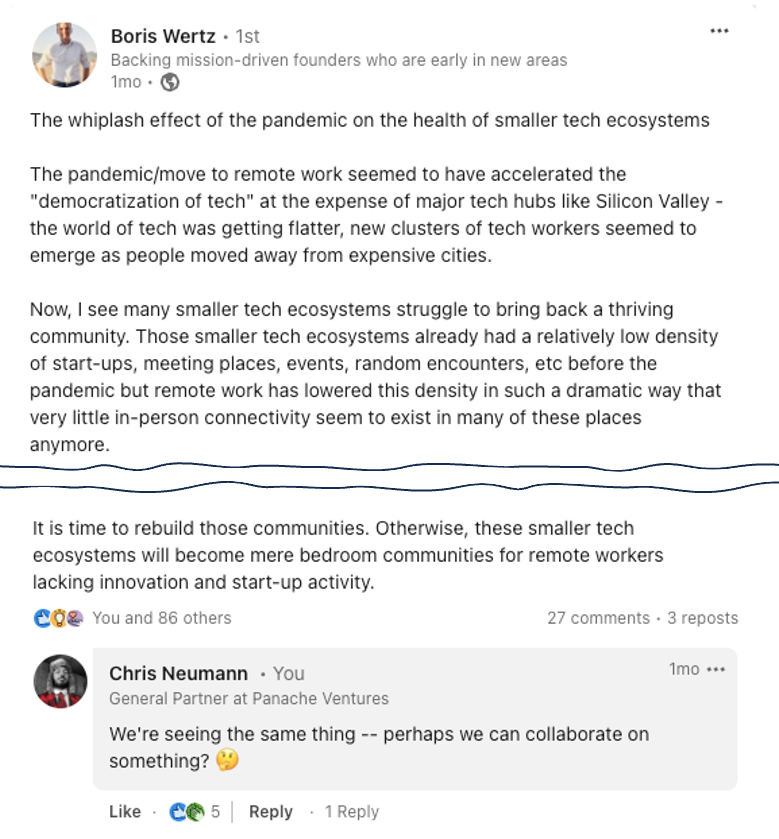
That post — and my reply — led to a flurry of text messages and phone calls over the next few days. Everyone I spoke to was seeing the same thing, at least in the Vancouver ecosystem:
A desire for connection, manifested in an increasing number of grass-roots communities popping up (developer communities, founder communities, design communities, AI communities, etc.)
Relatively little connectivity amongst those communities
Virtually no connectivity between those communities and the experienced founders and communities of past generations
Which begged the question: how could we harness the expertise and experience of Vancouver's previous generations of tech founders to help accelerate the next generation?

At that point, it was the last week of July. Everyone I spoke with suggested that we plan something for the fall. But I’ve always been a believer that velocity is the one metric that matters most. If we really wanted to inject some energy into the Vancouver ecosystem, we needed to do it before the busy fall season when founders are pulled in 30 different directions.
So I started sending text messages and emails to some of the “OG” founders I know:

To my amazement, every single person I emailed responded almost immediately, with one of two answers:
“Absolutely!”
“I wish I could, but I’m out of town that week.”
Next, I turned my attention to sponsors. Vancouver, like most startup ecosystems, has plenty of corporates that are eager to support community activities. Would they be willing to sponsor an event like this?
Again, almost everyone I spoke with responded instantly, “Absolutely!”
With speakers, mentors and money lined up, all we needed was a venue. I figured that if we got 100 - 150 founders to attend, that would be a rousing success, so I reached out to a handful of venues that I knew could accommodate 150 - 200 people. We quickly landed on one that would be a perfect fit.
On July 31st — 5 days after sending the initial emails to potential speakers — I posted this announcement on LinkedIn:

In less than 4 hours, we reached our capacity. By the end of the day, more than 350 people had registered. By the end of the week, we were at nearly 500.

It was clear that we had hit a nerve with the value proposition. Now, it was time to deliver. Together with the team at Panache, our partners (Fasken, Google, Boast and Web Summit) and others from the community, we got to work.
Destination Vancouver stepped in and helped us to get a new, larger venue for our daytime activities that we would never have otherwise had access to: none other than the Vancouver Convention Centre.
Nice place for a tech meetup, eh?
Fasken helped us to secure a new, larger afternoon venue that could accommodate the founder office hours and cocktail party: GoodCo.

Office hours and pinball machines, who could ask for more?
And each of our partners not only doubled-down on their financial commitment, but they came to the table in countless other ways (everything from lanyards, name tag printing and signage to staff for the registration desk and even my co-host — thanks Casey!). Not only that, but many more people from the community pitched in, from William Johnson helping with mic duties to J. Ryan Williams as the event videographer.
As a result, in only 3 weeks we went from a LinkedIn post to an event hosted at the Vancouver Convention Centre with nearly 800 registered attendees!

And guess what else?
Plenty of things went wrong:
We ran out of lanyards and sleeves to hold all of the name tags, so had to order them from Amazon the day before.
The sleeves we got from Amazon were the wrong size, so we had to cut hundreds of name tags minutes before registration opened to make them fit.
I forgot to email the final agenda to all of the attendees, so nobody had any idea who was on what panel (or what time they were at).
There was no event manager coordinating the speakers, so a couple of speakers completely missed their panels (thankfully, nobody had a schedule so none of the attendees realized 🤣).
The use of multiple venues wasn’t clear on the event registration page, so many people got confused around where to go for office hours.
…and many more!
But despite all of the challenges, we delivered on our core value proposition: bringing Vancouver founders from across generators together in a welcoming, inclusive, collaborative manner.
I want to thank everyone who helped make Vancouver Founders Day a success, starting with Vancouver’s many amazing founders past, present and future.
And stay tuned. I have a feeling we’re just getting started.

From our 10th annual Valentine's Day dinner ("Hold My Beer")
🚀🇨🇦️🔥