Lessons from 250 Blog Posts
I never thought I’d actually write for this long, so I thought I would take some time this week to reflect on it. Here are some of the lessons I learned from writing 250 blog posts.
This week marks a momentous milestone (for me, at least): this is the 250th post that I’ve written on chrisneumann.com.
I never thought I’d actually write for this long, so I thought I would take some time this week to reflect on it. How has my content evolved over the past four and a half years? Does it still resonate with readers? And where should I go next? (If you’re currently reading this on the website, you may have noticed a new look — I’ll dive into the rationale for that shortly.)
Here are some of the lessons I learned after 250 blog posts.
The Backstory
When I moved to Canada in late-2020 to join Panache Ventures, I noticed that there was a lack of entrepreneurial content available for founders there. I had spent the better part of the 5 years prior teaching founders around the world strategies and best practices used by leading Silicon Valley startups (first at 500 Startups and, later, through Commonwealth Ventures). So I thought I’d write about some of them.
But there was one problem.
Over the years, I had written a handful of blog posts, but I could never figure out how to publish content on a consistent schedule. I knew it was possible to write with a weekly cadence (after all, I wrote weekly investor updates for nearly five years at DataHero), but I had never done so with creative or longer-form content.
I mentioned this dilemma in passing to one of my mentors, Marvin Liao, who told me about a course he had recently taken called Write of Passage. The program was the brainchild of an exceptional young writer named David Perell. Despite its name, Write of Passage wasn’t actually a course about writing. At least, not in the strictest sense. Rather, it was a bootcamp designed to teach you how to build systems and processes to support writing and publishing new content on a regular basis (like weekly blog posts). It was exactly what I needed.
It turned out, I wasn’t the only one. The participants in my cohort included many residents of Startupland™, like founders and VCs. But there were also professional athletes, academics and a wide variety of other writers and aspiring writers.
How It Started
Write of Passage was one of those programs that unapologetically threw you in the deep end from the start. The very first session kicked off with a firm dictum from David: in order to stay in the program, you had to publish your first post within one week.
The prompt: “What is the definitive answer to the question that people ask you most often?”
At the time, it had been about six months since news of my joining Panache and moving to Vancouver was announced. In subsequent calls and coffee chats I was repeatedly being asked the same question:
“Why did you come back to Canada?”
On April 13th, 2022, I published the answer to that question and launched this website.

How It’s Going
It’s now been 229 weeks since that first post (for those of you wondering how I reached 250 posts in only 229 weeks, there were several periods of time when I published multiple posts each week — such as during my brief side quest into food blogging.) Over the past 4 ½ years, readership of both my website and the corresponding newsletter have steadily grown (thank you all for that 🙏).

I have no idea what happened in early 2024…
But it hasn’t all been “up-and-to-the-right.”
While website traffic and newsletter subscribers have steadily grown, open rates for the newsletter have slightly declined over the years.

The open rate for my newsletter has held steady around 60% for the past two years (a rate that is generally considered pretty solid, though with AI preview and summary tools becoming so prevalent, it’s increasingly hard to tell). That said, I still wanted to dig into the performance data for both the website and the newsletter.
First, a few thoughts on open rates:
Year 1 open rates aren’t meaningful in any way. The early subscriber numbers were so low (and so heavily skewed to people who already knew me personally), that they were unnaturally high.
A better metric for overall relevance is unsubscribe rate. With agents making it easier-than-ever to ditch newsletters we don’t read anymore, are people still keeping me in their inbox? It turns out the answer is yes (the 90-day rolling unsubscribe rate for my newsletter is ~0.1%, which is considered very strong — thank you again 🙏)
That said, despite a steady open rate and strong retention, there has unequivocally been more inconsistency in content performance over the past few years. So I started to look at what I’ve been posting and how that’s changed:
The content I posted in Years 1 and 2 was overwhelmingly instructional/educational in nature (fundraising best practices, posts about how venture capital worked, etc.). In fact, more than 70% of the first 120 posts I wrote either taught the reader how to do something or explained how something worked.
In year 3, I started writing more posts about startup trends, observations about different ecosystems and topics related to mental and physical health. Last year (2025), only 37% of the posts I wrote were instructional/educational in nature.
The last 2 years have also seen an (understandable) uptick in posts related to AI.
Many of the posts I wrote in years 1 - 3 had an overtly Canadian slant to them. That was very much a by-product of my role as a GP at a Canadian-focused Pre-Seed fund. Since leaving Panache at the end of 2024 to focus on [Redacted], most of the posts that I’ve published were written independent of geography (though I’ve still made a point of writing about trends in the Canadian ecosystem as part of my quarterly 5 Things I Think I Think posts).
What Comes Next
The biggest epiphany going through 250 posts’ worth of data was the degree to which the type of content I’ve published has evolved over the years. The first few years were overwhelmingly educational/instructional in nature because I had a massive backlog of topics that I wanted to write about. Now that I’ve written about most of those, my posts are more focused on trends and observations.
But I’m not done yet.
For starters, it became abundantly clear as I went through Google Analytics data and spoke with founders that a significant portion of my older content had become difficult to find or access. That’s where this redesign comes in. In addition to a cleaner, more streamlined design, there’s a new Topics page that more effectively organizes all of my posts (driven by a complete refactoring of post tags).
I’m also working on a further refactoring related to AEO/SEO/GEO. But I’ll save details of that for a future post.
In the meantime, as I look ahead to (hopefully) another 250 posts on chrisneumann.com, expect more insights, more data and more in-depth posts to help founders, investors and ecosystem supporters around the world make sense of Silicon Valley and beyond.
Thanks for reading 🙏.
Before You Start Fundraising, You Need to Get Acclimated
Founders trying to raise Seed or Series A funding from Silicon Valley VCs need to change their approach now.
Last week, I met with 4 different startups based outside of California: one from New York, another in London, a third in Vancouver and the fourth from Toronto. All of these startups are preparing to fundraise in the fall (either for their Seed or Series A round). At some point in each of those conversations, I found myself giving the founders a piece of advice that I hadn’t previously offered with any regularity:
“You should go to San Francisco a few weeks before you start to fundraise. You need to get acclimated.”
It wasn’t all that long ago that the majority of fundraising — even at later stages — was being done mostly online. For founders based outside of the U.S., raising from Silicon Valley VCs took a bit of extra prep work, but for the most part it didn’t matter if you were based in Brisbane, California or Brisbane, Australia. As recently as Q1, most Seed and Series A fundraising processes still began with virtual intro calls.
But over the past few quarters, things have shifted dramatically. Silicon Valley has been speeding up. A lot.

The first half of the year saw valuations for the top 5% of Seed rounds hit unprecedented highs, driven primarily by a surge in preemptive fundraising rounds. At the same time, the culture in Silicon Valley has been evolving to reflect its shift in velocity and intensity, manifesting in ways both big and small.
I hadn’t internalized just how prevalent these changes have been until I was on those calls last week. As I spoke with each of the founders, I found myself subconsciously (and not-so-subconsciously) noticing a variety of tells that made clear that they were not based in the Bay Area. An observation that my mind immediately translated to, “they’re not going fast enough.”

Considering that 2 of the 4 founding teams had previously spent considerable time in Silicon Valley, I was shocked at just how apparent it was to me that they were no longer locals. Some of it was language — there are a lot of new phrases that have entered the San Francisco lexicon as of late (the tongue-in-cheek website SF-isms catalogues some of them). But mostly it was their sense of urgency.
Or lack thereof.
I want to be clear that I’m not suggesting that any of these four startups aren’t operating at a high velocity — they all are — but Silicon Valley founders have upped their intensity and velocity to such a degree that everyone else seems slow by comparison. And in fundraising, just as in life, perception is reality.
Velocity has always been the metric that matters most when it comes to early-stage startups. And in today’s AI-driven landscape, Silicon Valley VCs are paying more attention than ever to how fast startups are going. Fundraising calls are happening in hours instead of days. Meetings are scheduled over text messages instead of through Calendly links. Everything in the ecosystem is happening faster.
Which brings us back to my fundraising advice.
It used to be relatively easy to prepare out-of-town founders for Silicon Valley fundraising by pointing them to a few key phrases, a list of what was “hot or not” in San Francisco at the time and a rubric of what Bay Area VCs would focus on for their stage. But it’s not so simple anymore. Right now many Seed and Series A VCs are struggling to adapt to the changing landscape, so there is no single list of what these investors are looking for to point at. Moreover, Silicon Valley itself is still accelerating.
Which makes it challenging to enumerate exactly what out-of-town founders should do in order to best prepare to pitch Silicon Valley VCs at this particular moment in time.
So I will instead share the advice I gave to each of the four founders I spoke to last week:
As you prepare your pitch for Silicon Valley VCs, reduce your level of confidence in feedback from hometown founders and investors (unless they have spent considerable time in the Bay Area recently and/or successfully fundraised from Silicon Valley VCs this year). In all likelihood, their advice is outdated.
Counterbalance this by proactively seeking feedback from founders, investors and others with strong current ties to Silicon Valley.
If at all possible, spend 2 - 3 weeks in San Francisco immediately prior to kicking off your fundraise. Doing so will:
Give you enough time to adjust and acclimate to the “new” pace and culture of Silicon Valley
Allow you to tap into the serendipity of Silicon Valley by attending events and meeting other founders
Provide an opportunity for you to solicit feedback on your pitch and fundraising strategy from Silicon Valley-based founders and investors
Expect to do most of your fundraising in person this time around
For founders outside of California who are trying to raise a Seed or Series A round from Silicon Valley VCs this year, I think this is likely to be the best approach given (a) the currently evolving nature of Silicon Valley, and (b) the widening gap in velocity/intensity/urgency between Silicon Valley and the rest of the world.
Note: the above advice is specifically geared towards founders trying to raise Seed or Series A rounds from Silicon Valley VCs. While Pre-Seed founders can certainly benefit from spending time in Silicon Valley, the vast majority of Pre-Seed rounds globally continue to be raised from local investors, so it may not impact your success rate when it comes to fundraising.
What’s Going On With Accelerators?
With more accelerators and fellowships than ever, it might seem like there’s an overabundance of options for founders to choose from. What we’re seeing is actually a clustering around two very specific approaches to hands-on investing.
I’ve written a lot lately about the ongoing bifurcation of venture capital and its implications for fundraising (both in my quarterly updates and in dedicated posts, like this one on early-stage investing).
One prediction I made last year was that we would start to see more early-stage investors lean in to the “hands-on” styles of investing that were more common in years past. As megafunds ramped up their early-stage activity, many Seed VCs would be crowded out. They would in turn head upstream to the “safety” of Pre-Seed. The increased competition at Pre-Seed would force investors to find new ways to differentiate themselves in the eyes of both founders and LPs.
And that would lead to more accelerators,
“…we’re seeing a resurgence of both small, dedicated accelerators and offerings from Seed-specialist VCs…it feels like the pendulum is swinging solidly back from the “hands-off” investing style of the ZIRP era to the more “hands-on” style of years past. At a time when AI is making it cheaper than ever to get a company off the ground, I think we’re going to quickly see a new level of competition amongst credible accelerators (and between accelerators and pre-seed VCs).”
Sure enough, the accelerator landscape has gotten a lot more crowded since I wrote that post.

Since the beginning of the year, megafund a16z significantly ramped up their speedrun team (I might have done reference calls for some people they were looking to hire 👀). They followed that up by launching a new fellowship program called “alpha” a few weeks ago.
Speaking of alpha, the big dog of accelerators, YC, didn’t sit long with its earlier assertion that, “…the total number of startups going through the program each year will hold steady at about 500…” The recently completed W26 batch had nearly 200 companies (i.e. they’re currently on pace to invest in 800 startups in 2026).
And that’s just the start. Here is some of the other activity that took place across the accelerator landscape during the first quarter of 2026:
London-founded fellowship program Entrepreneurs First completed its move to San Francisco and unveiled a fresh $200M fund
Accelerator upstart Neo announced a new Residency program for college students
Montreal-based AI research institute Mila launched a new venture-building program for AI research scientists as part of a $100M “venture scientist fund” announced earlier in the year
South Park Commons shared its plans to raise a new $500M fund for its self-proclaimed “anti-accelerator”
Taken together, it might seem like there’s now an overabundance of programs for founders to choose from. But if you look closer, what we’re seeing is actually a clustering around two very specific approaches to hands-on investing:
Accelerators as the New MBA
Fellowships as the New Montessori
Let’s dig deeper into each of these trends.
Accelerators as the New MBA
In the early days of accelerators, programs like YC, Techstars and 500 Startups didn’t have nearly the prestige of today’s industry leaders. In fact, it was quite the opposite. Amongst many founders and investors in the startup world, accelerators were seen as something of a crutch. They were the thing you went to if you couldn’t figure it out on your own.
Fast-forward 20 years and the perception is very different. Not only are accelerators broadly accepted as a reasonable path for first-time founders to take, but having simply attended a top accelerator is seen by many as a mark of credibility and prestige. Sound familiar?
“You got into Harvard…you must be smart!”
“You got into YC…you must be smart!”
Last year, David Crow wrote about the increasing similarities between top accelerators and universities. He noted that,
“In the past, ambitious graduates invested in themselves by going to grad school. They spent $100,000 on an MBA, law degree, or medical program as their path to impact.
Today, ambitious people might choose YC or Speedrun instead…
YC and Speedrun are not just accelerators; they’re the new professional schools of venture.”
I’ll take it a step further: not only are ambitious individuals increasingly looking at top accelerators as a credible path to advance their careers, accelerators are increasingly selecting founders in ways that look a lot like how elite MBAs choose students.
And I’m not the only one.
I recently caught up with a friend who spent many years as a VC at one of Silicon Valley’s top-tier funds (he also happens to have an MBA from a prominent business school). In discussing the evolution of the early-stage landscape, he suggested that top accelerators have very intentionally moved towards a model for selecting founders that mirrors how top MBA programs select students:
“At this point, [top accelerators] know the “shape” of founders that Tier 1 VCs like to invest in. The schools they went to, the companies on their resume, the traction points that matter. The things that get an IC* comfortable investing in a company that maybe hasn’t done anything yet.
It’s the same way MBA programs cater to top employers. What undergrad did the student go to? Where did they intern? What test scores do they need if they came from a lesser-known school? They’re trying to maximize the chances that an incoming student will land a job with a name brand employer, regardless of what they actually do during business school.”
* investment committee
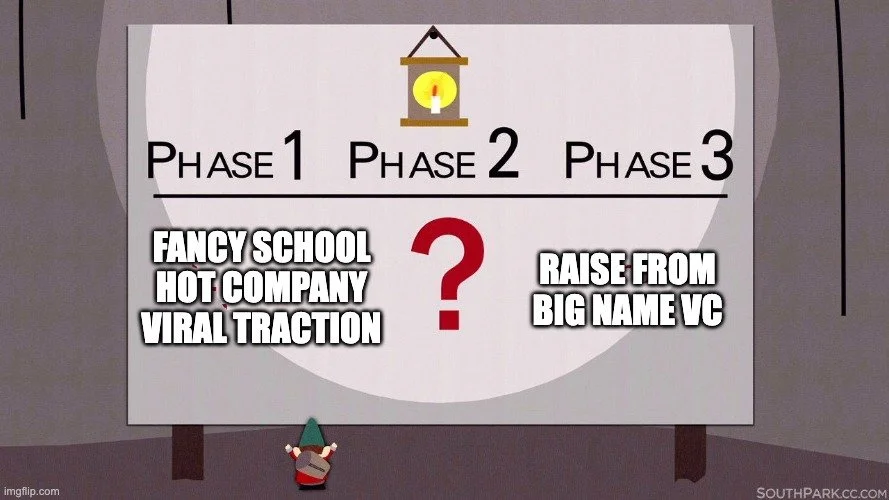
If you read my recent post on Hunters vs. Farmers, you might be getting a sense of deja vu. That’s because what we’re talking about here is the approach that “hunters” typically take, but within the context of a segment of venture that we historically think of as “farmers”:
“Early-stage hunters focus on pedigree and traction as their primary signals. Things like:
Graduating from a top school or program (Stanford, MIT, Waterloo, IIT Bombay, Thiel Fellowship, etc.)
Early employees that left “hot” companies
Repeat founders
Hot sectors
Virality / significant early traction
They’re generally betting on the correlation between pedigree and outcome (or, at least, pedigree and quick markups).”
This is exactly what elite MBA programs do. They bet on the correlation between pedigree and outcome, where outcome is “gets hired by a top-tier employer”. Today’s top accelerators are increasingly converging on a similar model. And you can see it in their marketing,
“Want to maximize your chances of landing a job with [top employer]? Apply to Harvard!”
“Want to maximize your chances of raising a round from [top VC]? Apply to YC!”
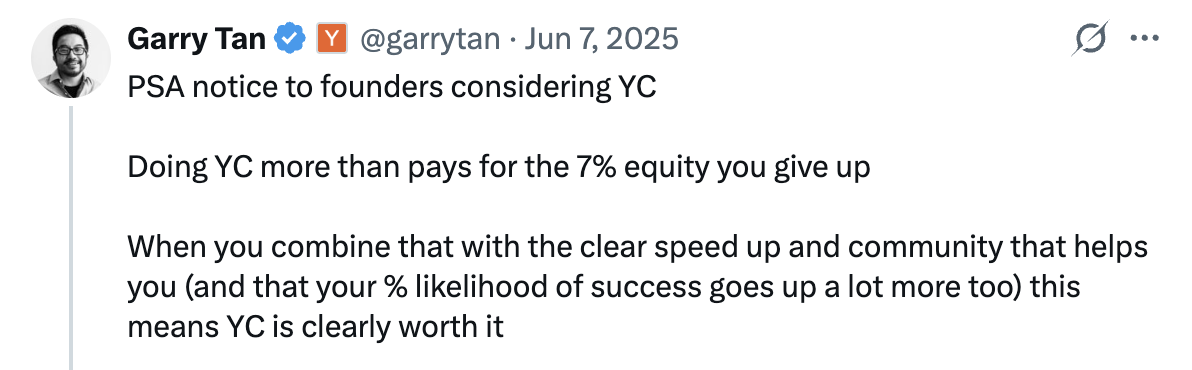
This certainly isn’t a bad approach — for either the accelerators or the founders.
That said, it’s worth noting that what’s happening at the top of the accelerator pyramid right now is very much influenced by a considerable imbalance in supply and demand. More and more qualified founders are looking for the “cheat codes” that come with the brand recognition and alumni networks of top accelerators. Yet there are very few programs that credibly deliver consistent outcomes along these dimensions (particularly in the aftermath of 500 Startups and Techstars both effectively failing). With so many qualified startups and so few spaces available in each program, founder pedigree naturally becomes a more prominent factor in selection.
Which means that a significant number of ambitious founders — especially founders outside of California and those from schools, companies and backgrounds that don’t neatly fit the typical Silicon Valley mold — are struggling to gain acceptance into these elite programs.
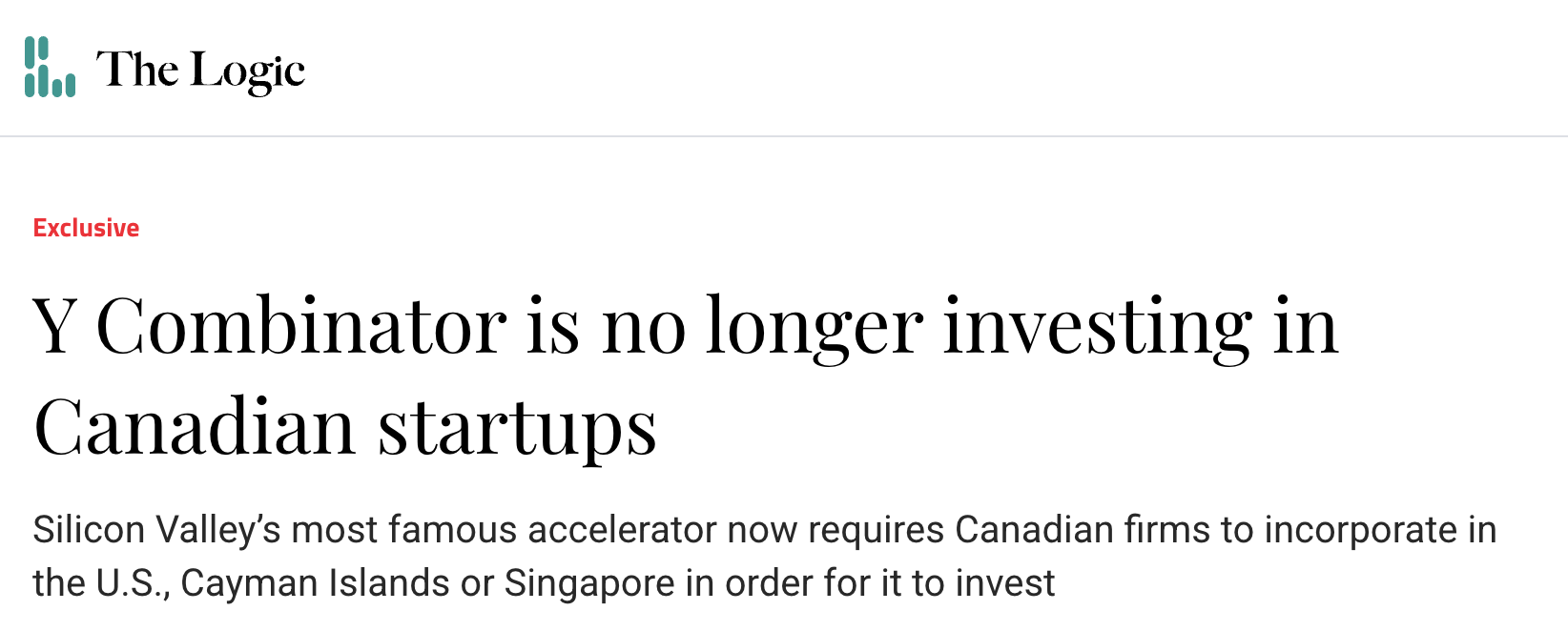
When the supply-demand curve is so imbalanced that an entire country doesn’t make the cut
So why aren’t we seeing more “elite MBA programs” emerge if the supply-demand curve is so imbalanced?
Despite the incredible demand for top tier Silicon Valley-based accelerators, only two platforms founded in the past decade have found success: Neo starting in 2017 and speedrun (from a16z) in 2023.
It turns out that creating a full-fledged accelerator platform from scratch is hard. It takes a lot of resources, investors who are experienced evaluating startups with virtually no traction, and an incredible number of high-quality, properly incentivized mentors. Creating a high-quality accelerator is, in fact, really, really hard.
But it is doable. Not only that, with so much latent opportunity — especially when it comes to startups outside of California — more elite Silicon Valley-based platforms are undoubtedly going to emerge. It’s just a question of when.
In the meantime, the majority of early-stage investors that have started rolling up their sleeves are taking a different approach. One that focuses almost entirely on the potential of individual founders while forgoing much of the complexity of a full-blown accelerator…
Fellowships as the New Montessori
If accelerators like YC and speedrun are the new MBA, then fellowship programs like South Park Commons, HF0 and Entepreneurs First are the new Montessori school.
If you’re unfamiliar with the term “Montessori”, it is an approach to early childhood education that focuses on encouraging children’s natural interests rather than providing formal, structured education. Montessori programs are designed around student-directed work, with a particular emphasis on uninterrupted work periods. The approach is based on the idea that children are naturally eager for knowledge and the primary role of teachers is to guide and mentor them.
At a high level, Montessori schools take a group of highly-motivated individuals and place them in a room with a handful of experienced, light-touch mentors in the hope of creating magic.

A Montessori “hacker house”
Which brings us to fellowships.
Fellowship programs invest in aspiring founders based primarily on their experience and pedigrees. These individuals are placed into a cohort and participate in activities designed to guide them towards founding high-potential companies (with a particular emphasis on ideation and cofounder matching). In other words, they take a group of highly-motivated individuals and place them in a room with a handful of experienced, light-touch mentors in the hope of creating magic.
Over the past few years, the number of fellowship programs has exploded. Not only are there an increasing number of standalone platforms (like South Park Commons, HF0 and Entepreneurs First), but many existing VCs have launched fellowship offerings as a means to increase their access to high-potential founders at the earliest stages. Some examples include a16z’s “alpha” fellowship (mentioned above), Conviction Partners’ “Embed” program, and Afore Capital’s “Founder in Residency” program.
Earlier, I alluded to the fact that fellowship programs forgo much of the complexity of a full-blown accelerator. Let me expand on that point — as it’s key to understanding why so many fellowship programs are emerging.
Both fellowship programs and Montessori schools are rooted in the notion that individual participants are highly-motivated and eager for knowledge. The corollary of that belief is that mentors need not be heavy-handed (either in their depth of programming or the help they provide). Montessori programs don’t so much teach children as they guide them on where to look for their own answers. Similarly, fellowship programs don’t focus on the type of “startup 101” programming that accelerators historically delivered. Instead, they provide frameworks for aspiring founders to search for answers while making introductions and connections to help them progress.
Guess what? That approach means fewer mentors, less time and effort developing programming, and significantly lower costs.
The simplest form of a fellowship offering is a VC partner providing regular mentorship and occasional connections to an aspiring founder. Which is exactly what many VCs have done for years through entrepreneur-in-residence (EIR) programs. From the perspective of traditional VCs, fellowship programs are little more than the cohort-ization (is that a word?) of something they were already doing.
Want to have your mind blown even further? Y Combinator — the world’s foremost accelerator — actually started out more like a fellowship program. Here is how Paul Graham originally described YC (then referred to as the “Summer Founders Program”):
The Summer Founders Program preserves many features of a conventional summer job. You have to move here (Cambridge) for the summer, as with a regular summer job. We give you enough money to live on for a summer, as with a regular summer job. You get to work on real problems, as you would in a good summer job. But instead of working for an existing company, you'll be working for your own; instead showing up at some office building at 9 AM, you can work when and where you like; and instead of salary, the money you get will be seed funding.
…
We'll have some smart people who are willing to talk over your plans with you, and suggest pitfalls and new ideas. We may also have connections to companies you'd like to do deals with. But how much you want to take advantage of our advice and connections is up to you.
We'll organize dinner once a week for all the Summer Founders, so you can meet one another and compare notes. We'll try to get some expert in technology, business, or law to speak at each dinner. But beyond that we'll be hands-off.

The first batch of YC’s “fellowship program”
To be clear, today’s top-tier fellowship programs provide significantly more that just a la carte mentoring and connections. They are full-blown platforms with programming and mentorship strategies that have been developed and iterated over many years. But the low “entry price” of starting a basic fellowship program, combined with the dramatic supply and demand imbalance I alluded to earlier (more and more founders looking for “cheat codes” but relatively few credible accelerators), is driving what I believe to be just the start of a wave of new fellowship offerings.
To recap:
The bifurcation of venture capital is forcing many VCs to invest earlier-and-earlier
Increased competition at the Pre-Seed stage is driving those investors to find new ways to differentiate themselves — which, for many, involves getting more hands-on with founders
Creating a new accelerator is difficult and prohibitively expensive for most VCs (a16z can afford to throw a ton of money at creating a new accelerator, but the funds who are moving upstream specifically because they can’t afford to compete against a16z most certainly cannot)
However, “systematizing” mentorship and/or scaling an existing EIR program is much more approachable for most VCs (and easy to justify from an ROI standpoint)
Bottom line: expect to see more and more fellowship programs emerge in the coming months (particularly from mid-sized Seed funds that are trying to figure out how to effectively compete at Pre-Seed).
On Terms and Terminology
Before I wrap things up, I want to share two final thoughts on terms and terminology:
On Terms
Many accelerators and fellowships are increasingly trumpeting large numbers when it comes to their investment amount. It’s not uncommon to see programs seemingly offering $1M of investment to startups.
But don’t believe everything you read.
The vast majority of accelerators and fellowships make either milestone-based or follow-on based investments. That means that (a) you might not receive the full amount, and (b) if you do, you may end up giving away a much higher portion of your company than you realized.
Consider the following examples:
Y Combinator
Top-line number: $500K
Actual initial investment: $125K for 7%
Follow-on investment: $375K (MFN)
a16z Speedrun
Top-line number: $1M
Actual initial investment: $500K for 10%
Follow-on investment: $500K (contingent on follow-on funding)
Entrepreneurs First (US)
Top-line number: $250K
Actual initial investment: $125K for 8%
Follow-on investment: $125K (MFN)
South Park Commons
Top-line number: $1M
Actual initial investment: $400K for 7%
Follow-on investment: $600K (contingent on follow-on funding)
Strictly speaking, there’s nothing wrong with this approach (in fact, it very much represents a standardization of the traditional venture capital strategy of “investing early and doubling down on winners”). But as a founder, it’s important that you read the fine print (here is a somewhat dated post on accelerator terms that I wrote a few years ago).
On Terminology
I’m not going dive into the etymology of (or debate over) terms related to accelerators / incubators / startup schools / etc., but I do think it’s important to share one point as it relates to fellowships (as they’re relatively new on the startup landscape and the language is still in flux):
The term “residency” is often used interchangeably with “fellowship” (e.g. Neo refers to its fellowship program as “Neo Residency”). However, it is also increasingly being used to differentiate between full-blown fellowship programs and lighter-touch coworking offerings that standalone fellowship programs are using to attract potential candidates (e.g. the Entrepreneurs First Residency and the South Park Commons Residency).
If you are considering a fellowship program, be sure to pay attention to the terminology and make sure you understand exactly what you’re applying to (lest you mistake one for the other).

Snakes and Ladders
Over the past 18 months, Silicon Valley has sped up. And most people outside of the Bay Area have no clue just how wide the chasm has become.
I spend a lot of time traveling back and forth between San Francisco and other cities across North America and the UK.
Every time I leave the Bay Area, I find that my internal clock naturally slows down, as it adjusts to the pace of life in whatever city I’m visiting. Conversely, the moment my flight lands at SFO, it ramps back up. My good friend Marvin Liao wrote about this last year (referencing a short but insightful post from Sriram Krishnan the year prior).
This particular phenomenon isn’t new to anyone in tech. Silicon Valley has always operated at a higher velocity than other startup ecosystems (similar to how New York has a different gear than comparable cities when it comes to other forms of white collar work). But over the past 18 months, something has been happening.
Silicon Valley has been speeding up.
And most people outside of the Bay Area — including founders, ecosystem supporters and even many VCs — have no clue just how wide the chasm has become.

The Resurgence of Silicon Valley
Over the past year, there have been a number of signals hinting at Silicon Valley’s resurgence. For example, the PitchBook-NVCA Venture Monitor, which provides a quarterly snapshot of the US venture landscape, has shown a steady increase in the percentage of US VC investment going to companies based in the San Francisco Bay Area (on both a dollar and deal count basis):

Source: PitchBook-NVCA Venture Monitor, Q1 2023 - Q1 2026
A report recently published by Silicon Valley Bank showed that, since 2022, the rate of VC-backed company formation has plummeted in every major city in America, except for San Francisco…where new company formation has skyrocketed:
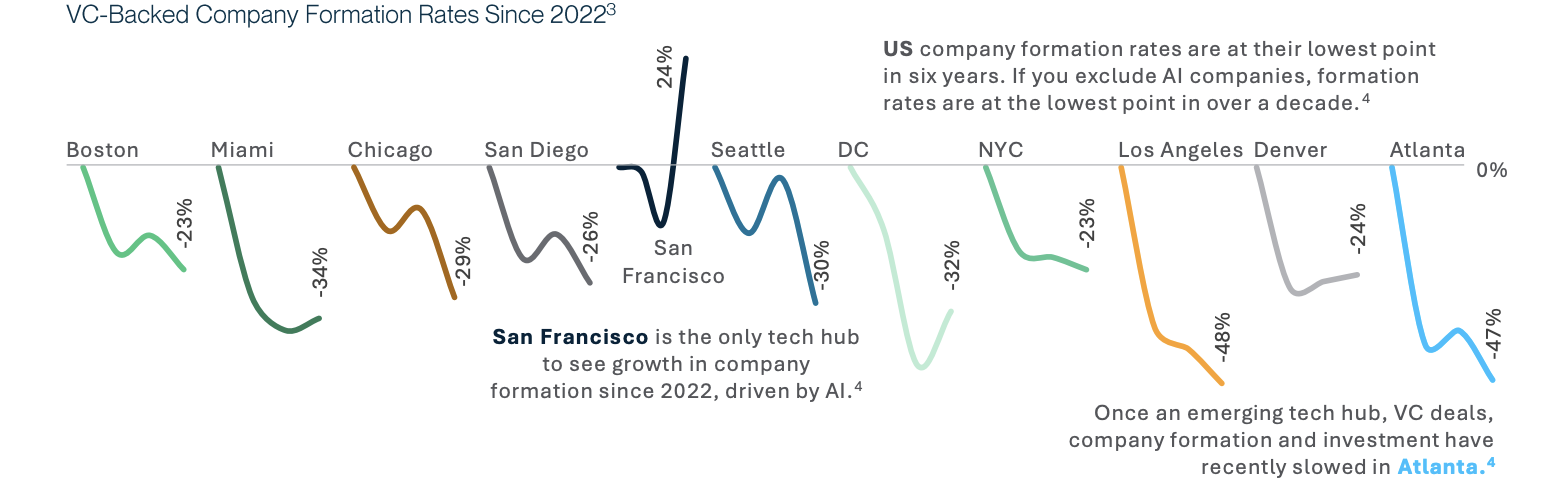
Meanwhile, rent in San Francisco is increasing at the highest rate in the US and is on pace to surpass NYC for one- and two-bedroom units.
“In San Francisco, rents are surging, with one-bedrooms climbing 16.1% and two-bedrooms up 19% year-over-year, as a return-to-office push and optimism around AI-driven hiring pull high-income workers back into an already supply-constrained market.”
Taken alone — or even together — these signals don’t necessarily indicate a shift in “how” Silicon Valley is operating as an ecosystem. After all, San Francisco has been a gold rush town since the 1800s. People in tech rushed to the Bay Area during the dotcom boom in the late 90s and then again as the recovery from the 2008 financial crisis accelerated in the early 2010s. But this time is different.
Each time I’ve returned to the Bay over the past 18 months, it’s seemed faster than when I left. And each time I travelled to another city, the slowdown felt more pronounced. The contrast more jarring. It was as if Silicon Valley was accelerating and evolving in near real-time, while other ecosystems remained static.

What’s Going On?
Last year, tech media started publishing articles about Silicon Valley embracing “996”. The implication of these articles was that the acceleration happening in tech could simply and easily be attributed to startup employees working longer hours. But that explanation rang hollow to me.
While the idea of working 996 (9AM to 9PM, 6 days/week) seems shocking to many people, it’s actually nothing new for Silicon Valley. Back when I worked in startups, a 12-hour workday was pretty normal (I actually have a draft blog post on the topic which I have yet to get around to finishing…). I personally think the media reaction has a lot more to do with how many visitors to Startupland™ during the ZIRP era didn’t actually work that hard, but that’s a topic for another day.
From where I sat, there had to be something else going on.
It took a conversation that I had with Charles Hudson last fall — when I was brainstorming for an experiment that would become Game On — to provide the lightbulb moment. We were discussing the fact that founders seemed to be executing faster in San Francisco than they had been before. Charles had observed something similar and had invited several of his portfolio founders from outside of California to visit for “field trips” (short visits to San Francisco during which they would work out of the Precursor Ventures office).
Charles shared with me a story about one such founder, who was working at the Precursor office on a Friday afternoon when he ran into a bug with an API that he was building on top of (the anecdote is paraphrased as follows):
Founder: “I just ran into a bug with X, so I’m blocked.”
Charles: “What are you going to do about it?”
Founder: “I filed a ticket.”
Charles: “And then?”
Founder: “And then what…?”
Charles: “What else did you do?”
At this point, the founder looked dumbfounded.
Charles: “Are you really going to just file a ticket and call it a day?”
Founder: “What else am I supposed to do?”
Charles: “How about I connect you with the CEO?”
A few minutes later, the founder was describing the bug to the company’s CEO. Within an hour, it was fixed.

Snakes and Ladders
I’ve been thinking about that anecdote — any many similar ones that I’ve heard since — and I believe that the best metaphor for what’s going on in Silicon Valley right now is the board game snakes and ladders.

Founders in SF have always benefited from high-value networks, but over the past couple of years they’ve become far more aggressive in how they leverage them. Have a bug? Reach out to the CEO. Want early access to the next release? Get your VC to connect you to the CEO. Trying to get into that invite only party with the who’s who of your sector? Reach out to the party organizer (aka the CEO).
These days, founders up and down Silicon Valley unapologetically search for and leverage “ladders” in order to skip steps. They’ve become far more aggressive at this than I’ve ever seen before — going into social debt to a degree that would have been considered inappropriate (and, frankly, cringe-worthy) only a few years ago. But these days, it’s increasingly perceived as a socially-acceptable form of ambition.
These founders are sprinting and scrambling as fast as they possibly can up each and every ladder they find. Occasionally, they screw up and slide back down a “snake”. But no one in the valley bats an eyelash. There are no negative social implications. Meanwhile, founders everywhere else in the world are dutifully running back and forth along the left-to-right game squares. Some of them are trying to go faster (aka 996), but all of them continue to follow the linear, back-and-forth path.
Have you ever heard of anyone winning a game of snakes and ladders without climbing a ladder? Me neither…
One of the experiments we performed during the “Game On” program last January involved introducing the 35 visiting Canadian founders to some unexpected ladders. On day two of the program, we had Google’s Global Founder Advocate, John Alioto, join us. He sat down in front of our visiting founders with a simple offer,
“Tell me anything you want access to anywhere in Google, and I’ll make it happen.”
One of the founders in the room raised their hand and mentioned that they had been on a waiting list for a pre-release product for 3 months. John smiled, typed a few things into his computer, and several moments later declared that they had access to it. Everyone’s eyes widened.
Over the course of the morning, he repeated similar unlocks for many of the founders in the room. In mere moments, these founders climbed ladders that they had been dutifully marching towards for weeks or months. John unlocked doors that were previously closed to them, with no idea as to when (or if) they might be opened.
That’s a daily occurrence for Silicon Valley’s highest-velocity founders.
The Fog of War
Popping up a level, it’s important to address the topic of information asymmetry in the current startup landscape.
Whether you are a founder, an investor or an ecosystem supporter, it’s essential that you understand that there has been a significant reduction in the information flow emanating from Silicon Valley. The “fog of war” between the Bay Area and the rest of the world has gotten thicker. “Snake and ladders” is but a single example of the many changes that have taken place in how San Francisco startups operate that aren’t yet apparent to the outside world.
Historically, information and innovation flowed fairly reliable out of Silicon Valley. Each time a new idea would arise — whether technical, business process, or otherwise — it would first disperse throughout local Bay Area networks. A month or two later, some number of people would share it with the wider world through blog posts, Twitter threads and videos. Within a quarter or two, the majority of the world’s tech ecosystems were up-to-speed.
That’s not happening anymore.
Technological innovations are still widely and reliably distributed online (you need only look at the speed with which OpenClaw took the world by storm to be convinced of that). But when it comes to business processes, go-to-market strategies, best practices and other innovations, very little information is leaving the Bay Area these days.
There are three reasons for this:
The intensity of AI-driven competition has resulted in many people deprioritizing non-critical content creation
An increasing percentage of the content that does get created is useless, AI-generated slop
Within Silicon Valley, information sharing has overwhelmingly shifted from public forums to private group chats and closed events
When taken together, the result is that founders, investors and ecosystem builders outside of Silicon Valley are increasingly out-of-touch with what’s happening on the ground in San Francisco for no other reason than that no one is telling them.
In the past six months, I’ve seen numerous founding teams from outside of Silicon Valley visit the Bay Area, only to discover that their knowledge — about technology, competition, customer interest, and more — was significantly out of date. Despite having every belief that they were operating at the bleeding edge of their industry, they discovered that they were, in fact, very far behind.
I’m not sure when (or if) the flow of information from Silicon Valley to the outside world will return to it’s previous rate. For now, I can simply offer this: if your goal is to create a globally competitive tech company, you should presume that what you think you know about what’s happening Silicon Valley is significantly outdated. At worst, it’s flat-out wrong.
The solution? Go on a field trip. Get on a plane, spend a few weeks in San Francisco during the summer. And see for yourself.
For founders building outside of Silicon Valley, it’s the new playbook.
Who Should I Talk To?
I’m a big proponent of startup founders visiting San Francisco on a regular basis. But many make a fatal mistake when asking for on-the-ground introductions.
I’m a big proponent of startup founders visiting San Francisco on a regular basis. But there’s one mistake many founders make when planning their trip to Silicon Valley. Each-and-every week, I get at least one email from a founder that goes something like this:
“Hey Chris,
I’m coming to SF in a few weeks. Who are the 2-3 people I should absolutely talk to when I’m there?”
It seems like a reasonable enough request, right? Especially given Silicon Valley’s pay-it-forward culture. But emails like this are more likely to result in me hitting the trash button than typing out a reply.
Here’s why:
1. I Probably Don’t Know You
Granted, I don’t have the world’s best memory, but these emails generally come from people I barely know. In fact, they almost always come from founders I’ve spoken with exactly once.
Looking at the example above, the lack of familiarity is pretty obvious from the tone — you would never write an email like this to someone you’re friends with. But for some reason many people (particularly CEOs), think it’s okay to fire off what are effectively demands to relative strangers.

2. I Definitely Don’t Work for You
Not only are emails like this tone-deaf, they also imply a request: please do work for me.
In order for me to respond affirmatively to this request, I have to:
Look up our past interactions to refresh my memory on who you are and what your company does (granted, AI does help with this)
Then spend time to think about what help you might need at this point in your journey
After that, I need to think through the details of my personal and professional networks to match those needs with people I know
Next, I need to write a detailed email back to you about who these people are and why I think they might help you
Then…
Suffice to say, that’s a considerable amount of work for someone I barely know. And it certainly doesn’t show an understanding of the paradox of time.

3. I’m Very Protective of My Network
Even if I were to come up with 2 or 3 people that I think might be of use to you, I won’t promise you an intro.
In order for my friends to remain my friends, I need to be respectful of their time and ensure that all introductions are double opt-in.
How to Ask for Introductions
Chris Albinson, Managing Partner of True North Fund and cofounder of the Canadian expat network, C100, recently shared this advice with visiting Canadian founders,
“There are nearly 300,000 Canadians in the Bay and they sincerely want to help. But you have to show up prepared.”
This scenario is a great example of that.
Instead of asking someone to do all of the work for you, be specific in your asks,
“I’m hoping to meet 2 or 3 Pre-Seed investors to get feedback on my pitch before we start fundraising in the fall. Do you know any VCs who actively invest in X and might be willing to take a 20-minute meeting?”
“I want to meet CTOs of companies in industry X in order to ask about Y. Do you have any connections to such companies in your portfolio that you would be willing to pass along a request-for-intro email to?”
“I’m considering spending more time in San Francisco and would like to speak with a couple of expats who recently relocated there to learn about their experience. Do you happen to know anyone that might be willing to connect?”
Not only do each of these examples have specifics about the type of person the author wants to meet with, they’re also significantly more humble in their tone (which is likely to lead to more positive responses).
Here are some other tips:
Consider including a fully-written request-for-introduction email below the ask (so that the recipient can take action without having to go back-and-forth with you)
Use LinkedIn to research if a person is connected to individuals who meet your target and ask for specific intros (e.g. “I notice you’re connected to the following VPs of Engineering. Would you be willing to pass along a request-for-introduction email to any of them?”)
And always remember, to win transactions, don’t be transactional.
How to Tap Into the Serendipity of Silicon Valley
Many founders come to San Francisco for a weekend or a week, hoping to “tap into the magic.” But come away disappointed. Why?
If you’ve been a reader of my newsletter for any length of time, then you know that I’m a huge proponent of founders (and investors) spending time in San Francisco / Silicon Valley. But I regularly meet founders who travelled to the Bay Area only to come away disappointed.
They didn’t meet anyone particularly interesting. They didn’t have any life-changing epiphanies. Sure, it was cool to visit. But they didn’t get it.
In contrast to the never-ending stream of posts about amazing SF experiences, it doesn’t make a lot of sense. So many people claim that San Francisco is open and welcoming. They assure you that it’s easy to get in the proverbial door. That it’s all about “paying it forward”.
But not everyone has that experience. What gives?
It boils down to two things: time and a willingness to say ‘yes’.
Silicon Valley is a fast-moving ecosystem, but relationships still take time to develop. Many founders come to San Francisco for a weekend or a week, hoping to “tap into the magic.” But a week isn’t long enough.
Because San Francisco serendipity works in hops.
Consider the following scenario:
You fly to SF, having done your research and found some events to attend on SF IRL. The first couple of meetups you go to are duds, but on the third day you strike gold. While at a hackathon, you start up a conversation with some like-minded founders, who casually drop the opportunity,
“You should totally come to X with us on Tuesday.”
Too bad you’re leaving town the next morning… 🤷♂️
These types of conversations happen every week in San Francisco — it’s a big part of how the ecosystem operates. Many events don’t have formal invites. The details spread through word-of-mouth, text messages and group chats. It’s easier than it might seem to get into the “inner circle”, but it starts with being able to say yes.
Which means you have to visit for more than a few days.
When we first conceived of last month’s Game On Canada experiment, one of the key questions was, “how long should the program be?” One of my objectives was to help the visiting founders build the beginnings of genuine personal and professional networks in the Bay Area. That meant having them visit San Francisco long enough that they could say “yes” — not only to the first hop of serendipity, but to the ones that came after.
We eventually landed on three weeks. In theory, that would be enough time to get the lay-of-the-land, attend a number of “entry level” events and meetups (both those we held and ones they found themselves), and then go deeper with some of their burgeoning relationships.
At the end of the program, I asked the founders to export their LinkedIn connection graphs for me. I wanted to see if that part of the experiment worked. Were the founders able to make connections in the Bay Area? Here’s what I saw:
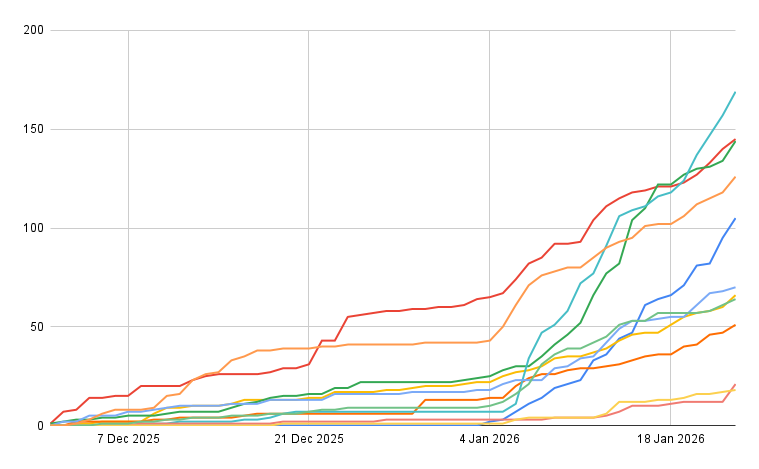
LinkedIn Connections (Baseline as of 1/1/25)
LinkedIn connections certainly don’t provide a complete picture of anyone’s relationship graph (I’m connected to plenty of people who I don’t remember and have many friends who I’m not “LinkedIn official” with). But when I first saw this graph, I immediately smiled. Not only did every single founder have a meaningful increase in LinkedIn connections during the program, but a significant number had their rate of connections “accelerate” as the program went on.
On the last day of the program, I asked the founders to share their experiences meeting people in San Francisco. As we went around the room, almost all of them told stories of meeting people who invited them to something, where they met other people who then invited them to something else. Hackathons, art exhibits, dinners, conference parties, after parties, hikes,… — almost all of the founders were able to tap into the serendipity of Silicon Valley!
And almost every single one referenced the fact that they had met people that they intended to stay in touch with after returning home.
That, to me, is success.
Is three weeks the correct number for everyone? I don’t know — but it feels like a good place to start. It’s obviously not easy to pickup and relocate for three weeks, but if one of your goals is to build genuine connections in San Francisco / Silicon Valley, see if you can make it happen.
And be sure to say yes.
10 Nonobvious Things About Silicon Valley Fundraising
Here are 10 nonobvious tips about Silicon Valley fundraising from the VCs mentoring at Game On.
We’re in the final stretch of Game On, a 3-week experiment in founder velocity.
Week two was all about fundraising. Specifically, the second week focused on helping our out-of-town founders understand why fundraising from Silicon Valley VCs is different from raising capital elsewhere.
Here are 10 nonobvious things about fundraising in Silicon Valley according to our week two speakers:
1. Getting Warm Intros is Easier than it Seems
Charles Hudson, Managing Partner, Precursor Ventures
Charles Hudson has been investing in early-stage startups for more than 20 years. He noted that getting warm intros in Silicon Valley is far easier that it might seem from the outside.
“Trying to get warm intros can seem intimidating,” he shared with the founders. “But if you’re physically here in San Francisco, it’s far easier that it looks.”
Charles went on to explain that the Bay Area is effectively a “company town”. Almost everyone in the region is somehow connected into the tech/startup ecosystem.
“Of course you meet people at networking events,” Charles continued. “But you also see them at social events, community events or just bumping into each other.”
He encouraged founders to spend time in the Bay Area building connections and getting to know people as a way to prime their networks long before they need intros.
2. Cultivate Relationships Before You Fundraise
Emily Bennett, Partner, a16z
Emily Bennett, who co-leads a16z’s speedrun accelerator, similarly encouraged founders to cultivate relationships with Silicon Valley-based founders and other people within the “orbit” of the firms they hope to raise money from well before they go out to fundraise.
“As we get closer to investing in your company, we’re going to start doing backchannel references,” she explained. “That means we’re looking at LinkedIn and other sources to see who we know that you’re connected to.”
Emily went on to explain that for a16z, the number of connections a founder has to people known to partners in the firm is a factor in their investment decisions.
“Having a large number of connections to people in our orbit is a signal that you’re building relationships with the right people (or, at least, people who we think can make a difference for your company),” Emily continued. “Spending time getting to know founders and individuals connected to us long before you fundraise won’t just help you with warm intros, it will provide signal that you’re able to get into the right circles.”
3. People Will Open Doors…If You Come Prepared
Chris Albinson, Managing Partner, True North Fund
Chris Albinson has been traveling back-and-forth between Canada and Silicon Valley for nearly three decades, so he knows a thing or two about navigating ecosystems. The cofounder of C100 reinforced the willingness of people in the Bay Area to help visiting founders,
“There are nearly 300,000 Canadians in the Bay,” he remarked to the Game On cohort. “And they sincerely want to help. But you have to show up prepared.”
Chris went on to speak about the paradox of time — how people in positions of influence and power genuinely want to help but don’t have enough time — and the need for founders to come to meetings prepared.
“You need to know who the person is before you meet them,” he continued. “Don’t show up and ask them generic questions or things you can Google. Know who they are, what they’ve accomplished and how they, specifically, can help you before the meeting starts. If you do that, when you finish up and ask them to introduce you to 3 people who can help you with X, 99% of the time they’ll say yes.”
4. It’s Easier Than You Think to Get a First Meeting
Marvin Liao, Partner, Sukna Ventures
Marvin Liao, who has invested in nearly 500 early-stage startups during his career, echoed the notion that folks in the Bay Area are more open to initial meetings that it might seem.
“This is an ecosystem that’s built on knowledge and opportunities,” he shared with the founders. “Almost everyone in SF is from somewhere else. People here want to meet new people with new ideas.”
Marvin explained that simply walking up to someone and saying hi can lead to meetings and opportunities in ways you don’t generally see in other parts of the world.
“Whether you’re asking someone for a meeting at a conference, getting a warm intro from a founder, or connecting with someone at a hackathon, it’s way easier to get a first meeting than in other places.” But Marvin also cautioned the founders, “But that’s just the first meeting. After that, you have to earn it. If the first meeting sucks, you’re not getting another one!”
5. Pay-It-Forward Culture is Real
Angela Tran, General Partner, Version One Ventures
Toronto-born Angela Tran has spent the past 12 years investing in mission-driven founders as the San Francisco-based General Partner of Vancouver-based Version One Ventures. She admitted that after so many years in the Bay Area, she sometimes forgets how unique Silicon Valley’s “pay-it-forward” culture is.
“When I first came to the Bay Area, I was amazed how willing people were to do things without expecting anything in return,” Angela recounted. “People here will make introductions or find ways to help you after barely meeting you once.”
She went on to describe the contrast to other ecosystems she operates in,
“When I travel to other places, I meet people who make offers they don’t follow through on, or say things they don’t do. It’s those moments when I remember that Silicon Valley truly is special like that.”
6. Information is a Commodity
Alex Norman, Managing Partner, N49P
Alex Norman, Managing Partner of Toronto-based VC firm N49P and Cofounder of TechTO, noted that in Silicon Valley, information is a commodity amongst investors.
“First off, VCs are constantly sharing information with each other,” Alex offered. “They’re swapping decks, talking about startups they’ve met and otherwise trying to look smart. If you want to learn something from an investor or start building a relationship with them, offer them information.”
Alex referenced Mark Suster’s famous call to arms, Invest in Lines, Not Dots, and encouraged founders to find reasons to have touch points with the VCs they want to meet (check out this post for tips on how do do that).
7. The Best Founders Seem Inevitable
Gaurav Jain, Managing Partner, Afore Capital
A graduate of the University of Waterloo, Gaurav Jain cofounded one of the largest venture funds dedicated to Pre-Seed ($500M AUM). He observed that the best founders he’s invested in seem “inevitable”.
“You meet certain founders and it seems like their success is inevitable,” Gaurav shared. “They move fast. They’re impatient. They make you feel like they’re going to win with or without your help.”
He went on to share why that trait is so important to early investors.
“At my stage, I’m investing in the founders and not much else. The more confidence they have in themselves, the more appealing it is to me. But it’s not just about self-confidence, it’s also that they have a plan and know how they’re going to get there.”
8. Deck Design Matters More Than You Think
Arjun Dev Arora, Managing Partner, Format One
“Plenty of VCs claim that the design of your deck doesn’t matter,” started former founder and long-time investor Arjun Dev Arora. “But the reality is that deck design matters a lot.”
Potential investors are looking for the smallest signals in every deck they see, either as a reason to lean in or an excuse to pass.
“If you’re pitching a consumer app and your design sucks, you immediately lose credibility. Similarly, if you’re building back-office software for slow-moving enterprises but your deck looks like it’s for a Marin kombucha brand, it’s not going to fly. The design of your deck needs to reinforce what you’re trying to pitch to investors.”
Arjun went on to explain why seemingly small aspects of a pitch deck can matter so much.
“Ultimately, the pitch deck isn’t just a representation of the company, it’s a reflection on you as the CEO. Do you pay attention to details? Do you understand the market you’re going after?
Investors see dozens or even hundreds of decks a week — make sure you spend the time and effort to put your best foot forward.”
9. The Sense of Urgency is Palpable
Alysaa Co, Partner, Bain Capital Ventures
Alysaa Co is one of a very small number of people who have worked at both a Canadian-based VC firm and a Silicon Valley one. The former iNovia Associate and now Partner at Bain Capital Ventures noted that, from her vantage point, the sense of urgency that founders in the Bay Area have is unlike anywhere else in the world.
And investors in San Francisco are used to seeing that.
“Founders in San Francisco seem like they’re impatient about almost everything,” shared Alysaa. “It’s not just about 9-9-6. It’s as if they can’t wait to run through each obstacle and get on to the next one.”
After sharing several examples from her portfolio, Alysaa went on to observe that she’s become more cognoscente of urgency when evaluating new founders.
“You get used to seeing it. These days, if I don’t sense that urgency when I meet someone, I find myself less interested.”
10. You’re Just as Smart as Everyone Else
Dana Oshiro, General Partner, Heavybit
Vancouver-born Dana Oshiro, an investor in early-stage dev tools startups, channelled her nearly twenty years of experience living in Silicon Valley into words of inspiration.
“You’re just as smart as anyone here,” she offered. “The founders here aren’t smarter than you. They’re not better than you. What they have is a lot more reps and probably better networks. You can solve for that.”
Dana went on to encourage founders to find ways to operate at the speed of Silicon Valley,
“When you’re here, meet as many people as you can. Find out how they operate and figure out how to maintain that pace when you leave.”
How to Build a Silicon Valley Network
Here are the top tips for breaking into Silicon Valley and building a network that matters.
Last week, we welcomed 35 Canadian founders to San Francisco as part of an experiment in velocity called Game On. More than a third of the founders had never been to the Bay Area before, so we spent a good chunk of time helping them get acquainted with the unique culture and etiquette of the world’s preeminent tech ecosystem.
One of the big questions our founders had during week one was how to get to know quality people while in San Francisco. Here are some of the top tips for “breaking into Silicon Valley”, as shared by our speakers:
Leverage Your “Expat Network”
Michael Buhr, Executive Director, C100
As a former founder and the current executive director of the Canada’s tech expat network in Silicon Valley, Michael has been helping visiting Canadians build their San Francisco networks for more than 20 years. His number one piece of advice is to leverage that network to bootstrap local connections.
“Almost everyone in the Bay Area came from somewhere else — a different city, state or country,” shared Michael at the start of Game On. “And most everyone here genuinely wants to help. Reach out to people who grew up where you did and you’ll be amazed what happens.”
“If you reach out to a Canadian living in the Bay Area with a cold email or DM that starts with ‘I’m from Canada,’ 99% of the time you’ll get a response.”
Doing your homework before arriving in the Bay Area and looking up people you want to meet from the same city, school or former employer can give you a leg up when landing in Silicon Valley.
Follow Up Right Away
Ramneet Sran, Consul and Head of Office, Consulate General of Canada in San Francisco
The head of Canada’s Trade Commissioner Service in San Francisco, Ramneet Sran, emphasized follow-up in her advice,
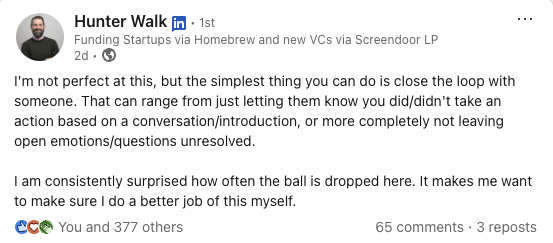
“Try to follow-up with everyone you meet the same day. Don’t wait until tomorrow or next week or until you get home — they’ll forget about you by then.
Silicon Valley moves so quickly that one of the best things you can do is to simply make sure that there’s an email or text in their inbox before they go to bed.”
Even VCs have to remind themselves to do this
Do Things That Keep You Top of Mind
Tom Charman, CEO and Cofounder, Blok
Tom Charman has built multiple companies in the U.K., Germany and the U.S. He encouraged founders to find creative ways to stay top-of-mind, even when you aren’t in Silicon Valley,
“It’s easy to add people to your mailing list, but there’s so much more you can do,” he offered. “If you’re creating company swag, make extra and send it to the VCs, founders and other people in San Francisco you’re trying to build relationships with. For years, I’ve made a point of sending personalized Christmas cards to everyone I want to get to know.”
“Almost nobody does that anymore, so it really sticks out.”
Treat Your Visit Like a Vacation
Hiten Shah, CEO and Cofounder, Crazy Egg
Multi-time founder and prolific investor Hiten Shah offered this seemingly counterintuitive advice to visiting founders,
“Use every visit to the Bay like a vacation from your default settings.”
Hiten’s not suggesting that you kick it on Ocean Beach with a bonfire and a beer (though that can certainly be fun). Rather, it’s about being open to change and putting everything on the table,
“Go back with more urgency than you arrived with.”
Have a Plan
Clayton Bryan, Partner, 500 Global
Clayton Bryan has welcomed thousands of founders to San Francisco over the past decade. His advice was to make sure that you have a plan before trying to meet people,
“Too many founders spend their time in San Francisco all over the place,” he shared. “They’ll take our database of mentors and email every single one, without rhyme or reason. Or they’ll go to every single party and meetup they can…just because. That might fill your calendar with meetings, but it won’t move your business along.”
He encouraged founders to be clear on their goals and intentional about how they spend their time in the Bay Area,
“Who are you trying to meet? What are you trying to achieve? It’s cool to go to parties, but if you’re doing it for work, what will you consider a success?”
(If you want some tips specifically on how to get the most out of networking events, check out this post.)
Visit Often
Ian MacKinnon, Cofounder, Stingray Security
When Ian MacKinnon was building Later.com, he took full advantage of the fact that the company’s headquarters in Vancouver, British Columbia was only a 2-hour flight from San Francisco.
“I would regularly take the earliest flight down in the morning, go to investor or other meetings in Silicon Valley, and be back home in time for bed.”
By showing up in person periodically, you stay top of mind and build deeper relationships than you would if your interactions were entirely over Zoom.
“Plus, over time people will forget that you aren’t actually based in SF. Which is a huge advantage.”
For more ideas on what to do when you first land in San Francisco / Silicon Valley, check out these posts:
The Myth of the Magical Money Fairies
The myth of Silicon Valley’s magical money fairies is deeply entrenched in many ecosystems around the world.
There are a lot of myths and misconceptions that exist around the world when it comes to Silicon Valley. In my experience, no topic is more misunderstood (and, frankly, misrepresented) than fundraising.
It makes sense. Silicon Valley is by far the largest source of capital for tech startups. Combine that with the fact that most folks in other ecosystems learn about its dynamics through click-bait funding announcements loosely wrapped as “journalism” and its easy to understand how perceptions can be skewed.
There’s one myth in particular that I’ve seen do more damage to startups around the world than any other: it’s the myth of the magical money fairies.

The myth of Silicon Valley’s magical money fairies is deeply entrenched in many ecosystems around the world. And it really is a myth in the truest sense. For millennia, human folklore has contained popular stories about treasures and fortunes that have some grain of truth, but are vastly overstated in terms of likely outcome. For example, most children learn the old Irish myth about leprechauns with pots of gold at the end of a rainbow. All you need to do is catch one and, voila!
Replace “leprechaun” with “Silicon Valley VC” and you’ll see where I’m going with this one.
(As an aside, the leprechaun myth had its origins back when vikings invaded Ireland, buried looted treasure around the island and eventually left while leaving some of their stolen gold behind to eventually be discovered by locals…).

So what exactly is the myth of the magical money fairies?
Simply put, there is a pervasive belief around the world that it is easier to raise money in Silicon Valley, because VCs there are more risk-taking / willing to invest / willing to “take a chance”. Like magical money fairies, they will obviously be willing to invest. You just need to get to them.
Like any myth, there are grains of truth at its core. For example, VCs in Silicon Valley are more willing to invest in pre-prototype companies than VCs in other ecosystems. But it’s not because they’re more risk-taking, it’s because more of them have the technical background needed to “invest in napkins”.
Similarly, it is broadly true that founders can raise a round of funding quicker in Silicon Valley than in other ecosystems (which can feel like the investors are more risk-taking / willing to invest / willing to “take a chance”). In reality, there are two key dynamics at play:
There are generally more VCs in Silicon Valley that invest in a given industry than in other ecosystems (which makes it possible to have more credible pitches in a shorter period of time).
Silicon Valley VCs have learned to perform deep diligence much faster than VCs in other ecosystems (and often in ways that are imperceptible to founders). That can feel like they’re doing less diligence, though I promise that’s not the case.
What makes this myth particularly dangerous is the unrealistic expectations that many founders (and ecosystem proponents) have when it comes to Silicon Valley VCs as a result of it. Here’s a dynamic I’ve seen play out hundreds of times:
A founder tries to fundraise locally, but struggles.
They receive consistent, repeated feedback from multiple local investors. Rather than paying attention to the feedback and addressing it, they attribute it to “risk aversion” and keep going.
Emboldened by fundraising books, blogs and well-meaning supporters who loudly cheer “you just need one yes”, they keep going. They limp along from investor to investor, often for months.
As they approach the end of their runway, having lost 6+ months of time fundraising (and having not addressed the core challenges of the business or made further progress), they spend their last bit of money on a “Hail Mary” trip to San Francisco.
Landing in the Bay Area, they finally meet Silicon Valley VCs. All of whom see the exact same weaknesses in the business that their local investors saw, plus a company with no runway and a founder who wasn’t willing to listen to feedback.
The fundraising trip fails and the founder returns home, closing the business shortly thereafter.
Unfortunately, those stories rarely make it back into the ecosystem. Many founders who travel this path eventually realize their folly, but are too embarrassed to share their experiences publicly in ecosystems that are more likely to punish failure than celebrate the attempt.
Absent these important stories, the myth of the magical money fairies perseveres — in part because the handful of outlier founders who do end up raising in the Valley typically make a lot of noise about it.

It is, of course, true that Silicon Valley VCs often see things differently than investors in other ecosystems. But that goes both ways.
Silicon Valley VCs might see an opportunity that local investors don’t. They might be willing to take a chance on a founder that local investors aren’t convinced about (Jesse Rodgers refers to this as small-town bias).
But they’re just as likely to be skeptical about a business that local investors are tripping over themselves to back. I’ve seen plenty of startups over the years fail to raise in Silicon Valley, despite their hometown investors being incredibly bullish (a different perspective on revenue and growth is often the culprit).
Despite what many founders and ecosystem supporters continue to believe, it isn’t easier to convince a given VC in Silicon Valley to invest in a company — it’s much, much harder. But there are far more VCs in Silicon Valley than in other ecosystems and, generally speaking, they make faster decisions.
So what is a founder to do with this information?
Simple. If you are trying to raise a fundraising round, you should absolutely include Silicon Valley VCs in the mix. But don’t do it at the end of your process, do it in parallel. Understand that the vast majority of early-stage funding rounds happen locally — the mythical U.S. lead investor does not, in fact, exist. But fundraising is a numbers game and the more potential investors you have in the mix, the more likely you are to succeed.
Just don’t expect Silicon Valley VCs to gloss over legitimate concerns that local investors have raised. VCs in different ecosystems do see the world differently. But none of them are charities. Their job is not to “give you a chance”, it’s to generate a return on investment.
In that sense, they are actually magical money fairies…for their LPs.
Changing Founder Metabolism
Announcing Game On, a program designed to accelerate Canadian founders and help them build meaningful connections to Silicon Valley.
A few weeks ago, I wrote about why 99% of accelerators fail. The vast majority of accelerators around the world fail to live up to their expectations for the simple reason that most of the mentors who work with these programs don’t actually have the lived experience needed to accelerate startups (at least, not if we’re talking about billion-dollar outcomes).
As it stands today, the only ecosystem in the world that has enough such mentors is Silicon Valley. So how do we accelerate startups in the rest of the world?
If the quintessential requirement of a good startup accelerator is good mentorship and only Silicon Valley has a sufficient quantity and diversity of mentors to cater to a wide diversity of founders, how can we reasonably accelerate startups in the rest of the world?
By leveraging Silicon Valley’s talent.
This isn’t a new epiphany by any stretch of the imagination. For more than 20 years, governments around the world have recognized this experience gap and have poured considerable resources into trying to tap into Silicon Valley’s magic. Almost every country (and many cities/states/provinces within them) have programs that attempt to build connections between their startups and Silicon Valley.
Unfortunately, a lot of these efforts fall flat.
A for Effort
There’s the Hollywood Tour of the Stars, designed by organizers convinced that the solution to their country’s woes is to expose founders to Silicon Valley’s biggest successes “for inspiration”. Founders drive up and down the San Francisco peninsula, sampling the cafeteria fare at the world’s most prominent tech companies and visiting their gift shops. They return home excited and energized, only to realize a few days later that they learned absolutely nothing.

Another well-meaning but low-ROI approach is the Investor Dating Game, designed on the premise that the only thing missing in a tech ecosystem is funding. If organizers could simply introduce their startups to Silicon Valley VCs, everything would magically come together.
There’s only one problem: the organizers often don’t understand that there are different stages of startups and different types of investors. Founders soon realize that they’re pitching a random mashup of VCs, private equity investors and corporates, and return home without a dollar raised between them.

And, of course, there’s the Silicon Valley Bootcamp. This one is actually a step in the right direction. Rather than wasting founders’ time with tours of big tech cafeterias or low-probability investor show-and-tells, organizers attempt to design a program centered around Silicon Valley insights. Unfortunately, many of them — particularly those planned from afar — end up as little more than a haphazard collection of fireside chats with expats. Such as:
The locally-famous founder, who moved to San Francisco a decade ago only to have their company fail before the ink was dry on their work visa.
The charismatic connector, who convinced the organizers that he/she sits at the center of Silicon Valley’s power brokers — but nobody in the Bay Area knows them.
The self-proclaimed fundraising coach, who has never actually fundraised.
Employee #12,376 of Uber, who joined 2 years after Travis left but will nonetheless tell you all about the early days.
Rise of the Expats
While many “top-down” efforts to connect with Silicon Valley have struggled over the years, one type of initiative has yielded ongoing success for many countries. And each country’s version has one thing in common: they all started as grassroots efforts instigated by Silicon Valley expats.
Here are some examples:
TiE was founded back in 1992 by Ambrish (AJ) Patel and eight cofounders originally from India
In 2007, Israeli expats Moshik Raccah and Eran Wagner founded IEFF
Canada’s C100 was founded in 2009 by Canadian expats Anthony Lee and Chris Albinson
In 2017, a group of British expats led by Trulia founder Pete Flint launched GBx
And there are many more such groups. Some of these organizations receive funding and support from the “home” government and/or local embassy while others are completely independent.
Each of these organizations creates networking opportunities that bring Silicon Valley-based expats together and then leverages that community for the benefit of visiting founders (offerings that typically include a more effective version of the Silicon Valley Bootcamp, such as C100’s “48 Hours in the Valley” or GBx’s “Brits by the Bay”).

The annual C100 Summit at Halfmoon Bay
The Landing Pad
Recently, we’ve started to see the emergence of a new category of offering that seeks to make it easier for international founders to spend an extended period of time working in Silicon Valley. The “landing pad” concept blends Silicon Valley co-working with the benefits of an international cohort. One of the best examples of this comes from the relatively small startup ecosystem of Scotland.
Back in 2022, the Scottish government issued a £42 million tender, known as “Techscaler”, to find novel ways to improve the local startup ecosystem. But rather than award the contract to one of the (many) US-based pay-to-play accelerator brands that applied, they awarded it to a local organization called Codebase. What makes Codebase different from most incubators around the world is that the founders deeply understand and accept the limitations of their local ecosystem. And they’ve spent years building relationships with Silicon Valley and other ecosystems to help plug the gaps (I first met them back in 2017 when I was with 500 Startups).
One of the first proposals that Codebase put forth as part of Techscaler was both incredibly progressive and incredibly simple: they proposed a 3-week program to take a dozen Scottish founders to San Francisco…to work. Not to drive up and down the peninsula visiting big tech offices. Not to sit in a financial district office listening to speakers deliver content they probably could have watched online. But to go to Silicon Valley and work on their startups.

And guess what? The Scottish government supported it wholeheartedly. They didn’t trip over themselves panicking about brain drain. They didn’t insist that the founders needed guidance / structure / handholding. They agreed with the assertion that the best way to support Scottish founders building connections to Silicon Valley was to let them do it. Here’s how the program was originally described:
The Techscaler Silicon Valley Hub was delivered as a pilot programme throughout February 2024, to build links between Scotland’s and Silicon Valley’s start-up ecosystems. It consisted of a “pop-up” hub in San Francisco, which provided office space for 12 Scottish start-ups to use as a base for several weeks, from where they built a new business network, learned from other world class businesses in similar markets, connected with US founders, partners, potential customers and investors. The programme also offered support for founders to find their way around San Francisco and Silicon Valley, signpost relevant events and facilitate introductions as relevant.
Since that first pilot, Techscaler has delivered multiple international programs with the full support of the Scottish government (the third Silicon Valley program took place this past spring).
Game On.
Over the years, I’ve had a front-row seat for an incredible number of accelerators, incubators, and startup programs. I’ve also spent a lot of time in a lot of ecosystems around the world.
Witnessing what Codebase was able to do with their landing pad got me thinking:
What if we went a step further?
What if we combined the simplicity of a San Francisco landing pad with the intentionality of an expat program and the experience of Silicon Valley mentors?

Today, I’m thrilled to share a new experiment in velocity designed specifically for Canadian founders: Game On.
I believe that one of Silicon Valley's greatest advantages over other startup ecosystems is velocity. And the velocity gap between Silicon Valley and the rest of the world has only grown since AI came on the scene. That’s why I’m inviting 30 up-and-coming founders from across Canada to join me in San Francisco for 3 weeks in January with two objectives:
To infuse them with a deep understanding of Silicon Valley’s velocity (and teach them how to operate at that velocity)
To help them develop their own high-value networks with potential customers, partners, other founders and investors in Silicon Valley
All while working on their startup.
This is an experiment unlike any founder program that’s been done before. It won’t be startup 101. And it definitely won’t be innovation theatre. Through light-touch programming, mentorship and intentional experiences, founders will experience firsthand how Silicon Valley really works. All towards one singular goal: go faster.
We’re not just trying to change the velocity of startups. We’re trying to change the metabolism of founders (H/T to my friend Mark Dobbin for that one 😉).
Applications are open now through November 15, 2025. You can learn more at chrisneumann.com/gameon.
Want to Hire the Best? Stop Paying Local Wages
If you raise Silicon Valley funding or are generating revenue primarily from US customers, there is fundamentally no reason why you can’t pay employees Silicon Valley salaries.
One of the excuses I hear all the time from founders, investors and others outside of Silicon Valley about why startups in their ecosystems “aren’t succeeding” is the claim that it’s impossible for them to compete with Silicon Valley salaries. Founders use it as an excuse for why they lose out on top talent. Community builders point to it as the reason why more young people aren’t building. Politicians use it as a scape goat for brain drain.

Here’s the thing: the only thing stopping you from paying a higher wage…is you.
Before your mind starts racing with all of the reasons why the above statement is laughably wrong, let me set the foundation for my claim: First off, I’m not trying to argue that wages can be (or should be) identical the world over. I’m also not suggesting that startups in Moose Jaw, Memphis or Manchester have a chance of competing on salary against “Big Tech” — especially when Meta starts throwing around $100M bonuses.
But guess what? Startups in Silicon Valley can’t compete on that either.
For as long as startups have been starting up, they’ve had to attract talent in the face of big incumbents with big treasuries. This report from ReadWriteWeb (circa 2013) provides insight into the hiring challenges faced by startups a dozen years ago:
“The toughest challenge facing most new technology companies these days isn’t getting funded – it’s hiring the best, most skilled employees. Heavyweights such as Google and Facebook can lure top talent with six-figure salaries, lucrative stock packages and lavish perks, including sushi buffets and free laundry service.”
You know what else came out in 2013? This post from Open AI CEO Sam Altman about how to hire, which he wrote while a Partner at YC:
“If you don’t hire very well, you will not be successful—companies are a product of the team the founders build. There is no way you can build an important company by yourself. It’s easy to delude yourself into thinking that you can manage a mediocre hire into doing good work.”
(If you want to go back in time even further, check out the “People” section of this 2005 post from YC Founder Paul Graham on How to Start a Startup.)
So let’s put to the side the talent battle of startup vs. incumbent and instead focus on the battle between startups. Specifically, let’s compare equivalent-stage startups in Silicon Valley and elsewhere in the world. Can startups based outside of Silicon Valley employ the same tactics (including salary ranges) as their Bay Area brethren to attract and retain talent?
In today’s world, the answer is unequivocally yes.
You’ve been spending too much time at Grateful Dead concerts…
Historically, startups outside of Silicon Valley have behaved a lot like sports teams in small markets — trying to win championships by squeezing the most out of a roster of lesser-known, lower salaried players. Twenty years ago, that approach made sense, as the majority of startups generated their early revenue locally (and, thus, were beholden to the economic realities of the ecosystems in which they operated). But things have changed significantly since then.
Today, many startups sell their products globally from day one. At the same time, their founders — emboldened by the realization that they hold more power than ever before — are increasingly unwilling to limit their fundraising goals simply because of the limitations of local VCs. Which means the most promising startups around the world are following Silicon Valley revenue trajectories and raising Silicon Valley-sized funding rounds. So why shouldn’t they be able to compete with Silicon Valley-based startups for talent?
Still don’t believe me? Let’s look at some numbers…

I used OpenAI’s o3 reasoning model to research the following two questions:
What is the average salary of a software engineer at a Seed stage startup in <city>?
What is the average number of employees at a startup that has raised USD $3M in <city>?
Let’s look at the results for some major startup ecosystems:
San Francisco
According to o3, the average salary of a software engineer at a Seed stage startup based in San Francisco is $150K. On average, startups that have raised $3M in funding have 6 - 8 employees at the time their funding was announced (although recent reports, such as Carta’s 2024 State of Startup Compensation Report, suggest that this number has fallen in recent years).
Toronto, Canada
Given the identical prompt, o3 reported that the average salary of a software engineer at a Seed stage startup in Toronto is CAD $125K - 135K (roughly $90K - 100K). Upon raising $3M in funding, the average Toronto-based startup has 10 - 12 employees.
London, UK
For London, o3 determined that the average salary of a software engineer at a Seed stage startup is £75K (approximately $100K). London-based startups that have raised $3M in funding have, on average, between 9 and 12 full-time employees.
What’s the point of all of this…?

Here is the average amount that Seed stage startups are spending on employees after raising $3M (assuming all of those employees are software engineers):
San Francisco: $900K - $1.2M
Toronto: $900K - $1.2M
London: $900K - $1.2M
There are obviously a bunch of assumptions baked into the above (it doesn’t take into account differences in taxes, benefits, actual employee roles, etc.) but, roughly speaking, Seed stage startups in San Francisco, Toronto and London all spend approximately the same amount of money on salaries.
How can this be possible, yet so many founders (and investors and community builders and politicians) outside of Silicon Valley remain convinced that they can’t compete on salary?
For years, founders outside of Silicon Valley have been sold a narrative that goes something like this:
Hustle hard and show early traction
Raise VC funding from Silicon Valley investors
Leverage that funding to build a higher-margin company in your home town (i.e. hire more employees at a lower average wage than what Silicon Valley startups can do)
The problem is, quality (and experience) matter. Both in building companies and winning championships.

So what we’re really talking about isn’t so much of a financial shift as it is a mindset shift. And I suspect it starts with torpedoing the (imho very bad) advice pushed by many investors outside of the US that startups should hire CFOs, COOs and other non-product employees before achieving PMF (though I’ll save that rant for another post).
For now, I’m going to keep the punchline simple: if you raise Silicon Valley funding and/or are generating revenue primarily from US-based customers, there is fundamentally no reason why you can’t pay employees Silicon Valley salaries.
That doesn’t mean you have to (you certainly don’t have to follow the Silicon Valley playbook by any means). It also doesn’t mean that you should spend recklessly or pay high salaries for the sake of paying high salaries. But it’s time to retire the excuse that startups in <city> can’t compete on salary with Silicon Valley startups.
Which means if you’re an early-stage startup that’s playing to win, your salary benchmark shouldn’t be set by other companies in your city (even the locally-famous ones 😉). If you find someone you believe to be a game changer for your startup, you should be willing to pay them up to the current benchmark for startups at your stage based in Silicon Valley. Even if that amount is considerably higher than the local norm.
I'm sure that plenty of folks will argue with me on this, but IMHO there is simply no reason for a startup to lose talent to an equivalently-funded startup anywhere in the world based on salary alone. Even Silicon Valley.

VCs are Changing Their Tune on Conflicts
VCs generally do not invest in startups that compete directly with existing portfolio companies. But that norm is changing.
Founders and investors aren’t always on the same page.
But for most of the history of Startupland™, there has been one industry norm that both sides agreed on: in general, VC firms do not invest in startups that compete directly with existing portfolio companies. In fact, most VCs go to great lengths to ensure that (1) there are the no direct competitors in their portfolio, and (2) there is enough “room” between portfolio companies to allow them to pivot without risk of running into one another.

I previously wrote about this norm in a post titled Don’t Talk to Your Competitor’s Investors. The post walks through the historical reasons for this norm (both moral and legal), while noting that,
“The best investors don’t want to be in a position of conflict. They don’t want to have to choose between your company and their portfolio company, so the moment they sniff an overlap, they’ll pump the brakes.”
But the tides are changing and this long-accepted norm may soon be a thing of the past.
Last week, Charles Hudson of Precursor Ventures suggested that, with multi-stage funds getting larger and larger, the tradition of venture firms not investing in competitive companies may soon go away:
“As venture fund sizes keep getting larger, I do think that the tradition of venture firms having a norm (if not a stated policy) to not invest in competitive companies is likely to go away. This is simply a function of the fact that as venture funds have grown larger, it has become increasingly essential for those firms to be associated with the biggest and most important companies. The larger the fund, the more important it is to be an investor in the companies that are true outliers; there is no way to make the fund math work if you are not in those companies unless you are in other, similarly-situated companies. My sense is that there is more money chasing outliers at the moment than there are outlier companies to fund.”
Charles goes on to suggest some approaches that large funds can take to reduce the impact of such conflicts-of-interest, though he also notes that, “this is an issue where the business model for funds is at odds with what most founders want.”
His post focuses mostly on the dynamics of large multi-stage funds, but smaller funds and single-stage specialists are also starting to rethink their approach to competitive investments.
Why the Change of Heart?
Before you rush to the conclusion that this shift is simply another case of greedy VCs behaving badly, it’s worth noting that a couple of significant changes have happened in the past few years that fundamentally change some of the assumptions underpinning venture capital portfolios:
1. Companies are Staying Private Longer
Venture capital firms have historically been built on an assumption that most exits would occur within 7 - 10 years. Over the past decade, that number has crept higher, as many businesses have chosen to stay private longer. Add to that the many macroeconomic shocks we’ve had in recent years, and its increasingly common for early-stage VCs to hold positions in their winners for 15 years or more.
Think about what you were doing 15 years ago.
In my case, Aster Data was raising its Series C (it wouldn’t be acquired for almost another year — and DataHero wouldn’t be founded for a year after that). The cloud wasn’t really a thing yet. Neither Stripe nor Snowflake had been founded. And peer-to-peer anything hadn’t caught on.
So yeah…
2. Technology is Changing Faster
Step back and think of everything that has come into being technologically speaking over the past 15 years. Now think about how much faster innovation is happening as a result of AI.
In the past, it was reasonable (and, in many cases, prudent) for an early-stage fund to remain steadfast in its commitment to avoiding portfolio conflicts even after 10 years. After all, the fact that a company survived to its tenth birthday suggested that it was probably doing well. Moreover, a slower rate of change of technology implied that a new startup entering the same sector was likely to be a genuine competitor.
Things are different now. Even if two companies with an age gap of 10 years are likely to be competitive from a sector standpoint, chances are their technologies, target personas, and value propositions are fundamentally different.

3. Startups are Pivoting Sooner
A third major shift that’s occurred as a result of AI is that startups are able to validate (or invalidate) concepts sooner than ever before. It’s now increasingly common for investors to back a company, only for the founders to pivot within months of the investment closing.
In the past, it might take a company 6 - 9 months to determine that its original hypothesis wasn’t going to work, and then another 3 - 6 months to come up with something new. Today, startups can achieve both of those in a single quarter. In addition, we’re seeing early-stage startups pivot further away from their original ideas, making it harder than ever before for VCs to ensure adequate “space” between portfolio companies.
At this point, some early-stage VCs are investing with the presumption that the original idea will fail. They’re backing strong teams, but with no real idea of what the ultimate product will be (an approach founders typically love, but one that can result in unintended consequences — especially when it comes to portfolio conflicts).
4. Companies are Living Longer
Last but not least, many more startups that failed to achieve product-market fit have found ways to survive longer than ever before. Historically, if a VC-backed company didn’t achieve its goals, that company would either be acquired or shut down. Today, we’re seeing many more companies transition into long-term sustainable (but slower growing) businesses. While that can be great for the founders, it’s not necessarily the outcome investors signed up for.
The problem occurs if a company has changed trajectories to one that no longer fits the VC business model, yet the founders expect their investors to continue to uphold a moratorium on investing in potential competitors.
What Can Be Done?
First off, I agree with Charles’ assertion that the norm of VCs not investing in competing companies is going away. As a former founder, I hate this. But as an investor, I understand it.
From the perspective of multi-stage funds, they simply have to chase extreme outliers, portfolio conflicts be damned. Mega funds will increasingly do this until it’s widely-accepted behavior (hopefully, with some of the best practices Charles suggests).
On the other hand, I think that most early-stage / single-stage investors continue to believe that “the norm of not investing in competitive companies [is] a feature, not a bug” (I sure do!). The best Pre-Seed and Seed stage VCs are so involved with their portfolio companies that any conflict — real or perceived — is going to cause problems. So my assertion from two years ago — “the best investors don’t want to be in a position of conflict.” — still holds true.
That said, it’s no longer pragmatic for early-stage investors to think about conflicts in such absolute terms. Especially not over a 15-year horizon.
As we look ahead, I think there are some practical approaches that Pre-Seed and Seed-stage VCs can take to reasonably mitigate conflicts and maintain strong founder relationships, while future-proofing their ability to make reasonable new investments. All of which require clear, transparent communication with founders. For example:
Adopting an “expiration date” policy for avoiding portfolio conflicts — Instead of having a blanket moratorium on investing in competitive companies, consider a policy that expires after a certain amount of time or under certain conditions (e.g. no material forward progress in 36 months). The goal here isn’t to abandon companies that are struggling or to normalize “do-overs” (though I’m sure some investors will do that). Rather, it’s to provide clear guidelines as to when the investor might reasonably consider a competitive investment. Conceptually, this is closer to a standard employment non-compete (which founders and investors alike are very familiar with).
No guarantees in the case of a pivot — This is a touchy one for founders, but from an investor’s perspective, it can be challenging to support a competitive moratorium after a startup makes a significant pivot. Especially if the VC is not confident in the pivot (or in the team’s ability to execute the pivot). Early-stage VCs generally have little control over a startup deciding to pivot. Most still want to back their portfolio companies after a pivot — at a bare minimum, they have a financial incentive to do so — but if the pivot is into an area that the founding team has no prior experience in, it’s not unreasonable for the investor to want to keep their options open.
No guarantees below a minimum ownership — This is another one I’ve seen cause problems (in both directions). On the one hand, I’ve seen founders squeeze investors down to an inconsequential amount of ownership, only to expect that VC to not invest in competitors. On the other hand, I’ve seen VCs intentionally write small scout checks, then use the information they gain to make large investments in competing companies. Making clear the expectations in both directions will go a long way towards a smoother, long-term relationship.
Interestingly, I think that founders will broadly “get over” a shift in behavior by multi-stage funds and that conflicts within early-stage funds will end up being more prominent. (We generally don’t expect good service from Chase or Comcast, so we’re not disappointed when our experience sucks.) Conflicts within smaller funds — particularly those known to be more “founder-friendly” are where we’re likely to see the drama.
How investors choose to adapt their policies on competitive investments — and how transparent they are about those policies — may very well become a future marketing point. Regardless, founders should absolutely ask potential new investors what their current policy is on investing in competitive companies, how they view that in light of pivots, and whether or not they expect it to change in the future.
Some final thoughts from Charles:
“Most founders lack significant “hard power” (i.e., the right to block an investment) in these negotiations; funds can and do invest in competitors if they choose to do so. However, there will always be a set of founders who possess soft power and will utilize it to encourage their investors not to engage in such behavior. The universe of founders with meaningful soft power to influence this is very small, but that universe of founders is very powerful.”
Why Won’t VCs Here Invest in Napkins?
Are Silicon Valley VCs really more willing to invest in ideas than VCs in other ecosystems?
One of the most pervasive stereotypes in Startupland™ is that Silicon Valley VCs are more willing to take risks than VCs in other ecosystems.
It’s not true.
Over the years, I’ve tried my best to take a literary sledgehammer to this overly simplistic narrative. While it’s unequivocally true that investors in Silicon Valley behave differently from their peers in other countries, attributing that to a cultural propensity for risk isn’t the reason.
Why do I care about this so much? Repeating and amplifying this naive stereotype derails founders outside of Silicon Valley when it comes to fundraising. It holds back ecosystems when it comes to recognizing their strengths and weaknesses. It even clouds the ability of VCs to look in the mirror and understand why they are (or are not) winning deals.

“Show me the incentive and I’ll show you the outcome.”
In the past, I’ve unpacked a number of falsehoods about Silicon Valley VCs that flow from this simple stereotype, including:
That they skip diligence to win deals (no, VCs don’t skip diligence — they’ve just learned how to move fast)
That they insist on companies relocating as a condition of investment (sorry folks, American VCs aren’t the reason your startups are leaving)
That VCs in other countries don’t lead rounds and instead sit around waiting for the mythical U.S. lead investor
That all VCs are the same (in fact, there are 9 types of startup investors, each with their own incentives and motivations)
In this post, I’m going to dive into another widely-held belief: that Silicon Valley VCs are more willing to invest in ideas than VCs in other ecosystems.
What is a Napkin?
Let’s start off by defining very specifically what we’re talking about with a simple hierarchy of early (pre-revenue) startup progress:
Team Only: The founding team is set. They don’t yet have a specific thesis beyond a vague idea of the market they’re going after and/or a concept for the product.
Team + Idea: The team has come up with a specific idea. That idea is represented using some combination of a simple business plan or pitch deck, technical papers, and possibly a proof-of-concept implementation (i.e. a technical prototype that can do one or two hard-coded things meant to demonstrate the technical potential of the idea).
Team + Prototype: The team has developed a working prototype of the idea. This is a rudimentary implementation focused on high-level design and functionality, but not sufficient to perform market testing (while it can be shown to potential users/customers to gather feedback, it’s not yet ready for actual user testing).
Team + MVP: The team has developed an MVP (“minimum viable product”) that can be used for alpha / beta testing with prospective users/customers/investors.
Now, let’s talk briefly about what it takes to get investment at each of these stages:
Team Only
Despite what you might think from reading TechCrunch, raising VC funding at the “Team Only” stage is exceedingly rare. Startups that do so generally fall into one of four categories:
Celebrity Repeat Founders - These teams are comprised of well-known repeat founders who have demonstrated significant success in the past. Very few startups fall into this category, in part because such founders have both the financial means to bootstrap their company beyond this stage and they know the value of doing so.
High-Profile Spinout Founders - These teams are comprised of founders who together spun out of a highly-regarded company. They typically signal a desire to focus on a problem immediately adjacent to the one they most recently worked on, leaving investors confident that they “know enough” about the market to hit the ground running.
Buzzy First-Time Founders - These teams are comprised of founders who did something to generate disproportionate buzz prior to launching a company (think viral social media stunts). The bet here is that there’s enough of a halo around these founders that they’ll be able to create something of value, making it a not-unreasonable investment for a Pre-Seed VC to make.
Friends-of-the-Family - This is the most common form of “team only” investment (but the type that rarely makes the news). Friends-of-the-family are individuals known to a VC firm, such as founders from a previously-exited portfolio company, who are are trying to figure out what to do next. These founders may or may not have a specific idea for a company. VCs will often employ them as EIRs (“entrepreneurs-in-residence”) in order to provide them with resources or they may invest a small amount of money directly if a company has already been formed.
Team + Idea
Raising VC funding at the “Team + Idea” stage most commonly occurs for startups building a product that involves meaningful technical innovation. For these companies, the time from idea to prototype is significant. Startups that choose to raise at this stage typically do so because they need money to cover the founders’ cost-of-living, are looking to hire additional engineers to help develop the prototype and/or because they require specialized hardware or other resources in order to develop the prototype. Most deep tech companies fall into this category, as do many enterprise software companies.
Aster Data, where I was the first employee, is a classic example of this. The three cofounders spent the summer after their graduation from Stanford building a simple proof-of-concept implementation for what would become the world’s first “big data” platform. The system with which they raised their first round of funding was nowhere close to a prototype — all it could do was run a small set of hardcoded SQL statements (known as the TPC-H benchmark). It had no ability to take user input, nor could it interpret any SQL other than the set of hardcoded statements that it was built for. What this rudimentary proof-of-concept could do was out-perform a $10M purpose-built Oracle data warehouse on that set of benchmarks using five cheap, off-the-shelf computers from Frys.

George Candea hard at work on the floor of his Stanford apartment
The “Team + Idea” stage is what we’re referring to when we talk about raising off a napkin. The idea is relatively fleshed out, but the company is still far from a functioning prototype or MVP.
In the case of Aster Data, it took nearly two more years to build the first MVP (it was 2.5 years later and another round of funding before the company came out of stealth mode, and even then the system we were selling could only process a fraction of the SQL that our customers used).
Team + Prototype
Similar to the “Team + Idea” stage, raising funding at the “Team + Prototype” stage is most common for startups that are building technically complex products. In particular, companies that raise at this stage generally foresee a meaningful amount of time between prototype and MVP and require additional resources to get there (such as for many hardware companies).
If the gap between prototype and MVP is perceived to be relatively small, most VCs will be unwilling to invest until the company has actual user feedback.
Team + MVP
At the “Team + MVP” stage, a startup has developed a representation of the product that is close enough to what it will ultimately bring to market that it can begin user/customer testing. Prospective investors are able to personally try the product out. Moreover, those investors can gather feedback from initial test users and/or pilot customers, thus allowing them to better predict how the company’s value proposition will be received by the market.
Notably, companies at this stage have mostly overcome technical risk. While there may still be some challenges in the future (such as in manufacturing or scaling), the existence of an MVP suggests that the key hurdles have been solved and the product is technically feasible.

It’s smooth sailing from here, folks.
How VCs Invest in Napkins
As I mentioned earlier, when we refer to founders “raising on a napkin” (or VCs “investing in a napkin”), we’re talking about the “Team + Idea” stage. At that point in a startup’s journey, the team is formed, they’ve landed on a specific idea, and they have put some amount of work towards fleshing it out.
Let’s look at what needs to be true for a VC to invest at this stage:
1. Time-to-Prototype
First and foremost, investors (in Silicon Valley and elsewhere) will almost universally refuse to invest at this stage if there is not a significant length of time from idea to prototype inherent in the concept.
Generally, if you can build a functioning prototype in 6 months or less, VCs will hesitate to invest until that is done. They might suggest that you bootstrap until you get there or raise a small amount of angel funding if necessary. While this might seem unfair, if you look at it from a VC’s perspective, waiting a few months for the founders to develop a prototype will alleviate considerable investment risk (both in terms of the the concept and the team).
With AI coding tools now widely available, time-to-prototype (and time-to-MVP) have been drastically reduced for many software startups. As such, this requirement has gained additional emphasis in the eyes of early-stage investors. If you’re building an app or vertical SaaS product, it’s difficult to credibly argue that you can’t leverage these tools to get to a reasonable prototype or MVP without outside funding.
2. Technical Complexity
Products that have a lengthy time-to-prototype almost always have significant innovation and/or technical complexity under-the-hood. That means genuine technical challenges that need to be overcome and, thus, genuine technical risk.
In other words, the idea might not actually work.
VCs who invest at this stage are ultimately underwriting the technical risk inherent in the idea and, thus, the ability of the team to solve the technical challenges that they will face in the months ahead. In the case of Aster Data, the early investors had to look at the proof-of-concept implementation and the backgrounds of the founders to answer key questions, including:
Were the performance improvements demonstrated in the hard-coded set of benchmark queries likely to be replicated across the broader SQL language?
Would the performance improvements remain as significant as the amount of data being processed increased?
Were the benchmarks likely to be representative of how real-world customers would use the system?
What additional technical challenges would need to be solved in order to evolve the simple prototype into a fully-functioning data warehouse?
Did the founding team seem capable of overcoming those challenges?
3. An Obvious Market
The third characteristic of startups that successfully raise funding on a napkin is that almost all of them are targeting an “obvious” market. Assuming that the technology works, VCs need to believe that there is a sizable, natural market (or markets) at the end of the proverbial tunnel.
Case in point: when investors were evaluating Aster Data for its initial investment, not a single VC asked “what is the market for this?” or “what will your initial market be?” It was obvious. In 2005, the database market was already $15B and was growing at a blistering pace (it’s now more than $150B). It was crystal clear that if the technology worked, there was a huge potential market.
Put another way, in order for VCs to commit at the “Team + Idea” stage, there must be relatively little market risk. That’s not to say that there won’t be go-to-market risk (the startup will still need to figure out how to sell, how to market, and everything else involved in generating revenue), but investors need to feel confident that there’s a compelling set of initial customers for the first version of the product.
A counter point to this is what happened to me when I subsequently co-founded DataHero. We had hoped to similarly raise our initial round of funding with a proof-of-concept (as we knew it would take at least 6 more months to get to a prototype/MVP), but VCs weren’t convinced that there was a market for cloud BI. And they were unwilling to invest until we could show evidence to the contrary.
Are Silicon Valley VCs More Willing to Invest in Napkins?
All of this brings us to the core question of this post: are Silicon Valley VCs more willing to invest in napkins (“Team + Idea” startups) than VCs in other ecosystems?
I’ve met countless founders around the world building technically complex products with lengthy times-to-prototype who have struggled to raise funding at the “Team + Idea” stage. The vast majority of them relay an experience wherein one of two things consistently occurred:
The VCs they spoke with, despite understanding that the product they’re building is technically complex and that they needed funding in order to build the initial prototype, responded with some version of “come back when you’ve built the prototype”.
The VCs they spoke with, despite the existence of a fairly obvious, large market, got lost in market analysis and questions about their initial market, ICP, etc.
What’s going on?

There’s no way to get accurate data on the exact stage of pre-revenue development a startup was at when it raised funding, so I decided to focus on the characteristics of early-stage VCs themselves. Can we infer an answer to this question by studying the investors in various ecosystems?
Given that investing at the “Team + Idea” stage requires a VC to underwrite technical risk, it’s reasonable to presume that most VCs will hesitate to do so unless they themselves have some form of technical background. (While many VCs consult with external experts during diligence, my personal observation is that most aren’t willing to fully outsource the decision on what they perceive to be the most significant risk in a company.)
How Many VCs Have Technical Backgrounds?
By leveraging AI deep-research tools, I was able to build a dataset of investing partners (individuals with the title “Partner”, “General Partner”, “Managing Partner” or “Founding Partner”) at Pre-Seed and Seed stage VC funds in various ecosystems, along with their university degree(s) and operating backgrounds. Here’s what I found:
How Many Silicon Valley VCs Have Technical Backgrounds?
As a baseline, let’s look at VCs based in Silicon Valley. Here is a breakdown of the degrees held by investing partners at 100 Pre-Seed and Seed stage VC firms in San Francisco, Palo Alto and Menlo Park:

According to this sample data:
1/3 of investing partners at Silicon Valley VCs have either computer science, computer engineering or electrical engineering degrees
42.5% of investing partners at Silicon Valley VCs have some form of engineering degree (CS/CE, electrical engineering, mechanical engineering, etc.)
If we expand our definition of “technical degree” to include pure math and science (e.g. physics or biology, both of which are heavily represented in deep tech), the number grows to 48.4%
In other words, nearly half of all investing partners at Silicon Valley VCs have some form of technical degree. Put differently, nearly half of all investing partners at Silicon Valley VCs have the background required to underwrite technical risk in some subset of companies.
How Many VCs in Canada Have Technical Backgrounds?
Next, let’s take a look at Canada. Here is a breakdown of the degrees held by investing partners at 75 Pre-Seed and Seed stage VC firms located in the Great White North:

According to this sample data:
Only 15% of investing partners at Canadian VCs have either computer science, computer engineering or electrical engineering degrees (for those of you about to object that CS falls under the Faculty of Math at Waterloo…that’s taken into account here :) )
29.6% of investing partners at Canadian VCs have some form of engineering degree (CS/CE, electrical engineering, mechanical engineering, etc.)
If we expand our definition of “technical degree” to include pure math and science, the number is 35.9%
In other words, slightly more than 1/3 of investing partners at Canadian VCs have some form of technical degree.
How Many VCs in the UK Have Technical Backgrounds?
Finally, let’s look at the UK. Here is a breakdown of the degrees held by investing partners at 75 Pre-Seed and Seed stage VC firms located in the United Kingdom:

According to this sample data:
Only 15% of investing partners at UK VCs have either computer science, computer engineering or electrical engineering degrees (the exact same percentage as in Canada!)
28.0% of investing partners at UK VCs have some form of engineering degree (CS/CE, electrical engineering, mechanical engineering, etc.)
If we expand our definition of “technical degree” to include pure math and science, the number is 36% (again, almost the exact same number as in Canada).
In other words, slightly more than 1/3 of investing partners at UK VCs have some form of technical degree.
Let’s put all of these results on a single chart in order to see the comparison more easily:

At this point, the key difference should be obvious — the percentage of Silicon Valley VCs that have a computer science, computer engineering or electrical engineering degree — the three most relevant degrees when it comes to underwriting technical risk in the vast majority of VC-backed companies — is more than double that of VCs in other countries (33% in Silicon Valley vs. 15% in both Canada and the UK).
So…VCs in My Ecosystem are More Risk Averse!
No, they’re not.
The role of a VC is to generate returns. And they do so by underwriting risk. When a VC makes an investment, they’re doing so based on a risk-reward calculation that reflects their belief that a given company will be able to overcome all of the obstacles it will face in order to become successful.
Good VCs only underwrite risks that they understand. Investing without fully understanding the risks that a company faces is little more than gambling (which, despite what many pundits might believe, is not what VCs do). What the data above shows is that a significantly higher percentage of early-stage VCs in Silicon Valley are qualified to underwrite technical risk — particularly the type of technical risk inherent in software and hardware startups.
The implication of this is an (uncomfortable) confirmation that when the vast majority of early-stage VCs outside of Silicon Valley pass on opportunities to invest in “Team + Idea” startups, they’re making the correct decision based on rational economic theory.
Not because they’re risk averse, but because they do not have the technical background necessary to judge if the idea is a reasonable one or not.
What Does This Mean for Founders?
First off, this data suggests that what founders outside of Silicon Valley often perceive — that VCs in Silicon Valley are more willing to invest in napkins than VCs in other ecosystems — is, in fact, accurate. But it’s not because Silicon Valley VCs more willing to take risks than VCs in other ecosystems. It’s because they’re more qualified to underwrite the technical risks required to invest in “Team + Idea” stage companies.
If you’re a founder outside of Silicon Valley attempting to raise at the “Team + Idea” stage, tailoring your investor outreach to take the background of VCs into account can have a massive impact on your success. Here are some suggestions on ways to do that when filling your fundraising funnel:
Prioritize investors with the type of educational background and/or work experience necessary to understand what your building (though don’t do this exclusively, as resumes don’t tell you everything about a VC or what they’re willing to invest in)
Search for firms that have specifically invested in companies in your space pre-revenue (you generally can’t tell the exact stage that a company was in when they raised pre-revenue funding, so look for the investors listed when a company came out of stealth and, in particular, those listed as “prior investors” at the Seed round)
Ask other founders in your space who the VCs and angel investors are that they had positive pre-revenue interactions with
Expand your search beyond your local ecosystem to include other investors with a track record of investing in your space pre-revenue
Some Final Thoughts
The post above makes a number of assumptions, so I want to be clear on a few things:
Educational background is definitely not the sole determinant when it comes to what investors will or will not invest in. There are certainly VCs without technical backgrounds who are willing to invest in “Team + Idea” stage companies. But in my experience, it’s a lot easier for founders to raise at that stage when the person or people sitting across the table from them inherently “get” what they’re trying to do.
The datasets used for this post contain reasonably representative samples of early-stage VCs in each ecosystem, but I will not claim that they are statistically representative. That said, I do believe the analysis to be directionally correct and, thus, insightful.
As a final thought, at a time when many ecosystems around the world are trying to catalyze innovation in more technically complex fields (deep tech / hard tech / AI / defense / etc.), many would benefit from encouraging more technical expertise within their early-stage investor ranks.
The next generation of foundational companies will not emerge if the founders are unable to raise pre-prototype funding. And that’s exceedingly hard to do in ecosystems where the majority of the investor class is unable to confidently evaluate and underwrite technical risk.
American VCs Aren’t the Reason Your Startups are Leaving
Instead of blaming American VCs for “taking” their high-potential startups, ecosystems should stop and look in the proverbial mirror.
There isn’t a week that goes by without well-meaning ecosystem supporters around the world posting about how startups from their city/state/country keep moving to the U.S. because they raised funding from American investors.

Every time I see one of these posts, I want to scream.

If you’ve never participated in a startup board meeting, I can promise you that no VC spends time trying to convince a company to move, unless there’s a very, very good reason to do so. Moving a company — especially internationally — is expensive, disruptive, and risky. Scaling a company in a country where the founders have no lived experience is similarly fraught with risks.
In my experience, there is exactly one reason that rises to the level where investors will push a company to move or scale elsewhere: velocity.
For startups, velocity is the one metric that matters most. If investors sense that a company is going too slow or, conversely, believe that there’s an opportunity to dramatically increase the velocity of a startup, then they will flag that to the founders. The most common scenarios where this happens include:
Founder Velocity: This is fairly common when a company is very young (e.g. just the founders plus maybe an employee or two). Investors may believe that the individuals and, thus, the company as a whole, would benefit from the founders being in a larger, more intense ecosystem. We see this both domestically (e.g. startups in small Canadian towns being encouraged to relocate to Toronto or small UK towns being encouraged to relocate to London) as well as internationally (with San Francisco and New York as the most frequently-recommended destinations).
Sales Velocity: Other than outsourcing (which is typically more of a cost argument than a velocity argument), the opportunity to increase sales velocity is the most common reason why companies scale internationally. We normally think of this as occurring later in a startup’s life cycle (e.g. after the company has established strong domestic sales, it expands into new markets). Such international expansion is fairly well accepted and doesn’t usually bother hometown advocates. But it can also occur early on if the company struggles to sign pilots and/or secure early sales with local companies. If a startup finds that its early sales traction is much stronger in the U.S. — especially when sales are still founder-led — investors may encourage one or more of the founders to relocate.
Executive Velocity: This scenario typically arises when a CEO travels back-and-forth between the company’s home base and a larger, higher-velocity ecosystem (usually San Francisco or New York) and begins to recognize a difference in velocity between the executives they meet in that ecosystem and those on their leadership team. The result could be replacing one or more executives at HQ with higher-velocity individuals elsewhere or relocating one or more executives to a higher-velocity ecosystem. (I know of one Canadian company that recently raised a $5M round for the express purpose of relocating their entire leadership team to San Francisco because of a lack of executive velocity — a move that the CEO proposed to his investors, rather than the other way around).
Hiring Velocity: Another common reason why companies move/scale in the U.S. occurs when founders struggle to hire senior talent with the necessary skills and experience locally. Like it or not, there is more experienced talent in almost every job function relevant to tech in San Francisco/Silicon Valley than there is in any other ecosystem on the planet. The most ambitious founders and investors inherently understand this. If hiring velocity becomes an issue, investors won’t hesitate to recommend that the company change tactics.
In none of these situations do the investors issue an ultimatum to the founders. VCs simply don’t have that power. And these discussions don’t generally occur if the company is firing on all cylinders.
In reality, these moves almost always arise synergistically between founders and investors. The reason why there’s a higher correlation between a startup taking investment from U.S. VCs and a move/expansion into the U.S. is that American investors can facilitate these “aha!” moments earlier in a company’s journey. Silicon Valley VCs often encourage founders to spend more time in the U.S., help them build their U.S. network by making introductions to other founders, inviting them to events, etc. and help with introductions to potential customers in the U.S. They can also flag issues of velocity earlier in a startup’s journey than a founder (or a local investor) would typically recognize them.
As the strengths and opportunities of higher-velocity ecosystems become more apparent (and, in contrast, the weaknesses of being based in a lower-velocity ecosystem), many ambitious founders naturally start to think about moving/scaling elsewhere. That’s the #1 reason why complaints about a lack of ambition in other countries misses the point. Once ambitious founders experience high-velocity excellence, it’s difficult to unsee.

“You take the blue pill - the story ends, you wake up in your bed and believe whatever you want to believe. You take the red pill - you stay in Wonderland and I show you how deep the rabbit hole goes.”
I should also note that there is a category of founders who intrinsically want to move to the U.S. These are typically younger founders with relatively few attachments and for whom the adventure is part of the motivation. It’s really no different from young people wanting to leave home to go to college or moving from a rural town to the big city. There’s no point in trying to change their minds and no benefit to complaining about it (*cough cough* Waterloo).
The reality is that the vast majority of founders who either move to Silicon Valley or setup significant operations in the U.S. do so reluctantly. Almost all of them want to build their companies in their home towns/countries, but eventually come to the realization that it is impossible to do so (at least, if they want to compete globally). The decision to move/expand elsewhere is not “because Silicon Valley VC”. It’s because of the limitations of their own ecosystem — and the contrasts that they see first-hand traveling back-and-forth to the U.S.
So instead of blaming American VCs for “taking” your high-potential startups, stop and take a look in the proverbial mirror:
It’s not the fault of U.S. investors if there isn’t enough senior leadership experience in your ecosystem
It’s not the fault of U.S. investors if the established companies in your ecosystem aren’t willing to buy from local startups
It’s not the fault of U.S. investors if the “work-life” balance in your ecosystem prioritizes surfing and snowboarding over…work
It’s not the fault of U.S. investors if taxes, regulations or other government bureaucracy in your ecosystem make it more difficult to get a startup off the ground
And it’s definitely not the fault of U.S. investors if the VCs in your ecosystem aren’t willing to invest.
“Remember, all I'm offering is the truth.
Nothing more.”
- Morpheus
10 Tips for UK Founders Going to San Francisco
If you’ve never been to San Francisco before, where do you start?
Here are 10 resources for UK founders landing in San Francisco for the first time.
I’m very vocal about the fact that international founders should prioritize spending time in San Francisco and Silicon Valley. There are many reasons to do so, from competitive benchmarking to fundraising to simple inspiration. But what if you’ve never been to San Francisco before? Where do you start?
Here are 10 resources for UK founders landing in San Francisco for the first time:
1. GBx
Many countries have Silicon Valley-based networking organizations focused on helping new arrivals connect with their expat communities. For UK founders, it’s GBx. The organization was founded nearly 10 years ago with the support of the UK government as a private network for successful British entrepreneurs, investors and senior tech executives in the Bay Area. It quickly expanded to offer programming and events focused on helping UK-based founders land and expand in Silicon Valley. In addition to regular social events, GBx hosts one of the few formal events in the San Francisco tech community, the annual GBx Gala.
Is this thing on right…?
2. The Department for Business and Trade
When founders think of high-value resources, “the government” usually doesn’t make the list. But for UK founders landing in San Francisco, the Department for Business and Trade (formerly known as the Department for International Trade) can be an incredibly valuable resource. UK DBT has a San Francisco-based team specifically dedicated to supporting UK founders and tech investors that operates out of the British Consul General’s office. UK DBT regularly operates trade missions to bring UK-based founders to the Bay Area to meet with investors and business leaders in their industry (I’ve personally spoken at many of them over the years).
3. London and Partners
Another government-affiliated organization that supports UK founders coming to San Francisco and Silicon Valley is London and Partners, the economic development agency for London. Like UK DBT, London and Partners operates a number of programs designed to help London-based founders visit and expand to the Bay Area. Grow London: Global is the organization’s overarching initiative to support London-based companies with international expansion, while Grow London: Early-Stage focuses specifically on early-stage companies.
Subscribe to their newsletter to stay up-to-date with London and Partners’ offerings.
4. LinkedIn
LinkedIn can be an incredibly valuable resource for meeting people in San Francisco, provided you use it intentionally. Before you head to the Bay Area, use LinkedIn to find and reach out to people who could help bootstrap your visit. If there are specific people that you know you want to meet, see if you have any mutual connections and ask for introductions. Beyond those, look for individuals that you have a common connection with, such as:
People that you’re already connected to you and who (perhaps unbeknownst to you) are currently located in San Francisco or Silicon Valley
People who attended the same school as you
People who have worked at the same company as you
People who are simply from the same city or town as you
Then, write an intentional, personalized outreach to each of them asking to meet.
5. Portfolio “Cousins” and Founder Groups
Continuing on the theme of common connections, reaching out to founders who have the same investors you do can be a great hack for bootstrapping your Bay Area network.
Before traveling to San Francisco, reach out to each of your investors and ask them if they can introduce you to any founders they’ve invested in who are currently in the Bay Area. If you’re in any portfolio groups (email lists, WhatsApp, etc.) share the dates you plan to be in California and ask if anyone else will be there.
Speaking of founder groups, don’t forget to reach out to the local founder groups that you’re a part of to see if anyone plans to be in the Bay Area at the same time as you, or knows of any founders that you can meet.
6. SF IRL
SF IRL is a newsletter that shares events and meetups happening in and around San Francisco. Sign up for the mailing list before traveling to the Bay Area and look for events that will take place during your visit (events typically get posted 2-3 weeks in advance). As with any collection of meetups, the ones listed in SF IRL are hit-or-miss, but adding some number of events to your schedule can be a great way to hit the ground running.
7. Cold Emails
If there are specific people you want to try to meet while you’re in San Francisco, don’t be afraid to send a thoughtful cold email several weeks in advance. Most people in places of power, influence and experience in the Bay Area genuinely want to help up-and-coming founders, but their work and other obligations leave little to no time for them to do so — so be aware of the paradox of time and how it dictates their availability.
Here are some tips on how to write for success.
8. Shack15
San Francisco has plenty of private clubs and social venues, but nowhere in the city is the tech community popping off more these days than at Shack15. Located above the iconic San Francisco Ferry Building, Shack15 is a membership-based coworking space that regularly hosts public events (many of which you’ll find listed in SF IRL).
Shack15 offers one-time day passes based on availability, so reach out to them a few weeks before your visit and see if you can secure one.

Shack15’s coworking space
9. Conferences…Maybe
Many founders visiting San Francisco time their visits to coincide with major tech conferences. This can be a great strategy for meeting lots of people in a short period of time, but you have to be intentional. If you’re not careful, you’ll end up making a bunch of connections with other founders who are also visiting from abroad (which might be great, but doesn’t necessarily fulfil your goal of building a network in the Bay Area).
TechCrunch Distrupt is a prime example of this — virtually nobody local to San Francisco attends this conference (unless they’re a speaker, in which case they typically show up for their session and leave immediately after).
Industry-specific conferences are generally higher-value. The JP Morgan health conference in January, the Game Developers Conference in March and the SaaStr Annual conference in September are all great events for founders in those sectors. But even with these conferences, the best opportunities to meet people tend to be at the parties and side-events, rather than the main show. Try to hustle your way into as many of those as you can.
10. Speaking of Hustle…
If you’re visiting the Bay Area for the first time, nothing’s going to supercharge your experience more than good old fashioned hustle.
On a recent visit to San Francisco, one of our Associates joined me armed only with a copy of that week’s SF IRL, a spreadsheet of events shared with her by a friend, and a lot of ambition. In only two days, she attended 7 events and made dozens of meaningful connections with founders and investors alike. (Not unrelated, she was recently promoted to Principal.)

Be like Sarah Willson
10 Tips for Canadian Founders Going to San Francisco
If you’ve never been to San Francisco before, where do you start?
Here are 10 resources for Canadian founders landing in San Francisco for the first time.
I’m very vocal about the fact that Canadian founders should prioritize spending time in San Francisco and Silicon Valley. There are many reasons to do so, from competitive benchmarking to fundraising to simple inspiration. But what if you’ve never been to San Francisco before? Where do you start?
Here are 10 resources for Canadian founders landing in San Francisco for the first time:
1. The C100
Many countries have Silicon Valley-based networking organizations focused on helping new arrivals connect with their expat communities. For Canadian founders, it’s the C100. The organization was founded 15 years ago by a group of Canadian founders and investors living in Bay Area to help up-and-coming Canadian entrepreneurs build connections down south. The C100 is most well-known for its “48 Hours in the Valley” program, which brings cohorts of Canadian founders to San Francisco and Silicon Valley, but it also runs programs for growth-stage companies, hosts an annual summit for Bay Area expats and has an active Slack community dedicated to supporting Canadian founders.
Last year’s C100 Summit in Half Moon Bay
2. The Canadian Trade Commissioner Service
When founders think of high-value resources, “the government” usually doesn’t make the list. But for Canadian founders landing in San Francisco, the Trade Commissioner Service can be an incredibly valuable resource. Global Affairs Canada has a group of Trade Commissioners specifically dedicated to supporting Canadian founders and tech investors that operates out of the Consulate General of San Francisco and Silicon Valley. Consul General Rana Sarkar is a regular fixture at Bay Area tech events, while Consul and Head of Office, Ramneet Sran, and her team are focused on connecting Canadian founders with Silicon Valley investors, customers, and other business opportunities.

Consul General of Canada, Rana Sarkar, speaking to a group of founders and VCs at a Panache Ventures event in San Francisco
3. LinkedIn
LinkedIn can be an incredibly valuable resource for meeting people in San Francisco, provided you use it intentionally. Before you head to the Bay Area, use LinkedIn to find and reach out to people who could help bootstrap your visit. If there are specific people that you know you want to meet, see if you have any mutual connections and ask for introductions. Beyond those, look for individuals that you have a common connection with, such as:
People that you’re already connected to you and who (perhaps unbeknownst to you) are currently located in San Francisco or Silicon Valley
People who attended the same school as you
People who have worked at the same company as you
People who are simply from the same city or town as you
Then, write an intentional, personalized outreach to each of them asking to meet.
4. Portfolio “Cousins”
Continuing on the theme of common connections, reaching out to founders who have the same investors you do can be a great hack for bootstrapping your Bay Area network.
Before traveling to San Francisco, reach out to each of your investors and ask them if they can introduce you to any founders they’ve invested in who are currently in the Bay Area. If you’re in any portfolio groups (email lists, WhatsApp, etc.) share the dates you plan to be in California and ask if anyone else will be there.
5. Founder Groups
Speaking of founder groups, don’t forget to reach out to the local founder groups that you’re a part of to see if anyone plans to be in the Bay Area at the same time as you, or knows of any founders that you can meet.
6. SF IRL
SF IRL is a newsletter that shares events and meetups happening in and around San Francisco. Sign up for the mailing list before traveling to the Bay Area and look for events that will take place during your visit (events typically get posted 2-3 weeks in advance). As with any collection of meetups, the ones listed in SF IRL are hit-or-miss, but adding some number of events to your schedule can be a great way to hit the ground running.
7. Cold Emails
If there are specific people you want to try to meet while you’re in San Francisco, don’t be afraid to send a thoughtful cold email several weeks in advance. Most people in places of power, influence and experience in the Bay Area genuinely want to help up-and-coming founders, but their work and other obligations leave little to no time for them to do so — so be aware of the paradox of time and how it dictates their availability.
Here are some tips on how to write for success.
8. Shack15
San Francisco has plenty of private clubs and social venues, but nowhere in the city is the tech community popping off more these days than at Shack15. Located above the iconic San Francisco Ferry Building, Shack15 is a membership-based coworking space that regularly hosts public events (many of which you’ll find listed in SF IRL).
Shack15 offers one-time day passes based on availability, so reach out to them a few weeks before your visit and see if you can secure one.
Shack15’s coworking space
9. Conferences…Maybe
Many founders visiting San Francisco time their visits to coincide with major tech conferences. This can be a great strategy for meeting lots of people in a short period of time, but you have to be intentional. If you’re not careful, you’ll end up making a bunch of connections with other founders who are also visiting from abroad (which might be great, but doesn’t necessarily fulfil your goal of building a network in the Bay Area).
TechCrunch Distrupt is a prime example of this — virtually nobody local to San Francisco attends this conference (unless they’re a speaker, in which case they typically show up for their session and leave immediately after).
Industry-specific conferences are generally higher-value. The JP Morgan health conference in January, the Game Developers Conference in March and the SaaStr Annual conference in September are all great events for founders in those sectors. But even with these conferences, the best opportunities to meet people tend to be at the parties and side-events, rather than the main show. Try to hustle your way into as many of those as you can.
10. Speaking of Hustle…
If you’re visiting the Bay Area for the first time, nothing’s going to supercharge your experience more than good old fashioned hustle.
On a recent visit to San Francisco, one of our Associates joined me armed only with a copy of that week’s SF IRL, a spreadsheet of events shared with her by a friend, and a lot of ambition. In only two days, she attended 7 events and made dozens of meaningful connections with founders and investors alike. (Not unrelated, she was recently promoted to Principal.)
Be like Sarah Willson
In Silicon Valley, No Answer is an Answer
No aspect of Silicon Valley etiquette is more jarring to newly-arrived founders than the fact that it is culturally acceptable to not reply to emails.
Silicon Valley has a unique business culture that has the paradox of time at the core of many of its peculiarities: most people in places of power, influence and experience genuinely want to help up-and-coming founders, but their work and other obligations leave little to no time for them to do so.
No side effect of this paradox is more jarring to newly-arrived founders than the fact that, in Silicon Valley, it is culturally acceptable to not reply to emails.

As humans, we like closure. In fact, we expect it in most facets of our lives. When you ask someone a question (even a complete stranger), you almost always get a response. It’s considered extremely rude in most cultures to not acknowledge such a request, even if the answer is a polite “no”.
When we don’t receive a response to our inquiries, it drives us mad.

In recent years, “ghosting” has become a more common cultural trait. But that’s not what I’m talking about here.
Ghosting refers to a sudden ending of active communication without any apparent warning or explanation. If you had an ongoing back-and-forth email thread with someone and they suddenly stop replying, that’s ghosting. And it’s unequivocally not culturally acceptable. Anywhere.
But what if you reach out to someone with a brand new request?
In Silicon Valley, it is culturally acceptable to not respond to such an email as a form of “no” (even if you know the person).

Here’s the thing: I’m pretty sure nobody actually likes this. Literally no human I have ever met enjoys the idea of not getting a response to a reasonable request. Moreover, most folks aren’t exactly thrilled that they’re potentially leaving others hanging.
But it’s widely adopted and accepted as a means of survival.

So how do you deal with this behavior in an era of email read receipts, when you know that the person has opened your email? Here are some tips:
DO - Internalize the fact that the recipient is not trying be a jerk. They’re not “not responding” out of spite or arrogance or whatever.
DON’T - Get mad or send an angry follow-up email. There is literally no situation where this will put you in a better position (even if it might make you feel better for 12 seconds).
DO - Lean into this aspect of Silicon Valley etiquette. When I send an email request, I intentionally include the phrase “Let me know if you’re interested.” This is a subtle signal that I understand the etiquette at play, as if to say “…you don’t have to respond if you’re not interested.” (Ironically, I’ve found that including this particular phrase actually increases the likelihood that I get some form of response. 👀)
DO - Give them a second chance. Many times I’ll scan an email, decide to return to it later and simply forget (e.g. because I didn’t mark it correctly in my todo system). If you don’t hear back after a week, feel free to send a polite follow-up email.
DON’T - Keep trying ad nauseum. If you haven’t received a response after 2 or 3 emails, then the answer is no. Continuing to follow-up demonstrates that you don’t understand the etiquette at play and decreases the likelihood of a positive response to a future request. Your effective flow should be something along the lines of:
Send Initial Email → Wait 7 Days → Send Follow-Up Email → Wait 7 Days → Mark as “No”
DON’T - Interpret a non-response as no forever. Whether in fundraising, sales or other activities, you shouldn’t remove a person who doesn’t respond to your email from consideration for future opportunities. Oftentimes, “no” just means, “not right now”.
DO - Check out this post for more tips on how to write for success.
It takes time to get used to this dynamic — if I’m being honest, I still find it frustrating at times after 20+ years — but the sooner you make peace with this etiquette, the more effective and efficient you’ll be in your outreach.
Because in Silicon Valley, no response means no.
…unless it means I’m already off for Thanksgiving.

YC's Move to 4 Batches is a Win for Founders
Last week, YC doubled the number of batches it's running each year. Here's why that's good news for founders.
Last week, the world’s top accelerator, Y Combinator, announced that it is doubling the number of cohorts it runs each year — from two to four:

As with any move YC makes, this one was immediately scrutinized across the tech industry. It’s bold! It’s absurd! It’s good! It’s bad! Not to mention this beauty:

Uh…sure…
So what’s behind the move and why is it good for founders?
How Accelerators Work
Let’s start with how accelerators work.
Back in its heyday, I was a Venture Partner/EIR at 500 Startups and helped run its flagship San Francisco accelerator. Over the years, I’ve spent a lot of time working with accelerators around the world. All accelerators operate with a very similar, batch-driven schedule:
Pre-Marketing (activities to promote the upcoming batch)
Review Applications (after applications open, review and filter them to determine who gets interviews)
Interviews and Company Selection
Legal and Administrative (diligence, funding, etc.)
The Batch!
Demo Day
Rinse-and-Repeat
For founders and the public at large, the batch and demo day are the two most visible aspects of an accelerator. But the activities that surround each batch actually take far more effort than running the batch itself. Believe it or not, the majority of accelerators have more behind-the-scenes staff handling administrative and other activities than they do personnel who directly interact with founders (and that’s without higher-level responsibilities like fundraising, investor relations, HR, etc.).
Why More Batches is Better for Founders
A key aspect of Y Combinator’s announcement is that it is not increasing the number of companies it invests in each year:
“…the total number of startups going through the program each year will hold steady at about 500…”
In other words, by doubling the number of batches, YC is effectively decreasing the cohort size by 50% (from ~250 companies per batch to ~125).
This is likely to be a significant improvement for founders for the same reason that we benefit from smaller class sizes at other types of schools:
A smaller class size means a higher “teacher-to-student” ratio (which leads to better results)
A smaller class size increases the connectivity between the students
(This latter point is particularly significant for startup accelerators, where peer pressure amongst founders has a significant impact on company performance during the batch and, ultimately, fund returns.)
The shift to smaller cohorts should enable YC to provide more hands-on guidance to each company (including more opportunities for founders to benefit from partners other than their lead), while giving founders the opportunity to get to know more of their batchmates.
Why More Batches is Better for YC
It shouldn’t surprise you that Y Combinator isn’t doing this purely out of the goodness of their hearts.
There are at least two significant reasons why more batches with fewer participants makes sense from YC’s perspective:
1. Fewer “Misses”
Investor-company fit is an important thing. Accelerator-company fit even more so.
If a company joins an accelerator too early, it might not be ready to fully reap the benefits of the program. It might even distract the founders to such an extent as to be detrimental to the company (which is definitely not good from an investor’s perspective). As a result, it is incredibly common for startups to be rejected by an accelerator not because the investors don’t like the company or founders, but because they know it’s too early for their program.
However, anytime you reject a company, there’s the risk that you’ll lose the opportunity to invest in them entirely.
Founders who are rejected by an accelerator don’t sit around waiting for the next application to open. They’re marching forward, making progress and, in many cases, securing investment elsewhere. Once you’ve got a couple million dollars in the bank, it’s hard to justify giving up 7% (+ MFN) to join an accelerator.
By running programs all year long, YC can ensure that the time between applications is only 2-3 months, increasing the likelihood that the founders that they like but who are too early will re-apply before they raise another round.
2. Reducing Demo Day Fatigue
To say that Y Combinator’s recent demo days have been a marathon would be an understatement.
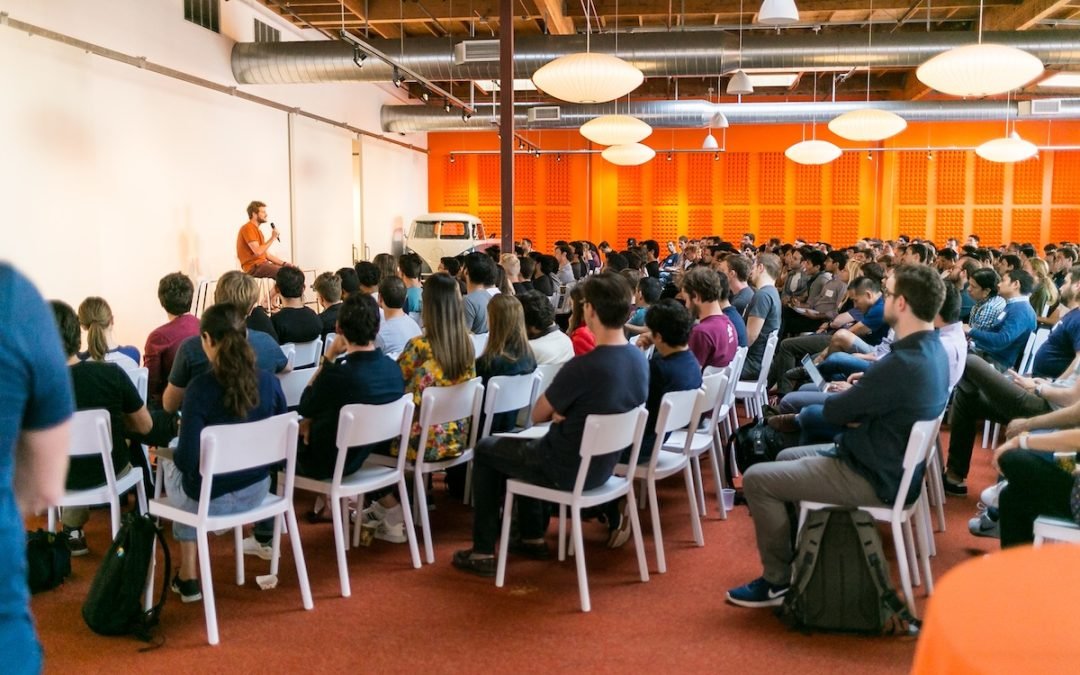
A packed room for YC’s demo day
When I was at 500, we got feedback from investors that it was challenging for them to stay focused with 30 - 40 pitches in one day. To genuinely pay attention to ~250 pitches over two days takes serious dedication. By the time you hear the 13th pitch of a company that started as X but pivoted mid-batch into an AI-powered Y (or whatever the current trend is), it’s sincerely hard to keep track.
An inability of demo day attendees to focus on all of the presenting companies has real implications for an accelerator, including:
A decrease in the average number of investor meetings per company (which has significant implications for the long tail of companies in each batch)
Fewer companies who get press coverage
Less compelling press coverage for those who do get it
Ensuring that the batch size remains “digestible” by both investors and the media is very much in YC’s best interests.
Why Doesn’t Every Accelerator Run Year-Round?
If running year-round batches is such an obvious win for both accelerators and founders, why doesn’t every accelerator do it?
It goes back to my earlier overview of how accelerators work. Each batch takes a lot of effort to run and requires significant administrative resources (both human and financial). Replacing one accelerator batch of X companies with two batches of X/2 startups is costly.
If you only run one or two batches a year, you have plenty of time to market, source companies, evaluate potential investments and deliver programming. After each batch, staff has time to decompress and debrief. Scheduling vacations is easy (seriously).
When you run three or four programs each year, suddenly you start to get overlap. Partners have to juggle working with companies in-batch and interviewing founders for the next batch. Vacations have to be scheduled more carefully. Administrative roles — like finance, legal and HR — need to be staffed up. When 500 Startups moved to 4 batches per year, it staffed up 2 full teams to support accelerator batches (alternating between locations in San Francisco and Mountain View).
So when Garry Tan says that, “…all the YC partners worked with me very closely to make this happen…,” he means it. This was likely not an easy decision.
The Bottom Line
Y Combinator doubling the number of batches while reducing the cohort size is a clear win for founders. It provides them with more frequent opportunities to apply to the world’s leading accelerator and a better experience when they are accepted.
It’s also sure to be a win for YC (though likely one that will include a few growing pains along the way).
The only ones who it’s not good news for? Early-stage investors competing for founder mindshare.
…wait. That’s me. 🤦♂️
I Never Wanted to be a VC
When I graduated from Stanford more than 20 years ago, nobody aspired to "be a VC".
A few weeks ago, I attended a close friend’s wedding in San Francisco. I sat at a large table with people I’ve known for more than 20 years (though many of us hadn’t seen each other in nearly that long). Over the course of the night, we caught up on the twists and turns that each of our lives have taken since we all lived on Stanford’s campus so many years ago. The proverbial scores on our Silicon Valley bingo cards were high:
Most of us ended up in tech
Almost everyone had worked at one or more startups
There were lots of founders and ex-founders
A few of us eventually found our way into venture capital
As we shared our respective journeys, it struck me that all of the VCs had one thing in common: none of us had graduated Stanford with “become a VC” as our ultimate career goal.

Back in my day…this was not a thing
The first time I ever heard the term “venture capital” was in the late-90s during the dot-com boom. I took an 8-month break from my undergraduate computer science program to work at a local startup. The company I worked for raised a small amount of money from “venture capitalists”, whom I naively presumed were just rich people who wanted to invest in tech.
The dot-com bubble burst. That company (and countless more) went bankrupt. The investors lost their money. I went back to school.
By the time I graduated, the nascent tech scene in Vancouver had been all but obliterated. So I opted to head south and go to grad school.
I spent two years at Stanford working on my Masters degree in computer science, then re-entered the workforce in 2004. By then, nature was healing and startups were beginning to return. At the annual Stanford Computer Forum Career Fair, up-and-coming companies like Google, Netflix and “The Facebook” were recruiting alongside tech behemoths like Microsoft, Oracle and IBM.

Antonio’s Nuthouse, circa 2002 (in those days — before Mark Zuckerberg and his Facebook crew took over — startups and venture capital were rarely the topic of discussion)
By that point, I was vaguely aware of venture capital. Entrepreneurship is deeply intertwined in Stanford’s programming, so the topic was frequently mentioned, but always within the context of funding startup ideas. By the time I graduated, I knew that VCs existed and that they were a source of capital for startups, but I couldn’t tell you who they were, how they operated or where they got their money from. It’s very likely that I met a number of VCs while I was a student. It’s also very likely I could have cared less.
Because in those days, being a VC wasn’t something you aspired to.
20 years ago, if you were technical, you aspired to work on really hard problems. That typically meant working at a large tech company or, perhaps, joining or founding a startup.
If you were in finance in 2004, more than likely your goal was to work at Goldman Sachs.
But that was then. And this is now.

So what happened?
First off, the growing prominence of the tech industry as a whole led to an increased awareness of and interest in venture capital. Today, venture capital courses are offered at almost every undergraduate and graduate business program in the world. Tens of thousands of eager students learn about the venture capital industry each year.
And then there are the VC “clubs”.
In 2012 (when competition amongst VCs was increasing and the concept of the “scout fund” was first borne), First Round Capital launched an experiment called the Dorm Room Fund at Drexel University and the University of Pennsylvania. The idea was simple: teach a handful of business students the basics of venture capital and give them a small amount of money to invest in student entrepreneurs. The experiment was wildly successful. Not only did Dorm Room Fund expand across the US, but similar programs popped up all over the world (such as Rough Draft Ventures in Boston, The House Fund at UC Berkeley and Front Row Ventures in Canada).

Panache Ventures portfolio company Valence Discovery, which was acquired by Recursion Pharmaceuticals last year, began life as a student-founded startup called InVivo AI that received its initial funding from Front Row Ventures
Aside from generating returns for their benefactors, these programs have proven to be incredibly effective at both helping student-founded startups access early funding and teaching students how venture capital as an industry works. But there’s been an unexpected consequence: many of the business students who participate in these programs subsequently expect to graduate and move immediately into VC.
I don’t think that’s a good thing.
Every month, I get dozens of emails and LinkedIn messages like this one, from graduating business students eager to get into VC:

There’s absolutely nothing wrong with this email. In fact, it’s incredibly well-written and came from a very strong student.
When I receive such messages, I almost always schedule a call to have a conversation with them. But it’s generally not to tell them about the recruiting process at Panache. It’s to help them to understand that their best path into venture capital isn’t directly out of school (at least, not in my humble opinion).
At this point, it’s worth noting there are two distinct categories of venture capital: early-stage and late-stage (growth stage). The exact definitions of these vary wildly, but from a functional standpoint they can be categorized as follows:
Early-stage investing: Investing in startups where virtually none of the investment decision is based on financial analysis
Late-stage investing: Investing in startups where the majority of the investment decision is based on financial analysis
Late-stage investing is actually a great fit for high-achieving business students, due to its emphasis on financial analysis and the structured way in which these firms typically operate. But when business students ask me about “getting into VC,” they’re usually referring to early-stage investing. And therein lies the mismatch.
At the early stages, investment decisions are mostly driven by subjective potential. The potential of the founders. The potential of the technology. The potential of the market. A classroom or VC club can teach the process of early-stage investing, but cannot possibly impart the expertise required to evaluate subjective potential.
What can? Experience.

When I was an undergraduate, all of my internship/coop experiences were technical. Sure, I had dreams of becoming wildly successful one day (it was the dot-com days, after all), but I had no illusions that my best path forward would be anything other than to build something. Though I was pursuing both computer science and business degrees, CS was unquestionably my focus.
I recently had coffee with a student completing the exact same joint degree that I did 20+ years ago. His vision was the opposite. He saw his CS degree not as the core asset but as a “checkbox” for his resume. He wanted to become a VC and desperately hoped that he wouldn’t have to actually “get a coding job.” Over the course of our conversation, he asked every way he could how to go directly into VC and how he could “avoid having to be a programmer.” When it became clear that I wasn’t going to give him the answer he wanted, he thanked me for my time and excused himself.
I’ve had many conversations like this over the years and they always make me sad and frustrated. Sad that so many bright young people are infatuated by an industry that is, at its core, glorified capital allocation. Frustrated that they’re increasingly led to believe that there’s a credible path from graduation directly into venture capital.

I have absolutely no issues with students being impatient (lord knows, I certainly was!). But I wish these programs focused more on understanding venture capital as a means to building successful companies and less on glorifying the industry itself. Venture Deals by Brad Feld and Jason Mendelson continues to be one of the most impactful books on founders nearly 15 years after it was first published specifically because it comes from that perspective.
That’s not to say that VC courses and clubs shouldn’t talk about the career opportunities in the industry. But they should be realistic about the prospects and focus on the many paths that can lead to being an early-stage VC, including:
Successful founder
Unsuccessful founder
Early employee at a high-growth startup
Product management
Combining startup and “big company” experience
Corporate development (the people in large companies who analyze and acquire startups)
Tech journalist
Let’s stop inspiring students to become venture capitalists and get back to inspiring them to become founders and builders.
Because that’s what we actually need.
Stop Trying to Replicate Silicon Valley
Along with death and taxes, one of the certainties of life is that every politician, journalist and armchair entrepreneur thinks that their city can be the next Silicon Valley.
A few weeks ago, I participated in a panel titled, “Building Realistic Ecosystem Dreams”. The goal of the session — part of a day-long conference focused on Alberta’s tech ecosystem — was to discuss and debate what a realistic future for the local tech ecosystem could be and how best to support it’s growth.
It was a fantastic conversation that covered a wide variety of topics. Of course, it was only a matter of time before someone asked the well-meaning but inevitable question,
“How can we make our tech ecosystem more like Silicon Valley?”

I’ve had the privilege of working with dozens of startup ecosystems around the world, and I can say from experience that along with death and taxes, one of the certainties of life is that every politician, journalist and armchair entrepreneur thinks that their city can be (and should be) the next Silicon Valley. There’s Silicon Alley, Silicon Beach, Silicon Slopes, Silicon Wadi, Silicon Glen…
You get the point.
While I completely understand — and support — the desire to build entrepreneurial ecosystems around the world, I’ve always found it odd how many people think it’s possible to replicate Silicon Valley. We don’t think that way about any other industry (when was the last time you heard someone ask, “How can our city be the next Wall Street?”).
Of course, there are plenty of organizations that are more than happy to sell the Silicon Valley dream to anyone who will listen.
“For the low, low price of [redacted], we can drop a shiny new ACME™ accelerator in your city and it’ll be instant success!”
…
“Well, no…we won’t actually invest in any of the companies that go through the program…”

So if we can’t replicate Silicon Valley, are there opportunities to leverage it to foster the growth of global entrepreneurial ecosystems?
Absolutely.
First off, despite my cynicism when it comes to replicating Silicon Valley, I believe wholeheartedly that there are lessons for other ecosystems to learn from Silicon Valley. In fact, that was the original premise behind the first generation of startup accelerators.
There have also been countless books written to encapsulate various aspects of Silicon Valley’s culture and best practices, from The Lean Startup and Zero to One to The Cold Start Problem and Secrets of Sand Hill Road. There’s also Brad Feld’s excellent book, Startup Communities: Building an Entrepreneurial Ecosystem in Your City and its follow-up, The Startup Community Way, both of which offer a cornucopia of lessons from “the Boulder Experiment” and its impact on startup ecosystems around the world.
Which brings us to the million dollar question: what can governments do to support local entrepreneurs if “bringing Silicon Valley to a town near you” isn’t the answer?
They can send local entrepreneurs to Silicon Valley.

“But wait,” you might be thinking, “don’t governments already do that…?”
Sort of.
Governments, corporates and other ecosystem supporters around the world have been sending entrepreneurs on tours of Silicon Valley for years (Canada was one of the pioneers of this, with the C100’s “48 hours in the Valley” program nearly 15 years ago). But that’s not what I’m talking about.
Last month, the Scottish government did something almost unheard of: they paid for 12 startups to relocate to San Francisco for a month as part of the country’s Tech Scalar program.
To be clear: the Scottish government didn’t pay for a startup tourism trip, as many governments do (“Next, we’ll visit Google’s cafeteria…”). Nor did they fly the entrepreneurs all the way to Silicon Valley only to make them sit through a program run by compatriots who travelled to Silicon Valley with them. Instead, they did something revolutionary: they gave the startups office space…and let them work.

It may seem like an exaggeration, but in backing this initiative, the Scottish government made a mental leap that few governments around the world have ever made: they stopped being scared that their entrepreneurs might stay in Silicon Valley and instead focused on the long-term benefit of helping them to work there.
The Scottish government successfully overcame a globally-shared insecurity that is deep within many countries’ cultures: a fear that, if given the opportunity to spend time in Silicon Valley, their entrepreneurs will choose not to return. While there’s definitely some validity to the worry, ultimately this short-term thinking is the economic policy equivalent of an insecure boyfriend who doesn’t want his partner to go out or do anything for fear that they may leave him.
Here’s the thing: if governments really want to accelerate their tech ecosystems, they should be encouraging their founders to travel to Silicon Valley in order to learn from and work with the best. Sure, a few might stay. But the vast majority won’t for a wide variety of reasons. And guess what? Those who do stay will learn a ton while they’re in the U.S. And a good number of them will one day repatriate home and bring back with them the knowledge and experience they gained. And for those who choose not to return, where do you think they’re going to open their first remote office…?
Of course, it’s understandably difficult for politicians worried about getting reelected and corporate executives trying to get their next promotion to support this kind of long-term thinking, but it can be done.
And all it takes is a plane ticket and some office space.
Not a program. Not a detailed itinerary. Not another tour of Google’s cafeteria. Just a plane ticket and some office space.
Imagine the ROI on that.
