Chris Neumann
Investor | Founder | Advocate
Humility vs. Hubris
A lot of the magic that happens in Startupland™ takes place at the intersection of humility and hubris.
Last week, I visited Edinburgh, Scotland to speak at Ecosystem Exchange, an annual conference that brings together investors, government officials and ecosystem builders from across UK to collaborate on ways to improve their local, regional and national startup ecosystems.
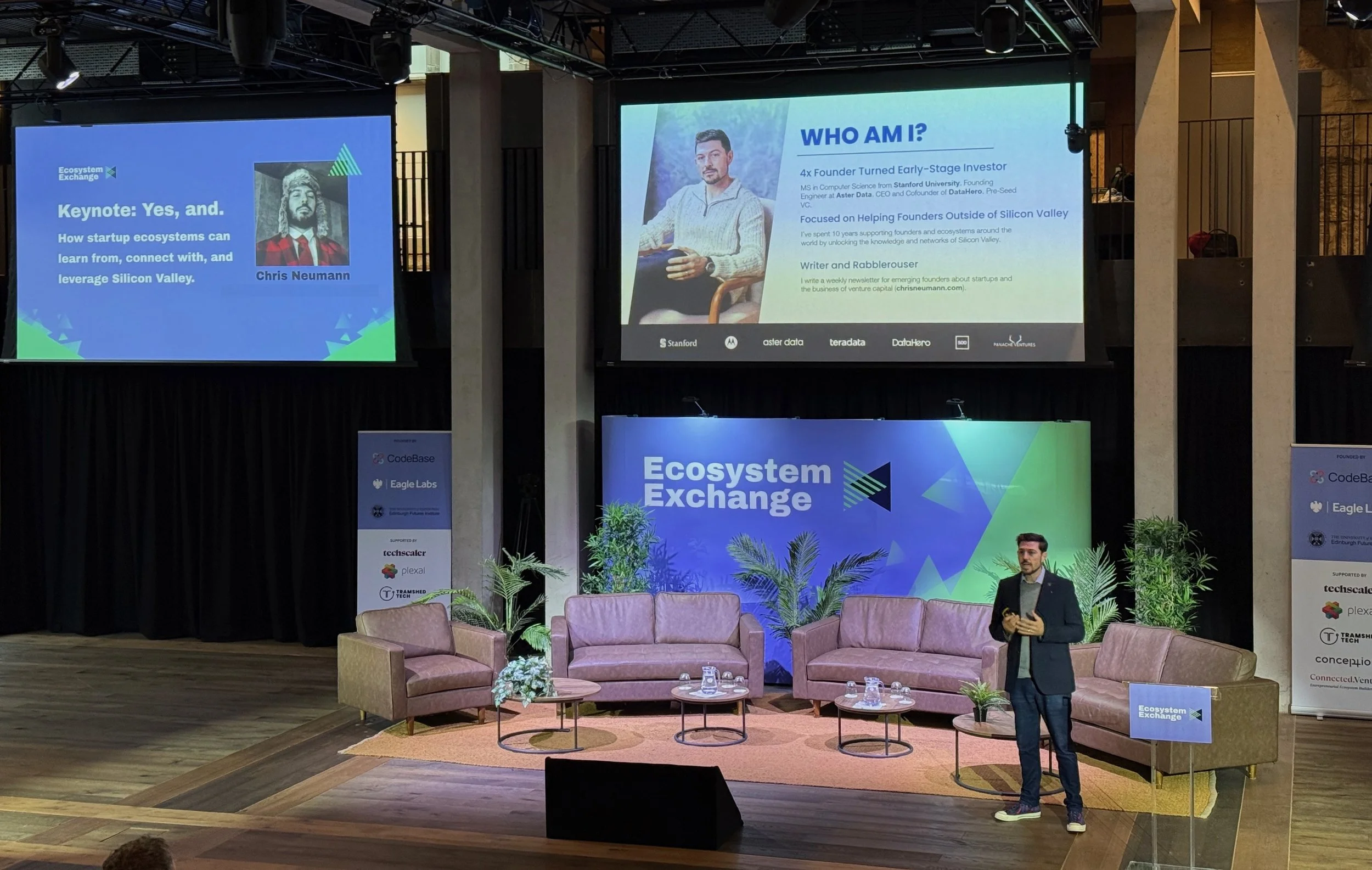
The conference was the brainchild of Jon Hope, a long-time UK ecosystem builder who previously co-founded one of the country’s largest networks of incubators and co-working spaces, Barclays Eagle Labs.
Over the course of two days, the speakers and panelists dove into a number of issues shared by countries around the world, including:
Disparities in talent, experience and capital availability across different cities and regions
Challenges commercializing IP developed in (government-funded) universities
The tensions between supporting high-growth companies with global ambitions and locally-focused startups that serve domestic needs
The impact of government policies / geopolitical shifts / local culture on startup ecosystems
Challenges retaining top talent and competing globally
When it was my turn to step to the mic, I spoke to the audience about a topic that’s deeply engrained in the ethos of each and every VC around the world: humility.
Ok, so maybe humility isn’t the first word that comes to mind when you think about a venture capitalist.
How about hubris?

It may seem surprising, but a lot of the magic that happens in Startupland™ takes place at the intersection of humility and hubris.
Here are some examples:
The best startup founders possess the hubris to believe that they can create billion-dollar companies out of nothing, but the humility to seek out mentorship, peer advice, and other forms of support to do so.
Top performing VCs possess the hubris to believe that they can identify the most promising startups before anyone else. Their humility comes from the knowledge that nearly 90% of their investments will fail (despite their best efforts). And no matter how much diligence they do, they won’t know which ones until much later.
But what about ecosystems?
In my experience, the ability to navigate hubris vs. humility is essential for ecosystems to grow. Why? Because no ecosystem outside of Silicon Valley has enough density of experience, expertise and talent to do it all.
Smaller ecosystems inherently understand this. One of the reasons why Scotland is amongst the fastest-growing startup ecosystems in the world is because it long-ago embraced the notion that it needs to build connections with other ecosystems in order to augment its domestic capabilities and support its local startups.

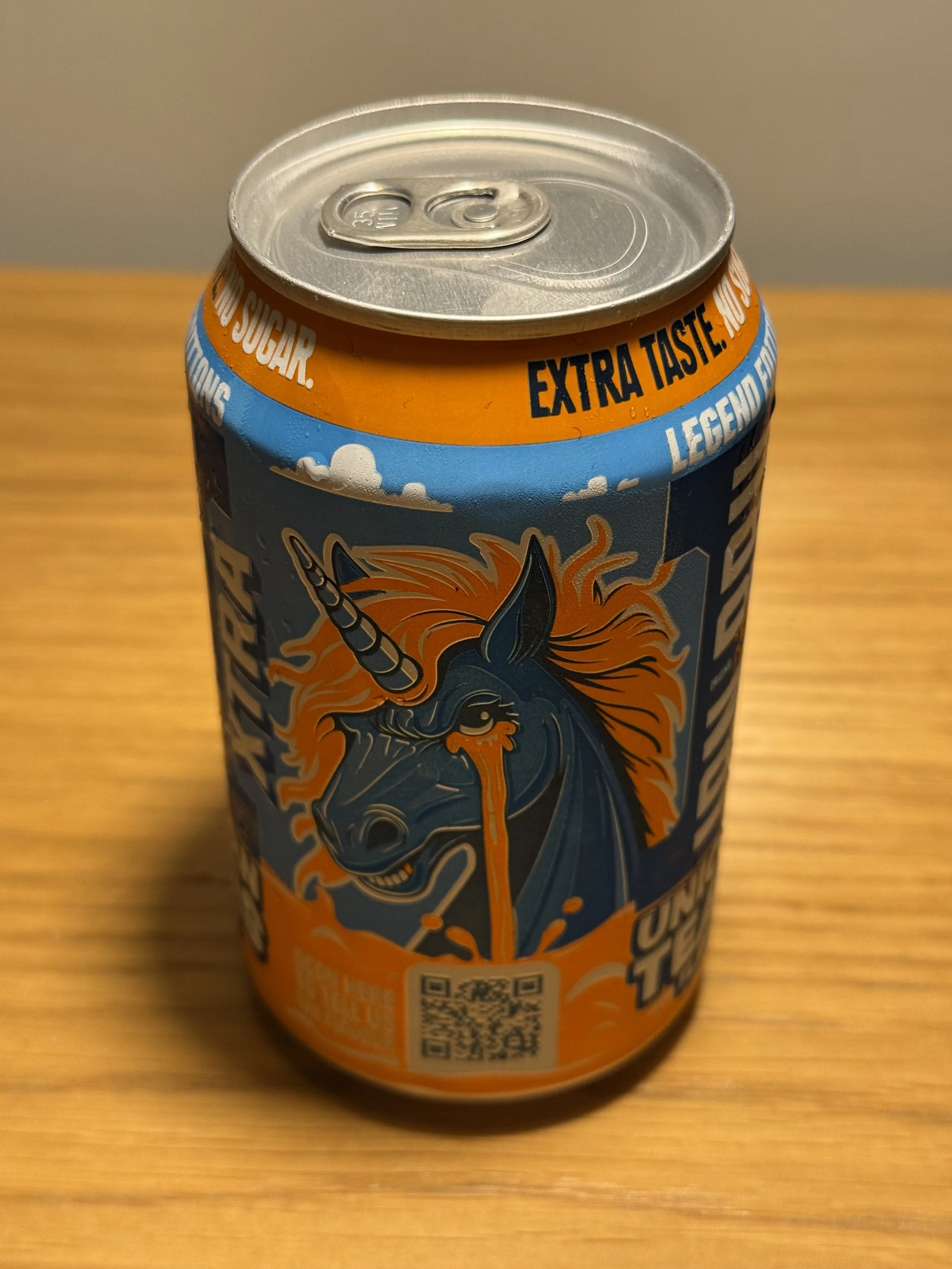
Scotland even has a version of its national soda dedicated to startups.
So why did I talk about humility and hubris at an ecosystem conference that took place in a country that seems to have figured it out?
Because even ecosystems that possess the self-awareness to recognize that they have gaps often struggle to maintain humility when addressing them.
Governments spend millions of dollars sending founders around the world to “tap into” other ecosystems (humility), but insist that they participate in highly choreographed programs designed at home (hubris).
Ecosystem builders pour time and effort into creating incubators and accelerators to support their startups (humility), then staff them with people who have no experience actually building successful tech companies (hubris).
Investors obsess over the their portfolio companies raising follow-on rounds from bigger, more prominent (predominantly Silicon Valley-based) VCs (humility) but can’t be bothered to get on a plane to get to know them in order to understand what they are actually looking for (hubris).
(And just to be clear, it’s not only ecosystem supporters who struggle with this tension — founders are far from immune to the pull of hubris.)
We’re currently in an era of significant macroeconomic, technological and geopolitical change. The gap between Silicon Valley and the rest of the world has never been greater. Yet at a time when the U.S. is becoming more insular, tech ecosystems around the world are banding together to address their weaknesses and create economies of scale.
On top of that, I’ve increasingly come to believe that Gen Z may be inherently better at walking the tightrope between humility and hubris than the generations who came before them. Younger founders have a different relationship with community than those who came before them. They also have a different relationship with geography. The Times, They Are A-Changin’.
I’ll close with this thought: as countries continue to shift away from globalization, there is opportunity in building deeper, more consequential relationships between tech ecosystems. Founder-to-founder. Investor-to-investor. Ecosystem-to-ecosystem. The ecosystems that capitalize on these opportunities will be the ones that embrace the idea that economic prosperity >> egos.
And that magic happens at the intersection of humility and hubris.
What’s The Worst That Could Happen?
Even founders who are naturally risk-averse can develop a bias towards action. And it starts by understanding the real — and realistic — worst case scenario.
One trait shared by the best founders I meet is a propensity to action. Specifically, a bias towards action over excuses. When an new opportunity arises, these individuals ask themselves, “how can I make this happen?” or “how can I take advantage of this opportunity?” as opposed to starting with the reasons why it’s going to be hard.
Case in point: a few weeks ago, I announced Game On, a 3-week long experiment in the heart of San Francisco to accelerate Canadian founders. The goal of the program is to evoke a mindset shift in early-stage founders by exposing them to the velocity and intensity of Silicon Valley’s ecosystem through mentorship, speakers and intentional experiences.
The program will be entirely free for participating founders thanks to support of some incredible partner organizations. But there’s a caveat: the founders have to cover their own transportation and living expenses while in San Francisco.
A handful of people publicly and privately suggested that the need for founders to cover their own expenses would make the program “inaccessible” to some. Meanwhile, one founder emailed me to let me know that they had already arranged for a couch to sleep on and pre-purchased a refundable plane ticket, “…in case we’re selected.”

I firmly believe that velocity is the metric that matters most to startups. A big part of that is a willingness to take action on the part of the founders. And while it might seem easy for me to suggest that the best founders “just get it”, for many people it’s neither easy nor natural. Thankfully, in my experience this is a behavior that can be learned.
It turns out that even founders who are naturally risk-averse can develop a bias towards action. And it starts by understanding the real — and realistic — worst case scenario.

Scaredy Squirrel has a wild imagination
Focusing on the worst case that can realistically occur in a decision has helped me to lean into more opportunities while making faster decisions. Even really big ones. Here’s an example:
Many years ago, some friends of mine from grad school approached me about joining a new startup they were building. It was in a space I wasn’t familiar with but I was intrigued by the opportunity to work with them (they were three of the smartest guys I knew at the time, which is saying a lot coming out of Stanford). Having lived through the dot com bubble, I knew that there was a high likelihood that the startup would fail. So, I thought about the worst case scenario:
My friends had just raised a small pre-seed round — enough money to last about a year
In the worst case scenario, the company would fail after a year and I would struggle to find another job
Given that I was on an H-1B visa, if I didn’t find a new job in time, my visa would expire and I would have to go back to Canada
That would likely mean moving back in with my parents while I figured out what to do next
So, the realistic worst case scenario was that after a year, I would have to leave the U.S., move back in with my parents, and figure out a new job. But in exchange, I would get to spend a year working alongside three of the smartest people I knew. That’s a pretty good worst case scenario if you ask me. I leaned in and the result turned out to be far from the worst case.

Of course, not all decisions turn out the way you hoped, which is why it’s essential that you think about the worst case as part of your decision process (if you’ve ever heard the phrase “hope for the best, plan for the worst,” that’s what I’m talking about). But more than that, you need to mitigate the worst case scenario whenever possible.
If you assume that the worst case scenario will occur, are there things you can do to make it “not so bad”?
I recently wrote about my propensity to travel and the fact that traveling is an underrated superpower. As much as I do it, traveling does come with real costs:
Financial costs
Opportunity costs
Personal costs (time away from family, etc.)
In many cases, it can be hard to know in advance if a given trip will be “worth it.” A conference might end up sucking. A speaking opportunity might not deliver the expected ROI. A 3-week trip to San Francisco to participate in an experiment to accelerate Canadian founders might not actually accelerate you.
How do you mitigate the worst case scenario in situations like these?
Before committing to a trip, I look at whether or not there are things I can do to generate value even if the worst case occurs. For example:
Are there additional people I can arrange to meet while I’m there (either personally or professionally)?
Can I instigate a founder meetup or other easy / low-cost event (like these)?
Is it somewhere I just want to personally visit?
At the same time, I generally try to minimize the financial/opportunity/personal costs by keeping the trip as short as possible. After doing all of that, I’ll make a decision based on the “new and improved” worst case scenario.
It turns out, if you mitigate the worst case scenario as part of your decision process, many seemingly obvious “noes” turn into pretty clear “yesses” (and the ones that remain “noes” are all the more obvious). This extra step can make it much easier to say yes to an opportunity, particularly if the upside is significant.
And this approach doesn’t only apply to work-related decisions.
Years ago, I met a girl who was living in Hawaii at the time. We kept in touch for a few months, until one day I asked her what it would take for the two of us to go out on a date. She responded, “when do you want to come to Hawaii?”
I thought about it for a moment, and replied, “How about this weekend?”
When I told some friends of my plan, they thought I was crazy. Why would I fly all the way to Hawaii just to go on a date?
Aside from the fact that I really liked this girl, I thought about the worst case scenario.
In the absolute worst case, we would meet up for drinks, it would be super awkward and I’d be stuck in Hawaii by myself for the rest of the weekend. In other words, the worst case scenario was that I would get a desperately-needed weekend break in Hawaii right before having to go out and raise DataHero’s series A. That’s a pretty good worst-case scenario if you ask me.
Ten years and two kids later, it remains one of the best decisions of my life.

The Myth of the Magical Money Fairies
The myth of Silicon Valley’s magical money fairies is deeply entrenched in many ecosystems around the world.
There are a lot of myths and misconceptions that exist around the world when it comes to Silicon Valley. In my experience, no topic is more misunderstood (and, frankly, misrepresented) than fundraising.
It makes sense. Silicon Valley is by far the largest source of capital for tech startups. Combine that with the fact that most folks in other ecosystems learn about its dynamics through click-bait funding announcements loosely wrapped as “journalism” and its easy to understand how perceptions can be skewed.
There’s one myth in particular that I’ve seen do more damage to startups around the world than any other: it’s the myth of the magical money fairies.

The myth of Silicon Valley’s magical money fairies is deeply entrenched in many ecosystems around the world. And it really is a myth in the truest sense. For millennia, human folklore has contained popular stories about treasures and fortunes that have some grain of truth, but are vastly overstated in terms of likely outcome. For example, most children learn the old Irish myth about leprechauns with pots of gold at the end of a rainbow. All you need to do is catch one and, voila!
Replace “leprechaun” with “Silicon Valley VC” and you’ll see where I’m going with this one.
(As an aside, the leprechaun myth had its origins back when vikings invaded Ireland, buried looted treasure around the island and eventually left while leaving some of their stolen gold behind to eventually be discovered by locals…).
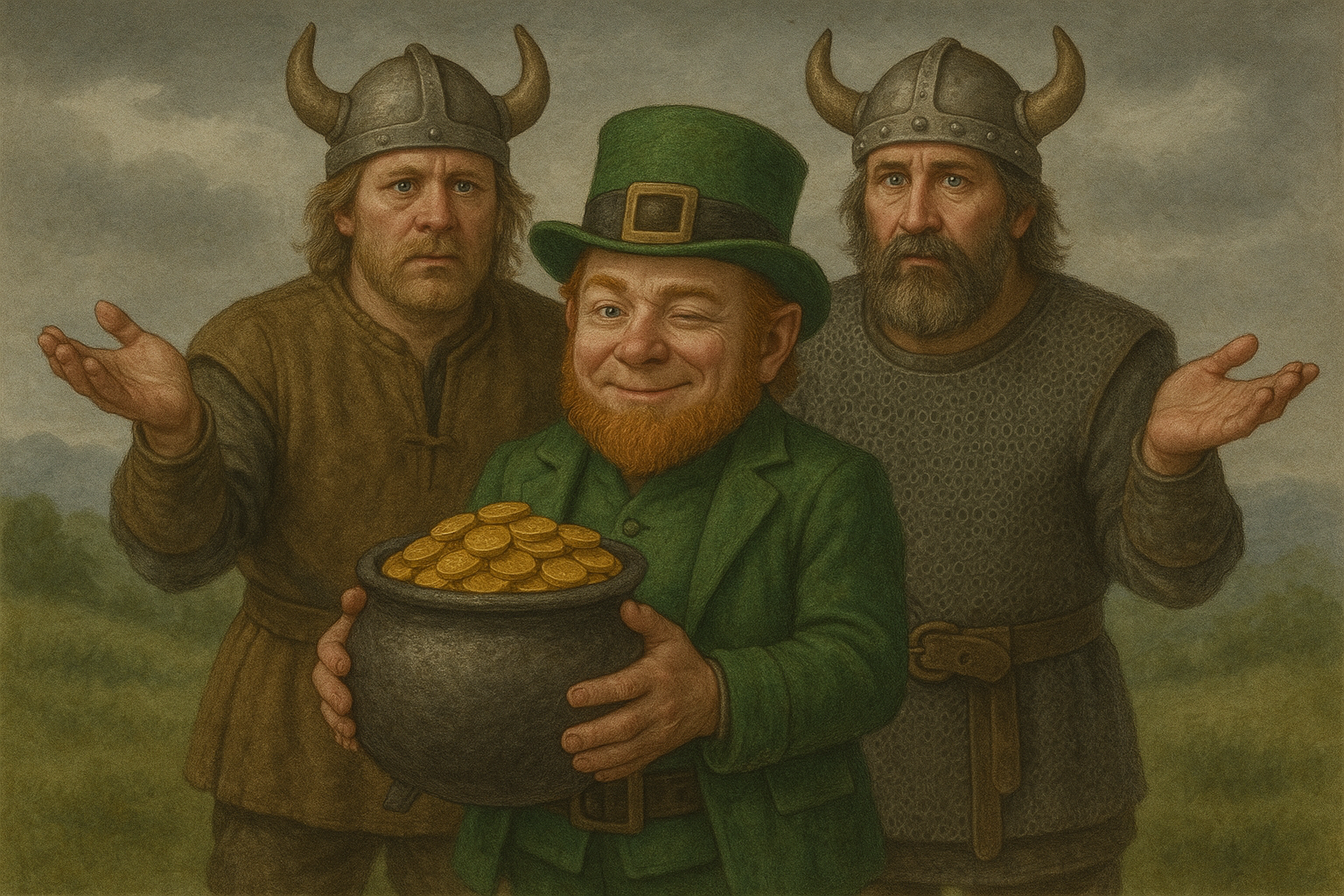
So what exactly is the myth of the magical money fairies?
Simply put, there is a pervasive belief around the world that it is easier to raise money in Silicon Valley, because VCs there are more risk-taking / willing to invest / willing to “take a chance”. Like magical money fairies, they will obviously be willing to invest. You just need to get to them.
Like any myth, there are grains of truth at its core. For example, VCs in Silicon Valley are more willing to invest in pre-prototype companies than VCs in other ecosystems. But it’s not because they’re more risk-taking, it’s because more of them have the technical background needed to “invest in napkins”.
Similarly, it is broadly true that founders can raise a round of funding quicker in Silicon Valley than in other ecosystems (which can feel like the investors are more risk-taking / willing to invest / willing to “take a chance”). In reality, there are two key dynamics at play:
There are generally more VCs in Silicon Valley that invest in a given industry than in other ecosystems (which makes it possible to have more credible pitches in a shorter period of time).
Silicon Valley VCs have learned to perform deep diligence much faster than VCs in other ecosystems (and often in ways that are imperceptible to founders). That can feel like they’re doing less diligence, though I promise that’s not the case.
What makes this myth particularly dangerous is the unrealistic expectations that many founders (and ecosystem proponents) have when it comes to Silicon Valley VCs as a result of it. Here’s a dynamic I’ve seen play out hundreds of times:
A founder tries to fundraise locally, but struggles.
They receive consistent, repeated feedback from multiple local investors. Rather than paying attention to the feedback and addressing it, they attribute it to “risk aversion” and keep going.
Emboldened by fundraising books, blogs and well-meaning supporters who loudly cheer “you just need one yes”, they keep going. They limp along from investor to investor, often for months.
As they approach the end of their runway, having lost 6+ months of time fundraising (and having not addressed the core challenges of the business or made further progress), they spend their last bit of money on a “Hail Mary” trip to San Francisco.
Landing in the Bay Area, they finally meet Silicon Valley VCs. All of whom see the exact same weaknesses in the business that their local investors saw, plus a company with no runway and a founder who wasn’t willing to listen to feedback.
The fundraising trip fails and the founder returns home, closing the business shortly thereafter.
Unfortunately, those stories rarely make it back into the ecosystem. Many founders who travel this path eventually realize their folly, but are too embarrassed to share their experiences publicly in ecosystems that are more likely to punish failure than celebrate the attempt.
Absent these important stories, the myth of the magical money fairies perseveres — in part because the handful of outlier founders who do end up raising in the Valley typically make a lot of noise about it.

It is, of course, true that Silicon Valley VCs often see things differently than investors in other ecosystems. But that goes both ways.
Silicon Valley VCs might see an opportunity that local investors don’t. They might be willing to take a chance on a founder that local investors aren’t convinced about (Jesse Rodgers refers to this as small-town bias).
But they’re just as likely to be skeptical about a business that local investors are tripping over themselves to back. I’ve seen plenty of startups over the years fail to raise in Silicon Valley, despite their hometown investors being incredibly bullish (a different perspective on revenue and growth is often the culprit).
Despite what many founders and ecosystem supporters continue to believe, it isn’t easier to convince a given VC in Silicon Valley to invest in a company — it’s much, much harder. But there are far more VCs in Silicon Valley than in other ecosystems and, generally speaking, they make faster decisions.
So what is a founder to do with this information?
Simple. If you are trying to raise a fundraising round, you should absolutely include Silicon Valley VCs in the mix. But don’t do it at the end of your process, do it in parallel. Understand that the vast majority of early-stage funding rounds happen locally — the mythical U.S. lead investor does not, in fact, exist. But fundraising is a numbers game and the more potential investors you have in the mix, the more likely you are to succeed.
Just don’t expect Silicon Valley VCs to gloss over legitimate concerns that local investors have raised. VCs in different ecosystems do see the world differently. But none of them are charities. Their job is not to “give you a chance”, it’s to generate a return on investment.
In that sense, they are actually magical money fairies…for their LPs.
Changing Founder Metabolism
Announcing Game On, a program designed to accelerate Canadian founders and help them build meaningful connections to Silicon Valley.
A few weeks ago, I wrote about why 99% of accelerators fail. The vast majority of accelerators around the world fail to live up to their expectations for the simple reason that most of the mentors who work with these programs don’t actually have the lived experience needed to accelerate startups (at least, not if we’re talking about billion-dollar outcomes).
As it stands today, the only ecosystem in the world that has enough such mentors is Silicon Valley. So how do we accelerate startups in the rest of the world?
If the quintessential requirement of a good startup accelerator is good mentorship and only Silicon Valley has a sufficient quantity and diversity of mentors to cater to a wide diversity of founders, how can we reasonably accelerate startups in the rest of the world?
By leveraging Silicon Valley’s talent.
This isn’t a new epiphany by any stretch of the imagination. For more than 20 years, governments around the world have recognized this experience gap and have poured considerable resources into trying to tap into Silicon Valley’s magic. Almost every country (and many cities/states/provinces within them) have programs that attempt to build connections between their startups and Silicon Valley.
Unfortunately, a lot of these efforts fall flat.
A for Effort
There’s the Hollywood Tour of the Stars, designed by organizers convinced that the solution to their country’s woes is to expose founders to Silicon Valley’s biggest successes “for inspiration”. Founders drive up and down the San Francisco peninsula, sampling the cafeteria fare at the world’s most prominent tech companies and visiting their gift shops. They return home excited and energized, only to realize a few days later that they learned absolutely nothing.

Another well-meaning but low-ROI approach is the Investor Dating Game, designed on the premise that the only thing missing in a tech ecosystem is funding. If organizers could simply introduce their startups to Silicon Valley VCs, everything would magically come together.
There’s only one problem: the organizers often don’t understand that there are different stages of startups and different types of investors. Founders soon realize that they’re pitching a random mashup of VCs, private equity investors and corporates, and return home without a dollar raised between them.

And, of course, there’s the Silicon Valley Bootcamp. This one is actually a step in the right direction. Rather than wasting founders’ time with tours of big tech cafeterias or low-probability investor show-and-tells, organizers attempt to design a program centered around Silicon Valley insights. Unfortunately, many of them — particularly those planned from afar — end up as little more than a haphazard collection of fireside chats with expats. Such as:
The locally-famous founder, who moved to San Francisco a decade ago only to have their company fail before the ink was dry on their work visa.
The charismatic connector, who convinced the organizers that he/she sits at the center of Silicon Valley’s power brokers — but nobody in the Bay Area knows them.
The self-proclaimed fundraising coach, who has never actually fundraised.
Employee #12,376 of Uber, who joined 2 years after Travis left but will nonetheless tell you all about the early days.
Rise of the Expats
While many “top-down” efforts to connect with Silicon Valley have struggled over the years, one type of initiative has yielded ongoing success for many countries. And each country’s version has one thing in common: they all started as grassroots efforts instigated by Silicon Valley expats.
Here are some examples:
TiE was founded back in 1992 by Ambrish (AJ) Patel and eight cofounders originally from India
In 2007, Israeli expats Moshik Raccah and Eran Wagner founded IEFF
Canada’s C100 was founded in 2009 by Canadian expats Anthony Lee and Chris Albinson
In 2017, a group of British expats led by Trulia founder Pete Flint launched GBx
And there are many more such groups. Some of these organizations receive funding and support from the “home” government and/or local embassy while others are completely independent.
Each of these organizations creates networking opportunities that bring Silicon Valley-based expats together and then leverages that community for the benefit of visiting founders (offerings that typically include a more effective version of the Silicon Valley Bootcamp, such as C100’s “48 Hours in the Valley” or GBx’s “Brits by the Bay”).

The annual C100 Summit at Halfmoon Bay
The Landing Pad
Recently, we’ve started to see the emergence of a new category of offering that seeks to make it easier for international founders to spend an extended period of time working in Silicon Valley. The “landing pad” concept blends Silicon Valley co-working with the benefits of an international cohort. One of the best examples of this comes from the relatively small startup ecosystem of Scotland.
Back in 2022, the Scottish government issued a £42 million tender, known as “Techscaler”, to find novel ways to improve the local startup ecosystem. But rather than award the contract to one of the (many) US-based pay-to-play accelerator brands that applied, they awarded it to a local organization called Codebase. What makes Codebase different from most incubators around the world is that the founders deeply understand and accept the limitations of their local ecosystem. And they’ve spent years building relationships with Silicon Valley and other ecosystems to help plug the gaps (I first met them back in 2017 when I was with 500 Startups).
One of the first proposals that Codebase put forth as part of Techscaler was both incredibly progressive and incredibly simple: they proposed a 3-week program to take a dozen Scottish founders to San Francisco…to work. Not to drive up and down the peninsula visiting big tech offices. Not to sit in a financial district office listening to speakers deliver content they probably could have watched online. But to go to Silicon Valley and work on their startups.

And guess what? The Scottish government supported it wholeheartedly. They didn’t trip over themselves panicking about brain drain. They didn’t insist that the founders needed guidance / structure / handholding. They agreed with the assertion that the best way to support Scottish founders building connections to Silicon Valley was to let them do it. Here’s how the program was originally described:
The Techscaler Silicon Valley Hub was delivered as a pilot programme throughout February 2024, to build links between Scotland’s and Silicon Valley’s start-up ecosystems. It consisted of a “pop-up” hub in San Francisco, which provided office space for 12 Scottish start-ups to use as a base for several weeks, from where they built a new business network, learned from other world class businesses in similar markets, connected with US founders, partners, potential customers and investors. The programme also offered support for founders to find their way around San Francisco and Silicon Valley, signpost relevant events and facilitate introductions as relevant.
Since that first pilot, Techscaler has delivered multiple international programs with the full support of the Scottish government (the third Silicon Valley program took place this past spring).
Game On.
Over the years, I’ve had a front-row seat for an incredible number of accelerators, incubators, and startup programs. I’ve also spent a lot of time in a lot of ecosystems around the world.
Witnessing what Codebase was able to do with their landing pad got me thinking:
What if we went a step further?
What if we combined the simplicity of a San Francisco landing pad with the intentionality of an expat program and the experience of Silicon Valley mentors?

Today, I’m thrilled to share a new experiment in velocity designed specifically for Canadian founders: Game On.
I believe that one of Silicon Valley's greatest advantages over other startup ecosystems is velocity. And the velocity gap between Silicon Valley and the rest of the world has only grown since AI came on the scene. That’s why I’m inviting 30 up-and-coming founders from across Canada to join me in San Francisco for 3 weeks in January with two objectives:
To infuse them with a deep understanding of Silicon Valley’s velocity (and teach them how to operate at that velocity)
To help them develop their own high-value networks with potential customers, partners, other founders and investors in Silicon Valley
All while working on their startup.
This is an experiment unlike any founder program that’s been done before. It won’t be startup 101. And it definitely won’t be innovation theatre. Through light-touch programming, mentorship and intentional experiences, founders will experience firsthand how Silicon Valley really works. All towards one singular goal: go faster.
We’re not just trying to change the velocity of startups. We’re trying to change the metabolism of founders (H/T to my friend Mark Dobbin for that one 😉).
Applications are open now through November 15, 2025. You can learn more at chrisneumann.com/gameon.
Traveling is an Underrated Superpower
In a world where most of our interactions occur online, a willingness to travel is a superpower.
In the past month, I’ve been to San Francisco, Vancouver, Toronto, Montreal, and Halifax. In the coming month, I’ll spend time in Chicago, Columbia (Missouri), London, Edinburgh and then again in both San Francisco and Vancouver.
People I meet often comment that they can’t believe how much I travel. To most, it seems absurd. Unsustainable. Irrational. But to a small number of people, it’s normal. A smile. A knowing nod.
In the world of startups, a willingness to travel is a superpower.

I’m not talking about traveling for fun or personal growth (though I certainly do love that). I’m talking about traveling in support of professional goals.
We live in a world where an increasing number of our interactions occur online. We order on Amazon, Instacart or DoorDash instead of going to the store. We have meetings over Zoom instead of over coffee. We swipe left and right and up and down for hours each day. Increasingly, we prioritize efficiency above all else.

Improving efficiency unquestionably increases productivity in many parts of our lives. It helps us solve the paradox of time, helps us get more done each day and, in theory, unlocks more time for ourselves. But at what cost?
There was a time when if you wanted to sell something, you had no choice but to travel. For centuries, the traveling salesman was a key part of society in one form or another. In fact, one of the most famous problems in computational science is known as the “traveling salesman problem”.
Here’s the thing: showing up in person still matters. In fact, in a world where it costs us virtually nothing to get on a phone call or Zoom, the potential impact of traveling and showing up in person has never been greater.

For the majority of people, traveling — especially by plane — is a stressful affair. Even people who fly regularly often experience anxiety when traveling. For many flyers, the idea of missing a flight or landing only to discover that you’ve forgotten something is nerve-wracking.
Back in 2007, we had signed MySpace as the flagship customer for Aster Data. It was a $1M deal that would change the trajectory of the company — but we had to get the system into production. And that system was the world’s first commercially-deployed 100 TB data warehouse.
We decided that I would take point on the deployment and project manage the work from Aster’s side. MySpace was headquartered in Beverly Hills, while Aster Data was in San Carlos (a small suburb of San Francisco close to the airport). For the first few months, I traveled to LA for 2-3 days every other week. Each time, I would drive to SFO, fly to LAX, rent a car, head to their offices and work for a few days while staying overnight at a (cheap) hotel. I hadn’t done much work travel up until that point, so these trips were exciting. They were adventurous. They were also exhausting.
After awhile, they became routine. And as we got closer to the launch, they became shorter.
Multi-day trips every other week were replaced with daytrips every week. I would drive to SFO in the morning, hop on the first Southwest flight of the day, grab the rental car, head to MySpace, then turn around and be back home in time for bed.
It wasn’t long before my brain stopped thinking about it as travel. I wasn’t flying somewhere exotic. I was simply commuting to a client’s office. It just happened that part of my commute involved an airplane. That simple change of perspective changed everything.

Travel isn’t easy. It’s tiring (especially when you change time zones). It can be unhealthy if you aren’t careful about your eating and exercise habits. And when you have family or other obligations, there are additional complexities and considerations.
But the moment travel stops being stressful, it becomes a super power.
You stop worrying about taking a flight. You stop worrying about missing a flight (after all, there’s always another one).
Before long, you’ve experienced almost everything that can go wrong. And just like other aspects of being a startup founder, you learn to roll with the punches. You expect the unexpected.
More than that, you start to account for travel time in your regular routine. For some people, being on a plane means reading and deep work. For others, it’s mindless movies and downtime. For me, it’s writing (I wrote this post on a plane). As a result, your opportunity cost changes. Travel time is no longer “lost” time. The return-on-investment that comes from travel is much higher, because your cost is much lower.
And that’s how the magic happens. You start going where others won’t. You go when others won’t. While competitors are trying to schedule Zoom calls to close a deal, you’re there in person taking the prospect out for lunch. When new opportunities present themselves, your default answer is yes instead of no.
You are seemingly everywhere, all at once.

Be like Michelle Yeoh
To be clear, this amount of travel is not for everyone. And the opportunity cost calculations very much change depending on the stage of your company and your stage of life.
But if you can mentally get over the hump of “travel is hard”. If you can switch your mindset from “this is intimidating” to “this is easy”. If you can transcend the stress that typically comes with travel, you’ll find yourself with a superpower that few can match.
Why Do 99% of Startup Accelerators Fail?
Why do 99% of startup accelerators fail to live up to their expectations?
In 2005, Paul Graham, Trevor Blackwell, Jessica Livingston, and Robert Morris decided to run an experiment. Paul had a hypothesis that undergraduates were undervalued when it came to starting companies. At a time when almost all VC’s required a “business cofounder” to run the company (aka a CEO with an MBA from a fancy school), Paul et. al. believed that the world was changing,
“This summer, as an experiment, some friends and I are giving seed funding to a bunch of new startups. It's an experiment because we're prepared to fund younger founders than most investors would. That's why we're doing it during the summer—so even college students can participate.
We know from Google and Yahoo that grad students can start successful startups. And we know from experience that some undergrads are as capable as most grad students. The accepted age for startup founders has been creeping downward. We're trying to find the lower bound.”
Their summer 2005 experiment — referred to as the Summer Founders Program — is today better known as Batch #1 of Y Combinator.
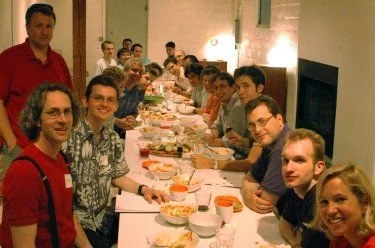
SFP included Alexis Ohanian (Reddit, Initialized Capital, 776 Ventures), Justin Kan (Kiko, Twitch) and Sam Altman (Loopt, OpenAI)
Fast forward twenty years and there are self-proclaimed “startup accelerators” around the world. Yet despite all of the innovations that have occurred over the past two decades — technologically, socially, and business-wise — YC remains the world’s preeminent accelerator — and it’s not even close.
So why is it that 99% of accelerators fail to live up to their expectations?
What is a Startup Accelerator?
Let’s start with a definition, to make sure we’re all on the same page.
The key characteristic of a startup accelerator is that it accelerates a startup.

You might think I’m being facetious, but I’m not. A startup accelerator is a program that is purpose-built to accelerate the trajectory of a high-growth tech startup. Implicit in that definition is that the participants are founders/cofounders of a startup with a clearly-defined market hypothesis (a business idea). They are not founders in search of an idea, a cofounder or a market for their technology.
This distinction is crucial (and we’ll get back to it later).
What Do Startup Accelerators Do?
The basic concept of a startup accelerator has changed very little since the Summer Founders Program. In October 2005, Paul Graham shared some of his learnings from the initial batch. It’s incredible how many of those observations remain at the core of today’s accelerators:
Mentorship
“Some we helped with technical advice-- for example, about how to set up an application to run on multiple servers. Most we helped with strategy questions, like what to patent, and what to charge for and what to give away. Nearly all wanted advice about dealing with future investors: how much money should they take and what kind of terms should they expect?”
Pitch Practice and Demo Day
“The weekend before the demo day for investors, we had a practice session where all the groups gave their presentations. They were all terrible. We tried to explain how to make them better, but we didn't have much hope. So on demo day I told the assembled angels and VCs that these guys were hackers, not MBAs, and so while their software was good, we should not expect slick presentations from them.
The groups then proceeded to give fabulously slick presentations. Gone were the mumbling recitations of lists of features. It was as if they'd spent the past week at acting school. I still don't know how they did it.”
Investor and Customer Intros
“I was surprised how much time I spent making introductions. Fortunately I discovered that when a startup needed to talk to someone, I could usually get to the right person by at most one hop. I remember wondering, how did my friends get to be so eminent? and a second later realizing: shit, I'm forty.”
Peer Learnings
“Just as happens in college, the summer founders learned a lot from one another-- maybe more than they learned from us. A lot of the problems they face are the same, from dealing with investors to hacking Javascript.”
Batch Format
“Another surprise was that the three-month batch format, which we were forced into by the constraints of the summer, turned out to be an advantage. When we started Y Combinator, we planned to invest the way other venture firms do: as proposals came in, we'd evaluate them and decide yes or no. The SFP was just an experiment to get things started. But it worked so well that we plan to do all our investing this way, one cycle in the summer and one in winter. It's more efficient for us, and better for the startups too.”
Twenty years later, startup accelerators around the world all follow roughly the same approach as that first Y Combinator batch:
Cohorts of startups / founders participate in a program that takes place over a defined period of time
The accelerator invests on standardized terms (typically at a lower valuation than a traditional VC would provide — thus pricing in the perceived benefit of the program)
Founders benefit from both peer learnings and the peer pressure that comes from being in a class / batch
The organizers provide mentorship and facilitate introductions to customers and potential investors
Most programs conclude with a “demo day” event, where potential investors can meet all of a program’s startups at once
The most significant evolution of accelerators has been the addition of standardized content intended to streamline learnings that almost all first-time founders have, such as:
Go-to-market (sales/marketing best practices)
Finding product-market fit
Fundraising
Startup Schools are Not Accelerators
A significant percentage of programs offered to startups around the world are not, in fact, accelerators. They are startup schools.
Startup schools teach founders the basics of running a company along with various concepts and methodologies related to entrepreneurship. But they do not accelerate a company in a fundamental sense.
True acceleration changes the trajectory of a startup by instilling founders with the best practices and work habits needed to succeed. And if we’re talking about building world-changing companies, then what we’re referring to is specifically, “instilling founders with the best practices and work habits needed to create billion-dollar companies.”
How does that happen? Through one-on-one mentorship.
If the definition of a startup accelerator is “a program that accelerates startups” and the primary means through which these programs effect change is through mentorship, then the quintessential requirement of a good startup accelerator is good mentorship.
But what is “good” mentorship?
The One About Youth Sports
Let me tell you about my friend Kenndal McArdle.
Like me, Kenndal is an early-stage investor. He is also a former founder. Kenndal and I have kids that are the same age and we both coach their sports teams. But there’s one big difference in what we bring to the table in that regard.
You see, one of us was a first-round draft pick of the Florida Panthers and played in the NHL. And one of us is me.

While we can both teach our kids the fundamentals of playing sports, only one of us has first-hand experience in the best practices and work habits necessary to reach the highest echelons of professional sports. Kenndal has a gold medal from the 2007 World Junior Championships. I watched the 2007 World Junior Championships on TV. We are not the same.
At a basic level, this is the fundamental flaw with 99% of startup accelerators. The mentorship in almost all of the world’s “accelerators” is provided by well-meaning individuals who have zero personal experience at the highest echelons of tech. Many have genuine experience building and/or investing in startups, but the vast majority have no firsthand experience building billion-dollar companies (as a founder, employee or investor).
They can teach topics, but they don’t actually know what it takes to reach the pinnacle.
Spotting Opportunity is Only the First Step
Almost all accelerators are founded by individuals who observe specific problems and/or opportunities within their ecosystems.
Y Combinator’s founding was a response to Paul Graham’s observation that “hackers” (specifically, undergraduate hackers) were not getting as much funding as he felt they deserved and that there was an investment opportunity to be had in addressing that need.
Techstars was founded in the tiny community of Boulder, Colorado by David Cohen, Brad Feld, David Brown and Jared Polis, who believed that there was a lack of funding available to founders in middle America and that there was an investment opportunity to be had in addressing that need.

Boulder is a wild place 🤘
500 Startups’ origins came from the observation that women, minority and foreign founders did not have access to the same degree of funding that white male Stanford graduates had access to and that there was an investment opportunity to be had in addressing that need.
So why did these accelerators flourish while so many others failed? It starts with the experience of the founders:
Y Combinator: YC cofounders Paul Graham and Robert Morris previously cofounded Viaweb, the world’s first application service provider. They subsequently sold the company to Yahoo! and witnessed Yahoo!’s meteoric rise through the dotcom bubble.
Techstars: David Cohen, David Brown and Jared Polis all cofounded multiple successful tech startups while cofounder Brad Feld cofounded both startups and VC firms (most notably Foundry Group).
500 Startups: In addition to founding his own startups, Dave McClure was a member of the famed PayPal Mafia and an early employee at Simply Hired.
In all three cases, the founders had firsthand experience working at globally-successful tech startups. While they were not the founders of those companies, they had experience working with (and observing) the habits of exceptional founders both as employees within such companies and as investors later on. They understood from multiple angles what exceptional looked like.
But, more than that, they also had direct relationships with dozens of other founders and early employees who had similar firsthand experience inside the world’s biggest tech companies. Relationships that they could leverage for the benefit of the startups that went through their programs. (Recall Paul Graham’s observation from Y Combinator’s first batch: “I discovered that when a startup needed to talk to someone, I could usually get to the right person by at most one hop.”)
Anatomy of a Premier Accelerator
Let’s get back to the topic of mentorship.
What sets the world’s best accelerators apart is the strength of the teams working with founders. The quality of the mentorship, as well as the introductions that mentors can potentially make.
This starts with the employees of the accelerator. The best accelerators employ partners, entrepreneurs-in-residence and even operational staff who have firsthand experience working in some of the world’s fastest-growing tech companies.
Here are just a few of the people I had the privilege of working with at 500 Startups back in its heyday:
Jake Gibson (previously Cofounder of NerdWallet)
Sheel Mohnot (previously Founder of FeeFighters, which he sold to GroupOn where he became VP of Business Development)
Marvin Liao (previously head of international markets for Yahoo!)
Arjun Dev Arora (previously Founder of ReTargeter)
Binh Tran (previously Cofounder of Klout)
Elizabeth Yin (previously Cofounder of Launchbit)
Eric Bahn (previously Founder of Beat the GMAT and early employee at Instagram)
Mike Sigal (multiple time cofounder with both acquisitions and IPOs under his belt)
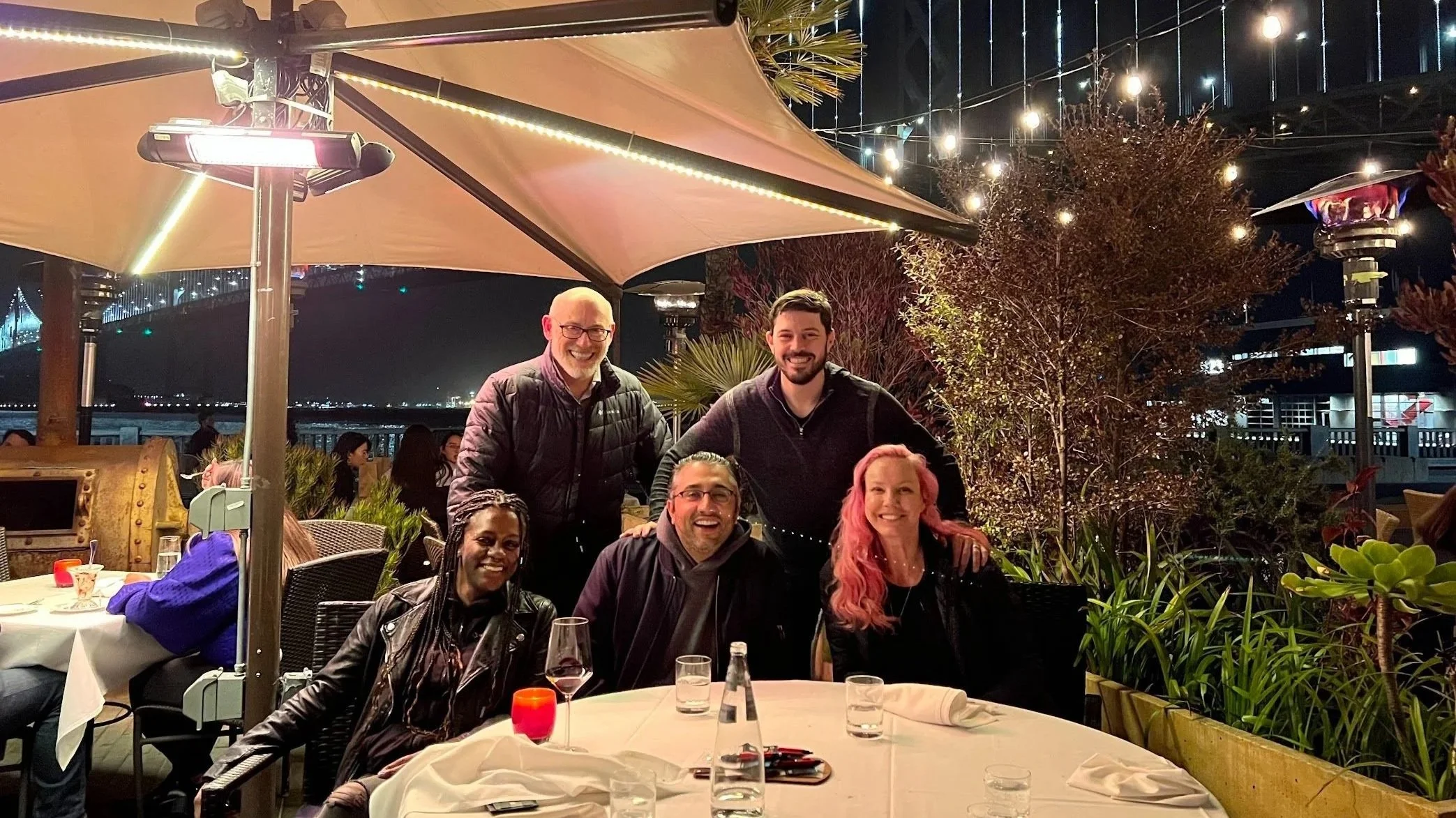
A gathering of a few old friends
A few of these individuals were founders of unicorns. But all of us had direct, firsthand experience with billion-dollar tech companies (as key employees, founders/early employees of companies that were acquired into unicorns, and as investors). We had each seen firsthand the best practices and work habits necessary to reach the highest echelons of tech.
That experience is key. But it’s not just the employees. It’s their personal networks and the multiplier effect that comes from them.
On Density and Mentorship
The world’s best accelerators surround founders with mentors and subject-matter experts who have directly contributed to some of the world’s most successful tech companies. Some of those mentors are employees of the accelerator. Many more come from the employees’ personal networks.
It’s this ability to provide founders with a wide variety of high-quality mentorship that differentiates the best accelerators from the rest. Ultimately, quantity of “good” mentors matters to the ongoing success of an accelerator almost as much as quality.
The companies within an accelerator batch are generally trying to solve vastly different problems in a variety of markets. While some of the mentorship topics (e.g. fundraising) have commonality across the batch, many more — from sales and marketing to product development — differ. So being able to pair each founder with multiple mentors who have direct experience in their industry and with the specific problems they’re trying to overcome matters.
If you think about my friend Kenndal, he’s a phenomenal mentor for anyone who wants to play professional sports. But he has far more to offer someone whose specific goal is to play left wing in the NHL than others. As a mentee strays further away from his lived experience (from left wing to other hockey positions and from hockey to other sports), his experiences and mentorship will necessarily be less relevant and specific. Introductions that he can potentially make will similarly be fewer and less direct.
This is why accelerators in smaller ecosystems generally fail over the long term. Even if there are a handful of unicorns locally, the specific experience and advice of the mentors coming from those companies will only resonate with a subset of founders. You can also only call on those same people so many times. If you think about it as a “snowball effect”, it’s a lot harder to build a snowman when there isn’t much snow on the ground.
This is why Silicon Valley has such an advantage when it comes to startup acceleration: experience and mentorship compounds.
When I was at 500 Startups, if I wanted someone with a particular type of experience to stop by (for office hours, to meet with a specific company or to deliver a talk), I could easily reach out to multiple people at multiple companies and find someone willing and able to drop by our San Francisco office. That’s simply not possible anywhere else in the world.
Even YC — which originally split batches between Silicon Valley and Boston/Cambridge — ultimately shifted entirely to the Bay Area. In 2009, Paul Graham wrote the following:
“I think it will be better for the startups we fund to all be in the Valley. We never tried to claim to the startups in the summer cycles that it was a net advantage to be in Boston. The most we could claim was that we could mitigate the disadvantages sufficiently well—for example, by flying everyone out to California to present to investors at our Mountain View office. But we did worry that the Boston groups were losing out. Boston just doesn't have the startup culture that the Valley does. It has more startup culture than anywhere else, but the gap between number 1 and number 2 is huge; nothing makes that clearer than alternating between them.”
But, But, But…
“But wait!” you say, “What about all of those big name accelerators around the world?”
How could the above claim hold true if so many prominent accelerators have created programs in cities around the world?
Simple.
Those “global” programs aren’t actually startup accelerators. They’re mostly government- and corporate-funded startup schools.
About 10 years ago, governments and corporates started approaching some of Silicon Valley’s accelerators with a proposition: if we pay you money, will you run a program locally in our ecosystem / for our specific industry?
At first glance, there seemed to be clear synergies. Founders in underrepresented geographies or industries would get programming, education and mentorship from experienced Silicon Valley founders and investors. Accelerators would gain exposure, access to new markets and revenue. They could expand their impact globally (which many genuinely wanted to do). But it didn’t take long before the shine wore off.
It turns out that few, if any, of these programs consistently birthed companies that the accelerators actually wanted to invest in. So while the first few batches were typically led by experienced Silicon Valley founders and investors excited to visit new ecosystems, before long the quality of mentorship plummeted as the accelerators shifted resources. Out of town experts were soon replaced with inexperienced local mentors, augmented by a roving band of “digital nomad” mentors who travel the world, offering their services to any accelerator or incubator willing to pay their room and board (trust me, there’s a lot of them).
Over time, many of these accelerators became addicted to the (very significant) revenue that governments and corporates around the world offered. They created entire divisions dedicated to selling and staffing such programs (in some cases, those divisions became larger than the actual core fund / accelerator). A focus on DPI was replaced by an obsession with program margin, often with disastrous consequences.
But There Have Been Successes Outside of Silicon Valley
Yes and no.
Over the past 20 years, there have been a number of examples of accelerators operating successfully for brief periods of time outside of Silicon Valley. But almost none of them succeeded over the long-term. In many cases, these programs were founded in nascent startup ecosystems hungry for any sort of cohort-based programming and benefited from an initial "burst” of extremely high quality founders. In others, an initial set of high-quality mentors eventually gave way to inexperienced replacements, with the quality of the program (and its results) soon following. We really haven’t seen accelerators form outside of Silicon Valley that have repeatedly, consistently shown an ability to take early-stage startups and accelerate them into unicorns.
What we have seen come out of other geographies are some of the most incredible, innovative “pre-acceleration” programs. Recall my earlier assertion that a startup accelerator is a program that is purpose-built to accelerate the trajectory of a high-growth tech startup. What about before then?
In 2011, Matt Clifford and Alice Bentinck founded Entrepreneur First in London. Their observation: that there was a lack of mentorship and guidance available for talented individuals who had the potential to be founders but didn’t necessarily have a specific idea in mind.
In 2012, Ajay Agarwal founded Creative Destruction Lab at the University of Toronto. His observation: too many PhD researchers were being hired directly into large tech companies instead of commercializing their research.
Both of these organizations have become globally impactful, each with billions of dollars worth of equity value created and multiple unicorns emerging from their programs.
(At this point, I’ll admit that the line between accelerator and pre-accelerator is a blurry one at best. YC, for example, is known to accept some founders whose ideas aren’t yet fully formed, while both Entrepreneur First and Creative Destruction Lab accept incorporated startups. The distinction as I see it is about whether the program primarily focuses on helping founders figure out whether or not a concept could be massive vs. instilling the best practices and work habits necessary to accelerate and ultimately reach that level of success.)
Accelerating the Rest of the World
We’re getting to the finish line here, I promise!
If the quintessential requirement of a good startup accelerator is good mentorship and only Silicon Valley has a sufficient quantity and diversity of mentors to cater to a wide diversity of founders, how can we reasonably accelerate startups in the rest of the world?
By leveraging Silicon Valley’s talent.
Side note: I’ve found over the years that, for some reason, this simple, seemingly innocuous statement offends a lot of people.
If I were to say to a minor league hockey coach, “I can bring some former NHL players to come work with your kids for a week,” or “We’re running a camp on the sidelines of this year’s all-star game and we’d like to invite some of your kids to join,” every single coach would be over the moon. No one would respond, “No, no…we don’t need that. One guy from our town made the NHL 15 years ago. We’re good.” Yet for some reason that’s the reaction that comes from many ecosystem builders when it comes building connections with Silicon Valley.
I’m not going to go down the rabbit hole of why this happens (it’s surely a deep one). Suffice to say, the idea of leveraging the world’s largest pool of startup experience to augment local mentors shouldn’t be a controversial one.
In any case, there are two obvious ways to leverage Silicon Valley experience for the benefit of global ecosystems: bring Silicon Valley’s mentors to the world or bring the world’s startups to Silicon Valley.
Both approaches can work. In fact, they’re not even exclusionary.
I won’t go into a discussion of how to do this — that’s a post for another day. Instead, I’ll conclude with the following observation:
Like many things in Startupland™, the majority of accelerators around the world have failed as a result trying to replicate something that can (at least today) only work at scale in Silicon Valley. But that doesn’t mean there can’t be successes elsewhere.
They just won’t look like “the YC of X.”

Stay Hungry, Stay Foolish
Stay hungry, stay foolish. A simple phrase so effortlessly and completely captures the ethos of being a founder.
Twenty years ago, Steve Jobs encouraged the graduating students of Stanford University to “stay hungry, stay foolish.” The phrase originated in a counter culture magazine called the Whole Earth Catalog that was published in the late-1960s and early 70s. If you haven’t heard of WEG before, it was the precursor to print publications like Make Magazine and Tom’s Hardware Guide and pretty much birthed the entire genre of media combining DIY, product reviews and a dash of social commentary (Top Gear, anyone?).
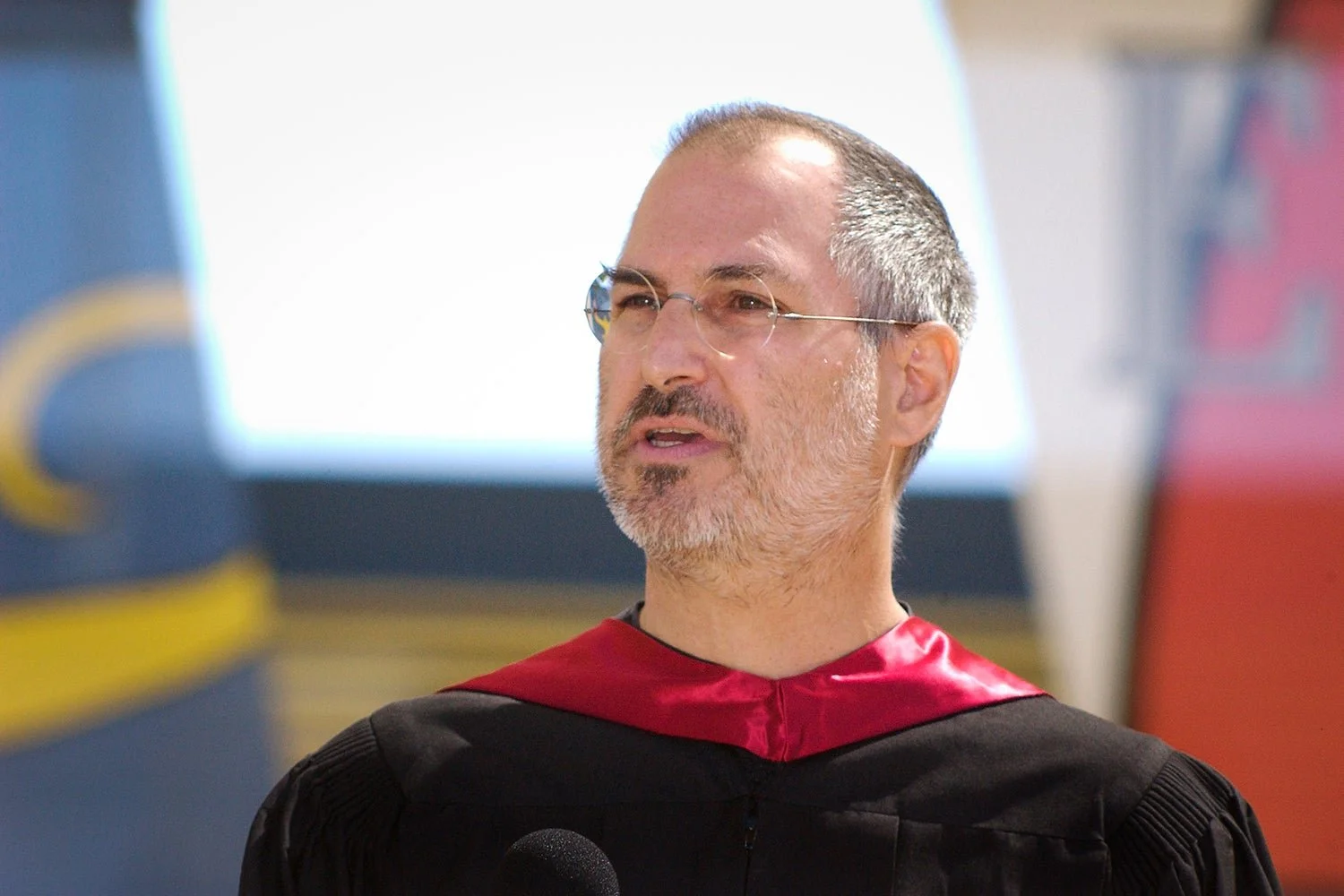
Stanford University Commencement, June 2025
The phrase “stay hungry, stay foolish” was a directive from the magazine’s authors to actively seek out knowledge and remain curious and open. To question the status quo.

The back cover of the final edition of the Whole Earth Catalog
This simple phrase so effortlessly and completely captures the ethos of being a founder. It evokes determination and resolve. It commands continuous reflection, iteration and improvement. The word “foolish” can equally well refer to a hunger for knowledge as it can the naivety of believing that you can single-handedly change the world. And it quickly became a rallying cry in startup circles in Silicon Valley and around the world.
As an investor, this is one of the phrases that goes through my mind when I meet new founders. I try to get a sense of their level of “hunger” and “foolishness”. Here’s what I mean:
How Hungry Are You?
Depending on how you interpret this question, it can mean different things. Here are some of the variations that go through my head when meeting a founder:
How important is it to you to solve this problem? Why is this the thing that you want to dedicate the next 7 - 10 years of your life to? What are your motivations (beyond financial)?
How badly do you want to win? Assuming that this is a winner-takes all / winner-takes most market, how hard are you going to compete? What will keep you going when things get really, really tough?
How hard are you going right now? Velocity is the one metric that matters most. What is yours? How are you benchmarking your progress?
How driven are you to self-improve? The best founders are driven to continuously improve themselves. Some are avid readers. Some obsess over exercise and diet. Some have therapists, executive coaches or both. Some founders just really, really want to win their annual football/hockey/basketball pool. In my experience, the best founders are constantly trying to get better at multiple things, both inside and outside of their startup (though I don’t recommend playing League of Legends during an investor pitch meeting).
How Foolish Are You?
This question similarly evokes multiple characteristics of strong founders:
Do you have a beginners mind? Are you willing to be wrong? When faced with new information, do you incorporate it and adapt your thinking?
How much time do you spend learning? What are your sources of information? What do you do proactively to learn and improve (despite having less-than-no-time in your day)?
What do you do outside of your role as a founder? To me, this is a very important question. It’s not a question about work-life-balance but, rather, it’s about making sure that you’re not so insulated in your bubble that you are oblivious to lessons and revelations from other disciplines and aspects of life.
Do you find time for deep thinking? The best founders prioritize time for regular reflection. But it doesn’t have to come in the form of a half-day block in your calendar. Some founders think while doing exercise. Others carve out time in the mornings, at night or on weekends. When I was a founder, I did a lot of my thinking during regular 2-hour commutes between San Francisco and Palo Alto.
Are you open to new people and new opportunities? What are you doing to expand your personal and professional networks? Are you proactively getting to know people beyond your immediate circle of friends and colleagues? Are you keeping an eye on the broader market in order to know how the players are moving and the market is evolving?
One simple phrase. Four short words. To paraphrase the late Steve Jobs:
Stay hungry. Stay foolish.
I've always wished that for myself. And I wish that for you.
Stay hungry. Stay foolish.
Things I Think I Think - Q3 2025
The memories of summer are fading. Burning Man is over. And the kids are back in school. Here are 5 Things I Think I Think: Q3 2025.
The memories of summer are already starting to fade away. Burning Man is over. So is the After Burn. And the After After Burn. Best of all? The kids are back in school 🙌. Time to shift gears and get into fall with my latest homage to legendary sports columnist Peter King.
Here are 5 Things I Think I Think - Q3 2025 Edition:
1. Orange is the New Triple, Triple, Double
It used to be that venture capitalists’ preferred roadmap for success was the “triple, triple, double, double, double”. The path is simple (at least, according to MBA-types who’ve never actually run a business): Just get to $1.5M in revenue, then triple it the following year. And triple it the year after that. And then double it for the next three years. Voila! You’ve got a $100M business and are ready to go public.

Now, some VCs are latching onto an even more audacious blueprint. Hemant Taneja of General Catalyst recently had this to say:
“Triple, triple, double, double is definitely dead. I tell our investors: don’t bring that to me <laugh>…Going from $1M to $3M to $9M is not interesting…you gotta go, like, $1M to $15 - $20M to $100M.”
His comments were polarizing, to say this least.

As aloof as Hemant’s comments might seem, they reflect the converging perspective of a growing number of VCs. At the start of the summer, I wrote about some of the changes that are happening amongst early-stage investors. In the post, I shared the following anecdote:
“I [recently] met a founder who was extremely frustrated with the lack of progress they’d made raising capital from VCs. In relaying their experience to me, the founder proclaimed that they had a stellar founding team with an amazing track record, a working prototype and clear evidence of a market need. Yet they were getting zero traction with investors.
Later that day, I looked up the founder’s company and thought to myself, “what a nice, incremental business.”
…
To be clear, there was nothing wrong with this founder’s business. It was — and is — a perfectly reasonable B2B SaaS company. The type that was built to solve a real problem and that very likely would have been able to raise VC funding 2 years ago (not because of ZIRP, but because it is a perfectly reasonable company solving a real problem).
Yet in comparison to AI companies, with their unprecedented growth trajectories, and deep tech companies, with their imagination-bending potential, it just felt…
…incremental.”
It used to be that a startup achieving “triple, triple, double, double, double” growth was rare and exciting. Only the best-of-the-best could achieve it. Now, the definition of “exceptional” growth has fundamentally changed. And, like it or not, VCs chasing power law outcomes can’t unsee that.

2. But, But, But…
As much as some VCs — particularly those associated with Silicon Valley’s billion-dollar funds — are extolling the virtues of these AI-driven money machines, other investors are raising the alarms.

So what does all this mean for founders?
For starters, if your company is building an AI-first “prosumer” product — or anything where distribution should reasonably follow AI adoption — this type of extreme growth is what investors are looking for. But, more than that, if you’re any type of SaaS-y company, this is the benchmark against which you’re now being compared.
That may not seem fair, but it’s happening.
We’re now seeing companies go from zero to $10M in ARR (or more) in less than two years with an increasing degree of regularity. To be clear, this is still very much the exception to the rule, but it’s occuring frequently enough that a small but growing number of VCs are holding their dry power until and unless they see such growth.
At the same time, many investors are questioning how sticky this revenue will be. What percentage of these companies will be able to maintain their revenue and customer base after the initial growth explosion (vs. seeing it collapse like a house of cards)? At this point, we simply don’t know. So while some VCs are tripping over themselves to chase these extreme growth companies, others are steering clear.
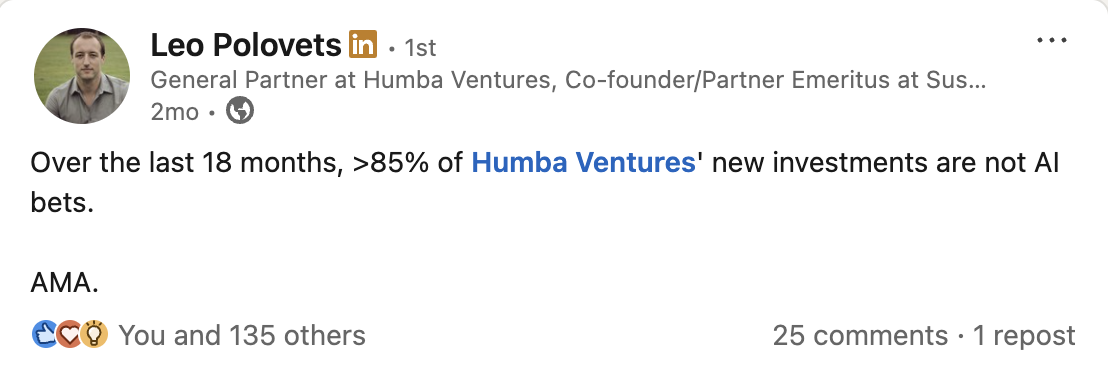
If you’re a founder raising capital this fall, my biggest advice is to cast a wide net. There’s a lot of capital flowing right now, but also an unusual degree of opacity around what individual investors are looking for.
3. A Tale of Two Ecosystems
Speaking of capital flowing, the difference between what’s happening in Silicon Valley right now and what we’re seeing in the rest of the world couldn’t be more stark.
It’s only one month into the fall fundraising season and I’ve seen dozens of pre-seed deals happen in the Bay Area in only days, while Seed and Series A rounds are going from first meeting to term sheets in 1-2 weeks. By contrast, I’ve spoken with founders in Canada, the UK and elsewhere who are struggling to get local investors across-the-line. Why the difference?
Outside of the U.S., the dry powder we’ve been hearing so much about for the past few years is starting to dry up.
Take Canada, for example, According to a recent Betakit article,
“Canadian VCs, particularly emerging managers, are struggling to raise new capital. According to BDC, only 17 funds raised a total of $2 billion in 2024, marking a year-over-year decline in dollars raised and average fund size. The share of emerging managers is shrinking: the report shows that established managers, considered to be those who have raised more than three funds, now make up 20 percent of active GPs—the largest share in a decade.”
To put that in context, in 2024 a16z raised 3.6x as much capital as all Canadian VCs combined.

A year later, we’re starting to see the impact. According to the Canadian Venture Capital Association, in the first half of 2025 there was “…a 26% decline in dollars invested and a 22% drop in deal count [by Canadian VCs] compared to H1 2024.”
Why does this matter?
Throughout the world, early-stage funding rounds are overwhelmingly led by local investors. A small percentage of international founders each year succeed in raising capital from Silicon Valley VCs, but the vast majority rely on local VCs and angels for their first few rounds of funding. The mythical U.S. lead investor is just that: a myth. A reduction in early-stage domestic capital can, therefore, have a long-term negative impact on a country’s entire tech ecosystem.
A drop in the share of emerging managers (newer VCs) is an even bigger red flag for a country’s startup ecosystem.
Bottom line: if institutional and corporate LPs outside of the U.S. continue to sit on their hands, their countries risk missing out on what looks to be the biggest and most consequential technological (and economic) shift in our lifetimes.
So yeah…it’s a big deal.
4. Founders Are On the Move
While VCs in some countries are struggling, founders are sprinting as fast as they can. And going wherever they need to.
A few weeks ago, I reached out to a handful of young Canadian founders about putting together an impromptu mixer in San Francisco. I figured 10 or 12 might show up. More than 30 founders descended on the bar in Lower Haight (much to the chagrin of some of the locals).
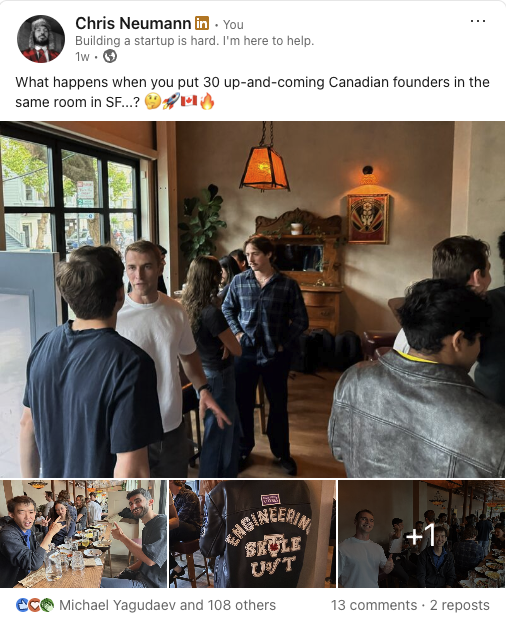
That might not seem like a big deal, but consider this: nearly half of them flew in from Vancouver, Toronto and Montreal just for this event.
For awhile now, I’ve observed an increasing mobility amongst founders — particularly Gen Z founders — who seem utterly unencumbered by the cost or complexity of going back-and-forth between cities. As someone who’s spent a long time championing the importance of spending time in Silicon Valley, I consider this a strong signal when it comes to the potential of the next generation of founders. But even I’ve been shocked by how quickly and widely their expat networks are expanding — often without any involvement or support of past generations of founders.

There’s a lot to unpack here (and I plan to in a future post), but for now I’ll say this: the mental model that the current generation of founders has when it comes to operating in and across multiple ecosystems if fundamentally different than generations past. And that’s really exciting.
5. Speaking of On the Move
The past few weeks in Startupland™ have been dominated by coverage of the U.S. administration’s introduction of a $100,000 fee on H-1B applications. Since that announcement was made, multiple countries — from Canada to China — have introduced or are in the process of introducing policies designed to lure foreign workers away from the U.S.
While those efforts are domestically very popular, I continue to believe that the reactions to the policy change (both inside and outside of the U.S.) are much ado about nothing. While some people and companies will undoubtedly be impacted by the change, I don’t believe that this will result in a sudden flow of talent away from the U.S. Here’s what Democrat megadonor Reed Hastings had to say:

Reed’s take was certainly against the flow when it came to Silicon Valley reactions, but I think it’s the correct one if you reframe the categorization of high tech visas as follows:
H-1Bs will be used for very high value jobs
O-1s will be used for very high value people
Much Ado About Nothing, H-1B Edition
What does the announcement of a $100,000 fee for H-1B visas mean for startups in the U.S. and tech ecosystems around the world?
Let’s jump right in with the biggest news in Startupland™ this week: the announcement that the U.S. is increasing the fee to apply for an H-1B visa to $100,000.
What does this announcement mean for startups in the U.S. and tech ecosystems around the world?

Absolutely. Nothing.
Before you interrupt me to explain how wrong I am, why this changes everything for America, or why your favorite non-U.S. city/state/country stands to benefit, hear me out.
Since President Trump’s announcement last Friday, the internet has been awash with hot takes. Why is Chris Neumann’s any better? For starters, I’ve actually been on an H-1B visa. Moreover, I’ve also hired people on H-1B visas. I’ve worked at big U.S. tech companies and small ones. I’ve been a founder and a VC. None of these facts make me an immigration lawyer by any stretch of the imagination, but they make my understanding of what these visas are, how they’re used by tech companies, and the potential impact of this announcement better than 99% of what you’ve read so far.
So let’s dive right in, starting with a quick primer…
What is an H-1B visa?
Established under the Immigration Act of 1990, the H-1B program enables U.S. employers to temporarily hire highly-skilled foreign professionals in specialized occupations, primarily in science, technology, engineering and mathematics (STEM) fields.
U.S. companies apply for the visa on behalf of prospective employees, who must have at least a bachelor’s degree in their area of specialization. There are three buckets for H-1Bs:
Up to 65,000 petitions each year are granted to general applicants
An additional 20,000 petitions each year are granted specifically to applicants who earned a master’s degree or higher from a U.S. institution
A further category of H-1B petitions, known as cap-exempt petitions, enables universities, government research organizations and certain non-profits to apply for H-1Bs visas outside of the congressionally-mandated annual cap
Note that the H-1B caps described above are for “initial employment” visas (visas granted to people who did not previously have an ongoing right to work in the U.S.) as opposed to extensions/adjustments to existing H-1B visas.
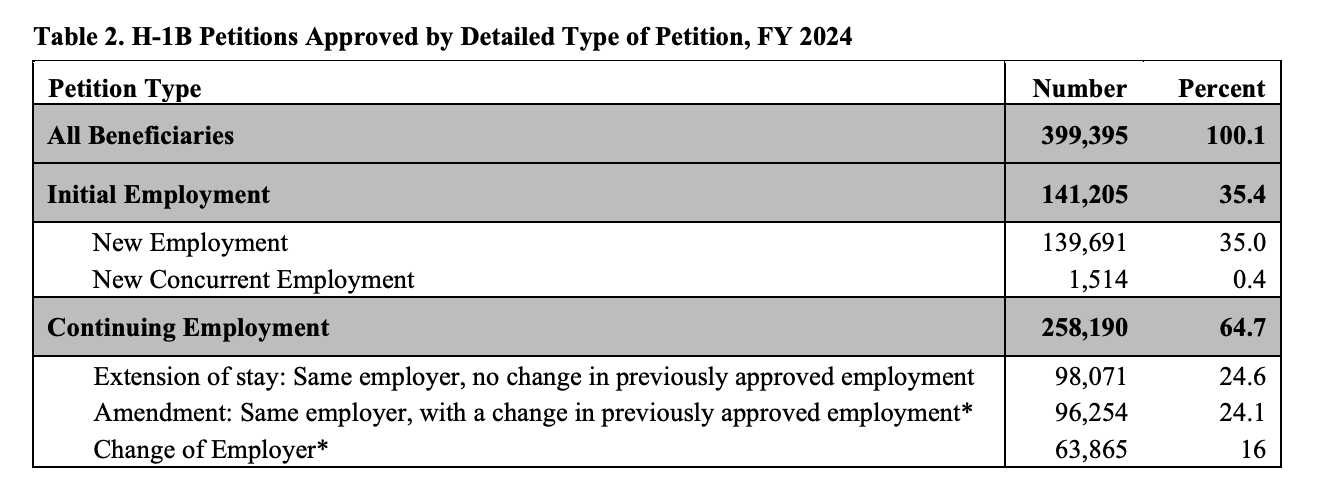
To give a sense of scale, according to the USCIS report to congress on the Characteristics of H-1B Specialty Occupation Workers for FY 2024, 141,205 H-1B petitions were granted for initial employment in FY 2024 (which we can reasonably assume consisted of 65,000 general petitions, 20,000 petitions for individuals with a U.S. master’s degree or higher, and 56,205 cap-exempt petitions), while 258,190 were approved for continuing employment:
Who Gets H-1B Visas?
Contrary to popular belief, H-1B visas are not only used to bring new workers into the U.S. from other countries. In fact, they are mostly used to keep highly-skilled workers in the U.S.
In its report to congress, USCIS noted the following breakdown of the 141,205 H-1B petitions for initial employment that were approved in FY 2024,
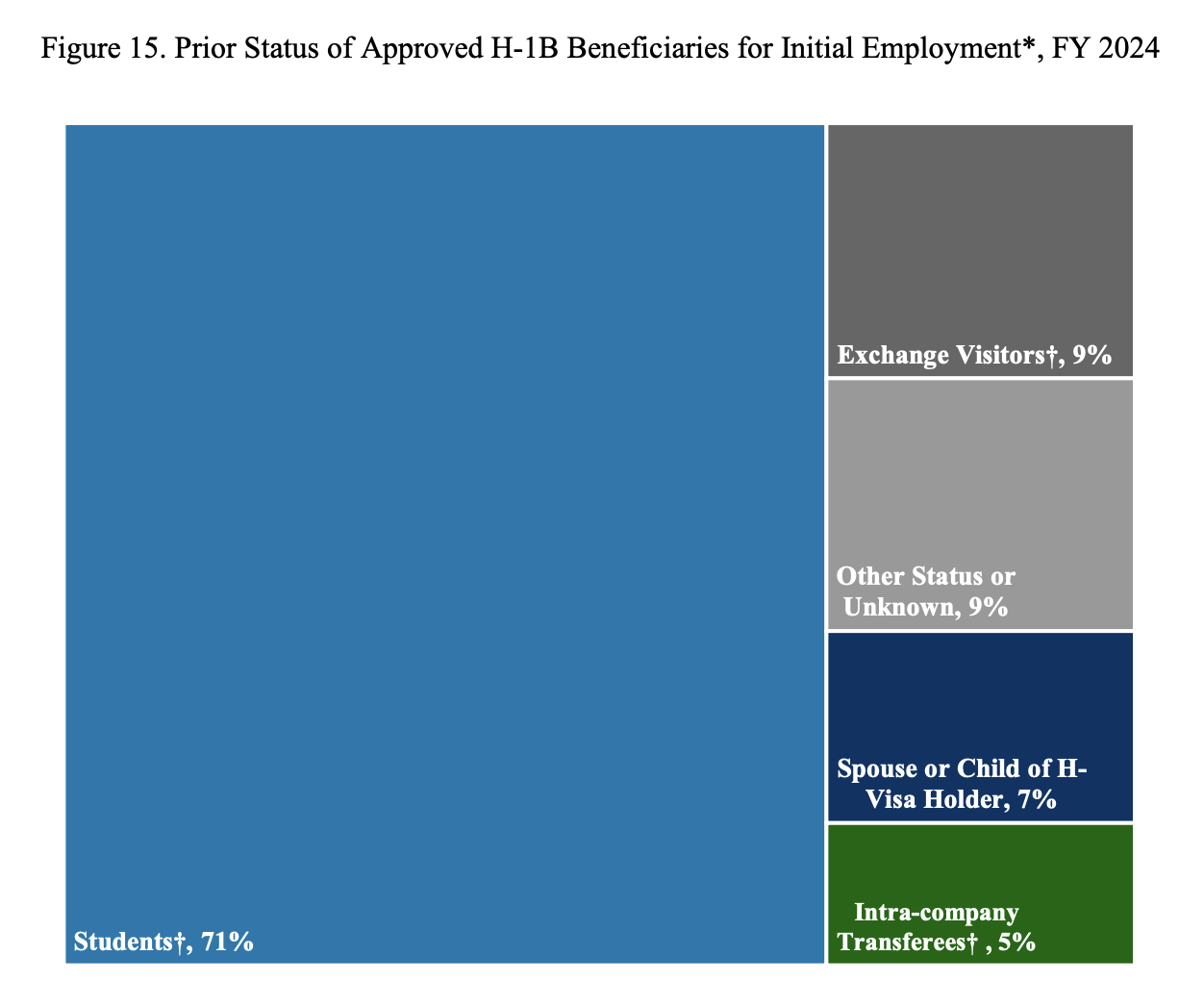
“Of the 141,205 petitions approved in FY 2024 for initial employment, almost 46 percent requested consular (or port of entry) notification, and the remaining approximate 54 percent requested a change to H-1B nonimmigrant status for a beneficiary already in the United States.”
In other words, 54% of the approved petitions for “initial employment” H-1Bs went to people who were already in the U.S. on other, non-employment visas. The vast majority of those (more than 71%) were transitioning to H-1Bs from student visas. This is the path that I personally took after graduating from Stanford with my master’s degree (we’ll get back to this point later).
Who Sponsors H-1B Visas?
All H-1B visa petitions must be submitted / sponsored by a U.S. company. The significant majority are sponsored by tech companies (which should come as no surprise to most readers). What might be surprising is the types of tech companies that sponsor H-1B petitions. According to the USCIS Data Hub, the top 10 petitioners for FY 2024 included 6 of the largest tech companies in the U.S. (Amazon, Google, Meta, Microsoft, Apple and IBM). The other 4? U.S. subsidiaries of India’s largest consulting companies (Infosys, Cognizant, Tata and HCL).
If you’re wondering why the the topic of H-1B visas is so contentious in the U.S. right now, here it is in one chart:
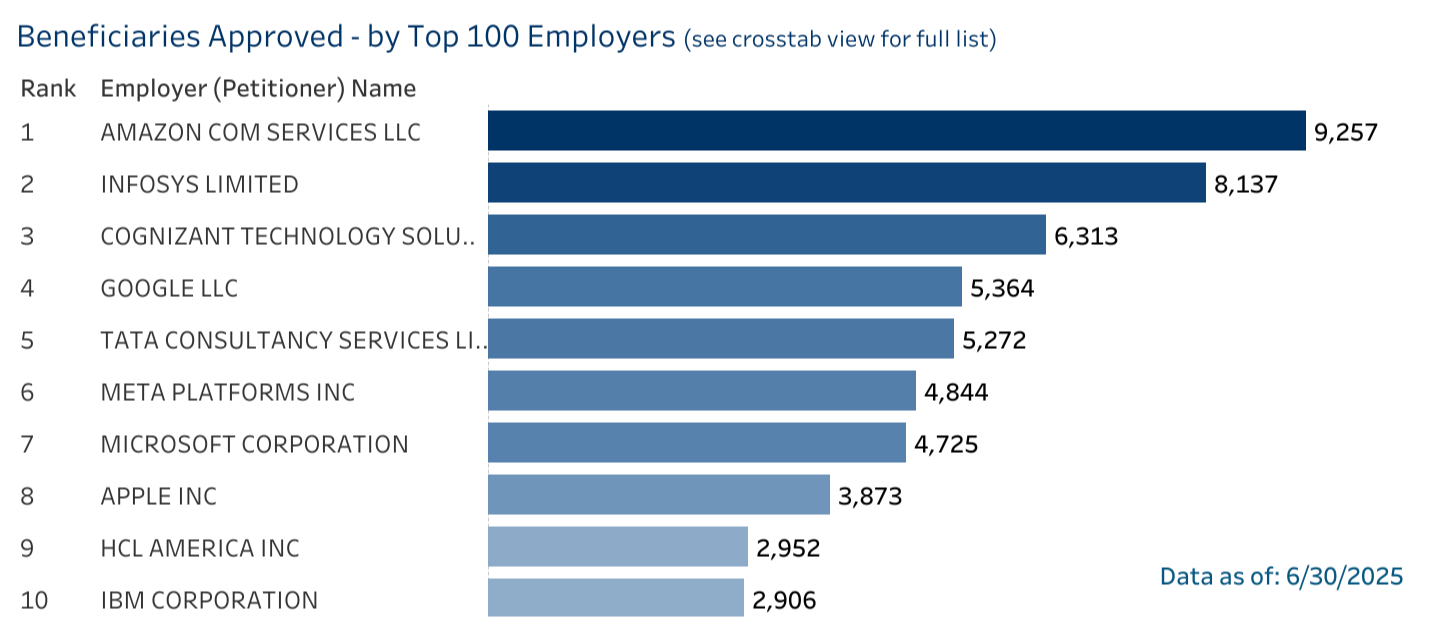
Despite all of the political rhetoric, the biggest critique of H-1Bs has never really been that U.S. companies use them to hire the best and brightest from around the world in place of American workers. Rather, it’s the perception that foreign consulting firms have been leveraging the program to bring in foreign workers to service U.S. clients (ostensibly at lower wages). I don’t know the degree to which these criticisms hold true, but it certainly doesn’t look good.
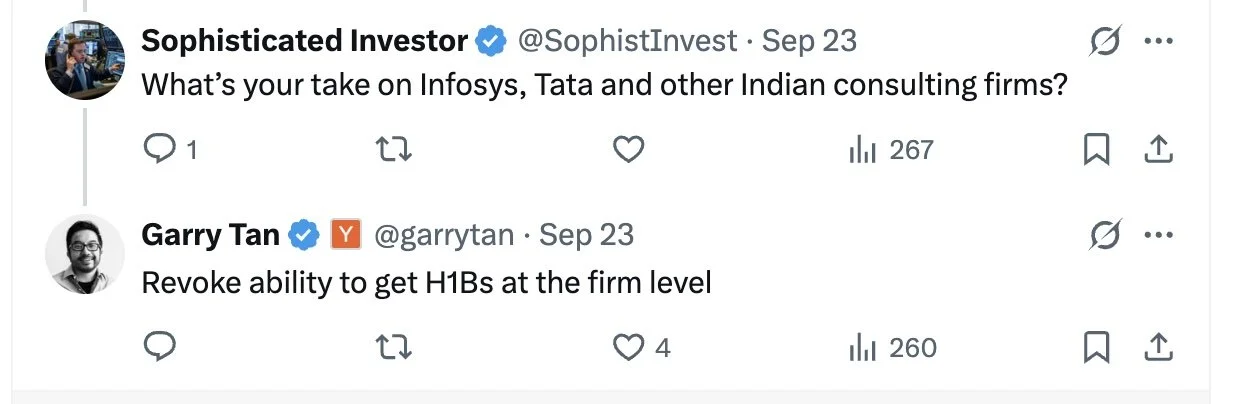
Y Combinator CEO Garry Tan has some thoughts on the matter
In fact, if you go through the top 100 list of H-1B petitioners on the USCIS website, alongside a “who’s who” of American tech giants you’ll find a surprising number of U.S. subsidiaries of foreign-owned consulting companies. You know what you won’t find? Actual startups.
Do Startups Hire H-1B Employees?
The short answer is “sometimes”. And that “sometimes” comes with a lot of caveats.
The first thing to note about H-1B visa applications is that “initial employment” petitions take a long time to approve. The approval process (known as the H-1B lottery) only takes place once per year. So depending on when an application gets filed, it could easily take a year or more for an H-1B petition to be approved — if it’s approved at all.
That’s way too long for most startups to wait. Especially when there are other options.
Here’s the reality: the vast majority of U.S. startups don’t hire any foreign workers using initial employment visas. At least, not in their early days.
Why not? Because hiring employees on initial employment visas takes time, costs money and is generally a pain-in-the-ass. It’s far more efficient and effective for startups to hire Americans. No immigration. No complications.
When they do hire nonimmigrant workers, early-stage startups prefer to hire people who already have a visa.
Transferring Sponsorship of H-1B Visas
In FY 2024, 16% of H-1B actions (covering nearly nearly 64,000 individual workers) were transfers of H-1Bs from one employer to another. That’s how a lot of startups hire foreign-born workers. In fact, that’s what happened to me. My initial H-1B petition (approved under the category for individuals with U.S. master’s degrees) was filed by a big U.S. tech company known as Motorola (remember them?). When I joined my former classmates from Stanford a few years later as Aster Data’s first employee, they simply filed the paperwork to transfer sponsorship of my visa over. There was no uncertainty. No long wait. Just some simple paperwork and a (relatively small) transfer fee.
Guess what startups often get when they hire an ambitious young (foreign-born) engineer with a couple of years of experience at Google/Meta/Apple/etc.? A freshly-approved H-1B.
According to USCIS, the fee change announced last week will have no impact on this path:
“This Proclamation does not:
- Apply to any previously issued H-1B visas, or any petitions submitted prior to 12:01 a.m. eastern daylight time on September 21, 2025.
- Does not change any payments or fees required to be submitted in connection with any H-1B renewals. The fee is a one-time fee on submission of a new H-1B petition.
- Does not prevent any holder of a current H-1B visa from traveling in and out of the United States.”
Transferring from Other Visas to H-1B Visas
Another common approach that startups use to hire foreign-born workers is to hire individuals who are already in the U.S. on another visa.
Earlier, I noted that 71% of the H-1B visas granted in FY 2024 to holders of other visas went to individuals who were already in the U.S. on student visas. (That’s 52,385 visas for those keeping track.) How does this work if it can take a year or more to complete an H-1B petition?
It works because F-1 visas come with up to 36 months of post-graduation work authorization.
When it comes to taking advantage of the economic benefits of foreign-born students educated in the U.S., America isn’t dumb. New graduates with designated STEM degrees can legally work in the U.S. for up to 3 years after graduation while their employers petition for an H-1B or other long-term visa on their behalf.
And guess who early-stage startups tend to hire? New graduates.
The change announced last week will have minimal impact on the very healthy pipeline of foreign-born students → U.S. universities → U.S. startups.
(I won’t say zero, as there are likely some individuals who might choose to go to a “big tech” company before joining a startup to increase the likelihood of getting a long-term work visa. But as I described above, that isn’t a new phenomenon.)
It is worth nothing that the change to H-1B petition fees does impact the transition of individuals who begin working at startups on F-1 work authorizations to H-1Bs. But as we’ll see below, there are other potential paths for such individuals. (It’s also worth noting that as of the publishing of this post, there are already discussions underway about potential exemptions to the fee for smaller companies.)
What About Startup Founders? Won’t They Leave?
Probably not.
One important thing to understand is that the H-1B visa isn’t the only employment visa available for tech workers in the U.S. And when it comes to startups, it isn’t necessarily even the best one.
The H-1B wasn’t the only tech-friendly visa established under the Immigration Act of 1990. The Act also established the O-1 nonimmigrant visa, for “the individual who possesses extraordinary ability in the sciences, arts, education, business, or athletics.” In recent years, it has become the preferred option for startup founders and many early employees of startups for three big reasons:
No Annual Cap: Unlike the H-1B, there is no annual cap on O-1 visas.
Shorter Processing Time: Whereas H-1B applications are only processed once per year, O-1 petitions can be processed within weeks of the application being filed, regardless of when the petition is filed.
Certainty: Whereas H-1B recipients are chosen randomly from a pool of qualified applicants as part of a lottery, O-1 visas are granted entirely on the merit of the petition.
It’s only in recent years that O-1s became more common among startups and for a simple reason: they’re harder to qualify for.
To qualify for an H-1B, an individual needs little more than an offer letter and a degree from a qualifying institution. An O-1 is much more involved than that. To qualify for an O-1, the petitioner must provide evidence that the individual is of “extraordinary ability” within their industry:
“The petitioner must provide evidence demonstrating your extraordinary ability in the sciences, arts, business, education, or athletics, or extraordinary achievement in the motion picture industry. The record must include at least three different types of documentation corresponding to those listed in the regulations, or comparable evidence in certain circumstances, and the evidence must, as a whole, demonstrate that you meet the relevant standards for classification.“
Guess what? Many startup founders and early employees fall into that category.
So What Does This Change Actually Mean?
At the start of this post, I posed the question, “what does this announcement mean for startups and tech ecosystems around the world?”
If we ignore the politics around this change and focus only on (1) what has been officially announced by the administration (including the most recent clarifications) and (2) how H-1B visas actually work and are used in practice, here is my personal opinion:
1. What Will Be the Impact on Startups?
Despite all of the rhetoric, increasing the application fee for new H-1B petitions will have little-to-no impact on startups in the U.S.
At the early stages, relatively few startups submit initial employment H-1Bs. Those that do can potentially take advantage of other visa programs and/or are likely to have raised enough funding to be able to absorb the cost (considering that many VC-backed startups in the U.S. spend more than $100K on recruiters or legal fees).
Don’t believe me? The best example the Wall Street Journal could find of a startup founder claiming that he would stop using H-1Bs as a result of this change raised $6M in VC funding, employs 11 people — 5 of whom are remote contractors in South Africa and Portugal — and has hired *checks notes* one H-1B worker 🤦♂️.
Still don’t believe me? Here’s what Democratic megadonor Reed Hastings had to say:

Granted, Reed’s take was certainly against the flow when it came to Silicon Valley reactions, but I think it’s the correct one if you reframe the categorization of visas as follows:
H-1Bs will be used for very high value jobs
O-1s will be used for very high value people
2. What will be the Impact on Ecosystems Outside of the U.S.?
As much as politicians and ecosystem advocates around the world rushed to proclaim that this was a massive own-goal on the part of the U.S., I doubt that we’re going to see much (if any) impact in other countries.
Big tech companies in the U.S. won’t blink an eye when it comes to paying this fee. Neither will startups if the jobs are very high value (they will also continue to happily hire workers who spent a few years at a big company in order to get a visa).
We may see a reduction in the number of H-1B applications from consulting companies — who are often driven far more by per-employee margins than other organizations — but that won’t necessarily translate into increases in immigration elsewhere (unless those consulting companies suddenly increase their non-U.S. hiring).
My good friend Alex Norman, Founding Partner of Canadian Pre-Seed firm N49P (who incidentally also previously worked in the U.S. on an H-1B visa) had perhaps the best take on this:
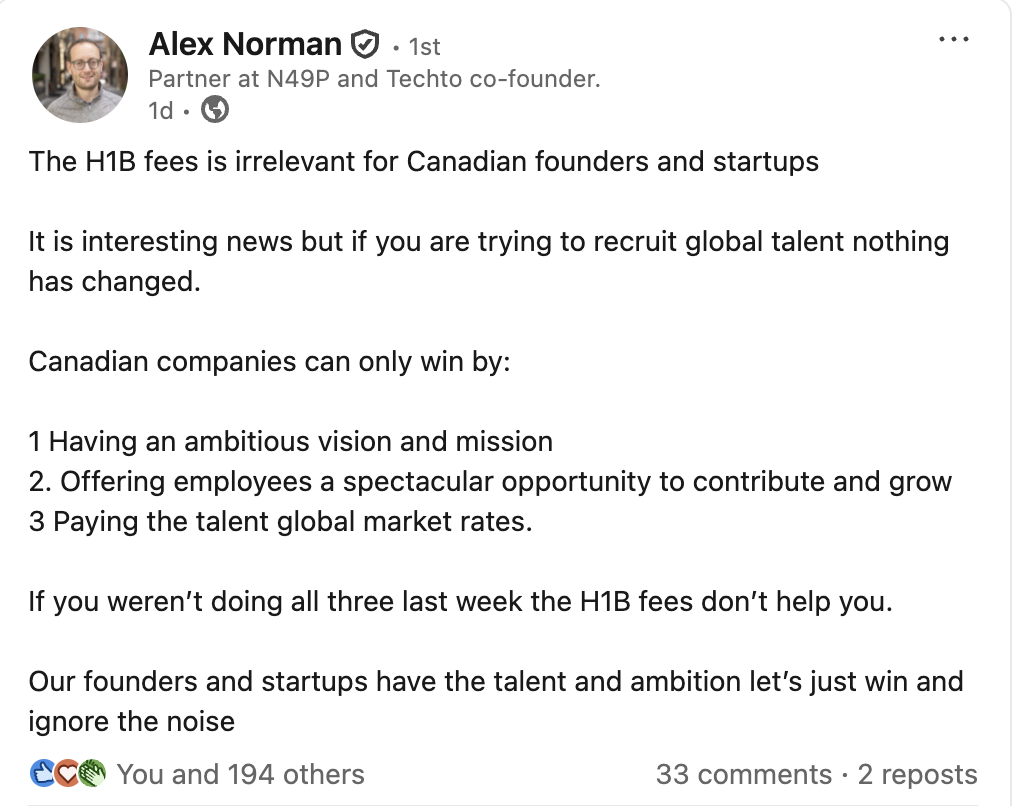
Or as Jack Dorsey once said, “You can worry about the competition…or you can focus on what’s ahead of you and drive fast.”
10 Anthems for Startup Founders
Here are 10 songs that perfectly capture the journey of a startup founder. And they’re probably not the ones you would expect.
One of my favorite inventions in modern sports is the walk out song. The idea originated back in the 70s, when Chicago White Sox organist Nancy Faust started playing different songs to entertain fans when the players came up to bat. In the late 80s and early 90s, teams began using short clips from recorded songs for player entrances. But it wasn’t until 1995, when a brash rookie named Derek Jeter requested Montell Jordan’s This is How we Do It for his very first professional at-bat, that the trend of players choosing their own entrance music caught fire.
Today, walk out songs can be found across sports and around the world. They’ve even found their way into Startupland™. Back when I was at 500 Startups, founders got to choose their walk out songs when presenting on demo day (I’m pretty sure a few teams spent more time debating their entrance song than practicing their pitch… 🤦♂️).
So for something a bit different this week, here are 10 songs that (I think) perfectly capture different aspects of a startup founder’s journey.
1. Anthem for the Founder Going Into a VC Partner Meeting
Raising venture capital is an enterprise sale. And in any enterprise sale, you have to be ready to overcome objections.
Hit Me With Your Best Shot by Pat Benatar
Well you're a real tough cookie with a long history
Of breaking little hearts like the one in me
That's okay, let's see how you do it
Put up you dukes, let's get down to it
Hit me with your best shot
Why don't you hit me with your best shot
Hit me with your best shot
Fire away
2. Anthem for the (Repeat) Solo Founder
Some founders are destined to walk the startup path alone. 80s hair band Whitesnake knows all about that.
Here I Go Again by Whitesnake
Here I go again on my own
Going down the only road I've ever known
Like a drifter I was born to walk alone
And I've made up my mind
I ain't wasting no more time
3. Anthem for the Founder in Search of Product-Market Fit
Replace the word “music” with “product-market fit” in Eminem’s 2002 anthem Till I Collapse and you’ve got a song that captures the struggle of every early founder.
Till I Collapse by Eminem ft. Nate Dogg
Music is like magic, there’s a certain feelin’ you get
When you real and you spit, and people are feelin’ your sh*t
This is your moment, and every single minute you spend
Tryna hold on to it ’cause you may never get it again
So while you’re in it, try to get as much sh*t as you can
And when your run is over, just admit when it’s at its end
4. Ballad for the Sacrifices of a Founder
Long before they became a household name in the United States, French band Pheonix released a song that captures the challenges and sacrifices of a founder’s journey.
If I Ever Feel Better by Pheonix
It's like somebody took my place
I ain't even playing my own game
The rules have changed, well, I didn't know
There are things in my life I can't control
I feel the chaos around me
A thing I don't try to deny
I'd better learn to accept that
There's a part of my life that will go away
5. Anthem for the Founder Who Wasn’t Discouraged When a VC Said No
This song was originally written about a girl who moved on, but it could easily apply to a diligent founder who didn’t slow down when they heard no from an overconfident VC.
Break my Stride by Matthew Wilder
Ain't nothin' gonna break my stride
Nobody gonna slow me down
Oh no, I got to keep on moving
Ain't nothin' gonna break-a my stride
I'm runnin' and I won't touch ground
Oh no, I got to keep on moving
6. Anthem for the Founder Going Fearlessly Against the Incumbent
Look no further than the Beastie Boys for a song that perfectly captures the feeling of a founder boldly going after an overconfident incumbent. “That startup can’t possibly beat us. It must be…sabotage.”
Sabotage by Beastie Boys
So listen up 'cause you can't say nothin'
You'll shut me down with a push of your button
But I'm out and I'm gone
I'll tell you now I keep it on and on
'Cause what you see you might not get
And we can bet so don't you get souped yet
You're scheming on a thing that's a mirage
I'm trying to tell you now it's sabotage
7. Anthem for the Bootstrappers Who Started with a Side Hustle
Drake’s massive hit Started from the Bottom resonates with plenty of founders, but it’s a perfect fit for those whose companies started off as a side hustle.
Started From the Bottom by Drake
I done kept it real from the jump
Living at my mama house we'd argue every month
I was tryna get it on my own
Workin' all night, traffic on the way home
…
And we started from the bottom, now we're here
Started from the bottom, now my whole team f*ckin' here
Started from the bottom, now we're here
Started from the bottom, now the whole team here
8. Ballad for the Founder Who Moved Away
Many founders leave home in pursuit of their startup dreams, only to find mixed receptions when they return. Rick Nelson’s 1972 ballad Garden Party, written after he was booed at a concert where he chose not to sing some of his earlier hits, could just as easily capture the feelings of founders returning home after achieving startup success abroad.
Garden Party by Rick Nelson and the Stone Canyon Band
I went to a garden party
To reminisce with my old friends
A chance to share old memories
And play our songs again
When I got to the garden party
They all knew my name
But no one recognized me
I didn't look the same
9. Anthem for Technical Founders Coming Into Their Own as CEOs
My kids told me that I was not allowed to publish a list of songs without at least one from KPop Demon Hunters (if you don’t yet know what that is, this is the best explanation I’ve come across). So here it is: the anthem for all the technical founders who had to listen to finance bro VCs repeatedly telling them that they needed to hire a “business cofounder”.
Golden by HUNTR/X
I'm done hidin', now I'm shinin' like I'm born to be
We dreamin' hard, we came so far, now I believe
We're goin' up, up, up, it's our moment
You know together we're glowing
Gonna be, gonna be golden
10. Anthem for Every Founder
Last but certainly not least, there’s one song that universally describes the plight of the underdog, while also capturing the challenges involved in staying focused enough to come out on top. It needs no further introduction…
Eye of the Tiger by Survivor
So many times, it happens too fast
You trade your passion for glory
Don't lose your grip on the dreams of the past
You must fight just to keep them alive
How to Approach Someone at an Event
Knowing how to get the most out of an event is an underrated and unpracticed skill for many founders.
It’s the second week of September.
The memories of summer are already starting to fade away. The annual ritual of “back to school”, a glorious event celebrated by parents across the northern hemisphere, has come and gone. Burning Man is over. So is the After Burn. And the After After Burn.
For most of the world, that means back to the humdrum of office life. But for residents of Startupland™, the second week of September marks the start of fall event season. YC officially kicked things off yesterday with with their S25 Demo Day in San Francisco. In startup ecosystems around the world, the coming weeks will be filled with happy hours and hackathons, receptions and retreats, soirees and cinq à septs. (All while founders try their best to make actual progress on their business and VCs fight over the hottest deals.)
Packed room to hear the Mayor of San Francisco speak
It’s a busy time of year, but also one filled with opportunities…provided you play your cards right.
Knowing how to get the most out of an event is an underrated and unpracticed skill for many founders. I’ve previously shared tips for how to pitch a VC at a party. In this post, I’ll pop up a level and discuss more broadly how to make the most out of any work-related event.
1. Define Your “Why”
The best founders don’t go to events for the sake of going. At least, not after the initial buzz of being invited to “exclusive” events for the first time wears off (we’ve all been there). There has to be a reason for high achievers to take time away from work, friends, family and other priorities to attend a professional event. What’s yours?
There are plenty of reasons to attend an event, including:
Prospecting for customers
Prospecting for investors
Prospecting for employees
Getting feedback on an idea
Meeting other high-achieving founders (for inspiration, to build your network, etc.)
Showing support for someone or their company
Being seen and/or catching up with people you already know
Just getting out of the office (that’s okay too!)
Before you go to an event, take a moment to really think about your objective. What is your “why” for attending the event?
2. Quantity or Quality?
The second question to answer is “quantity or quality?”
Do you want to have deep conversations with a small number of people or are you hoping to connect with as many individuals as possible who fit your target persona?
Think about this question carefully. Would you be happy if you spent the entire night speaking to only one person? What if you already knew them? Are there specific people you absolutely have to speak to (if only so they know that “you were there”) or is your primary objective to meet new people?
Even if your reason for going to the event is simply “to get out of the office,” thinking about the types of conversations you hope to have and/or the types of people you hope to meet will help you to navigate the event with more intentionality.
3. Target List
Who are the people you absolutely, positively need to see at this event?
Write down those names or personas and what your objective is with each person (Is it simply to say hello and be seen? Do you want discuss a particular topic with them? Do you hope to get their contact information?) If you have access to the invite list, spend 5 minutes to review it and highlight anyone you specifically want to talk to. Think about the types of conversations you hope to have with each person and how much time you want to spend with each of them.

“At 7:35pm, the Series A VC will arrive…”
4. The Approach
Despite the title of this post, I’m not actually going to tell you how to approach a stranger at an event. There are plenty of books, posts and podcasts that have been made on the topic, so I’ll leave that as an exercise for the reader. But I will encourage you to be thoughtful about it. There isn’t necessarily a perfect approach, but there are plenty of ways that are guaranteed to fail.
Here are some actual approaches I’ve had from people at events:
A self-proclaimed “ecosystem leader” who rudely interrupted an obvious conversation that I was having with a young founder, positioned his back to the founder, and then proceeded to declare how influential he was in the ecosystem and that we should find time for a conversation
A founder who physically blocked me from walking onto a stage (while I was holding a microphone) and insisted on trying to pitch me despite my saying multiple times, “I have to go on stage”
A founder who followed me into a bathroom, stood beside me and attempted to pitch me while I was doing my business (that really does happen…)

In general, people who attend networking and other startup events are there to meet and talk to others. So if you’re patient, polite and just the right amount of assertive, chances are you can talk to almost anyone at an event. If only for a few minutes…
5. Make Your Move
You’ve patiently waited and finally have the opportunity to talk to the person you’ve had your eye on. What’s next?
If you’re doing any sort of prospecting, your goal is actually not to pitch the person on the spot. Rather, it’s to get their contact information so that you can have a proper 1-1 conversation later. Events are loud (at least, the good ones are). It’s hard to hear people and you frequently get interrupted. As such, it’s essential that you are concise.
Make your elevator pitch and see where the conversation goes. If the person shows interest, ask if you can get their contact information to follow-up later. By preempting your own pitch with an early ask, you signal respect for the person’s time and, in doing so, are more likely to get a ‘yes’ than if you gave them an extended pitch. At this point, they might happily give you their contact info or they might ask more questions (in which case, you can dig in deeper if you choose).
The other benefit of making the ask early is that you can be more efficient with your time. The faster you make the ask, the sooner you’ll close the “sale”. And the sooner you close the sale, the sooner you can move on to your next prospect.
(On the other hand, if your goal is quality over quantity, then by all means engage the person in a deep, lengthy conversation about whatever topic you have in mind.)
6. Watch for Yes
If someone offers you the close — i.e. they offer to share their contact information with you — take it. Even if you’re not ready.
It’s not uncommon for someone to interrupt your pitch during an event in order to preemptively offer you their contact information. I do it all the time. It usually goes something like this,
“This sounds great. Why don’t you send me an email and we can find time to continue the conversation later.”
Many times, founders are so focused on their pitch that they fail to recognize that the person they’re talking to just said yes and they continue pitching. By not watching for yes, they miss the signal in the response.
When someone interrupts you to preemptively offer their contact information, they’re not only saying “yes”, they’re also saying, “I want to end this conversation.” There could be any manner of reasons why they want to move on, but the critical piece is that they gave you a yes. If you fail to catch the double-meaning — and graciously cut off the conversation while taking their contact information — it’s possible they won’t offer it a second time. And you might ultimately lose the opportunity.
Also be prepared for the yes to come in a form you weren’t expecting. For example, you might ask for an email address and they might instead offer you their phone number or a LinkedIn QR code. Whatever form they offer, you should take it. Here’s an actual conversation I had with a founder recently:
Founder: “Can I have your email address?”
Me: “You already have it. The invite for tonight’s event came from my actual email…just hit reply and email me there.”
Founder (pulling out phone): “Ok, but can I have your email address?”
Me: “You already have it. The invite for tonight came from my actual email…just email me there.”
After the founder asked for a third time, I shrugged and said no.
That might seem harsh, but if someone has to repeat themself more than once, it’s generally a signal that you’re not listening (and as an investor, it’s not a great signal). So always remember, if you want people to say yes, you have to listen to them.
I’m sure that more than a few of you have made it to this point and are thinking “wow, Chris really overthinks things,” or “this all seems a bit over-calculated.”
You certainly don’t have to meticulously plan out each and every event you attend. By all means, show up to some events and just have fun. But if you take a few minutes to consciously set a goal for each work-related event you attend and then “debrief” with yourself afterwards (did you meet the goal? why or why not?), you’ll soon discover that you’re navigating events with far more intentionality and effectiveness than you were before.
And as a founder, every little bit helps.

Why Do VCs Make Startups Pay Their Legal Fees?
Why do VCs ask founders to pay their legal bills? How common is this practice and what should you do about it?
One of the most annoying surprises many founders encounter during fundraising is when they finally get a term sheet, only to discover a clause buried towards the end specifying that the startup must pay the investor’s legal fees.
WTF…?
This moment of shock happens so often that, every few months, a new thread pops up on social media decrying the widespread practice.
The initial post is inevitably followed by a pile-on of founders and armchair pundits dunking on greedy VCs. Then come the proud interjections of “founder-friendly” investors bragging about how they don’t make founders pay their legal bills (“not like those other guys…”).

What’s the deal here? How common is it for VCs to make founders pay their legal bills? Why is that even a thing (and what should you do about it)?
Why Do VCs Ask Founders to Pay their Legal Fees?
Let’s start off with the basic question of why VCs do this to begin with.
Don’t VCs have a lot of money?
If a VC is putting $5M into my company, why do they need me to pay $25K for their lawyers?
Venture capital firms actually have two distinct budgets:
1. The fund budget (the money a VC invests in companies)
2. The operating budget (the money a VC uses to operate the firm)
Whenever we talk about the size of a VC (e.g. “VC X is a $100M fund” or “VC Y is a billion-dollar firm”), what we’re referring to is the fund budget. Most founders are shocked to discover that the operating budget for a typical venture capital firm is only a tiny fraction of the fund size.
The majority of VC firms have only one source of revenue: management fees (the fees that a VC charges LPs to invest and manage their money). The standard management fee for VCs is 2% per year. Let’s do the math on that:
A VC managing a $100M fund has an annual operating budget of $100M x 2% = $2M / year
A VC managing a $250M fund has an annual operating budget of $250 x 2% = $5M / year
A VC managing a $1B fund has an annual operating budget of $1B x 2% = $20M / year
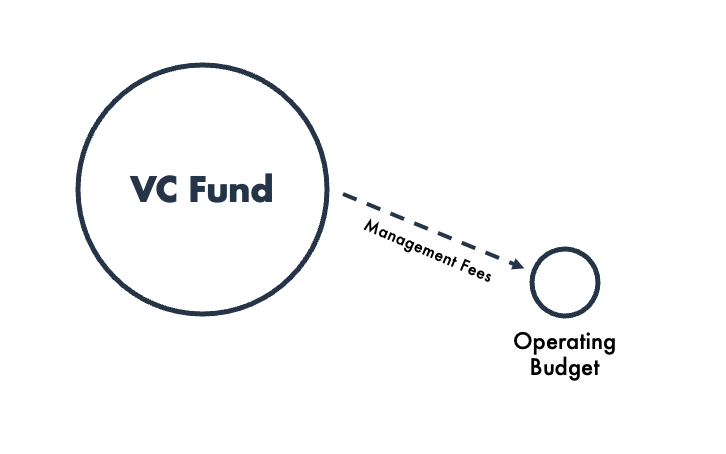
(For the purposes of this post, I’m not going to worry about billion-dollar funds — since those are pretty healthy budgets) — instead, I’ll focus on the more typical-sized funds that you’ll encounter as a founder.)
If a $100M VC firm did 8 deals each year that incurred $25K in legal fees, they would be paying 8 x $25K = $200K / year in deal-related legal fees. If they paid those fees from their operating budget, it would be about 10% of their annual budget. That’s a lot for any business — especially one that has no ability to increase it’s revenue.
Cry Me a River — Why is This My Problem?

I know, I know. This probably feels like me asking you to play a very teeny, tiny violin for the “poor, starving” VCs. But if you step back for a moment, what we’re really talking about is balancing budgets.
I promise you that VCs don’t like paying legal bills any more than founders do. All of the VCs I know would much rather spend their limited operating budgets on finding and supporting founders than paying lawyers. They also don’t want you to do it.
Seriously.
The last thing any investor wants to do is hand you a bunch of money and have you turn around and spend it all on legal bills. In most situations, that’s not helping anyone win (except maybe the lawyers).
What if I told you that for all the bluster, this isn’t strictly about VCs getting founders to pay their legal fees?
It’s about two things:
Getting the LPs who invest in VCs to pay their legal fees
Getting the prior shareholders who invested in the company to pay their legal fees
How VCs Get LPs to Pay their Legal Fees
I mentioned before that most VCs have limited options when it comes to increasing their revenue. But there are two ways that they can offload these expenses.
The most straight-forward way of doing this is to bill the legal fees back to their LPs as a “fund expense”. In venture capital, fund expenses are the costs of running and managing the fund, which include management fees, administrative costs, legal and accounting fees, and due diligence expenses. In other words, a VC firm can simply pass along the legal fees to the VC fund and get reimbursed. Case closed.

From a founder’s perspective, this is perfect. But it’s not ideal for the VC, for two reasons:
It directly reduces the amount of “investable capital” that the VC has (i.e. the amount of money that a VC has available to invest in startups).
The VC has no control over the scale of those legal expenses.
Many founders presume that if the legal diligence and closing costs get too high, then it must be the fault of the VC. But there are many reasons outside of the VC’s control that can lead to unusually high legal fees, including:
Inexperienced legal representation for the startup
Complex cap table situations that need to be resolved as part of the funding
Amendments to preexisting legal documents that need to be made
Multi-country complexities
IP issues
(One could obviously argue that a VC should know what they’re getting into before legal closing starts, but this isn’t always the case — particularly if a founder left out crucial details or didn’t realize that a particular situation might cause problems during closing.)
Which leads to the second option: offload the legal fees to the company.
How VCs Get their LPs and a Startup’s Shareholders to Pay their Legal Fees
When a VC asks a startup to pay their legal fees, this is what’s actually happening.
A VC can effectively transfer money from their fund budget to their operating budgeting by (1) investing in a startup and then (2) having that startup pay for something on their behalf.

Where do the startup’s other shareholders come in? By virtue of the effective dilution caused by those legal fees being shared across the cap table.
When our hypothetical VC invests $5M in a company and then asks that company to pay $25K in legal fees, the company only ends up with $4.975M. That’s $25K that could otherwise be used to generate a return for shareholders (which includes the incoming VC and all preexisting shareholders — founders, angel investors, other VCs, etc.).
More precisely, the payment of those legal fees results in a loss of value of the startup immediately following the close of the round of $25K (the money paid to the VC’s lawyers from the company’s bank account), which translates into a proportionate loss in the portfolio of each of the startup’s shareholders.
e.g. if our hypothetical startup has a post-financing cap table that is comprised of of 20% New VC, 15% Prior VC, 10% angel investors and 55% founders, then the effective loss of value incurred by each of those groups is:
New VC: -$5,000
Prior VC: -$3,750
Angel Investors -$2,500
Founders: -$13,750
By virtue of this strategy, the VC gains two benefits:
They offload their legal fees to both their LPs and the startup’s other shareholders (without directly reducing their investable capital).
They provide a “soft incentive” to control the overall legal fees (as everyone would now share the pain of out-of-control legal fees).
One More Thing…
There’s one additional (subtle) point to make about this that might not be apparent:
Regardless of how their legal fees get paid, the VC will ultimately end up paying a proportion of the startup’s legal fees (by virtue of the fact that those fees are typically charged after the round closes).

One could argue that the incoming VC will have taken into account the value of the startup post-legal fees when negotiating a valuation, but that’s never actually the case. So if each side ends up with $25K in legal fees — which isn’t unheard of — those fees are proportionately paid by all of the shareholders:
New VC: -$10,000
Prior VC: -$7,500
Angel Investors -$5,00
Founders: -$7,500
(For the VC, this is still very much a win, but it’s not quite the “slam-dunk” that folks who argue about this practice being founder-unfriendly might have you believe.)
What About the VCs Who Don’t Make Startups Pay Legal Fees?
I mentioned at the start of this post that whenever a social media thread on startup legal fees gets going, it inevitably becomes a “me too!” list of VCs bragging about how they don’t do that.
Guess what? A lot of those investors are Pre-Seed VCs. And almost all Pre-Seed VCs invest on SAFEs.
In other words, many of the VCs bragging about how they don’t make founders pay their legal fees generally don’t incur any legal fees when they make new investments.
When I was a partner at Panache Ventures, we did not charge founders legal fees related to our investments. We could do that without reducing our investable capital because almost all of our deals were done on a standard SAFE with a standard, pre-written side letter. Occasionally, we would incur legal fees when some peculiarities arose in the deal or we were following another lead in an equity round, but those were typically a drop the bucket of our operating budget and not worth passing along (to either the startup or our LPs).
To say it differently, a Pre-Seed VC bragging that they don’t charge founders legal fees is like someone puffing their chest after buying you lunch — when all you ordered was a $3 coffee.

“I insist…”
There are absolutely some VCs that don’t ask startups to pay their legal fees, but it’s still relatively rare (and mostly done by established firms with more substantive operating budgets and/or larger funds).
Tips for Founders
Let’s wrap this post up with a few quick tips:
You should expect VCs to ask you to pay legal fees on equity rounds. Generally, this starts at Seed or Series A.
If it’s your first equity round, the costs should be relatively low (as most countries have standardized agreements). Of course, this assumes that you’re coming in with a relatively straight-forward situation.
Most term sheets that ask you to pay legal fees have a cap. That’s good for everyone.
Most reputable legal firms offer fixed pricing for early fundraising rounds.
Make sure your legal team has experience working with startups. Nobody wants you to end up with a giant legal bill because of inexperienced lawyers marking up standardized documents.
If an investor asks you to pay their legal fees on a SAFE round, it may be a red flag. Ask them why they included that clause.
If a Pre-Seed VC wants to do an equity investment instead of a SAFE round, ask if they’re willing to pay the associated legal fees (I personally have no qualms about Pre-Seed equity rounds, but if you’re in a competitive situation where the other offers are all on SAFEs, don’t be afraid to bring this up).
Last but not least, if you’re really annoyed by this, you can always ask the VC to increase the round size to neutralize the effective dilution. Usually, this is a small fraction of the round size — so it might not be the hill to die on if there are other, larger issues to negotiate — but it’s certainly an option.
Bottom line, this practice is neither completely innocuous to founders nor is it a nefarious plot hatched by greedy VCs to take advantage of them.
At the end of the day, the goal on all sides is to get across the finish line and get back to building your business. And everyone wants you to have as much money as possible to do that.
Anatomy of an Ecosystem
Let’s look at the evolution of Vancouver’s startup ecosystem through the lens of BC Founders Day..
Last week, I had the privilege of hosting the second iteration of what’s fast becoming an annual celebration of startups in Vancouver and the surrounding ecosystems: BC Founders Day.

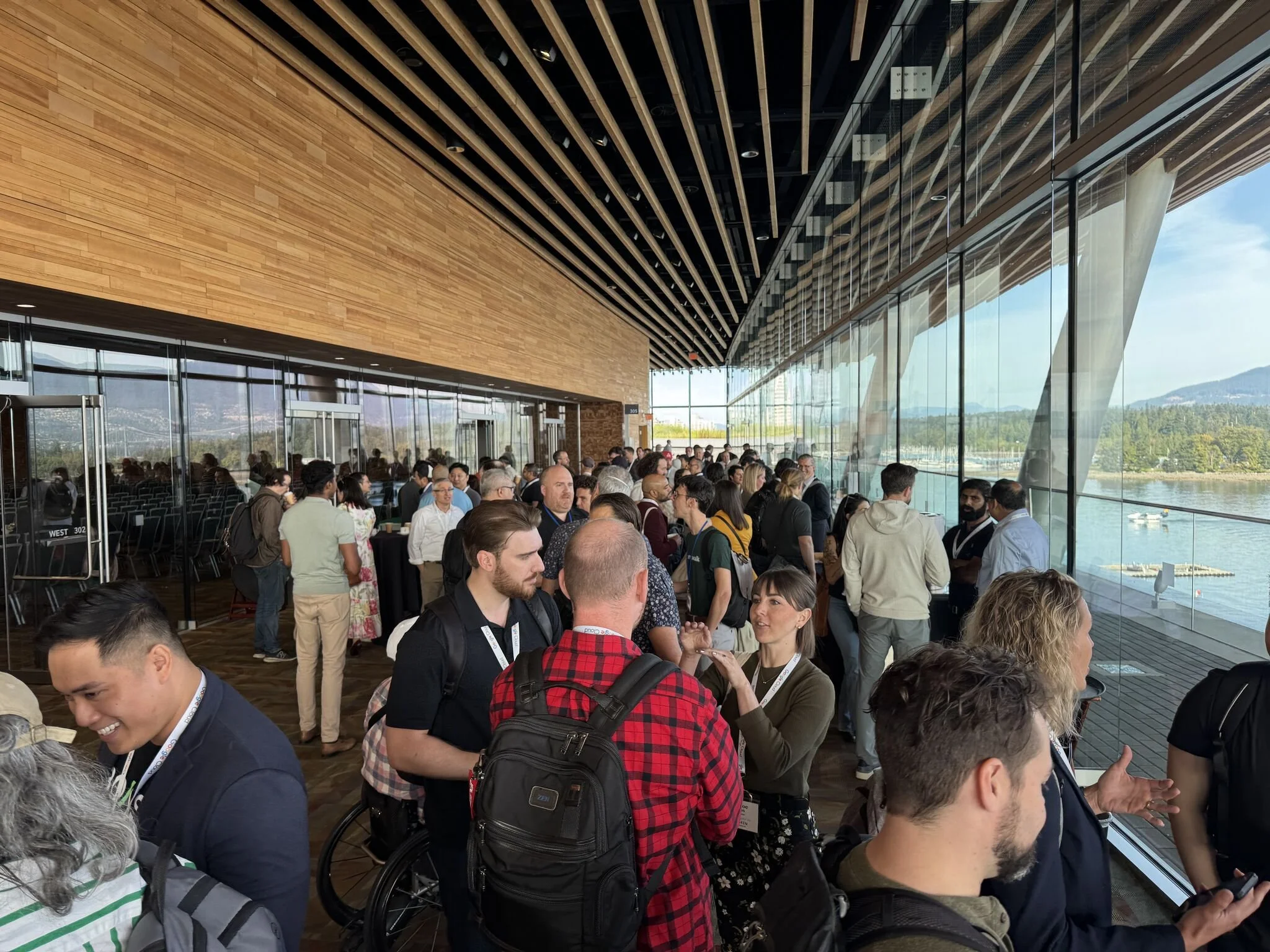
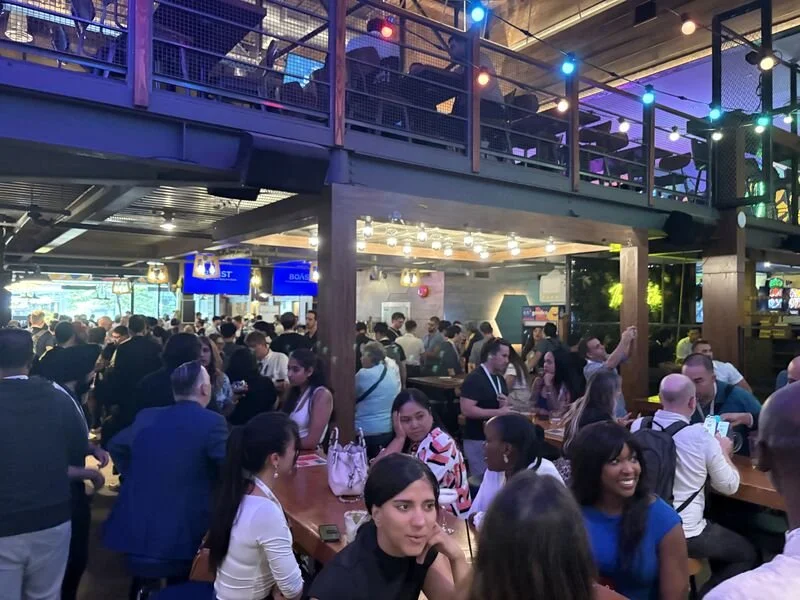
BC Founders Day originated from a simple idea: what would happen if we put up-and-coming founders from across British Columbia in the same room with dozens of experienced founders from startups past? It turns out, a lot.
The day consisted of three parts:
A mini conference with experienced founders sharing insights from their startup journeys (with a few VCs sprinkled in for good measure)
Founder-only office hours, where founders could meet and ask questions of the speakers and dozens of other experienced founders
A community networking event where founders, investors and supporters from across the ecosystem celebrated together
For an event like this to have maximum impact, curating the attendees is key. I’ve written before about the emphasis that high achievers place on meeting other high achievers when deciding whether or not to attend an event,
“The most ambitious people I know are drawn to other high-achievers. They want to learn from them, connect with them and be surrounded by them. Creating an event focused on the opportunity to meet other high-achievers can be a big draw. The most impactful events often take it a step further by focusing the audience around a specific theme,”
A big draw of BC Founders Day is that a significant portion of the event is only open to founders. Advisors, brokers, recruiters, consultants, fractional CXOs, salespeople and even investors are only permitted to join the community networking event. The result is a safe space where founders (and aspiring founders) from across the ecosystem can engage with each other on any topic they feel drawn to.
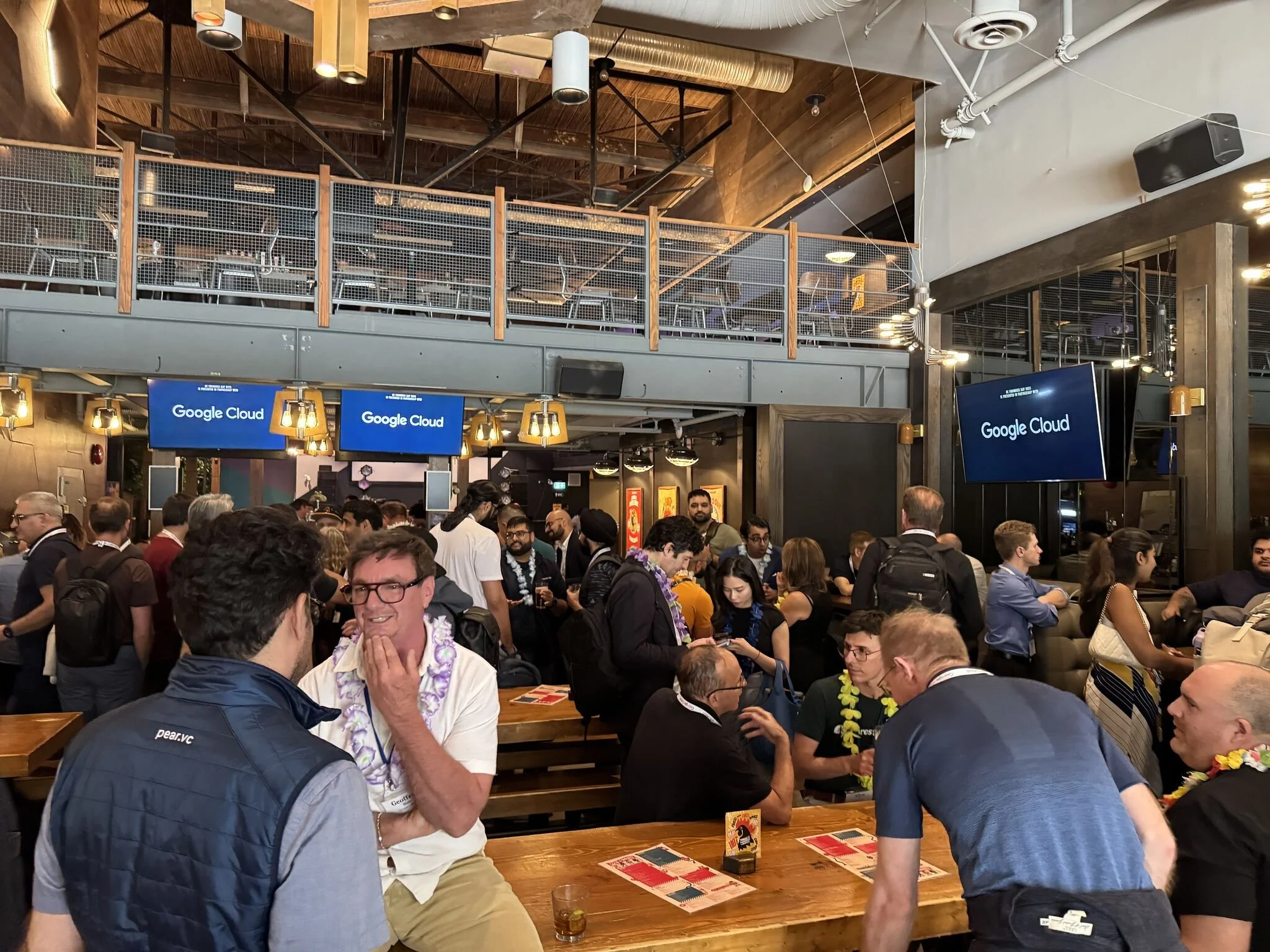
70+ speakers and OG founders wore Hawaiian leis during the founders-only office hours to identify themselves as mentors
In order to achieve this, we have to meticulously validate each attendee’s background and establish whether or not they are, in fact, a founder. That process gives us some pretty interesting data. Which got me thinking: with nearly 1,000 registered attendees this year (a 25% year-over-year increase 😉) we’ve created a pretty good snapshot of the BC startup ecosystem. So why not share it?
Let’s take a look at the startup ecosystem in Vancouver and the surrounding region through the lens of BC Founders Day…
Attendee Breakdown
Let’s begin with a high-level breakdown of the registered attendees by their role in the ecosystem:
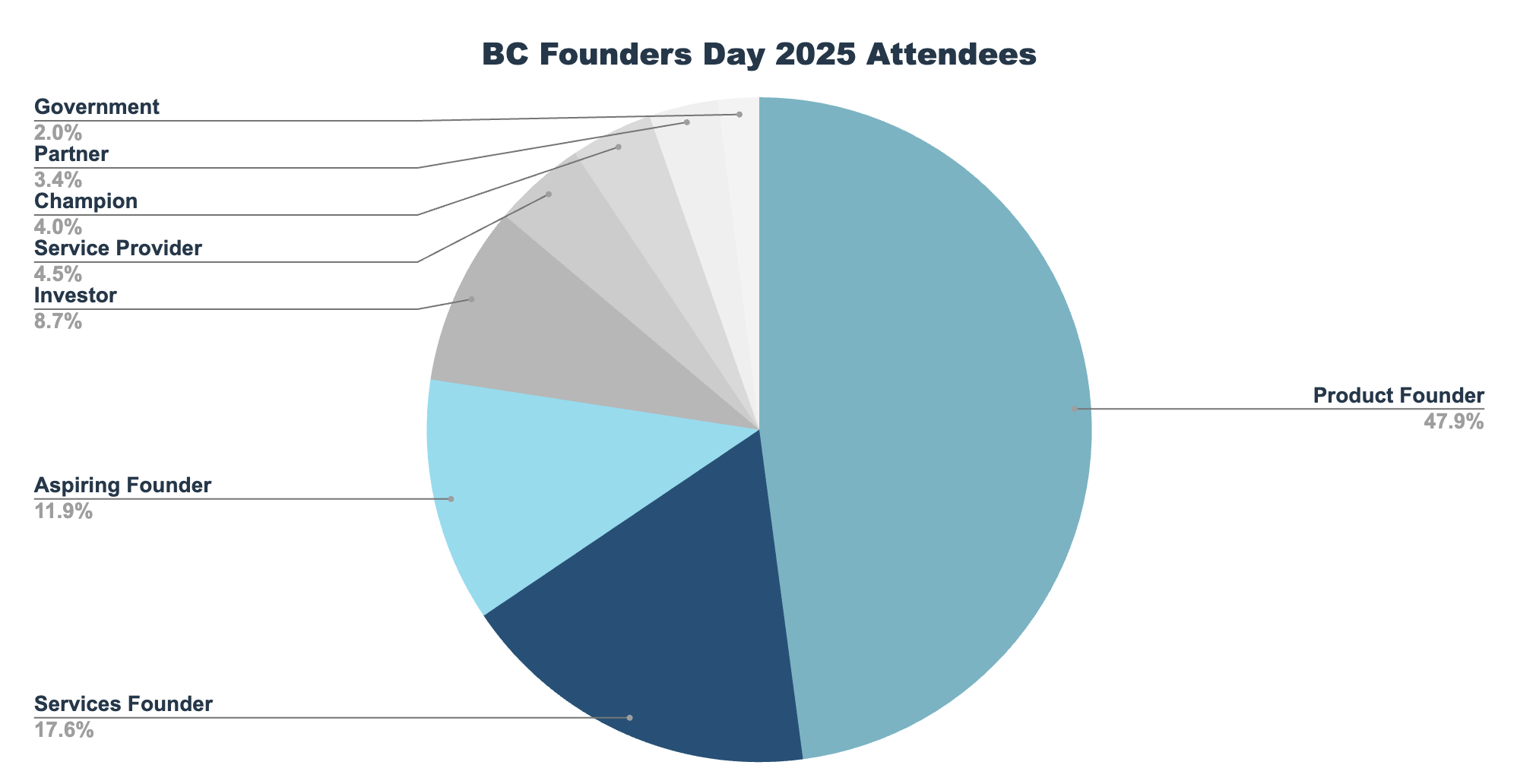
More than 65% of the event’s registered attendees — about 660 people — were confirmed, active founders. We broke that group down into two categories based on whether they founded a product company or a services company (a cohort that included consultancies, outsourced development shops and other service providers).
Another ~12% were aspiring founders. That group included students, individuals currently working full-time at a larger tech company and previously-exited founders considering starting something new.
8.7% of the attendees were VCs, angel investors and folks who work at local incubators/accelerators.
The remaining ~14% of registered attendees included non-founder service providers (recruiters, lawyers, salespeople, etc.), a group we refer to as “Champions” (individuals who either through occupation or by way of personal interest dedicate their time to supporting the local ecosystem), corporate partners and government representatives.
That’s a pretty good mix!
Location
Next up is location: where did this year’s attendees come from?

The vast majority of registered attendees — nearly 90% — came from the Greater Vancouver area (the city of Vancouver and it’s surrounding suburbs).
Another 1.6% traveled by boat, seaplane or helicopter to join us from the capital city of Victoria, while 5.1% of the attendees came from elsewhere in British Columbia.
A further 1.6% of attendees came from the rest of Canada (including former Wattpad co-founder and current deep tech investor Allen Lau, who made a 4,200 km day trip from Toronto to share his experiences).
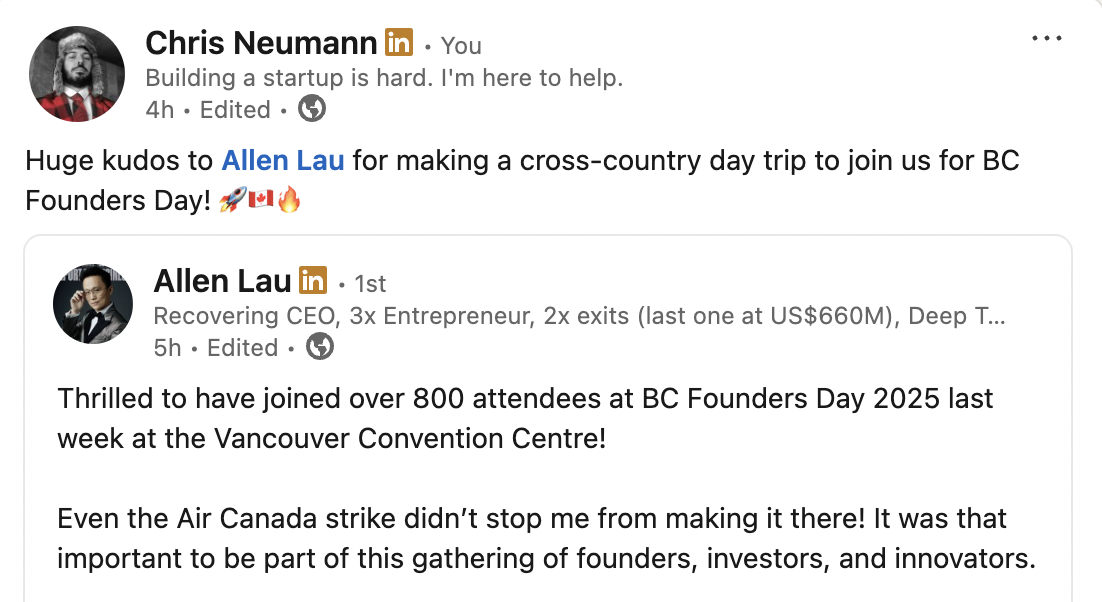
The final ~2.2% of registered attendees were from outside of Canada (split evenly between the US and the rest of the world, at 1.1% each).
Founder Experience
To me, this was one of the coolest discoveries from our analysis.
We looked at the backgrounds of every single registered attendee to see if they had any founder experience at any point in their professional history. It turned out that ~78% of attendees to BC Founders Day 2025 had founded or cofounded at least one company 🤯.

Those companies weren’t all tech startups. Some had previously founded consulting companies. Others were the founders of media companies. A few had founded cough cough VC firms cough cough. The point is, ~780 of the registered attendees of BC Founders Day had founded something. And for a startup ecosystem, that’s amazing.
It truly was a gathering of founders.
Financing Stage
Last but not least, we dug into the progress made by the founders of product companies using fundraising as a (very imperfect) proxy. How far along are the companies and where is there source of funding?
Two quick notes on this before I go further:
The data below represents a combination of public and non-public data. It’s also imperfect. While I personally have knowledge of a number of unannounced funding rounds, there are undoubtedly others that I’m not privy to. So take this as an approximation.
The data reflects the companies that the founders are currently working on. Many attendees have progressed further in the past (raising multiple rounds of funding, exiting and even IPOing). But this data is all about what they’re working on right now.
With that out of the way, here’s what we found:

Once you move past the obvious reaction (“Wow…Chris must be colorblind”), what this data shows is a healthy, balanced and — most importantly — growing ecosystem.
About 35% of the founders have bootstrapped their companies. Some of them may eventually raise funding. Many won’t (either because their company isn’t a fit for investors or because they choose not to).
About 20% of the founders have financed their company thus far through a combination of angel investors, accelerators, incubators and/or grants (the latter something that is quite prevalent in British Columbia).
Nearly 14% of the founders have successfully raised Pre-Seed funding. Another 12% have raised a Seed round.
Once we get into the scaling and growth stages, the “graduation” rates approximate what we see globally in VC-backed startups.
Perhaps the most interesting insight from the data is that more than 14% of the registered attendees (nearly 150 founders) are currently building in stealth 👀. How do I know this? Some of those founders currently have “Stealth” listed on their LinkedIn profiles. Others…well, I can’t share all of my secrets 🤫
(Though I will note that a number of these stealth founders have already raised unannounced rounds of funding 🔥🔥🔥).
Overall, BC Founders Day 2025 was an incredible, invigorating event. For an ecosystem that’s often accused of being fragmented, it’s clear that a lot of founders across the region crave connectivity.
One last note: by far, my favorite panel of the day was comprised of three young, relatively unknown (for now) Gen Z founders. Each of these individuals is spearheading their own movement within the local ecosystem. And each of them was unapologetic about what they’re doing, why they’re doing it, and how it bears no resemblance whatsoever to what came before it.

A wise man once sang, “The Times, They Are A-Changin’”. The next generation of founders is grabbing the reins of ecosystems around the world — whether the old guard is ready or not. And that’s a great thing.
Even if the data doesn’t show it just yet.
Special thanks to our incredible corporate and government partners. BC Founders Day 2025 would not have been possible without their support: Google, RBCx, Fasken, Boast, Launch Academy, Innovate BC and Web Summit.
To get more of my thoughts on startups, the business of venture capital and tech ecosystems delivered to your inbox, subscribe to my newsletter.
AI Won’t Actually Change Everything
The current gap between the tech world’s obsession-of-the-moment and the rest of the world seems more like a chasm.
Last week, I took a few days away from preparing for this year’s BC Founders Day and escaped into the British Columbia wilderness.
I’ve written before about the importance of finding what recharges you. For me, a few days in nature (preferably somewhere devoid of cell phone coverage) is ideal. One reason why I do this on a regular basis is because of how it rejuvenates me. The healing benefits of spending time in nature have been proven time and time again (not only is it okay to go outside, it will make you more effective as a founder).
But there’s another reason why nature is my preferred escape: it forces me completely out of the bubble of Startupland™.

I don’t wanna goooooooo!
Usually when I head into the wilderness, I use the time to reset and reflect. When I go with my kids (as was the case last week), I try to simply focus on them (p.s. if you haven’t gone camping with kids before, it really is one of the best things in life).
Despite nature throwing an atmospheric river at us — after nearly 60 days of pure sunshine, no less — our brief trip into the woods was an undeniable success. There was exploring, swimming, laughing, getting dirty, getting frustrated, overcoming challenges and, of course, s’mores.



You know what there wasn’t any of? AI.
The only prompting I did was trying to get my boys to help wash the dishes. The only agent I encountered with was the one checking tickets for BC Ferries.
AI didn’t help us put up the tent when we arrived late to our campsite and it didn’t make it any easier to anchor a tarp over the picnic table when the skies suddenly opened up.

AI didn’t help my son spot these two bald eagles
I wasn’t expecting to have any work-related epiphanies on this particular trip, but as I sat on my well-worn REI camping chair, I was struck by how wide the gap had become between Startupland™ and the outside world since the emergence of AI. There is always a sizable distance between the tech world’s obsession-of-the-moment and the perspective of the rest of society. But it feels like the current AI-centric gap is closer to a chasm.
If you’re like me, you’ve probably had a lot of conversations with other residents of Startupland™ recently that leave you feeling like we’re all in a mad rush to maintain relevance. Investors and founders are sprinting to capture market share, CEOs are rushing to make their workforce AI-native, and everyone seems desperate to leverage AI and agents any and every way possible.
But in the rest of the world? Not so much.
That’s not to say that the masses aren’t already benefiting from AI. It’s creeping into everyone’s cell phones, search tools and social media. But in many industries, AI isn’t really changing anything. And it probably won’t anytime soon.
AI won’t change how the friendly campground hosts we met on our trip welcome visiting campers. It won’t change how the small town ice cream store we stopped at doles out scoops of ice cream to wide-eyed children. Nor will it change the operations of the mini golf course we played at, the local bait and tackle store we bought supplies at, or the fish-and-chip shop we patronized before boarding our ferry.
And while it might be easy to dismiss these as niche examples that only representing the long-tail of the economy, such observations are increasingly being made by larger players. Earlier this summer, Thomas Bravo raised nearly $35 Billion for three new funds. The firm’s co-founder and managing partner, Orlando Bravo, was asked how they leverage AI and where he saw potential,
"Summarizing data. But right now there is not a compelling use case we see that will dramatically affect how we add value."
Around the same time, Jason Lemkin of Saastr made this observation,

I’m certainly not trying to downplay the impact and importance of AI — to the tech world or beyond. AI represents the most significant technological advancement in a generation. But it’s worth remembering that there are a lot of places where AI isn’t necessarily top of mind.
Generational wealth will undoubtedly be made by many working in and around AI. But there are also an incredible number of opportunities that remain for founders willing to look where others don’t.
Plus ça change, plus c'est la même chose.
Give Your Customers What They Want
What can this recent history of fast food teach us about AI? It turns out, a lot.
For this week’s post, I’m going to start off with a case study that isn’t from the annals of Silicon Valley (although many in the tech world are loyal customers of this industry). Today, we’re going to talk about fast food. Specifically, we’re going to look at the astonishing rise of A&W Canada.

If you’re reading this from the U.S., you’re probably scratching your head right now (in all likelihood, you haven’t been inside of an A&W in years and, if you have, your experience was likely…not great).
A&W Canada is a completely separate company from A&W Restaurants, which operates A&W in the U.S. and elsewhere. You can read the full history here, but the tl;dr is that A&W Canada split from the US company in 1972 when it was sold to Unilever. A group of Canadian franchisees subsequently bought the company back in 1995 and have operated independently since then. Not only is the Canadian company larger than A&W Restaurants (by both number of stores and revenue), many of the popular menu items and brand assets (including the chain’s bear mascot) were created by A&W Canada and licensed to A&W Restaurants.
Ok, so let’s jump into the case study.
Back in the early 2010s, fast food chains were going through an existential crisis as millennials led a massive shift towards healthier eating. Quick-service restaurants (QSRs) around the world were seeing sharply decreasing sales and rushed to introduce new menu items in order to stem the bleeding. McDonald’s introduced McWraps and egg white sandwiches, Taco Bell added herb-grilled chicken and cantina bowls, while Burger King unveiled turkey burgers and low-sodium french fries. But A&W Canada took a different approach.
At the time, A&W Canada was having its own crisis of identity. Although it was the fifth-largest QSR in the country, its growth was stagnating.
“We were seen as not being very connected with consumers and being out of date, out of style, out of touch, outmoded, not very relevant,” said [Trish] Sahlstrom.
Rather than rush to introduce new menu items as many QSRs were doing, A&W Canada initiated a deeper strategic planning process centred on “dramatic changes in consumers’ attitudes and behaviours.”
“We saw, for instance, an increasing desire among consumers to know who and where their food was raised,” she said. “Consumers were saying, ‘Where’s the evidence? I no longer trust just that it tastes good. I want to know where it came from. I want to know who has raised the animals that are feeding us. I want to know your values, A&W.’”
The company then asked what factors came into play when consumers wanted a hamburger.
“As we started to put together all of these pieces of evidence — all of the answers to these questions — what came out incredibly strong and clear to us was leave out the hormones and steroids and don’t use the antibiotics.”
A&W Canada stumbled on an epiphany that, surprisingly, seems to have been missed by most other QSRs: their customers didn’t want them to change their menu per se, they just wanted to feel better about eating there. A&W customers didn’t want to buy a salad or a wrap or a gluten-free super food quinoa bowl when they visited one of the company’s restaurants. They simply wanted a slightly healthier hamburger.
So in 2013, the company announced that all of its burgers would be made with beef raised without hormones, steroids or other additives.

Following the announcement, the Canadian beef industry was up in arms. The move required A&W Canada to source beef from the U.S. and Australia, as there weren’t enough ranchers in Canada at the time raising cattle that met their requirements. The industry responded with a public relations campaign and attempted boycott of A&W, but failed miserably.
Same-store revenue for A&W Canada increased 6.3% the following year, while a consumer research study by QRI subsequently found that “89% of burger eaters [in Canada] were “impressed and interested that A&W is serving beef raised without added hormones or steroids.” (By contrast, McDonald's same-store sales decreased in 2014 — falling by -2.1% in the U.S. and -1.0% globally)
A&W followed up the success of its “better beef” campaign with similar shifts to its chicken and egg supply chains in 2014.

The sustained focused on healthy ingredients resulted in even greater success in 2015, with same-store revenue increasing 7.6% that year. Total revenue for 2015 topped $1 billion — the first time in the company’s history — while its share of the QSR market in Canada increased from 12.7% in 2013 to 14.4% in 2015. And the company hasn’t taken its foot off the gas since.
In 2018, A&W Canada became the first QSR in the world to introduce Beyond Burgers nationally. That same year, the company further evolved its egg supply from vegetarian-fed to cage-free and antibiotic free eggs. And in 2020, it shifted its burgers to 100% Canadian, grass-fed beef.

And the results showed. With the exception of 2020’s Covid-driven drop, A&W Canada outpaced the world’s largest QSR brands on same-store sales for many of the years following this strategic shift.

So what does this have to do with tech?
A&W Canada’s recent successes were the result of a management team that, amidst a groundbreaking shift in consumer preferences, took the time to stop and ask the question, “what do our customers really want?”
Today, the technology world is undergoing a similarly unprecedented shift as AI rapidly permeates every aspect of our industry. As I look around, I see countless companies of all shapes and sizes rushing to plug AI into their offerings without stopping to ask themselves, “is this what our customers really want?”
Services businesses trying to become product companies, “so our customers can do it themselves”
Product companies replacing interfaces that their customers have grown to love with text-based prompt interfaces, “because that’s how AI works”
Business intelligence / data analytics startups rushing to leverage AI so that “business users can directly query the database” (trust me on this one 😉)
While it’s inevitable that AI will fundamentally change many aspects of our lives, it’s important that founders take the time to think about the shift from their customers’ perspective. In some cases, AI will completely upend a category and, thus, require a total rethink of a company and its products. But I suspect in many industries, customers will simply want a faster, more powerful, AI-enabled “hamburger”.
Want to Hire the Best? Stop Paying Local Wages
If you raise Silicon Valley funding or are generating revenue primarily from US customers, there is fundamentally no reason why you can’t pay employees Silicon Valley salaries.
One of the excuses I hear all the time from founders, investors and others outside of Silicon Valley about why startups in their ecosystems “aren’t succeeding” is the claim that it’s impossible for them to compete with Silicon Valley salaries. Founders use it as an excuse for why they lose out on top talent. Community builders point to it as the reason why more young people aren’t building. Politicians use it as a scape goat for brain drain.

Here’s the thing: the only thing stopping you from paying a higher wage…is you.
Before your mind starts racing with all of the reasons why the above statement is laughably wrong, let me set the foundation for my claim: First off, I’m not trying to argue that wages can be (or should be) identical the world over. I’m also not suggesting that startups in Moose Jaw, Memphis or Manchester have a chance of competing on salary against “Big Tech” — especially when Meta starts throwing around $100M bonuses.
But guess what? Startups in Silicon Valley can’t compete on that either.
For as long as startups have been starting up, they’ve had to attract talent in the face of big incumbents with big treasuries. This report from ReadWriteWeb (circa 2013) provides insight into the hiring challenges faced by startups a dozen years ago:
“The toughest challenge facing most new technology companies these days isn’t getting funded – it’s hiring the best, most skilled employees. Heavyweights such as Google and Facebook can lure top talent with six-figure salaries, lucrative stock packages and lavish perks, including sushi buffets and free laundry service.”
You know what else came out in 2013? This post from Open AI CEO Sam Altman about how to hire, which he wrote while a Partner at YC:
“If you don’t hire very well, you will not be successful—companies are a product of the team the founders build. There is no way you can build an important company by yourself. It’s easy to delude yourself into thinking that you can manage a mediocre hire into doing good work.”
(If you want to go back in time even further, check out the “People” section of this 2005 post from YC Founder Paul Graham on How to Start a Startup.)
So let’s put to the side the talent battle of startup vs. incumbent and instead focus on the battle between startups. Specifically, let’s compare equivalent-stage startups in Silicon Valley and elsewhere in the world. Can startups based outside of Silicon Valley employ the same tactics (including salary ranges) as their Bay Area brethren to attract and retain talent?
In today’s world, the answer is unequivocally yes.

You’ve been spending too much time at Grateful Dead concerts…
Historically, startups outside of Silicon Valley have behaved a lot like sports teams in small markets — trying to win championships by squeezing the most out of a roster of lesser-known, lower salaried players. Twenty years ago, that approach made sense, as the majority of startups generated their early revenue locally (and, thus, were beholden to the economic realities of the ecosystems in which they operated). But things have changed significantly since then.
Today, many startups sell their products globally from day one. At the same time, their founders — emboldened by the realization that they hold more power than ever before — are increasingly unwilling to limit their fundraising goals simply because of the limitations of local VCs. Which means the most promising startups around the world are following Silicon Valley revenue trajectories and raising Silicon Valley-sized funding rounds. So why shouldn’t they be able to compete with Silicon Valley-based startups for talent?
Still don’t believe me? Let’s look at some numbers…

I used OpenAI’s o3 reasoning model to research the following two questions:
What is the average salary of a software engineer at a Seed stage startup in <city>?
What is the average number of employees at a startup that has raised USD $3M in <city>?
Let’s look at the results for some major startup ecosystems:
San Francisco
According to o3, the average salary of a software engineer at a Seed stage startup based in San Francisco is $150K. On average, startups that have raised $3M in funding have 6 - 8 employees at the time their funding was announced (although recent reports, such as Carta’s 2024 State of Startup Compensation Report, suggest that this number has fallen in recent years).
Toronto, Canada
Given the identical prompt, o3 reported that the average salary of a software engineer at a Seed stage startup in Toronto is CAD $125K - 135K (roughly $90K - 100K). Upon raising $3M in funding, the average Toronto-based startup has 10 - 12 employees.
London, UK
For London, o3 determined that the average salary of a software engineer at a Seed stage startup is £75K (approximately $100K). London-based startups that have raised $3M in funding have, on average, between 9 and 12 full-time employees.
What’s the point of all of this…?
Here is the average amount that Seed stage startups are spending on employees after raising $3M (assuming all of those employees are software engineers):
San Francisco: $900K - $1.2M
Toronto: $900K - $1.2M
London: $900K - $1.2M
There are obviously a bunch of assumptions baked into the above (it doesn’t take into account differences in taxes, benefits, actual employee roles, etc.) but, roughly speaking, Seed stage startups in San Francisco, Toronto and London all spend approximately the same amount of money on salaries.
How can this be possible, yet so many founders (and investors and community builders and politicians) outside of Silicon Valley remain convinced that they can’t compete on salary?
For years, founders outside of Silicon Valley have been sold a narrative that goes something like this:
Hustle hard and show early traction
Raise VC funding from Silicon Valley investors
Leverage that funding to build a higher-margin company in your home town (i.e. hire more employees at a lower average wage than what Silicon Valley startups can do)
The problem is, quality (and experience) matter. Both in building companies and winning championships.

So what we’re really talking about isn’t so much of a financial shift as it is a mindset shift. And I suspect it starts with torpedoing the (imho very bad) advice pushed by many investors outside of the US that startups should hire CFOs, COOs and other non-product employees before achieving PMF (though I’ll save that rant for another post).
For now, I’m going to keep the punchline simple: if you raise Silicon Valley funding and/or are generating revenue primarily from US-based customers, there is fundamentally no reason why you can’t pay employees Silicon Valley salaries.
That doesn’t mean you have to (you certainly don’t have to follow the Silicon Valley playbook by any means). It also doesn’t mean that you should spend recklessly or pay high salaries for the sake of paying high salaries. But it’s time to retire the excuse that startups in <city> can’t compete on salary with Silicon Valley startups.
Which means if you’re an early-stage startup that’s playing to win, your salary benchmark shouldn’t be set by other companies in your city (even the locally-famous ones 😉). If you find someone you believe to be a game changer for your startup, you should be willing to pay them up to the current benchmark for startups at your stage based in Silicon Valley. Even if that amount is considerably higher than the local norm.
I'm sure that plenty of folks will argue with me on this, but IMHO there is simply no reason for a startup to lose talent to an equivalently-funded startup anywhere in the world based on salary alone. Even Silicon Valley.

VCs are Changing Their Tune on Conflicts
VCs generally do not invest in startups that compete directly with existing portfolio companies. But that norm is changing.
Founders and investors aren’t always on the same page.
But for most of the history of Startupland™, there has been one industry norm that both sides agreed on: in general, VC firms do not invest in startups that compete directly with existing portfolio companies. In fact, most VCs go to great lengths to ensure that (1) there are the no direct competitors in their portfolio, and (2) there is enough “room” between portfolio companies to allow them to pivot without risk of running into one another.

I previously wrote about this norm in a post titled Don’t Talk to Your Competitor’s Investors. The post walks through the historical reasons for this norm (both moral and legal), while noting that,
“The best investors don’t want to be in a position of conflict. They don’t want to have to choose between your company and their portfolio company, so the moment they sniff an overlap, they’ll pump the brakes.”
But the tides are changing and this long-accepted norm may soon be a thing of the past.
Last week, Charles Hudson of Precursor Ventures suggested that, with multi-stage funds getting larger and larger, the tradition of venture firms not investing in competitive companies may soon go away:
“As venture fund sizes keep getting larger, I do think that the tradition of venture firms having a norm (if not a stated policy) to not invest in competitive companies is likely to go away. This is simply a function of the fact that as venture funds have grown larger, it has become increasingly essential for those firms to be associated with the biggest and most important companies. The larger the fund, the more important it is to be an investor in the companies that are true outliers; there is no way to make the fund math work if you are not in those companies unless you are in other, similarly-situated companies. My sense is that there is more money chasing outliers at the moment than there are outlier companies to fund.”
Charles goes on to suggest some approaches that large funds can take to reduce the impact of such conflicts-of-interest, though he also notes that, “this is an issue where the business model for funds is at odds with what most founders want.”
His post focuses mostly on the dynamics of large multi-stage funds, but smaller funds and single-stage specialists are also starting to rethink their approach to competitive investments.
Why the Change of Heart?
Before you rush to the conclusion that this shift is simply another case of greedy VCs behaving badly, it’s worth noting that a couple of significant changes have happened in the past few years that fundamentally change some of the assumptions underpinning venture capital portfolios:
1. Companies are Staying Private Longer
Venture capital firms have historically been built on an assumption that most exits would occur within 7 - 10 years. Over the past decade, that number has crept higher, as many businesses have chosen to stay private longer. Add to that the many macroeconomic shocks we’ve had in recent years, and its increasingly common for early-stage VCs to hold positions in their winners for 15 years or more.
Think about what you were doing 15 years ago.
In my case, Aster Data was raising its Series C (it wouldn’t be acquired for almost another year — and DataHero wouldn’t be founded for a year after that). The cloud wasn’t really a thing yet. Neither Stripe nor Snowflake had been founded. And peer-to-peer anything hadn’t caught on.
So yeah…
2. Technology is Changing Faster
Step back and think of everything that has come into being technologically speaking over the past 15 years. Now think about how much faster innovation is happening as a result of AI.
In the past, it was reasonable (and, in many cases, prudent) for an early-stage fund to remain steadfast in its commitment to avoiding portfolio conflicts even after 10 years. After all, the fact that a company survived to its tenth birthday suggested that it was probably doing well. Moreover, a slower rate of change of technology implied that a new startup entering the same sector was likely to be a genuine competitor.
Things are different now. Even if two companies with an age gap of 10 years are likely to be competitive from a sector standpoint, chances are their technologies, target personas, and value propositions are fundamentally different.

3. Startups are Pivoting Sooner
A third major shift that’s occurred as a result of AI is that startups are able to validate (or invalidate) concepts sooner than ever before. It’s now increasingly common for investors to back a company, only for the founders to pivot within months of the investment closing.
In the past, it might take a company 6 - 9 months to determine that its original hypothesis wasn’t going to work, and then another 3 - 6 months to come up with something new. Today, startups can achieve both of those in a single quarter. In addition, we’re seeing early-stage startups pivot further away from their original ideas, making it harder than ever before for VCs to ensure adequate “space” between portfolio companies.
At this point, some early-stage VCs are investing with the presumption that the original idea will fail. They’re backing strong teams, but with no real idea of what the ultimate product will be (an approach founders typically love, but one that can result in unintended consequences — especially when it comes to portfolio conflicts).
4. Companies are Living Longer
Last but not least, many more startups that failed to achieve product-market fit have found ways to survive longer than ever before. Historically, if a VC-backed company didn’t achieve its goals, that company would either be acquired or shut down. Today, we’re seeing many more companies transition into long-term sustainable (but slower growing) businesses. While that can be great for the founders, it’s not necessarily the outcome investors signed up for.
The problem occurs if a company has changed trajectories to one that no longer fits the VC business model, yet the founders expect their investors to continue to uphold a moratorium on investing in potential competitors.
What Can Be Done?
First off, I agree with Charles’ assertion that the norm of VCs not investing in competing companies is going away. As a former founder, I hate this. But as an investor, I understand it.
From the perspective of multi-stage funds, they simply have to chase extreme outliers, portfolio conflicts be damned. Mega funds will increasingly do this until it’s widely-accepted behavior (hopefully, with some of the best practices Charles suggests).
On the other hand, I think that most early-stage / single-stage investors continue to believe that “the norm of not investing in competitive companies [is] a feature, not a bug” (I sure do!). The best Pre-Seed and Seed stage VCs are so involved with their portfolio companies that any conflict — real or perceived — is going to cause problems. So my assertion from two years ago — “the best investors don’t want to be in a position of conflict.” — still holds true.
That said, it’s no longer pragmatic for early-stage investors to think about conflicts in such absolute terms. Especially not over a 15-year horizon.
As we look ahead, I think there are some practical approaches that Pre-Seed and Seed-stage VCs can take to reasonably mitigate conflicts and maintain strong founder relationships, while future-proofing their ability to make reasonable new investments. All of which require clear, transparent communication with founders. For example:
Adopting an “expiration date” policy for avoiding portfolio conflicts — Instead of having a blanket moratorium on investing in competitive companies, consider a policy that expires after a certain amount of time or under certain conditions (e.g. no material forward progress in 36 months). The goal here isn’t to abandon companies that are struggling or to normalize “do-overs” (though I’m sure some investors will do that). Rather, it’s to provide clear guidelines as to when the investor might reasonably consider a competitive investment. Conceptually, this is closer to a standard employment non-compete (which founders and investors alike are very familiar with).
No guarantees in the case of a pivot — This is a touchy one for founders, but from an investor’s perspective, it can be challenging to support a competitive moratorium after a startup makes a significant pivot. Especially if the VC is not confident in the pivot (or in the team’s ability to execute the pivot). Early-stage VCs generally have little control over a startup deciding to pivot. Most still want to back their portfolio companies after a pivot — at a bare minimum, they have a financial incentive to do so — but if the pivot is into an area that the founding team has no prior experience in, it’s not unreasonable for the investor to want to keep their options open.
No guarantees below a minimum ownership — This is another one I’ve seen cause problems (in both directions). On the one hand, I’ve seen founders squeeze investors down to an inconsequential amount of ownership, only to expect that VC to not invest in competitors. On the other hand, I’ve seen VCs intentionally write small scout checks, then use the information they gain to make large investments in competing companies. Making clear the expectations in both directions will go a long way towards a smoother, long-term relationship.
Interestingly, I think that founders will broadly “get over” a shift in behavior by multi-stage funds and that conflicts within early-stage funds will end up being more prominent. (We generally don’t expect good service from Chase or Comcast, so we’re not disappointed when our experience sucks.) Conflicts within smaller funds — particularly those known to be more “founder-friendly” are where we’re likely to see the drama.
How investors choose to adapt their policies on competitive investments — and how transparent they are about those policies — may very well become a future marketing point. Regardless, founders should absolutely ask potential new investors what their current policy is on investing in competitive companies, how they view that in light of pivots, and whether or not they expect it to change in the future.
Some final thoughts from Charles:
“Most founders lack significant “hard power” (i.e., the right to block an investment) in these negotiations; funds can and do invest in competitors if they choose to do so. However, there will always be a set of founders who possess soft power and will utilize it to encourage their investors not to engage in such behavior. The universe of founders with meaningful soft power to influence this is very small, but that universe of founders is very powerful.”
SMH
We all have them. Moments that seem so unbelievable that the only sane reaction is to shake my head.
A few weeks ago, Indie VC founder Bryce Roberts posted an epic photo from his operating days, which involved an ad campaign for famed Scotch Dewar’s:

Later that day, I was chatting about this post with another friend and we started sharing various “SMH” moments in our careers — moments that seem so unbelievable that the only sane reaction is to shake my head.
After more than 20 years in Startupland™, I’ve come to realize that these crazy, unbelievable experiences are one of the reasons why so many people love startups. When you’re in an industry that attracts the most ambitious outliers in the world, the likelihood of crazy stuff happening is so high that it’s not actually that unusual.
There are some moments that are shared by many founders, such as the first time you found yourself in the Sand Hill Road office of a world-famous VC, or the first time you met a “celebrity” founder that you’d always admired (bonus points if you eventually became peers or even friends). Then there are those moments that are a part of your personal journey, each one shared with only a handful of people.
Some moments are triumphant; others are tragic. Some are just too ridiculous to be believed. But they’re a big part of what makes startups so fun and fulfilling. And these experiences — good, bad or just plain ridiculous — weave their way through the tapestry of our lives so frequently that most outside of the industry can hardly believe it. But to fellow residents of Startupland™, a knowing nod and SMH is par for the course.
I started off intending to share some of my own SMH moments, but quickly realized that what was emerging was more of a cringy humble-brag post. So rather than rattle off a list of memories, I’ll share some thoughts on why I think this matters.
Startups are hard. They really are. They’re all-encompassing, financially and emotionally stressful and many of our friends and family members simply can’t relate. But they’re also inspiring, exciting and invigorating. The opportunity to literally change the world is why so many of us are drawn to this life.
We often speak of the rollercoaster of startups — with their incredible highs and lows. I find that it can be difficult to fully appreciate either one in the moment (when things are going well, we’re too busy to really enjoy it…and when things are crashing and burning, we’re just trying to put out the fire!). But over time, these moments eventually become the stories that power us to greater and greater heights.
In times of stress, reconnecting with the friends and colleagues with whom you share such memories can be an incredible way to reset. With enough time, even the most challenging moments can become fond memories that form part of a heroic story (“Remember that time we almost lost all of MySpace’s data and Vaibhav figured out a way to recover the missing files from the damaged hard drives?”)

Actual photo circa 2009 of Vaibhav Nivargi (current CTO and Cofounder of Moveworks), saving ~100TB of MySpace’s data (“Dude…why are you bothering me?”)
It’s easier said than done, but if you’re going through a founder moment that seems absolutely surreal, do your best to enjoy it. If your startup just survived an existential crisis, take an extra moment to pat yourself (and everyone around you) on the back for making it through.
And if you’re feeling a little nostalgic, don’t hesitate to call a former coworker and reminisce about that time famed superangel and Silicon Valley heavyweight Ron Conway stopped by the office on his birthday, and you rushed out to by him a cake…at Safeway 🎂.
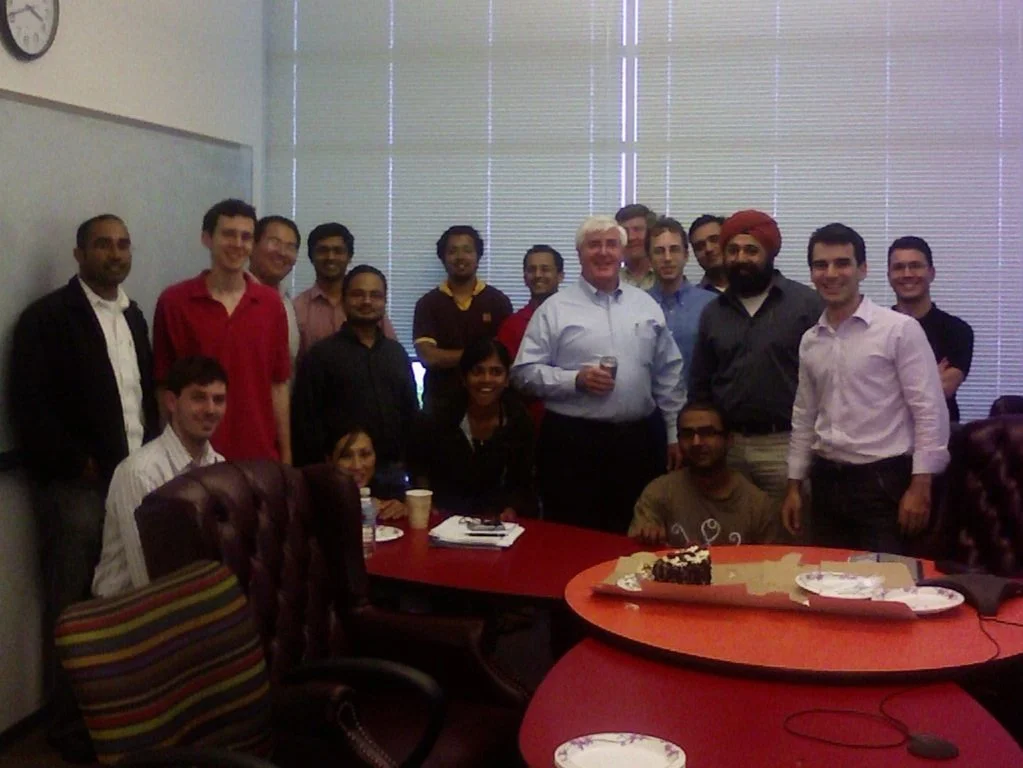
Happy birthday Ron!
I Don’t Know Who You Are. I’m Sorry.
There’s one aspect of being an investor that fills me with shame. Despite my best efforts, chances are I have absolutely no idea who you are.
Last week was Startupfest, Montreal’s annual outdoor celebration of early-stage startups. It’s been one of my favorite events to attend each year since I was first introduced to it while I was at 500 Startups. Founders and investors from across Canada descend on La Belle Province to catch up, swap stories, and check out what the next generation of founders is up to.
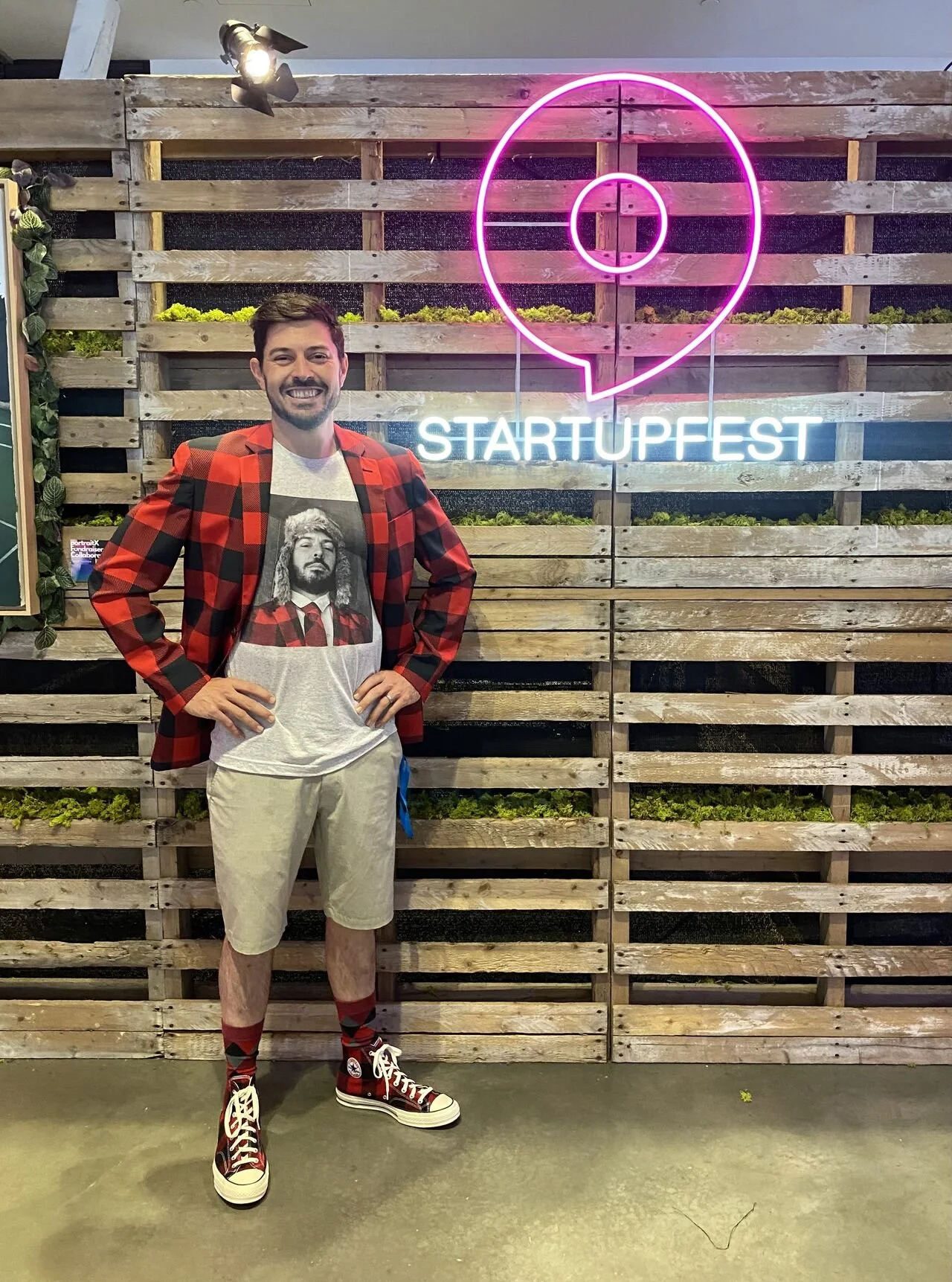
I use it as an excuse to make questionable fashion statements
Startupfest also marks the end of a two month gauntlet of tech events that take place across Canada each year. Kicking off in late-spring, the industry’s “festival season” now includes Web Summit, Invest Canada, NACO Summit, Toronto Tech Week, Creative Destruction Lab’s Super Session and more. By the time summer comes around, my default introvert is in full rebellion and desperately in search of a recharge.
But no matter how tired I am by the end of it, I simply can’t get enough of events like these. It’s been almost 10 years since DataHero was acquired (damn…) and I still absolutely love the energy that comes from being around other founders. The excitement. The ambition. The creativity. The velocity. Each and every conversation I have with a founder genuinely invigorates me.
But there’s one aspect of my experience navigating Startupland™ as an investor that fills me with shame. Despite my best efforts, chances are I have absolutely no idea who you are.

As a former founder, this is unquestionably one of the most frustrating aspect of transitioning to being an investor. I remember how impactful each-and-every interaction I had with an investor was to me. That’s why I try to always bring my full, focused self whenever I meet founders.
It’s also what makes this particular aspect of being an investor so frustrating. Even after a decade, I’m still struggling to come to terms with how inverted the dynamic is from the other side.
Maybe it’s just me, but I can still remember almost every conversation that I had with a VC during my days as a founder. Sure, some of the interactions were negative, but the vast majority felt sincere and genuine. Many of these conversations changed my trajectory as a founder — and, thus, the trajectory of my life.
When I first started the next chapter of my career as an investor, I reconnected with many of these same people to get their advice. Inevitably, I brought up some interaction that we had had years before and how impactful it was to me. In almost every case, the VC shifted awkwardly in their seat, looking visibly uncomfortable.
They. Didn’t. Remember.

In some cases, the VC admitted as much. In others, they tried to play it off. At first, it was disconcerting and discouraging. How could so many people not remember moments that were so impactful to me? Was I imagining their sincerity? Was I foolish enough to believe that they cared about me or my future? Was it all a facade?
Now that nearly 10 years have passed, I’ve realized that, no, it’s not a facade (at least, not with most investors). The vast majority of VCs absolutely try to bring their full, focused self to every interaction they have with founders. Unfortunately, most investors do so thousands upon thousands of times each year. Despite the fact that many of these conversations are impactful (or, at least, memorable) to the founders, from the investor’s perspective they are but one of dozens each day.
And the majority of people can’t retain that. Which means that if I’ve only met you once or twice, chances are I don’t remember you.

For founders who are giving everything to their startup, this can feel like a hard pill to swallow. Especially if that initial conversation was particularly impactful to you. But you can reconnect with VCs (or, really, anyone where there is a similar asymmetrical dynamic) in a way that increases your likelihood of a positive outcome: by providing context with grace.
The insight comes from a simple observation: nobody likes to feel uncomfortable in a conversation. And it’s corollary: if you actively remove a discomfort from a conversation, the other person will not only appreciate it, they’ll be more likely to remember it.
The trick? Providing context with grace.
Consider these three examples:
“It’s great to see you again.”
“It’s great to see you again. Do you remember our last conversation?”
“It’s great to see you again. You probably don’t remember, but we met last year at Startupfest during a Braindate session.”
These three slightly different openers leave the other person with vastly different feelings if they don’t remember the prior meeting. The first puts the person on edge (who is this? are they going to ask me something about our last conversation? I don’t want to look dumb…). The second is even more challenging, as it serves as an interpersonal pop quiz (I have no idea who this person is…why are they expecting me to remember?). The third, however, gracefully provides context from the prior interaction with no expectation that the other person remembers.
Using the third approach might spur the person’s memory. But even if it doesn’t, it provides a safe re-introduction. Moreover, it signals that you have a high enough EQ to remove a potential barrier to this new conversation (thus increasing the likelihood that they’ll remember it).
Epilogue
Years ago when I was a graduate student at Stanford, I met a visiting politician at an event. We spoke briefly — 1 or 2 minutes of small talk in which he asked where I was from, what I was studying, etc. Ten years later, I encountered that same politician at another event. Before I could say anything, he commented, “Haven’t we met before? At a Stanford event, right?”
That’s just not fair.
What’s Going on with Early-Stage Founders?
What now we’re seeing the manifestation of the shift Everett Randle warned about back in 2021.
A few weeks ago, I shared my thoughts on what’s been happening recently in the early-stage investment market, which is more bifurcated than it’s ever been. In short, I believe that we’re currently witnessing both a realignment of the investment strategies of many early-stage VCs and a fundamental shift in how the best founders raise capital. In my previous post, I dug into the first part of that statement. This week, I’m going to dig into how and why top founders are changing their approach to fundraising and the impact it’s having on the venture capital industry.
To set the context, let’s start with an overview of a fundamental shift that’s currently taking place in venture capital.
Venture Capital is Dead!
Right now, there are an incredible number of hot takes about venture capital. Try searching “venture capital is dead” and you’ll see pages upon pages of blogs and opinion pieces on why VC is dead (or, at least, VC as we know it). Read a little further and you’ll quickly realize that the majority of these takes were written by people who provide alternative products to venture capital or who have a philosophical opposition to the VC model. Add to that a handful of well-meaning but inaccurate posts written without the benefit of knowing the numbers behind-the-scenes (I promise that a handful of multi-billion dollar funds registering as RIAs does not portend the death of venture capital 😉), and you’re forgiven for believing that, this time, VC really is dead.
I’m sorry to say, VC is not dead. But it is definitely changing.
The Bifurcation of Venture Capital
The past decade saw the emergence of VC “megafunds”, as leading firms raised larger and larger funds in order to expand their capabilities and competitive advantages. That trend went into overdrive following the ZIRP crash, with institutional LPs desperate for safety as exits dried up.
Last year, 9 firms raised half of all VC capital in the US (more than $35 billion). The top 30 firms accounted for 75% of all capital raised by US VCs:

At the other end of the spectrum, emerging funds — in particular, those less than $50M in size — saw an increase in capital raised. At the extreme end of this trend are microfunds — funds less than $10M in size — which accounted for 42% of the funds closed in 2024.
In contrast to the perceived safety of megafunds, LPs tend to invest in sub-$50M funds because of the combination of (1) a focused thesis and (2) a disproportionate potential to generate outsized returns. As one longtime investor put it,
“There are a dozen ways to 10x a $30M fund; there’s only one way to 10x a $3B fund.”
Rex Woodbury describes these two categories as “artisans” and “scaled asset managers”:
“Artisans focus on people; they invest capital, sure, but their value really shines in hands-on partnership…Asset managers are more about the money—their form of venture is less about craft than about putting dollars to work.”
The Tail Wagging the Dog
Ultimately, LP investment dollars follow returns. And returns come from the ability of VCs to successfully invest in the best founders and companies.
So while it’s interesting to talk about the bifurcation of venture capital in terms of LP dollars raised, this is actually a lagging indicator of a behavioral shift on the part of founders.
Everett Randle of Kleiner Perkins predicted this shift back in 2021. Specifically, he foresaw the “middle squeeze” that we’re currently seeing in venture as akin to what happened in retail during the decades prior. Since the turn of the millennia, consumers have increasingly chosen luxury brands (e.g. Tiffany) and mass-market retailers (e.g. Walmart) over the middle ground. Everett noted,
“The most exposed and vulnerable will be funds stuck in the “middle”. When choosing between capital providers, sometimes founders will want the $12 Amazon Prime 1-day-shipping Carhartt T-Shirt, sometimes they’ll want the $1,500 Gucci Cardigan, but very rarely will they want the $22 J.C. Penney Hoodie. You really, really don’t want to be the VC version of J.C. Penney.”
Today, Founders Really Do Have the Power
There was a time not so long ago when the power disparity between founders and VCs was so extreme that investors held virtually all the chips. In the early days of Aster Data, we needed to raise $1M in order to buy the physical servers that we needed to develop and test our software on. There was no “bootstrapping” for enterprise software companies in those days. Either we raised venture capital or the company would not exist.
Fast forward 20 years later and the tables have turned, primarily as the result of three major shifts:
Reduced Costs - AWS drastically reduced the overhead costs of developing and deploying software. The resultant cloud / SaaS offerings drastically reduced the overhead costs of building a company. The combination meant less capital required to get many new startups off the ground. The recent innovations in AI have put this dynamic on steroids.
Shorter Time to Revenue - Not only have technical advancements reduced the cost of bringing software products to market, they’ve also reduced the time to initial revenue. The potential for global distribution from day one has fundamentally changed the revenue trajectories for many startups.
More Funding Options - In parallel with these fundamental changes in company formation, we’ve seen an explosion in funding options for startup founders. The emergence of microfunds, operator VCs, crowdfunding and a proliferation of angel investors — combined with an increased willingness by VCs to invest globally — has led to far more capital options for founders than ever before.
Which brings us back to the bifurcation of venture capital…
How Founders Today Think about Venture Capital
What we’re seeing with early-stage founders today is the manifestation of the shift Everett Randle warned about back in 2021. With more options (and, thus, more power) than ever before, the world’s best founders are increasingly rejecting the “VC version of J.C. Penney.” Some are rejecting venture capital outright. Others are taking the “seedstrapping” approach to fundraising, wherein they raise a single round to get things off the ground and strive for profitable growth from then on. Those who do seek out external funding are overwhelmingly choosing between one of two options:
Scaled Asset Managers: Megafunds, with their globally-recognized brands, deep pockets and comprehensive resources
Artisans: Emerging Managers, with their focused specializations, narrow investment theses, and clearly-defined value-adds
In the past three years, this massive shift has contributed to more than 2,000 VC firms globally shuttering their doors.

If you’re surprised by the scale of the numbers above, it’s because the U.S. tech media (which is the source of much of the world’s news on all things tech), really hasn’t covered this. And that’s because such seismic shifts have happened there before. The first such shift happened in the early-2000s, after the dot-com bubble burst. The second occurred after the financial crisis of 2008. In both cases, a significant percentage of under-performing VC firms failed, only to be replaced by a new generation of emerging firms.
Case-in-point: megafund a16z was founded in 2009.
But in the rest of the world, this is really the first time that domestic venture capital industries have experienced an existential crisis of this magnitude. Up until now, they’ve mostly been sheltered by virtue of:
A hesitancy by U.S. VCs to invest internationally
A hesitancy by local founders to seek capital internationally
In other words, until recently, many VCs around the world benefited from a local advantage.
But if our earlier retail analogy is anything to go by, that local advantage is about to disappear forever.
In the consumer bifurcation of the past two decades (towards focused, direct-to-consumer brands and cheaper, mass-market retailers), one of the biggest losers was generic local retailers who depended on a local advantage but offered little more than higher prices to their shoppers. It turned out that, when presented with options, the vast majority of consumers simply weren’t willing to pay a higher price solely to subsidize a local retailer.
The same is proving true when it comes to venture capital.
Today’s founders — empowered by the realization that they hold more power than ever before — are increasingly unwilling to accept a lower-quality product from investors simply because those investors are local. And many mid-sized VCs around the world are waking up to the reality that they may, in fact, be the J.C. Penney of VC.

Before I go any further, I want to be clear: I’m not suggesting that there is zero value in local venture capital. Quite the contrary.
I believe that a strong domestic VC industry — especially at the early stages — is an essential component of any tech ecosystem. Despite all of the technological and cultural shifts that are happening, the vast majority of Pre-Seed and Seed deals are led by local investors. Which means that the availability of strong local early-stage funding options is critical to the success of startups around the world.
But once you’ve got a product and/or some early traction, all bets are off. At the later stages (and, increasingly, at Pre-Seed and Seed for top founders), the competition for the privilege of investing in their companies is now global.
Jack Newton, the intensely patriotic CEO and Founder of Canadian unicorn Clio, recently highlighted this perspective, noting that,
“Though it might be nice for Canadian investors to reap the returns of domestic companies, the creation of jobs and homegrown talent is the most important thing,”
So how are VCs around the world reacting? Surprisingly similar to how local retailers did twenty year ago when threatened by “big box” retailers. In a striking parallel to local business associations of the past, venture capital associations around the world are increasingly trying to tie the survival of their members to that of the ecosystems in which they operate.
For example, outgoing CVCA president Kim Furlong recently inferred that a drop in deployment by Canadian VCs in Q1, “…threatens the innovation economy we’ve worked hard to build.” But the data doesn’t support her assertion. While funding from Canadian VCs into Canadian startups fell in Q1, overall funding in Canadian startups actually rose according to PitchBook, with U.S. investors participating in 80 per cent of Canadian venture capital investments that quarter.
Adapt, Evolve, Compete or Die
Today’s founders are emboldened by choice and, just as with consumers of the past, there’s no going back to mediocrity for them. As Everett Randle predicted, the most exposed and vulnerable funds are those currently stuck in the “middle” — surrounded by heavily-resourced megafunds on one side and a growing number of laser-focused emerging funds on the other. That leaves such VCs with the choice first posed by famed hedge fund manager Paul Tudor James: “adapt, evolve, compete or die.”
Thankfully, there are many paths forward for fund managers to take. They can reorient around a more focused thesis, as Canadian firm Two Small Fish and U.S. firm Susa Ventures did with deep tech (the latter via spinout fund Humba Ventures). They can develop compelling platform offerings, as many U.S. VCs did post-2008. Or they can even double down on a geographic advantage, demonstrating to local founders that they understand their needs better than anyone, as Toronto-based Golden Ventures recently did in spearheading the inaugural Toronto Tech Week.
In the coming years, we will see a number of prominent VC firms reorient around new strategies as this shift progresses. We will also see many shutter their doors as they fail to react to the changing landscape. But rest assured, ecosystems around the world will survive and thrive. With more and more new funds being created, founders will continue to have plenty of options even if J.C. Penney, Kmart or Hudson’s Bay close their doors.
