Chris Neumann
Investor | Founder | Advocate
Things I Think I Think - Q2 2025
Sending dispatches from the wilderness in between Canada Day and America Day. Here are 5 Things I Think I Think: Q2 2025.
It’s that magical week at the beginning of summer when school is out, the weather is nice and we all get to celebrate Canada Day and America Day. So let’s kick back with this year’s summer homage to legendary sports columnist Peter King.
Here are 5 Things I Think I Think - Q2 2025 Edition:
1. Liquidity, My Old Friend!
After what seemed like an eternity without exits, we finally saw several prominent tech IPOs and major acquisitions take place towards the end of Q2.
While these still represent a relative drop-in-the-bucket when it comes to the overall amount of capital deployed, the fact that some VCs are finally receiving some sweet, sweet liquidity is a big deal. It means long-overdue distributions to their LPs and, potentially, some amount of recirculation back into VC.
As the VC landscape continues its increasingly bifurcated convergence towards megafirms like Sequoia and A16Z and smaller, sub-$50M firms, an increase in LP liquidity will have a big impact on the latter category. That means more capital for early-stage founders creating exciting, new businesses.
2. Sovereignty Startups are Hot 🥵
In my Q1 update, I touched on the reactions that we were starting to see from the tech communities in Canada and Europe to the US tariffs, such as Build Canada and Project Europe. Those initiatives are now maturing into longer-term endeavors (Build Canada, for example, recently shared details on its next phase, following the Canadian federal election, which included the announcement of its inaugural CEO.)
Much like in the US, we’re seeing a lot of this startup energy converging in areas related to sovereignty (think defense, energy, manufacturing and AI). And the funding seems to be following (I’m looking forward to seeing the breakdown of early-stage funding from the first half of the year…AI notwithstanding, I suspect it will be eyeopening).
The challenge for many of these ecosystems they lack enough Pre-Seed VCs with the technical background necessary to underwrite pre-product companies in these spaces. A hard tech renaissance is happening — and many ecosystems around the world risk missing out.
3. B2B SaaS is Not 🥶
If sovereignty startups are what’s hot in startup ecosystems around the world, traditional B2B SaaS is not. In fact, Q2 has yielded the most bifurcated fundraising environment I’ve ever seen.

I said it on LinkedIn, so it must be true
In response to questions from founders about what I meant by this, I wrote an extensive post on this a few weeks ago titled, What’s Going On with Early-Stage Investing? The tl;dr is that we’re seeing a dramatic shift by investors away from the types of incremental tech businesses that they’ve backed over the past decade (think B2B SaaS, e-commerce, etc.) and towards technically-heavy startups that were the norm up until 2010 or so.
At this point, I think it’s safe to say that a significant percentage of startups that were within the strike zone of venture capital two years ago are now fundamentally out of play. And not just in the short term.
This isn’t about VCs chasing the latest trend. Between exit multiple compression and a growing belief that the long-term value of many SaaS businesses will trend to zero as AI continues to improve, a significant percentage of tech founders are going to need to rethink how they capitalize their company.
Personally, I don’t think that’s a bad thing. 99% of companies aren’t — and never were — a fit for VC (and that’s okay). Perhaps this shift will better align the behavior of founders and investors alike. It would be great to see VCs stop wasting founders’ time in categories they don’t intend to invest in. And maybe….just maybe…we’ll start to see new funding options emerge for the plethora of founders who are building interesting, but not exponential, businesses.
4. Some Big Changes are on the Horizon
A few weeks ago, I attended Creative Destruction Lab’s annual Super Session, where founders and investors from around the world converge each year on the University of Toronto. One of the most eye-opening panels consisted of a range of practitioners and researchers at the bleeding edge of AI, including executives from Neuralink, several startups currently in stealth, and Turing Award winner Richard Sutton.
While I can’t share everything that was discussed, it’s not an understatement to say that there are some truly massive changes coming in the next few years, particularly at the intersection of AI and health. We’re going to see some things that inspire us, as well as some that will undoubtedly make us question how we see the world. It’s an incredibly exciting time to be alive and be a participant in the global tech ecosystem.

5. Toronto on the Verge?
Speaking of Toronto, the city recently hosted the first-ever Toronto Tech Week (a grassroots replacement for Collision, which this year moved to Vancouver). While I was thrilled to see my hometown host another major tech conference, it was hard not to compare the local reaction to that of a sheltered teenager getting invited to a house party for the first time (and not knowing quite what to do). Toronto, on the other hand, demonstrated why it’s the third largest and fastest-growing tech ecosystem in North America.
The energy throughout the GTA was palpable. The overlapping activities showcased just how large and diverse Toronto’s tech community now is. At the same time, I couldn’t help but notice the same self-limiting themes that have historically held Toronto (and Canada) back creeping up throughout the week:
There was lots of talk of ambition, but almost as much talk about how Canadians don’t brag enough
There was entirely too much focus on government — in fact, I don’t think there was a single panel I attended where someone wasn’t complaining about what the Canadian government is or is not doing
And there were way too many navel-gazing comparisons to the US
Don’t get me wrong, Toronto feels like it’s on the verge of breaking out (like…really breaking out). But to do so, it needs to embrace what it is — and what it is not — in order to take its rightful place on the global tech stage.
Stop complaining, stop comparing, and just go! 🚀 🇨🇦 🔥
Why Won’t VCs Here Invest in Napkins?
Are Silicon Valley VCs really more willing to invest in ideas than VCs in other ecosystems?
One of the most pervasive stereotypes in Startupland™ is that Silicon Valley VCs are more willing to take risks than VCs in other ecosystems.
It’s not true.
Over the years, I’ve tried my best to take a literary sledgehammer to this overly simplistic narrative. While it’s unequivocally true that investors in Silicon Valley behave differently from their peers in other countries, attributing that to a cultural propensity for risk isn’t the reason.
Why do I care about this so much? Repeating and amplifying this naive stereotype derails founders outside of Silicon Valley when it comes to fundraising. It holds back ecosystems when it comes to recognizing their strengths and weaknesses. It even clouds the ability of VCs to look in the mirror and understand why they are (or are not) winning deals.

“Show me the incentive and I’ll show you the outcome.”
In the past, I’ve unpacked a number of falsehoods about Silicon Valley VCs that flow from this simple stereotype, including:
That they skip diligence to win deals (no, VCs don’t skip diligence — they’ve just learned how to move fast)
That they insist on companies relocating as a condition of investment (sorry folks, American VCs aren’t the reason your startups are leaving)
That VCs in other countries don’t lead rounds and instead sit around waiting for the mythical U.S. lead investor
That all VCs are the same (in fact, there are 9 types of startup investors, each with their own incentives and motivations)
In this post, I’m going to dive into another widely-held belief: that Silicon Valley VCs are more willing to invest in ideas than VCs in other ecosystems.
What is a Napkin?
Let’s start off by defining very specifically what we’re talking about with a simple hierarchy of early (pre-revenue) startup progress:
Team Only: The founding team is set. They don’t yet have a specific thesis beyond a vague idea of the market they’re going after and/or a concept for the product.
Team + Idea: The team has come up with a specific idea. That idea is represented using some combination of a simple business plan or pitch deck, technical papers, and possibly a proof-of-concept implementation (i.e. a technical prototype that can do one or two hard-coded things meant to demonstrate the technical potential of the idea).
Team + Prototype: The team has developed a working prototype of the idea. This is a rudimentary implementation focused on high-level design and functionality, but not sufficient to perform market testing (while it can be shown to potential users/customers to gather feedback, it’s not yet ready for actual user testing).
Team + MVP: The team has developed an MVP (“minimum viable product”) that can be used for alpha / beta testing with prospective users/customers/investors.
Now, let’s talk briefly about what it takes to get investment at each of these stages:
Team Only
Despite what you might think from reading TechCrunch, raising VC funding at the “Team Only” stage is exceedingly rare. Startups that do so generally fall into one of four categories:
Celebrity Repeat Founders - These teams are comprised of well-known repeat founders who have demonstrated significant success in the past. Very few startups fall into this category, in part because such founders have both the financial means to bootstrap their company beyond this stage and they know the value of doing so.
High-Profile Spinout Founders - These teams are comprised of founders who together spun out of a highly-regarded company. They typically signal a desire to focus on a problem immediately adjacent to the one they most recently worked on, leaving investors confident that they “know enough” about the market to hit the ground running.
Buzzy First-Time Founders - These teams are comprised of founders who did something to generate disproportionate buzz prior to launching a company (think viral social media stunts). The bet here is that there’s enough of a halo around these founders that they’ll be able to create something of value, making it a not-unreasonable investment for a Pre-Seed VC to make.
Friends-of-the-Family - This is the most common form of “team only” investment (but the type that rarely makes the news). Friends-of-the-family are individuals known to a VC firm, such as founders from a previously-exited portfolio company, who are are trying to figure out what to do next. These founders may or may not have a specific idea for a company. VCs will often employ them as EIRs (“entrepreneurs-in-residence”) in order to provide them with resources or they may invest a small amount of money directly if a company has already been formed.
Team + Idea
Raising VC funding at the “Team + Idea” stage most commonly occurs for startups building a product that involves meaningful technical innovation. For these companies, the time from idea to prototype is significant. Startups that choose to raise at this stage typically do so because they need money to cover the founders’ cost-of-living, are looking to hire additional engineers to help develop the prototype and/or because they require specialized hardware or other resources in order to develop the prototype. Most deep tech companies fall into this category, as do many enterprise software companies.
Aster Data, where I was the first employee, is a classic example of this. The three cofounders spent the summer after their graduation from Stanford building a simple proof-of-concept implementation for what would become the world’s first “big data” platform. The system with which they raised their first round of funding was nowhere close to a prototype — all it could do was run a small set of hardcoded SQL statements (known as the TPC-H benchmark). It had no ability to take user input, nor could it interpret any SQL other than the set of hardcoded statements that it was built for. What this rudimentary proof-of-concept could do was out-perform a $10M purpose-built Oracle data warehouse on that set of benchmarks using five cheap, off-the-shelf computers from Frys.

George Candea hard at work on the floor of his Stanford apartment
The “Team + Idea” stage is what we’re referring to when we talk about raising off a napkin. The idea is relatively fleshed out, but the company is still far from a functioning prototype or MVP.
In the case of Aster Data, it took nearly two more years to build the first MVP (it was 2.5 years later and another round of funding before the company came out of stealth mode, and even then the system we were selling could only process a fraction of the SQL that our customers used).
Team + Prototype
Similar to the “Team + Idea” stage, raising funding at the “Team + Prototype” stage is most common for startups that are building technically complex products. In particular, companies that raise at this stage generally foresee a meaningful amount of time between prototype and MVP and require additional resources to get there (such as for many hardware companies).
If the gap between prototype and MVP is perceived to be relatively small, most VCs will be unwilling to invest until the company has actual user feedback.
Team + MVP
At the “Team + MVP” stage, a startup has developed a representation of the product that is close enough to what it will ultimately bring to market that it can begin user/customer testing. Prospective investors are able to personally try the product out. Moreover, those investors can gather feedback from initial test users and/or pilot customers, thus allowing them to better predict how the company’s value proposition will be received by the market.
Notably, companies at this stage have mostly overcome technical risk. While there may still be some challenges in the future (such as in manufacturing or scaling), the existence of an MVP suggests that the key hurdles have been solved and the product is technically feasible.

It’s smooth sailing from here, folks.
How VCs Invest in Napkins
As I mentioned earlier, when we refer to founders “raising on a napkin” (or VCs “investing in a napkin”), we’re talking about the “Team + Idea” stage. At that point in a startup’s journey, the team is formed, they’ve landed on a specific idea, and they have put some amount of work towards fleshing it out.
Let’s look at what needs to be true for a VC to invest at this stage:
1. Time-to-Prototype
First and foremost, investors (in Silicon Valley and elsewhere) will almost universally refuse to invest at this stage if there is not a significant length of time from idea to prototype inherent in the concept.
Generally, if you can build a functioning prototype in 6 months or less, VCs will hesitate to invest until that is done. They might suggest that you bootstrap until you get there or raise a small amount of angel funding if necessary. While this might seem unfair, if you look at it from a VC’s perspective, waiting a few months for the founders to develop a prototype will alleviate considerable investment risk (both in terms of the the concept and the team).
With AI coding tools now widely available, time-to-prototype (and time-to-MVP) have been drastically reduced for many software startups. As such, this requirement has gained additional emphasis in the eyes of early-stage investors. If you’re building an app or vertical SaaS product, it’s difficult to credibly argue that you can’t leverage these tools to get to a reasonable prototype or MVP without outside funding.
2. Technical Complexity
Products that have a lengthy time-to-prototype almost always have significant innovation and/or technical complexity under-the-hood. That means genuine technical challenges that need to be overcome and, thus, genuine technical risk.
In other words, the idea might not actually work.
VCs who invest at this stage are ultimately underwriting the technical risk inherent in the idea and, thus, the ability of the team to solve the technical challenges that they will face in the months ahead. In the case of Aster Data, the early investors had to look at the proof-of-concept implementation and the backgrounds of the founders to answer key questions, including:
Were the performance improvements demonstrated in the hard-coded set of benchmark queries likely to be replicated across the broader SQL language?
Would the performance improvements remain as significant as the amount of data being processed increased?
Were the benchmarks likely to be representative of how real-world customers would use the system?
What additional technical challenges would need to be solved in order to evolve the simple prototype into a fully-functioning data warehouse?
Did the founding team seem capable of overcoming those challenges?
3. An Obvious Market
The third characteristic of startups that successfully raise funding on a napkin is that almost all of them are targeting an “obvious” market. Assuming that the technology works, VCs need to believe that there is a sizable, natural market (or markets) at the end of the proverbial tunnel.
Case in point: when investors were evaluating Aster Data for its initial investment, not a single VC asked “what is the market for this?” or “what will your initial market be?” It was obvious. In 2005, the database market was already $15B and was growing at a blistering pace (it’s now more than $150B). It was crystal clear that if the technology worked, there was a huge potential market.
Put another way, in order for VCs to commit at the “Team + Idea” stage, there must be relatively little market risk. That’s not to say that there won’t be go-to-market risk (the startup will still need to figure out how to sell, how to market, and everything else involved in generating revenue), but investors need to feel confident that there’s a compelling set of initial customers for the first version of the product.
A counter point to this is what happened to me when I subsequently co-founded DataHero. We had hoped to similarly raise our initial round of funding with a proof-of-concept (as we knew it would take at least 6 more months to get to a prototype/MVP), but VCs weren’t convinced that there was a market for cloud BI. And they were unwilling to invest until we could show evidence to the contrary.
Are Silicon Valley VCs More Willing to Invest in Napkins?
All of this brings us to the core question of this post: are Silicon Valley VCs more willing to invest in napkins (“Team + Idea” startups) than VCs in other ecosystems?
I’ve met countless founders around the world building technically complex products with lengthy times-to-prototype who have struggled to raise funding at the “Team + Idea” stage. The vast majority of them relay an experience wherein one of two things consistently occurred:
The VCs they spoke with, despite understanding that the product they’re building is technically complex and that they needed funding in order to build the initial prototype, responded with some version of “come back when you’ve built the prototype”.
The VCs they spoke with, despite the existence of a fairly obvious, large market, got lost in market analysis and questions about their initial market, ICP, etc.
What’s going on?

There’s no way to get accurate data on the exact stage of pre-revenue development a startup was at when it raised funding, so I decided to focus on the characteristics of early-stage VCs themselves. Can we infer an answer to this question by studying the investors in various ecosystems?
Given that investing at the “Team + Idea” stage requires a VC to underwrite technical risk, it’s reasonable to presume that most VCs will hesitate to do so unless they themselves have some form of technical background. (While many VCs consult with external experts during diligence, my personal observation is that most aren’t willing to fully outsource the decision on what they perceive to be the most significant risk in a company.)
How Many VCs Have Technical Backgrounds?
By leveraging AI deep-research tools, I was able to build a dataset of investing partners (individuals with the title “Partner”, “General Partner”, “Managing Partner” or “Founding Partner”) at Pre-Seed and Seed stage VC funds in various ecosystems, along with their university degree(s) and operating backgrounds. Here’s what I found:
How Many Silicon Valley VCs Have Technical Backgrounds?
As a baseline, let’s look at VCs based in Silicon Valley. Here is a breakdown of the degrees held by investing partners at 100 Pre-Seed and Seed stage VC firms in San Francisco, Palo Alto and Menlo Park:

According to this sample data:
1/3 of investing partners at Silicon Valley VCs have either computer science, computer engineering or electrical engineering degrees
42.5% of investing partners at Silicon Valley VCs have some form of engineering degree (CS/CE, electrical engineering, mechanical engineering, etc.)
If we expand our definition of “technical degree” to include pure math and science (e.g. physics or biology, both of which are heavily represented in deep tech), the number grows to 48.4%
In other words, nearly half of all investing partners at Silicon Valley VCs have some form of technical degree. Put differently, nearly half of all investing partners at Silicon Valley VCs have the background required to underwrite technical risk in some subset of companies.
How Many VCs in Canada Have Technical Backgrounds?
Next, let’s take a look at Canada. Here is a breakdown of the degrees held by investing partners at 75 Pre-Seed and Seed stage VC firms located in the Great White North:

According to this sample data:
Only 15% of investing partners at Canadian VCs have either computer science, computer engineering or electrical engineering degrees (for those of you about to object that CS falls under the Faculty of Math at Waterloo…that’s taken into account here :) )
29.6% of investing partners at Canadian VCs have some form of engineering degree (CS/CE, electrical engineering, mechanical engineering, etc.)
If we expand our definition of “technical degree” to include pure math and science, the number is 35.9%
In other words, slightly more than 1/3 of investing partners at Canadian VCs have some form of technical degree.
How Many VCs in the UK Have Technical Backgrounds?
Finally, let’s look at the UK. Here is a breakdown of the degrees held by investing partners at 75 Pre-Seed and Seed stage VC firms located in the United Kingdom:

According to this sample data:
Only 15% of investing partners at UK VCs have either computer science, computer engineering or electrical engineering degrees (the exact same percentage as in Canada!)
28.0% of investing partners at UK VCs have some form of engineering degree (CS/CE, electrical engineering, mechanical engineering, etc.)
If we expand our definition of “technical degree” to include pure math and science, the number is 36% (again, almost the exact same number as in Canada).
In other words, slightly more than 1/3 of investing partners at UK VCs have some form of technical degree.
Let’s put all of these results on a single chart in order to see the comparison more easily:

At this point, the key difference should be obvious — the percentage of Silicon Valley VCs that have a computer science, computer engineering or electrical engineering degree — the three most relevant degrees when it comes to underwriting technical risk in the vast majority of VC-backed companies — is more than double that of VCs in other countries (33% in Silicon Valley vs. 15% in both Canada and the UK).
So…VCs in My Ecosystem are More Risk Averse!
No, they’re not.
The role of a VC is to generate returns. And they do so by underwriting risk. When a VC makes an investment, they’re doing so based on a risk-reward calculation that reflects their belief that a given company will be able to overcome all of the obstacles it will face in order to become successful.
Good VCs only underwrite risks that they understand. Investing without fully understanding the risks that a company faces is little more than gambling (which, despite what many pundits might believe, is not what VCs do). What the data above shows is that a significantly higher percentage of early-stage VCs in Silicon Valley are qualified to underwrite technical risk — particularly the type of technical risk inherent in software and hardware startups.
The implication of this is an (uncomfortable) confirmation that when the vast majority of early-stage VCs outside of Silicon Valley pass on opportunities to invest in “Team + Idea” startups, they’re making the correct decision based on rational economic theory.
Not because they’re risk averse, but because they do not have the technical background necessary to judge if the idea is a reasonable one or not.
What Does This Mean for Founders?
First off, this data suggests that what founders outside of Silicon Valley often perceive — that VCs in Silicon Valley are more willing to invest in napkins than VCs in other ecosystems — is, in fact, accurate. But it’s not because Silicon Valley VCs more willing to take risks than VCs in other ecosystems. It’s because they’re more qualified to underwrite the technical risks required to invest in “Team + Idea” stage companies.
If you’re a founder outside of Silicon Valley attempting to raise at the “Team + Idea” stage, tailoring your investor outreach to take the background of VCs into account can have a massive impact on your success. Here are some suggestions on ways to do that when filling your fundraising funnel:
Prioritize investors with the type of educational background and/or work experience necessary to understand what your building (though don’t do this exclusively, as resumes don’t tell you everything about a VC or what they’re willing to invest in)
Search for firms that have specifically invested in companies in your space pre-revenue (you generally can’t tell the exact stage that a company was in when they raised pre-revenue funding, so look for the investors listed when a company came out of stealth and, in particular, those listed as “prior investors” at the Seed round)
Ask other founders in your space who the VCs and angel investors are that they had positive pre-revenue interactions with
Expand your search beyond your local ecosystem to include other investors with a track record of investing in your space pre-revenue
Some Final Thoughts
The post above makes a number of assumptions, so I want to be clear on a few things:
Educational background is definitely not the sole determinant when it comes to what investors will or will not invest in. There are certainly VCs without technical backgrounds who are willing to invest in “Team + Idea” stage companies. But in my experience, it’s a lot easier for founders to raise at that stage when the person or people sitting across the table from them inherently “get” what they’re trying to do.
The datasets used for this post contain reasonably representative samples of early-stage VCs in each ecosystem, but I will not claim that they are statistically representative. That said, I do believe the analysis to be directionally correct and, thus, insightful.
As a final thought, at a time when many ecosystems around the world are trying to catalyze innovation in more technically complex fields (deep tech / hard tech / AI / defense / etc.), many would benefit from encouraging more technical expertise within their early-stage investor ranks.
The next generation of foundational companies will not emerge if the founders are unable to raise pre-prototype funding. And that’s exceedingly hard to do in ecosystems where the majority of the investor class is unable to confidently evaluate and underwrite technical risk.
Will You Be the Better Man or the Bitter Man?
This past Sunday was Father’s Day. I spent the day thinking about both my own journey as a dad and those of my father and grandfathers.
Note: feel free to replace the pronouns in the post with whatever you want. The story applies to everyone. It just happens to be about me.
This past Sunday was Father’s Day. Like many who are privileged to call ourselves fathers, I spent the day thinking about both my own journey as a dad and those of my father and grandfathers.
My dad was an immigrant. He and my uncle came to Canada as young boys, arriving by boat with my grandparents shortly after the war. Like many immigrants of that generation, my grandfather used his work ethic and what little money he had to build something out of nothing. Over time, the small business he started with a friend from the old country grew and eventually evolved into a “family business”.

Also like many immigrant families, my father and uncle had no choice in their career paths. When they finished school, they would enter the family business. There were many difficult and stressful times — particularly in the late-70s and early-80s, when I was a kid — but the family persevered and the business eventually flourished. (At some point, I’ll write a post about my grandmother’s incredible influence and impact on all of this.)
But that success came at a personal cost to both my father and uncle, as neither of them had a say in their future careers (I know for certain that neither of them would would have chosen to enter the family business if it had been up to them). Despite that, neither one of them were ever overtly bitter about it. Now, I’m sure that there were plenty of nights — especially in those early years when things were tough and the arguments were loud — when they wished things had been different. But as time went on they both let go of any and all frustration.
Instead, they redirected their energy in a single direction: their kids.

Both worked long hours and traveled often, but there was no question that when it was family time, it was family time. They coached and cheered and took us camping and fishing and did all of the things you could ever ask of a father. All while imparting three core lessons:
Family comes first
A strong work ethic is mandatory (we were the first generation kids of immigrants — would you expect anything less?)
Life happens. Don’t be bitter.
The third lesson — often described as, “when life gives you lemons, make lemonade” — has been foundational to my own journey, both personally and as an entrepreneur.
When I was 9 years old, I was diagnosed as having Type I Diabetes. I had never heard of diabetes before that day, but it sounded pretty bad. I remember spending 48 hours in the hospital surrounded by a whirlwind of nurses and doctors who told me that I couldn’t eat candy anymore and would have to inject myself multiple times each day with insulin for the rest of my life. That…didn’t sound great.
My mother was devastated. I remember hearing her crying on the phone to friends asking why this had happened to her son. Amidst her angst, my father came into the room, looked at me and simply said,
“This is your life now. It’s okay.”
Looking back on that day, I’m certain that he was in no way, shape or form calm about that moment — how could he be? — but that simple statement grounded me. I was fine. Tomorrow would happen. Life would be okay.
My parents never allowed my being diabetic to get in the way of anything. I was still encouraged (and expected) to play sports, do my chores, and otherwise be a normal kid. I remember once shortly after I was diagnosed trying to use it as an excuse to get out of something, only to be met by one of those piercing dad stares that immediately made you stop in your tracks and slowly slink away.

From that point on, I knew that no matter what happened — good, bad or otherwise — the sun would rise, tomorrow would happen, and life would go on. There was no use in being bitter about the past. Instead, I was encouraged to use each and every life experience to get better. To improve.
It’s only as I’ve grown older that I’ve realized just how much of a superpower this really is. From my father and uncle I was gifted something we often encourage for startup founders but which is incredibly difficult in practice — to not get too caught up in the highs or the lows. I have tapped into this ability countless times during my entrepreneurial journeys.
The vast majority of startups fail. We all know that going in. Sadly, many founders whose endeavors don’t work out end up bitter about their experiences or towards the people they blame for those failures. Having been an investor now for nearly 10 years, I’ve seen far too many founders struggle to recover and move on.

Side note: if you know any founders who are struggling right now, encourage them to read Annie Duke’s incredible book Quit, which I wrote a post on a few years ago.
Those who choose to enter the world of startups in any role are opting into a life of uncertainty. While I sincerely wish for all of you to succeed, the most likely outcome is failure.
And that’s okay.
No matter the outcome, the sun will rise, tomorrow will happen, and life will go on.

Thanks dad.
What’s Going on with Early-Stage Investing?
I have never seen a more bifurcated fundraising environment. What’s going on?
“I have never seen a more bifurcated fundraising environment.”
I recently shared this observation on LinkedIn in response to a post from the amazing Amanda Robson (“Robby”) of Modern Technical Fund:

Amongst the various responses — both sincere and snarky — to Robby’s post and mine were questions from a number of commenters,
“What do you mean?”
“Was there a time when this wasn’t the case?”

My instinct was to immediately respond, but I quickly realized that I didn’t know how to put in to words what I’ve been seeing. What I’ve been feeling.
In recent weeks, I’ve seen both sides of the proverbial fundraising coin. I’ve watched founders raise massively oversubscribed rounds in a matter of weeks, while others struggle on the brink of failure. I’ve spoken with early-stage VCs overwhelmed by the volume of high-quality companies they’re seeing, while others lament their inability to deploy capital.

Like many, I believe that there’s never been a better time to build a company (I can only imagine what we could have achieved at DataHero or Aster Data if we had the types of AI-driven tools that are available today). I also think that it’s an incredible time for founders to raise capital. Yet in both private and public conversations, I’ve been challenged on this latter point by founders and VCs alike (ask anyone who attended my recent Web Summit talk 😉).
What’s going on?
For starters, contrary to what some more cynical observers have suggested, this isn’t just a “return to normal”. The difference in fundraising experience between founders whose companies are “on thesis” and those that aren’t is far more pronounced than it was pre-2021. It’s also not the case that investors have already forgotten the lessons they learned post-ZIRP and are rushing into bad investments driven solely by FOMO (VCs still don’t skip diligence).
I believe that what we’re witnessing today in the early-stage market is both a realignment of the investment strategies of many early-stage VCs and a fundamental shift in how the best founders raise capital.

For the purposes of this post, I’ll focus on the behavior change that’s happening amongst early-stage VCs (and many angel investors) and save the founder perspective for another day.
Let’s start with the numbers. Carta’s recent State of Private Markets: Q1 2025 Report shows that the number of Seed deals has plummeted year-over-year, but the average valuations have increased sharply (including for bridge rounds).

Notwithstanding my standard disclosure that early-stage funding data is incredibly unreliable (as a result of the fact that many rounds are not disclosed until well after the investment is made), this tracks with what I’ve seen in the market: fewer rounds are happening, but those that do are oversubscribed, resulting in higher valuations.
But why?
On the one hand, large multistage funds are certainly throwing around more money, but that isn’t enough to explain this data. It’s also naive to think that investors are blindly chasing anything and everything AI.
…or is it?
The “aha” moment came to me in three acts…
1. The Oracle’s Report
First, there was the recent release of legendary analyst Mary Meeker’s first “Trends” report in 6 years, focused on all things AI. In a corresponding interview with Axios’ Dan Primack, she noted,
“We've never seen anything like the user growth of ChatGPT, particularly outside the U.S., and it shows how the global dynamics of tech and distribution have changed.
I wasn't around for the evolution of the mainframe or mini-computer, but have read up on it and was around for the PC, desktop internet, mobile internet, cloud, and now AI. This is such a faster pace of change.”
A lot of folks have compared the potential impact of AI to the emergence of the cloud (and, in particular, the impact of AWS) and the internet before that. Both are reasonable precedents in terms of the scale of impact, but we really have no precedent when it comes to the rate of growth. Consider the following:
AWS
Initial beta release in 2002
First infrastructure service, SQS, was released in 2004
S3 was released in 2006
EC2 was released in full production in 2008
AWS surpassed 1 million users in 2012
International releases were staggered, sometimes years after the US release
Open AI
Initial beta release in 2018
Initial public release (GPT-3.5 / ChatGPT) in 2022
ChatGPT surpassed 100 million users two months later (January 2023)
o1 was released in December 2024
ChatGPT had 400 million users in 188 countries as of February 2025
AWS took approximately 10 years to get to 1 million users. ChatGPT took 2.5 years to get to 400 million uses.
Of course, this is not an apples-to-apples comparison (as AWS’ users are almost exclusively developers while ChatGPT is a general use program). But if we take that growth rate as an approximation for the growth of the underlying infrastructure (and what we’re subsequently seeing in agents and other AI-driven technologies), it’s clear that Mary’s observation is far from an understatement. The adoption of AI and AI-related technologies is happening faster than any foundational technology in history.
And a big part of that is due to the fact that these platforms are generally made available around the world from day one.
2. The Deep Tech Investor
A few days later, Leo Polovets of Humba Ventures, a prominent early-stage deep tech fund, posted the following on LinkedIn:
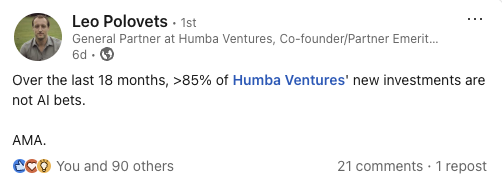
While the post itself was tongue-in-cheek, the message struck a chord with me. Leo is very well-respected VC who has both worked for and invested in multiple consequential companies. He’s making big bets, but not necessarily in AI.
This also maps to what I’ve been seeing in the market. While I’ve met with plenty of founders of AI-centric companies as of late, I’ve also met strong, ambitious founders working in manufacturing, space technology, transportation, infrastructure, and the mining of rare earth minerals.
There are a lot of founders working hard to solve big, consequential problems right now. Not only in AI.
3. The Frustrated Founder
In the midst of all of this, I met a founder who was extremely frustrated with the lack of progress they’d made raising capital from VCs. In relaying their experience to me, the founder proclaimed that they had a stellar founding team with an amazing track record, a working prototype and clear evidence of a market need. Yet they were getting zero traction with investors.
Later that day, I looked up the founder’s company and thought to myself, “what a nice, incremental business.”
“…incremental business.”
I don’t know why that particular phrase popped into my head, but that’s when everything clicked.
To be clear, there was nothing wrong with this founder’s business. It was — and is — a perfectly reasonable B2B SaaS company. The type that was built to solve a real problem and that very likely would have been able to raise VC funding 2 years ago (not because of ZIRP, but because it is a perfectly reasonable company solving a real problem).
Yet in comparison to AI companies, with their unprecedented growth trajectories, and deep tech companies, with their imagination-bending potential, it just felt…
…incremental.
Right now, we are entering a period of monumental technological change. Virtually every industry is going to be impacted by AI. At the same time, consequential technologies are on the verge of disrupting countless industries from energy to transportation to manufacturing to defense. Founders building in those spaces or who are able to convincingly argue why their company will benefit from the changing landscape are having more success fundraising than ever before.
But for founders of nice, incremental businesses. The type that solve a real problem and that very likely would have been able to raise VC funding 2 years ago, it’s a different story.
Not because they aren’t good businesses. But because they no longer capture the imagination. Which in the mind of an investor translates to a lower potential return (and always remember, the job of a VC is first and foremost to generate a return for their LPs). Moreover, in many cases, it’s not clear if the problem they’re solving will even be around in 5 years.
That e-commerce company you’re building? Is it relevant if AI changes how we shop?
That vertical B2B SaaS company you’re building? What happens if someone can vibe code a competitor next year?
These may sound like facetious questions, but I promise they’re not. We really don’t have any precedent for the adoption of AI. Which is why investors are piling into the relatively small number of companies whose founders can clearly articulate why they will be relevant in a post-AI world. And saying no to virtually everyone else.
It might not seem fair, but I think this is going to be the fundraising reality for the immediate future — at least until we have some more clarity around the rate at which AI and AI-driven technologies will permeate the broader market.
So if your company started out before the AI wave, you’re not building in deep tech, and/or you don’t have a convincing answer to the question, “why will this be relevant in 5 years?” then I’m afraid that VC (probably) isn’t right for you.
How to Be a Community Instigator
To many people, the idea of planning an event is overwhelming, so I’m going to show you how to do it. Here’s how you can be an instigator for your community.
Last week, tens of thousands of people descended on my home town of Vancouver, Canada for the inaugural Web Summit Vancouver conference. Of course, given that I’m an unapologetic instigator, I couldn’t pass up the opportunity to host an event.
Or three 😃.


There was the Web Summit Investor Dinner, where 50 VCs from around the world engaged in conversations about the future of tech. There was the Web Summit Developer Dim Sum, where founders from both small startups and industry leaders like Netlify and Klue connected over dumplings. And, finally, the Celebration of Vancouver Party, where 250 VIPs, including CEOs, investors, conference speakers and the Mayor of Vancouver discussed Vancouver’s tech scene on the top floor of one of the city’s iconic high rises.
As I floated through the buzz of the city, catching up with friends and connecting with visitors from around the world, one question kept coming up:
“How do you do it?”
To many people, the idea of planning a single event — much less three in one week — is overwhelming. So I’m going to show you how to do it.
Here’s how you can be an instigator for your community.
Start with Why
The most important part of planning an effective event is coming up with the “why”. Specifically:
Why do you (the host) want to do this? What is your goal?
Why will the people you want to bring together choose to attend your event over the many other things they have to do in their lives?
Far too many event organizers know their “why”, but fail to develop a compelling “why” for attendees. Instead, they try to use gimmicks. They think that:
People will come to my dinner because it’s at nice restaurant
People will come to my party because it’s at a fancy club
People will come to my conference because it’s in a beautiful city
These gimmicks work on college students and mid-level managers, but not on high-achievers (which, I’m assuming is your target market). High achievers will occasionally go out to a nice restaurant, a fancy club or an out-of-town conference for work, but only if there’s another reason to do so. (Moreover, if they really want to go to that nice restaurant, fancy club or beautiful city, they’ll generally do so on their own terms with their own friends and family.)
In my experience, high achievers gravitate towards events that deliver on one or more of the following four goals:
1. Meeting Other High Achievers
The most ambitious people I know are drawn to other high-achievers. They want to learn from them, connect with them and be surrounded by them. Creating an event focused on the opportunity to meet other high-achievers can be a big draw. The most impactful events often take it a step further by focusing the audience around a specific theme, such as:
A single industry (e.g. founders of developer tool companies vs. all founders)
A job function (e.g. CTOs vs. anyone who works at a startup)
A stage-of-life / career / company (e.g. CEOs of Series B+ companies, exited founders looking for their next thing, etc.)
Most intimate events (dinners, lunches, cocktails, etc.) have this as the primary “why”.

Secret meeting of the Vancouver dev tool founders club
2. Meeting Customers / Partners
High-achievers are always selling. The opportunity to connect with potential customers or partners can, therefore, be a major draw for ambitious people.
Investor-only events are a great example of this. A big part of being a VC involves building a network of other investors (for co-investment, deal flow and leveling up), so any opportunity to meet a large number of credible investors in one place is an easy sell.

“Our team has more than 200 years of combined experience in VC…”
Connecting startup founders with executives of established companies is another great example, provided that they overlap in their areas of interest (e.g. founders of fintech startups and banking/finance executives).
And, of course, events where both investors and founders are present can appeal to both groups.
3. Leveling Up
Focused opportunities for learning are another great way to anchor community events. Identify a shared challenge in your target audience and build an event around one or more people who can speak to the problem. For example:
Bringing in later-stage founders to speak to a group of up-and-coming founders
Bringing in subject-matter experts to speak to specific challenges (e.g. how to hire your first sales person, how to open an office in the U.S., etc.)
Facilitating off-the-record / Chatham House Rule events, where attendees can openly speak about sensitive topics

“Four California VCs walk into a bar…”
4. Paying it Forward
Finally, many high achievers (myself included) dedicate a percentage of their time to paying-it-forward. Often times, you can attract prominent high-achievers to anchor an event through their desire to give back to their community. Many events that involve mentorship and office hours leverage this as the “why” for their mentors.
In addition to planning three events last week, I spoke at two more where my primary “why” for attending was to pay it forward.
Note that it’s essential that you not abuse the goodwill of attendees looking to pay it forward. It’s one thing to ask a prominent CEO to speak for free at your sponsored community event. It’s another to ask them to speak for free at an event you’re charging $100 per person to attend (and pocketing the profits).
Finally, it’s important to note that if you’re creating an event that will bring together two or more groups of people, each group will need a distinct “why” to draw them in — and they’re likely different.
For example, Vancouver Founders Day — an event I created that brought together more than 800 up-and-coming founders with experienced founders from the community — was anchored around “leveling up” for the up-and-coming founders and paying it forward for the experienced founders.

Clarify Who
Intertwined with “why” is the question of “who”. Specifically, who exactly do you want to attend your event?
It is important to precisely define “who”, as the same “why” can generally be applied to a wide swath of people. Moreover, there is no right or wrong answer to the question of “who”. It is based on your objectives for the event as the host.
Part of the answer to this question is demographic (are you targeting early-stage founders, CTOs of growth-stage companies, anyone who invests in startups, etc.?). But there’s also a question of quality vs. quantity. Do you want to create an intimate event where each-and-every attendee is highly vetted or do you want to put on a “big tent” event that’s open to anyone who wants to attend?
There are pros and cons of each approach. I won’t dig into them, other than to say that it’s essential to be intentional about your target audience. If you aren’t explicit in your definition, you’re likely to end up with a mediocre event that leaves everyone involved — attendees, partners and hosts — underwhelmed and disappointed.
Build Your Base
Once you’ve identified the “why” and “who” for your event, you should build a base of core attendees to anchor the event around. These are the folks that are willing to commit early to your event and who you can then leverage to draw in other attendees.

Like a snowball…but with less screaming
There are three main strategies to build the base for your event:
1. Anchor Around a Minimum Attendance
When using this approach, you should reach out to people in your target audience and gauge their willingness to attend, based on a minimum viable group size. For example:
“I’m planning a dinner for founders of developer tools startups. If I can find a night that works for 10-12 people, are you interested?”
Many people are willing to conditionally commit to an event, provided the expectations are met. Once you’ve got those initial soft commits, you can start to entice others to attend:
“I’m planning a dinner for founders of developer tools startups. I’ve got 4 seats left…are you interested?”
As you get closer to your target number, you can switch gears to logistics and lock in attendees. Just make sure you don’t over-promise and under-deliver. If you tell people that there are going to be 12 high-quality attendees and instead 5 random people show up, you’ll burn your reputation.
2. Anchor Around a Person / People
Many events are anchored around one or more high-profile individuals who serve as a draw to the broader target audience. This could be a recognized speaker for a “leveling up” event or visiting high-achievers for a dinner.
A few years ago, several of my VC friends from California coincidentally needed to schedule visits to Vancouver (to meet with portfolio companies, visit family, etc.). I suggested that they all visit during the same week and then anchored a “leveling up” event around their visit. We brought together 250 founders for an event to help them better understand how California-based VCs make investment decisions.

3. Anchor Around an Activity
The third way to anchor an event is to focus on an activity that appeals to your target audience and is synergistic with the “why”. Many founder-focused events are built around activities.
San Franciso-based Brandon Waselnuk has built up a massive community of Canadian expats (the Maple Syrup Gang) anchored around monthly hikes. Vancouver-based IcePanel holds a monthly “Chill Club” for developers where attendees reverse-demo each others’ products (volunteers try to figure out how someone else’s product works with no documentation or advanced instructions).

One advantage to this type of event is that the activity still delivers value even if attendance is low. Another advantage is that they can provide a healthy alternative to alcohol-centric events, thus appealing to attendees tired of happy hours.

The main disadvantage is that attendance for activity-anchored events is often inconsistent. Without a core group of attendees “pulling in” others, individuals make just-in-time decisions based on how they feel about the activity on that particular day.
Activity-anchored events succeed best when they’re delivered over multiple occasions, as their reputation builds within the community. But consistency is key — it’s very likely that no one will show up the first few times (so don’t get discouraged).
Regardless of your approach, start small and build your attendance from there. Secure your initial commits and leverage them to attract the rest of your attendees.
Here’s how I leveraged the early speakers for Vancouver Founders Day to secure even more speakers (which then provided the anchor for all of the founders who attended):


Figure Out the Finances
Once you’ve got the outline of your event, the next thing you have to do is figure out the finances. I’ll assume for this part that you aren’t trying to generate a profit, so our goal is to make sure we break even (that is, we have enough revenue to cover the full cost of the event, including possible overages).
Depending on how your mind works, you can either start with the revenue and then back into the expenses or vice versa. Either way, it’s likely to be an iterative process as you converge on a plan.
Revenue
Event revenue generally comes from one or more of the following three sources:
Host Sponsorship (you and/or your co-hosts subsidize the event)
Revenue from Attendees (attendees purchase tickets, dinner guests split the bill, etc.)
Partner Sponsorship (other groups subsidize the event)
The first thing you need to do is figure out what combination of the above sources you want to leverage to fund your event.
1. Host Sponsorship
From a logistical standpoint, host sponsorship is the easiest way to finance an event. You organize the event, run the event and pay for the event (or split the bill with your co-hosts). Kind of like when you host a birthday party and invite all of your friends over.
Of course, this requires you to be willing and able to pay for the event.
From a business standpoint, this approach makes the most sense for events where the “why” involves meeting customers/partners or otherwise building your company’s brand. Customer dinners, LP events held by VCs and pretty much any event where the attendees fall into the bucket of “deal flow” fit this category.
2. Revenue from Attendees
At the other end of the spectrum are events where the attendees themselves are expected to pay all or part of the costs.
Ticket sales are common for events that deliver high value to the attendees, such as “leveling up” events with prominent speakers. Splitting the bill is a reasonable approach for events that the host is organizing but doesn’t necessarily derive disproportionate value from (like a dinner amongst peers or a coffee / happy hour meet-up).

Vancouver-based tech journalist William Johnson has for years organized a weekly coffee at various venues around the city
When I first came back to Vancouver, I met a number of later-stage founders who lamented the fact that they didn’t know many peers in the city. These CEOs felt that while there were plenty of startup events in the community, they were all focused on early-stage founders. I heard the same complaint so many times that I organized a “Breakfast of Champions” on the first Friday of each month. The offer was simple: I’ll make the restaurant reservation and each person pays for their own meal.
30 CEOs showed up to the first breakfast.
(Note: many events combine ticket sales / splitting the bill with host and/or partner sponsorship in order to control costs, such as events where the attendees receive a fixed number of drink tickets).
3. Partner Sponsorship
The third way to finance an event is through sponsorship arrangements, under which one or more partners contribute to the event in exchange for some form of benefit. Partner/sponsor benefits can include:
Advertising (the partner’s name and logo get included in marketing materials)
Access (the partner gains access to a group of potential customers / partners that they might not otherwise)
Information (the partner receives contact information about the attendees)
All of these benefits typically fall under a company’s marketing objectives, so what we’re really talking about are branding / marketing / top-of-funnel benefits. Thankfully, there are many vendors and service providers who sell to startups, VCs and other groups involved in tech.
The key thing to understand about sponsorship arrangements is that one of two things must be true for a potential partner to lean in:
They either must get some meaningful brand benefit from being associated with the event; and/or
The target attendees (the “who”) must significantly overlap with their target customers or partners
In other words, for a partner organization to commit to sponsoring your event, you need to have a compelling “why” for them.
Expenses
Event expenses are typically driven by the following three categories:
Venue (some venues charge a fee to use them)
Food & Beverage (aka “F&B” costs)
Staffing & Equipment
(Many events will also incur costs for consumables like name tags, lanyards and swag, but these are usually discretionary and/or relatively minor, so I’ll skip them in the interest of brevity.)
The Venue
The choice of venue can either result in a major expense for the event or no expense at all. Auditoriums, convention centers and specialty venues typically charge a rental fee for the use of their space. Many restaurants will also charge a “buy-out” fee on top of other charges to rent out all or a significant percentage of their venue.

The venue for Vancouver Founders Day was…not free
In contrast, many restaurants, bars and coffee shops bundle all of their charges into a single amount based on your F&B purchases, with a minimum spend amount and a fixed service charge (tip).
For “leveling up” events and basic networking, you can often get sponsors to provide space in their offices at no charge, provided they can attend and receive some marketing benefits. And if you’re just getting started, consider hosting it in your office or even the “party room” at a team member’s apartment building.
Tip: Many venues have lower rental fees and F&B minimums on days when they’re not typically busy (typically Monday - Wednesday). In each city I operate, I have a list of go-to venues (typically independently-owned), where I’ve built relationships with the owners/managers over time and where I can organize cost effective, win-win events for everyone involved.
Food & Beverage
F&B spend is the largest expense for many events, but it’s also the easiest to control (as it’s generally tied to the number of attendees).
While it can be tempting to splurge on F&B for your events — particularly if you’re inviting people you admire or look up to — it’s essential that you control your temptation. The best instigators know how to throw events within their means while delivering on the “why”.
Some strategies for controlling F&B costs include:
Arranging fixed menus at restaurants
Filtering the available drink options (e.g. no top-shelf)
Serving shared appetizers / snacks instead of full meals
Off-loading some or all of the F&B costs to attendees or sponsors is also a common strategy (e.g. have a sponsor bring branded food or drinks, provide a fixed number of drink tickets to attendees or even make attendees responsible for any and all F&B).
Staffing & Equipment
Staffing and equipment for events is one of those categories that sneaks up on you. Hiring a caterer? Watching out for the cost of servers. That fancy convention space? They’ll charge you extra for access to the projectors (and a union A/V person to run it). And don’t get me started on the cost of power and WiFi.
All of these costs can be controlled, but if you’re not prepared for them they can be a shock.
If you’re just getting started running events, keep things simple. Organizing a “leveling up” event in a host or sponsor’s office is an easy way to minimize staffing & equipment costs (at most, they’ll charge you a cleaning fee). One big advantage to hosting events with food and/or drinks at a restaurant or bar is that the servers are included in the F&B costs, whereas you’ll often be charged additional fees if you bring in vendors.
One last note on finances: when planning things out, assume that your math will be wrong by at least 20%. Even after running hundreds of events, I still end up with my estimates being off. It might be a service charge that I forgot to add, an estimate that didn’t include tax, or an extra round of chicken dumplings that one of the tables ordered.
None of these things should be a deal breaker — especially if your attendees walk away with big smiles on their faces — but making sure you know exactly what the plan is should expenses go over is critical.
Bringing It All Together
At this point, your eyes might be glazing over, but I promise you that events done right aren’t nearly as hard as they seem. You just need to focus on these 3 key questions:
What is the core value proposition for the event?
What are you trying to achieve as the host, who is your target audience (or audiences) and what is the compelling “why” for each group involved (including potential sponsors)?
What is the anchor for the event?
What is the initial draw upon which you will build momentum?
One or more prominent attendees,
The overall group of attendees, or
The activity that attendees will perform?
How will you leverage that anchor to pull together the various groups that you want to attract?
What are the logistics for the event?
What are your revenue sources / what is your budget? What type of venue will you hold the event at? What other resources will you need to deliver your event (equipment, F&B, etc.) and what will they cost?
There are plenty of other questions to answer and details to define (what color will the lanyards be? what witty name will you give the signature cocktail? what AI-generated image will you use for the online invitations?), but if you focus on the above questions, you’re well on your way to a successful event.



A Few Examples
Last but not least, I thought it might be helpful to provide a few specific examples of events I’ve hosted within the context of the above framework:

7 Things I Learned From VCs Who Passed On Me
Hundreds of VCs passed on me when I was a founder. And I learned important lessons from a lot of them.
When I was a founder, we ran a high-velocity fundraising process each time we raised capital. That meant a lot of investor meetings. And a lot of VCs who passed on us.
I learned a lot from those investors — though some of the lessons didn’t become apparent until I was on the other side of the proverbial table.
I’m going to present this week’s post in the style of a list of Friends episodes. (If you’re too young to know what that means, ask your friendly neighborhood AI to explain it 😉.) Here are 7 things I learned from VCs who passed on me:
1. The One with Josh Kopelman
Josh Kopelman was an early investor in Aster Data, the big data company where I was the first employee. After Aster Data was acquired and I left to found DataHero, he spent more hours than I can remember meeting with me and brainstorming about the potential for cloud BI. Each time we met, he asked poignant questions that had a material impact on the trajectory of our company.
On the one hand, Josh was definitely playing the long game and hoping for a potential investment. But it was more than that. I always felt like he was genuinely excited about what we were doing. Even after passing on our Pre-Seed round, Josh continued to make time for me. It always felt like he sincerely wanted us to win.
It was only later that I realized how much of an outlier Josh was in the way he interacted with founders. And it’s influenced how I approach the role of an investor to this day.
The Lesson: The best investors genuinely want to see you win, even if they don’t invest in you.
The Tip: “Pay-it-forward” culture is real. If you encounter an investor who’s willing to offer you their time, don’t be afraid to take advantage of it. Just make sure to pay it forward down the road.
2. The One About the New iPhone
Back when I was a founder, every new iPhone release came with lines around the block of fanboys eager to get their hands on the latest-and-greatest device.
One day, I entered the office of a VC who proudly showed me his brand new iPhone. And then proceeded to stare at it for the duration of our meeting.
I have no doubt that whatever messages he was getting during our meeting were of the utmost importance (were they from the President? or maybe they were from Steve Jobs himself?). Either way, the fact that a VC literally stared at his phone non-stop during a 20-minute pitch meeting made me feel like absolute shit.
It was a complete waste of my time. And I will never, ever forget it.
The Lesson: If an investor isn’t giving you their undivided attention, then they aren’t giving you any attention (and they’re not going to invest).*
The Tip: Don’t be afraid to politely but firmly excuse yourself from a situation when an investor isn’t focused on you (e.g. “It seems that this meeting isn’t a priority for you, so I’m going to give you back your 20 minutes and allow you to focus on what is.").
* Occasionally, a legitimate issue comes up during a pitch meeting. If an investor seems sincere and apologetic in their need to deal with it, try to be understanding.
3. The One With the New Partner
Back when we were raising DataHero’s Seed round, we were in deep diligence with a top tier, multi-billion dollar Silicon Valley firm. The lead partner had an extensive background in our space, understood what we were trying to do, and seemed eager to lead the deal.
What we didn’t realize at the time was that he was brand new to the firm and he had never led a single investment.
We spent weeks in diligence with the firm, including multiple presentations to larger and larger groups of partners. And then one day, the deal just died.
It wasn’t until years later that I found out what actually happened. After the final partner meeting, one of the firm’s senior-most partners asked our champion a straightforward question:
“Do you believe in this company enough to make it your first investment?”
He waffled. And the deal collapsed.
The Lesson: A VC’s tenure with their firm directly impacts their ability (and willingness) to get deals across the line.
The Tip: If a firm “redirects” you to a new partner — even if they’re an expert in your space — ask questions to understand their deal history with the firm and their ability to lead the deal.
(To read more about this situation, check out The Paradox of the Junior VC Partner).
4. The One With the Self-Proclaimed Expert
Ok, this wasn’t just one. It was many. In fact, I’m pretty sure every founder has had this experience multiple times.
You’re five minutes into a pitch with a VC when all of a sudden they turn around and start mansplaining to you exactly what you’re doing wrong and how to fix it.
To the self-proclaimed expert, every startup is a nail and they’re the only hammer to save-the-day. There’s the go-to-market expert, who will tell you how to fix your sales strategy despite having no experience in your industry. The product expert, who will tell you the one tweak that will magically fix your churn because it worked for him 20 year ago (also, he’s never actually tried your product). And don’t forget the marketing expert, to whom everything is just a matter of “positioning”.
(Note: the self-proclaimed expert is different from a run-of-the-mill opinionated VC — of which there are many — in that they always seem to circle back to one specific topic, regardless of what you’re actually talking about.)
The Lesson: As in every industry, there are some investors who just need to be the smartest person in the room.
The Tip: Learn to smile and nod? I dunno…I never really figured this one out.
5. The One About the CVCs
Prior to DataHero, my knowledge of corporate venture capital firms (“CVCs”) was limited. I knew that a lot of tech companies had venture capital arms, but I didn’t really understand how or why they differed from regular VCs.
In those days, Intel Capital, Google Ventures and Salesforce Ventures were three of the CVCs that were most widely respected amongst founders and I had the opportunity to pitch all of them. In each case, my interactions were strongly positive. The partners were extremely well-informed with an understanding of the market that exceeded that of many other VCs I met. But in each case, a topic of conversation arose that did not come up with traditional VCs: synergy.
Some CVCs had very direct requirements. For example, Igor Taber of Intel Capital had a single question: how would DataHero’s success help Intel sell more processors? (It wouldn’t)
In Salesforce’s case, Villi Iltchev wanted to understand how we envisioned DataHero fitting into their portfolio of offerings (given that we thought their reporting product was atrocious and wanted to replace it, I didn’t have a great answer).
Ultimately, our vision wasn’t closely enough aligned with the strategic objectives of any of the CVCs that we pitched, so none of those conversations went far.
The Lesson: CVCs are looking for strategic alignment on top of (and in some cases, instead of) financial benefit from their investments.
The Tip: Ask corporate VCs what strategic objectives they’re trying to satisfy and what needs to be true in order for them to invest.
6. The One With the Industry Luminary
One of the investors I met with while fundraising for DataHero’s Pre-Seed round was a genuine luminary in the database space. He had co-founded an incredibly successful company before becoming a prolific early-stage investor. His understanding of both technology and business were second-to-none. So why did he pass?
His company — like many others of the big data era — was built on the premise that all of the data in a company should be collocated in a single data warehouse. What we were proposing with DataHero went directly against that premise. We believed that data would be distributed across the cloud services companies were increasingly adopting. Not only that, we also believed that an increasing amount of data analysis would be performed without the traditional data warehouse team involved.
This conflict meant that the only way for DataHero to succeed would be if the premise upon which the investor had built a successful 20-year career no longer held.
Despite multiple engaging and intellectually stimulating conversations, the luminary remained rooted in his view of the world and passed on DataHero.
The Lesson: A VC is unlikely to invest if a fundamental premise of your startup goes against a belief that they hold strongly.
The Tip: Qualify potential investors by testing their openness to the future state that you envision (e.g. “We believe that the future will involve X. What do you think of that?”)
7. The One About Everyone Else Who Passed
Whenever a VC passed on DataHero with an explanation along the lines of, “it’s not a fit for us,” I struggled to accept their reasoning at face value. After all, shouldn’t a good VC want to invest in a stellar business no matter what?
Now that I’m on the other side of the table, I understand how wrong that line of thinking is.
In many cases, a company just isn’t a fit. It might not be a fit for the firm’s thesis, it might contradict the partner’s lived experiences or the partner might realize that, given the dynamics of their firm, it’s unlikely that the deal will get approved.
After nearly 10 years as an investor, I understand the degree to which, “it’s not you, it’s me,” really is a thing when it comes to VCs.
The Lesson: Sometimes (s)he’s just not that into you.
The Tip: Fundraising is a numbers game. By filling your fundraising funnel with a sufficient number of qualified target investors, you put yourself in the best position to succeed even when many investors pass for reasons that aren’t entirely clear to you.
What Does it Mean to be Investor Ready?
It feels like the term “investor ready” is all the rage these days, but what does it actually mean?
It feels like the term “investor ready” is all the rage amongst incubators, angel groups and ecosystem supporters these days. Search for “investor ready” or “investor readiness workshop” and you’ll get hundreds upon hundreds of results.
I have to be honest: I’m highly skeptical of the vast majority of these programs. For starters, I’ve been asked to speak at countless “investor readiness” workshops over the years — which I’ve always found funny. If you’re running a program that teaches founders what they need to do to be ready to speak to investors, why do you need me there? Moreover, many of these programs are run by people who have never raised any capital, nor invested any of their own. How on earth can you proclaim to be an expert in navigating a two-sided marketplace when you’ve never participated on either side? (Wait…I think I have my answer… 🤣)
But seriously…what does “investor ready” actually mean?

Let’s start with a basic fact: it is possible for almost any company to attract capital at any stage of its journey.
Sound crazy?
I’m not saying that any company can raise capital at whatever terms the founders want, but simply that in the vast majority of cases, there is a price at which some number of investors greater than one would be willing to invest.
You might not be willing to give me $10,000,000 for 10% of my company, but you might be willing to give me $10 for 100% of it.

My point is that “investor readiness” isn’t about how far along you are in your journey.
It’s not about whether you’ve achieved X revenue or Y pilots or Z users. Those things impact the likelihood that you will be able to attract investors at the terms you’re looking for, but not whether prepared to talk to investors.
Investor readiness is a measure of your preparedness to credibly engage with a potential investor. Which boils down to three things:
Can you accurately describe your business and its potential to someone who hasn’t met you before?
Do you have the materials necessary for a potential investor to perform diligence on the investment opportunity?
Is the company structured in a way that it can receive external investment?
Let’s dig into each one.
1. The Pitch
By far the most important part of investor readiness is the pitch. Can you accurately describe your business and its potential to someone that you’ve never met before?
I won’t go into the details of what makes a good pitch, but at its most basic, you should be able to cover the following points concisely and confidently:
What problem are you solving?
How big is the opportunity? (Why does it matter?)
What is your team best positioned to capture the opportunity?
What have you achieved so far? (What evidence do you have in support of your market hypothesis?)
You should have both a written form of The Pitch — aka your pitch deck — and a verbal form (known as your “elevator pitch”). Make sure that you practice pitching and fielding Q&A from a variety of people prior to speaking with investors. Though don’t rely too heavily on founder friends.
2. The Data Room
If an investor shows genuine interest after The Pitch, do you have all of the necessary materials ready and available for them to perform diligence?
A collection of diligence materials is organized in a “Data Room” (which is just a fancy name for a Dropbox folder or other online repository). A basic data room includes the following materials:
Company documents (incorporation certificates and similar documents)
Financials (standard financial reports, bank account balance, prior investment details, etc.)
Proposed Budget
Product Materials (architecture/design documents, patents, IP agreements, etc.)
Sales Materials (contracts, partnerships, pipeline, etc.)
It’s common for investors to ask for additional materials based on their personal questions, but you should have the basics ready to go.
3. The Company Structure
This last point is usually not an issue, but if you don’t pay attention it can kill a potential investment.
Not all companies are structured in a way as to be able to receive external investment. I won’t go into the details here (consult your friendly neighborhood startup lawyer), but making sure that you are incorporated in the correct form and in the correct jurisdiction is essential.
You also need to make sure that your cap table isn’t “upside down”. Potential investors may balk if a significant amount of your equity is owned by a cofounder who’s no longer part of the company or an angel investor who only put in a tiny amount of capital. They want to know that the team they’re investing in is highly motivated (which means that they own the majority of the company).
Being investor ready isn’t about whether or not your company is in a good position to raise capital. It’s simply about whether or not you’re prepared to have credible conversations with potential investors.
If you maintain investor readiness, you can periodically “test the waters” with investors to get a sense of whether now is a good time to raise (or if there are specific benchmarks you should achieve first). I’m a big proponent of creating a “dotted line” with potential investors, rather than choosing when to fundraise based on overly-general rules of thumb or milestones proposed by advisor and friends. Being investor ready allows you to pounce when the timing is right, which can lead to incredible results.

Don’t Slam the Door on Your Way Out
If you successfully fundraise from Silicon Valley VCs, be careful about how you tell the story. You could end up accidentally burning bridges.
It’s a tale as old as time.
An ambitious young founder starts a company in their hometown. After struggling to raise funding locally, they decide to make a trip to California. In a matter of weeks, the young founder successfully raises money from from “Silicon Valley investors” and returns home triumphant. Then, they go on to tell anyone and everyone they meet how much better it is “in Silicon Valley”.

In most cases, this is beneficial for the ecosystem. Other young founders see someone “like them” succeed raising money abroad and learn to expand their fundraising horizons. Local investors get a healthy reminder to stay competitive.
But occasionally, an excited founder takes it too far.
In their eagerness to ingratiate themselves with other founders in the ecosystem, the tone of their message turns from positive (“Silicon Valley is great / Silicon Valley investors are great”) to negative (“this ecosystem is not great / local investors are not great”). Before long, the young founder is known more for railing on their local ecosystem than anything to do with their startup.
While other founders eat it up — especially those who’ve struggled to raise — the founder can become persona non grata to many others in the ecosystem. And chances are, they don’t even know it.

At this point, some of you might be rolling your eyes at me (“aren’t you the guy who’s always talking about San Francisco?”).
But if you pay close attention to my writing, you’ll find that I never express a blanket perspective that “Silicon Valley is better” — because I simply don’t believe that. For example, last year I wrote a post titled The Mythical U.S. Lead Investor in order to debunk the overly-simplistic stereotype that U.S. investors are more risk-taking than investors in other countries. I’ve also written about The 9 Types of Startup Investors to help explain the varying motivations held by different categories of startup investors and how those impact their behavior.
While I absolutely believe that a significant number of VCs outside of Silicon Valley do themselves (and their ecosystems) a disservice by not building deep connections to Silicon Valley, I don’t believe that investors in the Bay Area are inherently better than investors in other ecosystems.
They’re just different.
But enough about me. Let’s get back to our intrepid young founder…

When we last left our heroes…
The problem with spending too much time comparing and contrasting your fundraising experiences at home and in Silicon Valley is that the story you tell yourself is often self-serving. Local VCs obviously didn’t invest because there is something wrong with them. Silicon Valley VCs clearly saw the potential and were willing to take the risk.
End of story.

Local investors obviously didn’t get it
In some cases, that might actually be the story. But 99% of the time, it’s not that simple.
In reality, most founders have no idea why local VCs actually passed on their startup, or for that matter what caused the investors on their cap table to lean in.
Here are 3 key differences between the perspective of Silicon Valley investors and those in other ecosystems when it comes to evaluating out-of-town startups:
1. History
For better or worse, local investors have more intimate access to your recent history. That promising startup you previously worked at? They know if it was legit or a total sh*tshow. The regional tech company you cut your teeth at? They know whether it hires the cream of the crop or pays the bare minimum and takes whoever it can get. They also likely have access to people who can vouch for your reputation — good, bad or otherwise.
As a result, local investors will sometimes pass on promising startups because the founders didn’t reference well or they have negative perceptions about their prior work history.
Silicon Valley investors are often unaware of the baggage an out-of-town founder brings (and many are less inclined to find out). That gives you an opportunity for a clean slate, but it also means that they won’t give you as much credit for some of your “locally famous” accomplishments.
2. Generalist vs. Specialist Investors
Outside of Silicon Valley, the vast majority of investors are generalists. That means they might not have any prior experience in your space (and may never have met a single company doing what you’re doing). There are some things you can do to more effectively pitch to a generalist investor, but you should also expect that you’ll get far more noes than you will yesses.
From a VC perspective, investing in something you don’t understand is akin to playing the lottery. That’s not a good investment strategy. While this can be frustrating as a founder, don’t blame it on risk-averseness.
By simple virtue of the number of investors in Silicon Valley (there are nearly 2,000 active early-stage funds between San Francisco and San Jose), you’re more likely to run into investors that understand and have experience with what you’re working on. Which makes it more likely that you’ll be able to secure investment if your space is less widely-understood.
3. Power Law
The majority of Silicon Valley investors rely heavily on the concept that returns in venture follow a power law distribution. These investors expect one or two companies to drive the returns of their fund, while the rest will provide a rounding error.
VCs that adhere to power law investing presume that any startup they invest in which is not a “breakout win” will not be material to their returns and, therefore, spend little-to-no time evaluating alternative scenarios. That can be good or bad for startups.
If you have a clear thesis as to how you could become a billion dollar company but no credible “Plan B”, it could be a great fit for Silicon Valley investors but a turnoff for local VCs (who tend to — correctly — discount the likelihood that you’ll actually become a unicorn). On the other hand, if your trajectory lends itself to multiple options should the primary hypothesis fail, local investors might lean in whilst Silicon Valley VCs worry that you’re straddling the fence.
All of this is to say, be careful about how and when you share your reflections on fundraising. Chances are, your perspective is hidden behind rose colored glasses. Also keep in mind that there’s a big difference between sharing your experiences with a group of founders under Chatham House Rule and airing your dirty laundry on stage at a conference. Or worse, in the media.
Not only do negative quotes in press statements take attention away from your company (the story isn’t about how awesome your company is, it’s about how bad your ecosystem is), it can burn a lot of bridges. That might feel good for a moment, but I promise you that in exchange for your 15 seconds of fame, you’ve lost potential local champions.
Often because those folks “knew the real story.”
Like the founder whose funding announcement was focused his big “decision” to move the company to San Francisco, when everyone in the local ecosystem knew he’d been trying to get a U.S. visa for years. Or the founder who complained that local investors only wanted safe investments with complicated deal structures, when all of the local VCs had passed due to concerns over a prior company.
Or the founder who publicly complained about how atrocious Salesforce’s reporting interface was, only to have the SVP of Analytics for Salesforce call him incensed because they were supposed to be partners.

…oh wait, that was me. 😬
What were we talking about again?
A Strong Company Gets You a Term Sheet. A Strong Process Gets You a Valuation.
Great founders of strong companies will almost always get a round done. But whether or not they get the valuation they want depends on their process.
Q1 2025 was the busiest fundraising quarter that we’ve seen in years (something I predicted recently in my Things I Think I Think: Q1 2025 post 😉). According to Crunchbase, it was the strongest quarter for startup fundraising globally since Q2 2022, with a 17% quarter-over-quarter increase in funding vs. Q4 2024 and a 54% year-over-year jump from Q1 2024.

The biggest increase was in later-stage deals — led by Open AI’s massive $40B funding round — but we also saw an incredible number of companies raise Seed and Series A rounds for businesses that are firing on all cylinders (note: Crunchbase’s data shows a slight drop in Early-Stage and Seed funding in Q1, but given that many of these rounds only see the light of day months or years later, I expect the data will show an increase in funding across-the-board when the dust eventually settles).
I was personally hands-on with a half-dozen founders in my portfolio who were fundraising in Q1 and many more through mentorship programs like Creative Destruction Lab. Almost all of these companies successfully closed their funding rounds — and they should have, because they all had strong, high-potential businesses.
But not all of them got the valuation they wanted.
The biggest difference? Whether or not the founders ran a tight fundraising process.

Pick a sports analogy. Any sports analogy.
When I was at 500 Startups, Marvin Liao would start every batch’s fundraising course with some version of the following statement:
“Over the next few weeks, we are going to teach you how to run a proper fundraising process. Effective fundraising is well understood. If you put in the work to prepare and run a tight process, you’re very likely going to get the result you want.
We’re going to teach you how to run a tight fundraising process, but not all of you will listen.
Some of you think that you’re special. Some of you think that the rules don’t apply to you. Some of you think that you don’t have to put in the work or that you can fundraise part-time. But fundraising in Silicon Valley is different.”
Sure enough, in every batch there were a handful of founders who “thought they were special.” Founders who either didn’t put in the work to fully prepare or didn’t run a strong, tight fundraising process.
And every single one of those companies either failed to raise their round or raised what I will diplomatically call a “suboptimal round”.

In my experience, there’s a direct correlation between how easy it was for a founder to raise their initial round of capital (whether it be friends-and-family, angel or Pre-Seed) and an over-confidence going into their Seed or Series A round. Founders who raised their first round quickly and with minimal effort often underestimate the effort required to raise true institutional capital.
This is especially true when founders from outside of California attempt to “make the leap” and raise a Seed or Series A round from Silicon Valley VCs.
I’ve written at length about high-velocity fundraising, the fundraising approach recommended by most Silicon Valley accelerators and VCs. There are subtle differences to the fundraising systems taught by various firms, but they are all based on the same 3 pillars:
Preparing and refining the pitch deck and fundraising materials in advance
Building a sufficiently large, fully-researched target pipeline (and identifying people who can introduce you to as many of those target investors as possible)
Executing a tightly-controlled fundraising process with densely-packed meetings
The goal of high-velocity fundraising is to get as many qualified investors through your funnel on approximately the same timeline. Running a strong process maximizes the likelihood of competition amongst investors at the end.

What if we replace Shark Tank with a version of American Gladiators where the investors have to fight for the privilege to lead a round? 🥊
Econ 101 teaches us that competition for a scarce resource (in this case, your equity) leads to increased prices. That fundamental fact is why it’s so important for founders to prioritize fundraising. And it’s ultimately why a strong company gets you a term sheet but a strong process gets you a valuation.
Unfortunately, some otherwise exceptional founders don’t go all-in on fundraising. The result? A scenario that I’ve witnessed far too many times:
The founders of a strong company run a weak fundraising process and eventually are forced to make a life-altering decision based on a single term sheet (with a less-than-ideal valuation).
How can you avoid this? Here are the three biggest mistakes founders make that negatively impact their ability to drive competitive dynamics:
1. Not Building a Large Enough Target Investor List
Before you send a single email or take your first call, you should have a fully-researched pipeline CRM with a minimum number of qualified target investors:
Pre-Seed: 100 – 150 qualified target investors (a mix of angel investors and VCs)
Seed: 80 – 100 qualified target investors (mostly VCs)
Series A: 60 – 80 qualified target investors (all VCs)
Series B: 40 – 60 qualified target investors (all VCs)
“Fully-researched” means that for each VC, you’ve identified the specific partner at that firm who you want to meet with, figured out who can help you with an introduction, and pre-written a personalized request-for-introduction email.
2. Delaying Investor Outreach
Over the years, I’ve seen too many founders build a solid target investor list, only to delay hitting “send” on all of the introductions. Maybe it’s an overconfidence issue (“I don’t need to talk to all of these investors to get the round done”) or maybe it’s a lack of confidence (“I’ll test out these ones out first and see how it goes”). Either way, if you’re not triggering all of your introductions, you won’t be able to generate a dense enough meeting schedule to get the outcome you want.
Effective fundraising requires a carefully-choreographed meeting schedule. Delaying introductions by even a few days can have a catastrophic impact on your competitive dynamics.
3. Fundraising Part-Time
Effective fundraising is a full-time job. Too many founders think that they can fundraise part-time while still writing code, selling or handling customer support.
I get it. But the difference between full-time and part-time fundraising can mean the difference between 40-50 investor meetings per week and 10-20.
Which can be the difference between competitive term sheets and “we’re not going to be able to catch up, so we’ll have to bow out.”
If you’re not prepared to dedicate 3-5 weeks to full-time fundraising, then you should think long and hard about whether or not it’s the right path for you. That’s easier said and done (especially when startups are resource-constrained at the best of times), but raising capital is one of the most consequential financial transactions in the life of any company. You simply can’t afford to treat it as just another task on your list.
At the end of the day, strong founders of strong companies will almost always get a round done, even with a weak process. That’s proof that they’re onto something.
But I can tell you that it’s a bittersweet outcome to close a funding round knowing that you left money on the table.
It’s an expensive lesson to learn. And one that you can generally avoid.
Want People to Say Yes? Listen to Them.
One simple filter busy people use trips up many founders: when I tell you how to get my help, do you listen?
I had been trying for weeks to get an introduction to a well-known founder-turned-angel investor. Finally, I was able to find a friend willing to forward my request for introduction email. A few hours later, a successful introduction landed in my inbox followed quickly by an email response from the angel 🙌.
I opened his email and saw the following:
“Call me. 415-XXX-XXXX”
Caught off-guard by his directness and unsure of what to do, I sent a polite response thanking him for his time and offering to schedule a call.
I never heard from him again.

At the time, I was so used to the choreographed dance of introductions and scheduling that my mind was completely broken by a stranger telling me to just “call him”. That was 15 years ago, long before I understood Silicon Valley’s paradox of time:
In Silicon Valley, most people in places of power, influence and experience genuinely want to help up-and-coming founders, but their work and obligations leave little to no time for them to do so.
The founders who can solve this puzzle unlock an unfair advantage that can change the trajectory of their startup: access to Silicon Valley’s insiders. And the solution isn’t as complex as you might imagine.
You simply have to make it easy for them to say yes.
A corollary of the paradox of time is that people in places of power, influence and experience who genuinely want to help employ aggressive filtering in order to decide who to help.
The double opt-in intro system is an example of one such filter. Another filter — which is shockingly simple yet trips up many people — is the following: when I tell you how to get my help, do you listen?

Can you follow the “treasure” map?
In my anecdote above, the investor literally told me to call him. I ignored his instructions and instead did something else (sent him an email to try to schedule a call). While it might seem harsh for him to ghost me after such a simple slight, it makes perfect sense if you look at it through the lens of what he was really saying:
“I’m willing to talk to you but I am unwilling to spend even 5 seconds on scheduling.”
By responding to him with an email, I introduced additional overhead and, thus, failed his filter.
Fifteen years later, I have the privilege of receiving dozens of requests each week for help from founders. But I’m beholden to the paradox of time — as much as I would genuinely like to help each-and-every person who reaches out to me, I simply don’t have enough hours in the day.
So I filter.
And one of those filters is embedded within the responses that I send to the founders I want to help. Responses like:
Asking someone who DM’d me to please send me an email (e.g. “Email me your pitch deck and I’ll take a look.”)
Sending someone a Vimcal link to book a call (e.g. “Click on a slot below to book a call or lmk if none of these work.”)
Pointing them to a blog post I previously wrote that answers their exact question
In each of these cases, I’m trying to minimize the time and effort to get from initial interaction to help. And it’s very much based on how I personally work. For example, my preferred workflow centers around email on my laptop, which is why I redirect as many inbound requests as I can to email.
This is where understanding the dynamics of the relationship is essential to success. If you are the person asking for help, then you should make every effort to fit seamlessly into how the other person works. Jason Lemkin’s advice on asking for in-person meetings is a perfect example of this:

That’s why it’s so essential that you pay attention to the instructions encoded in an offer for help. Especially if it involves changing the communication channel.
If someone responds to your DM asking you to email them, email them.
If someone sends you a Vimcal, Calendly, etc. link to book a call, use that link to book a call.
If someone tells you to just call them, pick up the phone and just call them.
Now that I’m on the other side of the table, I see how frequently people who ask for help ignore (or miss) such instructions. Perhaps it’s because they don’t recognize them for what they are. Perhaps it’s because it’s out of their comfort zone or doesn’t fit the way they prefer to work. Either way, I simply don’t have time to figure it out.
If I ask you to email me something and you instead keep messaging me, I’ll probably stop responding.
If I send you a Vimcal link and you email me back with the time you prefer (instead of clicking the link to just book it), I’ll probably stop responding.
If I send you a link to a blog post that has the exact answer to your question and you instead complain that I’m redirecting you to my blog instead of answering your question, I’ll definitely stop responding.
Not because I’m ornery or don’t want to help you, but because every minute I spend on overhead is one less minute I have to actually help.
That, or I might just be a cranky old man.

Life is Short. Have Fun.
Over time, small injections of fun can change the trajectory of a company. And your experience as a founder.
There’s a lot going on in the world right now.
A lot of distractions. A lot of things to feel stressed about. A lot of armchair entrepreneurs telling founders to “just put your head down and build” (never mind that they’ve long since forgotten what it actually feels like to build).
Being a founder is never easy. I know firsthand — I’ve done it 4 times. It doesn’t matter if you’re building a high-growth VC-backed company, a slow-growth calm business, a consulting company, or something else…they’re all hard! It’s risky. It’s stressful. It involves long hours and sleepless nights. And that’s before throwing in curveballs like global pandemics, unprecedented interest rates spikes and geopolitical rollercoasters.

Life as an founder
But entrepreneurship can also be a hell of a lot of fun.
One of the things I try to do with my “founder journey” posts is to share simple tips to improve the entrepreneurial experience that are easy for even the busiest founders to adopt. 5 Easy Ways to be a Healthier Founder, Treat Yo’ Self and Find Your Recharge are recent examples of this. Today, I’m going to focus on fun.

I’ve previously written about the recent resurgence of hustle culture in certain corners of the startup world. Last week, Matt Munson published a post challenging what he sees as a false choice between “leading with heart” and “founder-mode”. Matt noted that, as a founder:
You can lead with heart and strength.
You can be decisive and deeply human.
You can care about your team and hold a clear standard.
His point is an important one, which I deeply believe in: the best founders don’t choose between high expectations and showing empathy for their teams. Nor should they face or force that choice on themselves. That’s where fun comes in.
But before I get there, I want to be clear in my belief that for many ambitious people, the simple act of being part of an intense, high-growth startup is fun. A few years ago, Tobi Lütke of Shopify made the following observation (which was shockingly controversial in some circles):

Tobi’s point was that working long, hard hours can itself be fun, if you enjoy the work and the people you’re working with.
But no matter how passionate about the work you are, and no matter how caring and brilliant the people you’re surrounded by are, it can still be exhausting. Which is where genuine fun comes in. The thing is, you don’t need to come up with grand plans to have fun. You just need to be open to taking things a bit less seriously. And the impact can be huge (both on you and on your team).
In the early days of Aster Data, we were working particularly long hours (often well into the night). There was an intensity to our work environment, such that when things went wrong — which they often did — people had a tendency to get pretty upset.
One day, one of the engineers brought in a stuffed animal of the “evil monkey” from the TV show Family Guy to the office. He declared that, going forward, the evil monkey would belong to whomever most recently broke the build.

Now, one could imagine that this could amp up the level of frustration when the build broke, but it had the polar opposite effect. Everyone found it so hilarious to have a giant stuffed monkey pointing at them that breaking the build went from an event that triggered frustration and arguments to a celebration of the “build monkey” being moved to a new person’s desk. That simple gesture of fun was a key pillar of the Aster Data engineering culture for years through to the company’s acquisition.
At DataHero, we had a similar level of intensity in the early days that would occasionally result in colorful arguments (particularly amongst the founders 😬). We eventually recognized that we had to button things up, but we didn’t want to lose the intensity. My long-time partner-in-crime, Gail Yui, proposed a solution: the “HR Jar” (aka a grown up “swear jar”). The implementation was simple, yet hilarious.
If someone used inappropriate language or an argument got too heated, anyone could yell out “HR violation!” and the entire company would immediately stop what they were doing. That person would then recount what just happened (e.g. “Chris just said that my idea was stupid”) and the rest of the company would vote on whether or not it was an “HR violation” (99.99% of complaints were voted to be HR violations).

Don’t ask about the zebra head
Over time, things got even funnier as there developed a trend of “prepayments” into the HR jar (people would proactively drop $20 into the jar before going to town on something that they were annoyed with). None of this related to actual HR violations, mind you. It was simply a fun way to defuse arguments. And when the jar got full? We would take the entire company out to the bar around the corner for drinks.
The observant reader will notice that in neither of these examples did the idea come from a founder. Rather, their success came from the fact that the founders were willing to adopt silly ideas proposed by the team. Being willing to support and incorporate grassroots “fun” into the company serves the dual purpose of making work more enjoyable and empowering the rest of the team. Easy. Simple. Win-win.
There are plenty of ways to incorporate fun into startups, from stocking games in the office to taking the team out to offsites to planned multi-day retreats. But in my experience, the biggest impact comes from adopting simple, silly ideas without overthinking it. Over time, those small injections of fun can change the trajectory of a company (and your experience as a founder).
Want another suggestion? Take the budget you’ve set aside for the next fancy team dinner and swap it for an impromptu cooking “competition”.

Things I Think I Think - Q1 2025
Can you write this post in the style of Studio Gibli? Here are 5 Things I Think I Think: Q1 2025.
It’s been a rollercoaster of a quarter on so many fronts. Let’s slow things down with another homage to legendary sports columnist Peter King.
Here are 5 Things I Think I Think - Q1 2025 Edition:
1. I Came in Like a Wrecking Ball
A lot of people thought they knew what was coming with the new administration, but the breadth and velocity of actions has impressed even the most seasoned political pundits.
I’ve said before that I have zero background in government or public policy, so I’m not going to try to unpack or opine on everything that’s going on. Rather, I’m going to share a few thoughts from the perspective of someone in venture:
The fundraising environment has, thus far, been completely immune to the day-to-day geopolitical drama (and, in fact, is very much on fire — more on that later). It remains an excellent time to raise if you’re a founder.
At this point, it’s fair to assume that tariffs of one form or another are here to stay. Plan accordingly.
Like many in tech, I was surprised by the recently-announced pardons for several startup founders convicted of fraud given the number of VCs in the administration’s inner circle. Hunter Walk has a good summary of why the right amount of fraud in Seed stage startups is greater than 0% but it shouldn’t be pardoned.
Speaking of VCs, I previously predicted that we would see a meaningful amount of vitriol directed at VCs as the new administration made move that were seen to have been influenced by the “VC arm” of the Republican party. With DOGE’s efforts mostly attributed to Elon Musk and talk of tariffs the primary economic topic, that hasn’t happened.
2. Fundraising is on 🔥
In my new year’s update, I predicted that the first half of 2025 would be hot from a fundraising perspective and wow…has it ever been!
Rounds are coming together with breathtaking speed. Virtually every founder I’ve worked with this quarter ended up in an oversubscribed scenario, with valuations at or above their target.
Some of this is stems from the entry of significant dry powder into the system that was sitting on the sidelines for the past couple of years. Some of this, undoubtedly, comes from the excitement surrounding all things AI.
Additionally, I think a not-insignificant part of the energy and enthusiasm in the ecosystem right now is due to the fact that we’re finally nearing the end of the washout of companies that raised too much during the ZIRP days. Investors are seeing more fast-growing, inspiring startups and fewer struggling companies in search of salvation, which is impacting their psychology.
In other words, investors are feeling more positive because their day-to-day experience is more positive.
Sound silly? A few years ago, I wrote about the impact that the adrenaline of deal flow has on investor behavior. When VCs see fewer deals or fewer companies that they perceive to be high quality, their rate of investment slows. What we’re seeing now is the inverse: investors are seeing a high rate of high-quality startups, which is keeping their level of enthusiasm — and thus, their willingness to invest — high.
It’s only been one quarter, but it’s feeling like we’ve finally moved back from glass half empty to glass half full on the fundraising front (at least, at the early stages — there remain a significant number of Series B and later companies in the danger zone).

As we head into Q2, I have two fundraising-related predictions:
When the final numbers are tallied up, I expect that Q1 2025 will have been the biggest startup fundraising quarter in North America in years (even without Open AI’s unprecedented $40B funding round).
Q2 will continue the momentum, although I won’t be entirely surprised if VCs start their summer slowdown a few weeks early. If you’re planning to raise before the summer, make sure you start before Memorial Day.
3. Elbows Up
In my Q4 update, I noted that the G7 countries were all falling behind the U.S. in terms of productivity and wondered aloud whether the tech communities in Canada, the UK, or any of the other countries would step up in the same way we were seeing in America. Talk of tariffs and trade wars in the early days of the new administration has since pushed a number of founders, investors and policy makers into action.
When the first round of tariffs was announced, I wrote about the unprecedented level of anger amongst Canadians. Canadians were (and still are) pissed. One outcome has been the Build Canada initiative, a coordinated effort from the tech and business community to promote a range of policy changes focused on increasing Canadian productivity in the lead-up to that country’s federal election.
We’re starting to see similar initiatives across the pond in Europe. For example, a group of prominent investors and founders including Harry Stebbings of 20VC and my former colleague Rina Onur Sirinoglu recently announced Project Europe, a new fund modeled after Peter Thiel’s famed Thiel Fellowship. But the urgency around Europe’s actions doesn’t yet seem as high as those in the Great White North (at least, not within the tech community). I suspect this has a lot to do with the fact that Canada is physically proximate to the U.S. and has a major federal election this month.
At a time when Canadian entrepreneurs on both side of the border are trying to make sense of what these changes mean for them, the coming weeks will tell us a lot about how influential Canada’s tech community really is.

4. San Francisco is Still the Place to Be
With so much of the tech news cycle focused on the impacts of tariffs and other actions from the new administration, it might not be as apparent to the outside world how fast San Francisco is moving right now. But it absolutely, unequivocally remains the place to be.
I was recently in San Francisco for YC Demo Day and the energy and activity dwarfed the prior demo day, which is notable as that was the first in-person demo day since Covid. The San Francisco Palace of Fine Arts was packed to the brim with investors and founders, and the buzz around AI and the emerging impact of vibe coding was palpable.

5. AI has its Studio Gibli Moment
I was going to end this post by sharing some thoughts on the emergence of vibe coding, but that was before Open AI released its latest image generation capabilities in an update to GPT‑4o. This past weekend, millions of people around the world rushed to reimagine their photos in the style of Studio Gibli.


While this viral trend might seem like nothing of particular significance, anyone who’s studied technology adoption knows the impact that moments like this can have.

According to Sam Altman, ChatGPT added more than a million users in a single hour on Monday. For context, it took 5 days to add that many users during the app’s viral launch. For many people around the world, the opportunity to “Gibli-fy” their images served as their introduction to AI.
I don’t think it’s an exaggeration to suggest that we’ll look back at this release as a turning point in the mainstream adoption of AI. Numerous technological waves have been driven by photo-related capabilities. It makes perfect sense to me that the opportunity to leverage AI in such a magical way would trigger the imaginations of the public-at-large. (Sorry, but AI’s killer app was never going to be “deep research”).
I’m not a consumer guy, but I can’t help but wonder if we’ll see a wave of AI-driven consumer apps catch fire in the coming months. Either way, it will be exciting to see how the adoption of these technologies changes as we transition into the “early majority” phase of the technology adoption lifecycle.
5 Easy Ways to Be a Healthier Founder
Here are 5 easy ways to be a healthier founder (and, in doing so, perform better over the long-run).
Being a founder is a marathon, not a sprint. That’s why, regardless of where you fall in terms of work-life balance, it’s essential to find your recharge and every once-in-awhile take a break. No really.
But the days can be long even while the years are short. Which is why finding small ways to inject regular healthy behaviors into your routine is essential for long-term performance.
Here are 5 easy ways to be a healthier founder (and, in doing so, perform better over the long-run):
1. Ditch Sugary Sodas
It’s surprising to me that this is still a thing in 2025, but if you’re consuming high-sugar sodas on a regular basis, cut them out. A single can of soda has between 40 and 50 grams of sugar (that’s 10 - 12 tsp). There are plenty of things you can swap sugary sodas for, including:
Black coffee
Flavored carbonated water
Unsweetened iced tea
Unsweetened electrolyte drinks
Diet soda (though I know some folks have thoughts on artificial sweeteners)

One of my all-time favorite beverages
2. Switch to Black Coffee
I love coffee and I’m a daily coffee drinker. For most of my life, I happily consumed my morning joe with cream and sugar. A few years ago, I switched to black coffee in the mornings at the suggestion of my trainer.
I admit it wasn’t easy at first — I had grown quite accustomed to sweeter coffee before the sunrise — but with so many flavorful roasts available, it didn’t take long to get used to.
I still happily drink cappuccinos during my many coffee meanings during the day. But switching to black coffee first thing in the morning was an easy way to extend my natural overnight fast without really changing anything.

3. Pacing Phone Calls
One of the changes I made years ago — back before any of us had heard of Zoom — was to pace during phone calls. Seriously.
Whenever I take phone calls, I stand in whatever room I’m taking the call in and walk around in circles. Over and over again.
When Fitbit first came on the market, I started tracking my steps and was astonished to find I was easily cracking 15,000 steps each day, even on days when I didn’t leave the office.
It’s a little harder to do today, when so many of our calls are expected to be on video, but if you can switch some of those to the phone and then stand up and walk around while you’re on them, you’ll be amazed what it will do for your health.

You can barely see his AirPods
4. Walking Meetings
This is another easy change to your weekly routine: take some of your 1x1 meetings as walk-and-talks. You can do this with coffee meetings (order the coffees to go instead of sitting down) or in-office meetings that don’t require screens or whiteboards.
With so much evidence that it’s okay to go outside (and, in fact, incredibly beneficial), this is a simple change that can can provide a multitude of benefits.
5. Leave Your Phone Outside
This may sound crazy, but hear me out…
Countless studies have shown that using your phone too close to bedtime negatively impacts sleep. It’s not just the light from the screen (which has been shown to suppress the production of melatonin, which regulates sleep). The simple act of utilizing your phone — whether to read an email or send a text or doom scroll — engages your brain in such a way as to delay REM sleep.
The solution? Leave your phone outside of your bedroom.
It doesn’t have to be far away — you can literally plug it into an outlet in the hallway overnight — but by leaving your phone in a different room, you add just enough friction to make you mentally do a double-take before mindlessly reaching for it. Trust me.
I haven’t kept my phone in my bedroom in years, and it’s done wonders for my sleep (and I promise, I haven’t missed a single late-night emergency call or morning alarm).

Looking for more tips on how to be a healthier founder? Check out this post on how I undid my Covid bad habits or this collection of delicious and (mostly) healthy recipes designed to fit within the busy schedule of a startup founder, investor, early startup employee…or pretty much anyone.
If You’re Not Prototyping with AI, You’re Going Too Slow
If you’re a founder in 2025, you need to learn about vibe coding. Here’s why.
Last week, I attended YC’s W25 demo day, where 160 startups presented to a packed room of the world’s top investors. At the start of the program, Y Combinator CEO Garry Tan shared an astonishing fact that he had posted on Twitter/X a few days earlier,

If you haven’t heard the term “vibe coding” before, then you’re to be forgiven. It was only coined 6 weeks ago.

YC Demo Day was just the latest in a string of events that has quickly brought vibe coding to the forefront of the tech world. The week before, Clockwork Labs unveiled Spacetime DB, a new relational database with an integrated back-end server.
So what?
By creating a system that can seamlessly execute application logic inside the database, Spacetime DB unlocked the ability for code — and, thus, AI-generated code — to fully deliver an application back end.

<Side Quest> As a database geek, I went down the rabbit hole a bit on this one. Spacetime DB isn’t a complete replacement for existing relational databases (for example, it doesn’t support complex analytics, like those I helped build at Aster Data). Rather, it is purpose-built around the subset of high speed / low latency features required to support real-time applications. You can think of it as the natural successor to MongoDB, which was originally positioned as a turn-key back end database for web applications. Pretty cool, if you ask me. </Side Quest>
Clockwork Labs is specifically targeting online games as the initial market for Spacetime DB, which makes a ton of sense. But what does that have to do with vibe coding? Well, if you’ve spent anytime on “startup Twitter/X” in the past few weeks, you’ve likely come across an increasing number of posts from people showing off simple games that they built using AI.

That gives us YC startups and amateur game developers as two groups that are early adopters of vibe coding. And what do they both have in common?
They’re both prototyping.
Prototypers are the ICP for Vibe Coding
One of the most important early tasks for founders is to get from initial concept to prototype as quickly as possible, so that they can validate their core hypothesis. Until you can get a real-life implementation of “the idea” in the hands of potential users/customers, it’s impossible to really know if you’re on to something (which is why The Mom Test is required reading for all founders).
When I was a founder, the journey from idea to prototype was measured in months or even years. The emergence of AWS significantly reduced both the time and cost of developing new software, but it still took most startups several months to go from concept to prototype. “Clickable prototyping” tools, like Figma, provided an incremental improvement, but they mostly ended up as tools for non-technical founders and settled into an ICP in larger, more mature companies.

This early prototype of DataHero took more than 6 months to build
The arrival of AI and vibe coding is once again changing the game.
Even in the early innings, LLM-based coding has drastically reduced the journey from idea to a functional prototype for many startups (something I predicted last year). And we saw this on full display at YC Demo Day.
Although I don’t know this for certain, I have a strong suspicion that the 40 or so YC companies that had generated 95% of their code using LLMs were almost all still at their prototyping / early user feedback stage (a strong hint was the frequency with which certain founders proudly shared that, “we only started writing code X weeks ago…” in their pitch). That’s not to lessen the impact of AI-based development. Rather, it’s to emphasize that the initial PMF of vibe coding very clearly falls within the early prototyping stage. And I suspect it’s going to stay that way for the foreseeable future.
As amazing as AI-based coding tools are at accelerating developers, they’re nowhere close to a point where they can develop complex, production-quality applications on their own (I’ll dive into this assertion more in an upcoming post). For now, I’ll simply point to the current state of AI image generators as a proxy:

So…which one is facing backwards? (Also, I asked for founders…not McKinsey consultants.)
I often share that one of my litmus tests when meeting new founders is the question, “Can you beat my friends?” Well, my friends are all now building prototypes using AI. So if you’re a software founder and you’re not already leveraging these tools, stop what you’re doing and spend a week trying them out.
Because if you’re not prototyping with AI, you’re going too slow.
Want to Improve Your Pitch? Stop Talking to Founders
A trusted group of peers is one of the most valuable resources a founder can have, but there’s one area where talking to founders can steer you wrong: your fundraising pitch.
One of the most important resources that any startup founder can possibly have is a trusted group of peers to talk to. Whether it’s getting feedback on product, tips for go-to-market or simply venting / decompressing in a safe space, a pit crew of other founders is invaluable.

But there’s one area where talking to founders can steer you wrong: your fundraising pitch.

Creating a pitch deck typically involves the following steps:
Scour the internet for blog posts, templates and examples to use as a starting point (or use AI)
Create v1 of the deck
Get feedback and iterate
Step 3 is where things can go off the rails for founders — and it’s all because of who they talk to: the vast majority of founders start by getting their feedback from other founders.
Why is that a problem? After all, conventional wisdom holds that having a solid pit crew of other founders is one of the best resources you can have (heck, I just told you as much).
It’s simple: most founders don’t actually know what matters to investors in a pitch — even (especially?) if they’ve successfully raised money before.
What Do Investors Care About?
Let’s start with the basics: what matters to investors in a fundraising pitch?
Every investor is different, but in general all VCs and angel investors want to understand the following:
What problem are you’re solving?
How big is the problem?
What is your solution?
Why is your solution new/innovative/different?
What evidence do you have in support of your hypothesis?
Who are you and why are you the team to do this?
What have you accomplished so far?
The astute reader will notice that only two of these things are related to product (3 and 4). Yet the vast majority of founders presume that product is the most important part of an early-stage pitch.
But investors don’t invest in products or product ideas. They invest in companies.

This simple distinction trips up a lot of first-time founders, but it’s crucial to understand. Your product (or product idea) is a key part of your pitch, but it’s only one part of the story. Good investors will, of course, spend a considerable amount of time on your product, but the other points are just as important when it comes to creating a full portrait of your company’s true potential.
It makes perfect sense that founders gravitate so often towards product. After all, that’s what you spend the vast majority of your time on. When you meet other founders, they generally want to geek out about what you’ve built — which is exactly why their pitch feedback disproportionately relates to product.
Founders who have successfully raised capital can be even worse, as they tend to fall victim to survivorship bias in their feedback.
More emphasis on product!
Founders who believed that part X of their pitch was the key to their success in fundraising will tell you that part X of *your* pitch must also be the most important part. Unfortunately, very few founders actually fact-check this with the investors who gave them money.
So how can you get more complete, well-rounded feedback on your pitch? Intentionally source feedback from a variety of sources:
Founders: Does the pitch make sense? Can they understand it?
Subject-matter experts: Is the pitch credible to experts and industry insiders?
Non-tech friends and family: Does the pitch make sense at a conceptual level? Can they understand it even without a strong technical background (this is important for two reasons: (1) many investors you meet won’t be experts in your space, and (2) many investors want to know that you can pitch to non-experts, given how important that skill is to company building)
Angel investors: Does the pitch resonate as a potential investment opportunity?
VCs: Does the pitch resonate with how VCs, specifically, think and invest?
This might seem easier said than done, particularly if you don’t have an extensive network. Not only is it possible, it’s pragmatic and well worth the effort.
Feedback from groups (1) - (3) should be easy to obtain, since you should already know multiple people in those groups. (4) and (5) is actually quite obtainable, given how many VCs and angel investors hold office hours, engage with incubators and accelerators, and otherwise make themselves accessible to founders as part of their deal flow strategies. You can also try reaching out to a small, targeted set of investors to get more precise feedback (this post on How to Create a Dotted Line with VCs discusses how to do this in more depth).
Regardless of your approach, just remember not to over-index on any one person’s feedback (including the one or two VCs you might talk to). With a diverse audience, you’re very likely to get feedback that’s all over the place — and some that directly contradicts each other. Filter the feedback you receive through the lens of who provided it and how much experience they have making investment decisions (also keep in mind that there are 9 different types of startup investors, each of which tends to focus on something different).
Last point: expect that you will very likely receive entirely new and unexpected points of feedback when you start pitching investors for real. Why? Because investors pay a little more attention and think about things more seriously when they’re genuinely considering an investment.
Good luck!

Want to get the Most Out of Mentoring? Don’t be a Pushover
Here are 5 steps to ensuring that you get the most out of mentorship without being steamrolled by an overzealous mentor.
One of the joys of being at the current stage of my career comes from the fact that I’ve amassed a reasonably-sized collection of experiences that seem to be helpful to founders. Sharing those experiences with up-and-coming founders is one of my favorite things to do. Whether it’s in one-on-one meetings with portfolio companies, online sessions with founders across Canada and the UK, through structured programs like Creative Destruction Lab, or as part of university programs, it’s always an honor and a privilege to speak with ambitious entrepreneurs.
But many founders don’t maximize the opportunities presented by mentorship. And a big reason is that they get caught up in the “honor” of speaking with the mentors.

It seems silly, but it’s absolutely true — I certainly did it when I was a founder!
I’m not talking about getting caught up in a mentor’s “celebrity” or fawning over them like a fanboy/girl. I’m referring to the very common scenario in which a founder eagerly comes to a mentorship meeting and the mentor — caught up in “trying to be helpful” — absolutely steamrolls over them and monologues for an hour.
…and the mentee walks away with none of their actual problems solved.

The solution? Don’t be a pushover!
Here are 5 steps to ensuring that you get the most out of mentorship (without being steamrolled by an overzealous mentor):
1. Have an elevator pitch designed for mentors
A standard startup elevator pitch is a precursor to a sales pitch — whether for customers, investors or potential employees. But mentorship is something different. You’re trying to solicit information and advice, not sell them something. As such, if you use your standard elevator pitch to kick off a mentor session, you’re likely to be pulled into the wrong types of conversations and questions.
To get the most out of a mentorship session, kick things off with a purpose-built elevator pitch that gives mentors the context they need about your company while telegraphiing the topics you’d like to discuss:
Start with a high-level company description
Provide a summary of the current status (sales, funding, etc.)
What are the things that are going well?
What are the things that are challenging?
What are 1-3 specific topics you would like to focus on?
Here’s an example:
“Acme.ai has created the world’s first AI-driven LEGO brick sorter to help LEGO enthusiasts quickly find the piece they’re looking for from a large inventory of bricks. More than 5 trillion hours each year are wasted by LEGO enthusiasts looking for specific bricks at a cost of $500 billion to the global economy.
In less than 6 months, our team has:
- Built a working prototype that can identify specific LEGO bricks within collections of up to 10,000 pieces
- Signed 20 paid pilots worth $100,000 with some of the world’s leading LEGO clubs
- Built a waiting list of more than 20,000 LEGO enthusiasts
We recently closed a $750K Pre-Seed round, which gives us 18 months of runway.
We feel like we’ve definitely tapped into a latent interest amongst LEGO enthusiasts, which is manifesting in our waiting lists and top-of-funnel engagement. However, we’re struggling with converting the paid pilots into long-term contracts. The pilot users generally like the prototype system and find value in it, but it’s not translating into commercial agreements.
If it’s okay with you, I’d like to spend our time reviewing the feedback and results from our first few pilots and walking you through our sales process, to see what we’re missing.”
2. Come armed with questions
Beyond just a topic of focus for the conversation, come armed with a selection of specific questions that you’d like the mentor’s perspective on. This will demonstrate to the investor that you’ve already given the topic thought, while ensuring you don’t revisit aspects of the topic that you’ve already thought through.
For example:
“Here are some specific things I would like to dig into:
- Why are our pilot companies willing to spend thousands of dollars on a pilot but don’t seem to have budget for a larger agreement?
- The subjective feedback from pilot users seems to be all over the place. It would be really helpful to see if you can discern any patterns that we’re missing.
- Are there any obvious flaws in our pilot process that might be preventing or delaying users from getting to the “a ha!” moment that could lead to a deal?”

3. Don’t be afraid to interrupt
Ever been in a situation where a mentor starts talking and you can’t seem to get a word in edgewise?
It happens all the time. Sometimes, it’s good ol’ fashioned mansplaining. Other times, the well-meaning mentor gets so caught up in the emotion of recounting an experience they previously had that they lose track of time.
Either way, don’t be afraid to interrupt them! It can feel awkward to do so (particularly if the mentor is someone that you look up to), but I promise they won’t be offended. Just charge right in if/when the conversation goes off-track or the short story turns into a novel:
Sorry to interrupt, but given how little time we have left, I’d love to refocus on X.

4. Be honest and vulnerable
This is the hardest one for most founders, particularly if the mentorship opportunity is in a group setting or the mentor is also a potential investor. But the more honest and vulnerable you are with a mentor, the more likely they’ll be able to help you with your real problem.
I can’t tell you how many mentorship sessions I’ve been in where it’s utterly apparent that the founder’s “up-and-to-the-right” narrative of how perfectly everything is going has no basis in reality. The founder spends the entire time trying to convince the mentor(s) how awesome things are, completely missing the opportunity for help.
Don’t do this.
It may be hard to admit when things aren’t going perfectly — especially when so much of your time is spent putting on a brave face for those around you — but that’s exactly why most mentors want to help. We’ve been there. We’ve seen that. We’ve ridden the startup rollercoaster. And we genuinely understand and empathize with what you’re going through.
We want to help…but we can only do so if you’ll let us in.
5. Remember that these are one person’s opinions based on limited information
Remember that no matter how convincing or confident the mentor is, their advice is just that: the advice and opinions of a single person.
It can be tempting to jump right into following the recommendations of a mentor, but it’s essential that you view their advice through the lens of their lived experience (which may or may not be the same as yours).
The best mentors bookend their advice with a disclaimer, but even if they don’t, just add the phrase “in my experience,” “in my opinion,” or “ymmv” (your mileage may vary) to each and every piece of advice.
Check out this post for more thoughts on how to make the most of mentors.
How to Setup a Minecraft Bedrock Server on a Mac
Here is a start-to-finish tutorial on how to setup and run a Minecraft: Bedrock Edition server on a Mac.
Surprised by this week’s topic?
Sure, technically speaking playing Minecraft and setting up private Minecraft servers doesn’t fall into the realm of “musings on startups, the business of venture capital and tech ecosystems.” (And no, this isn’t going to be a post on “5 things founders can learn from playing Minecraft.”) But I’m willing to bet I’m not the only person in Startupland™ who has kids obsessed with Minecraft.
I’m also pretty sure I’m not the only person who thought to themselves,
“Gee, I’d really like for my kids to be able to safely play Minecraft with their siblings/friends/cousins without having to worry about all the creepers, inappropriate content and unrelenting pressure to make in-game purchases.”
So, of course, the next logical step is to setup a private server. It can’t be that hard, right..?

My naive, reasonably tech-savvy self figured this would be a fairly straight-forward task (after all, I’ve got a Computer Science degree from Stanford, for crying out loud). But lo and behold, I soon found myself falling deeper and deeper down a rabbit hole of antiquated tech, questionable design decisions and classic corporate walled gardens. Amazingly, after three weeks of late nights and weekends (and more than a few skeptical looks from my wife), I came out victorious!
…or, as victorious as you can be given the aforementioned corporate walled gardens.
So in the hopes of saving a few of you some time, headaches and despair, here is a start-to-finish tutorial on how to setup and run a Minecraft Bedrock server on a Mac.
The Basics
Let’s start with the basics. For some historical reason I have no interest in digging into, there are two versions of Minecraft, Minecraft: Java Edition and Minecraft: Bedrock Edition.
Minecraft: Java Edition is, as the name suggests, an easy-to-install version of Minecraft that runs on Java. This is the version most commonly used when playing on a computer (and the version that YouTubers are referring to when discussing their custom mods).
Minecraft is also available to play on consoles — like Playstation, Xbox and Nintendo Switch. Those systems don’t support Java, so instead they run a version of Minecraft called Minecraft: Bedrock Edition.
Unfortunately, the folks behind Minecraft decided to not put in the work to make these two versions compatible with each other. Minecraft Java players are unable to play with Minecraft Bedrock players and vice versa.

As a result of this, there are two different versions of the Minecraft server software: Minecraft: Java Edition Server and Minecraft: Bedrock Edition Server.
Like the Java edition client, Minecraft: Java Edition Server is easy-to-install on any computer that runs Java (which includes Windows, MacOS and Linux machines). Most of the tutorials you’ll find online about “how to setup a Minecraft server on a Mac” refer to Minecraft: Java Edition.
If you want to setup a server that supports console players, you need install Minecraft: Bedrock Edition Server. Unfortunately, there is no native MacOS version of Minecraft: Bedrock Edition Server 🤦♂️.
And with that as background, let’s dive into our rabbit hole…
Overview
This tutorial is fairly technical and assumes that you have some prior background working with Linux. You will be setting up a virtual machine running Ubuntu on MacOS. If you don’t know what these words mean, I highly recommend you forgo this exercise.
In my case, I setup the Minecraft: Bedrock Edition server on an old Intel-based Macbook Pro. I’ve done my best to also include the appropriate links and instructions for using a Mac with Apple silicon, but there may be some slight differences not listed.
Setting up Minecraft: Bedrock Edition Server on a Mac consists of the following steps:
Erasing the Mac and Re-Installing MacOS
Installing UTM
Installing Ubuntu
Installing Minecraft: Bedrock Edition Server
Testing the Minecraft: Bedrock Edition Server on Your Local Network
Obtaining and Configuring a Static IP
Testing the Minecraft: Bedrock Edition Server on the Internet
Connecting to the Minecraft: Bedrock Edition Server on Nintendo Switch (or Xbox or Playstation)
1. Erasing the Mac and Re-Installing MacOS
Strictly speaking, it isn’t necessary to completely erase your Mac in order to install a Minecraft: Bedrock Edition server. However, if your goal is to have a dedicated server that is available 24/7 and you won’t be using it for anything else, I highly recommend it.
Why?
Because anytime you run a server, there’s a potential for security issues. The last thing you want is someone hacking into your Minecraft server and having access to your personal emails, files, etc.
To erase (format) the built-in startup disk of an Intel-based Mac, follow these instructions.
To erase (format) the built-in startup disk of a Mac with Apple silicon, follow these instructions.
Once that’s done, you can reinstall MacOS according to these instructions.
After that, you will need to setup MacOS as you otherwise would. I strongly recommend that you setup a new Apple ID for this server, in order to ensure no inadvertent links to your existing accounts, data stored in iCloud, etc.
2. Installing UTM
UTM is an open source virtualization software that we will use to run Ubuntu. There are other virtualization frameworks for MacOS, such as Parallels, but this one is free.
There are two ways to install UTM:
Install via the Mac App Store
Download and install from GitHub
The App Store version costs $9.99, which provides a small amount of funding to the organization that supports UTM. That version also comes with automatic updates. The GitHub version is free. It does not include automatic updates.
Both are straightforward to install — just click the button on the UTM homepage for the approach you want to take.
3. Installing Ubuntu
Now that you’ve got UTM installed, the next step is to create a virtual machine and install Ubuntu on it.
First, download the version of Ubuntu that you want to install from the Ubuntu download page. You’ll need to choose between Ubuntu Desktop and Ubuntu Server. Historically, there were some considerable differences between these, but at this point they’re effectively the same. The main practical difference is that Ubuntu Desktop comes with an IDE and some preinstalled applications. If you aren’t a Linux expert, I recommend using Ubuntu Desktop as the IDE can make life easier during setup.
Whichever edition you choose, download the version labelled “LTS” (for “long-term support”). This isn’t the latest-and-greatest version of Ubuntu. Rather, it’s the most recent version that is considered long-term stable. For an Intel-based Mac, you should download an “AMD64” ISO. If you are installing Ubuntu on a Mac with Apple silicon, make sure you download an “ARM” image.
After your download is complete, hit the plus button in UTM to create a new virtual machine and select “Virtualize” from the options:

Select “Linux” as the operating system that you want to use for your virtual machine:

If you are setting up Ubuntu on Apple silicon, select “Use Apple Virtualization” Otherwise, leave this unchecked.
Use the “Browse” button to select the Ubuntu .iso file that you downloaded as the boot image:

After this, you’ll be presented with several screens to configure your virtual machine (how much memory, storage, etc. to allocate for it). You’ll need to base these decisions on the resources of your particular Mac, but something in the range of 4GB / 4096 MB of RAM and 20+ GB or storage should be sufficient (this also depends on how many concurrent users you intend to host on your server).
Next, UTM gives you the option to assign a “shared directory”. This is a directory within MacOS that will be accessible from within the virtual machine. I used the Downloads folder for this.

On the next screen, give your virtual machine a name and select “Save”. After that, you can hit the big shiny “play” button to launch your new VM:

Once your virtual machine has booted up, you need to setup Ubuntu. Refer to these instructions on the Ubuntu website for guidance. Make sure you select “Erase disk and install Ubuntu” when prompted for the type of installation (this is referring to the virtual machine disk — not your Mac — so it will ensure a clean installation).
After you’ve installed Ubuntu, make sure that all of the packages are up-to-date with the following command:
$ sudo apt update
Next, we’re going to download the Java Development Kit software required to run Minecraft: Bedrock Edition Server:
$ sudo apt install default-jdk
Finally, if you chose to install Ubuntu Desktop, you need to disable the automatic sleep functionality or else your server will periodically go down. To do this, issue the following command:
$ sudo systemctl mask sleep.target suspend.target hibernate.target hybrid-sleep.target
You can verify that the sleep commands have been disabled (“masked”) as follows:
$ systemctl status sleep.target
4. Installing Minecraft: Bedrock Edition Server
Now that we’ve got our virtual instance of Ubuntu running, we can finally move on to installing Minecraft: Bedrock Edition Server.
Before we actually install the server, there are a few preparation steps necessary:
Create a Dedicated User to Run the Server
It is a general best practice to create a dedicated, non-admin user and permission group to run a server. The following command will create a user minecraft and an associated group minecraft:
$ sudo useradd -m -r -d /opt/minecraft minecraft
In addition to creating a new user, the above command creates a home directory /opt/minecraft, where we’ll install the Minecraft: Bedrock Edition Server software.
Download Minecraft: Bedrock Edition Server
Next, download the Minecraft: Bedrock Edition Server software.
Start by visiting this website, where the various versions of Minecraft: Bedrock Edition Server can be found. You’re looking for the one labelled “Minecraft Dedicated Server software for Ubuntu (Linux)”:

After you click the checkbox to agree to the Minecraft EULA and Privacy Policy, you’ll be able to download a .zip file containing the server software. If you’re using the browser on Ubuntu Desktop, you can save the file directly into the /opt/minecraft folder. If you’re using the browser on the Mac, save the file in the shared directory you selected with UTM and then move it into /opt/minecraft.
Inside of Ubuntu, navigate to /opt/minecraft and unzip the compressed file (replace bedrock-server-1.21.61.01.zip with the correct name of the file):
$ unzip bedrock-server-1.21.61.01.zip
At this point, all of the files you need to run your server will be present.
Configure Your Minecraft: Bedrock Edition Server
The next step is to configure your Minecraft: Bedrock Edition server.
The file /opt/minecraft/server.properties contains all of the settings used to configure your server. There download includes an HTML file, /opt/minecraft/bedrock_server_how_to.html, which describes all of the settings available to you. You can open this with a web browser to review all of the options, but here are a few notable ones:
gamemode: Minecraft game mode (survival, creative or adventure)
difficulty: Level of difficulty (peaceful, easy, normal or hard)
allow-list: Whether or not players must be included on a whitelist in order to play (true or false)
If you want to make sure that the only players on your Minecraft server are you kids and their friends, then you want to make use of an allow list. The bedrock_server_how_to.html file describes the format of the allow list file and how to set it up.
Review the How To file for everything you need about configuring your server.
Start Your Server
Finally, it’s time to start your Minecraft: Bedrock Edition server!
From the /opt/minecraft folder, issue the following command:
$ LD_LIBRARY_PATH=. ./bedrock_server
5. Testing the Minecraft: Bedrock Edition Server on Your Local Network
The easiest way to test your server setup is using a copy of Minecraft: Bedrock Edition on a PC or Mac. Connecting from a console is more involved (if you only have a console, skip ahead to section 8).
To connect to your Minecraft: Bedrock Server, start by hitting the Play button:

After that, select the “Server” tab at the top-right:

Scroll to the bottom of the list on the left and press the “Add Server” button:

A popup will then appear for you to enter the server details. Enter a name for the server where it says “Server Name” and the local IP address for “Server Address”. Make sure that the Port number is 19132. Then hit “Play”:

After that, your Minecraft client will attempt to connect to the server. If everything goes according to plan, your client will connect to your newly-created Minecraft server and you’ll be able to play! On the server, you should see some log messages indicating that a new player has connected:
[INFO] Player connected: <player name> <xid>[INFO] Player spawned: <player name> <xid> <pfid>
(If your Minecraft client doesn’t successfully connect to the server, start by looking at the server terminal. If you don’t see the above messages, it suggests that there was something wrong with the network connectivity — either you entered the wrong IP address or there’s something in your network setup preventing your client from connecting the server. Unfortunately, it’s outside of the scope of this post to explore all of the things that could possibly go wrong here, so if things aren’t working you’ll have to put on your detective hat.)
6. Obtaining and Configuring a Static IP
Obtaining a Static IP Address
If your goal is for people outside of your house to be able to use the server, then you have to obtain a static IP address. Most internet service providers (ISPs) use dynamic IP addresses, which simply means that they regularly change the address that computers on your home network use to access the internet.
The process of obtaining a static IP address is going to differ for each internet provider, so you’ll have to contact them. In my case, it involved calling the ISP and providing the configuration details over the phone.
The one piece of information that you will need before you do this is the MAC address of the computer you installed the server on. It is a coincidence that this is called a “MAC address” and we’re installing Minecraft: Bedrock Edition Server on a Mac. The acronym stands for “medium access control” and is a globally unique ID used to identify the network interface that’s being used.
To get your MAC address, go into System Settings on your Mac, click on “Network” and then select the interface you’re using (“Wi-Fi” if you’re using a wireless interface, “Ethernet” if you’re Mac has a built-in Ethernet port, or “USB 10/100/1000 LAN” if you’re using a USB-Ethernet adaptor). Then click “Details…” and select the tab at the left labelled “Hardware”. You will then see the MAC address for the interface:

The MAC address consists of 12 hexadecimal digits in the form XX:XX:XX:XX:XX:XX. Your ISP will map the static IP address to this value, ensuring that every time this computer connects to the internet, it will be assigned the same IP address.
At this point — a completely optional step — you can register a domain name (e.g. mysupercoolminecraftbedrockserver.com) and set it up to point to the static IP address you just registered. This is in no way, shape or form necessary for your server to work, but a domain name can be easier for folks to remember and access. I won’t include the steps to do so here but will leave them as an exercise for you to explore.
Configuring Your Server to be Accessible from the Internet
Your ISP will provide you with the settings necessary to utilize the static IP address on your computer (as these are often dependent on the systems that they use). Once that’s done, you need to setup your network so that the server is accessible from the outside world.
The exact steps to make your server accessible from the internet will depend on three things:
Your internet server provider (and how their infrastructure works)
The hardware provided by the internet server provider
Any additional networking hardware that you have setup (e.g. a wireless mesh network, like Eero)
It is beyond the scope of this post to anticipate and solve for every possible combination of the above three. So rather, I’ll provide high-level guidelines on what you need to accomplish:
In an ideal setup, your home network should remain completely locked down except for incoming connections to ports 19132 and 19133 (the ports used by Minecraft: Bedrock edition). Those connections should go directly to the computer running your server with no other connections permitted to enter your network.
If your computer is connected directly to the router provided by your internet service provider, then you should only need to change the settings there. The admin panel for that route should provide some ability to configure the router’s firewall settings to allow incoming connections. Refer to the documentation provided by your ISP on how to do so.
If you have additional networking equipment between your server and the internet, you will need to make similar changes to those routers.
However, even in the case that you are using additional networking equipment, I highly recommend that you connect the server directly to the ISP’s router — outside of the rest of your home network. This ensures that if the server is hacked, the attackers do not have access to anything else on your network.
In my case, I have the following setup:

With this setup, I have ports 19132 and 19133 open on the ISP modem/router and redirecting to the Minecraft: Bedrock Edition server, while all other ports closed. All ports remain completely locked down on my mesh network router.
7. Testing the Minecraft: Bedrock Edition Server on the Internet
To test that your server is accessible from the internet, follow the steps in Section 5, but replace the local IP address with the static IP address that was assigned by your ISP (or the domain name you setup).
Don’t be surprised if things don’t work perfectly the first time — there are a number of overlapping pieces when it comes to network setup and security. This is another step where you may need to pull out your detective hat once or twice (or, as was my case, spend an hour on the phone with your ISP only to discover that they misconfigured your router 🤦♂️).
8. Connecting to the Minecraft: Bedrock Edition Server on Nintendo Switch
Congratulations! You’ve finally made it to this point.
You’ve successfully installed Minecraft: Bedrock Edition Server on a Mac and made it available over the internet. Now you can sit back and relax while your kids and their friends safely play together on their consoles.
Not so fast…

Microsoft, in their wise walled-garden ways, decided to remove the “Add Server” button from the console versions of Minecraft. When you click on the “Servers” tab after selecting “Play”, the only option is to connect to one of their “featured” servers (i.e. servers that have been pre-selected due to their status as healthy sources of revenue).
Not cool.
Thankfully, a workaround is possible by redirecting your console to “BedrockConnect”, a Minecraft server proxy that was created by a programmer who goes by the name of Pugmatt to solve this problem. You can read more about his solution in this Reddit thread (or download the source code if you want to run your own BedrockConnect instance from GitHub), but the gist of it is as follows:
BedrockConnect uses a DNS redirection method so that your console connects to the BedrockConnect server before looking elsewhere for content.
If you’re attempting to connect to a Minecraft Bedrock server, it will present you with an option to specify a custom server address
The whole workaround is annoying AF, but it’s the only way to trick a Minecraft console edition into letting you connect to a “non-featured” server, so here we go:
Update Your Console’s DNS Settings
Follow the instructions that map to your console to update your primary DNS settings:
PS4/PS5: Go into your console's internet settings, and set the primary DNS to 45.55.68.52 and secondary DNS to 8.8.8.8
Connect to Your Minecraft: Bedrock Edition Server
Press the Play button in Minecraft then select the Server tab at the top-right. Unlike the PC / Mac edition, there is no “Add Server” button at the bottom.
Next, select any of the available servers and press “Join Server”.
After connecting, you will see a new “Connect to a Server” button that is generated by BedrockConnect. Choose this button, then enter the address of your Minecraft: Bedrock Edition server.

Voila!
(See…I told you it was annoying. But it works!)
Conclusion
There you have it 💥.
It’s certainly not an easy (or painless) path, but if you want to setup your own custom Minecraft: Bedrock Edition server on a Mac, this post should hopefully get you there (though expect to encounter at least a handful of trials and tribulations not covered in this post).
And if you’ve made it to the finish line…if you’ve managed to setup your own custom Minecraft: Bedrock Edition server so that your kids, their cousins and friends can all safely play together. Well, kudos to you my friend 🍸

References
I started off this post by saying that this project was a deep rabbit hole. Suffice to say, it involved reading dozens of articles and blog posts and watching more than a few YouTube videos. In the spirit of giving credit where credit is due, here are some of the key resources I relied on to create this guide (you may find some of them helpful should you encounter challenges):
How to Run a Minecraft Server on Ubuntu 22.04 (note: this article describes Minecraft: Java Edition Server)
Ubuntu 22.04 Minecraft Server Setup (note: this article describes Minecraft: Java Edition Server)
How to Connect to your Minecraft Bedrock Server on Nintendo Switch
How to join any Minecraft: BE server IP/address on Nintendo Switch (BedrockConnect)
American VCs Aren’t the Reason Your Startups are Leaving
Instead of blaming American VCs for “taking” their high-potential startups, ecosystems should stop and look in the proverbial mirror.
There isn’t a week that goes by without well-meaning ecosystem supporters around the world posting about how startups from their city/state/country keep moving to the U.S. because they raised funding from American investors.

Every time I see one of these posts, I want to scream.

If you’ve never participated in a startup board meeting, I can promise you that no VC spends time trying to convince a company to move, unless there’s a very, very good reason to do so. Moving a company — especially internationally — is expensive, disruptive, and risky. Scaling a company in a country where the founders have no lived experience is similarly fraught with risks.
In my experience, there is exactly one reason that rises to the level where investors will push a company to move or scale elsewhere: velocity.
For startups, velocity is the one metric that matters most. If investors sense that a company is going too slow or, conversely, believe that there’s an opportunity to dramatically increase the velocity of a startup, then they will flag that to the founders. The most common scenarios where this happens include:
Founder Velocity: This is fairly common when a company is very young (e.g. just the founders plus maybe an employee or two). Investors may believe that the individuals and, thus, the company as a whole, would benefit from the founders being in a larger, more intense ecosystem. We see this both domestically (e.g. startups in small Canadian towns being encouraged to relocate to Toronto or small UK towns being encouraged to relocate to London) as well as internationally (with San Francisco and New York as the most frequently-recommended destinations).
Sales Velocity: Other than outsourcing (which is typically more of a cost argument than a velocity argument), the opportunity to increase sales velocity is the most common reason why companies scale internationally. We normally think of this as occurring later in a startup’s life cycle (e.g. after the company has established strong domestic sales, it expands into new markets). Such international expansion is fairly well accepted and doesn’t usually bother hometown advocates. But it can also occur early on if the company struggles to sign pilots and/or secure early sales with local companies. If a startup finds that its early sales traction is much stronger in the U.S. — especially when sales are still founder-led — investors may encourage one or more of the founders to relocate.
Executive Velocity: This scenario typically arises when a CEO travels back-and-forth between the company’s home base and a larger, higher-velocity ecosystem (usually San Francisco or New York) and begins to recognize a difference in velocity between the executives they meet in that ecosystem and those on their leadership team. The result could be replacing one or more executives at HQ with higher-velocity individuals elsewhere or relocating one or more executives to a higher-velocity ecosystem. (I know of one Canadian company that recently raised a $5M round for the express purpose of relocating their entire leadership team to San Francisco because of a lack of executive velocity — a move that the CEO proposed to his investors, rather than the other way around).
Hiring Velocity: Another common reason why companies move/scale in the U.S. occurs when founders struggle to hire senior talent with the necessary skills and experience locally. Like it or not, there is more experienced talent in almost every job function relevant to tech in San Francisco/Silicon Valley than there is in any other ecosystem on the planet. The most ambitious founders and investors inherently understand this. If hiring velocity becomes an issue, investors won’t hesitate to recommend that the company change tactics.
In none of these situations do the investors issue an ultimatum to the founders. VCs simply don’t have that power. And these discussions don’t generally occur if the company is firing on all cylinders.
In reality, these moves almost always arise synergistically between founders and investors. The reason why there’s a higher correlation between a startup taking investment from U.S. VCs and a move/expansion into the U.S. is that American investors can facilitate these “aha!” moments earlier in a company’s journey. Silicon Valley VCs often encourage founders to spend more time in the U.S., help them build their U.S. network by making introductions to other founders, inviting them to events, etc. and help with introductions to potential customers in the U.S. They can also flag issues of velocity earlier in a startup’s journey than a founder (or a local investor) would typically recognize them.
As the strengths and opportunities of higher-velocity ecosystems become more apparent (and, in contrast, the weaknesses of being based in a lower-velocity ecosystem), many ambitious founders naturally start to think about moving/scaling elsewhere. That’s the #1 reason why complaints about a lack of ambition in other countries misses the point. Once ambitious founders experience high-velocity excellence, it’s difficult to unsee.

“You take the blue pill - the story ends, you wake up in your bed and believe whatever you want to believe. You take the red pill - you stay in Wonderland and I show you how deep the rabbit hole goes.”
I should also note that there is a category of founders who intrinsically want to move to the U.S. These are typically younger founders with relatively few attachments and for whom the adventure is part of the motivation. It’s really no different from young people wanting to leave home to go to college or moving from a rural town to the big city. There’s no point in trying to change their minds and no benefit to complaining about it (*cough cough* Waterloo).
The reality is that the vast majority of founders who either move to Silicon Valley or setup significant operations in the U.S. do so reluctantly. Almost all of them want to build their companies in their home towns/countries, but eventually come to the realization that it is impossible to do so (at least, if they want to compete globally). The decision to move/expand elsewhere is not “because Silicon Valley VC”. It’s because of the limitations of their own ecosystem — and the contrasts that they see first-hand traveling back-and-forth to the U.S.
So instead of blaming American VCs for “taking” your high-potential startups, stop and take a look in the proverbial mirror:
It’s not the fault of U.S. investors if there isn’t enough senior leadership experience in your ecosystem
It’s not the fault of U.S. investors if the established companies in your ecosystem aren’t willing to buy from local startups
It’s not the fault of U.S. investors if the “work-life” balance in your ecosystem prioritizes surfing and snowboarding over…work
It’s not the fault of U.S. investors if taxes, regulations or other government bureaucracy in your ecosystem make it more difficult to get a startup off the ground
And it’s definitely not the fault of U.S. investors if the VCs in your ecosystem aren’t willing to invest.
“Remember, all I'm offering is the truth.
Nothing more.”
- Morpheus
Fundraising Sucks. Get Over It.
Each week, I get emails from founder expressing frustration about fundraising. My advice? Get over it.
At least once a week, I get an email from a founder expressing frustration about one or more aspects of fundraising. The process. The way they were treated by an investor. The lack of feedback. The simple fact that they have to do it in the first place.
“Founders are tired of having to validate themselves and their ideas to VCs, so the VCs can make money on the backs of those who are doing the work.”
Having been in Startupland™ for 20+ years, I can confidently say that almost no one enjoys the process of fundraising (shout out to Andrea Barrica and Kim Kaplan, two of the only humans I’ve ever met who genuinely love it). Fundraising is time-consuming. It’s inefficient. It’s filled with gatekeepers. It pulls the CEO away from running the business.
“We're the ones that need the runway, and the money is a tool to help us get there to make *everyone* money and create jobs, etc. etc. so what sense does it make for the key person to take so much time (and money!) away from the business to secure this?”
The thing is: none of this is a secret.

Every founder you know who has ever raised money (or tried to) will warn you about how difficult, time-consuming and frustrating it is. Mentors and advisors will caution you to temper your expectations. And the internet is awash in posts with tips and tricks to try to make it easier for you to fundraise (including plenty from yours truly). So this really shouldn’t come as a surprise.
Despite that, many founders start off with the naive presumption that their fundraising experience will be different/easier/better.

But once things get going, 99.9% of founders are splashed with a cold, hard dose of reality. And it sucks.
It really does. (I know because it happened to me.)
How founders react to this reality is a big indicator of what comes next.
I’ve spoken to thousands of founders over the years about their fundraising experiences and the best all had one thing in common: when the going got tough, they focused on finding solutions, not making excuses.
So if you’re finding that your fundraising process isn’t going as planned, I have one simple piece of advice: get over it.

Sounds harsh? Maybe. But it’s also the path to success.
I have deep respect and empathy for all founders, especially when it comes to how hard it can be to fundraise. That’s a big reason why I put so much time and effort into trying to make it just a little bit easier with this website. Unfortunately, a lot of founders get caught in a spiral of despair around how difficult fundraising is, which distracts them from figuring out why it’s not working and identifying the factors that are within their control.
Let’s start with the fact that VC (probably) isn’t right for you. The reality is that venture capital isn’t a fit for 99% of tech startups — something that has more to do with the VC asset class than it does the startups themselves. That simple fact accounts for the lion’s share of frustration around fundraising — many founders spend months trying to raise funding from VCs when their business was never going to be a fit.

If you’re running a high-velocity fundraising process (which I hope you are!), then you should be able to get enough datapoints to recognize if there is something fundamental getting in the way of investors leaning in within weeks. After 2-3 weeks of back-to-back meetings, you should have feedback from dozens of potential investors about your business. At that point, it’s up to you what to do with it.
(If you aren’t running a high-velocity fundraising process and find yourself limping from one investor to the next — with only a meeting or two each week — I can’t urge you enough to stop and regroup. There are so many reasons why a drawn-out fundraising process is bad — one of the most important being that it’s difficult to see patterns in the investor feedback.)
Assuming that you’ve lined up a sufficient number of investor meetings, make sure to dedicate time at the end of each week to really look at the feedback you received. What patterns do you see?
For example, if investors are repeatedly telling you that the market is too small or the opportunity isn’t big enough, what they might be saying is, “the market is too small for VCs,” not that it’s a bad idea. (See this post on why market matters most to VCs for more.) Now be honest with yourself. Are they accurate in their assessment of the market you’re going after? If the answer is yes, then you shouldn’t waste time seeking out more VCs, hoping that you’ll get a different answer.

Similarly, if the investors you’ve met with are overwhelmingly asking for more traction, then one of two factors is likely at play:
The investors you’re speaking to aren’t comfortable investing in companies at your stage
The investors you’re speaking to aren’t convinced that there’s a market for what you’re building
Plenty of founders (and ecosystem supporters) get caught in the trap of complaining about (1), particularly when their home base is an emerging ecosystem with relatively few real Pre-Seed investors. That might be frustrating, but complaining won’t change anything. It’s time to change tactics.
“There are not enough people doing sub-100k investing in Canada... the VC models don't support it. Only VCs seem to disagree with me.”
I could write an entire series of blog posts translating the feedback founders get from investors (and maybe I will down the road), but my point here is simple: after 30 or 40 investor meetings, you should start to see patterns emerge in the feedback you’re receiving. Taking the time to identify and reflect on those patterns is critical to making progress on your fundraising journey and avoiding the frustration trap.
The question is, will you pay attention to those patterns?
Chances are, they’re telling you that there is something fundamental in your current approach to fundraising that’s preventing you from succeeding. It could be something about your business. It could be something about the way you’re pitching the business. It could be something about the investors that you’re pitching the business to. Either way, the sooner you recognize the patterns, the sooner you can change tactics. But complaining about how unfair fundraising is won’t change anything. (Note: you certainly have every right to complain — and you should absolutely leverage your mentors, advisors, friends and friendly-neighborhood bloggers to let off steam — but know that complaining won’t change the outcome.)
So pay attention to the patterns. They’re pointing the way forward.
But at the end of the day, if you really don’t like fundraising. If you think it’s completely unfair and it’s all the investors’ fault that you can’t raise capital. If you find yourself getting angrier and angrier at what you’re having to go through in order to get the company off the ground,
…maybe, don’t do it?

Canada is pissed. So what?
This weekend, the U.S. shattered the trust of an entire nation. And Canadians are pissed.
For months, Donald Trump had threatened to impose tariffs on America’s two largest trading partners, Canada and Mexico. On Saturday, the hammer dropped. 25% tariffs were announced on virtually all goods coming into the U.S. from Canada and Mexico.
What followed was a whirlwind 48 hours that torpedoed global stock markets and whiplashed foreign exchange rates, all before we seemingly ended up right back where we started.

Who wants to tell him that this was all announced last year…?
I'm not sure exactly what the purpose of this whole exercise was. Was it to show the world how serious the new administration is? Was it to rally supporters? Was it to distract attention from controversial domestic moves? Was it to sow chaos for chaos’ sake? (Perhaps a little bit of all four?)
I've written before that I have zero background in government or public policy, so I’m not going to speculate on the administration’s objectives or end game. But I will say this: Canadians were — and are — pissed.
If you live in the U.S., you might have read a story on ESPN about Canadians booing the American national anthem and thought to yourself, "oh, how cute." You may have glanced over an article about “buy Canadian” signs popping up in stores across the country and thought to yourself, “that’s quaint.” You probably didn’t talk to any of the tens of thousands of founders who spent their weekends scrambling to figure out whether or not the tariffs would apply to their companies. The hundreds of thousands of lawyers, accountants, bookkeepers and other service providers who, instead of enjoying time with their families, worked throughout the weekend to help their clients prepare for what might happen on Monday. The millions of people across the country who tried to make sense of why their closest ally would take this unprecedented action.
To many Americans, this was simply an entertaining reality show to kick back and watch on social media.
But Canadians are pissed.
This week, I was in San Francisco for the C100 Summit, an annual gathering of Canadian business leaders from across the tech industry. The topic of tariffs, of course, came up — but very little of the conversation involved the actions of the administration. Rather, it was focused almost entirely on a shared observation: that none of us have ever seen this level of collective anger in Canada.
About anything.

Canadians are used to being disrespected by their southern neighbors. For whatever reason, the vast majority of Americans don't take Canada or Canadians very seriously. They disrespect Canadian culture, presume that Canadians have little-to-no pride in their country, and frequently joke about...well, pretty much everything to do with Canada.
Canadians have long since grown accustomed to this type of treatment. But this weekend was different. This weekend, the U.S. shattered the trust of an entire nation.
Canadians aren’t just pissed. They’re incredulous.
So what?
This may be a knee-jerk reaction, but I think that there is a very high likelihood that we will eventually look back at this weekend as having triggered a fundamental change in the relationship between Canada and the U.S.
While most American viewers of our shared political reality show have already moved on to next week’s episode, the ramifications north of the border have barely begun. The business community — and the Canadian public at large — was already deeply frustrated about the country’s direction. That pent-up anger just got redirected and multiplied a hundredfold. One person I spoke to this week suggested that it will take at least 4 successive U.S. administrations before Canadians fully trust the U.S. again. I don’t think that’s an unreasonable perspective.
For better or for worse, there’s no going back.
Nothing has changed. But everything has changed.
Did a full 180, crazy
Thinking 'bout the way I was
Did the heartbreak change me? Maybe
But look at where I ended up
I'm all good already
So moved on, it's scary
I'm not where you left me at all