What is a Forward-Deployed Engineer (and Why Should You Care)?
Forward-deployed engineers are nothing new (I built a team of FDEs in 2009). But they can be a game-changer.
If you’ve been paying any attention to tech media as of late, you’ve undoubtedly seen articles about the rise of AI’s hottest new role: the forward-deployed engineer (FDE). If the term is new to you, let’s start off with a basic definition of what an FDE is:
A forward-deployed engineer is an engineer who is taken from the core product team and “forward-deployed” into a customer environment.
That’s it. It’s not rocket science. An FDE is just a regular ol’ engineer who gets sent out into the field. So why is this such a big deal? And why now?

The History of the Forward-Deployed Engineer
The folks from Palantir’s PR department would have you believe that their company invented the forward-deployed engineers in 2011. Although they can certainly claim credit for having originated the modern job title, the practice of sending engineers from the core product team into the field long predated their adoption of it.
I know this because I built and ran a team of “forward-deployed engineers” back in 2009 (more on that later).
Generally speaking, sending highly-specialized engineers from HQ into customer environments isn’t an optimal use of a company’s resources. Notwithstanding brief trips into the field to get “real-world experience”, product engineers are almost always more valuable working on the product than they are deploying and/or customizing it. That’s why the vast majority of technology companies build separate organizations (staffed with less expensive hires) for field engineering tasks.
But every once in a while, a new technology emerges for which demand spikes before it is mature enough to be deployed by arms-length professional services workers. That happened with application servers in the late-90s. It happened again with big data platforms in the late-00s / early-10s.
And it’s happening today with AI.
What a Forward-Deployed Engineer Really Is (and What It Is Not)
Before we go any further, I think it’s helpful to know what an actual forward-deployed engineer is (especially given how quickly we’ve already progressed in the “hype cycle” of the term).
A true forward-deployed engineer is someone who has spent time working on a company’s core product and is later “forward-deployed” into customer environments in order to help with installation, deployment, customization and/or sales.
Despite what some articles suggest, a forward-deployed engineer is not just a rebranding of a solutions engineer/field engineer/integration engineer. Yes, the title sounds cool (and, yes, there are actual gains to be had by simply giving professional services workers a trendy new title). But the distinction is important as it goes to the unique capabilities that a forward-deployed engineer brings to the table — particularly for early-stage startups.
Solutions engineers and their ilk generally have strong technical backgrounds and experience working in customer environments but they rarely have deep insights into how the product was developed or how it works beneath-the-hood. Their effectiveness comes from the combination of advanced training, access to “employee-only” functionality, and a direct line-of-communication into the engineering department. Ultimately, solutions engineers can be thought of as supercharged power users who specialize in installing, deploying and customizing the product.

The didn’t build it, but they’re really good at installing it
In contrast, forward-deployed engineers understand the how and the why of a product’s operation by virtue of having contributed to its development. As we’ll see later, it is this experience and understanding that is critical to delivering customer value when demand for a new technology surges ahead of the its maturity.
When are Forward-Deployed Engineers Required?
In a typical technology company, the team responsible for installing, deploying and customizing the product for customers exists independently from the product team. This evolution happens surprisingly early on — and for very practical reasons — but demands a key prerequisite: the product must be mature enough that responsibility for installing/deploying/customizing it can be “handed off” to individuals who have little-to-no understanding of how it actually works.
This isn’t usually a challenging requirement. Case in point: the rise of SaaS software was entirely predicated on the notion that most tasks related to installation/deployment/customization could be automated (and those that couldn’t were easily encapsulated into standalone configuration tasks).
If we think about it within the context of the technology adoption lifecycle, most new technologies are relatively mature from an installation/deployment standpoint before early adopters come on board (and absolutely before they “cross the chasm” into the early majority). That’s because startups are usually able to work out the kinks in their deployment processes through beta testers and their earliest customers (innovators).

But what happens when customer demand surges before the product is ready? Or more precisely, what happens when customer demand surges before the process for installing/deploying/customizing the product is ready?
That’s what we are currently seeing with AI.
And while we’re not used to this dynamic after 10+ years of relying on easy-to-install vertical SaaS solutions, historically speaking it’s fairly common.
To illustrate this, let’s take a look at the rise of big data.
A Case Study in Forward-Deployed Engineers
For those of you who are too young to remember, there was a time not so long ago when large-scale data analytics was impossible. At the turn of the millennia — a decade before Snowflake or Databricks were founded — complex analytics could only be performed on data that was physically collocated on a single server. In those days, we already had web servers and mobile devices generating tons of data. We also had systems capable of storing all that data. But if you wanted to perform anything more than the most rudimentary statistical analysis on it…too bad.
By the mid-noughts, a handful of startups were trying to figure out how to make complex distributed analytics a reality. I was the first engineer at one such startup, Aster Data, which was founded by three of my friends from grad school.

We were much younger in those days…
By 2007, we had a handful of notable customers and enough revenue to raise our Series A. We used those funds to hire a number of experienced sales reps to scale our go-to-market efforts. And scale they did. The promise of distributed data analytics was so clear and compelling that demand surged. Fortune 500 companies were tripping over each other to schedule trials and pilots with Aster Data and our competitors. But we quickly discovered that our ability to install/deploy/configure the product couldn’t keep up with sales (and we weren’t alone in that regard).
Our first attempt to build an independent field engineering organization began as most such efforts do. In parallel to hiring our first sales reps, we brought on a number of experienced “pre-sales” and “post-sales” engineers from companies like Oracle and Business Objects. These individuals had spent years working alongside sales reps to understand the technical requirements of prospective customers and subsequently deploy database software into their organizations. Yet every single one of them struggled upon joining Aster Data.
The issue? Our product — and distributed data analytics technology more broadly — wasn’t mature enough to be deployed by individuals who didn’t have a deep understanding of how it worked beneath-the-hood. The installation and configuration of those early “big data” systems depended on a litany of variables, including the nature of a customer’s data, the types of queries they intended to ask of it, and even the brand and configuration of the servers that they planned to deploy it on. Our core R&D team — and those of our competitors — were still trying to understand and quantify exactly how all of these variables coexisted, so it was unreasonable (and, in fact, impossible) for anyone outside of the core product team to take on this responsibility.
Having failed multiple times to scale our field organization with traditional hires, in late-2008 I was tasked with figuring out a path forward. And there was only one solution we could come up with: to “deputize” some of our core product engineers into the field.
If you’ve ever tried to convince an engineer to trade in their IDE for the opportunity to be joined at the hip with an enterprise sales rep, it’s not exactly an easy sell. But we were able to convince four of our early engineers to sign on for 6-month field deployments (including two who relocated to New York and Chicago for their stints).
The results were incredible. But almost as important as the increase in sales was the fact that the strategy bought us enough time for the product to mature to the point that it could finally support a truly independent field organization (which we started building after raising our Series B).
Why Forward-Deployed Engineers are Critical to AI Adoption
By this point, the parallels between what’s happening with AI and my big data anecdote should be pretty clear.
Much like with big data, the enticing potential of AI has caused demand to surge amongst early adopters well before the processes for installing/deploying/customizing these products have matured. We can already see the impact of that imbalance in the pitiful numbers of companies that have managed to successfully get these systems into production.
One dirty little secret of the big data era was that a significant percentage of the industry’s early revenue came from R&D spend, as Fortune 500 companies tried to figure out how to get actual value from these systems. Sounds a lot like early token spend, doesn’t it?

Go on…
The parallels don’t stop there.
A few weeks ago, I wrote about the return of solution selling as the preferred sales methodology for AI. With AI technology significantly ahead of where the market is, sales teams are returning to a go-to-market approach that focuses on selling solutions to business problems. The return of forward-deployed engineers is a well-worn strategy for taking those early customers into deployment while we await the maturation of the technology.
But there is one big difference from what happened two decades ago. Both founders and VCs today understand the critical role that forward-deployed engineers can play in making sure these early customers are successful. Which is why the hype around FDEs is almost as loud as AI itself. Instead of wasting valuable time trying to build traditional field organizations, many AI companies are skipping right to engineers. And their VCs are following close behind with support.
A few weeks ago, a16z announced a fellowship for forward-deployed engineers. Such programs are normally launched as a means for VCs to find new founders to invest in. But in this case, if a16z can accelerate the development of the individuals who are critical to deploying early AI systems, the impact on their portfolio companies will be massive.
(And if they become known as the VC who understands the best way to get nascent AI products into production…well, that will undoubtedly help them win future deals.)
In the coming years, AI will mature and we’ll get to a point where arms-length professional services teams can once again drive the majority of installation/deployment/configuration (at which point the title forward-deployed engineer will return to being little more than the “ninja” of professional services). But I suspect that we’re a few years away from that.
In the meantime, if you’re struggling to get from sale to production (or even from interest to pilot), don’t be afraid to forward-deploy core engineering resources to make it happen. It can be scary at first to think about slowing down your product roadmap, but in the long run, it’s 1,000% worth it.
The Return of Solution Selling
The rise of AI is upending B2B sales. If you’re a founder or sales rep, here’s what you need to know.
In the late-90s and early-2000s, a sales methodology known as “solution selling” was the dominant approach for selling B2B technology products. The approach all but disappeared in the 2010s as the rise of the internet led to customers who were far more educated and informed about the market than their predecessors.
The rise of AI is upending B2B sales once again, and suddenly what’s old is new. If you’re a founder (or sales rep) selling B2B technology products, here’s what you need to know.
A Brief History of Sales Methodologies
In 1994, Michael T. Bosworth, a former software sales exec who had spent 10 years at Xerox during its heyday in the late-70s and early-80s, published a groundbreaking sales book called Solution Selling: Creating Buyers in Difficult Selling Markets. The book described a methodology that he developed by analyzing the behaviors of Xerox’s top performing sales reps.
The key concept behind solution selling is that it focuses on selling a solution to a customer’s business problems, rather than on selling the product itself. Here is how the book described the challenge,
“When products or services are hard to describe, intangible, have long sell cycles, or are expensive, chances are they're difficult to sell. In situations like this, conventional sales techniques not only don't help, they may in fact hinder success. Solution Selling is a process to take the guesswork out of difficult-to-sell, intangible products and services.”
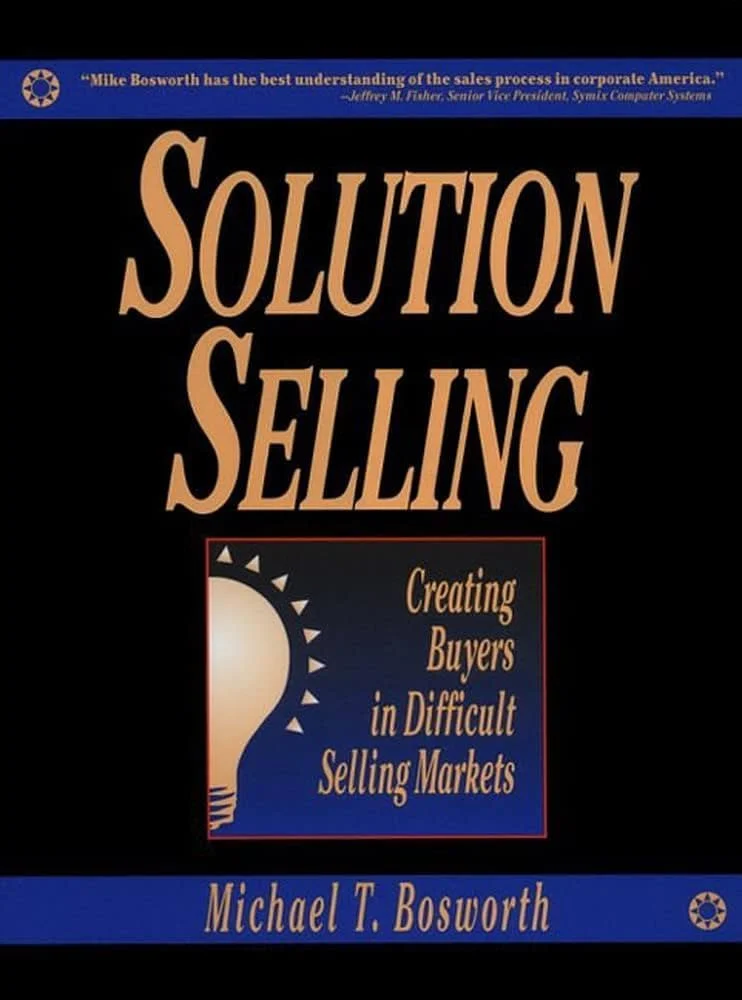
Solution selling quickly became the dominant approach for selling enterprise software and hardware products and remained so for nearly two decades. At Aster Data, we hired one of Silicon Valley’s top sales leaders, Mark Cranney (previously VP of Sales for Ben Horowitz’s company, Opsware), and many exceptional salespeople from companies that were famous for their enterprise sales prowess, including Opsware, Business Objects, PTC and Teradata. All of them were experts in variations of solution selling (and it’s no understatement to say that the education and experience I received working alongside so many incredible sales leaders had a profound impact on my career!)
But something fundamental changed in the early 2010s. Solution selling was based on the premise that the product(s) you were selling were too complex for most customers to understand. With the rise of the internet came a customer base that increasingly had done their research beforehand. In many cases, customers knew more about a vendor’s product than the sales reps did.
In 2012, Harvard Business Review wrote a blistering article titled The End of Solution Sales, which unpacked how a rise in customer education had rendered solution selling all but dead. At that time, a new sales methodology was already on the rise. One that anticipated customers who were far more educated about both their problem and the products available to solve them: challenger selling.
Introduced a year earlier in the book, The Challenger Sale: Taking Control of the Customer Conversation, the challenger sales methodology focuses on injecting insights into a prospective customer’s understanding of their problems and potential solutions. Rather than positioning the sales rep as the ultimate problem solver, it embraces the reality of well-informed customers while maintaining the notion that the sales rep is the “expert”:
“Instead of bludgeoning customers with endless facts and features about their company and products, Challengers approach customers with unique insights about how they can save or make money. They tailor their sales message to the customer's specific needs and objectives. Rather than acquiescing to the customer's every demand or objection, they are assertive, pushing back when necessary and taking control of the sale.”
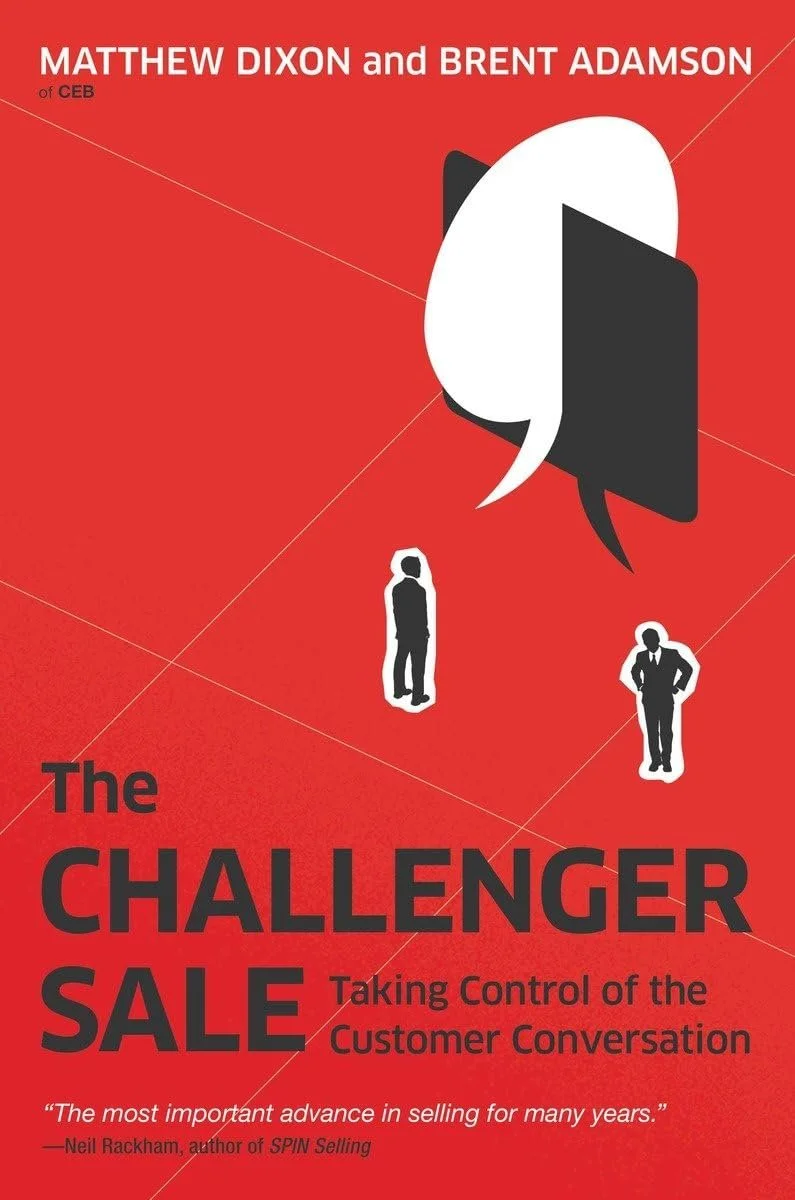
Challenger selling quickly ascended to replace solution selling as the dominant sales methodology in B2B technology sales and has remained so for the past 15 years.
Until now.
How AI is Changing Sales
The rise of AI has upended technology sales once again, though perhaps not in the way you might expect.
If you were to listen to all of the Silicon Valley tech bros, you might be under the impression that traditional sales is altogether dead. “Agents will do all of the buying and selling,” “human sales reps are going to be extinct,” and so on. But that couldn’t be further from the truth.
A few weeks ago, I wrote about how building with AI is like mowing lawns. Founders in Silicon Valley are rushing to build and adopt AI platforms to go faster, but elsewhere in the world most people and businesses are still trying to wrap their heads around what’s happening.
“Everyone in the Bay Area is trying to build and scale as fast as they possibly can,…but elsewhere in the world, a much more basic question is being asked. From students to business owners, SMBs to enterprises, the #1 question being asked is, “what does this mean for me?” Everyone knows that AI is coming. But most have no idea what to do about it.”
While the “agentification” of sales is unquestionably underway in product categories dominated by self-service offerings, B2B sales (especially outside of Silicon Valley) remains — and will remain — predominantly human-driven. But there is a key shift that is essential for founders to understand: in stark contrast to the past decade, today many B2B customers no longer feel well-informed or confident about the options available to them.
In other words, AI has caused a significant portion of B2B buyers to effectively “devolve” to a level of understanding of and confidence about technology that is more akin to the 90s than the past decade. They still know what their business problems are, but they are no longer confident in how (or if) technology can solve them.
Which means challenger selling isn’t going to work. But solution selling will.
What Founders (and Sales Reps) Should Do
If you are a founder building a B2B product designed for anyone other than developers or power users of AI, or a sales rep selling such a product, order a copy of Solution Selling (or its 2003 follow-up, The New Solution Selling) and read it front-to-back. The examples in both books are extremely dated at this point — not to mention many of the cultural references — but if you focus on the underlying concepts of understanding a prospective customer’s business problems and how to position your offering as a solution to those problems, it will quickly become clear why this approach makes sense in an age of AI.
(As a side note, I have a feeling that if we one day look back at the effectiveness of sales organizations in these early days of AI, we will find that the many of the top sales execs were older ones — reps who originally learned solution selling and were able to quickly and seamlessly switch back to that approach).
Bottom line: there is a bifurcation in sales methodologies underway. If you are building and selling a (non self-service) product for developers or other AI power users, then you should likely continue with challenger selling as your core methodology. But if you are selling to buyers who are less confident and/or knowledgable about AI, using solution selling will likely enable you to close sales at a rate your competitors can’t match.

Time to switch gears
Stop with the AI Slop
Many of us have quickly accepted that AI can do things better/faster/cheaper than we can. But is that actually true?
A few weeks ago, I travelled to Saskatoon, Saskatchewan to give the opening keynote for Uniting the Prairies, a conference that brings together founders, investors and ecosystem supporters from across Canada’s prairie provinces. Both the conference and my hosts were fantastic and my talk seemed well received, but I was completely unprepared for what happened the next day.
The morning after my talk, as I sat bleary-eyed in an Uber in the way that only a redeye can leave you, I picked up my phone to see hundreds of notifications from LinkedIn.
“X mentioned you in a post”
“X commented on Y’s post that mentioned you”
“X reacted to Y’s post that mentioned you”
My initial excitement quickly gave way to confusion as I scrolled through the pages of notifications. All of the posts I was mentioned in — literally dozens of them — were virtually identical.

At first, I wondered if it might be some form of spam. But why on earth would anyone spam me over a conference talk? And then it hit me.
Every LinkedIn post about my talk had been written by AI.
Not a few of them. Not most of them. Every. Single. One.
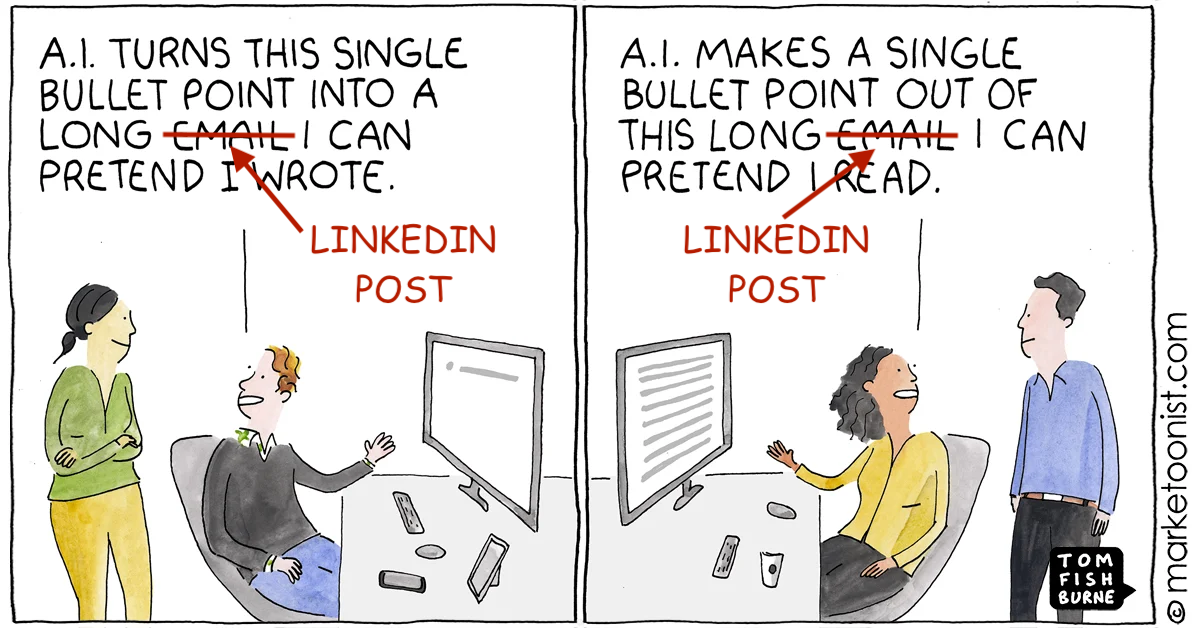
At this point, it’s obvious to anyone with half a brain when a social media post has been generated by AI. The bullet lists denoted by emojis no human ever uses. The wistful tone that reads as though the author was trying their absolute hardest to ghost write for a Morgan Freeman-narrated documentary (or, more aptly, a circa 2006 Yelp review). The hashtags upon hashtags upon hashtags.
Each post was nearly a page long. “Attention-grabbing” intros gave way to “reviews” of the various speakers and activities that took place at the conference. Here are two examples:


Fun fact: I have never used the phrase “play their own game” in any talk, podcast or blog post — it was a phrase the conference organizers added to the online agenda for my keynote.
After a while, my eyes glazed over. Eventually, I stopped reading and responding. Reading through so many nearly-identical posts left me wondering: what’s the point?
I don’t mean that as an existential “what is the meaning of life?” sort of question. But, rather, why go through the time and effort of creating a post like this to begin with?
In contrast to the comic above, none of these posts were created from a single bullet point. In each case, the author would have needed to build and refine their prompt (in some cases, it was clear that the post simply pulled details from the conference website and made the rest up, but many appeared to include actual insights from the author’s experience at the conference). After that, they would need to iterate and refine the results in order to create the final post.
At this point of the AI hype cycle, a lot of us have simply accepted that “AI can do things” better/faster/cheaper than we can, without really thinking about whether or not that’s actually true. Social media posting is a great case study.
For years, social media influencers taught us that there was a “right way” to write content / build online audiences / drive traffic. AI offered the promise of getting outlier results without having to go through the hassle of actually learning how to do it ourselves. But here’s the thing: the “attention-grabbing” strategies that worked on social media two years ago were effective specifically because the posts were outliers in their content and/or structure. When everyone uses AI that’s been trained on the same content marketing strategies, the resulting output is not an outlier. Because the strategies no longer work.
AI might indeed make it faster or cheaper to post on social media, but it doesn’t actually do it better (at least, not if your metric for better is some form of “gets a human to pay attention”). In other words, relying on AI to generate social media posts is now likely to result in a post that under-performs when it comes to the KPI that matters.

This dynamic is actually nothing new — in fact, it’s very well understood in the world of finance. It’s referred to as alpha decay.
In finance, alpha refers to the ability of a strategy to outperform the market (VCs spend a lot of time in search of alpha). Over time, outperforming strategies become more widely known and practiced, leading their effectiveness to diminish (alpha decay). “Attention-grabbing” social media strategies worked because they were outliers — they had alpha — but now that AI defaults to using such approaches when crafting posts, their effectiveness has all but disappeared.
I suspect that we’re going to see this dynamic play out across a variety of AI-related activities in the very near future. As more people chase the efficiency gains offered by AI, the output will converge and the alpha will rapidly decline.
Which brings me back to my earlier question: what’s the point?
Consider the following thought exercise based on my anecdote above:
Let’s assume that it takes an average person 10 minutes to write an effective LinkedIn post about a tech conference by hand
Let’s further assume that to create one with AI takes 5 minutes
If the human-authored post drives 100 interactions (because it is still unique in some meaningful way) while the AI-authored one drives only 50, is it worth it?
What if I told you the 50 reactions to the AI-authored post are mostly bots and people reacting out of obligation (e.g. you’re my friend so I’m going to like it no matter what)?
If we presume that a similar alpha decay is taking place across a wide variety of tasks as we increase our use of AI, then I would posit the following:
Before you rush to do the thing with AI, think about whether or not it’s worth doing at all. What output are you expecting/hoping for? Is there alpha in doing the task the way you’re doing it today? If that alpha were to disappear, is it worth doing it at all?

AI might be cheaper/faster, but if it’s not actually better (and you’re not willing to take the time to do the thing by hand) then…maybe just don’t do it?
Why Building with AI is Like Mowing Lawns
What can mowing lawns teach you about how to build a successful AI startup?
My first entrepreneurial endeavor (lemonade stands notwithstanding) was a lawn care “business” I started with a friend back when we were in middle school. We each had a lawnmower — okay, technically speaking they were our parents’ lawnmowers — and we went around the neighborhood looking for houses with long grass. We would knock on each such door and ask the homeowners if they would like us to mow their lawn.
Before long, we had a list of regular customers whose lawns we would cut every week or two. We did this for several seasons (until we were old enough to get “real” jobs). At our peak, we were each making a couple hundred dollars per week — which was a ton of money for a middle school kid in the early 90s!

I spent a lot of money on video games 🎮
Fast forward to today, and I think AI is about to provide a similar opportunity for intrepid young entrepreneurs. This time though, it’s not lawnmowers or power washers or painting supplies that will provide the leverage with which to build a business from scratch. It’s the knowledge of how to build with AI.

“Would you like us to install your AI?”
There are a variety of opinions when it comes to where the big opportunities for AI lie. And your answer very much depends on your perspective.
In Silicon Valley, it’s all about building scalable infrastructure. “Pickaxes and shovels,” as the saying goes. Everyone in the Bay Area is trying to build and scale as fast as they possibly can, in the hope that their platform will be one of the winners.
But elsewhere in the world, a much more basic question is being asked. From students to business owners, SMBs to enterprises, the #1 question being asked is, “what does this mean for me?” Everyone knows that AI is coming. But most have no idea what to do about it.
It’s as if millions of homeowners are staring out of their windows, watching the grass grow longer and longer but without any clue what to do about it.
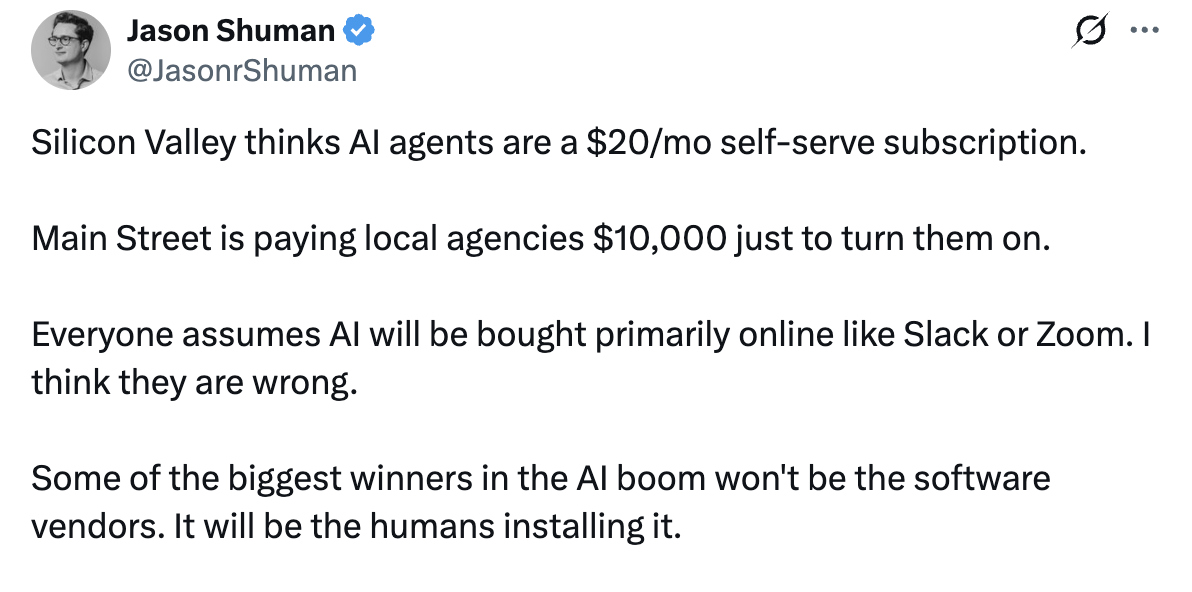
While some reports claim that SMB adoption of AI is skyrocketing, the Marks Group, a consultancy that specializes in small businesses, sees a different reality,
“They’re playing with chatbots like ChatGPT, Gemini, Copilot, Claude and Grok. They’re using these platforms for research. They’re getting help crafting emails.
…[but] core adoption — where AI agents are being used to reconcile accounts, place orders, send emails, converse with customers, apply cash, analyze transactions and produce quotes, estimates and proposals automatically based on historical transactions — is nowhere near happening at small businesses.”
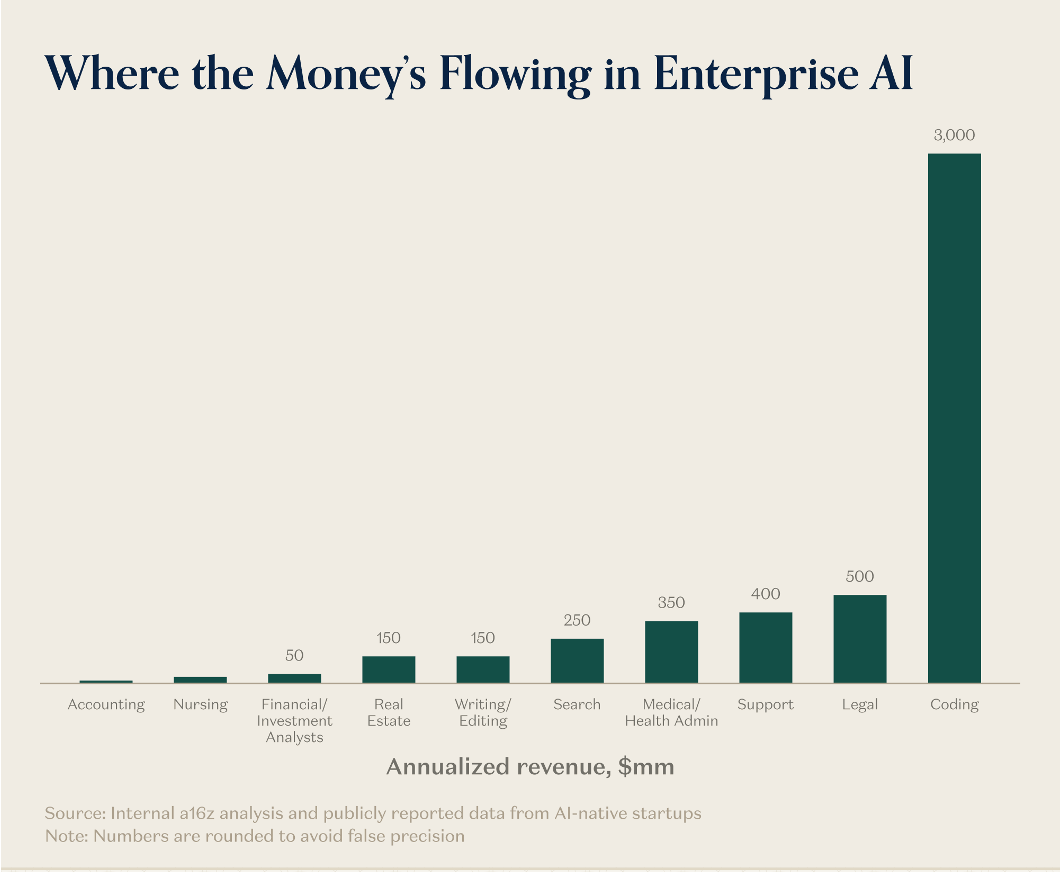
And it’s not just small business owners that are struggling to adopt AI. a16z recently released a report on enterprise adoption of AI, which found that even the world’s largest companies are barely scratching the surface when it comes to AI.
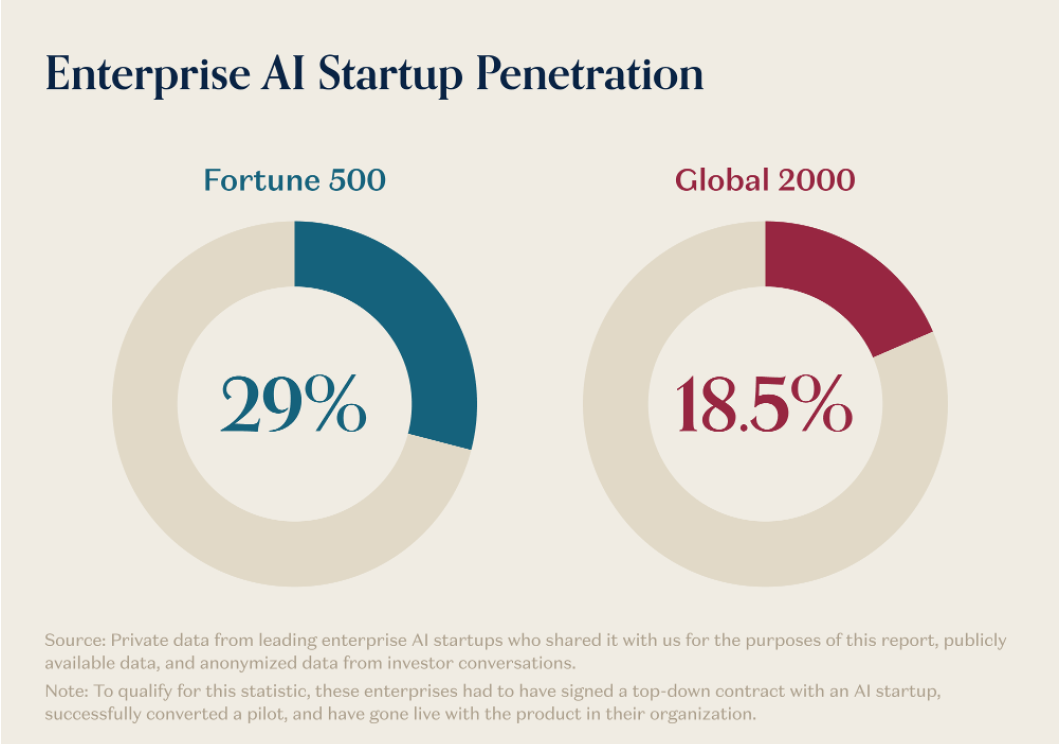
Moreover, the vast majority of AI adoption thus far has been in and around software development.
So what does this have to do with lawn care?
Right now, there is a massive opportunity for founders who are willing to simply knock on doors and metaphorically ask, “do you need your lawn cut?”
Marvin Liao recently described this opportunity in terms of age:
“…there is an arbitrage now between the generation above us, which don’t know how to use all of the things that the 17-year-olds know how to use.
If you were to ask me the best way to make money in the world today, it is to take advantage of the fact that there is a large subsection of the population that not only have all the money but, secondly, don’t know how to do a lot of things that most young people already know how to do. And if you can leverage that correctly you can actually make quite a lot of money.”
There are an incredible number of young people who have or are quickly developing the ability to build with AI. At the other end of the spectrum are countless business owners, managers, and individuals who have real problems to be solved, budget to solve those problems but for whatever reason (time, interest, ability, etc.) aren’t in a position to figure out how to do it themselves.
Silicon Valley would have you believe that either (a) every human is going to become a prompt engineer, or (b) there will soon be a permanent underclass populated exclusively by those who aren’t AI native. Both of these are very stereotypical Silicon Valley viewpoints (remember when everyone was going to learn how to write SQL..?).
In fact, the most likely outcome is that a large number of astute entrepreneurs will make considerable amounts of money by servicing the many businesses and individuals who aren’t AI native but have budget to solve their problems. These opportunities won’t be as sexy as the latest and greatest uber-for-fintech-for-agents platform, but I promise there is real money to be made pursuing them.
A lot of real money.
But capturing this value will require a skill that many technical founders struggle with: the ability (and willingness) to unflinchingly listen to prospective customers and build for their needs. The path to success for these businesses will have far more in common with building a consulting company than a traditional product startup:
Market Research — Reach out to potential clients and interview them about their biggest challenges and what specific problems they have budget to solve.
Initial Engagement — After landing on a problem area, build an initial, custom solution for one or more clients (while making sure you own the resulting IP).
Attempt to Resell — Reach out to additional, similar prospects and see if they have the same problem. If so, attempt to service them with the previously-created solution (or as much of it as can be reused).
Productize — After completing multiple engagements with the same general solution, productize your work and bring it to market at scale.
While this approach sounds easy enough, it’s actually quite hard for many founders. In recent months, I’ve met multiple founding teams who, despite having credible prospects tell them very directly what their biggest problem was, chose instead to build something different in the “hope” of capturing a market.
I think that a big reason for this is that, as an industry, we’ve spent the better part of the past twenty years trivializing consulting-first startups as “lifestyle businesses” whilst idolizing the potential of product-first startups. But AI will flip that (at least, when it comes to how vertical solutions get built).
So if you’re a founder, a student, or anyone else who’s holding an AI “lawnmower” and trying to figure out what to do next…try knocking on your neighbor’s door.

(You can also ring the doorbell)
Believe It Or Not, Etiquette Still Matters
In the era of rage bait, showing deference, respect and etiquette in your interactions can make you stick out amongst a crowd.
A lot has changed over the past few decades when it comes to how we interact with the world around us. As a culture, we have become more casual, more concise and more curt. We are increasingly drawn to conflict, whether real or perceived. The Oxford Word of the Year for 2025 is “rage bait”:
rage bait (noun): online content deliberately designed to elicit anger or outrage by being frustrating, provocative, or offensive, typically posted in order to increase traffic to or engagement with a particular web page or social media content.
Recently, a number of startups that were clearly built with rage bait in mind were funded by prominent VCs, including Cluely (“cheat on everything”) and Chad (“the brainrot IDE”) — with plenty of opinions from the residents of Startupland™. A few weeks ago, Jordi Hays of TBPN published an excellent post on how we got to this point,
“To understand Chad IDE, Cluely, Icon, Friend, and the new class of Gen Z startups, you have to understand the online environment these founders grew up in. If you grew up on the internet and studied how and why certain people would regularly go viral, you know that making people mad has and always will be a highly effective way to get attention. The feedback loop is simple: 1) make something (product or ad) that makes people angry; 2) people comment/ share/ dunk; 3) because feeds are optimized to show posts with high engagement the most, you get more reach.”
He goes on to explain why he believes rage baiting ultimately won’t work as a product strategy. I’ll take it a step further: unless you’re specifically building in or around marketing, content, or certain subsegments of the direct-to-consumer market, it doesn’t even provide a short-term gain.
In other words, etiquette still matters.

Really…?
Like many former founders / early-stage investors, I interact with hundreds of people each week in marketing- and sales-related scenarios. I’m regularly:
On the receiving end of pitches (founders trying to raise money)
On the sidelines of pitches (founders asking for my feedback on both VC pitches and their own GTM)
On the periphery of pitches (doom scrolling social media like everyone else)
When rage bait first started to come to the forefront, I observed it mostly with idle curiosity. It seemed a pretty natural evolution of where we had been going culturally for some time. And for the most part, it remained squarely in the realm of marketing and content creators. Sure, a handful of creators leveraged their personas to build larger brands and companies, but none of this seemed to me all that different from the “villains” and “heels” of years past.
I started to pay more attention when rage bait began to creep into the realm of startups. First came the rage bait social media posts. Then bus stops and billboards. Before long, I started to see it in pitch decks and elevator pitches.

Here’s the thing: even in the early days of rage bait — when the approach seemed relatively novel (at least, to old guys like me) — the tactic didn’t come across differently from any other GTM approach. Except for one key aspect, which Jordi aptly noted:
“Rage baiting (whether at the marketing level or product level) is the most effective way to get people (who could be potential investors, customers, or team members) to actively pray for your downfall.”
So what does this have to do with etiquette?
Around the same time rage started to become more prominent, I noticed an uptick in what I’ll simply refer to as “rude” interactions with founders. I’m not talking about the handful of founders getting upset because they were rejected by a VC (that always happens). Rather, I’m referring to an increase in the number of interactions that were overly casual or unexpectedly disrespectful. It felt like there was more sarcasm, presumption and entitlement in many of my interactions — especially emails.
At first I wasn’t sure what to make of it, but before long I reached the conclusion that this was intentional (either that, or an unintended side effect of founders spending too much time in the realm of rage bait). In either case, a subset of founders seemed to be introducing a version of rage bait into their interactions with me. It was unmissable.
An increase in subtly condescending, overly casual introductions (“Yo lad,” “Hey bud,” etc.)
An increase in sarcasm in places it didn’t belong
Cold pitch emails clearly written as rage bait
The thing is, none of these worked (at least, not on me). If anything, they had the opposite effect. Requests I might have otherwise responded to went unanswered. PDFs I might have been inclined to open went to the trash.
After I announced next month’s Game On program, I received a flood of emails from founders. A non-insignificant percentage of those emails included some degree of rage bait, which got me thinking: what is my perception of people who use this as an intentional tactic?
Transactional
Short-term thinker
Fake
Untrustworthy
Unprofessional
…
Rage bait has become so widespread that it no longer resonates with me as shocking or creative or even worthy of a response. It’s honestly just lame.

If anything, I’ve found myself even more drawn to founders who exhibit basic etiquette and respect in their interactions. I’ve always been a sucker for a well-written cold email, but these days I’m even more likely to respond to emails that are simply polite.
The use of rage bait is still on the rise in Startupland™, but I suspect that it will be short lived. For now, just know that these days, showing deference, respect and etiquette in your interactions can make you stick out amongst a crowd. And always remember that you never get a second chance to make a first impression.
Know what I mean, bruh?
Traveling is an Underrated Superpower
In a world where most of our interactions occur online, a willingness to travel is a superpower.
In the past month, I’ve been to San Francisco, Vancouver, Toronto, Montreal, and Halifax. In the coming month, I’ll spend time in Chicago, Columbia (Missouri), London, Edinburgh and then again in both San Francisco and Vancouver.
People I meet often comment that they can’t believe how much I travel. To most, it seems absurd. Unsustainable. Irrational. But to a small number of people, it’s normal. A smile. A knowing nod.
In the world of startups, a willingness to travel is a superpower.

I’m not talking about traveling for fun or personal growth (though I certainly do love that). I’m talking about traveling in support of professional goals.
We live in a world where an increasing number of our interactions occur online. We order on Amazon, Instacart or DoorDash instead of going to the store. We have meetings over Zoom instead of over coffee. We swipe left and right and up and down for hours each day. Increasingly, we prioritize efficiency above all else.

Improving efficiency unquestionably increases productivity in many parts of our lives. It helps us solve the paradox of time, helps us get more done each day and, in theory, unlocks more time for ourselves. But at what cost?
There was a time when if you wanted to sell something, you had no choice but to travel. For centuries, the traveling salesman was a key part of society in one form or another. In fact, one of the most famous problems in computational science is known as the “traveling salesman problem”.
Here’s the thing: showing up in person still matters. In fact, in a world where it costs us virtually nothing to get on a phone call or Zoom, the potential impact of traveling and showing up in person has never been greater.

For the majority of people, traveling — especially by plane — is a stressful affair. Even people who fly regularly often experience anxiety when traveling. For many flyers, the idea of missing a flight or landing only to discover that you’ve forgotten something is nerve-wracking.
Back in 2007, we had signed MySpace as the flagship customer for Aster Data. It was a $1M deal that would change the trajectory of the company — but we had to get the system into production. And that system was the world’s first commercially-deployed 100 TB data warehouse.
We decided that I would take point on the deployment and project manage the work from Aster’s side. MySpace was headquartered in Beverly Hills, while Aster Data was in San Carlos (a small suburb of San Francisco close to the airport). For the first few months, I traveled to LA for 2-3 days every other week. Each time, I would drive to SFO, fly to LAX, rent a car, head to their offices and work for a few days while staying overnight at a (cheap) hotel. I hadn’t done much work travel up until that point, so these trips were exciting. They were adventurous. They were also exhausting.
After awhile, they became routine. And as we got closer to the launch, they became shorter.
Multi-day trips every other week were replaced with daytrips every week. I would drive to SFO in the morning, hop on the first Southwest flight of the day, grab the rental car, head to MySpace, then turn around and be back home in time for bed.
It wasn’t long before my brain stopped thinking about it as travel. I wasn’t flying somewhere exotic. I was simply commuting to a client’s office. It just happened that part of my commute involved an airplane. That simple change of perspective changed everything.

Travel isn’t easy. It’s tiring (especially when you change time zones). It can be unhealthy if you aren’t careful about your eating and exercise habits. And when you have family or other obligations, there are additional complexities and considerations.
But the moment travel stops being stressful, it becomes a super power.
You stop worrying about taking a flight. You stop worrying about missing a flight (after all, there’s always another one).
Before long, you’ve experienced almost everything that can go wrong. And just like other aspects of being a startup founder, you learn to roll with the punches. You expect the unexpected.
More than that, you start to account for travel time in your regular routine. For some people, being on a plane means reading and deep work. For others, it’s mindless movies and downtime. For me, it’s writing (I wrote this post on a plane). As a result, your opportunity cost changes. Travel time is no longer “lost” time. The return-on-investment that comes from travel is much higher, because your cost is much lower.
And that’s how the magic happens. You start going where others won’t. You go when others won’t. While competitors are trying to schedule Zoom calls to close a deal, you’re there in person taking the prospect out for lunch. When new opportunities present themselves, your default answer is yes instead of no.
You are seemingly everywhere, all at once.

Be like Michelle Yeoh
To be clear, this amount of travel is not for everyone. And the opportunity cost calculations very much change depending on the stage of your company and your stage of life.
But if you can mentally get over the hump of “travel is hard”. If you can switch your mindset from “this is intimidating” to “this is easy”. If you can transcend the stress that typically comes with travel, you’ll find yourself with a superpower that few can match.
How to Approach Someone at an Event
Knowing how to get the most out of an event is an underrated and unpracticed skill for many founders.
It’s the second week of September.
The memories of summer are already starting to fade away. The annual ritual of “back to school”, a glorious event celebrated by parents across the northern hemisphere, has come and gone. Burning Man is over. So is the After Burn. And the After After Burn.
For most of the world, that means back to the humdrum of office life. But for residents of Startupland™, the second week of September marks the start of fall event season. YC officially kicked things off yesterday with with their S25 Demo Day in San Francisco. In startup ecosystems around the world, the coming weeks will be filled with happy hours and hackathons, receptions and retreats, soirees and cinq à septs. (All while founders try their best to make actual progress on their business and VCs fight over the hottest deals.)

Packed room to hear the Mayor of San Francisco speak
It’s a busy time of year, but also one filled with opportunities…provided you play your cards right.
Knowing how to get the most out of an event is an underrated and unpracticed skill for many founders. I’ve previously shared tips for how to pitch a VC at a party. In this post, I’ll pop up a level and discuss more broadly how to make the most out of any work-related event.
1. Define Your “Why”
The best founders don’t go to events for the sake of going. At least, not after the initial buzz of being invited to “exclusive” events for the first time wears off (we’ve all been there). There has to be a reason for high achievers to take time away from work, friends, family and other priorities to attend a professional event. What’s yours?
There are plenty of reasons to attend an event, including:
Prospecting for customers
Prospecting for investors
Prospecting for employees
Getting feedback on an idea
Meeting other high-achieving founders (for inspiration, to build your network, etc.)
Showing support for someone or their company
Being seen and/or catching up with people you already know
Just getting out of the office (that’s okay too!)
Before you go to an event, take a moment to really think about your objective. What is your “why” for attending the event?
2. Quantity or Quality?
The second question to answer is “quantity or quality?”
Do you want to have deep conversations with a small number of people or are you hoping to connect with as many individuals as possible who fit your target persona?
Think about this question carefully. Would you be happy if you spent the entire night speaking to only one person? What if you already knew them? Are there specific people you absolutely have to speak to (if only so they know that “you were there”) or is your primary objective to meet new people?
Even if your reason for going to the event is simply “to get out of the office,” thinking about the types of conversations you hope to have and/or the types of people you hope to meet will help you to navigate the event with more intentionality.
3. Target List
Who are the people you absolutely, positively need to see at this event?
Write down those names or personas and what your objective is with each person (Is it simply to say hello and be seen? Do you want discuss a particular topic with them? Do you hope to get their contact information?) If you have access to the invite list, spend 5 minutes to review it and highlight anyone you specifically want to talk to. Think about the types of conversations you hope to have with each person and how much time you want to spend with each of them.

“At 7:35pm, the Series A VC will arrive…”
4. The Approach
Despite the title of this post, I’m not actually going to tell you how to approach a stranger at an event. There are plenty of books, posts and podcasts that have been made on the topic, so I’ll leave that as an exercise for the reader. But I will encourage you to be thoughtful about it. There isn’t necessarily a perfect approach, but there are plenty of ways that are guaranteed to fail.
Here are some actual approaches I’ve had from people at events:
A self-proclaimed “ecosystem leader” who rudely interrupted an obvious conversation that I was having with a young founder, positioned his back to the founder, and then proceeded to declare how influential he was in the ecosystem and that we should find time for a conversation
A founder who physically blocked me from walking onto a stage (while I was holding a microphone) and insisted on trying to pitch me despite my saying multiple times, “I have to go on stage”
A founder who followed me into a bathroom, stood beside me and attempted to pitch me while I was doing my business (that really does happen…)

In general, people who attend networking and other startup events are there to meet and talk to others. So if you’re patient, polite and just the right amount of assertive, chances are you can talk to almost anyone at an event. If only for a few minutes…
5. Make Your Move
You’ve patiently waited and finally have the opportunity to talk to the person you’ve had your eye on. What’s next?
If you’re doing any sort of prospecting, your goal is actually not to pitch the person on the spot. Rather, it’s to get their contact information so that you can have a proper 1-1 conversation later. Events are loud (at least, the good ones are). It’s hard to hear people and you frequently get interrupted. As such, it’s essential that you are concise.
Make your elevator pitch and see where the conversation goes. If the person shows interest, ask if you can get their contact information to follow-up later. By preempting your own pitch with an early ask, you signal respect for the person’s time and, in doing so, are more likely to get a ‘yes’ than if you gave them an extended pitch. At this point, they might happily give you their contact info or they might ask more questions (in which case, you can dig in deeper if you choose).
The other benefit of making the ask early is that you can be more efficient with your time. The faster you make the ask, the sooner you’ll close the “sale”. And the sooner you close the sale, the sooner you can move on to your next prospect.
(On the other hand, if your goal is quality over quantity, then by all means engage the person in a deep, lengthy conversation about whatever topic you have in mind.)
6. Watch for Yes
If someone offers you the close — i.e. they offer to share their contact information with you — take it. Even if you’re not ready.
It’s not uncommon for someone to interrupt your pitch during an event in order to preemptively offer you their contact information. I do it all the time. It usually goes something like this,
“This sounds great. Why don’t you send me an email and we can find time to continue the conversation later.”
Many times, founders are so focused on their pitch that they fail to recognize that the person they’re talking to just said yes and they continue pitching. By not watching for yes, they miss the signal in the response.
When someone interrupts you to preemptively offer their contact information, they’re not only saying “yes”, they’re also saying, “I want to end this conversation.” There could be any manner of reasons why they want to move on, but the critical piece is that they gave you a yes. If you fail to catch the double-meaning — and graciously cut off the conversation while taking their contact information — it’s possible they won’t offer it a second time. And you might ultimately lose the opportunity.
Also be prepared for the yes to come in a form you weren’t expecting. For example, you might ask for an email address and they might instead offer you their phone number or a LinkedIn QR code. Whatever form they offer, you should take it. Here’s an actual conversation I had with a founder recently:
Founder: “Can I have your email address?”
Me: “You already have it. The invite for tonight’s event came from my actual email…just hit reply and email me there.”
Founder (pulling out phone): “Ok, but can I have your email address?”
Me: “You already have it. The invite for tonight came from my actual email…just email me there.”
After the founder asked for a third time, I shrugged and said no.
That might seem harsh, but if someone has to repeat themself more than once, it’s generally a signal that you’re not listening (and as an investor, it’s not a great signal). So always remember, if you want people to say yes, you have to listen to them.
I’m sure that more than a few of you have made it to this point and are thinking “wow, Chris really overthinks things,” or “this all seems a bit over-calculated.”
You certainly don’t have to meticulously plan out each and every event you attend. By all means, show up to some events and just have fun. But if you take a few minutes to consciously set a goal for each work-related event you attend and then “debrief” with yourself afterwards (did you meet the goal? why or why not?), you’ll soon discover that you’re navigating events with far more intentionality and effectiveness than you were before.
And as a founder, every little bit helps.

Give Your Customers What They Want
What can this recent history of fast food teach us about AI? It turns out, a lot.
For this week’s post, I’m going to start off with a case study that isn’t from the annals of Silicon Valley (although many in the tech world are loyal customers of this industry). Today, we’re going to talk about fast food. Specifically, we’re going to look at the astonishing rise of A&W Canada.

If you’re reading this from the U.S., you’re probably scratching your head right now (in all likelihood, you haven’t been inside of an A&W in years and, if you have, your experience was likely…not great).
A&W Canada is a completely separate company from A&W Restaurants, which operates A&W in the U.S. and elsewhere. You can read the full history here, but the tl;dr is that A&W Canada split from the US company in 1972 when it was sold to Unilever. A group of Canadian franchisees subsequently bought the company back in 1995 and have operated independently since then. Not only is the Canadian company larger than A&W Restaurants (by both number of stores and revenue), many of the popular menu items and brand assets (including the chain’s bear mascot) were created by A&W Canada and licensed to A&W Restaurants.
Ok, so let’s jump into the case study.
Back in the early 2010s, fast food chains were going through an existential crisis as millennials led a massive shift towards healthier eating. Quick-service restaurants (QSRs) around the world were seeing sharply decreasing sales and rushed to introduce new menu items in order to stem the bleeding. McDonald’s introduced McWraps and egg white sandwiches, Taco Bell added herb-grilled chicken and cantina bowls, while Burger King unveiled turkey burgers and low-sodium french fries. But A&W Canada took a different approach.

At the time, A&W Canada was having its own crisis of identity. Although it was the fifth-largest QSR in the country, its growth was stagnating.
“We were seen as not being very connected with consumers and being out of date, out of style, out of touch, outmoded, not very relevant,” said [Trish] Sahlstrom.
Rather than rush to introduce new menu items as many QSRs were doing, A&W Canada initiated a deeper strategic planning process centred on “dramatic changes in consumers’ attitudes and behaviours.”
“We saw, for instance, an increasing desire among consumers to know who and where their food was raised,” she said. “Consumers were saying, ‘Where’s the evidence? I no longer trust just that it tastes good. I want to know where it came from. I want to know who has raised the animals that are feeding us. I want to know your values, A&W.’”
The company then asked what factors came into play when consumers wanted a hamburger.
“As we started to put together all of these pieces of evidence — all of the answers to these questions — what came out incredibly strong and clear to us was leave out the hormones and steroids and don’t use the antibiotics.”
A&W Canada stumbled on an epiphany that, surprisingly, seems to have been missed by most other QSRs: their customers didn’t want them to change their menu per se, they just wanted to feel better about eating there. A&W customers didn’t want to buy a salad or a wrap or a gluten-free super food quinoa bowl when they visited one of the company’s restaurants. They simply wanted a slightly healthier hamburger.
So in 2013, the company announced that all of its burgers would be made with beef raised without hormones, steroids or other additives.

Following the announcement, the Canadian beef industry was up in arms. The move required A&W Canada to source beef from the U.S. and Australia, as there weren’t enough ranchers in Canada at the time raising cattle that met their requirements. The industry responded with a public relations campaign and attempted boycott of A&W, but failed miserably.
Same-store revenue for A&W Canada increased 6.3% the following year, while a consumer research study by QRI subsequently found that “89% of burger eaters [in Canada] were “impressed and interested that A&W is serving beef raised without added hormones or steroids.” (By contrast, McDonald's same-store sales decreased in 2014 — falling by -2.1% in the U.S. and -1.0% globally)
A&W followed up the success of its “better beef” campaign with similar shifts to its chicken and egg supply chains in 2014.

The sustained focused on healthy ingredients resulted in even greater success in 2015, with same-store revenue increasing 7.6% that year. Total revenue for 2015 topped $1 billion — the first time in the company’s history — while its share of the QSR market in Canada increased from 12.7% in 2013 to 14.4% in 2015. And the company hasn’t taken its foot off the gas since.
In 2018, A&W Canada became the first QSR in the world to introduce Beyond Burgers nationally. That same year, the company further evolved its egg supply from vegetarian-fed to cage-free and antibiotic free eggs. And in 2020, it shifted its burgers to 100% Canadian, grass-fed beef.

And the results showed. With the exception of 2020’s Covid-driven drop, A&W Canada outpaced the world’s largest QSR brands on same-store sales for many of the years following this strategic shift.

So what does this have to do with tech?
A&W Canada’s recent successes were the result of a management team that, amidst a groundbreaking shift in consumer preferences, took the time to stop and ask the question, “what do our customers really want?”
Today, the technology world is undergoing a similarly unprecedented shift as AI rapidly permeates every aspect of our industry. As I look around, I see countless companies of all shapes and sizes rushing to plug AI into their offerings without stopping to ask themselves, “is this what our customers really want?”
Services businesses trying to become product companies, “so our customers can do it themselves”
Product companies replacing interfaces that their customers have grown to love with text-based prompt interfaces, “because that’s how AI works”
Business intelligence / data analytics startups rushing to leverage AI so that “business users can directly query the database” (trust me on this one 😉)
While it’s inevitable that AI will fundamentally change many aspects of our lives, it’s important that founders take the time to think about the shift from their customers’ perspective. In some cases, AI will completely upend a category and, thus, require a total rethink of a company and its products. But I suspect in many industries, customers will simply want a faster, more powerful, AI-enabled “hamburger”.
Want People to Say Yes? Listen to Them.
One simple filter busy people use trips up many founders: when I tell you how to get my help, do you listen?
I had been trying for weeks to get an introduction to a well-known founder-turned-angel investor. Finally, I was able to find a friend willing to forward my request for introduction email. A few hours later, a successful introduction landed in my inbox followed quickly by an email response from the angel 🙌.
I opened his email and saw the following:
“Call me. 415-XXX-XXXX”
Caught off-guard by his directness and unsure of what to do, I sent a polite response thanking him for his time and offering to schedule a call.
I never heard from him again.

At the time, I was so used to the choreographed dance of introductions and scheduling that my mind was completely broken by a stranger telling me to just “call him”. That was 15 years ago, long before I understood Silicon Valley’s paradox of time:
In Silicon Valley, most people in places of power, influence and experience genuinely want to help up-and-coming founders, but their work and obligations leave little to no time for them to do so.
The founders who can solve this puzzle unlock an unfair advantage that can change the trajectory of their startup: access to Silicon Valley’s insiders. And the solution isn’t as complex as you might imagine.
You simply have to make it easy for them to say yes.
A corollary of the paradox of time is that people in places of power, influence and experience who genuinely want to help employ aggressive filtering in order to decide who to help.
The double opt-in intro system is an example of one such filter. Another filter — which is shockingly simple yet trips up many people — is the following: when I tell you how to get my help, do you listen?

Can you follow the “treasure” map?
In my anecdote above, the investor literally told me to call him. I ignored his instructions and instead did something else (sent him an email to try to schedule a call). While it might seem harsh for him to ghost me after such a simple slight, it makes perfect sense if you look at it through the lens of what he was really saying:
“I’m willing to talk to you but I am unwilling to spend even 5 seconds on scheduling.”
By responding to him with an email, I introduced additional overhead and, thus, failed his filter.
Fifteen years later, I have the privilege of receiving dozens of requests each week for help from founders. But I’m beholden to the paradox of time — as much as I would genuinely like to help each-and-every person who reaches out to me, I simply don’t have enough hours in the day.
So I filter.
And one of those filters is embedded within the responses that I send to the founders I want to help. Responses like:
Asking someone who DM’d me to please send me an email (e.g. “Email me your pitch deck and I’ll take a look.”)
Sending someone a Vimcal link to book a call (e.g. “Click on a slot below to book a call or lmk if none of these work.”)
Pointing them to a blog post I previously wrote that answers their exact question
In each of these cases, I’m trying to minimize the time and effort to get from initial interaction to help. And it’s very much based on how I personally work. For example, my preferred workflow centers around email on my laptop, which is why I redirect as many inbound requests as I can to email.
This is where understanding the dynamics of the relationship is essential to success. If you are the person asking for help, then you should make every effort to fit seamlessly into how the other person works. Jason Lemkin’s advice on asking for in-person meetings is a perfect example of this:

That’s why it’s so essential that you pay attention to the instructions encoded in an offer for help. Especially if it involves changing the communication channel.
If someone responds to your DM asking you to email them, email them.
If someone sends you a Vimcal, Calendly, etc. link to book a call, use that link to book a call.
If someone tells you to just call them, pick up the phone and just call them.
Now that I’m on the other side of the table, I see how frequently people who ask for help ignore (or miss) such instructions. Perhaps it’s because they don’t recognize them for what they are. Perhaps it’s because it’s out of their comfort zone or doesn’t fit the way they prefer to work. Either way, I simply don’t have time to figure it out.
If I ask you to email me something and you instead keep messaging me, I’ll probably stop responding.
If I send you a Vimcal link and you email me back with the time you prefer (instead of clicking the link to just book it), I’ll probably stop responding.
If I send you a link to a blog post that has the exact answer to your question and you instead complain that I’m redirecting you to my blog instead of answering your question, I’ll definitely stop responding.
Not because I’m ornery or don’t want to help you, but because every minute I spend on overhead is one less minute I have to actually help.
That, or I might just be a cranky old man.

Know Your Competition
If an investor knows more about your competition than you do, that’s a problem.
I recently participated in a day of mentoring with my good friend Alex Norman of N49P. We each met with several dozen founders over the course of the day, then got together afterwards to compare notes. Both of us had the same observation: more than half of the founders we spoke with knew virtually nothing about their competition.
Sure, they could all list one or two big-name incumbents. Several name-dropped similar-ish startups that had recently raised well-publicized rounds. But very few actually understood the competitive dynamics at play in the markets they were targeting. It’s a worrisome trend I’ve seen increasingly as of late.

I’ve previously written about the power of perspective: the fact that, as a founder, one of the most powerful things you can have is a unique perspective, insight or opinion about a market. But in order to have a unique perspective about a market, you have to understand the market. And a big part of that understanding involves the competitive landscape.
The most popular model for analyzing a market’s competitive landscape is Porter’s Five Forces model, which was first published back in 1979. If you’re not already familiar with it, I encourage you to learn about it (and take a stab at using the framework to analyze the forces currently at play in the market you’re targeting — I promise you’ll learn something). But Porter’s model takes the perspective of the incumbent rather than a potential new entrant. So while it’s a helpful framework for understanding the current competitive dynamics, startups founders need to go beyond that and understand the competitive landscape past, present and future.
With that in mind, here are 5 things all startup founders should know about their competition:
1. The Incumbents
First and foremost, it’s essential that you understand the incumbents in your market. But don’t do the lazy thing and just stereotype them as slow, out-of-touch, ancient product, etc. Go a level deeper:
Start by looking at history: how did they get to where they are today? What was the original value proposition they focused on to win customers? Does that value proposition still resonate today (why or why not)?
What are their strengths and weakness? Why do customers choose them over other competitors? What are their vulnerabilities (try to talk to multiple customers to find out what they do / do not like about the product and whether or not those weaknesses are significant enough for them to consider changing)?
How do they sell? What are the strengths in their go-to-market strategy? What are their weaknesses?
What is your competitive positioning against them? Is it credible? What would their salespeople counter with?

The old guys are used to being on top. And they won’t give up without a fight.
(Also, if you’ve never read The Innovator’s Dilemma, do so!).
2. The Challengers
Next up are the challengers: the new entrants to the market who are already several years into their journeys.
Don’t waste time analyzing all the other small fry local competitors doing something similar to you. Focus on the startups that are credibly gunning for the same throne you are. Who are they and what is their unique perspective on the market? In what ways do you agree with that perspective? In what ways do you disagree?
Try to learn as much as you can about both their product strategy and their go-to-market approach and compare/contrast it with yours.
The goal isn’t for you to be better on 100% of the dimensions — ultimately, there will be 3-5 winners that matter in each generation of companies. Instead, think deeply about why their approach makes sense, what you can learn from it and how you can eventually compete with it.

3. The Fallen Stars
What’s past it prologue, especially when it comes to startups.
Who are the companies that tried to disrupt this market before but didn’t succeed? What worked for them? Why did they fail?
If there are failed startups that had a similar value proposition to you, it’s essential that you be able to answer the question: why will your outcome be different?
Many founders are more than willing to share their stories and lessons learned (especially off-the-record to other founders). Try reaching out to the founders of prior generations of startups in the market and see if they’d be willing to jump on a call with you. (From a fundraising standpoint, I promise that every investor will be extremely impressed if you can talk in specifics about the reasons why other startups going after this market have failed.)

4. The Neighbors
Now pop your head up a level: who else could credibly make a play for this market?
Porter’s Five Forces model considers the threat of buyers and suppliers moving up/down market, but not about players in adjacent industries. In the world of software, we also have to consider integration partners and other adjacent products and services in addition to platform providers and more traditional “neighbors”. You’re probably used to investors asking you what market you’re going after next, but what about the inverse?
What companies are likely to expand into the market you’re starting out in?

5. The Inflections
In his recently-published book, Pattern Breakers, Floodgate Cofounder Mike Maples, Jr. introduced the concept of “inflections”:
We’ve defined an inflection as a change that a start-up can exploit to radically alter how people think, feel, and act.
While most founders are used to thinking about macroeconomic trends at a high level (e.g. in order to answer the question, “why now?”) the concept of an inflection is much more specific. It encapsulates the change that is occurring, the impact of that change on all of the players in the market (both existing and new), and timing.
You may have correctly identified an inflection, but if you act too quickly to harness it, you’ve got a science project. It’s too soon to radically change human behavior. If you act too slowly, you’ve got what is now a conventional idea, embraced only after it became obvious to many others—leaving your idea to compete against a crowded field. There’s a Goldilocks moment, neither too early nor too late but just right, when you can bring about meaningful change.
What inflection has either recently occurred or is about to occur that will significantly impact the industry? What opportunities does it provide your startup? What challenges is it likely to deliver to incumbents and challengers? Why is your company uniquely positioned to capitalize on the inflection?
Thinking about inflections within the context of competition forces you to consider how the chess board is likely to unfold over a longer time horizon. It’s generally naive to think that nobody else is aware of the technical and/or societal changes driving your strategy, so why are you uniquely positioned to take advantage of them? If the inflection is truly significant, then your competition certainly won’t stand still and do nothing. Which is precisely why “What if Google builds it?” is no longer a bullshit question.
A final note: while it’s important for you as a founder to know your competition, it’s also important that you not be obsessed by it. Avoid going down rabbit holes every time a tiny startup that might be doing something similar announces something. It’s important to know the competitive landscape, but stay focused on building, shipping and selling. Ultimately, that’s how you’ll win.
Make It Easy for Customers to Pay You
Last week, I wrote about the importance of removing friction for early adopters in order to make it easy for customers to love you.
This week, I’m going to touch on another seemingly obvious, but often overlooked capability that startups need to develop: making it easy for customers to pay you.
Let’s start with an anecdote:
The One About a Microwave
A few weeks ago, I needed to buy a new microwave. Our old one had developed some *ahem* extra features, notably that opening the door would short out the entire kitchen.

Normally, I’m the guy who spends a couple of hours sifting through online reviews and then orders something delivered to the house. In this case, the various manufacturers’ websites didn’t make it easy to get all of the information I needed to make a purchase decision, so I headed to the local appliance store. My goal: to buy and bring home a new microwave.
But things didn’t go as planned. By the time the day was done, I had visited 5 different stores and ended the day without a microwave.
Here’s what happened:
Store #1
I walked into the first store just after it opened and was greeted by a friendly sales rep. I told him that I needed to replace a built-in microwave and shared the pertinent specs. After a few minutes, he showed me a floor model that they were getting rid of on clearance that had everything I needed. Perfect!
Except for one thing: he couldn’t provide me with a delivery date. The store’s policy was to not deliver floor models until they had a new replacement model to sell, so as to not leave a “hole” in their display. And the sales rep had no idea when they would be getting a new microwave model in.
So he could not provide me with a delivery date (or even an estimate), even if I bought it.

Store #2
Confused and disappointed, I left the first store and headed to a “big box” electronics retailer, confident that I could procure a microwave there. As I walked around looking at the various models, I kept waiting to be greeted by a sales rep.
And then I started looking for a sales rep.
Alas, there was no sales rep in the appliance department that morning.
Store #3
Next, I travelled to a well-known home improvement store. In the appliance department, I saw a couple of sales reps busy helping other customers, so I wandered the aisles to get acquainted with their selection. After narrowing things down, I made eye contact with one of the reps and patiently waited while he finished up with another couple’s refrigerator order.
My two kids were accompanying me on this adventure. While we waited our turn a few aisles away, they were happily playing with each other, goofing off and giggling.
After about 10 minutes, the sales rep I was waiting on looked up at me from across the room and loudly proclaimed, “Can you get your kids to stop screaming? I’m trying to help a customer here.”

Store #4
By this point, it was approaching noon and my “early riser” advantage was long gone. The fourth store (a combination furniture and appliance store) had a reasonable selection of microwaves, including several potential matches. Unfortunately, there were at least a dozen other customers in the appliance department and only a single sales rep on staff.
Conscious that I had exhausted all of the good will I could muster out of my kids (who, for real, were incredibly patient through all of this), I waved the white flag and we headed for lunch.
But I wasn’t quite ready to give up. I managed to bribe them with some dessert in exchange for accompanying me to one more store…
Store #5
The fifth and final store of the day was another dedicated appliance store. I walked in and was immediately greeted by a friendly sales rep. He took one look at my two kids and escorted them to a table covered in coloring books and crayons. He then asked if there was something specific I was looking for.
I told him about my need to replace a built-in microwave, shared the pertinent specs and held my breath.
He responded by asking a couple of qualifying questions (which matched the particular questions that had caused me to embark on this journey to begin with) and then replied, “Let’s start with what’s available in inventory and go from there.”

5 minutes later, I had chosen one of the microwaves that they had in stock. 10 minutes later, I was out the door (albeit without the microwave, which I would have to pickup the next day at their warehouse — but it was still a success in my mind).
Less than 20 minutes start-to-finish.
Lessons for Startups
While it might be easy to dismiss my adventures in microwave shopping as a relic of old school brick-and-mortar retail, the reality is that both offline and online businesses often struggle to close what should be the easiest sales.
In today’s world, a significant percentage of prospects have thoroughly researched products and competition before ever engaging with a company. They know what they want and are ready to buy…if you make it easy for them.
In these cases, the sales are yours to lose.
And there are plenty of ways to lose them:
A SaaS website that only has “Contact Us” on the pricing page or “Book a Demo” as the call to action, instead of a way to sign up (or at least start a buying process)
SDRs who aren’t trained to identify buying signals and unnecessarily stick to their scripts
Overly complicated pricing tiers that introduce confusion and ambiguity into the buying process
Founders who pitch the future state of the product instead of focusing on what is available today (and in doing so, miss out on the fact that the current state is potentially as exciting to the prospect as the future state is to you)
Even in the earliest days of a startup, if you’re building something of genuine value, there are likely customers who are ready (and eager) to buy. Learning how to identify buying signals and simplifying your buying process in order to make it easy for those customers to pay you is essential to capturing as much early value as you can.
Because if someone needs a microwave today, they’re going to keep searching until they find one.
Make it Easy for Customers to Love You
Back when I lived in San Francisco, one of my favorite places to shop was Fatted Calf. If you’ve never been there before, it has by far the best selection of meats and charcuterie in the 7 x 7. From the quality of products to the level of knowledge and customer-focus possessed by the staff, it’s an exceptional retailer on every level.

Original Fatted Calf location on Fell St.
So when I moved back to Vancouver, I was already reserved to the fact that I wouldn’t find a butcher shop anywhere close to Fatted Calf. Then one day, I stumbled upon Two Rivers Meats. The wholesale supplier of meat to top restaurants throughout Vancouver had coincidentally opened a retail location in the neighborhood that we moved to.

Two Rivers Meats “The Shop”
At this point, you’re probably wondering where I’m going with all of this. Stick with me…
On one of my early visits to Two Rivers Meats, I picked up a couple of duck breasts for dinner. When I got home, I opened the package and to my surprise, saw the following:


If you’re not someone who regularly cooks duck, you might be shrugging right now. Notice the crosshatch pattern on the duck fat. This is called “scoring”. It’s something you do before cooking meat with a fatty side that you want to crisp up, like duck or pork belly.
In the case of duck breast, scoring the fatty side is almost always the first preparation step. But the butchers at Two Rivers Meats had already done that for me. I then flipped the duck breasts over to remove the tendon (the second step in preparing duck and one that I find particularly tedious). But lo and behold, that was also done!
While this might not seem like a big deal, for a mediocre home chef like myself these two small details probably saved me 10 minutes of prep time (including scoring, removing the tendon, and washing the knives and cutting board afterwards). As a result, my preparation was simply: season with salt and pepper, add a few drops of balsamic vinegar, a grating of orange rind and a bay leaf, and put in the fridge. Less than a minute start-to-finish.

The folks at Two Rivers Meats didn’t need to do this. In fact, almost no butchers do. They know that their customers are making buying decisions based on the quality of the product (so these small details likely wouldn’t change that decision). But in scoring the duck fat and removing the tendon — something that probably took their expert hands less than 30 seconds — they left me absolutely delighted.
I soon discovered that they do this with every product they sell that has “standard” preparation requirements. For example, removing the membrane from ribs or trimming the excess fat from brisket.
So what does this have to do with startups?
Many tech products have “preparation tasks”. Data analytics and machine learning products frequently require that the data be uploaded in a certain format or labelled in a particular way. Hardware products often need setup and installation. Migrating from a competitor’s product can sometimes involve many steps (not to mention a steep learning curve).
Founders, of course, often hope to solve all of this with automation. But in the early days of a startup — when you have limited resources and are still trying to figure out what the end product is going to be — self-service onboarding is rarely magical. In fact, it’s frequently the opposite. Bad, incomplete onboarding often gets in the way of early users becoming delighted in the promise of your new product.

Underpinning that? The eagerness of the founders to “do things that scale.”
Sure, we could format a new user’s data, but we can’t possibly do that for 10 users. Or 100. Or 1,000.
Sure, we could drive to a new customer’s home or office to physically setup their hardware, but we can’t possibly do that for 10 customers. Or 100. Or 1,000.
Sure, we could give one-on-one training to a new user to help them onboard, but…
You get my point.
In 2013, Y Combinator founder Paul Graham wrote an essay titled Do Things That Don’t Scale about this very challenge. Ten years later, many founders (and entirely too many investors) are still convinced that manual tasks are not scalable. That having human involvement in recurring user interactions is inherently bad.
I’ve never understood this.
Think about the contrast between these approaches:
“Download this CSV template and put your data into this format before uploading it” vs. “Send us your data and we’ll upload it for you”
“Follow these steps to configure the product” vs. “We’re happy to walk you through the configuration over Zoom, or we can come to your office and do it for you in-person”
“Click the link corresponding to the product you’re migrating from to get a list of equivalent functions in ShinyNewApp™” vs. “Schedule a call and we’ll walk you through a personalized onboarding to make sure you understand how to access all of the functionality you’re used to with BoringOldApp™ and can take advantage of all the new hotness in ShinyNewApp™”
Lands different, huh?
And guess what? Doing that messy, annoying, non-scalable stuff leads to an increased level of communication with early customers that accelerates the path to product-market fit and can result in long-term differentiators.
So in your early days, when you’re still trying to find product-market fit, don’t be afraid to roll up your sleeves. Make it easy for your customers to love you.
(Just don’t be surprised when those messy, annoying, non-scalable things turn into messy, annoying, scalable differentiators.)
10 Ways to End 2022 Strong

Tomorrow is the first day of the last month of 2022. For some startups, December is the busiest month of the year. For others, it’s a time to reflect, recharge and set goals for the new year. Whether you’re sprinting towards the end of Q4 or beginning a slow wind-down into the holiday season, it’s important that you end the year strong.
Here are 10 ways any startup can end 2022 strong:
1. Go All-In on Sales
If December is a big sales month for you (or even if it’s not), considering getting the whole team involved in sales. In this kind of environment, revenue is everything, so be creative. Get engineers and designers involved in demand gen. Have HR and IT field sales calls. Company-wide contests can be a great motivator and help end Q4 strong. The whole company benefits from increased revenue and you get the added benefit of exposing your back office team to the customer front lines.

2. Talk to Your Customers
December is a great month to get feedback from your customers. Reach out to customers big and small, new ones and old ones. Find out what they like, what they don’t like, and what matters to them most. As a bonus, get the entire company involved — from engineers to accountants. Hearing firsthand what customers think and feel provides numerous benefits and can help set context for a strong new year push.
3. Build Your Investor Pipeline
The 2022 fundraising window is closed, but if you’re looking ahead to fundraising in the new year, December is a great time to prepare.
In order to run a high-velocity fundraising process, you need to build a fully-researched pipeline of qualified target investors. For early-stage companies, you’re going to want to identify 80-100 qualified target investors, which takes time. December is a great time to fill your fundraising funnel.
4. Benchmark
Investors won’t start new fundraising processes in December, but many will take “getting to know you” calls. Consider reaching out to 4-6 VCs at the top of your list with a specific ask:
I’m planning to fundraise in 2023. Would you be open to a 20-minute call during which I could share a bit about my business and get your feedback on what milestones we would need to achieve for you to take a fundraising meeting with me in the future?
Providing investors with a dotted line in exchange for fundraising benchmarks is a great trade for both sides.
5. Show Appreciation for Your Team’s Team
Most companies give year-end gifts to their team, but what about the people who support them? If you’re a typical startup, your employees have had their share of late nights and weekend pushes throughout the year. That can often mean cancelled plans and missed events. It’s not just your team members who make sacrifices in pursuit of your dream, it’s their family and friends.
Show your appreciation by giving gifts that benefit the people around them. First and foremost is the gift of time (I’m a massive proponent of shutting down the company between Christmas and New Years whenever possible). But you can also show your appreciation by giving experiences that they can share with their loved ones.
At DataHero, we regularly gave employees gifts that they could share with family or friends. For some It was weekend spa getaways, for others concert tickets. We customized the gift for each employee, taking into account their personal situation.
6. Do Something Fun
The end of the year is an important time for team bonding. Everyone does holiday parties, but what can you do that’s “different”? What can you do to show your team how much you appreciate them? You know your team best. If you’re going to do a year-end event, give it some extra thought and do something that they’ll remember.

Dog sledding is a great way to have fun!
7. Pay Off Technical Debt
If December is a slow month product-wise, it’s a great opportunity to give engineers (and others) free rein to fix things. The key is to leave it up to them. Give your team a week to work on any bug or refactoring project they want, whether or not it’s a top priority. Most engineers find this to be incredibly satisfying, plus the end result is a stronger codebase (whether or not their managers find the individual items to be a top priority).
At DataHero, we gave all engineers two “free weeks” at the end of the year. One focused on technical debt. The second focused on prototyping new features. It was a low-stress, high-productivity way to lead into the holidays, with everyone feeling positive and rejuvenated going into the new year.
8. Cut Costs
This might not be at the top-of-your-list, but December is a great month to go through your expenses and see if there’s any fat to trim. Software you’re not using anymore? User licenses you could aggregate into groups? Pending renewals you can renegotiate? With sales teams trying to hit their Q4 goals, there are lots of opportunities to get discounts and cut your spending going into the new year.
9. Research and Training
We’ve already talked about two types of research (customer outreach and fundraising benchmarking). December is actually a great month for the entire company to learn and improve. Here are just a few of the many ways you can use December to improve your company’s intelligence:
Read research papers
Perform competitive intel (learn about your competitors’ marketing plans, try out the latest versions of their products and even reach out to their customers)
Attend demos for and evaluate potential new vendors
Attend training courses
Plan conferences for the team to attend in 2023
10. Recharge
The last, but most important thing for to do in December is recharge. If you don’t have to work during the holiday season, don’t. Give as many people as you can a genuine week off (if December is a busy month for you — such as in retail/e-commerce — shift the week off to early January).
No email. No slack. No thinking about work.
And yes, I’m talking to you too dear founder. Rest, relax and recharge for 2023.

Is Your Revenue Real?

When Canadian founders ask investors what they must achieve to raise their next round, the advice often starts and ends with revenue:
“You need to get at least $25K in MRR”
“You need a minimum of 4 new clients and $100K+ in bookings”
“You need more than $250K/month in GMV"
But when it comes to raising from top Silicon Valley VCs, top-line revenue is just the tip of the iceberg.

A captivating picture of an iceberg from a management consulting deck
The best investors, particularly at Seed and Series A, focus on growth and growth potential when making investments decisions. They’re looking for early evidence of product-market fit and indications that the founders understand the needs of their customers. They want to know that if they invest, they’re adding fuel to a rocket that’s heading in the right direction 🚀
In order to do that, they need to understand how “real” your revenue is.
What Does that Even Mean?
Many first-time founders (and, sadly, more than a few investors) believe that reaching a certain level of revenue will instantly unlock the next round of funding. They expect to succeed at fundraising the same way they did at school: get the “correct” answers on the test and you pass.

When I grow up, I’m going to be a VC! 💪
Accelerators and startup personalities have compounded this misconception with overly simplistic concepts like “one metric that matters.” These approaches encourage founders to focus on a single metric (typically revenue) to the detriment of all others.
In theory, having the entire company focus on revenue is a great idea, but in practice it’s easy to get caught up in growth practices that are unsustainable. The top-line numbers look great, but they’re built on a house of cards.

Good investors understand this, which is why they dig deep.
Here’s what they’re looking for:
Let’s Start with the Basics
Note: The examples and definitions in this article are of SaaS businesses with monthly revenue, but the concepts apply to all startups.
Evaluating revenue starts with two metrics: the actual (current) revenue and the rate at which it is growing.
Revenue
Starting at the Seed stage, VCs almost always want to see a minimum level of revenue — whether they admit it or not. Depending on your business, that might be represented as MRR, GMV, bookings or something else, but every investor has a number in mind.
Paradoxically, the important part isn’t the revenue number itself — it’s the number of customers it represents. At each stage, investors are looking at how many people/businesses need your product badly enough that they’re willing to pay for it. Yes, the actual amount of revenue you’re generating from each customer is important (and we’ll get to that later) but investors first and foremost want to see evidence of product-market fit.
Revenue = objective evidence that you’re solving a problem that matters to someone
Revenue Growth Rate
The next thing investors want to understand is how fast your revenue is growing. Silicon Valley VCs are strictly in the business of “unicorn hunting” — investing in companies that can exceed a valuation of $1B in 7-10 years — and growth rate is key to achieving that goal.
In fact, having a numeric goal allows us to reverse engineer the rate of growth required to get there…

Let’s get out the calculator
Assume that your startup currently has $25K in MRR. You are trying to raise a Seed round from an investor who expects a valuation of $1B in 7 years. Let’s further assume that to achieve this valuation you’ll need to reach $100M/year in revenue. In order to do this, you must have an average monthly growth rate of:
$25,000 MRR x X^(12 months/year x 7 years) = $100,000,000 / 12 months
X^84 = 333.3333
X = 1.072 —> 7.2% MoM growth
This means you need to increase revenue 7.2% every single month for 84 months straight to reach your goal. 😅
The practical takeaway from this example is that top investors will typically want to see consistent double-digit MoM growth from early-stage startups. They understand that growth rate will ebb and flow (it’s okay to have off months while you’re fixing bugs and getting the product right), but the potential needs to be there.
Revenue Growth Rate = objective evidence that you’re solving a problem that matters to many people
So your current revenue is healthy and you’ve got consistent 20% MoM growth. Fundraising will be a slam dunk, right?
Not quite…
The Leaky Bucket Problem
Imagine you’re trying to carry water back-and-forth in a bucket with holes in it. You fill the bucket to the top each trip, but by the time you get to your destination only part of it is still there. That’s what happens with your revenue.

Something’s wrong here…
Each month, your team works hard to acquire new customers, only to find out that by the end of the month, some of your existing customers have churned. In the early days, this is a constant battle that highlights the evolution of three core functions:
Marketing - identifies potential customers (leads) and brings them in with the promise of a solution to their problem
Sales - converts them into paying customers
Product - fulfills their needs and keeps them happy
Revenue and revenue growth rate only prove the effectiveness of a company’s sales and marketing efforts. They demonstrate that the company has identified a meaningful problem (one that users/businesses are willing to pay to solve) and has figured out how to attract and convert customers. But without supporting evidence, they don’t prove that the company is actually solving the problem.
In fact, a poor product can be hidden for months — even years — by an effective sales and marketing function. As long as sales and marketing can bring in new customers faster than existing ones are churning, from the outside things look good.
Experienced investors have seen this many times, which is why they’ll dig into your churn next.
Customer Churn Rate
The first thing investors will look at is the customer churn rate — what percentage of existing customers are you losing each month?
At scale, your churn rate should only be one or two percent. For Seed and Series A startups, investors understand and expect it to be much higher. After all, the product is still really early. It’s likely missing key features and those that do exist are held together by duct tape.

The key question investors will ask: is the churn rate getting better?
Churn rate is a proxy for the quality of a product and its ability to solve customers’ problems. A decreasing churn rate demonstrates that you understand why customers are churning and are able to address those issues.
Customer Churn Rate = the percentage of customers who realize that your product doesn’t actually solve their problem
Revenue Churn Rate
Churn rate can also be calculated from a revenue perspective — what percentage of existing revenue are you losing each month?
This is a particularly insightful calculation when customers can generate different amounts of revenue (e.g. when a product has different pricing tiers, business customers can purchase multiple licenses, etc.).
The calculation for revenue churn rate is as follows:
X = MRR at start of month
Y = New monthly revenue from existing customers (upsells)
Z = Lost monthly revenue (from customers who downgraded and/or churned)
Revenue Churn Rate = ( Z - Y ) / X
Revenue Churn Rate = how happy are the customers who stayed relative to those who left?
Negative Churn (a revenue churn rate < 0) indicates that you are upselling enough to compensate for all revenue loss. In other words, your revenue is increasing even before you take into account new customers!

Net Revenue Retention (NRR)
Net revenue retention (NRR) inverts revenue churn rate. Instead of looking at the percentage of revenue you lost, it highlights the percentage that you kept — are you getting more new revenue from existing customers than you’re losing each month?
The calculation for net revenue retention is:
X = MRR at start of the month
Y = New monthly revenue from existing customers (upsells)
Z = Lost monthly revenue (from customers who downgraded and/or churned)
NRR = (X + Y - Z ) / X
If NRR > 100%, then you’re adding more revenue each month from existing customers than you’re losing (woo hoo!).

But wait…
Startups will often point to strong NRR as proof that they’ve got everything figured out, but it doesn’t actually do that. NRR > 100% is a great thing, but it can also be misleading, particularly in the early days when numbers are small, pricing models are changing, etc. It’s a start, but there’s more to dig into.
Net Revenue Retention = how leaky is your revenue bucket?
So How Real is Your Revenue?
After looking at churn, investors will turn their attention to the customers who stayed and the revenue they’re generating. How solid is that revenue?
Customer Lifetime
The first thing investors want to understand is how long, on average, are customers sticking around?
For an early startup, this isn’t an easy question to answer. It’s likely that a number of the customers who signed up in the first few months still haven’t left. That’s awesome, but it makes measuring customer lifetime quite challenging (and has led many a founder to overestimate how good their product is).
I find it helpful to think about three distinct cohorts:
New customers who fail to onboard or quickly realize that the product isn’t for them
Customers who stay for more than one renewal period and then churn
Customers who haven’t yet churned
Customers in category (1) consist of two main groups:
Customers for whom the product didn’t match marketing (they came because the marketing spoke to them, but the actual product didn’t solve their problem)
Customers who churned during — or shortly after — onboarding (they failed to complete the tasks needed to become an “active customer”)

Most investors will look at churn rate for this group but not include them in lifetime calculations — as they were never really customers. As a subset of churn analysis, understanding this particular cohort provides an indication of how effective onboarding is (including the initial impression new users/customers have of the product) and how aligned product and marketing are.
New User/Customer Churn = how good is your onboarding and does product deliver on marketing’s promise?
The second category (customers who renewed at least once and later churned) is the next step after NRR for analyzing progress towards product-market fit. How long did customers stay on average? Is that period getting longer over time? When customers do leave, why did they churn (and how easily can the underlying reasons be addressed)?
Customer Lifetime = how long before customers reach the limit of your product?

As founders, the more you understand this category, the better. During fundraising, presenting exit interviews/surveys, cohort analysis and other supporting evidence can go a long way to convincing investors that you’re on the right path, even if the numbers aren’t great.
Average Revenue Per User (ARPU) / Average Revenue Per Customer (ARPC)
The next piece of the puzzle is how much revenue are you generating per customer (user, business, etc.)?
The calculation here is fairly straight-forward:
For B2C SaaS businesses: ARPU = MRR / number of individual customers
For B2B SaaS businesses: ARPC = MRR / number of business customers
Average Revenue Per User/Customer = how much will customers pay you each month to solve their problem?
Lifetime Value (LTV)
The lifetime value of a customer (LTV) is how investors evaluate product from a revenue perspective. How much revenue, on average, is generated from each customer before they churn?
The basic calculation for lifetime value is as follows:
LTV = ARPU (or ARPC) × Customer Lifetime
But since we don’t actually know customer lifetime yet, we can approximated by inverting the customer churn rate:
LTV = ARPU (or ARPC) / Customer Churn Rate
Customer Lifetime Value = how much do customers value your product as a solution to their problem?
Is it Sustainable?
The final question on the minds of investors digging into revenue is one that is often misunderstood: is it sustainable?

As a founder, the mere existence of this question might seem preposterous — the success of startups is very much predicated on their ability to do things that don’t scale. But when it comes to revenue, long-term sustainability is crucial.
Returning to our leaky bucket analogy, investors ultimately want to know whether or not your ongoing efforts to “fill the bucket” can lead to long-term success. Given sufficient time and resources, can this business become a billion-dollar company?
This boils down to three questions:
Is there enough water to continue filling the bucket (is the market big enough)?
Can you make the bucket better (by improving the product and achieving product-market fit)?
Can you repeatedly fill the bucket in a sustainable way (is the business model long-term profitable)?
The answer to this final question is often the difference between an oversubscribed round from top VCs and struggling to raise anything.
Cost of Acquiring Customers (CAC)
The first metric investors will focus on is your cost to acquire new customers (CAC). This is the average cost to acquire each new customer, inclusive of both sales and marketing.
Customer acquisition cost is calculated each month, as follows:
CAC = (total sales costs for the month + total marketing costs for the month) / number of new customers for the month
For purely self-service SaaS businesses, there may not be significant sales costs. However, if anyone in your company (other than customer support) is actively talking to leads as part of the sales process, you need to include those costs in your calculation.
Cost of Acquiring Customers = how must do you spend to acquire each new customer?
LTV / CAC: The Ultimate SaaS Metric
Dave Kellogg once described the ratio of Customer Lifetime Value to Cost of Acquisition as The Ultimate SaaS Metric, and in many respects it is. This ratio tells us how profitable each customer is:
Assume that the cost to acquire each new customer is $100 and that the lifetime value for each customer is $500. This means that every new customer is worth $400 in gross profit!
LTV / CAC = $500 / $100 = 5
In the early days of most startups, LTV/CAC is less than 1. This reflects both a high churn rate (since the product is still very early) and a high cost of acquisition (having neither zeroed in on the target customer nor figured out how to acquire them cheaply).
Over time, investors will expect to see this ratio improve — however, this isn’t a case where bigger is always better. An LTV/CAC ratio of 3 is considered good. Too much higher and investors will worry that you’re being too cautious in your growth (once you reach a certain level, a portion of your marketing spend should always be directed at discovering new markets, which will increase your average CAC).
Putting it all Together
By now, you should have a sense of just how deep top investors will go to understand how “real” your revenue is. They want to understand:
How fast is top-line revenue growing
How “leaky” is your revenue bucket
Is your understanding of your customers improving
Is your ability to solve their core problems Improving (is product getting better?)
Is the problem you’re solving important enough that customers will pay a meaningful amount to solve it
Is your business model long-term sustainable
Investors don’t expect you to have it all figured out, but they absolutely expect you to understand and be able to articulate your progress on each of these questions. That means that you — the founder — need to deeply understand your revenue and business model, even if the numbers are still small.
Far too many founders think it inappropriate that early-stage VCs dig into revenue numbers in such detail. Hopefully, this post helps you to understand that it isn’t so much the revenue that’s important to investors, but what it represents:
Objective evidence that you might actually be able to pull it off.
