Things I Think I Think - Q3 2026
It’s San Francisco Tech Week!
…wait, isn’t every week in San Francisco “tech week”? 🤔
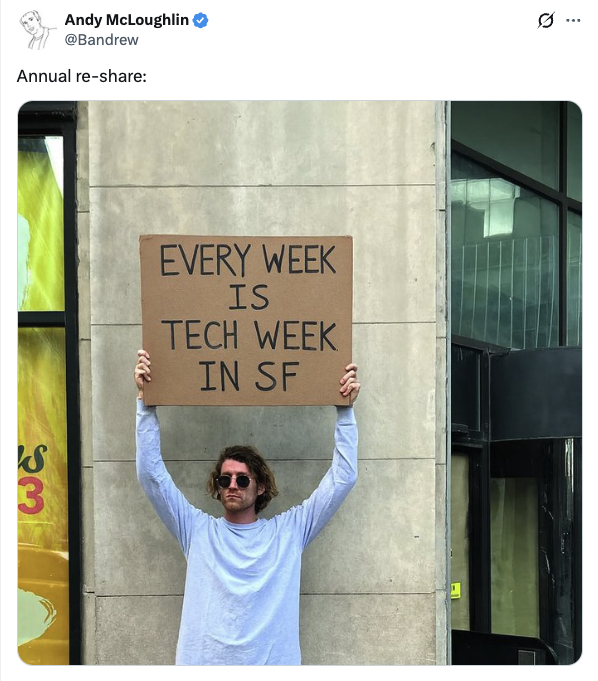
In any case, as we bid farewell to the summer of AI, it’s time for 5 Things I Think I Think - Q3 2026 Edition:
1. The Bifurcation of VC Accelerates
The first half of the year saw a sharp increase in preemptive rounds at Series A and B as later-stage funds pushed to get allocation in hot companies. After petering off towards the end of May, that activity resumed in earnest in mid-August (see: Instinct). But along with it came the continuation of a sluggish fundraising market for the majority of companies — i.e. those that aren’t displaying the “hypergrowth” characteristics of leading AI companies.
Notably, in Q3 we saw the shift in VC behavior that started with Pre-Seed in 2025 and Seed in Q1 progress to Series A, with VCs at that stage trying to figure out their investment strategy in a world of king-making. We’ve also started to see a drop in bridge rounds, with an increasing number of early-stage VCs choosing to pull the plug on companies they previously invested in rather than provide additional funding.
I think Q4 is going to tell us a lot about where the overall VC market is going to land when it comes to the long-term effects of this AI-centric bifurcation, particularly at Seed and Series A. How many funds will chase hot companies, regardless of the cost? How many will stick to an investment thesis based on pre-AI valuations (or at least, slightly inflated valuations with a consistent valuation range)? How many will adopt a hybrid approach? And how many will quietly quit (or be forced to quit after their LPs don’t re-up)?
I’m involved with a number of strong-but-not-hypergrowth companies that are preparing to raise Series A or B rounds in the coming weeks. Each of these companies would have been a no-brainer raise a year ago — and I’m still confident that each of them will drive competitive outcomes — but it will be interesting to see how the market reacts in terms of the level of competition, valuations, etc. for their offerings.
Moreover, I suspect that we’ll see a number of such companies test the fundraising waters in Q4 and quickly hit pause on their process if they don’t get the type of reaction they were expecting (and then reorient around a fundraising effort post-IPO window reopening). Speaking of which…
2. The IPOs are maybe, sort of, possibly coming..?
As I foreshadowed in my Q2 2026 update, Anthropic’s IPO did indeed get pushed back (though not yet all the way through to 2027). The S-1 that the company filed confidentially back in June leaked last week and analysts have been digging into the details. Current signs point towards an early-November IPO, but there is still plenty of time to hit a bump in the road (or three).
While there have been some notable acquisitions in the past few months (shout out to former Panache portfolio company PurposeMed on their acquisition by Grindr last week! 🙌), there is still a massive lack of liquidity in the market. Between SpaceX’s IPO landing with a resounding “meh” and other tech IPOs being pushed back, the impact is now being felt across the board.
What might not be obvious to founders is that, just as there is a significant bifurcation happening with company fundraising, there’s also a similar bifurcation happening when it comes to VCs raising new funds. While a small number of mega funds and high-profile GP spin outs are able to quickly raise new funds, the vast majority of VCs are taking longer than ever to raise new funding — in no small part due to the lack of liquidity in the market. As a specific data point, last week Carta released a report showing that the average time between raising a first and second fund for VCs has spiked to nearly 4 years (compared to a low of just over 2.5 years in 2022). For context, US VCs historically average just under 3 years to raise new funds. If an investment period is 2 - 3 years but it takes 4 years to raise a new fund, that means one full year when the VC isn’t making new investments (or is investing at a drastically slowed pace).
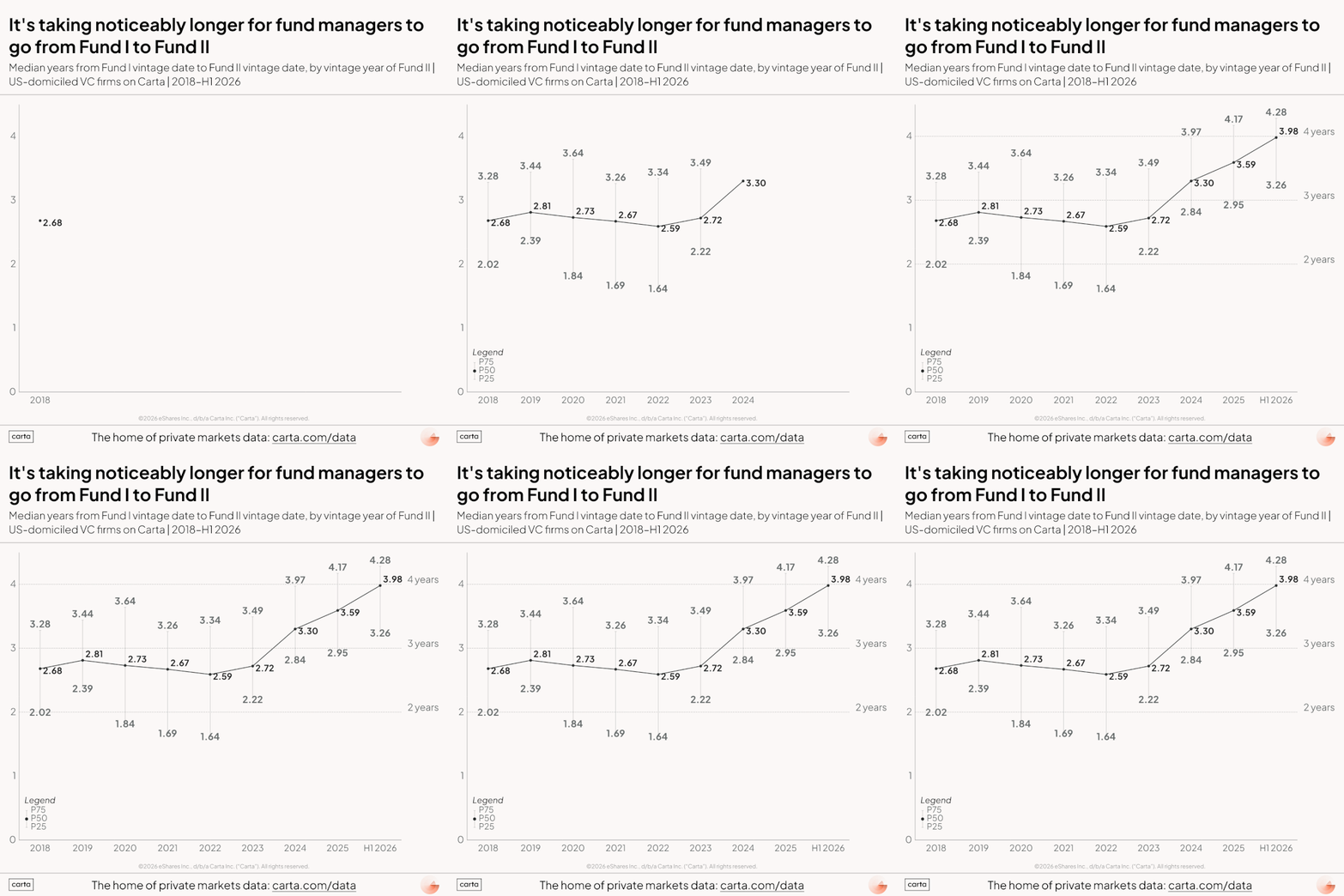
It’s worth noting that the data above is for US-domiciled VC firms. My strong suspicion is that the gap is even greater for funds based outside of the US.
3. Drowning in Agents
In my last update, I noted that AI agents had finally crossed the chasm. We’ve now blown past the top of the hype cycle and are rocketing towards the trough of disillusionment.
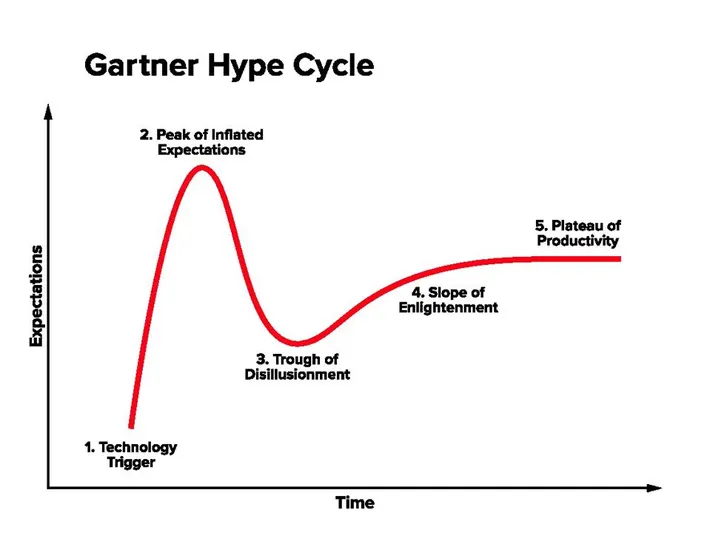
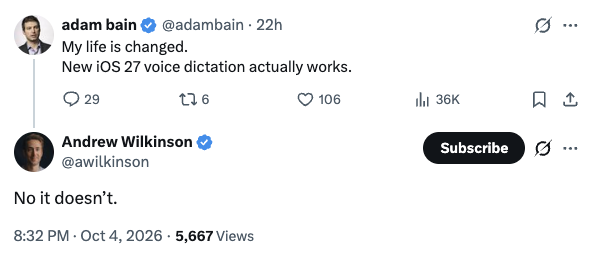
In the past month alone, a < 1 year old viral agent startup raised $1 billion in funding, Facebook (still not gonna call it Meta) released its own agent — that was promptly blocked by the majority of websites — and Apple finally released a version of Siri with dictation that works.
So why do I think we’re about to crash into the trough of disillusionment? Because users are quickly discovering how finicky and limited prepackaged AI agents really are. For as much hype as the technology has, the reality is that there are very few use cases for which agents genuinely and consistently work “out-of-the-box”. Once you get past the initial excitement of “Oh cool! My agent found an invoice for a service I forgot to cancel and saved me $20. Never mind that I would have found myself if I looked…,” there’s not a ton you can actually trust them to do right now without making mistakes.
Which is why, despite cheering loudly each time a funding round takes place, most folks in Silicon Valley use AI agents exclusively for low-value tasks with limited downside.
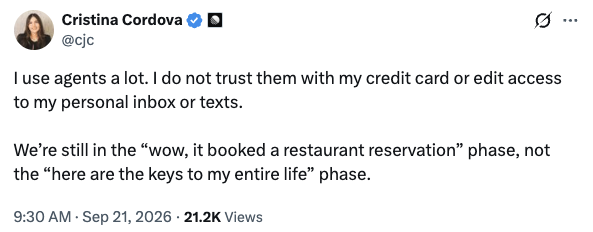
I’ve personally stopped using agents for most of the use cases I “kicked the tires on” over the past year, simply because they couldn’t be relied on to complete the task correctly. In many cases, I found myself spending more time trying to figure out if the agent actually did what I asked it to than I would have it I had simply done the task myself. With so many edge cases failing and infinitely more on the horizon, it’s becoming clear that the real moat for AI agents is going to be customer support.
I have no doubt that the technology will eventually get there, but in the meantime I expect a lot of very loud public disillusionment as mainstream users step (trip?) into the gap between inflated expectations and reality. In particular, I expect that we’ll soon see a stream of negative stories in the media that will resonate far more with the public at large than the recent spate of AI lab hacking stories has. Once the 6 o’clock news starts running tear-jerkers about how company X’s agent blew through a widow’s retirement savings or a small business owner’s payroll or a young couple’s wedding budget, well…let’s just say there’s not going to be a lot of empathy for the companies behind those agents.
4. Silicon Valley Founders are Speaking Another Language
A few weeks ago, I wrote a post suggesting that founders based outside of the San Francisco Bay Area should spend a few weeks in San Francisco “getting acclimated” before starting a fundraising process.
The extent to which the current generation of Silicon Valley founders really are speaking a different language was driven home to me last week, when I caught up with a founder whom I’ve known for nearly 20 years (starting back when I hired him at Aster Data in 2007). This particular individual has since founded and exited multiple VC-backed companies, raised funding from the some of leading Silicon Valley VC firms and, by all accounts, should be able to dictate the terms for any new endeavor as he sees fit. Yet when he talked to me about his latest concept, I couldn’t help but immediately think, “this guy is out-of-touch”.
We’ve since had multiple conversations on topic (which I plan to eventually synthesize in a dedicated post), but for now I’ll highlight a few things that have become clear to me:
Today’s most competitive founders are focused on opportunities measured in the tens of billions or even trillions of dollars.
They spend little-to-no-time anchoring their pitch around the traditional contrast of “this is the world today / this is the world tomorrow” and instead jump right ahead to “this is what the world is going to look like when AI is prevalent…and here is what’s going to break”.
Virtually no one spends time on the traditional market sizing exercise of TAM / SAM / SOM (it’s either, “this is a ridiculously massive opportunity that’s blatantly obvious to everyone” or crickets).
The traditional timeline of, “in 18 months we will achieve incremental milestone X,” now screams, “we’re going too slow!” for many categories of startups. Instead. the most ambitious pitches revolve around previously impossible timelines built around multiple rounds of funding per year. Yet they do so in a way that seems believable / achievable.
For founders looking to raise funding, it’s hard to understate how jarring the contrast is for VCs between a founder who credibly pitches a startup that can go from zero to massive in 2-3 years and one who projects needing multiple rounds of funding to get to PMF.
…for an app.
My best advice at this point for founders preparing to fundraise is to go through the following intellectual exercise: assume that the people who pitched a given VC before and after you both pitched hypergrowth startups that could credibly go to $1 billion in revenue in 3 years. How do you present what you’re doing in a way that gets them excited, even if it’s not on that trajectory?
If you can’t do that, then maybe VC isn’t right for you (even if it would have been two years ago).
5. Sometime in 2027, the Music Will Stop
A few weeks ago, Venky Ganesan of Menlo Partners wrote an exceptional post on the current state of venture capital that I strongly encourage you to read. Venky shared that, “…right now is the most disorienting period in venture capital I can remember, and I have been doing this for a while.” His post concluded with the following observation:
“The music will stop. It always does. Dance if you must, but know where the chairs are.”
As I alluded to earlier, I think that by the time 2026 comes to a close, we’ll have a much better sense of how early-stage VCs (i.e. VCs that invest in Pre-Seed / Seed / Series A companies) plan to adjust to the emergence of AI. Going into next year, we’ll have far more clarity on which funds are willing to invest in companies on “traditional” trajectories vs. those who are exclusively looking for hypergrowth AI startups. We’ll also likely see the emergence of a number of new funds explicitly targeting non-hypergrowth companies.
Moreover, at some point next year, the AI music will stop. One or more high-flying AI startups will crash to the ground, and with it the seemingly endless game of one-upmanship that many of the megafunds have been playing. That’s not to say that the AI bubble will burst (a number of these companies will turn out to be credible long-term businesses), but at this point it’s clear that a meaningful number of companies have raised funding at valuations that they can’t possibly ever grow into, even if the best king-making assumptions come to pass.
It’s too soon to know exactly what the fallout of this will be, but for founders building companies that are delivering real value to customers (and, in doing so, generating real revenue), staying focused through next summer will be essential.
Because there’s going to be a lot of noise.