Things I Think I Think - Q3 2026
It’s San Francisco Tech Week! Wait…isn’t that every week? Time for 5 Things I Think I Think: Q3 2026 edition.
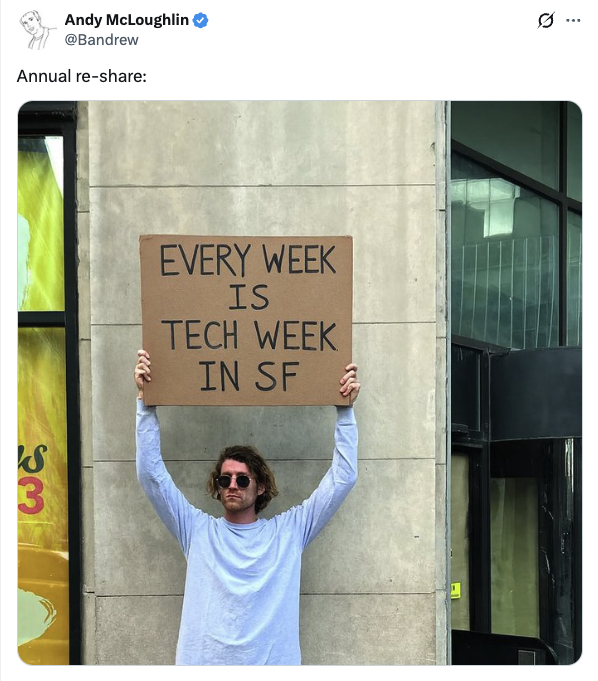
It’s San Francisco Tech Week!
…wait, isn’t every week in San Francisco “tech week”? 🤔
In any case, as we bid farewell to the summer of AI, it’s time for 5 Things I Think I Think - Q3 2026 Edition:
1. The Bifurcation of VC Accelerates
The first half of the year saw a sharp increase in preemptive rounds at Series A and B as later-stage funds pushed to get allocation in hot companies. After petering off towards the end of May, that activity resumed in earnest in mid-August (see: Instinct). But along with it came the continuation of a sluggish fundraising market for the majority of companies — i.e. those that aren’t displaying the “hypergrowth” characteristics of leading AI companies.
Notably, in Q3 we saw the shift in VC behavior that started with Pre-Seed in 2025 and Seed in Q1 progress to Series A, with VCs at that stage trying to figure out their investment strategy in a world of king-making. We’ve also started to see a drop in bridge rounds, with an increasing number of early-stage VCs choosing to pull the plug on companies they previously invested in rather than provide additional funding.
I think Q4 is going to tell us a lot about where the overall VC market is going to land when it comes to the long-term effects of this AI-centric bifurcation, particularly at Seed and Series A. How many funds will chase hot companies, regardless of the cost? How many will stick to an investment thesis based on pre-AI valuations (or at least, slightly inflated valuations with a consistent valuation range)? How many will adopt a hybrid approach? And how many will quietly quit (or be forced to quit after their LPs don’t re-up)?
I’m involved with a number of strong-but-not-hypergrowth companies that are preparing to raise Series A or B rounds in the coming weeks. Each of these companies would have been a no-brainer raise a year ago — and I’m still confident that each of them will drive competitive outcomes — but it will be interesting to see how the market reacts in terms of the level of competition, valuations, etc. for their offerings.
Moreover, I suspect that we’ll see a number of such companies test the fundraising waters in Q4 and quickly hit pause on their process if they don’t get the type of reaction they were expecting (and then reorient around a fundraising effort post-IPO window reopening). Speaking of which…
2. The IPOs are maybe, sort of, possibly coming..?
As I foreshadowed in my Q2 2026 update, Anthropic’s IPO did indeed get pushed back (though not yet all the way through to 2027). The S-1 that the company filed confidentially back in June leaked last week and analysts have been digging into the details. Current signs point towards an early-November IPO, but there is still plenty of time to hit a bump in the road (or three).
While there have been some notable acquisitions in the past few months (shout out to former Panache portfolio company PurposeMed on their acquisition by Grindr last week! 🙌), there is still a massive lack of liquidity in the market. Between SpaceX’s IPO landing with a resounding “meh” and other tech IPOs being pushed back, the impact is now being felt across the board.
What might not be obvious to founders is that, just as there is a significant bifurcation happening with company fundraising, there’s also a similar bifurcation happening when it comes to VCs raising new funds. While a small number of mega funds and high-profile GP spin outs are able to quickly raise new funds, the vast majority of VCs are taking longer than ever to raise new funding — in no small part due to the lack of liquidity in the market. As a specific data point, last week Carta released a report showing that the average time between raising a first and second fund for VCs has spiked to nearly 4 years (compared to a low of just over 2.5 years in 2022). For context, US VCs historically average just under 3 years to raise new funds. If an investment period is 2 - 3 years but it takes 4 years to raise a new fund, that means one full year when the VC isn’t making new investments (or is investing at a drastically slowed pace).
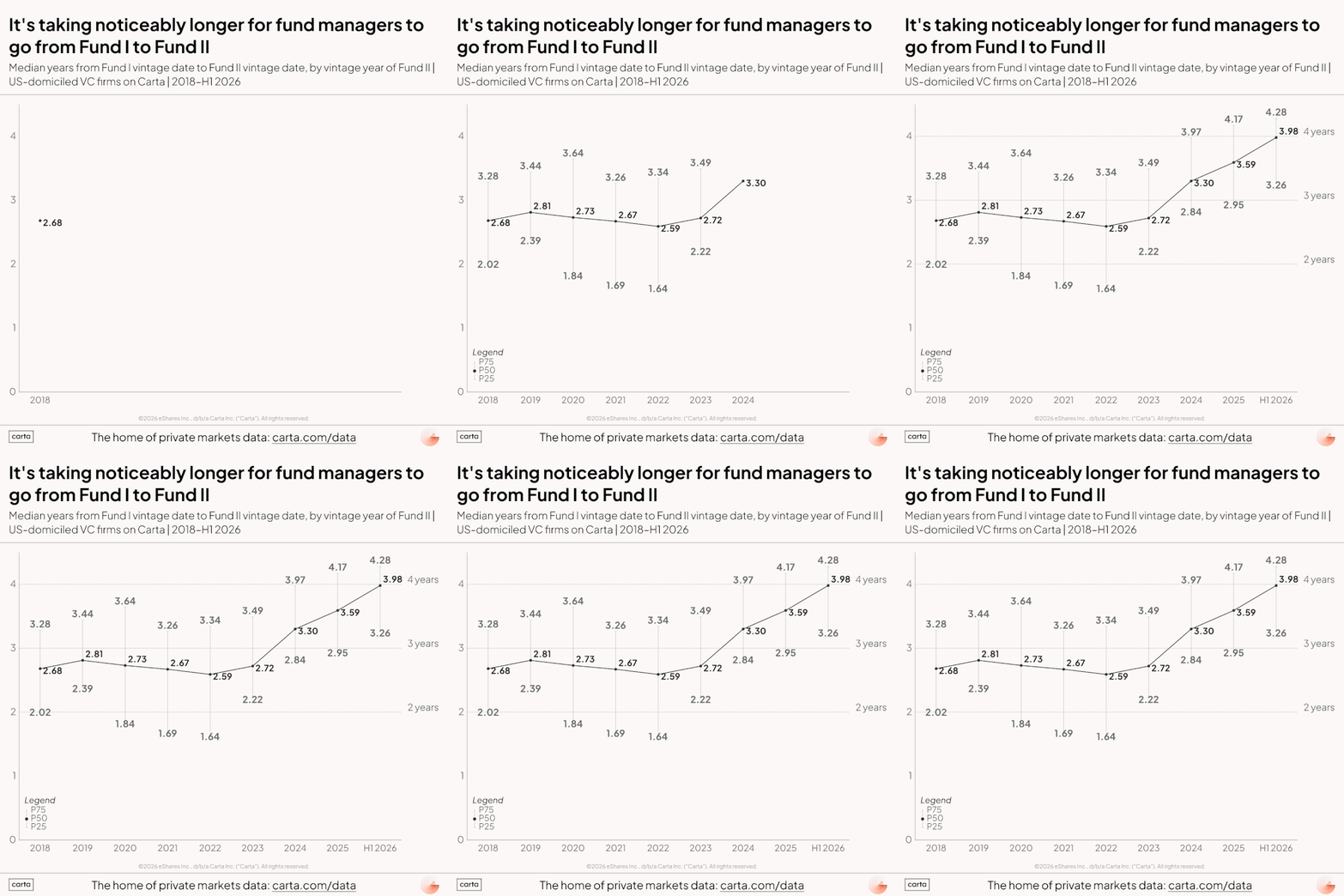
It’s worth noting that the data above is for US-domiciled VC firms. My strong suspicion is that the gap is even greater for funds based outside of the US.
3. Drowning in Agents
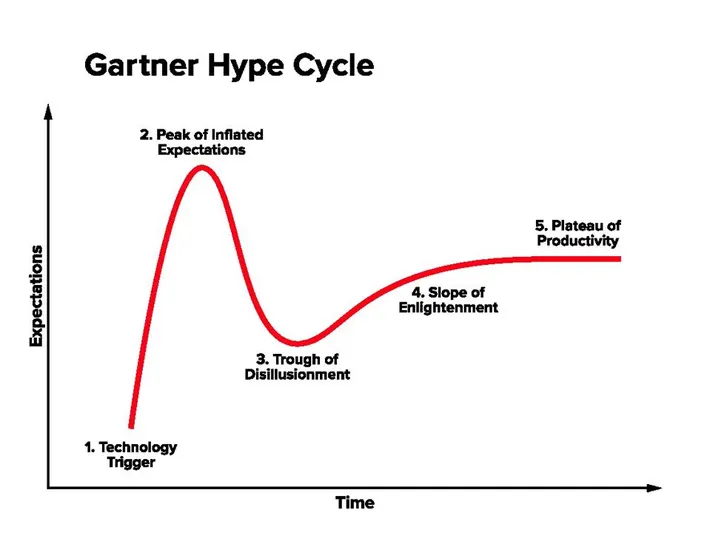
In my last update, I noted that AI agents had finally crossed the chasm. We’ve now blown past the top of the hype cycle and are rocketing towards the trough of disillusionment.
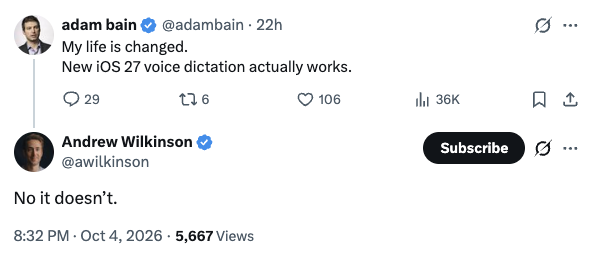
In the past month alone, a < 1 year old viral agent startup raised $1 billion in funding, Facebook (still not gonna call it Meta) released its own agent — that was promptly blocked by the majority of websites — and Apple finally released a version of Siri with dictation that works.
So why do I think we’re about to crash into the trough of disillusionment? Because users are quickly discovering how finicky and limited prepackaged AI agents really are. For as much hype as the technology has, the reality is that there are very few use cases for which agents genuinely and consistently work “out-of-the-box”. Once you get past the initial excitement of “Oh cool! My agent found an invoice for a service I forgot to cancel and saved me $20. Never mind that I would have found myself if I looked…,” there’s not a ton you can actually trust them to do right now without making mistakes.
Which is why, despite cheering loudly each time a funding round takes place, most folks in Silicon Valley use AI agents exclusively for low-value tasks with limited downside.
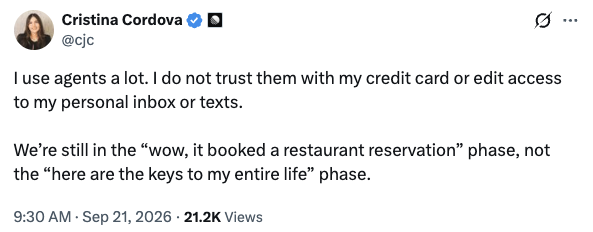
I’ve personally stopped using agents for most of the use cases I “kicked the tires on” over the past year, simply because they couldn’t be relied on to complete the task correctly. In many cases, I found myself spending more time trying to figure out if the agent actually did what I asked it to than I would have it I had simply done the task myself. With so many edge cases failing and infinitely more on the horizon, it’s becoming clear that the real moat for AI agents is going to be customer support.
I have no doubt that the technology will eventually get there, but in the meantime I expect a lot of very loud public disillusionment as mainstream users step (trip?) into the gap between inflated expectations and reality. In particular, I expect that we’ll soon see a stream of negative stories in the media that will resonate far more with the public at large than the recent spate of AI lab hacking stories has. Once the 6 o’clock news starts running tear-jerkers about how company X’s agent blew through a widow’s retirement savings or a small business owner’s payroll or a young couple’s wedding budget, well…let’s just say there’s not going to be a lot of empathy for the companies behind those agents.
4. Silicon Valley Founders are Speaking Another Language
A few weeks ago, I wrote a post suggesting that founders based outside of the San Francisco Bay Area should spend a few weeks in San Francisco “getting acclimated” before starting a fundraising process.
The extent to which the current generation of Silicon Valley founders really are speaking a different language was driven home to me last week, when I caught up with a founder whom I’ve known for nearly 20 years (starting back when I hired him at Aster Data in 2007). This particular individual has since founded and exited multiple VC-backed companies, raised funding from the some of leading Silicon Valley VC firms and, by all accounts, should be able to dictate the terms for any new endeavor as he sees fit. Yet when he talked to me about his latest concept, I couldn’t help but immediately think, “this guy is out-of-touch”.
We’ve since had multiple conversations on topic (which I plan to eventually synthesize in a dedicated post), but for now I’ll highlight a few things that have become clear to me:
Today’s most competitive founders are focused on opportunities measured in the tens of billions or even trillions of dollars.
They spend little-to-no-time anchoring their pitch around the traditional contrast of “this is the world today / this is the world tomorrow” and instead jump right ahead to “this is what the world is going to look like when AI is prevalent…and here is what’s going to break”.
Virtually no one spends time on the traditional market sizing exercise of TAM / SAM / SOM (it’s either, “this is a ridiculously massive opportunity that’s blatantly obvious to everyone” or crickets).
The traditional timeline of, “in 18 months we will achieve incremental milestone X,” now screams, “we’re going too slow!” for many categories of startups. Instead. the most ambitious pitches revolve around previously impossible timelines built around multiple rounds of funding per year. Yet they do so in a way that seems believable / achievable.
For founders looking to raise funding, it’s hard to understate how jarring the contrast is for VCs between a founder who credibly pitches a startup that can go from zero to massive in 2-3 years and one who projects needing multiple rounds of funding to get to PMF.
…for an app.
My best advice at this point for founders preparing to fundraise is to go through the following intellectual exercise: assume that the people who pitched a given VC before and after you both pitched hypergrowth startups that could credibly go to $1 billion in revenue in 3 years. How do you present what you’re doing in a way that gets them excited, even if it’s not on that trajectory?
If you can’t do that, then maybe VC isn’t right for you (even if it would have been two years ago).
5. Sometime in 2027, the Music Will Stop
A few weeks ago, Venky Ganesan of Menlo Partners wrote an exceptional post on the current state of venture capital that I strongly encourage you to read. Venky shared that, “…right now is the most disorienting period in venture capital I can remember, and I have been doing this for a while.” His post concluded with the following observation:
“The music will stop. It always does. Dance if you must, but know where the chairs are.”
As I alluded to earlier, I think that by the time 2026 comes to a close, we’ll have a much better sense of how early-stage VCs (i.e. VCs that invest in Pre-Seed / Seed / Series A companies) plan to adjust to the emergence of AI. Going into next year, we’ll have far more clarity on which funds are willing to invest in companies on “traditional” trajectories vs. those who are exclusively looking for hypergrowth AI startups. We’ll also likely see the emergence of a number of new funds explicitly targeting non-hypergrowth companies.
Moreover, at some point next year, the AI music will stop. One or more high-flying AI startups will crash to the ground, and with it the seemingly endless game of one-upmanship that many of the megafunds have been playing. That’s not to say that the AI bubble will burst (a number of these companies will turn out to be credible long-term businesses), but at this point it’s clear that a meaningful number of companies have raised funding at valuations that they can’t possibly ever grow into, even if the best king-making assumptions come to pass.
It’s too soon to know exactly what the fallout of this will be, but for founders building companies that are delivering real value to customers (and, in doing so, generating real revenue), staying focused through next summer will be essential.
Because there’s going to be a lot of noise.
Things I Think I Think - Q2 2026
Against the backdrop of this summer’s competition for global sport supremacy, here are 5 Things I Think I Think - Q2 2026 Edition.
There is a magical time once every 4 years when the world comes together around the beautiful game. Given all of the geopolitical changes that have taken place over the past few years, it’s hard not to smile at the fact that cohost United States will play its first elimination game today, on Canada Day, while Canada will next take to the pitch on the 4th of July.

Let’s go Canada! 🇨🇦
Set against the backdrop of this summer’s competition for global sport supremacy, here are 5 Things I Think I Think - Q2 2026 Edition:
1. Fast and then Slow
The frantic pace of investment that characterized the first quarter of 2026 continued into Q2. Megafunds, in particular, continued to throw around their proverbial weight, with numerous preemptive rounds happening at the start of the quarter (especially at Series A and B). I suspect that when the statistics for Q2 eventually see the light of day, we’ll see that valuations for the top 5% of companies continued to climb sharply through Q1 and into Q2.
But a funny thing happened as May rolled around: the pace of deals started to slow. Gradually, then suddenly.
In particular, the preemption of Series A and B rounds that was prevalent during the first third of the year dropped off rather dramatically towards the end of Q2. I watched a number of VCs that had been aggressively pursuing preemptive deals downshift their activity mid-quarter. Almost in sync, a number of founders I know who were looking down the barrel of preemptive term sheets stepped back from the alter, with plans to revisit in the fall.
It’s not often that you see VCs and founders adjust their activities in parallel. In my inaugural “Things I Think I Think” post back in 2023, one of my observations was about Canadian founders lagging in their acceptance of and adjustment to changes that were happening in the market post-ZIRP. So what happened in Q2 was quite unusual (but something I view as a strong positive). It wasn’t so much a correction in the fundraising market as a mutual, unspoken agreement by both sides to hit the pause button.

Coming into Q2, I had spoken with both VCs and founders who felt that they had no choice but to play the “preemption game”. As alluded to in my Q4 2025 update, investors fearful of missing out on the next OpenAI or Anthropic were driving “…a degree of preemption and FOMO for hypergrowth AI startups that’s on par (if not greater) than what happened during ZIRP.” At the same time, a number of founders I spoke with felt like they had an obligation to entertain preemptive investor interest. Many of them were spending considerable cycles on investor meetings even though they already had plenty of money in the bank.
By the time June came around, the slowdown in activity had expanded well beyond the “cease fire” in preemptive investments. Many VCs I know — from Pre-Seed to Series B — had all but stopped taking new meetings by the start of June. Perhaps it was a similar desire to hit pause and revisit their AI-related investment theses. Perhaps it was simply a weariness after more than a year of frenetic activity. Regardless, this summer is going to be a particularly bad time to fundraise (but a great time to be heads down on your business).
2. The IPOs are Coming! The IPOs are Coming!
Q2 saw the first of three potentially massive tech liquidity events with SpaceX’s record-breaking IPO. But it was the other two IPOs on the horizon — from Anthropic and OpenAI — that had a more immediate impact on the behavior of many VCs.
As I alluded to above, a lot of the high-octane investor behavior over the past year has been driven by VCs desperately trying to replicate investments in Anthropic and OpenAI. Both companies have achieved unprecedented user adoption, revenue growth and — most appreciated by investors — valuation growth (aka markups). And, until recently, both seemed on a path that would quickly translate those paper gains into similarly unprecedented IPOs (DPI!).
But what seemed like surefire wins suddenly became not-so-certain. Anthropic’s smooth sailing hit bumpy seas as it repeatedly found itself in conflict with the U.S. government, while ongoing questions about OpenAI’s business fundamentals has led to speculation that it may delay its IPO until 2027.

Pete the Cat, early-stage VC
As the shine began to come off these two industry darlings, VCs slowly started to remove their rose-colored AI glasses. The slowdown in preemptive activity I described above was very much triggered by the recognition that, despite their unprecedented growth trajectories, the path from inception to IPO for AI-based companies is still a bumpy one.
To be clear, investors are by no means giving up on AI (many are still wearing very thick rose-colored AI glasses, albeit with a slightly lighter tint). The fact that Anthropic and Open AI have hit bumps in the road won’t damper VC enthusiasm for AI’s industry-disrupting potential. Rather, investors are adjusting their expectations when it comes to the trajectories of these companies, particularly as it relates to time-to-liquidity. Ultimately, that will affect the rate at which preemptive rounds occur and the valuations at which those rounds happen.
But make no mistake, once fall comes around, VCs will once again be champing at the bit to invest in the latest-and-greatest AI startups.
3. Agents Cross the Chasm
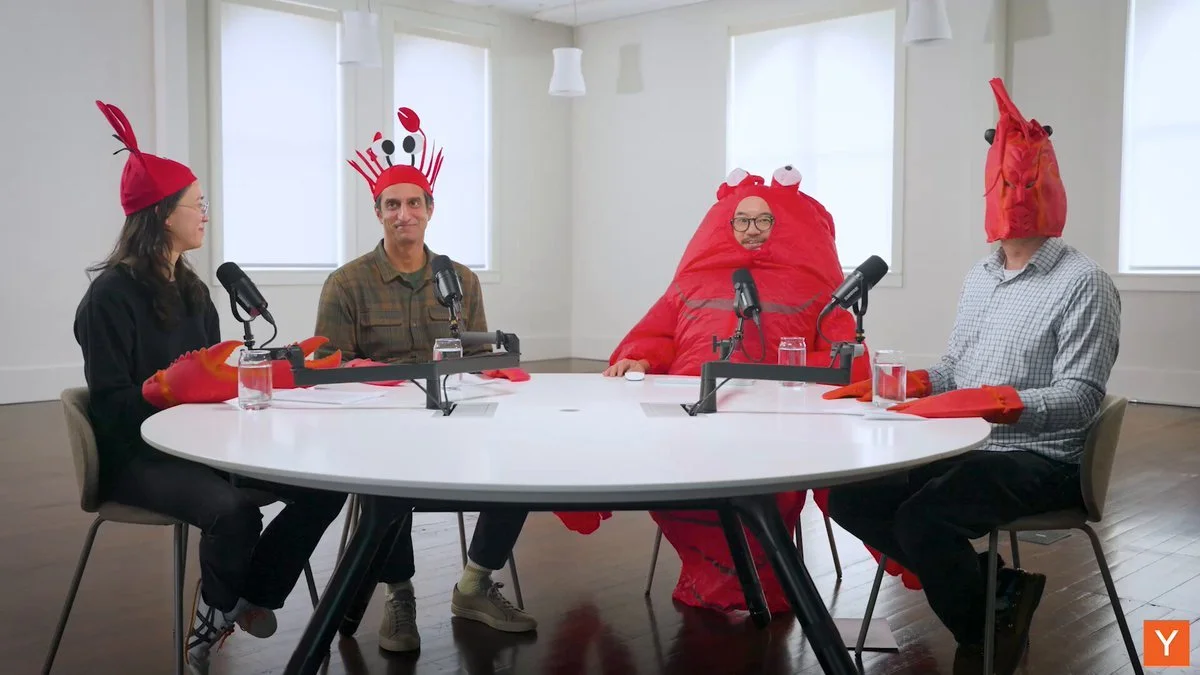
When I wrote my end-of-year update six months ago, nobody had heard of moltbot clawdbot OpenClaw. By Q1, prominent VCs were showing up on podcasts wearing lobster costumes. But the technology was still barely usable. We were still very much at the Homebrew Computer Club phase of the technology adoption lifecycle.
But like many things related to AI, the rate of progression from barely usable open source “projects” to relatively-stable early “products” has been unprecedented. This past quarter, a number of companies came to market with purpose-built agent products, ranging from more mature open source projects, like Hermes, to agents for managing family calendars. Howie, an email scheduling assistant that I previously wrote about, recently released “Howie Blue”, a full-blown personal agent that integrates with both email and iMessage (hence the name).
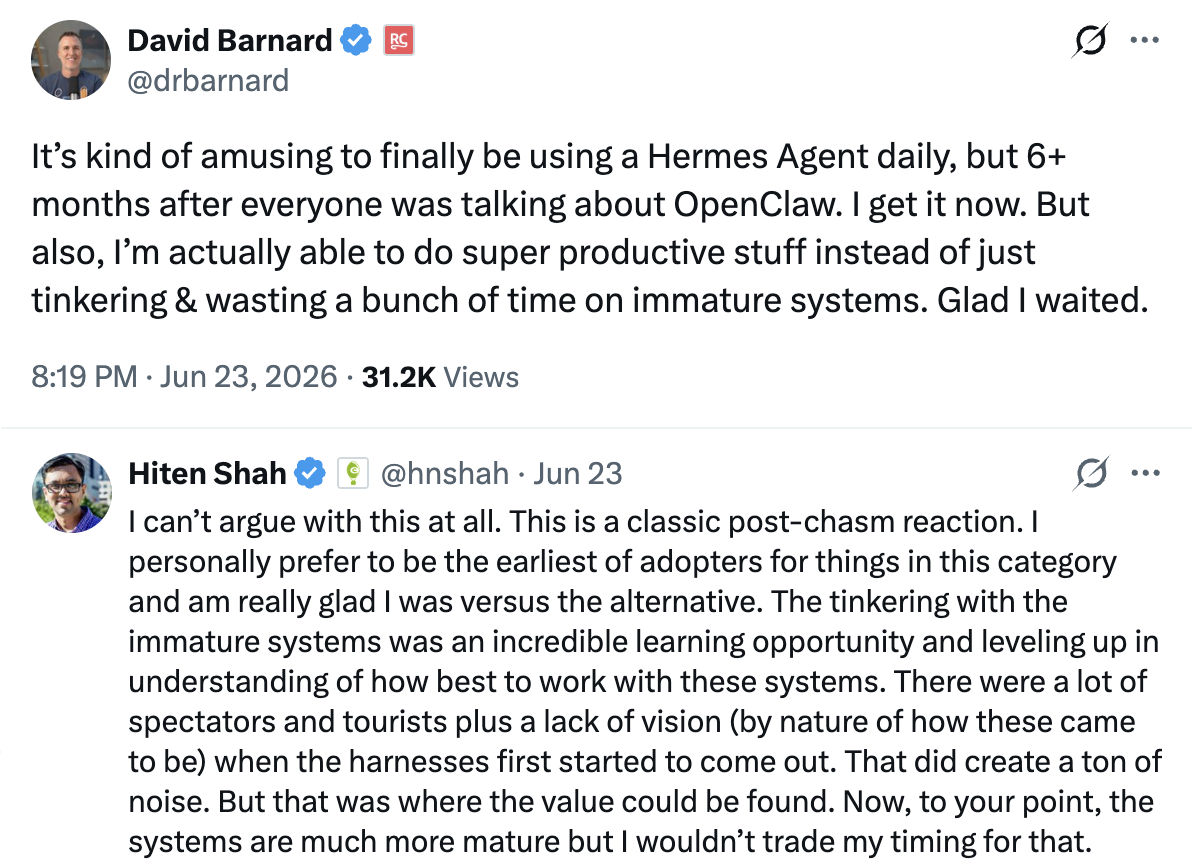
My friend Hiten did a great job of describing the value that many early adopters got from working with nascent agent platforms, though I’m not sure that the general populace had nearly as much ROI to gain from adopting the technology so early. But with so many agent-based products now coming to market, the bar has never been lower to start using AI agents.
I expect that adoption rates of agent-based products will skyrocket as we head into the back half of the year, especially in Startupland™. For founders and investors alike, the takeaway should be this: if you aren’t already using agents in some form or another (not just within your company, but you personally) take some time this summer to get started. It doesn’t matter if you’re rolling your own open source agent or signing up for one of the many turnkey solutions hitting the market. Do something.
Continuing to sit on the sidelines won’t land you in a “permanent underclass” (despite what many in Silicon Valley continue to believe), but it will absolutely leave you at an increasing competitive disadvantage.
4. Canadian VC on the Brink
For the past few quarters, the ongoing bifurcation of venture capital has led to a relatively small number of big VC firms capturing an increasing percentage of LP dollars. This shift is happening all over the world, but the particular manner in which it has manifested in Canada has the potential to completely devastate the country’s tech sector.
RBCx recently published its mid-year report on Canada’s VC market, which included a staggering claim: as of the end of 2025, the country’s emerging managers (new VCs who are on their first, second or third fund) have raised 36% less capital than projected. For a country that already has too few early-stage VCs, a lack of fundraising by emerging managers is nothing less than an existential threat to its entire tech sector.
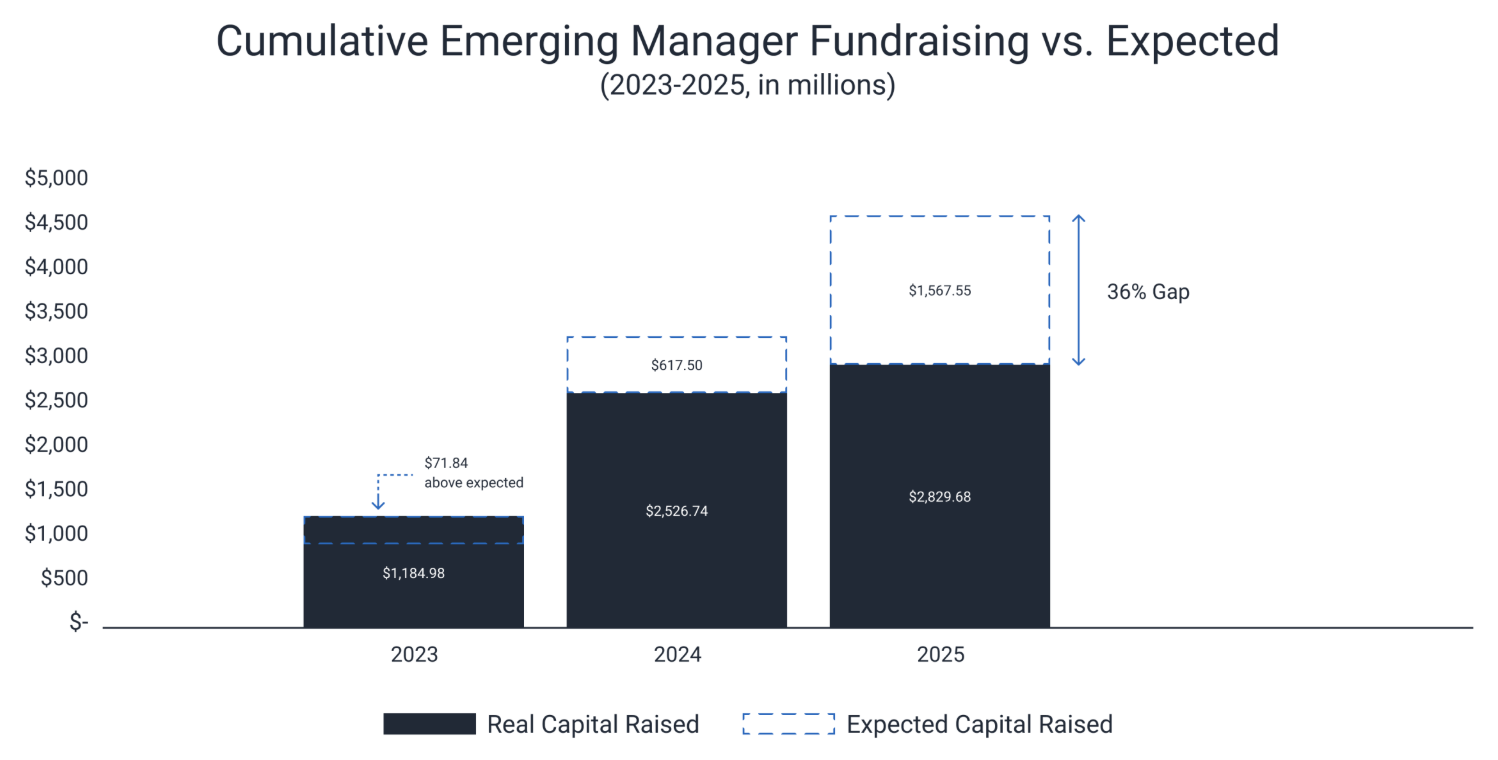
A lack of support for emerging managers isn’t a new phenomenon in Canada. In fact, I wrote about it 3 years ago. But the implications of the current prolonged drought has the country on the precipice of disaster — whether or not its leaders realize it.
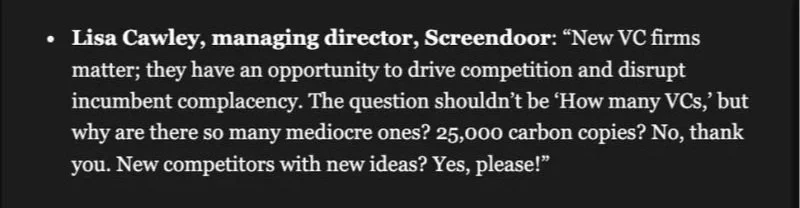
Why? Emerging managers overwhelmingly invest at the earliest stages. They also tend to bring new ideas and new perspectives to startup ecosystems. That frequently leads them to be the first check into companies with very different profiles to what “old guard” VCs back, which is key to an ecosystem’s ability to innovate and drive long-term growth. Lisa Cawley, Managing Director of Screendoor, a leading fund-of-funds that invests exclusively in U.S.-based emerging managers, described the critical role of new VCs to the Wall Street Journal last year,
“New VC firms matter; they have an opportunity to drive competition and disrupt incumbent complacency. The question shouldn’t be ‘How many VCs,’ but why are there so many mediocre ones?”
That said, a dip in the number of early-stage VCs in an ecosystem typically doesn’t threaten its long-term survival. But time is not on Canada’s side. Its unique existential threat comes from the fact that its neighbor to the south is home to the tech world’s largest, fastest-moving and most risk-taking capital market. At a time when fewer Canadian VCs are willing (or able) to write the first check into first-time founders, a growing number of local founders have simply stopped looking for capital at home. Instead, they’re going straight to Silicon Valley.
And in many cases, those first-time Canadian founders are choosing to move to the U.S. as part of the process.
A handful of efforts have recently emerged trying to address the lack of capital flowing to emerging managers in Canada — notably the launch of the Canadian Startup Capital Association (CSCA) in April — but the country needs to make some bold, systemic moves fast. The last time Canada experienced a dip in the number of active VC firms, most Silicon Valley VCs were unwilling to invest in Canadian startups. That’s no longer the case.
If 2026 ends with a similar lack of fundraising success for Canada’s emerging managers, by this time next year there may not be much of a startup pipeline for the rest of the ecosystem to support.
5. We Lost a Giant
Last week, Om Malik passed away after a prolonged health battle. Countless posts and articles have been written about him in the days since. This observation from John Gruber does a good job of capturing how many of us in the tech industry currently feel,
“it is a profound irony that a man with such a big and beautiful figurative heart could have such a lousy literal one.”
I only met Om a handful of times over the years, so I can’t say that I knew him well, but his work and legacy had a profound impact on my journey.
His namesake publication, Gigaom, was unlike any other tech publication at the time (or since). It seamlessly blended the “breaking news”-style coverage of Silicon Valley that was on the rise with a deeper level of analysis — about both technology and business — that simply didn’t exist anywhere else. The approach stemmed from Om’s personal style of journalism, which Stacey Higginbotham described thusly,
“He was the smartest guy writing about really geeky tech and putting it into context. He was able to discuss the nuts and bolts of technology and then extrapolate what new advances would mean and how people would react.”
Gigaom focused primarily on infrastructure and enterprise software, which put both Aster Data and DataHero squarely in its coverage box. In 2009, the publication brought on a dedicated infrastructure/data writer named Derrick Harris, who I quickly got to know and soon became friends with. He shared his own thoughts on Om’s passing here.
For more than 5 years, my professional world existed very much within the orbit of Gigaom. I got to know many of the exceptional writers that passed through its doors and had the privilege of speaking at several of the company’s influential conferences. To this day, the way in which I view tech journalism and its potential for positively influencing the world while holding people in power accountable is overwhelmingly influenced by my years interacting with the team at Gigaom.
In a world where tech media is increasingly driven by algorithms and agendas, the type of deep, thoughtful writing that Om championed is frustratingly hard to come by. If you haven’t already checked out Crazy Stupid Tech, the blog Om launched last year with Fred Vogelstein, I strongly encourage you to do so.
Things I Think I Think - Q1 2026
Three months ago, nobody had heard of OpenClaw, OpenAI was valued at a mere $500B, and Anthropic was signing multi-year partnerships with the U.S. Government.
Three months ago, nobody had heard of moltbot clawdbot OpenClaw, OpenAI was valued at a mere $500B, and Anthropic was signing multi-year partnerships with the U.S. Government.
Here’s where we stand ninety days into 2026 in my latest homage to legendary sports columnist Peter King.
Try explaining this one to 2025 Garry
Here are 5 Things I Think I Think - Q1 2026 Edition:
1. The Bifurcation of VC Continues (Continued…)
In my Q4 2025 post, I shared some observations about the ongoing bifurcation of VC. In particular, I discussed some of the changes that were starting to emerge at the Seed round. Over the past three months, those shifts have gone into overdrive.
It’s now very clear that for a certain category of companies (namely, AI-native companies whose revenue tracks usage), the growth trajectory is very different from what has historically been the case in the software world. The extreme compression of time has led to a dramatic acceleration of funding for those companies and a dramatic upswing in round sizes and valuations. And while usage-based revenue won’t last forever, the companies capitalizing on it are running away from the proverbial pack.
Carta recently noted that the top 5% of U.S. Seed rounds in Q4 2025 had an average valuation of $115.5M (compared to a median valuation of $24M). That looks a lot more like a traditional Series A valuation. And if this year’s on-the-ground activity is any indication, I expect the Q1 numbers to absolutely crush that.
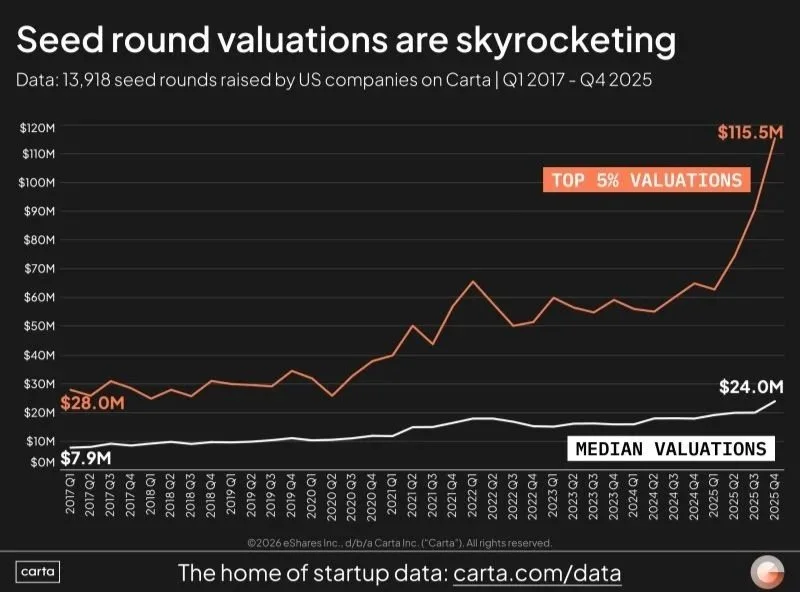
So, if it’s the case that the top segment of Seed companies are splitting off from the rest, are we still talking about a “bifurcation” of VC?
Yes.
Because it’s the megafunds that are swooping in to fund the perceived top Seed companies.
The vast majority of traditional Seed funds (even large ones) can’t afford to invest in these mega rounds. At least…not with traditional fund models. Which is why we’re seeing a ton of adjustment happening amongst Seed VCs. I shared some thoughts on this shift in last week’s post, but it’s worth pointing out that we’re only just starting to see the resulting dominos fall.
I expect that we’ll see a lot of changes when it comes to fund strategies at the Seed by this time next year. In particular, I expect that we’ll see a number of Seed funds adjust their models to look more like Pre-Seed microfunds, with 3 - 5% ownership targets at much higher valuations.
In the meantime, I offer a warning for founders preparing to fundraise: expect to see a Seed crunch for at least the rest of this year.
Much like the Series A crunch we saw last year, this one won’t be due to a lack of capital. It will be because the majority of Seed funds are completely rethinking their investment criteria.
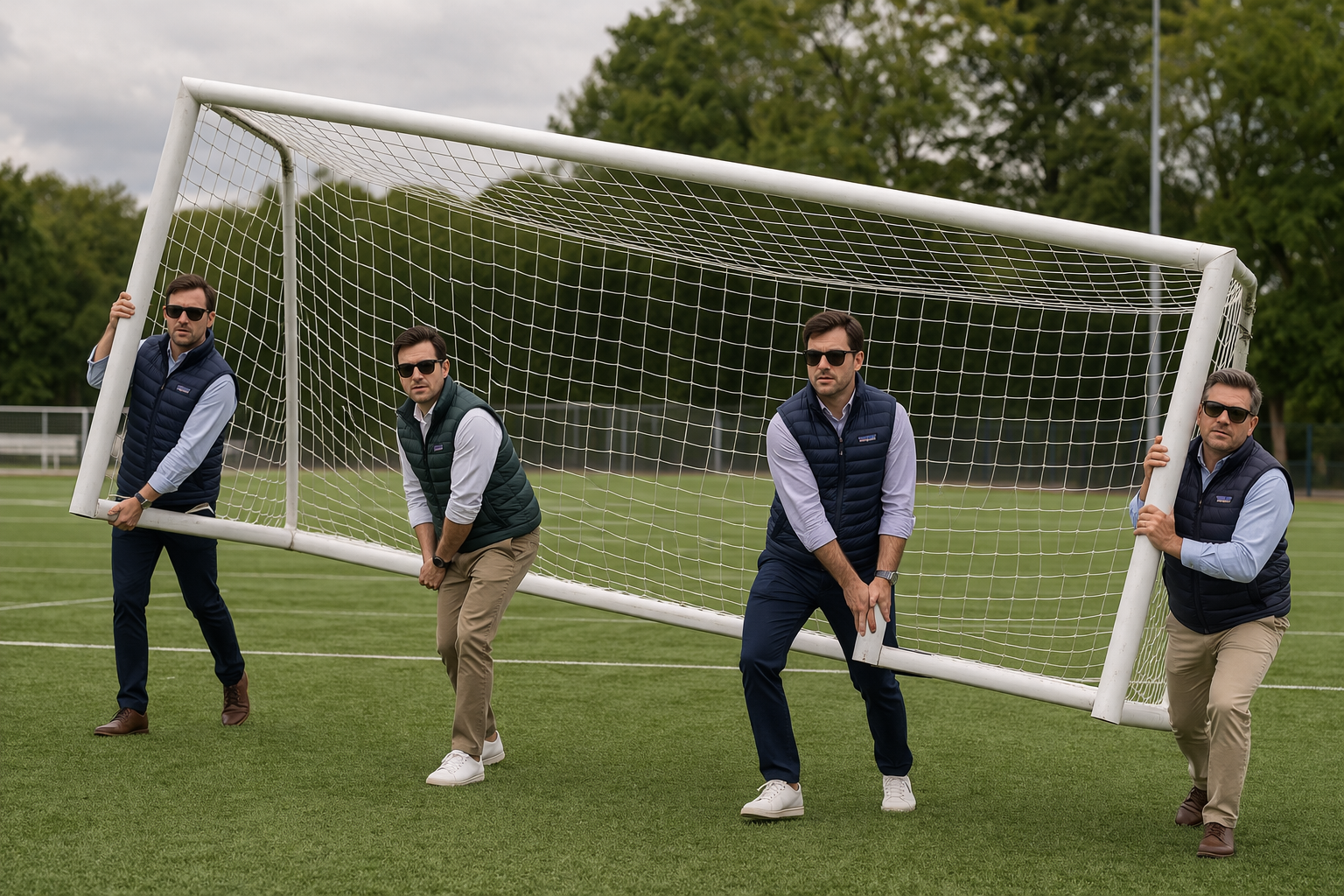
Warning: goal posts moving
In the past few weeks alone, I’ve seen multiple companies that would have easily raised a Seed round a year ago struggle to get first meetings with VCs. Companies with real revenue and prominent logos aren’t even getting a 20-minute intro call.
Plan accordingly.
2. The SF Maker Phase is On Off On
A little over a year ago, I noted that the “maker faire” phase of San Francisco’s AI cycle was over,
“…we’ve moved from the “innovators” phase of this edition of the San Francisco technology lifecycle to the “early adopters” phase. And that’s a good thing.
This isn’t to say that you shouldn’t go to San Francisco in 2025 if you’re a builder — you absolutely should — just don’t expect it to have the same level of serendipity as last year. On the other hand, if you’re a founder a bit further along on your journey who’s looking to meet other high-quality founders focused on building their companies, there’s no better time to come. Just know that you need to be more intentional about your visit and manufacture the outcomes you want.”
I also argued that, “if history’s any indication, it will be another 20 years before it’s back.”
It turns out that history wasn’t helpful in this one. In January, moltbot clawdbot OpenClaw took the tech world by storm. Add to that the latest advancements in Claude Code and it seems like everyone is back to tinkering again.
In reality, I don’t believe that we’re heading back to another full-blown “maker faire” phase of SF’s tech cycle, but there is definitely is mini boom that’s happening right now around agents. Lots of meetups. Lots of activity. Lots of enthusiasm.
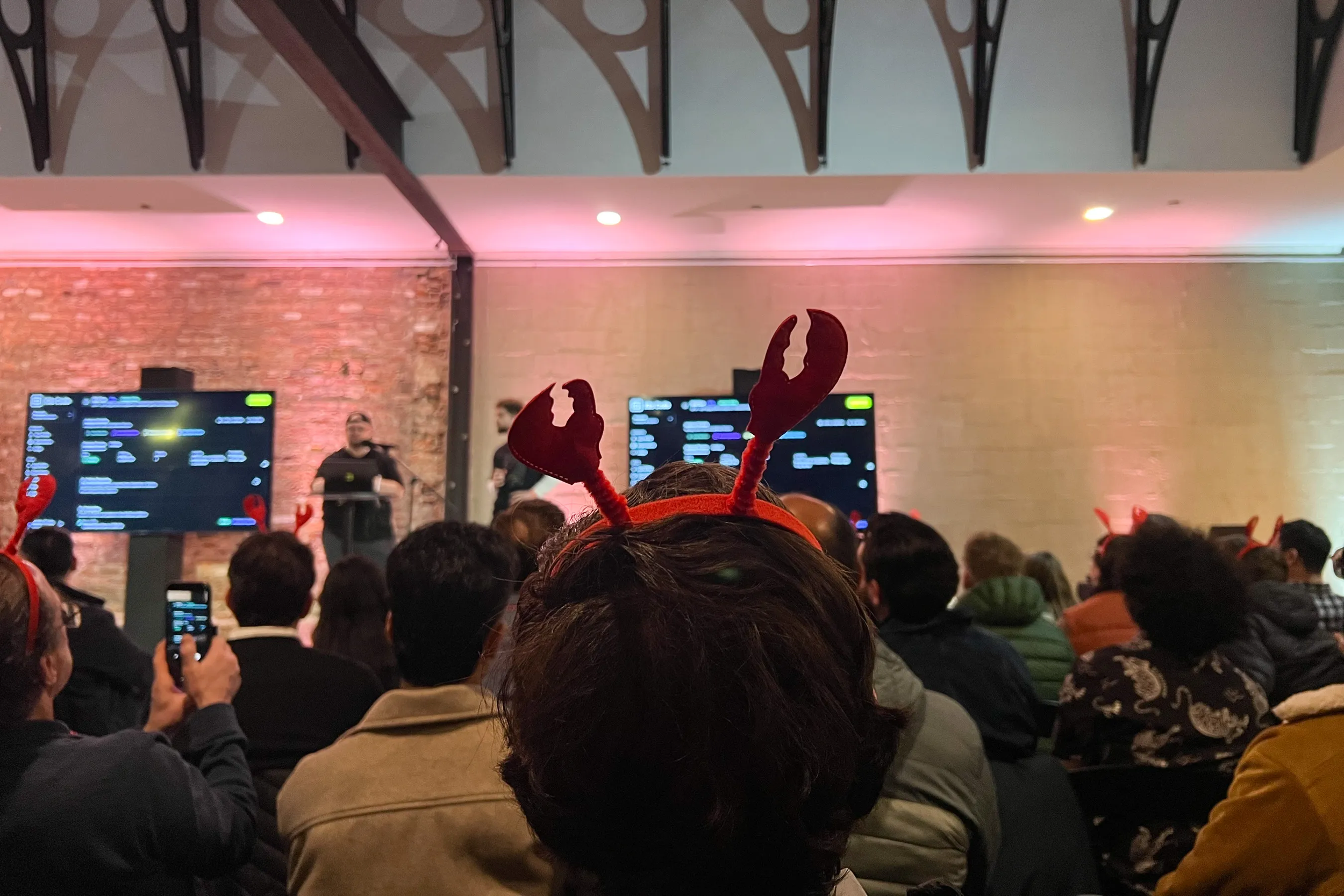
I suspect that this maker revival period will be relatively short-lived, particularly as more (and differently-targeted) agent offerings come to market. But it’s definitely going to be an eventful spring in Silicon Valley.
3. Do You Even Moat, Bro?
Another ongoing debate in the tech world surrounds the evolution of moats.
Historically, technical moats were a big deal for a lot of VCs. But with AI compressing time-to-market, a variety of new ideas have emerged. Some pundits have argued that deep knowledge of a particular industry or specialization will be a moat. Others suggest that trust and brand loyalty will win the day. There’s also the element of “taste”…

Jordi Visser recently wrote an article titled, The Repricing of Time: Equity in the Age of Agents, in which he discussed the impact of AI on equity markets (I highly recommend that you read it). Jordi posits the following:
“For more than a decade, equity markets were built around a simple premise: durable franchises deserved durable multiples. Investors weren’t just buying earnings. They were buying time. Time to compound. Time before meaningful competition arrived…Time was the moat.
…
But something subtle has changed.
AI does not simply disrupt business models.
It compresses time.”
Jordi goes on to propose that as AI continues to improve, the biggest moat will no longer relate to what you are building. It will be dictated by your ability to adapt. In other words, more than ever before, velocity will be the one metric that matters most.
4. YC is Pricing the Market
A year and a half ago, I noted that YC was boxing out. Earlier that year, Techstars had effectively failed. With 500 Startups’ having imploded a few years prior, that left an unprecedented opening for YC to dictate the proverbial terms across the entire accelerator landscape. It started with a move to 4 batches per year and has followed with the firm driving higher and higher average valuations each batch.
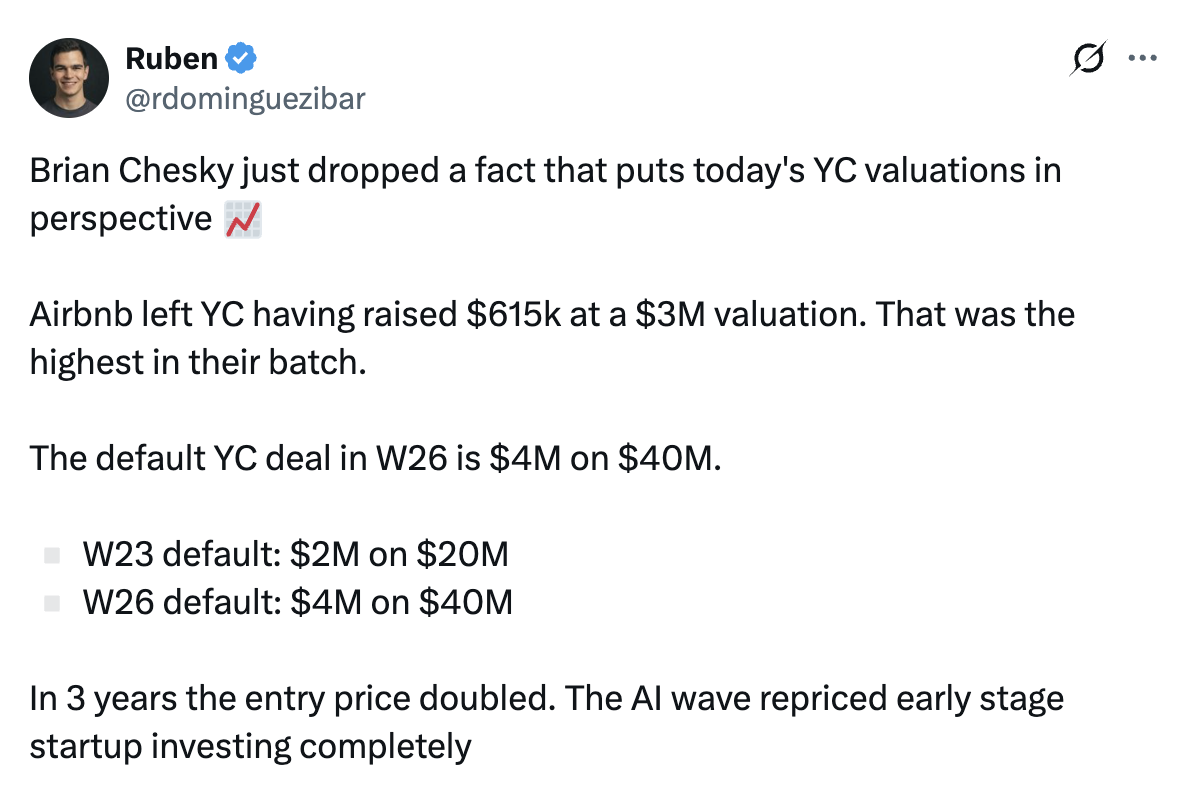
To be clear, the “default” YC deal isn’t actually what all of the companies graduating from the program get. (Moreover, as an index YC batches represent a very particular segment of the early-stage market — one typically characterized by high-pedigree founding teams supplemented by certain early traction signals). But the fact remains that these companies consistently price at the high end of the market across multiple dimensions.
a16z is targeting the same founder demographic with their Speedrun platform. The firm spent Q1 aggressively ramping up their team (I did more than a few reference calls over the past few months). It will be interesting to see where their batch valuations land as that platform settles into its groove and whether or not the well-funded competition puts a dent in YC’s ability to dictate prices.
5. The Delta Between SF / Silicon Valley and the Rest of the World is Exploding
I constantly travel between San Francisco / Silicon Valley and other startup ecosystems around the world (particularly those in Canada and the UK). Over the past year, the rate of change in the Bay Area has accelerated dramatically. Over the past 3 months, it’s gone stratospheric.
And founders / investors / ecosystem builders in the rest of the world — including in most of the US — genuinely have no clue.
I find myself increasingly disoriented as I bounce between ecosystems. I regularly meet founders outside of Northern California who are excited about the projects and products they’re working on, completely oblivious to the fact that companies in Silicon Valley have long-since abandoned those approaches, technologies or markets. At the same time, technologies that have permeated the day-to-day lives of Bay Area residents are still foreign in most of the world.
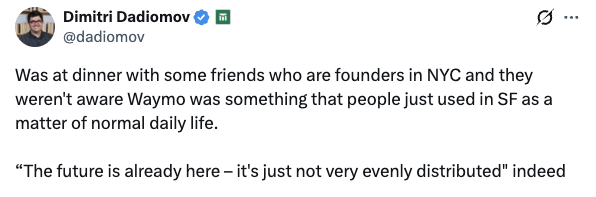
That’s certainly not to suggest that founders / startups / investors in the Bay Area are the preeminent experts on everything to do with technology (Silicon Valley remains a very thick bubble in both positive and negative ways). But it feels to me as though the rate of change occurring as a result of AI is actually decreasing the flow of information from Silicon Valley to the rest of the world.
Things are advancing so quickly that people in the Bay Area are finding less time to share what they’re working on with the world outside.
More than ever, I think it’s essential that founders, investors and ecosystem supporters around the world make a point of traveling early and often to Silicon Valley. To understand what’s going on, to benchmark the velocity at which it’s happening, and to understand what the competitive landscape really looks like.
Things are only going to get faster.
Things I Think I Think - Q4 2025
Now that we’ve all made it through our backlogged New Years inboxes, let’s reflect on Q4 and kick off 2026 with my latest homage to legendary sports columnist Peter King
It’s hard to believe how much transpired in the past year. From new administrations to the blistering pace of innovation, 2025 was one for the books.
Now that we’ve made it through our backlogged inboxes, let’s reflect on Q4 and kick off the new year with my latest homage to legendary sports columnist Peter King.
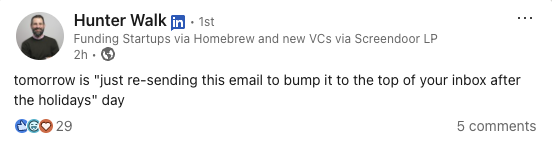
Here are 5 Things I Think I Think - Q4 2025 Edition:
1. The Bifurcation of VC Continues
At this point of the movie, the idea that venture capital has split into two broad categories (multi-billion dollar megafunds and nimble, specialized funds) is no longer up for debate. What’s been fascinating to watch is the behavior of the many funds caught in the middle. These funds are too small to compete on price, too big to embrace the opportunities presented by AI-native companies going after niche markets (read this post on why market matters most to VCs to understand why), and, more often than not, incapable of pivoting to an industry or technological speciality due to the backgrounds of the partners.
Over the past few months, I’ve spoken with multiple institutional LPs who are frustrated at a lack of deployment by some of the VCs they’ve invested in. Unlike the immediate aftermath of the ZIRP crash — when VCs slowing deployment was seen by LPs as a feature, not a bug — the firms caught-in-the-middle have slowed their pace of investment due to an entirely internal reason: they can’t figure out how to adjust their investment thesis to this new reality.
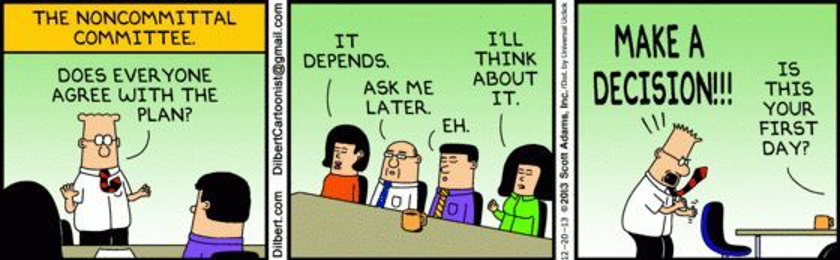
The noncommittal investment committee
The fastest-growing companies are now leap-frogging one or more fundraising rounds (most commonly, the Seed round). That leaves $100M - $250M funds that anchored around Seed — particularly generalist funds — having to reinvent themselves. Do they invest larger amounts of money in fewer companies? Try going downstream to Series A? Or upstream to Pre-Seed?
This dynamic is most noticeable outside of the Bay Area, especially in ecosystems where multistage funds are increasing their presence.
For founders, it’s harder than ever to make sense of local investor behavior. If you plan to fundraise outside of the Bay Area, I recommend adding the following question to every initial investor meeting:
“How many investments did you make last quarter?”
(With followup questions, “what stage were the investments?”, “how much did your firm invest in those companies?” and “were you the lead investor?”)
Don’t be surprised if the answers don’t match what the VC has on their website.
2. SF is Over
It seems like only yesterday that I was trumpeting the return of San Francisco:
Q3 2024: “SF’s slow recovery is accelerating”
Q4 2024: “…we’ve moved from the “innovators” phase of this edition of the San Francisco technology lifecycle to the “early adopters” phase. And that’s a good thing.”
Q1 2025: “San Francisco is still the place to be”
Q2 2025: (I was really excited by Toronto Tech Week and forgot to fanboy San Francisco)
Q3 2025: “…the difference between what’s happening in Silicon Valley right now and what we’re seeing in the rest of the world couldn’t be more stark.”
But I guess it’s all over now…

So what’s happening?
A year ago, I noted that the “maker faire” phase of San Francisco’s AI cycle was over,
“…we’ve moved from the “innovators” phase of this edition of the San Francisco technology lifecycle to the “early adopters” phase. And that’s a good thing.
This isn’t to say that you shouldn’t go to San Francisco in 2025 if you’re a builder — you absolutely should — just don’t expect it to have the same level of serendipity as last year. On the other hand, if you’re a founder a bit further along on your journey who’s looking to meet other high-quality founders focused on building their companies, there’s no better time to come. Just know that you need to be more intentional about your visit and manufacture the outcomes you want.”
What you’re seeing now is the natural result of that shift. The folks who thrived during the meetup and party-heavy experimentation phase of AI’s emergence are finding that, “…there’s nothing too interesting to discuss at a party anymore.”
But it’s not because interesting work isn’t being done. It’s because the people doing interesting work no longer have time to go to parties.
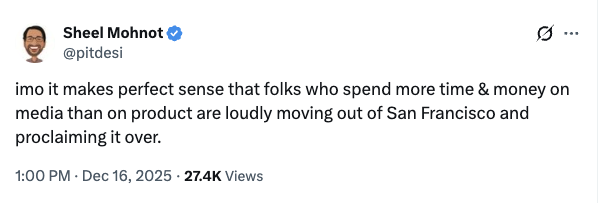
(Side note: a few weeks ago, I wrote about the fact that the tide is starting to turn against rage bait as a strategy for product development and marketing. I suspect that there is a significant overlap in the venn diagram of “Founders who are leaving loudly SF in 2026” and “Founders who rely heavily on rage bait as a strategy”.)
3. The AI Backlash is Here
For a few weeks now, there’s been an increasing amount of coverage about an impending “AI backlash”. Traditional media, social media and countless “2026 predictions” have referenced the turn in public sentiment against AI.
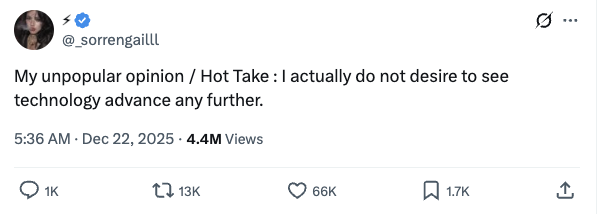
Rather than focus on public sentiment, I thought I’d share some observations on how investors are behaving.
On the one hand, legitimate AI startups are as hot as ever. We’re seeing a degree of preemption and FOMO for hypergrowth AI startups that’s on par (if not greater) than what happened during ZIRP.
On the other hand, I’m seeing an increasing number of investors respond to credible “good-but-not-great” AI startup pitches with a resounding, “meh.”
Overall, it’s clear that the AI honeymoon is over. What’s intriguing to me is that I’m seeing more VC interest in AI startups that are targeting specific niches based on subject-matter expertise (and have real traction points) than in broad, big picture startups.
It’s almost as if vertical SaaS might not actually be dead…
4. The Impact of AI on Junior Roles
Speaking of AI, one of the pervasive narratives in the back half of 2025 was that it was going to kill all of the “junior roles.”
I can’t tell you how many founders I spoke to last year who excitedly proclaimed that they were cutting their staff, getting rid of all of their junior employees and that “AI was the future.” Why hire junior employees when you can just have experienced, senior hires managing teams of agents?
With economists and politicians alike warning of increasing youth unemployment, this trend seemed like a near-inevitability.
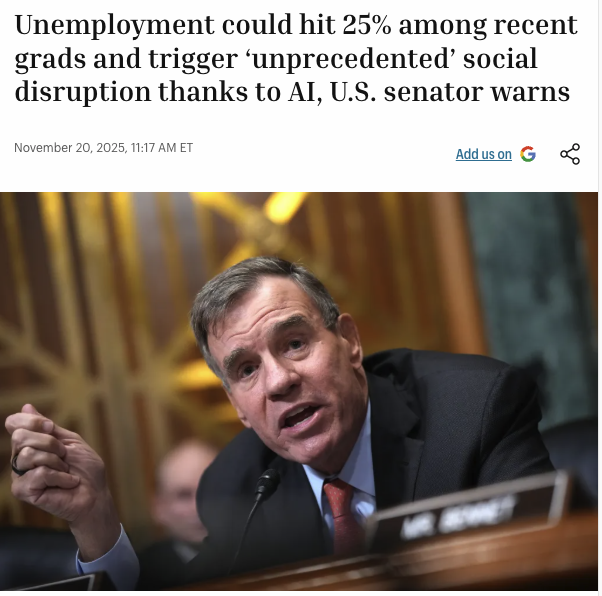
Aside from the fact that this didn’t make sense to me as a long-term strategy (if you don’t ever hire junior people, how will you end up with experienced employees when those senior staff members move on?), I couldn’t help but observe a sharp contrast between different companies that I was connected to. At the same time that many CEOs were culling their junior ranks, others were on a hiring binge. I felt a distinct sense of deja vu…
And then it dawned on me: the founders who were proclaiming that AI was end of junior hiring were the same ones who, five years prior, predicted that work-from-home was the future. And you know what they have in common?
They all sucked at managing people.
I’m not suggesting that the job market for new graduates is rosy by any means. But my personal observation is that ambitious, highly-motivated young people with technical skills are in extremely high demand. Especially in companies where there’s a willingness to focus on nurturing, growing and developing talent.
But here’s the zinger: in many cases, Gen Z employees are often more productive than their more experienced colleagues, specifically because they are the first ever AI-native generation. While they may lack experience, their willingness to embrace and utilize AI far outpaces what many of their older colleagues are willing (or able) to do.
Which leads me to two, admittedly knee-jerk, conclusions:
CEOs arbitrarily reducing their junior ranks and/or completely pausing junior hiring is, broadly speaking, a negative signal
CEOs prioritizing the hiring and development of AI-native / Gen Z employees (and, even better, intentionally pairing them with more experienced colleagues) is a positive signal
5. Accelerators are Hot Again
Many of you know that my first stop as an investor was at 500 Startups. Ten years ago, there was genuine competition in the accelerator game. In those days, YC was focused mostly on California, TechStars was championing the “rise of the rest” while 500 was staking its claim to the rest of the world.
But 500 Startups and TechStars both lost the plot, leaving YC to assert its dominance. With YC’s move to four batches a year ago, there’s been little room for competitors to wiggle in. But the tides are turning. Over the past two years, a number of challengers — both new and old — have started to gain momentum.

At one end of the spectrum are the megafunds. Almost all of them now offer some form of accelerator or incubator — either as standalone entities or as platform offerings for their portfolio companies (Canadian investor David Crow wrote a great piece last year about how larger funds are trying to manufacture funnels with this approach).
Most notable amongst the megafunds is a16z, which originally launched its Speedrun accelerator in 2023 as a gaming-focused offering. The firm has since pivoted Speedrun into a generalist accelerator and poured considerable resources into the program (it’s deployed more than $180M to-date and is currently in the process of significantly scaling up its team).
At the other end of the spectrum, we’re seeing a resurgence of both small, dedicated accelerators and offerings from Seed-specialist VCs. There’s Mint from BTV, Pear X from Pear Ventures, and recent entrants like Neo and HF0. Add to that the fact that several international accelerators — most notably, London-based Entrepreneur First — are refocusing their efforts on the Bay Area and it makes for an increasingly crowded field.
With both founders and investors alike looking for an edge, it feels like the pendulum is swinging solidly back from the “hands-off” investing style of the ZIRP era to the more “hands-on” style of years past. At a time when AI is making it cheaper than ever to get a company off the ground, I think we’re going to quickly see a new level of competition amongst credible accelerators (and between accelerators and pre-seed VCs).
And that’s great for founders.
Things I Think I Think - Q3 2025
The memories of summer are fading. Burning Man is over. And the kids are back in school. Here are 5 Things I Think I Think: Q3 2025.
The memories of summer are already starting to fade away. Burning Man is over. So is the After Burn. And the After After Burn. Best of all? The kids are back in school 🙌. Time to shift gears and get into fall with my latest homage to legendary sports columnist Peter King.
Here are 5 Things I Think I Think - Q3 2025 Edition:
1. Orange is the New Triple, Triple, Double
It used to be that venture capitalists’ preferred roadmap for success was the “triple, triple, double, double, double”. The path is simple (at least, according to MBA-types who’ve never actually run a business): Just get to $1.5M in revenue, then triple it the following year. And triple it the year after that. And then double it for the next three years. Voila! You’ve got a $100M business and are ready to go public.

Now, some VCs are latching onto an even more audacious blueprint. Hemant Taneja of General Catalyst recently had this to say:
“Triple, triple, double, double is definitely dead. I tell our investors: don’t bring that to me <laugh>…Going from $1M to $3M to $9M is not interesting…you gotta go, like, $1M to $15 - $20M to $100M.”
His comments were polarizing, to say this least.

As aloof as Hemant’s comments might seem, they reflect the converging perspective of a growing number of VCs. At the start of the summer, I wrote about some of the changes that are happening amongst early-stage investors. In the post, I shared the following anecdote:
“I [recently] met a founder who was extremely frustrated with the lack of progress they’d made raising capital from VCs. In relaying their experience to me, the founder proclaimed that they had a stellar founding team with an amazing track record, a working prototype and clear evidence of a market need. Yet they were getting zero traction with investors.
Later that day, I looked up the founder’s company and thought to myself, “what a nice, incremental business.”
…
To be clear, there was nothing wrong with this founder’s business. It was — and is — a perfectly reasonable B2B SaaS company. The type that was built to solve a real problem and that very likely would have been able to raise VC funding 2 years ago (not because of ZIRP, but because it is a perfectly reasonable company solving a real problem).
Yet in comparison to AI companies, with their unprecedented growth trajectories, and deep tech companies, with their imagination-bending potential, it just felt…
…incremental.”
It used to be that a startup achieving “triple, triple, double, double, double” growth was rare and exciting. Only the best-of-the-best could achieve it. Now, the definition of “exceptional” growth has fundamentally changed. And, like it or not, VCs chasing power law outcomes can’t unsee that.

2. But, But, But…
As much as some VCs — particularly those associated with Silicon Valley’s billion-dollar funds — are extolling the virtues of these AI-driven money machines, other investors are raising the alarms.

So what does all this mean for founders?
For starters, if your company is building an AI-first “prosumer” product — or anything where distribution should reasonably follow AI adoption — this type of extreme growth is what investors are looking for. But, more than that, if you’re any type of SaaS-y company, this is the benchmark against which you’re now being compared.
That may not seem fair, but it’s happening.
We’re now seeing companies go from zero to $10M in ARR (or more) in less than two years with an increasing degree of regularity. To be clear, this is still very much the exception to the rule, but it’s occuring frequently enough that a small but growing number of VCs are holding their dry power until and unless they see such growth.
At the same time, many investors are questioning how sticky this revenue will be. What percentage of these companies will be able to maintain their revenue and customer base after the initial growth explosion (vs. seeing it collapse like a house of cards)? At this point, we simply don’t know. So while some VCs are tripping over themselves to chase these extreme growth companies, others are steering clear.
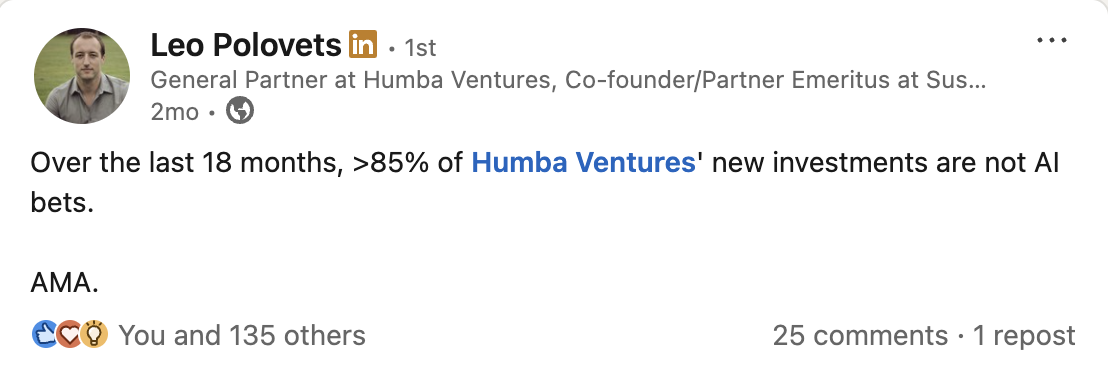
If you’re a founder raising capital this fall, my biggest advice is to cast a wide net. There’s a lot of capital flowing right now, but also an unusual degree of opacity around what individual investors are looking for.
3. A Tale of Two Ecosystems
Speaking of capital flowing, the difference between what’s happening in Silicon Valley right now and what we’re seeing in the rest of the world couldn’t be more stark.
It’s only one month into the fall fundraising season and I’ve seen dozens of pre-seed deals happen in the Bay Area in only days, while Seed and Series A rounds are going from first meeting to term sheets in 1-2 weeks. By contrast, I’ve spoken with founders in Canada, the UK and elsewhere who are struggling to get local investors across-the-line. Why the difference?
Outside of the U.S., the dry powder we’ve been hearing so much about for the past few years is starting to dry up.
Take Canada, for example, According to a recent Betakit article,
“Canadian VCs, particularly emerging managers, are struggling to raise new capital. According to BDC, only 17 funds raised a total of $2 billion in 2024, marking a year-over-year decline in dollars raised and average fund size. The share of emerging managers is shrinking: the report shows that established managers, considered to be those who have raised more than three funds, now make up 20 percent of active GPs—the largest share in a decade.”
To put that in context, in 2024 a16z raised 3.6x as much capital as all Canadian VCs combined.

A year later, we’re starting to see the impact. According to the Canadian Venture Capital Association, in the first half of 2025 there was “…a 26% decline in dollars invested and a 22% drop in deal count [by Canadian VCs] compared to H1 2024.”
Why does this matter?
Throughout the world, early-stage funding rounds are overwhelmingly led by local investors. A small percentage of international founders each year succeed in raising capital from Silicon Valley VCs, but the vast majority rely on local VCs and angels for their first few rounds of funding. The mythical U.S. lead investor is just that: a myth. A reduction in early-stage domestic capital can, therefore, have a long-term negative impact on a country’s entire tech ecosystem.
A drop in the share of emerging managers (newer VCs) is an even bigger red flag for a country’s startup ecosystem.
Bottom line: if institutional and corporate LPs outside of the U.S. continue to sit on their hands, their countries risk missing out on what looks to be the biggest and most consequential technological (and economic) shift in our lifetimes.
So yeah…it’s a big deal.
4. Founders Are On the Move
While VCs in some countries are struggling, founders are sprinting as fast as they can. And going wherever they need to.
A few weeks ago, I reached out to a handful of young Canadian founders about putting together an impromptu mixer in San Francisco. I figured 10 or 12 might show up. More than 30 founders descended on the bar in Lower Haight (much to the chagrin of some of the locals).
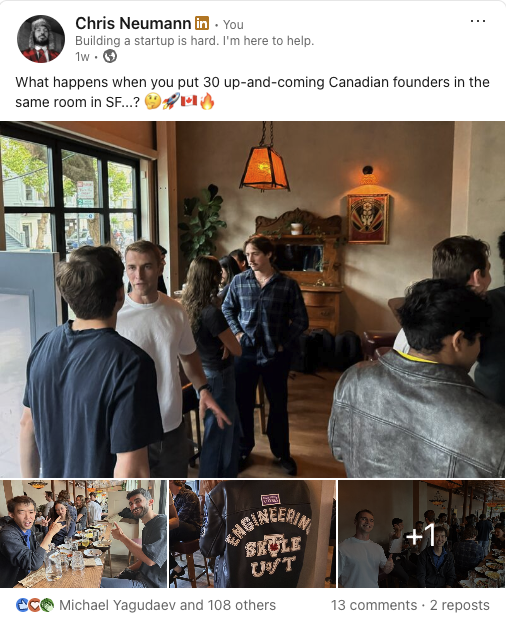
That might not seem like a big deal, but consider this: nearly half of them flew in from Vancouver, Toronto and Montreal just for this event.
For awhile now, I’ve observed an increasing mobility amongst founders — particularly Gen Z founders — who seem utterly unencumbered by the cost or complexity of going back-and-forth between cities. As someone who’s spent a long time championing the importance of spending time in Silicon Valley, I consider this a strong signal when it comes to the potential of the next generation of founders. But even I’ve been shocked by how quickly and widely their expat networks are expanding — often without any involvement or support of past generations of founders.

There’s a lot to unpack here (and I plan to in a future post), but for now I’ll say this: the mental model that the current generation of founders has when it comes to operating in and across multiple ecosystems if fundamentally different than generations past. And that’s really exciting.
5. Speaking of On the Move
The past few weeks in Startupland™ have been dominated by coverage of the U.S. administration’s introduction of a $100,000 fee on H-1B applications. Since that announcement was made, multiple countries — from Canada to China — have introduced or are in the process of introducing policies designed to lure foreign workers away from the U.S.
While those efforts are domestically very popular, I continue to believe that the reactions to the policy change (both inside and outside of the U.S.) are much ado about nothing. While some people and companies will undoubtedly be impacted by the change, I don’t believe that this will result in a sudden flow of talent away from the U.S. Here’s what Democrat megadonor Reed Hastings had to say:

Reed’s take was certainly against the flow when it came to Silicon Valley reactions, but I think it’s the correct one if you reframe the categorization of high tech visas as follows:
H-1Bs will be used for very high value jobs
O-1s will be used for very high value people
Things I Think I Think - Q2 2025
Sending dispatches from the wilderness in between Canada Day and America Day. Here are 5 Things I Think I Think: Q2 2025.
It’s that magical week at the beginning of summer when school is out, the weather is nice and we all get to celebrate Canada Day and America Day. So let’s kick back with this year’s summer homage to legendary sports columnist Peter King.
Here are 5 Things I Think I Think - Q2 2025 Edition:
1. Liquidity, My Old Friend!
After what seemed like an eternity without exits, we finally saw several prominent tech IPOs and major acquisitions take place towards the end of Q2.
While these still represent a relative drop-in-the-bucket when it comes to the overall amount of capital deployed, the fact that some VCs are finally receiving some sweet, sweet liquidity is a big deal. It means long-overdue distributions to their LPs and, potentially, some amount of recirculation back into VC.
As the VC landscape continues its increasingly bifurcated convergence towards megafirms like Sequoia and A16Z and smaller, sub-$50M firms, an increase in LP liquidity will have a big impact on the latter category. That means more capital for early-stage founders creating exciting, new businesses.
2. Sovereignty Startups are Hot 🥵
In my Q1 update, I touched on the reactions that we were starting to see from the tech communities in Canada and Europe to the US tariffs, such as Build Canada and Project Europe. Those initiatives are now maturing into longer-term endeavors (Build Canada, for example, recently shared details on its next phase, following the Canadian federal election, which included the announcement of its inaugural CEO.)
Much like in the US, we’re seeing a lot of this startup energy converging in areas related to sovereignty (think defense, energy, manufacturing and AI). And the funding seems to be following (I’m looking forward to seeing the breakdown of early-stage funding from the first half of the year…AI notwithstanding, I suspect it will be eyeopening).
The challenge for many of these ecosystems they lack enough Pre-Seed VCs with the technical background necessary to underwrite pre-product companies in these spaces. A hard tech renaissance is happening — and many ecosystems around the world risk missing out.
3. B2B SaaS is Not 🥶
If sovereignty startups are what’s hot in startup ecosystems around the world, traditional B2B SaaS is not. In fact, Q2 has yielded the most bifurcated fundraising environment I’ve ever seen.

I said it on LinkedIn, so it must be true
In response to questions from founders about what I meant by this, I wrote an extensive post on this a few weeks ago titled, What’s Going On with Early-Stage Investing? The tl;dr is that we’re seeing a dramatic shift by investors away from the types of incremental tech businesses that they’ve backed over the past decade (think B2B SaaS, e-commerce, etc.) and towards technically-heavy startups that were the norm up until 2010 or so.
At this point, I think it’s safe to say that a significant percentage of startups that were within the strike zone of venture capital two years ago are now fundamentally out of play. And not just in the short term.
This isn’t about VCs chasing the latest trend. Between exit multiple compression and a growing belief that the long-term value of many SaaS businesses will trend to zero as AI continues to improve, a significant percentage of tech founders are going to need to rethink how they capitalize their company.
Personally, I don’t think that’s a bad thing. 99% of companies aren’t — and never were — a fit for VC (and that’s okay). Perhaps this shift will better align the behavior of founders and investors alike. It would be great to see VCs stop wasting founders’ time in categories they don’t intend to invest in. And maybe….just maybe…we’ll start to see new funding options emerge for the plethora of founders who are building interesting, but not exponential, businesses.
4. Some Big Changes are on the Horizon
A few weeks ago, I attended Creative Destruction Lab’s annual Super Session, where founders and investors from around the world converge each year on the University of Toronto. One of the most eye-opening panels consisted of a range of practitioners and researchers at the bleeding edge of AI, including executives from Neuralink, several startups currently in stealth, and Turing Award winner Richard Sutton.
While I can’t share everything that was discussed, it’s not an understatement to say that there are some truly massive changes coming in the next few years, particularly at the intersection of AI and health. We’re going to see some things that inspire us, as well as some that will undoubtedly make us question how we see the world. It’s an incredibly exciting time to be alive and be a participant in the global tech ecosystem.

5. Toronto on the Verge?
Speaking of Toronto, the city recently hosted the first-ever Toronto Tech Week (a grassroots replacement for Collision, which this year moved to Vancouver). While I was thrilled to see my hometown host another major tech conference, it was hard not to compare the local reaction to that of a sheltered teenager getting invited to a house party for the first time (and not knowing quite what to do). Toronto, on the other hand, demonstrated why it’s the third largest and fastest-growing tech ecosystem in North America.
The energy throughout the GTA was palpable. The overlapping activities showcased just how large and diverse Toronto’s tech community now is. At the same time, I couldn’t help but notice the same self-limiting themes that have historically held Toronto (and Canada) back creeping up throughout the week:
There was lots of talk of ambition, but almost as much talk about how Canadians don’t brag enough
There was entirely too much focus on government — in fact, I don’t think there was a single panel I attended where someone wasn’t complaining about what the Canadian government is or is not doing
And there were way too many navel-gazing comparisons to the US
Don’t get me wrong, Toronto feels like it’s on the verge of breaking out (like…really breaking out). But to do so, it needs to embrace what it is — and what it is not — in order to take its rightful place on the global tech stage.
Stop complaining, stop comparing, and just go! 🚀 🇨🇦 🔥
Things I Think I Think - Q1 2025
Can you write this post in the style of Studio Gibli? Here are 5 Things I Think I Think: Q1 2025.
It’s been a rollercoaster of a quarter on so many fronts. Let’s slow things down with another homage to legendary sports columnist Peter King.
Here are 5 Things I Think I Think - Q1 2025 Edition:
1. I Came in Like a Wrecking Ball
A lot of people thought they knew what was coming with the new administration, but the breadth and velocity of actions has impressed even the most seasoned political pundits.
I’ve said before that I have zero background in government or public policy, so I’m not going to try to unpack or opine on everything that’s going on. Rather, I’m going to share a few thoughts from the perspective of someone in venture:
The fundraising environment has, thus far, been completely immune to the day-to-day geopolitical drama (and, in fact, is very much on fire — more on that later). It remains an excellent time to raise if you’re a founder.
At this point, it’s fair to assume that tariffs of one form or another are here to stay. Plan accordingly.
Like many in tech, I was surprised by the recently-announced pardons for several startup founders convicted of fraud given the number of VCs in the administration’s inner circle. Hunter Walk has a good summary of why the right amount of fraud in Seed stage startups is greater than 0% but it shouldn’t be pardoned.
Speaking of VCs, I previously predicted that we would see a meaningful amount of vitriol directed at VCs as the new administration made move that were seen to have been influenced by the “VC arm” of the Republican party. With DOGE’s efforts mostly attributed to Elon Musk and talk of tariffs the primary economic topic, that hasn’t happened.
2. Fundraising is on 🔥
In my new year’s update, I predicted that the first half of 2025 would be hot from a fundraising perspective and wow…has it ever been!
Rounds are coming together with breathtaking speed. Virtually every founder I’ve worked with this quarter ended up in an oversubscribed scenario, with valuations at or above their target.
Some of this is stems from the entry of significant dry powder into the system that was sitting on the sidelines for the past couple of years. Some of this, undoubtedly, comes from the excitement surrounding all things AI.
Additionally, I think a not-insignificant part of the energy and enthusiasm in the ecosystem right now is due to the fact that we’re finally nearing the end of the washout of companies that raised too much during the ZIRP days. Investors are seeing more fast-growing, inspiring startups and fewer struggling companies in search of salvation, which is impacting their psychology.
In other words, investors are feeling more positive because their day-to-day experience is more positive.
Sound silly? A few years ago, I wrote about the impact that the adrenaline of deal flow has on investor behavior. When VCs see fewer deals or fewer companies that they perceive to be high quality, their rate of investment slows. What we’re seeing now is the inverse: investors are seeing a high rate of high-quality startups, which is keeping their level of enthusiasm — and thus, their willingness to invest — high.
It’s only been one quarter, but it’s feeling like we’ve finally moved back from glass half empty to glass half full on the fundraising front (at least, at the early stages — there remain a significant number of Series B and later companies in the danger zone).

As we head into Q2, I have two fundraising-related predictions:
When the final numbers are tallied up, I expect that Q1 2025 will have been the biggest startup fundraising quarter in North America in years (even without Open AI’s unprecedented $40B funding round).
Q2 will continue the momentum, although I won’t be entirely surprised if VCs start their summer slowdown a few weeks early. If you’re planning to raise before the summer, make sure you start before Memorial Day.
3. Elbows Up
In my Q4 update, I noted that the G7 countries were all falling behind the U.S. in terms of productivity and wondered aloud whether the tech communities in Canada, the UK, or any of the other countries would step up in the same way we were seeing in America. Talk of tariffs and trade wars in the early days of the new administration has since pushed a number of founders, investors and policy makers into action.
When the first round of tariffs was announced, I wrote about the unprecedented level of anger amongst Canadians. Canadians were (and still are) pissed. One outcome has been the Build Canada initiative, a coordinated effort from the tech and business community to promote a range of policy changes focused on increasing Canadian productivity in the lead-up to that country’s federal election.
We’re starting to see similar initiatives across the pond in Europe. For example, a group of prominent investors and founders including Harry Stebbings of 20VC and my former colleague Rina Onur Sirinoglu recently announced Project Europe, a new fund modeled after Peter Thiel’s famed Thiel Fellowship. But the urgency around Europe’s actions doesn’t yet seem as high as those in the Great White North (at least, not within the tech community). I suspect this has a lot to do with the fact that Canada is physically proximate to the U.S. and has a major federal election this month.
At a time when Canadian entrepreneurs on both side of the border are trying to make sense of what these changes mean for them, the coming weeks will tell us a lot about how influential Canada’s tech community really is.

4. San Francisco is Still the Place to Be
With so much of the tech news cycle focused on the impacts of tariffs and other actions from the new administration, it might not be as apparent to the outside world how fast San Francisco is moving right now. But it absolutely, unequivocally remains the place to be.
I was recently in San Francisco for YC Demo Day and the energy and activity dwarfed the prior demo day, which is notable as that was the first in-person demo day since Covid. The San Francisco Palace of Fine Arts was packed to the brim with investors and founders, and the buzz around AI and the emerging impact of vibe coding was palpable.

5. AI has its Studio Gibli Moment
I was going to end this post by sharing some thoughts on the emergence of vibe coding, but that was before Open AI released its latest image generation capabilities in an update to GPT‑4o. This past weekend, millions of people around the world rushed to reimagine their photos in the style of Studio Gibli.


While this viral trend might seem like nothing of particular significance, anyone who’s studied technology adoption knows the impact that moments like this can have.

According to Sam Altman, ChatGPT added more than a million users in a single hour on Monday. For context, it took 5 days to add that many users during the app’s viral launch. For many people around the world, the opportunity to “Gibli-fy” their images served as their introduction to AI.
I don’t think it’s an exaggeration to suggest that we’ll look back at this release as a turning point in the mainstream adoption of AI. Numerous technological waves have been driven by photo-related capabilities. It makes perfect sense to me that the opportunity to leverage AI in such a magical way would trigger the imaginations of the public-at-large. (Sorry, but AI’s killer app was never going to be “deep research”).
I’m not a consumer guy, but I can’t help but wonder if we’ll see a wave of AI-driven consumer apps catch fire in the coming months. Either way, it will be exciting to see how the adoption of these technologies changes as we transition into the “early majority” phase of the technology adoption lifecycle.
Things I Think I Think - Q4 2024
Out with the old, in with the new. Here are 5 Things I Think I Think: Q4 2024.
Out with the old, in with the new. That goes for the year, the administration and whatever it is I’ll be working on next 👀.
Let’s ring in 2025 with another homage to legendary sports columnist Peter King. Here are 5 Things I Think I Think - Q4 2024 Edition:
1. The Return of Trump
I’ll start with the biggest news of Q4 2024: the return of Donald J. Trump to the Oval Office.
From a strictly business standpoint, this is shaping up to be a very different administration than the first Trump presidency. In particular, all signs suggest that it will be particularly favorable towards the tech industry. This is due in no small part to the degree to which VCs have embraced (and been embraced by) the incoming president.

I’m not sure that folks outside of Silicon Valley truly understand the degree to which VCs and former VCs are slotting into roles within the new administration. Here are some of the official positions that are set to be filled by venture capitalists:
JD Vance, Mithril Capital - Vice-President Elect
David Sacks, Craft Ventures - AI and Cryptocurrency “Czar”, Chair of Presidential Council of Advisors on Science and Technology (PCAST)
Jim O’Neil, Mithril Capital and Clarium Capital - Deputy Secretary of the Department of Health and Human Services
Michael Kratsios, Clarium Capital - Director of the White House Office of Science and Technology Policy (OSTP)
Scott Kupor, a16z - Director of the Office of Personnel Management
Sriram Krishnan, a16z - Senior Policy Advisor for Artificial Intelligence
Ken Howery, Founders Fund - U.S. Ambassador to the Kingdom of Denmark
That’s in addition to the numerous VCs who are unofficially connected with the administration and/or in remain in consideration for roles (a list that includes Marc Andreesen, Peter Thiel, Joe Lonsdale, Keith Rabois and Trae Stephens). This is an astonishing degree of representation for what is objectively a cottage industry. Fred Wilson shared his thoughts on how this came about a few days ago.
I won’t pretend to have any background whatsoever in government or public policy, but I do know a lot about tech and venture capital. Here are a few things I think:
This has the potential to be the most technologically competent administration in history — both from a technical standpoint and a “business of technology” perspective. Virtually all of the VC appointees are widely respected and many of their appointments were praised by tech leaders across the political spectrum (despite the fact that some of them hold polarizing political beliefs). The incoming administration has also tapped a number of experienced tech executives with ties to Silicon Valley.
Many of the VCs working with the new administration hold a political viewpoint referred to as techno-libertarianism. That perspective directly conflicts with a number of core beliefs held by traditional MAGA adherents, notably on immigration, education and a tolerance of diverse lifestyles. I expect that we will likely see one or more of these conflicts arise in the first half of 2025. The new administration hasn’t even been sworn in and we’re already seeing these come into conflict. This past weekend, clashes over support for H1-B visas (the type of visa that I personally worked under for nearly 6 years) came front-and-center following the appointment of Sriram Krishnan as Trump’s Senior Policy Advisor for AI. In the past few days, Trump has signaled his support for H1-Bs, suggesting that the VC wing within the incoming administration will hold considerable sway on policy. I expect that we will see more of these conflicts come to the forefront as the policy differences between Trump 2.0 and 1.0 come into view — which could ultimately lead to backlash directed towards both VCs and the broader tech industry from the MAGA wing of the Republican party.
Speaking of backlash, I expect that we will see a meaningful amount of vitriol directed at VCs in the U.S. from across the political spectrum as the incoming administration makes moves that are seen to have been influenced by the newly-powerful “VC arm” of the Republican party. “Venture capitalists” are an easy punching bag for both left- and right-wing media looking for inflammatory, clickbait headlines and I’m sure they’ll take full advantage of that. Case in point: David Ingram of NBC’s recent post that referred to VCs working with the administration as “right-wing tech barons”.
It will be fascinating to see whether or not startup-style “efficiency improvements” can actually be enacted within government. An impressive number of experienced people from Silicon Valley are signing up for 6-month tours of duty within Elon Musk’s “Department of Government Efficiency” (which doesn’t require the same level of divestiture as the formal positions some VCs have accepted within the administration). But that experience comes almost entirely from operating private businesses. What happens when these enthusiastic change agents come head-to-head with decades of policies and procedures, entrenched career bureaucrats and the very-different ways in which government operates? Few people would argue that there aren’t gains to be had from cutting red tape and improving government efficiency, but it’s never that easy. Will eager VCs and tech leaders succeed in enacting meaningful change within the notoriously bureaucratic U.S. government, or will they give up and return to the comforts of Silicon Valley when the going gets tough?
2. The First Half of 2025 is Going to be 🔥
Startup fundraising activity increased rapidly during the back half of 2024. Q3 was the busiest quarter at Panache Ventures in 3 years while Q4 saw a frenetic pace of deals long after U.S. Thanksgiving, which is historically the unofficial end of the fundraising season.
Combining the economic optimism surrounding the new administration with an already-strong resurgence in Startupland™ and a reopening of the IPO window, and Q1 2025 is lining up to be the hottest quarter in years. Expect to see a massive increase in the number and size of deals, with funds that have been sitting on dry powder returning to market in a serious way. I suspect that we’ll also see a sharp increase in LP activity, particularly in support of new funds led by experienced GPs who are venturing out as part of venture capital’s changing of the guard (see this recent Bloomberg article for more on that).
With a doubt, H1 2025 will be “risk on” in the investing world.
So why am I only predicting a strong first half of 2025? Because there are still so many unknowns about the incoming U.S. administration.
President Trump’s first term was mired in unpredictability and conflict — so it’s reasonable to expect that Trump 2.0 will have it’s fair share of drama. Will the incoming administration’s alliance with Silicon Valley remain strong or will the President sour on some of his advisors and allies as was the case in his previous term? What impact will conflicts between the pro-business / libertarian arm of the Republican party and the hard right / MAGA arm have? And I haven’t even touched on geopolitics, tariffs, inflation or social issues.
By the summer, we should have a sense of what this administration is going to look like over the longer term and we’ll be better poised to predict how long this tech “bull run” will last.
3. The Rest of the G7 is Stuck in the Past
Canada has become something of an international punching bag as of late, with its productivity plummeting relative to its southern neighbor and its government on the brink of collapse, but the reality is that the entire G7 is economically stuck in the past. And with the world’s leading economy and tech sector set to go into overdrive, absent significant policy changes the gap is only going to widen.

Fun fact: one G7 country still requires that incorporation documents be read out loud and in person by a notary… 🤦♂️
It isn’t so much that the U.S. is playing chess to other countries’ checkers. It’s that the rest of these countries continue to be led by politicians with little-to-no real-world experience and limited understanding of the disruptive and distributed nature of tech. From Canada’s stuck-in-the-nineties obsession with IP and domestic ownership of startups to Germany’s obstinate stance on nuclear energy, I could easily fill several blog posts with examples of archaic (but often domestically popular) policies that hold these nations back. But could that change?
With Canada, the UK, Germany and Japan all headed towards 2025 elections, it will be interesting to see if the tech communities in any of these countries become as involved and influential in their elections as was the case in the U.S. There are plenty of calls for other countries to implement DOGE-style efforts and for experienced tech leaders to get more involved in government, but will anything manifest?
In the meantime, I expect that we will continue to see a significant increase in the flow of ambitious founders and tech workers from the rest of the world to the U.S. as they look to capitalize on the resurgent U.S. economy.
4. San Francisco’s “Maker Faire” Phase is Over
Back in 2006, a small gathering called “Maker Faire” was hosted in San Mateo. It was the first of many events inspired by Make: Magazine, a publication dedicated to do-it-yourself projects (mostly involving robotics and simple electronics). The fledging event attracted all manner of engineers, tinkerers and builders — and was a ton of fun (I’m pretty sure it was the first time I saw battling robots in person). Each year, Maker Faire attracted groups of people who wanted to build stuff, learn about building stuff or simply meet other people who liked to build stuff.

That’s what San Francisco has been like for the past 18 months.
With the rise of AI and the resurgence of the City by the Bay, “builders” from around the world have been flocking to San Francisco — and the Bay Area more broadly — to be a part of it. I first wrote about this phenomenon a year ago, noting that,
“…what’s happening in the Bay Area right now is different. It’s special.
What’s happening right now represents a convergence of excitement and creativity around a new technological wave (AI) and a long-awaited resurgence of a struggling yet world-leading city. I’ve been to SF four times in the past two months and the momentum is vicerally building week-over-week.
I believe that this is a unique moment in time for both San Francisco and tech in general. And it’s one that likely won’t last long.”
A few weeks ago, I traveled to San Francisco for YC Demo Day (my 9th visit of the year) and it was clear that the energy had shifted.
Gone was the collective enthusiasm of new builders all trying to figure out AI and startups and the Bay Area at the same time. There were still plenty of meetups and hackathons taking place, but it was no longer the best-and-brightest attending them (those folks are all now heads down building the companies that they ultimately founded). And while there are still waves of new arrivals coming, not all of them are builders.
It’s clear that we’ve moved from the “innovators” phase of this edition of the San Francisco technology lifecycle to the “early adopters” phase. And that’s a good thing.

This isn’t to say that you shouldn’t go to San Francisco in 2025 if you’re a builder — you absolutely should — just don’t expect it to have the same level of serendipity as last year. On the other hand, if you’re a founder a bit further along on your journey who’s looking to meet other high-quality founders focused on building their companies, there’s no better time to come. Just know that you need to be more intentional about your visit and manufacture the outcomes you want.
The “Maker Faire” phase of this startup cycle is now over. And if history’s any indication, it will be another 20 years before it’s back.
5. A New Type of Zombie Company
The term “zombie company” typically refers to a company that earns just enough money to stay alive. Most zombie tech startups failed to achieve product-market fit yet are able to make ends meet with a skeleton crew, minimal revenue and, in certain countries, well-meaning but woefully misallocated government subsidies (cough cough SR&ED). In late-2024, we saw the emergence of a new type of zombie company that arose from the ashes of the ZIRP bubble.

These startups raised over-inflated Pre-Seed rounds — typically $3 - 5M or more — in buzzy areas that are now out-of-vogue. To the founders’ credit, many of them drastically cut burn when interest rates shifted, allowing them to ensure 36 months of runway or more. Sounds ideal, right? But what we’re seeing with many of these companies is something quite different.
As time passed, the early enthusiasm of many of these companies was replaced with listlessness. Their early employees moved on, their investors disengaged and, without any pressing existential threat, motivation or external oversight, they simply continue to exist (many with effectively infinite runway). Almost every VC that was active in 2021-22 has multiple such companies in their portfolio.
The outliers will continue to make progress and a few may ultimately see success. Some of the founders will eventually decide to shutter their company and potentially return some amount of capital to investors in order to move on. But the rest of these companies — with no real product, limited forward progress and no staff to be “aqui-hired” — will be a new species of startup walking dead.
Things I Think I Think - Q3 2024
We're heading into the home stretch of 2024. Here are 5 Things I Think I Think: Q3 2024.
Today is YC demo day! Next week is YC demo day! Every day is YC demo day!
In homage to legendary sports columnist Peter King, here are 5 Things I Think I Think - Q3 2024 Edition:
1. SF’s Slow Recovery is Accelerating
For nearly a year, I’ve been asserting that SF is back. I’ve been encouraging founders to go to SF at a time when many media outlets were still scaremongering. But at this point, there’s no denying that the San Francisco Bay Area has reclaimed its position as the center of the tech universe. Which is why many of the people who left during the pandemic are quietly (and not-so-quietly) coming back.

While many people around the world got hung up on the media narrative of San Francisco’s demise, more and more San Franciscans have been directing their energy towards turning the tide of the City by the Bay. Folks like San Francisco-born Garry Tan and transplant Zach Coelius, who made these comments in 2022:

It’s taken time, but the collective energy — and dollars — being put towards revitalizing San Francisco by the private sector is unlike anything I’ve ever seen. Earlier this week, San Francisco-born VC Neil Mehta was revealed to be the sole backer behind a $100M effort to restore the city’s Fillmore neighborhood, where he grew up.
The tech landscape in San Francisco is certainly different than it was pre-pandemic. You’d be forgiven for being skeptical if you only visited Soma and FiDi, both of which are shadows of their former selves. The Dogpatch (where YC is now based), Hayes Valley (“Cerebral Valley”), Jackson Square and the Presidio are the focal points of New SF™.
Bottom line: if, at this point, you’re in tech and are still not spending at least some of your time in San Francisco, it’s going to be increasingly difficult to compete at a global level (which is why the entire Panache Ventures team plus many of our portfolio founders were in San Francisco last week 😉).
2. YC is Boxing Out
Speaking of New SF™, since returning as CEO of Y Combinator two years ago, Garry Tan has made increasingly confident moves at the helm of the world’s preeminent tech accelerator. Most recently, YC announced that it was moving from 2 to 4 batches per year, ensuring that the accelerator will be in session all year round.

YC clearly sees an opportunity to box out its competition (which includes both other accelerators and early-stage investors), while delivering a better experience to founders and higher returns for its LPs. As a result, pre-seed investors the world over (yours truly included) must reevaluate how they fit into a puzzle where YC + San Francisco is capturing increasing mindshare amongst the world’s best young founders.

3. We Haven’t Hit Bottom Yet
At the other end of the rink are the startups and VC firms that are struggling to adapt to this new world order.
In my Q1 update, I noted that “the great shutdown” was underway, as startups that hadn’t raised funding since the ZIRP heyday reached the end of their runways. That process continues on. Many such companies (particularly later stage startups) still haven’t reached the finish line.
But now, the corp dev sharks sense blood in the water.
Earlier in the year, we saw failing companies find reasonable landing places, with outcomes that were fair (but not great) for founders, employees and investors alike. More recently, we’re seeing an increasing number of drawn-out acquisition processes as potential acquirers cut, and cut, and cut their offers, until founders have no choice but to accept a pittance for their years of hard work.
Thousands of companies around the world are looking for landing spots right now. And hundreds of VC firms are simultaneously insisting to their LPs that those companies are still deserving of their inflated 2021 valuations. But as Marvin Liao recently noted,
Many of these Unicorns are not run by their original founders anymore. Many founders were able to take out 10s of millions of dollars of secondaries in the 2020 & 2021 mania. Unlike in prior downturns, these folks have FU money and are now doing the chairman of the board thing.
Why stick around in crap times, when you have to fire half your staff, you have no business model and probably have to take a down round (or more). Easier to chill out cuz you have the cash, join the board, promote your COO to CEO and chillax. I mean, my god, if Frank Slootman of Snowflake, wisely known as one of toughest CEOs in SV quit, most [unicorn] founders will definitely not stick around.
4. A Lot of Deals are Getting Done
Summer is historically a bad time to fundraise, but Q3 2024 was absolutely on fire. The team at Panache made more new investments in Q3 than we have in a single quarter in 3 years (and that’s saying a lot!). In fact, we had three portfolio companies publicly announce new funding rounds on the same day:

And we were far from the only VC to have had a busy Q3. But many of those funding rounds remain unannounced and unreported, leading to some misguided and misinformed reports that Seed funding is down. Take my word for it, credible founders with credible companies are getting funded at a rapid pace. And nearly every such deal is highly competitive, with multiple term sheets surfacing within a matter of days.
5. VC Struggles are an Issue for VCs. Not Founders.
A lot has been written recently about the struggles that some VCs are having raising new funds. And some of that is leading to fear mongering that it’s going to be more difficult for founders to raise capital.
I’m calling BS on that.
While it is absolutely true that many LPs are sitting on the sidelines as they wait for returns to materialize — which will make it harder for funds to raise capital — we’re also seeing new LPs enter the fray. But much like the next generation of founders, these LPs are looking for unique insights and innovation in the VCs they choose to partner with. So what’s really happening is a changing of the proverbial VC guard. Firms that haven’t evolved and adapted over the past few years are finding that the old way isn’t resonating (with founders or LPs). “I’m an experienced GP with differentiated deal flow” just isn’t cutting it any more.
In some cases, GPs are retiring, returning to operating roles or shuttering their firms entirely. A handful of GPs are lashing out and blaming everyone but themselves for their inability to fundraise. Some are even suggesting that this will lead to doom and gloom for founders:

Founders aren’t going to have to bootstrap longer or eat more ramen than they otherwise would because a handful of old guard VCs couldn’t raise new funds, even in smaller ecosystems. To my earlier point, right now there is plenty of capital flowing at the early stages around the world. (As for crossing the border to fundraise, I hate to break it to you, but for most founders that’s the goal.)
At the end of the day, global competition is coming to the VC asset class. That’s tough for VCs, but it’s great for founders.
The founders will be alright.
Things I Think I Think - Q2 2024
Q2 has come to a close and we’re into that sweet, sweet Canadian summer. Here are 5 Things I Think I Think: Q2 2024.
Q2 has come to a close and we’re into that sweet, sweet Canadian summer.

In homage to legendary sports columnist Peter King, here are 5 Things I Think I Think - Q2 2024 Edition:
1. Toronto is Back 🔥
Summer came early to Canada’s largest city.
In my Q1 2024 update, I noted that the Panache team introduced more companies to our ICM in Q1 than we had in any quarter since 2022.
That number doubled in Q2. More notable: 70% of the activity we saw in Q2 was based in Toronto.

Unpacking the recent quarter a bit more:
There was a considerable surge in the number of strong repeat founders fundraising in Q2, particularly in Toronto.
The increase in fundraising activity was very much concentrated in Toronto proper (folks in Ontario love to lump together Waterloo and Toronto — aka the “Toronto-Waterloo corridor” — but this was all about the 416).
While there were certainly a lot of AI-related startups, the companies we met with were from a wide spectrum of industries (this wasn’t a case of activity being purely driven by hype/FOMO/AI-for-the-sake-of-AI).
What about the rest of the country?
Fundraising activity increased across Canada in Q2, however, the increases were far less pronounced than in Toronto. From our (very unscientific) vantage point, Montreal experienced the second-largest increase in the country, followed by Vancouver and then Calgary. So while overall activity was up across the country, the majority of Canada still feels sluggish relative to Toronto (and certainly in comparison to the US).
2. Everyone’s Jumping on the Preemptive Term Sheet Bus
One of the topics I discussed in my Q1 2024 update was the lack of Series A funding across North America. A major contributor to this is a shift in the investment strategy of multi-stage funds away from new Series A investments and in favor of doubling down on existing portfolio companies at Series B and C.
We saw this firsthand in the Panache portfolio, with 2 out of the 3 Series B rounds announced in Q2 led by existing investors:
Toronto-based Relay (USD $32.2M Series B led by existing investor Bain Capital Ventures)
St. John’s-based CoLab (USD $21M Series B led by existing investor Insight Partners)
(Quebec City-based Qohash raised a $17.4M Series B led by new investor Fonds de solidarité FTQ.)
We continue to see companies with solid-but-not-stellar metrics struggling to raise Series A funding (AI-related companies being the notable exception). As a result, many startups across North America are currently trying to raise smaller Seed extensions / bridges to secure enough funding to push through the current Series A freeze.

Can you spare a Series A..?
For companies caught in the no-mans land between Seed and Series A, making it through the second half of 2024 will be a grind. There isn’t a lot of appetite amongst Seed VCs to bridge companies that aren’t already in their portfolio — particularly when many bring with them the “baggage” of a high 2021 valuation — and most smaller funds simply don’t have the reserves to bridge portfolio companies on their own. Extending runway and focusing on capital efficiency is going to be the name of the game for these founders.
3. Valuations are Rising in Smaller Markets
One of the unique aspects of the Canadian venture landscape is the prevalence of region-specific funds backed by local governments, economic development agencies and other investors focused on regional growth. These regional VCs operate in a manner akin to more traditional VC firms with two key exceptions:
They are geographically constrained and must invest in a specific province or region
Most have strict time-bound requirements for deploying capital
While all VCs have a deployment period specified in their LPA (the period of time when they can invest in new startups — typically 2-4 years), traditional VC firms have a lot of flexibility around this. For example, they can extend their deployment period with the approval of their LPs or they can choose to not invest all of the capital in the fund. Both of these make sense, since financially-driven LPs generally don’t want VCs to make bad investments. But the LPs in regional VCs often have a different motivation: economic development. As a result, many of these firms are required to deploy their capital even when the environment to do so isn’t great (i.e. even when there aren’t a ton of good startups raising money).
Which brings us to Q2.
Coming out of 6 quarters of sluggish activity, many regional VCs (not to mention their LPs) face pressure to deploy capital. Now.
The surge in strong founders coming to market in Q2 finally provided that opportunity for many of them.

The result is an unusual phenomenon: in provinces where regional VCs provide a disproportionate amount of funding, we’re seeing valuations rise for non-competitive deals — in some cases, far beyond what those same companies would justify in Toronto, New York or even San Francisco. This increase is due to regional investors looking to deploy more capital than they might otherwise into companies while still backing into a cap table that will look good to downstream investors (20 - 25% dilution).
For founders, this can seem like winning the lottery: a clean cap table, relatively low dilution and more money out of the gate than they would typically be able to access. But over-capitalization can have long-term negative consequences for startups — especially those with first-time founders. It can lead to over-hiring, lack of focus and operational inefficiencies, behaviors that tend to be more pronounced in ecosystems where founders have fewer experienced mentors or comparison points. (Combine that with easy-to-access tax credits like SR&ED, and you can end up with a Seed-stage company with an effective burn of $200K and very little to show for it.) It can also be a turn off to potential investors whose mandate spans a broader geography.
Assuming that fundraising momentum continues into the fall, I would expect these regional valuation bumps to only last a quarter or two.
(To learn more about regional VCs, see this post on the 9 types of startup investors.)
4. US Funds Are Throwing Their Weight Around
The first half of 2024 has been a unique one from a VC fundraising perspective. While many small-to-midsize funds are struggling to raise, mega funds have been knocking down LPs like they’re going out of style (this is very much a “flight to quality” by institutional LPs).

While these mega funds might not be deploying much at Series A, a number of them are leapfrogging even earlier and throwing their weight around at the Pre-Seed and Seed stages.
And Canada is very much on their radar.

Too soon?
In Q2, multiple US mega funds were extremely aggressive at the early stages in Canada, particularly in Toronto and Vancouver. I’ve heard similar stories from VCs in smaller US markets, like Seattle, Atlanta and Salt Lake City.
This “barbell” strategy makes total sense for larger funds given what’s happening in the market right now: deploy aggressively into credible early-stage, AI-native companies where local competition can’t compete on price, while doubling down on portfolio winners at Series B and C.
Barring any significant shift in the market, I expect this behavior by US mega funds to continue — if not increase — in the back half of the year. (That’s great news for founders, even if it makes my job tougher.)
5. Deals Are Happening Really Fast. Or Not.
Combine all of these points together and deal velocity has increased significantly — at least when it comes to “hot” deals.
What constituted a “hot” deal in Q2?
Credible founding team (repeat founders and/or founders who were previously early employees at a well-known startup)
AI-native proposition (natural incorporation of AI into a core aspect of the value proposition)
Strong market tailwinds (developer tools, AI infrastructure, and future of work were all notably hot amongst investors in Q2)
Early customer validation
Vancouver, Toronto and Montreal all saw early-stage deals that went from initial meeting to signed term sheet in less than two weeks. Think that’s fast? I know of multiple deals that went from first meeting to money wired in a single week.

Alex Norman trying to close deals before the rest of Canada finds out
What about the rest of the market?
The good news is that capital is definitely flowing in Canada. But there’s an noticeable difference in deal velocity for early-stage startups raising outside of hot sectors. Extensions and bridge rounds notwithstanding, most deals where the founder is running a well-planned high-velocity fundraising process are still taking 4-5 weeks (or longer) to get to a term sheet (at least, based on my very unscientific view of the market).
Bottom line: the Canadian startup ecosystem got its swagger back in Q2. Credible, experienced founders are fundraising and most VCs have shaken off the cobwebs. Add to that the entry of US mega funds into the early-stage picture and we’ve got strong signs for a healthy second half of 2024.
Things I Think I Think - Q1 2024
The frost of winter is finally thawing and spring is upon us. Will the tech market begin to open up like early spring flowers?
The frost of winter is finally thawing and spring is upon us. Will the tech market begin to open up like early spring flowers?

In homage to sports columnist Peter King, who announced his retirement last month, here are 5 Things I Think I Think - Q1 2024 Edition:
1. Canadian Fundraising is Springing Back to Life
In my Q4 2023 thoughts, I observed that Canadian founders had largely come to terms with the shift in market conditions and predicted that we would see the Canadian fundraising market return in the first half of 2024.
If Q1 is any indication, we’re well on our way.
At Panache, we saw the largest number of companies presented to our investment committee in a single quarter since 2022 (this a key step in our investment process: when a partner shares a prospective investment with the entire Panache team).

As with any good Canadian winter, the level of activity was relatively slow until the end — the bulk of fundraising activity in Q1 took place towards the end of the quarter. January was a slow month across the country. By mid-February, early-stage fundraising activity had started to pick up. By the time spring was within sight, the level of activity had increased dramatically — March 2024 was easily busier than any single month we had observed since 2022.
That said, the resurgence in fundraising activity has not been equal across the country. Toronto-Waterloo experienced by far the most significant pickup, with the majority of early-stage deals in Canada taking place there. Vancouver and Montreal also saw an increase in fundraising activity, but not nearly to the extent that Toronto-Waterloo did. At this point, I expect their recoveries to lag Toronto-Waterloo by a quarter or two. The rest of Canada remains relatively nascent — while there certainly many companies in the Prairies and Atlantic Canada that kicked off fundraising processes in Q1, the uptick in those regions was not nearly as prominent as in the rest of the country.
Overall, the increase in domestic fundraising activity is a strong signal for the Canadian tech sector and bodes well for a strong Q2 across the country. From my previous quarterly update:
Assuming that the level of geopolitical conflict remains relatively contained, I would expect a strong (but not mind-blowing) Q1 in the Canadian private markets, followed by a notable uptick in Q2 as we head into the summer.
2. Series A is Still Glacial
While early-stage funding is rebounding around the world, Series A activity remains frozen solid (outside a handful of notably hot sectors). Two things appear to be happening:
Funds that specialize in Series A investments are being extremely cautious coming back to market, with many still remaining on the sidelines.
At the same time, multi-stage funds that leverage Series A investments as an entry point are reducing their rate of new investments at Series A in favor of doubling down on their winners at Series B and C.

I’ve spoken with dozens of Pre-Seed and Seed VCs in the past month and almost everyone is seeing the impacts of these dynamics on their portfolio companies:
Strong companies that previously raised Seed and/or Series A funding from multi-stage funds are increasingly fielding preemptive term sheets from inside investors for Series B and C rounds
Many companies that did not previously raise from multi-stage funds are struggling to generate momentum for Series A and later rounds
While most Series B and later companies had prepared themselves for a difficult 2024, many companies that had planned to raise their Series A funding in Q1/Q2 2024 are instead having to look at ways to extend their runway in order to delay fundraising into the back half of the year.
The longer-term risk here is that if the Series A freeze continues beyond the summer, it will start to propagate back to earlier stages — as Seed funds are forced to bridge more companies in their portfolios. I personally don’t expect that to happen — especially if both the early-stage and Series B+ markets continue to accelerate — but companies that are planning to raise Series A funding anytime in 2024 would be well advised to consider backup plans, just in case.
Note: Within the context of the dynamics described above, the eagerness of multi-stage funds to preempt rounds in their portfolio winners is unfortunately leading to bad behavior on the part of some VCs. I know of multiple companies who had existing investors issue preemptive term sheets, signed those terms sheets (thus delaying a full-blown fundraising process), only to have those investors renege on their commitment.
Let’s be clear here: absent the discovery of something materially negative during diligence, pulling a signed term sheet is already amongst the worst behaviors a VC can do. Pulling a signed term sheet from a company that you’re already an investor in is completely, absolutely, utterly inexcusable.

3. The Great Shutdown is Underway
In my Q3 2023 update, I predicted that we would see a lot of startups who raised their last round of funding during the ZIRP heyday of 2020-2021 but failed to achieve product-market fit close their doors. Q4 saw the beginning of that prolonged period of startup closures, a movement that accelerated in the first quarter of 2024.
But there’s a glimmer of light amidst the darkness of this incredibly difficult time for many founders: a significant number of failed startups are being acquihired.

For founders who started off with billion dollar dreams, the idea of an acquihire can be a difficult pill to swallow. But compared to shutting down the company completely, an acquihire can potentially be very lucrative for both founders and employees.
The reason this development is somewhat surprising is that, last year, the acquihire market for early-stage startups was ice cold. Going into 2024, the general consensus was that acquihires would remain few and far between. Large tech companies were continuing to shed headcount while the overall hiring market’s pendulum was clearly swinging back towards employers. As a result, most smart people (including yours truly) predicted that there would be little-to-no demand for failed startups.
It turns out that there remains a significant number of large and growing tech companies that are thriving and continue to place a premium on top performers — and top-performing teams. These outcomes won’t have a material impact on investors, but if this trend continues, we’ll see fewer outright shutdowns and less resulting doom-and-gloom across the tech sector.
4. AI Sliding Into the Trough of Disillusionment
Last quarter, I noted that we were entering a period of calm before the AI storm. We’re now well on our way into the AI trough of disillusionment.

Need proof? Think about how quickly the discourse around any new AI release flips from “this is so cool!” to “look at all the things that are broken”. Need more proof? A lot of generative AI startups that were funded in late-2022 / early-2023 on the back of unprecedented hype are quietly closing their doors.
“But Chris,” you say, “I keep hearing about generative AI startups that are raising massive Seed and Series A rounds at nonsensical valuations. How can we be headed towards the trough of disillusionment if there’s still so much hype around AI companies?”
One fascinating side-effect of the AI industry moving so quickly is that a visible split has developed in terms of the perception of where it is on the hype cycle depending on your vantage point. For early-stage investors like myself, it’s clear that we’re past peak hype and are already seeing many of the early generative AI startups wash out. In contrast, many later-stage investors are currently swimming in hype (just last week, Gary Survis of Insight Partners — a well-know later stage VC fund — shared his view that the generative AI market is currently at peak hype).
Regardless of vantage point, we’re barreling towards the part of the cycle where it’s crystal clear that a lot of the early hype was overblown. At the same time, there are an incredible number of well-funded companies that are quietly working with customers, refining their products and value propositions, and preparing their go-to-market strategies.
In the short term, expect the punditry about how overblown the hype of AI is to get really, really loud. But the real value is coming.
5. I Left My Wallet in El Segundo
While the hype around generative AI is starting to quiet, the noise around hard tech is reaching Stanley Cup final decibel levels. And El Segundo, California is ground zero.

Today, we’re seeing renewed interest in hard tech on a number of fronts:
Global conflicts shining a spotlight on defense tech
A reversal of globalization driving interest in supply chain and energy technologies
A new golden era of space accelerating research into communications, manufacturing and transportation technologies
A growing focus on climate change accelerating research into climate and sustainability technologies
A few weeks ago, I wrote about this emerging hard tech renaissance and the reasons why Canada risks missing out. One aspect I didn’t dig into in that post — but which I expect to have a significant impact on where the winners in these fields will ultimately emerge — is the growing “American dynamism” movement.
The term American dynamism entered U.S. tech vernacular as the result of a 2022 essay authored by a16z General Partner Katherine Boyle (there is now an entire section of a16z’s website dedicated to the theme). The essay served as a siren’s call to builders who not only wanted to focus on hard tech, but wanted to advance the national interests of the United States.
And many across the country have answered the call.

There is an incredible amount that one could unpack about this growing movement and its emergence in a period of increasing political and cultural conflict both within the U.S. and internationally. From a purely economic standpoint, I suspect that we may look back at this period as a key inflection point in the resurgence of manufacturing and productivity in the United States. If only a fraction of the companies that are being built in America today around hard tech themes reach their potential, the economic impact will be absolutely massive.
Founders and investors around the world — even those who don’t fancy themselves in “hard tech” — should pay close attention to what’s happening in the U.S. right now. Never underestimate the multiplier that deeply felt nationalism can be on the drive and velocity of already highly-motivated founders. That, plus massive amounts of funding and government support.
Things I Think I Think - Q4 2023
As we enter 2024, there’s significant reason for optimism. So in the spirit of sports columnist Peter King, here are 5 Things I Think I Think - Q4 2023 Edition.
Last week brought to a close what was certainly one of the most challenging years for startups and venture capital in recent memory. It was an absolute roller coaster that saw the excitement and promise of generative AI and LLMs, the uncertainty of SVB’s collapse (remember that?) and funding challenges for companies of all stages.
We haven’t yet reached the end of the bumpy roads but, as we enter 2024, I believe there’s significant reason for optimism.
So in the spirit of sports columnist Peter King, here are 5 Things I Think I Think - Q4 2023 Edition:
1. We’re (Hopefully) Coming in for a Soft Landing
At the Panache Ventures AGM in November, my partner Prashant Matta shared with our LPs our belief that the U.S. economy would manage to pull off a soft landing. On December 13, the U.S. Federal Reserve left interest rates unchanged and signalled that, with inflation falling faster than expected, the need to leverage interest rate increases as the primary policy lever had reached an end.
"That's us thinking we've done enough," said Federal Reserve Chairman Jerome Powell, adding that rate increases were "not the base case anymore."
While I don’t expect that interest rates will fall significantly in 2024, the signal that we’ve reached “the top” provides the stability and predictability necessary for capital markets to finally start to open back up. Expect that to start with an increase in IPO announcements and flow back through growth and later-stage venture capital.

Q1 will likely still prove challenging for companies trying to raise later-stage rounds, but by Q2 I expect that we’ll begin to see regular announcements of Series B and C funding (albeit at much lower valuations that in 2020-21). Once that happens, the subset of early-stage VCs who have been sitting on their hands for the past year should come back to the table, leading to a healthy level of activity across all stages heading into the second half of 2024.
Dan Primack of Axios Pro Rata recently noted that,
“One of the first things I learned as a young deals reporter was that private markets always follow public markets, although the lag length varies. If everything holds to form, private market activity should accelerate in the coming months; particularly if the Fed cuts rates, thus loosening both lender and LP wallets.”
In his annual new year’s post, Fred Wilson of USV shared that,
“Optimistic capital markets are necessary but not sufficient for a healthy innovation economy. We also need innovation. The good news is we have a lot of that and more is coming in 2024. I have never seen an environment with more innovation in the forty years I have been in the tech sector. It is breathtaking to see.”
So why did I title this section “…(Hopefully)…”? There are two significant wildcards at play that could derail a soft landing: increased geopolitical conflict (namely, an expansion of the current conflicts in Ukraine and the Middle East, or — heaven forbid — a new conflict with China) and this year’s U.S. presidential election. Assuming that the level of geopolitical conflict remains relatively contained, I would expect a strong (but not mind-blowing) Q1 in the Canadian private markets, followed by a notable uptick in Q2 as we head into the summer.
2. Canadian Founders Have Come to Terms with the Market
In my Q3 thoughts, I observed that we were still seeing Canadian founders attempting to fundraise with unrealistic expectations about valuation (in particular, valuation expectations that were higher than what the market was supporting in Silicon Valley and more reflective of 2021-22 market conditions). As of the end of Q4, Canadian founders have broadly come to terms with the new normal.
In the final weeks of 2023, we met with a number of strong founding teams looking for Pre-Seed and Seed valuations that are very much in-line with the deals that are getting done in the U.S. and other markets. Some were first-time founders. Many were repeat founders. Notably, every startup we met with that was looking for an extension or bridge round was aiming for a valuation reflective of the current market (rather than using an inflated 2021-22 valuation as their starting point). That’s a great sign for the new year.
Valuation convergence in Silicon Valley broadly occurred in Q3 2023. Historically, Canada has lagged Silicon Valley by 1-2 quarters when it came to adjusting to market changes. The fact that we saw valuation convergence take place in Q4 — only one quarter later than Silicon Valley — is a big deal (and one that very much speaks to the maturing of Canada’s startup ecosystem).

Similar to optimistic capital markets, valuation alignment between founders and investors is a necessary but not sufficient condition for deals to get done. That said, with so much innovation happening in areas like AI, energy, climate and infrastructure, achieving convergence sets up the conditions for a strong first half of 2024.
3. The Great Shutdown has Begun
Last quarter, I predicted that we would see a lot of startups close their doors in Q4. While the end of 2023 didn’t produce a tsunami of showdowns, we definitely saw the beginning of a prolonged period of startup closures.
Around the world, there are thousands upon thousands of startups who raised their last round of funding during the ZIRP heyday of 2020-2021 but failed to achieve product-market fit. Their founders have done everything within their power to extend their runways as market conditions changed, but the majority of them (as is true with all entrepreneurial endeavors) will ultimately have to shut down. What we saw in Q4 was the first wave of founders reaching this conclusion.

While some founders publicly shared their final chapters, many more have quietly shut down
In “normal” times, many founders who reach the end of their runway are able to manufacture soft landings for their companies (typically technology/asset sales or acqui-hires). But these are not normal times. With the onslaught of AI over the past 18 months, many startups shutting down find themselves with IP that is obsolete and of minimal interest to potential acquirers. Similarly, the hiring market is by far the most favorable for employers that it’s been in more than a decade. Outside of a handful of specialized industries, there simply isn’t any demand for acqui-hires. (The only asset that remains unquestionably in-demand is cash, so we are seeing acquisitions of companies that still have significant balance sheets yet have chosen to pursue an exit long before their runway runs out.)
Overall, I expect that we’ll see relatively few acquisitions over the coming year and the vast majority of startups will be forced to unceremoniously shut their doors. This will undoubtedly include a number of large, formerly high-flying companies, which will provide plenty of fodder for the media. (Cue the inevitable freak out by Canadian media and politicians pointing fingers about the sky falling on the Canadian tech sector).

Each and every one of these shutdowns will be a difficult event for founders, employees and investors. But in the long run, reaching this long-overdue chapter will prove beneficial to the Canadian tech ecosystem (particularly at a time when AI and other technology sectors are beginning to take off). Unlike in previous cycles, when most startups simply couldn’t afford to hire experienced employees, this time around there will be tens of thousands of ambitious, hard-working people rejoining the workforce with a massive amount of startup experience to bring to the table. That’s a good thing.
4. The Calm Before the AI Storm
The drop in AI hype that started in Q3 continued into Q4, as the public became increasingly less enthralled by all things AI. The Open AI fiasco — complete with VCs unashamedly tripping over themselves to publicly curry favor with various players — certainly didn’t help things. But behind the scenes, the AI storm is brewing.
The level of activity, excitement and creativity happening right now in the Bay Area’s AI community is unlike anything I’ve seen in nearly two decades. We’re past the wave of naivety that comes with the initial introduction of a new technology (during which too many startups and investors incorrectly presume that incumbents won’t adopt it themselves), have converged on an initial AI platform “stack”, and are entering the application phase of AI.
That’s not to say that the foundational landscape of AI is set. Quite the contrary: OpenAI’s self-inflicted misadventures provided a significant opening for competitors, as it shined a giant spotlight on the platform risk faced by companies building upon its APIs. Mistral AI, in particular, is taking full advantage of OpenAI’s miscues.

Just don’t expect a wave of AI-first companies to make noise in the first half of 2024.
Building high-value applications — even ones based on AI — takes time. Regardless of the underlying technology, it takes time to talk to users/customers, time to iterate on the go-to-market hypothesis and time to get to product-market fit. It also takes time to navigate complex procurement cycles and regulatory requirements. Right now, there are numerous companies (including a number in Panache’s portfolio 😉) that are quietly building AI-first applications and iterating in closed beta. Many of these won’t see the light of day until late-2024 or even 2025.
But they’re coming.
5. A Tale of Two Startups
The startup landscape in 2024 will broadly consist of two groups of founders (and, by extension, two groups of employees) who have vastly different lived experiences.
Startups that were founded during or prior to the ZIRP heyday of 2020-2021 likely started off fast, with capital easy to come by. They were founded with the tailwinds of an enthusiastic market behind them, only to run head-first into a wall of uncertainty. For companies that manage to survive The Great Shutdown™ but have not yet attained product-market fit, the new year sadly won’t offer a much-needed respite. Instead, they’ll graduate to the next phase of a grueling marathon that not only includes finding product-market fit, but also demands that they hold together an exhausted team that will undoubtedly be inundated by job offers from hot, new startups (which don’t shoulder the same baggage).

For startups founded during or after 2022, capital was never easy to come by (with the exception of certain AI startups). These teams have had to be frugal from the start. The best of this cohort enter 2024 with strong, cohesive teams, a deep focus on customers, product-market fit, and — wait for it — revenue. Not to mention simple, stable balance sheets. As private capital begins to unlock, some of these companies will add rocket fuel to their very strong foundations, leading to a level of acceleration that we haven’t seen since 2010-2011. Many more will question whether traditional VC funding is right for them at all…
But I’ll leave that topic for another day.
Things I Think I Think - Q3 2023
With all of the uncertainty of the past couple of years, I’m often asked for my opinion on the state of the venture market, macroeconomic trends and what’s happening in tech both within Canada and abroad. So I thought I’d start sharing my thoughts on a quarterly basis.
I’m definitely not the first person to do this. To that end, here are some recent state-of-the-market posts I think very highly of (go read them!):
Dave Kellogg of Balderton Capital’s Predictions for 2023 / Review of 2022
Logan Bartlett’s 2023 State of the Market from Redpoint’s AGM
Alex Kolicich of 8VC’s Q3 2023 State of Venture Update
And now, in the spirit of sports columnist Peter King, here are 5 Things I Think I Think - Q3 2023 Edition:
1. Valuations Have Stabilized, Deal Flow Has Not
Last week, Alex Kolicich of 8VC posted an excellent analysis of the current venture market, arguing that the “new normal looks a lot like the old normal of 2018.” While I think this is true of valuations, from the perspective of deal flow / number of deals being done, we’re not there yet.
In the Bay Area, activity at the Pre-Seed and Seed stages has picked up significantly and we’re starting to see a meaningful number of Series A and B rounds getting done. However, outside of the Bay Area, the rebound hasn’t been as pronounced.

The view from New York
Many founders I’ve spoken with outside of the Bay Area remain anxious about the willingness of VCs to write checks and are holding off on fundraising. In parallel, some VCs are reticent to make new investments at a time when they’re not seeing very many opportunities. A handful of funds have gone a step further by extending their deployment period (the time frame in which they can invest in new startups), while others have started privately repositioning themselves around the 2024-25 “vintage years”.

The perspective in Utah
That’s not to say there aren’t any deals being done. In Canada, a number of startups have recently raised substantial rounds in hot sectors, such as AI and climate. There are also quite a few angel rounds taking place across the country. But we’re not seeing close to the same increase in deal flow velocity at the Pre-Seed / Seed / Series A that’s occurring south of the border.

Checking in with a Toronto-based GP 👀
As a result, I expect two things to come out of Q3 and Q4 in Canada:
The aggregate amount of venture dollars invested will go up moderately relative to Q2, primarily driven by a small number of large deals
The total number of deals completed will stay relatively flat (or potentially even decrease) when compared to Q2
Looking further ahead, I expect that we’ll start to see a meaningful pickup in the number of deals starting in Q1 2024, with overall deal flow activity stabilizing by next summer.
2. Many Canadian Founders Continue to have Unrealistic Valuation Expectations
In Silicon Valley, the return to pre-pandemic valuation norms is, at this point, well understood and accepted by both investors and founders. This mutual understanding is, in my opinion, one of the key reasons why Pre-Seed and Seed activity has picked up sharply in the Bay Area leading into Q4, whereas we haven’t seen the same rebound in other ecosystems. Investors and founders are broadly on the same page, so deals are getting done.
In Canada, we continue to see founders across the country approaching investors with valuation expectations that are more reflective of 2021-22 market conditions than what’s happening in 2023.

(Note: I fully recognize the conflict-of-interest / self-serving nature of an investor proclaiming that valuations need to go down, but hear me out…)
In general, the valuations of companies that raise funding from Silicon Valley VCs are higher than the valuations of similar companies raising capital anywhere else in the world, due in large part to the globally unique competitive dynamics amongst Bay Area investors. All things equal, companies that raise from U.S. VCs should generally command higher valuations than equivalent companies who raise from non-U.S. VCs (other than competitive situations where a non-U.S. VC “beats” a U.S. VC for a deal).
But in Q3, we regularly met with Canadian founders who were looking for valuations that were significantly higher than what equivalent companies are currently raising from Silicon Valley investors.
Valuation alignment between founders and investors is crucial to deal flow velocity. Obviously, founders will almost always want a higher valuation than what investors might prefer to give, but so long as the gap remains relatively narrow, deals get done. That’s not what I’m seeing in Canada right now. In contrast to Silicon Valley, the valuation gap between Canadian founders and investors is inhibiting deals that would otherwise take place from getting done.
Historically, it’s not unusual for Canada to lag Silicon Valley by a quarter or two when it comes to adjusting to market changes, so my hope is that we’ll see convergence by the end of the year (which would further support a strong level of activity in Q1).
3. Q4 Will See a Lot of Startups Shutdown
At the same time we’re beginning to see a resurgence of investments in new startups, we haven’t yet seen the full washout of startups who raised their last round of funding during the ZIRP heyday of 2020-21 but failed to achieve product-market fit.
Giving credit where credit is due, many founders did an incredible job of extending their runways as market conditions changed. Unfortunately, the majority of them (as is true with all entrepreneurial endeavors) will ultimately fail to reach profitability or product-market fit. At this point, there are a large number of startups around the world that are finally reaching the end of their capital and are unlikely to attract new investors.
Some companies, like Clearco, will survive through recapitalizations and down rounds. But at a time where many investors remain hesitant and/or are looking ahead to new opportunities — such as those being created around AI — many more will find their journeys come to an end.
I expect that the next two quarters will see a lot of startups seek out soft landings or close their doors altogether, which will feel rocky for the Canadian startup sector. But in the long (and even medium) term, this will result in a recycling of experienced startup workers into new companies at a time when demand for talent remains high.
4. Generative AI is at Peak Hype, Generative AI is Just Getting Started
The first half of 2023 saw generative AI land at the forefront of public consciousness following the release of ChatGPT 3 in late-2022. VCs around the world rushed to make investments into this new generation of AI companies while the public’s imagination went wild. 123 of the companies in YC’s summer batch were AI-related (including Panache portfolio company, Reworkd 😉).
But as Alex Kolicich noted in his recent state of venture market update, web traffic related to generative AI has dropped sharply since the summer and there are widespread reports that ChatGPT’s revenue has similarly slowed, suggesting that the public’s infatuation with gen AI has waned.
From an investment standpoint, VC dollars for core models and infrastructure are coalescing around a relatively small number of companies (with some pretty massive rounds taking place). The initial excitement around agents and other general-purpose AI tools is fading and most investors (Panache included) are looking ahead to vertical-specific applications of AI.
In general, the shift from general-purpose platforms to purpose-built applications takes time, so don’t expect to see many of these in market for several quarters. But investments are taking place and the applications are coming.

5. Generative AI Will Change Startup Trajectories Forever
A lot of people describe the potential impact of generative AI on company-building by comparing it to the shift from on-premise hardware to cloud computing. The emergence of cloud computing massively decreased the cost of bringing a software product to market, as startups no longer needed to buy expensive servers (I still have PTSD from all of the servers we had to build at Aster Data…). The corresponding argument is that generative AI will further decrease the cost of bringing a software product to market, as fewer developers will be needed to achieve the same output.
While that’s certainly true, there’s a second potential impact that could be an absolute game-changer: generative AI has the potential to significantly reduce the length of time it takes to bring a software product to market.
Think about it: while the emergence of the cloud meant that startups no longer needed to buy and provision expensive hardware, it generally did little to reduce the length of time needed to create the software that sat on top of the cloud. (Yes, AWS and its peers over time created a variety of tools to streamline operations, but you still had to write the software).
Already, we’re seeing AI copilots and other generative AI tools improve the efficiency of developers by 3x or more. What happens when instead of measuring the savings in headcount and cost savings, we think about it in terms of development velocity? Can we achieve the same amount of development work in 1/3 of the time? Is it possible that we’ve just upended The Mythical Man-Month?

Is this still required reading in school…?
To be clear: I don’t expect that generative AI will magically reduce the length of time needed for every task in a startup (e.g. it’s still going to take months for enterprise startups to get through BigCo™’s convoluted procurement process), but I think we’ll absolutely see a decrease in the length of time needed for many software startups to bring initial products to market, achieve product-market fit and generate meaningful revenue.
For self-service and PLG-driven SaaS companies, it’s very likely that we will see a corresponding compacting of time between funding rounds. Conventional wisdom holds that startups generally raise funding every 18-24 months, but I think we’ll start to see a subset of startups raise at shorter intervals and/or “skip” funding rounds, due to their ability to quickly hit key milestones that de-risk the business in a meaningful way.