Why You Shouldn’t Use an Out-of-Office Responder
For almost as long as email has been around, there have been systems capable of sending “out of office” (OOO) notifications — automatic responses that you can set up to let people know that you’re away for an extended period of time and you won’t be able to respond as quickly as you normally would.
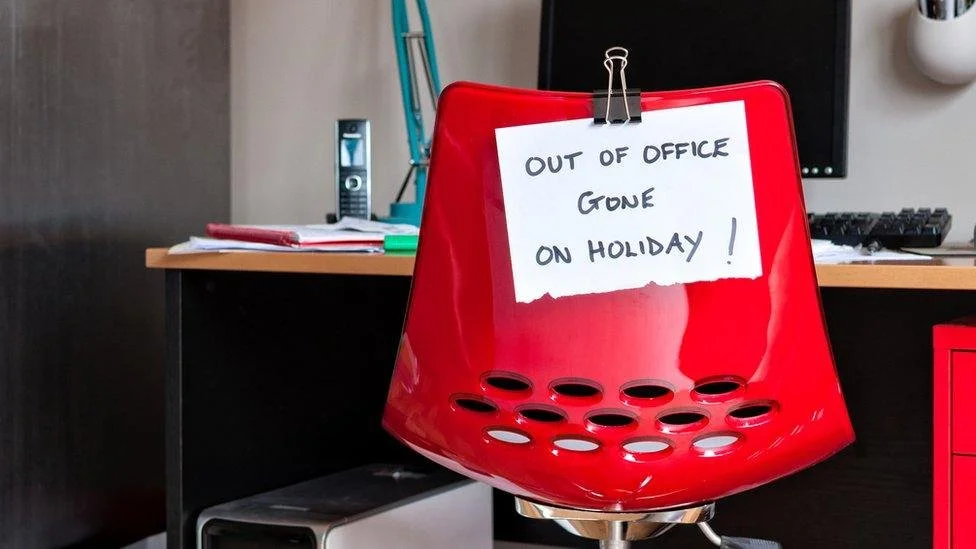
In the old days — back before smartphones and Starlink and global roaming plans — the etiquette and expectations for when to enable OOO responses was pretty straightforward:
If you worked in a role for which external clients/customers expected same-day responses (e.g. professionals who worked in legal, medical, etc.), you would enable an OOO response for any normal work day when you would be unavailable
If you worked in pretty much any role that used email, you would enable an OOO response anytime you were out of the office for multiple consecutive days (but maybe not if you were just taking a single day off)
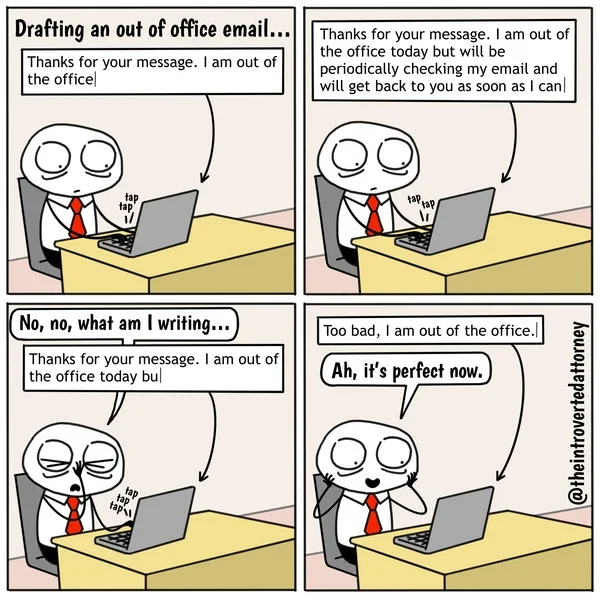
Notwithstanding the performative aspect of out of office responses in big companies, the hardest part of OOO notifications was generally writing the actual text.
So why on earth am I writing about out of office responders in a blog that’s supposed to be about startups?
Because 25 years later, the etiquette and expectations around email have completely changed and even OOO responses can carry unintended signals in Startupland™.
A few months ago, I wrote about the fact that email read responses have made it impossible to get away with the excuse that, “I totally missed your email” (when I opened it 15 separate times and just didn’t get around to answering it).
Similarly, the frequency with which we check our work email — regardless of time or location — has changed how out of office responses are interpreted. Here are three common mistakes I see founders make with OOO responders:
1. Setting an OOO response and then posting all over social media
These days, most people you email with (including clients, investors and partners) also follow you on one or more social media platforms. If you set an out of office response that says you won’t have access to email and proceed to blow up threads on X or comment profusely on LinkedIn posts, know that your activity is highly likely to show up in their activity feeds.
…and immediately blow your credibility.
2. Setting an OOO response “because I’m visiting San Francisco”
I can’t tell you how many times I meet with a founder who is visiting the Bay Area, send them an email follow-up later that day, and receive an out of office response along the following lines:
“Thank you for your email. I am visiting San Francisco this week for meetings and will be slow to reply.”
I get why people do this — they’re trying to signal to folks back home, “Look at me! I’m in Silicon Valley doing the thing!” but to the residents of Northern California, you look like you can’t walk and chew gum at the same time.
Those meetings you’re having? Founders in SF have the same types of meetings day-in-and-day out (and I promise they aren’t setting autoresponders when they have them). If any of your meetings are with potential investors, sending an out of office response like this is likely to kill any future investment opportunity.
And you’ll never even know it.
3. Setting an OOO response when you’re customer-facing
If you’re doing founder-led sales and hustling to get your first customers, sending them an out of office response is very likely to cause churn.
Why?
Because you just reminded them that their single point of contact is also a single point of failure.
Early adopters have to convince themselves that it’s not really a big deal that the company they’re starting to rely on is actually 3 founders and a dog, selling software held together by duct tape and paper clips. Even in an age when some are envisioning billion dollar companies with only a handful of employees, there’s absolutely no reason for you to remind your customers of that fact.
So when should you use an out of office response?
Some people, like my friend Kirby, believe that early-stage founders should never use an out of office responder:
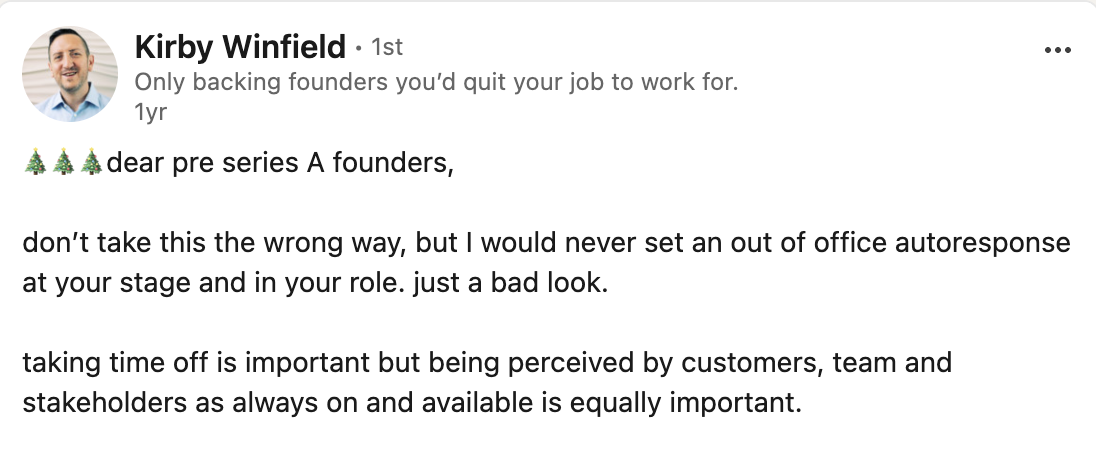
I have a slightly softer take: I generally think that it’s okay to set an out of office responder in two scenarios:
If you will actually be unreachable for an extended period of time (e.g. I set one whenever I go camping in the Canadian wilderness with my kids).
During holiday breaks (I think it’s okay to signal to employees and customers that you’re prioritizing some amount of time off around the holidays, provided that the out of office message includes a way to escalate)
But if there’s any chance whatsoever that you’re going to check your inbox while the OOO responder is set — even just once a day — then you should leave that autoresponder off.
These days, almost everyone in Startupland™ is perpetually online. And whether or not it’s fair, it’s generally in your best interest to be perceived that way as well.