Chris Neumann
Investor | Founder | Advocate
2 Minutes for Instigating
My name is Chris. And I’m an instigator. Here's the story of Vancouver Founders Day.
If you’re a hockey fan (and let’s be honest, if you’re reading this post there’s a good chance that you are), then you know what an instigator is. An instigator is the player who started a fight.
Or, at least, that’s what the rule book says:
An instigator is defined as a player who, by their demeanour or physical or verbal actions, is responsible for starting or causing a fight based on any one or more of the following criteria:
i. Throwing or attempting to throw the first punch, thus forcing their opponent to defend themselves by engaging in an otherwise undesired fight.
ii. Verbal invitation, instigation or threat, thus forcing their opponent to defend themselves by engaging in an otherwise undesired fight.
iii. First player to remove gloves and throw a punch without their opponent’s compliance.

Are you looking at me?
But if you’re a real hockey fan (or a fan of any sport), then you understand that being an instigator isn’t just about starting a fight. It’s about altering the momentum of a game. A physical play at the right time — whether a bodycheck in hockey, a sack in football or a block in basketball — can rile up the home crowd and literally change the game.
Ask any hockey fan of a certain age who the man pictured above is and they won’t just tell you his name, they’ll recite it as though part of a crowd of 20,000 fans chanting it in unison. Haaaaaaaaaaaaroooooooooooold.
But instigators aren’t only found in sports. They play a crucial role in changing the momentum of many aspects of our lives.
In our personal lives, almost everyone has that friend. The one who always proposes plans. The one who you can rely on to take the initiative to “start the ball rolling.”

The same is true in startup ecosystems. In his seminal book, Startup Communities, Brad Feld defined instigators thusly:
Instigators are the proactive individuals or organizations that initiate and drive activities, events, or programs to promote engagement, learning, and collaboration within the startup community. They act as catalysts that bring together different stakeholders, fostering a sense of unity and shared purpose in the ecosystem.
Hi. My name is Chris. And I’m an instigator.
The One About Food
Fifteen years ago, my long-time co-conspirator, fellow foodie and occasional co-founder, Gail Yui, and I had an idea: what if we hosted a dinner where the menu was made up entirely of lavish, cholesterol-rich foods (we were about to turn 30 and figured it was all downhill from there 🤣). We regularly hosted dinner parties together and were excited by the idea, but it came with a challenge: how would we pick which of our friends to invite?
We figured that we’d end up with angry friends if we didn’t invite everyone but we also knew that we could only reasonably cook for 8 - 10 people. So we stumbled upon what we thought was an ingenious solution: we would host the dinner on Valentine’s Day. All of our friends were in their late-20s or early-30s (which meant lots of dating and over-the-top courtship), so we figured that only our single friends would show up. A few days later, we sent out the invite for our “Heart-stopping Valentine’s Day Dinner” and patted ourselves on the back.
Then 35 people RSVPd.

Both Gail and I are, at our core, problem-solvers. So after the initial shock wore off, we got to work. We only had about 3 weeks until Valentine’s Day, so we came up with a checklist and started knocking down as many of our obstacles as we could:
Venue: I lived in a condo in SoMa, which allowed us to shift the location from my place to the building’s “party room” downstairs at a minimal cost.
Preparation/Logistics: We revisited our menu and spent time planning how exactly we could prepare in advance to minimize our day-of cook time. Several of our friends offered to help (as prep cooks, waiters, etc.) and we gladly took them up on their offers.
Budget: We swapped out some items in order to reduce the per-person cost (e.g. instead of a few bottles of really expensive wine, we got a couple of cases of solid but cheaper wine).
After weeks of preparation, Valentine’s Day 2010 arrived.
And it was an unmitigated disaster.

We had an (admittedly-ambitious) 10-course menu with a goal of serving one dish every 15 minutes. Instead, we served one every 30-40 minutes. The oven in the party room struggled to maintain temperature and, by 11:00pm, we still hadn’t served the main courses. At the same time, building management was eager to kick us out (the party room was only to be used until 10:30pm).
But as we looked around the room in our shared moment of defeat, we realized that absolutely nobody cared.
In fact, our friends were having an incredible time and were entirely oblivious to our struggles. Because to them, it was never about the food (not really). Sure, they were all curious about what we were going to make, but at the end of the day 35 people RSVPd to our dinner so that they could hang out and share a unique experience with the other 34.

As an instigator, there were three key lessons that I took away from that day:
If the core value proposition of an event is delivered, people will tolerate things going wrong in almost every other area.
If attendees know (and can see) that you’re genuinely trying your best, they will tolerate a lot of things going wrong.
If attendees feel a connection to the organizers and to the community at large, many of them will step in to help.
This is very much the mantra of the “build in public” philosophy. Deliver something of value, try your best and listen to the community.
Over the years, I’ve instigated events both big and small. These three lessons have proved to be critical to the success (or failure) of every single one of them.
The One About Founders
My most recent exercise in instigating, like many, started off with a chance encounter. In this case, it was with a LinkedIn post from Boris Wertz of Version One Ventures:
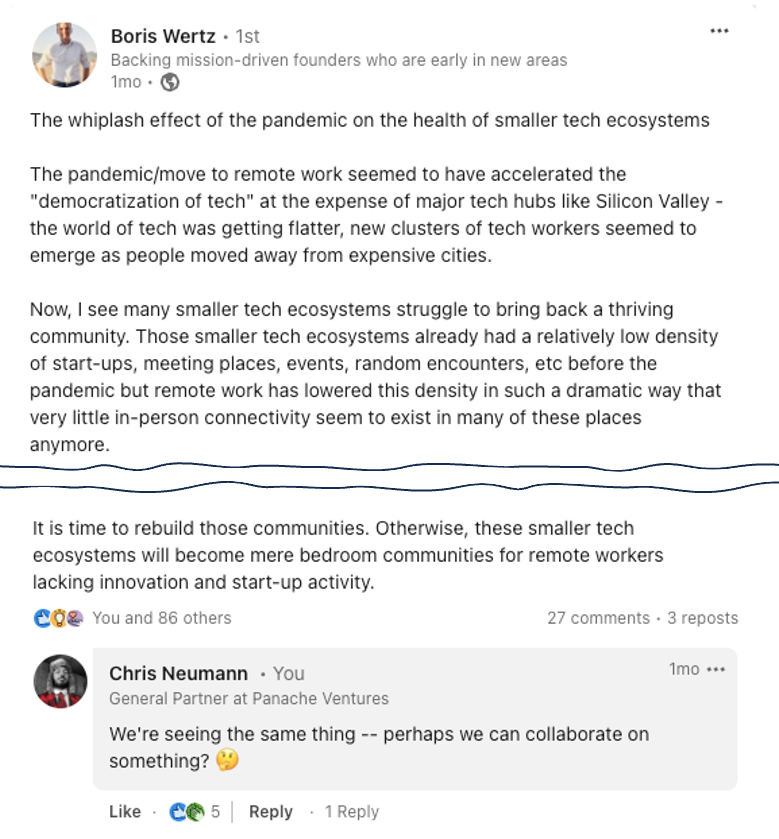
That post — and my reply — led to a flurry of text messages and phone calls over the next few days. Everyone I spoke to was seeing the same thing, at least in the Vancouver ecosystem:
A desire for connection, manifested in an increasing number of grass-roots communities popping up (developer communities, founder communities, design communities, AI communities, etc.)
Relatively little connectivity amongst those communities
Virtually no connectivity between those communities and the experienced founders and communities of past generations
Which begged the question: how could we harness the expertise and experience of Vancouver's previous generations of tech founders to help accelerate the next generation?

At that point, it was the last week of July. Everyone I spoke with suggested that we plan something for the fall. But I’ve always been a believer that velocity is the one metric that matters most. If we really wanted to inject some energy into the Vancouver ecosystem, we needed to do it before the busy fall season when founders are pulled in 30 different directions.
So I started sending text messages and emails to some of the “OG” founders I know:

To my amazement, every single person I emailed responded almost immediately, with one of two answers:
“Absolutely!”
“I wish I could, but I’m out of town that week.”
Next, I turned my attention to sponsors. Vancouver, like most startup ecosystems, has plenty of corporates that are eager to support community activities. Would they be willing to sponsor an event like this?
Again, almost everyone I spoke with responded instantly, “Absolutely!”
With speakers, mentors and money lined up, all we needed was a venue. I figured that if we got 100 - 150 founders to attend, that would be a rousing success, so I reached out to a handful of venues that I knew could accommodate 150 - 200 people. We quickly landed on one that would be a perfect fit.
On July 31st — 5 days after sending the initial emails to potential speakers — I posted this announcement on LinkedIn:

In less than 4 hours, we reached our capacity. By the end of the day, more than 350 people had registered. By the end of the week, we were at nearly 500.

It was clear that we had hit a nerve with the value proposition. Now, it was time to deliver. Together with the team at Panache, our partners (Fasken, Google, Boast and Web Summit) and others from the community, we got to work.
Destination Vancouver stepped in and helped us to get a new, larger venue for our daytime activities that we would never have otherwise had access to: none other than the Vancouver Convention Centre.

Nice place for a tech meetup, eh?
Fasken helped us to secure a new, larger afternoon venue that could accommodate the founder office hours and cocktail party: GoodCo.

Office hours and pinball machines, who could ask for more?
And each of our partners not only doubled-down on their financial commitment, but they came to the table in countless other ways (everything from lanyards, name tag printing and signage to staff for the registration desk and even my co-host — thanks Casey!). Not only that, but many more people from the community pitched in, from William Johnson helping with mic duties to J. Ryan Williams as the event videographer.
As a result, in only 3 weeks we went from a LinkedIn post to an event hosted at the Vancouver Convention Centre with nearly 800 registered attendees!

And guess what else?
Plenty of things went wrong:
We ran out of lanyards and sleeves to hold all of the name tags, so had to order them from Amazon the day before.
The sleeves we got from Amazon were the wrong size, so we had to cut hundreds of name tags minutes before registration opened to make them fit.
I forgot to email the final agenda to all of the attendees, so nobody had any idea who was on what panel (or what time they were at).
There was no event manager coordinating the speakers, so a couple of speakers completely missed their panels (thankfully, nobody had a schedule so none of the attendees realized 🤣).
The use of multiple venues wasn’t clear on the event registration page, so many people got confused around where to go for office hours.
…and many more!
But despite all of the challenges, we delivered on our core value proposition: bringing Vancouver founders from across generators together in a welcoming, inclusive, collaborative manner.
I want to thank everyone who helped make Vancouver Founders Day a success, starting with Vancouver’s many amazing founders past, present and future.
And stay tuned. I have a feeling we’re just getting started.

From our 10th annual Valentine's Day dinner ("Hold My Beer")
🚀🇨🇦️🔥
The Mythical U.S. Lead Investor
The stereotype that local investors don’t lead rounds but "foreign investors" do exists all over the world. But is it true?
A few months ago, an early-stage Canadian VC called Two Small Fish announced their third fund (woo hoo! 🎉). In covering the announcement, one of the local tech publications included this quote:

Suffice to say, I was annoyed. Because this is simply not true.
I expressed my annoyance on Twitter, only to be met with a stream of opposing responses, like this one:

This deeply-held stereotype — that local investors don’t lead rounds, but “foreign investors do” — exists not only in Canada, but in tech ecosystems all over the world. There is a pervasive belief amongst founders and ecosystem supporters that goes something like this:
Investors here don’t take risks
Investors here don’t back early companies
Investors here don’t lead rounds
But…
U.S. investors take risks and move fast
U.S. investors back ideas on napkins
U.S. investors don’t care who else is in the round
To most folks in Startupland, this perspective seems completely reasonable — especially if the main lens through which one learns about Silicon Valley fundraising is the selectively-chosen, click-bait funding announcements that permeate tech media these days. But that’s not reality.
While it’s true that a handful of repeat founders are able to raise funding with little more than “an idea on a napkin,” that’s far from the majority case (it certainly wasn’t my experience).
It’s also true that, in general, Silicon Valley investors move faster than investors in other geographies. But that’s not because they’re “better” investors, it’s because the competitive dynamics in Silicon Valley demand it. In Silicon Valley, speed is a key dimension on which investors compete. They’ve learned to do so over many years (and, no, VCs don’t “skip” diligence). There are only a handful of other geographies around the world where investors are starting to compete on speed — and it’s mostly ecosystems that Silicon Valley VCs have set their sights on.
I could go deeper into the subtleties involved in comparing Silicon Valley investors with investors in other geographies, but I’m pretty sure that most of you reading are still thinking this:

So instead of talking (writing?) until I’m blue in the face, let’s take a look at the data.
I’ve previously noted that there’s no such thing as accurate Pre-Seed data. A big reason for this is that the details of many Pre-Seed rounds (and a significant number of Seed rounds) aren’t made public until long after they’re closed.
In order to account for this dynamic, we’ll look at six years of Crunchbase funding data from 2016 through 2021. Given that the typical length of time between funding rounds is 18 - 24 months, it’s reasonable to presume that the majority of rounds that took place during those years have now been made public (at least, for companies that still exist).
As a starting point, let’s look at all Canadian Seed deals that occurred between 2016 and 2021 and split them into three categories:
Canadian Seed deals with a U.S. lead
Canadian Seed deals with a Canadian lead and U.S. participation
Canadian Seed deals with no U.S. participation
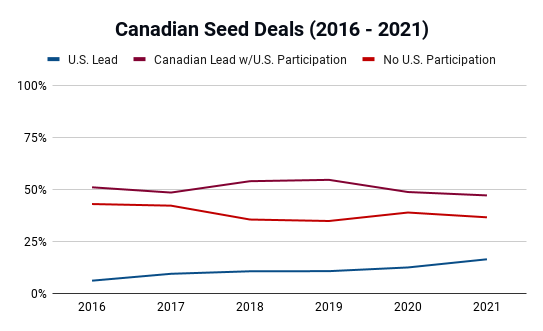
For each of these years, fewer than 20% of Seed deals that occurred in Canada had a U.S. lead investor.
You might be thinking, “but that blue line is moving up each year…” and you’d be correct. More Canadian deals are being led by U.S. investors each year. But that fact doesn’t in any way imply that Canadian investors are reticent to lead deals. Rather, it speaks to the maturation of the Canadian startup ecosystem in two important ways:
More U.S. investors are paying attention to — and investing in — Canadian startups
More Canadian founders have the confidence and willingness to raise capital south of the border (as I’ve said before, Canada’s problem isn’t ambition)
Want proof? Here is a chart showing the number of US investors that participated in at least one early-stage funding round (Pre-Seed or Seed stage) for a Canadian startup over the same time period:

The number of U.S. investors participating in at least one Pre-Seed or Seed stage funding round steadily increased each year between 2016 and 2021. That’s a great thing — it means more capital flowing into Canada’s tech ecosystem and more options for Canadian founders — but U.S. investors still represent only a small fraction of the capital deployed into early-stage funding rounds in Canada.
“Hmm…” you might be thinking. “Your earlier chart only showed Seed deals. What about Pre-Seed deals? Canadian investors don’t lead Pre-Seed rounds!”
Let’s take a look at Pre-Seed deals between 2016 and 2021 in the same fashion:

If you look at the blue line in the above chart (the percentage of deals led by U.S. investors), it is almost identical to the one for Seed deals. As with Seed deals, in each of the years 2016 - 2021, fewer than 20% of all Canadian Pre-Seed deals were led by U.S. investors.
(If you’re wondering about the spike in participation by U.S. investors in 2021 — the dark red line — you can thank Covid. While we were all stuck at home, many U.S. Pre-Seed investors started investing internationally, with Canada the main beneficiary. In the years since, the number of Canadian-led Pre-Seed deals with at least one U.S. investor has steadily remained above 50%.)
To bring this all home, let’s combine the data for Pre-Seed and Seed deals into a single chart (which is helpful anyways, given that the terms are not used consistently):

And there you have it. Each year over the six-year period from 2016 through 2021, less than 20% of all early-stage Canadian rounds were led by U.S. investors. Or, put differently, more than 80% of all early-stage Canadian rounds during that time period were either led by Canadian investors or were syndicates (e.g. angel rounds) without any American participation.
Those numbers are slowly changing (as the number of U.S. VCs investing in Canadian companies continues to increase) but the vast majority of Canadian early-stage deals continue to be led by Canadian investors. And that’s not going to change anytime soon (at some point, I’ll write a separate post on why this is the case).
In the meantime, let’s take a look at another leading tech ecosystem for the sake of comparison. Here is a breakdown of U.K. early-stage deals during that same period of time:

In the U.K., fewer than 10% of early-stage rounds are led by U.S. investors. In fact, the participation rate by U.S. investors is lower across the board (in Canada, approximately 70% of early-stage funding rounds include at least one U.S.-based investor, while in the U.K. that number sits around 35%) . But if you focus on the shape/slope of the blue line, they are very similar. This is because the U.K. startup ecosystem is currently undergoing a similar evolution to what’s happening in Canada:
More U.S. investors are paying attention to — and investing in — U.K. startups
More U.K. founders have the confidence and willingness to raise capital across the pond
But the percentages are much smaller — and are unlikely to ever reach the same levels as in Canada. For starters, there are additional complexities for U.S. funds wanting to invest in U.K. entities. And even when those aren’t a factor (such as when a U.K.-based startup incorporates in Delaware), American investors often hesitate to invest in European companies at the early stages (something I saw firsthand while running Commonwealth Ventures). A big part of that simply has to do with proximity.
For better or worse, Canada’s startup ecosystem is increasingly impacted by being treated as America’s “51st state”.

But I’m not done looking at data just yet.
Next, let’s look at America.

That’s right. Let’s take a look at startup funding in the United States.
Specifically, let’s take a look at the fundraising reality of early-stage American startups based outside of California.
Here is a breakdown of early-stage funding for U.S. companies based in the 49 states whose flags don’t include a grizzly bear, using a similar categorization:
Non-California deals with a California lead
Non-California deals with a non-California lead and California participation
Non-California deals with no California participation

Look familiar?
That’s right, the experience of early-stage American founders located outside of California is virtually identical to that of international founders when it comes to raising from Silicon Valley.

If you’ve ever participated in one of my accelerators, I start off by stating that there are exactly three funding ecosystems in the world:
Silicon Valley
China
Everywhere else
And this is a perfect demonstration of that.
This post barely scratches the surface of these dynamics (trust me, I’ve got plenty of adjacent topics for future blog posts). For now, if you take anything away from this analysis, it’s the following:
Silicon Valley is a global outlier when it comes to fundraising dynamics.
In the rest of the world, early-stage funding rounds are overwhelmingly led by local investors.
U.S. participation in early-stage Canadian funding rounds is higher than anywhere else in the world — including in most U.S. states (which is either a blessing or a curse, depending on whether you’re a hungry startup looking for funding or a Canadian investor wary of competition).


That, and the fact that the mythical U.S. lead investor does not exist.
Or does she...?

How to Pitch Hard Tech to a Generalist VC
To increase fundraising success with generalist VCs, hard tech founders must show that your startup fits the traditional VC model. Here's how.
A few months ago, I wrote a post about the current hard tech renaissance and the challenges founders face when trying to raise capital for hard tech / deep tech startups. That post resonated with a lot of folks and I was subsequently invited to talk about it at Startupfest in Montreal. The conference organizers gave me the following prompt:
Shed light on the Canadian hard tech landscape, the reality of engaging with VCs, and the realities of raising capital as a hard tech startup.
It shouldn’t come as a surprise that despite a resurgence of interest in hard tech, convincing early-stage VCs to invest is still really hard. For many hard tech founders, the experience of raising pre-seed capital often feels like this:

I started digging into the numbers: how many Canadian VCs have actually invested in at least one hard tech startup? It turns out, quite a few:

Some of the Canadian VCs who have recently invested in hard tech
If so many VCs are willing to invest in hard tech startups, why does raising pre-seed capital still feel so hard? It starts with a simple fact: the vast majority of VCs that invest in hard tech startups aren’t actually hard tech VCs. They’re generalists. And generalist investors often come to the table with stereotypes and preconceived notions that can get in the way of making an investment.
Thankfully, Leo Polovets of Susa Ventures / Humba Ventures is helping to dismantle many of the misconceptions around hard tech investing.

Two years ago, Susa Ventures announced a spin-off fund led by Leo called Humba Ventures. Humba’s mandate includes a specific focus on early-stage investing in hard tech / deep tech. Leo — a very data-oriented VC — published a post titled Betting on Deep Tech that shared some of the detailed research he did to better understand the historical performance of deep tech investments and convince himself that a deep tech-focused fund was viable. He found that the following four assumptions about deep tech companies turn out to be misconceptions:
Deep tech companies have poor outcomes.
Deep tech companies are much more capital intensive.
Deep tech companies take much longer to exit.
Deep tech companies have much higher failure rates.
(If you haven’t already, I highly encourage you to read the full post here.)
Of course, there are some nuances to these conclusions. Leo found that some of the stereotypes around hard tech companies are actually true. For example, certain sub-categories in hard tech — such as life sciences — are inherently capital intensive. So what does that mean when it comes to raising early-stage capital?
To increase your chances of success with generalist VCs, you need to credibly make the argument that your startup fits the traditional venture capital model. Which means arguing that the stereotypes listed above don’t apply to your company.
1. Outcome Potential
Assuming that you’re pitching to a power law VC, you need to demonstrate that your company has the potential for a multi-billion dollar exit. There are three factors that come into play:
Historical Exits - What exits have occurred in your industry for similar companies and at what stage of development?
Exit Multiple - For revenue-based exits, what is the historical multiple for your industry?
Revenue Trajectory - What is a realistic revenue trajectory for your company?
With the three pieces of information above, you can suggest potential scenarios that might occur (e.g. this is what is likely to happen if we get acquired at point X, this is what happens if we get acquired at point Y, and this is what happens if we IPO).
Note that this is different from saying “this is our exit plan” (which is a bad thing to present — at least, when pitching to North American VCs). Rather, you’re trying to paint a picture as to the potential of your company to achieve the scale of outcome necessary to return a VC’s fund.
2. Capital Requirements
Generalist VCs are very wary of capital-intensive companies, as their funding needs can dilute the investor’s holdings such that they won’t realize a significant return even if the startup is a breakout success. To counter this, you need to demonstrate that the amount of dilutive funding that your company will require is not dissimilar from what a software startup might need.
In this case, I’m not talking about a detailed, 10-year financial plan. What I’m referring to is understanding the amount of capital that will likely be required to achieve each of your key milestones (prototype, regulatory, product, GTM, etc.) and the levels of non-dilutive funding that you can realistically access to help defer those. Showing these milestones in 12-24 month phases will best align this with the traditional VC model. For example:
Milestone 1 (12 - 18 months): $5M ($1.5M equity / $3.5M non-dilutive)
Milestone 2 (15 - 21 months): $15M ($5 - 6M equity / $9 - 10M non-dilutive)
…
Be sure to list as many of the sources of non-dilutive capital as you can for each phase, in order to add credibility to your predictions.
3. Exit Timeline
Generalist VCs typically look for exits to occur in 7-10 years. You can counter the fear that your hard tech startup might take “too long” by adding a timeline to (1) and (2). How long did it take for the historical exits described in (1) to occur? How do those timelines map to the milestones described in (2)?
4. Failure Scenarios
One of the most powerful things any startup can do in their initial pitch is to be forthcoming about the “likely reasons we will fail”. For a generalist VC that isn’t an expert in your space, the risk of failure can seem much higher than it actually is — so countering any preconceived notions is crucial.
For each of the milestones described in (2), lay out the risks that could prevent you from succeeding along with the actions that you’re taking (or have already taken) to mitigate those risks. If there are recent examples of companies in your space that failed, explain why their situations don’t apply to your startup.
The details above are likely too much to include in your initial pitch, so add them as an appendix to your deck or include them in an “investor FAQ” that you distribute after your initial meeting (just make sure to telegraph to the VC that you’re going to send this after the call to preempt them from jumping to conclusions). You won’t be able to convince every generalist VC that your hard tech startup is a fit, but by countering common stereotypes, you can significantly increase the number from whom you receive serious consideration.

I Never Wanted to be a VC
When I graduated from Stanford more than 20 years ago, nobody aspired to "be a VC".
A few weeks ago, I attended a close friend’s wedding in San Francisco. I sat at a large table with people I’ve known for more than 20 years (though many of us hadn’t seen each other in nearly that long). Over the course of the night, we caught up on the twists and turns that each of our lives have taken since we all lived on Stanford’s campus so many years ago. The proverbial scores on our Silicon Valley bingo cards were high:
Most of us ended up in tech
Almost everyone had worked at one or more startups
There were lots of founders and ex-founders
A few of us eventually found our way into venture capital
As we shared our respective journeys, it struck me that all of the VCs had one thing in common: none of us had graduated Stanford with “become a VC” as our ultimate career goal.

Back in my day…this was not a thing
The first time I ever heard the term “venture capital” was in the late-90s during the dot-com boom. I took an 8-month break from my undergraduate computer science program to work at a local startup. The company I worked for raised a small amount of money from “venture capitalists”, whom I naively presumed were just rich people who wanted to invest in tech.
The dot-com bubble burst. That company (and countless more) went bankrupt. The investors lost their money. I went back to school.
By the time I graduated, the nascent tech scene in Vancouver had been all but obliterated. So I opted to head south and go to grad school.
I spent two years at Stanford working on my Masters degree in computer science, then re-entered the workforce in 2004. By then, nature was healing and startups were beginning to return. At the annual Stanford Computer Forum Career Fair, up-and-coming companies like Google, Netflix and “The Facebook” were recruiting alongside tech behemoths like Microsoft, Oracle and IBM.

Antonio’s Nuthouse, circa 2002 (in those days — before Mark Zuckerberg and his Facebook crew took over — startups and venture capital were rarely the topic of discussion)
By that point, I was vaguely aware of venture capital. Entrepreneurship is deeply intertwined in Stanford’s programming, so the topic was frequently mentioned, but always within the context of funding startup ideas. By the time I graduated, I knew that VCs existed and that they were a source of capital for startups, but I couldn’t tell you who they were, how they operated or where they got their money from. It’s very likely that I met a number of VCs while I was a student. It’s also very likely I could have cared less.
Because in those days, being a VC wasn’t something you aspired to.
20 years ago, if you were technical, you aspired to work on really hard problems. That typically meant working at a large tech company or, perhaps, joining or founding a startup.
If you were in finance in 2004, more than likely your goal was to work at Goldman Sachs.
But that was then. And this is now.

So what happened?
First off, the growing prominence of the tech industry as a whole led to an increased awareness of and interest in venture capital. Today, venture capital courses are offered at almost every undergraduate and graduate business program in the world. Tens of thousands of eager students learn about the venture capital industry each year.
And then there are the VC “clubs”.
In 2012 (when competition amongst VCs was increasing and the concept of the “scout fund” was first borne), First Round Capital launched an experiment called the Dorm Room Fund at Drexel University and the University of Pennsylvania. The idea was simple: teach a handful of business students the basics of venture capital and give them a small amount of money to invest in student entrepreneurs. The experiment was wildly successful. Not only did Dorm Room Fund expand across the US, but similar programs popped up all over the world (such as Rough Draft Ventures in Boston, The House Fund at UC Berkeley and Front Row Ventures in Canada).

Panache Ventures portfolio company Valence Discovery, which was acquired by Recursion Pharmaceuticals last year, began life as a student-founded startup called InVivo AI that received its initial funding from Front Row Ventures
Aside from generating returns for their benefactors, these programs have proven to be incredibly effective at both helping student-founded startups access early funding and teaching students how venture capital as an industry works. But there’s been an unexpected consequence: many of the business students who participate in these programs subsequently expect to graduate and move immediately into VC.
I don’t think that’s a good thing.
Every month, I get dozens of emails and LinkedIn messages like this one, from graduating business students eager to get into VC:

There’s absolutely nothing wrong with this email. In fact, it’s incredibly well-written and came from a very strong student.
When I receive such messages, I almost always schedule a call to have a conversation with them. But it’s generally not to tell them about the recruiting process at Panache. It’s to help them to understand that their best path into venture capital isn’t directly out of school (at least, not in my humble opinion).
At this point, it’s worth noting there are two distinct categories of venture capital: early-stage and late-stage (growth stage). The exact definitions of these vary wildly, but from a functional standpoint they can be categorized as follows:
Early-stage investing: Investing in startups where virtually none of the investment decision is based on financial analysis
Late-stage investing: Investing in startups where the majority of the investment decision is based on financial analysis
Late-stage investing is actually a great fit for high-achieving business students, due to its emphasis on financial analysis and the structured way in which these firms typically operate. But when business students ask me about “getting into VC,” they’re usually referring to early-stage investing. And therein lies the mismatch.
At the early stages, investment decisions are mostly driven by subjective potential. The potential of the founders. The potential of the technology. The potential of the market. A classroom or VC club can teach the process of early-stage investing, but cannot possibly impart the expertise required to evaluate subjective potential.
What can? Experience.

When I was an undergraduate, all of my internship/coop experiences were technical. Sure, I had dreams of becoming wildly successful one day (it was the dot-com days, after all), but I had no illusions that my best path forward would be anything other than to build something. Though I was pursuing both computer science and business degrees, CS was unquestionably my focus.
I recently had coffee with a student completing the exact same joint degree that I did 20+ years ago. His vision was the opposite. He saw his CS degree not as the core asset but as a “checkbox” for his resume. He wanted to become a VC and desperately hoped that he wouldn’t have to actually “get a coding job.” Over the course of our conversation, he asked every way he could how to go directly into VC and how he could “avoid having to be a programmer.” When it became clear that I wasn’t going to give him the answer he wanted, he thanked me for my time and excused himself.
I’ve had many conversations like this over the years and they always make me sad and frustrated. Sad that so many bright young people are infatuated by an industry that is, at its core, glorified capital allocation. Frustrated that they’re increasingly led to believe that there’s a credible path from graduation directly into venture capital.

I have absolutely no issues with students being impatient (lord knows, I certainly was!). But I wish these programs focused more on understanding venture capital as a means to building successful companies and less on glorifying the industry itself. Venture Deals by Brad Feld and Jason Mendelson continues to be one of the most impactful books on founders nearly 15 years after it was first published specifically because it comes from that perspective.
That’s not to say that VC courses and clubs shouldn’t talk about the career opportunities in the industry. But they should be realistic about the prospects and focus on the many paths that can lead to being an early-stage VC, including:
Successful founder
Unsuccessful founder
Early employee at a high-growth startup
Product management
Combining startup and “big company” experience
Corporate development (the people in large companies who analyze and acquire startups)
Tech journalist
Let’s stop inspiring students to become venture capitalists and get back to inspiring them to become founders and builders.
Because that’s what we actually need.
How to Connect with a VC on LinkedIn
Connecting on LinkedIn can be the easiest way to open a direct line of communication with a potential investor. But you have to do it right.
LinkedIn is the preeminent social network when it comes to professional relationships. It’s also grown significantly in prominence as a a content platform in recent years. For many founders, connecting on LinkedIn can be the easiest way to open a direct line of communication with a potential investor.
But you have to do it right.

Here are 5 tips for connecting with a VC (or really anyone) on LinkedIn:
1. Make Sure Your Profile is Tight
The first thing most people do when they receive a LinkedIn connection request is click on the profile link. So make sure you’re profile page is buttoned up.
At a minimum, your profile should have the following:
Headline - A few words about who you are / what you do (e.g. “Cofounder and CTO at Stealth”). Make sure that your headline is short enough to fit into a preview without being truncated.
About - A couple of sentences about you and your prior experience.
Experience - List all of your past positions with key projects/achievements that you were responsible for. If a company is a lesser-known startup, consider adding a line about what the company did or links to significant media stories.
Education - What schools did you go to, what did you study and what were a few significant achievements?
LinkedIn offers plenty of other profile sections, so feel free to add any that seem relevant and can highlight aspects of your experience.
Finally, make sure that your profile photo is visible to people who haven’t yet connected with you. It might seem great to keep your photo private, but nothing screams “spammer” more than a connection request from someone without a visible photo.

Go to Settings ➡ Visibility to set this
2. Create a Company Profile
If you’re fundraising for a startup that’s out of stealth, take the time to setup a robust company profile.
Upload size-appropriate logos and headline images
Add a solid “About” statement that concisely describes what the company does
Make sure all of your cofounders and any employees, advisors, etc. have added the company to their profile (so you all show up under the “People” tab)
If any media articles have been published about your company, include them under the “Posts” section
If your company is still in stealth mode, you should still list the experience on your profile as your current role (so eager investors can find you). You can do this in one of two ways:
List yourself as a cofounder of one of the ubiquitous “Stealth Startup” companies already on LinkedIn (the largest of which currently has more than 21,000 “employees”)
Create a custom “stealth” profile for your company, including a more accurate description, location and list of cofounders

3. Always Send a Personalized Message
Like most social networks, LinkedIn makes it incredibly easy to connect with anyone by displaying a big, fat “Connect” button on their profile. But far too many people simply click that button without any further thought or effort.
I get dozens of LinkedIn requests each week — and I’m sure that’s nothing compared to many people. Many of them are undoubtedly legit. But a significant percentage are spam/bots/etc. So once or twice each week, I scan through the list of requests. Unless someone immediately jumps out at me, I ignore them. As a result, I regularly ignore requests from people who I previously met in person, simply because I don’t recognize their LinkedIn photo or remember their name (sorry!).
How do you stick out from the crowd? Simple: include a personalized note.
Here’s how you do it:
Connecting on Desktop
When you click the “Connect” button on someone’s profile page when using LinkedIn on a desktop browser, you will get a popup box with an option to “Add a note”. Click this to enter a custom message that goes along with the connection request.

If you pitched a VC at a party, this is where you remind them where you met:
Hi Chris,
It was great to meet you last night at the epic Panache Venture party! I’d love to connect and schedule a follow-up conversation as we discussed.
If you’re sending a cold connection request, then consider this the equivalent to sending a cold email — so make it shine (here are some tips on how to write for success).
Connecting on Mobile
Here’s where things start to get tricky: if you click on that exact same “Connect” button on someone’s mobile profile, you don’t get the option to send a personalized note. Instead, the connection request gets sent off automatically without any personalization (and no ability to add one later…big thanks to the PM who removed that option).

To send a personalized connection request on LinkedIn mobile, press the button with the 3 ellipses to the right (“…”). That will bring up a menu with an option to “Personalize invite” (do not use the “Connect” option 🤦♂️). Press that button and you can add your message.

Connecting vs. Following
Some profiles on LinkedIn have a “Follow” button instead of a “Connect” button.

Who does this guy think he is?
These users have optimized their profile for sharing content by offering a way for people to easily follow their posts. To send a connection request to users with these “creator” profiles, do the following:
On Desktop: Click the “More” button to reveal the Connect option, which will be followed by the personalization popup.

On Mobile: Click the button with the three ellipses (“…”) and use the “Personalize invite” option:

Never Click the Connect Button on a Recommended Profile
Are we having fun yet? 🙃
Here’s another doozy for you: when LinkedIn recommends someone to you via their People You May Know algorithm, they have an identical-looking “Connect” button under their profile:

Notice the person who’s profile photo is hidden 👀
Never, ever, ever click that button. On both desktop and mobile, clicking the connect button on a recommended profile will instantly send a connection request without any option to include a personalized note.
To send a personalized connection request to someone recommended to you via LinkedIn’s People You May Know algorithm, click on their name, go to their full profile and send a personalized connection request using one of the options above.

P.S. In case you’re wondering why all of this matters, it’s because if you try to rescind a connection request in order to add a personalized note, LinkedIn won’t let you do so for 3 weeks.

The next time a VC asks you “what if BigCo does this?”, just point them to post-acquisition LinkedIn
4. Review Your Connection Requests
In general, if someone doesn’t accept your connection request after a week or so, it’s highly unlikely they ever will. Not because they don’t like you, but because they’re never going to scroll through the thousands-upon-thousands of requests they received on the off chance they might find someone interesting.
Once a month, go through your pending requests by navigating to My Network ➡ Invitations ➡ See All ➡ Sent:

Even VCs get ignored sometimes 😢
Remove any that are more than a few weeks old by clicking the “Withdraw” button, then add them to a list to revisit later (such as by sending a different personalized note).
5. Follow Up
Once you’ve connected with a potential investor, it’s time to start a conversation (you aren’t connecting for the sake of connecting).
Send a follow-up message via LinkedIn or email (if they’ve also given you their email address) and make a point to stay in touch. Just as regular investor updates can keep potential new investors apprised of your progress, tagging them on important updates on LinkedIn can help keep you top-of-mind.
Just don’t overdo it.
How to Pitch a VC at a Party
Pitching an investor at a party is very different from pitching in an office, a coffee shop or over Zoom. Here are 6 tips for pitching a VC at a party.
Part of our thesis at Panache Ventures is that, as investors, we benefit from helping the Canadian startup ecosystem grow. A stronger startup ecosystem leads to more (and better) founders, which leads to more (and better) startups for us to invest in.
One of the ways we try to contribute to the ecosystem is by providing opportunities to build connections between founders, investors and others in Canada and the US.
That’s a fancy way of saying, “we like to throw parties”.

Who invited that guy?
When we host events, our team makes every effort to be accessible to everyone who attends. One of the side-effects of this is that we get pitched at parties. A lot. But pitching an investor at a party is very different from pitching in an office, a coffee shop or over Zoom.
Here are 6 tips for pitching a VC at a party:
1. Know Your Objective
When pitching a VC at a party, it’s important to know what your goal is: to get their contact information.
It’s not to convince them to invest. It’s not even to convince them to take a meeting (although that’s likely your ultimate goal). Rather, your objective is simply to get them to share their contact information.
Why? So that, when you send a follow-up message, it’s treated like a warm introduction rather than a cold email.

2. Be Concise
Parties are loud (at least, the good ones are). It’s hard to hear people and you frequently get interrupted. As such, it’s essential that you are concise when pitching a VC at a party.
Even if an investor is genuinely interested, they’re at best half-listening to your pitch. They’re likely scanning the room for other people they want to meet, reacting to bumps and interruptions from other attendees and asking you to repeat yourself over-and-over again.
Resist the urge to give them your full pitch in all its glory. Rather, keep things focused on your founder background and the key highlights of your company. In other words, the shortest possible version of your elevator pitch.

3. Make the Ask
In sales, one of the most important steps is “making the ask”. In this case, the ask is quite straightforward:
“Can I have your email address so that I can send you a follow-up email with our pitch deck?”
At a loud, busy party, the dynamics are such that you’re more likely to “close the sale” the earlier into the conversation you make the ask. Think about these two scenarios:
You ask for their email after pitching the investor for an extended period of time, ignoring the fact that they’re looking around and paying less-and-less attention to you as time goes on.
After giving your best, most concise elevator pitch, you tell the investor, “I know there are probably lots of people you want to talk to at this party. Can I get your email address and I can send you a follow-up with our pitch deck so we can talk further at a better time?“
By preempting your pitch with an early ask, you signal respect for the investor’s time and, in doing so, are more likely to get a ‘yes’ than if you gave them an extended pitch. At that point, the investor might happily give you their contact info or they might ask more questions (in which case, you can dig in deeper if you choose).
The other benefit: by making the ask early, you can be more efficient with your time. The faster you make the ask, the sooner you’ll close the “sale”. And the sooner you close the sale, the sooner you can move on to your next prospect.

4. Associates Are Your Friend
Most founders looking for VCs at a party focus exclusively on partners. Given all of the fundraising advice about only talking to partners, it makes total sense. But they’re also the most in-demand individuals at a party. Which makes associates and other junior members of the investment team a far better target at these events.
When you’re at a party with lots of other founders, there is often a line of people waiting to talk to each VC partner. It can be almost impossible to get time alone to pitch them (especially if they themselves are trying to connect with other attendees). Associates, on the other hand, often navigate parties solo, trying to connect with founders and other investors.
Because that’s their job.

One thing to understand is when it comes to parties and other community events, each person at a VC firm has their role. Partners are often tasked with talking to LPs, influential ecosystem players and partners at other firms, while associates are responsible for connecting with promising new founders. In other words, the KPI for most associates at a party is how many strong founders they identify.
Which means that if you make a good impression with an associate at a party, it’s very likely you’ll be fast-tracked to meet with a partner.
Another thing to note: if you’re speaking with a VC associate, don’t be as concise and quick to make the ask as you are with a partner. Their primary responsibility for the party is speaking with founders and identifying the top candidates, so take more time to share your story and your pitch. Not only do you need to get their contact information, but you need to sell them enough on your business for them to highlight you to the partners in their event debrief.
5. Follow Up Immediately
I can’t tell you how many founders I’ve given my contact information to over the years who never followed up. The conversation usually goes something like this:
[Founder] Can I have your email address / connect with you on LinkedIn?
[Me] Absolutely. Please be sure to include the fact that we met tonight, so that I have context and can follow-up.
That’s a pretty clear opt-in on my part, yet countless founders never act on it.
If you’re serious about fundraising, you should send the follow-up email or LinkedIn message immediately after the conversation ends. Not later that night. Not the next day. The minute you walk away from the investor.
The best way to do this is to pre-write a template for the follow-up email before you come to the party (if you use Superhuman, this is a great use case for snippets). Then, you can immediately hit send on an email with all of the pertinent details plus a sentence or two of personalization before you forget anything (use the “send later” feature if you want to pre-write the email to be sent the next morning).

Dude…this is VC. You definitely get more than one shot (but still…).
6. Don’t Act a Fool
Last, but not least, if you’re going to a party to meet potential investors, act like a professional.
Don’t get drunk. Don’t get high. Don’t act inappropriately towards anyone at the party.
These things should be obvious, but sadly they’re not. Moreover, with an increasing number of people choosing to stay sober at work-related parties, out-of-bounds behavior is more likely than ever to lead to negative ramifications.
(Founders: if you’re ever at an industry party and someone acts inappropriately towards you, don’t be afraid to let one of the hosts know. You deserve better, and the vast majority of investors want to create safe, inclusive environments for everyone.)
Why is Summer a Bad Time to Fundraise?
Is summer really a bad time to fundraise? And if so, why?
Conventional wisdom holds that the summer months of July and August are a bad time to fundraise. Is that really true? And if so, why?

Let’s start with the basics: the vast majority of VCs work through the summer months. Nobody I know is taking a 6-week holiday or shutting down the firm for two months. But almost everyone who works in VC does take some form of vacation during the summer.
Just like everyone else in North America.
Because the weather is nice and their kids are out of school.

Last week, I took my kids camping in northern BC. The park we stayed at had no cell service.
I previously wrote about how deals get done at VC firms. As a founder, understanding this is key to understanding why it’s harder to fundraise during the summer.
Most firms have a standardized investment process in which a certain number of partners need to meet the founders of a prospective investment, votes have to happen in a certain way, etc. If, in any given summer week, one or more partners is on vacation, that process will take longer. Some of the practical impacts from the perspective of a founder include:
It takes longer to schedule an initial meeting with a VC
The time between meetings increases
The amount of time needed for a VC to complete their diligence takes longer (as analysts and others at the firm also take vacations)
There is more inertia when it comes to building the type of excitement/momentum that leads to FOMO (see this post on the adrenaline of deal flow for more)
As a result, a process that might typically take one week stretches into two. Or two stretches into three.
Now map those delays across the majority of funds that you’re talking to.
(Of course, every VC will claim otherwise — just check out the investors hilariously tripping over themselves to disagree with Eric’s tweet from above here.)

One of the less serious responses 🤣
Why does this matter? What’s the issue if fundraising takes a little longer?
Because you’re trying to build momentum.
If you’re running a high-velocity fundraising process, your goal is to align as many VCs as you can into an efficient, effective timeline. That’s unequivocally harder to do if you can’t start with the baseline assumption that everyone you need to interact with at a firm is actually available when you need them to be.
To be clear: this doesn’t mean that it’s impossible to fundraise in the summer. Most funds do deals in the summer months (we certainly do). But as a founder, it’s much more difficult to coordinate multiple VCs in a way that drives competitive dynamics. Which means it’s more difficult for you to orchestrate an oversubscribed round (and the benefits that come from one).
So what should you do during summer months?
Prepare for your fundraising round by building your fully-researched pipeline of potential investors
Practice and perfect your pitch
Build out your data room and all of the supplementary materials you think will be necessary (so you don’t have to do this while you’re fundraising)
Consider reaching out to a small number of investors to get feedback as a dotted line (you can often get more quality time with prospective investors in the summer, as their schedules aren’t nearly as packed)
Focus your team on driving the key metrics you believe will be critical to your fundraise (revenue, users, etc.) in order to show strong month-over-month growth going into your fundraise
In terms of when you should start fundraising, there are three key dates to know:
The third week of August is when most Bay Area schools start (San Francisco/Silicon Valley VCs with kids are back home and in the office)
The fourth week of August is when Burning Man happens (many VCs without kids - any some with - are off running around in the desert)
The first Tuesday in September is when most Canadian schools start (at this point, every VC in North America is back to full capacity)
Assuming that your process includes “practice meetings” with investors that are lower down your target list, the third week of August is a great time to start. You can then ramp up initial meetings in the fourth week of August and into September. By the time you’re on to second and third meetings and into diligence, all of the VCs you engage with should be at full capacity.
Have questions on fundraising? Feel free to reach out! I’ll be here all summer.
Unless, I’m not 😉.

Things I Think I Think - Q2 2024
Q2 has come to a close and we’re into that sweet, sweet Canadian summer. Here are 5 Things I Think I Think: Q2 2024.
Q2 has come to a close and we’re into that sweet, sweet Canadian summer.

In homage to legendary sports columnist Peter King, here are 5 Things I Think I Think - Q2 2024 Edition:
1. Toronto is Back 🔥
Summer came early to Canada’s largest city.
In my Q1 2024 update, I noted that the Panache team introduced more companies to our ICM in Q1 than we had in any quarter since 2022.
That number doubled in Q2. More notable: 70% of the activity we saw in Q2 was based in Toronto.

Unpacking the recent quarter a bit more:
There was a considerable surge in the number of strong repeat founders fundraising in Q2, particularly in Toronto.
The increase in fundraising activity was very much concentrated in Toronto proper (folks in Ontario love to lump together Waterloo and Toronto — aka the “Toronto-Waterloo corridor” — but this was all about the 416).
While there were certainly a lot of AI-related startups, the companies we met with were from a wide spectrum of industries (this wasn’t a case of activity being purely driven by hype/FOMO/AI-for-the-sake-of-AI).
What about the rest of the country?
Fundraising activity increased across Canada in Q2, however, the increases were far less pronounced than in Toronto. From our (very unscientific) vantage point, Montreal experienced the second-largest increase in the country, followed by Vancouver and then Calgary. So while overall activity was up across the country, the majority of Canada still feels sluggish relative to Toronto (and certainly in comparison to the US).
2. Everyone’s Jumping on the Preemptive Term Sheet Bus
One of the topics I discussed in my Q1 2024 update was the lack of Series A funding across North America. A major contributor to this is a shift in the investment strategy of multi-stage funds away from new Series A investments and in favor of doubling down on existing portfolio companies at Series B and C.
We saw this firsthand in the Panache portfolio, with 2 out of the 3 Series B rounds announced in Q2 led by existing investors:
Toronto-based Relay (USD $32.2M Series B led by existing investor Bain Capital Ventures)
St. John’s-based CoLab (USD $21M Series B led by existing investor Insight Partners)
(Quebec City-based Qohash raised a $17.4M Series B led by new investor Fonds de solidarité FTQ.)
We continue to see companies with solid-but-not-stellar metrics struggling to raise Series A funding (AI-related companies being the notable exception). As a result, many startups across North America are currently trying to raise smaller Seed extensions / bridges to secure enough funding to push through the current Series A freeze.

Can you spare a Series A..?
For companies caught in the no-mans land between Seed and Series A, making it through the second half of 2024 will be a grind. There isn’t a lot of appetite amongst Seed VCs to bridge companies that aren’t already in their portfolio — particularly when many bring with them the “baggage” of a high 2021 valuation — and most smaller funds simply don’t have the reserves to bridge portfolio companies on their own. Extending runway and focusing on capital efficiency is going to be the name of the game for these founders.
3. Valuations are Rising in Smaller Markets
One of the unique aspects of the Canadian venture landscape is the prevalence of region-specific funds backed by local governments, economic development agencies and other investors focused on regional growth. These regional VCs operate in a manner akin to more traditional VC firms with two key exceptions:
They are geographically constrained and must invest in a specific province or region
Most have strict time-bound requirements for deploying capital
While all VCs have a deployment period specified in their LPA (the period of time when they can invest in new startups — typically 2-4 years), traditional VC firms have a lot of flexibility around this. For example, they can extend their deployment period with the approval of their LPs or they can choose to not invest all of the capital in the fund. Both of these make sense, since financially-driven LPs generally don’t want VCs to make bad investments. But the LPs in regional VCs often have a different motivation: economic development. As a result, many of these firms are required to deploy their capital even when the environment to do so isn’t great (i.e. even when there aren’t a ton of good startups raising money).
Which brings us to Q2.
Coming out of 6 quarters of sluggish activity, many regional VCs (not to mention their LPs) face pressure to deploy capital. Now.
The surge in strong founders coming to market in Q2 finally provided that opportunity for many of them.

The result is an unusual phenomenon: in provinces where regional VCs provide a disproportionate amount of funding, we’re seeing valuations rise for non-competitive deals — in some cases, far beyond what those same companies would justify in Toronto, New York or even San Francisco. This increase is due to regional investors looking to deploy more capital than they might otherwise into companies while still backing into a cap table that will look good to downstream investors (20 - 25% dilution).
For founders, this can seem like winning the lottery: a clean cap table, relatively low dilution and more money out of the gate than they would typically be able to access. But over-capitalization can have long-term negative consequences for startups — especially those with first-time founders. It can lead to over-hiring, lack of focus and operational inefficiencies, behaviors that tend to be more pronounced in ecosystems where founders have fewer experienced mentors or comparison points. (Combine that with easy-to-access tax credits like SR&ED, and you can end up with a Seed-stage company with an effective burn of $200K and very little to show for it.) It can also be a turn off to potential investors whose mandate spans a broader geography.
Assuming that fundraising momentum continues into the fall, I would expect these regional valuation bumps to only last a quarter or two.
(To learn more about regional VCs, see this post on the 9 types of startup investors.)
4. US Funds Are Throwing Their Weight Around
The first half of 2024 has been a unique one from a VC fundraising perspective. While many small-to-midsize funds are struggling to raise, mega funds have been knocking down LPs like they’re going out of style (this is very much a “flight to quality” by institutional LPs).

While these mega funds might not be deploying much at Series A, a number of them are leapfrogging even earlier and throwing their weight around at the Pre-Seed and Seed stages.
And Canada is very much on their radar.

Too soon?
In Q2, multiple US mega funds were extremely aggressive at the early stages in Canada, particularly in Toronto and Vancouver. I’ve heard similar stories from VCs in smaller US markets, like Seattle, Atlanta and Salt Lake City.
This “barbell” strategy makes total sense for larger funds given what’s happening in the market right now: deploy aggressively into credible early-stage, AI-native companies where local competition can’t compete on price, while doubling down on portfolio winners at Series B and C.
Barring any significant shift in the market, I expect this behavior by US mega funds to continue — if not increase — in the back half of the year. (That’s great news for founders, even if it makes my job tougher.)
5. Deals Are Happening Really Fast. Or Not.
Combine all of these points together and deal velocity has increased significantly — at least when it comes to “hot” deals.
What constituted a “hot” deal in Q2?
Credible founding team (repeat founders and/or founders who were previously early employees at a well-known startup)
AI-native proposition (natural incorporation of AI into a core aspect of the value proposition)
Strong market tailwinds (developer tools, AI infrastructure, and future of work were all notably hot amongst investors in Q2)
Early customer validation
Vancouver, Toronto and Montreal all saw early-stage deals that went from initial meeting to signed term sheet in less than two weeks. Think that’s fast? I know of multiple deals that went from first meeting to money wired in a single week.

Alex Norman trying to close deals before the rest of Canada finds out
What about the rest of the market?
The good news is that capital is definitely flowing in Canada. But there’s an noticeable difference in deal velocity for early-stage startups raising outside of hot sectors. Extensions and bridge rounds notwithstanding, most deals where the founder is running a well-planned high-velocity fundraising process are still taking 4-5 weeks (or longer) to get to a term sheet (at least, based on my very unscientific view of the market).
Bottom line: the Canadian startup ecosystem got its swagger back in Q2. Credible, experienced founders are fundraising and most VCs have shaken off the cobwebs. Add to that the entry of US mega funds into the early-stage picture and we’ve got strong signs for a healthy second half of 2024.
Canada's Problem Isn't Ambition
Canadian founders are amongst the most ambitious in the world. Seriously.
One of the more commonly-referenced differences between the US tech ecosystem and the rest of the world is that American founders are perceived as being more “ambitious” than founders from other countries. Investors and founders both inside and outside of Silicon Valley regularly discuss this topic:

Recently, the topic of Canadian ambition was brought to the forefront at a town hall hosted by Betakit to discuss Canada’s productivity crisis. At the event, Shopify founder Tobi Lütke spoke about Canadian innovation, government and policy, and his views on what should come next. One quote in particular seemed to resonate with the Canadian tech community and quickly made its rounds:
“I think ambition is a problem…Canada is a go-for-bronze culture, and that sucks.
No one wants bronze. Bronze is the thing you got because you didn’t get the gold. You’ve got to go for gold.
Why would you ever start a company in anything that isn’t in some frame of reference…the best product in the world?”

Tobi Lütke of Shopify speaking with Satish Kanwar at the Betakit town hall
As the founder of the largest tech company in Canada (and one of the most successful companies in the world), when Tobi Lütke speaks, people listen. And he’s been sharing his concerns about Canadian ambition for many years (I first heard him reference the topic at a Creative Destruction Lab event back in 2019).
The following week, I was on a Vancouver Tech Week panel and was asked about the topic. Do Canadian founders have a “go-for-bronze” mentality? My answer was immediate and clear:
“Ambition isn’t the problem. We have ambition.”
The longer I’ve been back in Canada, the more I’ve come to believe that complaints about the lack of ambition amongst Canadian founders is a red herring. In fact, I believe that Canadian founders are amongst the most ambitious in the world.
But if Canadians are so ambitious, why do we buy into the narrative of a “bronze medal mentality”?
Because to do otherwise would require us to accept an inconvenient truth: that the problem isn’t the founders, it’s the ecosystem.
It would require us to accept a fact that many Canadian founders have come to terms with over the years: in many cases, the best path to fulfill their ambitions involves leaving Canada.

Before I continue, let’s detour into another aspect of Canadian culture: our inability to take constructive criticism.
Like many Commonwealth countries, Canadians don’t typically communicate or give feedback in a direct manner. Unlike our neighbors to the south, who value concise and direct communications, Canadians typically perceive bluntness as rude. As a result, we couch our feedback in soft language and detours into adjacent topics (I lost this ability many years ago while living in the US 🙃).
One unfortunate result of this is that many Canadians are simply not accustomed to receiving direct constructive criticism. That lack of experience means that we tend to reject it — even when it’s both well-meaning and accurate. Case-in-point: a post that Alex Danco wrote back in 2021 about what he perceived as structural weaknesses in Canada’s tech ecosystem — factors that he believed would prevent the Canadian tech ecosystem from achieving it’s full potential.
I had only just moved back to Canada when Alex published this essay, but I distinctly remember reading it and thinking that almost everything he described matched what I had observed engaging with the Canadian tech ecosystem from the outside. Frankly, I didn’t think anything he wrote was controversial at all (other than maybe a slight over-obsession with the SR&D program). But soon, leaders from across the Canadian ecosystem were tripping over each other to make it clear how wrong Alex was and how he didn’t understand the “real” Canadian tech ecosystem.

At the time, I couldn’t wrap my head around this reaction. It felt like someone had said to a runner, “Great job running that half-marathon. But the strategies you’ve been using so far aren’t going to work if you want to run a full marathon,” and the runner reacted by getting angry and screaming, “But you don’t understand — I used to only be able to run 5km!”
In America, this type of thoughtful, detailed feedback is viewed as gold. But not, apparently, in Canada. Even when it's unmistakeable that the post was written in the spirit of constructive criticism and that Alex is a ardent supporter of Canada’s tech ecosystem:
“It was a bit of a bummer writing this essay. It’s not fun to write about this systemic trap we’ve gotten ourselves into; especially because there are so many individually good people and startups and firms in Canada who are trying their best to do good work. This is a system problem.
My hope is that people in Canada reading this will realize that the problem facing us isn’t a lack of anything. The problem with our startup scene isn’t a lack of money, startups, investors, hustle, great universities, technical talent, or creativity…Canada is great and there’s a lot to be proud of here. But Canadian tech, specifically, can do better. I hope we do!”
Which brings us to the topic of ambition.
I believe that Canadian founders are amongst the most ambitious in the world.

Since the dawn of time, humans have travelled in search of more. And, in general, we encourage and support that. When children leave home to go to school or travel the world or move to “the big city” or to a new country, we are sad but proud. We lament our loss but smile for their futures.
When I left Canada in 2002 to attend grad school at Stanford, not a single person questioned my decision (including my advisor at SFU, to whom I had to renege on an offer I had previously accepted to be a PhD student in his lab). Instead, there was only encouragement and support: go forth and do big things and make us proud!
But that’s not how the Canadian ecosystem generally reacts when it comes to founders (and startups) moving. Especially if they’re moving to the US.
Instead of encouragement and support, we try to convince them that they can do it here. Instead of listening to their reasons for leaving, we argue that they don’t need to. Instead of praising them for their ambition and willingness to move to the place they believe will give them the greatest likelihood of success, we quietly criticize them and question their commitment to Canada.
Until, of course, they succeed — and then the revisionist history kicks in and we were obviously behind them the entire time.

There are two problems with this reaction:
First, we downplay the ambition required of all of the amazing Canadian founders who choose to uproot their lives (and often those of their cofounders and early employees) in pursuit of success. “The ambition of Canadian founders” becomes “the ambition of founders in Canada” in our collective discourse.
(I was an ambitious Canadian founder, yet I was never an ambitious founder in Canada.)
Second, we downplay the ambition required of all of the amazing Canadian founders who choose to stay in Canada and, in doing so, take on another challenge unrelated to that of their company: the challenge of improving their local tech ecosystem. Of course, to give credit for this ambition would be to admit that it exists. Which would mean admitting that there are weaknesses and limitations to the Canadian tech ecosystem…
I believe that Canadian founders are amongst the most ambitious in the world.
Let’s look at some numbers.
Since we’re focused on tech, let’s use raising venture capital as a proxy (a very, very bad one…but it’s all I’ve got 🤷♂️):
According to PitchBook, there are currently 4,007 active Canadian companies that have raised venture capital (likely a significant undercount if you read my recent post on why there is no such thing as accurate Pre-Seed valuation data). Let’s compare that to the UK, a tech ecosystem has broadly similar characteristics but with a larger population and GDP. In the UK, there are currently 9,580 VC-backed startups according to PitchBook.
So what?
Let’s look at expat founders in the US.
In the US, there are currently 1,189 VC-backed companies with one or more founders who attended a Canadian university. In other words, there are another 30% more VC-backed “Canadian startups” if we focus on who the founders are instead of on where they live.
What about the UK? According to PitchBook, there are only 1,091 VC-backed companies based in the US with one or more founders who attended a UK university.

As a data guy, I’m going to be the first one to admit that there are a whooooooooooooole lot of assumptions baked into the numbers above. But my point is simple: there are a lot of ambitious Canadian founders building companies outside of Canada.
And I promise they’re not going for bronze.
But neither are the founders who choose to build their company in an ecosystem that they know is missing key ingredients.
And every single tech ecosystem in Canada (and the vast majority around the world) are missing key ingredients — at least, relative to Silicon Valley. That’s not a criticism, that’s a fact.
So as we head into the Canada Day long weekend, let’s get rid of this red herring that Canadian founders aren’t ambitious and let’s celebrate, encourage and support them.
Let’s celebrate and support the founders who choose to build their companies in Canada despite the very real limitations of Canada’s still-emerging ecosystem. The founders who are putting a piece of their local ecosystem on their back and saying, “I want to make this better.”
And let’s celebrate and support the founders who choose to uproot their lives and relocate elsewhere in pursuit of their ambitions.
Because, at the end of the day, ambition was never the problem.

Want to learn more about the ambition required to build a global tech company in an emerging ecosystem? Read about the critical lesson in MySpace’s failure that is still relevant today.
There is No Such Thing as Pre-Seed Valuation Data
Founders and VCs both want valuation comparisons when fundraising. But the truth is, there is no such thing as accurate pre-seed valuation data.
One of the most opaque areas of fundraising — particularly for early-stage companies — is valuation.
Price.
Like most other things, the value of a startup is heavily dependent on the broader market. When you’re buying a house or a concert ticket or a loaf of bread, you typically have access to comparable data. What are other houses in the neighborhood going for? How much are other people paying for Taylor Swift tickets? And so on. So it’s natural to want similar market data when negotiating the sale of a part of your company.

When it comes to evaluating later-stage companies, we generally have access to comprehensive data about the company’s performance as well as established formulas with which to analyze it. Moreover, we have robust data about the overall market, which allows us to make fact-based comparisons (e.g. “what are other companies in industry X with similar metrics and ratios going for?”).
But most pre-seed companies are pre-revenue (and many are pre-traction of any kind), which means we can’t rely on performance data or formulas.
That leaves us with market data. What are other, similar pre-revenue startups being valued at?
But the cold hard truth is that there is no such thing as accurate pre-seed valuation data. And every source that claims to provide it is misleading you.

Why is There No Accurate Pre-Seed Valuation Data?
Until a company is publicly traded, it’s valuation is confidential. That means a startup’s valuation will only become known to outsiders in one of two situations:
The company decides to publicly disclose it
Someone with inside knowledge of the company’s valuation leaks it
The vast majority of founders never publicly disclose their valuation (the rare exception being when a company raises at a ridiculously high valuation and discloses it for marketing purposes), meaning almost all publicly available valuation data has been obtained through leaks.
For later stage companies — especially those that have been involved in secondary transactions — the list of insiders is so lengthy that valuations become widely known. But for early-stage startups, only a handful of parties outside of the company’s walls generally know the valuation…
Who’s Leaking the Data?
If valuation data isn’t being shared by the company itself, who is it coming from?
The vast majority of publicly-available valuation data comes from one of two sources:
VCs and other investors
Companies that provide cap table software

Now, before you grab the pitchforks and run after your investors for sharing confidential information, that’s not exactly what’s happening here. Let’s looks at the two main sources of valuation data to understand (a) what’s going on, and (b) why, even though both of these sources in theory provide good data, the resulting datasets are inherently flawed when it comes to Pre-Seed valuations.
Data from VCs and Other Investors
Many VCs share anonymized data on the investments they make with industry associations and market intelligence companies in order to contribute to broader data sets. That’s generally a good thing for the ecosystem.
Moreover, the data that investors share with industry bodies and market intelligence companies is obviously pretty accurate. The problem is that none of the resulting datasets are anywhere close to being complete/comprehensive at Pre-Seed:
Many VCs do not submit any of their investments to these databases
VCs who make submissions often omit some of their more sensitive (or competitive) investments
International VCs do not submit their investments to these databases
Virtually no angel investors or family offices submit their investments to these databases (so Pre-Seed rounds that do not include at least one VC are almost never included in these datasets)

There seem to be a lot of holes in here…
Data from Cap Table Vendors
Valuation data stored by cap table vendors is more granular and accurate than the data submitted by third-parties (after all, their raison d'être is to keep safe the details of each-and-every investment in a company). The weakness from a reporting and analysis standpoint comes from the inherent limitation of these datasets: each vendor only has data for the companies that use their software.
And the vast majority of Pre-Seed startups don’t use any cap table software.
Most Pre-Seed rounds in North America are done using a SAFE, which means that there’s no issuance of equity at the time of funding. That means there’s no need to formally issue shares to investors (for those too young to remember, Carta was once upon a time known as eShares, as its primary offering was electronic share issuance). Absent a need to issue shares or track company ownership for fiduciary activities, the overwhelming majority of Pre-Seed companies simply keep track their cap table in an Excel spreadsheet — something that most startup law firms will do for free.

Barney invested $500K on this SAFE, which had a $6M post-money cap with a 20% discount…
Pre-Seed Datasets Have Holes…So What?
Why does it matter if the valuation datasets obtained from VCs and cap table providers are incomplete?
Let’s reach back into the cobwebs of our memories and recall a bit of statistics…

A representative sample is a sample from a larger group that accurately represents the characteristics of the larger population. The statistics obtained from a representative sample accurately reflect the results you would achieve by interviewing the entire population.
For a dataset of startup valuations to be representative, the set of startups included in the sample must reflect the broader population of startups. That means it can’t have any significant omissions (i.e. groups with shared characteristics that are excluded from the sample).
The problem with Pre-Seed valuation data is that every single dataset excludes significant cohorts of startups and/or has inherent properties that otherwise make the data set not representative. As a result, the two most commonly-published valuation reports are fundamentally flawed when it comes to Pre-Seed companies:
Quarterly “State-of-the-Market” Reports
Quarterly “state of the market” reports are great fodder for the media. Everyone is eager to read what the average valuation for startups was in Q1. But when it comes to Pre-Seed startups, all of these reports draw their conclusions from datasets that are not at all representative of the market.
Historical Valuation Reports
Historical valuation reports show trends over time (“Look! The average valuation of startups in Q1 increased X% year-over-year.”). In theory, these reports are based on comparisons of similar datasets (i.e. each period’s statistics are drawn from datasets with identical weaknesses and limitations). In practice, Pre-Seed datasets become infected a new issue as time goes on: survivorship bias.

Most valuation datasets become more robust over time, as historical data gets submitted to the database. But almost all of the new submissions are triggered by a specific event: a company raising a subsequent round of funding. As time goes on, this skews the valuation data for previous reporting periods in favor of surviving companies and away from those that didn’t last.
What This Looks Like in Practice
Let’s look at some examples of Pre-Seed valuation reports to see what this looks like in practice:
Venture Capital Associations
Venture capital associations, like the National Venture Capital Association of America (NVCA) and the Canadian Venture Capital Association (CVCA) regularly publish reports on startup valuations in their local geographies. The data contained within these reports is sourced exclusively through volunteer submissions from their membership. Here are some recent examples:
In general, these reports are open and transparent about the characteristics of the underlying data. As an example, the latest Canadian Venture Capital Market Overview included the following statement:
“In Q1 2024, Pre-Seed investment activity saw a notable decrease, with only $15M invested across 11 deals.”
While this statement might not seem particularly notable — other than the fact that it seems shockingly low — we’ll see shortly that the simple fact that it includes the number of data points (“…across 11 deals”) sets association reports apart from all other Pre-Seed valuation reports.
Of course, the low number of deals shines a spotlight on the limitation inherent in this type of report: the data comes exclusively from venture capital firms that (a) are members and (b) have volunteered to submit valuation data to the report. As a result, the following categories of Canadian Pre-Seed deals are all likely to be missing from the above report:
Deals by Canadian VCs that are not CVCA members
Deals by Canadian VCs that opted to not submit the details (or failed to submit the details in time)
Deals that did not include any Canadian VCs (increasingly common at Pre-Seed, as more US funds invest early into Canadian startups)
Deals that did not include any VCs (also common at the Pre-Seed stage)
So while the transparency about the size of the underlying dataset is commendable, we have no idea what fraction of the total number of deals done in Canada in Q1 this represents. Thus, we cannot tell if the subsequent analysis is representative of Pre-Seed activity in Canada or not.
(This particular report does not provide any analysis of valuations, but it’s easy to see how the narrow source of data could lead to misleading conclusions — e.g. I’m willing to bet that a dataset of Canadian Pre-Seed deals that excludes those where only US VCs participated is likely to have a lower average valuation than one that includes such deals).
Market Intelligence Companies
The most widely-used valuation reports come from market intelligence companies, like Pitchbook and Crunchbase. The data contained within these reports is primarily sourced from VCs and other investors in startups, though such companies also employ analysts (aka detectives) who try to dig up more details. Here are some recent examples:
Unlike venture capital association reports, market intelligence companies don’t limit themselves by geography or membership. The leading companies try to source data from all over the world.

“$10M-post, you say?”
But if you read through each of the above reports, you’ll quickly notice that none of them are explicit in terms of the number of Pre-Seed deals that underpin their analysis:
PitchBook presents plenty of stats on Pre-Seed deal sizes, without any information whatsoever about how many deals are included in their dataset
Crunchbase and CB Insights both combine angel, Pre-Seed and Seed deals into a single category (and while none of them break out the percentages, Crunchbase at least discloses the aggregate number of such deals)
Crunchbase also deserves credit for being forthright about the fact that there is a delay in regards to their dataset of early-stage funding rounds, with following disclaimer included with their Q1 analysis:
Keep in mind, however, there is typically a pronounced time lag for seed fundings that are added retrospectively to the Crunchbase dataset.
This statement is more than just a tacit acknowledgement that a large portion of their Pre-Seed and Seed data only gets added later. It implies that the impact of the survivorship bias I described earlier is significant when it comes to their early-stage datasets.
Of course, the underlying issue with taking Pre-Seed valuation data from market intelligence companies at face value is that we simply cannot tell whether or not the samples are representative of the Pre-Seed market (and across what dimensions). With venture capital association reports, we know the limitations in the underlying datasets. We have no such transparency when it comes to market intelligence companies. So we can’t even begin to guess at the accuracy of their conclusions.
Cap Table Vendors
Using proprietary data to create content marketing has a long history in the tech world — going back to OKCupid’s epic data blog more than 15 years ago. So it’s no surprise that cap table vendors should look to publish insights about startup valuations.
Angellist and Carta both have a long history of publishing reports on startup valuations. Given the granularity and accuracy of their data, these reports can be incredibly insightful, provided that the reports are based on datasets where the vendor has a significant share of the market. Over the years, Carta has published fantastic insights into later stage rounds. Angellist has similarly shared some of the best data on syndicates and angel-only rounds over the years.
The problem comes when vendors try to publish “authoritative” reports on markets they have relatively little penetration in as a strategy to gain new customers. Case in point: Carta’s recent push into Pre-Seed valuation reporting.
Carta recently published their State of Pre-Seed: Q1 2024 report, which begins with the following statement:
“Since 2020, companies on the Carta cap table platform have signed 101,865 individual SAFEs and convertible notes before raising any priced funding.”
Impressive, right?
The problem is, this big, shiny number says nothing about how many Pre-Seed companies on Carta raised funding in Q1 2024.
The report goes on to provide all sorts of interesting statistics about Pre-Seed deals in Q1 2024, but every single one is presented using aggregates and percentages. There is no indication anywhere in the report about how many data points are included in the underlying dataset. This is in stark contrast to Carta’s State of Private Markets: Q1 2024 report (covering activity starting at the Seed round), which begins with the following statement:
“At current count, companies on Carta closed 1,064 new funding rounds during the first quarter of the year,”
Now, it could very well be that an impressively large number of Pre-Seed startups that raised in Q1 2024 immediately loaded their data into Carta. But I’ve been in the data world for nearly 20 years, and one thing I’ve learned is that if you have an impressive number of data points, you don’t hide it behind an intentionally ambiguous statement.
So, once again, we have statistics being presented as authoritative fact without any ability to determine whether or not the samples are representative of the Pre-Seed market (and across what dimensions).
Why Does it Matter?
Why does any of this matter?
It matters because founders take these reports at face value and incorporate them into their decision process when fundraising.

This particular statistic didn’t match anything I (or any other investor I know) was seeing in the market at the time.
If you’re anchoring your negotiations around statistics from incomplete datasets or datasets that lack context, you’re likely to lose no matter what:
If the reported average is too low, you might be leaving money on the table
If the reported average is too high, you might walk away from a good offer because you think you’re being lowballed
What Can You Do About It?
For starters, anchor your decision process around specific data points instead of the latest click-bait report:
Reach out to founders in your network who recently raised and ask if they’re willing to share their valuation data with you (most are)
Better yet, reach out to founders in your space who’ve recently raised and ask for details on their rounds
At the end of the day, running an effective, efficient high-velocity fundraising process will have far more of an impact on your Pre-Seed valuation than pointing to the latest report. But if you also come armed with specific data points (e.g. “I know that X raised at $7M-post from Y”), your position will be much stronger.
Founders and investors alike would love a comprehensive database of anonymized Pre-Seed valuation data, but I struggle to see how we’re ever going to get one (and, no, blockchain does not “solve this”). So as Mr Miyagi says, “Stay focused.”
(And to all the well-meaning folks publishing Pre-Seed funding reports, please disclose more details on your datasets. It matters. 🙏)

The Paradox of the Junior VC Partner
There’s plenty of debate around whether or not founders should talk to associates at VC firms. But there’s another, more subtle fundraising dynamic at play that most founders are completely unaware of: the dynamic between partners.
One of the frequent debates around fundraising is whether or not founders should talk to associates at VC firms or exclusively aim for partners. But there’s another, more subtle dynamic at play that most founders are completely unaware of: the dynamic between partners.
I’m not talking about differences in expertise (it’s usually obvious when one partner is an expert in enterprise software while another specializes in consumer products). What I’m referring to is the different levels of seniority within VC partnerships and the impact that has on fundraising and long-term support.
Let’s start with partner titles:
VC Partner Titles
There are a number of different partner-level titles at VC firms. Let’s look at how each role relates to a VC fund.
(Note: there are additional nuances that come into play with regard to a VC firm’s management company and the fact that roles and responsibilities can change between funds. I’m going to steer clear of those and focus on how each title relates to the decisions made within the context of a single fund — which is what matters to founders.)
General Partner
A General Partner (GP) is a part-owner of the entity that oversees a VC fund. They are signatories to the Limited Partner Agreement (LPA) that governs the fund and have also invested personally in the fund. GPs are able to lead new deals and vote as part of the Investment Committee (IC) on which new companies to invest in.
Managing Partner
A Managing Partner (MP) is a GP who acts as the CEO of the fund. An MP’s vote typically has the same weight as a GP’s vote, however, their standing in the organization may lead to more soft influence over the outcomes.
Note that many VCs do not have a Managing Partner (Panache Ventures, for example, has 4 GPs and no MP).
Founding Partner
A Founding Partner is a GP who was a cofounder of the firm (the title is shorthand for “General Partner and Cofounder”). As with Managing Partners, a Founding Partner’s vote typically carries the same official weight as that of other GPs, however, their opinion and soft influence can have more of an impact.
Partner
A Partner is a senior person on the investment team who is able to lead deals and who typically has a vote on the Investment Committee. However, they are not signatories to the LPA, nor are they typically owners of the entity that oversees the fund. At most firms, a Partner’s vote carries the same official weight as that of General Partners, however, they are usually subservient in soft influence to the GPs (except in areas of subject matter expertise).

Other Senior Titles
There are a few other titles you may come across that are given to senior individuals who are not on the investment team (that is, they are senior in the firm’s overall hierarchy, but don’t make investments and are typically not on the Investment Committee):
Operating Partner
A partner-level individual who leads one or more non-investment functions of the business. Founders will often encounter Operating Partners when engaging with a VC’s platform, portfolio support and finance functions.
Vice President
While it sounds senior and influential, a Vice President is typically the non-investing equivalent of a Principal or Senior Associate (so it’s actually a fairly junior title in most firms).
Partner
What…what?

Yeah…this is where things start to go off the rails. Some VC firms *cough, cough* a16z, throw around “Partner” titles like they’re going out of style. At these firms, you can’t actually tell if a “Partner” is on the investment team or not, based solely on their title. You can’t even tell if they’re an actual partner-level individual. That is…annoying.
How Deals Get Done
Every good founder knows that one of the first questions to ask a prospective investor is, “How do deals get done at your firm?” (“What’s your investment process?”). The answer usually sounds something like this:
“We try to keep our process fast and efficient (to be respectful of founders’ time).”
“You will have X meetings with Y individuals.”
“We usually take Z days/weeks to perform diligence (please send us your data room if it’s ready).”
“We are a [majority/consensus] firm, so every deal takes X/Y votes to pass.”
Conventional wisdom says that the last point tells you all you need to know: do you need to win over all of all partners or just a majority?
Straight-forward, right?
Not so fast…

How Voting Works (Officially)
To understand how voting works, you need to understand the structure of a VC’s Investment Committee (IC). This is the group of partners who vote on a deal. There are four common structures:
Solo GP - There is only one person on the Investment Committee. Assuming that they don’t get into arguments with themselves, it’s a pretty straightforward process.
Multiple GPs - There are multiple people on the Investment Committee. All of them are GPs and each vote carries equal weight.
GPs + Partners, Simple Vote - The Investment Committee includes GPs and non-GP Partners. Each vote carries equal weight.
GPs + Partners, Formulaic Vote - The Investment Committee includes GPs and non-GP Partners. The voting structure is not a simple vote but is based on a more complicated formula.
In the first three cases, each person’s “official” vote carries equal weight. In the fourth case (which is usually found at larger, multi-stage funds), the voting process can be far more complicated. Some examples include:
Partners are split into teams (e.g. “enterprise” vs. “consumer”, “early-stage” vs. “later-stage”, etc.). The vote must be unanimous for the partners whose area of responsibility the company falls into and a simple majority for other teams.
Votes do not carry equal weight but are adjusted based on seniority, area of expertise, etc.
Votes carry equal weight, but certain partners have veto rights (based on their seniority, area of expertise, etc.)
Wildcards
Many funds also have processes that allow partners to do deals despite the objections of their peers. This is to provide a mechanism for partners to make a certain number of “contrarian” investments in situations where they have strong conviction but haven’t been able to win over the rest of the Investment Committee.
At Panache, each partner has a set number of wildcards over the life of each fund that they can deploy at any time. A wildcard can be used to lead a deal that is rejected by the Investment Committee, so long as it meets certain set-in-stone requirements (e.g. a wildcard cannot be used to invest in a company that is out of thesis for the fund).

Actual footage of a Panache partner about to play a wildcard
How Voting Works (Unofficially)
At smaller funds — where everyone on the Investment Committee is a GP — voting on deals is relatively straight-forward. This is because everyone on the IC is an owner of the fund. That implies a baseline level of trust in and economic alignment with each other — i.e. they are truly partners.
At Panache, for example, we have 4 GPs on the Investment Committee. We’ve worked with each other long enough to be comfortable deferring to each other on all manner of situations. We know which partner is the subject-matter expert on any given industry and partner’s opinion will carry a lot of weight when looking at a company in their area of expertise. We’re also comfortable deferring to each other when it comes to evaluating the subjective potential of a founding team (though we have checks-and-balances in place to ensure that we don’t defer too easily or get caught behind rose-colored glasses).
As a result, votes are rarely contentious at smaller funds. At Panache, successful outcomes almost always reflect one of the following situations:
Unanimous: All partners enthusiastically vote yes
Unanimous by deference: All partners vote yes, but one or more partners defers to the judgement of the others on one or more aspects of the deal
3/4: 3 partners enthusiastically vote yes while one votes no in order to document their objection for future learnings (this is typically not contentious but, rather, expresses a perspective of “I’m on board, but I still disagree with you on X”)
Similarly, unsuccessful outcomes are generally unanimous or near-unanimous (I can’t for the life of me recall a situation where we were split 2 vs. 2 on a vote).
Of course, that leaves the case of the “wildcard”. It might surprise you to know that even those are generally not contentious. We go into wildcard situations knowing that (a) each partner has a certain number of wildcards to use, and (b) the only reason to use a wildcard is because you have extremely high conviction that we should do the deal. All GPs are owners of the fund, so our economic interests are fully aligned even when our individual opinions diverge. There’s no reason to do a deal out of spite, so there’s no need to ever question the underlying motivations of a partner using a wildcard.
Getting deals done at larger firms — where the Investment Committee consists of both GPs and non-GP partners — is far more nuanced, specifically because the level of trust in and economic alignment between partners varies across the different levels of seniority. Which leads us to the paradox of the junior VC partner.
Choose Your Fighter
One of the most significant decision points in a fundraising process comes long before the first meeting: when you identify which specific partner at each target fund you want to reach out to. At a smaller fund, it’s usually pretty obvious: more often than not, a single person led all of the deals in given industry.
But at larger funds, you’ll frequently find that multiple partners have led investments into similar companies. Often these partners have different levels of seniority at the firm, varying degrees of operator experience and a mix of “big wins” and up-and-coming investments.
How do you choose who to reach out to? Let’s consider two options:

Option 1: The Big Cheese
The default option for many founders is to go with the biggest name: the most senior partner familiar with your industry. The person who’s led the most prominent investments. The “a” in a16z. The partner with the Midas (list) touch.

Pros: As a senior GP, they hold considerable sway in the voting process. If you win them over, they can often influence the rest of the partnership to follow suit. They bring with them considerable experience and first-hand knowledge of what it takes to build successful companies. Moreover, given that the big cheese is usually one of the most prominent names at the firm, there’s bragging rights that come along with that person leading your round. All things equal, having a more senior partner in your corner is better.
Cons: Senior GPs at large firms are typically being pulled in a dozen directions at any given time. Not only does this mean it’s harder to get their attention, but they’re often less inclined to dig deep into “non-obvious” opportunities. Post-investment, they might not have the bandwidth to spend considerable time with you (so while their name can open a lot of doors, you might not get as much individual attention from them as you might hope for).
Option 2: The Rookie
In the other corner, we have the up-and-comer. The eager new arrival at the firm who’s trying to build a name for themself. The rookie of the year.

Pros: Junior partners at VC firms are hungry. Really hungry. While their parents and B-school friends are busy bragging that they’re a partner at Big Name Ventures, in reality they’re getting a fraction of a percent of carry (upside), are the only person on the investment committee without a dedicated EA, and are last in line when someone brings donuts to the office. Junior partners are in search of their signature investment — the unpolished gem whose discovery will make them a household name (even if they won’t get the full economics when it IPOs). Post-investment, junior partners are typically far more hands-on than their senior teammates, due to both available bandwidth and their drive to see these first few investments succeed.
Cons: Junior partners rarely have the gravitas to push a controversial investment through. Given that VC is supposedly about making contrarian bets, this dynamic alone can make it challenging to win over a big name firm if you don’t have mind-blowing traction or a rock star, pedigreed team. As a result, they will often hesitate when faced with questions from more senior partners for fear of wanting to be wrong with their early investments.

Do you really want to do this deal..?
A Real-Life Tale
Back in 2013, I was raising DataHero’s Seed round. One of the firms we were in diligence with was a top tier, multi-billion dollar Silicon Valley firm that I’ll refer to as Acme Ventures. We met Acme through a warm introduction by one of our Pre-Seed investors. The partner we were introduced to at Acme had an extensive background in our space. He immediately understood what we were trying to do and was eager to move into diligence with us. Let’s refer to him as Jim.
Within the first week, we met with Jim multiple times at Palo Alto coffee shops and at Acme’s Sand Hill Road office. We poured through details of our customer analytics and unit economics. We discussed at length what we had learned over the course of our first year of commercial activity and how that might influence our strategy going forward. We debated the pros and cons of the bottoms-up strategy we were employing (the term “product-led growth” hadn’t been coined yet) and how we might tweak our go-to-market with an additional injection of capital. Everything about our engagement with Jim filled us with optimism.
What we didn’t realize at the time was that Jim was brand new to Acme. And he had never led a single deal.
Over the course of the next few weeks, we had nearly a dozen meetings with Acme. Jim was eager to fill the role of champion, coaching us on the process and telling us what to expect at every step along the way. We met with partner after partner. Then teams of partners. Then teams of teams of partners (Acme had a lot of partners). Jim was enthusiastic at every step of the process. We had countless conversations and even began discussing the areas Jim felt that he could help us post-investment.
After three weeks of meetings, we went to Acme’s office for a final presentation to the full partnership. Jim advised us that this was a formality, given that the subset of partners responsible for enterprise deals had already given the thumbs up. So long as we didn’t completely fall on our faces, it was a done deal.
And then it wasn’t.
Two days after that meeting, Jim emailed us to say that Acme wouldn’t be investing. We were dumbfounded.
We subsequently spoke with Jim and he gave us an explanation which was…pardon my French…complete horseshit. It was an obvious cowardly copout.
It wasn’t until years later that I found out what actually happened. After that final meeting, one of the firm’s senior-most partners asked Jim a straightforward question:
“Do you believe in this company enough to make it your first investment at Acme?”
Jim waffled. And the deal collapsed.
A year later, Jim was out at Acme. In the time he was there, he never led a single Seed or Series A deal.
So…What’s the Lesson Here?
I wrote this post not to provide specific advice. This isn’t a case of “you should always do X” or “you should never do Y”.
Rather, my intention is to make you aware of the subtle dynamics at play within VC firms when it comes to getting deals done. As those of us old enough to remember the 80s learned, “The More You Know…”
Here are my observations on deal dynamics after nearly 20 years in the startup world:
All things equal, it is easier to secure investment from smaller funds where all of the partners are peers (GPs) than at larger funds with more complicated structures.
All things equal, a GP who has conviction in your company is more likely to get the deal done than a junior Partner.
All things equal, a junior Partner is going to have more enthusiasm and be more willing to put in work to help you succeed than a GP who has already “made it”.
Bottom line: if you have a junior VC partner who’s enthusiastic about your company, they will likely put more work into supporting you after the deal gets done than a more successful, senior GP will. But getting the deal across the line is going to take more work on your part.
So who should you pick: the Big Cheese or the Rookie?

Be Honest With Your Metrics
Here are 5 misleading metrics that have no place in your fundraising deck.
Traction.
For early-stage founders, it’s a word that can represent accomplishment, growth and possibility. It can also embody pressure, fear and judgement. Especially within the context of fundraising.
Unfortunately, all too often the pressures of fundraising lead founders to present traction in non-standard ways that they hope will make it look better. MRR becomes ARR. Daily active users become monthly active users. And so on.

Just putting on some lipstick…
I get it. You’re worried that the numbers aren’t impressive enough to secure the funding you need to keep going. But here’s the thing: you’re not tricking any investors by presenting “roll-up” metrics like these. What’s worse, you’re potentially planting unnecessary seeds of doubt in their minds about your trustworthiness, focus and understanding of the business.
Here are 5 misleading metrics that have no place in your fundraising deck (or your business):
1. ARR
What You Think it Means
Annual Recurring Revenue
What it Actually Means
If you sell your products exclusively through contracts that auto-renew once per year (or after multiple years), then it’s the amount of revenue normalized on an annual basis.
But if even a single customer renews monthly, it means absolutely nothing.
Despite what many blog posts and questionable startup advisors claim, you cannot calculate ARR by multiplying MRR by 12.
What You Should be Using Instead
If you’re a subscription service with any customers that renew on a monthly basis, your revenue metric should be monthly recurring revenue (MRR). All of your relevant performance metrics (churn, growth, etc.) should be based on the same time horizon: monthly.
2. Downloads/Signups/Accounts/Users
What You Think it Means
The number of people for whom your value proposition resonates.
What it Actually Means
The number of people who saw your Facebook ad, Product Hunt launch, etc., said to themselves “this sounds interesting” and clicked a link.
What You Should be Using Instead
Users.
But a very specific definition of users.
If you’re being honest about your metrics, a user isn’t a download nor is it a signup. It isn’t simply an ID that was created in your database (so, no, your total number of users isn’t equal to the number of the user accounts in your database). A user also isn’t someone who made it through your activation flow, kicked the tires for 30 seconds and never came back (see: MAU).
A true user is someone who not only created an account and made it through the activation flow, but looked around for awhile and, most importantly, came back.
At DataHero, we defined a user as someone who logged in on at least 3 separate occasions. Once just meant that they created an account. Twice could indicate they ran into problems during the activation flow or initial onboarding and came back to complete it. Three separate visits meant that they unequivocally understood what the product did and were intrigued enough to try to use it.
There’s an important benefit of using such a strict definition of users: it allows you to separate churn during each step of the acquisition and onboarding process from churn after they became a user. From a product development standpoint, this is massive:

3. MAU
What You Think it Means
Monthly Active Users
What it Actually Means
People who tried your app once and never came back.
Ok, that’s a bit harsh. Some of them probably came back…

What You Should be Using Instead
Usage should be measured on a daily or weekly basis (DAU or WAU), depending on your use case.
You should also expect that investors will ask for a cohort analysis showing usage over time, so have it ready to go (bonus points for including it as an appendix when you send your initial pitch deck):

4. LOI
What You Think it Means
Letter of Intent.
Proof that a company is excited about what you’re doing and wants to become a customer.
What it Actually Means
Absolutely nothing.
A letter of intent has zero commercial value and isn’t worth the paper it’s printed on.
What You Should be Using Instead
Phone calls.

In general, the key metric for B2B companies that aren’t yet into significant revenue is pilot agreements (signed legal agreements that form the basis of a pilot or trial engagement). But there’s an interim metric that can be beneficial when fundraising: referenceable prospects (aka “phone calls”).
How many people have you spoken with, showed a prototype or demo to, etc. who are willing to get on the phone and tell an investor that they genuinely want to try your product when it’s ready?
Rather than try to get a prospect to sign an LOI, see if you can convince them to take a reference call from a potential investor. Time is money, so I promise that I’ll be far more impressed by someone willing to spend 15 minutes of their day telling me how much they can’t wait to try your MVP than an “agreement” that has no commercial value whatsoever.
5. Partners
Just…don’t.

While it might seem perfectly reasonable to “roll-up” your metrics to try to look better to investors, the reality is most will have the exact opposite reaction. Meaningless metrics shine a spotlight on your insecurities and guarantee you’ll be asked even more questions about the things you’re trying to smooth over.

Every billion-dollar company had to get to $1 first. Every massive hit app started with a single user.
So instead of trying to make your traction look better, be confident in where you are in your journey. Come prepared with detailed that shows how things are moving in the right direction, even if the numbers are small. Convince me you have a plan to get from zero to one, instead of trying to trick me (and yourself) into thinking you’re already there.
Want more examples of phrases that founders and investors interpret differently? Check out You Keep Using that Word…
How to Manage Your Fundraising Timeline
Here are 5 tips for starting your fundraising process on the right foot and signalling to investors that you’re in control of the timeline.
Raising capital is a crucial step for many early-stage startups, but fundraising itself is a distraction for founders — every day you spend fundraising is a day that you’re not focused on your business. That’s why the best founders use high-velocity fundraising to run a tight, effective fundraising process.
But how do you maintain control of your process and manage your fundraising timeline once you hit go?
Here are 5 tips for starting your fundraising process on the right foot and signalling to investors that you’re in control of the timeline:
1. Dictate the Timeline in Your Intro Email
An effective introductory email (whether via a warm introduction or a cold outreach) telegraphs a tight fundraising timeline.
In the very first interaction, you’re signalling to a potential investor that the fundraising train is moving and you’re in control of the process. For example,
“I’m scheduling initial meetings for the first 2 weeks of June. Please let me know if you’d like to schedule a time to talk.”
If your first email to a potential investor doesn’t include a timeline, it’s a subtle signal that you might not be running a high-velocity fundraising process. (And if you’re not packing investor meetings back-to-back, then that raises questions about how competitive the round is, whether or not you know how to fundraise, etc.)
The most effective introductory emails not only signal a tight timeline to potential investors, but provide enough of a window for them to reasonably fit you into their busy schedules (unless you’re a repeat founder with an epic pedigree, they’re not going to clear their calendar to meet with you tomorrow).
My recommendation is to send out introductory emails on a Tuesday (since most VC firms block off Mondays for internal meetings) and signal a 2-week window that opens the following Monday. For example:
“I’m scheduling initial meetings starting next Monday, June 3 through Friday, June 14th. Please let me know if you’d like to schedule a time to talk.”
Note: If you’re breaking up your funnel into multiple waves of investors (e.g. angels first, VCs second), send the second wave of introductory emails the following Tuesday and signal a 2-week window that opens the Monday after that.

2. Don’t Share a Wide-Open Calendar Link
If you decide to send a potential investor a Calendly or Vimcal link to schedule your initial meeting, make sure to block off a whole lot of it. You want to leave the impression that your days are packed with investor meetings.
The minute I see a wide-open calendar, I assume that this isn’t a fast-moving deal (or that you’ve already spoken to a bunch of investors and they all said no).

In my experience, you’re far better off letting investors send you their calendar links and controlling the timing of each-and-every meeting. That allows you to make sure the “practice” meetings with investors you don’t really care about come first, you leave enough space between meetings for breaks, and so on.
3. Control the Meeting Agenda
A typical initial investor meeting takes 20-30 minutes. The best founders control the time down to the minute.

Be like Robert McCall
That doesn’t mean you can’t allow the investor to drive some of the conversation, but you need to control the timing. Here’s an effective schedule for initial calls:
00:00 - 05:00: Pleasantries, introductions and elevator pitch
05:00 - 20:00: Core conversation
20:00 - 25:00: Founder questions
This seems short, but it’s enough time to whet the whistle of a potential investor while sussing out whether or not they’re interested and learning about their process.
There are two crucial aspects of this agenda:
You must leave at least 5 minutes for you to ask questions (so don’t ramble on for 25 minutes)
You should stop the meeting promptly at the 25-minute mark
The next two tips explain why:
4. End the Meeting on Time
You’re on the first call with an investor. The meeting’s going well and the VC asks, “Can we go longer?”
It might seem like an innocent question — particularly if you’re feeling a connection to the investor — but hidden beneath the surface is a second one: “Do you have another call after this..?”

Even if you feel like the meeting is going well, resist the urge to keep going and politely cut the meeting off.
“This has been a great call but I’m going to need to get ready for my next one.”
You can schedule a follow-up meeting as soon as the next day (and, by all means, make that one longer), but the signal you provide by keeping the initial meeting to its scheduled time is unmistakeable: this is a competitive process and I’m in control.
Ending the meeting at the 25-minute mark subtly implies that (a) you have another meeting starting immediately after this one, (b) you prioritize promptness (and are ensuring that you don’t start the next meeting late), and (c) are enforcing a few minutes between meetings to take notes and reset. All characteristics of a strong CEO.
A second, lower pressure option, is to allow the call to extend for 10-15 minutes:
“My next call starts at 9:45 and I’d like to ensure enough time to prepare, but I can go another 10-15 minutes.”
To be clear: I’m generally not a fan of playing games. Ultimately, you’re trying to develop a genuine relationship with potential investors in order to not only successfully raise funding, but also to make sure you choose the best long-term partners. That said, it’s in your best interest to start that relationship off with a bit of competitive fire so that potential investors make you and your fundraising process a priority 😉
5. Agree on the Next Steps
Too many founders leave investor meetings without knowing with certainty what the next step is.
Towards the end of an initial meeting, every investor will ask, “Do you have any questions for me?” Many first-time founders make the mistake of treating this like a job interview and ask questions that are designed to make them sound smart. But that’s not what you should do.
The best founders use the final minutes of an initial meeting to strategically gather data that will help them manage their timeline:
Ask questions to understand how the investor makes decisions:
How does the fund make investment decisions?
What is the exact process?
What information do you typically ask for in your diligence process?
How fast can you reach conviction / what is your typical timeline?
Ask questions to understand the investor’s initial impressions of you and your company:
Based on what we’ve talked about so far, is this a company you could envision investing in?
What are the key doubts you have at this point?
Do you think our objectives for the next 12-18 months are the right ones?
Ask questions to reinforce that this is a competitive process (by making the investor sell themself):
What are the key value-adds that you provide to your portfolio companies?
Based on what I’ve shared, how can you help us achieve our objectives over the next 12-18 months so that we can be in the best possible position to raise our next round?
What would your portfolio founders say are the biggest strengths of the fund / ways that you and the fund add value?
And, most importantly, ask questions to understand what the exact next step is (and who owns it)

The point of these five tips is to ensure that you’re in control of your fundraising process while subtly signalling to potential investors that they’re going to face competition (so if they’re genuinely interested, they should prioritize your process).
But keep in mind, while subtle signals can help move your fundraising process along, whatever you do stop with the fake FOMO.
How Glean Raised a $1M Pre-Seed Round
How data analytics startup Glean raised a $1M pre-seed round…in 2012.
It was October 2011.
Seven months earlier, Aster Data — the big data pioneer where I was employee #1 — was acquired by Teradata. The acquisition left a halo around everyone involved and, with big data at peak hype, by Q4 many of of us were spinning up companies in adjacent areas.
Dheeraj, Mohit and Ajeet were hard at work on Nutanix. Manav, Hari and Raghu had teamed up on Instart Logic. Sharmila, John and Vaibhav had co-founded Clearstory Data. And I had partnered with my old roommate from Stanford, Jeff Zabel, to create an entirely new type of BI platform called Glean (oh…you thought I was talking about that Glean?).
Given the pedigrees of our respective teams and Aster Data’s reputation amongst investors, there was no shortage of interest in the companies being formed by Silicon Valley’s newest mafia. By late-2011, Nutanix had already raised two rounds of funding from top-tier VCs, while Instart Logic recently closed a seed round from Wing Ventures’ precursor fund. ActionIQ, Workspan, ThoughtSpot, Level Up Analytics, Cyberhaven and Cohesity were still to come. But in October, it was our turn to go to market.

Start Your Engines
The Aster Data acquisition gave our alumni a huge collective advantage when it came to fundraising: we could literally get meetings with any VC we wanted. In fact, many investors were so eager to meet with Aster Data’s alumni that they were reaching out the moment they heard rumor that one of us had left Teradata.
With such an advantage, Jeff and I figured that it would be easy for us to raise our first round of funding. Many of the Aster Data spinouts that had already raised VC funding had done so pre-product. We were coming to market not only with our experience and reputations, but with a functioning prototype. We thought it would be a cake walk.

But ours was to be a different journey. In the end, our experience had far more in common with that of relatively unknown, first-time founders than it did with those of my former colleagues.
And it taught me a lot about how early-stage investors think.
The First Try
Jeff and I started working together in May 2011. At the time, Jeff was wrapping up a stint in Münich leading development of the world’s first automotive integration with the Apple iPhone as head of BMW Connected (a precursor to the Apple CarPlay platform we all know and love today). By October, he had left BMW, returned to the Bay Area and was full time on Glean.
We were focused on creating a business intelligence platform that would enable less-technical users to make analytical decisions without having to rely on corporate data teams. The incumbent BI tools (MicroStrategy, Cognos, Business Objects and even Tableau), were so archaic in their interfaces and bloated with features that anyone without a strong data background struggled to use them. As a result, most organizations had entire teams of analysts that did nothing but create dashboards and reports for other employees. We saw an opportunity to change that.
We captured our vision — BI for Me — in this two-page overview:

We sent the Glean overview to several dozen investors in my network (mostly VCs whom I had previously met plus a handful who had reached out to me). While the term high-velocity fundraising hadn’t yet been coined, that was effectively what we were doing in scheduling so many investor meetings back-to-back. We naively assumed that our round would be instantly competitive and planned to spend only a couple of weeks fundraising.
Every single investor we reached out to took our meeting — the Aster Data halo was strong and all of them were eager to see what we were up to. Here’s the deck we shared with them (sadly, a few of the images in the deck have been lost to time):




With our early (but functional) prototype, a credible, experienced team and the halo of a well-publicized exit, we figured this would be a no-brainer for investors. But the VCs we met with had other ideas.
After three weeks of meetings, it was clear that we weren’t going to raise our round. But there was a silver lining: by meeting with so many VCs in such a short period of time, it was impossible to ignore the consistency of the feedback we were receiving:
We like the two of you as founders.
You’re credible and have the right mix of skills and experience to bring this to market.
The prototype is very promising.
But…
We aren’t convinced there’s a market for this.
Why was our experience so different from those of the other Aster Data spin-outs?
Simple: we were the only one not building a traditional enterprise software company with a well-known, well-understood go-to-market. Our company had a risk that none of those founded by my former colleagues had: market risk.
In 2011, nobody had ever tried product-led growth for a data analytics product. Our collective skills and experience, while credible, didn’t provide any supporting evidence that our market hypothesis was correct.
And to investors, market matters most.
Back to the Drawing Board
While the outcome of our first attempt at fundraising was discouraging, we firmly believed that we were on to something.
We hadn’t been building Glean in a bubble. Not only had I seen the pain point firsthand at many of Aster Data’s customers, we had socialized the concept with dozens of potential users, as well as data team leads and corporate executives. The feedback we received was consistently and overwhelmingly positive (even after taking into account The Mom Test). But we needed to do better.
We needed to get more specific.

“Life might have its failures, but this was not it. The only true failure can come if you quit.” - Great-great-aunt Rose
For the next three months, we were laser focused on three things:
Nailing the initial use case(s) for Glean
Gathering more evidence that there was, in fact, a market for this
Figuring our what specific functionality was necessary for an MVP (and building as much of it as we could)
In the final weeks of 2011, we spoke with hundreds upon hundreds of people. Business and data users at companies like Neiman Marcus, MySpace, LinkedIn, Nike and Ubisoft, executives (aka buyers) and data team leads in organizations large and small, and other experts in the data analytics space.
As we dug in, we began to see a very specific, very acute pain point that many of the organizations we spoke with were facing: business units were increasingly relying on a new wave of “cloud services” like Salesforce, Marketo and SurveyMonkey, but they had no way to analyze the data contained within those services (at least, not without considerable help from their internal data teams).
In those days, there were virtually no integrations between cloud services and on-premise databases (Salesforce being the most notable exception). That left companies wanting to analyze their “cloud data” with only two options:
Download the data in a giant CSV file and try to manually make sense of it
Build a custom connector to each service in order to pull the data into the corporate data warehouse, then build custom reports and dashboards for business users on top of the data warehouse
Both of these options required considerable effort on the part of internal data teams, meaning literally no one was doing it.
That was our wedge.

A More Focused Prototype
The insight hit us like a ton of bricks.
Before Aster Data was acquired, we had started experimenting with deploying our data warehouse in the cloud (in fact, we deployed the world's first production cloud data warehouse on AWS for ShareThis in 2008…it was barely functional). Snowflake hadn’t yet been founded, but the opportunity seemed crystal clear: data was increasingly being generated by cloud-native services. Of course we would need cloud-native data analytics.
With the help of Gail Yui, an experienced graphic designer who would eventually become the third leg of our product development stool, we kicked off 2012 in earnest. We rapidly iterated on our prototype with a goal of highlighting its potential for cloud-native BI.
We already had a fairly advanced machine learning engine that did a reasonable job of automatically identifying and classifying CSV data (that’s right kids, machine learning wasn’t invented by OpenAI 🤣). We identified every single cloud service we thought someone might want to use for data analysis — everything from business services like Salesforce and SurveyMonkey to personal fitness offerings from Fitbit and Nike+ —then downloaded sample CSV files from those services and used them to train our algorithm.


We didn’t build any actual integrations — open APIs weren’t a thing yet and, even if we had access, we didn’t have the engineering resources to build them. Instead, we focused on making our data classification layer as accurate as we could for the CSV files one could download from those services. We reasoned that if Glean could handle the standardized CSV files users could currently download, then we could credibly argue that we could eventually build a direct integration.
Proving a Market
The second thing we needed to do was to prove beyond a shadow of a doubt there was a market for what we were building.
We had a two-pronged approach to this:
Take our new-and-improved prototype back to the potential users, data team leads and execs we had been talking to and get as many of them as we could to agree to take reference calls with potential investors
Reach back out to the experts in the data space we had been talking to and try to get verbal commitments from some of them to angel invest (the SAFE hadn’t yet been invented, so there wasn’t an easy way to raise angel funding in advance of a VC round)
After circling back with the potential users, data team leads and execs, a number of them agreed to take reference calls and/or gave permission for their names to be included in our fundraising materials as potential future customers. These ranged from the President of Neiman Marcus Online to the head of Stanford University’s alumni fundraising organization to countless individual users.
When we showed our updated prototype and explained our vision to experts in the data space, we quickly secured commitments from a number of them to angel invest, including:
Mayank Bawa and Tasso Argyros, co-founders of Aster Data
Dave Kellogg, CEO of Host Analytics (also ex-CEO of Mark Logic and ex-GM of Salesforce)
Jonathan Goldman, Anu Tewary and Mike Greenfield, all previously of LinkedIn’s data team (Jon was the inventor of the “people you may know” algorithm that is used in literally every social media platform today)
(We also subsequently raised from angel investors who weren't in the data space, like Jerry Neumann and David Cohen.)

Fundraising: Take Two
With our narrowed focus, improved prototype, and clear evidence in support of our market hypothesis, it was time for us to try fundraising again.
But there was one more adjustment we planned to make: this time, we cast a wider net.
Our first attempt at fundraising was focused exclusively on VCs who had deep knowledge of the enterprise data space. While those investors immediately understood what we were trying to build, we were struct by how many of them reacted to our go-to-market hypothesis with some version of “that’s never going to work” (a far stronger stance than simply “I’m not convinced”). So, rather than just go back to the VCs who had previously rejected us, we took time to fill our fundraising funnel.
We built a target list that included more than 50 additional VCs that were active early-stage investors in B2B software companies but didn’t necessarily have a prior investment in a data analytics company. Then, we figured out how to get introductions to each and every one of them (reasoning that the Aster Data exit might not have been on their radar). The list of connectors included Jud Valeski, the cofounder of a young startup named Gnip who had attended the same high school as Jeff.
Over the coming weeks, we met with dozens and dozens of VCs. This time around, the majority of them were far more interested in what we were building and the early proof points we came armed with. We progressed into multiple meetings with a large number of firms, but ultimately, the majority of the investors we spoke with landed on the same conclusion as six month’s prior:
We aren’t convinced there’s a market for this.

While our first experience with fundraising was very much an exercise in our own naivety, our second attempt showed me for the first time how few early-stage VCs are actually willing to make non-consensus investments.
More than half of the investors we met with outright rejected the evidence we presented about a fundamental market shift. Unmistakeable evidence that data generation was moving to the cloud, large enterprises were struggling with this shift and cloud-native data analytics platforms would need to follow (I have no doubt that many of these same investors passed on Snowflake).

Trae Stephens of Founders Fund recently wrote about this phenomenon
But this isn’t about sour grapes. This is about fundraising being a numbers game.
Had we stuck to the “easy intros” — the VCs who were familiar with Aster Data and were looking to invest in Aster Data alumni founding another Aster Data — we might never have raised funding. Ultimately, we found success with investors whose view of the future of data analytics wasn’t colored by the industry’s recent past.
Which brings us back to Jeff’s high school friend, Jud. Jud introduced us to Ryan McIntyre of Foundry Group, a relatively new firm based in Boulder, Colorado. Ryan was a deeply technical investor who had firsthand experience with paradigm shifts, having cofounded dot-com pioneer, Excite. Unlike many of the other VCs we had pitched, Ryan had limited experience as an investor in data analytics platforms. As a result, his diligence was focused less on the recent history of the data analytics industry and more on the potential of the shift to the cloud.
Over the coming weeks, we met with Ryan multiple times in person and had calls with his partners in Boulder. We were excited about how they thought about our opportunity and Foundry quickly rose to the top of our list. All of which ultimately led to the moment of truth.
And when the dust settled, we successfully closed a $1M pre-seed round led by Foundry Group.
Epilogue: What About the Name?
You might be wondering why we gave up the name Glean and introduced ourselves to the world as DataHero.
This was another lesson for me: sometimes, your lawyers are wrong.
Jeff and I absolutely loved the name Glean. We thought it was far and away the best name for a data analytics company — especially one trying to bring data analytics to business users. We were so committed to the name that we had already started discussions about securing the domain glean.com while we were fundraising. But then we met with our lawyers.
Like many startups, we worked with one of the big 3 Silicon Valley firms. And our counsel was adamant that we should not under any circumstances brand the company as Glean. “You’ll never be able to get the trademark,” they said. “You won’t be able to protect the name.”
While they may have been right from a legal standpoint, it’s pretty apparent these days that trademarks aren’t everything. But we capitulated and abandoned our original name. And while the name DataHero served us well, I always lamented the fact that we gave up on Glean.
So it made me absolutely giddy when, 10 years later, a new startup called Glean came out of stealth to democratize data insights.

The Beginner VC’s Guide to Not Being a Jerk
Fundraising is hard enough before we add power dynamics and egos to the mix. So let’s try to be better as investors.
I’ve been a VC for 8 years. But long before I was an investor, I was a founder. I’ve pitched hundreds of VCs over the years and, to this day, I can tell you how I was treated by each and every one of them. Because founders never forget.
Now that I’m on the other side of the table, I try my best to treat founders how I would like to be treated. I’m certainly not perfect, but I’m trying.
The process of fundraising is stressful enough — and that’s before adding power dynamics and egos into the mix — so anything we can do to remove barriers and eliminate avoidable slights is good for everyone.
Here are 5 tips for new VCs on how not to be a jerk:

How Do I Reach These Kids?
1. Don’t Use Possessive Adjectives
“My companies do X…”
“When we work with our companies…”
It’s a subtle signal, but a telling one.
I’ve never met a investor who was previously a founder who uses possessive adjectives to describe portfolio companies. Not one.
Because possessive adjectives imply ownership. And while a VC might own a portion of a company, they don’t own the company. So you’d better believe that founders take notice when investors use possessive adjectives.
2. Don’t Multitask When a Founder is Pitching
If someone is pitching you their life’s work, have the decency to pay attention to them.
You may think you’re being sneaky checking email or writing a slack message while you’re talking over zoom, but the person on the other side of the call can clearly see your eyes darting back and forth. They can tell.
Same thing for panels, AMAs and any other founder engagements. If you signed up for it, put on your big girl / big boy pants and show up. Don’t glance at your phone. Don’t jump back-and-forth between monitors. Focus on the founders who are focused on you.
I still remember the VC who, during an in-person pitch, pulled out his phone while I was talking and started sending a text message. Like, what-the-actual-f*ck? (He certainly doesn’t remember…given how frequently he hits me up for deal flow these days 🤦).
3. Don’t Badmouth Founders
Let’s call this the VC equivalent of “locker room talk”. Their are certain investors (and, in fact, entire firms) who believe it’s appropriate to dunk on founders that they’ve met.
On the one hand, I get it — there are objectively many founders who are unlikely to succeed. But they’re putting it on the line and giving it a try. You’ve got to respect that. So when I hear a VC badmouth founders, it makes my blood boil (all the more so when those investors have never started anything themselves). And every other founder-turned-investor I know feels the same way.
So while you might think you’re engaging in locker room talk amongst friends, you’re likely losing credibility with a significant portion of the investors in the room (even if you don’t realize it).
That’s why at Panache, there is a very clear, unmistakeable rule that no one at the firm is allowed to badmouth a founder. Ever.
You can critique a pitch. You can criticize a business. But you can never, ever badmouth a founder.

A great anecdote courtesy of Hunter Walk
4. Don’t Mansplain
I know that this is hard for some people.
Especially men.
And especially men in VC. But you don’t actually have to be the “smartest person in the room” every time.
Especially if your entire resume is investment banking and management consulting.

5. Don’t Ghost Founders
As much as this behavior is widely tolerated, there is no legitimate reason to ghost founders.
So while you may have been led to believe that ghosting founders is a way of keeping your options open, not responding to a founder’s repeated emails after meeting with them actually leaves them with a very clear perception of you. A bad one.

So even if it’s a ridiculously generic pass email with no meaningful details whatsoever, you’ll end up with a better reputation amongst founders if by simply closing the loop.
None of this should be hard. There’s no rocket science here. Just common sense and decency.
(And founders, if you come across any of these behaviors, know that it’s not okay. You deserve better.)
To Win Transactions, Don’t Be Transactional
How often do you meet someone new and within 10 seconds get the feeling that they’re a transactional person?
How often do you meet someone new and within 10 seconds get the feeling that they’re a transactional person?
If you haven’t heard this term before, a transactional person is someone who navigates interpersonal relationships expecting that if they give, then they should receive (in very short order). This type of person often “keeps score” within their relationships and generally will not offer something to the other person unless they have a clear line-of-sight to when they will get their “reward”. Transactional individuals think first and foremost, “what’s in it for me?”

We all have transactional relationships in our lives. Many relationships — such as in commerce — presume a direct and immediate quid pro quo. And there’s nothing inherently wrong with that. But in my experience, long-term success comes from looking far beyond the horizon of a single interaction. Especially when it comes to the world of technology startups, where any given endeavor has a high probability of failure.
And believe you me, there are a lot of transactional people in startup land,
Founders who talk your ear off about what they’re working on but never ask about about your startup
Investors who reach out for an update on your progress without offering any insights in return
Engineers who join “because of the mission” but leave the moment their stock options vest
Board members who text you day and night when things are going well but ghost you when you hit a bump in the road
VCs who reach out to other investors when they want deal flow but never offer anything back

Let me get right on that…
The sad thing is, most of these people have no clue just how obvious their behavior is to others (or the negative impact it has on their reputation).
But if you plan to spend 20, 30 or more years in a single industry, you’ll realize very quickly that you encounter the same people over and over again. And you carry your reputation with you wherever you go.
Competitors become coworkers
Coworkers become cofounders, investors and “co-conspirators”
Customers become colleagues
Colleagues become friends
And all of these people become backchannel references on you
Just think about your local tech ecosystem. How often do you run into the same people at meetups, networking events and other gatherings?

Naval Ravikant and Babak Nivi, co-founders of Angellist, published a podcast back in 2019 about playing long-term games with long-term people. Their conversation does a great job of capturing the impact that a long-term approach to relationships has on long-term success:
“In Silicon Valley, the trust comes from the network of people in the small geographic area, that you figure out over time who you can work with, and who you can’t. …those people have to signal that they’re going to be around for a long time. That they’re ethical. And their ethics are visible through their actions.
In a long-term game, it seems that everybody is making each other rich. And in a short-term game, it seems like everybody is making themselves rich. … In a long-term game, it’s positive sum. We’re all baking the pie together. We’re trying to make it as big as possible. And in a short-term game, we’re cutting up the pie.”
I’ve written before about the fact that the best investors approach meeting founders with a long-term perspective. Yes, in the back of their mind, they’re spending time with founders in order to have an option on a potential future investment. But they’re also going in with a full expectation that the most likely outcome is nothing. In other words, the best investors spend time developing relationships with founders and others in the startup ecosystem knowing that they will likely get nothing in return.
Nothing except paying it forward and, perhaps, founders saying positive things about them. And guess what? That has value.


Brent Beshore, Founder and CEO of Permanent Equity, has in my opinion one of the best perspective of any investor in the power of thinking long-term. He founded one of the first — and only — PE firms that places a genuinely long-term lens on investing, co-founded the exceptional investor conference Capital Camp, and was the inspiration for the title of this post.
And although his perspective is very much that of an investor, anyone — founder, investor or employee — can learn from his approach. Treat people well, help others even when you have nothing to gain in return, and be “outrageously reliable”.
In the long-term, you’ll have more success. And it’s a hell of a lot more fun.
Can This Be Canada's "San Francisco" Moment?
Could Canada’s productivity crisis serve as the breaking point for a tech industry that historically stayed out of politics?
To say that the past few months have been rough when it comes to productivity sentiment in Canada would be an understatement.
If you haven’t spent any time north of the 49th recently (or read/listened to any Canadian news media), then you’d be forgiven for assuming that everything in Canada was as happy as a polar bear chugging maple syrup while waiting for the puck to drop on the 2024 NHL playoffs.

Did I miss the opening face-off?
But for the last six months, the focus of much of Canada’s business community has been on an expanding productivity crisis in the country. Things came to a head last week, when the governing Liberal party released their 2024 budget. It included a significant increase in the federal capital gains tax that was immediately met with an uncharacteristic tsunami of opposition from business and tech leaders across the country.
Could this moment serve as an inflection point for the relationship between tech and politics in Canada?
How Did We Get Here?
Coming out of Covid, most countries saw productivity increase as companies found their footing and identified ways to leverage new technologies and modes of operating. Canada, however, experienced the inverse. This chart from a November report by BMO’s Chief Economist highlights the contrast in productivity between Canada and the U.S. post-pandemic:

The implications have been significant:
As a result, Canada has steadily drifted down the relative productivity rankings in the OECD. Not only have the Nordic economies moved well north of Canada, along with the U.S., but so have most of Western Europe and Australia.
Our closest comparables are Italy and Spain; feel free to draw your own conclusions.
Beneath the hood, a dramatic drop in real GDP per capita is wreaking havoc with Canada’s productivity. After 25 years of tracking the U.S. on this measure, a gap began to open in 2015 that has ballooned post-Covid:

The continued increase in real GDP per capita in the United States is very much the result of positive developments south of the border — so we should give credit where credit is due. The issue for Canada is not that it’s southern neighbors are pulling ahead — it’s that Canadian productivity has been effectively flat since 2017.
Lighting a Match on a Tinderbox
The volume of discourse around Canada’s drop in productivity has grown significantly louder over the past six months.
In March, the Senior Deputy Governor of the Bank of Canada, Carolyn Rogers, proclaimed that the need to improve productivity had reached an emergency level,
“You know those signs that say ‘In an emergency, break the glass?’ Well, it’s time to break the glass.”
Then last week, a report was released showing a stark increase in Canada’s public sector employment post-pandemic, and contrasted it with a slowing rate-of-growth in the private sector and an effectively flat level of entrepreneurship:

Suffice to say, people in tech took notice:


Two days later, the Liberal party released their annual budget, with a significant increase in the federal capital gains tax front and center.
The Backlash
Personally, I wasn’t at all surprised that the Liberal Party chose to introduce a capital gains tax in this budget. For left-leaning parties, increasing capital gains taxes (or, at least, announcing a desire to do so) is a common tactic used to curry favor with their base — especially in the lead-up to a difficult election. President Joe Biden announced his own intent to increase capital gains taxes in the U.S. only a month ago:

The difference between these two announcements is that President Biden wasn’t attempting to increase capital gains taxes in the shadow of a national productivity crisis and an ongoing debate about how to better support the innovation economy. To say that Canada’s Minister of Finance failed to read the room on this would be an understatement.

Capital gains tax. Saving democracy since 1972.
Thus far, Minister Freeland has failed at her attempts to convince the tech community to get on board. In an interview with The Globe and Mail, she claimed that the decision to increase the capital gains tax was based on extensive research showing that there would be no adverse impact on startups and the innovation economy. But the academic literature she cited actually supported the opposite conclusion, including:
“evidence about the long-run economic impact of higher capital-gains taxes are mixed and not easily quantified.”
“economic analysis confirms the adverse effects of higher capital gains taxes on the creation and success of young enterprises.”
“a 2005 European Central Bank analysis of 14 countries found a lower corporate capital-gains tax rate increased the share of venture capital investment in early-stage high-tech enterprises.”
“a 2019 study of 32 countries found that higher capital-gains taxes leads to a reduction of startups receiving venture capital in a statistically and economically significant way.”
What Does This Have to Do With San Francisco?
Frequent readers of The Quiet Part Out Loud are forgiven for rolling their eyes and wondering why I’m referencing San Francisco yet again (and what SF could possibly have to do with a Canadian federal budget).

In the days after the budget was announced, the reactions and discussions I saw across WhatsApp channels, email threads and Zoom calls reminded me of the discourse flowing through the Bay Area a few years ago:
People talking about leaving Canada / how to leave Canada / where to go for tax reasons
Founders talking about moving their startups to the U.S.
People from across the political spectrum expressing frustration with a government that had been in power for a long time and had become more idealogical in its actions
Sound familiar?
It was only a few years ago that San Francisco was being similarly left for dead. Prominent VCs and other tech leaders were loudly proclaiming that the government was failing and making sure that everyone knew it on their way out the door.

The media narrative was increasingly one of a dystopian city spinning out-of-control in a doom loop that could only lead to failure.
But…

Amidst all the negative sentiment, an innovative and resilient tech community — one that was historically ambivalent to politics — hit its breaking point. Born-and-bred San Franciscans like Garry Tan of Y Combinator and SF transplants from around the world, like Zach Coelius, decided they had had enough.
And they started to mobilize.
In less than 2 years, San Francisco has gone from being left for dead to ground zero for the AI revolution. (Oh…and most of those folks who loudly slammed the door on their way out have quietly come back). It’s by no means back to its former glory, but the vast majority of people I know went from all-but-writing San Francisco off to being long San Francisco (at least, publicly 😉).
Could This Happen in Canada?
This brings us to the question posed by the title: can this be Canada’s “San Francisco” moment?
Outside of lobbying efforts, the majority of Canada’s tech leaders have historically stayed out of politics. But in recent years, we’ve seen a handful of former entrepreneurs cross over, such as Vancouver’s new Mayor, Ken Sim, and British Columbia’s Minister of Jobs, Economic Development and Innovation, Brenda Bailey.

Archive photo of BC’s “JEDI” Minister (seriously…is that not the coolest job title ever?)
But we haven’t yet seen this at a federal level in Canada.
A big part of this is that Canada’s parliamentary system doesn’t provide the same direct openings that the U.S. political system offers for new entrants. You can’t simply declare that you’re going to run for Prime Minister, for example, so there aren’t Canadian equivalents of Michael Bloomberg or Ross Perot.
But could that ever change? What would it take for more successful, experienced tech leaders to enter Canadian politics?

The tech industry has always been very diverse when it comes to political ideologies, so this isn’t about left or right. It’s about pragmatism vs. ideology.
As I watch the shift happening in San Francisco right now, I see the weight and influence of the tech industry slowly pulling the city back from political extremes that did not reflect the majority of the city’s population. San Francisco isn’t suddenly becoming conservative — it is and has always been one of the most progressive cities in the U.S. — it’s simply becoming more functional and sustainable.
Canada has the same opportunity.
Regardless of the reaction to the recent budget and the results of the next election, Canada isn’t suddenly going to become a conservative country — it has always been a progressive beacon for the world — but Canada is a country that at its best balances business, economic and social interests for the betterment of all.
Regardless of your political beliefs, if we want Canada to remain competitive in the long term and maintain its standing as an example for the world, we simply can’t afford to sacrifice innovation and competitiveness in the name of ideology. As the world continues to become more competitive, the countries that continue down that path will lose.
Velocity: One Metric that Matters Most
As an early-stage investor, velocity is the #1 thing I’m trying to measure when I meet with founders.
One phrase that you frequently hear in the startup world is “one metric that matters” (OMTM). It refers to the concept of focusing everyone in a company on a single metric, such as users, downloads, leads or revenue. For early-stage startups, rallying around a single metric can provide tremendous focus on a journey that’s filled with decisions and distractions.
But more than revenue. More than users. More than any other metric a company can measure, there’s one attribute that has a bigger impact on the success or failure of a startup than anything else: velocity.
And as an early-stage investor, it’s the #1 thing I’m trying to measure when I meet with founders.
What is Startup Velocity?
Let’s start with a definition of startup velocity:
Startup Velocity is the rate at which a startup achieves its milestones.
It’s that simple. How quickly can a startup achieve the goals and objectives necessary to move the company forward?
Here are a few examples of the many milestones an early startup might need to achieve:
Building an initial prototype
Launching a website
Signing 5 pilot customers
Hiring a developer
Getting the first $1 of revenue
Raising a round of funding
If we’re measuring velocity in days or weeks, it might seem obvious to directly tie a startup’s velocity to the number of hours you work each day. But startup velocity is far more than just hours worked (a nuance that many adherents to startup “hustle” culture get wrong). Velocity is not only about how hard you work, it’s about how you work.
At a fundamental level, startup velocity is a measure of a company’s sense of urgency.
Are You Playing to Win?
When I meet a founder for the first time, this is one of the key questions going through my head.
Are you playing to win?
Not win your city. Not win your country. Not win your initial market.
Are you playing to win the whole damned world?
Many years ago, I was at an event where Tobi Lütke, the founder of Shopify, was asked to describe the difference between Canadian entrepreneurs and American entrepreneurs.

His answer perfectly captured the key cultural advantage that American’s have when it comes to entrepreneurship:
“Canadian entrepreneurs aim to be the best in Canada. American entrepreneurs aim to win the world.”
If your goal is to build a world-changing, globally impactful tech company, you have to behave as though you’re competing against every other founder on planet Earth who is trying to solve the same problem you are.
If you understand that your competition is global from day one, the importance of startup velocity is evident.
(It’s also why one of the questions that’s always in the back of my mind as an investor is “Can you beat my friends?”)
Where is Your Benchmark?
When you’re in a race, everything is relative.
If you can run a 10-minute mile, you’re the fastest person in the race if everyone else takes 12 minutes. But you’re dead last if the rest of the field can do it in 8. As a founder, you need to be cognizant of (and intentional about) who you’re comparing yourself to.
This is one area where founders in cities with smaller startup communities and/or more laid-back lifestyles are at a disadvantage. If everyone around you is kicking back working a 9-to-5 job or running a lifestyle business, you might think you’re the hardest working team in town. But how does that compare to what’s going on in a top-tier ecosystem? How does that compare to your actual competition?
Marvin Liao recently wrote a great post titled, Steel Sharpens Steel: Picking your Tribe and Environment on the impact of being surrounded by ambitious people. In it, he includes a response that famed VC Bill Gurley recently gave to the question of where he would start a company today:
“Place can be very impactful. If I were a 22-year old founder starting something [today], I’d go to Silicon Valley just because it would increase your odds of success. I think many cities — whether it’s Austin or Miami — they have a problem that sounds ironic. They are a lot of fun. And so there is a question whether you attract the very most determined founders.
I think there are a lot of contagious qualities to successful startups. Constantly being around other people all in the same game is super helpful.”

The lesson here is not that every company needs to move to San Francisco. But if you’re a tech founder, you need to benchmark against what companies there are doing. Moreover, if you’re not in Silicon Valley, you need to be intentional about surrounding yourself (either physically or virtually) with other high achieving founders.
How Do You Measure Velocity?
When it comes to measuring startup velocity, I’m not talking about using formulas. The journey of every startup is unique, so it’s difficult to make a true apples-to-apples comparison.
I tend to can look at velocity from a binary perspective: a startup is either high velocity or it isn’t.
In my experience, the velocity of a startup generally follows the tendencies of the founding team. If the founders are high velocity individuals, the company tends to develop a high velocity culture (and vice versa). So when I meet with founders, I’m looking for signs that they are high velocity individuals.
Here are some examples of behaviors that signal a high velocity founding team:
Very responsive in communication (answers emails, texts, etc. very quickly and does so at all hours of the day)
Proactive in communication (reaches out whenever a question or issue comes up, rather than waiting for the next scheduled interaction)
Communication style often includes deadlines (e.g. “I’ll get back to you with this on Wednesday” vs. “Let me get back to you on this”)
Milestones are specific and measurable
Works on multiple milestones in parallel (e.g. reaching out to prospective customers and building pipeline while product is still in development)
Ruthlessly protective of their time
Schedules important meetings/calls within hours or days
Willing to travel on extremely short notice when necessary
Incorporates new ideas/information very quickly
And here are some examples of behaviors that can signal a low velocity founding team:
Takes weeks to schedule important meetings/calls
Unwilling to schedule important meetings/calls outside of their personal business hours (evenings/weekends, different time zones, second-tier/regional holidays, etc.)
Describes milestones in a strictly linear fashion and/or with unnecessary gates between steps (e.g. not willing to start selling the product until a particular feature, approval, etc. is complete, even when that completion date is known)
Over-engineers product / unwilling to release in beta until everything is done
Struggles to get employees to work outside of normal business hours, even in cases of big deadlines
Easily distracted by stories in the media / spends too much time comparing to others (especially when it comes to fundraising)
Spends too much time at conferences, speaking engagements, panels, etc. (when those things aren’t core to GTM)
Overly focused on customers / users / competitors in their local market / resistant to expanding beyond local market
Resists incorporating new ideas/information
Neither of these lists are exhaustive. Very few founders do all of the items in the first list. And almost all first-time founders do some of the things in the second list. But they’re signals.
The more signs I see that support a sense of urgency / high velocity, the more likely I’m going to lean in as a potential investor. On the other hand, the more signs I see that lead me to believe that you might not have that sense of urgency, the louder the voice in the back of my head gets worrying that you’re not going fast enough.
To be clear, as a founder you absolutely, unequivocally do not need to be high velocity if building a globally-impactful company isn’t your goal. There’s nothing wrong with taking another path. But in my experience, a high velocity founding team — and, thus, a high velocity startup culture — is absolutely a necessary (but not sufficient) condition to create a billion-dollar company. That’s why it’s so important to me as a VC.
I’ve met many smart, experienced founding teams with unique insights, great products and who on-paper looked like stellar investments. But as I got to know them, the nagging voice in the back of my head got louder,
“They’re not going fast enough…”
I’ve also met founding teams that didn’t have it all figured out, but were iterating and progressing forward at such a high rate that felt inevitable that they would figure it out.
Guess which teams I invested in?
How to Diligence a VC
Plenty of posts have been written about how investors diligence startup founders, but how can founders diligence VCs?
Plenty of posts have been written about the process VCs use to diligence startups. Heck, I’ve written a bunch myself. Like this one. And this one. And this other one. But what about the inverse? As a founder, it’s easy to get so caught up in the ultimate goal of fundraising — to raise money — that you forgot or run out of time to learn more about the source of the funding.
But it’s essential that you diligence potential investors before they end up on your cap table.
If things go well, you’ll likely interact with them week-in-and-week-out for 10 or more years. Even more significantly, you’ll have to work with them when things aren’t going smoothly (something that’s guaranteed to happen). Your choice of investors will impact the direction of your company and your journey as a founder, so it’s essential that you understand who they are and how they conduct themselves.
Here are 5 tactics you can use to diligence a VC:
1. Ask for References
The bare minimum you should do in terms of diligence is to ask potential investors for references from founders they’ve previously backed. Of course, this is like asking a potential hire for references — they’re only going to introduce you to people who will say amazingly positive things about them.
You should still talk to those founders and ask them about their experiences. You may be surprised by how candid they are. Then take it one step further: ask the VC for references to founders of companies they previously backed but which ultimately shut down.
The goal here is to understand not only how helpful the VC is when times are good, but how they work when things get tough. Pay attention to how an investor responds to this request. The best VCs will gladly make such introductions. The worst will make excuses.

(Note: The absolute best VCs will offer an introduction to any founder in their portfolio. Don’t be afraid to take them up on it.)
2. Talk to Former Founders
You wouldn’t be doing your diligence if you only talked to the references that a VC gives you. The next step is to find your own. Luckily, there’s an app for that.
Imagine if the next time you considered getting into a long-term relationship, you had a list of every one of that person's ex's and could call any of them to ask anything you wanted to. That's what Crunchbase is for founders.

You can literally go online and find each and every company an investor has previously invested in. Look for companies that not only had success, but also shut down. Then reach out to the founders.
Fun fact: while investors typically use warm introductions as a way to filter requests, 99.99% of founders will respond to a cold email titled “Founder Looking for Diligence on <X>” (if <X> was someone on their cap table). Every founder who’s ever raised capital understands the information imbalance inherent in fundraising and are more than happy to help even the odds. They’ll sing the praises of the investors who helped them the most, spill the tea on those who wronged them, and help you to understand the nuances in how a given investor operates.
To this day, I get cold emails from founders asking about investors in my previous companies (and that was more than a decade ago).
3. Ask Your Existing Investors to Backchannel
Getting the real story on a VC is one area where your existing investors can help. A lot.
Both angel investors and VCs spend a considerable amount of time meeting and getting to know other investors. So even if they don’t have first-hand knowledge of a particular VC, they should be able to get multiple points of reference for you.

Your existing investors have a vested interest in helping you to bring the right partners on board, so leverage each and every one of them to backchannel on your behalf.
4. Reach Out to Later-Stage Investors
In the course of your founder journey, you’ve likely come across investors that you were too early to raise from. In some cases, you might have had multiple touch points and have started to develop a relationship with them (aka a “dotted line”).
If they’re genuinely interested in your company, then they’ll also have an interest in seeing you raise from strong early investors (albeit not as significant an interest as your existing investors).
If you’ve started to build a relationship with one or two later stage investors, don’t be afraid to reach out and ask, “We’ve got a term sheet from <X>. Curious what your thoughts on them are?” The answers can be enlightening.
5. Trust Your Gut
Above anything else, trust your gut. If something seems off about your interactions with a potential investor, don’t be afraid to call them out on it. Or add it to the list of questions to ask other founders about.
At the end of the day, if something feels like a red flag, it probably is. This is your company. And your future.
Things I Think I Think - Q1 2024
The frost of winter is finally thawing and spring is upon us. Will the tech market begin to open up like early spring flowers?
The frost of winter is finally thawing and spring is upon us. Will the tech market begin to open up like early spring flowers?

In homage to sports columnist Peter King, who announced his retirement last month, here are 5 Things I Think I Think - Q1 2024 Edition:
1. Canadian Fundraising is Springing Back to Life
In my Q4 2023 thoughts, I observed that Canadian founders had largely come to terms with the shift in market conditions and predicted that we would see the Canadian fundraising market return in the first half of 2024.
If Q1 is any indication, we’re well on our way.
At Panache, we saw the largest number of companies presented to our investment committee in a single quarter since 2022 (this a key step in our investment process: when a partner shares a prospective investment with the entire Panache team).

As with any good Canadian winter, the level of activity was relatively slow until the end — the bulk of fundraising activity in Q1 took place towards the end of the quarter. January was a slow month across the country. By mid-February, early-stage fundraising activity had started to pick up. By the time spring was within sight, the level of activity had increased dramatically — March 2024 was easily busier than any single month we had observed since 2022.
That said, the resurgence in fundraising activity has not been equal across the country. Toronto-Waterloo experienced by far the most significant pickup, with the majority of early-stage deals in Canada taking place there. Vancouver and Montreal also saw an increase in fundraising activity, but not nearly to the extent that Toronto-Waterloo did. At this point, I expect their recoveries to lag Toronto-Waterloo by a quarter or two. The rest of Canada remains relatively nascent — while there certainly many companies in the Prairies and Atlantic Canada that kicked off fundraising processes in Q1, the uptick in those regions was not nearly as prominent as in the rest of the country.
Overall, the increase in domestic fundraising activity is a strong signal for the Canadian tech sector and bodes well for a strong Q2 across the country. From my previous quarterly update:
Assuming that the level of geopolitical conflict remains relatively contained, I would expect a strong (but not mind-blowing) Q1 in the Canadian private markets, followed by a notable uptick in Q2 as we head into the summer.
2. Series A is Still Glacial
While early-stage funding is rebounding around the world, Series A activity remains frozen solid (outside a handful of notably hot sectors). Two things appear to be happening:
Funds that specialize in Series A investments are being extremely cautious coming back to market, with many still remaining on the sidelines.
At the same time, multi-stage funds that leverage Series A investments as an entry point are reducing their rate of new investments at Series A in favor of doubling down on their winners at Series B and C.

I’ve spoken with dozens of Pre-Seed and Seed VCs in the past month and almost everyone is seeing the impacts of these dynamics on their portfolio companies:
Strong companies that previously raised Seed and/or Series A funding from multi-stage funds are increasingly fielding preemptive term sheets from inside investors for Series B and C rounds
Many companies that did not previously raise from multi-stage funds are struggling to generate momentum for Series A and later rounds
While most Series B and later companies had prepared themselves for a difficult 2024, many companies that had planned to raise their Series A funding in Q1/Q2 2024 are instead having to look at ways to extend their runway in order to delay fundraising into the back half of the year.
The longer-term risk here is that if the Series A freeze continues beyond the summer, it will start to propagate back to earlier stages — as Seed funds are forced to bridge more companies in their portfolios. I personally don’t expect that to happen — especially if both the early-stage and Series B+ markets continue to accelerate — but companies that are planning to raise Series A funding anytime in 2024 would be well advised to consider backup plans, just in case.
Note: Within the context of the dynamics described above, the eagerness of multi-stage funds to preempt rounds in their portfolio winners is unfortunately leading to bad behavior on the part of some VCs. I know of multiple companies who had existing investors issue preemptive term sheets, signed those terms sheets (thus delaying a full-blown fundraising process), only to have those investors renege on their commitment.
Let’s be clear here: absent the discovery of something materially negative during diligence, pulling a signed term sheet is already amongst the worst behaviors a VC can do. Pulling a signed term sheet from a company that you’re already an investor in is completely, absolutely, utterly inexcusable.

3. The Great Shutdown is Underway
In my Q3 2023 update, I predicted that we would see a lot of startups who raised their last round of funding during the ZIRP heyday of 2020-2021 but failed to achieve product-market fit close their doors. Q4 saw the beginning of that prolonged period of startup closures, a movement that accelerated in the first quarter of 2024.
But there’s a glimmer of light amidst the darkness of this incredibly difficult time for many founders: a significant number of failed startups are being acquihired.

For founders who started off with billion dollar dreams, the idea of an acquihire can be a difficult pill to swallow. But compared to shutting down the company completely, an acquihire can potentially be very lucrative for both founders and employees.
The reason this development is somewhat surprising is that, last year, the acquihire market for early-stage startups was ice cold. Going into 2024, the general consensus was that acquihires would remain few and far between. Large tech companies were continuing to shed headcount while the overall hiring market’s pendulum was clearly swinging back towards employers. As a result, most smart people (including yours truly) predicted that there would be little-to-no demand for failed startups.
It turns out that there remains a significant number of large and growing tech companies that are thriving and continue to place a premium on top performers — and top-performing teams. These outcomes won’t have a material impact on investors, but if this trend continues, we’ll see fewer outright shutdowns and less resulting doom-and-gloom across the tech sector.
4. AI Sliding Into the Trough of Disillusionment
Last quarter, I noted that we were entering a period of calm before the AI storm. We’re now well on our way into the AI trough of disillusionment.

Need proof? Think about how quickly the discourse around any new AI release flips from “this is so cool!” to “look at all the things that are broken”. Need more proof? A lot of generative AI startups that were funded in late-2022 / early-2023 on the back of unprecedented hype are quietly closing their doors.
“But Chris,” you say, “I keep hearing about generative AI startups that are raising massive Seed and Series A rounds at nonsensical valuations. How can we be headed towards the trough of disillusionment if there’s still so much hype around AI companies?”
One fascinating side-effect of the AI industry moving so quickly is that a visible split has developed in terms of the perception of where it is on the hype cycle depending on your vantage point. For early-stage investors like myself, it’s clear that we’re past peak hype and are already seeing many of the early generative AI startups wash out. In contrast, many later-stage investors are currently swimming in hype (just last week, Gary Survis of Insight Partners — a well-know later stage VC fund — shared his view that the generative AI market is currently at peak hype).
Regardless of vantage point, we’re barreling towards the part of the cycle where it’s crystal clear that a lot of the early hype was overblown. At the same time, there are an incredible number of well-funded companies that are quietly working with customers, refining their products and value propositions, and preparing their go-to-market strategies.
In the short term, expect the punditry about how overblown the hype of AI is to get really, really loud. But the real value is coming.
5. I Left My Wallet in El Segundo
While the hype around generative AI is starting to quiet, the noise around hard tech is reaching Stanley Cup final decibel levels. And El Segundo, California is ground zero.

Today, we’re seeing renewed interest in hard tech on a number of fronts:
Global conflicts shining a spotlight on defense tech
A reversal of globalization driving interest in supply chain and energy technologies
A new golden era of space accelerating research into communications, manufacturing and transportation technologies
A growing focus on climate change accelerating research into climate and sustainability technologies
A few weeks ago, I wrote about this emerging hard tech renaissance and the reasons why Canada risks missing out. One aspect I didn’t dig into in that post — but which I expect to have a significant impact on where the winners in these fields will ultimately emerge — is the growing “American dynamism” movement.
The term American dynamism entered U.S. tech vernacular as the result of a 2022 essay authored by a16z General Partner Katherine Boyle (there is now an entire section of a16z’s website dedicated to the theme). The essay served as a siren’s call to builders who not only wanted to focus on hard tech, but wanted to advance the national interests of the United States.
And many across the country have answered the call.

There is an incredible amount that one could unpack about this growing movement and its emergence in a period of increasing political and cultural conflict both within the U.S. and internationally. From a purely economic standpoint, I suspect that we may look back at this period as a key inflection point in the resurgence of manufacturing and productivity in the United States. If only a fraction of the companies that are being built in America today around hard tech themes reach their potential, the economic impact will be absolutely massive.
Founders and investors around the world — even those who don’t fancy themselves in “hard tech” — should pay close attention to what’s happening in the U.S. right now. Never underestimate the multiplier that deeply felt nationalism can be on the drive and velocity of already highly-motivated founders. That, plus massive amounts of funding and government support.