No, VCs Don't "Skip" Diligence

Every time there’s a slowdown in VC funding or a well-funded startup fails, a torrent of people rush to proclaim that investors hadn’t done their homework. It’s like clockwork. As markets have pulled back over the past few weeks, the usual suspects have come out of the woodwork with their “gotchas” and “I told you so’s.”

On Monday, the founder of Eco added some major fuel to the fire when he claimed that a recently-funded competitor had copy-pasted their entire business.

To be clear, if the claims made by Eco turn out to be true, it’s beyond unethical. It’s sketch AF. But that’s not the point of this post.
The purpose of this post is to obliterate the myth that VCs skip diligence in hot markets.

Santa can take a flame thrower to VC myths. Because Santa is 100% real.
Let’s Rewind for a Minute…
Before I get too ahead of myself, I want to be clear about what I’m referring to. When the fundraising market is hot, deals happen faster. In a strong market, more capital flows into the ecosystem, which results in increased competition to invest in the best startups. It’s also important to highlight that founders have become significantly better at fundraising in recent years. The best founders understand how to orchestrate a competitive process that maximizes their leverage and optionality.
Put these two things together and investors, on average, have less time start-to-finish to make a decision.
So What?
There’s a dangerous myth stemming from the above dynamic that permeates many founder and investor circles: in a hot market or a competitive deal, big-name investors “skip steps.”
The implication of this myth is that the only way a deal can be done in a competitive, fast-moving scenario is by cutting corners.
Here’s the thing: I don’t know a single legitimate VC that doesn’t do their homework. Not one.
Actually, I’ll put it even more bluntly: the idea that any VC worth their salt is going to write a multi-million dollar cheque without doing diligence is stupid. Saying so might get you a lot of likes on Twitter, but it’s flat out wrong.

VC Logan Bartlett poking fun at the situation
But Really…So What?
At this point, you’re probably wondering why I’m making such a big deal about this. I promise it’s not because I desperately need a gold star.

Look at meeeeeee! I did my diligence 😄
The fact is, buying into and propagating this myth is dangerous for both founders and investors.
Why It’s Dangerous for Founders
When founders buy into the myth of investors skipping diligence, it provides an excuse to not look in the mirror.
“Company X raised $5M and our product is way better than theirs, so…”
Far too many founders rely on this myth to justify continuing down a path akin to banging their head against a wall. They continue to fundraise with a misguided belief that they can somehow “trick” investors into not noticing their gaps. If they just tell the story differently or meet an investor that “gets it,” the problems in their business won’t matter.
That’s just not the way it works. (Want to see a concrete example? Check out my own Seed deck from 2013).
To succeed at fundraising — especially in a market like the one we’re in — it’s essential that founders be self-aware and recognize when fundamental issues are causing investors to lean away. Although it frequently takes 100 “no’s” to get a “yes” when fundraising, often the solution is to pause and address the underlying issues that investors see as risks.
Why It’s Dangerous for Investors
Investors….well, frankly, investors should know better.
It blows my mind how frequently I hear Canadian investors talk about Silicon Valley VCs getting caught up in FOMO or cutting corners to win deals.
Please.
Do you really believe that partners at the most successful, most sophisticated firms in the world are skipping steps to win deals while noble, disciplined Canadian VCs are the only ones doing things the right way?

If you believe that, I’ve got something to sell you…
It’s an arrogant perspective, but why is it dangerous?
For the exact same reason it’s dangerous for founders: it provides an excuse to not look in the mirror.
Believing that competitors skip steps is a great excuse for investors to not improve. “They’re lazy, so why do I need to get better?”
You might now be wondering why I would call this out. While I certainly might benefit in the short term from this type of behaviour, it’s not long-term good for me, because it’s not long-term good for the Canadian ecosystem. For Canada to thrive, we need everyone across the ecosystem to continue to get better — founders and investors alike. That means not resting on our laurels and not giving into convenient myths.
If VCs Aren’t Skipping Steps, What’s Happening?
The same thing that happens in every startup when there’s a deadline: all hands on deck.
In a startup, when there’s a big product release or a customer emergency, the whole company rallies to get it done. The same thing happens in top-performing VC firms. Partners, associates and analysts rally around hot deals so that they can complete the necessary diligence in time.
This doesn’t mean that the firm will research every possible aspect of a startup. It also doesn’t mean that investors aren’t prone to FOMO (they certainly are). What it does mean is that they will prioritize the diligence they feel is necessary to gain conviction around the deal. The best VC firms can do this very, very fast.

For non-deep tech companies, technical diligence has become less important to many pre-seed and seed investors
This ability to prioritize diligence and rally behind hot deals is a skill that Canadian VCs, for the most part, haven’t had to develop because we haven’t historically had the same level of competition as in the US.
We’re starting to see meaningful evolution in Toronto, but the majority of investors I’ve encountered still parrot the myth of cutting corners.

NGMI
What About Eco?
As of this post being published, that story is still in development. There are a lot of knee-jerk reactions that the VCs who invested in their competitor didn’t do their homework, should have known about Eco, etc.
But here’s the thing: the competitor hadn’t yet launched a public website (fairly common for Pre-seed and even Seed companies). Which meant unless the investors had personally seen (and remembered) Eco’s pitch deck, there would be no way to discover the supposed copy-and-paste.

The Genius of Creative Destruction Lab
If you’re a founder in Canada — or are involved in the Canadian tech scene in any way — then you’re familiar with the letters CDL. The Creative Destruction Lab helped create more than $19 Billion in equity value. And it's completely changed the Canadian tech landscape.
Last Thursday night, I sat in a dining room in St. John’s, Newfoundland and Labrador, the eastern-most city in North America. On a jagged cliff overlooking the unforgiving Atlantic sea, a group of CEOs and investors from across Canada dined on moose (seriously) to celebrate the conclusion of two days of meetings. But we weren’t there to meet with each other. Everyone in the room had spent the past 48 hours focused on a shared goal: mentoring 30 of the most promising startups in Atlantic Canada.

Signal Hill, where Guglielmo Marconi received the world’s first transatlantic wireless signal in 1901
If you’re a founder in Canada — or are involved in the Canadian tech scene in any way, shape or form — then you’re familiar with the letters CDL. The Creative Destruction Lab is more recognized across Canada than any other accelerator, save maybe Y Combinator. In 10 years, the program has helped create more than $19 Billion in equity value. That’s right, $19 Billion.
And it costs founders nothing to participate. 🤯

Awkward selfie with Adam Keating, CEO of St. John’s-based CoLab (Panache portfolio company and CDL Atlantic graduate, who recently announced a $17M Series A)
CDL’s model - a cross between a traditional accelerator and Shark Tank – was dreamt up not by a serial entrepreneur or well-known investor, but by a business school professor who was pissed off that Canadian PhD students kept getting hired away by Silicon Valley companies. Ajay Agrawal was determined to change the status quo. His audacious experiment to create a “marketplace for judgement” has completely changed the Canadian tech landscape.

The “Main Room” at CDL Montreal
I first attended CDL in Toronto in 2017 while I was with 500 Startups. And like so many people before and after me, I was blown away by what I saw. Billionaire CEOs, top investors and world-renowned subject matter experts sitting in a single room, laser focused on mentoring first-time founders.
Soon after, I found myself flying back and forth between San Francisco and Montreal for the CDL “AI Stream.” Two years later, I began adding regular trips to my hometown of Vancouver for CDL “Prime.” The year following, it was CDL-Atlantic, a rotating program held across Canada’s four maritime provinces. And my experience was far from unique.
Creative Destruction Lab’s approach to mentorship has tapped into a desire that many of us in business and tech have to do more. To make Canada better. Yes, many of the people involved in CDL find some manner of business value in participating (investors see deal flow, corporates meet potential vendors and everyone benefits from the networking), but that’s not the driving reason why so many CDL “Associates” fly across the country (and, increasingly, around the world) every 8 weeks.
As the program has continued to expand, so has the impressive list of CDL Fellows and Associates, which not only includes prominent CEOs and investors but also astronaut Chris Hadfield, Turing Award winner Yoshua Bengio, economist Joshua Gans and many more.

Astronaut Chris Hadfield mentors a group of founders at CDL Toronto
And CDL’s ambitions haven’t stopped with startups. They’ve added a program specifically designed to get more high school girls into entrepreneurship, created streams for everything from space to cancer research, and expanded beyond Canada’s borders to the US, UK, France and Estonia. Of course, there have been some growing pains along the way, but the core mission of CDL — to “Build Something Massive” — continues to strike a chord with many across the Canadian ecosystem.
Being back in person for CDL after two years of Covid — two weeks ago in Montreal and last week in St. John’s — reminded me of how special Creative Destruction Lab really is and what a game-changer it’s been for Canada.
I can’t wait until next year.
Applications are currently open for CDL’s 2022/23 cohort. Click here to learn more and apply.
The Sky is Falling! ...or is it?

In recent weeks, public markets have fallen dramatically, high-flying startups have had significant layoffs, and VC talking heads are rushing to proclaim that the good times are over. But is the sky really falling? And, if so, what should you do about it?
First a bit of an explanation of what’s going on:
In recent weeks, public markets have fallen by more than 20%. I won’t explain why (since that’s a whole other rabbit hole), but it’s causing a domino effect deep into Startupland:


When public markets pull back, companies that were planning to IPO put those plans on hold. This causes late stage investors (Series C and later) to change their behaviour for the two reasons highlighted above:
Their investment decisions are driven in large part by calculations around time-to-IPO, and that math is now unclear
They must determine whether or not they need to redirect additional capital to existing investments in order to prolong their runway and spend time supporting those founders as they navigate a new reality
The change in late stage investor behaviour cascades down to earlier investors (Series A and B) as their pace of investment slows down. Rounds take longer, are less competitive and result in lower valuations (which is less exciting to both startups and their investors). Eventually, this comes all the way back to the early stage market.
“But Chris!” you ask, “I keep hearing about how VCs have all sorts of dry powder.”
It’s true — in recent years, VCs have raised more money than ever before. But here’s the thing…that money isn’t actually in our bank accounts 🙈

Unlike startups, when VC funds raise money, we get commitments from investors (not actual 💰). The money is later wired as installments over time — typically 3 - 4 years. Those commitments are normally solid, but when public markets fall quickly cash flow can become an issue for individual investors and corporations alike. Believe it or not, it isn’t uncommon in a downturn for VCs to “call capital” from investors, only to have some of them default on their commitments.
This isn’t something that’s normally talked about because, even when it does happen, it usually isn’t a big issue. But over the past few years, there’s been an explosion of new funds, especially in the sub-$25M range (solo funds, operator angels, rolling funds, etc.). Unlike established funds like Panache, new VCs depend almost exclusively on individual investors and, as a result, are disproportionately impacted by the uncertainty caused by economic downturns. This can lead to liquidity issues, causing those funds to slow down their pace of investment.
So what we’re seeing play out across the investor landscape right now is akin to what happens if you’ve been driving your car at top speed in the pouring rain (a bit reckless, right?). Suddenly, you see brake lights from a slowdown up ahead and quickly pump the brakes to avoid crashing, with everyone else around you doing the same. Eventually, we’ll all come to a stop, take a breath, and get going again, but right now the cars are still skidding around.

So what does this mean for you, my dear founder?
1. Don’t be Cute
First off, this isn’t the time to be cute. While it’s entirely possible that this will blow over, all signals indicate that the downturn we’re currently witnessing will be measured in months, not weeks. So if you’re currently in the middle of a fundraising process, I recommend that you close your round as soon as possible. Don’t play games, get the money in the bank.
2. Hold Off on Fundraising
If you were thinking about fundraising but have the runway to delay, consider holding off until the fall. The current uncertainty will, at a minimum, cause rounds to take longer (leading to less competition and lower valuations for most companies), so you’re better off waiting until everything settles down.


If fundraising wasn’t on your radar to begin with (either because you recently raised or are cash flow positive), then tune out the noise, put your head down and get to work. It may even be an opportunity to get aggressive while others are pulling back.

3. Extend Your Runway
Every founding team should talk candidly about things they can do to extend their runway. Most founders today (and many investors, for that matter) have never been through a prolonged economic downturn. In a real downturn, not only can it be harder to raise funding, but customers can downgrade or, worse, simply stop paying.
When the 2008 financial crisis happened, a major US bank with whom we had a 7-figure contract called us up and matter-of-factly stated that they were not going to pay us. They knew it was a breach of contract but they also knew we could not afford to sue them.
Damn.
These things really happen and, when they do, they happen fast. So take the time to think about ways to extend your runway and get ahead of the market. That can mean cutting costs. It can mean enticing monthly customers to pre-pay for annual contracts. It doesn’t mean you should panic, but in a downturn, cash is king.
So what are we doing at Panache?
We haven’t slowed down our investing, that’s for sure. As Pre-Seed / Seed investors backed by some of Canada’s largest institutional LPs, we’re relatively isolated from shifts in public markets and continue to invest in promising companies across the country (in fact, we signed our latest investment yesterday).
However, we’re also taking the time to check in with all of our portfolio founders as they navigate this new reality.
Last week, we did a full top-to-bottom review of the 100+ companies in our portfolio to understand where each company is in terms of runway. We then reached out to all of those with 9 months or less to see if there’s anything we can do to help. Over the coming weeks, we’ll hold calls with founders across Canada to share our perspective on what’s happening and what actions (if any) they might want to consider.

The fact remains that no one knows how long this downturn will last. Are the brake lights up ahead a brief slowdown or a serious traffic jam?
My personal mantra is “hope for the best, plan for the worst” and while we wait to find out, this is a great time to do just that.
How to Pitch Like an American
Americans are born confident. So much so that the rest of the world often mistakes it for arrogance. But in many aspects of life, American confidence — born of a deeply held belief that success is manifest destiny — is an unfair advantage.
In fundraising, it’s a game-changer.

Americans are born confident. They pretty much come out of the womb oozing confidence. So much so that the rest of the world often mistakes it for arrogance. But in many aspects of life, American confidence — born of a deeply held belief that success is manifest destiny — is an unfair advantage.
In fundraising, it’s a game-changer.
As Canadians, we’re taught from a young age to be humble. We’re famous the world over for apologizing for everything.

In most contexts, our national propensity to say ‘sorry’ ends up little more than the butt of well-meaning jokes. But in the context of pitching, our collective humility is often mistaken as weakness, particularly by U.S. investors.
Why?
The average investor meets dozens of founders each week. For investors based in Silicon Valley, the vast majority of those founders are — you guessed it — American. VCs are only human (believe it or not) and humans are prone to pattern match. If I meet with confidence-oozing founders who pitch as though their success is preordained every single day, when I talk to anyone who doesn’t exert that same level of confidence, they will likely come across as weak, inadequate or lesser.
Sure, you can argue that as an investor, I should know better, but the reality is that most VCs look to invest in companies that feel inevitable. Projecting confidence is a big part of that.
Here are 3 ways that even the most mild-mannered Canadian can project confidence when pitching:
1. Answer First, Explain Second
When asked a question, most Canadians (and, in fact, most people from across the Commonwealth) respond using the format <explanation>, <answer>. As in:
Investor: What is your revenue?
Founder: Well, we just started monetizing a few months ago,…
By the time you eventually answer the question, I’m convinced that you’re making excuses. So even if the answer is awesome, I’ll have already discounted it. Instead, answer the question directly, then add any context:
Investor: What is your revenue?
Founder: We’re currently at $1,500 MRR. We just started monetizing a few months ago,…
Even in written form, the second version clearly comes across as more confident than the original.
2. Answer First and Don’t Explain
Want to project even more confidence? Hold off on providing any explanation until/unless the investor asks:
Investor: What is your revenue?
Founder: We’re currently at $1,500 MRR.
For a lot of people, this is really hard. The need to justify answers and provide additional context can be almost overwhelming, but keep your mouth shut! If the investor wants to know more, she’ll ask (I promise).
In many cases, you’ll be surprised to find that investors don’t actually care about the details you often dive into. Most people neither want nor need all that context. Being concise projects confidence. For founders who feel like they talk too much, this is a great strategy for staying out of the weeds, which is especially important in first meetings.
3. Be Proud of Every. Single. Answer.
Many founders I’ve talked to feel like fundraising is a school test: if I give the right answers, then I’ll pass the test and the investor will give me money. But that’s not how it works.
Yes, VCs look at metrics like revenue when making investment decisions, but they also know that in order to make a billion dollars you have to start with one.

For most investors, there is no “right” answer to the questions they ask. I’ve passed on startups making millions in ARR with the same conviction that I’ve invested in pre-revenue companies. The questions I ask help me to understand where you are in your startup journey, in order to figure out if your company (at its current stage) is a match for my investment thesis.
What I am definitely looking for is confidence in your answers. That means being proud whether you’re at $100 MRR or $100,000 MRR. Whether you’ve just signed your first pilot agreement or closed your 100th customer. The more confident you are in sharing your journey with me (both in terms of where you’ve been and where you’re going), the more confidence I will have in you. And I need to be confident in you in order to invest.
Be Hungry and Humble
This isn’t to say that confidence is everything. There’s a fine line between confident and cocky.
In my experience, the best founders are “hungry and humble.” They have supreme confidence in themselves, their team, and the opportunity they’re going after, a hunger to win, and the humility to learn and absorb new information along the way. In other words, the confidence of an American and the humility of a Canadian.
Hmm…on second thought, go out there and pitch like a Canadian. An Olympic gold medal-winning Canadian.

Wow, Did My Pitch Deck Suck
Long before I was a VC, I cofounded DataHero, the world’s first cloud BI company. I recently came across one of our old fundraising decks and boy, did it suck! Let’s look at all the mistakes we made in that deck.

Since becoming an investor, I’ve reviewed thousands of startup decks and helped hundreds of founders prepare their pitches. But long before I was a VC, I cofounded DataHero, the world’s first cloud BI company. I recently came across one of our old fundraising decks and boy, did it suck!
Let’s take a trip down memory lane and look at all the mistakes we made in that deck.
I’ll review the deck in two passes:
A Slide-by-Slide Review
An Overall (Holistic) Review
After that, I’ll conclude by sharing what the outcome of the round was.
Note: This deck is for a $3.5M “Series A” that we raised in late-2013, following a $965K “Seed” round in 2012. By today’s standards (for both company stage and round size) this would be considered a Seed round (with the prior fundraise our Pre-Seed).
As such, the feedback and recommendations in this post are from the perspective of a Seed investor reviewing a Seed deck.
Here is the full deck for DataHero’s 2013 fundraising round. Flip through it and then we’ll review it in detail…





Slide-by-Slide Review
Let’s start off by going through the slides one-by-one:
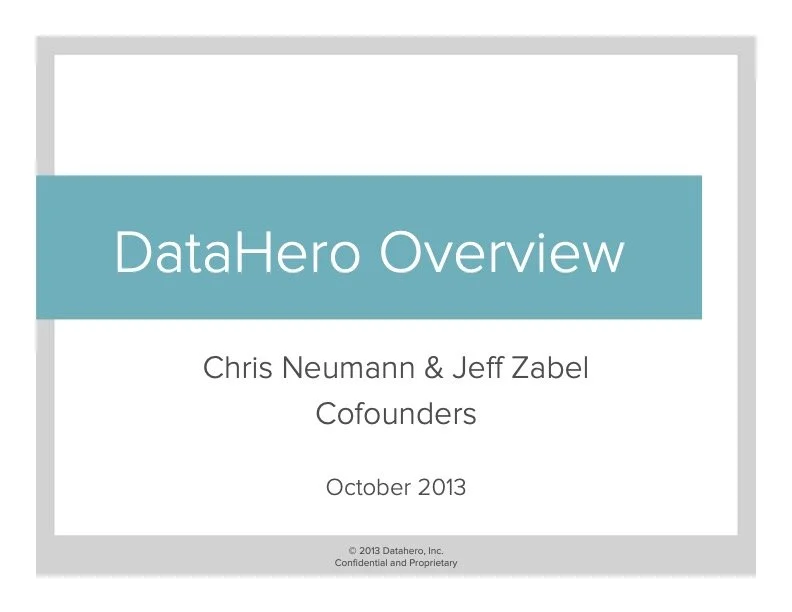
Title Slide

DataHero was founded at a time when tongue-in-cheek interfaces were quite popular (e.g. MailChimp had monkeys all over). Our branding was designed around superheroes, with a mid-century look.
The title slide showcases the art style (which we thought was important given our focus on UI/UX) and the background suggests that DataHero is some sort of an analytics product.
The one mistake in this slide is that we used our marketing tagline instead of describing our product and/or market, so it’s not clear what exactly DataHero is or who it’s for.
Slide #1

What did we put on our very first slide…? Another title slide! 🤦♂️
Having a subject title slide like this might make sense if you’re presenting at an academic conference or BigCo™️ event, but in a pitch deck it’s completely unnecessary/redundant.
(If we wanted our names as cofounders at the start of the deck, we could easily have put them in the actual title slide.)
Slide #2

Here’s the real first slide. The opportunity to grab the reader’s attention, like an explosion right out-of-the-gate in an action film.
So what did we do? We shared a company timeline — something that should generally be the second-to-last slide in a deck.
Oh…and the timeline didn’t have any user- or revenue-related achievements.
An effective first slide needs to have impact. It could describe the problem being solved and its scale, present compelling traction metrics, or show impressive customer logos. But it has to draw the reader in and make them want to learn more.
This…ain’t it.
Slide #3
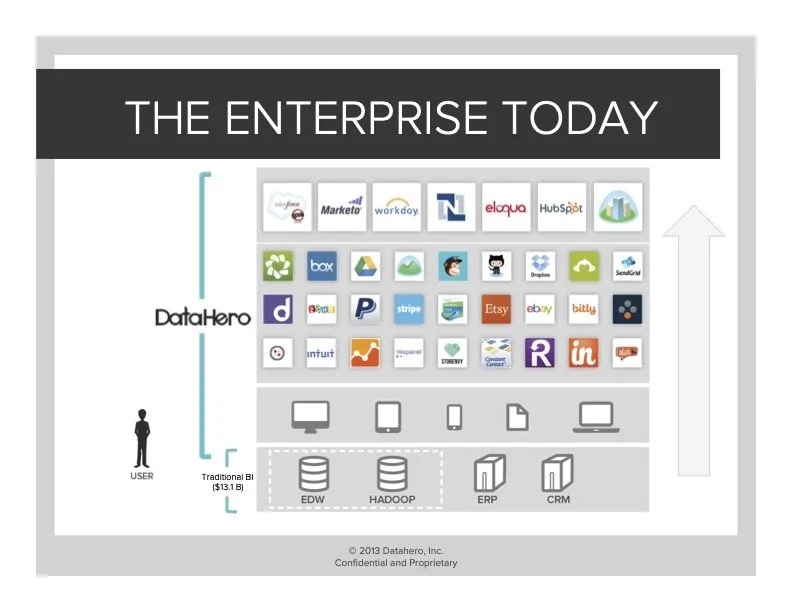
This, on the other hand, is a pretty effective slide.
It frames the problem we were solving by showing the data sources that traditional BI solutions worked with (at that time, primarily on-premise databases and other software) and contrasts that with the many SaaS services BI software couldn’t connect to.
If I were to do anything different with this one, I’d try to find some numbers to quantify those services in some way (how many users do they have? how much do companies spend on them, etc.). We implied that it was a big market by including the size of the traditional BI market, but at that time it was still a leap of faith to quantify the opportunity for DataHero.
Slide #4

This is a strong, concise product statement.
The only way to improve it would be to add market sizing, such as:
“DataHero will be the platform that enables 5 million enterprise users to visualize their cloud data”
or
“DataHero will be the platform that enables enterprise users to visualize 100 PB of data locked away in cloud services”
Slide #5
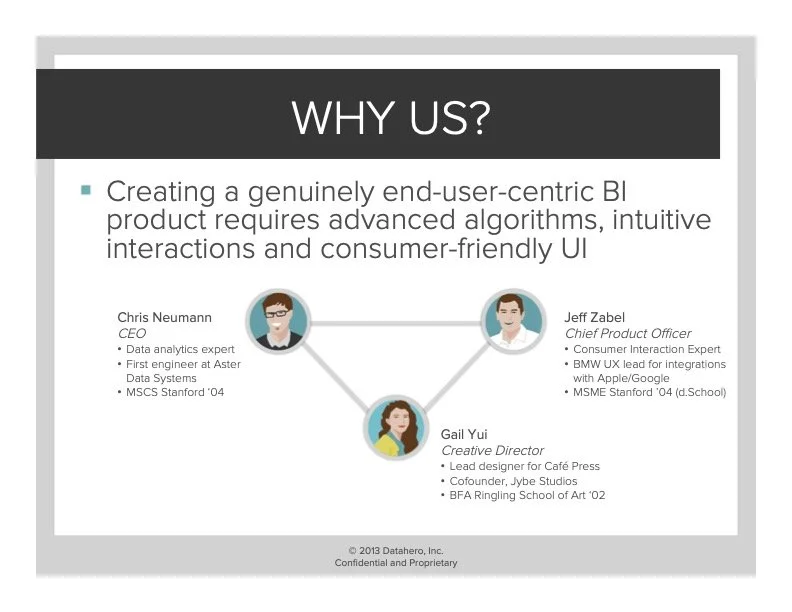
This is another strong slide that answers one of the most important questions early investors have: “Why are you the team to win this market?”
In the case of DataHero, we were building a product focused on a new market: business users who relied primarily on cloud services and needed to better understand the data stored within those systems. We felt that our combination of a CEO with a background in enterprise data software, a well-known UX expert and a creative director who led design at a Sequoia-backed company through IPO perfectly positioned us to develop the right product for this market.
This slide resonated strongly with potential investors.
Slide #6

This was a placeholder slide for demos during in-person / virtual meetings.
There’s obviously no reason to include this slide in a deck being emailed to investors. That said, were we to remove it, we would have needed to add more screenshots of the product (which we should have done anyways, since this is the only screenshot in the entire deck…).
Slide #7

This is a relatively decent “what does your product do” slide, but in hindsight it would have been better if we had replaced the cutesy cartoons with actual screenshots and/or a flow chart describing the user journey.
Slide #8

User/customer quotes are great, but they’re always a bit suspect when they don’t include the name of the company where a user works.
I can’t recall why we didn’t include Ali’s company name here - likely we thought it was too small or unknown. Now that I’m on the other side of the table, I see it through a different lens: you should always include customer names / logos whenever possible (even if you don’t think it’s a “big” name), because it’s an actual customer and you can/should project pride around that!
Everyone has to start somewhere.
Slide #9

Ok, so I just said that user/customer quotes are great…
…but there’s no reason for them to span two slides.
These should be combined into a single slide (with company logos added to each).
Slide #10

This is the first slide in the deck that references traction.
As an investor, the fact that it took so long is going to make me a bit skeptical, especially given that the timeline slide told me that the public launch occurred at least three months prior. We should have gotten to this sooner.
As for the slide itself, one of the biggest questions we faced when raising our Pre-Seed was “would end users pay directly for a data product?” (the number of successful bottoms-up SaaS products was still relatively small at that time). The title was meant to answer that question. The thing is, almost none of the investors we spoke with about our Seed round had met us before - so we were answering a question that they didn’t ask.
As such, they interpreted this slide as us claiming that we had “proven” a market, when it was obvious that we weren’t anywhere close to product-market fit.
All registered users proves is that you’re good at marketing. It says nothing about what happens after signup - is the product actually what people are looking for..?
Slide #11

At first glance, this is a really strong slide. It’s a list of amazing logos of companies that were using our product.
Unfortunately, they represented free users, not paying customers (at the point we raised our Seed round, we had just started to figure out monetization and how to effectively separate our free and paid products).
That said, to a potential investor, this is likely an impressive enough list to result in a first meeting - if only to dig in deeper. At the time, several investors told me that this slide was what resulted in us getting a meeting. The problem was, when they inevitably asked us how many of these companies were paying customers, we would sheepishly say “zero…” which wasn’t a great look.
Slide #12

This is a relatively strong case study slide, with one exception: it’s also talking about free users rather than paying customers. And the wording makes that fact glaringly obvious to an experienced VC.
As an investor, anytime I see a case study slide without any reference to revenue or licenses, alarm bells go off. 🚨
This slide is effective at showing that “land-and-expand” was working for DataHero as a product, however (unbeknownst to us at the time), it also makes clear that we weren’t in control of it — it wasn’t yet working from a sales perspective.
All that said, at the Seed stage, this is still okay — because pricing can be fixed.
Slide #13

Ugh…another slide with “proven” in the title 🤦♂️
I’m not sure why we made this slide the way we did, but in our minds it was important to emphasize how cheap/scrappy/cash-efficient we were.
As a concluding/timeline slide, the bullet points are solid. As a team slide, this is underwhelming (because we don’t include any logos of where our employees previously worked).
Going back to my comment on slide #5 about investors wanting to know why you’re the team to win, anytime you show your team it’s essential to include key details about them. A picture is worth 1,000 words and the best way to do that is to add logos of prior employers, schools, etc.
Slide #14

Conceptually, this go-to-market strategy makes sense.
But as an investor, I’m screaming “where are the numbers?!?” The product has been in market for at least 3 months, slide #10 has fairly impressive registration numbers (at least, for those days), but there’s still nothing concrete about user behaviour, retention or — heaven forbid — revenue.
As an investor, the fact that we’re now on slide #14 and I haven’t seen anything on unit economics is setting off all sorts of alarm bells that nobody is actually using this product (and they’re certainly not paying for it).
Slide #15

This is an interesting product slide, but I immediately want to learn more:
Which integrations were most popular?
What are the retention/revenue metrics for each?
What did you learn by attempting to attract a “diverse base of business users?”
For in-person meetings circa 2013, this was great (because we had answers to all of those and it would steer the conversation in a certain direction). By 2022 standards, this slide needs more depth.
Slide #16

There is literally no reason why this should be a separate slide (vs. combining it with slide #15).
Slide #17

This slide really frustrates me - as it breaks one of the cardinal rules of pitch decks: don’t mix two separate topics on a single slide.
The first section talks about predictors of usage (which hints at our retention / monetization strategy), while the second is about feature requests (or at least it reads that way - it was actually a really awkward way of explaining why the majority of our users didn’t connect a cloud BI product to a…you know…cloud service).
Oh…and still no depth to the numbers.
Some charts and substance around retention would have been great here. Also using plain english to explain that the 75% of users who weren’t connecting to SaaS services were doing so because they were uploading Excel files (from corporate data stores, services we didn’t support yet, etc.) and visualizing them.
Slide #18

Oh, look! Another roadmap slide.
All of this makes sense, but it’s frankly pretty in the weeds and could easily be combined with slide #14.
Slide #19

But wait! You haven’t seen enough roadmap slides yet? Let’s add one more… 🤦♂️
…and what is this one is entirely focused on? Product. Nothing about user numbers, revenue, or any other business metric. Just features and functions.
Interesting stuff to be sure, but by this point as an investor, I’m likely convinced that there are zero active users, zero revenue and I’m skeptical that there’s any plan whatsoever for sales and marketing. Typical technical/product founders building a product without talking to customers…
(The worst part is, we had tons of data from talking to early users and customers, but we weren’t showing it!)
Slide #20

Slide #20.
The second-to-last slide in the entire deck is the first and only time we used the word “revenue”.
FFS.
And even then — this slide shows projections for 2014 and beyond, but there is still no information whatsoever on the revenue DataHero had achieved to-date.
Looking back at my records, at the time of our fundraise our revenue was pretty paltry (we had about 20 paying customers generating around $500/mo in revenue), but it was something. To think that we could “hide” it from potential investors was beyond naive. Even for an early startup, you have to talk about revenue.
In our case, while our revenue was minimal, we actually had a strong free user base and had learned an incredible amount around usage patterns (hinted at in slide #17). The revenue was a lagging indicators because we had the wrong “premium” features at the time — something that’s fairly common for early startups. We should have leaned more into the data we had, rather than shying away from the revenue we felt that we didn’t have.
Slide #21

The final slide: the ask!
…this slide makes me cringe every time I look at it.
It makes two big mistakes:
It doesn’t include anything about what we’re going to achieve with the fundraise (how many users will we attract, how much revenue will we generate, etc. with the funding)
It positions $3M / $3.5M as already secured.
The former is a very common mistake in pitch decks. Founders talk about what they’re going to spend the money on, but not the milestones they’re going to achieve with it. Investors want to know what your plan is for the next 12 - 18 months to understand how you will de-risk the business and position it for a subsequent raise.
The latter point is one where I know we made a big strategic mistake.
Foundry Group, who led our first round, had shared their conviction in DataHero and offered to take down the entire seed round. We wanted to test the market, but didn’t know how/if to leverage Foundry’s offer with other investors.
We thought that we could gain leverage by bragging that “our existing investors think DataHero is so awesome they’re willing to put another $3M in!” but by including it in the deck the way we did, I believe a significant number of investors passed without a meeting because they presumed the lead to be secured. They thought we were looking for a relatively small amount of money to close the round (which wouldn’t achieve their ownership targets) and passed immediately.
Overall Review
Now that we’ve gone through each slide one-by-one, what are the key takeaways?
The Good
Despite the title of this post, there were certainly some things we did right:
The design of the deck was clean and did a good job of reflecting our brand and approach. (There continues to be a healthy debate around whether or not a pitch deck needs to “look good” — I am firmly of the belief that if UI/UX is a key part of your value proposition, the answer is 100% “yes.”)
We did a good job of answering the question “why are you the team to solve this problem?”
We presented the opportunity effectively by contrasting the world today (BI for on-premise data stores) with the world of tomorrow (BI for cloud-based services).
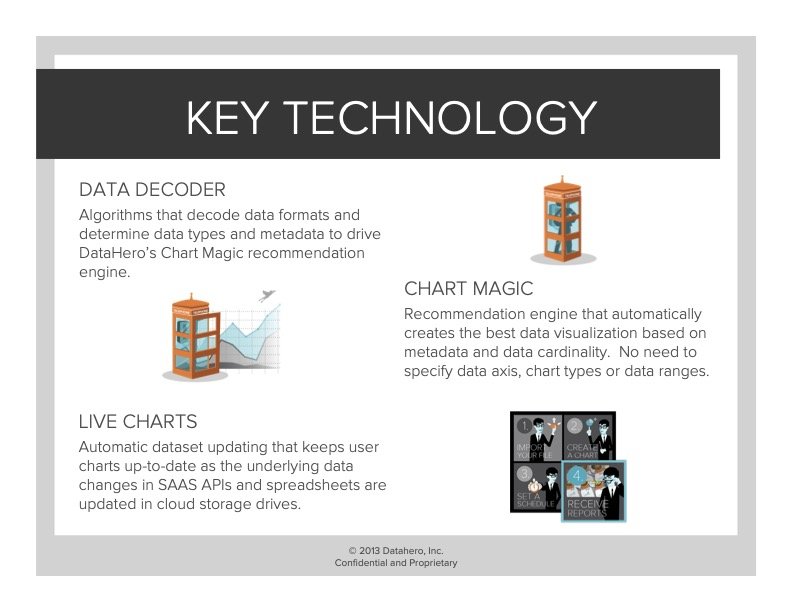
We presented the key features in an easy-to-understand manner while making clear that there was real tech under-the-hood.
We had strong customer quotes in support of the product.
The Bad
By far the biggest overall issue with our pitch deck was the complete lack of metrics. Despite the fact that we were only a few months into market and had almost no revenue, we had a significant amount of data around usage patterns and user retention. At a minimum, we needed a revenue slide (since every investor immediately asked about it), but in reality we could have done a lot to support our progress towards product-market fit by including user data — and we had a ton of it. By committing the sin of omission, we left potential investors free to assume the worst: that we were a heads-down product-centric startup that was good at getting registrations, but not at building a product users actually wanted.
In hindsight, the lack of screenshots was another obvious omission. DataHero was a gorgeous product with a UI that blew away every other BI tool at the time, yet we leaned on illustrations instead of showcasing the product itself.
A third missing piece was a competitive slide. We alluded to legacy competition in slide #3, but there’s no mention of any other analytics tools for SaaS services (DataHero was the first horizontal cloud BI tool, but there were service-specific tools already in market at the time, such as Baremetrics for Stripe).
Ironically, we had all of these slides — we just held them back them for after the first meeting. What we didn’t realize at the time (which I now clearly know), is that by holding back key parts of the story, we lost a lot of potential investors who never opted in to meet us.
In addition to the points above, the overall flow of the deck could be significantly improved. We should have led with the problem statement and market instead of starting with history to make sure we were hitting hard from the start. Revenue/traction definitely should have come earlier and with far more depth. Investors want to know what you’ve achieved (no matter how early in your journey you are), so don’t bury the lede!

This tweet from Paul Graham sums it up nicely
Finally, the deck was way too long. A good Seed deck should be 10 - 12 slides long (14 slides max). In our case, a number of the slides could easily have been combined, which would have made the deck far more concise and impactful. If all the user data we didn’t include made the deck too long, we could have put those slides into an appendix without sacrificing flow.
The Ugly
Including Foundry’s verbal commitment on the slide deck was a monumental error on our part. Instead of having the intended effect of demonstrating strong support from our existing investors, it gave the misconception that the lead investor was already decided and we were only looking to fill out the round.
So What Happened?
In October 2013, we launched our fundraising campaign, with our investors supportively sending out introductory emails to everyone on our target list. A significant majority declined those introductions, which I now believe to be in large part due to (a) the lack of metrics in our deck and (b) the manner in which Foundry’s verbal commitment was framed.
We still met with a good number of investors, several of whom went deep into diligence. Ultimately, the fact that we were so early into monetization at the point of fundraising was a challenge for net new investors (particularly given the amount we were looking to raise). After a few weeks, we pulled the plug on our process and finalized the internal round with Foundry leading:
DataHero Raises $3.1M and Revamps its Analytics Service
- GigaOm, December 10, 2013
Canadian VCs Need to Get Out of Canada
As a Canadian investor, I get to meet incredible founders from Victoria to St. John’s every single week. But as much as I enjoy crisscrossing this magnificent country, for me to be an effective investor, it's essential that I get out of Canada.

As a Canadian investor, I get to meet incredible founders from Victoria to St. John’s every single week. Some of the most ambitious people on the planet are building world-changing companies in the country I love and I’m privileged to have a front row seat. But as much as I enjoy crisscrossing this magnificent country (both virtually and – finally! – on airplanes again), for me to be an effective investor, it’s essential that I get out of Canada.
Already this year, I’ve been to San Francisco, Miami, Atlanta and LA. By the summer, I’ll have added Austin, Los Angeles, Tokyo and a second trip to San Francisco. Why do I do this? If my job is investing in Canadian startups, how can I possibly justify spending so much time gallivanting around the world?
Because it’s the only way for a VC based outside of Silicon Valley to be truly effective.
It shouldn’t come as a shock for me to point out that Silicon Valley is the only ecosystem in the world where investors see global deal flow. But think about the implications of that statement:
The best founders from all over the world travel to the Bay Area (physically or virtually) to raise capital. As a result, Silicon Valley investors can sit back confidently knowing that they’ll see the best that the world has to offer. When they make investment decisions, they do so with a global perspective.
For the rest of us, we need to put the work in.
That work comes in the form of travel. I love to travel and it makes me a better person in numerous ways. But it makes me a better investor in at least three:
Better Investment Decisions
If I only meet Canadian founders and only talk to Canadian investors, then my entire perspective on tech is based on what’s happening north of the 49th parallel. But my job is to invest in Canadian companies that can dominate on a global scale.
The Olympics have taught us that while we can own the podium in some sports, the best in Canada often don’t make the finals. The same is true with startups. That’s not a knock against Canadian founders. It’s the reality of competing in global markets. As an investor, I need to know what’s going on in the rest of the world in order to understand how good the “best in Canada” really is.

In both Olympics and startups, Americans often dominate the podium
Having a better understanding of the global tech landscape provides all sorts of advantages as an investor:
I can go all-in on an under-the-radar startup because I’m confident there’s nothing close anywhere in the world
I can pass with conviction on a “hot” local startup that other investors are tripping to get into because I know that there are three well-funded competitors in other countries that are still in stealth mode
By tapping my network to diligence startups in others countries, I can see opportunities to invest where others are scared away by “too much competition”
I can more accurately incorporate the likelihood of subsequent funding into my investment decisions, because I understand what downstream Silicon Valley investors believe will be hot/cold in the next 18 months
Better Founder Advice
For most founders, investors are a key source of mentorship and advice (I certainly believed that my investors knew everything back when I was a founder). One of the most crucial areas that investors have impact in is helping founders understand what milestones they need to achieve to raise the next round.
The problem is, if your goal is to raise your next round from Silicon Valley VCs (which is the case for the most ambitious founders the world over), then you need to know what Silicon Valley investors are looking for. Unfortunately, too many Canadian investors authoritatively tell founders that they need to achieve X, Y and Z to raise their next round, when the only downstream investors they’ve spoken with are down the street.
I can’t tell you how many Canadian founders I’ve met who dutifully marched towards the milestones their investors so confidently laid out, only to discover that they were nowhere close to what Silicon Valley VCs were actually looking for. Never mind the number of times I’ve heard a Canadian investor dismiss a large US-led round as being nothing more than FOMO or a company “raising a Series A on Seed metrics,” — as if the most sophisticated investors in the world were simply being duped.
The entire Silicon Valley ecosystem - startups and investors alike - evolves at a rate unlike anything else in the world. The best Canadian investors recognize this and are constantly In Silicon Valley. The lazy ones regurgitate media talking points instead of taking the time to understand the changing dynamics at play.

I was 4 rows behind Boris on this flight 👀
Better Investor Introductions
Job #1 for every VC is to help their portfolio companies raise their next round.
As important as mentorship and hands-on help is, the single biggest impact investors have after writing the check (cheque?) occurs during fundraising itself, helping companies prepare their pitch, making warm introductions to downstream VCs and championing portfolio companies through the process. In Silicon Valley, this is burned into the psyche of every investor, which is why they spend 1/3 of their time networking with other investors.
In Canada, not so much.
When I lived in Silicon Valley, I regularly met with Canadian founders who were trying to raise money in the US and was shocked by how many told me that their well-known, well-respected VCs provided zero warm introductions to Silicon Valley investors. Are you serious?!?
Today, there are nearly 2,000 active VC firms of various shapes and sizes between San Francisco and San Jose. The landscape is constantly changing, with new funds popping up literally every week. If I want to help startups raise their next rounds, then I have to meet as many of those investors as I possibly can, which means getting on a plane.

One of 4 dinners I had with investors on my last trip to SF
To be clear, my primary focus is — and will continue to be — meeting Canadian founders and investing in Canadian startups. This quarter alone, I’ll travel from my home in Vancouver to Victoria, Toronto, Montreal and St. John’s.
But for me to serve those founders best, it’s absolutely essential that I get out of Canada.
Why Did I Come Back to Canada?
Since moving from San Francisco to Vancouver in late 2020, I’ve been asked one question over and over: “Why did you come back to Canada?

Since moving from San Francisco to Vancouver in late 2020, I’ve been asked one question over and over: “Why did you come back to Canada?”
The short answer is that the Canadian tech ecosystem is at a generational inflection point and I want to be a part of it.
The longer answer is that through my nearly 20-year journey in Silicon Valley, I’ve developed a unique expertise in helping international startups access US capital. I believe not only that Canada is on the precipice of greatness, but that I can help accelerate the global potential of the next generation of Canadian startups.
In 2002, I moved to the Bay Area for grad school and became immersed in the Silicon Valley tech scene. My professional journey started at Motorola (back when the Razr was the hottest phone on earth and the iPhone was nothing more than an Apple fanboy’s dream), followed by two incredible startup adventures as the first employee at big data pioneer Aster Data and the CEO/cofounder of DataHero.

Aster Data, 2006 (Redwood Shores, CA) — Like my pink shirt?
After DataHero was acquired in 2015, I joined 500 Startups, where I invested in data and AI startups around the world on behalf of the firm’s flagship accelerator. Seeing the immense opportunities in bridging the gap between Silicon Valley and global startup ecosystems, I left to found Commonwealth Ventures. The goal of Commonwealth Ventures was both simple and groundbreaking: to increase the rate at which international startups could raise capital from Silicon Valley VCs with a starting assumption that they would never relocate to the US. At a time when the majority of US VCs still expected international founders to move to Silicon Valley as a condition of investment, this was unheard of.
And we were incredibly successful. Through a combination of mini accelerators (“fundraising bootcamps”), hands-on services and a powerful mentor network, in less than 3 years we helped international startups raise over $100M in Seed and Series A funding from US investors.
So why did I forgo this global opportunity to focus exclusively on Canada? Here’s the thing: 90% of that funding was raised by Canadian startups.
Even to a proud Canadian, this was a stunning result that I didn’t see coming. It turned out that two fundamental shifts were at play:
The Canadian startup ecosystem, which for years had been slowly but surely growing, was finally reaching escape velocity — with compelling new startups emerging faster than almost any other country in the world
US VCs had overwhelmingly become comfortable investing into Canadian domiciled companies
The second point represented a tectonic shift from only a few years prior, when most US investors still required Canadian companies to reincorporate in Delaware (and, thus, forgo significant tax breaks and grant opportunities).
With such an incredible opportunity staring me in the face, whatever thoughts I had of building Commonwealth Ventures in San Francisco crumbled like Jimmy Garoppolo on a fourth quarter drive. It was clear to me that the real opportunity was to focus exclusively on helping Canadian startups close the funding gap with their American competitors. Less than a year later, Commonwealth Ventures was acquired by Panache Ventures, Canada’s leading pre-seed and seed stage venture fund.
And, thus, began the next chapter in my startup journey, back where I started.