Chris Neumann
Investor | Founder | Advocate
Make it Easy for Customers to Love You
Back when I lived in San Francisco, one of my favorite places to shop was Fatted Calf. If you’ve never been there before, it has by far the best selection of meats and charcuterie in the 7 x 7. From the quality of products to the level of knowledge and customer-focus possessed by the staff, it’s an exceptional retailer on every level.

Original Fatted Calf location on Fell St.
So when I moved back to Vancouver, I was already reserved to the fact that I wouldn’t find a butcher shop anywhere close to Fatted Calf. Then one day, I stumbled upon Two Rivers Meats. The wholesale supplier of meat to top restaurants throughout Vancouver had coincidentally opened a retail location in the neighborhood that we moved to.

Two Rivers Meats “The Shop”
At this point, you’re probably wondering where I’m going with all of this. Stick with me…
On one of my early visits to Two Rivers Meats, I picked up a couple of duck breasts for dinner. When I got home, I opened the package and to my surprise, saw the following:


If you’re not someone who regularly cooks duck, you might be shrugging right now. Notice the crosshatch pattern on the duck fat. This is called “scoring”. It’s something you do before cooking meat with a fatty side that you want to crisp up, like duck or pork belly.
In the case of duck breast, scoring the fatty side is almost always the first preparation step. But the butchers at Two Rivers Meats had already done that for me. I then flipped the duck breasts over to remove the tendon (the second step in preparing duck and one that I find particularly tedious). But lo and behold, that was also done!
While this might not seem like a big deal, for a mediocre home chef like myself these two small details probably saved me 10 minutes of prep time (including scoring, removing the tendon, and washing the knives and cutting board afterwards). As a result, my preparation was simply: season with salt and pepper, add a few drops of balsamic vinegar, a grating of orange rind and a bay leaf, and put in the fridge. Less than a minute start-to-finish.

The folks at Two Rivers Meats didn’t need to do this. In fact, almost no butchers do. They know that their customers are making buying decisions based on the quality of the product (so these small details likely wouldn’t change that decision). But in scoring the duck fat and removing the tendon — something that probably took their expert hands less than 30 seconds — they left me absolutely delighted.
I soon discovered that they do this with every product they sell that has “standard” preparation requirements. For example, removing the membrane from ribs or trimming the excess fat from brisket.
So what does this have to do with startups?
Many tech products have “preparation tasks”. Data analytics and machine learning products frequently require that the data be uploaded in a certain format or labelled in a particular way. Hardware products often need setup and installation. Migrating from a competitor’s product can sometimes involve many steps (not to mention a steep learning curve).
Founders, of course, often hope to solve all of this with automation. But in the early days of a startup — when you have limited resources and are still trying to figure out what the end product is going to be — self-service onboarding is rarely magical. In fact, it’s frequently the opposite. Bad, incomplete onboarding often gets in the way of early users becoming delighted in the promise of your new product.

Underpinning that? The eagerness of the founders to “do things that scale.”
Sure, we could format a new user’s data, but we can’t possibly do that for 10 users. Or 100. Or 1,000.
Sure, we could drive to a new customer’s home or office to physically setup their hardware, but we can’t possibly do that for 10 customers. Or 100. Or 1,000.
Sure, we could give one-on-one training to a new user to help them onboard, but…
You get my point.
In 2013, Y Combinator founder Paul Graham wrote an essay titled Do Things That Don’t Scale about this very challenge. Ten years later, many founders (and entirely too many investors) are still convinced that manual tasks are not scalable. That having human involvement in recurring user interactions is inherently bad.
I’ve never understood this.
Think about the contrast between these approaches:
“Download this CSV template and put your data into this format before uploading it” vs. “Send us your data and we’ll upload it for you”
“Follow these steps to configure the product” vs. “We’re happy to walk you through the configuration over Zoom, or we can come to your office and do it for you in-person”
“Click the link corresponding to the product you’re migrating from to get a list of equivalent functions in ShinyNewApp™” vs. “Schedule a call and we’ll walk you through a personalized onboarding to make sure you understand how to access all of the functionality you’re used to with BoringOldApp™ and can take advantage of all the new hotness in ShinyNewApp™”
Lands different, huh?
And guess what? Doing that messy, annoying, non-scalable stuff leads to an increased level of communication with early customers that accelerates the path to product-market fit and can result in long-term differentiators.
So in your early days, when you’re still trying to find product-market fit, don’t be afraid to roll up your sleeves. Make it easy for your customers to love you.
(Just don’t be surprised when those messy, annoying, non-scalable things turn into messy, annoying, scalable differentiators.)
If I Had a (100) Million Dollars 🎵
In venture capital, “portfolio construction” refers to how a fund “spends” (invests) its capital. Let's examine the variables at play when a VC decides what to do "If I Had a (Hundred) Million Dollars".
If you’re of a certain age — and especially if you’re a Canadian of a certain age — then the lyrics to the Barenaked Ladies’ 90s hit If I Had a Million Dollars are undoubtedly etched into the recesses of your brain. For those too young to remember this folksy anthem, it’s an ode to all of the things the singer would buy if he suddenly had a million dollars (which, in those days, was a mind-boggling amount of money).

Maybe a nice chesterfield or an ottoman.
Thinking about how to spend money is something that VCs do regularly. In venture capital, “portfolio construction” refers to how a fund “spends” (invests) its capital. How much is invested in new companies vs. follow-on investments? How big should each investment be? How many companies will the fund invest in? And so on.
So let’s jump in and discuss the variables that come into play when a VC decides what to do…If I Had a (Hundred) Million Dollars.
Check Size
Check size is the first variable founders tend to think about: how large of a check does a VC write?
(That makes sense, since it’s the most important variable from the founder’s point of view.)
"We write checks between $500K and $1.5M.”

A nice reliant automobile.
Number of Investments
Naturally, the next thing to think about is the number of investments. How many $500K to $1.5M checks will our hypothetical VC write?
For simplicity’s sake, let’s take the median of their investment range. This gives us an average check size of $1M. The VC will, thus, invest in $100M / $1M per company = 100 companies.
"We write checks between $500K and $1.5M. This fund will invest in about 100 companies.
Simple, right? Not so fast…

I’d build a tree fort in our yard.
New Investments vs. Reserves
The number of investments isn’t only about check size. We also need to consider what percentage of the fund the VC intends to put towards new investments vs. the funds they will reserve to put additional money into portfolio companies down the road.
For example, a “60/40” fund will deploy 60% of its capital into new companies and then take the remaining 40% and put it into into second (or third, or fourth…) checks into a subset of those same companies.
There’s a wide range of “reserve strategies” employed by VCs. At one end of the spectrum, some funds (particularly smaller, emerging funds) write only “first checks”. They have a reserve strategy of 100% new investments and 0% follow-on investments. At the other end of the spectrum are “opportunity funds”. These are dedicated funds raised by VC firms for the explicit purpose of investing additional capital into existing portfolio companies.*
If we assume that our hypothetical VC has a 60/40 ratio, then the number of new investments evolves to: $100M x 60% / $1M per company = 60 companies.
"We write checks between $500K and $1.5M. This fund will invest in about 60 companies, with 40% of the fund held for follow-on investments.”
* Advanced readers will note that opportunity funds are technically 100/0 rather than 0/100. Although they are exclusively for follow-on investments from the perspective of the VC firm as a whole, from the perspective of the opportunity fund itself, each investment is into a “new” company.

They have pre-wrapped sausages, but they don’t have pre-wrapped bacon.
Stage and Ownership Percentage
Although we started with check size (because it’s important to founders), we didn’t talk about how a VC decides on their range of check size.
For most firms, the range of check size is a function of the strategy that the fund intends to use to generate returns. Key to this strategy is the stage at which they invest and the target ownership percentage. Some factors that come into play:
The earlier you invest in a company, the less it costs (👍) but the more risk you take (👎)
Also, the earlier you invest in a company, the more times you are likely to get diluted as a result of the company raising subsequent rounds of capital (also 👎)
How a VC thinks about the impact of dilution is the main factor in their reserve strategy. The combination of those two influences their approach to target ownership percentage.
For example, one fund might focus on achieving a high ownership percentage with the initial check, assuming that the impact of their follow-on investments will be minimal. Another fund might aim for a lower initial ownership percentage, preferring to see how the founders perform over the first year or two before deciding whether or not to invest substantial follow-on capital.
It’s worth noting that the size of a fund has a significant impact on all of this (a $100M fund, for example, can’t possibly invest in Series C rounds). Charles Hudson has an excellent post that explains how a VC’s fund size dictates their strategy.
Let’s assume that our hypothetical VC has landed on a strategy where they intend to focus on Seed stage investments, targeting an ownership percentage of 10% (astute readers will note that you can reverse-engineer the target valuation that a VC has based on check size and target ownership percentage).
"We invest in Seed stage companies with initial checks between $500K and $1.5M. This fund will invest in about 60 companies, with 40% of the fund held for follow-on investments. Our target ownership percentage is 10%.”

But we would eat Kraft Dinner.
Follow-On Strategy
Another important consideration is how the VC plans to invest their reserve capital.
Some VCs invest in only one follow-on round, while others will aim for more than that. Smaller funds might only invest their “pro rata” amount (the amount of money required to maintain their ownership percentage), while larger funds often try to increase their ownership percentage in top companies. And then there’s the topic of bridge rounds / extensions.
Many founders presume that their VC will support them with a bridge or other follow-on investment if they fall short of their objectives, but the reality is a large percentage of VCs do not write such checks. Instead, their follow-on strategy focuses on making additional investments only into their portfolio companies that are doing well (“doubling down on the winners”). Too many founders wait until it’s too late to ask their VC, “Do you still ❤️ me?”
"We invest in Seed stage companies with initial checks between $500K and $1.5M. This fund will invest in about 60 companies, with 40% of the fund held for follow-on investments. Our target ownership percentage is 10%. Our goal is to invest our pro rata amount in Series A and B rounds. We will also invest our pro rata into bridge rounds, but we do not lead them.”

But not a real green dress, that’s cruel.
Management Fees
So we’ve got it all figured out, right?
Wrong.
After all that, it turns out that our hypothetical VC doesn’t actually have $100M to invest.

Haven’t you always wanted a monkey?
Like most investment firms, VCs charge a “management fee” to their LPs, which typically averages 2% of committed capital. The management fee provides the operating capital for the firm (salaries, lawyers, accountants, back office software, travel, Patagonia vests, etc.).
Standard VC funds are structured as 10-year investment vehicles (3-4 years to make new investments and 6-7 years after that to support the companies as they grow), which means that VCs charge a management fee each year for 10 years.
If we assume that our hypothetical VC has an average management fee of 2% per year, then the amount of capital available for them to invest is actually $100M - ($100M x 2% per year x 10 years) = $80M.
Time to redo our math…
Fund size: $100M
Investable capital: $80M
Check size: $500K - $1.5M (median check size $1M)
Capital for new investments: $80M x 60% = $48M
Capital for reserves: $80M x 40% = $32M
Number of new investments: $48M / $1M per company = 48 companies
Which gives us the following portfolio construction:
"We invest in Seed stage companies with initial checks between $500K and $1.5M. This fund will invest in about 48 companies, with 40% of the fund held for follow-on investments. Our target ownership percentage is 10%. Our goal is to invest our pro rata amount in Series A and B rounds. We will also invest our pro rata into bridge rounds, but we do not lead them.”
The Adrenaline of VC Deal Flow
What happens to VC behavior when the adrenaline of deal flow runs out?
Recently, my partner Prashant Matta and I were discussing the slowed pace of fundraising in Canada (a topic that’s been top-of-mind for many people as of late). We spoke about the impact that the lull in activity has had on our individual day-to-day operations as well as on our teams. Prashant thoughtfully observed that one of his priorities during times of reduced activity is not allowing inertia to take hold.
Which got me thinking: we talk a lot about investor psychology during times of heightened activity, but not about the inverse. What happens to VC behavior when the adrenaline of deal flow runs out?

In any enterprise sales process, understanding buyer incentives, motivations and psychology is key to winning deals. And fundraising is, ultimately, an enterprise sales process. The more you know about how your “buyers” think, the better prepared you are to succeed.

When the economy is strong and fundraising activity is rampant, investors and founders alike are busy. Most of the blog posts, advice columns and articles that have been written about investor psychology presume this heightened level of activity. Google “fundraising FOMO” and you’ll get pages and pages of advice how to leverage FOMO during fundraising.
But what happens when overall fundraising activity is low? What happens to investor behavior when VCs aren’t tripping over each other chasing fast-moving deals?
Let’s start with the 5 Stages of Deal Flow Grief:
1. Excitement
Believe it or not, VCs are generally excited when they get an unexpected break from deal flow. That’s because most investors don’t have nearly enough hours in the day to get everything done. Just like startups, VC firms build up a lot of “tech debt” over time, as customer priorities (i.e. deal flow and portfolio support) trump everything else. So when there’s a break in activity, we dive in with both feet to try to make progress on process improvements, infrastructure projects and catching up with other investors and ecosystem players.

Actual footage of top tier VC
2. Denial
The second stage of Deal Flow Grief is denial. As the period of low activity extends into weeks, VCs will often resist the urge to acknowledge it, instead trying their best to explain it away (“It’s Spring Break. It’s Easter. It’s the first week in May when startups historically upgrade their laptops…”). They’ll pretend that everything is normal when catching up with other investors, wary of signalling a change in their firm’s deal flow (“How am I? Totally slammed! So many deals right now.“).

3. Insecurity
After denial comes insecurity. “Am I the only one who’s deal flow is slowing? Am I missing out on deals that other VCs are seeing? Is it just my city/stage/sector that’s slowing down…?”
Crucially, this is the point at which a VC’s tendency to invest starts to diminish. Unsure of whether or not they’re seeing the best startups, investors will slow their pace as they second guess the merits of the new deals that they do see.

4. Panic
As the slowdown continues, some VCs — particularly inexperienced ones — may panic and make poor investment decisions (a behavior that’s not entirely dissimilar to when investors get caught up in FOMO during frothy periods).
Early on, this can manifest as deals that take place at higher valuations than they should (e.g. investments that occur with lagging high valuations at a time when valuations are broadly falling). Over time, the panic can result in VCs lowering their bar and investing in companies that wouldn’t normally meet their criteria. (This is especially common in cases where the VC has vocal LPs that are themselves inexperienced and exert pressure on the investor to deploy capital.)

5. Acceptance
Finally, there is acceptance: VCs eventually come to terms with the shift in deal flow pace and adjust accordingly.
At this stage, VCs actively communicate and set expectations with their LPs that activity has slowed, alleviating external pressure to invest in deals that might not otherwise meet their requirements. They may also start to make adjustments in anticipation of a prolonged slowdown. For example, we’re currently seeing some investors extend their deployment period (the time frame in which they can invest in new startups).
It’s worth noting that not all VCs can do this. Government VCs and some regional VCs, for example, have expectations that they will deploy capital regardless of changes in the macroeconomic environment. As a result, it’s not uncommon to see these types of investors deploy as much — if not more capital — at a time when angel investors and financially-driven VCs slow their pace to match the rate of deal flow.
So where are we now?
At this point, we’ve broadly reached the acceptance stage of Deal Flow Grief. The vast majority of investors globally have come to terms with the fact that we’re in an extended period of low activity. That doesn’t mean that VCs aren’t willing to invest in new companies (the vast majority — particularly at Pre-Seed and Seed — are). It does mean that their psychology around making new investments has changed.
In the acceptance stage of slow deal flow, VCs have by-and-large disassociated themselves from any external pressure to do new deals. They’ve calibrated with enough other investors to confirm that, no, it’s not just them. They’ve spoken with their LPs about the reduction in activity and have likely received broad buy-in to adjust their investment strategy accordingly.
The result? A creeping inertia to not make investments.
That’s right, during extended periods of slow activity, investors flip from a fear-of-missing-out to a fear-of-making-bad-investments (FOMBI?).

For startup founders who are fundraising, their are two consequential impacts of this inertia:
In general, VCs will no longer “round up” when receiving your pitch.
During periods of high activity, the adrenaline of deal flow causes investors to give you the benefit of the doubt on certain aspects of your pitch. VCs won’t skip diligence, but they can absolutely get caught up in the excitement and have their skepticism tempered. In periods of low activity, VCs can become even more skeptical, as they increasingly worry about making bad investments. Expect to have more questions asked and more of your assumptions challenged during fundraising meetings.
It’s harder to generate competition amongst VCs
As inertia sets in, investors slow their deal pace. This can mean more meetings with each investor and — crucially — more time between meetings (as VCs no longer feel the time pressure to rush into a deal). The reduction in pace, combined with some VCs stopping making new investments altogether, makes it harder for founders to generate competitive dynamics when running a high-velocity fundraising process.
“So…does that mean I shouldn’t try to fundraise right now?”
No, absolutely not.
First off, although we’re starting to see signs of a deal flow rebound in Silicon Valley, we’re likely two quarters or more away from a rebound in the rest of the world. Fundraise when you need to and don’t risk your runway waiting for a change in the fundraising environment.
Secondly, keep in mind that the vast majority of VCs want to make investments right now. VCs can’t generate returns if they don’t invest in startups and there’s a lot of dry powder in the market (they’re also really excited about AI right now!). The fact that VCs have alleviated the short-term pressure to invest doesn’t mean that they want to sit on their hands. It just means that they are going to be more cautious and thoughtful when making new investments. Good VCs, like my partner Prashant, are actively trying to resist inertia.
Finally, you absolutely need to bring your A-game when fundraising in this environment:
Make sure your deck, data room and supporting materials are ready to go before you take a single meeting.
Build up a substantial funnel of qualified target investors before you start your outreach. This is not the time to drip feed your process or take 5 meetings per week. Founders raising Pre-Seed, Seed or Bridge rounds should aim for at least 100 - 150 qualified target investors in your CRM; for Series A, at least 80 - 100. Your goal is to line up 30 - 40 meetings in week one.
Don’t play fundraising games. This is not the time for fake FOMO or other goofy approaches (I’ve seen too many of these recently).

If you haven’t fundraised before or your last fundraising experience was in the Good Times™ of 2020-2021, expect to have a very different experience than what you’ve read about or previously experienced. VCs are still looking to cut checks, but they’re slower moving and more cautious than during times of heightened activity.
Be prepared and stick to the basics. It might take extra work to overcome their inertia, but if you come correct you’ll get the result you’re looking for.
How Needy Are VCs?
How often to VCs really want to hear from founders? And how do they prefer to communicate with them?
Plenty of blogs have been written about how important investor updates are. The reasons why — and frequency with which — founders should send updates to their VCs and angel investors have been shared ad nauseam. Google “investor updates” and you’ll get pages and pages of results. Heck, I even wrote one once.
But how often to VCs really want to hear from founders? And how do they prefer to communicate with them?
In the old days, founder-investor communication mostly happened via email or phone. Today, there are phone calls and text messages, Slack channels and WhatsApp groups. There are asynchronous voice and video memos — even VR if you’re so inclined.

What do you mean MRR went down?
I asked 30 VCs about their preferred style of communication in order to get to the bottom of the question: how needy are VCs?
How Frequently Do VCs Schedule Calls?
To start off with, I asked our VCs to share their preferred frequency of scheduled calls with founders:

The majority of VCs I spoke with prefer either bi-weekly or monthly scheduled calls with their portfolio founders (40% of each). Two of the VCs preferred weekly calls, while 4 of them don’t have any regularly-scheduled calls (preferring to communicate entirely vs. ad hoc conversations instead).
A number of the investors noted that the frequency of scheduled calls depends on the relationship between the VC and the founder:
“The frequency of my communication with teams changes depending on the relationship, company stage, need for support (generally early-stage cos need more help), and whether there are major changes to discuss.”
- Dana Oshiro, Heavybit
Additionally, several pointed out that this frequency typically changes over time:
“It evolves over time. We like to zoom with founders 2x per monthly directly after an investment. Then scale back to 1x. Then quarterly. Then ad hoc.”
- Kirby Winfield, Ascend
Ad Hoc Communication
When it comes to ad hoc communication, almost all of the VCs were of the opinion that frequency is generally up to founders:
It's less about 'how regularly' and more about making sure they know what we can help with, trust us to be responsive and useful, and that we live up to their expectations.”
- Hunter Walk, Homebrew
Many also pointed out that the frequency of ad hoc communication naturally ebbs and flows as each startup progresses. For example, ad hoc communication is very frequent leading up to and during fundraising, but can be almost nonexistent at other times:
“We usually have…lots of ad hoc communications via text/WhatsApp/Telegram. In some cases, that can be multiple times a day (e.g. during a fundraise), sometimes our founders are just heads-down and there is not much to share (and an investor cannot really help).”
- Boris Wertz, Version One
Mostly, the VCs emphasized that their goal is to make it easy for founders to reach them when they need to:
“We set up a group chat on Signal with all of our founders the minutes they join the Race family. We want them to know we are here for them anytime he or she needs.”
- Edith Yeung, Race Capital
As for their preferred medium of communication, the answers were all over the place:

I guess no one likes phone calls anymore 🤷♂️
For founders, this variety can be challenging to manage (especially as your cap table grows). Which inevitably leads to the question of “your platform or mine?”.
As appealing as it might be to try to convince all of your investors to use your preferred medium, in my experience when working with someone who has a strong personal preference, you’re likely to get the most out of them by adapting to their preferred communication style instead of the other way around. For example, if you know that a particular VC lives on Slack, jumping on there when you need something from them is likely to get a faster response than if you contact them another way.
Of course, if an investor truly has no preference, then by all means go with whatever you prefer:
“Each founder chooses their own preferred methods — some are heavy texters/WhatsApp, others prefer emails or calls. Some want to bundle their most active investors into a single group, where others prefer startup:Homebrew specific chats. We're really open to anything they want.”
- Hunter Walk, Homebrew
What About In-Person?
It used to be that VCs strongly preferred to be physically close to the founders whose startups they invested in. I remember many conversations with investors back-in-the-day who justified their geographic investment preferences based on the importance of being able to meet in-person “if the founder needed it.” While that’s not nearly as common today, many investors still value the ability to communicate in-person with founders:
“In addition to monthly Zoom calls and email, slack, text/phone, I try to meet in-person with every founder at least once a quarter.”
- Prashant Matta, Panache Ventures
It’s About Balance
As particular as many investors are (shout out to the VC who prefers email over text because it’s “better for my OCD” 😉), at the end of the day the perspective shared by almost all of the VCs I spoke with is the desire to find balance:
“Overall, we want to find the right balance of being close enough to the founders/businesses so that we understand enough to be helpful while making sure they have the maximum time available to build the business.”
- Boris Wertz, Version One
At the end of the day, investors want to be as helpful as possible to their portfolio founders — they have significant financial incentive to do so — and communication is a key part of that. If investors aren’t up-to-speed with what’s going on in the business, there can be missed opportunities:
“It's the founders' time - they're not 'reporting' to us so much as we're using it to maintain a minimum viable context that allows us to be proactively useful to them vs just waiting for email investor updates.”
- Hunter Walk, Homebrew
(Thanks to all of the investors who responded to this one — and all the many ways they did so!)
Things I Think I Think - Q3 2023
With all of the uncertainty of the past couple of years, I’m often asked for my opinion on the state of the venture market, macroeconomic trends and what’s happening in tech both within Canada and abroad. So I thought I’d start sharing my thoughts on a quarterly basis.
I’m definitely not the first person to do this. To that end, here are some recent state-of-the-market posts I think very highly of (go read them!):
Dave Kellogg of Balderton Capital’s Predictions for 2023 / Review of 2022
Logan Bartlett’s 2023 State of the Market from Redpoint’s AGM
Alex Kolicich of 8VC’s Q3 2023 State of Venture Update
And now, in the spirit of sports columnist Peter King, here are 5 Things I Think I Think - Q3 2023 Edition:
1. Valuations Have Stabilized, Deal Flow Has Not
Last week, Alex Kolicich of 8VC posted an excellent analysis of the current venture market, arguing that the “new normal looks a lot like the old normal of 2018.” While I think this is true of valuations, from the perspective of deal flow / number of deals being done, we’re not there yet.
In the Bay Area, activity at the Pre-Seed and Seed stages has picked up significantly and we’re starting to see a meaningful number of Series A and B rounds getting done. However, outside of the Bay Area, the rebound hasn’t been as pronounced.

The view from New York
Many founders I’ve spoken with outside of the Bay Area remain anxious about the willingness of VCs to write checks and are holding off on fundraising. In parallel, some VCs are reticent to make new investments at a time when they’re not seeing very many opportunities. A handful of funds have gone a step further by extending their deployment period (the time frame in which they can invest in new startups), while others have started privately repositioning themselves around the 2024-25 “vintage years”.

The perspective in Utah
That’s not to say there aren’t any deals being done. In Canada, a number of startups have recently raised substantial rounds in hot sectors, such as AI and climate. There are also quite a few angel rounds taking place across the country. But we’re not seeing close to the same increase in deal flow velocity at the Pre-Seed / Seed / Series A that’s occurring south of the border.
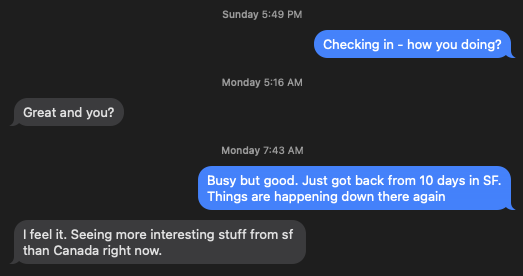
Checking in with a Toronto-based GP 👀
As a result, I expect two things to come out of Q3 and Q4 in Canada:
The aggregate amount of venture dollars invested will go up moderately relative to Q2, primarily driven by a small number of large deals
The total number of deals completed will stay relatively flat (or potentially even decrease) when compared to Q2
Looking further ahead, I expect that we’ll start to see a meaningful pickup in the number of deals starting in Q1 2024, with overall deal flow activity stabilizing by next summer.
2. Many Canadian Founders Continue to have Unrealistic Valuation Expectations
In Silicon Valley, the return to pre-pandemic valuation norms is, at this point, well understood and accepted by both investors and founders. This mutual understanding is, in my opinion, one of the key reasons why Pre-Seed and Seed activity has picked up sharply in the Bay Area leading into Q4, whereas we haven’t seen the same rebound in other ecosystems. Investors and founders are broadly on the same page, so deals are getting done.
In Canada, we continue to see founders across the country approaching investors with valuation expectations that are more reflective of 2021-22 market conditions than what’s happening in 2023.

(Note: I fully recognize the conflict-of-interest / self-serving nature of an investor proclaiming that valuations need to go down, but hear me out…)
In general, the valuations of companies that raise funding from Silicon Valley VCs are higher than the valuations of similar companies raising capital anywhere else in the world, due in large part to the globally unique competitive dynamics amongst Bay Area investors. All things equal, companies that raise from U.S. VCs should generally command higher valuations than equivalent companies who raise from non-U.S. VCs (other than competitive situations where a non-U.S. VC “beats” a U.S. VC for a deal).
But in Q3, we regularly met with Canadian founders who were looking for valuations that were significantly higher than what equivalent companies are currently raising from Silicon Valley investors.
Valuation alignment between founders and investors is crucial to deal flow velocity. Obviously, founders will almost always want a higher valuation than what investors might prefer to give, but so long as the gap remains relatively narrow, deals get done. That’s not what I’m seeing in Canada right now. In contrast to Silicon Valley, the valuation gap between Canadian founders and investors is inhibiting deals that would otherwise take place from getting done.
Historically, it’s not unusual for Canada to lag Silicon Valley by a quarter or two when it comes to adjusting to market changes, so my hope is that we’ll see convergence by the end of the year (which would further support a strong level of activity in Q1).
3. Q4 Will See a Lot of Startups Shutdown
At the same time we’re beginning to see a resurgence of investments in new startups, we haven’t yet seen the full washout of startups who raised their last round of funding during the ZIRP heyday of 2020-21 but failed to achieve product-market fit.
Giving credit where credit is due, many founders did an incredible job of extending their runways as market conditions changed. Unfortunately, the majority of them (as is true with all entrepreneurial endeavors) will ultimately fail to reach profitability or product-market fit. At this point, there are a large number of startups around the world that are finally reaching the end of their capital and are unlikely to attract new investors.
Some companies, like Clearco, will survive through recapitalizations and down rounds. But at a time where many investors remain hesitant and/or are looking ahead to new opportunities — such as those being created around AI — many more will find their journeys come to an end.
I expect that the next two quarters will see a lot of startups seek out soft landings or close their doors altogether, which will feel rocky for the Canadian startup sector. But in the long (and even medium) term, this will result in a recycling of experienced startup workers into new companies at a time when demand for talent remains high.
4. Generative AI is at Peak Hype, Generative AI is Just Getting Started
The first half of 2023 saw generative AI land at the forefront of public consciousness following the release of ChatGPT 3 in late-2022. VCs around the world rushed to make investments into this new generation of AI companies while the public’s imagination went wild. 123 of the companies in YC’s summer batch were AI-related (including Panache portfolio company, Reworkd 😉).
But as Alex Kolicich noted in his recent state of venture market update, web traffic related to generative AI has dropped sharply since the summer and there are widespread reports that ChatGPT’s revenue has similarly slowed, suggesting that the public’s infatuation with gen AI has waned.
From an investment standpoint, VC dollars for core models and infrastructure are coalescing around a relatively small number of companies (with some pretty massive rounds taking place). The initial excitement around agents and other general-purpose AI tools is fading and most investors (Panache included) are looking ahead to vertical-specific applications of AI.
In general, the shift from general-purpose platforms to purpose-built applications takes time, so don’t expect to see many of these in market for several quarters. But investments are taking place and the applications are coming.

5. Generative AI Will Change Startup Trajectories Forever
A lot of people describe the potential impact of generative AI on company-building by comparing it to the shift from on-premise hardware to cloud computing. The emergence of cloud computing massively decreased the cost of bringing a software product to market, as startups no longer needed to buy expensive servers (I still have PTSD from all of the servers we had to build at Aster Data…). The corresponding argument is that generative AI will further decrease the cost of bringing a software product to market, as fewer developers will be needed to achieve the same output.
While that’s certainly true, there’s a second potential impact that could be an absolute game-changer: generative AI has the potential to significantly reduce the length of time it takes to bring a software product to market.
Think about it: while the emergence of the cloud meant that startups no longer needed to buy and provision expensive hardware, it generally did little to reduce the length of time needed to create the software that sat on top of the cloud. (Yes, AWS and its peers over time created a variety of tools to streamline operations, but you still had to write the software).
Already, we’re seeing AI copilots and other generative AI tools improve the efficiency of developers by 3x or more. What happens when instead of measuring the savings in headcount and cost savings, we think about it in terms of development velocity? Can we achieve the same amount of development work in 1/3 of the time? Is it possible that we’ve just upended The Mythical Man-Month?

Is this still required reading in school…?
To be clear: I don’t expect that generative AI will magically reduce the length of time needed for every task in a startup (e.g. it’s still going to take months for enterprise startups to get through BigCo™’s convoluted procurement process), but I think we’ll absolutely see a decrease in the length of time needed for many software startups to bring initial products to market, achieve product-market fit and generate meaningful revenue.
For self-service and PLG-driven SaaS companies, it’s very likely that we will see a corresponding compacting of time between funding rounds. Conventional wisdom holds that startups generally raise funding every 18-24 months, but I think we’ll start to see a subset of startups raise at shorter intervals and/or “skip” funding rounds, due to their ability to quickly hit key milestones that de-risk the business in a meaningful way.
SF is Back
This past week, the Panache Ventures team returned to San Francisco for our annual Bay Area retreat. It was my second trip to SF in as many months and my fifth visit this year, but this trip was different. After this most recent visit, one thing is unequivocally clear to me:
SF is finally, actually, genuinely back.

Really…?
I lived in the Bay Area for 18 years, 12 of those in San Francisco’s South of Market (SoMa) neighborhood. When I first moved to SoMa, there were virtually no tech companies there. People lived in SoMa primarily because of its proximity to the Caltrain and the 101 (the two main ways of getting south to Silicon Valley). But after Ed Lee became mayor in 2011 and changed some of the city’s notoriously anti-business policies, SoMa quickly transformed into the heart of San Francisco’s tech scene. As new condos and office buildings filled the skyline, startups flocked to the neighborhood.

We moved DataHero’s HQ from Palo Alto to SoMa in 2013
Investors soon followed and by 2015, the South Park area of SoMa was surrounded by VC offices. Big tech came too. Google, Facebook, Apple and many others established sizeable outposts in SoMa to attract SF-based tech workers who didn’t want to commute 2+ hours each way.
All that changed with the arrival of Covid. Almost overnight, San Francisco’s most bustling tech neighborhood became deserted. As tech companies big and small shuttered their offices, many local restaurants, bars and shops were forced to close. The shiny condo buildings once popular with tech workers saw their occupancies plummet as many left the city.

2nd and Mission, in the heart of SoMa (mid-2020)
When you live in a neighborhood for 12 years, it means something to you. The places you visit, the small businesses you frequent and the many people you see week-in-and-week-out become a part of your life. I’ve been back to San Francisco nearly two dozen times since moving to Vancouver 3 years ago, and on every visit I make a point of of visiting and supporting my favorite restaurants and local shops.
It’s been hard to watch many of them struggle through Covid, only to emerge directly into another battle-for-survival.

But on my most recent visit, something was different. For the first time since 2020, SoMa felt like SoMa.
The Return of SoMa
When we arrived on Sunday, the streets of SoMa were filled with a particularly San Francisco brand of energy. Over the course of the week, our hotel pulsed with the vibrancy of tourists, tech conference attendees and baseball fans gearing up for the annual Giants-Dodgers rivalry (though it wasn’t much of a rivalry this year).
It was clear that the restaurants and bars were also experiencing a revival. One of my long-time favorite restaurants was packed solid on Wednesday night — the first time I’ve seen it full (on any night) in years. Catching up with the owner, she shared that it finally felt to her like they were turning a corner, after numerous near-death experiences.
Several bar locations that had previously shuttered had re-opened. Nearly all were busy for happy hour. There were people walking up and down the streets after work. Not nearly as many as pre-Covid, but a lot more than before. You couldn’t help but overhear people commenting on how good it felt to be busy again.

Sitting outside in the cold because the happy hour bar we went to was full
On Saturday morning, I visited the San Francisco farmers market — one of the largest farmers markets in North America. When I lived in SoMa, shopping at the farmers market was a weekly ritual for me. I would always go early (7:30am, at opening) in order to avoid the crowds and get the best produce. For the past three years, no matter what time of day I went, the foot traffic was sparse.
This past Saturday, it was packed.


I would guess that the number of vendors was about 80% of pre-pandemic and the number of shoppers about the same, but it was a marked improvement from my last visit.
There was something else I saw that morning for the first time in years: dozens and dozens of runners jogging up and down the Embarcadero, weaving in and out around morning shoppers. When I was a local, I used to complain about having to dodge tourists while running on the Embarcadero, but seeing this sure felt great.
Forever A Gold Rush Town
Since the day that gold was discovered in the Sierra Nevada foothills in 1848, San Francisco has been a gold rush town. Nearly two centuries after the actual gold rush ended, the Bay Area’s population continues to ebb and flow with the economy. In the late-90s, people rushed to join the dot-com boom, then fled when the bubble burst. Same thing in 2008. And again in 2020. But a funny thing happens each time: after the opportunists leave, the builders arrive.
When I moved to the Bay Area in 2002, most people were leaving. The only people coming here were hungry to learn and eager to build. It was like going the wrong way on a busy escalator. The same thing happened in 2009-10.
And it’s happening again in 2023.
Many of the people who loudly fled for buzzy destinations like Miami and Austin have quietly returned. But more importantly, new, young builders are coming. I personally know dozens of founders who have relocated to the Bay Area for the first time in their lives this year — 5 of them in the past month.
As a result, the buzz of startup activity around the city has started to return. Almost every night, there are meetups, hackathons and networking events taking place across San Francisco. When Panache Ventures hosted our latest U.S. investor event — a standing room only affair for VCs, angel investors and others in the Silicon Valley ecosystem — it was one of several stops for many of the people who attended. And that was on a Tuesday night!


Rana Sarkar, Consul General of Canada
I even saw some very early, very small — but also very meaningful — indications of a thawing of commercial real estate. SF has a particular commercial real estate challenge that will take years, if not decades to dig itself out of, but over the course of the week, I met with multiple VCs and founders who were in the process of moving into new or larger offices. Some were admittedly taking advantage of the current dip in commercial real estate prices, but many were moving in order to accommodate larger teams. That’s a positive sign.
Back, But Not Back
As excited as I am about what I witnessed last week in San Francisco, I want to be clear that SF is still a long way from returning to its pre-pandemic form. It may never get back there.
Without going down the (very deep) rabbit hole of San Francisco city politics, there are a lot of structural challenges that need to be fixed and the timeline for those fixes will be measured in years. While some conferences (and conference attendees) are beginning to return to San Francisco, the city continues to lose flagship events. Prominent local businesses continue to close, even while others open anew.
SF is back. But it’s not “back”.
At least not yet.

Can we still create this future?
What Does This Mean for You?
For founders, investors, and others who care about tech, my message is simple: it’s time to pay attention to San Francisco again.
In contrast to the doom-and-gloom of the mainstream media, startup and investor activity is picking up dramatically in both San Francisco and Silicon Valley. While we still haven’t hit the bottom in terms of tech layoffs or startups reaching the end of their runway — and San Francisco itself has an incredibly difficult journey ahead of it — the phoenix is beginning to rise from the ashes.
The city of San Francisco is different from before. SoMa is no longer ground zero for everything in tech. Many startups and VCs have moved to other neighborhoods, like the Mission, Potrero, the Presidio and Hayes Valley (though for the love of god, please stop trying to rename it “Cerebral Valley”).
If you’re a Canadian VC, it’s once again time to get out of Canada. If you’re a Canadian founder, you should probably do the same. Founders and investors alike need to benchmark themselves against the best in the world, and the San Francisco Bay Area is reclaiming its crown.
Despite all of its challenges, the City by the Bay remains at the center of global innovation. It’s also the only place in the world you can get picked up by an autonomous vehicle that plays this:
I, for one, welcome our new overlords…
What Cooking Can Teach You About Fundraising
Here are 6 things cooking can teach you about fundraising.
I love to cook. Large parties, small groups or just for myself — I’ll cook any chance I get. It’s one of the things that recharges me.
There are many important lessons from cooking that apply to fundraising — so let’s have some fun! Here are 6 things cooking can teach you about fundraising:
1. Preparation Makes All the Difference
The best chefs spend as much time doing prep work as they do actually cooking. When you’re in the midst of a complex cook, you don’t have time to stop and chop ingredients. Everything needs to be ready to go.

Preparing like this…

…enables you to create this.
The same is true in fundraising.
If you’re planning to run a high-velocity fundraising process (which is what most Pre-Seed, Seed and Series A rounds should generally be), then you won’t have time to make things up as you go along. Your deck, data room, fundraising CRM and fully-qualified investor funnel must be ready to go before you take a single meeting.
As Benjamin Franklin famously said, “By failing to prepare, you are preparing to fail.”
2. Presentation Matters
Any VC who tells you that it doesn’t matter what a deck looks like is lying.
That’s not to say that you should go and spend thousands of dollars on a professional designer for your deck (you shouldn’t). But presentation is important. First impressions matter and your deck is often the first impression that an investor has about you and your company.

A bowl of tomatoes and peas
Whether VCs admit or not, design absolutely has an impact on their reaction when they literally review hundreds of decks each week. In particular, investors are very observant when it comes to your attention to detail (or lack thereof). If a deck has spelling or grammatical mistakes, the slides aren’t aligned correctly or the images are pixelated, it’s distracts from the message you’re trying to convey.
On the other hand, a well-designed deck can add emphasis to key points in your story and make sure that investors come away with a solid understanding of your business. A well-designed deck isn’t going to guarantee you get a meeting, but with the prevalence of free/cheap tools to create good decks and solid imagery, there’s simply no excuse to not come correct.
3. Practice Makes Perfect
Even the simplest techniques and dishes take a long time to perfect. Your fundraising pitch is no different.

I’ve smoked a lot of ribs over the years…


It’s important that you practice your pitch with as many people as you can before you start fundraising. Start with existing investors, advisors and other founders. Make sure you practice with people who don’t already know what you do. Ask them to repeat back to you their takeaways to make sure that you’re getting your key points across.
Then, start your process with at least 5 - 10 investors that you don’t really care about. You’ll get different questions and have a different experience when you’re talking to someone who’s genuinely considering investing (while giving yourself enough meetings to get comfortable, knowing that you’ll probably screw the first few up).
4. Time Things Right
When you’re preparing a meal, different components will take different lengths of time to cook. Some items might take only a few minutes while others take hours. Making sure you get the timing right is the difference between everything coming together nicely and half of the items on the plate being cold.

24-hour brisket, 6-hour ribs, 2 hours for the chicken wings and 45 minutes for stuffed portabello mushrooms. All at 250º.
The best founders manage their fundraising process with the same level of intentionality.
VCs who’ve never met you before might need several meetings to come up to speed, while investors who already know you can make a relatively quick decision. Understanding each firm’s decision process and how far along they are, and then strategically controlling when each and every meeting takes place (relatively to other VCs) is how the best founders drive towards multiple term sheets at the same time. If you lose control of the process or let investors dictate the timing, you can end up with a term sheet from one firm before others are far enough along to make a decision.
5. Quality of Ingredients
The quality of the ingredients has a massive impact on the final result for any recipe. Whether it’s fresh, locally-sourced produce or grass-fed, free range meat, you can taste the difference.

The same is true in fundraising. At the end of the day, VCs are looking to invest in great companies. Focusing on your “ingredients” (revenue, unit economics, customer satisfaction and case studies, etc.) will have far more of an impact on your fundraising result than anything else.
6. Show Your Personality
Investors see hundreds of decks each month. Most are bland and formulaic. Leaning into your startup’s personality — whatever that is — can help you be memorable.
If you’re creative, be creative! If you’re super nerdy, be super nerdy!

Hi, I’m a pie.
How to Write for Success
Learning to put your best foot forward in writing is one of the most significant ways to increase your fundraising success.
We live in an era where a significant percentage of new relationships start in writing. Emails, text messages, social media posts and dating apps all serve as jump-off points for real-life relationships.
But it wasn’t always that way.
Back when I was in high school — cough cough 30 years ago — we had pagers but not yet two-way messaging. Email wasn’t mainstream (I didn’t get my first email address until university). And unless you were one of the super-nerdy people experimenting with BBSs (guilty-as-charged), you’d certainly never met anyone over the “Internet”.

I had the blue one 🔵
In those days, virtually every new relationship — personal or professional — started with an in-person introduction.
Today, the majority of new relationships start in writing. Introductions are made over email and text messages. We meet people in WhatsApp groups and Discord channels, by posting social media comments, sliding into someone’s DMs and “swiping right”. Despite this significant cultural shift, many people don’t consciously think about how they present themselves when they “meet” someone for the first time in writing.

You never get a second chance…
For startup founders, learning to put your best foot forward in writing is one of the most significant ways to increase your success. Improving your written first impression can be a game-changer for sales, fundraising, hiring or trying to get press.
Here are 5 keys to writing for success:
Be Specific
One of the most important things when writing for success is to be specific in your asks. Be up front about why you want to meet this person.
In Canadian culture (and, in fact, in most Commonwealth countries), directness is often seen as rude. We’re taught to dance around our reasons for outreach as though it’s inappropriate to have a specific objective when meeting someone new. This is something that Canadian founders have to unlearn, particularly when entering the U.S. market for sales or fundraising (as American culture values directness in business dealings).

Try to be as specific as you possibly can in your asks:
“I’d like to pick your brain” —> “I’d like to get your feedback on X, Y and Z”
“I’d love to see if there’s an opportunity to collaborate” —> “I’d like to speak with you about our Series A raise”
“I’d love to get your feedback on our deck” —> “I’m struggling with the competition section in our fundraising deck, could you take a look and let me know how it lands with you?”
Be Assertive
When one startup in Panache’s portfolio came out of stealth, a CEO I know pinged me to ask for an intro. He was excited by what he had read online and wanted to talk to them about a trial. I facilitated a double opt-in intro, to which the founder responded with the following:
Thanks Chris (bcc'd)
Hi <redacted>, it's nice to connect! Would love to talk shop when you have time.
While this seems like a reasonable response, there’s no call-to-action. No next step.
In this case, the CEO was a repeat founder himself who often mentors younger founders, so he took the initiative to keep this ball rolling and provide the Panache founder with feedback. Had that not been the case, this hot sales opportunity may very well have died-on-the-vine.
A more effective response would have been something along the lines of:
Thanks Chris (bcc'd)
Hi <redacted>, it's nice to connect! I’d love to learn more about what your pain points are at <redacted> and how we could help. Here is my calendly link to schedule a 30-minute call (or let me know if none of those times work and we can set something up directly).
Just as you do with in-person meetings, make sure your written interactions result in clear next steps and ownership of action items. Don’t be afraid to assert control over the budding relationship’s next steps.
Be Concise
Learning to write concisely is one of the most impactful skills you can learn as a founder.
When it comes to fundraising, being able to concisely convey the key facts about your startup can massively increase your fundraising funnel. You’re trying to convince investors to open your email, then read it, then open your deck and, finally, opt-in to a meeting with you. I find it helpful to think in terms of stages:
A warm introduction and/or good subject line earns you an email open
A well-written, compelling email earns you a deck open
And so on
For the subject line, put one or two key points in there, instead of a generic heading:
“Acme Co Seed Round” —> “YC / $100K MRR / Seed Round” or “Mila Drug Discovery Spinout Seed Round”
For the email body itself, resist the urge to write a rambling, exhaustive email that tries to explain everything about your company. Your goal in the initial email isn’t to try to tell me everything about your startup, it’s to get me to open the deck. That’s it.
I can’t tell you how many founders send me emails that go on for days. If I’ve never met you before, I’m simply not going to read an overly-lengthy email.

Michelle Obama does not have time to read your rambling email
In an introductory email, you need to catch an investor’s attention in the first 1-2 sentences. An effective intro email for fundraising is 1, maybe 2 paragraphs total. It uses bullet points to highlight 3-5 key achievements of the startup and immediately hands off to the deck (either as an attachment or a link).
A good rule of thumb: if someone can’t read a initial email in less than 20 seconds, it’s not going to get read.
Be Prepared
Think about how impressed you are when you meet someone in person for the very first time and they’re:
On time (or early)
Dressed and groomed well
Well prepared for the meeting/date/whatever
…and then they kick off the conversation by saying something that demonstrates they’ve taken the time to research you.

Preparing to meet someone for the first time in writing is just as important as it is in person. It’s why writing personalized request-for-introduction emails has such a huge impact on success rate.
Andy McLoughlin of Uncork Capital refers to this as “show me you know me”:
The best advice to remember with a cold pitch is to “show me you know me”. Show the investor that you’ve done the work and this is why you are pitching to them.
When fundraising, too many founders get stuck on quantity-over-quality and send out generic emails or emails where it’s clear that they’ve half-assed the research (or skipped it entirely). Nearly every investor has a lengthy track record available online, including plenty of blog posts, podcasts and videos. If you really want to get their attention, spend the time to look them up and learn something about them.
Does it take time and effort? Absolutely! But good salespeople know that preparation has a massive impact on win rate. You get out of it what you put into it.
(For more on how to write a great request-for-introduction email, check out this post from Arjun Dev Arora.)
Another place where personalization can make all the difference? LinkedIn connection requests.

You don’t say? 🤦♂️
Don’t Name Drop
This should go without saying, but don’t do it.
When someone walks up to you and says “hey, so-and-so says we should talk,” you immediately know it’s bullshit because that person would have made the introduction directly if they really felt that way.

Guess what? The same thing is true in writing.
One of my team members recently received a cold email from a founder that started off like this:
Hi Tim,
I hope this message finds you well. Found you guys through <redacted> at <redacted>.
The very first thing Tim did? Forwarded the email to <redacted> to fact check:
Hey <redacted> - Hope things are good.
This founder (below) reached out and dropped your name. Wondering if you actually know him? If so, I'll definitely take the call.
It turned out that <redacted> had never heard of this particular founder.
Even if the founder actually knew <redacted>, name dropping almost never works. It immediately shines a light on the fact that the person knows you, yet wasn’t willing to make an introduction — which leaves the recipient wondering “why not?”. You’re better off holding that card to yourself and sending a strong, confident cold email.
Find Your Recharge
Startups are a marathon, not a sprint. Long-term success requires you to pace yourself. It’s essential that you uncover the things that deplete your energy and what you need to replenish it. You need to find your recharge.
When we were building Aster Data back in 2006, the first 10 of us were all under 25 years old. We were fuelled by excitement, adrenaline and a healthy dose of caffeine. We would sometimes go for weeks on end without a day off. In one particular stretch, I literally worked 3 months straight…but that’s a story for another day.
I’m not trying to glorify this type of schedule (this is not hustle porn). But in the early days of a startup — especially when you’re young — the simple act of building can be invigorating.

But that adrenaline can only last for so long. Startups are a marathon, not a sprint. Long-term success requires you to pace yourself. It’s essential that you uncover the things that deplete your energy and what you need to replenish it. You need to find your recharge.

Some people recharge by being in nature. For others, it’s reading books or playing video games. One person might get energy from dancing or going to a rave in the desert while another wants nothing more than solitude.
My wife is very much an extrovert. She gets her energy from being around other people. For her, recharging involves going out and socializing — and it doesn’t matter who with. She gets as much energy from being around complete strangers as she does her closest friends.
It took me a long time to figure out what I needed to replenish my energy — well into my 40s, in fact. Not because I wasn’t recharging along the way, but because I hadn’t needed to consciously think about it. When I was single (and even well after I got married) I did the things I needed to recharge without realizing it.
It was only after I had kids and found my free time all but vanish that I had to think about what I needed to recharge. I often found myself exhausted and stressed, despite not being able to point out anything specific that was wrong. I was sleeping well (or, at least, as well as one can with young kids), exercising regularly and was generally enjoying work. It didn’t add up.
It was only after one of my frequent conference trips that I finally figured it out. After attending a 3-day conference packed with networking events, I was completely exhausted. All I wanted to do was lock myself in a room and not see anyone for a week. And that’s when it hit me like a ton of bricks: I’m an introvert. I need time alone.

Despite the fact that I’m frequently out in public, speaking at events and interacting with founders and others in the tech ecosystem, I’m actually a default introvert. When I was growing up, I would recharge by playing video games, reading, watching TV or cooking. As I grew older and became fully-immersed in the world of startups, I continued to do these things. At least once a week, I would stay home by myself and play video games. I frequently hosted dinner parties where I would cook for hours alone. After I got married, my wife would often tell me how “cute” it was that I loved to watch cooking shows.
For me, recharging means disconnecting. I’m the exact opposite of my wife: she recharges by being around people, I recharge by being alone.
That realization allowed me to re-incorporate some of the things I find replenishing into my schedule in a more intentional way. Now, I cook something new at least once a week (as opposed to before, where my cooking was ad hoc).

A few of my books
I make a point of spending an extra hour or two at the end of each week alone in my home office before jumping back in with the family for the weekend. Sometimes, I’ll read. Other times, I’ll play video games. Setting aside time to do what I need to replenish my energy has been a game changer for me.

Sometimes, I build
What I’m talking about here is different from hobbies (though some of your hobbies may also be replenishing). I love exercising and playing sports, but those things don’t recharge me. What recharges me is solitude.
Understanding what recharges you and incorporating it into your weekly schedule in an intentional way can be a game changer for your productivity, well-being and happiness.
I found my recharge. What’s yours?

VC (Probably) Isn't Right for You
Monique Woodard of Cake Ventures, Marvin Liao of Diaspora Ventures, advisor Mike Sigal, Web Summit host Casey Lau and I recently met with startup founders across Scotland. The one topic we kept returning to? The fact that VC isn’t right for 99% of startups.
One of the greatest privileges of being a VC is that I get to meet incredible founders every day. Week-in-and-week-out, I get to hear the audacious ideas that founders from all walks of life have come up with to literally change the world. As a former founder, I take that privilege very seriously.
But if I’m being honest, it’s not only out of obligation. I really enjoy helping founders.
And I’m not the only one.

A packed house in Inverness, Scotland
Last week, I led a delegation of Silicon Valley investors on a tour of Scotland as part of a joint initiative by Panache Ventures and CodeBase in support of the Scottish Government’s Tech Scalar programme.
Together with Monique Woodard of Cake Ventures, Marvin Liao of Diaspora Ventures, startup and fund advisor Mike Sigal and Casey Lau, host of Web Summit, we met with startup founders at packed events and intimate office hours in Edinburgh, Glasgow, Dundee and Inverness, sharing stories and answering questions on all manner of topics.
The one topic we kept returning to? The fact that VC isn’t right for 99% of startups.

I’ve previously written about the fact that market matters most to VCs. In order to generate returns, VCs look to invest in companies that have the potential to exceed $1B in valuation in 7-10 years — which typically means $100M+ in annual revenue. Most markets simply can’t support that level of growth. And even if they can, most companies aren’t structured to grow that fast.
Both of these are okay. In fact, they’re better than okay. Time-and-time again, our panel of VCs found ourselves dampening the allure of venture capital funding and encouraging founders to not view VC as the end-all-and-be-all.
It was an uphill battle.
Monique Woodard, Managing Partner of Cake Ventures, shared that as part of her diligence process she asks founders to describe in detail how they plan to get from where they are today to $100m in annual revenue. 9 times out of 10, the founders she meets haven’t thought through what this means in terms of the growth trajectory for their business.

Monique Woodard dropping knowledge 💣s in a trendy Glasgow brewery
The reality is that the vast majority of businesses cannot possibly support the type of super-linear growth required to go from zero to $100m+ in annual revenue in 7-10 years. Marvin Liao of Diaspora Ventures noted that companies whose revenue grows linearly with the number of employees, like consulting firms, will never be able to achieve this. That doesn’t mean those aren’t incredible businesses — it just means that they’re not a fit for VC funding.
Unfortunately, many founders aren’t ready to hear this.
Between the deafening hype of VC in the media and the encouraging yet often misguided notion that all founders need to do is find “just one investor” who sees their vision, too many founders get caught up on an endless quest to find mythical investors that simply don’t exist.

I was a wonderful father.
The real shame is that many companies have all of the raw materials necessary to build solid, sustainable businesses if the founders simply focused on generating revenue instead of searching for external investment. One of the greatest disservices of the VC hype machine is that it’s convinced many founders (and ecosystem supporters) that VC funding is the only way to build a tech company.
The vast majority of founders we met during our week-long trip were building businesses that are fundamentally not VC-backable. Of the 200 or so startups we met across Scotland, only one or two were companies with the potential to be VC scale. Not only is that to be expected, it should be celebrated. Those numbers are exactly what they should be!
As VCs, we need to do a better job of educating our ecosystems on what is / is not a fit for venture capital as an asset class. Think about how many founders spend hours in search of capital without realizing that it’s fundamentally not there for them. What if those founders instead focused on searching for early customers and revenue? Our ecosystems (and economies) would all benefit.
There are entire categories of companies that need to be built but will never be a match for VC funding. Opportunities such as:
Non-profits
Small businesses
Startups servicing niche markets
Startups servicing geographically constrained markets
Consulting/services businesses
We need to encourage and celebrate all manner of tech businesses and help make clear which ones are / are not a fit for VC. One piece of feedback I received from a founder in Dundee summed up exactly why this is so important:
Thank you! I’ve been wasting my time going after VCs without anyone explaining why it wasn’t for me. That’s not the type of business I’m building. Now I can focus.
To me, that’s a win.

A Canadian, an American and a Scottish VC walk into a bar…
What is Appropriate VC Diligence?
Founders get a lot of VC diligence requests during fundraising. Here are 6 examples of appropriate VC diligence requests and 6 examples that should set off your alarm bells.
Founders get a lot of VC diligence requests during fundraising. Most are straightforward, some can seem a bit odd and others can feel downright inappropriate. Here are 6 examples of appropriate VC diligence requests and 6 examples that should set off your alarm bells.
Financial Projections
✅ Appropriate: Asking for a Financial Projection
Many early-stage founders don’t understand why investors ask them for financial projections. Surely, if they were “good investors”, they would know that the numbers were pulled out of thin air and that the projections are completely inaccurate.

Of course we do.
The reason why VCs ask for financial projections isn’t because we expect them to be accurate, it’s because they give us insight into how you think. What assumptions are you making about customer acquisition, growth rates and pricing? How reasonable (or unreasonable) are your spending assumptions? And so on.
Ultimately, financial projections serve as an important conversation starter during the diligence process and allow us to better understand how you plan to manage the business (which is, ultimately, what we’re investing in).
🚩 Inappropriate: Asking for Itemized Financial Projections
While high-level financial projections are important to the diligence process, if an investor asks for itemized financial projections or starts debating small details (why are you buying lunch for employees once a week instead of once a month?), it’s generally a red flag. In particular, it can reveal an investor who expects to be involved in each-and-every decision and may ultimately act as a micromanager.
Moats
✅ Appropriate: Asking What Your Moat Is / Will Be
Similar to financial projections, many founders presume this to be a silly / lazy question.

For potential investors, it’s very insightful to hear how you think about long-term defensibility. Are you creating something you believe will become increasingly valuable over time? Are there aspects of your product/technology that are difficult to reproduce? Or do you think it’s all about first-mover advantage?
Regardless of the stage of your company or the industry you’re in, investors want to know how you’re thinking about competition and defensibility. (Packy McCormick recently wrote a great post on how early-stage startups should think about moats.)
🚩 Inappropriate: Asking What if Google Builds This?
For companies that are adjacent to a large incumbent or planning to go to battle with one, asking “what if Google/Facebook/Salesforce/Open AI/etc. builds this?” is a valid question (particularly if it’s not yet clear whether you’re building a “product or a feature”).
But in many situations, it’s just a lazy question. Yes, you should answer it seriously, but if an investor is trying to goad you into a lengthy discussion about what-if-Google-builds-something-they’ve-never-in-their-history-built (or shown any inclination towards building), it’s often a red flag. If the investor presses the issue, ask them why they’re so concerned about it and/or if they have inside information about the company’s future roadmap.

Valuation Expectations
✅ Appropriate: Asking What Your Expectations are for Round Size, Valuation/Cap, etc.
It is perfectly appropriate for a VC to ask you what your expectations are in terms of valuation. It’s a question that will come up in 99.999% of first meetings. Not only does it provide insight into how you’re thinking about your fundraise, it’s a first move that every investor will make in order to try to anchor future negotiations.
How you choose to answer the question is up to you:
If you’re raising a small round on a SAFE — where you’re setting the terms — then you should answer it directly.
If you’re running a high-velocity fundraising process and driving towards multiple term sheets, it’s perfectly acceptable to act coy (e.g. by telling the investor that you’re looking for the market to price the round).
Some programs (e.g. YC) encourage founders to anchor the conversation early on around a high valuation.
Regardless of your approach, you should have a pre-canned answer that you can deliver with confidence.
🚩 Inappropriate: Insisting that Your Expectations be Provided in Writing
With the exception of the dollar amount you are trying to raise, there is no reason for an investor to ever ask you to provide round expectations or progress details, such as the names of investors who have verbally committed, in writing (particularly if you’ve previously shared it with them). Asking for existing investor details is standard (your cap table should be in your data room) as is requesting copies of any SAFEs that have already been signed.
Otherwise, VCs are perfectly capable of taking notes.

User Data
✅ Appropriate: Asking for Retention Metrics, Cohort Analysis, Heatmaps, etc.
For pre-PMF companies, investors know that the early data is inconsistent and inconclusive. There are likely a lot of question marks around churn, long-term retention, frequency of usage, etc. (even if you have revenue). You’re still trying to figure it out.
That’s exactly why investors want to dig into the data. Are things moving in the right direction? Are you figuring out how to more effectively acquire users/customers (e.g. is CAC going down)? Are you plugging holes in the product (e.g. is retention going up / churn going down)? Are you seeing signals of “sticky” cohorts / power users (are there particular cohorts that are highly active)? Is your revenue real?
You should expect during fundraising that investors will ask you to generate a variety of analysis/reports in addition to the ones you’ve already got in your data room. It’s because they’re asking questions you might not have thought of yet and it’s perfectly normal (there is, of course, a limit to how much time/effort you want to dedicate to answering such requests, but so long as the justification for the request seems reasonable, you should go ahead and answer it).
🚩 Inappropriate: Asking for Raw User Data
With few exceptions, a VC asking for raw user data is a huge red flag. In my experience, investors rarely need access to raw customer/user data in order to make an investment decision. (Occasionally, an investor will want access to raw data for confirmatory reasons, but this can come after the term sheet.)
The reality is that most VCs asking for raw user data are doing so to add it to an internal databases, build capabilities that will benefit their firm and/or share it with their portfolio companies. If the investor doesn’t typically invest at your stage, this is guaranteed to be the reason.
If they ask you for raw data and insist that you provide it in a specific format, end the call immediately.

I do think it’s acceptable for investors to ask for samples of the data you’re collecting in order to help them understand your capabilities (particularly if data models, etc. are a core aspect of your IP). There are also some investors who will offer to collaboratively work through analysis during the diligence process — which is totally cool, since the data remains in your control.
But, broadly speaking, the appropriate diligence etiquette is for investors to ask specific questions and for you to provide them with the answers to those question. Not raw data.
User/Customer References
✅ Appropriate: Asking You for Customer References
At some point, every VC will want to speak to one or more customer references. Investors want to hear “from the horses mouth” how they feel about your product and how they’re thinking about it going forward.
You should also expect some of them to do so without asking you in advance. This might feel uncomfortable/inappropriate, but if you’re highlighting a company logo on your pitch deck and bringing attention to them as a customer, you’d better believe that VCs are going to reach out to people they know at that company to fact-check your claims.
🚩 Inappropriate: Insisting on Customer References Too Early
While you should expect every VC to insist on customer references at some point in the process, it’s completely acceptable for you to defer them (e.g. by saying “I’d be more than happy to provide you with multiple customer references as we progress further”). Good investors understand that you have to shield your customer champions from too much activity. Insisting on access to customers too early in the process can be a red flag that they’re looking to educate themselves on the market more than they’re looking to invest in you.

Sales Pipeline
✅ Appropriate: Asking You to Share Your Sales Pipeline
If you’re a B2B company, every VC will ask to see your sales pipeline at some point in the process. Generally, you should have this in your data room ready to go.
A few things to note:
Don’t overthink the formatting of your sales pipeline. It could be a direct export from your CRM, a simple spreadsheet, or a detailed PowerPoint slide.
Your sales pipeline should be broken down into stages that accurately reflect your sales process, with weight-adjusted estimates that reflect the value of your pipeline.
It is completely okay to anonymize some or all of the companies in your pipeline, particularly if there are sensitivities around them.
Expect this to be a focus of discussion during your fundraising process, as the investor attempts to read the tealeaves about your short-to-midterm revenue growth.
🚩 Inappropriate: Asking You to Speak with Sales Prospects
Investors will typically want to speak with one or more customers during the diligence process in order to understand how critical your product is to them and what is the potential for future sales. What isn’t typical is asking to speak with a company that has not yet signed with you (unless it’s a pilot customer who you’ve offered as a reference).

No good investor will ever act in a way that would put a potential sale at risk. While back channel references are common, be wary of any investor who jeopardizes your sales prospects in order to perform diligence — if they’re putting their own best interests ahead of yours this early, you can imagine what they might do down the road.
VC diligence can be intense and at times the questions might seem out of left field. Know that the vast majority of VCs have specific reasons for asking the questions they do and are intentional in the diligence requests they make. They’re trying to gain conviction in you and your business and are coming from a good place.
That said, if something doesn’t feel right, don’t be afraid to ask.
“What question are you trying to answer with this?” or “Can you walk me through how this will help you better understand my company?” are great questions that you should feel empowered to use.
And, as always, trust your gut. If something seems like a red flag, it probably is.
No, You Should Not Give Advisory Shares to Investors
I'm going to be blunt. Angel investors or VCs asking for advisory shares as a condition of investment is not okay. Full stop.
It’s August 2023.
I should not need to write this post today, yet here we are. 🤦♂️
I recently spoke with a founder who recounted an interaction he had with an angel investor who demanded, as a condition of investment, that he receive “advisory shares” (i.e. shares/options over-and-above those that he would receive in exchange for investing in the company under the standard terms of the round).
…because of all the “value add” he would bring to the table.

Unlike many of my other blog posts, I’m not going to provide a detailed history of advisory shares or a nuanced view of the topic. I’m going to be blunt:
Angel investors or VCs asking for advisory shares as a condition of investment is not okay. Full stop.
It’s not standard. It’s not appropriate. And it’s not acceptable in any tech ecosystem in the world. (At least not by any credible investor.)
I’ll go so far as to say that it’s predatory.
Yet we still see it.
Sometimes it’s from angel investors whose egos are far ahead of reality. Sometimes it’s from VCs in smaller markets who are capitalizing on their de facto monopoly. Sometimes it’s simply greedy investors taking advantage of first-time founders. Regardless of the reason, it’s not okay.
I’ve been both an angel investor and a VC. It is an absolute privilege to be able to invest in startups and work with founders. Unfortunately, some investors lose sight of that. They get so caught up in maximizing their return that they forget one of the most basic truths of startups: providing value is how you gain access to that privilege. It’s the cost of admission.
Yet we still see investors who behave otherwise.
It’s not standard. It’s not appropriate. And it’s not acceptable in any tech ecosystem in the world. (At least not by any credible investor.)
What is acceptable?
Asking for advisory shares and/or cash compensation when the work being performed crosses over into the realm of something you would otherwise pay someone to do. When the investor starts to act more like a consultant / part-time employee.
Some examples:
Performing design/branding/UI work (that you would otherwise pay a designer to do)
Training sales teams or performing sales activities (that you would otherwise pay a sales coach to do)
Designing or implementing a marketing campaign (that you would otherwise pay a marketer to do)
Architecting or implementing product (that you would otherwise pay a developer to do)
Building your fundraising materials or project managing your fundraising process (that you would otherwise pay a consultant to do)
Some of the activities listed above are provided for free by VCs as a means to differentiate.
For angel investors (particularly those who aren’t independently wealthy), it’s not uncommon to develop a consulting relationship with some of the companies they invest in and deliver services like those above.
Having an investor who gets meaningfully engaged with the company is totally okay. Because the investment and the services provided are separate decisions.
That’s not what I’m talking about.
I'm also not talking about situations where advisory shares are negotiated as part of the investment in order to solve cap table issues (a rare but not entirely uncommon occurrence).
What I'm specifically referring to is investors who demand, as a condition of investing, that they receive additional shares or options above-and-beyond what others in the round are getting.

The next time someone asks you for advisory shares as a condition of investment, politely but firmly remind them that you are giving them the once-in-a-lifetime opportunity to invest in your company.
Not the other way around.
Don't Talk to Your Competitors' Investors
One question many startup founders have is whether or not they should pitch VCs who have invested in their competitors.
(or On Ethics, Morals and Fiduciary Duty)
One question many startup founders have is whether or not they should pitch VCs who have invested in their competitors. While the answer might seem obvious, there are legitimate reasons why a conversation could be worthwhile:
VCs who have invested in a competitor are likely to be more knowledgable about the space, leading to conversations with more substance
VCs who have invested in a competitor have already demonstrated interest in the space, so a fundraising conversation could have a higher likelihood of success
Many founders believe that if they are not “exactly the same” as a given competitor, all they need to do is convince that company’s investors of the difference and an investment will make all the sense in the world.
Let me take a few minutes to explain why (1) this line of reasoning is flawed and (2) why it is not just a waste of time to talk to a competitor’s investors but why it can be extremely dangerous to do so.

Some founders like to fly too close to the sun…
When it comes to how investors should behave around competitive startups, there are plenty of strong opinions and lots of areas of grey.
So let’s start with two situations that are (or should be) relatively clearcut:
If a VC has divested (sold) all of their shares in a competitor and no longer has any formal relationship with that company, then you should absolutely talk to them
If a VC has a seat on a competitor’s board of directors, then you should absolutely not talk to them
Past Investments
If an investor has divested (sold) all of their shares in a company and no longer has any formal relationship with that company, then they can make an ideal target for a “next generation” startup.
Regardless of the outcome of their prior investment, the VC is likely very well-educated about the space after that experience (whether they feel positive or negative about the space is a different question altogether). So long as the investment is firmly “in the past”, you should absolutely include them in your fully-researched investor pipeline.

Please sir, may I have another?
Board Investments
If a VC holds a seat on a competitor’s board of directors, then you should never approach them during fundraising. This is because the VC has a “fiduciary duty of loyalty” to the company.
fi·du·ci·ar·y du·ty
noun
the legal duty of a fiduciary to act in the best interests of the beneficiary
Historically, the duty of loyalty was intended to prevent self-dealing amongst directors (that is, to ensure that directors put the best interests of the company and its shareholders ahead of their own) and to ensure confidentiality of company information (preventing directors from using privileged information to enrich themselves).

Over time, the definition of the duty of loyalty has evolved and diverged from country to country. In Canada, the fiduciary duty of loyalty requires that directors and officers of a company must “act honestly and in good faith with a view to the best interests of the corporation.”
But what exactly does that mean? The Supreme Court of Canada has ruled that the fiduciary duty of loyalty is owed at all times to the corporation while steadfastly avoiding narrowing the definition (other than to note that directors must act in the long-term interests of the company):
“The fiduciary duty of the directors to the corporation is a broad, contextual concept. It is not confined to short-term profit or share value. Where the corporation is an ongoing concern, it looks to the long-term interests of the corporation.
What Does This Have to do With Fundraising?
The fiduciary relationship between VCs and the companies they sit on the board of impacts fundraising in two key ways:
A VC with a board seat in your competitor will (almost) never be able to invest in your startup
Practically speaking, it’s impossible for a VC to make a new investment into a competitor while completely ignoring all of the confidential information they have learned (and will learn) through their position on the board. As a result, investing in a competitor places them at a high risk of legal liability from the company they sit on the board of.
In other words, if they invest in your company and you become successful in the future, they are at a high risk of being sued for breaching their duty of loyalty.
A VC with a board seat in your competitor will (almost certainly) share any information you give them with your competitor
While the duty of loyalty may not legally force a board member to provide information you share with them to the company they sit on the board of, in all likelihood, they’re going to do so. At the end of the day, their loyalty is unequivocally to your competitor, so you should not have any false illusions that they will keep your conversation private (even if that might seem like the “good” thing to do).
Non-Board Investments
What about VCs who have an investment in your competitor but don’t have a seat on their board?
Legally speaking, they don’t have the same fiduciary duty of loyalty to the company that they would if they had a board seat. Pragmatically speaking, they’re very likely to behave the same way.
A VC with an investment in your competitor will (almost) never be able to invest in your startup
Regardless of board seats, the vast majority of VCs avoid investing in both direct competitors and companies that are immediately adjacent to existing portfolio companies. Pivots are a fact of startup life and investors generally want to make sure that there’s enough “room” between portfolio companies to avoid having two investments in conflict.
Why? Because regardless of whether or not there’s a fiduciary duty at play, competition amongst portfolio companies just isn’t good business. The founders of companies in conflict are less likely to trust the investor in the short term (which prevents the VC from being able to help them). In the long term, one or more founders might feel upset to the point that they actively tell other founders to avoid the VC, affecting long-term deal flow (“don’t take money from them…they’ll just invest in your competitor!”).
Over the years, more than a few VCs have tried to make competitive investments work, only to discover how loud a founder scorned can truly be.
A VC with an investment in your competitor will (almost certainly) share any information you give them with your competitor
Regardless of board seats, investors have a very clear interest in helping their portfolio companies succeed. If they come into possession of competitive information that can potentially increase the likelihood of success, you’d better believe they’re going to share it with them.
The Exception
There is one important exception to the above rules-of-thumb: investors with large portfolios and no information rights.
Certain investors, such as most accelerators, make a large number of small investments into companies and don’t receive access to confidential information (referred to as “information rights”). These investors are generally comfortable investing into competitors and are seen by the market as “safe” with it comes to pitching, simply because they don’t really interact with the companies they invest in after the investment is made.
The Grey Area
At this point, you’re probably thinking that all VCs are greedy assholes and that all they want to do is steal your ideas and share them with your competitors.
Here’s the thing: most investors don’t want to be in a conflict of interest. The vast majority of VCs genuinely want to see founders win, regardless of whether or not they’ve invested in them.
The Onus is On You
It’s important to keep in mind that, prior to meeting with you, the average VC has no clue who you are or what your company does. That means they have no idea whether or not you’re competitive with one of their portfolio companies.

This is where morals come into play (and where you can rightfully judge investors on their behavior). What does an investor do when they realize that you are potentially competitive with one of their portfolio companies?
The best investors will immediately stop you and tell you that they can’t proceed any further.

They best investors don’t want to be in a position of conflict. They don’t want to have to choose between your company and their portfolio company, so the moment they sniff an overlap, they’ll pump the brakes.
This might seem harsh (and many founders immediately react with a feeling of unfairness), but the reality is these investors are airing on the side of caution. They would rather be overly cautious when it comes to avoiding conflict and immediately end a conversation than find themselves in a position where they have to choose.
In my experience, this is how the vast majority of VCs behave.
There are, of course, other investors who will ask pointed, incredibly well-informed questions, only to admit at the end of the meeting that they have already made an unannounced investment into a competitor, but thankfully they are few and far between.
So What Should You Do?
First off, avoid all VCs who have invested in your direct competitors. Don’t reach out. Don’t tempt fate. Just move on.
Second, at the beginning of every meeting, ask investors a simple question:
“Before we get started, I want to check one thing: have you made any unannounced investments into a company that you would consider a competitor to us, based on what you know so far?”
At best, I would guess that 1 out of every 100 founders I speak with asks this. Not only does it make me pause and think, but it immediately adds a couple of points to my impression of the founder. It comes across as experienced and self-aware, without being cocky or aggressive.
Finally, if an investor ever makes a comment or gives you a look that makes you feel as though something is off, trust your gut. Don’t be afraid to call them on it or ask if something is amiss. Most investors will be direct with you. If something still feels wrong, then politely end the meeting.
How to Get Press for Your Startup
Founders have to figure out lots of black boxes on their entrepreneurial journeys. One of the most opaque for many is how to get media coverage. You’ve spent months/years building your new product, closing a big customer or raising funding from the VC of your dreams. How do you get the media to share your story with the world?
I turned the tables on 6 of North America’s best technology and business reporters and interviewed them to find out.

Sean Silcoff
The Globe and Mail

Kia Kokalitcheva
Axios

Douglas Soltys
BetaKit

Aleksandra Sagan
The Logic

William Johnson
Vancouver Tech Journal

Clark Kent
Daily Planet*
* Ironically, some major U.S. publications don’t want their journalists to be quoted
What’s the best way to pitch a journalist?
Doug Soltys, BetaKit:
Most publications and individual journalists will tell you the best way to get in touch with them. For example, Coindesk has a very detailed intake form. We have a central contact form and our individual journalists share their preferred contact information on their bio pages. You don’t need to guess.
Kia Kokalitcheva, Axios:
Every reporter has their own preference. Our Axios email addresses are listed on our author pages and often in our Twitter bio, LinkedIn profile, etc.
William Johnson, Vancouver Tech Journal:
We keep our contact information public – on our website, in our Twitter bios, and on LinkedIn – because we want to hear from you.
Sean Silcoff, The Globe and Mail:
I’d say always a direct, tailored pitch starting with a call, email or text.
Aleksandra Sagan, The Logic:
I like to receive an email over a phone call as it lets me read, research and evaluate on my own.
Clark Kent, Daily Planet:
Especially for early-stage startups, the best move is to email, DM, or otherwise reach out directly — not through a PR agency. It establishes a better, more personal relationship and also cuts through the noise of inbox clutter from PR reps.
What are you looking for in a pitch?
Kia Kokalitcheva, Axios:
Actual news! It may sound silly, but pitches that amount to "please write about the awesomeness of our company" are not news.
Doug Soltys, BetaKit:
I’m looking for people who understand what BetaKit is interested in. Founders who have done their homework and understand the types of stories that we publish. You have to present something that’s in line with what we cover.
Sean Silcoff, The Globe and Mail:
For me, it always boils down to: what would our readers find interesting? That’s not always easy to define and there is no set formula. In fact, I don’t always know what I’m looking for.
But I know a good Globe story when I see it.
Aleksandra Sagan, The Logic:
At The Logic, all of our reporters cover specific beats — e-commerce and B.C. are mine — so something within those areas is a good start.
It's helpful to see that whoever is reaching out understands the type of stories that we write at The Logic (our tagline is Canada's business and tech newsroom) and tailors their pitch to that. It's less ideal to be one of X-number of reporters who receives the same generic pitch.
Clark Kent, Daily Planet:
Generally speaking, I'm looking for the who and the why. Who is doing it (because founder pedigree does matter when you're vetting pre-traction things like funding announcements or company launches) and why does it matter (this should be stated as clearly as possible, not marketing-speak).
How do I know if my story is “newsworthy”?
Kia Kokalitcheva, Axios:
There has to be something very significant about the deal (who is investing, buying, founding the company, etc.), or the company has to be part of a sector or trend that's very timely or important.
There's a whole universe of events that are a big deal to a company but are just not interesting to readers. This includes stuff like redesigning your website (or even a rebrand -- no one wants to read about your company getting a new name unless you're one of the top consumer brands in the world); reaching a particular employee headcount; opening a new office, etc.
William Johnson, Vancouver Tech Journal:
Think about why what you’re telling us matters, for you, for your industry, and for the world. What are the stakes? Think about who is involved and who should care.
Sean Silcoff, The Globe and Mail:
Lots of companies are very small fry and unproven to point that they just wouldn’t be interesting to our readers. That said, the Mindbridge Series A and and even its Seed rounds were interesting because the idea (AI for auditors) would radically transform the profession if done right.
A new sidekick tool to make ERPs 20% more effective that just raised $9 million has less of a chance of landing a story by me than a snowball does living a day on a Mexican beach, unless Jim Balsillie or Terry Matthews is the CEO.
How can I increase the chances that you’ll respond to my pitch?
William Johnson, Vancouver Tech Journal:
Do your homework. Take time to research the publication you’re trying to pitch and what stories the reporter you want to reach out to has written in the past.
And don’t be afraid to follow up. I get 200-300 emails a day. If I don’t respond to an email within 48 hours it doesn’t necessarily mean I’m not interested – I may not have even read it yet! Following up is an easy way to increase the chances that I’ll see the email from you (tweeting at me is an easy hack to get my attention).
Kia Kokalitcheva, Axios:
There's the logistical stuff: write a clear and concise email without nonsensical jargon or marketing-speak, and include key information like the type of news (funding, M&A, new product, etc.), target date, and so on.
And there's the other stuff, like making sure you're reaching out to the right reporter who focuses on your sector and/or type of news.
Pitching news that would be exclusive to us (meaning, information that no other outlet or reporter would have until after we publish our story) is also a great way to make things more enticing, though not a guarantee.
Doug Soltys, BetaKit:
It helps to be prepared.
Before you engage with media, you should have all the things required to engage with media ready to go, such as your assets, story, and announcement. Just like fundraising, you do not want to build this train as you’re going along — have a storytelling data room ready to go!
We’re inundated with requests, so try to make it very easy for the journalist to opt in and get started immediately.
Aleksandra Sagan, The Logic:
I'm always interested in developing a deep understanding of how the companies I cover operate and am keen to receive updates that are big or incremental. I often tell sources to keep me up to date on any developments because I want to stay informed on what's happening, with the caveat that not everything will be a story for us.
Clark Kent, Daily Planet:
Target specific reporters with pitches catered to them and what they generally cover. Remember: reporters aren't article-writing automatons; they're humans with egos, and if they feel like you respect them enough to work with them directly and not waste their time, that goes a long way.
After you've made positive contact, it can also help to reach out without any immediate agenda, and just talk shop, share info, and generally get to know each other over a beer or coffee — so when you do want something, I'll at least consider it.
How far in advance should I reach out to journalists?
Doug Soltys, BetaKit:
For earlier-stage companies, your biggest asset is time. You worked 6 months to raise your seed round, why are you trying to get your media coverage done in 48 hours?
Time is your ally. It allows journalists to do their job and it prevents your story from being bumped by breaking news or other priorities.
Kia Kokalitcheva, Axios:
If you're reaching out with news that I'd write a whole standalone story about (preferably an exclusive!), about a week is the sweet spot so there's enough time to schedule and get all the necessary interviews and reporting done and to account for everyone's busy schedules. If you're just reaching out to get your funding or M&A news into the newsletter's deal sections, then the day before is best — there's too much going on to keep track of press releases for more than a day.
Aleksandra Sagan, The Logic:
The farther in advance the better, but at least a couple days. We have a thorough editing and fact-checking process, so it's nice to have the time to take it from the reporting stage to a published story.
Will using a PR firm increase the chances you’ll respond to my pitch?
Kia Kokalitcheva, Axios:
The short answer: no. I'd argue that reaching out to and interacting with journalists is not sorcery, and it's just good basic professional communications. So for a small startup, any founder should be able to do it.
The other piece of this is the widely-held belief that reporters only (or tend to) read pitches from PR professionals they know — which is totally not true. While we may be more likely to at least respond to the folks we know (even just to tell them we'll pass on their pitch, which happens a lot), we read, respond, and interact with complete strangers on a daily basis. A good story can come from anyone!
Sean Silcoff, The Globe and Mail:
I think there are a lot of bad or ineffective PR firms out there and it’s best just to pitch me directly.
William Johnson, Vancouver Tech Journal:
It can. If someone on your team or at the PR firm you’re working with has a relationship with a tech reporter, you’ll probably have a better chance of getting their immediate interest.
Aleksandra Sagan, The Logic:
I don't think so. A well-crafted pitch can come from a number of sources — it doesn't have to be a PR firm.
Doug Soltys, BetaKit:
If you have no professional experience engaging with journalists, it can help. Certain PR firms have proven that they understand our interests and won’t waste our time. Because of that, we are more inclined to open their emails. The problem is, if you don’t do the work to find an agency that fits your needs, you might end up with a firm that just scatter shots pitches across the internet. If you’re going to use a PR firm, make sure to vet them.
Clark Kent, Daily Planet
Possibly, if I already have a strong relationship with that firm and they only send me things they know I'll be interested in (that does happen). But otherwise, it can seem impersonal.
Are there other reasons why I might want to work with a PR firm?
William Johnson, Vancouver Tech Journal:
One of the key benefits of working with a public relations firm is their practical expertise when it comes to media relations – pitching, writing press releases, and crafting stories and narratives.
Sean Silcoff, The Globe and Mail:
Good PR firms can help with strategy. The best PR folk know the media players and can guide longer term thinking about how and when to pitch particular outlets.
Kia Kokalitcheva, Axios:
If it makes you anxious or for whatever other reason you prefer help with it and don't mind spending the money, it's up to you.
Are there things that would destroy my chances of working with you?
Kia Kokalitcheva, Axios:
Lying: don't do it, we never forget the people who lied to us.
And don’t be overbearing: following up too much, trying to pressure us, trying to control what we write, etc.
Doug Soltys, BetaKit:
Don’t lie to us or feed us a line. It’s pretty easy to tell if someone’s trying to sell us a story that’s not tied to reality. What you tell us has to be true.
Don’t act entitled. Journalists don’t work for you. We’re not your marketing arm.
Sean Silcoff, The Globe and Mail:
Don’t pitch multiple reporters at the same publication. We talk to each other. Only if one reporter passes and says “but this might be a good one for reporter Y” then pitch reporter Y.
Finding out five Globe reporters got the same pitch is annoying and sometimes can be a deterrent.
Aleksandra Sagan, The Logic:
We have a strong editorial independence policy, which you can see here. We do not accept gifts, for example.
Clark Kent, Daily Planet
Being pushy and/or being an asshole. Or being very cagey and not divulging interesting information. Even if I take a call, that doesn't guarantee coverage. And after publishing a piece, following up with a bunch of nits and minor corrections (or claiming you were misquoted, or otherwise taking issue with the tone of a piece) will basically destroy future coverage.
Any last thoughts or words of advice?
William Johnson, Vancouver Tech Journal:
We’re in the business of crafting compelling stories – so for us to write one, you have to give us some phenomenal raw materials to work with.
Doug Soltys, BetaKit:
We’re a business publication. At the end of the day, we’re more interested in how your innovation will scale your businesses than the innovation itself.
Different publications will see you through a different lens. Understanding which publications care about certain aspects of your story is the first step in getting them interested in telling it.
Kia Kokalitcheva, Axios:
The story has to tell our readers something new about the world of dealmaking, your industry, or the world. I know this sounds like a cop-out, but bringing readers information that informs them about movement of capital, an industry, and the world, is the job here.
Sean Silcoff, The Globe and Mail:
Just because I say no to a pitch doesn’t mean no forever. It just means not at this moment or not now.
Clark Kent, Daily Planet
Remember that you and/or the idea must be interesting. There must be something that hooks me in, even if it's your energy or your genuine nature more so than what you're pitching. The counter to all of this, of course, is that your company is KILLING IT to such a degree that I can't justify not covering you, even if I loathe you or don't particularly like your product (these situations are few and far between).
Huge thanks to Sean, Kia, Doug, Aleks, William and “Clark” for their help with this! 👏👏👏
The Power of Perspective
As a founder, one of the most powerful things you can have is a unique perspective, insight or opinion about a market.
There are plenty of frameworks that VCs use to evaluate startups. In addition to wanting to learn about your team, your technology and the market you’re going after, the best investors always ask one question:
“What unique insight do you have about this problem?”

I’m looking for something special…
As a founder, one of the most powerful things you can have is a unique perspective, insight or opinion about a market.
Not every startup has this.
For example, the premise of many startups is to apply new technologies to existing markets without changing the core market dynamics (building a better mousetrap). This was the case when we built the world’s first massively distributed commercial database at Aster Data. The thing is, three other companies — Greenplum, Vertica and ParAccel — were doing the exact same thing at the exact same time. We each had slightly different technologies, but none of us had a unique market insight.
The result was an extremely competitive market and some big exits, but no breakout company.
Contrast that with Snowflake, which was founded only a few years later. The founders had the unique perspective / insight that the majority of data generation would move into the cloud and that on-premise database software would no longer be in high demand. They ostensibly built the exact same solution as Aster Data/Greenplum/et al. had a few years prior, but optimized it for the cloud.
And we all know how that ended up.

That was a pretty big IPO, amirite?
The problem for founders who have a unique perspective is that it’s generally a lot harder for them to raise early funding — precisely because their insight is unique. A lot of people won’t agree with you because they don’t see what you see. Especially if they’re experts in the space.
This is something that I’ve experienced firsthand.
We founded DataHero in 2012 after seeing countless people inside of large companies who were desperate to analyze the data held inside of the cloud services they relied on, but who had neither the technical skills to do so with existing tools, nor the priority within the organization to get help from internal data teams (an insight that was very similar to the one that led to the creation of Snowflake, except from the perspective of business intelligence tools instead of databases). Raising money from angel investors was easy for us, but our first round of VC funding was an absolute slog. The vast majority of VCs we met — particularly those who had experience in enterprise data — didn’t believe the shift to the cloud would be big enough or fast enough to lead to VC-scale outcomes.

When you have a unique perspective on a market, it’s incredibly frustrating when others don’t see your point of view. But that’s exactly what makes it unique. Your perspective is different specifically because others haven’t had the same lived experience you have. There’s an irony in the fact that investors specifically look for a unique perspective when they meet founders, yet when presented with one that contrasts with what they know about the current market, often aren’t able to reconcile the two and back away (I’m sure that my psychiatrist wife could offer a host of explanations as to why this is true).
At the end of the day, having a unique perspective is one of the most powerful things that you can present to investors to differentiate yourself from the host of startups they see week-in-and-week-out. If you have one, make sure that it’s clear and easy to understand. What do you believe to be true about the market that others do not? Investors will either buy into your perspective and want to learn more or struggle to make the leap and opt out. The path to capital can feel more difficult for founders with a unique perspective than those bringing to market an easy-to-digest, incremental improvement on an existing market.
But stick with it. Unique perspectives lead to unique outcomes.
Experience vs. Expertise
I recently caught up with a pair of founders who, in the past year, had successfully sold their company. Their exit wasn’t one that made headlines. By venture standards it would be considered an “early exit”. A lost opportunity.
But the acquisition was the right decision by almost any measure. It made all of the company’s investors a significant (albeit not fund-returning) return on their investment. It provided the founders the opportunity to continue their life’s work within an enthusiastic and strategically-aligned acquirer. Oh…and it netted each of them a nearly 8-figure sum.

As we discussed the founders’ post-acquisition experiences, the conversation turned to the topic of how they could give back to the entrepreneurial ecosystem that had supported them for so many years. Should they angel invest? Should they become LPs in funds?
I suggested that a great place to start was to look for opportunities to share their experiences with other founders, such as through mentorship, office hours or speaking engagements. Their response caught me off guard:
“Who am I to tell any founder what they should do?” said the former CEO. “We didn’t even make it that far.”
I turned to see his cofounder nodding in agreement, “I don’t feel like we’ve earned the right to give anyone advice.”
I paused to consider their response to my seemingly innocuous suggestion. How on earth could two founders who had built and successfully sold a company to each become multi-millionaires feel as though they weren’t “good enough” to mentor other founders?

I’m sure that for many of you reading this, the above anecdote must sound preposterous. These days, it feels like startup ecosystems are filled with people who’ve achieved minimal amounts of success (or none at all) loudly proclaiming their expertise for all to hear.

Despite the considerable experience these founders had amassed during their entrepreneurial journeys, neither one considered themselves to be an expert.
ex·pert
noun
a person who has a comprehensive and authoritative knowledge of or skill in a particular area.
It’s interesting to consider the above definition of an expert within the context of startups. While it is certainly possible for someone to amass comprehensive knowledge about building startups or an individual skill needed within startups (e.g. content marketing) it is, by definition, impossible to become an expert founder.
Because you can only be a founder at most a handful of times in your life.

Many founders misguidedly believe that experts can provide them with the “correct” answers to their founder questions. We’re so used to having access to expert knowledge from parents, teachers and others in our lives that we expect to be able to do so in our founder journeys. But the reality is that there are very few experts when it comes to the challenges of being a startup founder. Which is what makes founder experience so valuable.
The problem is, it’s sometimes hard to tell the difference.
Startup ecosystems around the world are filled with people who confidently share their opinions on all manner of topics. Many are well-intentioned. Many have actual experience in the topics that they talk about. But too few include the appropriate caveats when giving advice.
Too much “you should do this” and “you should do that” and not enough “in my experience,…” or “here’s what worked for me…”
Which is exactly why the lived experiences of two recently-exited founders is so incredibly valuable to their startup ecosystem. They’ve done things that few people have ever done:
Created a compelling product that solves a genuine need
Sold that product to eager customers
Raised multiple rounds of VC funding
Successfully sold their company and, in doing so, generated meaningful returns for their investors, employees and themselves
In a world filled with self-proclaimed experts, experience matters.
You Are Not Your Company
The journey of a founder often feels like a series of trials of worthiness. And no experience embodies this more than fundraising.
The journey of a founder often feels like a series of trials of worthiness. Over time, your identity becomes so intertwined with that of your startup that it’s hard to differentiate between the two. The trials and tribulations of the company become opportunities for others to pass judgement on you as an individual.
No experience embodies this more than fundraising.

Objectively, fundraising is nothing more than an enterprise sales process in which you’re attempting to sell shares of your company to external investors. But as a founder, it represents so much more than that. Investors see hundreds or thousands of startups each year, so founders often feel that they must be experts. A search for investment thus becomes a search for validation.
Is my company worthy?
Am I worthy?
Some of this is due to the way that funding announcements are covered by the media. Some of it is due to the “celebritization” of VCs. A lot of it comes from the fact that fundraising is, in fact, one of the only opportunities for founders to seek judgement on the company as a whole.

On top of the heavy financial pressures, this intertwining of meaning is a big part of why fundraising is so emotionally draining for many founders. As humans, we crave external validation yet it’s incredibly hard for us to isolate individual experiences from the feelings of rejection we believe they represent (if that last insight sounds particularly profound, it’s because it came from my psychiatrist wife).
So how can you set yourself up mentally for fundraising success knowing that each and every interaction with a VC will be seared into your brain?
1. Treat Fundraising as a Process
The more you embrace fundraising as a formal sales process, the easier it is to mentally separate individual interactions from feelings of judgement. Every salesperson knows that some leads close while others don’t. Sure, it stings whenever you lose a deal, but no good salesperson takes a single loss (or even a series of them) as an indication that they’re not worthy.

Every baseball player misses the ball far more than they hit it
As a founder, if you can internalize the fact that fundraising is a numbers game and that you are going to receive far more nos than yesses, you’ll be empowered during your process to perform at your best.
2. Focus on Feedback, Not Failure
Knowing that you’re going to receive far more nos than yesses, it’s important that you try to extract as much feedback as you can from each and every investor interaction. Having a plan to solicit feedback from investors and treating that as a fundraising KPI can help you to stay focused.
Keep score of the type and quality of feedback you receive from each investor
Grade yourself after each meeting on how effective you were at soliciting feedback
Set aside time each day and at the end of each week to review and the feedback in order to identify patterns
3. Have a Plan for Success. And a Plan for Failure
If you are running a high-velocity fundraising process, then your outcome should be one of two things:
A signed term sheet
Clear feedback as to why your company is not (currently) a fit for investors
Leaning into (2) as a possible outcome can empower you further during fundraising. The key to this is spending time beforehand to define:
What the criteria will be for you to pull the plug on fundraising; and
What you will do if/when that happens
I personally think that the attitude of “burning the bridges” / “failure is not an option” is stupid when it comes to fundraising because it ignores a very plausible outcome. To be clear: you should absolutely enter each fundraising process with the attitude that you will succeed, but taking the time to think through and plan for what will occur if you don’t is incredibly powerful and relieves you from having to panic down the road.
When we went out to raise DataHero’s Seed round, we knew that our metrics weren’t where we needed them to be and went in having already secured an internal round in case we weren’t able to get a term sheet. Ultimately, that’s what happened.
4. Leverage Your Pit Crew
One of the most important resources a founder has during fundraising is their support system. A small group of trusted investors, advisors and fellow founders committed to supporting them and helping them navigate the fundraising process. Their “pit crew”.

Communicating frequently with your trusted team — as well as friends and family members outside of the world of tech — will help you to maximize your performance while avoiding the emotional pitfalls that can come with fundraising.
Because at the end of the day, you are not your company.
Immigration: America's Achilles Heel
Something happened over the last 20 years. America — the nation whose foundation was built on immigration — has itself became anti-immigration. The rest of the world has seen America's achilles heel and is in attack mode.
Give me your tired, your poor,
Your huddled masses yearning to breathe free,
The wretched refuse of your teeming shore.
Send these, the homeless, tempest-tost to me,
I lift my lamp beside the golden door!

America.
A nation whose foundation is built on immigration. A country that for so long has been the preferred destination of the best and brightest from around the world. Growing up in the 80s, it was hard to conceive that any other country could or would ever complete with America for that title. There were not one, not two, but three Iron Eagle movies for crying out loud!

Yet here we are.
Reading through my social media feeds yesterday, I couldn’t help but notice that many of the annual tributes to immigration and the American Dream felt wistful. As though people knew that something great was slowly slipping away.

Some 4th of July observations were more overt than others
Coming to America
When I first moved to the U.S. in 2002, the immigration process was surprisingly straightforward. I entered on an F-1 “student” visa, which allowed me to attend graduate school at Stanford. After graduating, the “Optional Practical Training” (OPT) portion of the F-1 kicked in, which allowed me to work anywhere in the U.S. for 19 months.
During that period, my employer (Motorola) sponsored my application for an H1-B work visa. That process took some time, but was overall predictable: I applied, waited a number of months and eventually received the visa. Part of the predictability was due to the fact that I held an advanced degree (a dedicated allocation of H1-Bs was added in 2005 specifically for applicants with advanced degrees), but more significant was the fact that that, back then, the number of H1-Bs issued each year was within striking distance of the number of applications.
That’s no longer the case.

Data from USCIS (FY 2024 is the current application year). Application totals were not published for FY 2004, 2006-7 or 2010-13.
Since I received my initial H1-B nearly 20 years ago, the number of H1-B work visas each year has remained the same.
Staying in America
For foreign workers in tech, the H1-B visa is by far the most common U.S. work visa.
As with my experience, it was historically fairly straight-forward to get: a U.S.-based employer would submit an application to “sponsor” an individual and, assuming both the individual and the sponsoring company met the application criteria, the visa would be granted. Related immigration processes were similarly straightforward:
When I left Motorola to join Aster Data, the process of “transferring” my H1-B was straightforward
When my initial 3-year visa expired and I applied for the second 3-year H1-B, the process was straightforward
When I applied for my green card during the second 3-year visa period, the process was straightforward
At no point during any of these processes was the outcome ever in doubt. (To be clear, there were variations in some of the details — for example, friends and colleagues from certain countries had more steps to go through and often had to wait longer — but even their outcomes were relatively predictable.)
But something happened over the last 20 years. America — the nation whose foundation was built on immigration — itself became anti-immigration.
As Noah Smith wrote in 2021, immigration became a cultural wedge issue.
What’s the Big Deal?
When I read a lot of the discourse over U.S. immigration policy, it’s clear that very few of the people involved in the debates have every themselves been an immigrant, nor to many of them understand the impact some of these policies have on the decisions made by individuals. There also seems to be a widespread belief that highly-skilled immigrants will always choose the U.S. over other countries because there’s such a wide gap in opportunity.
The reality is twofold:
First, the gap between the U.S. and other countries has narrowed significantly when it comes to opportunities in tech.
Second, immigrants to the U.S. are less and less likely to stay in the country for even a short period when their ability to do so long-term is at question.
Why is this a big deal?
We’ve all seen infographics showing how many CEOs and founders of U.S.-based tech companies are immigrants. Here’s a specific example from my journey: Aster Data.

This photo, taken in early 2006, is of the first 7 of us. All Stanford grads. All highly skilled. 6/7 were immigrants.
Aster Data became a $300M exit that created over 100 U.S.-based jobs and its alumni have since founded companies worth more than $10B, including Nutanix, Cohesity, ThoughtSpot and Action IQ.
And it never would have happened if the 6 of us who were immigrants didn’t have certainty of our visa paths.
Maximum Canada
While the U.S. struggles with its feelings about immigration, the rest of the world senses weakness and is attacking.
For example, Canada has been steadily increasing its immigration numbers over the past 10 years, with a target of 500,000 new immigrants in 2023. Last week, the country’s immigration minister announced new policies specifically targeting highly-skilled immigrants in the U.S., including:
An 3-year open work permit that anyone with an H1-B visa can apply for. (Unlike H1-Bs, Canada’s open work permits aren’t tied to employees, so these individuals could work for almost any employer in Canada.)
Work/study permits for spouses and dependents of H1-B holders, providing a single path for entire families to immigrate to Canada.
Changes to Canada’s startup visa that will enable entire founding teams to get 3-year work visas.
New innovation and STEM streams that will provide express entry paths for highly-skilled workers.
6-month digital nomad visas to encourage highly-skilled workers from around the world to travel to Canada.
If you compare the statements made at Collision by Canada’s immigration minister by those frequently coming from America, the contrast is clear:
“We’re enthusiastic about the ambitious goals we have set in immigration, because they aren’t just about numbers—they are strategic. With Canada’s first-ever immigration Tech Talent Strategy, we’re targeting newcomers that can help enshrine Canada as a world leader in a variety of emerging technologies. I’m grateful for the collaboration of the tech, start-up and business communities, who have provided valuable insight to develop this strategy. Having a fast and flexible approach, one that is broadly supported by Canadians, is truly Canada’s immigration advantage.”
– The Honourable Sean Fraser, Minister of Immigration, Refugees and Citizenship

Canada hasn’t got it perfect by any means (for example, the current rate of immigration vastly outpaces the construction of new housing), but broadly speaking the approach it’s taking in pursuit of “maximum Canada” is lightyears ahead of what’s happening in the US.
Noah Smith has an excellent writeup on Canada’s nation-building strategy.

And Canada is far from alone in its enthusiastic approach to immigration.
The question is: now that the world has seen America’s achilles heel, how will it respond?

It's Not Just What You Say, It's How You Say It
In our first meeting, I’m focused less on what a founder says and more concerned with how they say it.
The average VC meets dozens of new founders each week. That means dozens of conversations with incredible founders sharing their visions for the future. While most founders focus on talking about their product and market (after all, market matters most to VCs), the investor on the other end of the call is often focused on something different: you.
Over the years, I’ve heard thousands of founders tell me about their market hypothesis, product, technology, team and long-term ambitions. But the reality is, I already knew most of what they were going to tell me from reading their pitch deck.
In our first meeting, I’m focused less on what a founder says and more concerned with how they say it.
Last week, I shared my story of pitching legendary investor Brad Feld and what I learned from that experience. Here are some of the things that I’m watching for in a first conversation:
Founder-Market Fit
We talk a lot about product-market fit, but founder-market fit is arguably more important to investors in the early stages of a company.
As a VC, I want to understand why you chose this particular problem. Of all the things that you could devote your life to, what started you down a path that will potentially lead to you spending the next 7-10 years (or more) on this?

Ultimately, VCs are looking for a passion that goes beyond just numbers. Far too many founders I meet have thoughtful business plans and product roadmaps, but can’t articulate in a convincing way why they’re doing this instead of any number of other things (beyond money). As a former founder, I know how hard things get and how lonely and exhausting the CEO journey is. I need to have conviction that 5 years down the road, when things get tough, early employees (and potentially cofounders) move on and the level of competition has you feeling like you’re like a back alley knife fight, you’re still going to push ahead because this problem matters so much to you.
The Road Ahead
The founders and companies that attract the most investor attention are, paradoxically, the ones that need our help the least.
VCs are in the business of generating a return for our LPs, which means we’re going to be far more interested in a company whose success seems like an inevitability than one that needs a lot of help. In my experience, this is best reflected in the level of confidence with which a founder talks about the road ahead:
Do you know exactly what the market wants and/or have a plan to figure it out?
Do you know where your competitors are weak and how to exploit those weaknesses?
Do you understand how purchase decisions are made in your market and have GTM (go-to-market) ideas that make sense and are realistic to execute?
If you’re in a regulated industry, do you know the exact steps necessary to gain approval and how long each step will take?
Do you know who you need to hire over the next 18 - 24 months and have a plan for finding those people?
Do you know what your blindspots are as a founding team and have a plan to solve for them?
Do you know what milestones you need to achieve in order to unlock subsequent rounds of funding?

I don’t expect founders to have answers to every single one of these questions (especially first-time founders), but I am looking for founders to come armed with a solid plan of what they’re going to do tomorrow, next week and next month.
I’m looking for founders who have supreme conviction in what they’re doing and what it’s going to take to succeed — and that they’re going to succeed with or without my help (though, hopefully, I can help a bit 😉).
Hungry Yet Humble
In my experience, the most successful founders exhibit both the extreme conviction I referred to above and a level of humility that enables them to learn from others and incorporate new information as it becomes available. It’s what I refer to as “hungry yet humble.”
When I speak with a founder for the first time, I specifically ask questions to understand how they incorporate new information:
If I challenge an assertion you made, do you respond in a thoughtful way or brush off my concerns?
If I point out contradictions or limitations in your approach, do you engage in a discussion or retreat to defensiveness?
If I offer a suggestion based on my past experience, do you take note of it, blindly accept it or immediately reject it?

I’m looking for founders who are willing to engage in thoughtful discourse and are capable of evolving their view of the world. You shouldn’t blindly accept everything I say, nor should you become defensive when I ask a pointed question or offer constructive criticism (and you definitely shouldn’t become argumentative). New information will come at you from all manner of sources and it’s essential that you be able to thoughtfully incorporate it into your model of the world.
Team Cohesion
Another thing I’m watching when I meet founders for the first time is how they interact with one another. Are you generally respectful and play to each others strengths? Or do you contradict, interrupt or one-up each other?
Over the years, I’ve seen it all. Cofounders correcting each other, disagreeing with each others’ answers or responding with snipes and micro-aggressions. I even watched two founders get into a full-on argument with each other while all but forgetting that I was in the room.

Once again, I’m not expecting you to be perfect. Fundraising can be incredibly stressful and you’re going to disagree. But I need to believe that you generally like and respect each other and can work together successfully for many years.
No Assholes
This last perspective isn’t shared by every VC (if it were, certain companies would never have had a single investor). I have zero interest in investing in or working with assholes. When Stanford professor Robert Sutton wrote his bestselling book in 2007, I loved it.

But as a VC, I’m in the business of generating a return for my LPs, so my feelings alone aren’t enough.
From a pure returns perspective, I believe that in today’s age of hyper-connectivity and social media, generational companies can no longer be built by people who exhibit or tolerate bad behavior. While there are still some well-known companies led by prominent jerks, I believe that the age of the asshole CEO is nearing its end and that investing in such founders today will lead to poor returns over the long run.
Companies led by assholes almost always self-implode. We’ve seen it over and over again. It will only happen more.
To be clear, this doesn’t mean that everyone should love you or that you should behave like a pushover. It does mean that you’re a generally good person who treats other people with respect. If you can’t do that, you’re going to have a tough time recruiting and retaining people. So, if I get a sense the first time we meet that you’re a jerk, we’re probably not going to spend much more time together.
Some behaviors that will immediately land you in my bad books:
Rude or disrespectful behavior (to anyone)
Being dismissive or talking down to a junior member of our team
Interrupting, cutting off or otherwise disrespecting female members of our team
Argumentative or combative behavior
Racist, sexist, or otherwise inappropriate comments
The Moment of Truth
It was 2012. My cofounder and I were huddled around a laptop pitching Brad Feld, the "final boss" in our quest to secure a term sheet from Foundry Group.
It was early 2012. My cofounder and I were huddled around a laptop nervously pitching yet another investor (that’s right folks, remote pitches existed long before Covid). But this wasn’t just any VC. Staring back at us from the screen was Brad Feld, cofounder of Foundry Group and TechStars.
It was the early days of DataHero and we were trying to raise our Pre-Seed round. Our vision was to create the world’s first cloud-native business intelligence platform. We believed that the shift to software-as-a-service would lead to massive demand for analytics solutions capable of unlocking insights across those services. Key to achieving this goal was the ability to identify and standardize data regardless of where it came from. To prove out our concept, we had created a prototype that could take any CSV file and automatically identify and normalize the data it contained.
Of course, it was the early days, so our prototype had lots of bugs.

DataHero 0.8 — aka why DataHero’s first hire was a designer
Brad Feld was the “final boss” in our quest to secure a term sheet from Foundry Group. We had already spoken with his three partners, Ryan, Seth and Jason, each of whom had given us a thumbs up. So there we sat, dutifully answering Brad’s questions before transitioning into a demo.
Brad’s eyes lit up as we showed him our prototype, importing a variety of CSV files that were automatically turned into beautiful charts. He then jumped into more questions,
“Can your system really take any CSV data and understand it?”
“Yes!” replied my cofounder and head of product, sharing more about how the underlying technology worked.
“Does the data need to be in a specific format?”
“No,” replied my cofounder, “DataHero can figure it out automatically!”
At that point, I started to get nervous. Brad was asking what were starting to feel like leading questions and my cofounder was getting caught up in the excitement.
“So…you can literally take any CSV file and load it into DataHero right now…?”

Before I could kick my cofounder under the table, he excitedly blurted out “Yes!!” as I watched a mischievous smirk pass across Brad’s face.
“I just emailed you a CSV export from my Withings scale. Can we try it?”

Actual photos of Brad Feld on a startup pitch call
Cue the record scratch.
At that point, we faced a choice: do we try loading Brad’s file, knowing that there was a high likelihood something would go wrong (seriously…our prototype had a lot of bugs), or do we back pedal and try to escape the corner that we’d painted ourselves into?
We took one look at each other and, without saying a word, answered, “absolutely!”
I then found the CSV file in my email, loaded it into DataHero and…
…it completely broke.

We desperately looked through the errors in front of us and figured out pretty quickly what went wrong. We told Brad that we knew what the issue was and asked if we could email him the results later that day. He agreed.
We got off the call frustrated and deflated.
We figured that we’d just blown our chances with Foundry, but nonetheless got to work fixing the bug in our prototype. A couple of hours later, we sent Brad a PDF with the charts that DataHero had generated from his data.
The next morning, we received an email from Ryan McIntyre with a term sheet to lead our Pre-Seed round.

A few weeks later, we went to Boulder and met Brad in person for the first time. I asked him about our experience and what made him decide to invest in us.
“The way you answered,” he responded, matter-of-factly.
“Look, I knew it would probably break,” Brad continued. “I didn’t care if it worked or not, I cared about how you answered. I would have invested even if your response was ‘we’ll send it to you the next day.’”
“The fact that you were willing to try it live — right then and there — told me that you guys believed it would work. That you believed in what you were pitching me. The way you responded told me everything I needed to know about you guys.”
Over the years, I’ve learned an incredible amount from Brad and his partners at Foundry, but this lesson always stuck out:
When the moment of truth arrives, how you respond matters as much as what you say.