Chris Neumann
Investor | Founder | Advocate
In Search of Alpha
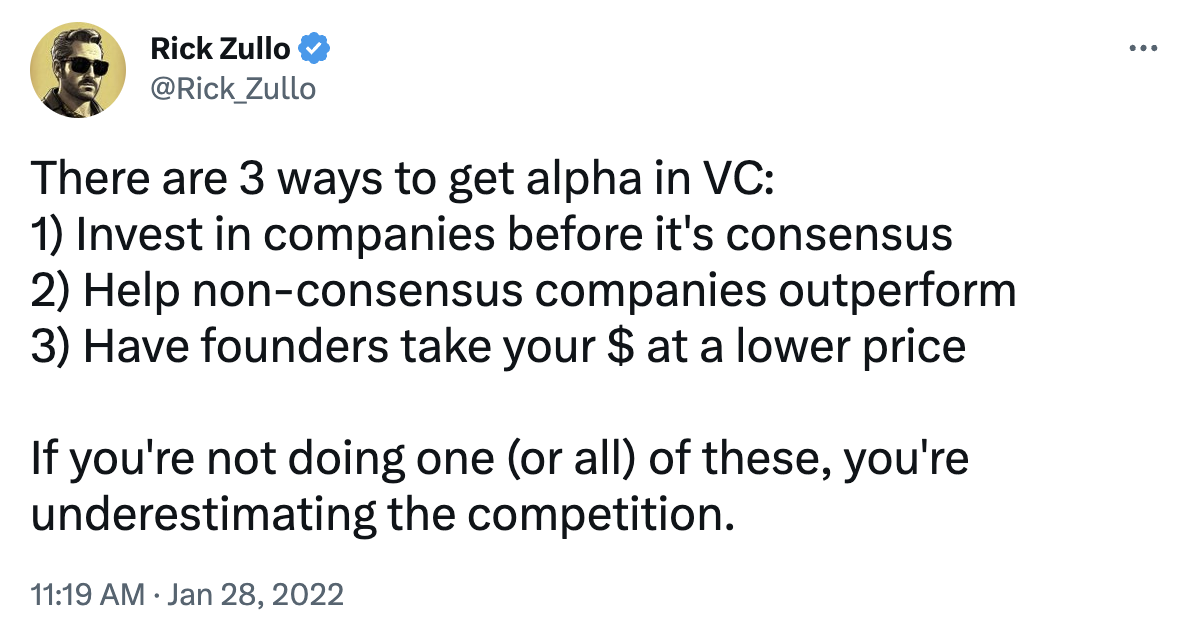
VCs are always "looking for alpha." But what is “alpha” and where do you find it?
If you’ve spent any time reading “VC Twitter” or been in the company of a group of VCs for more than 5 minutes, you’ve probably seen or heard reference to the concept of “finding alpha”. But what is “alpha” and where do you find it?
Alpha is one of the key metrics used to evaluate the performance of an investment portfolio. It measures a portfolio manager’s ability to outperform a market index, when adjusted for risk. An alpha of 1.0 means that the investment outperformed its benchmark index by 1%.
Of course, most VCs aren’t actually thinking about rigorous financial benchmarking when they’re talking about alpha.

When VCs talk about “finding alpha,” they’re loosely referring to the strategies they use to (a) win deals and (b) increase the likelihood that the startups they invest in succeed.
Hunting vs. Farming
The “hunter / farmer” sales model is one that’s been around for decades and captures these two key aspects of venture capital. In this methodology, “hunters” are salespeople who seek out and win new customers, while “farmers” cultivate relationships and generate returns from existing customers.
In venture capital, “hunting” refers to going out and winning new deals (investing in new companies) while “farming” refers to increasing the likelihood that a company will succeed through post-investment support and services.
Hunting Alpha
It goes without saying that VCs must first-and-foremost invest in startups. But what does alpha refer to in this context?
When VCs think about generating returns through hunting, they’re referring to two things:
Being able to invest in the best companies they can (winning deals)
Being able to invest at the best price they can (maximizing the potential return on an investment)

In both cases, investors can increase their chances of success by identifying and investing in startups early. Stated differently, when VCs are talking about “hunting alpha”, what they’re really referring to is avoiding competition.
For any given startup, one of the primary drivers of valuation is the level of competition amongst investors. This is why high-velocity fundraising is typically the best approach for early-stage startups. Investors, however, want to minimize competition. Not only does competition reduce the likelihood that a firm will win a deal (point 1 above), but if it does, the price will likely be higher (point 2 above).
Within VC firms, “deal sourcing” refers to the activities that the VC performs in order to identify new startups. Like any organization that performs sales and marketing, deal sourcing for VCs is a combination of “inbound” and “outbound” activities.
Inbound activities focus on increasing the likelihood that founders will reach out to the firm when they fundraise. These include traditional marketing activities like public speaking, newsletters and blogging (like the post you’re reading right now 😉).
Outbound activities try to proactively identify startups before they fundraise, in order to give the VC an opportunity to engage with the founders early. If you’ve ever received cold emails from VCs asking to meet, this is what I’m talking about.

For early-stage VCs, outbound activities focus on identifying both startups that might be of interest and individuals who might become founders.
In the US, most startups incorporate as Delaware C-Corps. The Delaware Division of Corporations has a public database of all registered companies and many VCs have built bots that monitor that registry for new companies that might be of interest. LinkedIn is another source of potential leads for VCs. If you’ve ever changed your status to “Starting Something New” or “Cofounder at Stealth”, VCs around the world immediately know.
Many VCs also have outbound activities that are designed to systematically leverage their networks to identify potential investments. Scout programs, in which VC firms empower founders and others in their network to make small investments on their behalf, are an example of this. The original scout program was created by Sequoia more than 10 years ago and led to early investments in Uber and Stripe.
Farming Alpha
In venture capital, “farming” refers to all of the ways VCs try to increase the likelihood that the startups they invest in succeed. Historically, this started and ended with the investing partner. After making a new investment, the lead partner might regularly meet with the founders to give them advice, sit on their board to provide fiduciary oversight, make introductions, etc. But that was about it.
In the early 2000s, VC firms started to build internal capabilities to perform some of the key but non-core functions startups required. The premise was that by helping founders not “get distracted” by non-core activities, they could increase the velocity of the startup and the likelihood that it would succeed.
After DataHero closed its Pre-Seed round in 2012, my cofounder and I easily spent two months on non-core activities, ranging from setting up bank accounts and accounting systems to building recruiting and onboarding infrastructure to generating legal agreements.
First Round Capital was one of the first firms to do this at scale, providing the startups it invested in with accounting and other services needed to “stand up” a company. Today, many VCs employ subject matter experts (such as internal recruiters, design partners and even decision support partners) that their portfolio companies can leverage. a16z famously employs more operating partners than it does investing partners.
At Panache Ventures, one of the ways we generate farming alpha is through Panache Academy, our San Francisco-based accelerator. Panache Academy delivers programs exclusive to our portfolio companies, such as our quarterly fundraising bootcamp. We believe (and have the data to show) that participating in the Panache Academy fundraising bootcamp materially increases the likelihood that our portfolio companies will succeed in raising follow-on capital, the valuation at which they raise follow-on capital, and the quality of the VC firms from which they raise follow-on capital (all of which increase the likelihood that those companies will succeed).
In fact, the entire accelerator model is based on a farming-centric approach to generating returns. Prominent accelerators like Y Combinator, Techstars and 500 Startups all have models built on investing in a large numbers of very early startups and surrounding them with the expertise needed to help them get to product-market fit.

The level of competition amongst VCs has never been higher. At the same time, outbound activities are becoming commoditized, greatly diminishing the potential for hunting alpha.
As we look ahead to the next decade of venture, I believe that the importance of investor value-add — farming — will only magnify in importance. Even in the current downturn, founders are firmly in the drivers seat when it comes to choosing who to allow on their cap table. Providing more than just capital is now table stakes for VCs and where the next decade of alpha is like to come from.
Why Do Pre-Seed Investors Ask for Side Letters?
I was recently asked by a founder to explain why early-stage VCs ask for side letters when investing using SAFEs. “Isn’t the point of a safe that it’s a standard agreement?”
I was recently asked by a founder to explain why early-stage VCs ask for side letters when investing using SAFEs. “Isn’t the point of a SAFE that it’s a standard agreement?”
Let’s dive in, starting with a bit of history…
The History of SAFEs
The SAFE (“Simple Agreement for Future Equity) was introduced by Y Combinator in 2013. Prior to that, startups raised funds using one of two methods:
Equity (Priced) Rounds
Convertible Notes
Priced rounds have the advantage of certainty of terms, but require a lot more detail than might be appropriate for a startup that has not yet achieved product-market fit. Convertible notes “kick the can down the road” in terms of valuation and terms, however, they are a form of debt (which comes with its own risks and drawbacks).
When we raised DataHero’s USD $1M Pre-Seed round in 2012, the SAFE did not yet exist. We executed a full equity agreement that cost ~USD $35K in legal fees.
The goal of the SAFE was simple: to standardize the fundraising documents for early-stage startups in a way that reduced overall costs and complexity, provide clarity for both sides around scenarios that were likely to occur, and avoid the pitfalls of debt.
When we raised DataHero’s Pre-Seed round, we had the benefit of an incredibly founder-friendly lead VC in Foundry Group, so our documents were “clean” and straightforward. Unfortunately, many startups don’t have that luxury. It wasn’t uncommon in those days to see small Pre-Seed rounds done with shareholder agreements filled with predatory terms.

Actual footage of a startup founder trying to avoid predatory investor terms
In addition to limiting the cost and complexity of small rounds, a major (positive) side-effect of the widespread adoption of the SAFE is that the prevalence of damaging and predatory terms in early funding rounds has been significantly reduced (at least, in North America).
The Limitation of SAFEs
The primary focus of the original SAFE was to simplify angel rounds (YC’s stated goal when it introduced the SAFE was to replace convertible notes, as opposed to VC-led equity rounds). Over time, however, investors across the board saw the benefits of this simplified approach for small funding rounds and many Pre-Seed VCs began to adopt the SAFE as their preferred agreement.
Today, Panache Ventures invests exclusively using SAFEs, unless a non-SAFE round has already occurred and/or we are co-investing with a firm that insists on an equity round.
This development was great for startups, as it made it faster, easier and cheaper to raise from Pre-Seed VCs. However, the simplicity of the SAFE was in part due to the removal of clauses that, while not particularly important to angel investors, matter a lot to VCs. As more and more VCs adopted the SAFE for smaller rounds, they needed to find a way to “add back in” key clauses without losing the spirit of the SAFE’s simplicity.

The point of the SAFE was to be a standard legal agreement that could be used without changing anything other than the cap, discount and signees. In order to maintain the standard SAFE template, another mechanism was needed to codify the additional clauses required by VCs. The result was the SAFE “side letter”.

VCs and Founders Adding and Removing Legal Clauses
What is a Side Letter?
A side letter is an amendment to a legal agreement that has the same force as the underlying contract but only impacts the signees to the side letter. Using a side letter along with a SAFE allows additional terms/provisions to be added that apply to the relationship between the VC and the startup without changing the SAFE itself or impacting other investors.
What Clauses Do VCs Put in SAFE Side Letters?
There are three clauses that are commonly found in SAFE side letters:
1. Information Rights
Information Rights grant the investor the right to receive certain types of information (typically, quarterly and/or annual financial reports) on an ongoing basis.
VCs need access to financial information in order to fulfil their fiduciary duties, however, the standard SAFE does not include any such rights (which makes sense, since founders generally would not want to provide detailed, highly-confidential financial information to each and every angel investor).

2. Pro Rata Rights
Pro Rata rights grant the investor the right to invest an additional amount at the next round in order to maintain their ownership percentage.
Angel investors rarely ask for this, as most would not be able to afford to invest in subsequent rounds. For VCs, however, the ability to maintain their ownership percentage as the company makes progress is key to generating a return for their investors. This right is standard in priced rounds but does not exist in the SAFE.

3. Major Investor Rights
Major Investor rights relate to the rights that the investor receives after the SAFE is converted into equity.
Each time an equity round occurs, investors receive a class designation (e.g. “SAFE Investors”, “Seed Investors”, “Seed-2 Investors”, “Series A Investors”, etc.). These designations are used throughout the shareholder agreement to define the rights, privileges and preferences of each class of shares. Class rights are shared by every investor in the class, regardless of how much (or how little) they invested.
A VC who invests $10M in a Series A round will receive the same class rights as an angel investor who contributes $10K as part of that round.
In addition to the shared class rights, shareholder agreements include a set of rights that are reserved for investors (typically VCs) whose shareholdings exceed a minimum threshold (referred to as the “Major Investor threshold”). The most common Major Investor rights relate to actions that cannot be performed without the approval of the Major Investors, including:
Acquisitions, Mergers and IPOs (i.e. a startup cannot do any of these without the approval of the Major Investors)
Diluting the rights and protections of the Major Investors (i.e. the rights of the Major Investors cannot be negatively altered in subsequent rounds without that investor’s approval).

Pre-Seed investors without the protections of Major Investor status can be wiped out by subsequent investors without any recourse
The standard SAFE does not include any reference to Major Investors, so it is common for side letters to include language that grants the investor “Major Investor” status — however that is subsequently defined — when the SAFE is converted into equity.
Why Have I Never Heard of This?
One Canadian founder I spoke to recently about SAFE side letters shared that he had asked an American founder friend about the topic and that founder’s response was, “I’ve never heard of such requests. It must be a Canadian VC thing.”
That perspective couldn’t be further from the truth.
In reality, there’s an entire generation of founders (in both Canada and the US) who never encountered SAFE side letters. Because for a period of time, they disappeared.

A few years after the original SAFE was introduced and VCs began to adopt it (along with the use of side letters), the economy started heating up. From 2017 onwards, there was an explosion of new funds and new types of funds. At the same time, large multi-stage funds began investing earlier and earlier. Early-stage rounds became more competitive and dedicated Pre-Seed funds found themselves unable to negotiate the rights that they needed. Given the choice between investing without a side letter and losing out on an investment altogether, many of them invested without protections (and against their long-term best interests).
As a result, the majority of founders who raised a SAFE round — particularly in the U.S. — between 2017 and 2021 were never introduced to side letters as a condition of VC investment. Now that the economy has recalibrated, we’re back to a landscape where early-stage funds (in both Canada and the U.S.) are insisting on these rights as a condition of their investment.
Side Letters are Here to Stay
As a Pre-Seed VC, I’m obviously biased when it comes to this topic. The rights contained in SAFE side letters are important to me as an investor and to my ability to generate a return for my LPs. Alongside angel investors, Pre-Seed VCs take the first big investor risk into a company. We’re also the most at-risk when it comes to later-stage investors eliminating our rights down-the-road.
That said, side letters are by no means a silver bullet. Elizabeth Yin recently wrote an excellent thread detailing some of the situations in which the protections of side letters can be nullified by later-stage investors:

Elizabeth makes the point (one which I agree with) that side letters are but one aspect of a relationship that early-stage investors must work hard to cultivate before, during and after an investment is made. At the end of the day, venture capital is a customer service business and we need to earn the right to continue to invest in the startups we back.
Ultimately, our goal as early-stage VCs is to support the founders we invest in all the way to the finish line, while ensuring that we can generate a return for our investors should you win. SAFE side letters are one tool that helps us to do so.
Founders Never Forget
It's been nearly 15 years since I founded DataHero. To this day, I viscerally remember how I was treated by each and every investor I met. All founders do.
It’s been nearly 15 years since I cofounded DataHero, while at a bed-and-breakfast in Tuscany (a story for another day). All these year later, certain memories are seared into my being:
There was the tense, late night conversation in a dark parking lot in Palo Alto as we debated the equity split between the founders. The excitement of our first day in a “real office” (in reality, a handful of unused desks that we rented from AOL). The anxiety and uncertainty of turning down the first term sheet we received because we felt the terms were unfair. And the thrill of seeing the first dollar of revenue hit our bank account (deposited via check, because we hadn’t yet implemented online payments).
More than anything else, I remember how we were treated by investors. To this day, I viscerally remember each and every investor encounter I had. All founders do.

Some of the investors who helped me the most were ones who, for a variety of reasons, never ended up on our cap table. There was Josh Kopelman, who spent hours with me over the course of several months thinking through the market opportunity for cloud-based BI and what applications could be “venture scale”. Or Doug Leone, who brought together members of the Sequoia team to work through the thought exercise of whether or not a SaaS business model could be applied to enterprise data software (it had never been tried before). There were folks like Kent Goldman, Mike Dauber, Aaref Hilaly, Stephanie Palmeri, Villi Iltchev and Karan Mehandru, each of whom spent time with me long before we raised a dollar of funding and shared their thoughts on go-to-market, the early landscape of SaaS providers and other aspects big and small of an entirely new approach to data analytics.
None of these VCs remember our interactions nearly as vividly as I do. In fact, some don’t remember them at all (I’ve asked!). But I remember each of these investors, their generosity of time, and the fact that they showed up focused, open-minded and genuine. And sure, they were each undoubtedly hoping for an investment down the road. But even after that ship had sailed, every single one of them continued to make themselves available. They genuinely wanted us to succeed.
And then there were the others…
There was [redacted], who couldn’t be bothered to look up from his phone when we pitched him. Or [redacted], who scheduled a meeting with me to “catch up”, showed up 15 minutes late and then asked arrogantly who I was and why were we meeting. There was [redacted], [redacted], and [redacted], each of whom declared — in their own snide, condescending way — that what we were doing would never work (while clearly having neither prepared for the meeting nor listened to what we were saying). And, of course, [redacted], who over the course of an hour asked pointed, incredibly well-informed questions, only to admit at the end of our meeting that he had already made an unannounced investment into a competitor.

Every meeting that I had with a VC informed not only my perspective of that individual, but of the firm they worked for. It informed the likelihood that I re-engaged with their firm for subsequent rounds. It informed what I told other founders when they asked about my experiences fundraising.
A decade later, those experiences — both good and bad — informed how I chose to enter the world of venture capital.
Most significantly, they informed the way that I try to show up for the founders each and every day.

My partner, Pat Lor, frequently reminds the team at Panache of the importance of bringing our full selves to every interaction we have with founders. Whether it’s a pitch meeting, a panel, or a chance encounter on the sidelines of a conference, every conversation we have with a founder leaves a lasting impression that reflects not only on ourselves, but on the firm as a whole.
Pat is adamant that the entire Panache team needs to come correct every time we interact with founders. No matter when, where or why.
He too remembers each and every one of his investor encounters.

Pat (center) on a recent panel at Creative Destruction Lab
Recently, I was reminded that not every investor shares this view.
A few weeks back, I had the privilege of joining a virtual investor panel. For the founders participating in the Zoom call, this was an important moment. They were eager to listen to what we had to say and came prepared with thoughtful, pointed questions. The moderator led a wide-ranging and engaging discussion amongst the VCs.
Well…almost all of the VCs.
Within a few minutes, it became glaringly obvious that one of the panelists wasn’t bringing his full and focused self to the session. Beyond his obviously bored facial expressions, this particular investor’s dual-monitor setup gave away his propensity to multitask, as he visibly turned his head away from the camera every time he finished speaking. He was clearly a big important person who had big important things to do.

I began watching the faces of the founders on the call. Each person was eager, engaged and smiling, except when this particular investor spoke. Each time he chimed in (often with a rambling comment that belied the fact that he only a half-heard the question), their smiles almost uniformly turned to frowns. Their body language became closed. Their feelings were clear: this VC — this person — doesn’t respect me.
My point in writing this post is not to call out another investor. Nor am I trying to stand on a soapbox and pretend like I’m perfect.
I’m writing this post as a reminder to myself and to other investors of the importance of showing up. We are incredibly privileged to do what we do, and we owe it to founders to bring our full and focused selves to every encounter. Every founder we meet is trying to create something out of nothing. To use their time, energy and resources to quite literally change the world.
That deserves our respect and our attention.
I also write this for founders as a reminder that you have the real power. Founders can build businesses without investors. Without founders? Investors are nothing. You have agency over who you choose to work with. Use it.
As an investor, I try my best to always bring my full, focused self whenever I meet founders. I hope that you’ll hold me accountable for that — if you ever meet me and feel that I wasn't fully present, please let me know.
Because I was once a founder. And I know that founders never forget.
“People will forget what you said, people will forget what you did, but people will never forget how you made them feel.”
- Maya Angelou
Why Silicon Valley VCs Want You to Be a Delaware C-Corp
What exactly is a Delaware C-Corp and why do Silicon Valley VCs care so much about where your company is incorporated?
One topic that frequently comes up for Canadian founders raising from U.S. VCs is the location of their startup’s incorporation.
“Are you a Delaware C-Corp?”
What exactly is a Delaware C-Corp and why do Silicon Valley VCs care so much about where your company is incorporated?
What is a Delaware C-Corp?
Let’s start with the basics. A C Corporation (or C-Corp) is the most common corporate structure in the U.S. It’s a legal entity in which the owners (or shareholders) are taxed separately from the company itself. In Canada, the equivalent is a Canadian-Controlled Private Corporation (or CCPC).
In the U.S., just like in Canada, the choice of state/province in which you incorporate has both legal and tax implications. Delaware is the preferred state of incorporation for most businesses because the state has more than 200 years of business-friendly legal precedents. The high volume of corporate disputes that the Delaware Court of Chancery has processed has resulted in judicial outcomes that are overwhelmingly predictable. In addition, the court has a history of protecting the rights of founders and board members to make business decisions without risking personal liability.

Delaware does not require that a company be physically based there in order to incorporate in the state. You are only required to have a Registered Agent (a Delaware-based intermediary who receives and forwards legal documents and correspondence from the Delaware Division of Corporations to you).
When I was a founder, the companies that I raised VC capital for (or considered raising external capital for) were all Delaware C-Corps.
What About Companies Outside of the U.S.?
Right now, you might be thinking “all of this sounds great, but my company is based in Canada — who cares?”
In this case, it helps to think about things from the perspective of a (U.S.-based) investor.
If your company is incorporated in Delaware, then investors (and potential investors) don’t have to spend brainpower thinking about potential tax or legal implications resulting from where your company is domiciled. On the other hand, if your company is incorporated outside of the U.S., then there are real implications for them as investors. And these aren’t just theoretical:

The U.S. government is very serious about keeping track of foreign investments made by U.S.-based firms. When an American VC invests in a Canadian company, it’s very likely that they will have to file additional paperwork about that investment each-and-every year. So in addition to the potential legal risk (or, at least, uncertainty) they incur by investing in a Canadian-domiciled company, doing so all but ensures that they will be doing extra paperwork as a result every year.
And nobody likes paperwork (even VCs).

Beyond paperwork, it’s helpful to empathize with the degree of uncertainty that potential investors might feel about investing internationally.
As the saying goes, you don’t know what you don’t know. So while it’s easy to say that “great companies can be based anywhere,” a typical investor has likely never given much thought to the tax and legal implications of investing in startups based in other countries. Your average Silicon Valley VC has no clue how Canadian taxes or laws work. Nor do they have any particular inclination to learn.
That doesn’t mean that they don’t want to invest in your company (they wouldn’t be talking to you if that was the case).
What it means is that figuring out whether or not they can invest in an Ontario-, Quebec- or BC-domiciled company may not be worth the effort to them if it’s unlikely that they’ll invest in another one anytime soon.
QSBS
Another consideration for some investors is QSBS (“Qualified Small Business Stock”). It’s a U.S. tax scheme that lets certain early investors reduce their capital gains taxes. I won’t dig into the details of QSBS or how it works, other than to say that for accelerators and early investors, it can provide a significant enough impact for them to insist on investments being domiciled in the U.S.
QSBS is generally not a consideration for Series A or later investors.
What Are Your Options?
As a Canadian founder, there are many reasons to want your company to remain domiciled in Canada. Many grant programs are only available to CCPCs while others, like SR&D, have material differences depending on whether or not the company is domiciled in Canada. Plenty of Canadian founders simply want their company to be Canadian (and that’s awesome!).
So what are your options if you’re looking to raise from Silicon Valley VCs but want to remain a Canadian-domiciled company?
1. Know Your Numbers
As part of your preparation for fundraising, figure out the exact costs of losing your status as a CCPC. Would you see a reduction in SR&D credits? Would you lose access to other relevant grants or government-sponsored opportunities?
A number of companies I’ve invested in have responded to requests by Silicon Valley VCs to reincorporate as a Delaware C-Corp by calmly stating:
“We aren’t willing to do that because it would cost us $Xm/year in government grants.”
U.S. investors rarely think about grants and tax breaks as part of their investment decision, so coming prepared with meaningful numbers can be very impactful.
2. Know Your Emotions
If remaining a Canadian-domiciled company is important to you for non-financial reasons, that’s equally as significant. But you need to think in advance about how to convey that to potential investors.
Too many founders don’t think through how to explain their convictions and instead ramble unprepared and off-the-cuff about how it’s “important to them.”
Americans are some of the most patriotic people on earth, so they will often be very receptive to founders who express sincere conviction around this. But it can’t be ad libbed.

3. Know Your Line
Bottom line: is this a deal-breaker for you?
Understanding the answer to that simple question before you talk to VCs is incredibly important (and will likely influence whether or not you get the result you want). Are you willing to walk away from an investor to remain a CCPC or is this a position that you’re willing to give up for the “right” VC?
Because it may be a deal-breaker for them.
At the end of the day, you should expect the majority of U.S. VCs to ask you to reincorporate as a Delaware C-Corp. It’s not a red flag and it’s not something they’re doing for spurious reasons — investing in Delaware C-Corps is simply easier, cheaper and and more predictable for Silicon Valley VCs.
That said, in my experience, the vast majority of US VCs are willing and able to invest in Canadian-domiciled companies. I’ve personally co-invested with many of the best Silicon Valley VCs in companies that chose to remain CCPCs.
At the end of the day, if it’s important to you to remain a Canadian-domiciled company, then come prepared. Explaining with conviction (ideally backed up by numbers) why you intend to remain a CCPC is the most effective way to get the result you want.

How to Make Your Startup Antifragile
In the aftermath of the shocking collapse of SVB, a plethora of posts have been written with recommendations for how startups should react. Many have, understandably, focused on ways to add redundancy to banking and financial infrastructure.
If you take a step back, this experience should serve as a broader reminder of the importance of building companies that are antifragile.

But what does it mean for a company to be “antifragile” and how can you make your startup antifragile?
What Does It Mean to be Antifragile?
The term antifragile was introduced 10 years ago by Nassim Nicholas Taleb, a professor and former hedge fund manager (who in a previous book coined the term “black swan event” to refer to the disproportionate role of high-profile, hard-to-predict events):
Some things benefit from shocks; they thrive and grow when exposed to volatility, randomness, disorder, and stressors and love adventure. Yet in spite of the ubiquity of the phenomenon, there is no word for the exact opposite of fragile. Let us call it antifragile. Antifragility is beyond resilience or robustness. The resilient resists shocks and stays the same; the antifragile gets better.

Nassim proposed three types of companies, each defined by how they react to stress: “Fragile” companies wither and collapse when stress is introduced. “Resilient” companies act like reeds: they bend but do not break when stress is introduced, returning to their original form once the stressor is removed. “Antifragile” companies grow stronger as a result of stress. Like muscle development through strength training, stress still challenges the system in the short term, but when the stressor is removed, the company becomes stronger as a result.

While the concept of antifragility is relatively new for companies, its application to software development predates Nassim’s book by at least a decade. My first exposure to the these concepts took place 10 years prior, when I was a graduate student at Stanford University. My advisor, Armando Fox, was part of the “Recovery-Oriented Computing” (ROC) project, a joint effort between Stanford University and U.C. Berkeley to develop reliable distributing computing and internet infrastructure.
The foundation of recovering-oriented computing was a simple concept: instead of trying to enumerate all of the ways that software could fail and trying to author it in such as way as to prevent bad things from ever happening, engineers should create software under the assumption that bad things can happen at any time and instead focus on reducing recovery time. (For those readers old enough to remember when you could remove the battery from a cell phone, this is how mobile software was designed: engineers had to presume that a user could take out the battery at any time, and the software had to be able to recover no matter what.)

Remember This?
The concepts originated in the ROC project helped move software design from fragile to resilient. The next step — towards antifragility — came in the form of software innovations intended to promote learning and adaptability of systems. For example, in 2011, Netflix created a tool called “Chaos Monkey” that randomly disabled servers and networks in its production infrastructure in order to test resiliency and drive improvement:
Imagine a monkey entering a 'data center', these 'farms' of servers that host all the critical functions of our online activities. The monkey randomly rips cables, destroys devices and returns everything that passes by the hand [i.e. flings excrement]. The challenge for IT managers is to design the information system they are responsible for so that it can work despite these monkeys, which no one ever knows when they arrive and what they will destroy.
It’s All About Options
Antifragile systems don’t try to predict future events. Rather, they are designed to react quickly and effectively to shocks of unknown or unexpected origin.
Just as recovery-oriented software is built on the assumption that bad things can happen at any time, antifragile companies expect shocks to occur. What makes them antifragile is how they deal with them.
The foundation of antifragile systems is options — courses of action that are prepared in advance, such that they can be put into action if and when a shock occurs. By preparing options in advance and independent of specific events, you don’t have to scramble when something unexpected occurs.
Scott Fenstermaker noted one example of an antifragile company that should be familiar to all startup founders: VC firms.
What does a VC company do? It buys a certain ownership percentage of a range of companies and mixes them together into a portfolio. These investments have a limited downside: the up-front cost of ownership. Therefore a VC company always knows what its maximum financial loss would be.
But every once in a while, they get a unicorn in their portfolio, a company that takes off to a far greater degree than the other members of the cohort.
Notice also that the VC didn’t have to predict which companies in the portfolio would be the ones to take off. This is key. Antifragile propositions don’t require specific predictions about the future.
VCs are not fragile to a deviation from expectation because they don’t care which company in their portfolio takes off. They just have to be correct on average. Every startup investment is simply an option that they can choose to exercise.
VCs don’t need to think in advance about which companies will fail, or what will cause their failure (although this information definitely benefits them when making investment decisions). By building a company that is predicated on options, VCs are able to continue moving forward when shocks to one or more portfolio companies occurs.
Making Your Startup Antifragile
As great as it sounds for a startup to get stronger when unexpected events occur, I don’t actually think that’s a realistic goal for most companies (it certainly isn’t the case for VC firms). Rather, I think the goal in making antifragile startups should be to minimize the risk and distraction when unexpected events occur, such that the company can continue to make progress while its competitors are panicking and reacting.
If we think about the recent collapse of SVB, every company fell into one of three buckets:
SVB was your only bank
SVB was one of multiple banks
You did not bank with SVB
If you were in category (1), then you likely lost a week (or more) of productivity dealing with the situation. If you were in (3), then you likely lost little or no time. Of course, founders with U.S. bank accounts couldn't reasonably have predicted which bank would collapse, so whether you were in (1) or (3) came down to luck. That means from a resiliency standpoint, (2) was actually the best case scenario. In this case, there would have been some distraction (trying to move money out), but no panicking (since short-term cashflow wouldn’t be a risk). In parallel, the company would have continued to make progress.
Of course, you would only ever have implemented (2) if you believed that there was a specific risk that a bank in the U.S. would fail. Until a few weeks ago, no reasonable founder believed that, or even thought about it.
So what is reasonable?
If we go back to the concept of recovery-oriented computing, the solution is definitely not to try to enumerate all of the exact things that could go wrong in the future. Trying to think through every possible shock that could happen and attempting to design resiliency around each and every one is a losing proposition.

Instead, founders should think about the broad categories of shocks that are possible and design around those. While the exact stressor might not be predictable, it’s possible to design resiliency around themes. For example:
An employee suddenly becoming unavailable (due to a family emergency, injury/illness, unexpectedly quitting, etc.)
A major technical issue (breach, hack, extended downtime, etc.)
A cash flow issue (large customers not paying, investor or grant money not coming through on time, fraud or other criminal activity, a major bank failing,…)
While this does require some enumeration of risks, in reality it’s focused on understanding the core components of the business and designing options for unexpected failures in each of those components.
Having redundancy across the team provides options when an employee is unavailable, without having to design around each specific employee or scenario. Building redundant software and infrastructure (and systems around that software and infrastructure) provides options when there’s a technical issue, without having to enumerate every possible thing that can go wrong. And so on.
At a higher level, you can design crisis management processes so that everyone knows who to go to when a shock occurs. Thinking about and designing (even at a high level) responses to technical, legal, PR and finance crises can provide a huge advantage if and when such a shock occurs.

Of course, all of this comes at a cost. Each option you create for your company requires an investment of time and resources. The return comes over the long-term as and when shocks do occur. As a founder, one of the best things you can do is to build your organization such that it is resilient to the types of unexpected shocks that are reasonably likely to occur.
As Louis Pasteur famously said, “Chance favors the prepared company mind.”
A Humbling Moment for Tech
Friday’s shocking collapse of Silicon Valley bank reverberated across the tech sector while making one thing very clear:
American’s really don’t like Silicon Valley.
Friday’s shocking collapse of Silicon Valley bank reverberated across the tech sector throughout this past weekend as nervous founders, investors and bankers awaited the U.S. government’s response. While the actions taken by the Fed look to have stabilized things in the short term, amongst the chaos and drama of the weekend, one thing became clear:
American’s really don’t like Silicon Valley.

While the tech industry was frantically trying to get money out of SVB and making backup plans and backup backup plans (along with a lot of tweeting and doomscrolling), the rest of America showed little sympathy. Following Sunday’s announcement of a rescue plan by the Fed, both sides of the political spectrum went into overdrive with derision and blame for the “tech elite”.

From the Left

From the Right
For Canadians (or anyone else in tech outside of America), it can be hard to understand the degree to which the U.S. tech sector is detached from the rest of the country. It’s even harder to understand the level of contempt that Middle America has for Silicon Valley, particularly when the rest of the world very much idolizes it.

To understand this dynamic, we need to go back to the turn of the century…
A Chip on the Shoulder
One of the historically common characteristics of people in tech is that many of them have a sizeable chip on their shoulder. They were often the nerdy kids in school, marginalized or bullied for being different (I was definitely not the “cool kid” growing up). In the late-90s and well into the 2000s, that shared experience and “us against them” mentality brought together many of the people who migrated to Silicon Valley.
When I moved to Palo Alto in 2002 (to do a Master’s Degree in Computer Science, no less) I was amazed to be surrounded by people like me. Smart, quirky, driven individuals who often didn’t fit in. But in Silicon Valley, the nerds were the majority. In those days, you were as likely to run into friends at the local electronics superstore as you were over beers at the Nut House.

I can’t begin to tell you how many hours I spent here ✨
For nearly a decade after that, Silicon Valley remained deeply uncool. There weren’t any celebrity-filled tech parties or private members clubs, just tens of thousands of quirky people from around the world coming together to build things. But that all started to change after the 2008 financial crisis. As the economy flourished and the world became more dependent on technology, money poured in at an unprecedented rate and Silicon Valley reaped the rewards.
Unfortunately, many people in tech haven’t fully accepted that they’re now at the top of the mountain. Far too many billionaire founders and influential VCs continue to act as if they’re the underdogs. They genuinely believe that they are still David fighting against Goliath. But with the the average salary of a mediocre engineer at a big tech company exceeding $250K, while the median salary for Americans is barely above $50,000, it’s long past time for us to stop and read the room.
Unfortunately, many in Silicon Valley haven’t.


It’s true that people in tech work crazy hours. In fact, they’re some of the hardest working people I know. Alex Iskold (above) has spent a good portion of the last year raising money for his native Ukraine, in addition to running 2048 Ventures and supporting hundreds of founders around the world.
But let’s be honest, a big part of the “sacrifice” people make in startupland is in pursuit of the pot of gold at the end of the proverbial rainbow. That doesn’t make it any less work, but it’s a hell of a lot less risky to join a venture-backed startup than to put your entire life’s savings into starting a traditional small business.

When I joined Aster Data as the company’s first employee in 2005, I took a big risk. But I also knew that if things didn’t work out, I could walk across the street to Google, Apple or a host of other companies and get an incredibly well-paying job in a matter of weeks. The worst case scenario was never going to be that bad. That is the absolute definition of privilege.
The fact of the matter is people in tech are elite. And if you ask most of Middle America, we’re completely out-of-touch.
The Silicon Valley Bubble
If you’ve only visited the Bay Area for brief periods of time, it’s hard to grasp just how much of a bubble it really is.
And how hard it can be to escape.

Jim Carrey knew a thing or two about living in a bubble
Over the years, the mantras popular with startups have encouraged an explosion of companies designed to service other startups. We build things for ourselves and champion “dog fooding” of our products. We invent and reinvent solutions to problems that only people in tech have, while turning a blind eye to the challenges of the rest of the world. (I won’t even begin to talk about all of the self-reinforcement that’s driven by the lack of representation across founders and funders.) These companies have absolutely moved the world forward in incredible ways — and in doing so, created enormous amounts of wealth — but for the average person, the benefits often seem isolated and far away.
To be clear, there are many people in Silicon Valley who are aware of these problems. People who’ve taken everything they’ve learned (and earned) and are using it to bridge the considerable social, cultural and economic gaps between Silicon Valley and the rest of America. But many more are emerging from last weekend’s rollercoaster to the slow realization that the rest of America doesn’t see them as the heroes we often imagine ourselves to be.

What About Canada?
If you’re in tech in Canada, all of this may very well sound foreign. Broadly speaking, our country is far more collaborative across industries and geographies. In general, Canadians are supportive and proud of our tech industry. Why is America so different?
There are two significant factors that have contributed to considerably different relationships between our respective tech industries and the rest of the country:
The U.S. tech industry is overwhelmingly concentrated in Northern California, whereas Canada’s is far more geographically distributed.
Canada’s system of equalization payments serves to ensure that the economic gap between the provinces never gets to big.
Canadians often lament our equalization system, but by ensuring that our entire country benefits when any one province “strikes gold,” we constantly reinforce our social fabric. “A rising tide lifts all boats.”
Canadians overwhelmingly see a growing tech sector as benefiting the entire country.
In the U.S., the situation is quite different. While the tech industry has seen an explosion of success over the past decade (along with unprecedented wealth creation), the rest of the country saw little or no benefit. To the contrary, during that same period of time, much of America suffered through crippling layoffs, a devastating opioid crisis, and increasing poverty.
Americans outside of tech see a growing tech sector as benefiting only the “tech elite”. And they’re not entirely wrong.
In the 80s, Wall Street was the target of Middle America’s ire. Today, Silicon Valley is the bad guy.
So What’s The Takeaway From All Of This?
While the majority of the media’s attention over the past few days has (rightly) been concentrated on analyzing the lead-up to SVB’s collapse and the Fed’s subsequent reaction, a growing subplot is focused on how the rest of America perceives Silicon Valley’s near-disaster.
For many in tech, the disdain and derision that Middle America has demonstrated towards the tech sector has been surprising or even shocking to witness. When we look back at this week’s events, they may prove to be an important wakeup call that helps refocus Silicon Valley on the challenges that exist outside of the Bay Area.
For those of us in Canada, there are plenty of lessons to take away. The reaction of Middle America to the challenges of Silicon Valley should serve as a reminder to all of us that we are part of a broader ecosystem and must remember that we are very much in positions of privilege.
Tech can change the world. We just have to remember to pay attention to it.

I'm a Canadian Founder. What Does SVB Mean for Me?
What does the collapse of Silicon Valley Bank mean for Canadian founders who don’t have a banking relationship with SVB? And what, if anything, should they do about it?
Unless you’ve been living under a rock for the last 48 hours, you woke up this morning to the shocking news that Silicon Valley Bank had collapsed.

For anyone unfamiliar with SVB, it’s a commercial bank that, for the past 40 years, has been laser-focused on the tech industry. It’s the 14th-largest bank in the United States and the preferred bank of VCs and VC-backed companies across the country (my last startup, DataHero, originally banked with SVB). It’s also one of the main providers of venture debt to tech startups, an offering it recently brought to Canada.
I’m not going to write about why we’re in this situation. Nor do I intend to posit on what the future may bring for SVB. There are people far smarter than I to educate you about the former, and thousands of instant experts on Twitter to spread rumours and mansplain to you the latter.
Instead, I want to focus on one simple question: what does this mean for Canadian founders who don’t have a banking relationship with SVB?
And what, if anything, should they do about it?
What Does this Mean for Canadian Founders?
Since SVB was taken over by regulators this morning, I’ve seen the full range of instant reactions about what this means for Canada, from “this could be catastrophic” to “nothing has changed and this won’t impact us”. My perspective is things are likely to land in the middle.
In general, I’m a “hope for the best, plan for the worst” kind of guy. I don’t think that the sky is falling just yet, but I also believe that it would be naive for Canadian founders to put their heads in the sand and assume this won’t impact them in any way.

There are a few key facts to understand:
As of this morning, all withdrawals from SVB accounts have been halted. That means any company whose money is deposited at SVB is unable to access it for any reason.
The FDIC (the US government organization that insures bank deposits) only insures up to $250K in deposits for a given customer. For an individual, this is a big amount. But for a startup that’s raised millions (or tens of millions) of dollars, it’s a drop-in-the-bucket.
The FDIC has indicated that SVB customers will have access to $250K of their deposits on Monday.
Looming overhead is next Wednesday, March 15th. For most companies, that’s their next payroll date (in fact, most companies would have had their payroll withdrawn today in order to pay on the 15th).
Put all of these together and it means that there is a real risk that a significant number of U.S. tech companies — particularly those with large head counts — will not be able to make their next payroll. It also means that any wire payments (to vendors, partners, conferences, etc.) may not be processed in time.
There are at least three areas where Canadian startups may experience short-term impact as a result of this:
1. Customers
For companies with U.S. customers, there may be a short-term impact on cash flow:
B2B customers that bank at SVB may not be able to pay you.
Even if they do have the cash, they may choose to delay payment in order to preserve that cash for payroll and more urgent services.
If your customers are individuals who work at impacted companies, they may proactively downgrade or withhold payment until they get clarity on their payroll situation.
2. Vendors / Partners
For companies who leverage U.S.-based vendors, partners, etc., there may be an interruption of service. For example, several major payroll processors use SVB to process transactions. Until they’re able to transfer their services to a new bank, those vendors aren’t able to run payroll (even for companies who themselves don’t bank with SVB).
3. Prospects / Pipeline
If you’re trying to sell to any companies that banks with SVB, expect a slowdown in that part of your pipeline. Even if your prospects have their short-term cash positions figured out, employees are likely to be distracted and whatever you’re selling them isn’t likely to be top of mind in the short-term.
What Should Canadian Founders Do?
If you have exposure to US tech companies through any of these categories, you should spend a few minutes to understand the magnitude of your risk:
If you have a large U.S. customer base (particularly tech startups), take a look at your cash flow and understand what the worst case scenario is. If a meaningful percentage of those customers miss or delay a payment, will it cause problems for you?
If you rely on U.S. vendors / partners who are likely to bank with SVB, are there any potential risks?
What happens if prospects you’re aiming to close by the end of Q1 (i.e. the end of this month) slip into the next quarter or off of your pipeline entirely as a result of this?
To be clear, I’m not saying that you should panic over any of these. It’s entirely possible that by Monday, a resolution will have taken place and/or we may have significant clarity into the road ahead, but it’s good hygiene as a founder to go through the thought exercise.
Be Canadian
Above all else, this is a time to be Canadian. And what’s more Canadian than showing empathy?
If you have U.S. customers that are likely to bank with SVB, consider sending them a note offering to delay payment if they need it.
If you have founder friends in the U.S., send them a message to check in with them and ask if you can help.
If you’re working with sales prospects that are likely to bank with SVB, offer to reschedule any meetings next week.
This is an incredibly stressful time for a lot of startup founders and their employees. And it could have happened to any of us.

When to Walk Away
Right now, many founders are facing difficult decisions.
In the aftermath of the 2020-21 bull market, countless startups are nearing the end of their runway. Some will make it. Many more will not. And then there are the companies languishing in the middle. They have revenue, but not product-market fit. They are growing, but not fast enough. Some employees have decided to move on. So have some customers. They can potentially extend their runway, but at what cost?
Over the past few months, I’ve spoken with a number of founders trying to decide what they should do next. Every investor I know has. And I expect to have many more of these difficult conversations in the near future. For founders caught between a clear win and an obvious loss, with the added pressures of investor expectations and employee responsibility weighing heavily on their shoulders, the path forward is as clear as molasses.
It’s a struggle I’m deeply familiar with. Because I’ve been there.
Which is why I was curious to read Annie Duke’s latest book, Quit: The Power of Knowing When to Walk Away. For readers unfamiliar with Annie, she was a professional poker player during the heyday of the World Series of Poker in the late 90s and early-2000s. After retiring from poker, she became a speaker, consultant and author and has written a number of books on decision science. Last year, Annie joined First Round Capital as a "Special Partner” focused on coaching founders through difficult decisions.

In her latest book, Annie discusses both the power of quitting and the social, societal and psychological barriers to doing so. In particular, she talks a lot about the two-sided nature of “grit”.
Persistence is not always the best decision, certainly not absent context. And context changes.
That’s the funny thing about grit. While grit can get you to stick to hard things that are worthwhile, grit can also get you to stick to hard things that are no longer worthwhile.
What makes the book so powerful for founders is the way it combines deep insights into the psychology, emotions and economics of quitting with real-life startup examples (including from Canadian founders Stewart Butterfield and Andrew Wilkinson).
Here are a few of my key takeaways from Quit:
Loss Aversion and Sunk Costs
While most founders understand (at least conceptually) the notion of sunk costs, loss aversion is an equally important concept. Loss aversion is a cognitive bias that causes humans to feel the pain of a loss more acutely than the pleasure of an equivalent gain:
One of the key findings of prospect theory, a theory at the core of behavioral economics, is loss aversion. Simply put, the negative emotional impact of a loss is greater than the positive emotional impact of an equivalent gain.
Loss aversion makes us not want to stop something we have already started.
The combination of loss aversion and sunk costs creates a powerful foe for founders who are considering quitting. Instead of clearly and rationally analyzing whether or not it makes sense to continue on, founders who’ve been grinding it out for years often struggle to separate the decision of what to do moving forward from the blood, sweat and tears that they’ve already put into their startup.
When we quit, we fear two things: that we’ve failed, and that we’ve wasted our time, effort or money.
Founder Identity
When you add founder identity into the mix, it gets even harder for startup founders to walk away.
When your identity is what you do, then what you do becomes hard to abandon, because it means quitting who you are.
First-time founders, in particular, often struggle to separate their identity from that of their startup. What started off as a statement of pride “I’m Chris, Founder of X”, can over time become an albatross that holds them back. Founders who have embraced grittiness as a core part of their identity (picture of all the founders you know who’ve been quoting The Hard Thing about Hard Things ad nauseum for the past few years), this effect can be orders of magnitude stronger.
Founders, who are gritty by nature, all too often continue to grind it out until the bitter end.
Duty to Investors
When it comes to quitting, most investors think the opposite of what founders assume. The reality is that no investor wants founders to work themselves into the ground when there is no longer a clear path to success. Investors are looking for a return-on-investment, not a martyr. Yet many founders believe this.
One of the most common ways that founders push back [on quitting] is by claiming that they have a duty to the investors to give it everything they have.
To prove this point, Annie points to one of Silicon Valley’s most successful angel investors, Ron Conway. Most people know Ron as the founder of SV Angel and as an investor in countless unicorns. What few realize is that he is also one of the startup world’s most skilled “quitting coaches”. According to Conway,
There is no honor in spending every last bit of investor money pursuing an endeavor that’s failing. Returning capital to investors is the responsible choice under those circumstances and demonstrates the ability to make the hard decision when it’s the right thing to do. It shows an understanding of expected value and the ability to respond to new information and changing circumstances with flexibility rather than rigidity.
Contrary to most founders’ beliefs, returning capital increases the chances that those investors will want to work with them again.
Duty to Employees
If you ask founders what holds them back from shutting down a business, responsibility to their employees is often at the top of their list. The idea that the people who took a chance on them will be out of work can be hard to stomach, leading them to continue on with the status quo.
This is another “trap” the adds founder ego into the mix. While it’s absolutely noble to want to take care of your employees, if it were really true that nobody on your team would be able to get another job, then you must have a pretty awful team. The reality is that each employee at a startup has made (and continues to make) economic decisions that take into account the potential future value of equity/options in considering their opportunity cost.
The problem? When founders of failing startups continue to sell their team on the future success of the company, they’re providing those employees with false information with which to make those decisions.
Just as investors don’t want to see founders trapped in something that’s failing, founders shouldn’t want that for their employees.
While reading Quit (which I highly recommend for both founders and investors), I found myself replaying some of the conversations I’ve had recently with founders debating the future of their companies. A few of those founders made the difficult decision to shut things down. Many are pushing ahead. As a VC, I obviously want to see every company I invest in succeed, but I know that will never happen. So while it’s hard not to admire the grit of those founders determined to give it their all, it’s difficult for me as a former founder to watch some of them continue down a path that I know has little-to-no chance of success.
If you’re a founder reading this, I hope you win. But please know that it’s okay to quit. To quit something that’s no longer worth pursuing isn’t a failure, it’s a success.
When the world tells you to quit, it is, of course, possible you might see something the world doesn’t see, causing you to rightly persist even when others would abandon the cause. But when the world is screaming at the top of its lungs for you to quit and you refuse to listen, grit can become folly.
Too often, we refuse to listen.
To Create More Canadian VCs, We Need More Canadian LPs
If we want to pour rocket fuel on Canadian tech, we need to make it easier for the next generation of Canadian investors to start their own funds.
Starting a new VC firm is hard. On average, it takes 18 – 24 months for an emerging manager (the term for a first-time VC fund manager) to raise a new fund.

San Francisco VC Monique Woodard spent more than two years raising the recently-announced debut fund for Cake Ventures
In Canada, starting a new VC firm is near-impossible.
Just as first-time founders in Canada often struggle to find angel investors and Pre-Seed VCs willing to take a chance on their startup, emerging managers in Canada struggle to find investors willing to take a chance on their VC firm.
Why? Because Canada doesn’t have enough risk-taking LPs.
How VCs Raise Funds
When startup founders raise their initial capital, they look to friends-and-family, angel investors and Pre-Seed VCs as potential investors. Emerging managers do the same thing: they target friends-and-family, high net worth individuals and family offices, and institutional investors that focus on emerging funds.
In the US, firms like Cendana Capital have built incredibly successful “fund-of-fund” businesses that focus on emerging managers. They effectively act as “Pre-Seed investors” for VC firms. Cake Ventures, a new VC focused on investing in opportunities created as the result of demographic change, recently closed a debut fund that boasts a number of such investors, including Cendana Capital, Foundry Group, Pivotal Ventures, Plexo Capital and Screendoor.
In Canada, there isn’t a single institutional investor dedicated to investing in emerging managers.

That’s not to say that their aren’t any institutional investors in Canada that have invested in emerging funds. However, those “emerging funds” have traditionally been large funds founded by experienced VCs with lengthy track records — safe bets — rather than $10-20M funds launched by up-and-coming investors.
As a result, when a Canadian investor wants to start a new VC firm, they generally take the same approach Canadian startup founders do: they look for angel investors to fill the gap. Unfortunately, in Canada there aren’t enough VC “angel investors”.
By some estimates, there are more than 1 million accredited investors in Canada (individuals and organizations that are eligible to invest in VC firms). Fewer than 5,000 have ever invested in a Canadian VC.
In other words, Canada doesn’t have any dedicated “Pre-Seed” LPs and we don’t have enough “Angel” LPs.

Actual footage of a Canadian founder hearing that it’s hard for new VCs to raise money
Why Does This Even Matter?
Why does Canada need more VCs?
In my opinion, the biggest challenge with Canadian early-stage funding today isn’t the lack of capital (despite how vocal I am that we don’t have enough of it), it’s the lack of capital allocators. Canada simply doesn’t have enough people and firms making investment decisions.
As investor Sylvain Carle recently noted, “While we need more generalist [VCs], we need many many more specialists.” Whether they be experts in climate tech, deep tech or the things that Gen Z likes that I’m way too old to understand, Canada needs more investors whose unique interests and backgrounds align with the startups being founded here.

This is also hugely important from the standpoint of diversity and inclusion. Like every country, Canada needs more investors from diverse backgrounds with a seat at the VC table. We know that underrepresented founders aren’t seeing enough investment dollars and we know that VCs from diverse backgrounds are more likely to invest in diverse founders.
One way to change this is to hire more diverse investors into existing funds (something that’s already starting to happen), but that’s a slow process.
If we really want to pour rocket fuel on Canadian tech, we need to make it easier for the next generation of Canadian investors to start their own funds.
Easier Said Than Done
Over the years, a variety of government-backed initiatives have been launched to bolster the Canadian VC ecosystem. Many of these have had an immensely-positive impact on the funding landscape. Unfortunately, only a handful included the creation of new VC firms as part of their mandate (the Government of Quebec’s Seed Fund Competition being the most recent).
The challenge with relying on government-backed programs to fund emerging managers is that they typically aim to deploy amounts of capital that are too large to be absorbed by a $10-20M emerging fund. In addition, their diligence expectations are frequently at odds with what an emerging manager is capable of. (Any Canadian founder who’s been asked for 5 years of financial plans for a pre-product friends-and-family round knows what I’m talking about).
The result? We see repeated cycles of government programs that funnel money into a relatively small number of established firms without driving expansion of the investor landscape.

Setting Canada up for Success
So how can we meaningfully accelerate the creation of new Canadian VCs if the top-down approach isn’t working?
Here are 5 ways Canadian tech leaders can help:
1. Investor Education
We have amazing angel groups across Canada that are dedicated to helping high net worth individuals learn how to invest in startups, but nothing equivalent for learning how to invest in VC funds. In fact, most angel investors have never even had the opportunity to invest in a VC fund. So investor education is the first step.
We also need to better support family offices that are looking to expand into the venture capital asset class. These investors are capable of investing millions of dollars into organizations that align with their professional and philanthropic missions, but many don’t know where to start when it comes to VC.
2. Emerging Manager Diligence Programs
A second function performed by angel groups is to centralize diligence into startups. A similar function could be performed for VC investments. What would it look like to create a program to “certify” emerging managers (or at least standardize their investment materials) to make it easier for angel investors and family offices to invest? (And, no, I’m not talking about the 58-page ILPA Due Diligence Questionnaire.)
3. Government Matching Programs
Rather than a heavy, top-down investment approach, could Canada or the provinces ever support a lightweight “matching” program for emerging managers? e.g. Any emerging fund that raises at least $5M and fulfils reasonable / stage-appropriate governance requirements automatically receives matching (which could, in effect, act as the fund anchor).
4. Emerging Manager Fund-of-Funds
What about the creation of a private “fund-of-funds” for emerging managers in Canada? As a country, Canada will likely never create more than a handful of high-potential emerging funds each year, but I suspect there might be demand amongst investors for a “Cendana of Canada”.
10 new funds/year @ $1M/fund is only $50M over 5 years…
5. Emerging Manager Scholarships
Most people assume that by the time someone decides to start a VC firm, they’re independently wealthy and can afford to take two years off to fundraise. In reality, virtually no emerging managers have that priviledge.
Instead, most work side gigs as advisors, consultants or EIRs/Venture Partners/Scouts at larger firms to pay the bills.
Imagine a program where promising emerging managers received two-year scholarships along with mentoring, legal grants (to actually form the fund) and other support to launch a new VC.
If we want to accelerate early-stage investment across Canada, we need to make it easier for promising investors from a variety of backgrounds to launch new funds. And that starts with minting new LPs who are willing to take risks.
Let’s come together and make it happen.

Why Aren't There More VCs in My City?
I’m very vocal about the fact that Canada is severely lacking in early-stage venture capital. Yet despite that, I don’t believe that we will see a sudden explosion of home grown venture capital firms. Nor should we want one.
Last week, I attended a gathering of 70 civic and business leaders from Vancouver hosted by the Frontier Collective, an organization dedicated to advancing Vancouver’s standing on the global tech stage. One of the questions that came up was whether Vancouver needs more “home grown” venture capital in order to reach its full potential.
I’m very vocal about the fact that Canada is severely lacking in early-stage venture capital. Whether we like to admit it or not, much of Canada’s recent successes in tech are due to angel investors across the country stepping up to fill the gap in risk-taking institutional capital. Toronto’s size — now firmly the third largest startup ecosystem in North America — provides enough gravitational pull to US VCs to further augment the local sources of capital, but it’s still not enough.
Yet despite that, I don’t believe that we will see a sudden explosion of home grown venture capital firms in Vancouver or any other mid-sized city. Nor should we want one.
Here’s why.
Supply and Demand
A typical VC invests in less than 1% of the startups they meet. Last year, the team at Panache spoke with more than 3,000 founders across Canada. We invested in 16 companies.

What does this mean for an ecosystem?
Assume that a typical VC aims to make 10 investments per year. If each firm invests in 1% of the startups they meet, then the startup ecosystem they operate in needs to reliably generate at least 1,000 new startups per year for every VC*.
This means that for a mid-sized city like Vancouver to support 10 power law VCs investing locally, it would need to produce more than 10,000 new startups per year.
It has only about 2,000 startups in total.
* This simple model doesn’t take into account competition amongst investors, sector focus, startups coming from outside of the region to fundraise, etc., but you get the point.
What Happens if There Aren’t Enough Startups?
If a VC firm is based in an ecosystem that doesn’t produce enough startups to satisfy their investment thesis, then they have only two choices:
Invest Outside of their Local Ecosystem
Adjust their Investment Thesis
Invest Outside of their Local Ecosystem
For power law VCs, the solution to not finding enough startups locally is to look elsewhere. This is what the top early-stage VCs in Canada do. Vancouver-based Version One has made investments in Toronto, San Francisco and New York. Golden Ventures from Toronto has made investments in Vancouver, Boston and Los Angeles. Montreal-based Inovia invests across North America.

(While Panache Ventures is Montreal-based, we consider our “local” ecosystem to be the entire country, which is why we have partners on-the-ground in Vancouver, Calgary, Toronto and Montreal.)
Adjust the Investment Thesis
Regional VCs – investors whose thesis restricts them to investing in a local city, province or region – have a different approach. They focus on delivering a return to their investors based entirely within their local ecosystem. While this might sound amazing (more money for the local ecosystem!), the reality is that outside of Toronto, no ecosystem in Canada generates enough new startups to support power law investing regionally.
The result? Investors who focus their diligence on revenue, sales cycles and short-to-medium term business plans instead of long-term potential, much to the frustration of founders.
Why does this happen? Because regional VCs need to ensure that they generate a return regardless of the quality of startups they meet. If a given VC’s thesis requires making 10 investments per year but the region only generates 2 venture-quality startups that match their thesis, then the fund must find 8 additional “safe bets” to round out their portfolio. These companies are unlikely to generate billion-dollar outcomes but could reliably return 2, 5 or 10x to their investors.
The Paradox of Numbers
If Canada doesn’t produce enough startups each year to support more locally-focused power law VCs, why am I so adamant that their aren’t enough early-stage VCs? Why does it feel like their aren’t enough VCs?
Because not every startup is a match for every VC.
The reality is that most startups are only a fit for 10 or 20% of the VC firms they meet. If a firm like Version One or Golden Ventures could find enough startups that matched their thesis locally, they wouldn’t have to search beyond Canada. But they don’t.
So how can Canada support more VCs if it can’t support more VCs? The solution depends on your perspective.
How Can Ecosystems Fill the Gap?
Cities and local ecosystems can fill the funding gap in two ways:
Help create more local VCs
Wait…didn’t you just say that the solution isn’t more local VC firms…?
While a city like Vancouver isn’t large enough to support power law VC firms focused exclusively on local investments, helping anchor new funds with a broader investment thesis will almost certainly result in more local investments. In other words, having more VCs based in a city — even if they don’t invest exclusively in that city — can have a massive impact on the local ecosystem.
Why doesn’t this happen?
In the US, there are numerous institutional investors that invest in emerging managers (the term for new VCs launching their first or second fund). In Canada, we have zero. That makes it incredibly difficult to launch new funds, even for investors with lengthy track records.
Help attract VCs from elsewhere
Investors from New York and Boston regularly travel to Toronto in search of deals. In Vancouver, we’re seeing increased interest from Pre-Seed VCs based in Seattle and Portland, with the occasional San Francisco VC heading north.
Unfortunately, cities themselves tend to struggle to attract the right types of investors.
(There is, actually, a third option: loudly and repeatedly profess that your city is just “one big exit” away from minting a bunch of super-angels who will magically fill the local funding gap. I don’t recommend that strategy.)

How Panache is Helping Fill the Gap
Panache’s national investment thesis ensures that we meet enough incredible, ambitious Canadian founders each year to achieve our investment goals. However, we feel the VC gap in a different way.
After we commit to investing in a company, we often have to help the founders seek out other investors to fill the round. For example, we might invest $500K into a $750K round or $1M into a $1.5M round. Sometimes we can find other Canadian investors to join us, but often we encounter the same challenges that founders do. There just aren’t enough like-minded VCs in Canada.
Last year, we embarked on an ambitious plan to build a North America-wide co-investor network, starting with a September event where we hosted more than 150 VCs in the heart of San Francisco.


This year, the team from Panache will be in Seattle, Portland, San Francisco, Los Angeles, Miami, Austin, New York, Atlanta, Washington DC, Boulder, Boston and Columbia, MO (iykyk) to champion the Canadian ecosystem and help bring more investors and investment dollars to the Great White North.

We’d love nothing more than to see more home-grown early-stage VCs. And I think it’s going to eventually happen.
But in the meantime, we’re going to go find some.
What Do VCs Talk About?
Each quarter, the Panache leadership team converges on a Canadian city for a week of strategy and planning meetings. As Canada’s only national early-stage VC, our partners live in four different cities (Vancouver, Calgary, Toronto and Montreal), so it takes extra effort for us to get together. When we do, we make certain that the time is well-spent.
But what do VCs talk about when they get together behind closed doors?

“Question #1: If it’s -10ºC outside, why don’t we have pants…?”
Here are some of the things we talked about last week in our 2023 kickoff meeting:
2022 Review
2022 was a wild year by any account. We spent a full day discussing last year, including:
A high-level review of the performance of each of our funds.
A post-mortem on the fundraise for Panache Fund II.
A brutally honest “highlights & lowlights” review of every aspect of Panache (what we did well and where could we improve).
A deep dive into the macroeconomic changes that took place in 2022 and our hypotheses for 2023.
Portfolio Companies
At each Panache offsite, we review our portfolio and the 100+ companies in it. Last week, our discussion focused on identifying companies impacted by ongoing changes in the macroeconomy and opportunities for us to help. Questions we asked included:
Which companies in our portfolio have had their core business affected by economic changes (e.g. interest rates) and how does that impact their path forward?
Which companies do we expect to face the most challenging fundraises in Q1 and Q2?
Which companies may want or need to explore M&A in the near-term?
What are the common challenges currently faced by our portfolio companies and is there anything we can do to help?
Finance
Venture Capital firms are complicated organizations with lots of moving pieces. But like every other company, we have revenues and expenses and have to make ends meet. Led by our fearless CFO (aka my Toronto Partner, Prashant Matta), we dug into our financial performance for 2022 and discussed, debated and disagreed on our budget for 2023 (seriously guys, I need more money for overpriced Vancouver coffee and Lululemon pants).

Actual photo of Prashant Matta
Investment Strategy
We started investing out of Panache Fund II when startup valuations were near their peak. The investment model we built for the fund (the mathematical model that we use to drive our investment decisions) very much reflected those valuations. Since then, the fundraising landscape has changed significantly and valuations have mostly returned to historical levels.
We discussed the impacts on our investment model and whether or not we wanted to revise our strategy as a result:
Should we invest in more companies?
Should we invest more money in the same number of companies?
Should we change our target ownership percentage?
Should we change the amount of money we hold for follow-on investments?
Are there any industries that we are more/less excited about given the macroeconomic shifts?
Investment Process
As a firm, we’re constantly trying to streamline and improve our investment process. How can we be more responsive to founders? How can we reach conviction on an investment in the shortest amount of time without skipping any diligence steps? Where can we trim the fat?
Last week, our focus was on our investment committee meetings, the weekly meetings in which the entire Panache team comes together to discuss potential investments. In particular, we brainstormed ways to more effectively surface key questions partners and associates have earlier in the diligence process, in order to reduce the number of times we need to go back to founders with follow-up requests and shorten the overall investment process.

Operations
Continuing with the theme of efficiency, operations is a key topic that we discuss at our partner meetings. Last year, we undertook a complete rebuild of our internal CRM and communications systems to better support our work and our ability to review more than 3,000 startups/year across Canada.
Last week, we discussed our infrastructure roadmap and the improvements we want to make in 2023. Areas of focus included our outbound infrastructure (the systems we use to identify potential entrepreneurs across Canada), our data analytics infrastructure and our portfolio support systems.

Marketing and Events
As Canada’s only national early-stage VC, it’s important that we be present in our communities and at startup events across the country. We recently brought on an amazing head of marketing and community and have big plans for 2023. Expect to see us at major events, like Collision and Startupfest, as well as smaller activities across the country.
We also firmly believe that support for our portfolio companies shouldn’t stop at the border. That’s why we made a strategic decision last year to start playing offense on the international stage. Our ambitions for 2023 are even bigger — stay tuned!

Panache hosted 100+ US VCs at an event in San Francisco in September
Partner Dynamics and Mental Health
Just like startups have cofounder dynamics, VCs have partner dynamics. As anyone who works in a distributed team knows, it’s even harder to manage interpersonal relationships when you’re not in the same office. To ensure that we prioritize this, we dedicate a full day every quarter to strengthening our partner relationships, which includes a half-day session led by an executive coach from the US who specializes in VC partner dynamics. We also talk openly about our mental health and that of the broader team and ways that we can prioritize everyone’s well-being while ensuring that we each perform to our peak.
Canada Can't Afford a Flight to Fear
As 2023 kicks off, an industry-wide funding pullback is in full effect. VC investing in North America was down a whopping 63% in Q4 2022 year-over-year and now the VC echo chamber is trumpeting far and wide about the impending “flight to quality”.

Merritt Hummer of Bain Capital Ventures defines this phenomenon as follows:
A “flight to quality” for the venture industry means a reversion to revenue models that are profitable and predictable.
Broadly speaking, “flight to quality” refers to a consolidation of resources towards companies that are considered to be of higher quality and, thus, lower risk. In the startup world, companies that are seen as being of higher quality will find themselves attracting a higher share of venture capital dollars in 2023 while others struggle to raise. But what is “quality”?
In Merritt’s definition, “quality” is defined in terms of a company’s revenue model, not the company itself. This distinction is important, since the vast majority of high-growth startups do not become profitable until many years in. True innovation takes time and money, which is why venture capital exists in the first place. Thus, a “flight to quality” in venture capital does not (and should not) be interpreted as a flight to profitable or near-profitable companies only.
Unfortunately, in countries outside of the US, that’s often the case.
A Bit of History
Like most countries not named America, Canada’s venture capital industry evolved from traditional investment banking and later-stage private equity. In contrast to the inherently risk-taking approach of US venture capital firms (the origins of which you can learn about in the excellent book VC: An American History), most early Canadian VC firms historically relied on spreadsheets, numbers and traction to make investment decisions. The predictable result was a deeply conservative industry, in stark contrast to our neighbours to the south.

The American approach to venture capital has its roots in 18th century whaling
A corollary of the “top-down” evolution of venture capital in Canada was the emergence of an industry far more focused on later-stage investing than is found in the US. Canada has plenty of investors who are willing to jump on board once a company has product-market fit, but at the Pre-Seed stage there are embarrassingly few VC firms across the country.
To be clear, Canada’s venture industry has matured significantly over the years. Today, there are many more early-stage firms than there were 20 years ago, but that number remains frighteningly low. So while Canada’s tech industry has reached unprecedented heights in recent years, our innovation pipeline is at serious risk of a catastrophic slowdown if more than a handful of those investors flee the risk-taking necessary in Pre-Seed and early Seed for “safer” waters.
The Challenge
The last time we faced a real pullback in the VC industry was in 2008, following the US housing crisis (for those keeping score, that’s 15 years ago!). Plenty of investors are pontificating on Twitter about how “great companies are founded in tough markets,” but the reality is many of them have never seen a bear market, much less invested in one.

Many of today’s investors have only ever known a world where follow-on funding was relatively easy to come by. A world in which many of their companies were able to raise subsequent rounds, even if they missed their numbers (including, heaven forbid, investments where the investor glossed over diligence or FOMO’d into a bad deal). Now, those same investors are at a crossroads: do they continue to invest in risky, pre-revenue / pre-product-market fit startups or become more conservative and wait until there are more numbers to analyze?
For a VC who hasn’t experienced a bear market before, it can be very tempting to give into fear and flee to the safety of numbers. When times get tough, the siren’s song to “go upstream” (invest in later-stage companies, where investment decisions require less subjectivity) becomes loud. All the more so if the firm is still relatively unproven and some of their early winners are suddenly looking like duds.
In the US, there are so many VC firms that dozens — or even hundreds — of individual investors could move upstream without meaningfully impacting the ecosystem. It happens all the time. But in Canada, if more than a handful of our preciously few early-stage investors abandon Pre-Seed, then there will be no startups to invest in at the later stage. That’s how precipitous our position is right now.
You might think I’m over-reacting, but as I sit here in Vancouver, I can literally count on one hand the number of VCs in my city who are actively writing Pre-Seed checks. If even one of us pulls back from investing, the long-term impact will be significant.
The Opportunity
As much as we talk about great companies being founded in tough markets, it’s also true that great investors are forged in difficult times. Some of the best-performing early-stage funds of all time are from the last recession (2008 - 2011 vintage). The problem is, the short-term incentives for venture firms can drive individual investors to more conservative behaviour when times get tough. When capital is scarce, VCs can still make a lot of money by being safe, “okay” allocators of capital rather than leaning in to the opportunity to be great (and risk making mistakes).

The reality is that while becoming a more conservative investor can give the illusion of a short-term safety net, over time the returns of conservative firms reverts to the mean. The performance of such firms becomes more and more mediocre as vintage-defining outliers emerge in the portfolios of the investors who were willing to take risks. Marvin Liao, who has led investments in more than 400 early-stage startups around the world, recently noted:
It’s pretty safe and easy to just invest on traction or the 2nd or 3rd time successful founder. This is unsurprisingly the strategy for many established VC funds and angel investors. And this is also why many of them don’t drive good returns on their investments.
So as we look ahead to 2023, here’s to hoping that Canada’s early-stage investors continue to take risks and support our country’s most ambitious founders.
Our country simply can’t afford a flight to fear. And we won’t own the podium if we don’t take the shots.

I Hate Investor Updates
When I was a founder, I wrote weekly investor updates. Every Sunday night, I dutifully spent 1-2 hours in front of my computer writing them.
And you know what? I hated every minute of it.

Plenty of founders will tell you that writing regular investor updates helps them to gain clarity about their business. That the process allows them to step out of the day-to-day grind and look at the big picture. That may be their experience, but it wasn’t mine.
My experience was that writing investor updates was a tedious, time-consuming pain-in-the-ass.
My todo list was seemingly endless, yet every week I had to spend 1-2 hours writing an investor update. As the years went on and the challenges we faced grew more frequent and complex – I dreaded Sunday night even more.
But no matter what, I sat down in front of my computer and wrote an investor update.
Every. Single. Week.

I still have every investor update I ever wrote
If you’re thinking to yourself “but Chris…nobody forced you to write those updates,” you’re absolutely correct.
My investors didn’t demand it. There wasn’t a clause in our investor docs mandating weekly updates, yet every single week I did it.
I hated it, but it was one of the most important, impactful things I did as a founder.
Why Investor Updates Matter
If my investors didn’t demand weekly updates and I hated doing them, why did I persist on writing them week-in-and-week-out?
Because consistency breeds trust. And trust is one of the most important things a founder can develop with their investors.
When someone invests in your company — whether they’re an angel investor or a VC — they’re taking a massive leap of faith in you as a founder. For as much diligence as they might do, at the end of the day they’re trusting that you will do the things that you said you would. Investor updates provide them with a window into the businesses.

When I first became an investor, I was surprised by how varied different founder’s approaches to investor updates were. Some founders sent weekly updates. Others sent monthly ones. A few sent quarterly updates.
Many founders sent no updates at all.
I quickly found myself spending more time with the founders who kept me in the loop. I knew what was going on with their businesses (at least, at a 10,000 ft level), so I could reach out when I thought I could help. Many would ask questions or share requests with their investors, and I would jump in where I could.
And when things got tough and founders needed extra help, I already had a strong understanding of the underlying circumstances.
At least, for the ones who sent updates.
Which Brings Us to Today
Today, we’re in a really tough market.
Many companies are facing serious challenges. Revenues are falling, runways are shortening. A significant number of companies will need to raise capital this year having not hit their milestones.
So what does that have to do with updates?
When the times get tough, one of the first things to go for many founders is the investor update. Weekly becomes biweekly or monthly. End-of-month updates start coming a few weeks late, and so on. As a CEO, it can be tough to garner the energy to write an investor update when it feels like you’re under siege, so many skip it.
The thing is, investors notice it. Immediately.

The best investors want to help when things get tough, but in order for that to happen, founders needs to keep them in the loop. Which means providing regular updates. No matter what.
Making Investor Updates Work for You
When things get hard, it’s easy to justify prioritizing something urgent over your investor update. Which makes it crucial that you do them in a way that works for you.
In my case, certain aspects of my updates became automated over time. Manually-calculating metrics turned into spreadsheet calculations, which eventually turned into database queries and then real-time dashboards. That helped reduce the burden and allowed me to focus on the important part of the update: the narrative. Aka my interpretation of what was going on.
Of course, that part of the update can be like leg day at the gym: no matter how consistently you do it, it still sucks every time.
But you need to do it. No matter what.

The folks at Highline Beta have a great investor update template
Investors take a massive leap of faith in you when they invest in your company. Maintaining that level of trust is essential if you hope to rely on them when facing challenges.
The last thing an investor wants to think is that you’re hiding bad news from them. Regular investor updates don’t guarantee that every investor will be there with things get tough, but skipping them almost guarantees that they won’t.
In my case, providing our investors with regular updates gave them the confidence to lead our Seed round when we failed to raise from new investors.
So keep it up. Find the energy and write that investor update email.
No matter what.
The 7 Deadly Sins of Fundraising
Since the ancient days of Palo Alto, scholars have written treatises of the seven deadly sins of fundraising. The vices that many a founder has fallen prey to on their lonely journeys. Let me share them with you, my dear founder, in the hopes that you may avoid their tempting fate.

Envy
The most common sin for first-time founders is envy. Worrying about what others have raised.
“Acme co raised $5M and our product is way better than theirs!”
“My friend’s startup raised a Pre-Seed without even having a working prototype!”
“Our competitor raised at a $30M valuation and we’re lightyears further ahead than they were!”
Whatever some other company might have done is not only irrelevant to you, but it’s likely to be a massive distraction. And talking about them makes you seem insecure.
You aren’t them. They aren’t you. So stop worrying about what others may or may not have done (and stop believing everything you read in TechCrunch!).
Greed
Many a company fell victim to this sin in 2021/22.
Fundraising is a negotiation and it’s easy to want to push the envelope further and further. But if both parties don’t feel good about the end result, then a deal won’t get done. I know far too many founders who wish today that they had taken an offer that was on the table last year.
That doesn’t mean you should sell yourself short, but resist the urge to push for “one more thing” if you feel that a deal is fair for both parties.
Sloth
Successful fundraising requires focus, hustle and a lot of meetings. It’s not uncommon for a Pre-Seed or Seed round to involve 150 or more meetings. High-velocity fundraising is the only way to make the numbers work. If you’re only taking a couple of meetings each week and limping along, you’re shooting yourself in the foot.
Fundraising is a full-time job and you can’t half-ass it. Especially in 2023.
Gluttony
Gluttony is an overconsumption / overindulgence to the point of waste. In 2021, many founders raised more money than they needed, at valuations that deep down they knew were too high. Investors eagerly pushed early founders to take more and more money, and many agreed.
Fast forward to today, and many of those founders are paying for their sin as those same investors are revealing the dark side of VC recycling.
This is unlikely to be as much of an issue in 2023, but you should always be wary of raising too much more capital than you actually need, particularly if it’s done at a valuation that you won’t be able to grow into.
Wrath
When fundraising, it’s inevitable that you’re going to hear ‘no’. In fact, you’re going to hear it a lot. The vast majority of interactions with investors will end without an investment. Many will end with frustration for you as a founder.
Some investors will ghost you. Others will string you along. Unfortunately, it’s also likely you’ll encounter a handful that disrespect you or otherwise treat you poorly. No matter the result — whether you feel that you were treated fairly or not — resist the urge to lash out in anger.
Pride
When meetings start to go well and you’re into third and fourth meetings with multiple firms, it’s easy to get cocky. Resist the urge to drink your own kool-aid and remember that nothing’s done until the money’s in the bank.
The foolish founder gets too far ahead of themself and starts referencing term sheets that haven’t been issued, investors that haven’t committed and promises that aren’t in writing. Get too far ahead of yourself and the entire process can unravel.
Lust
Lust is an intense longing that can lead you astray. For founders, it’s the trap of focusing on one or a handful of investors based on their fame, brand or other appealing features.
In Silicon Valley alone, there are nearly 2,000 early-stage VC firms. By all means go after your dream investor, but don’t ignore the dozens of other investors that could be a good (or better) fit.
Be sure to cast a wide net and look beyond the top names.
Chris Neumann's Top 10 Posts of 2022
Here are my top 10 posts from 2022.
When I launched chrisneumann.com back in April, I committed to publishing a new post and accompanying newsletter every Wednesday. No repeats. No missed weeks. No excuses.
I also promised my wife that I wouldn’t do any work between Christmas and New Years (except in the case of a portfolio company emergency). In other words, I’m taking a break.
So here you are, my dear reader: the 39th original post of 2022 and the first annual unapologetic cop-out: Chris Neumann’s Top 10 Posts of 2022 (in reverse order…so there’s a bit of drama):
#10

#9

#8

#7

#6

#5

#4

#3

#2
#1

Thanks for reading!
If you enjoyed these posts, sign up for my weekly newsletter below. 👇
See you in 2023! 🥳 🎉 🥂
Take a Break. No Really.
In the startup world, we give a lot of lip service to mental health. And by that, I mean we talk about it – which is a massive improvement over what we used to do – but not much else. On social media, our industry still spends as much time, if not more, fetishizing about a culture of long hours and personal sacrifices.

This warped perspective — that if you’re not working long enough hours and not sacrificing enough personally you must “not want it” badly enough skews a lot of the narrative around what it means to be an entrepreneur. It’s wrong.
To be clear, I personally believe that long hours and some level of personal sacrifices are, in fact, necessary to be a successful founder, but it’s not something we should glorify. It’s not the goal.
A Story
In 2018, Rand Fiskin published Lost and Founder: A Painfully Honest Field Guide to the Startup World. It was a shockingly transparent look back at his experiences as the Founder and former CEO of Moz.

In his book, Rand recounts a session led by Brad Feld at Foundry’s first CEO summit:
Near the start of the session, Brad asked all the CEOs in the room to raise their hand if they had experienced severe anxiety, depression, or other emotional or mental disorders during their tenure as CEO. Every hand in the room went up, save two. At that moment, a sense of relief washed over me, so powerful I almost cried in my chair. I thought I was alone, a frail, former CEO who’d lost his job because he couldn’t handle the stress and pressure and caved in to depression. But those hands in the air made me realize I was far from alone— I was, in fact, part of an overwhelming majority, at least among this group. That mental transition from loneliness and shame to a peer among equals forever changed the way I thought about depression and the stigma around mental disorders.
I was one of the two hands in the room that didn’t go up.
And I was completely floored.
To this day, I can tell you everything about that room inside the Leeds School of Business at the University of Colorado. What the tables and chairs looked like. How they were organized. Where I sat relative to the other CEOs, many of whom I looked up to and most of whom I’d only met hours before. My own nervousness at simply being in that room (the summit took place mere days after DataHero closed its first round of funding).
Most of all, I remember the heavy feeling of anxiety that hung over the room after Brad posed his question. I remember the eyes darting around, looking to see if anyone would raise their hand. I remember watching the first person slowly and bravely raise their hand. And then the second. And then another. And another.
I remember the overwhelming feeling of catharsis that swept over the room as literally dozens of CEOs exhaled their truth. I promise you that there wasn’t a single dry eye in that room, even if not everyone openly cried.
And I was completely floored.
For Rand (and I suspect many others in the room), that shared experience broke down a personal wall built from years of loneliness and shame. In my case, it allowed me to see for the first time something that I had been surrounded by yet oblivious to.
Truthfully, I had never thought much about mental health before that day. I had been lucky enough to not face the challenges wrought by depression and other mental illnesses. Until that day, I had no idea how lucky I truly was. But that day changed everything about how I see mental health and the importance I place on it as an investor.
Which brings us back to the title of this post: Take a Break. No Really.
It’s the holiday season. A time when most businesses naturally slow down. It’s a time where most people take a break to spend time with friends and family and to reflect on the year.
Unfortunately, many founders find it difficult to truly disconnect. They feel the pressure — both internal and external — to keep working. They forgo time with friends and family for an extra few hours of coding, some more time doing email, or a chance to work on an “important” project that’s been on the back-burner.
I’m here to tell you that it’s more important for you to take a break. Whether it’s for a few days or an entire week, allow yourself the opportunity to truly disconnect from your startup. Spend time with your friends and family. Watch a movie. Read a book. Resist the urge to open up your laptop and check your email. Unless you have end-of-year sales activity going on, I promise that your startup will be fine (and if you do, take a break in January).
That extra few hours of coding, replying to those additional emails, or getting a headstart on that “important” project (which can’t actually be all that important if it’s been on the back-burner all year) won’t change the trajectory of your startup. What will impact the trajectory of your company is for you to take a break.
Rest, relax and recharge for 2023.
You deserve it. Your company deserves it.
Happy holidays.

The Dark Side of VC Recycling
There’s a worrying trend I’ve seen recently. A dark side of VC recycling that represents the worst in VC and reflects a desperation amongst a handful of large funds to undo some of their 2021 investments.
There’s a worrying trend I’ve seen recently. A dark side of VC recycling that has emerged as investors try to recover from the hangover of 2021. A practice that represents the worst in VC and reflects a desperation amongst a handful of large funds to undo some of their investments.
What is Recycling?
When a startup in a VC’s portfolio has an exit, the firm can either distribute the money to its investors (the LPs) or it can “recycle it” and invest it in new and existing companies in the fund. The process of recycling is generally regarded as supporting long-term alignment between VCs and their investors, while also benefiting founders (as the VC has more capital to invest). In theory, it’s a win-win-win.
Here’s a great post about recycling by Brad Feld (Foundry Group) and another from Fred Wilson (USV).
In general, VC’s are allowed to recycle during each fund’s initial investment period (typically the first 3 or 4 years of the fund). After that, all returns go to LPs.
What’s the Problem?
Historically, recycling has been seen as positive for everyone involved: VCs, their LPs and startups. The only downside typically mentioned is that recycling delays the time until investors start to receive cash distributions from the fund (“delaying DPI” in VC parlance).
Recently, a worrisome trend has emerged amongst a handful of multi-stage funds that reflects a dark side of VC recycling: funds attempting to force startups to shut down or sell so that they can recapture and redeploy their investment dollars within their recycling period.
While it’s not uncommon for investors to nudge founders towards an exit if it becomes clear that the company is no longer growing, that’s not what I’m referring to here.
I’m talking about VCs trying to force companies with plenty of runway and whose founders have done everything right to sell or shut down.
Wait…what?!?
Let’s start with some background…
By late-2021 / early-2022 (the peak of the Frothy Times™), a number of large, multi-stage VC firms were deploying significant amounts of capital into companies that were far earlier in their trajectories than those firms would typically invest in. It wasn’t uncommon to see $20M, $50M or even $100M going into companies that hadn’t yet achieved product-market fit.
Contrary to popular narrative, these firms weren’t skipping diligence. Rather, they were intentionally investing in fast-growing companies ahead of the curve. The rationale for these investments was generally based on expectations that the companies would continue to rapidly grow, such that they would soon be able to secure leadership position in their markets and drive substantial follow-on rounds (and, thus, mark-ups for the funds).
By mid-2022, the warning lights of a recession were blinking brightly and VCs around the world were advising their portfolio companies to batten down the hatches. In the board room and across the interwebs, investors were proclaiming the need to cut burn and extend runway.
To their credit, most founders listened.

In fact, many startups extended their runway far beyond what investors could have expected. Many companies that raised in late-2021 / early-2022 found themselves proudly sitting on 3, 5 or even 8 years or runway. You literally could not have asked a founder to do anything more.
Unless you’re a big multi-stage VC.
The Risk of Runway
For firms who invested “ahead of the curve” (aka way earlier than they normally would), extended runways present a challenge. On the one hand, they ensure that the company has enough runway to weather the economic downturn, achieve product-market fit and ultimately become successful. On the other hand, by cutting burn and slowing growth, the expected time horizon for that to happen may be years longer.
That alone isn’t such a big deal (after all, VCs have the ability to extend their fund life with the approval of their investors…and they do so all the time).
What we’re seeing here is a handful of VCs who have serious buyers’ remorse. They are now staring at hundreds of millions (and in some cases, billions) of dollars “trapped” inside what are effectively very risky Pre-Seed and Seed stage companies. Investments that they should never have made to begin with. And they want a do-over.
How do they accomplish that? Recycling.
Are You Serious?
In the past several months, I’ve spoken with multiple founders who took investments from large multi-stage funds in 2021 or 2022 and whose investors have approached them about selling or shutting down the company.
All of these startups have years of runway and are growing and progressing at a solid pace (albeit slower than they were last year).
The founders have done everything they were “supposed to”. They hit their milestones, raised over-subscribed rounds, took preemptive capital when it was “on the table” and now they’re being punished for it by the very investors who pushed them to raise more.
It’s disgusting.

In pushing founders to unnecessarily sell or shut down their companies, these investors are putting on full display their utter contempt for entrepreneurs and their journeys. The arguments they’re making – and the degree of gaslighting they’re employing – is nauseating.
“You can always start another company.”
“Your reputation will be fine.”
“You could use the time off.”
“We’ll make it worth your while.”
The last argument is how they pull it off. In order to convince founders to preemptively sell or shut down their companies, these investors will offer them life-changing money.
All they need to do is give up their entrepreneurial aspirations, screw over their employees, customers and early investors, and potentially ruin their reputations.
And you wonder why people don’t like VCs?
This Can’t be Real…
Unfortunately, it is.
To be clear though, this behavior reflects only a very small minority of VCs. The vast majority of investors at all stages continue to be fiercely supportive of their portfolio companies and champions of their founders.
But those with the misfortune of having investors with buyers’ remorse face a tough road ahead. If you are one of those founders, know that you are not alone. Reach out to your angel investors, founder friends and early-stage investors for support. In most cases, a single VC cannot force you to sell the company, but they can make your life hell. Seek out a support network as you navigate the challenge.
Don’t be afraid to reach out cold to other founders in the VC’s portfolio. There is strength in numbers.
Also know that there are other solutions. If an investor wants their money back badly enough, then that might trump their need to save face (which is very much what they’re trying to do in forcing a sale or shutdown vs. unwinding their investment). Don’t be afraid to ask them a single, direct question:
“What would it take to get you off my cap table?”
If they want it badly enough, they have a price.
The entrepreneurial journey is difficult enough for founders. As investors, we have a duty to make it easier, not harder.
The Elephant in the Room

Every startup has one. In fact, every startup has many.
The proverbial “elephant in the room.”
idiom
a major problem or controversial issue that is obviously present but avoided as a subject for discussion because it is more comfortable to do so
I’m referring to the questions that you desperately hope an investor won’t ask you during a fundraising meeting. You know the ones, those questions that don’t have easy answers. The ones that you can’t point to a number or a chart or your resume to make go away.
The ones that late at night, as you lie awake in your bed whisper to you, “…what if they’re right?”

Ok, maybe that last part is a little over-dramatic. The fact is, every startup has its fundraising elephants. Questions that aren’t easy to answer manifesting as objections that aren’t simple to overcome. For some startups, they’re about market size. For others, they focus on competition. In many cases, you might not even see the elephant sitting right beside you.
So what can you do about it? How can you make your fundraising elephants go away?
Step 1: Find the Elephants

The first thing you need to do is identify all of your fundraising elephants.
Start with the elephants you know about. The questions you desperately hope that an investor won’t ask you. Be honest and harsh with yourself — what are all the holes in the market, the business, etc.?
Next, go to your trusted circle of founders, advisors and investors. Ask them what your biggest weaknesses are. The most significant risks they see in your company. In the case of your investors, ask them the most likely reasons they think you will fail (trust me, they’ve all thought about it).
Finally, reach out to a handful of investors who aren’t familiar with your company and either share your deck with them or ask them for a call/in-person meeting to share your story *. Ask them the same questions: what are their biggest concerns? Why would they not invest? Why do they think you will fail?
This can be a very humbling experience, but it’s incredibly important. You want these people to tear you apart. In some cases, they will identify risks you haven’t even thought about because you’re too close to the business. In others, they will highlight risks you are overconfident about or have internally downplayed.
* This can be done as part of a “dotted line” meeting, with friendly investors you know, or with “lower tier” investors you don’t plan to raise from.
Step 2: Name the Elephants

At this point, you should have a fairly long list of risks (if not, you aren’t trying hard enough).
Group them together into categories such as market risks, competitive risks, execution risks, team risks, etc. Then, formulate specific questions that capture their essence. Here are some examples:
Why will you succeed when all of the companies who tried this before failed?
Isn’t this a niche market?
Company X is 2 years ahead of you and raised $100M in funding. How could you possibly beat them?
You’re a first-time founder with no sales experience, how are you going to get your first customers?
If you’re doing this effectively, every question you write should make you cringe a little. They should feel as though the reader is unfairly judging you, making uniformed assumptions, or even asking lazy questions. You should feel a mix of defensiveness and frustration when you read them.
If you don’t feel that way, then these aren’t your elephants. Dig deeper.
Step 3: Conquer Your Elephants

Once you’ve named all of your elephants, it’s time to conquer them.
The first step is to come up with concise, effective answers to each of the questions/objections they represent. Iterate on these responses with your advisors to make sure your responses address each question in a convincing way. You likely won’t be able to fully “overcome” each of the objections, but your responses should clearly indicate your thinking.
Once you’ve got your responses, decide how to incorporate them into your pitch. There are three ways to do this:
1. Add them to your pitch deck
The first way to conquer your elephants is to tackle them head-on by incorporating them into your pitch deck. In some cases, this can be done subtly (e.g. tweaks to your market sizing slide). In others, it can involve adding an entire slide dedicated to the elephant (e.g. “why we will beat Competitor X”).
2. Pre-canned responses
The second way to overcome your elephants is to practice verbal responses to the questions/objections they represent. Turn your written answer into concise (1-2 sentence) verbal responses. The goal is to know exactly how you’re going to answer these questions when they come up, instead of ad libbing on the spot.
3. Fundraising FAQ
The final strategy is becoming increasingly popular due to its effectiveness and the confidence it projects to potential investors. Take every single one of your elephants and your written answers and put them into a “Fundraising FAQ”. At the end of your initial meeting, tell the investor that you’re going to send them the FAQ with answers to the most common objections raised about your company as a follow-up to the meeting.
This often catches investors off-guard (in a good way) and always leaves a strong impression.
For many founders, avoiding the elephant in the room can spell disaster for a fundraising process. Spending sufficient time before you fundraise to identify them, describe them, and effectively overcome them can dramatically increase your success rate.

10 Ways to End 2022 Strong

Tomorrow is the first day of the last month of 2022. For some startups, December is the busiest month of the year. For others, it’s a time to reflect, recharge and set goals for the new year. Whether you’re sprinting towards the end of Q4 or beginning a slow wind-down into the holiday season, it’s important that you end the year strong.
Here are 10 ways any startup can end 2022 strong:
1. Go All-In on Sales
If December is a big sales month for you (or even if it’s not), considering getting the whole team involved in sales. In this kind of environment, revenue is everything, so be creative. Get engineers and designers involved in demand gen. Have HR and IT field sales calls. Company-wide contests can be a great motivator and help end Q4 strong. The whole company benefits from increased revenue and you get the added benefit of exposing your back office team to the customer front lines.

2. Talk to Your Customers
December is a great month to get feedback from your customers. Reach out to customers big and small, new ones and old ones. Find out what they like, what they don’t like, and what matters to them most. As a bonus, get the entire company involved — from engineers to accountants. Hearing firsthand what customers think and feel provides numerous benefits and can help set context for a strong new year push.
3. Build Your Investor Pipeline
The 2022 fundraising window is closed, but if you’re looking ahead to fundraising in the new year, December is a great time to prepare.
In order to run a high-velocity fundraising process, you need to build a fully-researched pipeline of qualified target investors. For early-stage companies, you’re going to want to identify 80-100 qualified target investors, which takes time. December is a great time to fill your fundraising funnel.
4. Benchmark
Investors won’t start new fundraising processes in December, but many will take “getting to know you” calls. Consider reaching out to 4-6 VCs at the top of your list with a specific ask:
I’m planning to fundraise in 2023. Would you be open to a 20-minute call during which I could share a bit about my business and get your feedback on what milestones we would need to achieve for you to take a fundraising meeting with me in the future?
Providing investors with a dotted line in exchange for fundraising benchmarks is a great trade for both sides.
5. Show Appreciation for Your Team’s Team
Most companies give year-end gifts to their team, but what about the people who support them? If you’re a typical startup, your employees have had their share of late nights and weekend pushes throughout the year. That can often mean cancelled plans and missed events. It’s not just your team members who make sacrifices in pursuit of your dream, it’s their family and friends.
Show your appreciation by giving gifts that benefit the people around them. First and foremost is the gift of time (I’m a massive proponent of shutting down the company between Christmas and New Years whenever possible). But you can also show your appreciation by giving experiences that they can share with their loved ones.
At DataHero, we regularly gave employees gifts that they could share with family or friends. For some It was weekend spa getaways, for others concert tickets. We customized the gift for each employee, taking into account their personal situation.
6. Do Something Fun
The end of the year is an important time for team bonding. Everyone does holiday parties, but what can you do that’s “different”? What can you do to show your team how much you appreciate them? You know your team best. If you’re going to do a year-end event, give it some extra thought and do something that they’ll remember.

Dog sledding is a great way to have fun!
7. Pay Off Technical Debt
If December is a slow month product-wise, it’s a great opportunity to give engineers (and others) free rein to fix things. The key is to leave it up to them. Give your team a week to work on any bug or refactoring project they want, whether or not it’s a top priority. Most engineers find this to be incredibly satisfying, plus the end result is a stronger codebase (whether or not their managers find the individual items to be a top priority).
At DataHero, we gave all engineers two “free weeks” at the end of the year. One focused on technical debt. The second focused on prototyping new features. It was a low-stress, high-productivity way to lead into the holidays, with everyone feeling positive and rejuvenated going into the new year.
8. Cut Costs
This might not be at the top-of-your-list, but December is a great month to go through your expenses and see if there’s any fat to trim. Software you’re not using anymore? User licenses you could aggregate into groups? Pending renewals you can renegotiate? With sales teams trying to hit their Q4 goals, there are lots of opportunities to get discounts and cut your spending going into the new year.
9. Research and Training
We’ve already talked about two types of research (customer outreach and fundraising benchmarking). December is actually a great month for the entire company to learn and improve. Here are just a few of the many ways you can use December to improve your company’s intelligence:
Read research papers
Perform competitive intel (learn about your competitors’ marketing plans, try out the latest versions of their products and even reach out to their customers)
Attend demos for and evaluate potential new vendors
Attend training courses
Plan conferences for the team to attend in 2023
10. Recharge
The last, but most important thing for to do in December is recharge. If you don’t have to work during the holiday season, don’t. Give as many people as you can a genuine week off (if December is a busy month for you — such as in retail/e-commerce — shift the week off to early January).
No email. No slack. No thinking about work.
And yes, I’m talking to you too dear founder. Rest, relax and recharge for 2023.

The 2022 Fundraising Window is Now Closed
It’s official. The 2022 fundraising window is now closed.
No, this isn’t a commentary on the current macroeconomic climate. Nor the result of chaos in cryptoland.
Today, is the fourth Wednesday of November. The day each year when Silicon Valley VCs shutter their doors and begin their slow roll to the end of the year.

And where Silicon Valley leads, the rest of the investor world follows.
Let me explain…
Happy Thanksgiving
The end of fundraising season starts with American Thanksgiving.
As Canadians, we like our Thanksgiving. The second Monday of October, we happily get together with friends and family, eat a nice turkey dinner and then go to work the next day. It’s a perfectly enjoyable holiday.
But culturally, Thanksgiving isn’t that big of a deal for most of us. Yes, we get together with our family and friends. But it’s mostly local. Very few Canadians travel for Thanksgiving.
Thanksgiving in the US is different. The day before Thanksgiving (aka today) is one of the biggest travel days of the year in America. Nearly 5 million Americans will fly domestically for Thanksgiving and another 50 million will drive more than 50 miles to visit family. More Americans travel to visit family for Thanksgiving than during the Christmas holiday season — the inverse of Canada.
It’s a huge deal.
When I lived in the US, November schedules were built around Thanksgiving. Some years, I went to “friendsgiving” parties with 50+ people that kicked off with flag football at 9am and went late into the night. Other years, it was hoping from giant family get together to giant family get together, sometimes eating 3 or more Thanksgiving meals in one day.
The next day, is well-earned recovery. Either that, or shopping.

With US Thanksgiving falling on a Thursday, many Americans enjoy a 4-day weekend. In recent years, many companies (especially in tech) have turned that into a 5-day weekend to make travel easier on employees.
When I ran DataHero, all employees got a 5-day weekend around Thanksgiving. This allowed people to travel Tuesday night, thus avoiding the chaos of Wednesday.
Of course, any time you take 5 days off from work, there’s a bit of a “hangover”…
Fundraising Purgatory
If you work in retail, the four weeks between US Thanksgiving and Christmas is the busiest time of the year. It’s also the sprint-to-the-finish for anyone in a B2B business trying to hit Q4 numbers.
But in the land of venture capital, it’s a uniquely slow-moving period that can best be thought of as fundraising purgatory. Put bluntly, it’s where many fundraising rounds go to die.
Why? Well for starters, anyone who was actively fundraising prior to Thanksgiving that hadn’t yet received a term sheet just had their momentum interrupted by a giant speed bump.

Beyond that, most firms spend the remaining weeks of the year focused on closing out as many active deals as they can. The majority of VCs shut down between Christmas and New Years (despite popular belief, it’s the only week of the year where VCs actually disconnect). As a result, they’re working hard to minimize the number of “dangling threads” over the holidays.
This means prioritizing diligence on startups they were actively engaged with prior to Thanksgiving over taking new meetings.
We’re Still Open!
Of course, every VC will tweet until their fingers are blue that they’re still open for business following the Thanksgiving weekend.

And they are….to a point.
Despite my commentary above, many VCs will take introductory meetings and “start the ball rolling” after Thanksgiving. But they also know that unless you’re the hottest-of-hot startups, nothing’s really going to happen until the new year.
Which means they’re just gathering data.
What this Mean for Founders
For starters, the reality is that it’s nearly impossible to get from an initial meeting to a term sheet in the four weeks leading up to Christmas (even though that’s an achievable time frame during other times of the year).
For founders, you are effectively guaranteed that if you start a fundraising process after Thanksgiving, you won’t complete it by year-end. Instead, you’ll be interrupted by 1-2 weeks of vacation time at the end of December. That means any momentum you might have created will be dead. If you’re familiar with high-velocity fundraising, you should immediately recognize this as a problem.
In other words,
📣 📣 📣 If you haven’t started fundraising, don’t start your process until January 📣 📣 📣

If you were actively fundraising prior to Thanksgiving, you fall into one of four camps:
If you received a term sheet already, then you’re in great shape. In the best case, you’ll be able to close everything out and have money-in-the-bank by the end of the year. You should strive to get everything done before the holidays — as there is some risk that the round might not come together if it delays into the new year — but that risk is relatively low.
If you were already in active diligence with multiple firms prior to the Thanksgiving break (multiple meetings with each firm, deep into the data room, etc.) and feel that you are in a solid position to get to a term sheet within a week or two, you should stay the course. You likely won’t close the round before the end of the year, but you have enough time to get to a signed term sheet.
If you have not yet found meaningful traction with investors, you should strongly consider stopping fundraising, focusing on your business for the last 6 weeks of the year, and resuming fundraising in January. There’s still an outside chance you could get to a term sheet but, more likely, you’ll be better served by focusing your efforts on improving the business.
If you have identified angel investors or follow-on capital but have not yet “identified a lead,” you should consider strategies to close as many soft-circled investors as possible (such as by offering a discount), so you don’t lose momentum with them. Then, you should focusing on your business for the last 6 weeks of the year. In January, you can look at your balance sheet and decide if it makes sense to resume fundraising immediately or focus on the business for a period of time before going back to market.
What About Canada?
It’s all fine-and-dandy for us to be talking about US Thanksgiving, but what does that have to do with Canadian VCs?
Good question!

Unlike our friends to the south, Canadian investors aren’t necessarily slowing down. My calendar (and those of my colleagues) are booked solid this week and next. But we are thinking about those meetings differently.
Why?
Because as Canadian VCs, we know that any founders we meet for the first time during the period between US Thanksgiving and Christmas are unlikely to be talking to American investors.
That means it’s going to be a less competitive round, likely moving at a slower pace.
And that means that even in Canada, founders who start after American Thanksgiving are unlikely to get to a term sheet by the end of the year. Which means running into that big speed bump in December and a loss of momentum.
So what should you do?
My advice: this is a great time to reach out to a handful of VCs who you want to fundraising from in January and get on their radar. Figure out what you need to achieve in the next 6 weeks to get them excited to look at their round.
It’s a great time to make yourself a dotted line.